不同刈割频度对大针茅草原土壤呼吸及其土壤因子的影响
万志强1,2, 杨九艳1,*, 闫玉龙1,2, 谷蕊1,2, 杨劼1,2, 高清竹2,*
1.内蒙古大学生态与环境学院,内蒙古 呼和浩特 010021
2.中国农业科学院农业环境与可持续发展研究所, 农业部农业环境与气候变化重点试验室,北京 100081
*通信作者Corresponding author. E-mail:yangjj1122@163.com, gaoqingzhu@caas.cn

作者简介:万志强(1988-),男,山东泰安人,博士。 E-mail:xiaoqiang1988117@126.com

摘要

通过对大针茅草原土壤呼吸特性及影响因子的测定,研究3种不同刈割方式天然草地土壤呼吸特性及其影响因子,为典型草原刈割对碳收支研究提供基础理论依据。大针茅草原是亚洲中部草原亚区特有的一种草原类型。研究区设置在内蒙古锡林浩特市东部以大针茅建群的典型草原;在2009-2013年进行不同频度的刈割处理,一年两次、一年一次、两年一次(割一年休一年)、围封,在2013年8月采集测定土壤养分样品,在2013年生长季的6、7、8月进行土壤呼吸速率的测定及土壤微生物数量的测定。结果表明,围封处理下土壤含水量要高于其他刈割处理。6与8月时,围封处理下的细菌和微生物总数均显著高于刈割处理。不同频度刈割下群落的土壤呼吸速率有显著的差异,割一年休一年与围封处理显著高于其他刈割处理,且不同处理的土壤呼吸速率均在7月初为最低;土壤呼吸速率在内蒙古干旱半干旱地区与土壤含水量呈极显著正相关关系,受土壤含水量影响显著。结合生物多样性及生产利用的角度,割一年休一年为最合理的刈割频度。

关键词: 刈割频度; 大针茅草原; 土壤呼吸; 土壤影响因子
doi: 10.11686/cyxb2016154
Effects on soil respiration and soil factors of different mowing frequency on Stipa grandis steppe
WAN Zhi-Qiang1,2, YANG Jiu-Yan1,*, YAN Yu-Long1,2, GU Rui1,2, YANG Jie1,2, GAO Qing-Zhu2,*
1.School of Ecology and Environment, Inner Mongolia University, Hohhot 010021, China
2.Institute of Environment and Sustainable Development in Agriculture, Chinese Academy of Agricultural Sciences, Key Laboratory for Agro-Environment & Climate Change of Ministry of Agriculture, Beijing 100081, China
Abstract

The Stipa grandis steppe is a characteristically central Asian grassland. In grassland ecosystem, soil has a significant impact on plant community dynamics. The study area comprised Maodeng pasture near Xilin-haote, Inner Mongolia characterized as S. grandis steppe. We established four different mowing treatments in 2009 which were continued until 2013. Mowing frequencies were twice a year (TAY); Once a year (OAY); Once two year (OTY); No mowing (NM). Soil samples were collected to determine soil nutrient status in August 2013. Soil moisture (gravimetric), soil respiration rate and soil microbial number were measured in June, July and August, respectively. The results indicated that soil moisture of NM was the highest across all treatments. Soil organic matter content in the 20-30 cm and 30-40 cm depth bands in the TAY treatment was significantly higher than all other treatments; total soil nitrogen was also highest in the TAY treatment. There was significantly difference in soil respiration rate among cutting systems; OAY and NM produced higher soil respiration than that of remaining treatments; soil respiration was lowest in July for all systems. Soil microbial activity in NM treatments was significantly higher than in the cutting systems in both June and August. No mowing was beneficial to soil microbial activity, soil nutrients and soil respiration, but was not conducive to the growth of S. grandis. Annual mowing produced the optimal outcome in terms of productivity in the short and long term.

Keyword: mowing systems; Stipa grandis steppe; soil respiration; soil factors

随着草原上气候变化和人为活动的日益增多, 天然草地资源在近几十年退化严重。刈割是最为普遍的利用草原资源的方式, 同时也是人为干扰草地生态系统的机制, 对草地生态系统的物质循环、能量流动等方面都会产生一定的影响。

在草原生态系统中, 土壤呼吸是表征土壤质量和肥力的重要生物学指标[1]。土壤呼吸的变化, 反映出草原生态系统演替中土壤质量的变化过程。基础土壤呼吸与根系呼吸两部分构成了土壤呼吸, 其中基础土壤呼吸可以反应土壤的物质代谢能力[2]。因为刈割会影响土壤的非生物因子-环境条件, 如土壤微生物种类及数量比例, 土壤水分条件, 土壤元素组成等, 而土壤呼吸又受到土壤环境因子的重要影响[3, 4, 5]; 不同频度的刈割会直接影响土壤含水量, 或通过影响植被和枯落物覆盖和根系蓄水能力而间接影响土壤含水量, 土壤呼吸速率会随着土壤含水量的变化而产生差异, 在内蒙古典型草原生态系统中, 0~20 cm深度土壤含水量能够对土壤呼吸速率的解释率51%~80%, 两者间存在很好的线性相关关系[6, 7, 8, 9]。土壤条件的变化会使微生物种类及数量产生差异, 进而影响到微生物呼吸[10] , 因此土壤呼吸在不同刈割频度间必然会存在差异。相同地区温度和水分会因海拔高度不同而有差异, 因此导致碳同化过程产生变化[11]

关于刈割频度对草原生态系统影响的研究目前已有一些结果, 但多数关注于不同频度刈割对生产力[12, 13, 14, 15] 、群落组成[16, 17]、草地质量[18, 19]等影响的研究。刈割对土壤呼吸影响的研究主要集中在刈割与围封之间的差别, 但不同刈割频度也会对土壤的环境因子产生不同影响, 进而土壤呼吸速率产生差异。研究不同刈割频度对土壤环境因子及其与土壤呼吸的关系, 可以更为详细明确的揭示不同刈割频度对草地生态系统碳收支的影响。因此, 本研究关注不同刈割频度对土壤呼吸及土壤影响因子的影响, 为揭示天然草地在刈割利用方式下的碳收支提供部分理论依据和数据支撑。

1 材料与方法
1.1 研究区概况

实验样地布置在内蒙古自治区锡林浩特市东部内蒙古大学草地生态学研究基地。海拔为1101 m, 土壤类型为栗钙土。年平均温度为-0.4 ℃, ≥ 10 ℃年积温在1600~2300 ℃之间, 无霜期100 d左右。植物生长集中于4-9月, 约150 d。雨量主要集中在6-8月, 占年降水量的70%左右, 年度间降水变化率大, 丰水年与贫水年降水差距较大, 年蒸发量1746.5 mm, 约是降水量的5.8倍。该地区典型草原, 以大针茅(Stipa grandis)和羊草(Leymus chinensis)为建群种, 分布的优势种为知母(Anemarrhena asphodeloides)、糙隐子草(Cleistogenes squarrosa)和黄囊苔草(Carex korshinskii)。

1.2 实验样地设置

实验样地从2010年5月开始布置, 共设置4个处理, 每个处理设置4个重复, 具体情况见表1

表1 样地设置 Table 1 Fact sheet of research plots
1.3 土壤环境因子的调查

在2013年的6、7、8月, 测定土壤呼吸速率同时采用土钻法测定不同刈割频度的土壤含水量[20], 取土层次为0~10 cm、10~20 cm、20~30 cm、30~40 cm、40~50 cm, 5个重复, 用烘干称重法测定; 在2013年6、7、8月对不同实验处理样地采集0~15 cm表层土壤并低温保存, 采用平板计数法测定土壤中细菌和放线菌的数量, 细菌使用牛肉膏蛋白胨培养基; 放线菌使用高氏1号琼脂培养基(淀粉琼脂培养基)[21]

1.4 土壤呼吸速率调查

于6、7、8月用Li-8100测定不同刈割频度下的土壤呼吸, 提前埋置PVC管, 测定时, 管内植物要齐地面去除, 每个处理埋置5个PVC管; 测定时间选择晴朗无云天气, 上午9:00-11:00。

1.5 数据处理与分析

用Excel进行平均值计算与作图, SPSS 19.0进行方差分析与相关性分析。

2 结果与分析
2.1 土壤环境因子调查

2.1.1 土壤含水量季节动态 由图1看出, 在6月份时, 围封下土壤含水量在不同土壤深度均要高于其他处理, 且割一年休一年处理也要高于其他两个处理; 在7、8月, 各个处理下并无一致规律, 但总体趋势上可以看出, 围封处理下土壤含水量仍要高于其他刈割处理。
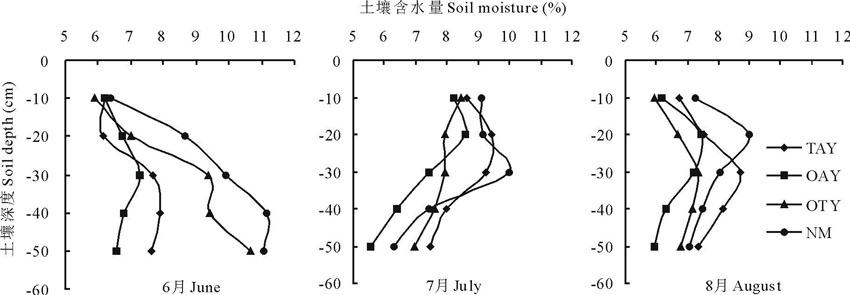
图1 不同刈割频度下土壤含水量季节变化Fig.1 Seasonal change of soil moisture under different mowing frequency treatments

2.1.2 土壤微生物数量季节动态 不同刈割处理下的土壤细菌数量的季节动态变化趋势, 在高频次刈割即一年两次(TAY)和一年一次(OAY)一致, 均为7月最低(P< 0.05); 但在割一年休一年(OTY)和围封处理下(NM)均为6月最高, 7月仍最低(P< 0.05); 可能原因是割一年休一年处理及围封处理, 地表有较多的枯落物, 土壤水分状况优于其他处理, 因此在生长季初期, 高频次刈割处理下细菌数量较少。围封对照处理下的细菌数量在6和8月显著高于其他刈割处理(P< 0.05)。一年一次的刈割处理, 细菌数量在季节上的变化趋势较为平缓(表2)。

土壤放线菌数量的季节动态, 在不同刈割处理下均为6月> 8月> 7月(P< 0.05)。在6月份, 围封处理下的土壤中的放线菌数量最低, 显著低于刈割处理(P< 0.05), 这与围封处理的地表枯落物较多有关, 导致了在植物开始生长的季节, 土壤中放线菌的活性与数量恢复较为缓慢(表2)。

表2 不同月份、不同频度刈割处理下土壤微生物类型及数量 Table 2 The type and number of the soil microbial under different cutting systems in different months× 106/g
2.2 土壤呼吸速率

不同的刈割频度下的土壤呼吸均在7月份为最高值, 这与植物的生长期有关, 7月份为植物生长速率最快速的时期。不同的刈割频度下的土壤呼吸, 围封处理下的土壤呼吸速率要显著高于其他刈割处理, 一年两次的高频刈割处理下的土壤呼吸速率为最小(表3)。

表3 不同刈割处理下土壤呼吸速率季节变化 Table 3 Seasonal variation of soil respiration rate under different cutting treatmentsμ mol/(m2· s)
2.3 土壤呼吸与影响因子相关性分析

对土壤呼吸速率与土壤环境因子作相关性分析, 结果得出, 土壤呼吸速率与土壤含水量呈现极显著正相关关系, 与细菌数量呈现显著相关(表4)。

表4 土壤呼吸速率与影响因子相关性分析 Table 4 Correlation analysis between diversity indices and soil factors
3 讨论

土壤呼吸由土壤微生物呼吸、植物根系呼吸、土壤动物呼吸3个生物学过程以及含碳矿物质的化学氧化作用组成。前人研究综合了国内外学者对植物根系呼吸与土壤呼吸关系的研究, 结论表明土壤总呼吸的30%~40%部分为根系呼吸[22, 23, 24, 25, 26]。温度和水分等环境因子是影响草地生态系统土壤呼吸的主要因素[22, 27], 此外土壤理化性质、土壤碳氮比等环境因子和放牧施肥灌溉等人类利用方式都会影响土壤呼吸[24, 27, 28]。本研究结果显示, 不同频度刈割处理下土壤呼吸速率间有显著差异, 围封处理下的土壤呼吸速率要高于其他刈割处理, 一年两次的高频刈割处理下的土壤呼吸速率为最小, 这是由于高频次刈割不利于植物根系的生长, 可导致根系数量降低[29, 30], 影响结果直接表现为根系呼吸下降。

仲延凯等[31]研究了刈割对典型草原的影响, 刈割带走土壤表面枯落物, 植物个体小型化并密度降低, 土壤中的营养物质得不到有效的补充, 是根系和微生物呼吸减弱的主要原因; 其次根系和土壤微生物都受到土壤水分的影响, 而刈割会导致土壤含水量降低进而影响土壤呼吸。围封样地植被和土壤受到的人为活动干扰最为微弱, 群落特征和土壤性质显著优于刈割处理, 因此围封处理下土壤呼吸速率最高。

枯落物的降解会因为长时间围封导致枯落物累积而减缓, 土壤中的养分得不到有效补充, 土壤呼吸速率减弱; 但持续高频度的刈割, 会导致地表枯落物的减少, 优势种小型化— — 根系活动减弱, 土壤呼吸速率要低于低频度刈割。

4 结论

本研究在内蒙古大针茅草原设置一年两次、一年一次、割一年休一年3个刈割频度及围封处理, 测定不同刈割频度对土壤呼吸及其影响因子的影响, 主要结论如下:

1)6月, 围封下土壤含水量在不同土壤深度均要高于其他处理, 且割一年休一年处理也要高于其他两个处理; 在7、8月, 各个处理下并无一致规律, 但总体趋势上, 围封处理下土壤含水量要高于其他刈割处理。

2)6与8月时, 围封处理下的细菌和微生物总数均显著高于刈割处理, 7月时, 一年一次刈割处理下的细菌和微生物总数显著高于其他处理。

3)割一年休一年与围封处理的土壤呼吸速率显著高于另外的刈割处理, 且不同处理的土壤呼吸速率均在7月初为最低。

4)土壤呼吸速率在内蒙古干旱半干旱地区与土壤含水量呈极显著正相关关系。

The authors have declared that no competing interests exist.

参考文献
[1] Liebig M A, Doran J W, Gardner J C. Evaluation of a field test kit for measuring selected soil quality indicators. Agronomy Journal, 1996, 88(4): 683-686. [本文引用:1]
[2] Luizao F J, Proctor J, Thompson J, et al. Rain forest on Maraca Island , Roraima, Brazil: soil and litter process response to artificial gaps. Forest Ecology & Management, 1998, 102(2/3): 291-303. [本文引用:1]
[3] Cui X Y, Wang Y F, Du Z C. Primary study on soil respiration of main plant communities in typical grassland s in Inner Mongolia. Acta Agrestia Sinica, 1999, 7(3): 245-250.
崔晓勇, 王艳芬, 杜占池. 内蒙古典型草原主要植物群落土壤呼吸的初步研究. 草地学报, 1999, 7(3): 245-250. [本文引用:1]
[4] Chen Q S, Li L H, Han X G, et al. Influence of temperature and soil moisture on soil respiration of a degraded steppe community on the Xilin river of Inner Mongolia. Acta Phytoecologica Sinica, 2003, 2: 202-209.
陈全胜, 李凌浩, 韩兴国, . 水热条件对锡林河流域典型草原退化群落土壤呼吸的影响. 植物生态学报, 2003, 2: 202-209. [本文引用:1]
[5] Wang W, Song R, Guo J X. The study on soil respiration and CO2 release rate of litter decomposition in Puccinellia tenuiflora community of Songnen grassland in northeast China. Acta Prataculturae Science, 2002, 11(2): 45-50.
王娓, 宋日, 郭继勋. 东北松嫩草原碱茅群落的土壤呼吸同枯枝落叶分解释放CO2贡献量研究. 草业学报, 2002, 11(2): 45-50. [本文引用:1]
[6] Cui X Y, Chen S Q, Chen Z Z. CO2 release from typical Stipa grand is grassland soil. Chinese Journal of Applied Ecology, 2000, 3: 390-394.
崔骁勇, 陈四清, 陈佐忠. 大针茅典型草原土壤CO2 排放规律的研究. 应用生态学报, 2000, 3: 390-394. [本文引用:1]
[7] Jia B R, Zhou G S, Wang F Y, et al. A comparative study on soil respiration between grazing and fenced typical Leymus chinensis steppe, Inner Mongolia. Chinese Journal of Applied Ecology, 2004, 9: 1611-1615.
贾丙瑞, 周广胜, 王风玉, . 放牧与围栏羊草草原生态系统土壤呼吸作用比较. 应用生态学报, 2004, 9: 1611-1615. [本文引用:1]
[8] Shi G X, Geng H L, Wang Y L, et al. Daily and seasonal dynamics of soil respiration and their environmental controlling factors in Stipa krylovii steppe. Acta Ecologica Sinica, 2008, 28(7): 3408-3416.
师广旭, 耿浩林, 王云龙, . 克氏针茅( Stipa krylovii)草原土壤呼吸及其影响因子. 生态学报, 2008, 28(7): 3408-3416. [本文引用:1]
[9] Qi Y C, Dong Y S, Liu L X, et al. Spatial-temporal variation in soil respiration and its controlling factors in three steppes of Stipa L. in Inner Mongolia, China. Science China: Earth Science, 2010, 3: 341-351.
齐玉春, 董云社, 刘立新, . 内蒙古锡林河流域主要针茅属草地土壤呼吸变化及其主导因子. 中国科学: 地球科学, 2010, 3: 341-351. [本文引用:1]
[10] Groffman P M, Eagan P, Sullivan W M, et al. Grass species and soil type effects on microbial biomass and activity. Plant and Soil, 1996, 183(1): 61-67. [本文引用:1]
[11] Mukesh J, Joshi M. Patterns of soil respiration in a temperate grass land of Kumaun Himalaya, India. Journal of Tropical Forest Science, 1995, 8(2): 185-195. [本文引用:1]
[12] Bao Y J, Li Z H, Bao Q H, et al. Influence of mowing for many years on community biomass and the important value of Leymus chinensis and Koeloria cristata population on L. chinensis Steppe. Journal of Inner Mongolia University: Natural Science Edition, 2001, 3: 309-313.
鲍雅静, 李政海, 包青海, . 多年割草对羊草草原群落生物量及羊草和洽草种群重要值的影响. 内蒙古大学学报: 自然科学版, 2001, 3: 309-313. [本文引用:1]
[13] Binnie R C, Chestnutt D M B. Effect of regrowth interval on the productivity of swards defoliated by cutting and grazing. Grass and Forage Science, 1991, 46(4): 343-350. [本文引用:1]
[14] Bao Q H, Zhong Y K. The comparison researches between mowing in succession years and rotation in the typical steppe region. Journal of Inner Mongolia University: Natural Science Edition, 1996, 27(5): 695-700.
包青海, 仲延凯. 典型草原地区轮休与连年刈割的比较研究. 内蒙古大学学报: 自然科学版, 1996, 27(5): 695-700. [本文引用:1]
[15] Li H, Xue F G. Effect of different clipping number on Leymus chinensis grassland in the Songnen plain of China. Journal of Northeast Normal University: Natural Science, 2000, 32(3): 53-57.
李红, 薛丰刚. 不同割草频次对松嫩平原羊草草地生产量的影响. 东北师范大学学报: 自然科学版, 2000, 32(3): 53-57. [本文引用:1]
[16] Li J D, Liu J X. A feasibility study on mowing two times a year in Leymus chinensis grassland . Grassland of China, 2000, 22(5): 32-34.
李建东, 刘建新. 羊草草地一年两次刈割可行性的研究. 中国草地, 2000, 22(5): 32-34. [本文引用:1]
[17] Williams P H, Morton J D. Effects of mowing interval, return of clippings, and potassium fertilizer on production and botanical composition of pasture in a mowing trial. New Zealand Journal of Experimental Agriculture, 1987, 15: 147-150. [本文引用:1]
[18] Ren Q J, Luo Y J, Wang H Y, et al. Restoration of degraded typical alpine meadowland on the Qinghai-Tibetan plateau. Acta Prataculturae Sinica, 2004, 13(2): 43-49.
仁青吉, 罗燕江, 王海洋, . 青藏高原典型高寒草甸退化草地的恢复-施肥刈割对草地质量的影响. 草业学报, 2004, 13(2): 43-49. [本文引用:1]
[19] Guo J X, Zhu T C. Study on the litter accumulation in a Leymus chinensis grassland : the litter accumulation under natural conditions and the effect of grazing and cutting on litter accumulation. Acta Ecologica Sinica, 1994, 14(3): 255-259.
郭继勋, 祝廷成. 羊草草原枯枝落叶积累的研究. 生态学报, 1994, 14(3): 255-259. [本文引用:1]
[20] Huang C Y. Soil Science[M]. Beijing: Chinese Agriculture Press, 2000: 100-101.
黄昌勇. 土壤学[M]. 北京: 中国农业出版社, 2000: 100-101. [本文引用:1]
[21] Zhou D Q. Microbiology Experimental Course[M]. Beijing: Higher Education Press, 2010: 10-117.
周德庆. 微生物学实验教程[M]. 北京: 高等教育出版社, 2010: 10-117. [本文引用:1]
[22] Cui X Y, Chen Z Z, Chen S Q. Progress in research on soil respiration of grassland s. Acta Ecologica Sinica, 2001, 21(2): 315-325.
崔骁勇, 陈佐忠, 陈四清. 草地土壤呼吸研究进展. 生态学报, 2001, 21(2): 315-325. [本文引用:2]
[23] Yi Z G, Yi W M, Zhou L X. Advances in the research on the methods for separating the components of soil respiration. Chinese Journal of Ecology, 2003, 22(2): 65-69.
易志刚, 蚁伟民, 周丽霞. 土壤各组分呼吸区分方法研究进展. 生态学杂志, 2003, 22(2): 65-69. [本文引用:1]
[24] Li L H, Chen Z Z. Soil respiration in grassland communities in the world. Chinese Journal of Ecology, 1998, 17(4): 45-51.
李凌浩, 陈佐忠. 草地群落的土壤呼吸. 生态学杂志, 1998, 17(4): 45-51. [本文引用:2]
[25] Li Y N, Wang G Y, Li W. Soil respiration and carbon cycle. Geoscience Frontiers, 2002, 9(2): 351-357.
李玉宁, 王关玉, 李伟. 土壤呼吸作用和全球碳循环. 地学前缘, 2002, 9(2): 351-357. [本文引用:1]
[26] Peng S L, Li Y L. Process in research on soil respiration under the global change. Advances in Earth Science, 2002, 17(5): 705-713.
彭少麟, 李跃林. 全球变化条件下的土壤呼吸效应. 地球科学进展, 2002, 17(5): 705-713. [本文引用:1]
[27] Yu W T, Ma Q, Shen S M, et al. Seasonal fluctuation of soil respiration with different ecosystems in the lower reaches of the Liaohe River Plain. Agricultural Research in the Arid Areas, 2010, (1): 122-129.
宇万太, 马强, 沈善敏, . 下辽河平原不同生态系统土壤呼吸动态变化. 干旱地区农业研究, 2010, (1): 122-129. [本文引用:2]
[28] Zhou J, Tong Y A, Huang D L, et al. Effects of water and organic materials on soil respiration. Soils and Fertilizers, 1996, (3): 7-9.
周军, 同延安, 黄东亮, . 水分与有机物料对土壤呼吸的影响. 土壤肥料, 1996, (3): 7-9. [本文引用:1]
[29] He F L, Pei M X, Wang J H, et al. Effect of Different Cutting Frequencies on Biomass Accumulation and Root Vertical Distribution of Atriplex canescens (Pursh) Nutt. Acta Agrestia Sinica, 2009, 17(1): 79-83.
何芳兰, 裴明祥, 王继和, . 刈割频度对四翅滨藜生物量累积及根系垂直分布的影响. 草地学报, 2009, 17(1): 79-83. [本文引用:1]
[30] Liu X B. Effects of stimulated nitrogen deposition and cutting on soil microbial biomass in a typical steppe in Inner Mongolia. Chinese Agricultural Science Bulletin, 2010, 26(13): 345-348.
刘宪斌. 模拟氮沉降和刈割对内蒙古典型草原土壤微生物量的影响. 中国农学通报, 2010, 26(13): 345-348. [本文引用:1]
[31] Zhong Y K, Bao Q H. The effects of different mowing intensity on natural grassland . Grassland of China, 1999, (5): 15-18.
仲延凯, 包青海. 不同刈割强度对天然割草地的影响. 中国草地, 1999, (5): 15-18. [本文引用:1]