

鬼针草与含羞草化感作用及其入侵性的研究
[王桔红1  , 史生晶
, 史生晶2 , 陈文3, * , 李云1 , 崔现亮4 ]
, 史生晶, 李云|
|


作者简介:王桔红(1963-),女,河北无极人,教授。E-mail: wjuh1918@163.com
采用培养皿滤纸法研究入侵植物鬼针草与含羞草根、茎、叶浸提液对种子萌发和幼苗生长的影响,从化感角度揭示外来植物的入侵机制。结果表明:1)鬼针草根、茎、叶浸提液随浓度升高显著抑制鬼针草和含羞草种子萌发,高浓度(0.04 g·mL-1)的叶浸提液使萌发率降低了67%~87%;高浓度(0.04 g·mL-1)的含羞草叶浸提液使其种子萌发率降低了21.7%,但对鬼针草种子萌发影响较小。2)鬼针草和含羞草根长随2种植物根、茎、叶浸提液浓度的升高而降低,尤其是高浓度的叶浸提液有较强抑制效应。3)各浓度的鬼针草根、茎、叶浸提液均能降低含羞草茎长,高浓度的叶浸提液抑制效应最强;高浓度(0.04 g·mL-1)的含羞草茎和叶浸提液抑制鬼针草茎长,中等浓度(0.02~0.03 g·mL-1)的根和叶浸提液促进鬼针草茎长;含羞草各器官浸提液对其茎长的抑制作用随浓度增大略有增强。4)鬼针草各器官浸提液(尤其叶浸提液)抑制自身根冠比,促进含羞草根冠比;含羞草各器官浸提液轻微降低自身根冠比,显著降低鬼针草根冠比。5)鬼针草对自身种子萌发率、根长及根冠比的化感强度大于鬼针草他感强度;鬼针草对含羞草茎长的化感强度大于其自感强度,也大于含羞草他感强度;含羞草对鬼针草根长及根冠比的化感强度大于其自感强度,也大于鬼针草他感强度。鬼针草主要通过抑制含羞草茎长,增强入侵性,而含羞草主要通过抑制鬼针草根的生长,增大竞争力。
This research aimed to determine the allelopathic effect of the invasion mechanism of the exotic plants Bidens pilosa and Mimosa pudica. The effects of extracts from the roots, stems and leaves of both B. pilosa and M. pudica on seed germination and seedling growth (root length, stem length and root∶shoot ratio) were studied using a petri dish filter paper method. It was found that: 1) B. pilosa extracts had a large concentration dependent effect on the seed germination of both B. pilosa and M. pudica, with leaf extracts being the most potent (67%-87% germination inhibition at the highest tested concentration). M. pudica leaf extracts at high concentration reduced germination of their own seeds by 21.7% but had no significant effect on germination of B. pilosa seeds. 2) Root, stem and leaf extracts (but especially leaf extracts) of both species all induced a concentration dependent reduction in root length of their own seedlings and of the other species. 3) Root, stem and leaf extracts of B. pilosa strongly reduced stem length of M. pudica at all tested concentrations. Only stem and leaf extracts of M. pudica at high concentrations showed any allelopathic effect on stem length of B. pilosa. Root and leaf extracts of M. pudica at medium concentrations enhanced stem growth of B. pilosa. M. pudica extracts had a moderate, concentration dependent autotoxicity effect on their own seedling stem length. For B. pilosa, only leaf extracts at high concentration reduced stem length of their own seedlings. 4) B. pilosa extracts (especially leaf extract) induced a strong concentration dependent reduction of root∶shoot ratio of their own seedlings while all three extracts enhanced root∶shoot ratio of M. pudica seedlings. M. pudica extracts caused only a mild reduction in root∶shoot ratio of their own seedings, but a substantial reduction in root∶shoot ratio of B. pilosa seedlings. 5) An index of allelopathic or autotoxicity intensity was calculated from the data. Autotoxicity intensity of B. pilosa on its own seed germination rate, root length and root-shoot ratio was greater than that of M. pudica, while the allelopathy intensity of B. pilosa on the stem length of M. pudica was greater than that of M. pudica on B. pilosa, and was also greater than its autotoxicity intensity. The intensity of allelopathic effects of M. pudica on the root length and root∶shoot ratio of B. pilosa was greater than the self-inhibition of B. pilosa, and was greater than its self-toxicity intensity. B. pilosa mainly inhibited the stem length of M. pudica to enhance its invasiveness, while M. pudica mainly inhibited the growth of B. pilosa roots to increase its competitiveness.
外来入侵植物严重威胁着入侵地物种多样性以及全球生态环境和经济发展, 而化感作用作为解释外来物种成功入侵的重要原因, 成为生态安全和生物多样性研究的领域之一[1, 2]。化感作用(allelopathy)是植物普遍存在的一种化学相互作用, 也是植物适应环境的一种化学防御生态机制, 包括种内或种间、直接或间接、促进或抑制作用[3, 4]。植物通过化感作用增强种间竞争力, 影响和改变种间互作及群落物种的分布格局[5]。
近年来, 一些学者从多个角度对化感作用进行了深入研究, 发现入侵植物不仅能够抑制或促进周围植物种子萌发和幼苗生长[6, 7, 8, 9], 而且能改变土壤微生物群落的结构及土壤酶活性[10]; 也有一些学者研究发现入侵植物通过抑制其他植物的光合速率、损伤植物细胞膜等实现成功入侵[11, 12]。据统计, 中国外来入侵植物共515种, 有260多种分布在东南部亚热带地区[13, 14], 其中菊科、豆科和禾本科构成了我国入侵植物的三大科[15]。鬼针草(Bidens pilosa)和含羞草(Mimosa pudica)是广泛分布在粤东地区的中等危害程度的两种入侵植物[16], 常生长在杂草地、农田和路边等同一生境中, 对当地农业、林业及生态环境等造成了严重危害。鬼针草属于菊科(Asteraceae)鬼针草属(Bidens)一年生草本植物, 原产于热带美洲, 现广泛分布于我国热带、亚热带地区[17]。其生命周期短、结实率高、萌发率高、繁殖速度快、生态适应性强等, 对当地生态系统的稳定性造成严重影响[18, 19], 属于1级入侵植物[20]。含羞草属于豆科(Fabaceae)含羞草属(Mimosa)多年生草本植物或亚灌木, 原产于热带美洲, 现广泛分布在我国热带和亚热带地区[21], 其生长快、耐寒性差、喜光、种子硬实率高、萌发率低, 常生长在路旁、空地、田边等开阔的生境, 形成群落优势种[22], 为2级入侵植物[20]。
关于鬼针草的研究主要集中在重金属富集、光合特性及化感作用等方面[23, 24]; 对于含羞草的研究主要集中在化学成分、植物修复、药用价值等方面[25, 26, 27]。目前, 关于入侵植物鬼针草和含羞草他感和自感的研究报道甚少。那么, 鬼针草和含羞草化感作用及竞争机制如何?本试验以鬼针草和含羞草为研究对象, 对其化感作用及强度进行探查, 旨在揭示外来植物的入侵机制, 为监测和有效防控入侵植物提供理论依据。
研究地位于广东省潮州市市郊(116° 42' E, 23° 39' N), 该地属于亚热带海洋性季风气候, 气候温和, 日照充足, 雨量充沛, 年均降水量1300~2400 mm, 日照1900~2400 h, ≥ 10 ℃的连续积温达7300~7890 ℃, 年均气温21~22 ℃, 极端最高气温39.6 ℃, 极端最低气温-0.5 ℃。
2种入侵植物鬼针草和含羞草相互作为供体和受体植物, 于2017年6月在广东省潮州市市郊分别挖取其成熟的植株各30株至实验室备用; 采集两种植物成熟的种子, 自然风干、备用。
1.3.1 鬼针草和含羞草浸提液的制备 将采集的鬼针草和含羞草全株用流水冲洗干净, 蒸馏水冲洗3次, 放在滤纸上吸干水分, 分离根、茎、叶后, 用剪刀剪成约2 cm的小段, 各称取根、茎、叶20 g, 加入500 mL蒸馏水, 充分混匀后放入恒温摇床中, 设定转速为110 r· min-1, 时间为48 h, 之后用双层纱布过滤, 得到浸提液母液; 再将其配制为0.01、0.02、0.03和0.04 g· mL-1 4个浓度的浸提液, 装入锥形瓶中, 置于4 ℃冰箱中保存备用。
1.3.2 种子萌发及幼苗生长试验 2种入侵植物的种子用蒸馏水冲洗3次后, 置于铺有两层定性滤纸的培养皿中(直径9 cm), 每个培养皿30粒, 4次重复。含羞草硬实率高达60.6%, 种皮是抑制种子萌发的主要因素[28], 因此含羞草种子放置前用砂纸打磨种皮以破除休眠。向培养皿中分别加入0、0.01、0.02、0.03和0.04 g· mL-1鬼针草/含羞草根、茎、叶浸提液10 mL, 置于变温(15~25 ℃)培养箱中培养至第7天(种子不再萌发)。每24 h观察记录种子萌发数(以胚根突破种皮1~2 mm为种子萌发基准), 期间补加适量浸提液, 保持滤纸湿润。同样条件下继续培养已萌发的种子, 每天定时观察幼苗生长状况, 培养至第12天, 测量所有幼苗的根长和茎长。
萌发率=(第7天正常发芽种子数/供试种子数)× 100%; 根冠比=根长/茎长; 参照Williamson等[29]的方法计算化感作用强度的化感效应指数(allelopathic response index, RI), RI=1-C/T(T≥ C), 式中:C为对照值, T为处理值, RI绝对值代表化感强度的大小, RI> 0表示促进作用, RI< 0表示抑制作用; 采用Microsoft Excel 2010软件进行数据整理, 采用SPSS 17.0软件进行单因素方差分析(One-way ANOVA), 采用Origin 8.5软件作图。
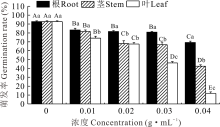
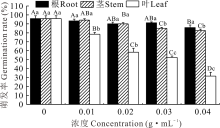
2.1.1 鬼针草浸提液对自身和含羞草种子萌发的影响 除鬼针草根浸提液对含羞草种子萌发影响不显著(P> 0.05)外, 鬼针草不同浓度的各器官浸提液对自身和含羞草种子萌发具有显著影响(P< 0.05), 萌发率随浸提液浓度的升高而降低。当根、茎、叶浸提液浓度升高至0.04 g· mL-1时, 鬼针草种子萌发率分别下降了25.42%、57.18%和87.15%, 含羞草种子萌发率分别下降了10.44%、19.91%和66.95%。同一浓度下, 鬼针草根、茎、叶浸提液对自身和含羞草种子萌发具有显著影响(P< 0.05), 抑制强度表现为叶> 茎> 根(图1和图2)。
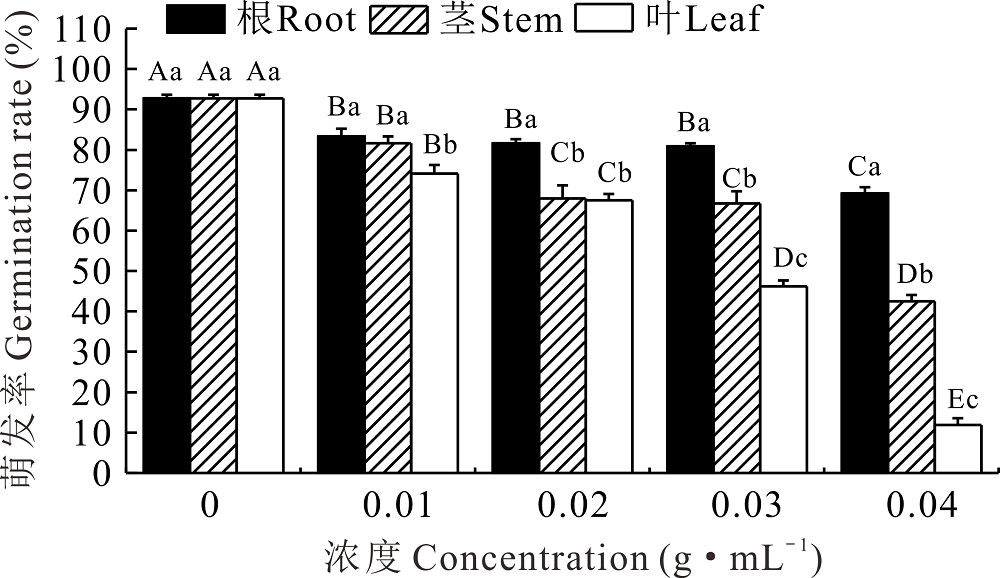 | 图1 鬼针草不同器官浸提液对自身种子萌发的影响Fig.1 Effect of different organs extract of B. pilosa on its own seed germination |
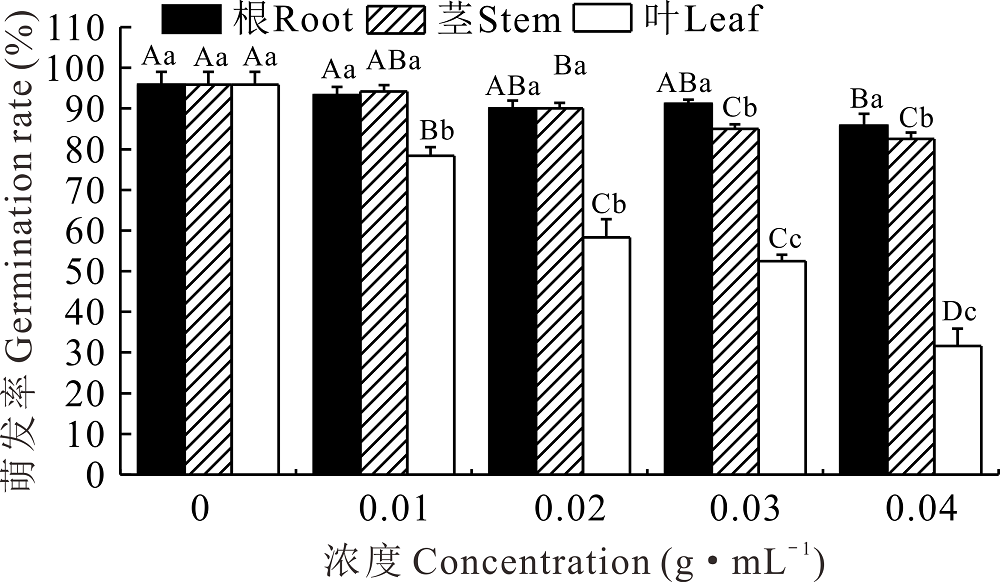 | 图2 鬼针草不同器官浸提液对含羞草种子萌发的影响 不同大写字母表示同一器官浸提液不同浓度间的显著性, 不同小写字母表示同一浓度不同器官浸提液间的显著性(P< 0.05)。下同。Fig.2 Effect of different organs extract of B. pilosa on seed germination of M. pudica The Different capital letters indicate the significance between different concentrations of extract from the same organ, different lowercase letters indicate the significance between different organs extract of the same concentration. The same below. |
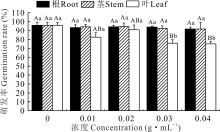
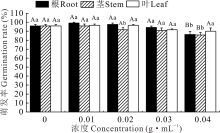
2.1.2 含羞草浸提液对自身和鬼针草种子萌发的影响 不同浓度的含羞草各器官浸提液对自身和鬼针草种子萌发影响不显著(P> 0.05), 当浓度达到0.04 g· mL-1时, 含羞草种子萌发率分别下降了4.35%、4.36%和21.74%; 鬼针草种子萌发率分别下降了9.91%、10.44%和6.08%。相同浓度下, 低浓度(0.01和0.02 g· mL-1)含羞草各器官浸提液对自身种子萌发影响不显著(P> 0.05), 高浓度(0.03 和0.04 g· mL-1)含羞草叶浸提液对自身种子萌发具有显著影响(P< 0.05), 叶浸提液对自身种子的萌发抑制作用最强(图3和图4)。
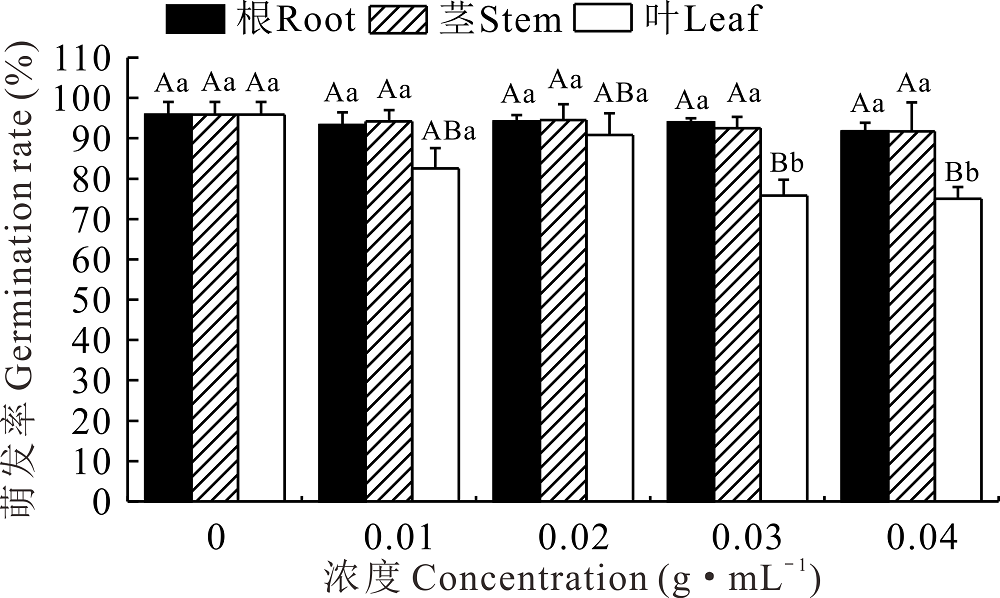 | 图3 含羞草不同器官浸提液对自身种子萌发的影响Fig.3 Effect of different organs extract of M. pudica on its own seed germination |
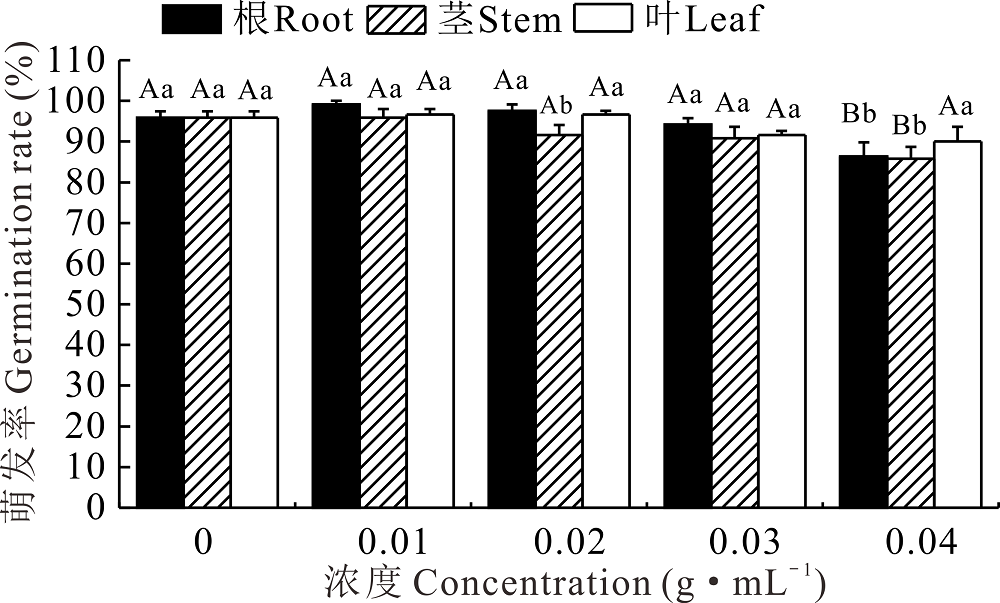 | 图4 含羞草不同器官浸提液对鬼针草种子萌发的影响Fig.4 Effect of different organs extract of M. pudica on seed germination of B. pilosa |
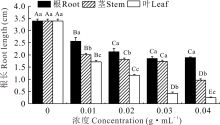
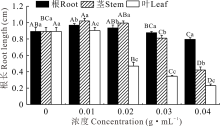
2.2.1 鬼针草浸提液对自身和含羞草幼苗根长的影响 不同浓度的鬼针草各器官浸提液对自身和含羞草根长具有显著影响(P< 0.05), 鬼针草根长随其茎和叶浸提液浓度的增大而减小, 而低浓度(0.01和0.02 g· mL-1)的鬼针草根和茎浸提液促进含羞草根长, 高浓度(0.03和0.04 g· mL-1)抑制含羞草根长。当鬼针草各器官浸提液浓度升高至0.04 g· mL-1时, 鬼针草根长分别减少了44.25%、71.68%和92.63%; 含羞草根长分别减少了11.24%、52.81%和74.16%。同一浓度下, 鬼针草各器官浸提液对自身和含羞草幼苗根长具有显著影响(P< 0.05), 低浓度(0.01和0.02 g· mL-1)的鬼针草各器官浸提液对含羞草根长的抑制强度为叶> 根> 茎; 鬼针草各器官浸提液对自身根长的抑制强度及高浓度(0.03和0.04 g· mL-1)鬼针草各器官浸提液对含羞草根长的抑制强度均为叶> 茎> 根(图5和图6)。
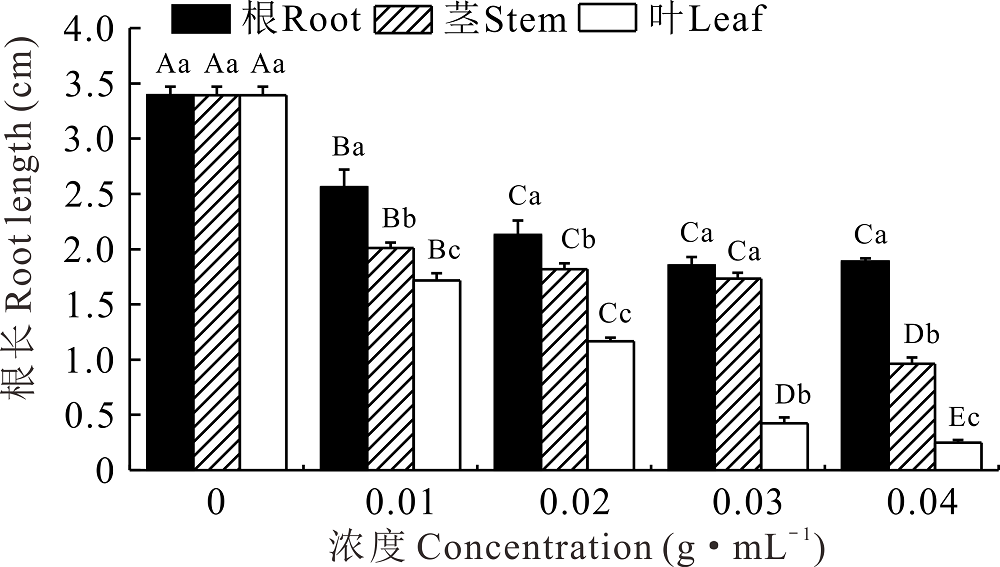 | 图5 鬼针草不同器官浸提液对自身根长的影响Fig.5 Effect of different organs extract of B. pilosa on its own root length |
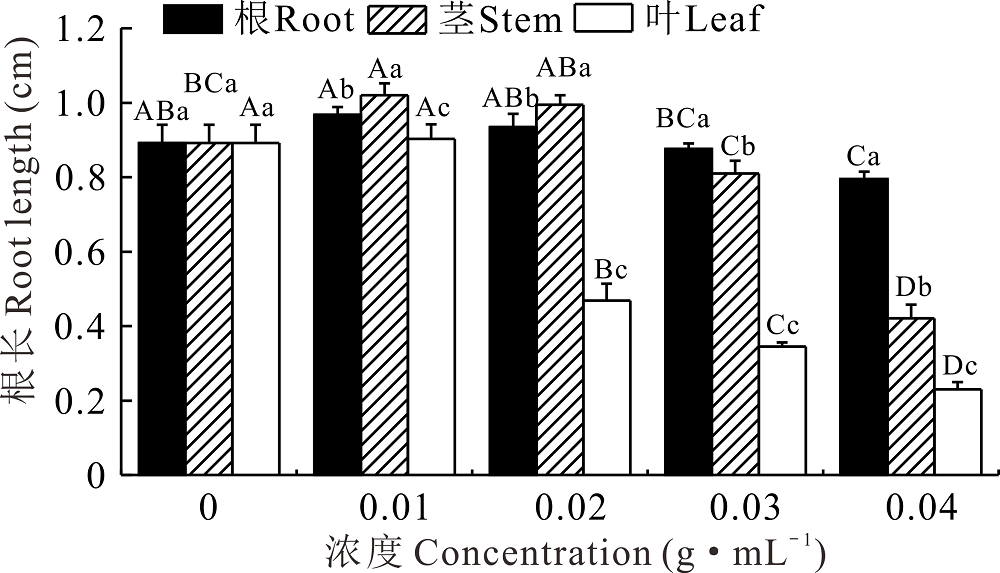 | 图6 鬼针草不同器官浸提液对含羞草根长的影响Fig.6 Effect of different organs extract of B. pilosa on root length of M. pudica |
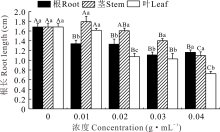
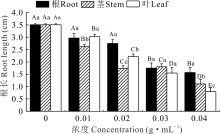
2.2.2 含羞草浸提液对自身和鬼针草幼苗根长的影响 不同浓度的含羞草各器官浸提液对自身和鬼针草幼苗根长具有显著影响(P< 0.05), 当浓度达到0.04 g· mL-1时, 含羞草根长分别下降了30.95%、35.12%和57.14%; 鬼针草根长分别下降了55.27%、68.38%和77.21%。相同浓度下, 含羞草各器官浸提液对自身和鬼针草幼苗根长具有不同的影响, 0.01~0.03 g· mL-1浓度的含羞草茎浸提液对自身根长抑制作用最弱, 0.04 g· mL-1含羞草各器官浸提液对自身根长的抑制强度表现为叶> 茎> 根; 低浓度(0.01和0.02 g· mL-1)的含羞草茎浸提液对鬼针草根长抑制作用最强, 高浓度(0.03和0.04 g· mL-1)的含羞草叶浸提液对鬼针草根长抑制作用最强(图7和图8)。
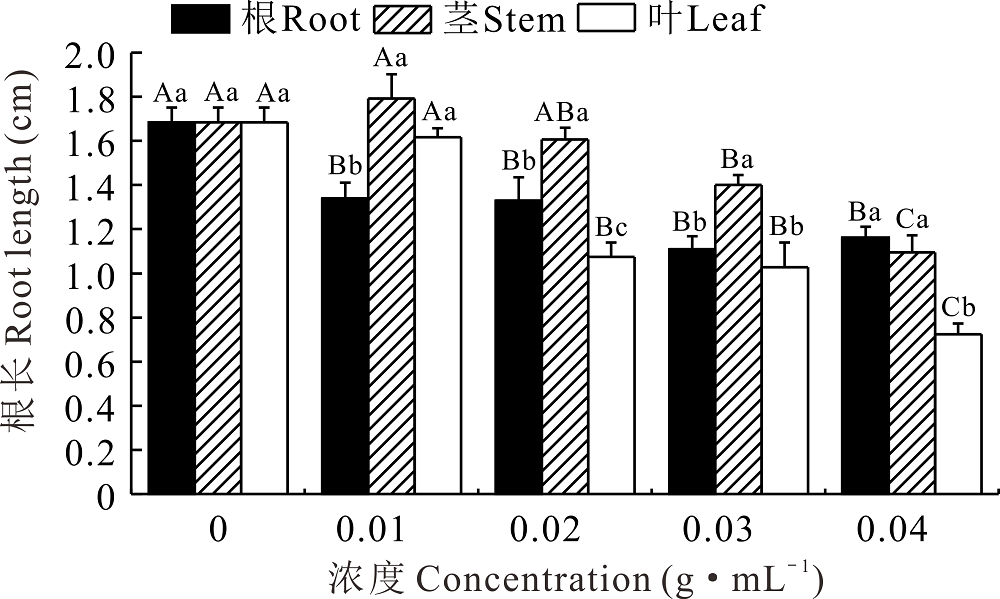 | 图7 含羞草不同器官浸提液对自身根长的影响Fig.7 Effect of different organs extract of M. pudica on its own root length |
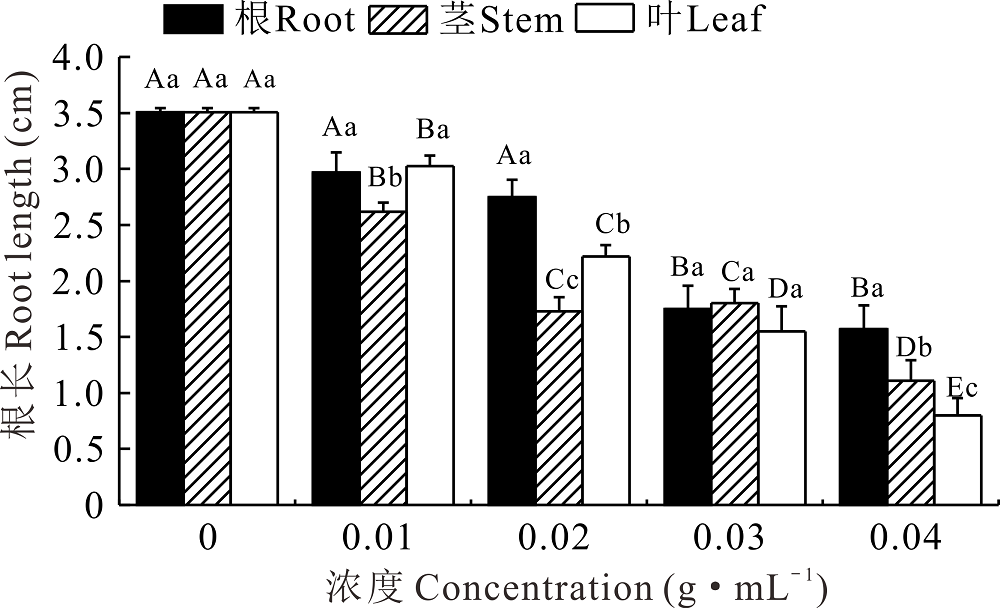 | 图8 含羞草不同器官浸提液对鬼针草根长的影响Fig.8 Effect of different organs extract of M. pudica on root length of B. pilosa |
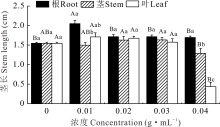
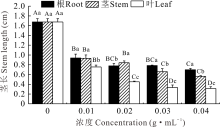
2.3.1 鬼针草浸提液对自身和含羞草幼苗茎长的影响 不同浓度的鬼针草根和叶浸提液对自身和含羞草幼苗茎长具有显著影响(P< 0.05), 茎浸提液对自身幼苗茎长的影响不显著(P> 0.05)。鬼针草各器官浸提液浓度为0.01~0.03 g· mL-1时促进自身茎的生长(除0.01g· mL-1的茎浸提液), 当浓度达到0.04 g· mL-1时, 茎和叶浸提液抑制其茎长, 分别下降了16.77%和71.61%; 含羞草茎长随鬼针草各器官浸提液浓度的升高而降低, 当浓度升高至0.04 g· mL-1时, 其茎长分别降低了58.33%、66.67%和81.55%。0.01 g· mL-1的鬼针草根、茎、叶浸提液对自身茎长的抑制强度为茎> 叶> 根; 浓度为0.02和0.03 g· mL-1时对其茎长影响不显著(P> 0.05), 对含羞草茎长具有显著的影响(P< 0.05); 当浓度为0.04 g· mL-1时, 鬼针草各器官浸提液对自身和含羞草茎长的抑制强度均表现为叶> 茎> 根(图9和图10)。
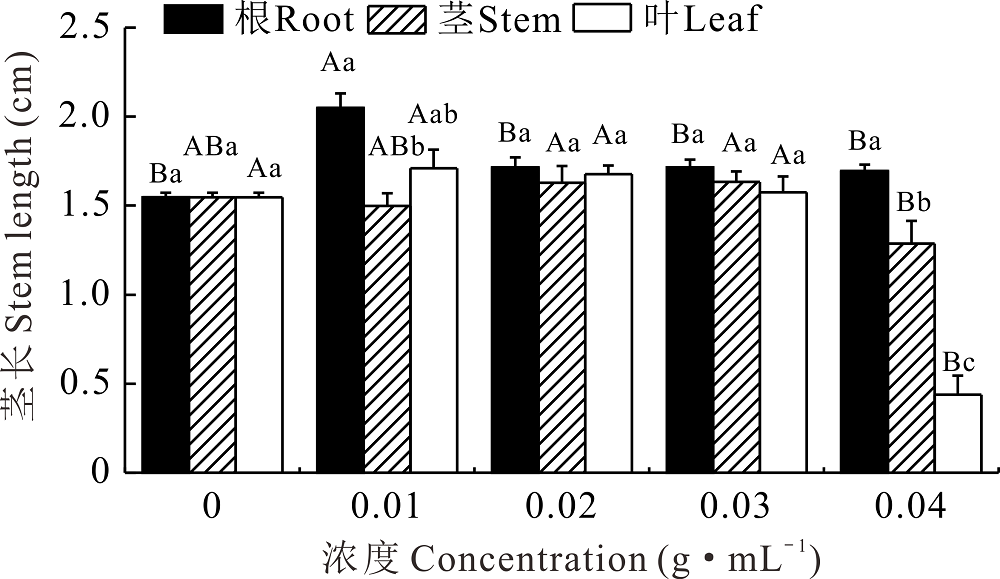 | 图9 鬼针草不同器官浸提液对自身茎长的影响Fig.9 Effect of different organs extract of B. pilosa on its own stem length |
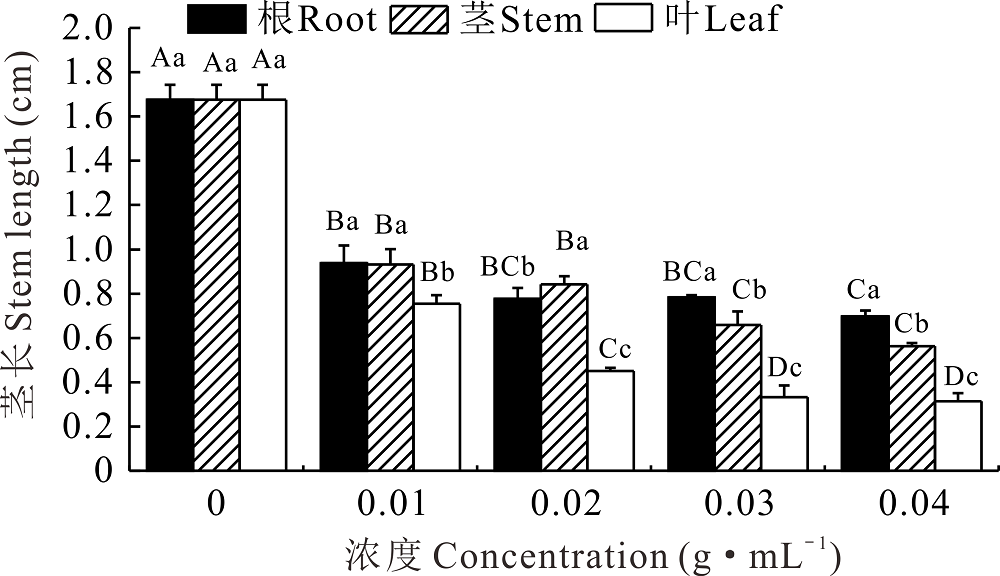 | 图10 鬼针草不同器官浸提液对含羞草茎长的影响Fig.10 Effect of different organs extract of B. pilosa on stem length of M. pudica |
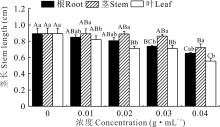
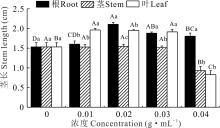
2.3.2 含羞草浸提液对自身和鬼针草幼苗茎长的影响 不同浓度的含羞草根和叶浸提液对自身及鬼针草幼苗茎长具有显著影响(P< 0.05)。含羞草茎长随浸提液浓度的升高而减小, 当浓度达到 0.04 g· mL-1时, 含羞草茎长分别降低了 26.97%、19.10%和38.20%; 0.01~0.03 g· mL-1的含羞草各器官浸提液促进鬼针草茎的生长, 当浓度达到0.04 g· mL-1时, 茎和叶浸提液对鬼针草茎长的抑制作用较强。相同浓度下, 0.02~0.04 g· mL-1浓度的含羞草各器官浸提液对其茎长具有显著影响(P< 0.05), 抑制强度表现为叶> 根> 茎; 含羞草各器官浸提液对鬼针草茎长具有显著影响(P< 0.05), 含羞草茎浸提液浓度为 0.01~0.03 g· mL-1对鬼针草茎长无显著影响, 0.04 g· mL-1含羞草各器官浸提液对鬼针草茎长抑制作用强度为叶> 茎> 根(图11和图12)。
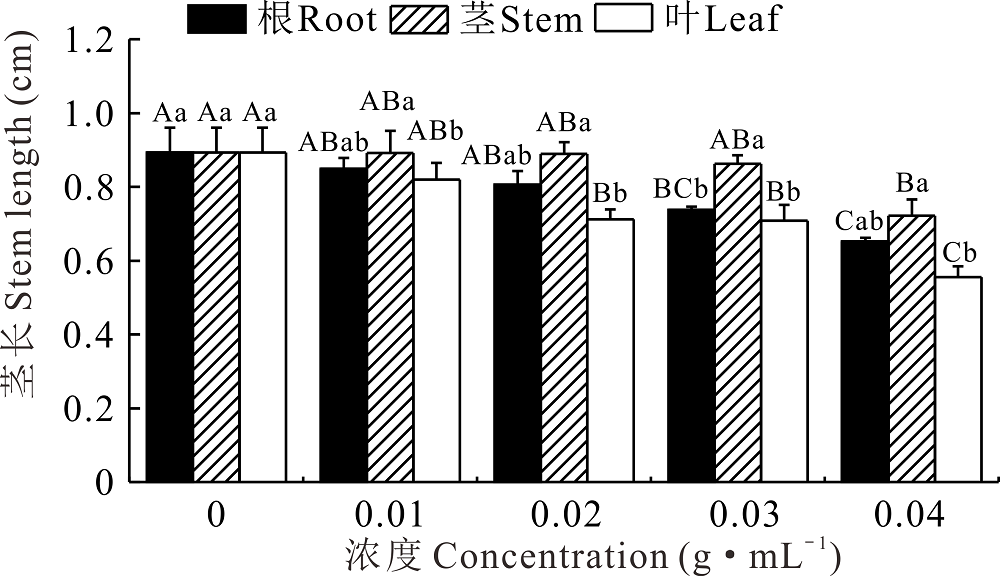 | 图11 含羞草不同器官浸提液对自身茎长的影响Fig.11 Effect of different organs extract of M. pudica on its own stem length |
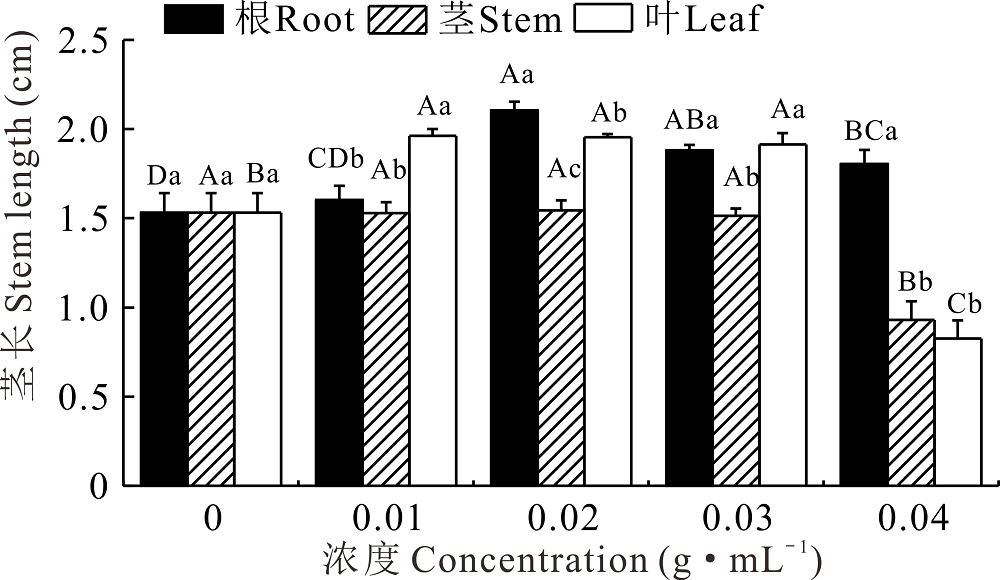 | 图12 含羞草不同器官浸提液对鬼针草茎长的影响Fig.12 Effect of different organs extract of M. pudica on stem length of B. pilosa |
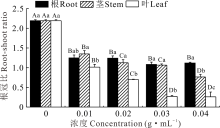
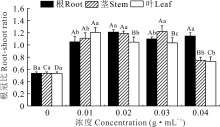
2.4.1 鬼针草浸提液对自身和含羞草根冠比的影响 不同浓度的鬼针草各器官浸提液对自身和含羞草根冠比具有显著影响(P< 0.05), 当浓度达到0.04 g· mL-1时, 鬼针草根冠比分别下降了49.10%、65.00%和88.18%, 而含羞草根冠比均显著高于对照组(图13和图14)。同一浓度下, 鬼针草各器官浸提液对自身和含羞草根冠比具有显著影响(P< 0.05), 0.02~0.04 g· mL-1鬼针草各器官浸提液对其根冠比抑制强度为叶> 茎> 根。
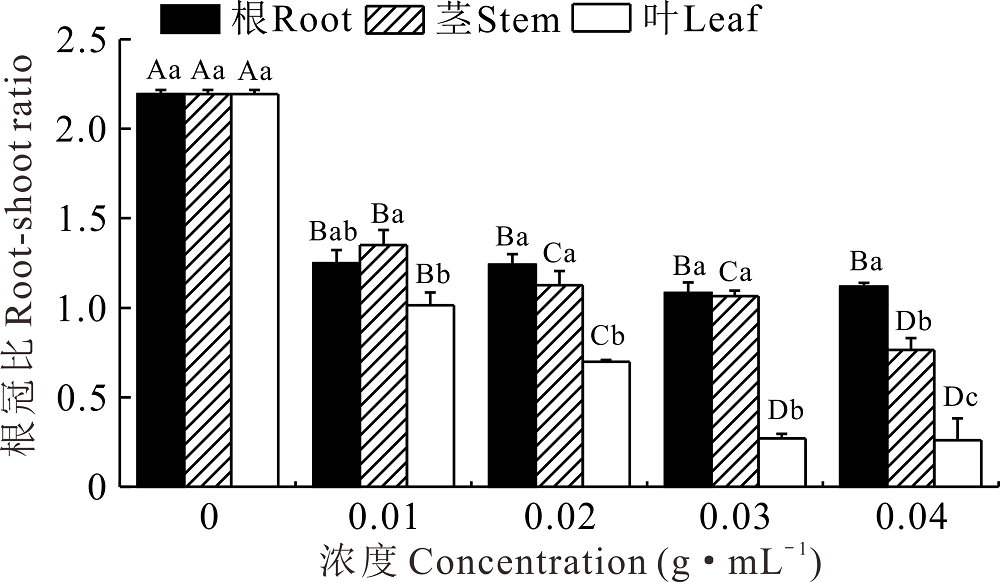 | 图13 鬼针草不同器官浸提液对自身根冠比的影响Fig.13 Effect of different organs extract of B. pilosa on its own root-shoot ratio |
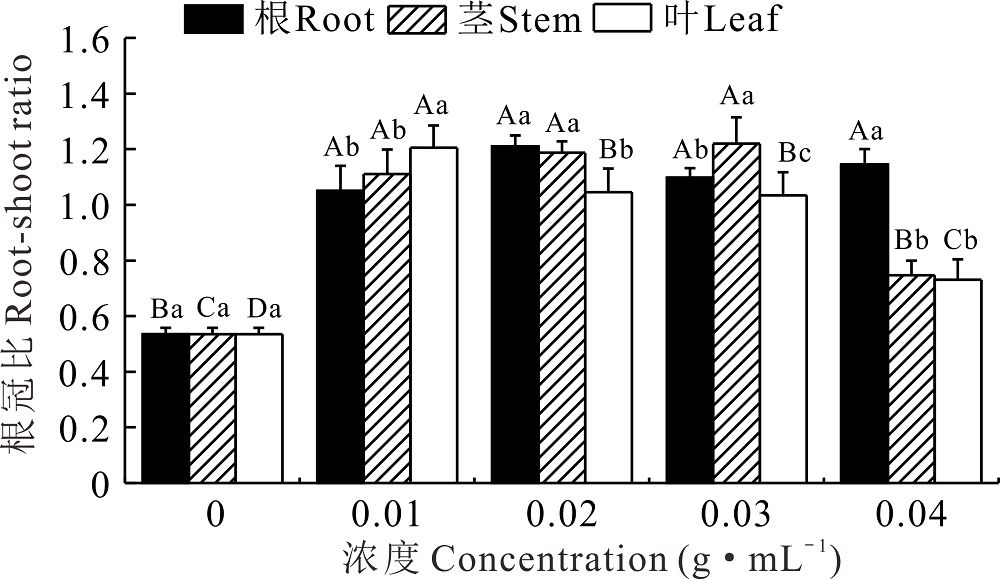 | 图14 鬼针草不同器官浸提液对含羞草根冠比的影响Fig.14 Effect of different organs extract of B. pilosa on root-shoot ratio of M. pudica |
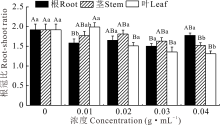
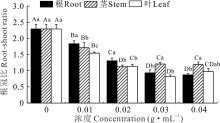
2.4.2 含羞草浸提液对自身和鬼针草根冠比的影响 不同浓度的含羞草各器官浸提液对自身和鬼针草根冠比具有显著影响(P< 0.05), 当浓度升高至 0.04 g· mL-1时, 含羞草根冠比分别降低了7.29%、20.83%和31.77%; 鬼针草根冠比分别降低了62.00%、48.03%和57.64%。相同浓度下, 含羞草各器官浸提液对自身和鬼针草根冠比具有不同的影响, 浓度为0.02~0.04 g· mL-1的叶浸提液对含羞草根冠比抑制作用最强, 0.03~0.04 g· mL-1的茎浸提液对鬼针草根冠比抑制作用最弱(图15和图16)。
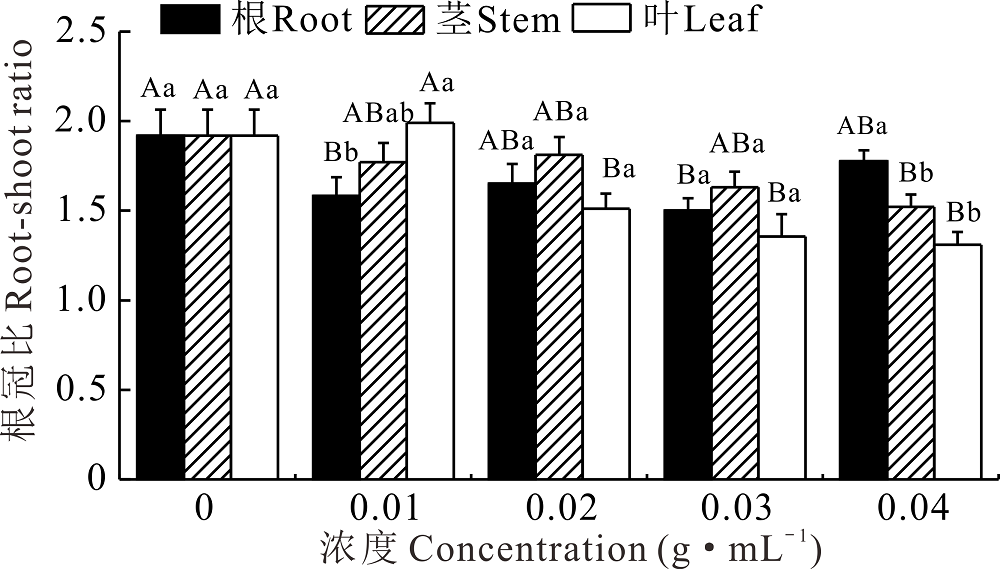 | 图15 含羞草不同器官浸提液对自身根冠比的影响Fig.15 Effect of different organs extract of M. pudica on its own root-shoot ratio |
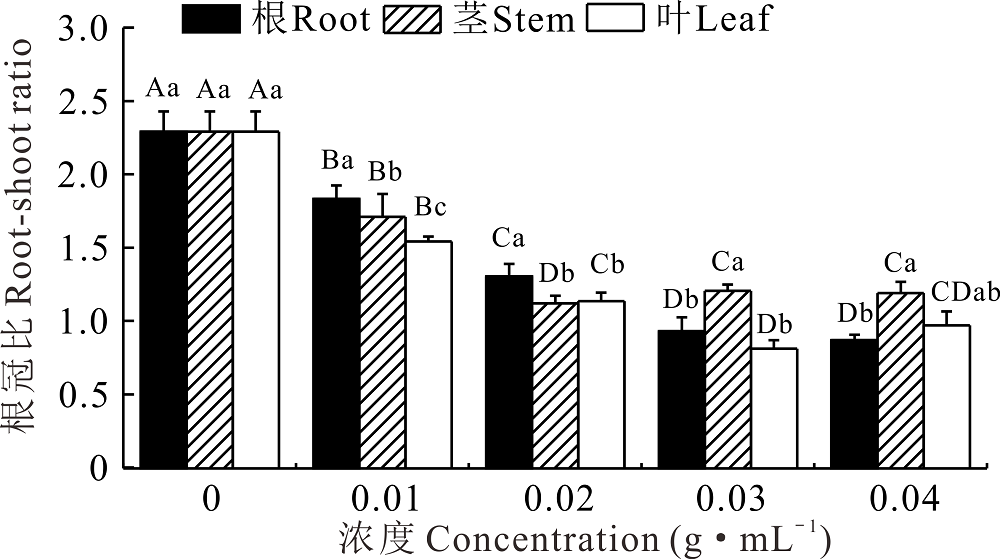 | 图16 含羞草不同器官浸提液对鬼针草根冠比的影响Fig.16 Effect of different organs extract of M. pudica on root-shoot ratio of B. pilosa |
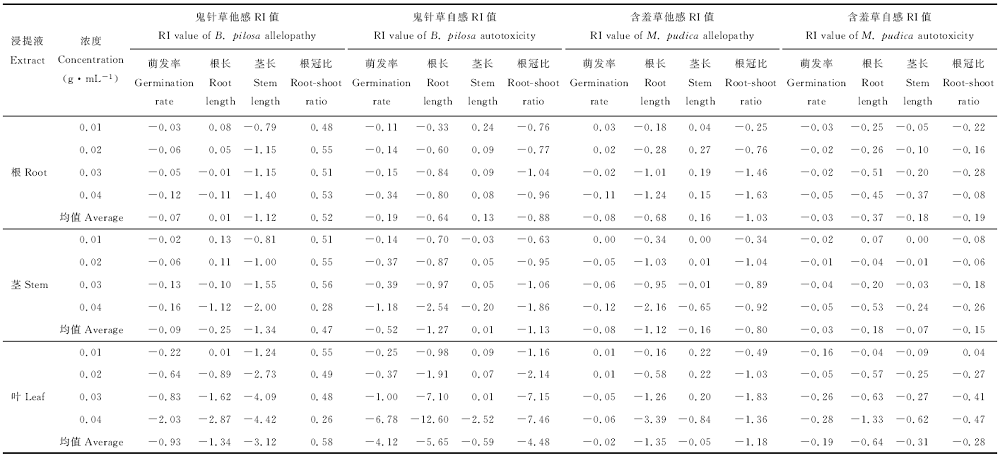
鬼针草各器官浸提液对自身种子萌发率、根长及根冠比具有化感抑制作用(RI< 0), 0.01~0.03 g· mL-1根和叶浸提液对自身茎长具有化感促进作用(RI> 0); 鬼针草各器官浸提液对含羞草种子萌发率和茎长具有化感抑制作用(RI< 0), 对根长具有“ 低促高抑” 的化感效应, 对根冠比具有化感促进作用(RI> 0)。鬼针草各器官浸提液对自身种子萌发率、根长及根冠比的化感强度大于鬼针草他感强度; 鬼针草各器官浸提液对含羞草茎长的化感强度大于其自感强度; 鬼针草茎和叶浸提液对含羞草种子萌发率及鬼针草各器官浸提液对含羞草茎长的化感强度大于含羞草他感强度(表1)。
 | 表1 鬼针草和含羞草不同器官浸提液对种子萌发、根长、茎长及根冠比的化感强度 Table 1 Allelopathic strength of extracts from different organs of B. pilosa and M. pudica on seed germination, root length, stem length and root-shoot ratio |
含羞草各器官浸提液对自身种子萌发率、根长、茎长及根冠比具有化感抑制作用(RI< 0), 对鬼针草根长和根冠比具有化感抑制作用(RI< 0); 含羞草茎和叶浸提液对鬼针草茎长表现出“ 低促高抑” 的化感效应, 其根浸提液促进鬼针草茎的生长(RI> 0)。含羞草叶浸提液对自身种子萌发率及含羞草各器官浸提液对其茎长的化感强度大于含羞草他感强度; 含羞草各器官浸提液对鬼针草根长和根冠比的化感强度大于其自感强度, 对鬼针草根长及根冠比的化感强度大于鬼针草他感强度(表1)。
入侵植物通过复杂的竞争关系获取所需的资源实现成功入侵, 其入侵性往往取决于入侵种的形态生理、生活史特性以及生态系统的可入侵性[30]。已有研究表明, 外来物种能够成功入侵到新的栖息地是由于其竞争力强于处在同一生态位的其他土著物种, 而且比土著物种具有更高的耐受性[31]。入侵种之间也存在竞争关系, 当不同外来物种所利用同一资源和空间发生重叠, 进而产生竞争[32]。本研究以广泛分布于潮州同一生境的两种入侵植物鬼针草与含羞草为研究对象, 从化感角度探查这两种入侵植物的入侵机制与竞争关系。
种子萌发是植物整个生命史中的关键环节[6]。本试验中, 鬼针草他感和自感对种子萌发均具有抑制作用, 萌发率随浸提液浓度的升高而降低, 其根、茎、叶浸提液对种子萌发的抑制强度表现为叶> 茎> 根, 说明不同部位对受体植物的化感作用存在差异。含羞草各器官浸提液对鬼针草种子萌发率的影响不显著。充分说明生态适应性较强的鬼针草易成功入侵, 其各器官通过分泌和挥发代谢化感物质抑制含羞草种子萌发, 进而增大对资源的竞争力。
鬼针草根、茎、叶浸提液对自身根长具有抑制作用, 对含羞草根长表现出“ 低促高抑” 的化感效应, 此结论与毛丹鹃等[33]研究三叶鬼针草水浸提液对两种牧草化感作用中得出的结论相符, 说明同一植物相同器官对不同受体植物的化感作用存在一定差异。含羞草根、茎、叶浸提液对自身和鬼针草根长均具有抑制作用, 这一结论与江贵波等[34]研究红花酢浆草(Oxalis corymbosa)浸提液对鬼针草化感作用的试验结果一致。含羞草浸提液对根长的他感强度大于鬼针草他感强度, 说明含羞草主要通过分泌化感物质抑制鬼针草根的生长, 进而更大限度地利用土壤中的养分, 提高自身在入侵地的竞争能力。高浓度的鬼针草茎和叶浸提液抑制其茎长, 这一结论与江贵波等[35]研究胜红蓟(Ageratum conyzoides)和三叶鬼针草的化感作用结论相符。鬼针草根、茎、叶浸提液抑制含羞草茎长, 该结果与陶宏征等[17]对鬼针草化感作用的研究结果一致。但也有研究发现鬼针草对茎长的影响随化感物质种类、数量及受体种类的变化而不同[36]。鬼针草浸提液对茎长的他感强度大于含羞草的他感强度, 体现了鬼针草可通过各器官挥发或淋溶的化感物质抑制含羞草地上部分的生长, 进而竞争更多的资源(如光照、水分等)。含羞草各器官浸提液抑制自身茎长, 对鬼针草茎长具有“ 低促高抑” 的作用, 这与敖苏等[37]研究入侵植物含羞草对7种植物的化感作用结论相似。本研究中, 鬼针草各器官浸提液对自身根冠比具有化感抑制作用, 对含羞草根冠比具有化感促进作用, 说明鬼针草浸提液对其地下部的抑制作用较强, 对含羞草地下部分抑制作用较弱。
1)鬼针草根、茎、叶浸提液对其种子萌发率、根长及根冠比均具有抑制作用, 高浓度的茎和叶浸提液抑制其茎长; 鬼针草各器官浸提液抑制了含羞草种子萌发率和茎长, 促进了其根冠比, 对其根长表现出“ 低促高抑” 化感效应。
2)含羞草根、茎、叶浸提液对其种子萌发率、根长、茎长和根冠比以及对鬼针草根长和根冠比均具有抑制作用, 而对鬼针草种子萌发率影响不显著, 高浓度的含羞草茎和叶浸提液抑制鬼针草茎的生长。
3)鬼针草对自身种子萌发率、根长及根冠比化感强度大于其他感强度, 对含羞草茎长化感强度大于含羞草他感强度; 含羞草对鬼针草根长及根冠比化感强度大于鬼针草他感强度, 大于其自感强度。
4)鬼针草和含羞草相互间的竞争符合“ 新武器假说” , 鬼针草主要通过抑制含羞草地上部分的生长增强入侵性, 而含羞草主要通过抑制鬼针草地下部分的生长增大竞争力。
| [1] |
|
| [2] |
|
| [3] |
|
| [4] |
|
| [5] |
|
| [6] |
|
| [7] |
|
| [8] |
|
| [9] |
|
| [10] |
|
| [11] |
|
| [12] |
|
| [13] |
|
| [14] |
|
| [15] |
|
| [16] |
|
| [17] |
|
| [18] |
|
| [19] |
|
| [20] |
|
| [21] |
|
| [22] |
|
| [23] |
|
| [24] |
|
| [25] |
|
| [26] |
|
| [27] |
|
| [28] |
|
| [29] |
|
| [30] |
|
| [31] |
|
| [32] |
|
| [33] |
|
| [34] |
|
| [35] |
|
| [36] |
|
| [37] |
|