中国不同区域常见绿肥产量和养分含量特征及替代氮肥潜力评估
杨叶华1, 张松2, 王帅3, 刘正兰4, 方林发1, 张学良1, 刘瑞1, 张建伟1, 张宇亭1,*, 石孝均1,5,*
1.西南大学资源环境学院,重庆400716
2.贵定县农业农村局,贵州 贵定551300
3.重庆市农业技术推广总站,重庆400700
4.忠县农业科技推广中心, 重庆 忠县404300
5.西南大学农业科学研究院,重庆400716
*通信作者Corresponding author. E-mail: shixj@swu.edu.cn; zyt2018@swu.edu.cn

作者简介:杨叶华(1994-),女,贵州凯里人,在读硕士。E-mail: 1605618450@qq.com

摘要

绿肥作为清洁的有机肥源,在培肥地力和替代化肥方面具有重要作用,明确中国不同区域绿肥产量及养分含量特征,旨在为绿肥种植和绿肥替代化肥提供理论依据和数据支撑。本研究通过检索中国知网数据库和相关书籍的绿肥产量及养分含量,收集整理了包含17种我国常见绿肥的3431个数据变量,整合分析了我国常见绿肥的产量和氮磷钾养分含量特征,比较了几种主要绿肥在我国不同区域的产量及养分含量差异,评估了不同区域种植绿肥替代化学氮肥的潜力。结果表明,我国绿肥鲜草产量平均为38.0 t·hm-2(含水量平均81.0%)、变幅大(0.7~186.7 t·hm-2),其中黑麦草、沙打旺、柱花草和红三叶平均产量>42.5 t·hm-2,均显著高于其他绿肥种类。17种常见绿肥的平均含氮量为28.0 g·kg-1(干基计),箭筈豌豆、苕子、苜蓿、金花菜和白三叶等豆科绿肥含氮量均在30.0 g·kg-1以上;常见绿肥的平均含磷量为7.0 g·kg-1,苕子和二月兰含磷量最高,均在8.0 g·kg-1以上;常见绿肥的平均含钾量为25.3 g·kg-1,二月兰和紫云英含钾量最高,均在32.0 g·kg-1以上。常见绿肥氮磷钾养分累积量平均为214.4 kg·hm-2、48.4 kg·hm-2和165.1 kg·hm-2,不同种类之间存在显著差异,其中以沙打旺、黑麦草、红三叶草、苜蓿和柱花草氮(N)、磷(P2O5)和钾(K2O)累积量最高,分别在250.0 kg·hm-2、50.0 kg·hm-2和191.7 kg·hm-2以上。分析不同气候区域绿肥养分累积状况发现,紫云英最适宜种植于南方丘陵谷地稻肥复种及茶果肥(草)间套种区;箭筈豌豆适宜种植于东北粮草(肥)轮作区和长江流域稻麦棉肥(草)复套间种区;苕子最适宜种植于长江流域稻麦棉肥(草)复套间种区;苜蓿最适宜种植于滨海稻肥(草)复种区;白/红三叶最适宜种植于西南山地丘陵粮肥(草)复间套种区;而黑麦草更适宜种植于滨海稻肥(草)复种区和南方丘陵谷地稻肥复种及茶果肥(草)间套种区。根据不同区域主要豆科绿肥产量、固氮量及种植面积进行固氮潜力评估表明,当前中国绿肥种植面积约448.6 万 hm2,相当于生产39.5~80.8 万t氮肥;如果按照中国可种植绿肥的潜在面积4600.0万hm2估算,相当于生产405.3~828.1万t的氮肥,豆科绿肥具有较高的化肥替代潜力。在绿肥生产过程中,应针对本区域适应性强的绿肥进行重点推广应用。

关键词: 绿肥; 区域性; 产量; 养分累积量; 替代氮肥潜力
Yield and nutrient concentration in common green manure crops and assessment of potential for nitrogen replacement in different regions of China
YANG Ye-hua1, ZHANG Song2, WANG Shuai3, LIU Zheng-lan4, FANG Lin-fa1, ZHANG Xue-liang1, LIU Rui1, ZHANG Jian-wei1, ZHANG Yu-ting1,*, SHI Xiao-jun1,5,*
1.College of Resources and Environment, Southwest University, Chongqing 400716, China
2.Guiding Agricultural and Rural Bureau, Guiding 551300, China
3.Chongqing Agricultural Technology Extension Station, Chongqing 400700, China
4.Zhongxian Agricultural Science and Technology Extension Center, Zhongxian 404300, China
5.Academy of Agricultural Science, Southwest University, Chongqing 400716, China
Abstract

Green manure is considered a clean source of organic fertilizer. It plays an important role in enhancing soil fertility and the substitution of chemical fertilizer. Quantifying green manure yield and nutrient concentration at the regional level can provide a theoretical basis and supporting data for green manure application and fertilizer replacement. This study, by searching the China National Knowledge Infrastructure (CNKI) database and related books, collected 3431 data, including information on 17 different common green manure crops across China. The green manure yield and nutrient concentration data from across China were systematically analyzed and compared, and the nitrogen fertilizer replacement effect was evaluated for different regions of China. It was found that the average yield of fresh green manure in China was 38.0 t·ha-1 (moisture content was 81.0% on average), but a wide range (0.7-186.7 t·ha-1) was noted. The average yields of ryegrass, erect milkvetch, Stylosanthes, and red clover were higher than 43 t·ha-1, and significantly higher than other green manure species. The average nitrogen concentration of 17 kinds of common green manures was 28.0 g·kg-1 (in the hay). The nitrogen concentration of common vetch, vetch, alfalfa, burclover, and white clover were all above 30.0 g·kg-1, and this was significantly higher than other green manure types. The average phosphorus concentration of different common green manure crops was 7.0 g·kg-1, and vetch and February orchid contained greater phosphorus concentration (above 8.0 g·kg-1) than other green manures. The average potassium concentration of different common green manure crops was 25.3 g·kg-1, and the February orchid and milk vetch were highest with a potassium concentration of more than 32.0 g·kg-1. The average accumulation of nitrogen, phosphorus and potassium of green manure crops was 214.4 kg N·ha-1, 48.4 kg P2O5·ha-1 and 165.1 kg K2O·ha-1. There were significant differences in the accumulation of nitrogen, phosphorus and potassium in different common green manures, among which the accumulation of nutrients was the highest in erect milkvetch, ryegrass, red clover, alfalfa, and Stylosanthes, above 250.0 kg N·ha-1, 50.0 kg P2O5·ha-1 and 191.7 kg K2O·ha-1, respectively. Linking the nutrient accumulation data with regional climatic data, our further analysis found that: milk vetch is most suitable for planting in the southern hilly valley and interplanting zone; common vetch is suitable for planting in the northeast grain rotation area and the Yangtze River Basin; vetch is suitable for planting in the rice-cotton complex intercropping area of the Yangtze River Basin; alfalfa is most suitable for planting in the coastal multiple cropping area; white and red clover are most suitable for planting in the grain-grass intercropping area of the southwest mountainous hills and the northeast grain and grass rotation area; and ryegrass is most suitable for planting in rice-grass multiple cropping area. According to the nitrogen fixation potential assessment of the yield, nitrogen fixation amount and planting area of major leguminous green manure in different regions, the current planting area of green manure in China is about 4.49 million ha, equivalent to the production of 400-810 thousand tons of nitrogen fertilizer. If we estimate the potential area of green manure fertilizer in China at 46 million ha, this is equivalent to the production of 4.0-8.28 million tons of nitrogen fertilizer. Thus, leguminous green manure fertilizer has a high potential of fertilizer replacement. In formulating regional recommendations for green manure crop production, the green manure crop with strong adaptability and performance in each region should be identified and promoted.

Keyword: Green manure; regional; yield; nutrient accumulation; potential for nitrogen replacement

栽培或野生的绿色植物体可以直接或间接还田作为肥料, 这种植物体称为绿肥[1]。我国有着丰富的绿肥资源, 大多以豆科植物为主, 同时也有其他科属的植物, 如禾本科、十字花科等[2]。不同科属绿肥在农业生态系统中有不同的作用。豆科绿肥翻压还田后可向土壤提供丰富的氮素[3], 为作物提供养分, 如甘肃河西绿洲灌区长期定位试验结果表明, 施用毛叶苕子(Vicia villosa)7500 kg· hm-2, 可以替代纯氮67.5~90.0 kg· hm-2[4]。禾本科绿肥由于其较高的碳含量, 可为土壤提供大量碳源, 并且其根系发达, 有益于土壤团聚体的形成; 而十字花科绿肥则有很好的解磷作用, 可丰富土壤耕层速效磷素含量[1]。绿肥作为清洁的有机肥源, 可多、快、好、省地提高土壤肥力、改善土壤质量并改善生态环境[5, 6]。因此, 合理利用绿肥资源, 充分发挥绿肥的作用, 是发展生态农业的重要途径之一。

我国幅员辽阔, 各区域水热条件不同, 不同区域优势绿肥种类存在很大差异。南方各省主要发展冬种绿肥, 包括紫云英(Astragalus sinicus)、光叶苕子(Vicia villosa)、黑麦草(Lolium perenne)、油菜(Brassica napus)和肥田萝卜(Raphanus sativus)等[7, 8], 而北方各省份主要种植箭筈豌豆(Vicia sativa)、毛叶苕子、紫花苜蓿(Medicago sativa)、草木樨(Mellilotus officinalis)、红三叶(Trifolium pratense)和高羊茅(Festuca elata)等绿肥[9, 10]。同一气候条件下, 不同绿肥的生产性能也不相同。浙江上虞有机茶园肥田萝卜生物量达65.9 t· hm-2, 而豌豆(Pisum sativum)、黑麦草和三叶草(Trifolium dubium)的生物学产量则为51.6、40.7和28.0 t· hm-2[11]。由于不同绿肥养分含量及产量不同, 养分累积量也存在较大差异。华北地区两年试验结果表明, 二月兰(Orychophragmus violaceus)生物量为4.7~5.1 t· hm-2, 毛叶苕子生物量为3.4~4.2 t· hm-2, 二月兰碳累积量比毛叶苕子显著高36%, 但毛叶苕子氮累积量却比二月兰显著高5.7%[12]。即便是同一绿肥种类, 在不同的地区产量和养分含量也有一定差异。如, “ 余江大叶种” 紫云英在湖南省长沙市、福建省浦城县产量分别为27.4和37.5 t· hm-2; 相比于产量, 养分含量差异较小, 两个地区紫云英的干基氮(N)、磷(P2O5)和钾(K2O)养分分别为27.6~29.6 g· kg-1、7.3~8.2 g· kg-1和37.0 g· kg-1[13, 14]

综上, 前人的研究主要集中在某一试验点或某一种绿肥产量及养分含量上, 尽管为不同位点上绿肥生产提供了一定的科学依据, 但在区域尺度上很难根据零星的研究来指导生产, 目前缺乏对我国不同区域绿肥产量及养分含量的系统研究。本研究通过整合分析中国知网数据库和相关书籍中的3431个变量, 系统总结了我国常见绿肥的产量和养分含量特征, 分析了不同区域种植豆科绿肥的固氮潜力, 从而明确我国常见绿肥概况及不同区域绿肥养分累积特性, 旨在为不同区域绿肥种植及替氮潜力评估提供依据。

1 材料与方法
1.1 数据来源

绿肥产量及养分含量数据来源于已出版的绿肥书籍和中文文献。数据的收集遵循以下几个原则:1)试验必须为大田试验; 2)试验的数据包含产量或养分含量; 3)标明试验的地点。书籍包括《中国绿肥种子出口技术手册》[15]、《绿肥在现代农业发展中的探索与实践》[16]和《浙江绿肥生产与综合利用技术》[17]。文献数据来源于中国知网数据库:检索时间为1997-2017年; 检索关键词为“ 绿肥” 或“ 紫云英” 或“ 箭筈豌豆” 或“ 苕子” 或“ 苜蓿” 或“ 白三叶(Trifolium repens)” 或“ 红三叶” 或“ 黑麦草” 或“ 柱花草(Stylosanthes guianensis)” 或“ 沙打旺(Astragalus huangheensis)” 或“ 田菁(Sesbania cannabina)” 或“ 柽麻(Crotalaria juncea)” 或“ 草木樨” 或“ 蚕豆(Vicia faba)” 或“ 金花菜(Medicago polymorpha)” 或“ 油菜” 或“ 肥田萝卜” 或“ 二月兰” 等, 共计获得296篇相关文献。

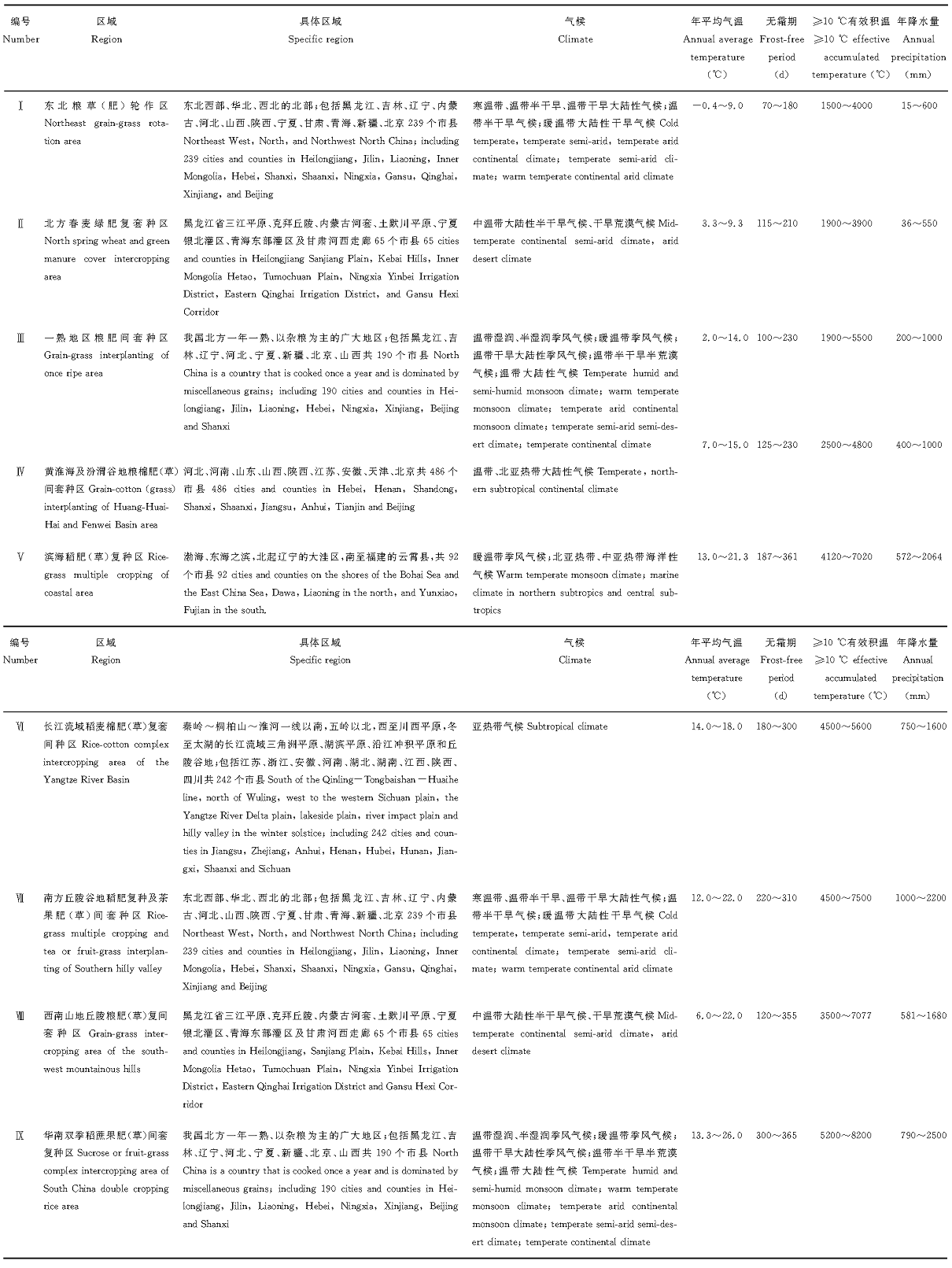
本研究共计收集3431条数据。产量为地上部鲜基生物量, 对于没有记录鲜草的文献, 通过含水量进行换算; 养分含量均指绿肥干基氮(N)、磷(P2O5)和钾(K2O)含量; 养分累积量根据绿肥鲜草产量、水分含量和养分含量计算。本研究中, 不同区域产量及养分含量特征分析仅选择产量样本数超过100的绿肥种类进行分析。绿肥区域划分参考《中国绿肥》[1]划分的9个绿肥种植区域, 具体区域划分情况见表1。当前绿肥种植面积及潜在种植面积数据来源于当前发表的期刊、报纸、书籍, 部分潜在种植面积指的是新中国成立以来种植面积最大年份的种植面积, 对于部分已知种植面积但缺少产量及氮含量的省市(山西、宁夏、贵州、重庆)用豆科绿肥平均产量及平均氮含量来计算; 生物固氮量按照豆科绿肥含氮量的46%~94%[18]计算。

表1 中国绿肥区域划分 Table 1 Green manure area division in China
1.2 数据分析

采用SPSS 20.0 进行统计分析, 使用ANOVA进行方差分析(Duncan法检验, P< 0.05为显著性差异)。采用Origin 2018和Excel 2010绘制图表。

2 结果与分析
2.1 不同绿肥产量差异

中国常见绿肥平均产量为38.0 t· hm-2(表2), 变幅在16.2~53.2 t· hm-2之间, 变异系数为27.1%~89.4%。不同绿肥种类产量高低为:禾本科最高, 其次是豆科, 十字花科最低。禾本科黑麦草绿肥平均产量达53.2 t· hm-2, 显著高于其他绿肥种类。豆科绿肥产量在16.8~48.2 t· hm-2之间, 红三叶、柱花草和沙打旺产量均高于40.0 t· hm-2, 紫云英、箭筈豌豆、苕子、苜蓿和田菁产量在29.7~38.6 t· hm-2之间, 其他豆科绿肥产量均低于30.0 t· hm-2, 其中蚕豆、草木樨和金花菜产量较低。十字花科油菜、肥田萝卜和二月兰绿肥产量均低于20.0 t· hm-2且差异不显著, 仅为黑麦草产量的1/3左右, 与豆科绿肥草木樨、金花菜产量相当。常见绿肥含水量在68.8%~90.6%之间, 平均含水量为81.0%。不同绿肥种类含水量有明显差异(P< 0.05)(表2), 其中紫云英含水量显著高于其他绿肥, 约为90.6%; 油菜、肥田萝卜和二月兰十字花科绿肥含水量变化不大, 约为87.5%; 沙打旺含水量最低, 约为68.8%; 其余绿肥含水量均在73.7%~84.0%之间。

表2 不同绿肥种类产量差异 Table 2 Yield of different green manure
2.2 不同绿肥种类养分含量和累积量特征

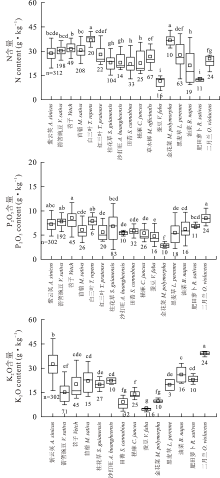
图1结果表明, 不同绿肥种类养分含量有明显差异。常见绿肥含氮量在12.7~36.7 g· kg-1之间, 平均为28.0 g· kg-1。箭筈豌豆、苕子、苜蓿、金花菜和白三叶草等豆科绿肥含氮量均在30.0 g· kg-1以上, 其中金花菜和白三叶含氮量显著高于其他绿肥, 在35.0 g· kg-1以上。不同绿肥种类含磷量在2.9~8.5 g· kg-1之间, 平均含磷量为7.0 g· kg-1。苕子和二月兰含磷量最高, 约为8.5 g· kg-1; 其次为紫云英、箭筈豌豆和白三叶, 含磷量在7.2~7.9 g· kg-1之间; 蚕豆含磷量低于5.0 g· kg-1, 金花菜含磷量不足3.0 g· kg-1。不同绿肥含钾量差异较大, 含量在5.2~39.0 g· kg-1之间, 平均含钾量为25.3 g· kg-1。二月兰和紫云英含钾量显著高于其他绿肥, 均高于30.0 g· kg-1; 蚕豆、田菁和金花菜含钾量低于10.0 g· kg-1; 其余绿肥含钾量则在13.8~26.0 g· kg-1之间。

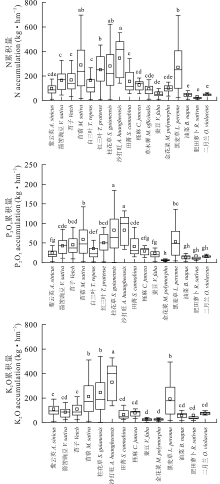
如图2所示, 常见绿肥氮累积吸收量在30.2~343.8 kg· hm-2之间, 平均氮累积量为214.4 kg· hm-2。沙打旺、苜蓿、柱花草、黑麦草和红三叶5种绿肥氮素累积量依次为343.8、289.7、279.6、268.3和250.0 kg· hm-2,

图1 不同绿肥种类氮磷钾含量差异Fig.1 Different of nitrogen, phosphorus and potassium in green manure

图2 不同绿肥种类养分累积特征
不同小写字母表示P< 0.05水平上差异显著。下同。
Fig.2 Characteristics of nutrient accumulation in different green manure
Different lowercase letters indicate significant difference at 0.05 level. The same below.

显著高于其他绿肥种类。十字花科绿肥氮素累积量较低, 在30.2~47.1 kg· hm-2之间, 不到沙打旺的1/7。不同绿肥磷素累积量在6.0~82.7 kg· hm-2之间, 平均磷素累积量为48.4 kg· hm-2。柱花草和沙打旺磷素累积量显著高于其他绿肥种类, 磷累积量约为82.2~82.7 kg· hm-2, 其次为苜蓿、黑麦草和红三叶, 金花菜磷素累积量最低, 不到沙打旺的1/10。常见绿肥钾累积量在25.5~328.8 kg· hm-2之间, 平均累积量为165 kg· hm-2。其中, 沙打旺钾素累积量显著高于其他绿肥种类, 约为328.8 kg· hm-2; 其次为柱花草、苜蓿和黑麦草, 钾素养分累积量191.7~243.2 kg· hm-2之间。

2.3 不同区域绿肥产量及养分含量差异

不同区域常见绿肥产量及养分含量差异如表3所示。紫云英主要分布在滨海稻肥(草)复种区(Ⅴ 区)、长江流域稻麦棉肥(草)复套间种区(Ⅵ 区)、南方丘陵谷地稻肥复种及茶果肥(草)间套种区(Ⅶ 区)和西南山地丘陵粮肥(草)复间套种区(Ⅷ 区)。其中南方丘陵谷地稻肥复种及茶果肥(草)间套种区产量显著高于其他区域, 达44.0 t· hm-2, 约为其他区域平均产量的1.6倍。并且, 紫云英在南方丘陵谷地稻肥复种及茶果肥(草)间套种区养分累积量也最高, 氮、磷和钾累积量分别达118.8 t· hm-2、27.8 t· hm-2和123.0 t· hm-2

表3 不同区域绿肥产量及养分含量差异 Table 3 Difference of green manure yield and nutrient content in different regions

箭筈豌豆主要种植于东北粮草(肥)轮作区(Ⅰ 区)、黄淮海及汾渭谷地粮棉肥(草)间套种区(Ⅳ 区)和长江流域稻麦棉肥(草)复套间种区(Ⅵ 区)。此3个区域箭筈豌豆产量和养分累积量均有显著性差异, 从大到小依次均为Ⅵ 区> Ⅰ 区> Ⅳ 区, 其中Ⅵ 区产量为42.0 t· hm-2, 氮、磷和钾养分累积量分别为198.8 kg· hm-2、51.7 kg· hm-2和99.4 kg· hm-2

苕子主要分布在东北粮草(肥)轮作区(Ⅰ 区)、北方春麦绿肥复套种区(Ⅱ 区)、长江流域稻麦棉肥(草)复套间种区(Ⅵ 区)和西南山地丘陵粮肥(草)复间套种区(Ⅷ 区)。其中, Ⅵ 区产量显著高于其他区域, 达38.6 t· hm-2, Ⅰ 区和Ⅱ 区2个区域产量均低于30.0 t· hm-2; Ⅵ 区的氮、磷和钾养分累积量分别为222.3 kg· hm-2、62.4 kg· hm-2和157.8 kg· hm-2

苜蓿种植的区域广泛, 除华南双季稻蔗果肥(草)间套复种区(Ⅸ 区)外其他区域均有种植。其中, 滨海稻肥(草)复种区(Ⅴ 区)产量显著高于其他区域, 达65.4 t· hm-2。而长江流域稻麦棉肥(草)复套间种区(Ⅵ 区)、南方丘陵谷地稻肥复种及茶果肥(草)间套种区(Ⅶ 区)产量低于30.0 t· hm-2, 显著低于其他区域, 约是滨海稻肥(草)复种区(Ⅴ 区)的1/3。

白三叶主要分布在东北粮草(肥)轮作区(Ⅰ 区)、南方丘陵谷地稻肥复种及茶果肥(草)间套种区(Ⅶ 区)和西南山地丘陵粮肥(草)复间套种区(Ⅷ 区)。3个区域产量在20~25 t· hm-2之间, 无显著差异。而红三叶除以上3个区域外, 还分布在长江流域稻麦棉肥(草)复套间种区(Ⅵ 区)。其中东北粮草(肥)轮作区(Ⅰ 区)产量达52.1 t· hm-2, 分别比长江流域稻麦棉肥(草)复套间种区(Ⅵ 区)、南方丘陵谷地稻肥复种及茶果肥(草)间套种区(Ⅶ 区)和西南山地丘陵粮肥(草)复间套种区(Ⅷ 区)高41.0、33.3和16.4 t· hm-2

黑麦草除了北方春麦绿肥复套种区(Ⅱ 区)、一熟地区粮肥间套种区(Ⅲ 区)和华南双季稻蔗果肥(草)间套复种区(Ⅸ 区)外, 其他区域均有种植。其中, 滨海稻肥(草)复种区(Ⅴ 区)和南方丘陵谷地稻肥复种及茶果肥(草)间套种区(Ⅶ 区)产量较高, 分别达80.0和74.3 t· hm-2

2.4 不同地区种植豆科绿肥替代化学氮肥潜力评估

豆科绿肥几乎在所有省(自治区、直辖市)均有种植(表4)。中国常见豆科绿肥鲜草产量约为38.0 t· hm-2, 其中河南、湖南、海南、陕西、四川、云南地区的产量较高, 均比平均产量高10 t· hm-2以上。豆科绿肥氮平均含量为28.0 g· kg-1, 各地区氮含量在17.3~35.0 g· kg-1之间, 其中福建、安徽、青海和四川等地绿肥氮含量较高, 在33.4~35.0 g· kg-1之间。

表4 不同地区豆科绿肥替代化肥潜力 Table 4 Potential of green leguminous fertilizer replacing chemical fertilizer in different areas

据统计, 中国绿肥种植面积为448.6 万 hm2, 其中以内蒙古、安徽、江西、陕西和贵州的种植面积最广, 分别为47.5、53.2、53.0、40.0和40.0万 hm2, 共计占全国种植面积的52.1%。另外, 湖南和广西也有一定规模的种植面积, 分别为30.0和33.3万 hm2, 共计占全国种植面积的14.1%。不同地区豆科绿肥产量、含氮量及种植面积不同, 其氮素累积量上也有一定的差异。其中内蒙古、安徽和陕西豆科绿肥氮素累积量较高, 分别为10.3、12.1和12.5万t; 湖南、河北、广西和贵州在5.1~7.5万t之间, 其余地区均低于5.1万t, 其中海南最低, 仅为0.02万t。豆科绿肥氮素累积吸收量来自自身固氮和土壤, 通过生物固氮途径从大气中固定的氮量可以视作豆科植物工厂生产氮肥, 按照目前中国绿肥种植面积计算, 每年种植豆科绿肥固定的大气氮约在39.5~80.8万t, 即可以替代39.5~80.8万t化学氮肥, 其中内蒙古、安徽和陕西地区替代化学氮量较高可达9.7、11.4和11.8万t, 其他地区则在0.02~7.1万t。

我国绿肥潜在种植面积为4600.0万 hm2, 种植潜力巨大, 其最高潜在固氮量为405.3~828.1万t, 其中河北、江苏和黑龙江绿肥潜在种植面积分别为300.0、200.0和433.3万 hm2, 占总潜力面积的20%左右, 并且生物固氮量最高分别可达81.1、31.3和54.1万t。而湖北、湖南、山西、安徽、浙江、辽宁和贵州等地区的潜在种植面积在100.0~160.0万hm2, 占中国总潜力面积的19.2%左右, 生物固氮量在4.5~28.3万t。

3 讨论

本研究表明, 不同绿肥产量水平表现为禾本科> 豆科> 十字花科(表2)。十字花科绿肥产量均低于20 t· hm-2, 约为豆科绿肥和禾本科绿肥平均产量的1/2和1/3(表2)。主要原因是十字花科绿肥对土壤肥力要求较高[12]; 而豆科绿肥可通过生物固氮作用, 在土壤肥力较低的情况下依然能获得较高产量[51]; 供试禾本科绿肥仅为黑麦草, 主要分布在黄淮海以南地区, 多种植在水稻(Oryza sativa)种植区的冬闲田, 其较高的生物学产量可能与种植区的较为优越的水热条件和土壤肥力有关[52]。绿肥产量和养分含量共同决定了养分累积量, 本研究发现, 不同绿肥氮磷钾含量差异相较于产量差异较小, 使得产量成了影响养分累积量的决定性因素。禾本科绿肥黑麦草、豆科绿肥红三叶、柱花草和沙打旺产量在42.5~53.2 t· hm-2(表2), 显著高于其他绿肥种类, 使得其养分累积量也具有明显优势, N、P2O5、K2O养分累积量分别为250.0~343.8 kg· hm-2、50.0~82.7 kg· hm-2、243.2~328.8 kg· hm-2, 显著高于其他绿肥种类。在农业生产过程中, 此类高产绿肥可直接就地翻压, 便可为土壤中输入大量养分。其他产量较低的绿肥就地翻压输入土壤的养分较少, 则可集中翻压, 使提供的养分量达到目标要求, 在替代化肥上有显著效果。万水霞等[53]研究表明, 在紫云英-水稻轮作系统中, 翻压7.5 t· hm-2紫云英, 至少可以替代纯氮49.5 kg· hm-2。郭云周等[54]的研究也表明, 在种植烟草(Nicotiana tabacum)的红壤上就地翻压光叶紫花苕子7.4 t· hm-2, 可替代54.0 kg· hm-2的化学氮肥。但由于腐解速率不同, 绿肥养分的化肥替代强度和替代时期也有所差异, 而绿肥的腐解速率受到碳氮比调控[55], 由于数据来源的限制, 本研究未能提供绿肥碳含量的数据。总体上看, 碳氮比较高的禾本科绿肥的腐解速率要慢于豆科绿肥, 如黑麦草和毛叶苕子在翻压16周后的腐解常数分别为0.1368和0.4505, 氮素在翻压后的前4周和前两周快速释放[56]。Dong等[57]研究表明, 碳氮比相当的二月兰和毛叶苕子, 腐解速率均表现为前14 d内腐解快, 后期慢等特点, 氮和钾在翻压7 d内快速释放, 磷在翻压80 d内均稳步释放。因此, 绿肥翻压替代化肥过程中, 应考虑绿肥的养分释放特征和主作物的养分需求规律相匹配, 根据生产需求选择合适的绿肥种类, 农田系统中通常可以选择含氮量高、生物量较大的紫云英、箭筈豌豆、苕子等绿肥, 翻压后可尽快为后茬作物提供养分。

不同绿肥适应性有所不同, 从分布区域上看, 苜蓿和黑麦草分布较广(表3)。但在华南双季稻蔗果肥(草)间套复种区均没有种植, 说明其虽然适应能力强但不耐高温。这与魏志标等[58] 的研究结果相似。滨海稻肥(草)复种区主要是暖温带季风气候、北亚热带、中亚热带海洋性气候, 雨热资源丰富但有效积温比华南双季稻蔗果肥(草)间套复种区低, 苜蓿和黑麦草在滨海稻肥(草)复种区生产性能最强, 产量分别为65.4和80.0 t· hm-2, 说明此区域适合大力发展苜蓿和黑麦草。紫云英是常见的南方稻田绿肥, 喜温暖湿润气候[59]。本研究表明, 紫云英主要分布在滨海稻肥(草)复种区以南和西南山地丘陵粮肥(草)复间套种区以北区域, 其中以南方丘陵谷地稻肥复种及茶果肥(草)间套种区生产性能最好, 产量比其他区域高17.0 t· hm-2, 说明紫云英最适宜在此区域生长。箭筈豌豆和苕子在长江流域稻麦棉肥(草)复套间种区产量最高, 此区域属于亚热带气候, 年平均气温、无霜期、有效积温和降水量均比其他区域低, 这与箭筈豌豆和苕子耐寒、耐旱的生理学特征相匹配[60]。此外, 东北粮草(肥)轮作区水热资源不够丰富且土壤贫瘠, 但苕子、箭筈豌豆、苜蓿、白三叶、红三叶和黑麦草却也表现出较强的生产性能, 而北方春麦绿肥复套种区气候条件和东北粮草(肥)轮作区差异较小, 但在两个区域种植的绿肥种类却差异较大。这可能跟本研究数据来源有关, 北方春麦绿肥复套种区除了苜蓿和苕子有栽培研究之外, 关于其他绿肥的研究较少。从气候条件出发, 该区域也可种植豆科绿肥如苕子、箭筈豌豆、苜蓿、白三叶、红三叶和黑麦草等绿肥。

除气候条件外, 施肥[61]、灌溉[62]、栽培模式[63]、播种时间和播种量[64]等因素也影响绿肥产量和养分含量, 多年生绿肥如苜蓿、黑麦草还受刈割次数影响[65], 为消除这些因素对绿肥生长的影响, 在以后的研究中要综合各种因素来指导绿肥栽培。选择合适的绿肥作物应充分根据作物生长所需的土壤和气候条件, 因地制宜, 从而在绿肥作物利用方式上发挥其最大经济和生态效益。

我国区域性、结构性、季节性闲置耕地多, 全国绿肥约有4600.0万hm2发展空间[50]。而目前, 我国绿肥种植面积约有448.6万hm2, 不到全国绿肥潜在种植面积的1/10。如果在全国范围内大力发展豆科绿肥, 当栽培面积达到4600.0万hm2时, 相当于生产881.1~1800.2万t尿素。并且, 豆科绿肥除提供大量氮素外, 还提供大量的碳、磷和钾等养分。以目前种植的面积来看, 豆科绿肥每年大约可提供20.0万t P2O5和73.0万t K2O。可见, 大力发展绿肥是实现化肥零增长的重要途径之一。目前, 绿肥已呈现快速发展势头, 绿肥和主作物轮作或套作在提升地力的同时又给主作物化学氮肥减施提供了支撑, 各地区应根据本区域生态区域特点和生产现状, 因地制宜, 统筹规划, 稳步推进绿肥生产发展。

4 结论

不同绿肥种类产量及养分含量均存在较大差异, 黑麦草、沙打旺、柱花草和红三叶的生物学产量在42.5~53.2 t· hm-2, 显著高于其他绿肥种类; 不同绿肥氮磷钾养分的平均含量分别为28.0 g· kg-1、7.0 g· kg-1和25.3 g· kg-1, 其中以豆科绿肥含氮量最高, 二月兰具有较高的磷和钾含量; 沙打旺、黑麦草、红三叶、苜蓿和柱花草等绿肥的氮磷钾养分累积量分别可达250.0 kg· hm-2、50.0 kg· hm-2和191.7 kg· hm-2。绿肥产量和养分含量受到不同区域气候环境条件的调控。种植豆科绿肥具有较高的化肥替代潜力, 当前中国绿肥种植面积约448.6 万 hm2, 相当于生产39.5~80.8万t氮肥; 如果按照中国可种植绿肥的潜在面积4600.0万hm2估算, 相当于生产405.3~828.1万t的氮肥。在绿肥的推广和应用过程中, 应根据绿肥的区域适应性及其产量和养分含量特征因地制宜地推广绿肥品种。

参考文献
[1] Jiao B, Gu R S, Zhang X S. China green manure. Beijing: Agricultural Press, 1986.
焦彬, 顾荣申, 张学上. 中国绿肥. 北京: 农业出版社, 1986. [本文引用:3]
[2] Chen Z H, Li X F, Yun X J, et al. Diversity and protection of grass germplasm resources in China. Pratacultural Science, 2009, 26(5): 1-6.
陈志宏, 李晓芳, 贠旭疆, . 我国草种质资源的多样性及其保护. 草业科学, 2009, 26(5): 1-6. [本文引用:1]
[3] Liu C Z, Lü Y H, Li B Y, et al. Effects of different sowing dates on growth, yield and nutrient accumulation of “xinzi no. 1”. Soil and Fertilizer Sciences in China, 2018, (1): 127-133.
刘春增, 吕玉虎, 李本银, . 不同播期对紫云英“信紫1号”生长状况、产量及养分积累的影响. 中国土壤与肥料, 2018, (1): 127-133. [本文引用:1]
[4] Zhang J D, Bao X G, Cao W D, et al. Effect of long-term application of green manure and chemical fertilizer on grass yield and soil fertility. Soil and Fertilizer Sciences in China, 2017, (6): 66-70.
张久东, 包兴国, 曹卫东, . 长期施用绿肥减施化肥对毛叶苕子产草量和土壤肥力的影响. 中国土壤与肥料, 2017, (6): 66-70. [本文引用:1]
[5] Li H Y, Hu T C, Cao Q H, et al. Effect of improving soil fertility by planting different green manures in different patterns in dryland . Journal of Plant Nutrition and Fertilizer, 2016, 22(5): 1310-1318.
李红燕, 胡铁成, 曹群虎, . 旱地不同绿肥品种和种植方式提高土壤肥力的效果. 植物营养与肥料学报, 2016, 22(5): 1310-1318. [本文引用:1]
[6] Chen S P. On the status of green manure in modern agricultural ecosystem. Chinese Journal of Soil Science, 1980, (1): 35-40.
陈士平. 论绿肥在现代化农业生态系统中的地位. 土壤通报, 1980, (1): 35-40. [本文引用:1]
[7] Li Z Y, Hu J M, Meng Y C, et al. Development and cropping patterns of green manure in Guangxi. Chinese Journal of Tropical Agriculture, 2015, 35(11): 71-75, 80.
李忠义, 胡钧铭, 蒙炎成, . 广西绿肥发展现状及种植模式. 热带农业科学, 2015, 35(11): 71-75, 80. [本文引用:1]
[8] Wang J H, Cao K, Jiang L N. et al. History, current status and guidelines about green manure development of Zhejiang. Acta Agricultural Zhejiangensis, 2009, 21(6): 649-653.
王建红, 曹凯, 姜丽娜, . 浙江省绿肥发展历史、现状与对策. 浙江农业学报, 2009, 21(6): 649-653. [本文引用:1]
[9] Zhang J M, Su Q R, Chi F Q, et al. The status and outlook of green manure crops production and application in Heilongjiang. Heilongjiang Agricultural Sciences, 2009, (6): 152-154.
张久明, 宿庆瑞, 迟凤琴, . 黑龙江省绿肥作物生产利用现状及展望. 黑龙江农业科学, 2009, (6): 152-154. [本文引用:1]
[10] Duan Y, Cao W D, Tuo D B, et al. Current situation and problems of comprehensive utilization of green manure in Inner Mongolia. Inner Mongolia Agricultural Science and Technology, 2008, (7): 23-25.
段玉, 曹卫东, 妥德宝, . 内蒙古绿肥综合利用现状及存在问题. 内蒙古农业科技, 2008, (7): 23-25. [本文引用:1]
[11] Zhang Y, Wu X. Comparative experiment of green fertilizer varieties in organic tea garden. Modern Agricultural Science and Technonlogy. 2007, (2): 7-8, 10.
张优, 吴洵. 有机茶园绿肥品种比较试验. 现代农业科技, 2007, (2): 7-8, 10. [本文引用:1]
[12] Zhao Q, Gao X B, Ning X G, et al. Effects of spring maize and winter cover crop rotation on accumulation of carbon and nitrogen and soil nutrition and microbe in north China. Journal of Plant Nutrition and Fertilizer, 2013, 19(4): 1005-1011.
赵秋, 高贤彪, 宁晓光, . 华北地区春玉米-冬绿肥轮作对碳、氮蓄积和土壤养分以及微生物的影响. 植物营养与肥料学报, 2013, 19(4): 1005-1011. [本文引用:2]
[13] Lu Y H, Liao Y H, Zhou X. et al. Adaptability comparison of Chinese milk vetch ( Astragalus sinicus) varieties for double-rice cropping system in Hunan. Agricultural Science & Technology, 2015, 16(9): 1902-1906. [本文引用:1]
[14] Chen J, Huang G B, Chen J Y. Comparison experiment of astragalus sinicus varieties in typical cropping area of Fujian. Anhui Agricultural Science Bulletin, 2014, 20(Z1): 83-84, 136.
陈均, 黄功标, 陈金英. 福建省典型双季稻区适宜紫云英品种比较试验. 安徽农学通报, 2014, 20(Z1): 83-84, 136. [本文引用:1]
[15] Yang J G, Duan R Z. China green manure seed export technical manual. Beijing: China Agricultural Science and Technology Press, 2013.
杨俊岗, 段仁周. 中国绿肥种子出口技术手册. 北京: 中国农业科学技术出版社, 2013. [本文引用:1]
[16] Cao W D. The exploration and practice of green manure in the development of modern agriculture. Beijing: China Agricultural Science and Technology Press, 2011.
曹卫东. 绿肥在现代农业发展中的探索与实践. 北京: 中国农业科学技术出版社, 2011. [本文引用:1]
[17] Wang J H, Fu J R. Zhejiang green manure production and comprehensive utilization technology. Beijing: China Agricultural Science and Technology Press, 2014.
王建红, 符建荣. 浙江绿肥生产与综合利用技术. 北京: 中国农业科学技术出版社, 2014. [本文引用:1]
[18] Chalk P M, Inácio C T, Balieiro F C, et al. Do techniques based on 15N enrichment and 15N natural abundance give consistent estimates of the symbiotic dependence of N2-fixing plants. Plant & Soil, 2016, 399(1/2): 415-426. [本文引用:1]
[19] Zhang X, Mao J W, Zhang Y T, et al. Problems and countermeasures of recovering and expand ing green fertilizer production in Henan Province. China’s Rural Well-off Technology, 2009, (6): 5-8.
张翔, 毛家伟, 张玉亭, . 河南省恢复和扩大绿肥生产问题及对策思考. 中国农村小康科技, 2009, (6): 5-8. [本文引用:1]
[20] Wu R, Yi Y R, Dai Z G, et al. Present situation and consideration of green fertilizer planting in Hubei. China Agricultural Technology Extension, 2015, 31(10): 8-10.
吴润, 易妍睿, 戴志刚, . 湖北省绿肥种植现状与思考. 中国农技推广, 2015, 31(10): 8-10. [本文引用:1]
[21] Nie J, Liao Y L, Peng K L, et al. Present situation and prospect of green manure crop production in Hunan. Hunan Agricultural Sciences, 2009, (2): 77-80.
聂军, 廖育林, 彭科林, . 湖南省绿肥作物生产现状与展望. 湖南农业科学, 2009, (2): 77-80. [本文引用:1]
[22] Liang J F, Cao W D, Jia X H, et al. On the feasibility and countermeasures of green manure development in Beijing suburb. China Agricultural Technology Extension, 2011, 27(7): 39-41.
梁金凤, 曹卫东, 贾小红, . 浅谈京郊发展绿肥的可行性及对策建议. 中国农技推广, 2011, 27(7): 39-41. [本文引用:1]
[23] Liu Z K, Zhi J F, Qin W L, et al. Research on the status of planting and utilization green manure crops in Hebei. Journal of Hebei Agricultural Sciences, 2009, 13(2): 12-14.
刘忠宽, 智健飞, 秦文利, . 河北省绿肥作物种植利用现状研究. 河北农业科学, 2009, 13(2): 12-14. [本文引用:1]
[24] Qin W L, Liu Z K, Cao W D, et al. Consideration and suggestion on the development of green manure in Hebei. Journal of Hebei Agricultural Sciences, 2010, 14(7): 38-41.
秦文利, 刘忠宽, 曹卫东, . 河北省发展绿肥的思考与建议. 河北农业科学, 2010, 14(7): 38-41. [本文引用:1]
[25] Zheng P S, Zhang Q, Liu G K, et al. History, current situation and development measures of green manure in Shanxi. Journal of Shanxi Agricultural Sciences, 2010, 38(12): 3-8.
郑普山, 张强, 刘根科, . 山西省绿肥作物种植历史、现状及对策. 山西农业科学, 2010, 38(12): 3-8. [本文引用:1]
[26] Wang Y A. Anhui green fertilizer extension to help farmers increase the income of 700 million yuan remarkable ecological benefits. Anhui Daily, 2017-5-2(2).
汪永安, 安徽省绿肥推广助农增收7亿多元生态效益显著. 安徽日报, 2017-5-2(2). [本文引用:1]
[27] Xia S W. Promote green manure and improve the quality of ecological agriculture on land . Anhui daily, 2016-4-17(2).
夏胜为. 推广绿肥养土地生态农业提品质. 安徽日报, 2016-4-17(2). [本文引用:1]
[28] Lin X J, He C M, Wang F, et al. History, current status and countermeasures about green manure of Fujian. Fujian Daily, 2013-8-28.
林新坚, 何春梅, 王飞, . 福建省绿肥作物历史, 发展及对策. 福建日报, 2013-08-28. [本文引用:1]
[29] Zhang J M, Lu Y C, Shan G Z, et al. Soil records of Jiangsu. Nanjing: Jiangsu Ancient Books Press, 2001.
张俊民, 陆彦椿, 单光宗, . 江苏省志土壤志. 南京: 江苏古籍出版社, 2001. [本文引用:1]
[30] Xia H L, Kang L C, Wang F, et al. The research status and prospect of Astragalus sinicus as green manure in Jiangxi. Pratacultural Science, 2018, 35(11): 2711-2721.
夏海林, 康丽春, 王飞, . 江西绿肥紫云英的研究. 草业科学, 2018, 35(11): 2711-2721. [本文引用:1]
[31] Shan Y J, Ni Z H. Green manure production and application status and countermeasures in Zhejiang. Journal of Zhejiang Agricultural Sciences, 2016, 57(2): 156-158, 163.
单英杰, 倪治华. 浙江省绿肥生产与推广应用现状及对策建议. 浙江农业科学, 2016, 57(2): 156-158, 163. [本文引用:1]
[32] Anonymity. The status of green manure in modern agriculture-on the development prospect of green manure in Guangdong Province. TroPical and Subtropical Soill Scienee, 1994, 3(1): 1-7.
佚名. 绿肥在现代农业中的地位──论广东绿肥的发展前景. 热带亚热带土壤科学, 1994, 3(1): 1-7. [本文引用:1]
[33] Liu W Q. Present situation, development protential and development countermeasures of green manure production in Guangxi. Nanning: Guangxi University, 2017, 3(1): 1-7.
刘文奇. 广西绿肥生产现状与发展潜力及发展对策研究. 南宁: 广西大学, 2017. [本文引用:1]
[34] Lü L W, Wang T Z. Utilization status and development countermeasures of organic fertilizer resources in Hainan Province. China Agricultural Technology Extension, 2009, 25(8): 34-35.
吕烈武, 王汀忠. 海南省有机肥资源利用现状及发展对策. 中国农技推广, 2009, 25(8): 34-35. [本文引用:1]
[35] Xie C J, Chen J. Problems and strategies of producing green manure in Gansu. Plant Fiber Sciences in China, 2012, 34(3): 138-141.
谢成俊, 陈娟. 甘肃省绿肥生产中存在的问题及解决途径. 中国麻业科学, 2012, 34(3): 138-141. [本文引用:1]
[36] Gao J W, Yin X H, Ji W, et al. Utilization status and countermeasures of organic fertilizer resources in Ningxia. Journal of Agricultural Sciences, 2007, (4): 23-25.
高建伟, 尹雪红, 季文, . 宁夏有机肥资源利用现状及对策. 农业科学研究, 2007, (4): 23-25. [本文引用:1]
[37] Zhao J, Zhang N Z. The present situation and some opinions of organic and inorganic fertilizer input in our district. Ningxia Agricultural and Forestry Science and Technology, 1989, (5): 51-53.
赵俊, 张乃中. 我区有机、无机肥投入现状及几点意见. 宁夏农林科技, 1989, (5): 51-53. [本文引用:1]
[38] Peng D M. Status and utilization technology of organic fertilizer resources in Qinghai Province. Modern Agricultural Science and Technology, 2007, (18): 150.
彭冬梅. 青海省有机肥资源现状及利用技术. 现代农业科技, 2007, (18): 150. [本文引用:1]
[39] Zhao N, Zhao H B, Cao W D, et al. The development prospect of green fertilizer production in Shaanxi. Shaanxi Agricultural Science, 2011, 57(1): 100-102, 129.
赵娜, 赵护兵, 曹卫东, . 陕西省绿肥生产的发展前景初探. 陕西农业科学, 2011, 57(1): 100-102, 129. [本文引用:1]
[40] Amanguli A Z Z, Wang F, Mao L, et al. Present situation and development strategy of planting green manure in Xinjiang. Xinjiang Agricultural Science and Technology, 2013, (5): 38-40.
阿曼古丽·艾孜子, 王飞, 毛兰, . 新疆种植绿肥现状及发展策略. 新疆农业科技, 2013, (5): 38-40. [本文引用:1]
[41] Ainiwaer, Zhang H W, Tu X N Y, et al. Problems and countermeasures of organic fertilizer utilization in Xinjiang. Xinjiang Agricultural Science and Technology, 2007, (2): 19.
艾尼瓦尔, 张惠文, 吐逊娜依, . 新疆有机肥利用中存在的问题及对策. 新疆农业科技, 2007, (2): 19. [本文引用:1]
[42] Anonymity. Overview and prospect of green fertilizer production and scientific research in our province. Liaoning Agricultural Science, 1978, (4): 10-14.
佚名. 我省绿肥生产与科研概况及展望. 辽宁农业科学, 1978, (4): 10-14. [本文引用:1]
[43] Ren S M, Han W B, Xie S G, et al. Problems existing in green fertilizer production in hilly areas of Sichuan and countermeasures for development. Science and Technology of Sichuan Agriculture, 2014, (11): 52-53.
任胜茂, 韩文斌, 谢树果, . 四川丘陵区绿肥生产存在的问题及发展对策. 四川农业科技, 2014, (11): 52-53. [本文引用:1]
[44] Cao W D, Xu C X, Lu J W, et al. Technical regulations for production and utilization of green manure crops in major agricultural regions of China. Beijing: China Agricultural Science and Technology Press, 2010.
曹卫东, 徐昌旭, 鲁剑魏, . 中国主要农区绿肥作物生产与利用技术规程. 北京: 中国农业科学技术出版社, 2010. [本文引用:1]
[45] Guo Y Z, Liu J X. Review and prospect of green fertilizer production and utilization in Yunnan. Kunming: Yunnan Science and Technology Press, 2011.
郭云周, 刘建香. 云南绿肥生产利用回顾与展望. 昆明: 云南科技出版社, 2011. [本文引用:1]
[46] Liu C Y, Guo Y Z, Zeng S H, et al. Problems and countermeasures of planting green manure in Yunnan. Yunnan Agriculture, 2016, (7): 84-85.
刘昌永, 郭云周, 曾思洪, . 云南绿肥种植存在问题及对策. 云南农业, 2016, (7): 84-85. [本文引用:1]
[47] Wu K, Xia Z M, Tang Z J. The roles and countermeasures of green manure in sustainable agriculture development in Guizhou. Tillage and Cultivation, 2017, (3): 70-71.
吴康, 夏忠敏, 唐志坚. 绿肥在贵州可持续农业发展中的作用与对策建议. 耕作与栽培, 2017, (3): 70-71. [本文引用:1]
[48] Chen X H. Development of green fertilizer and high yield cultivation technology in Guizhou. Guizhou Agricultural Sciences, 1998, (1): 37-40.
陈旭晖. 贵州绿肥的发展及高产栽培技术研究. 贵州农业科学, 1998, (1): 37-40. [本文引用:1]
[49] Shang Y F. Investigation and utilization of organic fertilizer resources in Chongqing and its countermeasures. South China Agriculture, 2011, 5(S1): 37-39, 42.
商跃凤. 重庆市有机肥料资源调查利用及对策. 南方农业, 2011, 5(S1): 37-39, 42. [本文引用:1]
[50] Cao W D, Bao X G, Xu C X, et al. Reviews and prospects on science and technology of green manure in China. Journal of Plant Nutrition and Fertilizer, 2017, 23(6): 1450-1461.
曹卫东, 包兴国, 徐昌旭, . 中国绿肥科研60年回顾与未来展望. 植物营养与肥料学报, 2017, 23(6): 1450-1461. [本文引用:1]
[51] Zhang H L, Han M, Guo S S, et al. Effect of changes of several factors on the growth of Vicia sativa L. and Vicia villosa roth. Journal of Anhui Agricultural Sciences, 2010, 38(31): 17499-17503.
张宏亮, 韩梅, 郭石生, . 几种因素变化对箭筈豌豆和毛苕子生长的影响. 安徽农业科学, 2010, 38(31): 17499-17503. [本文引用:1]
[52] Yang Z P, Nie J, Liao Y L, et al. Effect of different fertilizations on biomass yield and N, P, K absorption of annual ryegrass in rice. Chinese Agricultural Science Bulletin, 2015, 31(30): 173-180.
杨曾平, 聂军, 廖育林, . 不同施肥量对稻田一年生黑麦草产量及氮磷钾吸收的影响. 中国农学通报, 2015, 31(30): 173-180. [本文引用:1]
[53] Wan S X, Zhu H B, Tang S, et al. Effects of Astragalus sinicus manure and fertilizer combined application on biological properties of soil in Anhui double cropping rice areas along the Yangtze River. Journal of Plant Nutrition and Fertilizer, 2015, 21(2): 389-397.
万水霞, 朱宏斌, 唐杉, . 紫云英与化肥配施对安徽沿江双季稻区土壤生物学特性的影响. 植物营养与肥料学报, 2015, 21(2): 389-397. [本文引用:1]
[54] Guo Y Z, Yin X H, Lei S F, et al. Effects of combining application of fresh vetch straw and chemical nitrogen fertilizer on tobacco under equal nitrogen rates. Southwest China Journal of Agricultural Sciences, 2010, 23(6): 1930-1934.
郭云周, 尹小怀, 雷素芬, . 氮条件下烟草化肥绿肥合理配施初探. 西南农业学报, 2010, 23(6): 1930-1934. [本文引用:1]
[55] Dannehl T, Leithold G, Brock C. The effect of C: N ratios on the fate of carbon from straw and green manure in soil. European Journal of Soil Science, 2017, 68(6): 988-998. [本文引用:1]
[56] Sievers T, Cook R L. Aboveground and root decomposition of cereal rye and hairy vetch cover crops. Soil Science Society of America Journal, 2018, 82(1): 147-155. [本文引用:1]
[57] Dong H, Zhu G L, Xia G L, et al. Study on characteristics of decomposition and nutrients release of two kinds of green manure crops agricultural. Science & Technology, 2016, 17(8): 1875-1878. [本文引用:1]
[58] Wei Z B, Bai Z H, Ma L, et al. Yield gap of alfalfa, ryegrass and oat grass and their influence factors in China. Scientia Agricultura Sinica, 2018, 51(3): 507-522.
魏志标, 柏兆海, 马林, . 中国苜蓿、黑麦草和燕麦草产量差及影响因素. 中国农业科学, 2018, 51(3): 507-522. [本文引用:1]
[59] Wu Y Q, Zhang H, Lin X J, et al. Effects of different soil moisture on growth and physiological characteristics of Astragalus sinicus. Acta Prataclturae Sinica, 2012, 21(1): 156-161.
吴一群, 张辉, 林新坚, . 不同土壤田间含水量对紫云英生长及生理代谢的影响. 草业学报, 2012, 21(1): 156-161. [本文引用:1]
[60] Han M, Zhang H L, Cao W D, et al. Study on germination drought resistance of Vicia sativa. Qinghai Agriculture and Forestry Science and Technology, 2014, (2): 1-4.
韩梅, 张宏亮, 曹卫东. 绿肥作物箭筈豌豆萌发期抗旱性研究. 青海农林科技, 2014, (2): 1-4. [本文引用:1]
[61] Pan F X, Lu J W, Li X K, et al. Effect of fertilizer amount on yield and nutrient accumulation of green manures. Chinese Journal of Eco-Agriculture, 2012, 20(2): 158-162
潘福霞, 鲁剑巍, 李小坤, . 不同施肥量对绿肥产量和养分积累的影响. 中国生态农业学报, 2012, 20(2): 158-162. [本文引用:1]
[62] Zhang Q B, Yu L, Lu W H, et al. Optimize the irrigation system to increase the annual output and quality of alfalfa plantation. Transactions of the Chinese Society of Agricultural Engineering, 2016, 32(23): 116-122.
张前兵, 于磊, 鲁为华, . 优化灌溉制度提高苜蓿种植当年产量及品质. 农业工程学报, 2016, 32(23): 116-122. [本文引用:1]
[63] Wang Y, Li Y Y, Lu J W, et al. The effect of cultivation mode on the growth, yield and nutrient absorption and utilization of rapeseed. Plant Nutrition and Fertilizer Science, 2013, 19(3): 597-607.
王寅, 李雅颖, 鲁剑巍, . 栽培模式对直播油菜生长、产量和养分吸收利用的影响. 植物营养与肥料学报, 2013, 19(3): 597-607. [本文引用:1]
[64] Yang Y M, Pang L Y, Zhang Q Y, et al. Effect of sowing date and sowing rate on fresh grass production of Vicia villosa in central hilly area of Sichuan. Southwest China Journal of Agricultural Sciences, 2011, 24(3): 882-887.
杨玉敏, 庞良玉, 张庆玉, . 川中丘陵区不同播期和播种量对光叶紫花苕鲜草生产的影响. 西南农业学报, 2011, 24(3): 882-887. [本文引用:1]
[65] Yu H, Liu R, Liu H Q, et al. Comprehensive evaluation of the effect of cutting times on the productive capacity of alfalfa in Zhaodong. Pratacultural Science, 2010, 27(4): 144-148.
于辉, 刘荣, 刘惠青, . 刈割次数对肇东苜蓿生产能力影响的综合评估. 草业科学, 2010, 27(4): 144-148. [本文引用:1]