

ISSN 1004-5759 CN 62-1105/S
草业学报 ›› 2025, Vol. 34 ›› Issue (10): 151-163.DOI: 10.11686/cyxb2024444
• 研究论文 • 上一篇
唐致云1( ), 王文凯2, 刘冠兰1, 顾沛雯1()
收稿日期:2024-11-15
修回日期:2025-01-22
出版日期:2025-10-20
发布日期:2025-07-11
通讯作者:
顾沛雯
作者简介:E-mail: gupeiwen2019@nxu.edu.cn基金资助:
Zhi-yun TANG1(), Wen-kai WANG2, Guan-lan LIU1, Pei-wen GU1()
Received:2024-11-15
Revised:2025-01-22
Online:2025-10-20
Published:2025-07-11
Contact:
Pei-wen GU
摘要:
本研究旨在从苦豆子内生真菌中筛选获得高产槐定碱的菌株,并对其进行分类鉴定和产碱发酵条件优化,提高碱产率,为发酵过程提供优良的菌种资源。以前期从苦豆子健康种子中分离的50株内生真菌为材料,采用生物碱沉淀法和酸性染料比色法初筛,利用高效液相色谱法复筛得到高产槐定碱菌株,通过形态学和分子生物学确定其分类地位;通过单因素试验、Plackett-Burman试验、最陡爬坡试验和Box-Behnken design试验考察培养基成分(培养基种类、碳源和氮源)、发酵条件(培养天数和pH)、前体物质和诱导子对该菌株碱产率的影响,确定最佳产碱培养基、发酵条件和前体物质。结果表明,筛选获得一株高产槐定碱的菌株HY17,经鉴定为新种,命名为苦豆子无毛毛壳菌。Achaetomium sophora HY17菌株产槐定碱的最佳发酵参数为:在初始pH=6,碳源和氮源分别为玉米粉和干酪素的SDY液体培养基上培养8 d,添加L-赖氨酸、L-哌啶酸和苯丙氨酸浓度分别为1.044 g·L-1,0.081 g·L-1,1.995 g·L-1时,碱产率达到最大,为1.369 mg·g-1。与对照相比,优化后碱产率提高了61.95%。A. sophora HY17菌株能够稳定高产槐定碱,这为通过微生物发酵生产槐定碱提供了一种新方法。
唐致云, 王文凯, 刘冠兰, 顾沛雯. 新种苦豆子无毛毛壳菌Achaetomium sophora HY17产槐定碱发酵条件优化[J]. 草业学报, 2025, 34(10): 151-163.
Zhi-yun TANG, Wen-kai WANG, Guan-lan LIU, Pei-wen GU. Optimization of culture conditions for the sophoridine-producing new fungal species Achaetomium sophor strain HY17 isolated from seeds of Sophora alopecuroides[J]. Acta Prataculturae Sinica, 2025, 34(10): 151-163.
| 目标基因Target gene | 引物名称Primer | 引物序列Primer sequences (5′-3′) | 退火温度Annealing temperature (℃) | 参考文献Reference |
|---|---|---|---|---|
| ITS | ITS4 | TCCTCCGCTTATTGATATGC | 55 | [ |
| ITS5 | GGAAGTAAAAGTCGTAACAAGG | |||
| LSU | LSU1Fd | GRATCAGGTAGGRATACCCG | 55 | [ |
| LR5 | TCCTGAGGGAAACTTCG | |||
| TUB2 | Bt2a | GGTAACCAAATCGGTGCTGCTTTC | 58 | [ |
| Bt2b | ACCCTCAGTGTAGTGACCCTTGGC |
表1 用于ITS、LSU和TUB2基因片段PCR扩增的引物信息
Table 1 Primers used for the amplification of ITS, LSU, and TUB2 genes
| 目标基因Target gene | 引物名称Primer | 引物序列Primer sequences (5′-3′) | 退火温度Annealing temperature (℃) | 参考文献Reference |
|---|---|---|---|---|
| ITS | ITS4 | TCCTCCGCTTATTGATATGC | 55 | [ |
| ITS5 | GGAAGTAAAAGTCGTAACAAGG | |||
| LSU | LSU1Fd | GRATCAGGTAGGRATACCCG | 55 | [ |
| LR5 | TCCTGAGGGAAACTTCG | |||
| TUB2 | Bt2a | GGTAACCAAATCGGTGCTGCTTTC | 58 | [ |
| Bt2b | ACCCTCAGTGTAGTGACCCTTGGC |
变量 Codes | 因素 Factors | 水平Levels | |
|---|---|---|---|
| -1 | 1 | ||
| X1 | L-赖氨酸 L-lysine | 1.00 | 2.00 |
| X2 | L-哌啶酸 L-piperidinic acids | 0.08 | 0.16 |
| X3 | α-酮戊二酸 α-ketoglutaric acid | 0.01 | 0.02 |
| X4 | 苯丙氨酸 Phenylalanine | 2.00 | 5.00 |
| X5 | 丙酮酸 Pyruvate | 1.00 | 4.00 |
| X6 | 水杨酸 Salicylate | 1.00 | 2.00 |
| X7 | 茉莉酸甲酯Methyl jasmonate | 0.10 | 0.50 |
| X8 | 种子提取物 Seed extract | 2.00 | 5.00 |
表2 PB设计因素水平
Table 2 PB design factor levels
变量 Codes | 因素 Factors | 水平Levels | |
|---|---|---|---|
| -1 | 1 | ||
| X1 | L-赖氨酸 L-lysine | 1.00 | 2.00 |
| X2 | L-哌啶酸 L-piperidinic acids | 0.08 | 0.16 |
| X3 | α-酮戊二酸 α-ketoglutaric acid | 0.01 | 0.02 |
| X4 | 苯丙氨酸 Phenylalanine | 2.00 | 5.00 |
| X5 | 丙酮酸 Pyruvate | 1.00 | 4.00 |
| X6 | 水杨酸 Salicylate | 1.00 | 2.00 |
| X7 | 茉莉酸甲酯Methyl jasmonate | 0.10 | 0.50 |
| X8 | 种子提取物 Seed extract | 2.00 | 5.00 |
项目 Item | 因子 Factors | 水平 Levels | ||
|---|---|---|---|---|
| -1 | 0 | 1 | ||
| X1 | L-赖氨酸 L-lysine | 0.50 | 1.00 | 1.50 |
| X2 | L-哌啶酸 L-piperidinic acids | 0.04 | 0.08 | 0.12 |
| X4 | 苯丙氨酸 Phenylalanine | 0.50 | 2.00 | 3.50 |
表3 Box-Behnken因素及水平
Table 3 Box-Behnken factors and levels
项目 Item | 因子 Factors | 水平 Levels | ||
|---|---|---|---|---|
| -1 | 0 | 1 | ||
| X1 | L-赖氨酸 L-lysine | 0.50 | 1.00 | 1.50 |
| X2 | L-哌啶酸 L-piperidinic acids | 0.04 | 0.08 | 0.12 |
| X4 | 苯丙氨酸 Phenylalanine | 0.50 | 2.00 | 3.50 |
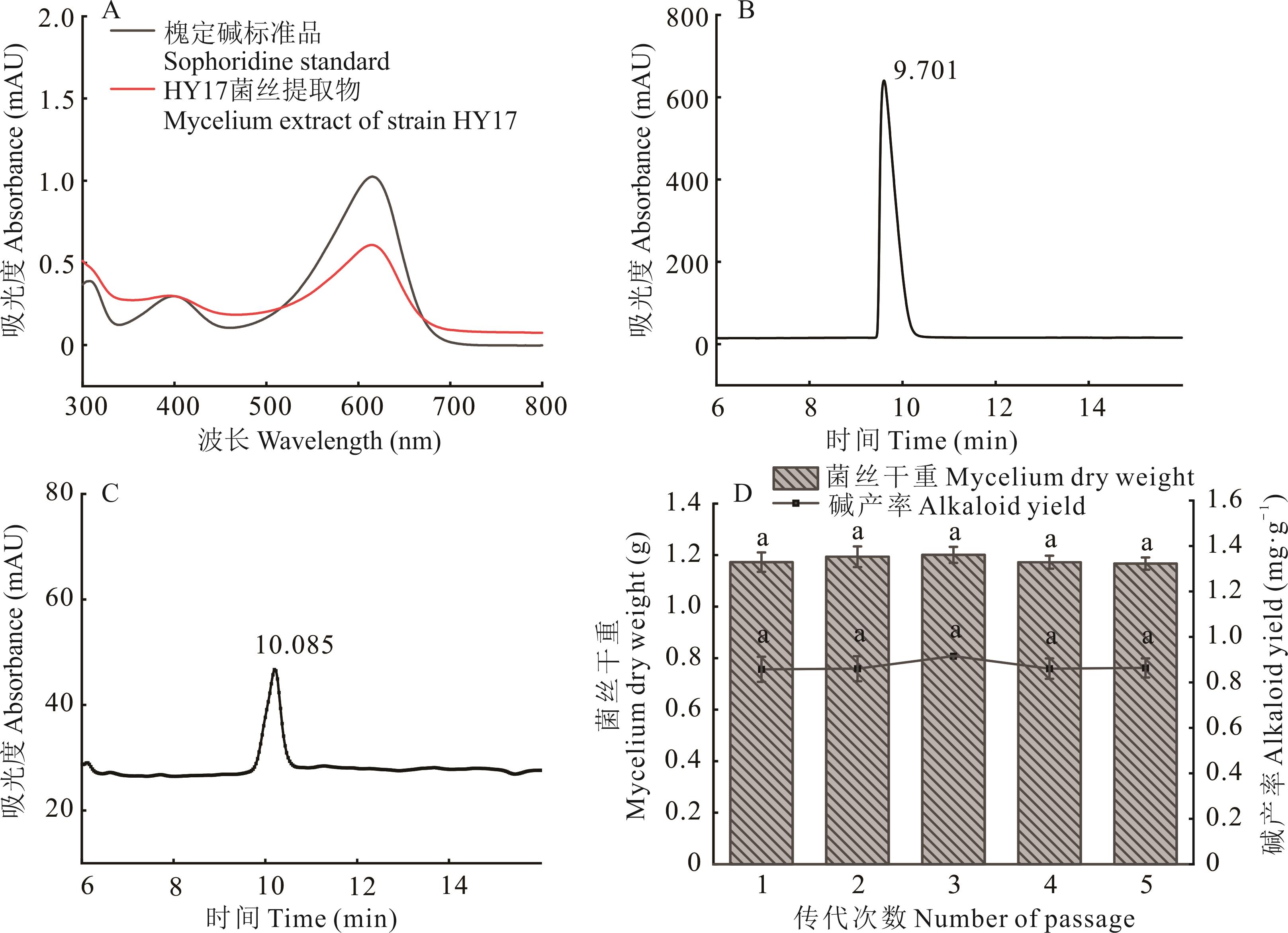
图1 苦豆子内生真菌产碱菌株的筛选A:槐定碱标准品与菌株HY17菌丝提取物扫描光谱图;B:槐定碱标准样品的HPLC图;C:菌株HY17菌丝提取液HPLC图;D:菌株HY17传代5次菌丝干重及碱产率。不同小写字母表示P<0.05水平差异显著,下同。A: Scanning spectra of sophoridine standard and mycelium extract of strain HY17; B: HPLC chromatogram of sophoridine standard sample; C: HPLC chromatogram of strain HY17 mycelium extract; D: Mycelium dry weight and alkaloid yield of strain HY17 in 5 passages. Different lowercase letters indicate significant differences (P<0.05). The same below.
Fig.1 Screening of alkali-producing strains of endophytic fungi from S. alopecuroides
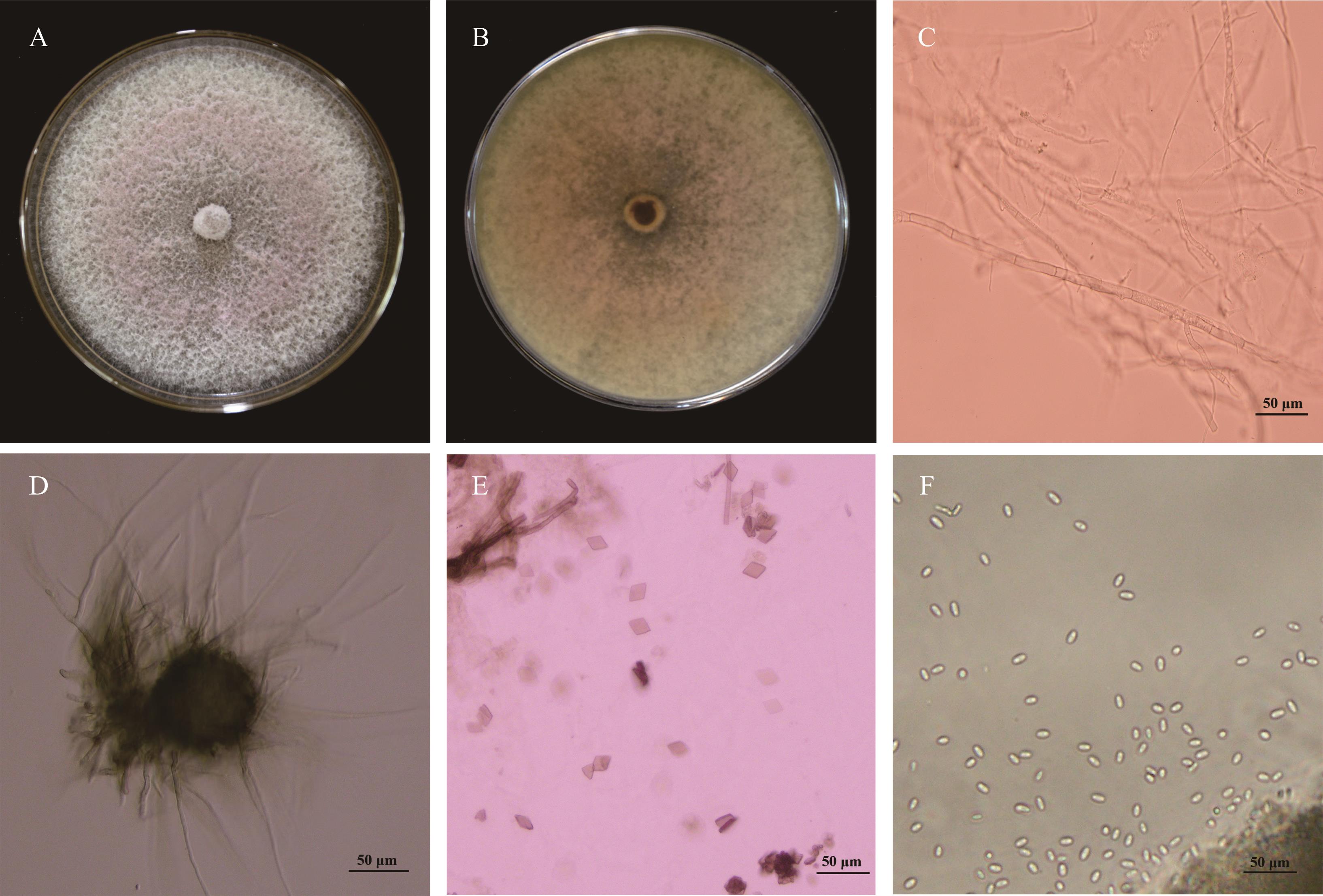
图2 苦豆子内生真菌菌株HY17的形态学鉴定A:菌落形态正面 Colony morphology frontal;B:菌落形态背面 Colony morphology dorsal;C:菌丝形态 Mycelial morphology;D:子囊壳形态 Mycelium morphology;E:子囊孢子形态 Spore morphology;F:厚膜孢子 Chlamydospore.
Fig.2 Morphological identification of the endophytic fungi strain HY17 from S. alopecuroides
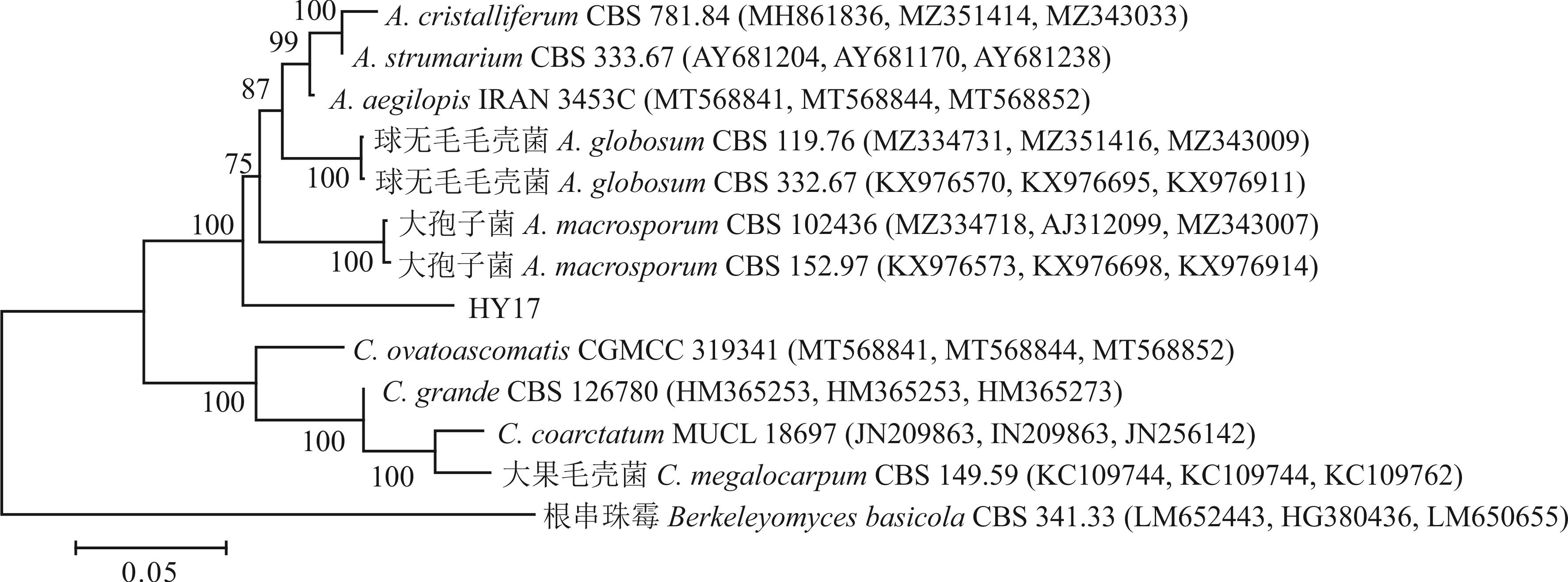
图3 苦豆子内生真菌菌株HY17基于ITS-LSU-TUB2构建的系统发育树
Fig.3 Phylogenetic tree based on ITS-LSU-TUB2 gene of the endophytic fungi strain HY17 from S. alopecuroides

图4 不同因素对苦豆子内生真菌菌株HY17菌丝干重及碱产率的影响
Fig.4 Effect of different factors on the mycelium dry weight and alkaloid yield of the endophytic fungi strain HY17 of S. alopecuroides
序号 No. | 因素 Factors | 菌丝干重 Mycelium dry weight (g) | 碱产率 Alkaloid yield (mg·g-1) | |||||||
|---|---|---|---|---|---|---|---|---|---|---|
| X1 | X2 | X3 | X4 | X5 | X6 | X7 | X8 | |||
| 1 | 1 | 0.16 | 0.02 | 5 | 1 | 1 | 0.1 | 5 | 0.81 | 1.94 |
| 2 | 1 | 0.80 | 0.01 | 2 | 1 | 1 | 0.1 | 2 | 1.04 | 1.34 |
| 3 | 2 | 0.08 | 0.02 | 5 | 1 | 2 | 0.5 | 5 | 1.65 | 1.18 |
| 4 | 1 | 0.16 | 0.01 | 5 | 4 | 1 | 0.5 | 5 | 1.03 | 1.27 |
| 5 | 2 | 0.08 | 0.02 | 5 | 4 | 1 | 0.1 | 2 | 1.06 | 1.23 |
| 6 | 2 | 0.08 | 0.01 | 2 | 4 | 1 | 0.5 | 5 | 2.51 | 1.67 |
| 7 | 2 | 0.16 | 0.01 | 5 | 4 | 2 | 0.1 | 2 | 0.96 | 1.30 |
| 8 | 1 | 0.08 | 0.02 | 2 | 4 | 2 | 0.1 | 5 | 1.33 | 2.05 |
| 9 | 2 | 0.16 | 0.01 | 2 | 1 | 2 | 0.1 | 5 | 1.33 | 2.05 |
| 10 | 1 | 0.16 | 0.02 | 2 | 4 | 2 | 0.5 | 2 | 0.49 | 2.82 |
| 11 | 1 | 0.08 | 0.01 | 5 | 1 | 2 | 0.5 | 2 | 0.64 | 1.98 |
| 12 | 2 | 0.16 | 0.02 | 2 | 1 | 1 | 0.5 | 2 | 0.89 | 1.51 |
表4 Plackett-Burman试验结果与分析
Table 4 Results and analysis of Plackett-Burman tests
序号 No. | 因素 Factors | 菌丝干重 Mycelium dry weight (g) | 碱产率 Alkaloid yield (mg·g-1) | |||||||
|---|---|---|---|---|---|---|---|---|---|---|
| X1 | X2 | X3 | X4 | X5 | X6 | X7 | X8 | |||
| 1 | 1 | 0.16 | 0.02 | 5 | 1 | 1 | 0.1 | 5 | 0.81 | 1.94 |
| 2 | 1 | 0.80 | 0.01 | 2 | 1 | 1 | 0.1 | 2 | 1.04 | 1.34 |
| 3 | 2 | 0.08 | 0.02 | 5 | 1 | 2 | 0.5 | 5 | 1.65 | 1.18 |
| 4 | 1 | 0.16 | 0.01 | 5 | 4 | 1 | 0.5 | 5 | 1.03 | 1.27 |
| 5 | 2 | 0.08 | 0.02 | 5 | 4 | 1 | 0.1 | 2 | 1.06 | 1.23 |
| 6 | 2 | 0.08 | 0.01 | 2 | 4 | 1 | 0.5 | 5 | 2.51 | 1.67 |
| 7 | 2 | 0.16 | 0.01 | 5 | 4 | 2 | 0.1 | 2 | 0.96 | 1.30 |
| 8 | 1 | 0.08 | 0.02 | 2 | 4 | 2 | 0.1 | 5 | 1.33 | 2.05 |
| 9 | 2 | 0.16 | 0.01 | 2 | 1 | 2 | 0.1 | 5 | 1.33 | 2.05 |
| 10 | 1 | 0.16 | 0.02 | 2 | 4 | 2 | 0.5 | 2 | 0.49 | 2.82 |
| 11 | 1 | 0.08 | 0.01 | 5 | 1 | 2 | 0.5 | 2 | 0.64 | 1.98 |
| 12 | 2 | 0.16 | 0.02 | 2 | 1 | 1 | 0.5 | 2 | 0.89 | 1.51 |
因素 Factors | 贡献度 Contribution (%) | 自由度 df | 均方 Mean square | F值 F-value | P值 P-value |
|---|---|---|---|---|---|
| X1 | 18.03 | 1 | 0.50 | 21.60 | 0.0143 |
| X2 | 14.12 | 1 | 0.25 | 15.14 | 0.0527 |
| X4 | 12.69 | 1 | 0.23 | 8.67 | 0.0635 |
| X5 | 9.20 | 1 | 0.31 | 6.47 | 0.1213 |
| X7 | 7.79 | 1 | 1.38 | 15.41 | 0.1111 |
| X1X3 | 1.38 | 1.38 | 15.41 | 0.01 | 0.1196 |
| X1X4 | 0.32 | 0.3159 | 3.52 | 0.11 | |
| 残差Residual | 0.45 | 0.0898 | |||
| 综合Cor total | 2.63 |
表5 各试验因素的效应分析
Table 5 Effect analysis of each experimental factor
因素 Factors | 贡献度 Contribution (%) | 自由度 df | 均方 Mean square | F值 F-value | P值 P-value |
|---|---|---|---|---|---|
| X1 | 18.03 | 1 | 0.50 | 21.60 | 0.0143 |
| X2 | 14.12 | 1 | 0.25 | 15.14 | 0.0527 |
| X4 | 12.69 | 1 | 0.23 | 8.67 | 0.0635 |
| X5 | 9.20 | 1 | 0.31 | 6.47 | 0.1213 |
| X7 | 7.79 | 1 | 1.38 | 15.41 | 0.1111 |
| X1X3 | 1.38 | 1.38 | 15.41 | 0.01 | 0.1196 |
| X1X4 | 0.32 | 0.3159 | 3.52 | 0.11 | |
| 残差Residual | 0.45 | 0.0898 | |||
| 综合Cor total | 2.63 |
试验号 No. | 因素 Factors (g·L-1) | 菌丝干重 Mycelium dry weight (g) | 碱产率 Alkaloid yield (mg·g-1) | ||
|---|---|---|---|---|---|
L-赖氨酸 L-lysine | L-哌啶酸 L-piperidinic acids | 苯丙氨酸 Phenylalanine | |||
| 1 | 0.75 | 0.06 | 1.25 | 1.21 | 0.35 |
| 2 | 1.00 | 0.08 | 2.00 | 1.24 | 0.49 |
| 3 | 1.25 | 0.10 | 2.75 | 1.20 | 0.14 |
| 4 | 1.50 | 0.12 | 3.50 | 0.98 | 0.21 |
| 5 | 1.75 | 0.14 | 4.25 | 1.05 | 0.21 |
| 6 | 2.00 | 0.16 | 5.00 | 0.70 | 0.38 |
| 7 | 2.25 | 0.18 | 5.75 | 0.85 | 0.23 |
| 8 | 2.50 | 0.20 | 6.50 | 0.55 | 0.14 |
表6 最陡爬坡试验及结果
Table 6 Steepest climb tests and results
试验号 No. | 因素 Factors (g·L-1) | 菌丝干重 Mycelium dry weight (g) | 碱产率 Alkaloid yield (mg·g-1) | ||
|---|---|---|---|---|---|
L-赖氨酸 L-lysine | L-哌啶酸 L-piperidinic acids | 苯丙氨酸 Phenylalanine | |||
| 1 | 0.75 | 0.06 | 1.25 | 1.21 | 0.35 |
| 2 | 1.00 | 0.08 | 2.00 | 1.24 | 0.49 |
| 3 | 1.25 | 0.10 | 2.75 | 1.20 | 0.14 |
| 4 | 1.50 | 0.12 | 3.50 | 0.98 | 0.21 |
| 5 | 1.75 | 0.14 | 4.25 | 1.05 | 0.21 |
| 6 | 2.00 | 0.16 | 5.00 | 0.70 | 0.38 |
| 7 | 2.25 | 0.18 | 5.75 | 0.85 | 0.23 |
| 8 | 2.50 | 0.20 | 6.50 | 0.55 | 0.14 |
序号 No. | L-赖氨酸 L-lysine (g·L-1) | L-哌啶酸 L-piperidinic acids (g·L-1) | 苯丙氨酸 Phenylalanine (g·L-1) | 碱产率 Alkaloid yield (mg·g-1) | 序号 No. | L-赖氨酸 L-lysine (g·L-1) | L-哌啶酸 L-piperidinic acids (g·L-1) | 苯丙氨酸 Phenylalanine (g·L-1) | 碱产率 Alkaloid yield (mg·g-1) |
|---|---|---|---|---|---|---|---|---|---|
| 1 | 0.5 | 0.08 | 3.5 | 0.667 | 10 | 1.5 | 0.04 | 2.0 | 0.767 |
| 2 | 1.0 | 0.08 | 2.0 | 1.232 | 11 | 1.0 | 0.12 | 0.5 | 0.839 |
| 3 | 1.5 | 0.08 | 0.5 | 0.810 | 12 | 1.0 | 0.08 | 2.0 | 1.424 |
| 4 | 0.5 | 0.04 | 2.0 | 0.700 | 13 | 1.5 | 0.08 | 3.5 | 1.054 |
| 5 | 1.0 | 0.08 | 2.0 | 1.414 | 14 | 1.5 | 0.12 | 2.0 | 0.810 |
| 6 | 1.0 | 0.04 | 3.5 | 0.772 | 15 | 1.0 | 0.04 | 0.5 | 0.877 |
| 7 | 1.0 | 0.08 | 2.0 | 1.359 | 16 | 1.0 | 0.08 | 2.0 | 1.396 |
| 8 | 0.5 | 0.12 | 2.0 | 0.751 | 17 | 1.0 | 0.12 | 3.5 | 0.847 |
| 9 | 0.5 | 0.08 | 0.5 | 0.917 |
表7 响应面设计方案及结果
Table 7 Experimental design scheme for response surface methodology and results
序号 No. | L-赖氨酸 L-lysine (g·L-1) | L-哌啶酸 L-piperidinic acids (g·L-1) | 苯丙氨酸 Phenylalanine (g·L-1) | 碱产率 Alkaloid yield (mg·g-1) | 序号 No. | L-赖氨酸 L-lysine (g·L-1) | L-哌啶酸 L-piperidinic acids (g·L-1) | 苯丙氨酸 Phenylalanine (g·L-1) | 碱产率 Alkaloid yield (mg·g-1) |
|---|---|---|---|---|---|---|---|---|---|
| 1 | 0.5 | 0.08 | 3.5 | 0.667 | 10 | 1.5 | 0.04 | 2.0 | 0.767 |
| 2 | 1.0 | 0.08 | 2.0 | 1.232 | 11 | 1.0 | 0.12 | 0.5 | 0.839 |
| 3 | 1.5 | 0.08 | 0.5 | 0.810 | 12 | 1.0 | 0.08 | 2.0 | 1.424 |
| 4 | 0.5 | 0.04 | 2.0 | 0.700 | 13 | 1.5 | 0.08 | 3.5 | 1.054 |
| 5 | 1.0 | 0.08 | 2.0 | 1.414 | 14 | 1.5 | 0.12 | 2.0 | 0.810 |
| 6 | 1.0 | 0.04 | 3.5 | 0.772 | 15 | 1.0 | 0.04 | 0.5 | 0.877 |
| 7 | 1.0 | 0.08 | 2.0 | 1.359 | 16 | 1.0 | 0.08 | 2.0 | 1.396 |
| 8 | 0.5 | 0.12 | 2.0 | 0.751 | 17 | 1.0 | 0.12 | 3.5 | 0.847 |
| 9 | 0.5 | 0.08 | 0.5 | 0.917 |
方差来源 Source | 平方和 Sum of squares | 自由度 df | 均方 Mean square | F值 F-value | P值 P-value |
|---|---|---|---|---|---|
| 模型Model | 1.1500 | 9 | 0.1276 | 31.880 | <0.0001 |
| X1 | 0.0206 | 1 | 0.0206 | 5.1400 | 0.0578 |
| X2 | 0.0021 | 1 | 0.0021 | 0.5359 | 0.4879 |
| X3 | 0.0013 | 1 | 0.0013 | 0.3296 | 0.5839 |
| X1X2 | 0.0000 | 1 | 0.0000 | 0.0041 | 0.9510 |
| X1X3 | 0.0611 | 1 | 0.0611 | 15.270 | 0.0058 |
| X2X3 | 0.0032 | 1 | 0.0032 | 0.8005 | 0.4007 |
| X12 | 0.3466 | 1 | 0.3466 | 86.550 | <0.0001 |
| X22 | 0.4195 | 1 | 0.4195 | 104.75 | <0.0001 |
| X32 | 0.1865 | 1 | 0.1865 | 46.570 | 0.0002 |
| 残差Residual | 0.028 | 7 | 0.004 | ||
| 失拟项Lack of fit | 0.0044 | 3 | 0.0015 | 0.2499 | 0.8580 |
| 纯误差Pure error | 0.0236 | 4 | 0.0059 | ||
| 综合Cor total | 1.1800 | 16 |
表8 响应面二次模型方差分析
Table 8 Response surface quadratic model ANOVA
方差来源 Source | 平方和 Sum of squares | 自由度 df | 均方 Mean square | F值 F-value | P值 P-value |
|---|---|---|---|---|---|
| 模型Model | 1.1500 | 9 | 0.1276 | 31.880 | <0.0001 |
| X1 | 0.0206 | 1 | 0.0206 | 5.1400 | 0.0578 |
| X2 | 0.0021 | 1 | 0.0021 | 0.5359 | 0.4879 |
| X3 | 0.0013 | 1 | 0.0013 | 0.3296 | 0.5839 |
| X1X2 | 0.0000 | 1 | 0.0000 | 0.0041 | 0.9510 |
| X1X3 | 0.0611 | 1 | 0.0611 | 15.270 | 0.0058 |
| X2X3 | 0.0032 | 1 | 0.0032 | 0.8005 | 0.4007 |
| X12 | 0.3466 | 1 | 0.3466 | 86.550 | <0.0001 |
| X22 | 0.4195 | 1 | 0.4195 | 104.75 | <0.0001 |
| X32 | 0.1865 | 1 | 0.1865 | 46.570 | 0.0002 |
| 残差Residual | 0.028 | 7 | 0.004 | ||
| 失拟项Lack of fit | 0.0044 | 3 | 0.0015 | 0.2499 | 0.8580 |
| 纯误差Pure error | 0.0236 | 4 | 0.0059 | ||
| 综合Cor total | 1.1800 | 16 |
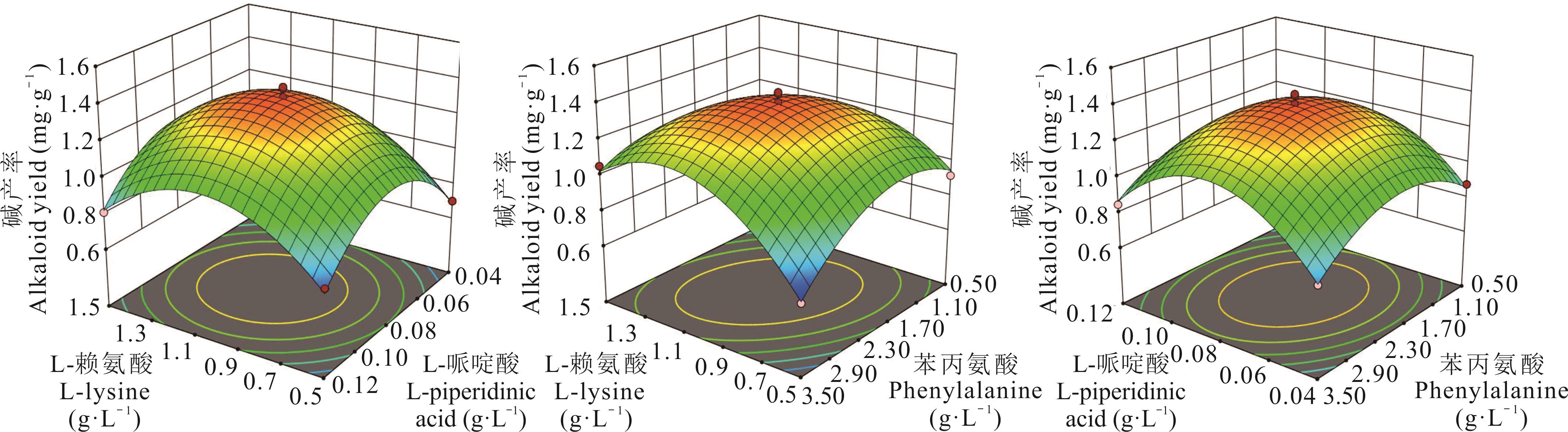
图5 各因素交互作用对菌株碱产率影响的响应面图
Fig.5 Response surface plot of the effect of interaction of factors on alkaloid yield
| [1] | Ren G, Ding G T, Zhang H Y, et al. Antiviral activity of sophoridine against enterovirus 71 in vitro. Journal of Ethnopharmacology, 2019, 236: 124-128. |
| [2] | Ma T, Yan H, Shi X L, et al. Comprehensive evaluation of effective constituents in total alkaloids from Sophora alopecuroides L. and their joint action against aphids by laboratory toxicity and field efficacy. Industrial Crops and Products, 2018, 111: 149-157. |
| [3] | Wang R, Deng X, Gao Q, et al. Sophora alopecuroides L.: An ethnopharmacological, phytochemical, and pharmacological review. Journal of Ethnopharmacology, 2020, 248: 112172. |
| [4] | Song X H, Pan Y, Li L Y, et al. Composition and diversity of rhizosphere fungal community in Coptis chinensis Franch. continuous cropping fields. Public Library of Science One, 2018, 13(3): e0193811. |
| [5] | Zhang G. An endophytic fungus from Gamptotheca acuminate that produce GPT and research of biology of GPT. Guiyang: Guizhou University, 2007. |
| 张根. 产喜树碱内生真菌的分离、鉴定及生物学活性研究. 贵阳: 贵州大学, 2007. | |
| [6] | Gao L, Wang K X, Zhou Y Z, et al. Uncovering the anticancer mechanism of compound kushen injection against HCC by integrating quantitative analysis, network analysis and experimental validation. Scientific Reports, 2018, 8(1): 624. |
| [7] | Cao X, Xu L, Wang J, et al. Endophytic fungus Pseudodidymocyrtis lobariellae KL27 promotes taxol biosynthesis and accumulation in Taxus chinensis. BMC Plant Biology, 2022, 22(1): 1-18. |
| [8] | Toghueo R M K, Sahal D, Zabalgogeazcoa Í, et al. Conditioned media and organic elicitors underpin the production of potent antiplasmodial metabolites by endophytic fungi from Cameroonian medicinal plants. Parasitology Research, 2018, 117: 2473-2485. |
| [9] | Kusari S, Hertweck C, Spitellert M. Chemical ecology of endophytic fungi: origins of secondary metabolites. Chemistry & Biology, 2012, 19(7): 792-798. |
| [10] | Luo D, Lin Q, Tan J L, et al. Water-soluble matrine-type alkaloids with potential anti-neuroinflammatory activities from the seeds of Sophora alopecuroides. Bioorganic Chemistry, 2021, 116: 105337. |
| [11] | Ju M X, Zhang Q, Wang R, et al. Correlation in endophytic fungi community diversity and bioactive compounds of Sophora alopecuroides. Frontiers in Microbiology, 2022, 13: 955647. |
| [12] | Yu Y T, He S H, Zhao Q M. Isolation and identification of matrine-producing fungal endophytes from Sophora alopecuroides in Ningxia. Scientia Agricultura Sinica, 2013, 46(13): 2643-2654. |
| 余永涛, 何生虎, 赵清梅. 宁夏苦豆子中产苦参碱内生真菌的分离与鉴定. 中国农业科学, 2013, 46(13): 2643-2654. | |
| [13] | Cao K, Chen J, Lu X, et al. Matrine-producing endophytic fungus Galactomyces candidum TRP-7: Screening, identification, and fermentation conditions optimization for matrine production. Biotechnology Letters, 2023, 45(2): 209-223. |
| [14] | Cook D, Gardner D R, Grum D, et al. Swainsonine and endophyte relationships in Astragalus mollissimus and Astragalus lentiginosus. Journal of Agricultural and Food Chemistry, 2011, 59(4): 1281-1287. |
| [15] | Chen Q, Wang J, Gao Y, et al. Optimization of fermentation conditions and product identification of a saponin-producing endophytic fungus. Microorganisms, 2023, 11(9): 2331. |
| [16] | Yang G D. Study on biosynthesis of swainsonine by the locoweed’s endophytic fungi. Yangling: Northwest A & F University, 2012. |
| 杨国栋. 疯草内生真菌合成苦马豆素的研究. 杨凌: 西北农林科技大学, 2012. | |
| [17] | Zhuang J H, Gao Z G, Liu X, et al. Effect of fermentation factors on spore types of Trichoderma strain 23. Chinese Journal of Biological Control, 2005, 21(1): 37-40. |
| 庄敬华, 高增贵, 刘限, 等. 不同发酵条件对木霉产孢类型的影响. 中国生物防治学报, 2005, 21(1): 37-40. | |
| [18] | Li Q N, Yin Y F, Ma Y, et al. Study on the optimum medium and concentration of fly maggot-killing conidia of Metarhizium brunneum. Heilongjiang Animal Science and Veterinary Medicine, 2024(8): 60-67, 76. |
| 李倩楠, 尹衍峰, 马园, 等. 棕色绿僵菌最适培养基和杀蝇蛆分生孢子浓度探究. 黑龙江畜牧兽医, 2024(8): 60-67, 76. | |
| [19] | Jin J. Screening and optimization of alkaloid-producing endophytic fungi of Sophora alopecuroides L. for quinolizidine alkaloids. Yinchuan: Ningxia University, 2022. |
| 金婧. 产喹诺里西啶生物碱苦豆子内生真菌的筛选与产碱条件的优化. 银川: 宁夏大学, 2022. | |
| [20] | Henzelyová J, Antalová M, Nigutová K, et al. Isolation, characterization and targeted metabolic evaluation of endophytic fungi harbored in 14 seed-derived Hypericum species. Planta Medica, 2020, 86(13/14): 997-1008. |
| [21] | Wang W K, Ju M X, Jin J, et al. Screening of alkaloid-producing endophytic fungi from Sophora alopecuroides and optimization of their fermentation conditions. Acta Agrestia Sinica, 2025, 33(1): 307-316. |
| 王文凯, 鞠明岫, 金婧, 等. 产生物碱苦豆子内生真菌筛选及其发酵条件优化. 草地学报, 2025, 33(1): 307-316. | |
| [22] | Ju M X, Zhang Q Q, Wang R T, et al. Community ecological succession of endophytic fungi associates with medicinal compound accumulation in Sophora alopecuroides. Microbiological Spectrum, 2024, 12(2): e03076-23. |
| [23] | Wang Q, Li Y, Li K W, et al. Sophoridine: A review of its pharmacology, pharmacokinetics and toxicity. Phytomedicine, 2022, 95: 153756. |
| [24] | Zhang X G, Guo S J, Wang W N, et al. Diversity and bioactivity of endophytes from Angelica sinensis in China. Frontiers in Microbiology, 2020, 11: 1489. |
| [25] | Berbee M L, Pirseyedi M, Hubbard S. Cochliobolus phylogenetics and the origin of known, highly virulent pathogens, inferred from ITS and glyceraldehyde-3-phosphate dehydrogenase gene sequences. Mycologia, 1999, 91(6): 964-977. |
| [26] | Dwibedi V, Rath S K, Jain S, et al. Key insights into secondary metabolites from various Chaetomium species. Applied Microbiology and Biotechnology, 2023, 107(4): 1077-1093. |
| [27] | Anitha K P G U, Mythili S. Antioxidant and hepatoprotective potentials of novel endophytic fungus Achaetomium sp., from Euphorbia hirta. Asian Pacific Journal of Tropical Medicine, 2017, 10(6): 588-593. |
| [28] | Zhou W, Cai M, Na K, et al. pH-dependent accumulation of anticancer compound on mycelia in fermentation of marine fungus. Journal of Industrial Microbiology and Biotechnology, 2014, 41(7): 1169-1173. |
| [29] | Hu Z, Weng Q, Cai Z, et al. Optimization of fermentation conditions and medium components for chrysomycin a production by Streptomyces sp. 891-B6. BMC Microbiology, 2024, 24(1): 120. |
| [30] | Zhang Y H, Li H, Zhang M Q, et al. Identification of a cellulose-degrading bacteria from silkworm excrement and optimization of enzyme production and its bioaugmentation effect. Acta Sericologica Sinica, 2023, 49(6): 551-559. |
| 张元昊, 李豪, 张敏琪, 等. 一株蚕沙纤维素降解菌的鉴定及产酶优化和生物强化效果. 蚕业科学, 2023, 49(6): 551-559. | |
| [31] | Wu X L. Studies on feather-degrading Flavobacterium breve ZDM, the fermentation conditions and characteristics of keratinase. Hangzhou: Zhejiang University, 2001. |
| 吴小伦. 羽毛角蛋白降解菌(Flavobacterium breve ZDM)的分离、鉴定及其发酵产酶条件和酶学特性的研究. 杭州: 浙江大学, 2001. | |
| [32] | Tang Q, Liu Y, Peng X, et al. Research progress in the pharmacological activities, toxicities, and pharmacokinetics of sophoridine and its derivatives. Drug Design, Development and Therapy, 2023, 16: 191-212. |
| [33] | Wei Z J, Zhou L C, Chen H, et al. Optimization of the fermentation conditions for 1-deoxynojirimycin production by Streptomyces lawendulae applying the response surface methodology. International Journal of Food Engineering, 2011, 7(3), 10.2202/1556-3758.2354. |
| [34] | Chen D, Sheng W, Wang D, et al. Effective purification of high concentration chromium-containing wastewater and preparation of chromium ferrite. Environmental Engineering Research, 2023, 28(6): 220706. |
| [35] | Venugopalan A, Srivastava S. Endophytes as in vitro production platforms of high value plant secondary metabolites. Biotechnology Advances, 2015, 33(6): 873-887. |
| [36] | Pu X, Qu X, Chen F, et al. Camptothecin-producing endophytic fungus Trichoderma atroviride LY357: Isolation, identification, and fermentation conditions optimization for camptothecin production. Applied Microbiology and Biotechnology, 2013, 97: 9365-9375. |
| [37] | Zhao X M, Wang Z Q, Shu S H, et al. Ethanol and methanol can improve huperzine A production from endophytic Colletotrichum gloeosporioides ES026. PLoS One, 2013, 8(4): e61777. |
| [38] | Li Y, Wang G, Liu J, et al. Quinolizidine alkaloids derivatives from Sophora alopecuroides Linn: Bioactivities, structure-activity relationships and preliminary molecular mechanisms. European Journal of Medicinal Chemistry, 2020, 188: 111972. |
| [39] | Ramírez-Betancourt A, Hernández-Sánchez A M, Salcedo-Morales G, et al. Unraveling the biosynthesis of quinolizidine alkaloids using the genetic and chemical diversity of mexican lupins. Diversity, 2021, 13(8): 375. |
| [40] | Bunsupa S, Yamazaki M, Saito K. Quinolizidine alkaloid biosynthesis: Recent advances and future prospects. Frontiers in Plant Science, 2012, 3: 239. |
| [41] | Zhang L L, Yu Y T, He S H, et al. Influence of different factors on swainsonine production in fungal endophyte from locoweed. Chinese Journal of Animal Husbandry and Veterinary Medicine, 2015, 46(1): 163-173. |
| 张蕾蕾, 余永涛, 何生虎, 等. 不同因素对疯草内生真菌合成苦马豆素的影响. 畜牧兽医学报, 2015, 46(1): 163-173. |
| No related articles found! |
| 阅读次数 | ||||||
|
全文 |
|
|||||
|
摘要 |
|
|||||
