

ISSN 1004-5759 CN 62-1105/S
草业学报 ›› 2025, Vol. 34 ›› Issue (11): 1-16.DOI: 10.11686/cyxb2024494
• 研究论文 •
吕毅1( ), 夏咏1, 李先东1,2(), 王福红1,3, 赵兰兰1, 丁宁1
收稿日期:2024-12-19
修回日期:2025-02-27
出版日期:2025-11-20
发布日期:2025-10-09
通讯作者:
李先东
作者简介:E-mail: xjxiandong@nwafu.edu.cn基金资助:
Yi LYU1(), Yong XIA1, Xian-dong LI1,2(), Fu-hong WANG1,3, Lan-lan ZHAO1, Ning DING1
Received:2024-12-19
Revised:2025-02-27
Online:2025-11-20
Published:2025-10-09
Contact:
Xian-dong LI
摘要:
“双碳”目标下推进畜牧业生态效率提升,是推动畜牧业可持续发展的重要途径,对现代畜牧业建设具有重要意义。综合运用Super-SBM模型测度2006-2020年新疆37个牧业县、半农半牧业县畜牧业生态效率,采用核密度估计、ArcGIS软件进行时空演化特征分析,进而建立空间杜宾模型探析畜牧业生产性服务业对畜牧业生态效率的空间效应。数据分析显示:研究期内新疆畜牧业生态效率呈波动上升趋势,介于0.50~0.65,且南疆的生态效率高于北疆,牧业县高于半农半牧业县。具体而言,新疆畜牧业生态效率表现为区域差异性和空间集聚性,南疆牧业县>南疆半农半牧业县>新疆整体均值>北疆牧业县>北疆半农半牧县,呈“南高北低”的空间特征。实证结果表明,生产性服务业能够显著提升畜牧业生态效率,且具有一定的正向空间溢出效应。为此,研究建议通过完善生产性服务体系建设,提升畜牧业生产性服务业水平;加强区域间的协作与沟通,发挥畜牧业生产性服务业对区域间畜牧业生态效率水平的拉动作用,实现畜牧业可持续发展。
吕毅, 夏咏, 李先东, 王福红, 赵兰兰, 丁宁. 生产性服务业对畜牧业生态效率的空间效应研究——以新疆为例[J]. 草业学报, 2025, 34(11): 1-16.
Yi LYU, Yong XIA, Xian-dong LI, Fu-hong WANG, Lan-lan ZHAO, Ning DING. Spatial effects of producer services on livestock eco-efficiency: an example from Xinjiang[J]. Acta Prataculturae Sinica, 2025, 34(11): 1-16.
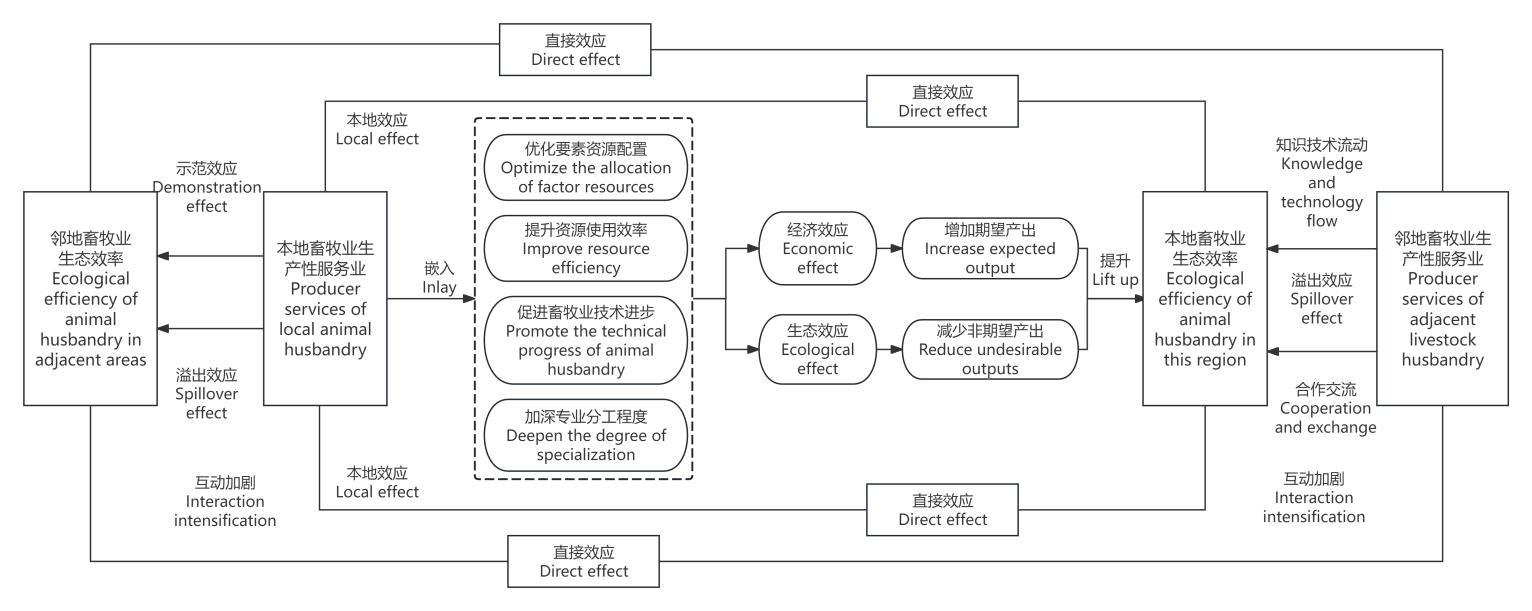
图1 生产性服务业对畜牧业生态效率的影响机理
Fig.1 Mechanism of impact of producer services on eco-efficiency of animal husbandry
类别 Category | 构成 Constitute | 具体指标 Specific index |
|---|---|---|
投入指标 Input index | 资本投入Capital input | 农牧业机械总动力(万kW·h-1) Total power of agricultural and animal husbandry machinery (×104 kW·h-1) |
| 劳动力投入Labor input | 畜牧业就业人数(人) Number of employed persons in animal husbandry (persons) | |
| 土地投入Land input | 可利用草原面积与耕地面积(千hm2) Available grassland area and cultivated land area (×103 hm2) | |
| 自然投入Natural input | NPP均值(反映草地生产能力) NPP mean (reflects grassland quality and productivity) | |
| NDVI均值(反映草地覆盖状况) Average NDVI (reflects the status of grassland cover) | ||
期望产出 Expected output | 畜牧业产值Output value of animal husbandry | 以不变价计算的畜牧业总产值(亿元) Total output value of animal husbandry at constant prices (×108 CNY) |
非期望产出 Undesirable output | 畜牧业碳排放Carbon emission of animal husbandry | 排放因子法测算畜牧业碳排放CO2当量 Estimation of CO2 equivalent of carbon emissions from animal husbandry by emission factor method (t·head-1·a-1) |
| 牲畜粪便污染指数Livestock manure pollution index | 根据产污系数测算牲畜粪便中污染物含量 Measurement of pollutant content in livestock manure based on pollution production coefficient (t·head-1·a-1) |
表1 畜牧业生态效率评价指标体系
Table 1 Ecological efficiency evaluation index system of animal husbandry
类别 Category | 构成 Constitute | 具体指标 Specific index |
|---|---|---|
投入指标 Input index | 资本投入Capital input | 农牧业机械总动力(万kW·h-1) Total power of agricultural and animal husbandry machinery (×104 kW·h-1) |
| 劳动力投入Labor input | 畜牧业就业人数(人) Number of employed persons in animal husbandry (persons) | |
| 土地投入Land input | 可利用草原面积与耕地面积(千hm2) Available grassland area and cultivated land area (×103 hm2) | |
| 自然投入Natural input | NPP均值(反映草地生产能力) NPP mean (reflects grassland quality and productivity) | |
| NDVI均值(反映草地覆盖状况) Average NDVI (reflects the status of grassland cover) | ||
期望产出 Expected output | 畜牧业产值Output value of animal husbandry | 以不变价计算的畜牧业总产值(亿元) Total output value of animal husbandry at constant prices (×108 CNY) |
非期望产出 Undesirable output | 畜牧业碳排放Carbon emission of animal husbandry | 排放因子法测算畜牧业碳排放CO2当量 Estimation of CO2 equivalent of carbon emissions from animal husbandry by emission factor method (t·head-1·a-1) |
| 牲畜粪便污染指数Livestock manure pollution index | 根据产污系数测算牲畜粪便中污染物含量 Measurement of pollutant content in livestock manure based on pollution production coefficient (t·head-1·a-1) |
变量名称 Variable name | 项目 Items | 界定 Define | 均值 Mean | 标准差Standard deviation |
|---|---|---|---|---|
| 被解释变量Variable explained | 畜牧业生态效率Animal husbandry ecological efficiency (LEE) | 由非期望产出的Super-SBM模型测算Measured by Super-SBM model of non-expected output | 0.588 | 0.468 |
| 核心解释变量Core explanatory variable | 畜牧业生产性服务业Livestock productive services (LPSI) | 畜牧业产值/农林牧渔机械总产值×农林牧渔服务业产值Output value of animal husbandry/total output value of agriculture, forestry, husbandry and fishery machinery×output value of agriculture, forestry, husbandry and fishery service industry | 1057.520 | 1054.165 |
| 控制变量Control variable | 牲畜存栏量Livestock stock (LI) | 牲畜数量Number of livestock | 75.699 | 38.033 |
| 畜牧业技术水平Animal husbandry technical level (LTL) | 畜牧业机械总动力/畜牧业产值Animal husbandry machinery total power/animal husbandry output value | 3.181 | 3.098 | |
| 人口城镇化率Urbanization rate (PUR) | 城镇人口/年末常住人口Urban population/permanent population at the end of the year | 0.428 | 0.217 | |
| 畜牧业经济发展水平Animal husbandry economic development level (LEDL) | 畜牧业总产值/畜牧业就业人数Total output value of animal husbandry/number of employed persons in animal husbandry | 4.500 | 3.792 | |
| 降水量Precipitation (PRE) | 降水量Precipitation | 17.418 | 9.864 |
表2 变量描述性统计
Table 2 Descriptive statistics of variables
变量名称 Variable name | 项目 Items | 界定 Define | 均值 Mean | 标准差Standard deviation |
|---|---|---|---|---|
| 被解释变量Variable explained | 畜牧业生态效率Animal husbandry ecological efficiency (LEE) | 由非期望产出的Super-SBM模型测算Measured by Super-SBM model of non-expected output | 0.588 | 0.468 |
| 核心解释变量Core explanatory variable | 畜牧业生产性服务业Livestock productive services (LPSI) | 畜牧业产值/农林牧渔机械总产值×农林牧渔服务业产值Output value of animal husbandry/total output value of agriculture, forestry, husbandry and fishery machinery×output value of agriculture, forestry, husbandry and fishery service industry | 1057.520 | 1054.165 |
| 控制变量Control variable | 牲畜存栏量Livestock stock (LI) | 牲畜数量Number of livestock | 75.699 | 38.033 |
| 畜牧业技术水平Animal husbandry technical level (LTL) | 畜牧业机械总动力/畜牧业产值Animal husbandry machinery total power/animal husbandry output value | 3.181 | 3.098 | |
| 人口城镇化率Urbanization rate (PUR) | 城镇人口/年末常住人口Urban population/permanent population at the end of the year | 0.428 | 0.217 | |
| 畜牧业经济发展水平Animal husbandry economic development level (LEDL) | 畜牧业总产值/畜牧业就业人数Total output value of animal husbandry/number of employed persons in animal husbandry | 4.500 | 3.792 | |
| 降水量Precipitation (PRE) | 降水量Precipitation | 17.418 | 9.864 |
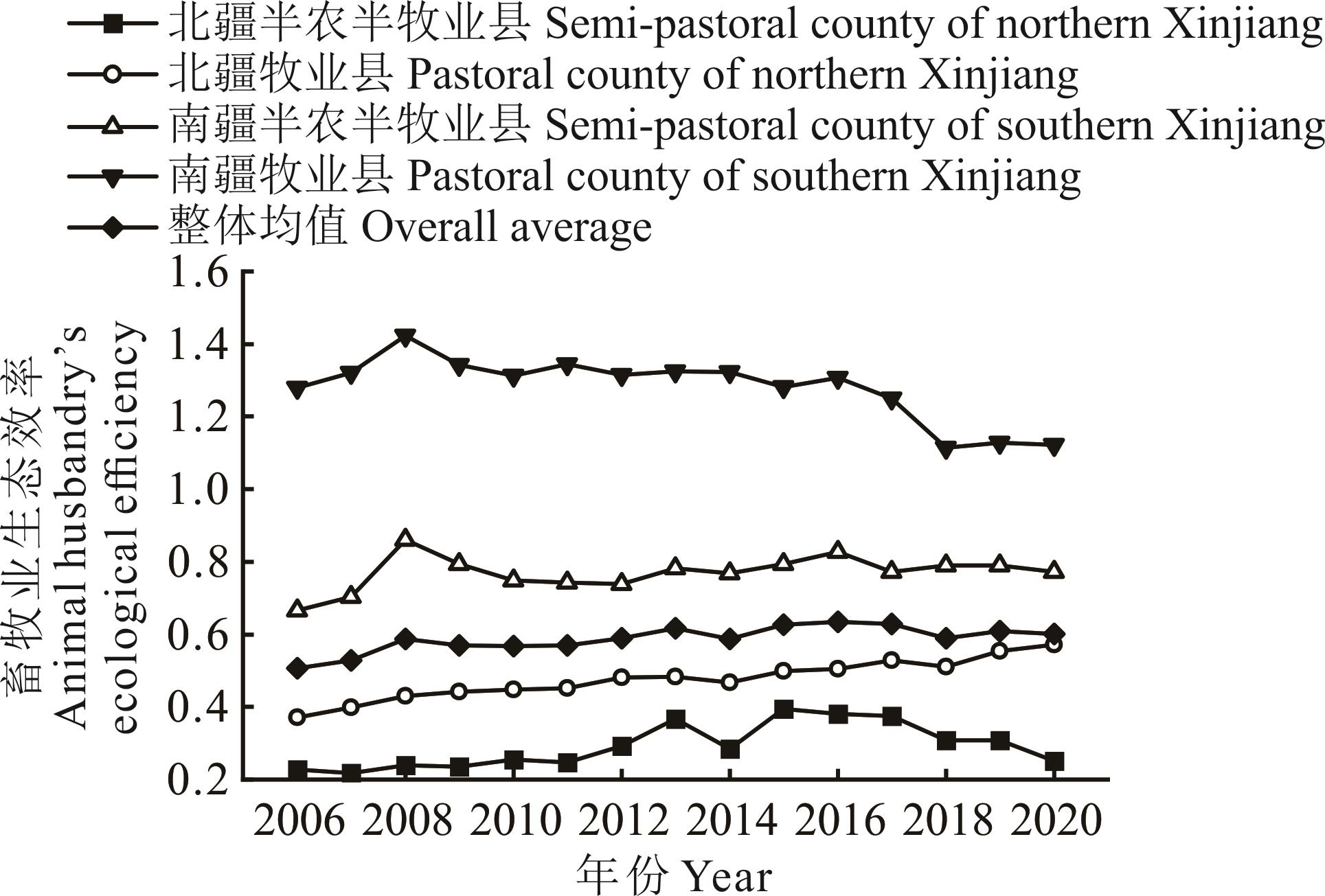
图2 2006-2020年新疆畜牧业生态效率变动趋势
Fig.2 Change trend of ecological efficiency of animal husbandry in Xinjiang from 2006 to 2020

图3 新疆畜牧业生态效率空间分布基于自然资源部标准地图服务网站(http://bzdt.ch.mnr.gov.cn/)GS(2022)1873号标准地图制作,底图边界无修改。Based on the standard map service website of the Ministry of Natural Resources (http://bzdt.ch.mnr.gov.cn/) No. GS (2022) 1873 standard map, the base map boundary has not been modified.
Fig.3 Spatial distribution of ecological efficiency of animal husbandry in Xinjiang
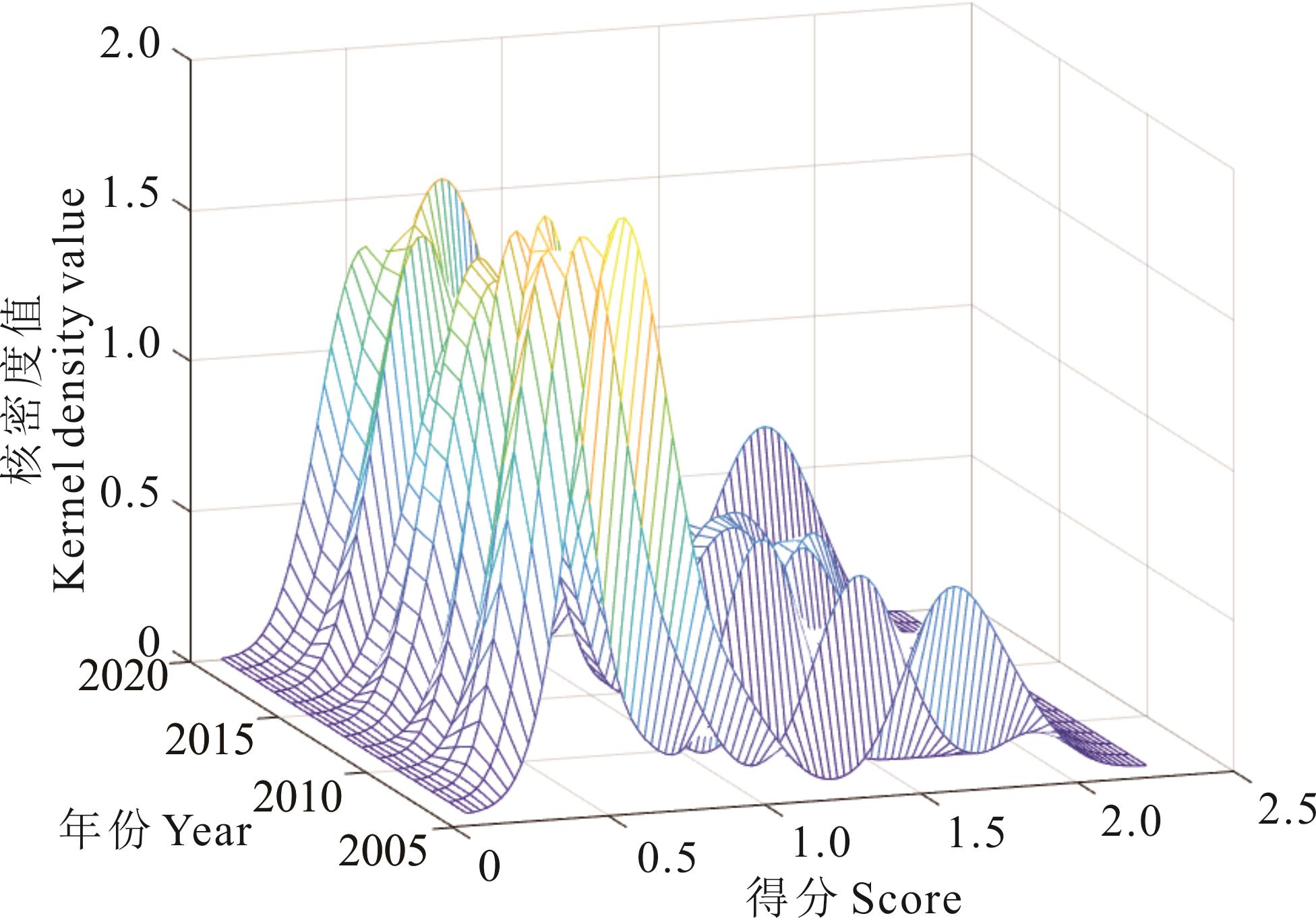
图4 新疆畜牧业生态效率核密度估计
Fig.4 Estimation of Kernel density of animal husbandry eco-efficiency in Xinjiang
年份 Year | Moran’s I | Z值 Z-value | 年份 Year | Moran’s I | Z值 Z-value |
|---|---|---|---|---|---|
| 2006 | 0.374*** | 3.272 | 2014 | 0.400*** | 3.483 |
| 2007 | 0.389*** | 3.394 | 2015 | 0.338*** | 2.975 |
| 2008 | 0.367*** | 3.210 | 2016 | 0.333*** | 2.938 |
| 2009 | 0.308*** | 2.729 | 2017 | 0.273*** | 2.448 |
| 2010 | 0.345*** | 3.032 | 2018 | 0.299*** | 2.657 |
| 2011 | 0.355*** | 3.114 | 2019 | 0.270** | 2.418 |
| 2012 | 0.356*** | 3.118 | 2020 | 0.276*** | 2.471 |
| 2013 | 0.310*** | 2.751 |
表3 2006-2020年畜牧业生态效率Moran’s I值
Table 3 Moran’s I value of animal husbandry eco-efficiency from 2006 to 2020
年份 Year | Moran’s I | Z值 Z-value | 年份 Year | Moran’s I | Z值 Z-value |
|---|---|---|---|---|---|
| 2006 | 0.374*** | 3.272 | 2014 | 0.400*** | 3.483 |
| 2007 | 0.389*** | 3.394 | 2015 | 0.338*** | 2.975 |
| 2008 | 0.367*** | 3.210 | 2016 | 0.333*** | 2.938 |
| 2009 | 0.308*** | 2.729 | 2017 | 0.273*** | 2.448 |
| 2010 | 0.345*** | 3.032 | 2018 | 0.299*** | 2.657 |
| 2011 | 0.355*** | 3.114 | 2019 | 0.270** | 2.418 |
| 2012 | 0.356*** | 3.118 | 2020 | 0.276*** | 2.471 |
| 2013 | 0.310*** | 2.751 |
统计量 Quantity of statistics | 统计值 Value of statistics | 统计量 Quantity of statistics | 统计值 Value of statistics |
|---|---|---|---|
| 空间误差模型的拉格朗日乘数检验LM-spatial error | 8.527*** | 空间滞后项的沃尔德检验Wald-spatial lag | 36.510*** |
| 稳健的空间误差模型拉格朗日乘数检验Robust LM-spatial error | 4.559*** | 空间误差项的沃尔德检验Wald-spatial error | 36.410*** |
| 空间滞后模型的拉格朗日乘数检验LM-spatial lag | 13.661*** | 豪斯曼检验Hausman | 15.880*** |
| 稳健的空间滞后模型拉格朗日乘数检验Robust LM-spatial lag | 9.692*** | 空间固定效应似然比检验LR test (spatial fixed effect) | 20.200** |
| 空间滞后模型的似然比检验LR-spatial lag | 35.390*** | 时间固定效应似然比检验LR test (time fixed effect) | 1308.620*** |
| 空间误差模型的似然比检验LR-spatial error | 35.750*** |
表4 空间计量模型的选择检验
Table 4 Selection test of spatial metrology model
统计量 Quantity of statistics | 统计值 Value of statistics | 统计量 Quantity of statistics | 统计值 Value of statistics |
|---|---|---|---|
| 空间误差模型的拉格朗日乘数检验LM-spatial error | 8.527*** | 空间滞后项的沃尔德检验Wald-spatial lag | 36.510*** |
| 稳健的空间误差模型拉格朗日乘数检验Robust LM-spatial error | 4.559*** | 空间误差项的沃尔德检验Wald-spatial error | 36.410*** |
| 空间滞后模型的拉格朗日乘数检验LM-spatial lag | 13.661*** | 豪斯曼检验Hausman | 15.880*** |
| 稳健的空间滞后模型拉格朗日乘数检验Robust LM-spatial lag | 9.692*** | 空间固定效应似然比检验LR test (spatial fixed effect) | 20.200** |
| 空间滞后模型的似然比检验LR-spatial lag | 35.390*** | 时间固定效应似然比检验LR test (time fixed effect) | 1308.620*** |
| 空间误差模型的似然比检验LR-spatial error | 35.750*** |
解释变量 Explanatory variables | 空间杜宾模型Spatial Durbin model (SDM) | 空间滞后模型Spatial lag model (SLM) | 空间误差模型Spatial error model (SEM) | |||
|---|---|---|---|---|---|---|
系数 Coefficient | Z值 Z-value | 系数 Coefficient | Z值 Z-value | 系数 Coefficient | Z值 Z-value | |
| 畜牧业生产性服务业Producer services of animal husbandry (LPSI) | 0.011** | 2.36 | 0.011** | 2.36 | 0.010** | 2.28 |
| 牲畜存栏量Livestock stock (LI) | -0.453*** | -8.33 | -0.451*** | -8.44 | -0.448*** | -8.37 |
| 人口城镇化率Urbanization rate of population (PUR) | -0.055** | -2.06 | -0.048* | -1.79 | -0.047** | -1.75 |
| 畜牧业技术水平Animal husbandry technology level (LTL) | 0.022*** | 4.50 | 0.023*** | 4.57 | 0.024*** | 4.81 |
| 畜牧业经济发展水平Animal husbandry economic development level (LEDL) | 0.054** | 1.95 | 0.061** | 2.32 | 0.064** | 2.40 |
| 降水量Precipitation (PRE) | 0 .085 | 1.18 | -0.027 | -0.61 | -0.026 | -0.53 |
| 空间自回归系数Spatial rho | 0.130*** | 2.51 | 0.132*** | 2.65 | ||
| 空间误差自回归系数Spatial lambda | 0.143*** | 2.77 | ||||
| 随机误差项的方差Variance of random error term (σ2) | 0.025*** | 16.62 | 0.025*** | 16.62 | 0.025*** | 16.62 |
| 决定系数Determination coefficient (R2) | 0.3612 | 0.3362 | 0.2990 | |||
| 对数似然值log-likelihood | 230.5649 | 224.2621 | 224.5794 | |||
表5 空间计量模型的回归结果
Table 5 Regression results of spatial econometric model
解释变量 Explanatory variables | 空间杜宾模型Spatial Durbin model (SDM) | 空间滞后模型Spatial lag model (SLM) | 空间误差模型Spatial error model (SEM) | |||
|---|---|---|---|---|---|---|
系数 Coefficient | Z值 Z-value | 系数 Coefficient | Z值 Z-value | 系数 Coefficient | Z值 Z-value | |
| 畜牧业生产性服务业Producer services of animal husbandry (LPSI) | 0.011** | 2.36 | 0.011** | 2.36 | 0.010** | 2.28 |
| 牲畜存栏量Livestock stock (LI) | -0.453*** | -8.33 | -0.451*** | -8.44 | -0.448*** | -8.37 |
| 人口城镇化率Urbanization rate of population (PUR) | -0.055** | -2.06 | -0.048* | -1.79 | -0.047** | -1.75 |
| 畜牧业技术水平Animal husbandry technology level (LTL) | 0.022*** | 4.50 | 0.023*** | 4.57 | 0.024*** | 4.81 |
| 畜牧业经济发展水平Animal husbandry economic development level (LEDL) | 0.054** | 1.95 | 0.061** | 2.32 | 0.064** | 2.40 |
| 降水量Precipitation (PRE) | 0 .085 | 1.18 | -0.027 | -0.61 | -0.026 | -0.53 |
| 空间自回归系数Spatial rho | 0.130*** | 2.51 | 0.132*** | 2.65 | ||
| 空间误差自回归系数Spatial lambda | 0.143*** | 2.77 | ||||
| 随机误差项的方差Variance of random error term (σ2) | 0.025*** | 16.62 | 0.025*** | 16.62 | 0.025*** | 16.62 |
| 决定系数Determination coefficient (R2) | 0.3612 | 0.3362 | 0.2990 | |||
| 对数似然值log-likelihood | 230.5649 | 224.2621 | 224.5794 | |||
解释变量 Explanatory variables | 直接效应Direct effect | 间接效应Indirect effect | 总效应Total effect | |||
|---|---|---|---|---|---|---|
系数 Coefficient | Z值 Z-value | 系数 Coefficient | Z值 Z-value | 系数 Coefficient | Z值 Z-value | |
| 畜牧业生产性服务业Producer services of animal husbandry (LPSI) | 0.096** | 2.56 | 0.067 | 0.86 | 0.163* | 1.75 |
| 牲畜存栏量Livestock stock (LI) | -0.256*** | -6.70 | -0.123 | -1.33 | -0.379*** | -3.75 |
| 人口城镇化率Urbanization rate of population (PUR) | -0.025 | -1.34 | -0.053 | -1.59 | -0.078** | -2.06 |
| 畜牧业技术水平Animal husbandry technology level (LTL) | 0.015*** | 4.32 | -0.016*** | -2.72 | -0.001 | -0.17 |
| 畜牧业经济发展水平Animal husbandry economic development level (LEDL) | 0.035* | 1.85 | -0.072** | -2.35 | -0.036 | -1.09 |
| 降水量Precipitation (PRE) | 0.027 | 0.54 | -0.103 | -1.55 | -0.076 | -1.55 |
表6 空间计量模型的效应分解
Table 6 Effect decomposition of spatial econometric model
解释变量 Explanatory variables | 直接效应Direct effect | 间接效应Indirect effect | 总效应Total effect | |||
|---|---|---|---|---|---|---|
系数 Coefficient | Z值 Z-value | 系数 Coefficient | Z值 Z-value | 系数 Coefficient | Z值 Z-value | |
| 畜牧业生产性服务业Producer services of animal husbandry (LPSI) | 0.096** | 2.56 | 0.067 | 0.86 | 0.163* | 1.75 |
| 牲畜存栏量Livestock stock (LI) | -0.256*** | -6.70 | -0.123 | -1.33 | -0.379*** | -3.75 |
| 人口城镇化率Urbanization rate of population (PUR) | -0.025 | -1.34 | -0.053 | -1.59 | -0.078** | -2.06 |
| 畜牧业技术水平Animal husbandry technology level (LTL) | 0.015*** | 4.32 | -0.016*** | -2.72 | -0.001 | -0.17 |
| 畜牧业经济发展水平Animal husbandry economic development level (LEDL) | 0.035* | 1.85 | -0.072** | -2.35 | -0.036 | -1.09 |
| 降水量Precipitation (PRE) | 0.027 | 0.54 | -0.103 | -1.55 | -0.076 | -1.55 |
| [1] | Ministry of Ecology and Environment of the People’s Republic of China. The third national communication on climate change of the People’s Republic of China. (2009-07-04)[2025-04-11]. https://www.ccchina.org.cn/Detail.aspx?newsId=71956&TId=65. |
| 中华人民共和国生态环境部. 中华人民共和国气候变化第三次国家信息通报. (2009-07-04)[2025-04-11]. https://www.ccchina.org.cn/Detail.aspx?newsId=71956&TId=65. | |
| [2] | Sun F P, Wang L N. On the strategic orientation and focus of Qinghai province to achieve the goal of “Double Carbon”. Qinghai Social Sciences, 2021(6): 43-52. |
| 孙发平, 王礼宁. 论青海实现“双碳”目标先行先试的战略导向与着力点. 青海社会科学, 2021(6): 43-52. | |
| [3] | The Xinhua News Agency. Outline of the 14th five-year plan for national economic and social development of the People’s Republic of China and the vision goals for 2035. (2021-03-13)[2025-04-11]. https://wwwgov.cn/xinwen/2021-03/13/content_5592681.htm. |
| 新华社. 中华人民共和国国民经济和社会发展第十四个五年规划和2035年远景目标纲要. (2021-03-13)[2025-04-11]. https://www.gov.cn/xinwen/2021-03/13/content_5592681.htm. | |
| [4] | The Xinhua News Agency. The No. 1 document of the central committee of the People’s Republic of China was released in 2024, proposing a “road map” for effectively promoting comprehensive rural revitalization. (2024-02-03)[2025-04-11]. https://www.gov.cn/yaowen/liebiao/202402/content_6929930.htm. |
| 新华社. 2024年中央一号文件公布 提出有力有效推进乡村全面振兴“路线图”. (2024-02-03)[2025-04-11]. https://www.gov.cn/yaowen/liebiao/202402/content_6929930.htm. | |
| [5] | Mayira·Mijiti, Xie Y X. Research on the impact of agricultural productive services on the high-quality development of agriculture. The World of Survey and Research, 2024(6): 15-26. |
| 玛依拉·米吉提, 谢雨欣. 农业生产性服务业对农业高质量发展的影响研究——基于双重机器学习模型. 调研世界, 2024(6): 15-26. | |
| [6] | Wang G F, Qian Z Y, Shi R. Research hotspots and trends of agricultural eco-efficiency in China. Chinese Journal of Agricultural Resources and Regional Planning, 2023, 44(10): 20-31. |
| 王国峰, 钱子玉, 石瑞. 中国农业生态效率研究热点和趋势分析. 中国农业资源与区划, 2023, 44(10): 20-31. | |
| [7] | Rafat B, Jerzy B. Eco-efficiency as part of sustainable farm development. Acta Universitatis Lodziensis Folia Oeconomica, 2019, 341(2): 23-42. |
| [8] | Cheng C Y, Ren J M, Wang R S. Spatial-temporal distribution of agricultural eco-efficiency in China. Acta Ecologica Sinica, 2014, 34(1): 142-148. |
| 程翠云, 任景明, 王如松. 我国农业生态效率的时空差异. 生态学报, 2014, 34(1): 142-148. | |
| [9] | Xie K H, Xing T X. Studies on the animal species structure and ecological efficiency in animal husbandry eco-economical subsystem of Guanshan village. Journal of Ecology and Rural Environment, 1993(2): 34-37, 67. |
| 谢克和, 邢廷铣. 观山村畜牧业生态经济亚系统的畜种结构和生态效率. 农村生态环境, 1993(2): 34-37, 67. | |
| [10] | Liang Y W, Wang M L, Ma X P, et al. Study on the spatial and temporal characteristics and spillover effects of eco-efficiency in China’s animal husbandry. Chinese Journal of Agricultural Resources and Regional Planning, 2023, 44(8): 189-201. |
| 梁耀文, 王明利, 马晓萍, 等. 中国畜牧业生态效率时空特征及溢出效应研究. 中国农业资源与区划, 2023, 44(8): 189-201. | |
| [11] | Zhao Z, Bai Y P, Hu Z M, et al. Evaluation of ecological efficiency and factors influencing grassland animal husbandry in the Hulunbuir region based on a super-efficiency DEA model. Acta Ecologica Sinica, 2018, 38(22): 7968-7978. |
| 赵哲, 白羽萍, 胡兆民, 等. 基于超效率DEA的呼伦贝尔地区草牧业生态效率评价及影响因素分析. 生态学报, 2018, 38(22): 7968-7978. | |
| [12] | Zhu F B, Fang Y P, Yi S H, et al. Eco-efficiency of grassland-based animal husbandry and its determinants in the source regions of the Yangtze and Yellow Rivers. China Environmental Science, 2017, 37(1): 310-318. |
| 朱付彪, 方一平, 宜树华, 等. 江河源区高寒草地畜牧业生态效率及影响因素. 中国环境科学, 2017, 37(1): 310-318. | |
| [13] | Ricardo R L, Lidia A M, Iriarte A, et al. Comparing two CF+DEA methods for assessing eco-efficiency from theoretical and practical points of view. Science of the Total Environment, 2019(659): 1266-1282. |
| [14] | Yang R. Spatial and temporal characteristics and influencing factors of agricultural eco-efficiency in Inner Mongolia. Journal of South-Central Minzu University (Humanities and Social Sciences), (2024-04-10)[2025-04-11]. https://doi.org/10.19898/j.cnki.42-1704/C.20240402.01. |
| 杨蓉. 内蒙古农业生态效率的时空特征及影响因素. 中南民族大学学报(人文社会科学版), (2024-04-10)[2025-04-11]. https://doi.org/10.19898/j.cnki.42-1704/C.20240402.01. | |
| [15] | Zheng J, Lin Y K. How does the co-agglomeration of manufacturing and producer services affect urban ecological efficiency? Economic Survey, 2024, 41(2): 3-16. |
| 郑洁, 林永康. 制造业与生产性服务业协同集聚如何影响城市生态效率? 经济经纬, 2024, 41(2): 3-16. | |
| [16] | Wan L L, Li H. Production service industry agglomeration, industrial structure upgrading and regional ecological efficiency improvement-Based on panel data of 30 provinces in mainland China from 2003 to 2016. Economic Survey, 2020, 37(2): 97-105. |
| 万伦来, 李浩. 生产性服务业集聚、产业结构升级与区域生态效率提升——来自2003-2016年中国30个省份的面板数据. 经济经纬, 2020, 37(2): 97-105. | |
| [17] | Zhu A A, Yin S K, Liu Q H. Spatial and temporal differentiation and influencing factors of agricultural ecological efficiency in northwest China. Arid Land Geography, 2024, 47(7): 1210-1219. |
| 朱瑷嫒, 殷颂葵, 刘琼慧. 中国西北地区农业生态效率时空分异及影响因素研究. 干旱区地理, 2024, 47(7): 1210-1219. | |
| [18] | Chen Q Q, Ye D M. Spatial pattern of animal husbandry industrial agglomeration in Gansu Province. Arid Land Geography, 2018, 41(3): 652-660. |
| 陈强强, 叶得明. 甘肃省畜牧产业集聚的空间格局研究. 干旱区地理, 2018, 41(3): 652-660. | |
| [19] | Wei X J, Li S L. Research on the relationship between China’s producer services and agricultural production efficiency-Based on DEA model and provincial panel data. Economic Survey, 2015, 32(3): 23-27. |
| 魏修建, 李思霖. 我国生产性服务业与农业生产效率提升的关系研究——基于DEA和面板数据的实证分析. 经济经纬, 2015, 32(3): 23-27. | |
| [20] | Qiao B R, Mu J W, Yu G X. Study on spatial effect of agricultural producer services on agro-ecological efficiency. Chinese Journal of Agricultural Resources and Regional Planning, 2023, 44(6): 86-96. |
| 乔保荣, 穆佳薇, 余国新. 农业生产性服务业对农业生态效率的空间效应研究. 中国农业资源与区划, 2023, 44(6): 86-96. | |
| [21] | Yu S H, Fu R. The influence of producer services agglomeration on regional ecological efficiency in Yangtze River Delta region. Journal of Hunan University (Social Sciences), 2020, 34(2): 49-56. |
| 喻胜华, 傅榕. 长三角地区生产性服务业集聚对区域生态效率的影响. 湖南大学学报(社会科学版), 2020, 34(2): 49-56. | |
| [22] | Cai X S, Gan T W, Chen H. A new perspective of industrial upgrading: Based on the development of human-capital-intensive industry. Journal of Industrial Technology and Economy, 2012, 31(11): 47-54. |
| 蔡晓珊, 甘天文, 陈和. 产业升级的新视角:基于人力资本密集型产业发展的思路. 工业技术经济, 2012, 31(11): 47-54. | |
| [23] | Zhang H, Guo X Y. Agricultural producer services, agricultural technology progress, and farmers’ income growth: Analysis based on the mediation effect and the panel threshold model. Research of Agricultural Modernization, 2021, 42(4): 652-663. |
| 张恒, 郭翔宇. 农业生产性服务、农业技术进步与农民增收——基于中介效应与面板门槛模型的分析. 农业现代化研究, 2021, 42(4): 652-663. | |
| [24] | Li H P, Li Z X. Research on greenhouse gas emissions and emission reduction effects in pastoral and semi-pastoral areas of Xinjiang. Acta Ecologica Sinica, 2024, 44(23): 10662-10675. |
| 李海萍, 李子瑄. 新疆牧区半牧区温室气体排放及其减排效果. 生态学报, 2024, 44(23): 10662-10675. | |
| [25] | Xi Q M, Li G P, Sun Y K, et al. Evolutionary characteristics of science and technology cooperation network of Beijing-Tianjin-Hebei region and its influencing factors. Acta Geographica Sinica, 2022, 77(6): 1359-1373. |
| 席强敏, 李国平, 孙瑜康, 等. 京津冀科技合作网络的演变特征及影响因素. 地理学报, 2022, 77(6): 1359-1373. | |
| [26] | Liu Y Q, Yan H J. Evaluation on the synergetic development status between Jing-Jin-Ji’s production services and manufacturing services. Urban Problems, 2018(5): 53-61. |
| 刘亚清, 闫洪举. 京津冀生产性服务业与制造业协同发展现状评估. 城市问题, 2018(5): 53-61. | |
| [27] | Jiang H, Wang M L, Li T Y, et al. Transformation and upgrading of grassland animal husbandry in Xinjiang: Development status, realistic dilemma and realization path. Journal of Huazhong Agricultural University, 2023, 42(5): 42-52. |
| 江惠, 王明利, 励汀郁, 等. 新疆草原畜牧业转型升级:发展现状、现实困境与实现路径. 华中农业大学学报, 2023, 42(5): 42-52. | |
| [28] | Ministry of Agriculture and Rural Affairs of the People’s Government of Xinjiang Uygur Autonomous Region. Notice on the issuance of Xinjiang grassland animal husbandry transformation and upgrading plan (2023-2030). (2023-03-15)[2025-04-11]. https://www.xinjiang.gov.cn/xinjiang/zfgbml/202311/27f303027bf24221bc1c8f1e50b17865.shtml. |
| 新疆维吾尔自治区人民政府农业农村部. 关于印发《新疆草原畜牧业转型升级规划(2023-2030年)》的通知. (2023-03-15)[2025-04-11]. https://www.xinjiang.gov.cn/xinjiang/zfgbml/202311/27f303027bf24221bc1c8f1e50b17865.shtml. | |
| [29] | Bureau of Statistics of Xinjiang Uygur Autonomous Region, Xinjiang Survey Corps of National Bureau of Statistics. Xinjiang statistical yearbook. Beijing: China Statistics Press, 2007-2021. |
| 新疆维吾尔自治区统计局, 国家统计局新疆调查总队. 新疆统计年鉴. 北京: 中国统计出版社, 2007-2021. | |
| [30] | Peng L N, Jiang Z D, Yan Z Y, et al. Effect of internet development level on agricultural ecological efficiency. Statistics & Decision, 2024, 40(18): 80-84. |
| 彭丽娜, 姜志德, 闫振宇, 等. 互联网发展水平对农业生态效率的影响. 统计与决策, 2024, 40(18): 80-84. | |
| [31] | Gu S Y, Qiu Z J, Zhan Y B, et al. Spatial-temporal characteristics and trend prediction of carbon emissions from animal husbandry in China. Journal of Agro-Environmental Sciences, 2023, 42(3): 705-714. |
| 顾沈怡, 邱子健, 詹永冰, 等. 我国畜牧业碳排放时空特征与趋势预测. 农业环境科学学报, 2023, 42(3): 705-714. | |
| [32] | Han Z, Han C, Yang C. Spatial econometric analysis of environmental total factor productivity of animal husbandry and its influencing factors in China during 2001-2017. Science of the Total Environment, 2020(723): 137726. |
| [33] | Zhang T L, Yan L, Wei D M. Characteristic distribution of livestock manure and warning analysis of environmental carrying capacity based on the consumption of cultivated land in China. Chinese Journal of Eco-Agriculture, 2020, 28(5): 745-755. |
| 张藤丽, 焉莉, 韦大明. 基于全国耕地消纳的畜禽粪便特征分布与环境承载力预警分析. 中国生态农业学报(中英文), 2020, 28(5): 745-755. | |
| [34] | Institute of Environment and Sustainable Development in Agriculture, Chinese Academy of Agricultural Sciences, Nanjing Institute of Environmental Sciences, Ministry of Environmental Protection. Manual of pollutant discharge coefficient of livestock and poultry production for the first national pollution source survey. (2009-02-06)[2025-04-11]. https://www.eia543.com/documents/07. |
| 中国农业科学院农业环境与可持续发展研究所, 环境保护部南京环境科学研究所. 第一次全国污染源普查畜禽养殖业产排污系数手册. (2009-02-06)[2025-04-11]. https://www.eia543.com/documents/07. | |
| [35] | Zhang J X, Wang H J. Spatio-temporal evolution and drivers of carbon emission efficiency in underdeveloped regions under the “dual-carbon” goal: Heterogeneity analysis of super-efficient SBM and GTWR models. Business Research, 2024(2): 93-103. |
| 张竞雪, 王海杰. “双碳”目标下欠发达地区碳排放效率时空演变与驱动因素——超效率SBM模型测度与GTWR模型的异质性分析. 商业研究, 2024(2): 93-103. | |
| [36] | Tone K. A slacks-based measure of super-eficiency in data envelopment analysis. European Journal of Operational Research, 2002, 143(1): 32-41. |
| [37] | Li Z Q, Ji X Q, Li H H, et al. Research on the spatial-temporal effects and the influence pathway of population aging on carbon emission intensity. Inquiry into Economic Issues, 2024(11): 58-77. |
| 李卓群, 吉雪强, 李豪豪, 等. 人口老龄化对碳排放强度的时空效应与影响路径研究. 经济问题探索, 2024(11): 58-77. | |
| [38] | Liu H J, Guo L X, Qiao L C, et al. Spatio-temporal pattern and dynamic evolution of logistics efficiency in China. Journal of Quantitative and Technical Economics, 2021, 38(5): 57-74. |
| 刘华军, 郭立祥, 乔列成, 等. 中国物流业效率的时空格局及动态演进. 数量经济技术经济研究, 2021, 38(5): 57-74. | |
| [39] | Shen L, Zhang H Y, Li W J. Regional differences and dynamic evolution of China’s inclusive finance. Journal of Quantitative & Technological Economics, 2019, 36(7): 62-80. |
| 沈丽, 张好圆, 李文君. 中国普惠金融的区域差异及分布动态演进. 数量经济技术经济研究, 2019, 36(7): 62-80. | |
| [40] | Lu S, Xiong J, Li W. Evolution and driving factors of spatial correlation network of agricultural eco-efficiency in the middle reaches of the Yangtze River. Acta Ecologica Sinica, 2024, 44(8): 3199-3212. |
| 陆杉, 熊娇, 李雯. 长江中游地区农业生态效率空间关联网络演化及驱动因素. 生态学报, 2024, 44(8): 3199-3212. | |
| [41] | Qian Z C, Wurihan, Zhao X Y, et al. Contribution rate of scientific and technological progress to the grass industry under the background of high-quality development of grassland-based livestock husbandry in Inner Mongolia. Acta Agrestia Sinica, 2023, 31(3): 641-648. |
| 钱政成, 乌日汗, 赵晓园, 等. 草牧业高质量发展背景下的内蒙古草业科技进步贡献率测算. 草地学报, 2023, 31(3): 641-648. | |
| [42] | Zhou J H, Wu B. Pricing strategies and incentive compensation mechanism for brands pricing strategies and incentive compensation mechanism for brands. Journal of Management, 2023, 20(9): 1370-1379, 1408. |
| 周建亨, 毋博. 考虑服务单双向搭便车的定价策略及品牌商激励补偿机制. 管理学报, 2023, 20(9): 1370-1379, 1408. | |
| [43] | Jia L, Lan J, Liu Z, et al. Carbon sequestration management zoning and optimization strategies of Loess Plateau, Northwest China. Chinese Journal of Applied Ecology, 2024, 35(12): 3257-3266. |
| 贾磊, 蓝菁, 刘震, 等. 黄土高原固碳增汇管理分区与优化策略. 应用生态学报, 2024, 35(12): 3257-3266. | |
| [44] | Zhao L L, Li X D, Xia Y. Evaluation of eco-efficiency of grassland animal husbandry in the light of rural revitalization and the influencing factors-a case of purely pastoral, semi-agricultural and semi-pastoral areas in the northern territory. Acta Agrestia Sinica, 2023, 31(10): 3074-3084. |
| 赵兰兰, 李先东, 夏咏. 乡村振兴视阈下草地畜牧业生态效率评价及影响因素研究——基于北疆纯牧区、半农半牧区案例的分析.草地学报, 2023, 31(10): 3074-3084. |
| No related articles found! |
| 阅读次数 | ||||||
|
全文 |
|
|||||
|
摘要 |
|
|||||
