

ISSN 1004-5759 CN 62-1105/S
草业学报 ›› 2026, Vol. 35 ›› Issue (3): 158-169.DOI: 10.11686/cyxb2025139
石盼洋1,2( ), 赵文勤1,2(), 董建瑞1,2, 曹赛1,2, 李予霞1,2, 李桂芳1
收稿日期:2025-04-17
修回日期:2025-06-16
出版日期:2026-03-20
发布日期:2026-01-19
通讯作者:
赵文勤
作者简介:Corresponding author. E-mail: zhwq518@shzu.edu.cn基金资助:
Pan-yang SHI1,2(), Wen-qin ZHAO1,2(), Jian-rui DONG1,2, Sai CAO1,2, Yu-xia LI1,2, Gui-fang LI1
Received:2025-04-17
Revised:2025-06-16
Online:2026-03-20
Published:2026-01-19
Contact:
Wen-qin ZHAO
摘要:
伊贝母药用品质的形成受土壤微生态系统内理化性质和微生物群落结构的共同影响。本研究通过比较栽培伊贝母(头茬3、4年和重茬3、4年)与野生伊贝母药用成分含量的差异,探究土壤微生态因子对伊贝母药用品质的影响。结果表明:在栽培伊贝母中头茬4年伊贝母的药用品质最优,其药用成分(总黄酮、西贝母碱、西贝母碱苷、腺苷和β-胸苷)的含量显著高于其他栽培伊贝母,但是与野生伊贝母相比仍有显著差异(P<0.05)。土壤理化性质分析显示,野生区土壤有机碳(SOC)、硝态氮(NO3--N)、铵态氮(NH4+-N)、速效磷(AP)和速效钾(AK)含量最高;头茬4年伊贝母土壤SOC、NO3--N、AP和AK的含量以及电导率(EC)显著高于头茬3年和重茬3、4年;而重茬4年土壤的pH最高(P<0.05)。微生物群落分析表明,野生区土壤微生物群落Shannon指数、Simpson指数最高(P<0.05),其中,子囊菌门、被孢菌门、担子菌门(82.79%~89.48%)及变形菌门、放线菌门、酸杆菌门(50.86%~69.01%)为优势类群。主成分分析(PCA)表明,野生土壤真菌和细菌群落异质性较高,头茬4年群落与野生土壤高度重合。冗余分析(RDA)显示,SOC和NH4+-N显著影响真菌和细菌群落的组成和空间分布。Spearman相关性分析显示,伊贝母药用成分含量与土壤NO3--N、SOC、AP含量呈显著正相关,与pH呈显著负相关(P<0.05)。在属水平上,野生土壤中聚集了更多与药用成分含量显著正相关的有益菌,其共现网络密度和平均邻居数显著高于栽培土壤。在重茬栽培条件下,伊贝母根际土壤中积累了更多的致病菌。本研究结果表明,生境、茬次和株龄通过土壤微生态协同影响伊贝母药用品质,建议通过施用有机肥、采用轮作制度,每隔4年更换种植地块以提升药用品质,以兼顾药用品质和经济效益。
石盼洋, 赵文勤, 董建瑞, 曹赛, 李予霞, 李桂芳. 土壤微生态因子对伊贝母药用品质的影响[J]. 草业学报, 2026, 35(3): 158-169.
Pan-yang SHI, Wen-qin ZHAO, Jian-rui DONG, Sai CAO, Yu-xia LI, Gui-fang LI. Effects of soil microecological factors on the medicinal quality of Fritillaria pallidiflora[J]. Acta Prataculturae Sinica, 2026, 35(3): 158-169.

图1 不同生境、茬次和株龄伊贝母药用成分含量的差异W: 野生生境Wild habitat; NF3: 头茬3年3 years old for the first crop; NF4: 头茬4年4 years old for the first crop; NR3: 重茬3年3 years old for the second crop; NR4: 重茬4年4 years old for the second crop. 不同的小写字母代表不同处理间在0.05水平上差异显著(P<0.05),下同。Different lowercase letters indicate significant differences among different treatments at the 0.05 level (P<0.05), the same below.
Fig.1 Differences in the content of medicinal components of F. pallidiflora in different habitats, stubbles and plant ages

图2 不同生境、茬次和株龄伊贝母土壤理化因子之间的差异
Fig.2 Differences of soil physico-chemical factors in different habitats, stubbles and plant ages of F. pallidiflora
项目 Items | 指标 Index | 处理Treatment | ||||
|---|---|---|---|---|---|---|
| W | NF3 | NF4 | NR3 | NR4 | ||
| 真菌Fungi | Shannon | 5.20±0.18a | 4.15±0.14b | 4.90±0.16b | 3.50±0.12c | 3.30±0.11c |
| Simpson | 0.95±0.02a | 0.82±0.03a | 0.84±0.04a | 0.71±0.05b | 0.64±0.06b | |
| 细菌Bacteria | Shannon | 5.93±0.18a | 4.35±0.16a | 4.21±0.15b | 3.70±0.14c | 3.02±0.13c |
| Simpson | 0.92±0.03a | 0.80±0.04a | 0.78±0.05a | 0.65±0.06b | 0.53±0.07b | |
表1 不同生境、茬次和株龄伊贝母根际土壤中真菌、细菌的多样性指数
Table 1 Diversity indices of fungi and bacteria in the inter-root soils of F. pallidiflora in different habitats, stubbles and plant ages
项目 Items | 指标 Index | 处理Treatment | ||||
|---|---|---|---|---|---|---|
| W | NF3 | NF4 | NR3 | NR4 | ||
| 真菌Fungi | Shannon | 5.20±0.18a | 4.15±0.14b | 4.90±0.16b | 3.50±0.12c | 3.30±0.11c |
| Simpson | 0.95±0.02a | 0.82±0.03a | 0.84±0.04a | 0.71±0.05b | 0.64±0.06b | |
| 细菌Bacteria | Shannon | 5.93±0.18a | 4.35±0.16a | 4.21±0.15b | 3.70±0.14c | 3.02±0.13c |
| Simpson | 0.92±0.03a | 0.80±0.04a | 0.78±0.05a | 0.65±0.06b | 0.53±0.07b | |

图3 不同生境、茬次和株龄伊贝母根际土壤中真菌、细菌的相对丰度
Fig.3 Relative abundance of fungal and bacterial composition in the inter-root soil of F. pallidiflora in different habitats, stubbles and plant ages
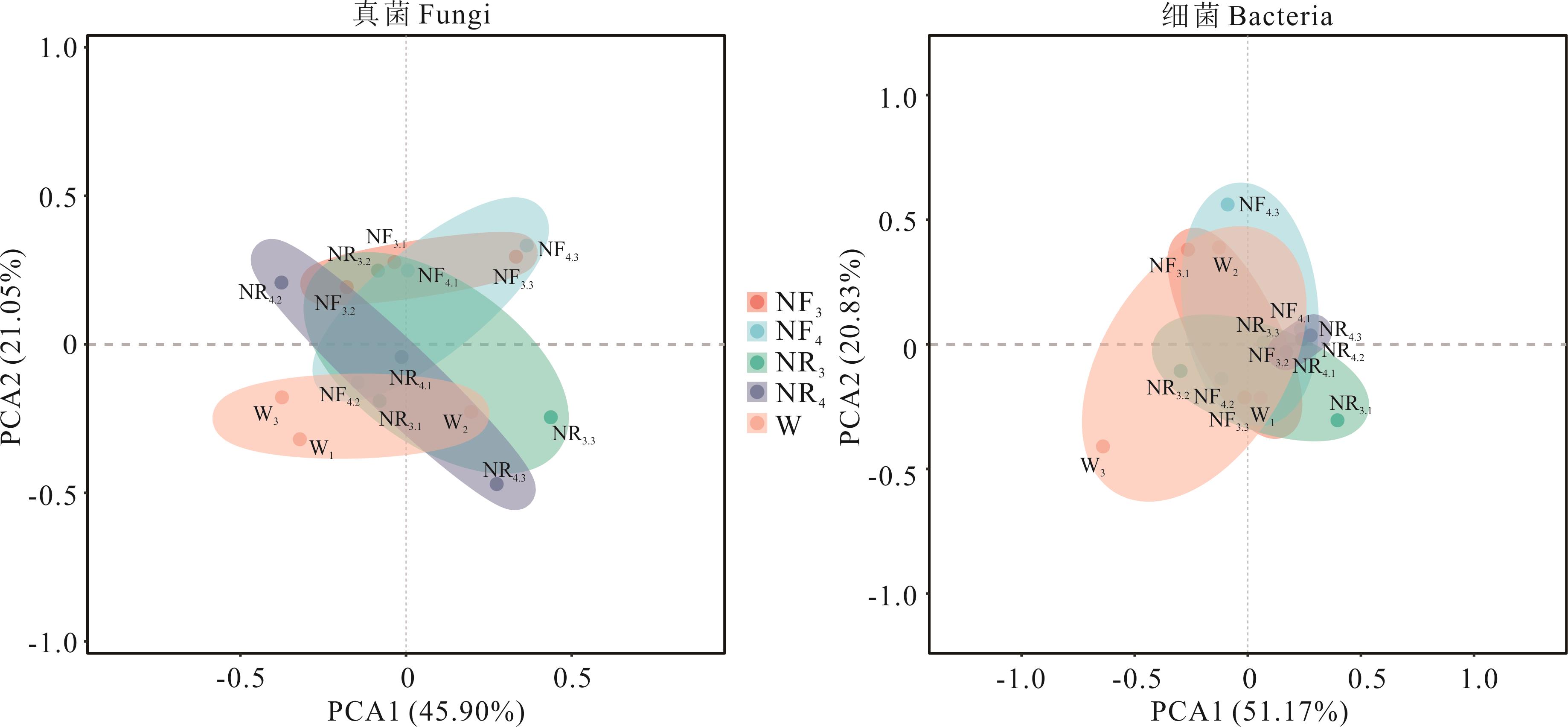
图4 不同生境、茬次和株龄伊贝母根际土壤中真菌、细菌群落的PCA分析
Fig.4 PCA analysis of fungal and bacterial communities in inter-root soils of different habitats, stubbles and plant ages of F. pallidiflora

图5 土壤理化因子和土壤真菌和细菌群落在属水平的冗余分析
Fig.5 Redundancy analysis of soil physicochemical factors and soil fungal and bacterial communities at genus level
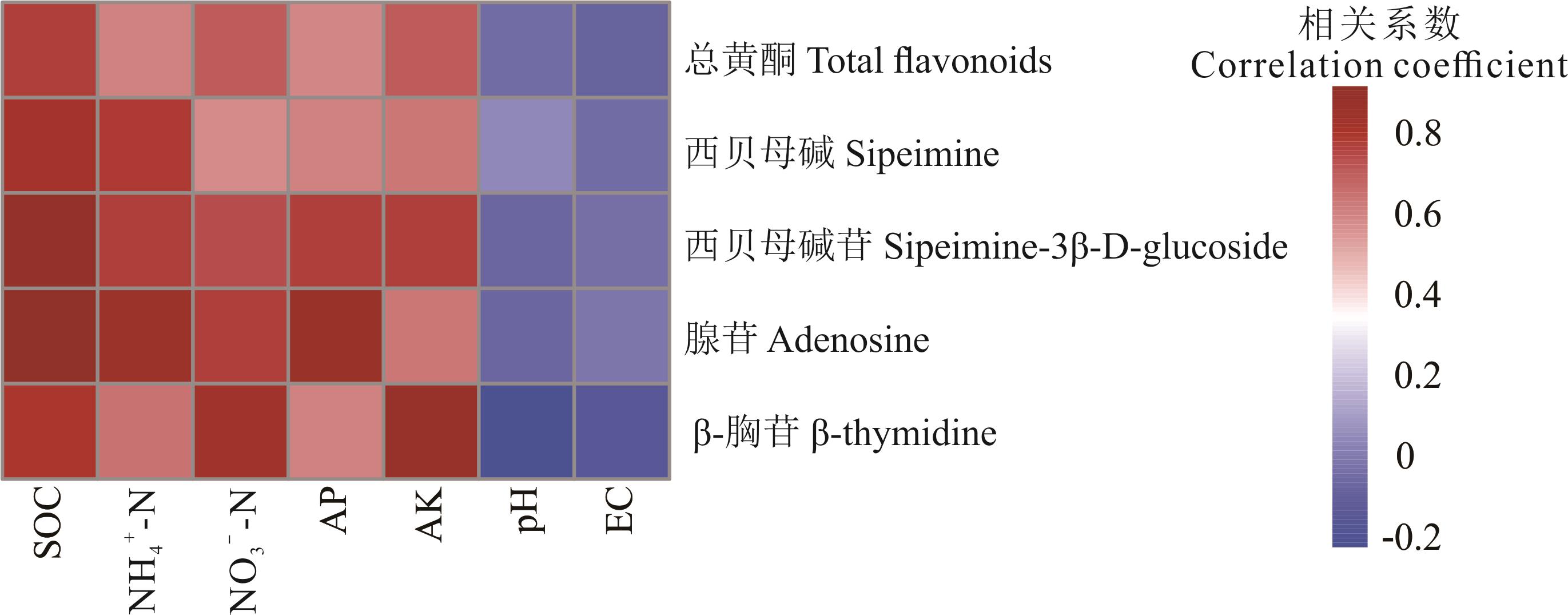
图6 伊贝母药用成分与土壤理化因子的Spearman相关性分析热图
Fig.6 Heat map of Spearman’s correlation analysis between medicinal components of F. pallidiflora and soil physico-chemical factors
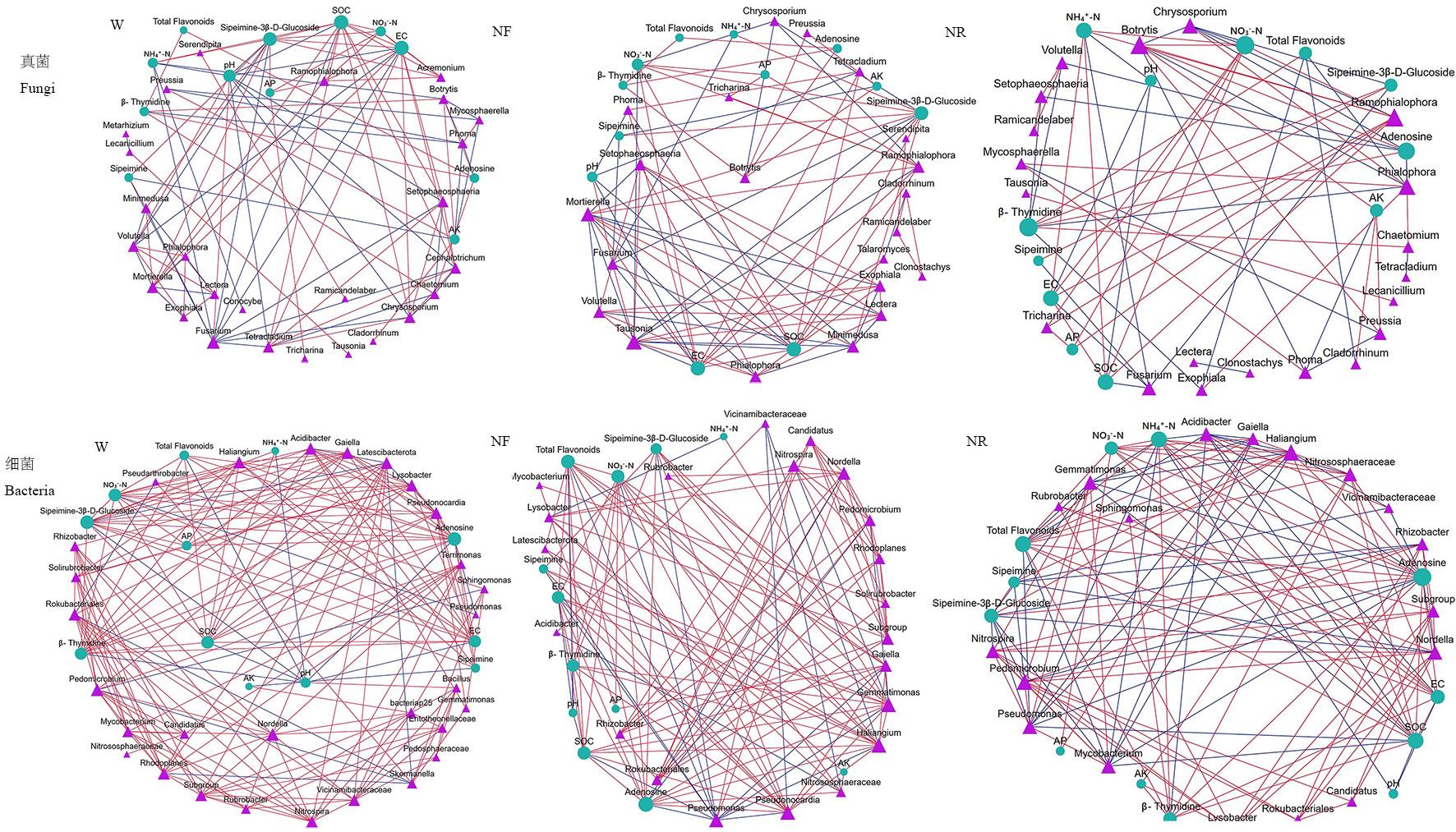
图7 不同生境、株龄伊贝母根际土壤中的真菌、细菌与土壤性质、药用成分相互作用的共现网络Acremonium: 枝顶孢属; Tricharina: 毛盘菌属; Tausonia: 陶氏霉属; Metarhizium: 绿僵菌属; Preussia: 普雷孢属; Lecanicillium: 拟青霉属; Volutella: 周刺座霉属; Phialophora: 瓶霉属; Lectera: 莱克霉属; Conocybe: 锥盖伞属; Mortierella: 被孢霉属; Exophiala: 外瓶霉属; Setophaeosphaeria: 刚毛褐球腔菌属; Tetracladium: 四枝孢属; Chaetomium: 毛壳菌属; Cephalotrichum: 丝孢霉属; Fusarium: 镰刀菌属; Serendipita: 瑟氏霉属; Chrysosporium: 金孢霉属; Botrytis: 葡萄孢属; Phoma: 疱霉属; Mycosphaerella: 球腔菌属; Acidibacter: 酸杆菌属; Bacillus: 芽孢杆菌属; Flavobacterium: 黄杆菌属; Gaiella: 盖勒氏菌属; Gemmatimonas: 芽单胞菌属; Haliangium: 海壤菌属; Lysobacter: 溶杆菌属; Mycobacterium: 分枝杆菌属; Nordella: 诺德氏菌属; Nitrospira: 硝化螺菌属; Pedomicrobium: 土微菌属; Pseudarthrobacter: 假节杆菌属; Pseudomonas: 假单胞菌属; Pseudonocardia: 假诺卡氏菌属; Rhizobacter: 根杆菌属; Rhodophanes: 红弯菌属; Rhodoplanes: 红游动菌属; Rubrobacter: 红色杆菌属; Skermanella: 斯克曼氏菌属; Solirubrobacter: 土壤红杆菌属; Sphingomonas: 鞘氨醇单胞菌属; Terrimonas: 土单胞菌属.
Fig.7 Co-occurrence network of fungal and bacterial interactions with soil properties and medicinal components in the inter-root soils of different habitats and plant ages of F. pallidiflora
| [1] | Lv G S, Li Z H, Zhao Z Y, et al. The factors affecting the development of medicinal plants from a value chain perspective. Planta, 2024, 259(5): 108-121. |
| [2] | Chen S, Lin R, Lu H L, et al. Effects of phenolic acids on free radical scavenging and heavy metal bioavailability in Kandelia obovata under cadmium and zinc stress. Chemosphere, 2020, 249: 126341-126358. |
| [3] | Chen S Y, Shi J J, Zou L S, et al. Quality evaluation of wild and cultivated Schisandrae chinensis Fructus based on simultaneous determination of multiple bioactive constituents combined with multivariate statistical analysis. Molecules, 2019, 24(7): 1335-1347. |
| [4] | Huang R, Dai S, Wu D, et al. Comparative study on the quality of wild and cultivated Arnebiae radix. Journal of Pharmaceutical Analysis, 2024, 44(5): 783-795. |
| [5] | Cheng J N, Jin H, Zhang J L, et al. Effects of allelochemicals, soil enzyme activities, and environmental factors on rhizosphere soil microbial community of Stellera chamaejasme L. along a growth-coverage gradient. Microorganisms, 2022, 10(1): 158-171. |
| [6] | Shi R, Gu H Y, He S, et al. Comparative metagenomic and metabolomic profiling of rhizospheres of Panax notoginseng grown under forest and field conditions. Agronomy, 2021, 11(12): 2488-2497. |
| [7] | Xie C X, Suo F M, Jia G L, et al. Correlation between ecological factors and ginsenosides. Acta Ecologica Sinica, 2011, 31(24): 7551-7563. |
| 谢彩香, 索风梅, 贾光林, 等. 人参皂苷与生态因子的相关性. 生态学报, 2011, 31(24): 7551-7563. | |
| [8] | Li C E, Zhang Y, Wang Y, et al. Characteristics and influencing factors of rhizosphere fungi of six mangrove plants of the genus Sonneratia. Acta Ecologica Sinica, 2024, 44(6): 2517-2530. |
| 李传恩, 张颖, 王芸, 等. 六种海桑属红树植物根际真菌特征及其影响因子. 生态学报, 2024, 44(6): 2517-2530. | |
| [9] | Dong J R, Zhao W Q, Shi P Y, et al. Soil differentiation and soil comprehensive evaluation of in wild and cultivated Fritillaria pallidiflora Schrenk. Science of the Total Environment, 2023, 872: DOI: 10.1016/j.scitotenv.2023.162049. |
| [10] | Jiao H Y, Chen X F, Hu J Q, et al. Review on chemical composition and biological activities of Fritillaria pallidiflora. Guangdong Chemical Industry, 2023, 50(4): 92-93, 86. |
| 焦豪妍, 陈晓芬, 胡嘉倩, 等. 伊贝母的化学成分和生物活性研究综述. 广东化工, 2023, 50(4): 92-93, 86. | |
| [11] | Mathela M, Kumar A, Sharma M, et al. Hue and cry for Fritillaria cirrhosa D. Don, a threatened medicinal plant in the Western Himalaya. Discover Sustainability, 2021, 2(1): 1-7. |
| [12] | An L S. Quality evaluation between wild growing and cultivated planting of bulbus Fritillaria pallidiflorae. Urumqi: Xinjiang Medical University, 2014. |
| 安露莎. 野生与栽培伊贝母质量评价研究.乌鲁木齐: 新疆医科大学, 2014. | |
| [13] | Dong Z Y, Rao M P N, Liao T J, et al. Diversity and function of rhizosphere microorganisms between wild and cultivated medicinal plant Glycyrrhiza uralensis Fisch under different soil conditions. Archives of Microbiology, 2021, 203(6): 3657-3665. |
| [14] | Choi J, Noh E, Lee D, et al. Effect of roasting after sugar-soaking on the level of volatile compounds, total polyphenol, total flavonoid, and isoflavones in black soybean (Glycine max (L.) Merr.). Lebensmittel-Wissenschaft und-Technologie, 2023, 185: DOI: 10.1016/j.lwt.2023.115166. |
| [15] | Jiang W, Wang X, Meng L, et al. Integrated microbiology and metabolomics analysis reveal patterns and mechanisms for improving the yield and alkaloid content of Fritillaria cirrhosa by nitrogen fertilization. Industrial Crops and Products, 2024, 218: 119011. |
| [16] | Zhang Y, Lu Y, Xia Y, et al. Determination of eight nucleosides in different parts of Radix et Rhizoma Ginseng by UPLC method. Journal of Pharmaceutical Analysis, 2023, 43(4): 595-601. |
| [17] | Pham H N, Pham P A, Nguyen T T H, et al. Influence of metal contamination in soil on metabolic profiles of Miscanthus×giganteus belowground parts and associated bacterial communities. Applied Soil Ecology, 2018, 125: 240-249. |
| [18] | Yu G, Zhao S L, Sun Y B, et al. Effects of mulching materials on soil physio-chemical properties, bacterial community characteristics, and citrus quality in orange orchards on the Yunnan-Guizhou Plateau. Acta Ecologica Sinica, 2024, 44(8): 3408-3422. |
| 余高, 赵仕龙, 孙约兵, 等. 覆盖材料对云贵高原柑橘园土壤理化性质、细菌群落特征及柑橘品质的影响. 生态学报, 2024, 44(8): 3408-3422. | |
| [19] | Tang J, Zhang L, Zhang J, et al. Physicochemical features, metal availability and enzyme activity in heavy metal-polluted soil remediated by biochar and compost. Science of the Total Environment, 2020, 701: DOI: 10.1016/j.scitotenv.2019.134751. |
| [20] | Hong S, Piao S, Chen A, et al. Afforestation neutralizes soil pH. Nature Communications, 2018, 9: 520. |
| [21] | Ge S, Gao J, Chang D, et al. Biochar contributes to resistance against root rot disease by stimulating soil polyphenol oxidase. Biochar, 2023, 5(1): 55-68. |
| [22] | Tarin M W K, Fan L, Xie D, et al. Response of soil fungal diversity and community composition to varying levels of bamboo biochar in red soils. Microorganisms, 2021, 9(7): 138-143. |
| [23] | Wen T, Xie P, Yang S, et al. ggClusterNet: An R package for microbiome network analysis and modularity-based multiple network layouts. iMeta, 2022, 1(3): e32-e42. |
| [24] | Sreevalli Y, Kulkarni R N, Baskaran K, et al. Increasing the content of leaf and root alkaloids of high alkaloid content mutants of periwinkle through nitrogen fertilization. Industrial Crops and Products, 2004, 19(2): 191-195. |
| [25] | Yuan X C, Xie H, Bai X Y, et al. Effects of short-term nitrogen addition on bioavailable phosphorus in rhizosphere and bulk soils of a Castanopsis fabri forest. Acta Ecologica Sinica, 2024, 44(17): 7817-7829. |
| 元晓春, 谢欢, 柏欣宇, 等. 短期氮添加对罗浮栲林根际和非根际土壤生物有效磷的影响. 生态学报, 2024, 44(17): 7817-7829. | |
| [26] | Ding M J, Tuo Y F, He X H, et al. Impact of irrigation and fertilization on soil potassium, pH, as well as yield and quality of Panax notoginseng. Journal of Irrigation and Drainage, 2024, 43(10): 55-66. |
| 丁明净, 脱云飞, 何霞红, 等. 三七土壤钾、pH值及其产量和品质对水肥制度的响应研究. 灌溉排水学报, 2024, 43(10): 55-66. | |
| [27] | Qiu Y J, Shao X L, Chen Y Y, et al. Research on effects of continuous cropping on the growth, physiological characteristics and autotoxic substances of Codonopsis pilosula var. modesta. Acta Prataculturae Sinica, 2025, 34(1): 107-117. |
| 邱亚娟, 邵晓龄, 陈莺宇, 等. 连作对纹党生长、生理特性及自毒物质的影响研究. 草业学报, 2025, 34(1): 107-117. | |
| [28] | Abbruzzese V, Semple K T, Haygarth P M, et al. Effects of substrate quality on carbon partitioning and microbial community composition in soil from an agricultural grassland. Applied Soil Ecology, 2021, 157: 103881-103937. |
| [29] | Wang Y C, Xie J L, Chen X Q, et al. Growth performance and changes in secondary metabolite content of Spartholobus suberectus with understory cultivation. Hunan Forestry Science and Technology, 2024, 51(6): 13-19. |
| 王运昌, 谢金兰, 陈新强, 等. 鸡血藤林下栽培生长表现及其次生代谢物含量变化. 湖南林业科技, 2024, 51(6): 13-19. | |
| [30] | Xie Y, Yan Y Y, Tian X W, et al. Effects of facility cultivation on soil fungal community structure and function in Ningxia. Acta Ecologica Sinica, 2024, 44(18): 8383-8396. |
| 谢祎, 闫元元, 田兴武, 等. 宁夏设施栽培对土壤真菌群落结构和功能的影响. 生态学报, 2024, 44(18): 8383-8396. | |
| [31] | Pieterse C M J, Zamioudis C, Berendsen R L, et al. Induced systemic resistance by beneficial microbes. Annual Review of Phytopathology, 2014, 52(1): 347-375. |
| [32] | Song X W, Yao Y, Yu P C, et al. Sodium nitroprusside improved the quality of radix saposhnikoviae through constructed physiological response under ecological stress. Scientific Reports, 2023, 13(1): 15823-15832. |
| [33] | Li S Y, Sun Z J, Yu B J, et al. Effect of grazing exclusion on soil carbon, nitrogen, and phosphorus contents and enzyme activity and stoichiometry in Seriphidium transiliense desert grasslands. Acta Prataculturae Sinica, 2024, 33(7): 25-40. |
| 李思媛, 孙宗玖, 于冰洁, 等. 封育对伊犁绢蒿荒漠草地土壤碳氮磷、酶活性及其化学计量特征的影响. 草业学报, 2024, 33(7): 25-40. | |
| [34] | Qiao H, Gao D, Yuan T. Differences in rhizosphere soil fungal communities of wild and cultivated Paeonia ludlowii species. Frontiers in Plant Science, 2023, 14: 1194598-1194610. |
| [35] | Ma L, Luo S, Xu S, et al. Different effects of wild and cultivated soybean on rhizosphere bacteria. Microbiology, 2019, 88(6): 720-728. |
| [36] | Lal R. Soil carbon sequestration impacts on global climate change and food security. Science, 2004, 304(5677): 1623-1627. |
| [37] | Fan D, Zhao Z, Wang Y, et al. Crop-type-driven changes in polyphenols regulate soil nutrient availability and soil microbiota. Frontiers in Microbiology, 2022, 13: 964039-964042. |
| [38] | Zhang M, O’Connor P J, Zhang J, et al. Linking soil nutrient cycling and microbial community with vegetation cover in riparian zone. Geoderma, 2021, 384: 114801-114821. |
| [39] | Six J, Elliott E T, Paustian K. Soil macroaggregate turnover and microaggregate formation: A mechanism for C sequestration under no-tillage agriculture. Soil Biology and Biochemistry, 2000, 32(14): 2099-2103. |
| [40] | Marler T E. Soil from Serianthes rhizosphere influences growth and leaf nutrient content of Serianthes plants. Agronomy, 2022, 12(8): 1938-1943. |
| [41] | Li Y, He X, Yuan H, et al. Differed growth stage dynamics of root-associated bacterial and fungal community structure associated with halophytic plant Lycium ruthenicum. Microorganisms, 2022, 10(8): 1644-1656. |
| [42] | Jiang S, Xing Y, Liu G, et al. Changes in soil bacterial and fungal community composition and functional groups during the succession of boreal forests. Soil Biology and Biochemistry, 2021, 161: DOI: 10.1016/j.soilbio.2021.108393. |
| [43] | Tu X D, Cui J F, Kuang F H, et al. Effects of conversion of alpine meadow to cultivated land on the soil microbial community in northwest Sichuan. Acta Prataculturae Sinica, 2025, 34(2): 54-66. |
| 涂晓东, 崔俊芳, 况福虹, 等. 川西北高寒草甸转为耕地对土壤微生物群落的影响. 草业学报, 2025, 34(2): 54-66. | |
| [44] | Bian X, Yang X, Li Q, et al. Effects of planting of two common crops, Allium fistulosum and Brassica napus, on soil properties and microbial communities of ginseng cultivation in northeast China. BMC Microbiology, 2022, 22(1): 182-191. |
| [45] | Peters B A, Wu J, Hayes R B, et al. The oral fungal mycobiome: Characteristics and relation to periodontitis in a pilot study. BMC Microbiology, 2017, 17(1): 157-165. |
| [46] | Badotti F, De Oliveira F S, Garcia C F, et al. Effectiveness of ITS and sub-regions as DNA barcode markers for the identification of Basidiomycota (Fungi). BMC Microbiology, 2017, 17(1): 42-49. |
| [47] | Gupta R S, Mok A. Phylogenomics and signature proteins for the alpha Proteobacteria and its main groups. BMC Microbiology, 2007, 7(1): 106-116. |
| [48] | Jiang C, Sun X R, Feng J, et al. Metagenomic analysis reveals the different characteristics of microbial communities inside and outside the Karst tiankeng. BMC Microbiology, 2022, 22(1): 1-12. |
| [49] | Liang C, Liu L, Zhang Z, et al. Do mixed Pinus yunnanensis plantations improve soil’s physicochemical properties and enzyme activities? Diversity, 2022, 14(3): 214-226. |
| No related articles found! |
| 阅读次数 | ||||||
|
全文 |
|
|||||
|
摘要 |
|
|||||
