

ISSN 1004-5759 CN 62-1105/S
草业学报 ›› 2026, Vol. 35 ›› Issue (12): 30-40.DOI: 10.11686/cyxb2025530
潘明巧1( ), 陈晓燕1,2, 韦盼1, 冯滔1, 杨澜1, 朱平宗1,2()
收稿日期:2025-12-25
修回日期:2026-03-09
出版日期:2026-12-20
发布日期:2026-11-02
通讯作者:
朱平宗
作者简介:E-mail: zpz2411615087@163.com基金资助:
Ming-qiao PAN1(), Xiao-yan CHEN1,2, Pan WEI1, Tao FENG1, Lan YANG1, Ping-zong ZHU1,2()
Received:2025-12-25
Revised:2026-03-09
Online:2026-12-20
Published:2026-11-02
Contact:
Ping-zong ZHU
摘要:
土壤崩解速率量化了土壤在静水中发生土粒分散和土块崩塌的快慢,是表征土壤抗侵蚀能力的关键指标,可为探究土壤侵蚀内在机理,制定有效的水土保持措施提供重要科学依据。在三峡库区库尾江津区黄墩溪小流域内选取了坡耕地、常绿阔叶林、常绿针叶林、灌木林、园地和草地6种典型土地利用方式,通过野外采样与室内分析相结合的方法,系统分析了不同土地利用方式土壤崩解速率的差异,并明确了导致差异的主控因素及影响途径。结果表明:1)不同土地利用方式土壤崩解速率为2.17~5.08 g·min-1,其中坡耕地的土壤崩解速率显著大于其他土地利用方式,常绿针叶林、常绿阔叶林和园地的土壤崩解速率则显著小于其他土地利用方式;2)不同土地利用方式土壤崩解速率与植被特性和土壤理化性质显著相关,其中土壤崩解速率与枯落物蓄积量、根质量密度、砂粒含量、黏粒含量、毛管孔隙度、>0.25 mm水稳性团聚体含量呈极显著负相关(P<0.01),与有机质含量呈显著负相关(P<0.05),而与粉粒含量呈极显著正相关(P<0.01);冗余分析结果表明,枯落物蓄积量、根质量密度、黏粒含量和土壤容重是导致不同土地利用方式土壤崩解速率存在差异的主要因素;3)通径分析结果表明,不同土地利用方式植被根系的直接和间接作用均有利于减小土壤崩解速率,且其直接效应(通径系数-0.433)大于其通过改善土壤结构的间接效应(通径系数-0.204)。研究结果深化了紫色土区植被生长对土壤崩解特性影响机理的认识,也为三峡库区优化土地利用结构、实施以植被管理为核心的水土保持措施提供了理论依据与实践指导。
潘明巧, 陈晓燕, 韦盼, 冯滔, 杨澜, 朱平宗. 三峡库区紫色土典型土地利用方式土壤崩解速率差异研究[J]. 草业学报, 2026, 35(12): 30-40.
Ming-qiao PAN, Xiao-yan CHEN, Pan WEI, Tao FENG, Lan YANG, Ping-zong ZHU. Differences in the soil disintegration rate among typical land-use types of purple soil in the Three Gorges Reservoir area[J]. Acta Prataculturae Sinica, 2026, 35(12): 30-40.
土地利用方式 Land-use type | 海拔 Altitude (m) | 坡度Slope gradient (°) | 坡向Slope aspect (°) | 林龄 Stand age (a) | 种植密度Planting density (plants·100 m-2) | 植被盖度Vegetation coverage (%) | 主要植被群落 Dominant plant community |
|---|---|---|---|---|---|---|---|
| 坡耕地Slope farmland | 432 | 5 | 60 | - | - | 46.7 | 玉米Z. mays |
| 常绿阔叶林Evergreen broad-leaved forests | 408 | 17 | 119 | 30 | 18 | 95.0 | 楠木Phoebe zhennan、樟树Cinnamomum camphora |
| 常绿针叶林Evergreen coniferous forests | 402 | 16 | 168 | 25 | 20 | 83.3 | 马尾松Pinus massoniana |
| 园地Garden plot | 430 | 5 | 60 | 20 | 15 | 10.0 | 花椒Z. bungeanum |
| 灌木林Shrubs | 422 | 6 | 60 | - | 88 | 66.7 | 漆树Toxicodendron vernicifluum |
| 草地Grassland | 431 | 5 | 60 | - | - | 75.0 | 马唐Digitaria sanguinalis |
表1 研究样地基本信息
Table 1 Basic information of the sample site
土地利用方式 Land-use type | 海拔 Altitude (m) | 坡度Slope gradient (°) | 坡向Slope aspect (°) | 林龄 Stand age (a) | 种植密度Planting density (plants·100 m-2) | 植被盖度Vegetation coverage (%) | 主要植被群落 Dominant plant community |
|---|---|---|---|---|---|---|---|
| 坡耕地Slope farmland | 432 | 5 | 60 | - | - | 46.7 | 玉米Z. mays |
| 常绿阔叶林Evergreen broad-leaved forests | 408 | 17 | 119 | 30 | 18 | 95.0 | 楠木Phoebe zhennan、樟树Cinnamomum camphora |
| 常绿针叶林Evergreen coniferous forests | 402 | 16 | 168 | 25 | 20 | 83.3 | 马尾松Pinus massoniana |
| 园地Garden plot | 430 | 5 | 60 | 20 | 15 | 10.0 | 花椒Z. bungeanum |
| 灌木林Shrubs | 422 | 6 | 60 | - | 88 | 66.7 | 漆树Toxicodendron vernicifluum |
| 草地Grassland | 431 | 5 | 60 | - | - | 75.0 | 马唐Digitaria sanguinalis |
影响因素 Influence factor | 坡耕地 Slope farmland | 常绿阔叶林 Evergreen broad-leaved forests | 常绿针叶林 Evergreen coniferous forests | 灌木林 Shrubland | 园地 Garden plot | 草地 Grassland |
|---|---|---|---|---|---|---|
| 枯落物蓄积量Litter weight (t·hm-2) | - | 1.24±0.56a | 0.71±0.03bc | 0.34±0.07cd | 0.95±0.14ab | 1.24±0.32a |
| 根质量密度Root mass density (kg·m-3) | 0.57±0.27c | 2.45±0.13a | 1.91±0.30b | 0.40±0.03c | 1.84±0.18b | 0.61±0.10c |
| 砂粒含量Sand content (%) | 10.23±0.23b | 20.16±0.88a | 19.78±0.22a | 10.32±0.11b | 10.76±0.10b | 10.46±0.16b |
| 粉粒含量Silt content (%) | 85.44±0.23a | 74.96±0.83c | 75.08±0.21c | 85.07±0.12a | 84.43±0.09b | 84.96±0.29ab |
| 黏粒含量Clay content (%) | 4.32±0.02d | 4.88±0.07b | 5.14±0.01a | 4.61±0.03c | 4.81±0.01b | 4.58±0.13c |
| 容重Bulk density (g·cm-3) | 1.26±0.02cd | 1.22±0.05d | 1.23±0.02d | 1.37±0.14bc | 1.52±0.11a | 1.43±0.05ab |
| 毛管孔隙度Capillary porosity (%) | 31.06±1.57c | 41.93±1.17a | 41.26±1.87a | 25.10±0.83e | 34.07±2.57b | 28.49±0.57d |
| 水稳性团聚体含量Water-stable aggregates content (>0.25 mm, %) | 53.81±3.47d | 81.42±3.71a | 82.57±2.73a | 64.02±3.53c | 70.25±2.37b | 61.45±2.86c |
| 土壤有机质含量Soil organic matter content (g·kg-1) | 18.69±0.32cd | 24.98±1.40b | 34.24±4.70a | 17.63±0.45d | 18.07±0.83d | 21.55±1.20bc |
表2 不同土地利用方式植被特性和土壤理化性质差异
Table 2 Differences in vegetation characteristics and soil physicochemical properties of different land use types
影响因素 Influence factor | 坡耕地 Slope farmland | 常绿阔叶林 Evergreen broad-leaved forests | 常绿针叶林 Evergreen coniferous forests | 灌木林 Shrubland | 园地 Garden plot | 草地 Grassland |
|---|---|---|---|---|---|---|
| 枯落物蓄积量Litter weight (t·hm-2) | - | 1.24±0.56a | 0.71±0.03bc | 0.34±0.07cd | 0.95±0.14ab | 1.24±0.32a |
| 根质量密度Root mass density (kg·m-3) | 0.57±0.27c | 2.45±0.13a | 1.91±0.30b | 0.40±0.03c | 1.84±0.18b | 0.61±0.10c |
| 砂粒含量Sand content (%) | 10.23±0.23b | 20.16±0.88a | 19.78±0.22a | 10.32±0.11b | 10.76±0.10b | 10.46±0.16b |
| 粉粒含量Silt content (%) | 85.44±0.23a | 74.96±0.83c | 75.08±0.21c | 85.07±0.12a | 84.43±0.09b | 84.96±0.29ab |
| 黏粒含量Clay content (%) | 4.32±0.02d | 4.88±0.07b | 5.14±0.01a | 4.61±0.03c | 4.81±0.01b | 4.58±0.13c |
| 容重Bulk density (g·cm-3) | 1.26±0.02cd | 1.22±0.05d | 1.23±0.02d | 1.37±0.14bc | 1.52±0.11a | 1.43±0.05ab |
| 毛管孔隙度Capillary porosity (%) | 31.06±1.57c | 41.93±1.17a | 41.26±1.87a | 25.10±0.83e | 34.07±2.57b | 28.49±0.57d |
| 水稳性团聚体含量Water-stable aggregates content (>0.25 mm, %) | 53.81±3.47d | 81.42±3.71a | 82.57±2.73a | 64.02±3.53c | 70.25±2.37b | 61.45±2.86c |
| 土壤有机质含量Soil organic matter content (g·kg-1) | 18.69±0.32cd | 24.98±1.40b | 34.24±4.70a | 17.63±0.45d | 18.07±0.83d | 21.55±1.20bc |
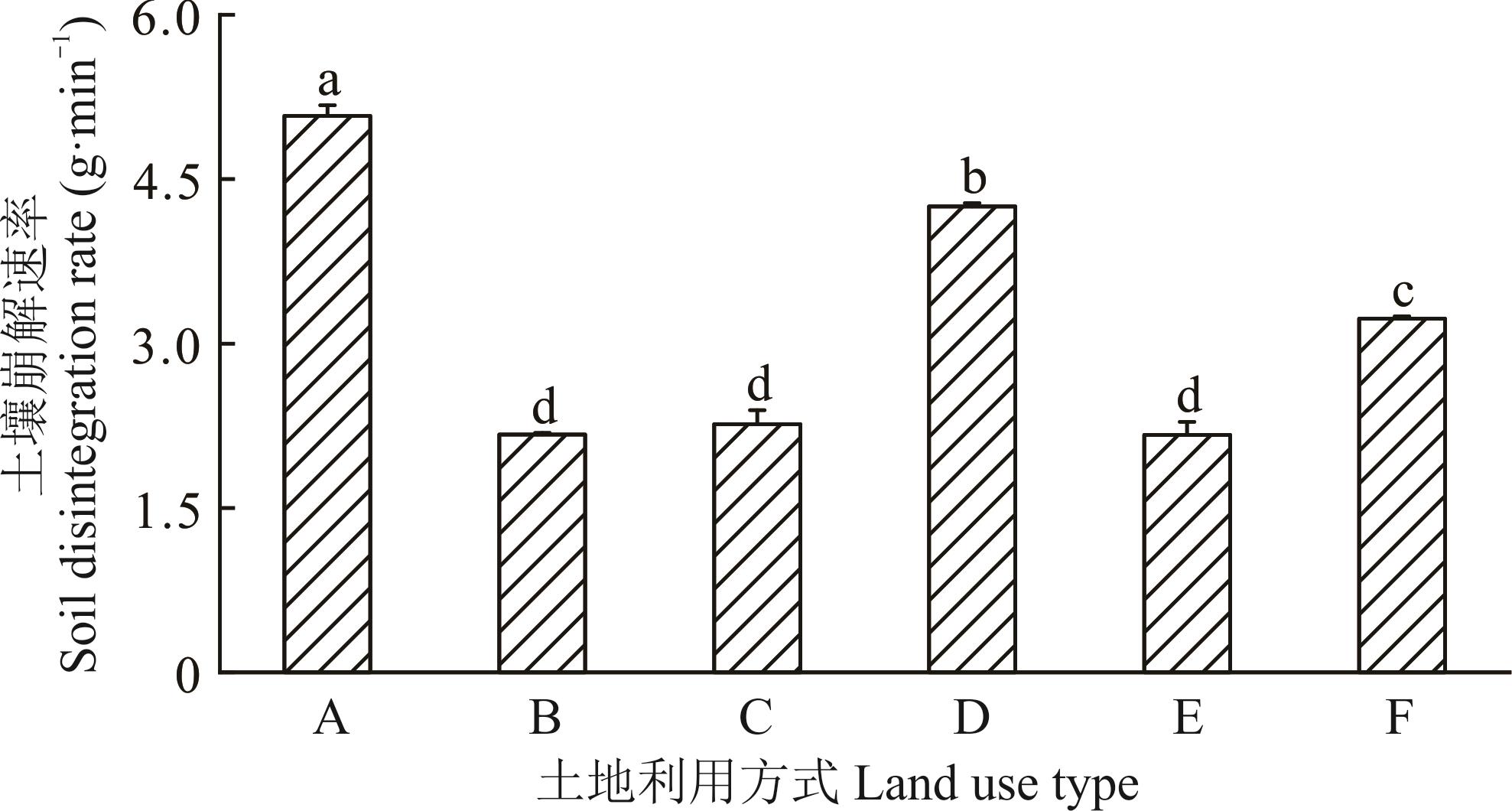
图1 不同土地利用方式土壤崩解速率差异A: 坡耕地Slope farmland; B: 常绿阔叶林Evergreen broad-leaved forests; C: 常绿针叶林Evergreen coniferous forests; D: 灌木林Shrubland; E: 园地Garden plot; F: 草地Grassland. 不同小写字母表示不同土地利用方式间差异显著(P<0.05)Different lowercase letters indicate significant differences among different land use types (P<0.05).
Fig. 1 Differences in soil disintegration rate among different land use types

图2 土壤崩解速率与其影响因素的相关性LD: 枯落物蓄积量Litter weight; RMD: 根质量密度Root mass density; Sand: 砂粒; Silt: 粉粒; Clay: 黏粒; BD: 土壤容重Soil bulk density; CP: 毛管孔隙度Capillary porosity; WSA: >0.25 mm水稳性团聚体含量Water-stable aggregates content >0.25 mm; SOM: 土壤有机质含量Soil organic matter content; SR: 土壤崩解速率Soil disintegration rate; *: P<0.05; **: P<0.01; 下同The same below.
Fig.2 Correlation between soil disintegration rate and its influencing factors
项目 Item | 黏粒 Clay | 枯落物蓄 积量 Litter weight | 根质量密度 Root mass density | 容重 Bulk density | 有机质 Soil organic matter | 毛管孔隙度 Capillary porosity | 粉粒 Silt | 水稳性团聚体 Water-stable aggregates (>0.25 mm) |
|---|---|---|---|---|---|---|---|---|
| 贡献度Contribution (%) | 73.90 | 15.20 | 4.70 | 4.20 | 0.80 | 0.60 | 0.30 | 0.30 |
| P | <0.010 | <0.010 | <0.050 | <0.050 | 0.204 | 0.170 | 0.362 | 0.406 |
表3 土壤崩解速率各影响因素的相对贡献
Table 3 Relative contribution of various influencing factors to soil disintegration rate
项目 Item | 黏粒 Clay | 枯落物蓄 积量 Litter weight | 根质量密度 Root mass density | 容重 Bulk density | 有机质 Soil organic matter | 毛管孔隙度 Capillary porosity | 粉粒 Silt | 水稳性团聚体 Water-stable aggregates (>0.25 mm) |
|---|---|---|---|---|---|---|---|---|
| 贡献度Contribution (%) | 73.90 | 15.20 | 4.70 | 4.20 | 0.80 | 0.60 | 0.30 | 0.30 |
| P | <0.010 | <0.010 | <0.050 | <0.050 | 0.204 | 0.170 | 0.362 | 0.406 |
自变量 Variable | 直接通径系数 Direct path coefficient | 间接通径系数Indirect path coefficient | 总通径系数 Total path coefficient | ||||
|---|---|---|---|---|---|---|---|
| 枯落物蓄积量Litter weight | 根质量密度 Root mass density | 黏粒 Clay | 容重 Bulk density | 合计 Total | |||
| 枯落物蓄积量Litter weight | -0.301** | - | - | -0.039 | -0.066 | -0.105 | -0.406 |
| 根质量密度Root mass density | -0.433** | - | - | -0.298 | 0.094 | -0.204 | -0.637 |
| 黏粒Clay | -0.415** | - | - | - | -0.005 | -0.005 | -0.420 |
| 容重Bulk density | -0.216** | - | - | - | - | 0.000 | -0.216 |
表4 土壤崩解速率主要影响因素的通径分析
Table 4 Path analysis of main factors affecting soil disintegration rate
自变量 Variable | 直接通径系数 Direct path coefficient | 间接通径系数Indirect path coefficient | 总通径系数 Total path coefficient | ||||
|---|---|---|---|---|---|---|---|
| 枯落物蓄积量Litter weight | 根质量密度 Root mass density | 黏粒 Clay | 容重 Bulk density | 合计 Total | |||
| 枯落物蓄积量Litter weight | -0.301** | - | - | -0.039 | -0.066 | -0.105 | -0.406 |
| 根质量密度Root mass density | -0.433** | - | - | -0.298 | 0.094 | -0.204 | -0.637 |
| 黏粒Clay | -0.415** | - | - | - | -0.005 | -0.005 | -0.420 |
| 容重Bulk density | -0.216** | - | - | - | - | 0.000 | -0.216 |
| [1] | Xiao H, Peng D D, Shao Y Y, et al. Mechanism of soil disintegration by Cynodon dactylon root in the purple soil from water-level fluctuation zone in the Three Gorges Reservoir. Chinese Journal of Soil Science, 2019, 50(5): 1116-1122. |
| 肖海, 彭逗逗, 邵艳艳, 等. 狗牙根根系对三峡库区消落带紫色土崩解性能的作用机理分析. 土壤通报, 2019, 50(5): 1116-1122. | |
| [2] | Li H R, Zhang Q, Wu J J, et al. Response of soil aggregate disintegration to antecedent moisture during splash erosion. Catena, 2024, 234: 107633. |
| [3] | Zhang C H, Xiao B, Li S L, et al. Characteristics of biocrusts in croplands and their effects on surface soil disintegration in the black soil region of Northeast China. Chinese Journal of Applied Ecology, 2022, 33(7): 1773-1782. |
| 张晨晖, 肖波, 李胜龙, 等. 东北黑土区农田生物结皮的特征及其对表层土壤崩解的影响. 应用生态学报, 2022, 33(7): 1773-1782. | |
| [4] | Li Q, Zhang Z, Sun H, et al. A new modified method for calculation of soil disintegration rate. Research of Soil and Water Conservation, 2015, 22(6): 344-348. |
| 李强, 张正, 孙会, 等. 土壤崩解速率的一种修正方法. 水土保持研究, 2015, 22(6): 344-348. | |
| [5] | Zhang S J, Ma J Y, Li Z B, et al. Experimental study on the change and influencing factors of the disintegration performance of silty loam soil in loess hilly and gully region: A case study of Wangmaogou small watershed. Acta Ecologica Sinica, 2025, 45(1): 91-102. |
| 张思靖, 马建业, 李占斌, 等. 黄土丘陵沟壑区粉砂壤土崩解性能变化及其影响因子试验研究-以王茂沟小流域为例. 生态学报, 2025, 45(1): 91-102. | |
| [6] | Li Y R, Wang Y Y, Fan W H, et al. Hydro-disintegration of loess-paleosol sequences and its implications for microscale landform evolution. Catena, 2025, 259: 1-13. |
| [7] | Jiang W S, Li Z W, Xie H G, et al. Land use change impacts on red slate soil aggregates and associated organic carbon in diverse soil layers in subtropical China. Science of the Total Environment, 2023, 856: 159194. |
| [8] | Li W Q, Shen F X, Liu Y J, et al. Soil depth determine the ecological stoichiometry of soil aggregates after returning ancient rice terraces to forest. Catena, 2022, 219: 106587. |
| [9] | Liu D D, Zhang P H, Wang J, et al. A comparison on soil anti-erodibility over different land use types on loess slope. Scientia Silvae Sinicae, 2013, 49(9): 102-106. |
| 刘旦旦, 张鹏辉, 王健, 等. 黄土坡面不同土地利用类型土壤抗蚀性对比. 林业科学, 2013, 49(9): 102-106. | |
| [10] | Zhang W. Soil anti-erodibility under different land use types in Dabie Mountainous Area of western Anhui Province-A case study in Yuexi County of Anhui Province. Bulletin of Soil and Water Conservation, 2016, 36(2): 38-41. |
| 张卫. 皖西大别山区不同土地利用类型的土壤抗侵蚀性-以安徽省岳西县为例. 水土保持通报, 2016, 36(2): 38-41. | |
| [11] | Yang Z Q, Guo J Y, Qin F C, et al. Soil aggregate stability and erodibility in different vegetation types of exposed feldspathic sandstone region. Bulletin of Soil and Water Conservation, 2021, 41(3): 8-14. |
| 杨振奇, 郭建英, 秦富仓, 等. 裸露砒砂岩区不同植被类型土壤团聚体稳定性与抗蚀性能. 水土保持通报, 2021, 41(3): 8-14. | |
| [12] | Wang L X, Chen Z X, Guo M M, et al. Soil erodibility and its influencing factors of erosion gully banks under different land use types in the typical black soil region of Northeast China. Research of Soil and Water Conservation, 2025, 32(3): 18-27. |
| 王丽鑫, 陈卓鑫, 郭明明, 等. 典型黑土区不同土地利用类型侵蚀沟沟岸土壤可蚀性及其影响因素. 水土保持研究, 2025, 32(3): 18-27. | |
| [13] | Song M X, Lü X H, Han C, et al. Impacts of rainfall characteristics and vegetation cover patterns on slope runoff and sediment yields in the Three Gorges Reservoir area. Journal of Soil and Water Conservation, 2024, 38(3): 82-90. |
| 宋民欣, 吕希恒, 韩陈, 等. 三峡库区降雨特征和林草覆被格局对坡面水沙产出的影响. 水土保持学报, 2024, 38(3): 82-90. | |
| [14] | Xiong Z Y, Wang Z F, Long Y, et al. Response of nitrogen loss flux in purple soil sloping field to reduced fertilizer and combining straw. Environmental Science, 2020, 41(4): 1930-1940. |
| 熊子怡, 王子芳, 龙翼, 等. 紫色土旱坡地氮流失通量对减肥配施秸秆的响应. 环境科学, 2020, 41(4): 1930-1940. | |
| [15] | Hu X Y, Xiao Z L, Qin C, et al. Multi-scenario prediction of land use changes and soil erosion in Three Gorges Reservoir Region based on PLUS-InVEST mode. Journal of Soil and Water Conservation, 2025, 39(6): 1-13. |
| 胡馨怡, 肖作林, 秦川, 等. 基于PLUS-InVEST模型的三峡库区土地利用变化与土壤侵蚀多情景预测. 水土保持学报, 2025, 39(6): 1-13. | |
| [16] | Xiao H, Xia Z Y, Peng D D, et al. Influence of plant root on the soil disintegration of purple soil from the water-level fluctuation zone in the Three Gorges Reservoir. Science of Soil and Water Conservation, 2019, 19(3): 98-103. |
| 肖海, 夏振尧, 彭逗逗, 等. 植物根系对三峡库区消落带紫色土崩解性能的影响. 中国水土保持科学, 2019, 19(3): 98-103. | |
| [17] | Shen P W, Tang H M, Wang D J, et al. Disintegration characteristics of red-bed mudstone of Badong Formation under wet-dry cycles. Rock and Soil Mechanics, 2017, 38(7): 1990-1998. |
| 申培武, 唐辉明, 汪丁建, 等. 巴东组紫红色泥岩干湿循环崩解特征试验研究. 岩土力学, 2017, 38(7): 1990-1998. | |
| [18] | Zhang W, Liu Y, Xia X L, et al. Characteristics of soil resistance to erosion and scouring, and their influencing factors in Dabie Mountains of western Anhui Province. Bulletin of Soil and Water Conservation, 2025, 45(3): 10-15. |
| 张卫, 刘亚, 夏小林, 等. 皖西大别山区土壤抗蚀与抗冲特征及其影响因素. 水土保持通报, 2025, 45(3): 10-15. | |
| [19] | Xu Y, Ran W J, Shi D M, et al. Profile distribution characteristics and main controlling factors of magnetic susceptibility in purple soil slope farmland. Journal of Soil and Water Conservation, 2025, 36(6): 1-10. |
| 许颖, 冉文建, 史东梅, 等. 紫色土坡耕地磁化率剖面分布特征及主控因素. 水土保持学报, 2025, 36(6): 1-10. | |
| [20] | Zhao G Y. Risk assessment and landscape impact of heavy metal pollution in cultivated soil in typical agricultural. Chongqing: Southwest University, 2023. |
| 赵光耀. 典型农业流域耕地重金属污染风险评估与景观影响. 重庆: 西南大学, 2023. | |
| [21] | Zhang B Q, Wang Z Y, Yang Y F, et al. Accumulation and water-holding capacity of typical shrub woodland litters in Loess Hilly Region. Bulletin of Soil and Water Conservation, 2019, 39(4): 76-81. |
| 张宝琦, 王忠禹, 杨艳芬, 等. 黄土丘陵沟壑区典型灌木林地枯落物的蓄积特征及持水性能. 水土保持通报, 2019, 39(4): 76-81. | |
| [22] | Chen L, Wang J, Huo C P, et al. Study on particle distribution characteristics of soil physical crust profile in sloping farmland. Acta Pedologica Sinica, 2023, 60(4): 983-992. |
| 陈琳, 王健, 霍春平, 等. 坡耕地土壤物理结皮分层颗粒组成特征研究. 土壤学报, 2023, 60(4): 983-992. | |
| [23] | Feng T, Chen X Y, Zhu P Z, et al. Differences in soil erosion resistance between different vegetation types of purple soil in the Three Gorges Reservoir area. Acta Pedologica Sinica, 2025, 62(1): 1259-1270. |
| 冯滔, 陈晓燕, 朱平宗, 等. 三峡库区紫色土不同植被类型土壤抗蚀性能差异研究. 土壤学报, 2025, 62(1): 1259-1270. | |
| [24] | Sun L, Zhang G H, Luan L L, et al. Temporal variation in soil resistance to flowing water erosion for soil incorporated with plant litters in the Loess Plateau of China. Catena, 2016, 145: 239-245. |
| [25] | Zhu P Z, Zhang G H, Zhang B J. Soil saturated hydraulic conductivity of typical revegetated plants on steep gully slopes of Chinese Loess Plateau. Geoderma, 2022, 412: 115717. |
| [26] | Li J W, Chen L, Shi D M, et al. Response characteristics of purple soil disintegrating characteristics to bulk densities and water contents. Journal of Soil and Water Conservation, 2019, 33(2): 68-72, 78. |
| 李敬王,陈林, 史东梅, 等. 紫色土崩解特性对容重和含水率的响应特征. 水土保持学报, 2019, 33(2): 68-72, 78. | |
| [27] | Yin S, Li Y R, Li L, et al. Different responses of aggregates-associated organic carbon to tillage and water erosion in the black soil region. Science of Soil and Water Conservation, 2020, 18(3): 67-73. |
| 殷爽, 李毅然, 李露, 等. 黑土团聚体有机碳对耕作与水蚀的响应差异. 中国水土保持科学, 2020, 18(3): 67-73. | |
| [28] | Han C, Song M X, Tang Q, et al. Post-farming land restoration schemes exhibit higher soil aggregate stability and organic carbon: Evidence in the Three Gorges Reservoir area, China. Catena, 2023, 227: 107099. |
| [29] | Zhu P Z, Feng T, Yang L, et al. Biological soil crusts decrease soil erodibility of economic fruit forests land through its consolidation effect in the Three Gorges Reservoir area. Catena, 2024, 243: 108200. |
| [30] | Guo M M, Wang W L, Wang T C, et al. Impacts of different vegetation restoration options on gully head soil resistance and soil erosion in loess tablelands. Earth Surface Processes and Landforms, 2020, 45(4): 1038-1050. |
| [31] | Wang Z L, Fan C M, Duan J Q, et al. Relationship between physicochemical properties and disintegration characteristics of subalpine meadow soils in central Yunnan. Journal of Soil and Water Conservation, 2024, 38(4): 170-180. |
| 王忠良, 范春梅, 段继琪, 等. 滇中亚高山草甸土理化性质和崩解特性关系. 水土保持学报, 2024, 38(4): 170-180. | |
| [32] | He L, Deng Y S, Tang Q Y, et al. Effects of the Dicranopteris linearis root system and initial moisture content on the soil disintegration characteristics of gully erosion. Journal of Mountain Science, 2022, 19(12): 3548-3567. |
| [33] | Li H R, Gu J, Liu G, et al. Effects of raindrop temperature on the contributions of slaking and mechanical striking to aggregate disintegration during splash erosion. Soil & Tillage Research, 2022, 224: 105518. |
| [34] | Lv J R, Bao Y H, Yang L, et al. Elevation-related variations of soil disintegration and its driving forces in the water level fluctuation zone of the Three Gorges Reservoir, China. Geomorphology, 2024, 455: 109193. |
| [35] | Li W Q, Liu Y J, Zheng H, et al. Complex vegetation patterns improve soil nutrients and maintain stoichiometric balance of terrace wall aggregates over long periods of vegetation recovery. Catena, 2023, 227: 107141. |
| [36] | Wang G Y, Zhou H, Xia Y Q, et al. Experiment on effect of grass root system on slope soil strength and disintegration characteristics. Journal of Highway and Transportation Research and Development, 2018, 31(2): 234-241. |
| 王桂尧, 周欢, 夏旖琪, 等. 草类根系对坡面土强度及崩解特性的影响试验. 中国公路学报, 2018, 31(2): 234-241. | |
| [37] | Wang J, Ma F, Zhang P H, et al. Effect of wet-dry alternation on loess disintegration rate. Acta Pedologica Sinica, 2015, 52(6): 1273-1279. |
| 王健, 马璠, 张鹏辉, 等. 干湿交替对黄土崩解速度的影响. 土壤学报, 2015, 52(6): 1273-1279. | |
| [38] | Grosse A K, Cantre S, Saathoff F. The applicability of disintegration tests for cohesive organic soils. Journal of Environmental Engineering and Landscape Management, 2015, 23(1): 1-14. |
| [39] | Zhang Y, Liu Y L, Li Y, et al. Effects of land use patterns on soil aggregate stability and organic carbon distribution in the Karst rocky desertification area. Chinese Journal of Soil Science, 2021, 52(6): 1308-1315. |
| 张艳, 刘彦伶, 李渝, 等. 喀斯特石漠化地区土地利用方式对土壤团聚体稳定性及其有机碳分布特征的影响. 土壤通报, 2021, 52(6): 1308-1315. | |
| [40] | Li G L, Zhou C H, Fiore S, et al. Interactions between microorganisms and clay minerals: New insights and broader applications. Applied Clay Science, 2019, 177: 91-113. |
| [41] | Zheng F L, Tan J L, Wang X N, et al. Progress of study on rainfall interception by water conservation forest in the Loess Plateau. Yellow River, 2020, 42(4): 89-93. |
| 郑飞龙, 谭军利, 王西娜, 等. 黄土高原水源涵养林截蓄降雨研究进展. 人民黄河, 2020, 42(4): 89-93. | |
| [42] | Huo B Y, Huang Q B, Kang X S, et al. Experimental study on the disintegration characteristics of undisturbed loess under rainfall-induced leaching. Catena, 2023, 233: 107482. |
| [43] | Shang C, Chen Z J, Xu J J, et al. Synergistic effects of cover crops on productivity enhancement and carbon sequestration with emission reduction in multiple cropping systems of southern China. Chinese Journal of Eco-Agriculture, 2026, 34(2): 284-296. |
| 尚程, 陈泽建, 许嘉杰, 等. 南方多熟制覆盖作物的丰产增效与固碳减排协同效应. 中国生态农业学报, 2026, 34(2): 284-296. | |
| [44] | Zhang F Y, Cheng Y, Yang Y Y, et al. Particle size composition, fractal characteristics and influencing factors of soils with different urbanization intensities in Nanchang. Soils, 2023, 55(5): 1138-1145. |
| 张佛熠, 承勇, 阳雅荧, 等. 南昌不同城市化强度土壤粒度组成和分形特征及其影响因素. 土壤, 2023, 55(5): 1138-1145. |
| [1] | 陈薪宇, 邓正昕, 王子芳, 谢军, 代文才, 高明. 铵态氮肥施用量对不同类型紫色土氮淋失及表面电化学性质的影响[J]. 草业学报, 2025, 34(7): 69-82. |
| [2] | 甘凤玲, 韦杰, 李沙沙. 紫色土埂坎典型草本根系摩阻特性对土壤含水率的响应[J]. 草业学报, 2022, 31(7): 28-37. |
| [3] | 罗楠, 舒英格, 陈梦军, 肖盛杨. 喀斯特山区不同草地土壤结构及分形特征[J]. 草业学报, 2020, 29(7): 11-22. |
| [4] | 杜子银, 蔡延江, 王小丹, 张斌. 放牧牦牛行为及其对高寒草地土壤特性的影响研究进展[J]. 草业学报, 2019, 28(7): 186-197. |
| [5] | 黎嘉成, 高明, 田冬, 黄容, 徐国鑫. 秸秆及生物炭还田对土壤有机碳及其活性组分的影响[J]. 草业学报, 2018, 27(5): 39-50. |
| [6] | 王润泽, 谌芸, 李铁, 彭石磊, 刘志鹏, 单志杰. 香根草和马唐的根系特征及对坡地紫色土抗侵蚀性的影响[J]. 草业学报, 2017, 26(7): 45-54. |
| [7] | 苟桃吉, 高明, 王子芳, 刘彬彬, 黄容. 三种牧草对三峡库区旱坡地氮磷养分流失的影响[J]. 草业学报, 2017, 26(4): 53-62. |
| [8] | 张洋, 雷平, 谢德体, 倪九派. 自然粒度酸化紫色土磷形态分级及其流失解析度评价[J]. 草业学报, 2017, 26(11): 22-34. |
| [9] | 黄泽, 田福平, 刘玉, 张静鸽, 苗海涛, 武高林. 黄土高原不同草地类型对水稳性团聚体粒径分布及稳定性的影响[J]. 草业学报, 2017, 26(11): 216-221. |
| [10] | 秦川, 何丙辉, 蒋先军. 三峡库区不同土地利用方式下土壤养分含量特征研究[J]. 草业学报, 2016, 25(9): 10-19. |
| [11] | 韩文娇, 白林利, 李昌晓. 水淹胁迫对狗牙根光合、生长及营养元素含量的影响[J]. 草业学报, 2016, 25(5): 49-59. |
| [12] | 韩晓飞, 高明, 谢德体, 王子芳, 陈晨. 长期定位施肥条件下紫色土无机磷形态演变研究[J]. 草业学报, 2016, 25(4): 63-72. |
| [13] | 张洋, 刘月娇, 倪九派, 谢德体. 柑橘/大球盖菇间作对三峡库区紫色土活性有机碳库的影响[J]. 草业学报, 2015, 24(5): 53-65. |
| [14] | 杨予静,李昌晓,马朋. 三峡水库城区消落带人工草本植被土壤养分含量研究[J]. 草业学报, 2015, 24(4): 1-11. |
| [15] | 刘月娇,倪九派,张洋,周川. 三峡库区紫色土旱坡地农桑配置模式对土壤养分的影响[J]. 草业学报, 2015, 24(12): 38-45. |
| 阅读次数 | ||||||
|
全文 |
|
|||||
|
摘要 |
|
|||||
