

ISSN 1004-5759 CN 62-1105/S
草业学报 ›› 2025, Vol. 34 ›› Issue (12): 134-144.DOI: 10.11686/cyxb2025009
• 研究论文 • 上一篇
刘婷婷( ), 李金升, 林健骅, 张丹丹, 江文宇, 朱徐睿, 张震()
收稿日期:2025-01-08
修回日期:2025-03-10
出版日期:2025-12-20
发布日期:2025-10-20
通讯作者:
张震
作者简介:E-mail: xjzhangzhen@163.com基金资助:
Ting-ting LIU(), Jin-sheng LI, Jian-hua LIN, Dan-dan ZHANG, Wen-yu JIANG, Xu-rui ZHU, Zhen ZHANG()
Received:2025-01-08
Revised:2025-03-10
Online:2025-12-20
Published:2025-10-20
Contact:
Zhen ZHANG
摘要:
鉴于入侵植物对本地植物群落结构和组成的改变及其对生物多样性的负面影响,本文旨在探讨菊科入侵植物与本地植物在叶片解剖结构与生理化学性状上的差异及其两者间的关系,以入侵植物加拿大一枝黄花、苦苣菜、一年蓬以及本地植物翅果菊、刺儿菜为试验材料测定其叶片解剖结构与生理化学性状。结果表明:入侵植物的平均角质层厚度、栅海比以及组织结构紧密度均显著高于本地植物,这说明入侵植物相较于本地植物展现出更优越的水分保持能力以及逆境适应性。而且入侵植物在光合作用能力以及养分获取能力上比本地植物更具潜在的优势,具体表现为入侵植物较高的叶绿素含量、比叶面积以及全氮含量。此外,根据冗余分析结果可知二者的叶片解剖结构与其生理化学性状之间均存在着一定的联系,即叶片厚度的增加通常意味着更多的光照被吸收,进而提高叶片的光合效率。因此,正是由于这些特征导致外来植物成功入侵并进一步扩散。
刘婷婷, 李金升, 林健骅, 张丹丹, 江文宇, 朱徐睿, 张震. 菊科入侵植物与本地植物叶片性状的差异[J]. 草业学报, 2025, 34(12): 134-144.
Ting-ting LIU, Jin-sheng LI, Jian-hua LIN, Dan-dan ZHANG, Wen-yu JIANG, Xu-rui ZHU, Zhen ZHANG. Differences in leaf traits between invasive and native species of Asteraceae[J]. Acta Prataculturae Sinica, 2025, 34(12): 134-144.
项目 Item | 性状 Trait | 入侵植物 Invasive plant | 本地植物 Native plant | 显著性 P |
|---|---|---|---|---|
解剖 结构 LAS | 叶片厚度LT (μm) | 230.78±7.25a | 229.93±2.80a | 0.755 |
| 角质层厚度CT (μm) | 7.71±0.32a | 6.98±0.58b | 0.007 | |
| 表皮厚度ET (μm) | 53.65±8.24a | 41.43±4.66b | 0.003 | |
| 栅栏组织厚度PT (μm) | 77.90±2.35a | 71.16±6.72a | 0.057 | |
| 海绵薄壁组织厚度ST (μm) | 96.43±11.26a | 103.59±0.77a | 0.094 | |
| 栅海比P/S | 0.82±0.13a | 0.69±0.07b | 0.019 | |
| 组织结构紧密度CTR (%) | 33.80±1.92a | 30.93±2.68b | 0.031 | |
| 组织结构疏松度SR (%) | 41.69±3.78b | 45.06±0.80a | 0.029 | |
| 气孔密度SD (mm-2) | 274.64±46.63a | 281.61±10.41a | 0.674 | |
| 叶脉密度VD (cm·cm-2) | 7.51±2.21a | 6.48±1.47a | 0.336 | |
生理 化学 性状 LPCT | 叶片干物质含量LDMC | 0.15±0.03a | 0.12±0.02a | 0.055 |
| 叶面积LA (cm2) | 22.60±6.16a | 7.16±0.66b | <0.001 | |
| 比叶面积SLA (cm2·g-1) | 93.19±25.06a | 64.98±9.22b | 0.011 | |
| 全磷TP (mg·g-1) | 1.00±0.11a | 0.90±0.04a | 0.059 | |
| 全碳TC (mg·g-1) | 478.09±12.59a | 481.36±8.57a | 0.590 | |
| 全氮TN (mg·g-1) | 33.29±1.62a | 28.37±2.79b | 0.005 | |
| C/N | 14.38±0.46b | 17.13±1.99a | 0.019 | |
| C/P | 483.03±59.15a | 535.66±22.02a | 0.060 | |
| N/P | 33.61±4.14a | 31.63±3.98a | 0.373 | |
| 叶绿素a Chl a (mg·g-1) | 20.38±2.40a | 17.13±1.95b | 0.016 | |
| 叶绿素b Chl b (mg·g-1) | 6.69±0.76a | 5.90±0.50b | 0.045 | |
| 总叶绿素Chl (mg·g-1) | 27.07±3.07a | 23.04±2.42b | 0.018 | |
| Chl a/b | 3.05±0.20a | 2.90±0.13a | 0.123 |
表1 菊科入侵植物和本地植物叶片解剖结构与生理化学性状的差异
Table 1 Differences in leaf anatomical structure (LAS) and physiological and chemical traits (LPCT) between invasive and native plants of Asteraceae
项目 Item | 性状 Trait | 入侵植物 Invasive plant | 本地植物 Native plant | 显著性 P |
|---|---|---|---|---|
解剖 结构 LAS | 叶片厚度LT (μm) | 230.78±7.25a | 229.93±2.80a | 0.755 |
| 角质层厚度CT (μm) | 7.71±0.32a | 6.98±0.58b | 0.007 | |
| 表皮厚度ET (μm) | 53.65±8.24a | 41.43±4.66b | 0.003 | |
| 栅栏组织厚度PT (μm) | 77.90±2.35a | 71.16±6.72a | 0.057 | |
| 海绵薄壁组织厚度ST (μm) | 96.43±11.26a | 103.59±0.77a | 0.094 | |
| 栅海比P/S | 0.82±0.13a | 0.69±0.07b | 0.019 | |
| 组织结构紧密度CTR (%) | 33.80±1.92a | 30.93±2.68b | 0.031 | |
| 组织结构疏松度SR (%) | 41.69±3.78b | 45.06±0.80a | 0.029 | |
| 气孔密度SD (mm-2) | 274.64±46.63a | 281.61±10.41a | 0.674 | |
| 叶脉密度VD (cm·cm-2) | 7.51±2.21a | 6.48±1.47a | 0.336 | |
生理 化学 性状 LPCT | 叶片干物质含量LDMC | 0.15±0.03a | 0.12±0.02a | 0.055 |
| 叶面积LA (cm2) | 22.60±6.16a | 7.16±0.66b | <0.001 | |
| 比叶面积SLA (cm2·g-1) | 93.19±25.06a | 64.98±9.22b | 0.011 | |
| 全磷TP (mg·g-1) | 1.00±0.11a | 0.90±0.04a | 0.059 | |
| 全碳TC (mg·g-1) | 478.09±12.59a | 481.36±8.57a | 0.590 | |
| 全氮TN (mg·g-1) | 33.29±1.62a | 28.37±2.79b | 0.005 | |
| C/N | 14.38±0.46b | 17.13±1.99a | 0.019 | |
| C/P | 483.03±59.15a | 535.66±22.02a | 0.060 | |
| N/P | 33.61±4.14a | 31.63±3.98a | 0.373 | |
| 叶绿素a Chl a (mg·g-1) | 20.38±2.40a | 17.13±1.95b | 0.016 | |
| 叶绿素b Chl b (mg·g-1) | 6.69±0.76a | 5.90±0.50b | 0.045 | |
| 总叶绿素Chl (mg·g-1) | 27.07±3.07a | 23.04±2.42b | 0.018 | |
| Chl a/b | 3.05±0.20a | 2.90±0.13a | 0.123 |

图1 5种菊科植物叶片解剖结构的比较数据代表平均值±标准差Data represent mean±standard deviation (SD); 不同小写字母表示5种菊科植物之间差异显著(P<0.05) Different lowercase letters indicate significant differences among the five species of Asteraceae (P<0.05); SC: 加拿大一枝黄花Solidago canadensis; SO: 苦苣菜Sonchus oleraceus; EA: 一年蓬Erigeron annuus; PI: 翅果菊Lactuca indica; CS: 刺儿菜Cirsium setosum; 下同The same below.
Fig.1 Comparison of leaf anatomical structures of five Asteraceae plants
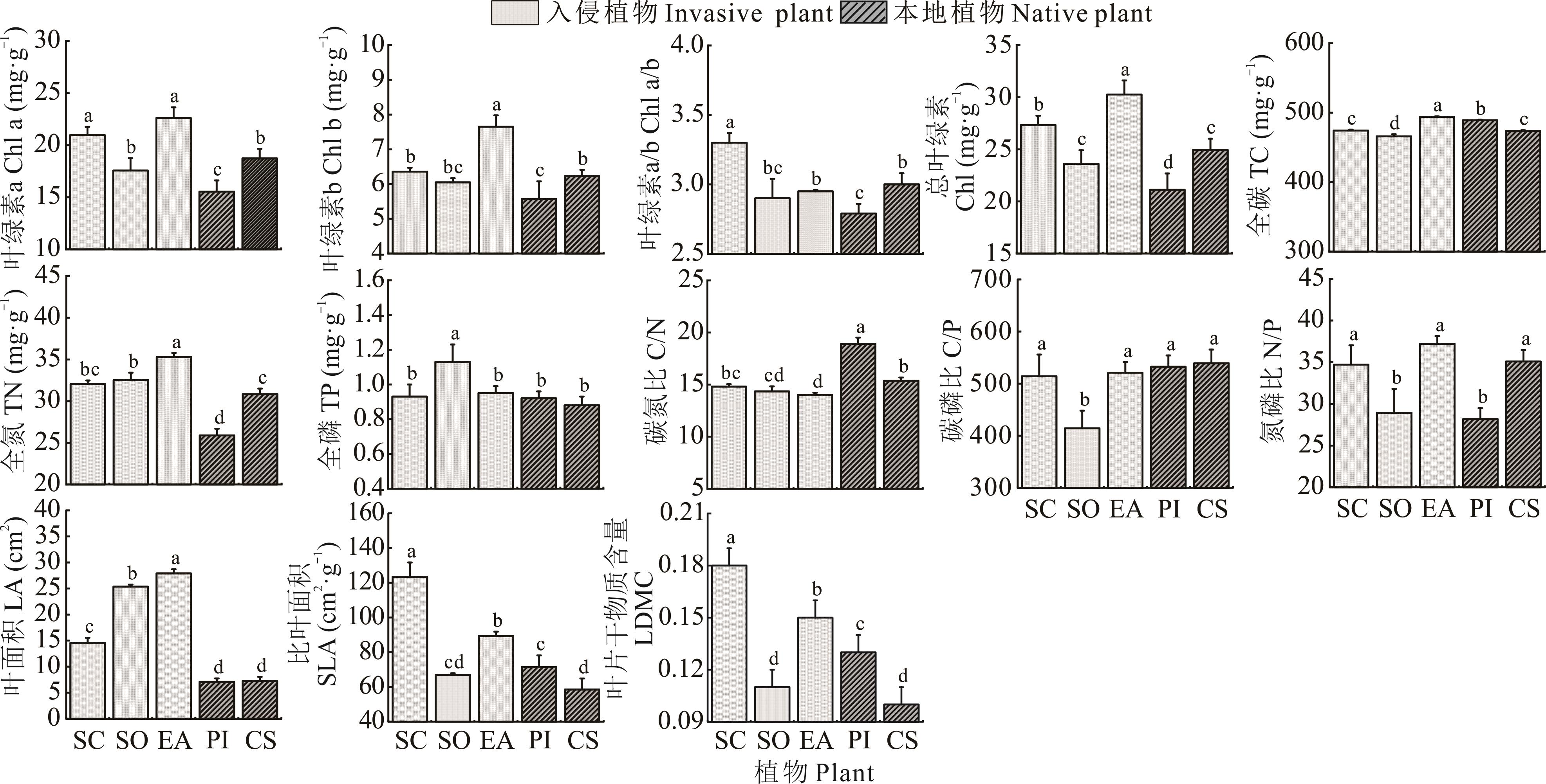
图2 5种菊科植物叶片生理化学性状的比较
Fig.2 Comparison of leaf physiological and chemical traits of five Asteraceae plants

图3 5种菊科植物叶片生理化学性状的相关性分析**: P<0.01; *: P<0.05.
Fig.3 Correlation analysis of leaf physiological and chemical traits of five Asteraceae plants
| 统计Statistic | 第1轴Axis 1 | 第2轴Axis 2 | 第3轴Axis 3 | 第4轴Axis 4 |
|---|---|---|---|---|
| 特征值Eigenvalues | 0.857 | 0.077 | 0.039 | 0.020 |
| 变异解释量(累积)Explained variation (cumulative) (%) | 85.720 | 93.440 | 97.380 | 99.340 |
| Pseudo-canonical相关性Pseudo-canonical correlation | 0.998 | 0.998 | 0.996 | 0.981 |
| 拟合变异解释量(累积)Explained fitted variation (cumulative) (%) | 86.160 | 93.910 | 97.880 | 99.850 |
表2 RDA分析中各排序轴的解释度
Table 2 Explanation of each sorting axis in RDA analysis
| 统计Statistic | 第1轴Axis 1 | 第2轴Axis 2 | 第3轴Axis 3 | 第4轴Axis 4 |
|---|---|---|---|---|
| 特征值Eigenvalues | 0.857 | 0.077 | 0.039 | 0.020 |
| 变异解释量(累积)Explained variation (cumulative) (%) | 85.720 | 93.440 | 97.380 | 99.340 |
| Pseudo-canonical相关性Pseudo-canonical correlation | 0.998 | 0.998 | 0.996 | 0.981 |
| 拟合变异解释量(累积)Explained fitted variation (cumulative) (%) | 86.160 | 93.910 | 97.880 | 99.850 |
性状 Trait | 解释度Explains (%) | 贡献度Contribution (%) | 检验值F | 显著性P | 性状 Trait | 解释度Explains (%) | 贡献度Contribution (%) | 检验值F | 显著性P |
|---|---|---|---|---|---|---|---|---|---|
| 叶绿素a/b Chl a/b | 45.1 | 45.3 | 10.7 | 0.004 | 叶片干物质含量LDMC | 0.4 | 0.5 | 1.9 | 0.144 |
| 叶面积LA | 31.7 | 31.9 | 16.4 | 0.002 | 碳氮比C/N | 0.3 | 0.3 | 2.4 | 0.102 |
| 比叶面积SLA | 10.2 | 10.2 | 8.6 | 0.004 | 叶绿素a Chl a | 0.1 | 0.1 | 0.9 | 0.406 |
| 全碳TC | 6.4 | 6.5 | 9.8 | 0.002 | 碳磷比C/P | <0.1 | <0.1 | 0.5 | 0.696 |
| 全氮TN | 4.3 | 4.3 | 16.7 | 0.002 | 全磷TP | 0.1 | 0.2 | 0.9 | 0.468 |
| 氮磷比N/P | 0.6 | 0.6 | 3.6 | 0.038 | 叶绿素b Chl b | <0.1 | <0.1 | 0.5 | 0.680 |
表3 5种菊科植物的叶片生理化学性状对其解剖结构变异的解释度
Table 3 Explanation degree of leaf physiological and chemical traits to the variation of anatomic structure of five Asteraceae plants
性状 Trait | 解释度Explains (%) | 贡献度Contribution (%) | 检验值F | 显著性P | 性状 Trait | 解释度Explains (%) | 贡献度Contribution (%) | 检验值F | 显著性P |
|---|---|---|---|---|---|---|---|---|---|
| 叶绿素a/b Chl a/b | 45.1 | 45.3 | 10.7 | 0.004 | 叶片干物质含量LDMC | 0.4 | 0.5 | 1.9 | 0.144 |
| 叶面积LA | 31.7 | 31.9 | 16.4 | 0.002 | 碳氮比C/N | 0.3 | 0.3 | 2.4 | 0.102 |
| 比叶面积SLA | 10.2 | 10.2 | 8.6 | 0.004 | 叶绿素a Chl a | 0.1 | 0.1 | 0.9 | 0.406 |
| 全碳TC | 6.4 | 6.5 | 9.8 | 0.002 | 碳磷比C/P | <0.1 | <0.1 | 0.5 | 0.696 |
| 全氮TN | 4.3 | 4.3 | 16.7 | 0.002 | 全磷TP | 0.1 | 0.2 | 0.9 | 0.468 |
| 氮磷比N/P | 0.6 | 0.6 | 3.6 | 0.038 | 叶绿素b Chl b | <0.1 | <0.1 | 0.5 | 0.680 |
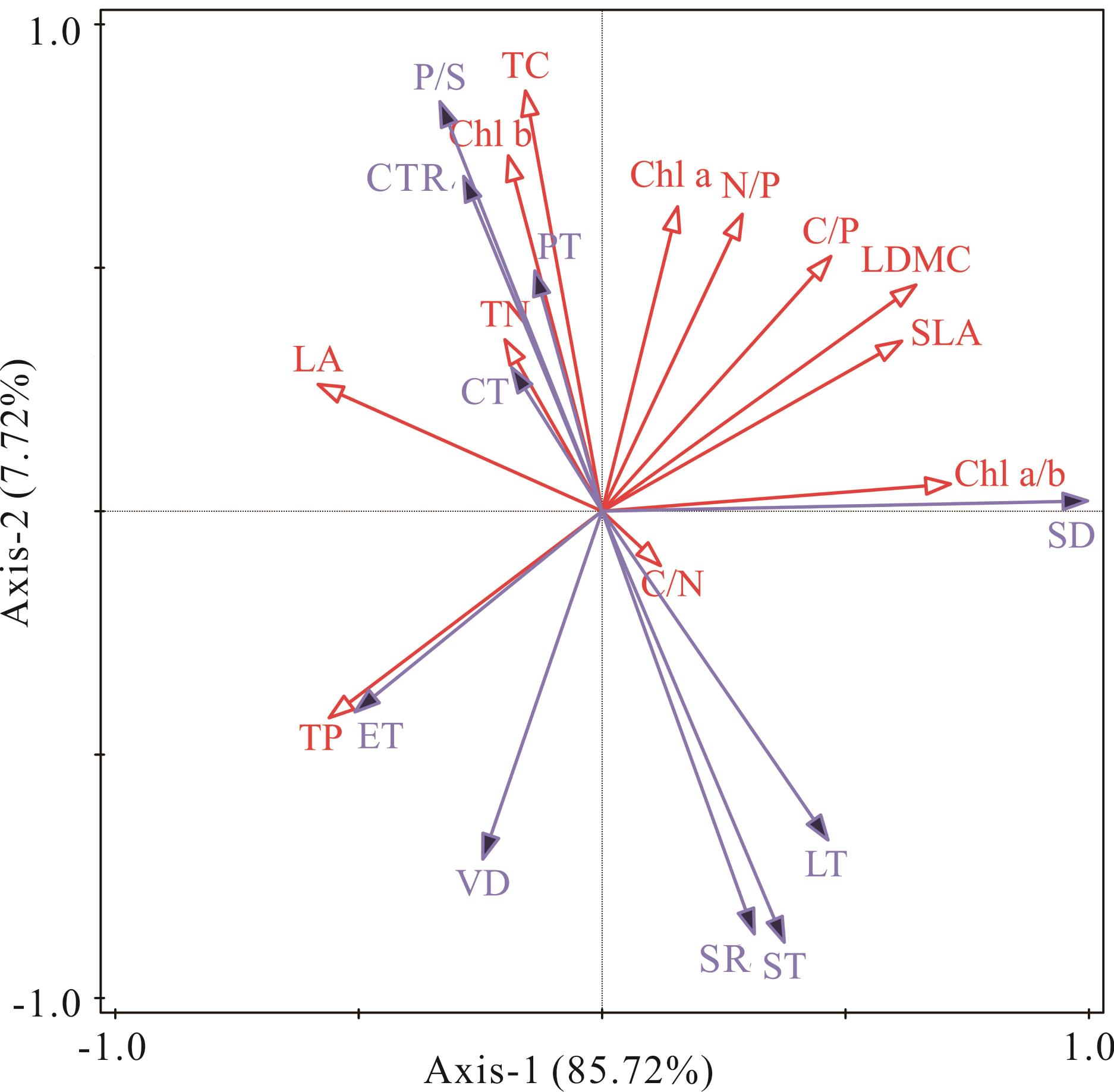
图4 5种菊科植物的叶片解剖结构与其生理化学性状的关系叶片生理化学性状用红色箭头表示,叶片解剖结构用蓝色箭头表示。箭头与箭头之间的夹角越小, 正相关性越强。Leaf physiological and chemical traits are represented by red arrows and leaf anatomical structure is represented by blue arrows. The smaller the angle between arrows, the stronger the positive correlation.
Fig.4 Relationship between leaf anatomical structure and physiological and chemical traits of five Asteraceae plants
| [1] | Liu Y J, Huang W, Yang Q, et al. Research advances of plant invasion ecology over the past 10 years. Biodiversity Science, 2022, 30(10): 276-292. |
| 刘艳杰, 黄伟, 杨强, 等. 近十年植物入侵生态学重要研究进展. 生物多样性, 2022, 30(10): 276-292. | |
| [2] | Jager H, Alencastro M J, Kaupenjohann M, et al. Ecosystem changes in Galapagos highlands by the invasive tree Cinchona pubescens. Plant and Soil, 2013, 371(1/2): 629-640. |
| [3] | Chitwood D H, Sinha N R. Evolutionary and environmental forces sculpting leaf development. Current Biology, 2016, 26(7): R297-R306. |
| [4] | Wang N J, Lyu T, Wang L, et al. Leaf functional traits and ecological strategies of common plant species in evergreen broad-leaved forests on Huangshan Mountain. Journal of Forestry Research, 2024, 35(130): 1-21. |
| [5] | Liu M C, Dong T F, Feng W W, et al. Leaf trait differences between 97 pairs of invasive and native plants across China: Effects of identities of both the invasive and native species. NeoBiota, 2022, 71: 1-22. |
| [6] | Wang X H, Ji M S. Photosynthetic characteristics of an invasive plant Conyza canadensis and its associated plants. Chinese Journal of Applied Ecology, 2013, 24(1): 71-77. |
| 王晓红, 纪明山. 入侵植物小飞蓬及其伴生植物的光合特性. 应用生态学报, 2013, 24(1): 71-77. | |
| [7] | Wei Z S, Chen X W, Yang D L, et al. Comparison of gas exchange characteristics between two invasive plants and a co-occurring native plant in Liaoning Province. Chinese Journal of Eco-Agriculture, 2017, 25(7): 975-982. |
| 魏子上, 陈新微, 杨殿林, 等. 辽宁地区两种菊科入侵植物与本地植物光合特性比较. 中国生态农业学报, 2017, 25(7): 975-982. | |
| [8] | Guo W W, Zhuomecao, Han J H, et al. Anatomical structure and stress resistance evaluation of leaves of Rhododendron L. in the Shergyla Mountain. Journal of Henan Agricultural Sciences, 2024, 53(6): 111-119. |
| 郭文文, 卓么草, 韩嘉华, 等. 色季拉山杜鹃花属植物叶片解剖结构特征与抗逆性评价. 河南农业科学, 2024, 53(6): 111-119. | |
| [9] | Pu Y F, Song Q X, Wang G X, et al. Leaf traits of nine common species of compositae weeds in Yunnan province. Southwest China Journal of Agricultural Sciences, 2023, 36(4): 816-825. |
| 浦艳飞, 宋起萱, 汪国鲜, 等. 云南9种常见菊科杂草叶片性状研究. 西南农业学报, 2023, 36(4): 816-825. | |
| [10] | Li S l, Sun Q, Zheng Q E, et al. Comparison of leaf anatomical characteristics of Eupatorium odoratum, E. adenophorum and two relative plants. Guangxi Agricultural Sciences, 2009, 40(8): 972-975. |
| 李素丽, 孙倩, 郑启恩, 等. 飞机草、紫茎泽兰与两种近缘植物叶片解剖结构比较研究. 广西农业科学, 2009, 40(8): 972-975. | |
| [11] | Cao J, Xu H, Pan X B, et al. Study on the status of invasive plants in Chinese grassland. Acta Agrestia Sinica, 2020, 28(1): 1-11. |
| 曹婧, 徐晗, 潘绪斌, 等. 中国草地外来入侵植物现状研究. 草地学报, 2020, 28(1): 1-11. | |
| [12] | Zhou Y Y, Guo M, Peng Y Q, et al. Characterization and phylogenetic analysis of the complete chloroplast genome of Erigeron annuus. Chinese Journal of Tropical Crops, 2023, 44(4): 689-698. |
| 周芸芸, 郭敏, 彭英权, 等. 一年蓬叶绿体基因组特征及系统进化分析. 热带作物学报, 2023, 44(4): 689-698. | |
| [13] | Yang R Y, Zan S T, Tang J J, et al. Invasion mechanisms of Solidago canadensis L. : A review. Acta Ecologica Sinica, 2011, 31(4): 1185-1194. |
| 杨如意, 昝树婷, 唐建军, 等. 加拿大一枝黄花的入侵机理研究进展. 生态学报, 2011, 31(4): 1185-1194. | |
| [14] | Zhang S, Guo S L, Guan M, et al. Diversity differentiation of invasive plants at a regional scale in China and its influencing factors: Accroding to analyses on the data from 74 regions. Acta Ecologica Sinica, 2010, 30(16): 4241-4256. |
| 张帅, 郭水良, 管铭, 等. 我国入侵植物多样性的区域分异及其影响因素——以74个地区数据为基础. 生态学报, 2010, 30(16): 4241-4256. | |
| [15] | Editorial Committee of Alien Invasive Plants from China. Alien invasive plants from China (Volume 4). Shanghai: Shanghai Jiao Tong University Press, 2020. |
| 中国科学院中国外来入侵植物志编辑委员会. 中国外来入侵植物志(第四卷). 上海: 上海交通大学出版社, 2020. | |
| [16] | Editorial Committee of Flora of China, Chinese Academy of Sciences. Flora of China (Volume 76, Part 2: Compositae). Beijing: Science Press, 1991: 123-125. |
| 中国科学院中国植物志编辑委员会. 中国植物志(第76卷, 第2册: 菊科). 北京: 科学出版社, 1991: 123-125. | |
| [17] | Zhang X Y, Alison W, Tadashi K, et al. Effects of provenance on leaf structure and function of two mangrove species: The genetic adaptation to temperature. Chinese Journal of Plant Ecology, 2021, 45(11): 1241-1250. |
| 张小燕, Alison W, Tadashi K, 等. 种源地对两种红树叶片结构和功能的影响: 对温度的适应性遗传. 植物生态学报, 2021, 45(11): 1241-1250. | |
| [18] | Bao P A, Qiu K Y, Huang Y Y, et al. Leaf functional trait characteristics and plasticity of desert steppe plants under nitrogen and phosphorus addition. Acta Prataculturae Sinica, 2024, 33(3): 97-106. |
| 鲍平安, 邱开阳, 黄业芸, 等. 荒漠草原植物在氮磷添加下叶功能性状特征及其可塑性.草业学报, 2024, 33(3): 97-106. | |
| [19] | Jiang G B. Effects of volatiles of invasive species Wedelia trilobata on chlorophyll content of weeds. Ecology and Environmental Sciences, 2011, 20(8/9): 1235-1237. |
| 江贵波. 入侵物种三裂叶蟛蜞菊挥发物对杂草叶绿素含量的影响. 生态环境学报, 2011, 20(8/9): 1235-1237. | |
| [20] | Bao S D. Soil agrochemical analysis (3 edition). Beijing: China Agriculture Press, 2000. |
| 鲍士旦. 土壤农化分析(3版). 北京: 中国农业出版社, 2000. | |
| [21] | Chen B, Li H Y, Liu X W, et al. Effects of different light intensities on morphogensis and ultrastructure of Gibasis pellucida leaf. Acta Prataculturae Sincia, 2019, 28(7): 175-185. |
| 陈斌, 李洪瑶, 刘筱玮, 等. 不同光照强度对新娘草叶片形态建成及超微结构的影响.草业学报, 2019, 28(7): 175-185. | |
| [22] | Wang J Z, Chen Z Q, Chen Z B, et al. Response of functional traits of Dicranopteris dichotoma leaves to soil factors in different vegetation restoration years in red soil erosion area of Southern China. Acta Ecologica Sinica, 2020, 40(3): 900-909. |
| 王敬哲, 陈志强, 陈志彪, 等. 南方红壤侵蚀区不同植被恢复年限下芒萁叶功能性状对土壤因子的响应. 生态学报, 2020, 40(3): 900-909. | |
| [23] | Kang Sarula, Niu J M, Zhang Q, et al. Anatomical structure of Stipa breviflora leaves and its relationship with environmental factors. Acta Prataculturae Sincia, 2013, 22(1): 77-86. |
| 康萨如拉, 牛建明, 张庆, 等. 短花针茅叶片解剖结构及与气候因子的关系.草业学报, 2013, 22(1): 77-86. | |
| [24] | Feng H H, Gao S Q, Gao J L, et al. Effect of nitrogen addition on leaf chlorophyll and nutrient content of typical plant species in peatland of the Great Hing’an Mountains. Chinese Journal of Ecology, 2025, 44(5): 1456-1464. |
| 冯欢欢, 高思齐, 高晋丽, 等. 氮添加对大兴安岭泥炭地典型植物叶片叶绿素和养分含量的影响. 生态学杂志, 2025, 44(5): 1456-1464. | |
| [25] | Zhang Y Y, Hu D D, Ma C H, et al. Leaf structure and photosynthetic properties of alfalfa in response to bacteria and phosphorus addition. Acta Prataculturae Sinica, 2024, 33(8): 133-144. |
| 张盈盈, 胡丹丹, 马春晖, 等. 苜蓿叶片结构和光合特性对菌磷添加的响应. 草业学报, 2024, 33(8): 133-144. | |
| [26] | Li Y, He N P, Liu C C. Plants functional traits network: Developments of conceptual framework and advances in applications. Acta Ecologica Sinica, 2024, 44(18): 7944-7961. |
| 李颖, 何念鹏, 刘聪聪. 植物功能性状网络:概念体系发展与应用进展. 生态学报, 2024, 44(18): 7944-7961. | |
| [27] | Liu K J, He N P, Hou J H. Spatial patterns and influencing factors of specific leaf in typical temperate forests. Acta Ecologica Sinica, 2022, 42(3): 872-883. |
| 刘可佳, 何念鹏, 侯继华. 中国温带典型森林植物比叶面积的空间格局及其影响因素. 生态学报, 2022, 42(3): 872-883. | |
| [28] | Davidson A M, Jennions M, Nicotra A B. Do invasive species show higher phenotypic plasticity than native species and, if so, is it adaptive? A Meta-analysis. Ecology Letters, 2015, 14(4): 419-431. |
| [29] | Zhang W, Liu W C, Xu M P, et al. Response of forest growth to C∶N∶P stoichiometry in plants and soils during Robinia pseudoacacia afforestation on the Loess Plateau, China. Geoderma: An International Journal of Soil Science, 2019, 337: 280-289. |
| [30] | Xu A Y, Zhang L H, Wang X J, et al. Responses of non-structural carbohydrates and C∶N∶P stoichiometry of Agropyron mongolicum to nitrogen addition. Acta Prataculturae Sinica, 2023, 32(2): 35-43. |
| 许爱云, 张丽华, 王晓佳, 等. 蒙古冰草非结构性碳水化合物及碳氮磷化学计量特征对氮添加的响应. 草业学报, 2023, 32(2): 35-43. | |
| [31] | Sun H, Liang H, Zhang Y Y. Response of root morphogenesis of medicinal plants to low phosphorus stress and molecular mechanism. China Journal of Chinese Materia Medica, 2022, 47(24): 6573-6580. |
| 孙海, 梁浩, 张亚玉. 药用植物根形态建成低磷响应策略及其分子机制. 中国中药杂志, 2022, 47(24): 6573-6580. | |
| [32] | Zhao Y J, Qing H, Zhao C J, et al. Phenotypic plasticity of Spartina alterniflora and Phragmites australis in response to nitrogen addition and intraspecific competition. Hydrobiologia, 2010, 637(1): 143-155. |
| [33] | Hu C C, Liu X Y, Lei Y B, et al. Foliar nitrogen and phosphorus stoichiometry of alien invasive plants and co-occurring natives in Xishuangbanna. Chinese Journal of Plant Ecology, 2016, 40(11): 1145-1153. |
| 胡朝臣, 刘学炎, 类延宝, 等. 西双版纳外来入侵植物及其共存种叶片氮、磷化学计量特征. 植物生态学报, 2016, 40(11): 1145-1153. | |
| [34] | Shan R Q J, Yao B Q, Li Y X, et al. Stoichiometries and their responses of leaf of four plant species in alpine grasslands to slopes. Acta Agrestia Sinica, 2024, 32(1): 121-129. |
| 鄯仁欠姐, 姚步青, 李永晓, 等. 高寒草地四种植物叶片化学计量学特征及其对坡度的响应. 草地学报, 2024, 32(1): 121-129. | |
| [35] | Wu H, Han M X, Han X. Effects of heterogeneous habitats on ecological stoichiometric characteristics of invasive plants Alternanthera philoxeroides. Southwest China Journal of Agricultural Sciences, 2020, 33(8): 1816-1823. |
| 吴昊, 韩美旭, 韩雪. 环境因子对入侵杂草空心莲子草化学计量特征的影响. 西南农业学报, 2020, 33(8): 1816-1823. | |
| [36] | Han W X, Fang J Y, Guo D L, et al. Leaf nitrogen and phosphorus stoichiometry across 753 terrestrial plant species in China. New Phytologist, 2005, 168(2): 377-385. |
| [37] | Huang X B, Liu W D, Su J R, et al. Stoichiometry of leaf C, N and P across 152 woody species of a monsoon broad-leaved evergreen forest in Pu’er, Yunnan Province. Chinese Journal of Ecology, 2016, 35(3): 567-575. |
| 黄小波, 刘万德, 苏建荣, 等. 云南普洱季风常绿阔叶林152种木本植物叶片C、N、P化学计量特征. 生态学杂志, 2016, 35(3): 567-575. | |
| [38] | Dai Z C, Fu W, Qi S S, et al. Different responses of an invasive clonal plant Wedelia trilobata and its native congener to gibberellin: Implications for biological invasion. Journal of Chemical Ecology: Official Journal of the International Society of Chemical Ecology, 2016, 42: 85-94. |
| [39] | Cao P L, Gallien L, Pollock L J, et al. Plant invasion in Mediterranean Europe: Current hotspots and future scenarios. Ecography, 2024(5): 14. |
| [40] | Qi D H, Wen Z M, Wang H X, et al. Stoichiometry traits of carbon, nitrogen, and phosphorus in plants of different functional groups and their responses to micro-topographical variations in the hilly and gully region of the Loess Plateau, China. Acta Ecologica Sinica, 2016, 36(20): 6420-6430. |
| 戚德辉, 温仲明, 王红霞, 等. 黄土丘陵区不同功能群植物碳氮磷生态化学计量特征及其对微地形的响应. 生态学报, 2016, 36(20): 6420-6430. | |
| [41] | Alami M M, Shu S H, Liu S B, et al. Impact of nitrogen rates on biosynthesis pathways: A comparative study of diterpene synthases in clerodane diterpenoids and enzymes in benzylisoquinoline alkaloids. International Journal of Biological Macromolecules, 2024, 280(4) : 13595. |
| [42] | Qu F, Peng T L, Jia Y J, et al. Adjusting leaf nitrogen allocation could promote photosynthetic capacity, and nitrogen accumulation in Cucumis sativus L. Environmental and Experimental Botany, 2022, 198: 104855. |
| [43] | Dai C Y, Lin Y M, Guan J J, et al. Mechanism analysis: Nitrogen and potassium synergy regulate nitrogen distribution in photosynthetic system to enhance Panax notoginseng resistance to light stress. Industrial Crops and Products, 2024, 210(7): 118111. |
| [44] | Wang M L, Feng Y L. Effects of soil nitrogen levels on morphology, biomass allocation and photosynthesis in Ageratina Adenophora and Chromoleana odorata. Acta Phytoecologica Sinica, 2005, 29(5): 697-705. |
| 王满莲, 冯玉龙. 紫茎泽兰和飞机草的形态,生物量分配和光合特性对氮营养的响应. 植物生态学报, 2005, 29(5): 697-705. | |
| [45] | Zhang Y H, Zhang F C, Li Y X, et al. Influence of exogenous N import on growth and leaf character of Spartina alterniflora. Ecology and Environmental Sciences, 2010, 19(10): 2297-2301. |
| 张耀鸿, 张富存, 李映雪, 等. 外源氮输入对互花米草生长及叶特征的影响. 生态环境学报, 2010, 19(10): 2297-2301. | |
| [46] | De la Riva E G, Olmo M, Poorter H, et al. Leaf mass per area (LMA) and its relationship with leaf structure and anatomy in 34 mediterranean woody species along a water availability gradient. PLoS One, 2016, 11(2): 1-18. |
| [47] | Wright I J, Dong N, Maire V, et al. Global climatic drivers of leaf size. Science, 2017, 357(6354): 917-921. |
| [48] | Liu X L, Zhu Y L, Yu M, et al. Changes in cell wall structure and photosynthetic characteristics of tea leaves under low temperature stress. Journal of Tea Science, 2024, 44(6): 917-927. |
| 刘晓璐, 朱亚兰, 于敏, 等. 低温胁迫下茶树叶片细胞壁结构变化及光合特性. 茶叶科学, 2024, 44(6): 917-927. |
| [1] | 赵光华, 高明龙, 王朵, 范世奇, 唐健, 孙阔, 温玄烨. 全球入侵植物的经济成本评估[J]. 草业学报, 2024, 33(5): 16-24. |
| [2] | 韩雨轩, 王瑞, 郝丽芬, 袁海滨, 林克剑. 外来入侵植物长刺蒺藜草在我国的地理分布格局及其影响因素[J]. 草业学报, 2024, 33(12): 34-44. |
| [3] | 刘晶, 杨艺涵, 钱永强, 陈雨峰, 刘丹, 解孝满, 刘岳含, 柳鑫, 邹博坤. 尼山-峄山区外来入侵草本植物风险评估[J]. 草业学报, 2024, 33(11): 1-14. |
| [4] | 陈美杉, 陈鲜, 满晓珍, 刘闯, 佟佳林, 曲波. 入侵种瘤突苍耳细根解剖结构的可塑性与入侵性间的关系[J]. 草业学报, 2023, 32(5): 118-126. |
| [5] | 王瑞, 胡玥, 崔宏安, 牛佳睿, 李亚东, 苗芳. 19种菊科植物花药结构及绒毡层的发育类型研究[J]. 草业学报, 2020, 29(6): 182-190. |
| [6] | 赵威, 王艳杰, 李亚鸽. 草地入侵植物对枝叶去除的生理生态响应:模式、机理与研究展望[J]. 草业学报, 2017, 26(6): 195-202. |
| [7] | 赵晓红, 杨殿林, 王慧, 刘红梅, 曲波, 皇甫超河. 黄顶菊入侵对不同地区土壤氮循环及微生物量的影响[J]. 草业学报, 2015, 24(2): 62-69. |
| [8] | 王瑞,万方浩. 外来入侵植物意大利苍耳在我国适生区预测[J]. 草业学报, 2010, 19(6): 222-230. |
| 阅读次数 | ||||||
|
全文 |
|
|||||
|
摘要 |
|
|||||
