
ISSN 1004-5759 CN 62-1105/S
Acta Prataculturae Sinica ›› 2026, Vol. 35 ›› Issue (3): 83-95.DOI: 10.11686/cyxb2025131
Previous Articles Next Articles
Jia-yi ZANG1,2,3( ), Ming-jie XU1,2,3, Ji-cheng XIE1,2,3, Yu-ying SHEN1,2,3, Xing-fa LAI1,2,3()
Received:2025-04-17
Revised:2025-06-11
Online:2026-03-20
Published:2026-01-19
Contact:
Xing-fa LAI
Jia-yi ZANG, Ming-jie XU, Ji-cheng XIE, Yu-ying SHEN, Xing-fa LAI. Effects of replacing chemical fertilizers with organic fertilizer at equivalent nitrogen levels on forage yield and water use efficiency in a silage maize/forage soybean intercropping system in dryland areas[J]. Acta Prataculturae Sinica, 2026, 35(3): 83-95.
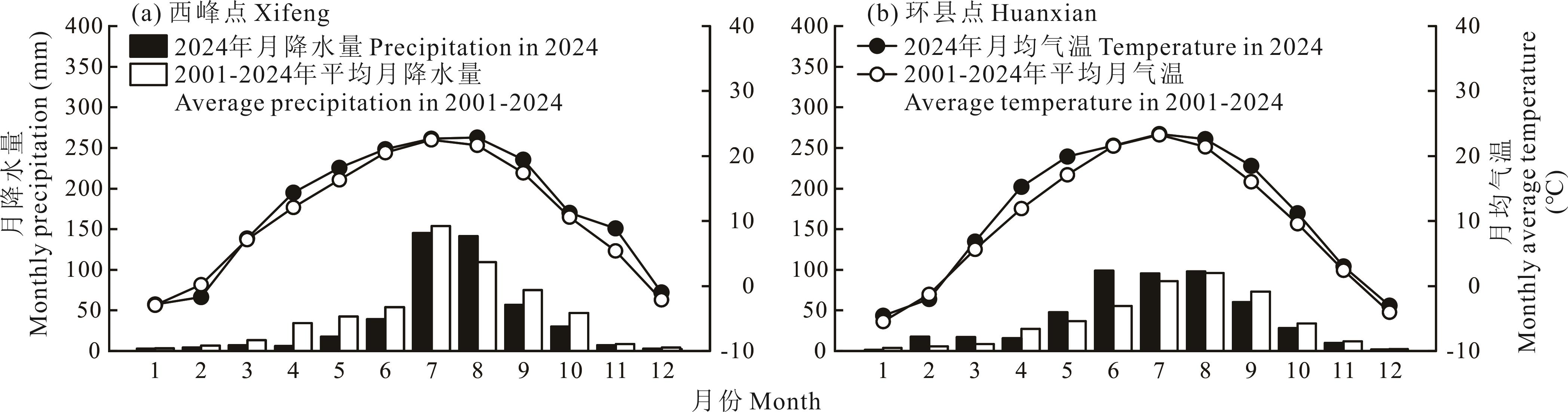
Fig.1 Monthly precipitation and temperature in 2024 and the long-term (2001-2024) average values at Xifeng (a) and Huanxian (b)
种植模式 Planting patterns | 施氮模式 Nitrogen fertilizer patterns | 处理编号 Codes of treatment |
|---|---|---|
| 青贮玉米单作Silage maize monoculture | 100%无机氮肥100% inorganic nitrogen fertilizer | M |
| 饲用大豆单作Forage soybean monoculture | 100%无机氮肥100% inorganic nitrogen fertilizer | S |
| 2行玉米/2行大豆2 rows of maize/2 rows of soybean | 100%无机氮肥100% inorganic nitrogen fertilizer | M2S2F |
| 有机肥等氮替代化肥Organic fertilizer substitution with equivalent nitrogen for chemical fertilizers | M2S2O | |
| 4行玉米/2行大豆4 rows of maize/2 rows of soybean | 100%无机氮肥100% chemical nitrogen fertilizers | M4S2F |
| 有机肥等氮替代化肥Organic fertilizer substitution with equivalent nitrogen for chemical fertilizers | M4S2O |
Table 1 Experiment design
种植模式 Planting patterns | 施氮模式 Nitrogen fertilizer patterns | 处理编号 Codes of treatment |
|---|---|---|
| 青贮玉米单作Silage maize monoculture | 100%无机氮肥100% inorganic nitrogen fertilizer | M |
| 饲用大豆单作Forage soybean monoculture | 100%无机氮肥100% inorganic nitrogen fertilizer | S |
| 2行玉米/2行大豆2 rows of maize/2 rows of soybean | 100%无机氮肥100% inorganic nitrogen fertilizer | M2S2F |
| 有机肥等氮替代化肥Organic fertilizer substitution with equivalent nitrogen for chemical fertilizers | M2S2O | |
| 4行玉米/2行大豆4 rows of maize/2 rows of soybean | 100%无机氮肥100% chemical nitrogen fertilizers | M4S2F |
| 有机肥等氮替代化肥Organic fertilizer substitution with equivalent nitrogen for chemical fertilizers | M4S2O |

Fig.2 Schematic diagram of different planting patterns at Xifeng (A) and Huanxian (B)

Fig.3 System dry matter yield (a, b) and crude protein yield (c, d) values in the silage maize/forage soybean intercropping systems at Xifeng and Huanxian
处理 Treatment | LERDM | |||||
|---|---|---|---|---|---|---|
| 西峰点Xifeng | 环县点Huanxian | |||||
| LERDM | LERDM_M | LERDM_S | LERDM | LERDM_M | LERDM_S | |
| M4S2F | 1.05±0.06a | 0.65±0.07ab | 0.40±0.09ab | 0.96±0.05a | 0.77±0.07a | 0.19±0.02c |
| M4S2O | 0.96±0.05a | 0.70±0.08a | 0.26±0.06b | 0.95±0.05a | 0.71±0.05a | 0.23±0.04bc |
| M2S2F | 1.04±0.01a | 0.52±0.07ab | 0.52±0.07a | 1.01±0.09a | 0.63±0.10a | 0.38±0.06ab |
| M2S2O | 0.93±0.05a | 0.47±0.04b | 0.46±0.08ab | 1.06±0.09a | 0.64±0.03a | 0.42±0.06a |
处理 Treatment | LERCP | |||||
| 西峰点Xifeng | 环县点Huanxian | |||||
| LERCP | LERCP_M | LERCP_S | LERCP | LERCP_M | LERCP_S | |
| M4S2F | 1.11±0.06a | 0.62±0.07a | 0.48±0.11a | 0.94±0.02a | 0.74±0.04a | 0.20±0.03b |
| M4S2O | 0.99±0.12a | 0.69±0.14a | 0.30±0.06b | 0.91±0.08a | 0.68±0.05a | 0.23±0.05b |
| M2S2F | 1.06±0.03a | 0.48±0.08a | 0.58±0.10a | 0.92±0.06a | 0.61±0.10a | 0.31±0.04ab |
| M2S2O | 1.03±0.04a | 0.49±0.08a | 0.53±0.08a | 1.13±0.19a | 0.62±0.05a | 0.51±0.14a |
Table 2 Land equivalent ratio (LER) based on dry matter (DM) yield and crude protein (CP) yield in the silage maize/forage soybean intercropping systems at Xifeng and Huanxian
处理 Treatment | LERDM | |||||
|---|---|---|---|---|---|---|
| 西峰点Xifeng | 环县点Huanxian | |||||
| LERDM | LERDM_M | LERDM_S | LERDM | LERDM_M | LERDM_S | |
| M4S2F | 1.05±0.06a | 0.65±0.07ab | 0.40±0.09ab | 0.96±0.05a | 0.77±0.07a | 0.19±0.02c |
| M4S2O | 0.96±0.05a | 0.70±0.08a | 0.26±0.06b | 0.95±0.05a | 0.71±0.05a | 0.23±0.04bc |
| M2S2F | 1.04±0.01a | 0.52±0.07ab | 0.52±0.07a | 1.01±0.09a | 0.63±0.10a | 0.38±0.06ab |
| M2S2O | 0.93±0.05a | 0.47±0.04b | 0.46±0.08ab | 1.06±0.09a | 0.64±0.03a | 0.42±0.06a |
处理 Treatment | LERCP | |||||
| 西峰点Xifeng | 环县点Huanxian | |||||
| LERCP | LERCP_M | LERCP_S | LERCP | LERCP_M | LERCP_S | |
| M4S2F | 1.11±0.06a | 0.62±0.07a | 0.48±0.11a | 0.94±0.02a | 0.74±0.04a | 0.20±0.03b |
| M4S2O | 0.99±0.12a | 0.69±0.14a | 0.30±0.06b | 0.91±0.08a | 0.68±0.05a | 0.23±0.05b |
| M2S2F | 1.06±0.03a | 0.48±0.08a | 0.58±0.10a | 0.92±0.06a | 0.61±0.10a | 0.31±0.04ab |
| M2S2O | 1.03±0.04a | 0.49±0.08a | 0.53±0.08a | 1.13±0.19a | 0.62±0.05a | 0.51±0.14a |
处理 Treatment | 西峰点Xifeng | 环县 Huanxian | ||
|---|---|---|---|---|
| AMS | CRMS | AMS | CRMS | |
| M4S2F | -0.002±0.000b | 0.928±0.236a | 0.580±0.098a | 2.147±0.522a |
| M4S2O | 0.437±0.121a | 1.473±0.367a | 0.484±0.076ab | 1.713±0.459a |
| M2S2F | -0.003±0.000b | 0.981±0.215a | 0.250±0.147b | 1.797±0.517a |
| M2S2O | 0.016±0.001ab | 1.115±0.240a | 0.219±0.036b | 1.575±0.177a |
Table 3 The aggressivity of maize relative to soybean (AMS) and competition ratio (CRMS) in the silage maize/forage soybean intercropping systems at Xifeng and Huanxian
处理 Treatment | 西峰点Xifeng | 环县 Huanxian | ||
|---|---|---|---|---|
| AMS | CRMS | AMS | CRMS | |
| M4S2F | -0.002±0.000b | 0.928±0.236a | 0.580±0.098a | 2.147±0.522a |
| M4S2O | 0.437±0.121a | 1.473±0.367a | 0.484±0.076ab | 1.713±0.459a |
| M2S2F | -0.003±0.000b | 0.981±0.215a | 0.250±0.147b | 1.797±0.517a |
| M2S2O | 0.016±0.001ab | 1.115±0.240a | 0.219±0.036b | 1.575±0.177a |
处理 Treatment | 西峰点Xifeng | |||||
|---|---|---|---|---|---|---|
| WU (mm) | ?WU | WUEDM (kg·hm-2·mm-1) | ?WUEDM | WUECP (kg·hm-2·mm-1) | ?WUECP | |
| M | 344.5±3.5a | — | 82.23±0.85a | — | 6.09±0.06c | — |
| M4S2F | 286.8±10.8a | -0.15±0.03a | 90.49±3.52a | 0.22±0.05a | 9.99±0.39a* | 0.36±0.05a* |
| M4S2O | 305.0±13.1a | -0.10±0.02a | 81.70±3.42a | 0.10±0.01a | 7.90±0.33b* | 0.08±0.01b* |
| M2S2F | 303.6±22.1a | -0.09±0.02a | 81.48±6.38a | 0.16±0.04a | 9.55±0.75ab | 0.20±0.03ab |
| M2S2O | 291.1±28.3a | -0.13±0.03a | 77.23±8.04a | 0.10±0.02a | 9.62±1.00ab | 0.21±0.03ab |
| S | 325.7±7.0a | — | 57.97±1.25b | — | 9.85±0.21a | — |
处理 Treatment | 环县点Huanxian | |||||
| WU (mm) | ?WU | WUEDM (kg·hm-2·mm-1) | ?WUEDM | WUECP (kg·hm-2·mm-1) | ?WUECP | |
| M | 287.6±6.0a | — | 68.25±1.41a | — | 6.31±0.13ab | — |
| M4S2F | 335.2±12.9a | 0.16±0.03a | 51.62±2.03b | -0.11±0.02b | 4.99±0.20c | -0.19±0.03b |
| M4S2O | 303.0±23.8a | 0.05±0.01a | 55.31±4.03b | -0.05±0.01ab | 5.41±0.39bc | -0.12±0.03b |
| M2S2F | 309.5±22.2a | 0.07±0.01a | 54.11±3.83b | 0.02±0.00ab | 5.34±0.38bc* | -0.12±0.02b |
| M2S2O | 297.7±6.6a | 0.02±0.00a | 57.63±1.30b | 0.09±0.02a | 6.67±0.15a* | 0.10±0.01a |
| S | 293.4±19.2a | — | 37.93±2.66c | — | 5.86±0.41abc | — |
Table 4 Water consumption (WU) and water use efficiency (WUE) of the silage maize/forage soybean intercropping and monoculture systems, and changes in water consumption (?WU) and water use efficiency (?WUE) of intercropping systems relative to monocultures at Xifeng and Huanxian
处理 Treatment | 西峰点Xifeng | |||||
|---|---|---|---|---|---|---|
| WU (mm) | ?WU | WUEDM (kg·hm-2·mm-1) | ?WUEDM | WUECP (kg·hm-2·mm-1) | ?WUECP | |
| M | 344.5±3.5a | — | 82.23±0.85a | — | 6.09±0.06c | — |
| M4S2F | 286.8±10.8a | -0.15±0.03a | 90.49±3.52a | 0.22±0.05a | 9.99±0.39a* | 0.36±0.05a* |
| M4S2O | 305.0±13.1a | -0.10±0.02a | 81.70±3.42a | 0.10±0.01a | 7.90±0.33b* | 0.08±0.01b* |
| M2S2F | 303.6±22.1a | -0.09±0.02a | 81.48±6.38a | 0.16±0.04a | 9.55±0.75ab | 0.20±0.03ab |
| M2S2O | 291.1±28.3a | -0.13±0.03a | 77.23±8.04a | 0.10±0.02a | 9.62±1.00ab | 0.21±0.03ab |
| S | 325.7±7.0a | — | 57.97±1.25b | — | 9.85±0.21a | — |
处理 Treatment | 环县点Huanxian | |||||
| WU (mm) | ?WU | WUEDM (kg·hm-2·mm-1) | ?WUEDM | WUECP (kg·hm-2·mm-1) | ?WUECP | |
| M | 287.6±6.0a | — | 68.25±1.41a | — | 6.31±0.13ab | — |
| M4S2F | 335.2±12.9a | 0.16±0.03a | 51.62±2.03b | -0.11±0.02b | 4.99±0.20c | -0.19±0.03b |
| M4S2O | 303.0±23.8a | 0.05±0.01a | 55.31±4.03b | -0.05±0.01ab | 5.41±0.39bc | -0.12±0.03b |
| M2S2F | 309.5±22.2a | 0.07±0.01a | 54.11±3.83b | 0.02±0.00ab | 5.34±0.38bc* | -0.12±0.02b |
| M2S2O | 297.7±6.6a | 0.02±0.00a | 57.63±1.30b | 0.09±0.02a | 6.67±0.15a* | 0.10±0.01a |
| S | 293.4±19.2a | — | 37.93±2.66c | — | 5.86±0.41abc | — |
处理 Treatment | 西峰点Xifeng | 环县点Huanxian | ||||
|---|---|---|---|---|---|---|
| 总投入Total input | 总产值Gross output | 净收入Net income | 总投入Total input | 总产值Gross output | 净收入Net income | |
| M | 10410 | 28633±960b | 18223±960b | 11025 | 23306±1087a | 12281±1087ab |
| M4S2F | 10290 | 34980±1811a | 24690±1811a | 10605 | 26115±1567a | 15510±1567a |
| M4S2O | 11415 | 35056±1812a | 23641±1812a | 11610 | 25204±1349a | 13594±1349a |
| M2S2F | 10290 | 34336±696a | 24046±696a | 10455 | 26178±2421a | 15723±2421a |
| M2S2O | 11130 | 32198±1477ab | 21068±1477ab | 11220 | 27272±2258a | 16052±2258a |
| S | 9420 | 19489±2046c | 10069±2046c | 9375 | 16581±789b | 7206±789b |
Table 5 Comparison of economic benefits performance in the silage maize/forage soybean intercropping systems at Xifeng and Huanxian (CNY·hm-2)
处理 Treatment | 西峰点Xifeng | 环县点Huanxian | ||||
|---|---|---|---|---|---|---|
| 总投入Total input | 总产值Gross output | 净收入Net income | 总投入Total input | 总产值Gross output | 净收入Net income | |
| M | 10410 | 28633±960b | 18223±960b | 11025 | 23306±1087a | 12281±1087ab |
| M4S2F | 10290 | 34980±1811a | 24690±1811a | 10605 | 26115±1567a | 15510±1567a |
| M4S2O | 11415 | 35056±1812a | 23641±1812a | 11610 | 25204±1349a | 13594±1349a |
| M2S2F | 10290 | 34336±696a | 24046±696a | 10455 | 26178±2421a | 15723±2421a |
| M2S2O | 11130 | 32198±1477ab | 21068±1477ab | 11220 | 27272±2258a | 16052±2258a |
| S | 9420 | 19489±2046c | 10069±2046c | 9375 | 16581±789b | 7206±789b |
| [1] | Shou N, Gao W, Shen Y Y, et al. Effects of different nitrogen application rates on yield and water use efficiency of silage maize. Pratacultural Science, 2022, 38(7): 1351-1361. |
| 受娜, 高玮, 沈禹颖, 等. 不同施氮量对青贮玉米产量及水分利用效率的影响. 草业科学, 2022, 38(7): 1351-1361. | |
| [2] | Li Y J, Ma L S, Wu P T, et al. Yield, yield attributes and photosynthetic physiological characteristics of dryland wheat (Triticum aestivum L.)/maize (Zea mays L.) strip intercropping. Field Crops Research, 2020, 248: 107656. |
| [3] | Monicah M M, Pieter P, Daniel M, et al. A staggered maize-legume intercrop arrangement robustly increases crop yields and economic returns in the highlands of Central Kenya. Field Crops Research, 2009, 115(2): 132-139. |
| [4] | Weng Q Y, Huang X J, Xu H L, et al. Effects of corn/soybean intercropping model on yield, quality, soil nutrition and rhizosphere microorganisms of silage corn. Journal of Nuclear Agricultural Sciences, 2021, 35(2): 462-470. |
| 瓮巧云, 黄新军, 许翰林, 等. 玉米/大豆间作模式对青贮玉米产量、品质及土壤营养、根际微生物的影响. 核农学报, 2021, 35(2): 462-470. | |
| [5] | Jiang Z W, Liu G Y, An H Y, et al. Effects of planting density and nitrogen application on forage yield, quality and nitrogen use efficiency in a maize/forage soybean intercropping system. Acta Prataculturae Sinica, 2022, 31(7): 157-171. |
| 蒋紫薇, 刘桂宇, 安昊云, 等. 种植密度与施氮对玉米/秣食豆间作系统饲草产量、品质和氮肥利用的影响. 草业学报, 2022, 31(7): 157-171. | |
| [6] | Tang G, Sui D H, Wu X J, et al. Research progress on forage of silage corn in China. Heilongjiang Animal Science and Veterinary Medicine, 2021(9): 26-28, 33. |
| 唐贵, 隋冬华, 武新娟, 等. 我国青贮玉米饲用化研究进展. 黑龙江畜牧兽医, 2021(9): 26-28, 33. | |
| [7] | Ge J, Liu G H, Yang C J, et al. Research progress on mixed silage of Medicago sativa. Journal of Henan Agricultural Sciences, 2014, 43(9): 6-10, 17. |
| 葛剑, 刘贵河, 杨翠军, 等. 紫花苜蓿混合青贮研究进展. 河南农业科学, 2014, 43(9): 6-10, 17. | |
| [8] | Liu Q, Sun Q Z, Hao H, et al. Study on alfalfa and corn mixed silage. China Dairy Cattle, 2017(1): 59-62. |
| 柳茜, 孙启忠, 郝虎, 等. 紫花苜蓿与全株玉米混合青贮研究. 中国奶牛, 2017(1): 59-62. | |
| [9] | Islam M R, Hu Y G, Mao S S, et al. Effectiveness of a water-saving super-absorbent polymer in soil water conservation for maize (Zea mays L.) based on eco-physiological parameters. Journal of the Science of Food and Agriculture, 2011, 91(11): 1998-2005. |
| [10] | Cheng J M. Pathways and suggestions for agricultural and animal husbandry development in semi-arid regions of the Loess Plateau. Gansu Animal Husbandry and Veterinary Medicine, 2017, 47(9): 15, 23. |
| 程积民. 黄土高原半干旱区农牧业发展途径与建议. 甘肃畜牧兽医, 2017, 47(9): 15, 23. | |
| [11] | Li R, Tao R, Ling N, et al. Chemical, organic and bio-fertilizer management practices effect on soil physicochemical property and antagonistic bacteria abundance of a cotton field: Implications for soil biological quality. Soil and Tillage Research, 2017, 167: 30-38. |
| [12] | Duan Y H, Xu M G, Gao S D, et al. Nitrogen use efficiency in a wheat-maize cropping system from 15 years of manure and fertilizer applications. Field Crops Research, 2014, 157: 47-56. |
| [13] | Sebilo M, Mayer B, Nicolardot B, et al. Long-term fate of nitrate fertilizer in agricultural soils. Proceedings of the National Academy of Sciences, 2013, 110(45): 18185-18189. |
| [14] | Ji J P, Zhao X Y, Wu J G, et al. Replacing 20% of chemical nitrogen with manures to increase soil nutrient availability and maize yield in a chernozem soil. Journal of Plant Nutrition and Fertilizers, 2021, 27(3): 491-499. |
| 季佳鹏, 赵欣宇, 吴景贵, 等. 有机肥替代20%化肥提高黑钙土养分有效性及玉米产量. 植物营养与肥料学报, 2021, 27(3): 491-499. | |
| [15] | Wu J Z, Xiao H S, Guo J H, et al. Effects of straw returning combined with organic fertilizer replacing 1/3 chemical fertilizer on grain yield, grain protein and chemical fertilizer use efficiency in dryland maize-wheat double cropping system. Journal of Soil and Water Conservation, 2023, 37(4): 319-326. |
| 吴金芝, 肖慧淑, 郭锦花, 等. 秸秆还田和有机肥配合替代1/3化肥对旱地玉—麦产量、蛋白质含量和化肥利用效率影响. 水土保持学报, 2023, 37(4): 319-326. | |
| [16] | Xiao Z M, Fan X, Ma D X, et al. Determination of crude protein in feed-kjeldahl method: GB/T 6432-2018. Beijing: China Standards Press, 2018. |
| 肖志明, 樊霞, 马东霞, 等. 饲料中粗蛋白的测定—凯氏定氮法: GB/T 6432-2018. 北京: 中国标准出版社, 2018. | |
| [17] | Wu Y H. Light and water use of forage maize/alfalfa intercropping system in Loess Plateau. Lanzhou: Lanzhou University, 2021. |
| 吴玉环. 黄土高原饲用玉米/紫花苜蓿间作群体光能及水分利用研究. 兰州: 兰州大学, 2021. | |
| [18] | Jiang C Z, Shou N, Gao W, et al. A multivariate evaluation of production performance and nutritional quality of different varieties of silage maize in the dry plateau area of Longdong. Acta Prataculturae Sinica, 2023, 32(7): 216-228. |
| 蒋丛泽, 受娜, 高玮, 等. 陇东旱塬区不同青贮玉米品种生产性能和营养品质综合评价. 草业学报, 2023, 32(7): 216-228. | |
| [19] | Oweis T Y, Farahani H J, Hachum A Y. Evapotranspiration and water use of full and deficit irrigated cotton in the Mediterranean environment in Northern Syria. Agricultural Water Management, 2011, 98(8): 1239-1248. |
| [20] | Huang Y L, Chen L D, Fu B J, et al. The wheat yields and water-use efficiency in the Loess Plateau: straw mulch and irrigation effects. Agricultural Water Management, 2005, 72(3): 209-222. |
| [21] | Morris R A, Garrity D P. Resource capture and utilization in intercropping: water. Field Crops Research, 1993, 34(3): 303-317. |
| [22] | Yong T W, Liu X M, Song C, et al. Effect of planting patterns on crop yield, nutrients uptake and interspecific competition in maize-soybean relay strip intercropping system. Chinese Journal of Eco-Agriculture, 2015, 23(6): 659-667. |
| 雍太文, 刘小明, 宋春, 等. 种植方式对玉米-大豆套作体系中作物产量、养分吸收和种间竞争的影响. 中国生态农业学报, 2015, 23(6): 659-667. | |
| [23] | Yang W T, Li Z X, Wang J W, et al. Crop yield, nitrogen acquisition and sugarcane quality as affected by interspecific competition and nitrogen application. Field Crops Research, 2013, 146: 44-50. |
| [24] | Lithourgidis A S, Vlachostergios D N, Dordas C A, et al. Dry matter yield, nitrogen content, and competition in pea-cereal intercropping systems. European Journal of Agronomy, 2011, 34(4): 287-294. |
| [25] | Zhao K N, Wu J Z, Li J H, et al. Effects of combined straw and organic fertilizer application as partial replacement for chemical fertilizers on water use efficiency and soil nitrate residue. Journal of Plant Nutrition and Fertilizers, 2022, 28(10): 1770-1781. |
| 赵凯男, 吴金芝, 李俊红, 等. 秸秆和有机肥配合替代部分化肥提高作物水分利用率减少土壤硝态氮残留. 植物营养与肥料学报, 2022, 28(10): 1770-1781. | |
| [26] | Zhang W. Regulation of nitrogen use efficiency for dryland maize-soybean intercropping and its mechanism of root-soil response in Loess Plateau. Beijing: University of Chinese Academy of Sciences, 2021. |
| 章伟. 黄土旱塬玉米/大豆间作体系氮素增效调控及根土响应机制. 北京: 中国科学院大学, 2021. | |
| [27] | Ma Q X, Pan W K, Tang S, et al. Maize and soybean experience fierce competition from soil microorganisms for the uptake of organic and inorganic nitrogen and sulphur: A pot test using 13C, 15N, 14C, and 35S labelling. Soil Biology and Biochemistry, 2021, 157: 108260. |
| [28] | Cao M J, Wang J Y, Cui Y, et al. Effects of different maize and soybean intercropping ratios on photosynthetic characteristics and yield of soybean. Soybean Science, 2023, 42(1): 48-54. |
| 曹曼君, 王婧瑜, 崔悦, 等. 不同玉米大豆间作行比对大豆光合特性及产量的影响. 大豆科学, 2023, 42(1): 48-54. | |
| [29] | Zhao C J, Gao F, Li Z W, et al. Effects of different maize/soybean intercropping row ratios on photosynthetic physiological characteristics and yield of soybean. Journal of Sichuan Agricultural University, 2023, 41(5): 820-825, 848. |
| 赵长江, 高菲, 李祯玮, 等. 玉米大豆不同间作行比对大豆光合生理特性及产量的影响. 四川农业大学学报, 2023, 41(5): 820-825, 848. | |
| [30] | Ren Y Y. Study on water use of maize-soybean intercrops on the Loess Plateau, China. Beijing: University of Chinese Academy of Sciences, 2016. |
| 任媛媛. 黄土塬区玉米大豆间作系统水分利用研究. 北京: 中国科学院大学, 2016. | |
| [31] | Willey R W. Resource use in intercropping systems. Agricultural Water Management, 1990, 17(1): 215-231. |
| [32] | Chai Q, Yu A Z, Chen G P, et al. Soil evaporation under sole cropping and intercropping systems and the main driving factors. Chinese Journal of Eco-Agriculture, 2011, 19(6): 1307-1312. |
| 柴强, 于爱忠, 陈桂平, 等. 单作与间作的棵间蒸发量差异及其主要影响因子. 中国生态农业学报, 2011, 19(6): 1307-1312. | |
| [33] | An Y W, Shi S Q, Feng L S, et al. Productivity enhancement and water use efficiency of maize-soybean intercropping. Horticulture & Seed, 2016(9): 80-83. |
| 安颖蔚, 史书强, 冯良山, 等. 玉米/大豆间作提高农田生产力和水分利用效率研究. 园艺与种苗, 2016(9): 80-83. | |
| [34] | Chai Q. Research progress on mechanism of high efficient water utilization in intercropping system. Journal of Agricultural Science and Technology, 2008(4): 11-15. |
| 柴强. 间套复合群体水分高效利用机理研究进展. 中国农业科技导报, 2008(4): 11-15. | |
| [35] | Wang C L, Guo L Y, Li Y X, et al. Systematic comparison of C3 and C4 plants based on metabolic network analysis. BMC Systems Biology, 2012, 6(Supple 2): S9. |
| [1] | Yi-yin ZHANG, Bin WANG, Teng-fei WANG, Jian LAN, Hai-ying HU. Effects of intercropping triticale with alfalfa on system yield, resource utilization, and alfalfa seed yield [J]. Acta Prataculturae Sinica, 2025, 34(8): 43-53. |
| [2] | Bin GUO, Wei-cheng LUO, Li-shan SHAN, Ning AN, Bing LIU. Effects of simulated warming on photosynthesis of typical desert shrubs in the Hexi Corridor [J]. Acta Prataculturae Sinica, 2025, 34(7): 145-157. |
| [3] | Qi-lin LIU, Xiao-jun WANG, Jin-lan WANG, Wen-hui LIU, Qiao-ling MA, Jian-hui LI, Sheng-yuan ZHANG, Wen-xia CAO, Wen LI. Effect of nitrogen and phosphorus combined application on forage yield of Elymus sibiricus in an alpine region [J]. Acta Prataculturae Sinica, 2025, 34(6): 193-202. |
| [4] | Di-cheng WANG, Qiang CHAI, Zhi-long FAN, Wen YIN, Hong FAN, Wei HE, Ya-li SUN, Hui-zhe SANG, Fa-long HU. Effects of mixed cropping of leguminous forage and reduced nitrogen fertilizer on soil physicochemical properties and forage yield in a silage maize production system [J]. Acta Prataculturae Sinica, 2025, 34(12): 97-110. |
| [5] | Yong-liang ZHANG, Ze TENG, Feng HAO, Tie-feng YU, Yu-xia ZHANG. Effects of different mixed sowing patterns and sowing ratios of alfalfa on grassland productivity and community stability in grass-legume mixtures [J]. Acta Prataculturae Sinica, 2024, 33(2): 185-197. |
| [6] | Mao-jian WANG, Wei SHI, Sheng-hua CHANG, Cheng ZHANG, Qian-min JIA, Fu-jiang HOU. Effects of irrigation modes on forage yield, quality and water use of corn-legume intercropping systems in the Hexi irrigation area [J]. Acta Prataculturae Sinica, 2023, 32(3): 13-29. |
| [7] | Wei GAO, Na SHOU, Cong-ze JIANG, Ren-shi MA, Yu-ying SHEN, Xian-long YANG. Effect of nitrogen application rate on dry matter accumulation, allocation and water use efficiency of forage sorghum [J]. Acta Prataculturae Sinica, 2022, 31(9): 26-35. |
| [8] | Da-liang ZHOU, Wei SHI, Zi-wei JIANG, Zheng-ye WEI, Huan-huan LIANG, Qian-min JIA. Effects of planting density and nitrogen application on leaf enzyme activity and water-nitrogen utilization of silage maize under ridge furrow rainwater harvesting in Loess Plateau [J]. Acta Prataculturae Sinica, 2022, 31(8): 126-143. |
| [9] | Wei-ling NIU, Hui CHEN, Hui-xin HOU, Chen-rui GUO, Jiao-lin MA, Jian-shuang WU. Ten-year livestock exclusion did not affect water and nitrogen use efficiency of alpine desert-steppe plants in Northwest Tibet [J]. Acta Prataculturae Sinica, 2022, 31(8): 35-48. |
| [10] | Hui-hui ZHANG, Shang-li SHI, Bei WU, Zi-li LI, Xiao-long LI. A study of yield interactions in mixed sowings of alfalfa and three perennial grasses [J]. Acta Prataculturae Sinica, 2022, 31(2): 159-170. |
| [11] | Lin CHEN, Gao-lu CHEN, Nai-ping SONG, Xue-bin LI, Hong-yun WAN, Wen-qiang HE. Response of photosynthetic characteristics and water use efficiency of Artemisia scoparia to rainfall changes in Eastern Ningxia desert steppe [J]. Acta Prataculturae Sinica, 2022, 31(10): 87-98. |
| [12] | Jing-dong ZHAO, Yan-tao SONG, Xin-lei XU, Wuyunna. Effects of nitrogen application and mowing on yield and quality of forage in degraded grassland in northwest Liaoning Province [J]. Acta Prataculturae Sinica, 2021, 30(8): 36-48. |
| [13] | Gulnazar Ali, Hai-ning TAO, Zi-kui WANG, Yu-ying SHEN. Evaluating the deep-horizon soil water content and water use efficiency in the alfalfa-wheat rotation system on the dryland of Loess Plateau using APSIM [J]. Acta Prataculturae Sinica, 2021, 30(7): 22-33. |
| [14] | Hui-xin JIANG, Shan-shan BAI, Bo WU, Jing-yi SONG, Guo-liang WANG. A multivariate evaluation of agronomic straits and forage quality of 22 oat varieties in the Huang-Huai-Hai area of China [J]. Acta Prataculturae Sinica, 2021, 30(1): 140-149. |
| [15] | XIE De-jin, LI Jing-wen, YE You-jie, YIN Biao, REN Ke, CHEN Ling-yan, RONG Jun-dong, ZHENG Yu-shan. Effects of light quality on growth, and physiological and biochemical traits of Sarcandra glaba seedlings [J]. Acta Prataculturae Sinica, 2020, 29(8): 104-115. |
| Viewed | ||||||
|
Full text |
|
|||||
|
Abstract |
|
|||||
