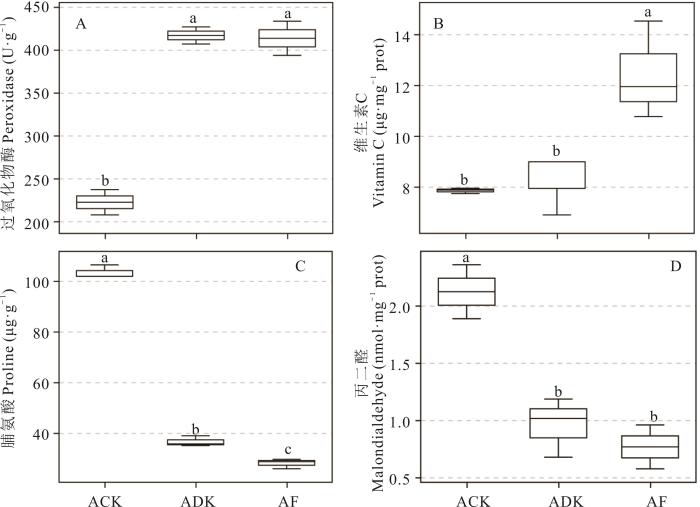
Endophytic fungi with the capacity to enhance plant growth, bolster plant stress tolerance, and modulate the composition of plant rhizosphere microbial communities offer significant implications for research and development of crop growth promotants. In a plot experiment, two endophytic fungus, Trichoderma rossicum and Floccularia luteovirens were applied. To assess the growth promoting effects of these endophytic fungi on Avena sativa, a range of indicators were measured, encompassing growth characteristics, physiological and biochemical parameters, soil physical and chemical properties, and others. In addition, high-throughput sequencing technology was utilized to assess the influence of endophytic fungus soaking on the composition of A. sativa root endophytic fungal communities. It was found that the application of the two endophytic fungi noticeably enhanced the growth of A. sativa, with increase in plant height, root length, dry weight, fresh weight, and other parameters observed. Particularly noteworthy was the pronounced influence of T. rossicum on the growth traits of A. sativa, while F. luteovirens had the greatest effect on the yield of A. sativa. Additionally, endophytic fungi significantly influenced physiological traits of A. sativa (P<0.05). For instance, compared to CK, the peroxidase activity was increased by 87.53%, and 86.03%, respectively, with T. rossicum and F. luteovirens seed soaking, while vitamin C content was increased by 5.56% and 58.11%. Conversely, proline and malondialdehyde levels were decreased, respectively by 64.62% and 54.82% with T. rossicum and by 72.85% and 63.85% with F. luteovirens seed soaking. Furthermore, the two endophytic fungi exerted distinct effects on soil physicochemical properties. Specifically, T. rossicum and F. luteovirens increased soil total phosphorus concentration, while F. luteovirens dramatically elevated soil organic carbon concentration. The high-throughput sequencing findings demonstrated that soaking endophytic fungi significantly influenced the diversity of endophytic fungi in the A. sativa rhizosphere. This was evidenced by increases in the Shannon index, Pielou index, and the number of unique OTUs of endophytic fungi in A. sativa roots, as well as changes in the community structure of endophytic fungi in the A. sativa roots. Additionally, a principal component analysis revealed that T. rossicum enhanced growth and diversified the variety of root endophytic fungi associated with A. sativa, whereas F. luteovirens enhanced productivity and bolstered stress tolerance of A. sativa. This study highlights the significant stimulatory impact of endophytic fungus soaking on the growth of A. sativa, enhancing its stress resistance, and altering the root endophytic fungal community. These findings pave the way for the utilization of F. luteovirens and T. rossicum as microbial fertilizers, thereby providing valuable fungal resources for the development of plant growth-promoting preparations in subsequent research.
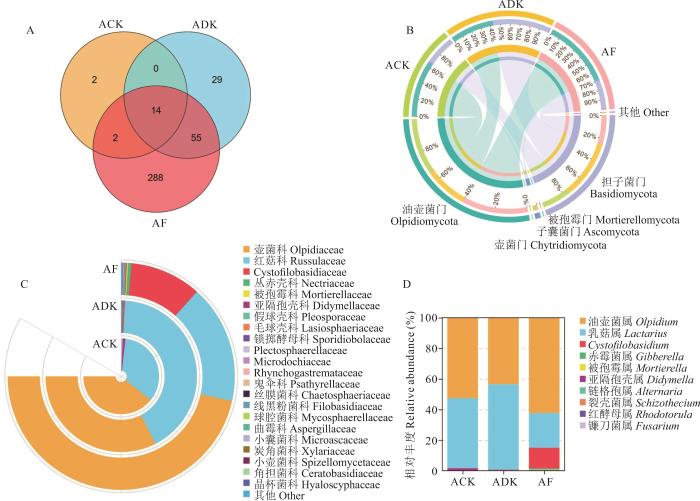
A: OTU水平真菌群落组成Distribution of endophytic fungal communities at OTU level; B, C: 门和科水平真菌群落组成Distribution of endophytic fungal communities at phylum and family level, respectively; D: 相对丰度排名前10属真菌群落组成The top 10 genera with higher relative abundance.
Fig.2
Effects of endophytic fungi soaking on A. sativa root fungal community
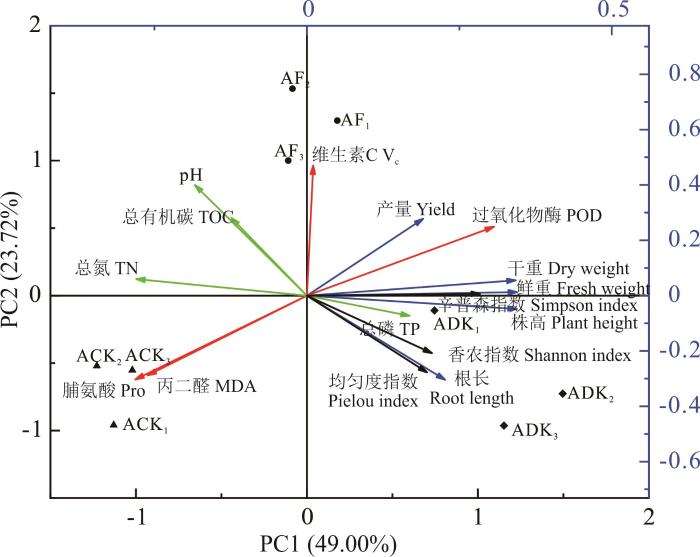
Fig.3
PCA analysis of the effects of endophytic fungi soaking A. sativa on its growth, physiology, soil physicochemical properties and fungal community
Yan C, Dai C C. Recent advances on endophytic fungi optimising soil environment. International Journal of Environmental Engineering, 2013, 5(4): 387-404.
Zhou W Q, Terry A W, Wheeler J L S, et al. A fungal endophyte defensive symbiosis affects plant-nematode interactions in cotton. Plant and Soil, 2018, 422: 251-266.
Wang Q M, Yan L, Hu X Q, et al. Effects of tea grey blight on the community structure of endophytic fungi in tea leaves. Acta Microbiologica Sinica, 2021, 61(9): 2949-2961.
Lu Y, Zhu J, Zhao X X, et al. Beneficial effects of endophytic fungi colonization on plants. Applied Microbiology and Biotechnology, 2019, 103(3): 3327-3340.
Liu S Y, Wang Y F, He Y Z, et al. Research progress on the effect of endophytic fungi on the growths and secondary metabolites of host plants. Journal of Tianjin Unviersity of Traditional Chinese Medicine, 2021, 40(1): 128-136.
Ahlem N, Rania A B A, Hayfa J K, et al. Ability of endophytic fungi associated with Withania somnifera L. to control Fusariem crown and root rot and to promote growth in tomato. Brazillian Journal of Microbiology, 2019, 50(2): 481-494.
Dang H L, Zhang T, Wang Z K, et al. Succession of endophytic fungi and arbuscular mycorrhizal fungi associated with the growth of plant and their correlation with secondary metabolites in the roots of plants. BMC Plant Biology, 2021, 21(1): 165.
Yuan Z L, Chen Y C, Zhang C L, et al. Trichoderma chlorosporum, a new record of endophytic fungi from Dendrobium nobile in China. Mycosystema, 2008, 27(4): 608-610.
Azeir A H, Dwi H P, Linda A, et al. Molecular characterization of Trichoderma strains from west Sumatera, Indonesia and their beneficial effects on rice seedling growth. Journal of Crop Science and Biotechnology, 2021, 24(4): 441-448.
Hou X Y, Wang Y F, Jiang C Y, et al. A native Trichoderma harzianum strain Th62 displays antagonistic activities against phytopathogenic fungi and promotes the growth of Celosia cristata. Horticulture, Environment, and Biotechnology, 2022, 63(1): 147.
Mayo P S, Campelo M P, Lorenzana A, et al. Antifungal activity and bean growth promotion of Trichoderma strains isolated from seed vs soil. European Journal of Plant Pathology, 2021,159(3): 273-292.
Ye W X, Shi F L, Zhao M L, et al. Screening of suitable forage oat varieties in central and western regions of Inner Mongolia. Chinese Journal of Grassland, 2022, 44(3): 66-71.
Yang P N, Du W H, Tian X H. Study on the mixed effect of Canadian forage oats and peas in Gannan alpine pasture area. Chinese Journal of Grassland, 2022, 44(3): 39-48.
Liu Y D, Zhao B P, Zhang Y, et al. Relationship between yield differences of different genotypes of oats and leaf physiological characteristics. Acta Agronomica Sinica, 2022, 48(11): 2953-2964.
Meenakshi G, Navreet K. Low temperature induced oxidative stress tolerance in oats (Avena sativa L.) genotypes. Indian Journal of Plant Physiology, 2018, 23(2): 316-324.
Zhang Y C, Yao T, Zhao G Q, et al. Screening and identification of salt-tolerant growth promoting rhizobacteria and its effects on oat growth under salt stress. Acta Agrestia Sinica, 2021, 29(12): 2645-2652.
Chen L, Xie Y L, Wu X H, et al. Avena sativa growth-promoting activity of Bacillus atrophaeus CKL1 under salt stress and the functional genes. Microbiology China, 2022, 49(8): 3150-3164.
Jin Y Y, Bowatte S, Jia Q M, et al. Effects of Epichloë endophytic fungi infection in wild barely (Hordeum brevisubulatum) on soil chemical properties and the soil microbial community. Acta Prataculturae Sinica, 2019, 28(10): 66-77.
He S B, Hu W G, Jin X T, et al. Soil bacterial community composition and diversity respond to soil environment in the Ebinur Lake Wetland. Archives of Microbiology, 2022, 203(11): 1175-1182.
Liu Y H. Effects of plant growth-promoting bacteria on the root metabolites and microbial community of Phyllostachys edulis seeding. Nanchang: Jiangxi Agricultural University, 2023.
Tang H M, Ni X Z, Wang Y C, et al. Effects of soil saline-alkali stress on arbuscular mycorrhizal fungal community diversity and composition of roots of endophyte-infected and endophyte-free tall fescue. Mycosystema, 2022, 41(8): 1268-1278.
Latch G C M, Hunt W F, Musgrave D R. Endophytic fungi affect growth of perennial ryegrass. New Zealand Journal of Agricultural Research, 1985, 28(1): 165-168.
Zhao Z R, Zhong R, Zhang X X. Effects of interaction of Epichloë gansuensis and arbuscular mycorrhizal fungi on the seedling growth and cadmium (Cd) tolerance of Achnatherum inebrians. Pratacultural Science, 2020, 37(3): 432-443.
Zhang X X, Li C J, Nan Z B. Effects of cadmium stress on growth and anti-oxidative systems in Achnatherum inebrians symbiotic with Neotyphodium gansuense. Journal of Hazardous Materials, 2010, 175(1): 703-709.
Jiang R J, He Q, Zhu J, et al. Effects of endophytic fungus AW57 from Ferula sinkiangensis K. M. Shen on seed germination and seedling growth of wheat (Triticum aestivum L.). Xinjiang Agriculture Sciences, 2019, 56(3): 393-402.
Lara R J. Seed inoculation with endophytic fungal entomopathogens promotes plant growth and reduces crown and root rot (CRR) caused by Fusarium culmorum in wheat. Planta, 2018, 248(8): 1525-1535.
Li K, Shi C, He F Y, et al. Effects of endophyte infection on growth and physiological characteristics of Melica transsilvanica under Pb stress. Acta Prataculturae Sinica, 2020, 29(3): 112-120.
Zhao J Y, Cai J R, Xu C Y, et al. Effects of citrus essential oil combined with chitosan treatment on post harvest physiology and storability of Chinese olive fruits. Journal of Tropical and Subtropical Botany, 2023, 31(1): 53-61.
Shi L M, Wang D M, Ying J H. Correlation analysis on pigment accumulation and physiological indexes of cherry-tomato fruit. Hubei Agriculture Sciences, 2013, 52(16): 1849-1851.
Tian F, Liao X F, Yan F X, et al. Effects of different arbuscular mycorrhizal fungi on seedling growth and physiological metabolism in Ardisia mamillata. Northern Horticulture, 2021, 7(10): 59-65.
Erich I, Torgny N. The below-ground perspective of forest plants: soil provides mainly organic nitrogen for plants and mycorrhizal fungi. New Phytologist, 2012, 195(2): 329-334.
Li S J, Wang F X, Wen C Q, et al. Microbial community structure and environmental response of desert soil in Hexi Corridor. Acta Pedologica Sinica, 2022, 59(6): 1718-1728.
Stewart T M, Mercer C F, Grant J L. Development of Meloidogyne naasi on endophyte-infected and endophyte-free perennial ryegrass. Australasian Plant Pathology, 1993, 22(2): 40-41.
Zhong R, Xia C, Ju Y W, et al. A foliar Epichloë endophyte and soil moisture modified belowground arbuscular mycorrhizal fungal biodiversity associated with Achnatherum inebrians. Plant and Soil, 2021, 458(112): 123.
Chen Z J, Liu J, Wei X K, et al. Effects of latosols extracts with different pH and endophytic fungi on growth and physiology of Lolium perenne seedling. Acta Botanica Boreali-Occidentalia Sinica, 2017, 37(7): 1348-1356.
Chen Z J, Jin Y Y, Yao X, et al. Fungal endophyte improves survival of Lolium perenne in low fertility soils by increasing root growth, metabolic activity and absorption nutrients. Plant and Soil, 2020, 452(1): 185-206.
Lu P, Shi M C, Randy D D, et al. Plant growth, ion accumulation, and antioxidant enzymes of endophyte-infected and endophyte-free tall fescue to salinity stress. Acta Physiologiza Plantarum, 2021, 43(6): 1-10.
Comandini O, Erős-Honti Z, Jakucs E, et al. Molecular and morpho-anatomical description of mycorrhizas of Lactarius rimosellus on Quercus sp., with ethnomycological notes on Lactarius in Guatemala. Mycorrhizal, 2012, 22(4): 279-287.
Montoya L, Bandala V, Ramos A, et al. The ectomycorrhizae of Lactarius rimosellus and Lactarius acatlanensis with the endangered Fagus grandifolia var. mexicana. Symbiosis, 2017, 73(2): 135-144.
Sun L L, Cao M, Liu F, et al. The volatile organic compounds of Floccularia luteovirens modulate plant growth and metabolism in Arabidopsis thaliana. Plant and Soil, 2020, 456(9): 207-221.
Cao M, Liu F, Sun L L, et al. Floccularia luteovirens modulates the growth of alpine meadow plants and affects soil metabolite accumulation on the Qinghai-Tibet Plateau. Plant and Soil, 2021, 459(9): 125-136.