

ISSN 1004-5759 CN 62-1105/S
草业学报 ›› 2026, Vol. 35 ›› Issue (7): 58-67.DOI: 10.11686/cyxb2025294
张晓曦1,2( ), 梁倩怡1, 张泽强1, 罗媛媛1, 李利平1, 李若萱1, 刘鑫1, 胡博1
收稿日期:2025-07-16
修回日期:2025-09-10
出版日期:2026-07-20
发布日期:2026-05-21
通讯作者:
张晓曦
作者简介:张晓曦(1990-),男,蒙古族,内蒙古锡林郭勒盟人,副教授,博士。E-mail: zhangxiaoxi712100@gmail.com基金资助:
Xiao-xi ZHANG1,2(), Qian-yi LIANG1, Ze-qiang ZHANG1, Yuan-yuan LUO1, Li-ping LI1, Ruo-xuan LI1, Xin LIU1, Bo HU1
Received:2025-07-16
Revised:2025-09-10
Online:2026-07-20
Published:2026-05-21
Contact:
Xiao-xi ZHANG
摘要:
草地生态系统中往往同时存在新鲜和半分解层凋落物,由于两者化学特性和定殖微生物的差异,其共同分解极有可能导致显著的混合分解效应,影响彼此和凋落物层整体的分解过程和系统内的物质循环。为验证上述现象是否存在、并分析其产生的潜在酶学机制,本研究以黄土丘陵区撂荒27 a左右草地内枯萎较早的硬质早熟禾和针茅的新鲜凋落物以及地表半分解层凋落物为对象,在20~25 ℃、恒湿条件下进行150 d的室内模拟混合分解试验。在分解过程中分离不同凋落物组分,测定各类型凋落物在参与混合分解时的分解速率、养分释放率和木质素酶活性,并将其与对应凋落物单独分解时的相应指标进行比较,据此分析两类凋落物混合分解时对彼此分解特征的影响及其机理。结果表明:1)总体而言,两类新鲜凋落物与半分解层凋落物混合时,均至少在试验后期显著促进彼此分解(P<0.05);2)分解150 d后,硬质早熟禾与半分解层凋落物显著促进彼此的碳释放,后者同时促进前者的氮和磷释放;针茅与半分解层凋落物显著促进彼此的碳和磷释放,前者同时显著促进后者的氮释放(P<0.05);3)总木质素酶活性与凋落物分解速率呈显著正相关(P<0.05),半分解层凋落物在分解30 d时显著提高硬质早熟禾凋落物的总木质素酶活性,但在150 d时产生抑制效应,其在上述分解时期均显著提高针茅凋落物的总木质素酶活性(P<0.05)。总体而言,新鲜和半分解层凋落物的混合有利于提高彼此的分解速率,在生态系统物质循环中可能发挥了积极作用。
张晓曦, 梁倩怡, 张泽强, 罗媛媛, 李利平, 李若萱, 刘鑫, 胡博. 黄土丘陵区撂荒草地新鲜和半分解层凋落物混合对彼此早期分解的影响[J]. 草业学报, 2026, 35(7): 58-67.
Xiao-xi ZHANG, Qian-yi LIANG, Ze-qiang ZHANG, Yuan-yuan LUO, Li-ping LI, Ruo-xuan LI, Xin LIU, Bo HU. Mutual effects of fresh and semidecomposed litter from abandoned grasslands in the Loess Hilly Region during early mixed decomposition[J]. Acta Prataculturae Sinica, 2026, 35(7): 58-67.
凋落物类型 Type of litter | 碳含量 Content of C (mg·g-1) | 氮含量 Content of N (mg·g-1) | 磷含量 Content of P (mg·g-1) | 木质素含量 Content of lignin (mg·g-1) | 木质素/氮 Lignin/N | 碳氮比 C/N | 碳磷比 C/P |
|---|---|---|---|---|---|---|---|
| 硬质早熟禾P. sphondylodes | 444.44±9.13b | 9.76±0.18b | 2.75±0.10ab | 305.10±3.58b | 31.27±0.91a | 45.56±1.50a | 161.84±6.54b |
| 针茅S. grandis | 395.57±7.55c | 15.50±0.91a | 3.00±0.05a | 308.02±2.58b | 19.98±0.99b | 25.74±1.92b | 131.92±4.51c |
| 半分解层凋落物Semidecomposed litter | 534.15±6.86a | 11.81±0.51b | 2.64±0.17b | 390.32±6.87a | 33.19±1.74a | 45.42±2.27a | 202.73±6.90a |
表1 供试凋落物初始化学特性
Table 1 Initial chemical traits of the tested litters
凋落物类型 Type of litter | 碳含量 Content of C (mg·g-1) | 氮含量 Content of N (mg·g-1) | 磷含量 Content of P (mg·g-1) | 木质素含量 Content of lignin (mg·g-1) | 木质素/氮 Lignin/N | 碳氮比 C/N | 碳磷比 C/P |
|---|---|---|---|---|---|---|---|
| 硬质早熟禾P. sphondylodes | 444.44±9.13b | 9.76±0.18b | 2.75±0.10ab | 305.10±3.58b | 31.27±0.91a | 45.56±1.50a | 161.84±6.54b |
| 针茅S. grandis | 395.57±7.55c | 15.50±0.91a | 3.00±0.05a | 308.02±2.58b | 19.98±0.99b | 25.74±1.92b | 131.92±4.51c |
| 半分解层凋落物Semidecomposed litter | 534.15±6.86a | 11.81±0.51b | 2.64±0.17b | 390.32±6.87a | 33.19±1.74a | 45.42±2.27a | 202.73±6.90a |
| 混合形式Type of litter mixing | 凋落物组分 Litter component | 分解形式 Type of decomposition | 分解速率 Decomposition rate (k) |
|---|---|---|---|
| Ⅰ | 硬质早熟禾 P. sphondylodes | 单独 Single | 2.65±0.05* |
| 混合 Mixed | 3.60±0.13 | ||
半分解层 Semidecomposed | 单独 Single | 1.24±0.03 | |
| 混合 Mixed | 1.51±0.03 | ||
| Ⅱ | 针茅S. grandis | 单独 Single | 1.80±0.12* |
| 混合 Mixed | 2.40±0.06 | ||
半分解层 Semidecomposed | 单独 Single | 1.24±0.05* | |
| 混合 Mixed | 1.66±0.17 |
表2 新鲜和半分解层凋落物混合分解对彼此分解速率的影响
Table 2 Effects of fresh and semidecomposed litter on decomposition rates of each other during mixed decomposition
| 混合形式Type of litter mixing | 凋落物组分 Litter component | 分解形式 Type of decomposition | 分解速率 Decomposition rate (k) |
|---|---|---|---|
| Ⅰ | 硬质早熟禾 P. sphondylodes | 单独 Single | 2.65±0.05* |
| 混合 Mixed | 3.60±0.13 | ||
半分解层 Semidecomposed | 单独 Single | 1.24±0.03 | |
| 混合 Mixed | 1.51±0.03 | ||
| Ⅱ | 针茅S. grandis | 单独 Single | 1.80±0.12* |
| 混合 Mixed | 2.40±0.06 | ||
半分解层 Semidecomposed | 单独 Single | 1.24±0.05* | |
| 混合 Mixed | 1.66±0.17 |
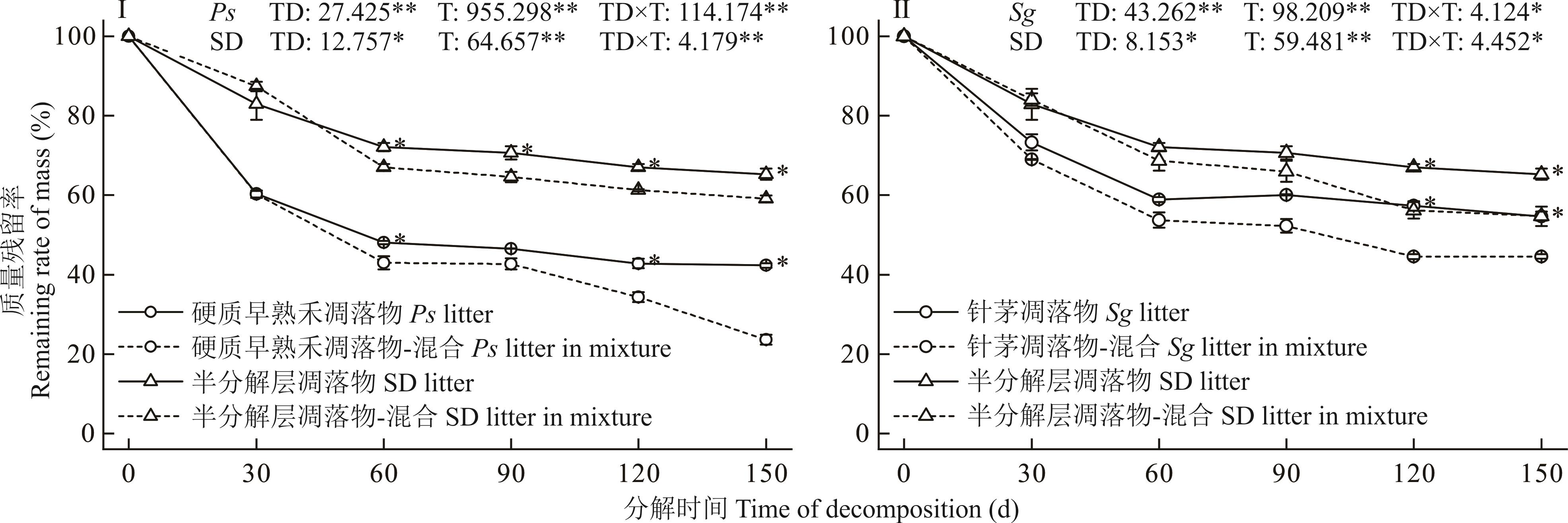
图1 新鲜和半分解层凋落物混合分解对彼此质量残留率的影响Ps: 硬质早熟禾P. sphondylodes; Sg: 针茅S. grandis; SD: 半分解层Semidecomposed layer. 数据以平均值±标准误(误差棒)表示;*表示在特定采样时间,同一凋落物在混合分解和单独分解时的质量残留率存在显著差异(基于独立样本t检验,P<0.05);重复测量方差分析结果标注形式为,“因素:F值及显著性检验结果”,T代表分解时间,TD代表分解形式,TD×T代表两者交互效应。*: P<0.05; **: P<0.01. 下同。Data are presented as the mean±SE (error bars), The * that followed the same type of litter indicates significant differences in the mass remaining rates in given sampling time when decomposing alone or in mixture on the basis of an independent samples t test (P<0.05). The results of repeated-measures ANOVA are represented as the “factor: F value and significance”, in which T indicates decomposition time, TD indicates the type of decomposition, TD×T indicates their interactions. The same below.
Fig.1 Effects of fresh and semidecomposed litter on the mass remaining rates of each other during mixed decomposition
混合形式 Type of litter mixing | 凋落物组分 Litter component | 分解形式 Type of decomposition | 养分残留率Nutrient remaining rate | ||
|---|---|---|---|---|---|
| 碳C | 氮N | 磷P | |||
| Ⅰ | 硬质早熟禾P. sphondylodes | 单独Single | 52.33±0.88* | 109.67±1.33* | 85.67±1.67* |
| 混合Mixed | 29.33±1.20 | 75.67±1.86 | 43.00±2.08 | ||
| 半分解层Semidecomposed | 单独Single | 56.67±2.19* | 147.00±3.51 | 86.67±3.33 | |
| 混合Mixed | 46.67±0.67 | 136.00±3.51 | 80.00±4.16 | ||
| Ⅱ | 针茅S. grandis | 单独Single | 71.33±3.53* | 97.67±5.78 | 72.67±4.37* |
| 混合Mixed | 60.67±2.03 | 91.33±3.38 | 67.67±0.88 | ||
| 半分解层Semidecomposed | 单独Single | 56.67±2.19* | 147.00±3.51* | 86.67±3.33* | |
| 混合Mixed | 45.67±0.67 | 121.00±4.58 | 69.67±2.96 | ||
表3 新鲜和半分解层凋落物混合分解对彼此养分残留率的影响
Table 3 Effects of fresh and semidecomposed litter on nutrient remaining rates of each other during mixed decomposition (%)
混合形式 Type of litter mixing | 凋落物组分 Litter component | 分解形式 Type of decomposition | 养分残留率Nutrient remaining rate | ||
|---|---|---|---|---|---|
| 碳C | 氮N | 磷P | |||
| Ⅰ | 硬质早熟禾P. sphondylodes | 单独Single | 52.33±0.88* | 109.67±1.33* | 85.67±1.67* |
| 混合Mixed | 29.33±1.20 | 75.67±1.86 | 43.00±2.08 | ||
| 半分解层Semidecomposed | 单独Single | 56.67±2.19* | 147.00±3.51 | 86.67±3.33 | |
| 混合Mixed | 46.67±0.67 | 136.00±3.51 | 80.00±4.16 | ||
| Ⅱ | 针茅S. grandis | 单独Single | 71.33±3.53* | 97.67±5.78 | 72.67±4.37* |
| 混合Mixed | 60.67±2.03 | 91.33±3.38 | 67.67±0.88 | ||
| 半分解层Semidecomposed | 单独Single | 56.67±2.19* | 147.00±3.51* | 86.67±3.33* | |
| 混合Mixed | 45.67±0.67 | 121.00±4.58 | 69.67±2.96 | ||

图2 新鲜和半分解层凋落物混合分解对彼此木质素酶活性的影响“single”和“mixed”分别代表单独和参与混合分解的分解形式。“single” and “mixed” indicate litter decomposed alone or in mixed decomposition. NS: P>0.05. 下同The same below.
Fig.2 Effects of fresh and semidecomposed litter on lignin-degrading enzymatic activity of each other during mixed decomposition
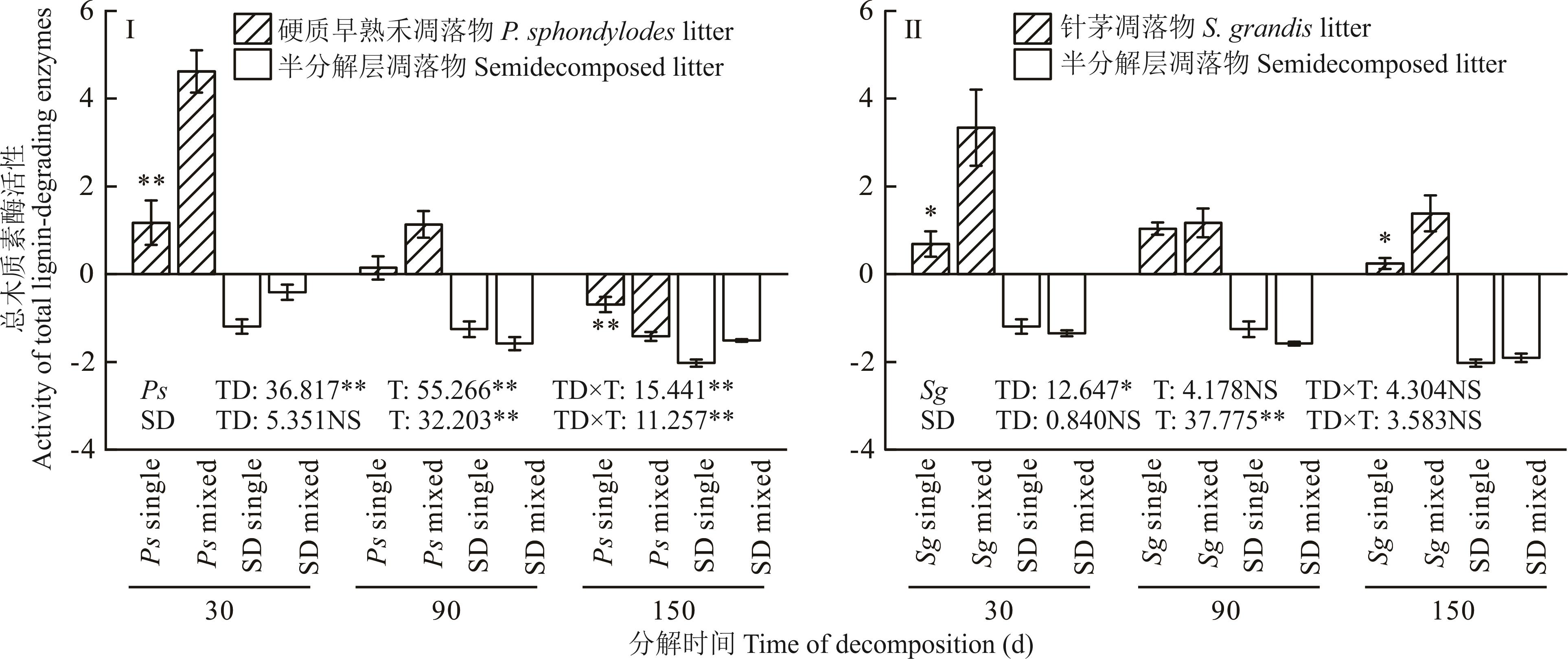
图3 新鲜和半分解层凋落物混合分解对彼此总木质素酶活性的影响
Fig.3 Effects of fresh and semidecomposed litter on the activity of total lignin-degrading enzymes of each other during mixed decomposition
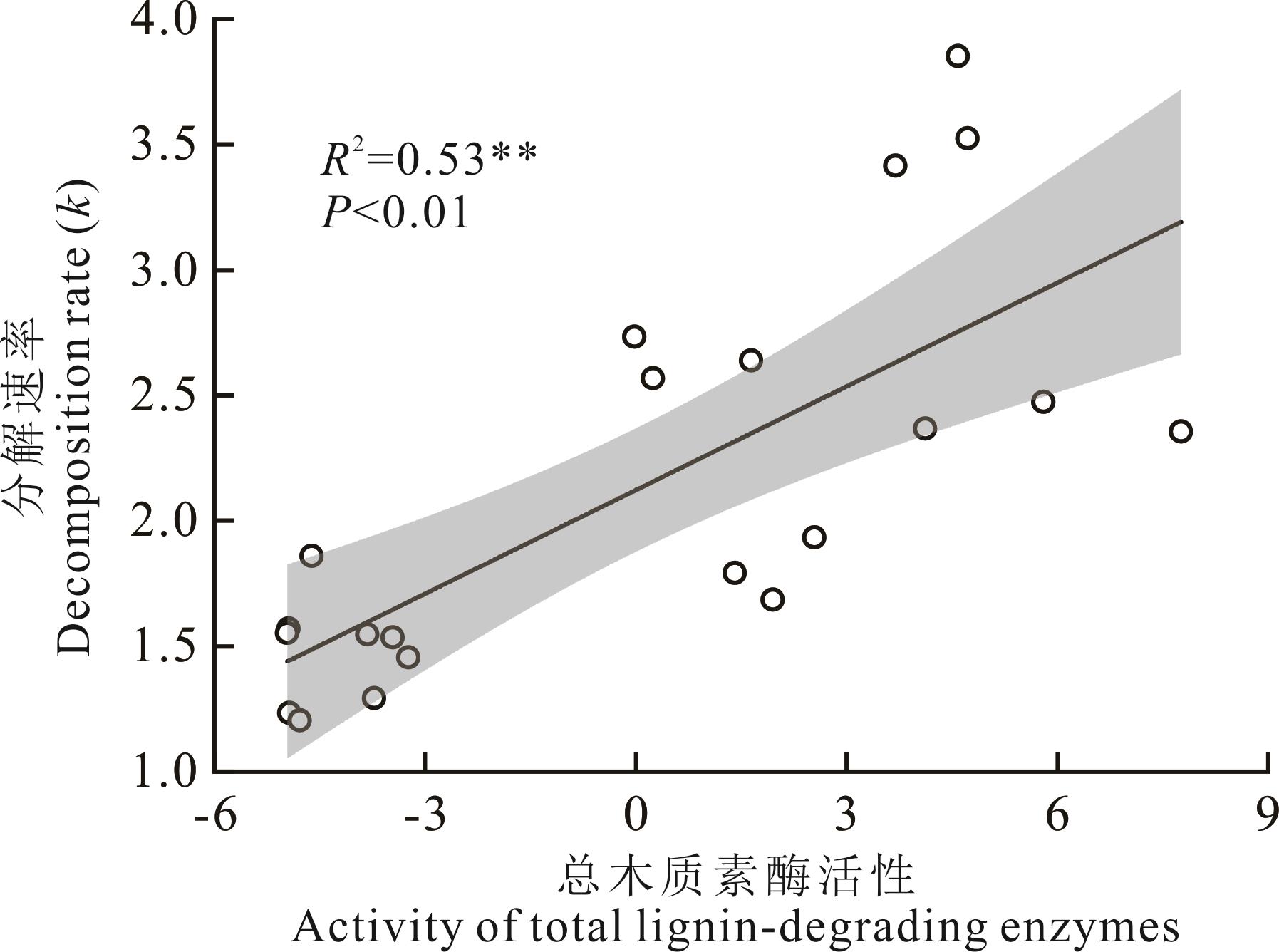
图4 凋落物总木质素酶活性与其分解速率的关系
Fig.4 Relationships between the activity of total lignin-degrading enzymes in litter and their decomposition rates
| [1] | Wu Q X, Ni X Y, Sun X Y, et al. Substrate and climate determine terrestrial litter decomposition. Proceedings of the National Academy of Sciences, 2025, 122(7): e2420664122. |
| [2] | Wang W C, Yan W D, Li Z W, et al. Effects of nitrogen addition on litter decomposition in Pinus massoniana plantation forest. Journal of Central South University of Forestry & Technology, 2019, 39(12): 55-61. |
| 王万才, 闫文德, 李忠文, 等. 氮添加对马尾松人工林凋落物分解的影响. 中南林业科技大学学报, 2019, 39(12): 55-61. | |
| [3] | Jia B R. Litter decomposition and its underlying mechanisms. Chinese Journal of Plant Ecology, 2019, 43(8): 648-657. |
| 贾丙瑞. 凋落物分解及其影响机制. 植物生态学报, 2019, 43(8): 648-657. | |
| [4] | Wang L F, Zhou Y, Chen Y M, et al. Litter diversity accelerates labile carbon but slows recalcitrant carbon decomposition. Soil Biology and Biochemistry, 2022, 168: 108632. |
| [5] | Xiao W Y, Chen H Y H, Kumar P, et al. Multiple interactions between tree composition and diversity and microbial diversity underly litter decomposition. Geoderma, 2019, 341: 161-171. |
| [6] | Zhang X X, Wang B Y, Liu Z W. Impacts of plant secondary metabolites from conifer litter on the decomposition of Populus purdomii litter. Journal of Forestry Research, 2019, 30(6): 2237-2245. |
| [7] | Zhang X X, Liu H, Zhou W X, et al. The effects of plant secondary metabolites from coniferous needle litter on the litter decomposition of Betula albo-sinensis Burk. Sains Malaysiana, 2019, 48(3): 561-570. |
| [8] | Jin X, Wang Z L, Wu F Z, et al. Litter mixing alters microbial decomposer community to accelerate tomato root litter decomposition. Microbiology Spectrum, 2022, 10(3): DOI: 10.1128/spectrum.00186-22. |
| [9] | Liu J, Liu X Y, Song Q N, et al. Synergistic effects: a common theme in mixed-species litter decomposition. New Phytologist, 2020, 227(3): 757-765. |
| [10] | Gartner T B, Cardon Z G. Decomposition dynamics in mixed-species leaf litter. Oikos, 2004, 104(2): 230-246. |
| [11] | Handa I T, Aerts R, Berendse F, et al. Consequences of biodiversity loss for litter decomposition across biomes. Nature, 2014, 509(7499): 218-221. |
| [12] | Lu W J, Qi J Y, Wu C, et al. Effects of mixed litter with different degrees of decomposition on the decomposition characteristics of semi-arid grassland in northern Shanxi. Acta Prataculturae Sinica, 2023, 32(12): 47-57. |
| 路文杰, 齐晋云, 吴聪, 等. 晋北半干旱草地不同分解程度凋落物混合对分解特征的影响. 草业学报, 2023, 32(12): 47-57. | |
| [13] | Xu Z X, Zhang Y Q, Tao Y, et al. Nutrient composition of litters and functional diversity of different microorganisms in various decomposition stages of Casuarina equisetifolia plantations. Journal of Nanjing Forestry University (Natural Science Edition), 2020, 44(2): 197-205. |
| 徐志霞, 张雅倩, 陶月, 等. 不同分解程度木麻黄凋落物的养分特征及微生物功能多样性分析. 南京林业大学学报(自然科学版), 2020, 44(2): 197-205. | |
| [14] | Chen Y C, Ma S Q, Liu J, et al. Soil C and N dynamics and their non-additive responses to litter mixture under different moisture conditions from an alpine steppe soil, Northern Tibet. Soil Biology and Biochemistry, 2018, 125: 231-238. |
| [15] | Zhang X X, Hu J W, Hu M, et al. Indoor simulating research of key plant metabolites release from the litters of typical arboreal, shrubby and herbaceous species in the Loess Hilly Region. Acta Botanica Boreali-Occidentalia Sinica, 2023, 43(4): 688-697. |
| 张晓曦, 胡嘉伟, 胡漫, 等. 黄土丘陵区代表性乔灌草植物凋落物关键代谢产物释放的室内模拟研究. 西北植物学报, 2023, 43(4): 688-697. | |
| [16] | Zhu J, Liu J F, He Z S, et al. Effects of physical barrier of litter on the seed germination and radicle growth of Castanopsis kawakamii. Acta Ecologica Sinica, 2020, 40(16): 5630-5637. |
| 朱静, 刘金福, 何中声, 等. 凋落物物理阻隔对格氏栲种子萌发及胚根生长的影响. 生态学报, 2020, 40(16): 5630-5637. | |
| [17] | Zhu J, Liu J F, Xing C, et al. Effect of seeds dispersal position on the root morphology and growth characteristics of Castanopsis kawakamii seedlings. Acta Ecologica Sinica, 2022, 42(10): 4065-4075. |
| 朱静, 刘金福, 邢聪, 等. 种子散布位置对格氏栲幼苗根系形态及生长特征的影响. 生态学报, 2022, 42(10): 4065-4075. | |
| [18] | Daebeler A, Petrová E, Kinz E, et al. Pairing litter decomposition with microbial community structures using the Tea Bag Index (TBI). Soil, 2022, 8(1): 163-176. |
| [19] | Purahong W, Wubet T, Lentendu G, et al. Life in leaf litter: Novel insights into community dynamics of bacteria and fungi during litter decomposition. Molecular Ecology, 2016, 25(16): 4059-4074. |
| [20] | Liu G B, Shangguan Z P, Yao W Y, et al. Ecological effects of soil conservation in Loess Plateau. Bulletin of Chinese Academy of Sciences, 2017, 32(1): 11-19. |
| 刘国彬, 上官周平, 姚文艺, 等. 黄土高原生态工程的生态成效. 中国科学院院刊, 2017, 32(1): 11-19. | |
| [21] | Zhao H B, Liu G B, Hou X L. Characteristics of nutrient cycling of different vegetation types in the Zhifanggou Watershed on the Loess Hilly Region. Acta Prataculturae Sinica, 2006, 15(3): 63-69. |
| 赵护兵, 刘国彬, 侯喜禄. 黄土丘陵区流域主要植被类型养分循环特征. 草业学报, 2006, 15(3): 63-69. | |
| [22] | Zhang X X, Zhou W X, Li J J, et al. Mixed decomposition and interspecific effects during early decomposition of litter mixtures of Pinus tabuliformis Carrière and broadleaved species. Plant Science Journal, 2019, 37(3): 303-311. |
| 张晓曦, 周雯星, 李佳佳, 等. 早期分解中油松与阔叶树种凋落叶混合分解效应及其相互影响. 植物科学学报, 2019, 37(3): 303-311. | |
| [23] | Wang H, Liu S R, Wang J X, et al. Mixed-species plantation with Pinus massoniana and Castanopsis hystrix accelerates C loss in recalcitrant coniferous litter but slows C loss in labile broadleaf litter in southern China. Forest Ecology and Management, 2018, 422: 207-213. |
| [24] | Wang L F, Chen Y M, Zhou Y, et al. Environmental conditions and litter nutrients are key determinants of soluble C, N, and P release during litter mixture decomposition. Soil and Tillage Research, 2021, 209: 104928. |
| [25] | Zhang X Y, Ni X Y, Heděnec P, et al. Litter facilitates plant development but restricts seedling establishment during vegetation regeneration. Functional Ecology, 2022, 36(12): 3134-3147. |
| [26] | Zhang A, Wang D, Wan S Q. Litter addition decreases plant diversity by suppressing seeding in a semiarid grassland, Northern China. Ecology and Evolution, 2019, 9(17): 9907-9915. |
| [27] | Li Y N, Zhou X M, Zhang N L, et al. The research of mixed litter effects on litter decomposition in terrestrial ecosystems. Acta Ecologica Sinica, 2016, 36(16): 4977-4987. |
| 李宜浓, 周晓梅, 张乃莉, 等. 陆地生态系统混合凋落物分解研究进展. 生态学报, 2016, 36(16): 4977-4987. | |
| [28] | Leppert K N, Niklaus P A, Scherer-Lorenzen M. Does species richness of subtropical tree leaf litter affect decomposition, nutrient release, transfer and subsequent uptake by plants? Soil Biology and Biochemistry, 2017, 115: 44-53. |
| [29] | Wang X Y, Lyu J L, He P, et al. Succession in bacterial community during maize straw decomposition. Plant Nutrition and Fertilizer Science, 2021, 27(1): 45-53. |
| 王西亚, 吕继龙, 何萍, 等. 玉米秸秆分解过程中细菌群落组成演化特征. 植物营养与肥料学报, 2021, 27(1): 45-53. | |
| [30] | Zhang M, Dong L G, Fei S X, et al. Responses of soil organic carbon mineralization and microbial communities to leaf litter addition under different soil layers. Forests, 2021, 12(2): 170. |
| [31] | Xu J Y, Lu Y P, Zhang X X, et al. Effects of leachates from understory medicinal plants on decomposition of Pinus tabuliformis litter and soil enzyme activities. Journal of Northwest A&F University (Natural Science Edition), 2018, 46(1): 30-38, 45. |
| 许纪元, 卢玉鹏, 张晓曦, 等. 药材植物淋出物对油松枯落物分解和土壤酶活性的影响. 西北农林科技大学学报(自然科学版), 2018, 46(1): 30-38, 45. | |
| [32] | Hong J T, Lu X Y, Ma X X, et al. Five-year study on the effects of warming and plant litter quality on litter decomposition rate in a Tibetan alpine grassland. Science of the Total Environment, 2021, 750: 142306. |
| [33] | Chen M, Zhu X P, Zhao C Y, et al. Rapid microbial community evolution in initial Carex litter decomposition stages in Bayinbuluk alpine wetland during the freeze-thaw period. Ecological Indicators, 2021, 121: 107180. |
| [34] | Chapman S K, Newman G S. Biodiversity at the plant-soil interface: Microbial abundance and community structure respond to litter mixing. Oecologia, 2010, 162(3): 763-769. |
| [1] | 闫丽娟,罗永忠,李广,王琦,罗珠珠,高珍妮, 李玥,燕振刚,刘强,聂志刚. 黄土丘陵区不同耕作措施下春小麦和豌豆轮作水肥协同效应[J]. 草业学报, 2015, 24(4): 39-47. |
| [2] | 李广,黄高宝,王琦,罗珠珠. 基于APSIM模型的旱地小麦和豌豆水肥协同效应分析[J]. 草业学报, 2011, 20(5): 151-159. |
| 阅读次数 | ||||||
|
全文 |
|
|||||
|
摘要 |
|
|||||
