

ISSN 1004-5759 CN 62-1105/S
草业学报 ›› 2026, Vol. 35 ›› Issue (10): 79-90.DOI: 10.11686/cyxb2025422
张蕊( ), 王铁娟(), 张冰冰, 冯婧, 邵金玲
收稿日期:2025-10-18
修回日期:2025-11-24
出版日期:2026-10-20
发布日期:2026-09-09
通讯作者:
王铁娟
作者简介:E-mail:wtj105@163.com基金资助:
Rui ZHANG(), Tie-juan WANG(), Bing-bing ZHANG, Jing FENG, Jin-ling SHAO
Received:2025-10-18
Revised:2025-11-24
Online:2026-10-20
Published:2026-09-09
Contact:
Tie-juan WANG
摘要:
黑沙蒿是我国特有的优良固沙植物,也是沙生植物群落重要的建群种。研究沙地固定过程中黑沙蒿的种群分布格局及其变化规律,以及与固沙植物小叶锦鸡儿的关系,对于认识其种群动态和种群分布格局的影响机制具有重要意义。本研究在毛乌素沙地的半固定和固定沙地中选择与小叶锦鸡儿共存的黑沙蒿群落,基于点格局的完全随机模型(CSR)、异质泊松模型(HP)、前提条件模型(AC)、环形转换模型(TS)以20 m的尺度研究黑沙蒿的种群空间分布格局、3个大小级的空间关联性以及与小叶锦鸡儿相互作用的关系。结果表明:黑沙蒿种群的年龄结构在半固定沙地为增长型,在固定沙地为稳定向衰退的过渡阶段。完全随机模型结果显示,黑沙蒿种群及其3个大小级以及小叶锦鸡儿种群在小尺度或小至中尺度上呈现聚集分布,且随着沙地的固定,聚集程度加大;剔除生境异质性后的异质泊松模型结果显示聚集性有不同程度的下降,半固定沙地种群更为明显。前提条件模型下,黑沙蒿Ⅰ与Ⅱ级、Ⅱ与Ⅲ级植株存在不同程度的正关联,且在固定沙地中正关联性更强,而Ⅰ与Ⅲ级植株在两种沙地中均没有关联性。随着尺度的增大,尤其是大于16 m,黑沙蒿与小叶锦鸡儿多呈现出随机分布和均匀分布(HP模型),黑沙蒿各大小级间多呈现出无关联性,反映了个体间的相互作用下降。随着沙地的固定,两种植物的个体数量和密度明显增加,环形转换模型结果显示,种间呈现出由半固定沙地的小尺度(0~1.0 m)至固定沙地的中小尺度(0~7.8 m)上的负关联,表明黑沙蒿与小叶锦鸡儿的竞争明显增强。研究结果可为沙地治理过程中物种的选择与搭配种植方式提供参考。
张蕊, 王铁娟, 张冰冰, 冯婧, 邵金玲. 毛乌素沙地黑沙蒿种群点格局及其与小叶锦鸡儿的空间关联性研究[J]. 草业学报, 2026, 35(10): 79-90.
Rui ZHANG, Tie-juan WANG, Bing-bing ZHANG, Jing FENG, Jin-ling SHAO. A study of the point occurrence pattern of Artemisia ordosica populations and their spatial correlation with Caragana microphylla occurrence in the Mu Us sandy land[J]. Acta Prataculturae Sinica, 2026, 35(10): 79-90.
样地 Plot | 株数 Plant number | 密度 Density (plant·m-2) | 最小值 Minimum value (cm) | 最大值 Maximum value (cm) | 均值 Mean value (cm) | 标准差 Standard deviation | 变异系数 Coefficient of variation (%) | 各级株数比例 All classes of the plant number proportion | ||
|---|---|---|---|---|---|---|---|---|---|---|
| Ⅰ | Ⅱ | Ⅲ | ||||||||
| S | 173 | 0.11 | 6.80 | 104.87 | 39.99 | 22.15 | 55.38 | 56(32.37%) | 103(59.54%) | 14(8.09%) |
| F | 736 | 0.46 | 8.41 | 128.62 | 56.46 | 20.36 | 36.07 | 39(5.30%) | 563(76.49%) | 134(18.21%) |
表 1 黑沙蒿种群植株个体大小特征
Table 1 Individual size characteristics of A. ordosica population plant
样地 Plot | 株数 Plant number | 密度 Density (plant·m-2) | 最小值 Minimum value (cm) | 最大值 Maximum value (cm) | 均值 Mean value (cm) | 标准差 Standard deviation | 变异系数 Coefficient of variation (%) | 各级株数比例 All classes of the plant number proportion | ||
|---|---|---|---|---|---|---|---|---|---|---|
| Ⅰ | Ⅱ | Ⅲ | ||||||||
| S | 173 | 0.11 | 6.80 | 104.87 | 39.99 | 22.15 | 55.38 | 56(32.37%) | 103(59.54%) | 14(8.09%) |
| F | 736 | 0.46 | 8.41 | 128.62 | 56.46 | 20.36 | 36.07 | 39(5.30%) | 563(76.49%) | 134(18.21%) |
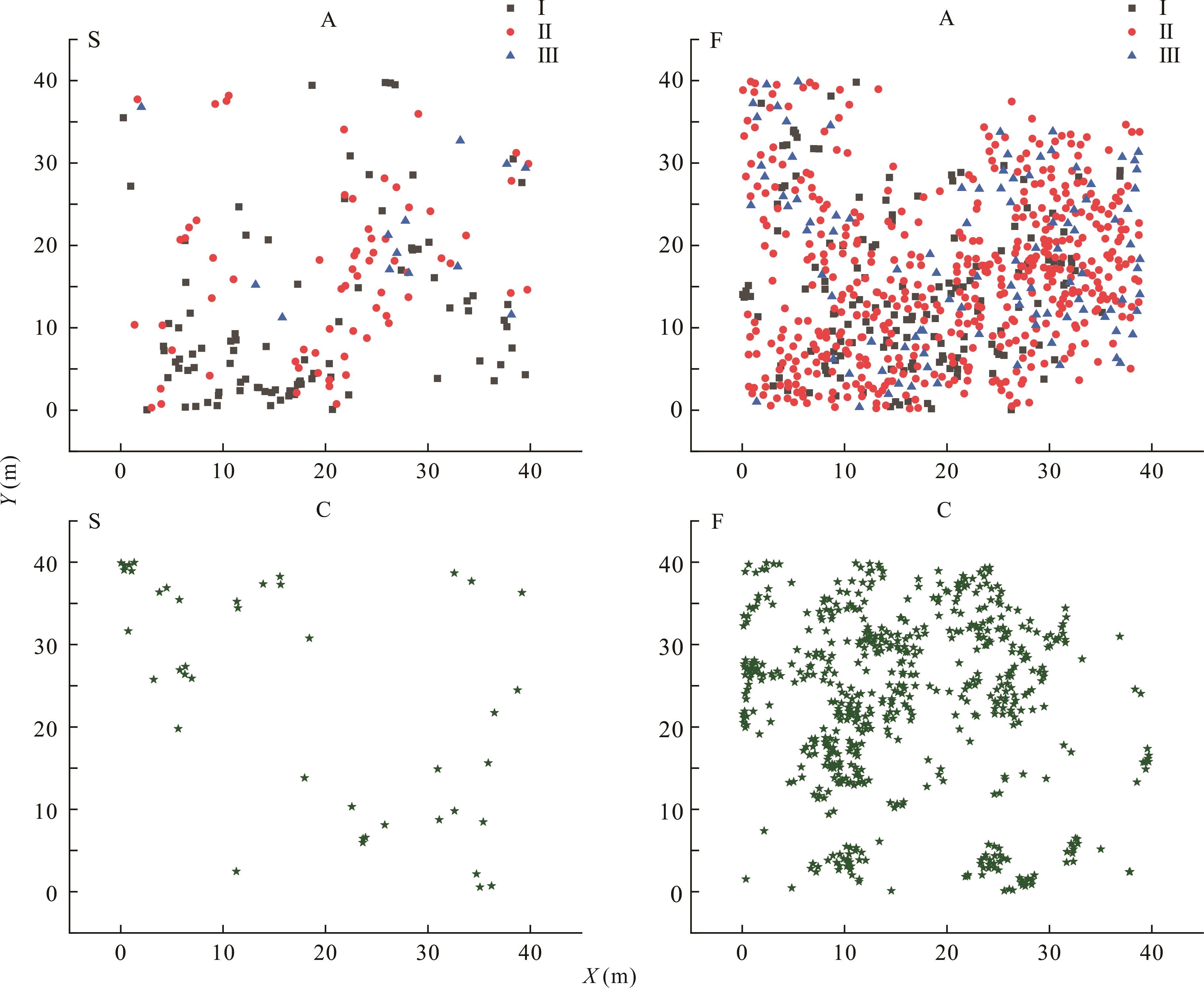
图1 黑沙蒿与小叶锦鸡儿个体的空间分布A, C分别代表黑沙蒿和小叶锦鸡儿;S,F分别代表半固定沙地和固定沙地。X:东向距离 (m);Y:北向距离 (m)。Ⅰ:d≤25 cm;Ⅱ:25 cm<d≤75 cm;Ⅲ:d>75 cm。d:植株大小。A and C represent A. ordosica and C. microphylla, respectively; S and F represent semi-fixed sandy land and fixed sandy land, respectively. X: Easting distance (m);Y: Northing distance (m). Ⅰ represents the size of individual with d≤25 cm;Ⅱ with 25 cm<d≤75 cm;Ⅲ with d>75 cm. d stands for the plant size.
Fig.1 Spatial distribution of individuals of A. ordosica and C. microphylla
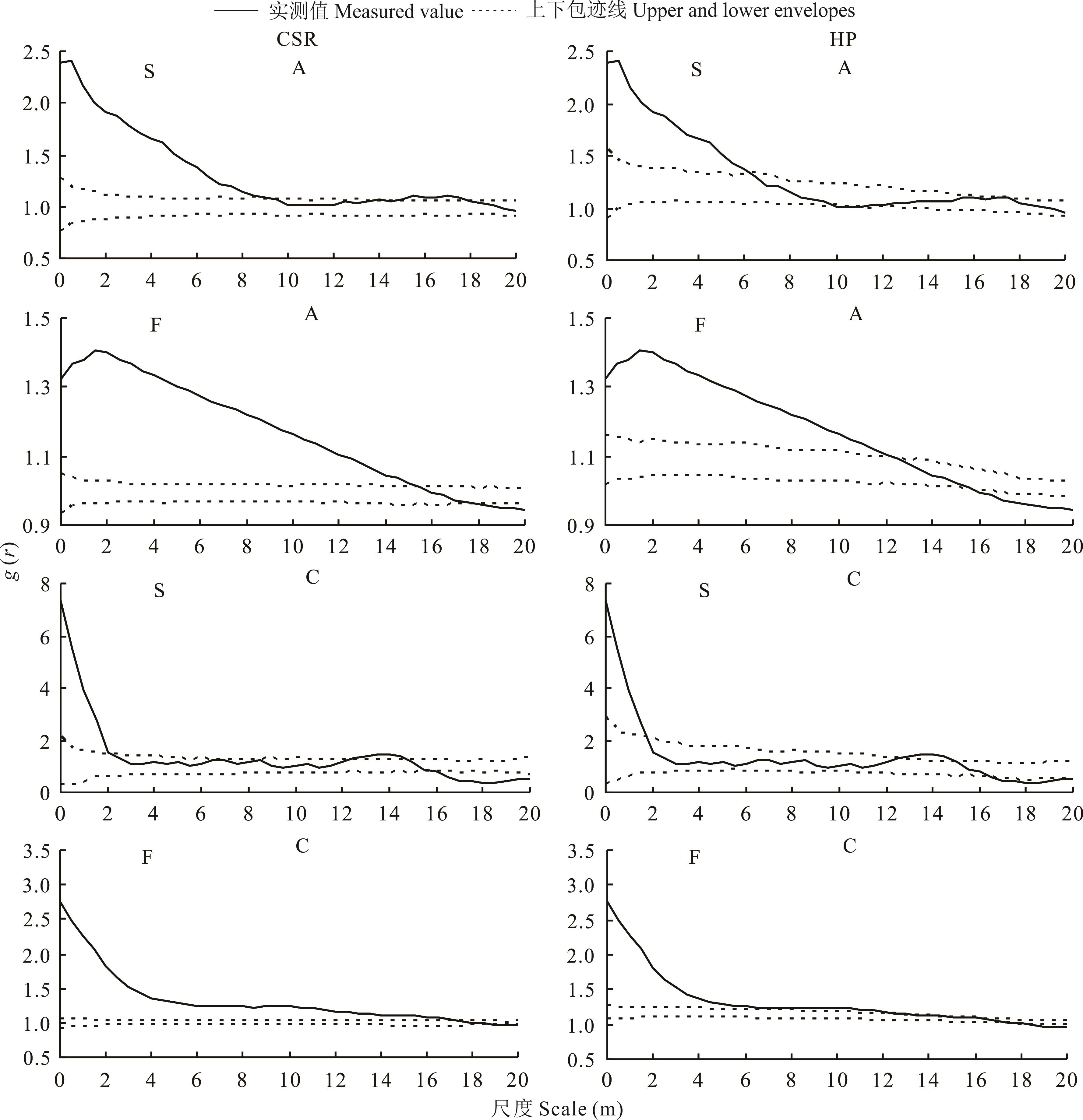
图2 黑沙蒿与小叶锦鸡儿的种群空间分布格局CSR:完全随机模型;HP:异质泊松模型。A, C分别代表黑沙蒿和小叶锦鸡儿;S,F分别代表半固定沙地和固定沙地。下同。CSR:Completely stochastic model;HP:Heterogeneous poisson model. A and C represent A. ordosica and C. microphylla, respectively; S and F represent semi-fixed sandy land and fixed sandy land, respectively. The same below.
Fig.2 Spatial distribution pattern of A. ordosica and C. microphylla populations

图3 半固定沙地黑沙蒿种群3个大小级的空间分布格局Ⅰ:d≤25 cm;Ⅱ:25 cm<d≤75 cm;Ⅲ:d>75 cm. 下同The same below.
Fig.3 Spatial distribution patterns of three size classes of A. ordosica population in semi-fixed sandy land
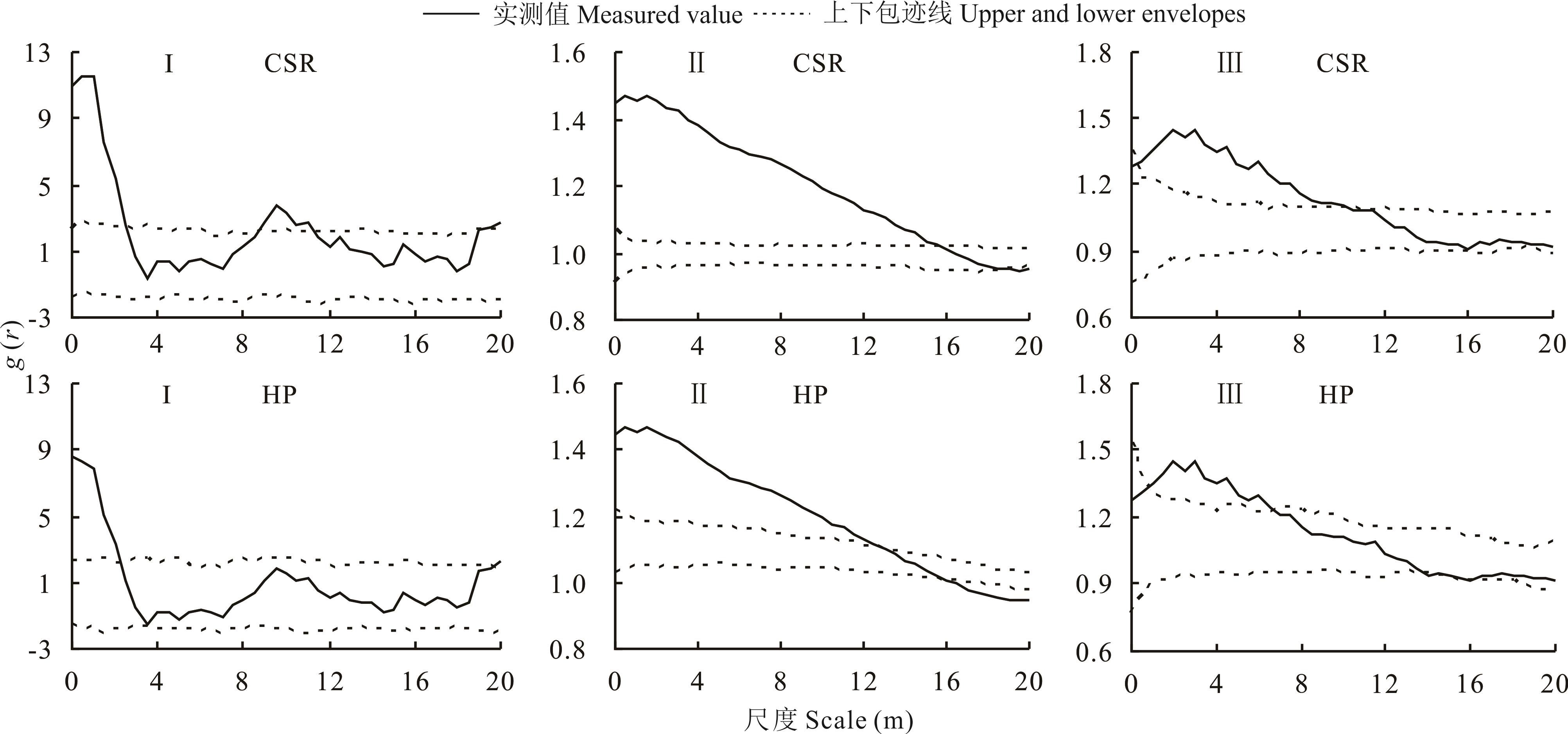
图4 固定沙地黑沙蒿种群3个大小级的空间分布格局
Fig.4 Spatial distribution patterns of three size classes of A. ordosica population in fixed sandy land
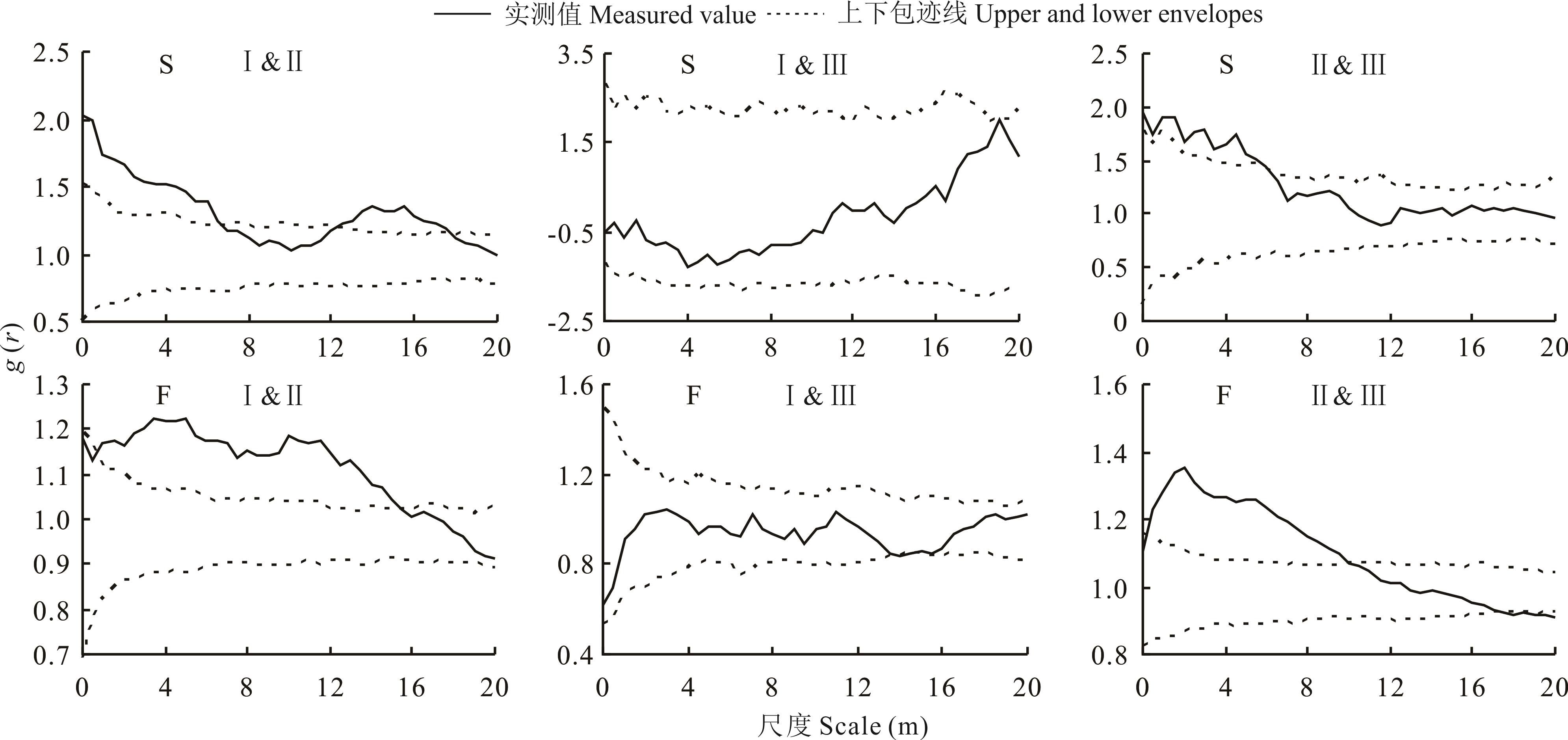
图5 黑沙蒿种群不同大小级之间的空间关联性
Fig.5 Spatial correlation between different size classes of A. ordosica populations
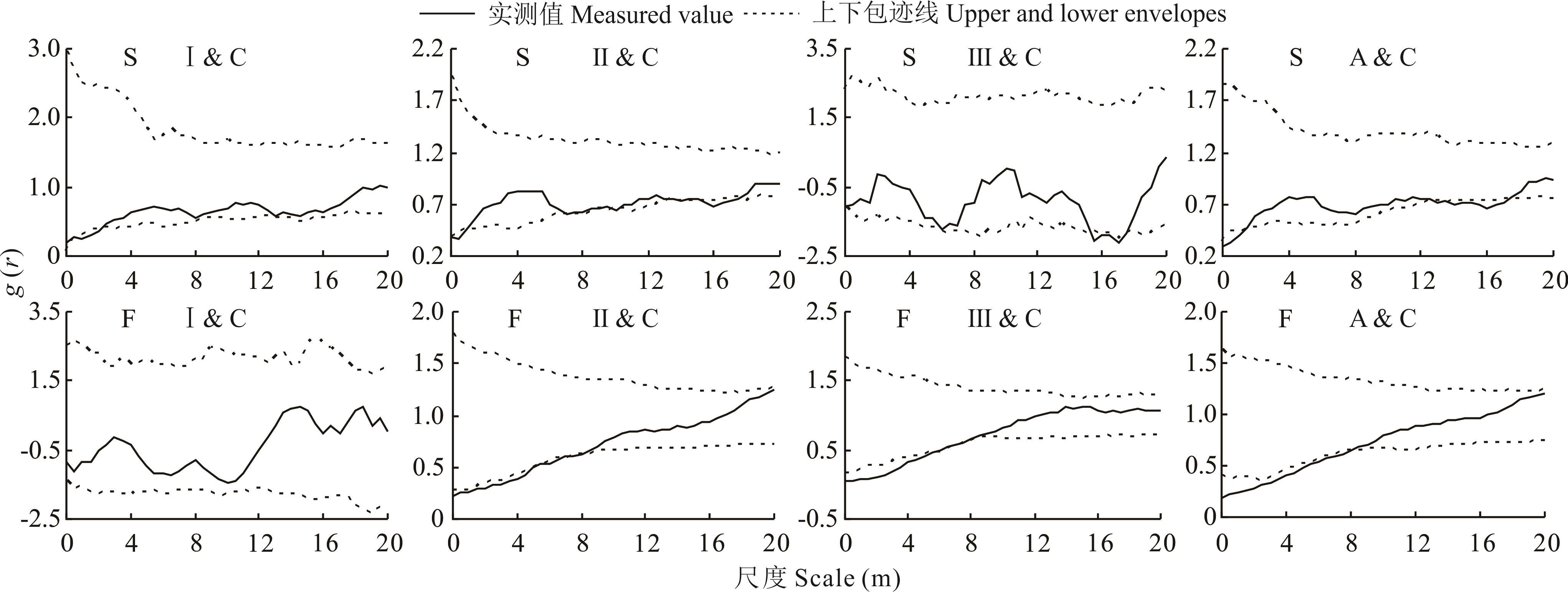
图6 不同大小级的黑沙蒿与小叶锦鸡儿的种间关联性
Fig.6 Interspecific association between different sizes of A. ordosica and C. microphylla
| [1] | John R, Dalling J W, Harms K E, et al. Soil nutrients influence spatial distributions of tropical tree species. Proceedings of the National Academy of Sciences of the United States of America, 2007, 104(3): 864-869. |
| [2] | Zhang W H, Zhang D H, Zhang Z S, et al. Spatial pattern of Artemisia ordosica population on semi-fixed dunes in the Tengger Desert, China. Acta Agrestia Sinica, 2023, 31(7): 2137-2145. |
| 张文豪, 张定海, 张志山, 等. 腾格里沙漠半固定沙丘上油蒿种群的空间格局研究. 草地学报, 2023, 31(7): 2137-2145. | |
| [3] | Zhang J T. Analysis of spatial point patten for plant species. Chinese Journal of Plant Ecology, 1998, 22(4): 57-62. |
| 张金屯. 植物种群空间分布的点格局分析. 植物生态学报, 1998, 22(4): 57-62. | |
| [4] | Tang R Y, Zhang D H, Zhao Y Y, et al. Spatial point pattern of Artemisia ordosica shrubland on fixed sand dunes in the Mu Us sandy land, China. Chinese Journal of Applied Ecology, 2025, 36(3): 719-728. |
| 唐如韵, 张定海, 赵有益, 等. 毛乌素沙地固定沙丘黑沙蒿灌丛空间点格局. 应用生态学报, 2025, 36(3): 719-728. | |
| [5] | Xu A Y, Xu D M, Liu J L, et al. Point pattern analysis of dominant populations based on null models in desert steppe in Ningxia. Acta Ecologica Sinica, 2020, 40(12): 4180-4187. |
| 许爱云, 许冬梅, 刘金龙, 等. 基于零模型的宁夏荒漠草原优势种群点格局分析. 生态学报, 2020, 40(12): 4180-4187. | |
| [6] | Condit R, Ashton P S, Baker P, et al. Spatial patterns in the distribution of tropical tree species. Science, 2000, 288(5470): 1414-1418. |
| [7] | Xing Y F, Shi J J, De K J, et al. Spatial distribution pattern and intraspecific association of Kobresia humilis in perennial artificial grassland. Acta Agrestia Sinica, 2022, 30(2): 253-258. |
| 邢云飞, 施建军, 德科加, 等. 多年生人工草地矮生嵩草(Kobresia humilis)种群空间格局与种内关联性. 草地学报, 2022, 30(2): 253-258. | |
| [8] | Li X T, Wang T J, Han W J, et al. Population structure and point pattern analysis of rare and endangered plant Potaninia mongolica in eastern Alxa, China. Chinese Journal of Plant Ecology, 2023, 47(4): 506-514. |
| 李晓田, 王铁娟, 韩文娟, 等. 东阿拉善珍稀濒危植物绵刺种群结构与点格局分析. 植物生态学报, 2023, 47(4): 506-514. | |
| [9] | Ma Z B, Xiao W F, Huang Q L, et al. A review of point pattern analysis in ecology and its application in China. Acta Ecologica Sinica, 2017, 37(19): 6624-6632. |
| 马志波, 肖文发, 黄清麟, 等. 生态学中的点格局研究概况及其在国内的应用. 生态学报, 2017, 37(19): 6624-6632. | |
| [10] | Zhao Y Z, Zhao L Q, Cao R. Flora Intramongolica (the third edition). Hohhot: Inner Mongolia People’s Publishing House, 2019, 5: 206-207. |
| 赵一之, 赵利清, 曹瑞. 内蒙古植物志(第三版). 呼和浩特: 内蒙古人民出版社, 2019, 5: 206-207. | |
| [11] | Guo K. Cyclic succession of Artemisia ordosica Krasch community in the Mu Us Sandy grassland. Chinese Journal of Plant Ecology, 2000, 24(2): 243-247. |
| 郭柯. 毛乌素沙地油蒿群落的循环演替. 植物生态学报, 2000, 24(2): 243-247. | |
| [12] | Yang H X, Zhang J T, Wu B, et al. Point pattern analysis of Artemisia ordosica population in Mu Us Sandy Land. Chinese Journal of Plant Ecology, 2006, 30(4): 563-570. |
| 杨洪晓, 张金屯, 吴波, 等. 毛乌素沙地油蒿种群点格局分析. 植物生态学报, 2006, 30(4): 563-570. | |
| [13] | Niu C X, Zhang D H, Zhang Z S, et al. Spatial distribution pattern and spatial correlation of main sand-fixing shrubs in fixed dunes in Yanchi region, Mu Us sandy land. Ecological Science, 2024, 43(1): 1-9. |
| 牛程旭, 张定海, 张志山, 等. 毛乌素沙地盐池地区固定沙丘主要固沙灌木的空间分布格局与空间关联性研究. 生态科学, 2024, 43(1): 1-9. | |
| [14] | Liu X T, Wang T J, Su R G G, et al. Spatial distribution patterns of Ammopiptanthus mongolicus population at different developmental stages in the Eastern Alashan. Acta Agrestia Sinica, 2023, 31(10): 3157-3166. |
| 刘晓婷, 王铁娟, 苏日古嘎, 等. 东阿拉善不同发育阶段沙冬青种群的空间分布格局. 草地学报, 2023, 31(10): 3157-3166. | |
| [15] | Zhang L, Wang T J, Guo J T, et al. Population distribution pattern analysis of the rare and endangered plant Tetraena mongolica in western Ordos China. Acta Agrestia Sinica, 2023, 31(2): 551-557. |
| 张丽, 王铁娟, 郭金停, 等. 西鄂尔多斯珍稀濒危植物四合木种群分布格局分析. 草地学报, 2023, 31(2): 551-557. | |
| [16] | Ripley B D. Modeling spatial patterns. Journal of the Royal Statistical Society: Series B (Methodological), 1977, 39(2): 172-192. |
| [17] | Stoyan D, Stoyan H. Fractals, random shapes and point fields: Methods of geometrical statistics. New York: John Wiley & Sons, 1994. |
| [18] | Matiu M, Wiegand T, Moloney K, et al. Handbook of spatial point-pattern analysis in ecology. Boca Raton: CRC Press, 2013. |
| [19] | Wang X T, Hou Y L, Liang C Z, et al. Point pattern analysis based on different null models for detecting spatial patterns. Biodiversity Science, 2012, 20(2): 151-158. |
| 王鑫厅, 侯亚丽, 梁存柱, 等. 基于不同零模型的点格局分析. 生物多样性, 2012, 20(2): 151-158. | |
| [20] | Shen G C, He F L, Waagepetersen R, et al. Quantifying effects of habitat heterogeneity and other clustering on spatial distributions of tree species. Ecology, 2013, 94(11): 2436-2443. |
| [21] | Qu W J, Wang L, Yang X G, et al. Point pattern analysis based on null models of population in fixed sand at the southeastern edge of the Tengger Desert. Acta Prataculturae Sinica, 2024, 33(10): 37-45. |
| 曲文杰, 王磊, 杨新国, 等. 基于零模型的腾格里沙漠东南缘固定沙地种群点格局分析. 草业学报, 2024, 33(10): 37-45. | |
| [22] | Dong X, Liu M H, Li X L, et al. Effects of artificial simulated precipitation on seed morphology and specific leaf area of Artemisia ordosica. Journal of Central South University of Forestry and Technology, 2020, 40(2): 36-42. |
| 董雪, 刘明虎, 李新乐, 等. 人工模拟增雨对油蒿种子形态性状和比叶面积的影响. 中南林业科技大学学报, 2020, 40(2): 36-42. | |
| [23] | Zhou Z L, Wang L, Yu J, et al. Seed germination physiology of two species of Caragana Fabr. Acta Botanica Boreali-Occidentalia Sinica, 2011, 31(12): 2509-2515. |
| 周正立, 王琳, 于军, 等. 锦鸡儿属两种植物种子萌发生理研究. 西北植物学报, 2011, 31(12): 2509-2515. | |
| [24] | West P W, Ratkowsky D A. Problems with models assessing influences of tree size and inter-tree competitive processes on individual tree growth: A cautionary tale. Journal of Forestry Research, 2022, 33(3): 565-577. |
| [25] | Ta F, Liu X D, Liu R H, et al. Spatial distribution patterns and association of Picea crassifolia population in Dayekou Basin of Qilian Mountains, northwestern China. Chinese Journal of Plant Ecology, 2020, 44(11): 1172-1183. |
| 拓锋, 刘贤德, 刘润红, 等. 祁连山大野口流域青海云杉种群空间格局及其关联性. 植物生态学报, 2020, 44(11): 1172-1183. | |
| [26] | Zhao G D, Xiong K, Xu G X, et al. Spatial patterns and associations of main dominant species Abies fargesii var. faxoniana and Betula utilis in Miyaluo subalpine dark coniferous forest of western Sichuan, China. Acta Ecologica Sinica, 2022, 42(8): 3377-3388. |
| 赵广东, 熊凯, 许格希, 等. 川西米亚罗亚高山暗针叶林岷江冷杉和糙皮桦空间格局及其关联性分析. 生态学报, 2022, 42(8): 3377-3388. | |
| [27] | Yu Y, Bai X J, Wang Z Y. Niche characteristics and competitive relationship of Larix gmelinii between different age classes in Greater Khingan Range secondary forest area. Acta Ecologica Sinica, 2022, 42(12): 4912-4921. |
| 俞昀, 白小军, 王志一. 大兴安岭次生林区不同龄级落叶松(Larix gmelinii)生态位特征和竞争关系. 生态学报, 2022, 42(12): 4912-4921. | |
| [28] | Yang C L, Liu M X, Wang Q Y, et al. Spatial pattern and correlation of populations of Anemone rivularis and Kobresia myosuroides under single-household management and multi-household management grazing patterns. Ecology and Environmental Sciences, 2023, 32(4): 651-659. |
| 杨春亮, 刘旻霞, 王千月, 等. 单户与联户放牧经营下草玉梅与嵩草种群空间格局及其关联性. 生态环境学报, 2023, 32(4): 651-659. | |
| [29] | Chen S H. Root types of grassland plants in Inner Mongolia. Hohhot: Inner Mongolia People’s Publishing House, 1987: 107-109. |
| 陈世璜. 内蒙古草原植物根系类型. 呼和浩特: 内蒙古人民出版社, 1987: 107-109. |
| [1] | 曲文杰, 王磊, 杨新国, 屈建军, 张力, 张波, 孙向波. 基于零模型的腾格里沙漠东南缘固定沙地种群点格局分析[J]. 草业学报, 2024, 33(10): 37-45. |
| [2] | 虎雅玲, 哈斯额尔敦, 满良, 杨一, 张萍. 小叶锦鸡儿灌丛地植被对沙源供给的响应[J]. 草业学报, 2023, 32(1): 26-35. |
| [3] | 戎荣, 孙斌, 武志涛, 高志海, 杜自强, 滕思翰. 灌丛化草原小叶锦鸡儿灌丛地上生物量测量方法研究[J]. 草业学报, 2023, 32(1): 36-47. |
| [4] | 李媛媛, 徐婷婷, 艾喆, 周兆娜, 马飞. 锦鸡儿属植物功能性状与根际土壤细菌群落结构的关系[J]. 草业学报, 2022, 31(7): 38-49. |
| [5] | 胡鸿姣, 刘新平, 张铜会, 何玉惠, 王明明, 张腊梅, 孙姗姗, 程莉. 小叶锦鸡儿饲用营养价值及青贮加工[J]. 草业学报, 2021, 30(11): 181-190. |
| [6] | 付青云, 刘小燕, 刘廷玺, 段利民, 王冠丽, 曹文梅, 黄天宇. 不同树龄小叶锦鸡儿干旱降水过渡时期用水策略研究[J]. 草业学报, 2018, 27(8): 67-77. |
| [7] | 柴华,方江平,温丁,李杰,何念鹏. 内蒙古灌丛化草地取样位置对评估土壤碳氮贮量的影响[J]. 草业学报, 2014, 23(6): 28-35. |
| [8] | 赵哈林,曲浩,周瑞莲,云建英,李瑾,王进. 沙埋对两种灌木生长影响及其生理响应差异[J]. 草业学报, 2014, 23(1): 185-191. |
| [9] | 李武斌,何丙辉,王力,申建红,黄治清,张兴华,文基坚,代万贵. 九寨沟马脑壳金矿矿山土壤养分空间分布格局[J]. 草业学报, 2011, 20(3): 1-9. |
| [10] | 林燕,白永飞. 内蒙古典型草原小叶锦鸡儿灌丛地上净初级生产力和种群结构对火烧的响应[J]. 草业学报, 2010, 19(5): 170-178. |
| [11] | 柴永青,曹致中,蔡卓山,万丽霞,李学玲. 肃北地区稀有植物裸果木种群的空间分布格局[J]. 草业学报, 2010, 19(5): 239-249. |
| [12] | 李衍青,张铜会,赵学勇,刘新平,童勋章,云建英. 科尔沁沙地小叶锦鸡儿灌丛降雨截留特征研究[J]. 草业学报, 2010, 19(5): 267-272. |
| [13] | 山宝琴,贺学礼,段小圆. 毛乌素沙地密集型克隆植物根围AM真菌多样性及空间分布[J]. 草业学报, 2009, 18(2): 146-154. |
| 阅读次数 | ||||||
|
全文 |
|
|||||
|
摘要 |
|
|||||
