
ISSN 1004-5759 CN 62-1105/S
Acta Prataculturae Sinica ›› 2025, Vol. 34 ›› Issue (11): 217-226.DOI: 10.11686/cyxb2024396
Da-yong HAN1( ), Yun-fei YANG1,2(), Hai-yan LI2, Wei ZHANG1
Received:2024-10-13
Revised:2025-02-19
Online:2025-11-20
Published:2025-10-09
Contact:
Yun-fei YANG
Da-yong HAN, Yun-fei YANG, Hai-yan LI, Wei ZHANG. Universal models of convergent adaptation based on the age structure and senescence process of population modules of 12 rhizomatous grass species in natural grassland, China[J]. Acta Prataculturae Sinica, 2025, 34(11): 217-226.

Fig.1 Age spectrum of population tillers for 12 rhizomatous grasses under three types of grassland utilization

Fig.2 Age spectrum of rhizome length of populations for 12 rhizomatous grasses under three types of grassland utilization

Fig.3 Age spectrum of population buds for 12 rhizomatous grasses under three types of grassland utilization
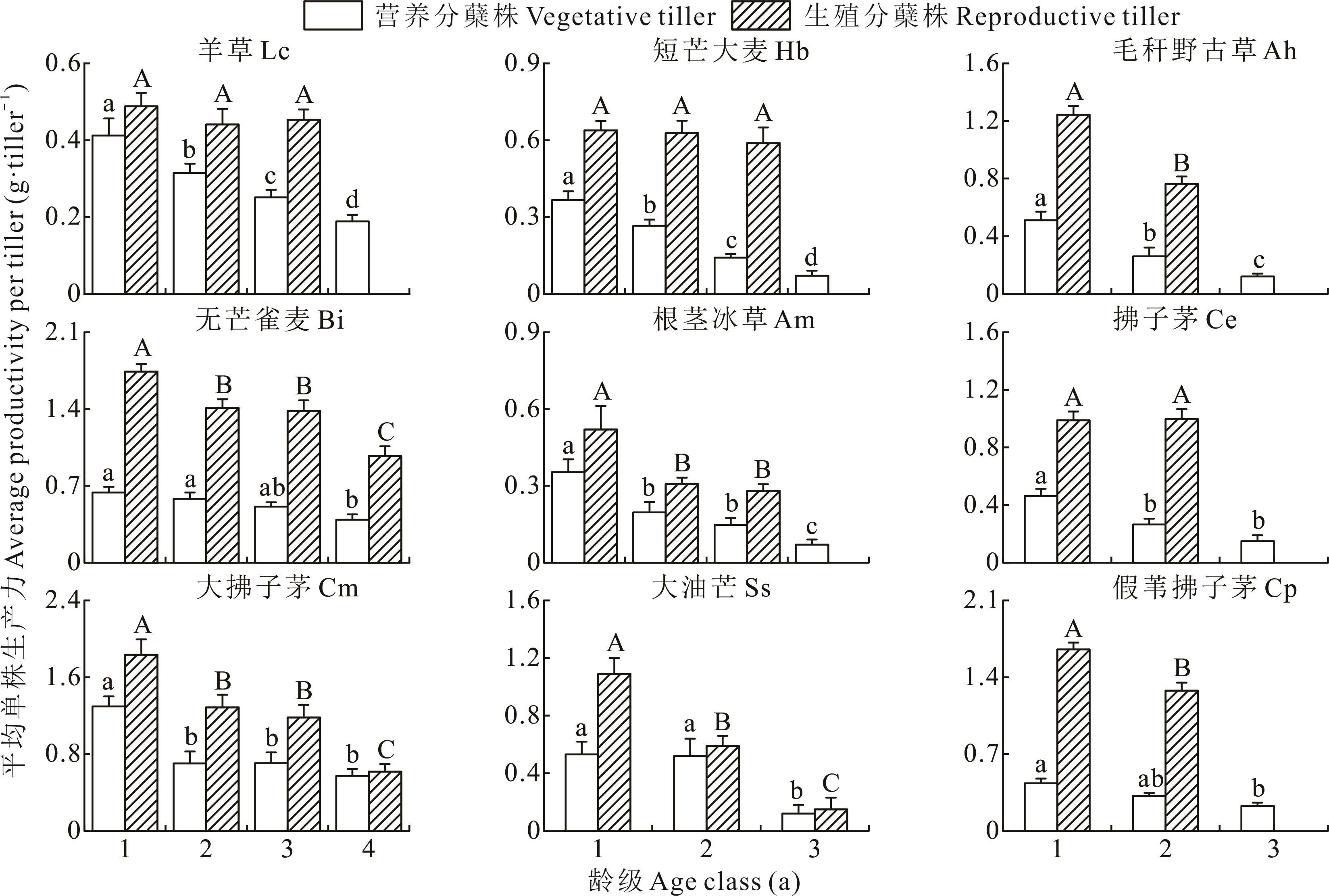
Fig.4 Average productivity per-tiller of vegetative tillers (V) and reproductive tillers (R) of 9 rhizomatous grass populations in enclosed grassland
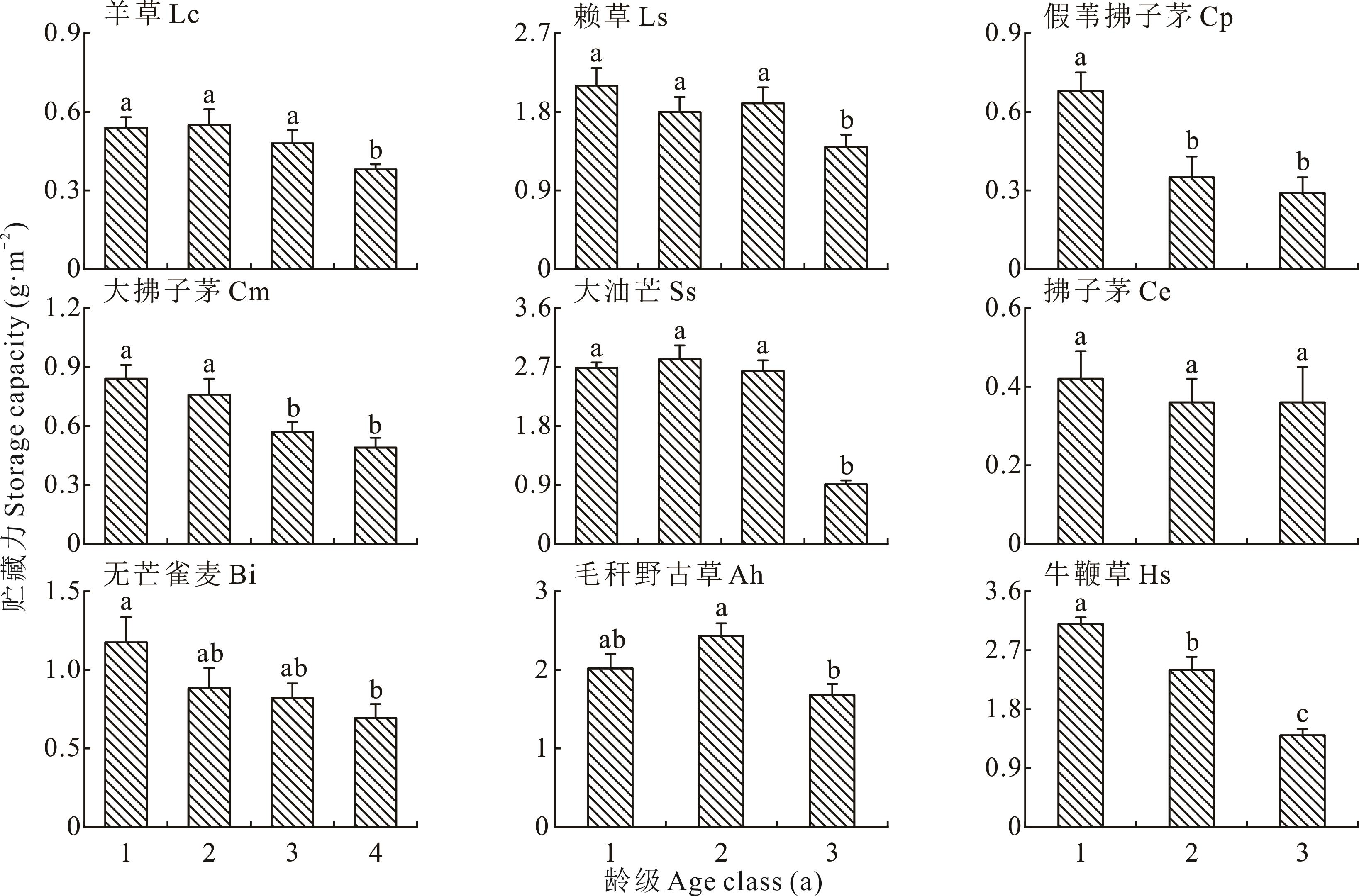
Fig.5 Average storage capacity per unit length of rhizomes of 9 rhizomatous grass populations in enclosed grassland
| [1] | Yang Y F, Zhu T C. Plant ecology. Beijing: Higher Education Press, 2011. |
| 杨允菲, 祝廷成. 植物生态学. 北京: 高等教育出版社, 2011. | |
| [2] | Shen H H, Zhu Y K, Zhao X, et al. Analysis of current grassland resources in China. Chinese Science Bulletin, 2016, 61(2): 139-154. |
| 沈海花, 朱言坤, 赵霞, 等. 中国草地资源的现状分析. 科学通报, 2016, 61(2): 139-154. | |
| [3] | Yang Y F, Liu G C, Zhang B T. An analysis of age structure and the strategy for asexual propagation of Aneurolepidium chinense population. Acta Botanica Sinica, 1995, 37(2): 147-153. |
| 杨允菲, 刘庚长, 张宝田. 羊草种群年龄结构及无性繁殖对策的分析. 植物学报, 1995, 37(2): 147-153. | |
| [4] | Yang Y F, Zheng H Y, Li J D. Methods of study on age structures of clonal populations in rhizome type grass. Journal of Northeast Normal University (Natural Science Edition), 1998(1): 54-58. |
| 杨允菲, 郑慧莹, 李建东. 根茎禾草无性系种群年龄结构的研究方法. 东北师大学报(自然科学版), 1998(1): 54-58. | |
| [5] | Yang Y F, Zheng H Y, Li J D. Comparison of age structures of the tillers in the Leymus chinensis population, a clonal grass species under different ecological conditions. Acta Ecologica Sinica, 1998, 18(3): 302-308. |
| 杨允菲, 郑慧莹, 李建东. 不同生态条件下羊草种群分蘖植株年龄结构的比较分析. 生态学报, 1998, 18(3): 302-308. | |
| [6] | Ding X M, Wang Y X, Yang Y F. Study of age structure of Leymus chinensis populations in different soil substrates in the Songnen Plain. Pratacultural Science, 2004, 21(2): 45-48. |
| 丁雪梅, 王涌鑫, 杨允菲. 松嫩平原不同土壤基质条件下羊草种群年龄结构的研究. 草业科学, 2004, 21(2): 45-48. | |
| [7] | Li H Y, Yang Y F. Age structures on clonal populations of Leymus chinensis in the process of restoration succession after the flooded meadow in the Songnen Plains of China. Acta Ecologica Sinica, 2004, 24(10): 2171-2177. |
| 李海燕, 杨允菲. 松嫩草原水淹恢复演替过程中羊草无性系种群构件的年龄结构. 生态学报, 2004, 24(10): 2171-2177. | |
| [8] | Jiao D Z, Ding X M, Yang Y F. Age structure of modules of Leymus chinensis populations in different habitats in Zhalong Nature Reserve of China. Chinese Journal of Ecology, 2006, 25(6): 617-620. |
| 焦德志, 丁雪梅, 杨允菲. 扎龙自然保护区不同生境条件下羊草种群构件的年龄结构. 生态学杂志, 2006, 25(6): 617-620. | |
| [9] | Jia F Q, Jianaer·A han, Zhang X F, et al. Age structures of components of Leymus chinensis population in different habitats in the Yili River Valley area, China. Chinese Journal of Grassland, 2011, 33(2): 95-99. |
| 贾风勤, 贾娜尔·阿汗, 张相锋, 等. 伊犁河谷不同生境羊草种群构件的年龄结构. 中国草地学报, 2011, 33(2): 95-99. | |
| [10] | Zhang J Y, Wang R Y, Li H Y, et al. Age structure of Leymus chinensis population modules in different habitats of Songnen Plain, China. Chinese Journal of Grassland, 2020, 42(4): 73-78. |
| 张嘉恒, 王柔懿, 李海燕, 等. 松嫩平原不同生境羊草种群构件的年龄结构. 中国草地学报, 2020, 42(4): 73-78. | |
| [11] | Li H. Studies on the reproductive characteristics and convergent adaptation theory of rhizome grass population in Songnen Plain. Changchun: Northeast Normal University, 2022. |
| 李红. 松嫩平原根茎型禾草种群的繁殖特性及趋同适应机理研究. 长春: 东北师范大学, 2022. | |
| [12] | Yang Y F, Li J D, Zheng H Y. Vegetative propagation characters of clonal populations of Hierochloe glabra in Songnen Plain. Chinese Journal of Applied Ecology, 1997, 8(6): 571-574. |
| 杨允菲, 李建东, 郑慧莹. 松嫩平原光稃茅香无性系种群的营养繁殖特征. 应用生态学报, 1997, 8(6): 571-574. | |
| [13] | Sheng J, Zhu Y, Li H Y, et al. Comparison of module structures of Hierochloe glabra populations in heterogeneous habitats in Songnen Plain of China.Chinese Journal of Grassland, 2018, 40(5): 36-42. |
| 盛军, 朱瑶, 李海燕, 等. 松嫩平原异质生境光稃茅香种群构件结构的比较. 中国草地学报, 2018, 40(5): 36-42. | |
| [14] | Yang Y F, Zheng H Y, Li J D. Vegetative propagation of clonal population of Hemarthria japonica in Songnen Plain of China. Acta Prataculturae Sinica, 1997, 6(2): 36-40. |
| 杨允菲, 郑慧莹, 李建东. 松嫩平原牛鞭草无性系种群的营养繁殖策略. 草业学报, 1997, 6(2): 36-40. | |
| [15] | Yang Y F, Zhang H J, Zhang B T. Propagation of Arundinella hirta clonal population in Songnen Plain of China. Acta Prataculturae Sinica, 1998, 7(1): 1-5. |
| 杨允菲, 张洪军, 张宝田. 松嫩平原野古草无性系种群的营养繁殖特征. 草业学报, 1998, 7(1): 1-5. | |
| [16] | Li C C, Li H Y, Yang Y F. Dynamics of module structures on Arundinella hirta populations in Songnen Plains of China. Acta Ecologica Sinica, 2015, 35(8): 2609-2615. |
| 李程程, 李海燕, 杨允菲. 松嫩平原野古草种群构件结构动态. 生态学报, 2015, 35(8): 2609-2615. | |
| [17] | Feng J, Liu Z K, Li H Y, et al. Effects of enclosure and long-term mowing on vegetative propagation characteristics of Leymus chinensis and Arundinella hirta populations in the Songnen grassland, China. Acta Prataculturae Sinica, 2023, 32(5): 50-60. |
| 丰吉, 刘志扩, 李海燕, 等. 围栏封育和长期刈割对松嫩草地羊草和野古草种群营养繁殖特征的影响. 草业学报, 2023, 32(5): 50-60. | |
| [18] | Yang Y F, Zheng H Y, Li J D. The effects of grazing on age structure in clonal populations of Agopyron michnoi. Acta Phytoecologica Sinica, 2001, 25(1): 71-75. |
| 杨允菲, 郑慧莹, 李建东. 放牧干扰对根茎冰草无性系种群年龄结构的影响. 植物生态学报, 2001, 25(1): 71-75. | |
| [19] | Jin X M, Ai L, Liu J D, et al. Dynamics of age structures on Agropyron michnoi and Leymus chinensis in different communities. Acta Ecologica Sinica, 2011, 31(18): 5406-5413. |
| 金晓明, 艾琳, 刘及东, 等. 不同群落中米氏冰草和羊草的年龄结构动态. 生态学报, 2011, 31(18): 5406-5413. | |
| [20] | Jin X M, Ao Y G, Ai L, et al. Age structures of Agropyron michnoi in Hulunbeier sandy grassland. Acta Agrestia Sinica, 2011, 19(3): 367-371, 387. |
| 金晓明, 敖永贵, 艾琳, 等. 呼伦贝尔沙地米氏冰草种群构件年龄结构动态. 草地学报, 2011, 19(3): 367-371, 387. | |
| [21] | Jin X M, Liu J D, Lu X S, et al. Relationship between vegetative potential populations and actual populations of Agropyron michnoi. Acta Prataculturae Sinica, 2012, 21(6): 228-234. |
| 金晓明, 刘及东, 卢欣石, 等. 米氏冰草营养繁殖潜在种群与现实种群的关系. 草业学报, 2012, 21(6): 228-234. | |
| [22] | Yang Y F, Zhang B T, Li J D. Quantitative characteristics of vegetative propagation of Calamagrostis rigidula clonal population in Songnen Plain of China. Acta Prataculturae Sinica, 1998, 7(4): 7-12. |
| 杨允菲, 张宝田, 李建东. 松嫩平原硬拂子茅无性系种群营养繁殖的数量特征. 草业学报, 1998, 7(4): 7-12. | |
| [23] | Zhang W, Jianaer·A han, Zhao Y, et al. Population age structures of Calamagrostis macrolepis under two habitats in Yili of Xinjiang. Acta Agrestia Sinica, 2011, 19(6): 898-903. |
| 张维, 贾娜尔·阿汗, 赵玉, 等. 新疆伊犁2种生境大拂子茅种群年龄结构研究. 草地学报, 2011, 19(6): 898-903. | |
| [24] | Yang Y F, Zheng H Y. Age structure of clone population of Calamagrostis pseudophragmites in the Songnen Plain of China. Acta Prataculturae Sinica, 2000, 9(3): 8-13. |
| 杨允菲, 郑慧莹. 松嫩平原假苇拂子茅无性系种群的年龄结构. 草业学报, 2000, 9(3): 8-13. | |
| [25] | Zhao Y, Li H Y, Janar·A han, et al. Components and age structures of Calamagrostis pseudophragmites population modules in the Yily River Valley area, China. Acta Prataculturae Sinica, 2009, 18(2): 89-94. |
| 赵玉, 李海燕, 贾娜尔·阿汗, 等. 伊犁河谷不同生境假苇拂子茅种群构件组成及其年龄结构. 草业学报, 2009, 18(2): 89-94. | |
| [26] | Zhao Y, Liu Y, Zhang X F. Dormancy module structures of Calamagrostis pseudophragmites populations in the Yily River Valley area of Xinjiang, China. Acta Agrestia Sinica, 2012, 20(6): 1059-1064. |
| 赵玉, 刘影, 张相锋. 伊犁河谷地不同生境天然假苇拂子茅种群冬眠构件的结构. 草地学报, 2012, 20(6): 1059-1064. | |
| [27] | Zhang L D, Li H Y, Yang Y F. Age structures of modules in a Calamagrostis epigejos population in single-species dominant patches in the Songnen Plain of China. Acta Prataculturae Sinica, 2016, 25(9): 20-27. |
| 张露丹, 李海燕, 杨允菲. 松嫩平原单优种群落斑块拂子茅种群构件的年龄结构. 草业学报, 2016, 25(9): 20-27. | |
| [28] | Li H, Yang Y F, Qiao X B. Age structure of tillers of Hordeum brevisubulatum clone in Songnen Plain of China. Chinese Journal of Applied Ecology, 2000, 11(3): 403-407. |
| 李红, 杨允菲, 乔喜波. 松嫩平原野大麦无性系分蘖株的年龄结构. 应用生态学报, 2000, 11(3): 403-407. | |
| [29] | Yang Y F, Zhang B T, Li J D. Structure and development regulation on dormancy modules of Hordeum brevisubulatum clone on cultivated condition in the Songnen Plains of China. Acta Ecologica Sinica, 2004, 24(2): 268-273. |
| 杨允菲, 张宝田, 李建东. 松嫩平原人工草地野大麦无性系冬眠构件的结构及形成规律. 生态学报, 2004, 24(2): 268-273. | |
| [30] | Li H Y, Yang Y F. Age structures of Spodiopogon sibiricus populations on weedy meadow and elm woodland in Songnen Plain, Northeast China. Chinese Journal of Applied Ecology, 2011, 22(8): 1982-1986. |
| 李海燕, 杨允菲. 松嫩平原杂类草草甸和榆树疏林草原大油芒种群的年龄结构. 应用生态学报, 2011, 22(8): 1982-1986. | |
| [31] | Li H Y, Yang Y F, Li J D, et al. Comparison of module characteristics of Spodiopogon sibiricus populations in different vegetation types. Chinese Journal of Grassland, 2011, 33(6): 35-40. |
| 李海燕, 杨允菲, 李建东, 等. 不同植被类型大油芒种群构件特征的比较研究. 中国草地学报, 2011, 33(6): 35-40. | |
| [32] | Sheng J, Zhu Y, Li H Y, et al. Effects of long-term moving and enclosure on module traits of Spodiopogon sibiricus populations. Acta Agrestia Sinica, 2018, 26(3): 545-550. |
| 盛军, 朱瑶, 李海燕, 等. 长期刈割及围栏封育方式对大油芒种群构件特征的影响. 草地学报, 2018, 26(3): 545-550. | |
| [33] | Yang Y F, Zhang B T. Clone growth and age structure on the modules of Leymus secalimus in the Songnen Plains of China. Chinese Journal of Applied Ecology, 2004, 15(11): 2109-2112. |
| 杨允菲, 张宝田. 松嫩平原赖草无性系生长及其构件的年龄结构. 应用生态学报, 2004, 15(11): 2109-2112. | |
| [34] | Yang Y F, Song X H. Age structure on population modules of Leymus secalimus in the process of the vegetative restoration in storage pools of coal ash in general firepower plant, Tongliao. Acta Prataculturae Sinica, 2005, 14(4): 116-118. |
| 杨允菲, 宋向华. 通辽火电厂储灰池植被恢复过程中赖草种群构件的年龄结构. 草业学报, 2005, 14(4): 116-118. | |
| [35] | Ma Y N. Research on module structures of Bromus inermis population in artificial grassland. Changchun: Northeast Normal University, 2008. |
| 马轶男. 人工草地无芒雀麦种群构件结构的研究. 长春: 东北师范大学, 2008. | |
| [36] | Zhang W, Jianaer·A han, Zhang N, et al. The age structure of Bromus inermis populations in two habitats in Yili of Xinjiang. Pratacultural Science, 2012, 29(5): 798-803. |
| 张维, 贾娜尔·阿汗, 张娜, 等. 新疆伊犁两种生境无芒雀麦种群的年龄结构. 草业科学, 2012, 29(5): 798-803. |
| Viewed | ||||||
|
Full text |
|
|||||
|
Abstract |
|
|||||
