

ISSN 1004-5759 CN 62-1105/S
草业学报 ›› 2027, Vol. 36 ›› Issue (1): 112-124.DOI: 10.11686/cyxb2026006
• 研究论文 • 上一篇
辛晴1( ), 姚拓1(), 向兴1,2, 吴佳奇1
收稿日期:2026-01-06
修回日期:2026-03-09
出版日期:2027-01-20
发布日期:2026-11-25
通讯作者:
姚拓
作者简介:E-mail: yaotuo@gsau.edu.cn基金资助:
Qing XIN1(), Tuo YAO1(), Xing XIANG1,2, Jia-qi WU1
Received:2026-01-06
Revised:2026-03-09
Online:2027-01-20
Published:2026-11-25
Contact:
Tuo YAO
摘要:
菌株Gnyt1是2014年从天祝高寒草地珠芽蓼根际分离的优良植物促生菌(PGPR),具备固氮、溶磷及分泌植物激素等功能,在高寒生态修复与作物促生中极具应用潜力。但前期仅通过传统表型鉴定与单一16S rDNA序列分析的分类结果存在争议,该菌株被分别归为蜡样芽孢杆菌与蕈状芽孢杆菌,模糊的分类学地位严重制约了其资源保藏、功能解析及工业化开发。为解决这一问题,采用多相分类学体系对菌株Gnyt1精准重新鉴定,明确其种级分类单元,为后续研究与应用提供可靠分类学依据。综合运用表型观察、生理生化试验、16S rDNA序列系统发育分析、平均核苷酸一致性(ANI)分析、数字DNA-DNA杂交(dDDH)分析及全基因组共线性分析,结合抗逆与促生功能基因挖掘、耐盐碱特性测定及促生性能评价开展系统研究。结果显示,菌株Gnyt1的表型与生理生化关键指标均与蕈状芽孢杆菌标准特征完全吻合,在动力测试、根状生长等标志性指标上与蜡样芽孢杆菌差异显著;其16S rDNA序列与蕈状芽孢杆菌模式菌株相似度为99.52%~100.00%,与近缘菌株LX30的ANI值为98.97%,与模式菌株的dDDH值为74.30%,均满足细菌种级分类标准,全基因组共线性一致性最高达87.95%;功能基因分析发现,该菌株携带冷休克蛋白基因cspA、钾离子转运基因簇kdpFABC及抗逆基因clpB,适配高寒草地低温、高渗生境,且在≤5% NaCl、pH为7~9条件下仍保持高效促生能力。综上,菌株Gnyt1的分类学地位明确为蕈状芽孢杆菌,其兼具优良耐盐碱抗逆性与稳定促生性能,可为高寒草地生态修复及轻度至中度盐碱土壤改良提供优质微生物资源,具有重要实际应用价值。
辛晴, 姚拓, 向兴, 吴佳奇. 一株分离自高寒草地的促生菌株Gnyt1多相分类鉴定及抗逆适应性研究[J]. 草业学报, 2027, 36(1): 112-124.
Qing XIN, Tuo YAO, Xing XIANG, Jia-qi WU. Polyphasic taxonomic identification and stress adaptability of plant growth-promoting strain Gnyt1 isolated from alpine grassland[J]. Acta Prataculturae Sinica, 2027, 36(1): 112-124.
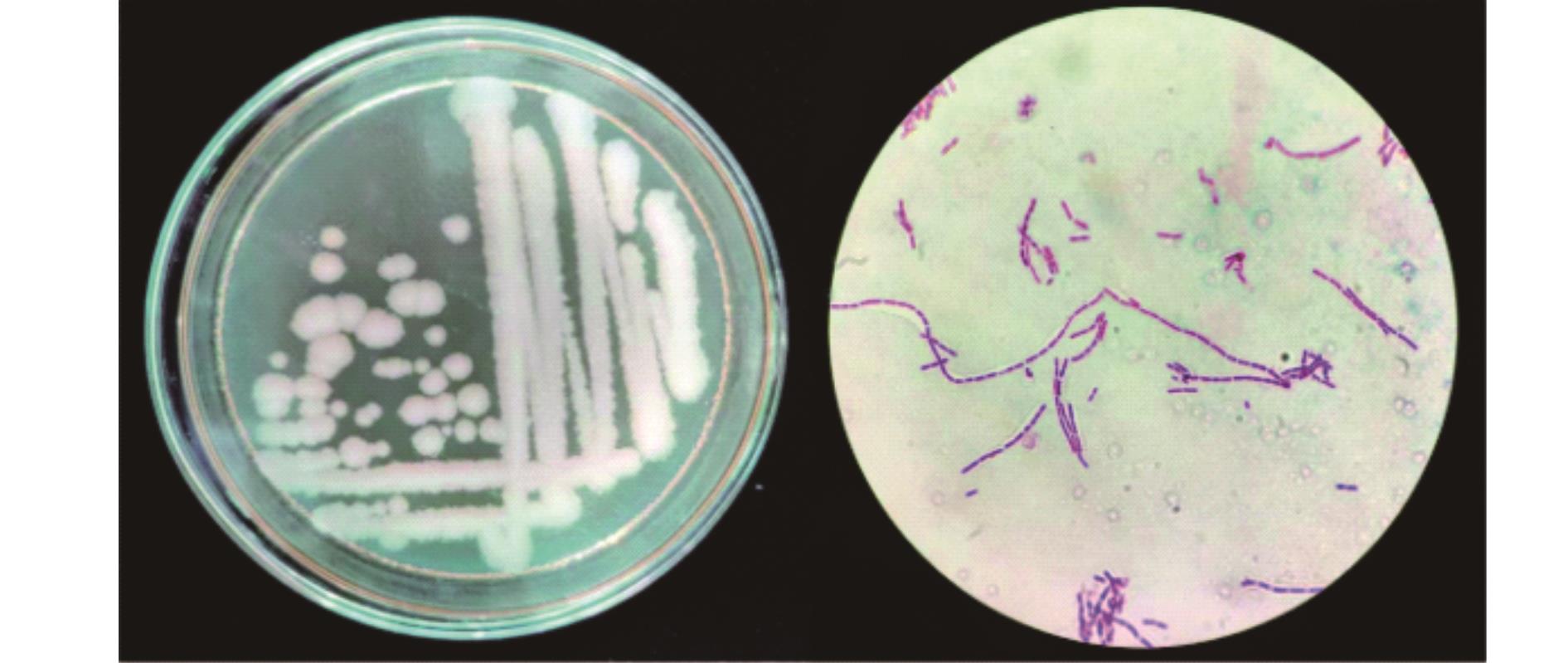
图1 Gnyt1菌株的菌落及菌体形态特征左图为LB平板上的菌落形态;右图为革兰氏染色后的菌体显微观察(1000×)。The left picture shows the colony morphology on the LB plate; The right picture shows the microscopic observation of the bacteria after Gram staining (1000×).
Fig.1 Colony and cell morphological characteristics of strain Gnyt1
试验名称 Test item | Gnyt1 | 蜡样芽孢杆菌 B.cereus | 蕈状芽孢杆菌 B. mycoides | 试验名称 Test item | Gnyt1 | 蜡样芽孢杆菌 B.cereus | 蕈状芽孢杆菌 B. mycoides |
|---|---|---|---|---|---|---|---|
| 过氧化氢酶Catalase test | + | + | + | 葡萄糖利用Glucose utilization | + | + | + |
| 动力测试Motility test | - | +/- | - | V-P测定Voges-Proskauer test | + | + | + |
| 硝酸盐还原Nitrate reduction | + | + | + | 甘露醇产酸Mannitol acid production | - | - | - |
| 酪蛋白分解Casein hydrolysis | + | + | +/- | 溶血反应Hemolysis test | + | + | + |
| 溶菌酶耐性Lysozyme tolerance | + | + | + | 根状生长Rhizoid growth | + | - | + |
| 卵黄反应Egg yolk reaction | + | + | + | 毒素晶体Toxin crystal | - | - | - |
表1 Gnyt1菌株与芽孢杆菌属相关菌株的生理生化特征对比
Table 1 Comparison of physiological and biochemical characteristics between strain Gnyt1 and related Bacillus strains
试验名称 Test item | Gnyt1 | 蜡样芽孢杆菌 B.cereus | 蕈状芽孢杆菌 B. mycoides | 试验名称 Test item | Gnyt1 | 蜡样芽孢杆菌 B.cereus | 蕈状芽孢杆菌 B. mycoides |
|---|---|---|---|---|---|---|---|
| 过氧化氢酶Catalase test | + | + | + | 葡萄糖利用Glucose utilization | + | + | + |
| 动力测试Motility test | - | +/- | - | V-P测定Voges-Proskauer test | + | + | + |
| 硝酸盐还原Nitrate reduction | + | + | + | 甘露醇产酸Mannitol acid production | - | - | - |
| 酪蛋白分解Casein hydrolysis | + | + | +/- | 溶血反应Hemolysis test | + | + | + |
| 溶菌酶耐性Lysozyme tolerance | + | + | + | 根状生长Rhizoid growth | + | - | + |
| 卵黄反应Egg yolk reaction | + | + | + | 毒素晶体Toxin crystal | - | - | - |

图2 Gnyt1菌株的系统进化分析
Fig.2 The system evolution tree of the Gnyt1 strain
物种名 Species | 菌株凭证号 Strain voucher number | 16S rDNA序列GenBank登录号 16S rDNA sequence GenBank accession number |
|---|---|---|
| 蕈状芽孢杆菌B. mycoides | LBUM203 | MG461449 |
| 人源芽孢杆菌B. hominis | BML-BC059 | NR_175557 |
| 炭疽芽孢杆菌B. anthracis | ATCC 14578 | AB190217 |
| 解蛋白芽孢杆菌B. proteolyticus | MCCC 1A00365 | NR_157735 |
| 魏登施泰因芽孢杆菌B. weihenstephanensis | KAR78 | KR055038 |
| 真菌源芽孢杆菌B. fungorum | 17-SMS-01 | NR_170494 |
| 蜡样芽孢杆菌B. cereus | ATCC 14579 | NR_074540 |
| 近活动芽孢杆菌B. paramobilis | BML-BC017 | NR_175556 |
| 图永芽孢杆菌B. toyonensis | BCT-7112 | NR_121761 |
| 苏云金芽孢杆菌B. thuringiensis | NBRC 101235 | NR_112780 |
| 太平洋芽孢杆菌B. pacificus | MCCC 1A06182 | NR_157733 |
| 活动芽孢杆菌B. mobilis | MCCC 1A05942 | NR_157731 |
| 白色芽孢杆菌B. albus | MCCC 1A02146 | NR_157729 |
| 单核细胞增生李斯特氏菌L. monocytogenes | lis114 | MT071644 |
表2 16S rDNA序列分析所用参考菌株信息
Table 2 Information of reference strains used for 16S rDNA sequence analysis
物种名 Species | 菌株凭证号 Strain voucher number | 16S rDNA序列GenBank登录号 16S rDNA sequence GenBank accession number |
|---|---|---|
| 蕈状芽孢杆菌B. mycoides | LBUM203 | MG461449 |
| 人源芽孢杆菌B. hominis | BML-BC059 | NR_175557 |
| 炭疽芽孢杆菌B. anthracis | ATCC 14578 | AB190217 |
| 解蛋白芽孢杆菌B. proteolyticus | MCCC 1A00365 | NR_157735 |
| 魏登施泰因芽孢杆菌B. weihenstephanensis | KAR78 | KR055038 |
| 真菌源芽孢杆菌B. fungorum | 17-SMS-01 | NR_170494 |
| 蜡样芽孢杆菌B. cereus | ATCC 14579 | NR_074540 |
| 近活动芽孢杆菌B. paramobilis | BML-BC017 | NR_175556 |
| 图永芽孢杆菌B. toyonensis | BCT-7112 | NR_121761 |
| 苏云金芽孢杆菌B. thuringiensis | NBRC 101235 | NR_112780 |
| 太平洋芽孢杆菌B. pacificus | MCCC 1A06182 | NR_157733 |
| 活动芽孢杆菌B. mobilis | MCCC 1A05942 | NR_157731 |
| 白色芽孢杆菌B. albus | MCCC 1A02146 | NR_157729 |
| 单核细胞增生李斯特氏菌L. monocytogenes | lis114 | MT071644 |

图3 Gnyt1菌株与参考菌株的ANI热图
Fig.3 ANI heatmap of strain Gnyt1 and reference strains
目标菌株 Target strain | 参考菌株 Reference strain | dDDH估计值 dDDH estimated value (%) | 置信区间 Confidence interval | 距离 Distance | 相同物种概率Probability of same species (%) | G+C百分比差异G+C percentage difference (%) |
|---|---|---|---|---|---|---|
| Gnyt1 | BPN36 3 | 74.30 | [71.30%~77.10%] | 0.0304 | 84.86 | 0.16 |
表3 Gnyt1菌株与B. mycoides BPN36 3菌株的dDDH分析结果
Table 3 dDDH analysis results between strain Gnyt1 and B. mycoides BPN36 3
目标菌株 Target strain | 参考菌株 Reference strain | dDDH估计值 dDDH estimated value (%) | 置信区间 Confidence interval | 距离 Distance | 相同物种概率Probability of same species (%) | G+C百分比差异G+C percentage difference (%) |
|---|---|---|---|---|---|---|
| Gnyt1 | BPN36 3 | 74.30 | [71.30%~77.10%] | 0.0304 | 84.86 | 0.16 |

图4 Gnyt1菌株与近缘蕈状芽孢杆菌的全基因组平行共线性图A为Gnyt1与LX30的平行共线性图,B为Gnyt1与BPN36 3的平行共线性图。上轴表示所测基因组,下轴表示参考序列基因组。上下两条轴中黄色框表示基因组正向链,蓝色框表示基因组反向链,框中填充颜色的高度表示比对的相似度,完全填充表示相似度为100%;上下轴之间链接图形的颜色表示比对类型:Forward_chain: 正向链; Reverse_chain: 反向链; Collinearity:同线性比对;Translocation:易位比对;Inversion:倒置比对;Tran+Inver:易位兼倒置的比对。A: Parallel collinearity plot of Gnyt1 and LX30; B: Parallel collinearity plot of Gnyt1 and BPN36 3. The upper axis represents the tested genome, and the lower axis represents the reference sequence genome. In both the upper and lower axes, the yellow boxes indicate the forward strands of the genome, and the blue boxes indicate the reverse strands of the genome. The height of the fill color in the boxes represents the alignment similarity, with full fill corresponding to 100% similarity. The colors of the connecting graphs between the upper and lower axes represent the alignment types: Collinearity: collinear alignment; Translocation: translocation alignment; Inversion: inversion alignment; Tran+Inver: translocation plus inversion alignment.
Fig.4 Parallel collinearity plot of the whole genome between Gnyt1 strain and its related B. mycoides
菌株组合 Strain combination | 共线位置 Collinear position | 非生物胁迫的功能基因Functional genes related to abiotic stress | ||||
|---|---|---|---|---|---|---|
DNA修复与损伤响应 DNA repair and damage response | 热激、氧化胁迫与蛋白质稳态 Heat shock, oxidative stress and protein homeostasis | 渗透与离子胁迫 Osmotic and ionic stress | 低温胁迫 Low temperature stress | 其他胁迫 Other stresses | ||
BPN36 3 VS Gnyt1 | NZ_CP035997.1 NZ_CP035998.1 | recA,recF,recG,mutS,mutL,ligA,pcrA,priA,lexA,uvrA,uvrB,mfd | groL,groES,clpC,ftsH,hslU,hslV | glmS,glmM,murF,proC,acpS,pgsA,asd,dapA,dapG | cspB | glnA,glnR,phnC,phnEsucC,sucD,acnA,pfkB,gmk,coaBC |
| LX30 VS Gnyt1 | NZ_CP092833.1 NZ_CP092834.1 NZ_CP092835.1 | recF,recR,gyrA,gyrB,mutY,radA | ahpC,ahpF,katB,perR,hemE,hemH | kdpFABC,nhaC,modA,modB | cspA | sigB,hppD,pdxS,pdxT,secA2,secY |
| Gnyt1 | - | recA,recF | groES,groL,clpC,clpB,ftsH,ahpF,ahpC,perR | glmS,glmM,nhaC,kdpF,kdpA,kdpB,kdpC | cspA | clpC,clpB,recA |
表4 Gnyt1菌株与近缘菌株的非生物胁迫相关功能基因对比
Table 4 Comparison of abiotic stress-related functional genes between strain Gnyt1 and closely related strains
菌株组合 Strain combination | 共线位置 Collinear position | 非生物胁迫的功能基因Functional genes related to abiotic stress | ||||
|---|---|---|---|---|---|---|
DNA修复与损伤响应 DNA repair and damage response | 热激、氧化胁迫与蛋白质稳态 Heat shock, oxidative stress and protein homeostasis | 渗透与离子胁迫 Osmotic and ionic stress | 低温胁迫 Low temperature stress | 其他胁迫 Other stresses | ||
BPN36 3 VS Gnyt1 | NZ_CP035997.1 NZ_CP035998.1 | recA,recF,recG,mutS,mutL,ligA,pcrA,priA,lexA,uvrA,uvrB,mfd | groL,groES,clpC,ftsH,hslU,hslV | glmS,glmM,murF,proC,acpS,pgsA,asd,dapA,dapG | cspB | glnA,glnR,phnC,phnEsucC,sucD,acnA,pfkB,gmk,coaBC |
| LX30 VS Gnyt1 | NZ_CP092833.1 NZ_CP092834.1 NZ_CP092835.1 | recF,recR,gyrA,gyrB,mutY,radA | ahpC,ahpF,katB,perR,hemE,hemH | kdpFABC,nhaC,modA,modB | cspA | sigB,hppD,pdxS,pdxT,secA2,secY |
| Gnyt1 | - | recA,recF | groES,groL,clpC,clpB,ftsH,ahpF,ahpC,perR | glmS,glmM,nhaC,kdpF,kdpA,kdpB,kdpC | cspA | clpC,clpB,recA |
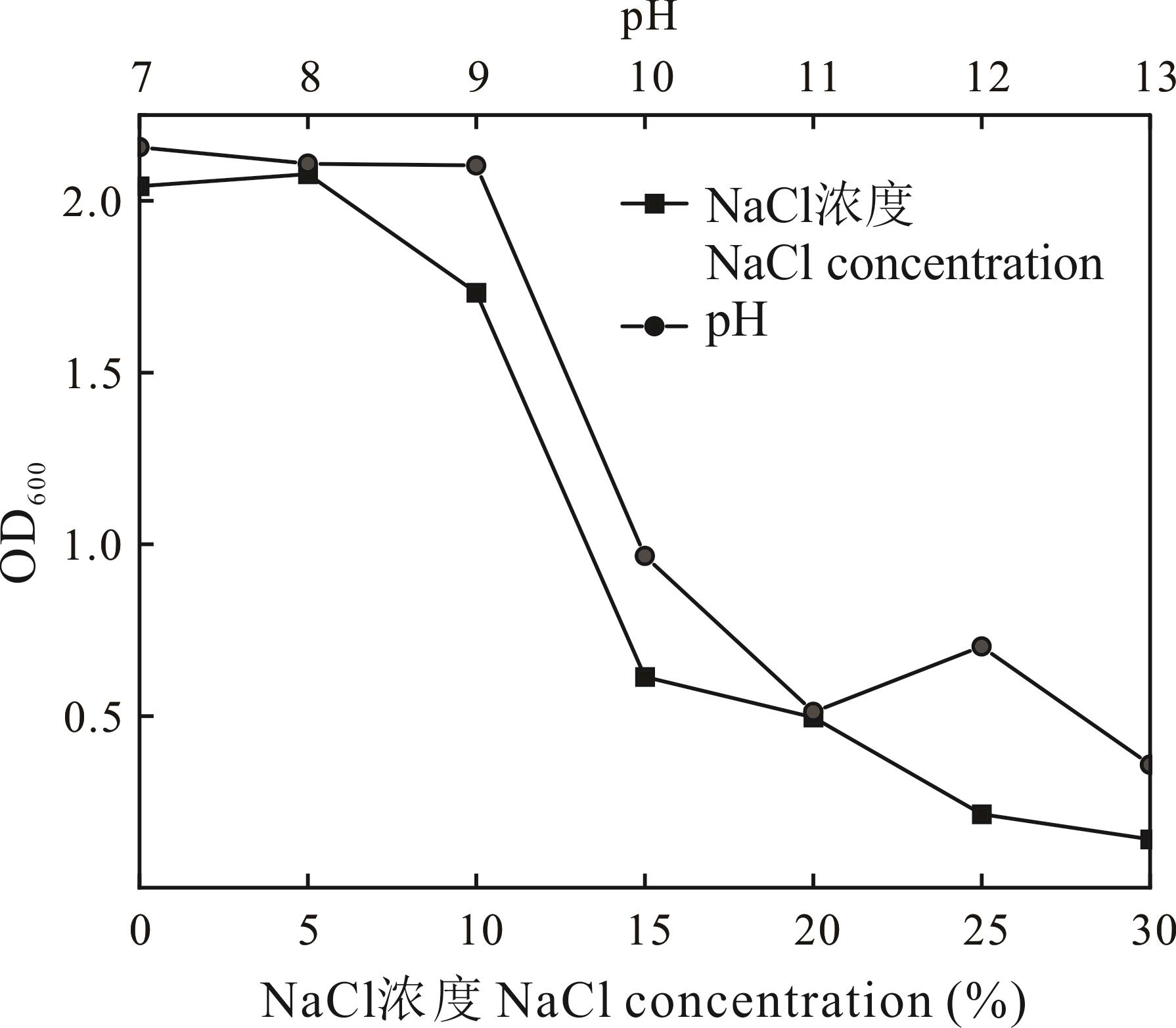
图5 Gnyt1菌株对不同NaCl浓度和碱性程度(pH)耐受性
Fig.5 The tolerance of the Gnyt1 strain to different NaCl concentrations and alkalinity levels (pH)
NaCl浓度 NaCl concentration (%) | 解磷、溶磷能力 Phosphate dissolving and solubilizing capacity (μg·mL-1) | 固氮酶活性 Nitrogenase activity (nmol·h-1·mL-1) | 吲哚乙酸 IAA (μg·mL-1) | |
|---|---|---|---|---|
| 有机磷 Organic P | 无机磷 Inorganic P | |||
| 0 | 32.70±0.88a | 246.63±4.82a | 123.85±2.15a | 39.98±1.05a |
| 5 | 33.25±0.82a | 250.37±4.65a | 125.62±2.08a | 40.56±0.98a |
| 10 | 26.18±0.75b | 195.78±4.21b | 98.47±1.92b | 32.15±0.91b |
| 15 | 10.15±0.62c | 76.45±3.56c | 38.26±1.57c | 12.37±0.78c |
| 20 | 7.86±0.55d | 59.28±3.12d | 29.83±1.32d | 9.64±0.65d |
| 25 | 4.22±0.48e | 31.85±2.67e | 13.57±1.08e | 4.32±0.52e |
| 30 | 2.15±0.36f | 18.56±2.15f | 7.42±0.85f | 2.26±0.41f |
表5 不同NaCl浓度中Gnyt1菌株促生特性测定结果
Table 5 Determination results of the growth characteristics of Gnyt1 strain at different NaCl concentrations
NaCl浓度 NaCl concentration (%) | 解磷、溶磷能力 Phosphate dissolving and solubilizing capacity (μg·mL-1) | 固氮酶活性 Nitrogenase activity (nmol·h-1·mL-1) | 吲哚乙酸 IAA (μg·mL-1) | |
|---|---|---|---|---|
| 有机磷 Organic P | 无机磷 Inorganic P | |||
| 0 | 32.70±0.88a | 246.63±4.82a | 123.85±2.15a | 39.98±1.05a |
| 5 | 33.25±0.82a | 250.37±4.65a | 125.62±2.08a | 40.56±0.98a |
| 10 | 26.18±0.75b | 195.78±4.21b | 98.47±1.92b | 32.15±0.91b |
| 15 | 10.15±0.62c | 76.45±3.56c | 38.26±1.57c | 12.37±0.78c |
| 20 | 7.86±0.55d | 59.28±3.12d | 29.83±1.32d | 9.64±0.65d |
| 25 | 4.22±0.48e | 31.85±2.67e | 13.57±1.08e | 4.32±0.52e |
| 30 | 2.15±0.36f | 18.56±2.15f | 7.42±0.85f | 2.26±0.41f |
| pH | 解磷、溶磷能力 Phosphate dissolving and solubilizing capacity (μg·mL-1) | 固氮酶活性 Nitrogenase activity (nmol·h-1·mL-1) | 吲哚乙酸 IAA (μg·mL-1) | |
|---|---|---|---|---|
| 有机磷 Organic P | 无机磷 Inorganic P | |||
| 7 | 32.70±0.88a | 285.63±5.36a | 123.85±2.12a | 40.18±1.02a |
| 8 | 31.25±0.78ab | 276.89±4.98a | 118.67±2.05a | 38.56±0.95ab |
| 9 | 28.64±0.72b | 252.47±4.52b | 105.32±1.89b | 34.27±0.88b |
| 10 | 18.42±0.56c | 156.39±3.87c | 62.58±1.56c | 21.35±0.76c |
| 11 | 10.26±0.52d | 98.76±3.21d | 38.45±1.23d | 12.68±0.63d |
| 12 | 12.83±0.58d | 112.58±3.45d | 45.79±1.31d | 15.42±0.69d |
| 13 | 6.57±0.45e | 65.42±2.76e | 22.63±1.05e | 8.79±0.55e |
表6 不同pH中Gnyt1菌株促生特性测定结果
Table 6 Determination results of the growth-promoting characteristics of Gnyt1 strain in different pH values
| pH | 解磷、溶磷能力 Phosphate dissolving and solubilizing capacity (μg·mL-1) | 固氮酶活性 Nitrogenase activity (nmol·h-1·mL-1) | 吲哚乙酸 IAA (μg·mL-1) | |
|---|---|---|---|---|
| 有机磷 Organic P | 无机磷 Inorganic P | |||
| 7 | 32.70±0.88a | 285.63±5.36a | 123.85±2.12a | 40.18±1.02a |
| 8 | 31.25±0.78ab | 276.89±4.98a | 118.67±2.05a | 38.56±0.95ab |
| 9 | 28.64±0.72b | 252.47±4.52b | 105.32±1.89b | 34.27±0.88b |
| 10 | 18.42±0.56c | 156.39±3.87c | 62.58±1.56c | 21.35±0.76c |
| 11 | 10.26±0.52d | 98.76±3.21d | 38.45±1.23d | 12.68±0.63d |
| 12 | 12.83±0.58d | 112.58±3.45d | 45.79±1.31d | 15.42±0.69d |
| 13 | 6.57±0.45e | 65.42±2.76e | 22.63±1.05e | 8.79±0.55e |
| [1] | Wang Z L, Yao T, Li M Y, et al. Isolation, screening, and characterization of dominant plant growth-promoting rhizobacterial species in Zoige alpine grassland. Pratacultural Science, 2023, 40(2): 319-328. |
| 王振龙, 姚拓, 李明源, 等. 若尔盖高寒草地优势牧草植物根际促生菌的筛选及特性. 草业科学, 2023, 40(2): 319-328. | |
| [2] | Ma Y, Oliveira R S, Freitas H, et al. Biochemical and molecular mechanisms of plant-microbe-metal interactions: Relevance for phytoremediation. Frontiers in Plant Science, 2016, 7: 918. |
| [3] | Zhou Y L. Development and fertilizer efficiency evaluation of growth promoting and disease resistant microbial agents in Camellia oleifera rhizosphere soil. Changsha: Central South University, 2025. |
| 周易龙. 油茶根际土壤促生抗病微生物菌剂研制及其肥效评价. 长沙: 中南林业科技大学, 2025. | |
| [4] | Li J, Peng Q C, Zhang Z P, et al. Isolation and identification of a strain of Bacillus tropicus and study of its probiotic effect. Soil and Fertilizer Sciences in China, 2024(2): 193-200. |
| 李俊, 彭启超, 张志鹏, 等. 一株热带芽孢杆菌的分离鉴定及促生作用研究. 中国土壤与肥料, 2024(2): 193-200. | |
| [5] | Song Z H, Tian P. A review of soil microorganism functions in soil improvement and remediation. Pratacultural Science, 2024, 41(11): 2622-2636. |
| 宋泽海, 田沛. 土壤微生物在土壤改良与修复中的作用概述. 草业科学, 2024, 41(11): 2622-2636. | |
| [6] | Wen Y X, Zhao B, Luo Q Y, et al. Distribution and ecological role in close-to-nature restoration of arbuscular mycorrhizal fungi in Tibetan Plateau alpine grassland. Mycosystema, 2021, 40(10): 2562-2578. |
| 温杨雪, 赵博, 罗巧玉, 等. 青藏高原高寒草地AM真菌分布及其对近自然恢复的生态作用. 菌物学报, 2021, 40(10): 2562-2578. | |
| [7] | Li S X, Yao T, Chai J L, et al. Effects of the addition of compound microbial agent on the physicochemical properties of soil in degraded alpine meadow. Grassland and Turf, 2025, 46(1): 1-13. |
| 李双雄, 姚拓, 柴加丽, 等. 复合微生物菌剂添加对退化高寒草甸土壤理化特性影响. 草原与草坪, 2025, 46 (1): 1-13. | |
| [8] | Ma K, An Y H, Wu H J, et al. Isolation and identification of a dominant lactic acid bacteria strain CGMCC 10624 from a traditional steamed buns Jiaozi. Journal of Food Safety and Quality, 2016, 7(9): 3720-3725. |
| 马凯, 安云鹤, 武会娟, 等. 传统馒头发酵酵子中一株优势乳酸菌CGMCC 10624的分离与鉴定. 食品安全质量检测学报, 2016, 7(9): 3720-3725. | |
| [9] | Tie X L, Zhang Y, Ma L X, et al. Study on the functional diversity of PGPR strains in oat rhizosphere in Sanjiangyuan Region. Acta Agrestia Sinica, 2024, 32(3): 693-702. |
| 铁晓龙, 张英, 马林雄, 等. 三江源区燕麦根际PGPR菌株功能多样性研究. 草地学报, 2024, 32(3): 693-702. | |
| [10] | Gan Y N. Screening of PGPR strains of typical legumes on alpine grassland and construction of synthetic bacteria. Lanzhou: Lanzhou University, 2023. |
| 甘雅楠. 高寒草地典型豆科植物PGPR菌株筛选及合成菌群的构建. 兰州: 兰州大学, 2023. | |
| [11] | Xie X Y, Liao K M, Hua X J, et al. The antagonistic effect of Bacillus velezensis Y-2-3 on Colletotrichum musae and its efficacy in preventing banana anthracnose disease. Journal of Agricultural Biotechnology, 2025, 33(11): 2460-2471. |
| 谢晓莹, 廖克妙, 花晓婕, 等. 贝莱斯芽胞杆菌Y-2-3对芭蕉炭疽菌的拮抗作用及其对香蕉炭疽病的防效. 农业生物技术学报, 2025, 33(11): 2460-2471. | |
| [12] | Li J H. The characteristics of a fine plant growth-promoting rhizobacteria Bacillus mycoides Gnytl and its whole genome sequencing analysis. Lanzhou: Gansu Agricultural University, 2017. |
| 李建宏. 优良植物根际促生菌Bacillus mycoides Gnyt1特性研究及全基因组测序分析. 兰州: 甘肃农业大学, 2017. | |
| [13] | Li J H, Li X P, Li C N, et al. Characterization of a plant-growth-promoting rhizosphere bacterium, Gnytl, and determination of its taxonomic status. Acta Prataculturae Sinica, 2019, 28(5): 55-67. |
| 李建宏, 李雪萍, 李昌宁, 等. 一株植物根际促生菌Gnyt1的特性研究及分类地位的确定. 草业学报, 2019, 28(5): 55-67. | |
| [14] | Yang X M. Comparative genome and functional gene of plant growth promoting rhizobacteria (Bacillus mycoides Gnytl) isolated from Polygonum viviparum. Lanzhou: Gansu Agricultural University, 2020. |
| 杨晓玫. 珠芽蓼根际促生菌Bacillus mycoides Gnyt1比较基因组及其功能基因研究. 兰州: 甘肃农业大学, 2020. | |
| [15] | Liu T. Evaluating and identifying of plant growth promoting rhizobacteria of dominant alpine meadows. Lanzhou: Gansu Agricultural University, 2016. |
| 刘婷. 高寒草甸优势植物根际促生菌资源评价及菌种鉴定. 兰州: 甘肃农业大学, 2016. | |
| [16] | Wang L F, Lou Y, Gu J P, et al. High-throughput sequencing was used to study the effect of metolimidazole on the intestinal microbiota of chimpanzees. Heilongjiang Animal Science and Veterinary Medicine, 2020(4): 129-132, 53-54. |
| 汪丽芬, 楼毅, 顾江萍, 等. 高通量测序研究甲苯咪唑对黑猩猩肠道菌群的影响. 黑龙江畜牧兽医, 2020(4): 129-132, 53-54. | |
| [17] | Bat-amgalan B. Analysis of microbial diversity and study on probiotics of cheege in Mongolia. Hohhot: Inner Mongolia Agricultural University, 2024. |
| Bat-amgalan B. 蒙古国策格微生物多样性分析及其益生菌研究. 呼和浩特: 内蒙古农业大学, 2024. | |
| [18] | Bai Y B, Xu M C, Jiao Y F, et al. Exploration of methods for identification of Enterococcus. Disease Surveillance, 2021, 36(5): 462-467. |
| 白一波, 徐明超, 焦一帆, 等. 肠球菌菌种鉴定方法的探索. 疾病监测, 2021, 36(5): 462-467. | |
| [19] | Daniela T, Santiago R, Melissa O, et al. Genome sequence of Bradyrhizobium japonicum E109, One of the most agronomically used nitrogen-fixing rhizobacteria in Argentina. Genome Announcements, 2015, 3(1): e01566-14. |
| [20] | Cortimiglia C, Real J A D, Daza M V B, et al. Evaluating the genome-based average nucleotide identity calculation for identification of twelve yeast species. Journal of Fungi, 2024, 10(9): 646. |
| [21] | Li S, Wang X R, Zhang W, et al. Genome-based reassessment of Sphingobacterium reveals the limitation of the fixed dDDH threshold for prokaryotic species delineation. Current Research in Microbial Sciences, 2026, 10: 100524. |
| [22] | Ma M C, Jiang X, Wang P H, et al. Rapid identification for Bradyrhizobium japonicum 5873 by PCR and its evaluation in application. Scientia Agricultura Sinica, 2023, 56(14): 2751-2760. |
| 马鸣超, 姜昕, 王鹏辉, 等. 大豆根瘤菌菌株5873 PCR快速检测方法的建立及应用效果评价. 中国农业科学, 2023, 56(14): 2751-2760. | |
| [23] | Rodriguez L L, Lopez M G, Alejo D H, et al. Rapid identification of enteric bacteria from whole genome sequences using average nucleotide identity metrics. Frontiers in Microbiology, 2023, 14: 1225207. |
| [24] | Zhu B, Wu J Q, Chen L, et al. Isolation, characterization, genomic analysis, and food application of virulent bacteriophage vB_VpaP_FR4 infecting Vibrio parahaemolyticus. Food Science, 2025, 46(21): 115-125. |
| 朱斌, 伍君权, 陈玲, 等. 副溶血性弧菌烈性噬菌体vB_VpaP_FR4的分离表征、基因组分析及在食品中的应用. 食品科学, 2025, 46(21): 115-125. | |
| [25] | Zhao X Y. The diversity of bacteria in Karst Caves in Libo and the identification and a preliminary study of two new bacteria species, Guiyang: Guizhou Normal University, 2021. |
| 赵小永. 荔波喀斯特洞穴细菌多样性及两株细菌的新种鉴定和性质初探. 贵阳: 贵州师范大学, 2021. | |
| [26] | Han F. Isolation and identification of lactic acid bacteria from breast milk and polyphasic taxonomy of new species of Streptococcus. Hohhot: Inner Mongolia Agricultural University, 2022. |
| 韩菲. 母乳中乳酸菌的分离鉴定及链球菌属新种的多相分类学研究. 呼和浩特: 内蒙古农业大学, 2022. | |
| [27] | Li Y Q. Polyphasic identification of 7 novel species of lactic acid bacteria and reclassification of Enterococcus xinjiangensis. Harbin: Northeast Agricultural University, 2021. |
| 李玉琴. 7个乳酸菌新种的多相鉴定和新疆肠球菌(Enterococcus xinjiangensis)的重新分类. 哈尔滨: 东北农业大学, 2021. | |
| [28] | Cao Y L, Tang S M, Zhang T, et al. De novo sequencing and genomics analysis of a rare marine fungus Stachybotrys longispora FG216. Microbiology China, 2021, 48(10): 3457-3471. |
| 曹玉陵, 唐思敏, 张添, 等. 一株稀有海洋真菌Stachybotrys longispora FG216的De Novo测序及基因组学分析. 微生物学通报, 2021, 48(10): 3457-3471. | |
| [29] | Xiang X, Yin H X, Fan J K, et al. Polyphasic identificationand genome mining of secondary metabolites of anovel species Streptomyces haixigobicum sp. nov.Qhu-G9 isolated from the Gobi habitat of the Qinghai-Tibetan Plateau. Microbiology China, 2023, 50(5): 1872-1886. |
| 向信, 殷恒霞, 樊嘉凯, 等. 青藏高原戈壁生境中一株链霉菌新种Streptomyces haixigobicum sp.nov.Qhu-G9的多相分类学鉴定及其次级代谢产物的基因组挖掘. 微生物学通报, 2023, 50(5): 1872-1886. | |
| [30] | Sun J Y, Xu Z R. Study on isolation and identification of Bacillus strain BC-lO and its application. Acta Agriculturae Zhejiangensis, 1999(1): 48-51. |
| 孙建义, 许梓荣. 芽孢杆菌的分离、鉴定及应用研究. 浙江农业学报, 1999(1): 48-51. | |
| [31] | Li X P, Li J H, Li M Q, et al. Screening and functional properties of cholesterol-degrading lactic acid bacteria from Jiangshui. Acta Microbiologica Sinica, 2015, 55(8): 1001-1009. |
| [32] | Bai J, Yao T, Wang Z J, et al. Isolation and identification as well as growth enhancement and saline-alkali tolerance properties of Cerasus humilis plant growth-promoting endophytes. Agricultural Research in the Arid Areas, 2022, 40(1): 132-138. |
| 白洁, 姚拓, 王占军, 等. 欧李内生促生菌分离、鉴定及促生、耐盐碱特性. 干旱地区农业研究, 2022, 40(1): 132-138. | |
| [33] | Yao T, Long R J, Wang G, et al. Isolation and characteristics of associative symbiotic nitrogen bacteria from rhizosphere of wheat in saline soil in Lanzhou area. Acta Pedologica Sinica, 2004(3): 444-448. |
| 姚拓, 龙瑞军, 王刚, 等. 兰州地区盐碱地小麦根际联合固氮菌分离及部分特性研究. 土壤学报, 2004(3): 444-448. | |
| [34] | Zhang Y C, Yao T. Study on the abilities of phosphorus solubilizing and indoleacetic acid secretion of phosphorus solubilizing bacteria. Grassland and Turf, 2020, 40(2): 17-22. |
| 张银翠, 姚拓. 溶磷细菌的溶磷及分泌吲哚乙酸能力研究. 草原与草坪, 2020, 40(2): 17-22. | |
| [35] | Zi Z D. Isolation of bacteria from tea garden soil, synthetic flora effects on tea seedling growth and polyphasic taxonomy of one novel Microvirga species. Beijing: Beijing University of Chemical Technology, 2022. |
| 资志达. 茶园土壤细菌分离与合成菌群对茶苗生长影响及一株Microvirga属新种细菌多相分类学研究. 北京: 北京化工大学, 2022. | |
| [36] | Li C N, Li Z X, Cao Q X, et al. Effects of 5 plant growth-promoting rhizobacteria on the growth and quality of Medicago sativa. Grassland and Turf, 2018, 38(3): 29-34. |
| 李昌宁, 李政璇, 曹全熙, 等. 5株植物根际促生菌对紫花苜蓿生长和品质的影响. 草原与草坪, 2018, 38(3): 29-34. |
| [1] | 李建宏, 李雪萍, 李昌宁, 韩冰, 徐万里, 姚拓. 一株植物根际促生菌Gnyt1的特性研究及分类地位的确定[J]. 草业学报, 2019, 28(5): 55-67. |
| 阅读次数 | ||||||
|
全文 |
|
|||||
|
摘要 |
|
|||||
