
ISSN 1004-5759 CN 62-1105/S
Acta Prataculturae Sinica ›› 2025, Vol. 34 ›› Issue (12): 33-49.DOI: 10.11686/cyxb2025004
Previous Articles Next Articles
Yang CHENG( ), Chang-qing JING()
Received:2025-01-07
Revised:2025-03-04
Online:2025-12-20
Published:2025-10-20
Contact:
Chang-qing JING
Yang CHENG, Chang-qing JING. Carbon and water fluxes of different grassland types in the growing season based on the Common Land Model[J]. Acta Prataculturae Sinica, 2025, 34(12): 33-49.
变量类型 Variable type | 变量Variable | 物理意义 Physical meaning | 单位 Unit |
|---|---|---|---|
输入 变量 Input variable | SW | 太阳短波辐射Solar shortwave radiation | W·m-2 |
| LW | 大气长波辐射Atmospheric long wave radiation | W·m-2 | |
| TA | 气温Air temperature | K | |
| RH | 比湿Specific humidity | kg·kg-1 | |
| PR | 降水速率Precipitation rate | mm·s-1 | |
| US | U风速U-wind | m·s-1 | |
| VS | V风速V-wind | m·s-1 | |
| PA | 大气压Atmospheric pressure | hPa | |
| LAI | 叶面积指数Leaf area index | m2·m-2 | |
输出 变量 Output variable | H | 感热通量Sensible heat flux | W·m-2 |
| LE | 潜热通量Latent heat flux | W·m-2 | |
| Fevpa | 蒸散发速率Evapotranspiration rate | mm·s-1 | |
| assim | 冠层同化速率Canopy assimilation rate | mol·m-2·s-1 | |
| respc | 总呼吸速率(植物+土壤) Total respiratory rate (Plant+soil) | mol·m-2·s-1 | |
| Etr | 植物蒸腾Plant transpiration | mm·s-1 | |
| Fg | 土壤蒸发Soil evaporation | mm·s-1 | |
| Wliq | 10层土壤水分含量Soil moisture content of 10 layer | kg·m-2 | |
| Tss | 10层土壤温度10 layer soil temperature | K |
Table 1 Input and output variables of the Common Land Model
变量类型 Variable type | 变量Variable | 物理意义 Physical meaning | 单位 Unit |
|---|---|---|---|
输入 变量 Input variable | SW | 太阳短波辐射Solar shortwave radiation | W·m-2 |
| LW | 大气长波辐射Atmospheric long wave radiation | W·m-2 | |
| TA | 气温Air temperature | K | |
| RH | 比湿Specific humidity | kg·kg-1 | |
| PR | 降水速率Precipitation rate | mm·s-1 | |
| US | U风速U-wind | m·s-1 | |
| VS | V风速V-wind | m·s-1 | |
| PA | 大气压Atmospheric pressure | hPa | |
| LAI | 叶面积指数Leaf area index | m2·m-2 | |
输出 变量 Output variable | H | 感热通量Sensible heat flux | W·m-2 |
| LE | 潜热通量Latent heat flux | W·m-2 | |
| Fevpa | 蒸散发速率Evapotranspiration rate | mm·s-1 | |
| assim | 冠层同化速率Canopy assimilation rate | mol·m-2·s-1 | |
| respc | 总呼吸速率(植物+土壤) Total respiratory rate (Plant+soil) | mol·m-2·s-1 | |
| Etr | 植物蒸腾Plant transpiration | mm·s-1 | |
| Fg | 土壤蒸发Soil evaporation | mm·s-1 | |
| Wliq | 10层土壤水分含量Soil moisture content of 10 layer | kg·m-2 | |
| Tss | 10层土壤温度10 layer soil temperature | K |

Fig.1 Site distribution, daily average temperature and daily precipitation
| 站点Site | 草地类型Grassland type | 数据时段Data period | 时间分辨率Time resolution (min) |
|---|---|---|---|
| 菊花台Juhatai (JHT) | 山地草甸 Mountain meadow | Apr.-Oct.2018 | 30 |
| 多伦Doron (DL) | 温性草原 Temperate grassland | Apr.-Oct.2008 | 30 |
| 阜康Fukan (FK) | 温性荒漠 Temperate desert | May.-Oct.2007 | 30 |
| 四子王旗Siziwang Banner (SW) | 荒漠草原 Desert steppe | Apr.-Oct.2013 | 30 |
Table 2 Basic information of vorticity flux data
| 站点Site | 草地类型Grassland type | 数据时段Data period | 时间分辨率Time resolution (min) |
|---|---|---|---|
| 菊花台Juhatai (JHT) | 山地草甸 Mountain meadow | Apr.-Oct.2018 | 30 |
| 多伦Doron (DL) | 温性草原 Temperate grassland | Apr.-Oct.2008 | 30 |
| 阜康Fukan (FK) | 温性荒漠 Temperate desert | May.-Oct.2007 | 30 |
| 四子王旗Siziwang Banner (SW) | 荒漠草原 Desert steppe | Apr.-Oct.2013 | 30 |
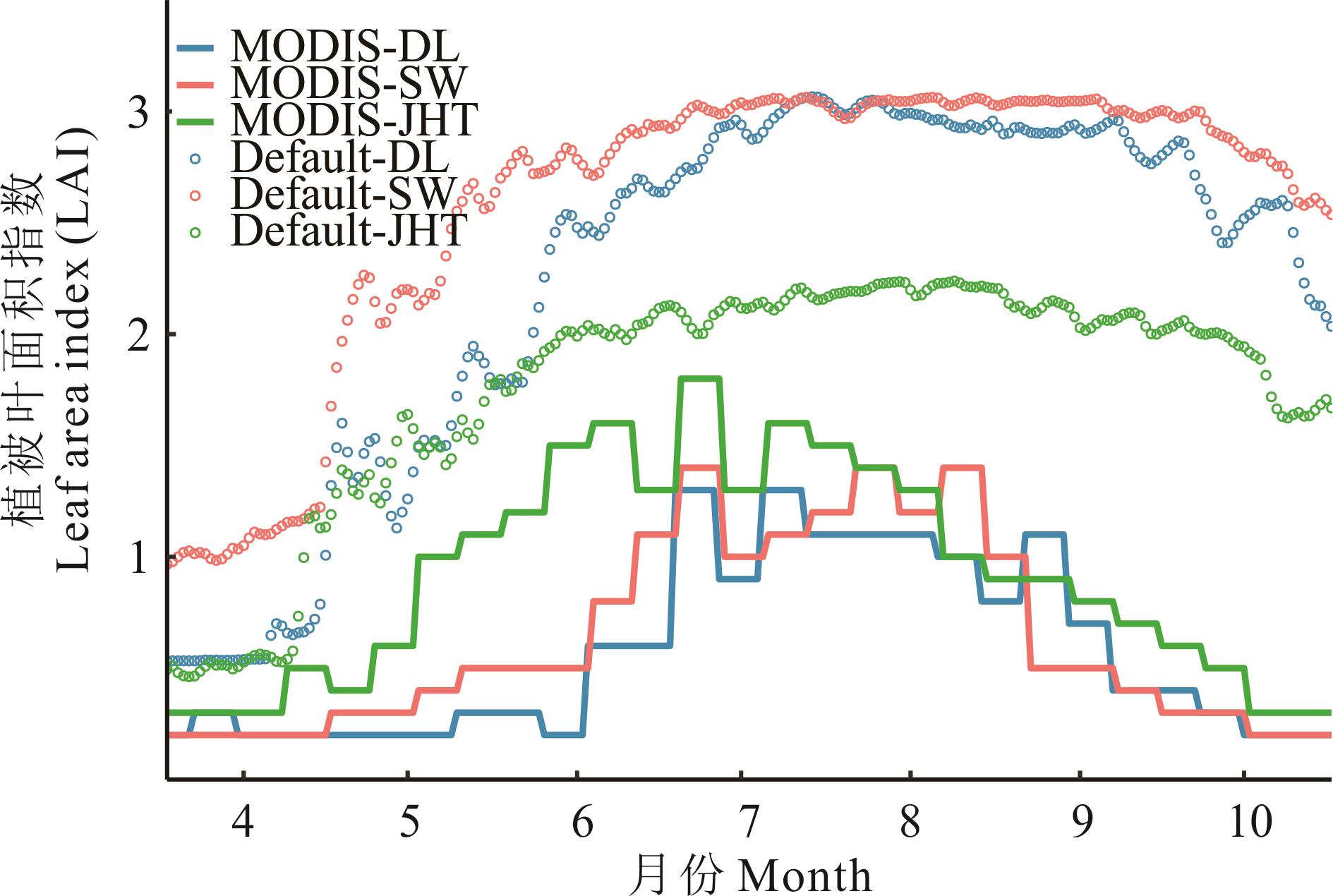
Fig.2 Model default LAI and MODIS LAI seasonal changes at each station

Fig.3 Station energy closure situation of different grassland types

Fig.4 Comparison between simulated and observed evapotranspiration of different grassland types by Common Land Model

Fig.5 Seasonal variation and monthly accumulation of simulated and observed evapotranspiration of different grassland types by Common Land Model

Fig.6 Daily variation trend of simulated and observed evapotranspiration of different grassland types by Common Land Model

Fig.7 Comparison of simulated and observed carbon fluxes in temperate steppe (DL), desert steppe (SW) and mountain meadow (JHT) by Common Land Model
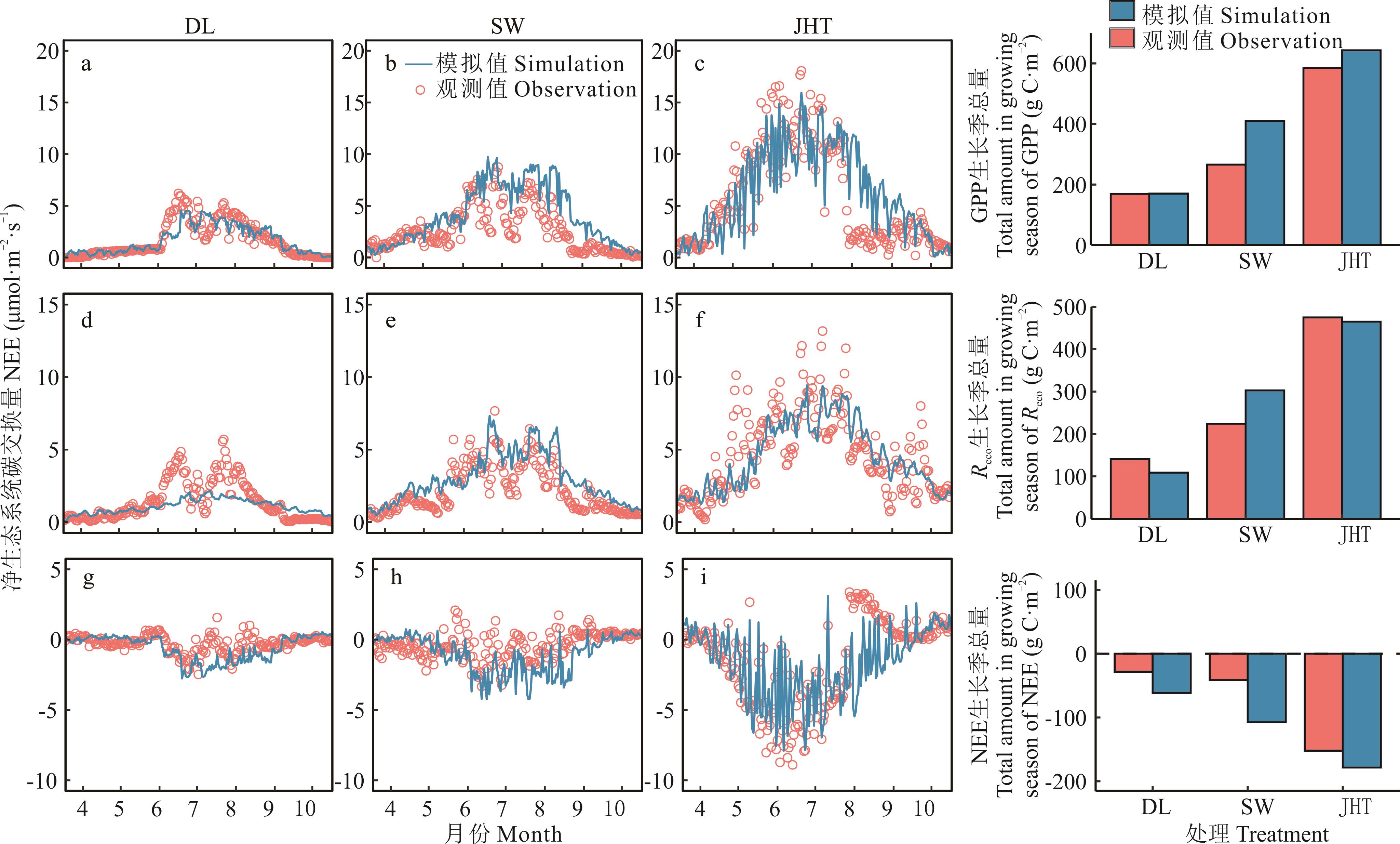
Fig.8 Growth season variation trend of simulated and observed carbon flux and total carbon in temperate steppe (DL), desert steppe (SW) and mountain meadow (JHT) by Common Land Model
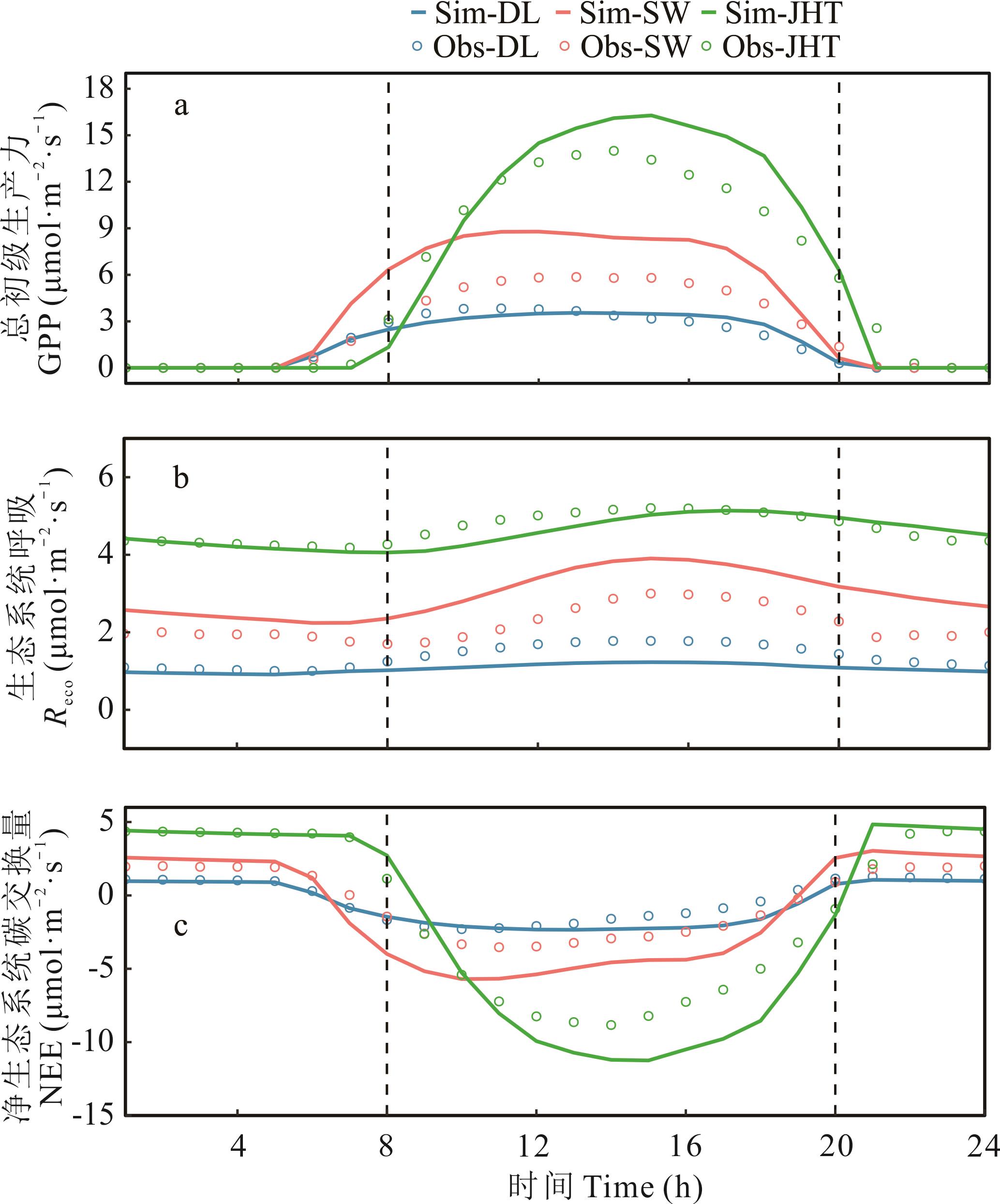
Fig.9 Daily variation trend of simulated and observed carbon flux values in temperate steppe (DL), desert steppe (SW) and mountain meadow (JHT) by Common Land Model
| 影响因子Influence factor | 变量名称Variable name | 单位Unit | 数据来源Data sources |
|---|---|---|---|
| H | 感热通量Sensible heat flux | W·m-2 | 涡度数据Vorticity data |
| LE | 潜热通量Latent heat flux | W·m-2 | 涡度数据Vorticity data |
| Etr | 植物蒸腾Plant transpiration | mm | CoLM模拟CoLM simulation |
| Fg | 土壤蒸发Soil evaporation | mm | CoLM模拟CoLM simulation |
| Rnet | 净辐射通量Net radiation flux | W·m-2 | 涡度数据Vorticity data |
| SWC (0~71 cm) | 土壤水分含量Soil moisture content (0-71 cm) | kg·m-3 | CoLM模拟CoLM simulation |
| Ts (0~71 cm) | 土壤温度Soil temperature (0-71 cm) | K | CoLM模拟CoLM simulation |
| Ta | 气温Air temperature | ℃ | 气象数据Meteorological data |
| Prec | 累计降水Accumulated precipitation | mm | 气象数据Meteorological data |
| LAI | 叶面积指数Leaf area index | - | MODIS数据MODIS data |
| RH | 空气湿度Air humidity | % | 涡度数据Vorticity data |
| VPD | 饱和水汽压差Vapor pressure deficit | kPa | 涡度数据Vorticity data |
Table 3 Environmental factors affecting carbon water flux
| 影响因子Influence factor | 变量名称Variable name | 单位Unit | 数据来源Data sources |
|---|---|---|---|
| H | 感热通量Sensible heat flux | W·m-2 | 涡度数据Vorticity data |
| LE | 潜热通量Latent heat flux | W·m-2 | 涡度数据Vorticity data |
| Etr | 植物蒸腾Plant transpiration | mm | CoLM模拟CoLM simulation |
| Fg | 土壤蒸发Soil evaporation | mm | CoLM模拟CoLM simulation |
| Rnet | 净辐射通量Net radiation flux | W·m-2 | 涡度数据Vorticity data |
| SWC (0~71 cm) | 土壤水分含量Soil moisture content (0-71 cm) | kg·m-3 | CoLM模拟CoLM simulation |
| Ts (0~71 cm) | 土壤温度Soil temperature (0-71 cm) | K | CoLM模拟CoLM simulation |
| Ta | 气温Air temperature | ℃ | 气象数据Meteorological data |
| Prec | 累计降水Accumulated precipitation | mm | 气象数据Meteorological data |
| LAI | 叶面积指数Leaf area index | - | MODIS数据MODIS data |
| RH | 空气湿度Air humidity | % | 涡度数据Vorticity data |
| VPD | 饱和水汽压差Vapor pressure deficit | kPa | 涡度数据Vorticity data |
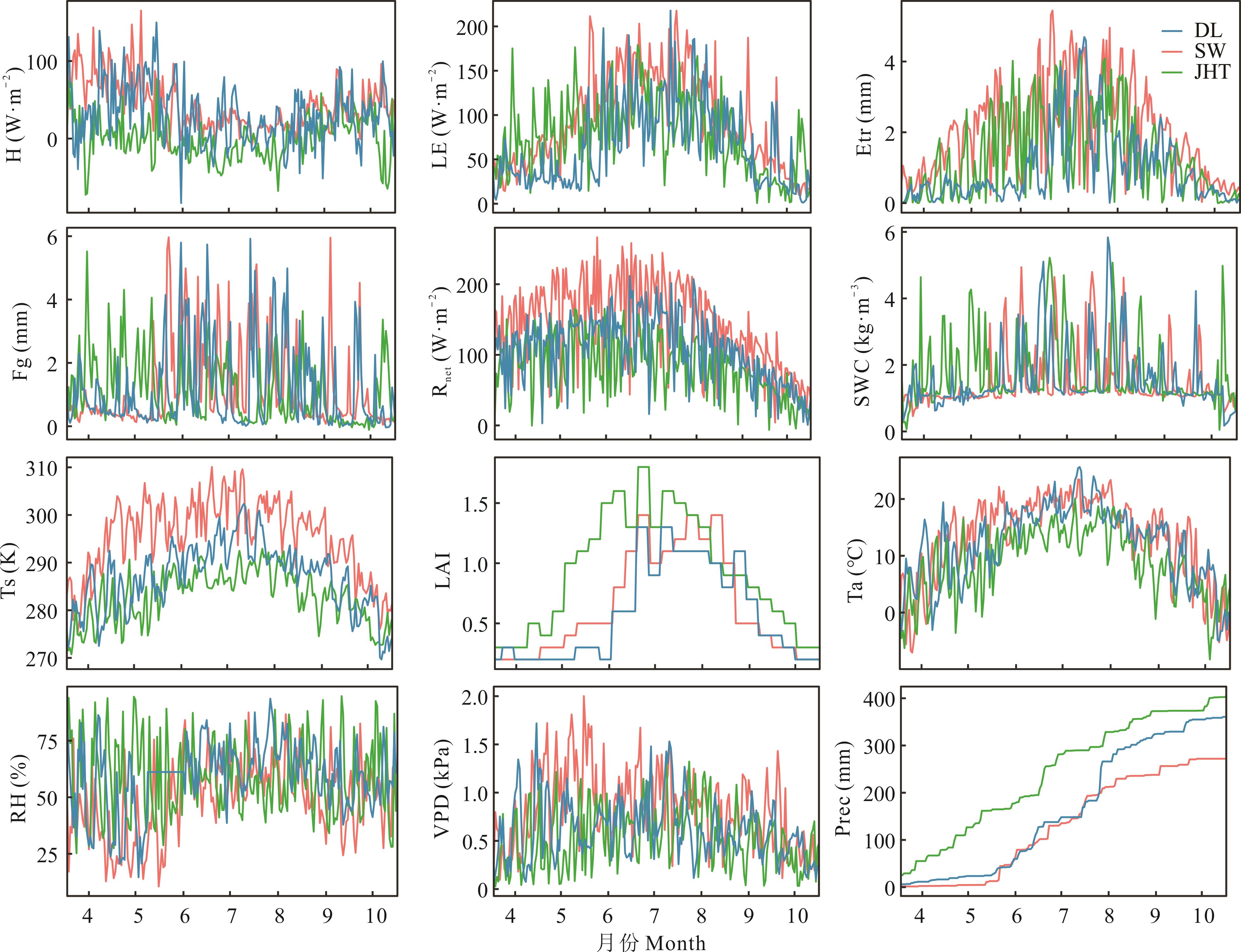
Fig.10 Simulate the trend of changes in environmental factors related to carbon and water flux during the growing season in temperate steppe (DL), desert steppe (SW) and mountain meadow (JHT)

Fig.11 The impact of various environmental factors on evapotranspiration, gross primary productivity, ecosystem respiration and net ecosystem exchange
通量站点 Flux site | 变量 Variable | 重要值Importance value | ||||
|---|---|---|---|---|---|---|
| 1 | 2 | 3 | 4 | 5 | ||
多伦站 Doron station (DL) | ET | Rnet(23.6)** | Fg(22.7)** | Etr(19.5)** | LE(19.0)** | Prec(16.8)** |
| GPP | LAI(30.0)** | Prec(21.6)** | Ta(15.0)** | Etr(14.3)** | Ts(12.2)** | |
| Reco | Ta(21.3)** | LAI(18.5)** | Prec(18.5)** | Ts(15.7)** | SWC(13.3)** | |
| NEE | Prec(20.3)** | Etr(17.5)** | LAI(16.1)** | Rnet(11.3)* | - | |
四子王旗站 Siziwang banner (SW) | ET | Prec(24.5)** | LE(21.8)** | Fg(21.5)** | Rnet(20.9)** | SWC(13.5)** |
| GPP | Prec(23.8)** | LAI(19.3)** | LE(17.1)** | Rnet(16.8)** | Fg(15.0)** | |
| Reco | Fg(19.5)** | LE(19.2)** | LAI(18.9)** | Ta(15.2)** | Ts(14.7)** | |
| NEE | Prec(23.9)** | Rnet(23.8)** | H(14.4)** | LE(13.8)** | Etr(11.8)** | |
菊花台站 Juhatai station (JHT) | ET | Rnet(28.5)** | Prec(27.4)** | Etr(22.3)** | LE(18.4)** | Ta(16.3)** |
| GPP | Prec(37.1)** | LAI(33.9)** | Rnet(18.3)** | Ta(13.4)** | Etr(12.9)** | |
| Reco | LAI(28.3)** | Prec(18.3)** | Ts(16.8)** | Ta(14.8)** | SWC(9.7)** | |
| NEE | Prec(46.6)** | LAI(22.8)** | Rnet(19.2)** | Etr(14.5)** | LE(11.7)* | |
Table 4 The impact of environmental factors on carbon and water fluxes in different types of grasslands (%)
通量站点 Flux site | 变量 Variable | 重要值Importance value | ||||
|---|---|---|---|---|---|---|
| 1 | 2 | 3 | 4 | 5 | ||
多伦站 Doron station (DL) | ET | Rnet(23.6)** | Fg(22.7)** | Etr(19.5)** | LE(19.0)** | Prec(16.8)** |
| GPP | LAI(30.0)** | Prec(21.6)** | Ta(15.0)** | Etr(14.3)** | Ts(12.2)** | |
| Reco | Ta(21.3)** | LAI(18.5)** | Prec(18.5)** | Ts(15.7)** | SWC(13.3)** | |
| NEE | Prec(20.3)** | Etr(17.5)** | LAI(16.1)** | Rnet(11.3)* | - | |
四子王旗站 Siziwang banner (SW) | ET | Prec(24.5)** | LE(21.8)** | Fg(21.5)** | Rnet(20.9)** | SWC(13.5)** |
| GPP | Prec(23.8)** | LAI(19.3)** | LE(17.1)** | Rnet(16.8)** | Fg(15.0)** | |
| Reco | Fg(19.5)** | LE(19.2)** | LAI(18.9)** | Ta(15.2)** | Ts(14.7)** | |
| NEE | Prec(23.9)** | Rnet(23.8)** | H(14.4)** | LE(13.8)** | Etr(11.8)** | |
菊花台站 Juhatai station (JHT) | ET | Rnet(28.5)** | Prec(27.4)** | Etr(22.3)** | LE(18.4)** | Ta(16.3)** |
| GPP | Prec(37.1)** | LAI(33.9)** | Rnet(18.3)** | Ta(13.4)** | Etr(12.9)** | |
| Reco | LAI(28.3)** | Prec(18.3)** | Ts(16.8)** | Ta(14.8)** | SWC(9.7)** | |
| NEE | Prec(46.6)** | LAI(22.8)** | Rnet(19.2)** | Etr(14.5)** | LE(11.7)* | |
| [1] | You C H, Wang Y B, Chen S P. A dataset of carbon and water fluxes of the typical grasslands in Duolun County, Inner Mongolia during 2006-2015. China Scientific Data, 2023, 8(2): 99-109. |
| 游翠海, 王彦兵, 陈世苹. 2006-2015年内蒙古多伦典型草原碳水通量观测数据集. 中国科学数据, 2023, 8(2): 99-109. | |
| [2] | Bai Y F, Han X G, Wu J G, et al. Ecosystem stability and compensatory effects in the Inner Mongolia grassland. Nature, 2004, 431(7005): 181-184. |
| [3] | Xi Z H, Wang Y Y, Ma Y M, et al. Characteristics of carbon and water fluxes over the alpine shrub steppe ecosystem during growing season on the northern slope of Qomolangma region. Plateau Meteorology, 2023, 42(4): 887-898. |
| 席振华, 王玉阳, 马耀明, 等. 珠峰北坡高寒灌丛草原生长季碳、水通量特征分析. 高原气象, 2023, 42(4): 887-898. | |
| [4] | Anav A, Friedlingstein P, Beer C, et al. Spatiotemporal patterns of terrestrial gross primary production: A review. Reviews of Geophysics, 2015, 53(3): 785-818. |
| [5] | Chen S P, Lin G H, Huang J H, et al. Dependence of carbon sequestration on the differential responses of ecosystem photosynthesis and respiration to rain pulses in a semiarid steppe. Global Change Biology, 2009, 15(10): 2450-2461. |
| [6] | Zhang B W, Tan X R, Wang S S, et al. Asymmetric sensitivity of ecosystem carbon and water processes in response to precipitation change in a semi-arid steppe. Functional Ecology, 2017, 31(6): 1301-1311. |
| [7] | Wang L, Liu H Z, Shao Y P, et al. Water and CO2 fluxes over semiarid alpine steppe and humid alpine meadow ecosystems on the Tibetan Plateau. Theoretical and Applied Climatology, 2018, 131(1): 547-556. |
| [8] | Chen S P, Chen J Q, Lin G H, et al. Energy balance and partition in Inner Mongolia steppe ecosystems with different land use types. Agricultural and Forest Meteorology, 2009, 149(11): 1800-1809. |
| [9] | Chaves M M, Flexas J, Pinheiro C. Photosynthesis under drought and salt stress: Regulation mechanisms from whole plant to cell. Annals of Botany, 2009, 103(4): 551-560. |
| [10] | Guo W Z, Jing C Q, Deng X J, et al. Variations in carbon flux and factors influencing it on the northern slopes of the Tianshan Mountains. Acta Prataculturae Sinica, 2022, 31(5): 1-12. |
| 郭文章, 井长青, 邓小进, 等. 新疆天山北坡荒漠草原碳通量特征及其对环境因子的响应. 草业学报, 2022, 31(5): 1-12. | |
| [11] | Xu S X, Jing C Q, Gao S H, et al. Evaluation of the applicability of remote sensing GPP models in four typical ecosystems in the arid zone of Central Asia. Acta Ecologica Sinica, 2022, 42(23): 9689-9700. |
| 许世贤, 井长青, 高胜寒, 等. 遥感GPP模型在中亚干旱区4个典型生态系统的适用性评价. 生态学报, 2022, 42(23): 9689-9700. | |
| [12] | Wang S J, Zhou S J, Fang C L. Spatial-temporal patterns and evolution of carbon storage in China’ s terrestrial ecosystems from 1980 to 2020. Scientia Sinica Terrae, 2024, 54(10): 3323-3339. |
| 王少剑, 周诗洁, 方创琳. 1980-2020年中国陆地生态系统碳储量时空格局与演进规律. 中国科学: 地球科学, 2024, 54(10): 3323-3339. | |
| [13] | Dai Y J, Dickinson R E, Wang Y P. A two-big-leaf model for canopy temperature, photosynthesis, and stomatal conductance. Journal of Climate, 2004, 17(12): 2281-2299. |
| [14] | Dai Y J, Zeng X B, Dickinson R E, et al. The Common Land Model. Bulletin of the American Meteorological Society, 2003, 84(8): 1013-1023. |
| [15] | Guo Q, Liu S F, Yuan H, et al. Evaluating energy fluxes of the common land model based on FLUXNET dataset. Climatic and Environmental Research, 2022, 27(6): 688-706. |
| 郭琦, 刘少锋, 袁华, 等. 基于FLUXNET数据集对陆面模式CoLM能量通量的单点评估. 气候与环境研究, 2022, 27(6): 688-706. | |
| [16] | Jing C Q, An S Z. Numerical simulation of land surface processes in arid desert grassland ecosystems in Central Asia by CoLM land surface model. Acta Prataculturae Sinica, 2017, 26(3): 13-21. |
| 井长青, 安沙舟. CoLM陆面模式对中亚干旱荒漠草地生态系统陆面过程的数值模拟. 草业学报, 2017, 26(3): 13-21. | |
| [17] | Jiang H N, Xu J H. Soil moisture simulation and error analysis in arid area of China based on CoLM model. Acta Agrestia Sinica, 2018, 26(1): 244-248. |
| 江红南, 许剑辉. 基于CoLM模式的干旱区土壤湿度模拟试验与误差分析. 草地学报, 2018, 26(1): 244-248. | |
| [18] | Li Y Z, Li L H, Dong J Q, et al. Process refinement contributed more than parameter optimization to improve the CoLM’s performance in simulating the carbon and water fluxes in a grassland. Agricultural and Forest Meteorology, 2020, 291(1923): 108067. |
| [19] | Shao Y Q, Yuan X L, Jing C Q, et al. A better simulation of water and carbon fluxes in a typical desert grassland ecosystem through the Common Land Model. Journal of Hydrology, 2024, 644(1694): 132111. |
| [20] | Zhang K Y, Liu D F, Liu H,et al. Soil respiration characteristics and influencing factors of shrub ecosystem on the Loess Plateau. Pearl River, 2022, 43(4): 83-94. |
| 张奎月, 刘登峰, 刘慧, 等. 黄土高原灌丛生态系统土壤呼吸特征及其影响因素. 人民珠江, 2022, 43(4): 83-94. | |
| [21] | Li J D, Duan Q Y, Dai Y J, et al. A study of the most sensitive parameters for simulating soil temperature and moisture of CoLM. Chinese Journal of Atmospheric Sciences, 2013, 37(4): 841-851. |
| 李剑铎, 段青云, 戴永久, 等. CoLM模拟土壤温度和湿度最敏感参数的研究. 大气科学, 2013, 37(4): 841-851. | |
| [22] | Xin Y F, Bian L G, Zhang X H. The application of CoLM to arid region of north west China and Qinghai-Xizang Plateau. Plateau Meteorology, 2006(4): 567-574. |
| 辛羽飞, 卞林根, 张雪红. CoLM模式在西北干旱区和青藏高原区的适用性研究. 高原气象, 2006(4): 567-574. | |
| [23] | Liu R, Wang Q X, Tang L S, et al. Seasonal variation in water, heat and CO2 fluxes and its driving forces over a saline desert. Acta Ecologica Sinica, 2009, 29(1): 67-75. |
| 刘冉, 王勤学, 唐立松, 等. 盐生荒漠地表水热与二氧化碳通量的季节变化及驱动因素. 生态学报, 2009, 29(1): 67-75. | |
| [24] | Reichstein M, Falge E, Baldocchi D, et al. On the separation of net ecosystem exchange into assimilation and ecosystem respiration: Review and improved algorithm. Global Change Biology, 2005, 11(9): 1424-1439. |
| [25] | Zhang L M, Yu G R, Sun X M, et al. Seasonal variations of ecosystem apparent quantum yield(a) and maximum photosynthesis rate(Pmax) of different forest ecosystems in China. Agricultural and Forest Meteorology, 2006, 137(3/4): 176-187. |
| [26] | Yu G R, Wen X F, Li Q K, et al. Seasonal patterns and environmental control of ecosystem respiration in subtropical and temperate forests in China. Science in China (Series D: Earth Sciences), 2005, 48(S1): 93-105. |
| [27] | Lloyd J, Taylor J A. On the temperature dependence of soil respiration. Functional Ecology, 1994, 8(3): 315. |
| [28] | Zheng Z, Wang G. Modeling the dynamic root water uptake and its hydrological impactat the Reserva Jaru site in Amazonia. Journal of Geophysical Research-Biogeosciences, 2007, 112(G4): 8512-8518. |
| [29] | Darenova E, Pavelka M, Acosta M. Diurnal deviations in the relationship between CO2 efflux and temperature: A case study. Catena, 2014, 123(123): 263-269. |
| [30] | Juszczak R, Acosta M, Olejnik J. Comparison of daytime and night time ecosystem respiration measured by the closed chamber technique on a temperate mire in poland. Polish Journal of Environmental Studies, 2012, 21(3): 643-658. |
| [31] | Hashimoto S, Carvalhais N, Ito A, et al. Global spatiotemporal distribution of soil respiration modeled using a global database. Biogeosciences, 2015, 12(13): 4121-4132. |
| [32] | Burri S, Niklaus P A, Grassow K, et al. Effects of plant productivity and species richness on the drought response of soil respiration in temperate grasslands. PLoS One, 2018, 13(12): e0209031. |
| [33] | Gill R A, Jackson R B. Global patterns of root turnover for terrestrial ecosystems. The New Phytologist, 2000, 147(1): 13-31. |
| [34] | Jones D R, Schonlau M, Welch W J. Efficient global optimization of expensive black-box functions. Journal of Global Optimization, 1998, 13(4): 455-492. |
| [35] | Katakami S, Sakamoto H, Okada M. Bayesian hyperparameter estimation using Gaussian process and bayesian optimization. Journal of the Physical Society of Japan, 2019, 88(7): 074001. |
| [36] | Breiman L. Random forests, machine learning 45.Journal of Clinical Microbiology, 2001, 2: 199-228. |
| [37] | Xu L L, Niu B, Zhang X Z, et al. Climate responses of carbon fluxes in two adjacent alpine grasslands in northern Tibet. Acta Prataculturae Sinica, 2024, 33(6): 1-16. |
| 徐玲玲, 牛犇, 张宪洲, 等. 藏北两个临近不同高寒草地碳通量对气候条件的响应. 草业学报, 2024, 33(6): 1-16. | |
| [38] | Flexas J, Ribas-Carbó M, Diaz-Espejo A, et al. Mesophyll conductance to CO2: Current knowledge and future prospects. Plant, Cell and Environment, 2008, 31(5): 602-612. |
| [39] | Pu C, Yang B, Zhao Y G, et al. Comparison of the variation characteristics and influencing factors of evapotranspiration in two alpine grasslands on the Qinghai-Xizang Plateau. Plateau Meteorology, 2024, 43(5): 1102-1112. |
| 蒲春, 杨斌, 赵阳刚, 等. 青藏高原两处高寒草地蒸散发的变化特征及影响因子对比. 高原气象, 2024, 43(5): 1102-1112. | |
| [40] | Li Q H, Zhang H S, Ju T T, et al. Experimental research on the characteristics of the atmospheric boundary layer in the semi-arid north China. Acta Scientiarum Naturalium Universitatis Pekinensis, 2020, 56(2): 215-222. |
| 李倩惠, 张宏升, 鞠婷婷, 等. 华北北部半干旱地区夏季大气边界层特征的实验研究. 北京大学学报(自然科学版), 2020, 56(2): 215-222. | |
| [41] | Wang X D. Study on the productivity and community dynamics of grassland vegetation in Inner Mongolia and their response to climate. Hohhot: Inner Mongolia Agricultural University, 2023. |
| 王晓栋. 内蒙古草原植被生产力与群落结构动态及其对气候变化响应的研究. 呼和浩特: 内蒙古农业大学, 2023. | |
| [42] | Lu Q Q, He H L, Zhu X J, et al. Study on the variations of forest evapotranspiration and its components in eastern China. Journal of Natural Resources, 2015, 30(9): 1436-1448. |
| 路倩倩, 何洪林, 朱先进, 等. 中国东部典型森林生态系统蒸散及其组分变异规律研究. 自然资源学报, 2015, 30(9): 1436-1448. | |
| [43] | Zhang M D, Zhang L F, Chen Z G, et al. Effects of evaporation and transpiration on evapotranspiration of degraded meadow in the Three-River Source Region. Acta Ecologica Sinica, 2021, 41(18): 7138-7152. |
| 张梦迪, 张立锋, 陈之光, 等. 土壤蒸发和植被蒸腾对三江源退化高寒草甸蒸散的影响. 生态学报, 2021, 41(18): 7138-7152. | |
| [44] | Spinelli G M, Snyder R L, Sanden B L, et al. Water stress causes stomatal closure but does not reduce canopy evapotranspiration in almond. Agricultural Water Management, 2016, 168(3774): 11-22. |
| [45] | Xiao M Z, Yu Z B, Kong D D, et al. Stomatal response to decreased relative humidity constrains the acceleration of terrestrial evapotranspiration. Environmental Research Letters, 2020, 15(9): 094066. |
| [46] | Yun W L, Hou Q, Wang Y L, et al. Spatial and temporal distribution of crop coefficient and actual evapotranspiration in typical steppe of Inner Mongolia. Journal of Natural Resources, 2013, 28(2): 300-311. |
| 云文丽, 侯琼, 王永利, 等. 内蒙古典型草原作物系数和实际蒸散量的时空分布特征. 自然资源学报, 2013, 28(2): 300-311. | |
| [47] | Zhang W B, Xin H J, Li Z S, et al.Net ecosystem CO2 exchange in alpine meadows in the Qilian Mountains during the non-growing season and its influencing factors. Journal of Glaciology and Geocryology, 2024, 46(2): 688-696. |
| 张文豹, 辛惠娟, 李宗省, 等. 祁连山高寒草甸非生长季碳水通量及其影响因素. 冰川冻土, 2024, 46(2): 688-696. |
| [1] | Wen-zhang GUO, Chang-qing JING, Xiao-jin DENG, Chen CHEN, Wei-kang ZHAO, Zhi-xiong HOU, Gong-xin WANG. Variations in carbon flux and factors influencing it on the northern slopes of the Tianshan Mountains [J]. Acta Prataculturae Sinica, 2022, 31(5): 1-12. |
| Viewed | ||||||
|
Full text |
|
|||||
|
Abstract |
|
|||||
