
ISSN 1004-5759 CN 62-1105/S
Acta Prataculturae Sinica ›› 2026, Vol. 35 ›› Issue (2): 107-119.DOI: 10.11686/cyxb2025118
Previous Articles Next Articles
Ya-nan QIAO1( ), Hong-qiang WANG2, Ying LI1(), Qiang YU1()
Received:2025-04-07
Revised:2025-05-16
Online:2026-02-20
Published:2025-12-24
Contact:
Ying LI,Qiang YU
Ya-nan QIAO, Hong-qiang WANG, Ying LI, Qiang YU. Responses of leaf trait networks to extreme drought in typical steppe plants of Inner Mongolia[J]. Acta Prataculturae Sinica, 2026, 35(2): 107-119.
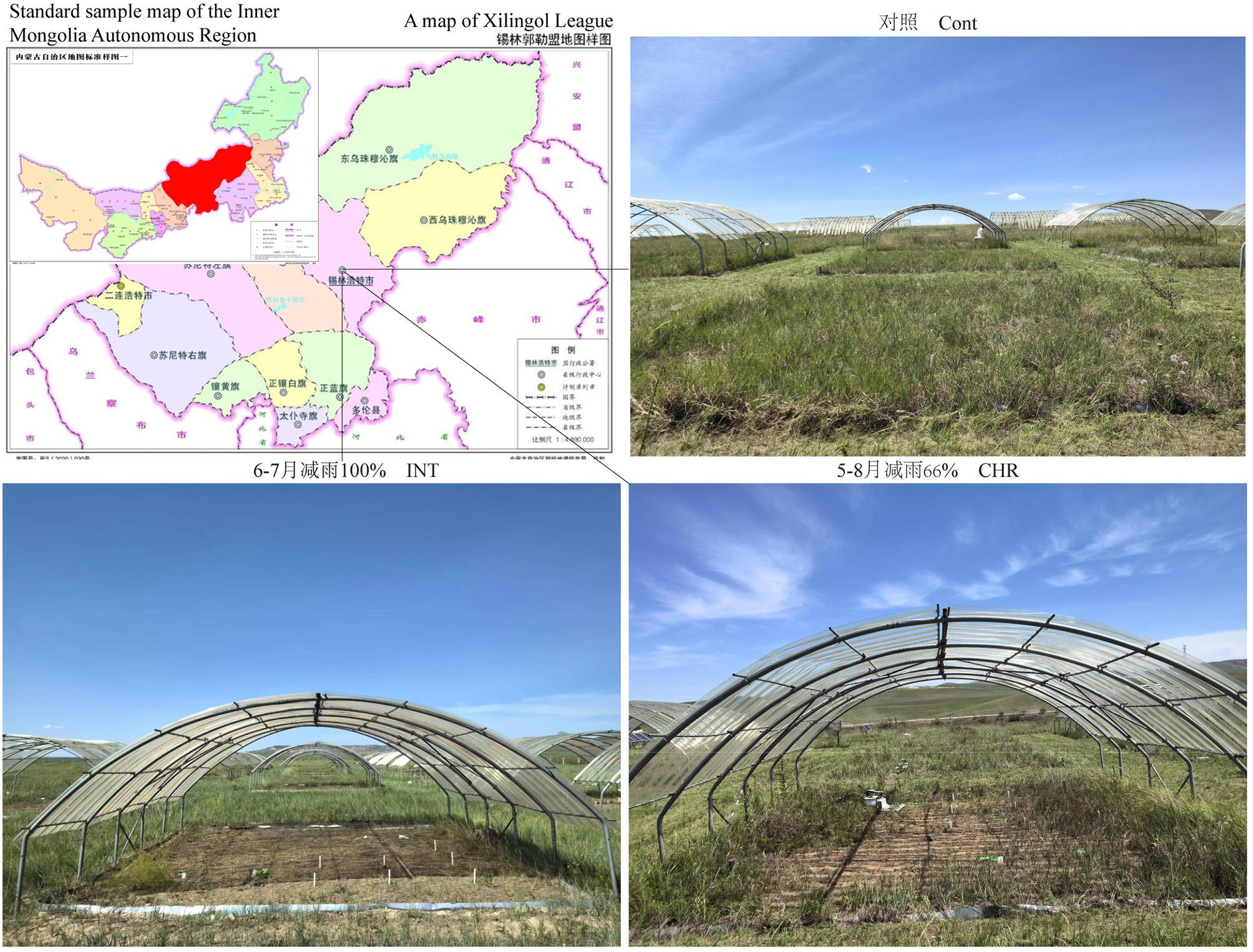
Fig.1 Experimental study layout
| 分类 Sort | 性状 Traits | 单位 Unit | 缩写 Abbreviation |
|---|---|---|---|
叶片水力学性状 Leaf hydraulic traits | 叶片含水量Leaf water concentration | % | LWC |
| 气孔器长Stomatal length | μm | SL | |
| 气孔器宽Stomatal width | μm | SW | |
| 气孔长Stomatal pore length | μm | PL | |
| 气孔面积Stomatal area | μm2 | SA | |
| 气孔密度Stomatal density | pores·mm-2 | SD | |
| 气孔面积指数Stomatal area fraction | % | SAF | |
| 叶片水势Leaf water potential | Mpa | LWP | |
叶片组成性状 Leaf composition traits | 叶片钙含量Leaf calcium concentration | mg·g-1 | Ca |
| 叶片铁含量Leaf iron concentration | mg·g-1 | Fe | |
| 叶片钾含量Leaf potassium concentration | mg·g-1 | K | |
| 叶片镁含量Leaf magnesium concentration | mg·g-1 | Mg | |
| 叶片磷含量Leaf phosphorus concentration | mg·g-1 | P | |
| 叶片硫含量Leaf sulfur concentration | mg·g-1 | S | |
| 叶片锌含量Leaf zinc concentration | mg·g-1 | Zn | |
| 叶绿素含量Chlorophyll concentration | - | SPAD | |
叶片形态学性状 Leaf morphological traits | 叶片厚度Leaf thickness | mm | LT |
| 叶片面积Leaf area | cm2 | LA | |
| 比叶面积Specific leaf area | mm2·mg-1 | SLA | |
| 叶片干物质含量Leaf dry matter concentration | % | LDMC |
Table 1 Plant leaf traits and their categories, units and abbreviations
| 分类 Sort | 性状 Traits | 单位 Unit | 缩写 Abbreviation |
|---|---|---|---|
叶片水力学性状 Leaf hydraulic traits | 叶片含水量Leaf water concentration | % | LWC |
| 气孔器长Stomatal length | μm | SL | |
| 气孔器宽Stomatal width | μm | SW | |
| 气孔长Stomatal pore length | μm | PL | |
| 气孔面积Stomatal area | μm2 | SA | |
| 气孔密度Stomatal density | pores·mm-2 | SD | |
| 气孔面积指数Stomatal area fraction | % | SAF | |
| 叶片水势Leaf water potential | Mpa | LWP | |
叶片组成性状 Leaf composition traits | 叶片钙含量Leaf calcium concentration | mg·g-1 | Ca |
| 叶片铁含量Leaf iron concentration | mg·g-1 | Fe | |
| 叶片钾含量Leaf potassium concentration | mg·g-1 | K | |
| 叶片镁含量Leaf magnesium concentration | mg·g-1 | Mg | |
| 叶片磷含量Leaf phosphorus concentration | mg·g-1 | P | |
| 叶片硫含量Leaf sulfur concentration | mg·g-1 | S | |
| 叶片锌含量Leaf zinc concentration | mg·g-1 | Zn | |
| 叶绿素含量Chlorophyll concentration | - | SPAD | |
叶片形态学性状 Leaf morphological traits | 叶片厚度Leaf thickness | mm | LT |
| 叶片面积Leaf area | cm2 | LA | |
| 比叶面积Specific leaf area | mm2·mg-1 | SLA | |
| 叶片干物质含量Leaf dry matter concentration | % | LDMC |
性状 Traits | 对照 Control | 5-8月降水量减少66% The precipitation decreased by 66% from May to August | 6-7月降水量减少100% The precipitation in June and July decreased by 100% |
|---|---|---|---|
| 叶片厚度 Leaf thickness (mm) | 0.245±0.016a | 0.225±0.017a | 0.231±0.033a |
| 叶片面积 Leaf area (cm2) | 7.905±2.221a | 7.706±1.831a | 8.149±0.238a |
| 叶片含水量 Leaf water content (%) | 0.661±0.058a | 0.734±0.046a | 0.743±0.061a |
| 比叶面积 Specific leaf area (mm2·mg-1) | 54.420±17.597a | 51.927±6.112a | 57.729±6.550a |
| 叶片干物质含量 Leaf dry matter content (%) | 0.598±0.041a | 0.648±0.007a | 0.620±0.025a |
| 叶片水势 Leaf water potential (MPa) | 12.825±1.402a | 8.305±1.026b | 9.428±0.282ab |
| 叶绿素含量 Chlorophyll concentration | 25.287±6.395a | 35.097±0.608a | 31.326±3.697a |
| 气孔密度 Stomatal density (pores·mm-2) | 1187.711±254.074a | 615.443±53.889a | 511.659±200.541a |
| 气孔器长 Stomatal length (μm) | 0.020±0.004a | 0.022±0.002a | 0.024±0.001a |
| 气孔器宽 Stomatal width (μm) | 0.015±0.003a | 0.014±0.002a | 0.015±0.001a |
| 气孔长 Stomatal pore length (μm) | 0.013±0.002a | 0.013±0.002a | 0.015±0.001a |
| 气孔面积 Stomatal area (μm2) | 214.365±78.887a | 200.715±40.244a | 216.898±21.307a |
| 气孔面积指数 Stomatal area fraction (%) | 0.112±0.007a | 0.063±0.021a | 0.065±0.024a |
| 叶片钙含量 Leaf calcium concentration (mg·g?1) | 64.993±9.344a | 81.673±11.979a | 90.204±12.828a |
| 叶片铁含量 Leaf iron concentration (mg·g?1) | 1.484±0.072a | 2.977±0.895a | 2.008±0.286a |
| 叶片钾含量 Leaf potassium concentration (mg·g?1) | 147.292±16.118a | 170.308±21.986a | 180.783±38.755a |
| 叶片镁含量 Leaf magnesium concentration (mg·g?1) | 11.728±1.476b | 17.276±1.531a | 19.460±1.773a |
| 叶片磷含量 Leaf phosphorus concentration (mg·g?1) | 11.004±0.331a | 15.368±2.723a | 16.454±1.176a |
| 叶片硫含量 Leaf sulfur concentration (mg·g?1) | 18.695±4.075a | 23.280±3.084a | 24.832±1.907a |
| 叶片锌含量 Leaf zinc concentration (mg g-1) | 0.265±0.009a | 0.365±0.053a | 0.328±0.011a |
Table 2 Response of leaf traits to different drought treatments
性状 Traits | 对照 Control | 5-8月降水量减少66% The precipitation decreased by 66% from May to August | 6-7月降水量减少100% The precipitation in June and July decreased by 100% |
|---|---|---|---|
| 叶片厚度 Leaf thickness (mm) | 0.245±0.016a | 0.225±0.017a | 0.231±0.033a |
| 叶片面积 Leaf area (cm2) | 7.905±2.221a | 7.706±1.831a | 8.149±0.238a |
| 叶片含水量 Leaf water content (%) | 0.661±0.058a | 0.734±0.046a | 0.743±0.061a |
| 比叶面积 Specific leaf area (mm2·mg-1) | 54.420±17.597a | 51.927±6.112a | 57.729±6.550a |
| 叶片干物质含量 Leaf dry matter content (%) | 0.598±0.041a | 0.648±0.007a | 0.620±0.025a |
| 叶片水势 Leaf water potential (MPa) | 12.825±1.402a | 8.305±1.026b | 9.428±0.282ab |
| 叶绿素含量 Chlorophyll concentration | 25.287±6.395a | 35.097±0.608a | 31.326±3.697a |
| 气孔密度 Stomatal density (pores·mm-2) | 1187.711±254.074a | 615.443±53.889a | 511.659±200.541a |
| 气孔器长 Stomatal length (μm) | 0.020±0.004a | 0.022±0.002a | 0.024±0.001a |
| 气孔器宽 Stomatal width (μm) | 0.015±0.003a | 0.014±0.002a | 0.015±0.001a |
| 气孔长 Stomatal pore length (μm) | 0.013±0.002a | 0.013±0.002a | 0.015±0.001a |
| 气孔面积 Stomatal area (μm2) | 214.365±78.887a | 200.715±40.244a | 216.898±21.307a |
| 气孔面积指数 Stomatal area fraction (%) | 0.112±0.007a | 0.063±0.021a | 0.065±0.024a |
| 叶片钙含量 Leaf calcium concentration (mg·g?1) | 64.993±9.344a | 81.673±11.979a | 90.204±12.828a |
| 叶片铁含量 Leaf iron concentration (mg·g?1) | 1.484±0.072a | 2.977±0.895a | 2.008±0.286a |
| 叶片钾含量 Leaf potassium concentration (mg·g?1) | 147.292±16.118a | 170.308±21.986a | 180.783±38.755a |
| 叶片镁含量 Leaf magnesium concentration (mg·g?1) | 11.728±1.476b | 17.276±1.531a | 19.460±1.773a |
| 叶片磷含量 Leaf phosphorus concentration (mg·g?1) | 11.004±0.331a | 15.368±2.723a | 16.454±1.176a |
| 叶片硫含量 Leaf sulfur concentration (mg·g?1) | 18.695±4.075a | 23.280±3.084a | 24.832±1.907a |
| 叶片锌含量 Leaf zinc concentration (mg g-1) | 0.265±0.009a | 0.365±0.053a | 0.328±0.011a |
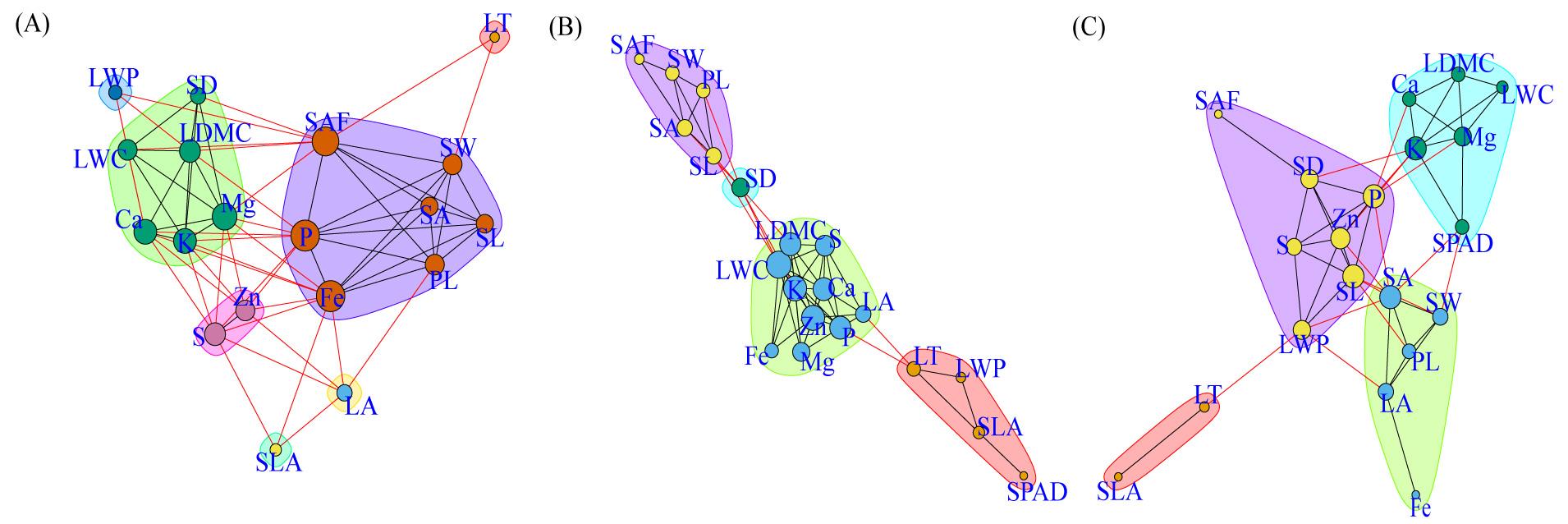
Fig.2 Leaf trait network
处理 Treatment | 节点数 Number of nodes | 边数 Number of edges | 边密度 Edge density | 直径 Diameter | 平均路径长度 Average path length | 模块度 Modularity | 平均聚类系数 Average clustering coefficient |
|---|---|---|---|---|---|---|---|
| 对照Control | 19 | 69 | 0.404 | 3 | 1.061 | 0.194 | 0.726 |
5-8月降水量减少66% The precipitation decreased by 66% from May to August | 20 | 55 | 0.290 | 7 | 1.775 | 0.355 | 0.700 |
6-7月降水量减少100% The precipitation in June and July decreased by 100% | 20 | 48 | 0.253 | 5 | 1.607 | 0.365 | 0.559 |
Table 3 Overall parameters of leaf trait network
处理 Treatment | 节点数 Number of nodes | 边数 Number of edges | 边密度 Edge density | 直径 Diameter | 平均路径长度 Average path length | 模块度 Modularity | 平均聚类系数 Average clustering coefficient |
|---|---|---|---|---|---|---|---|
| 对照Control | 19 | 69 | 0.404 | 3 | 1.061 | 0.194 | 0.726 |
5-8月降水量减少66% The precipitation decreased by 66% from May to August | 20 | 55 | 0.290 | 7 | 1.775 | 0.355 | 0.700 |
6-7月降水量减少100% The precipitation in June and July decreased by 100% | 20 | 48 | 0.253 | 5 | 1.607 | 0.365 | 0.559 |
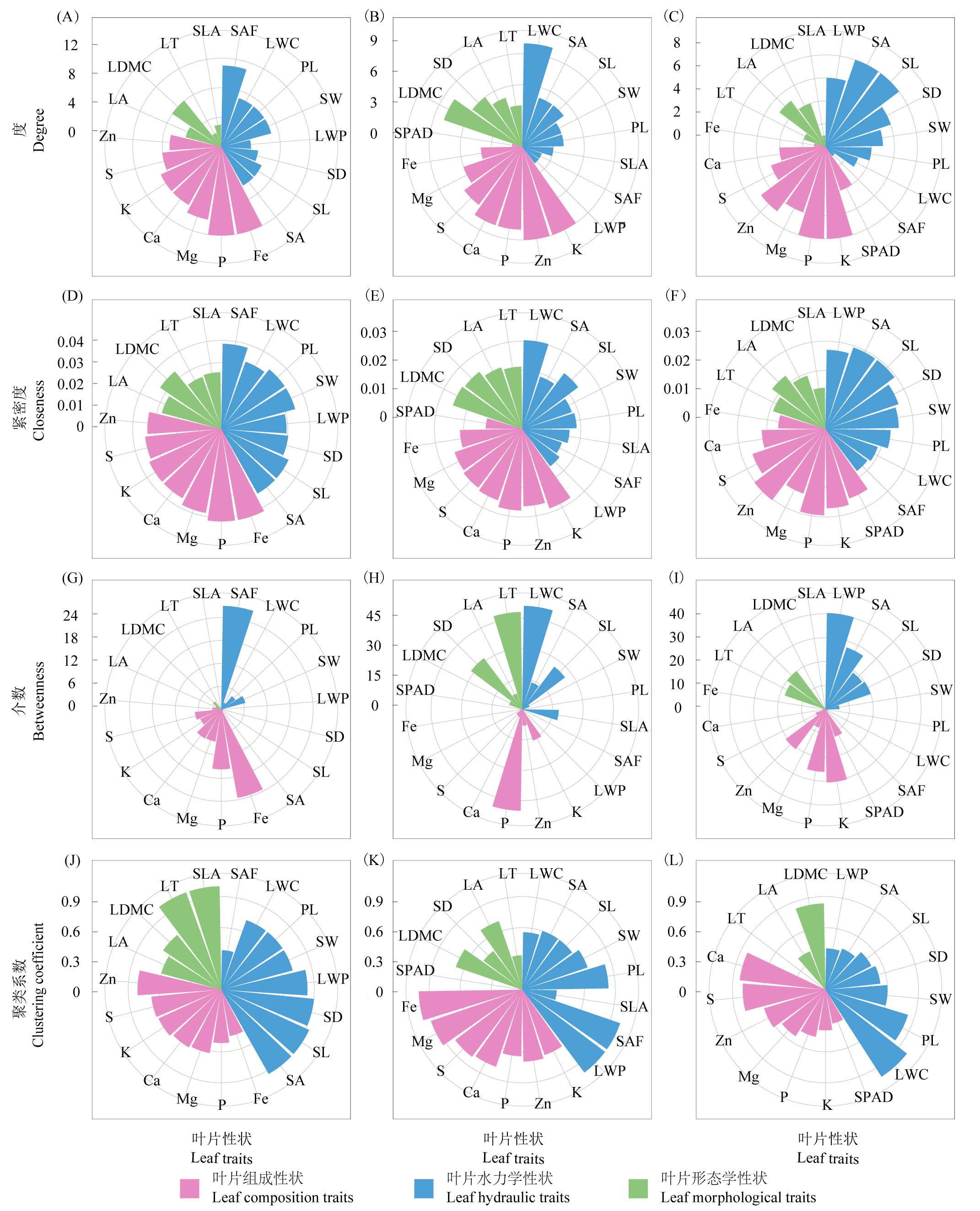
Fig.3 Changes in leaf trait network node parameters under different treatments
| [1] | Hao Z, Li W, Singh V P, et al. Impact of dependence changes on the likelihood of hot extremes under drought conditions in the United States. Journal of Hydrology, 2020, 581: 124410. |
| [2] | Kang X M, Yan L, Cui L J, et al. Reduced carbon dioxide sink and methane source under extreme drought condition in an alpine peatland. Sustainability, 2018, 10(11): 4285. |
| [3] | Intergovernmental Panel on Climate Change. Climate change 2013: The physical science basis// Stocker T F, Qin D, Plattner G K, et al. Contribution of working group I to the fifth assessment report of the intergovernmental panel on climate change. Cambridge, UK: Cambridge University Press, 2013. |
| [4] | Maestre F T, Quero J L, Gotelli N J, et al. Plant species richness and ecosystem multifunctionality in global drylands. Science, 2012, 335(6065): 214-218. |
| [5] | Wright I J, Reich P B, Westoby M, et al. The worldwide leaf economics spectrum. Nature, 2004, 428(6985): 821-827. |
| [6] | Lavorel S, Garnier E. Predicting changes in community composition and ecosystem functioning from plant traits: Revisiting the Holy Grail. Functional Ecology, 2002, 16(5): 545-556. |
| [7] | Poorter H, Niinemets V, Poorter L, et al. Causes and consequences of variation in leaf mass per area (LMA): A meta-analysis. New Phytologist, 2009, 182(3): 565-588. |
| [8] | Violle C, Navas M L, Vile D, et al. Let the concept of trait be functional! Oikos, 2007, 116(5): 882-892. |
| [9] | Aguirre-Gutiérrez J, Rifai S W, Deng X, et al. Canopy functional trait variation across earths tropical forests. Nature, 2025, 641: 129-136. |
| [10] | Díaz S, Kattge J, Cornelissen J H C, et al. The global spectrum of plant form and function. Nature, 2016, 529(7585): 167-171. |
| [11] | Bruelheide H, Dengler J, Purschke O, et al. Global trait-environment relationships of plant communities. Nature Ecology & Evolution, 2018, 2(12): 1906-1917. |
| [12] | Doughty C E, Santos-Andrade P E, Shenkin A, et al. Tropical forest leaves may darken in response to climate change. Nature Ecology & Evolution, 2018, 2(12): 1918-1924. |
| [13] | He N P, Li Y, Liu C C, et al. Plant trait networks: improved resolution of the dimensionality of adaptation. Trends in Ecology & Evolution, 2020, 35(10): 908-918. |
| [14] | Li Y. Variation of leaf trait network among different vegetation types and its influencing factors. Beijing: Beijing Forestry University, 2020. |
| 李颖. 叶片性状网络在不同植被类型间的变异规律及其影响因素. 北京: 北京林业大学, 2020. | |
| [15] | Intergovernmental Panel on Climate Change. Climate change 2021: The physical science basis//Masson-Delmotte V, Zhai P, Pirani A, et al. Contribution of working group I to the sixth assessment report of the intergovernmental panel on climate change. Cambridge: Cambridge University Press, 2021: 1767-1926. |
| [16] | Yu Q, Xu C, Wu H H, et al. Contrasting drought sensitivity of Eurasian and North American grasslands. Nature, 2025, 639(1): 114-118. |
| [17] | Joshi J, Stocker B D, Hofhansl F, et al. Towards a unified theory of plant photosynthesis and hydraulics. Nature Plants, 2022, 8(11): 1304-1316. |
| [18] | Lu J N, Zhao X Y, Wang S K, et al. Untangling the influence of abiotic and biotic factors on leaf C, N, and P stoichiometry along a desert-grassland transition zone in northern China. Science of the Total Environment, 2023, 884: 163902. |
| [19] | Lens F, Gleason S M, Bortolami G, et al. Functional xylem characteristics associated with drought-induced embolism in angiosperms. New Phytologist, 2022, 236(6): 2019-2036. |
| [20] | Song W, Song R Z, Zhao Y, et al. Research on the characteristics of drought stress state based on plant stem water content. Sustainable Energy Technologies and Assessments, 2023, 56: 103080. |
| [21] | Wellstein C, Poschlod P, Gohlke A, et al. Effects of extreme drought on specific leaf area of grassland species: A meta-analysis of experimental studies in temperate and sub-mediterranean systems. Global Change Biology, 2017, 23(6): 2473-2481. |
| [22] | Anderegg W R L, Konings A G, Trugman A T, et al. Hydraulic diversity of forests regulates ecosystem resilience during drought. Nature, 2018, 561(7724): 538-541. |
| [23] | Gutierrez V. Understanding the role of plant hydraulic traits in ecological processes. Minnesota: University of Minnesota, 2021. |
| [24] | Martínez-Vilalta J, García-Valdés R, Jump A, et al. Accounting for trait variability and coordination in predictions of drought-induced range shifts in woody plants. New Phytologist, 2023, 240(1): 23-40. |
| [25] | Choat B, Brodribb T J, Brodersen C R, et al. Triggers of tree mortality under drought. Nature, 2018, 558(7711): 531-539. |
| [26] | Li X M, Xi B Y, Wu X C, et al. Unlocking drought-induced tree mortality: Physiological mechanisms to modeling. Frontiers in Plant Science, 2022, 13: 835921. |
| [27] | Mantova M, Herbette S, Cochard H, et al. Hydraulic failure and tree mortality: From correlation to causation. Trends in Plant Science, 2022, 27(4): 335-345. |
| [28] | Song Y J, Sterck F, Zhou X Q, et al. Drought resilience of conifer species is driven by leaf lifespan but not by hydraulic traits. New Phytologist, 2022, 235(3): 978-992. |
| [29] | Ploughe L W, Jacobs E M, Frank G S, et al. Community response to extreme drought (CRED): A framework for drought-induced shifts in plant-plant interactions. New Phytologist, 2019, 222(1): 52-69. |
| [30] | Li Y, Liu C C, Sack L, et al. Leaf trait network architecture shifts with species-richness and climate across forests at continental scale. Ecology Letters, 2022, 25(6): 1442-1457. |
| [31] | Beaulieu J M, Leitch I J, Patel S G, et al. Genome size is a strong predictor of cell size and stomatal density in angiosperms. New Phytologist, 2008, 179(4): 975-986. |
| [32] | Kleyer M, Trinogga J, Cebrián-Piqueras M A, et al. Trait correlation network analysis identifies biomass allocation traits and stem specific length as hub traits in herbaceous perennial plants. Journal of Ecology, 2019, 107(2): 829-842. |
| [33] | Naikwade P V. Plant responses to drought stress: Morphological, physiological, molecular approaches, and drought resistance. Plant Metabolites under Environmental Stress, 2023: 149-183. |
| [34] | Flexas J, Bota J, Loreto F, et al. Diffusive and metabolic limitations to photosynthesis under drought and salinity in C3 plants. Plant Biology, 2004, 6(3): 269-279. |
| [35] | Sardans J, Janssens I A, Ciais P, et al. Recent advances and future research in ecological stoichiometry. Perspectives in Plant Ecology, Evolution and Systematics, 2021, 50: 125611. |
| [36] | Bartlett M K, Scoffoni C, Sack L. The determinants of leaf turgor loss point and prediction of drought tolerance of species and biomes: a global meta-analysis. Ecology Letters, 2012, 15(5): 393-405. |
| [37] | Anderegg W R L, Klein T, Bartlett M, et al. Meta-analysis reveals that hydraulic traits explain cross-species patterns of drought-induced tree mortality across the globe. Proceedings of the National Academy of Sciences of the United States of America, 2016, 113(18): 5024-5029. |
| [38] | Marschner H. Marschner’s mineral nutrition of higher plants. Pittsburgh, USA: Academic Press, 2011. |
| [39] | Cakmak I, Kirkby E A. Role of magnesium in carbon partitioning and alleviating photooxidative damage. Physiologia Plantarum, 2008, 133(4): 692-704. |
| [40] | Tränkner M, Jákli B, Tavakol E, et al. Magnesium deficiency decreases biomass water-use efficiency and increases leaf water-use efficiency and oxidative stress in barley plants. Plant and Soil, 2016, 406: 409-423. |
| [41] | Medeiros C D, Trueba S, Henry C, et al. Simplification of woody plant trait networks among communities along a climatic aridity gradient. Journal of Ecology, 2025, 113(4): 896-912. |
| [42] | Wang M, Zheng Q S, Shen Q R, et al. The critical role of potassium in plant stress response. International Journal of Molecular Sciences, 2013, 14(4): 7370-7390. |
| [43] | Hasanuzzaman M, Bhuyan M H M B, Nahar K, et al. Potassium: a vital regulator of plant responses and tolerance to abiotic stresses. Agronomy, 2018, 8(3): 31. |
| [44] | Ahmad S, Muhammad I, Wang G Y, et al. Ameliorative effect of melatonin improves drought tolerance by regulating growth, photosynthetic traits and leaf ultrastructure of maize seedlings. BMC Plant Biology, 2021, 21(1): 368. |
| [45] | Abuelsoud W, Hirschmann F, Papenbrock J. Sulfur metabolism and drought stress tolerance in plants. Drought Stress Tolerance in Plants, Volume 1: Physiology and Biochemistry, 2016: 227-249. |
| [46] | Li Y, Liu C C, Xu L, et al. Leaf trait networks based on global data: Representing variation and adaptation in plants. Frontiers in Plant Science, 2021, 12: 710530. |
| [47] | Perez-Harguindeguy N, Diaz S, Garnier E, et al. Corrigendum to: New handbook for standardised measurement of plant functional traits worldwide. Australian Journal of Botany, 2016, 64(8): 715-716. |
| [48] | McDowell N G, Ryan M G, Zeppel M J B, et al. Improving our knowledge of drought-induced forest mortality through experiments, observations, and modeling. New Phytologist, 2013, 200(2): 289-293. |
| [49] | Lawson T, Blatt M R. Stomatal size, speed, and responsiveness impact on photosynthesis and water use efficiency. Plant Physiology, 2014, 164(4): 1556-1570. |
| [50] | Bartlett M K, Klein T, Jansen S, et al. The correlations and sequence of plant stomatal, hydraulic, and wilting responses to drought. Proceedings of the National Academy of Sciences of the United States of America, 2016, 113(46): 13098-13103. |
| [1] | ZHANG Rui, MA Hong-bin, JIA Xi-yang, ZHOU Yao, SU Ting-ting, CAI Yu-rong, ZHOU Jing-jing. Characteristics of soil seed banks in a typical grassland in the loess hilly region of Ningxia under different ecological restoration measures [J]. Acta Prataculturae Sinica, 2018, 27(1): 32-41. |
| [2] | ZHAO Ling-Ping, BAI Xin, WANG Zhan-Bin, CHENG Ji-Min, TAN Shi-Tu, WANG Qing-Yi. Effects of fire on above-ground vegetation and offspring recruitment in a semiarid steppe on the Loess Plateau [J]. Acta Prataculturae Sinica, 2016, 25(1): 108-116. |
| [3] | JING Guang-Hua, CHENG Ji-Min, SU Ji-Shuai, WEI Lin, SHI Xiao-Xiao, JIN Jing-Wei. Response of dominant population niche breadths and niche overlaps to various disturbance factors in typical steppe fenced grassland of China’s Loess Plateau region [J]. Acta Prataculturae Sinica, 2015, 24(9): 43-52. |
| [4] | WANG Jing, ZHAO Meng-li, Willms W, HAN Guo-dong, GAO Xin-lei, WU Yu-shanhina). Productivity responses of different functional groups to litter removal in typical grassland of Inner Mongolia [J]. Acta Prataculturae Sinica, 2013, 22(6): 31-38. |
| Viewed | ||||||
|
Full text |
|
|||||
|
Abstract |
|
|||||
