
ISSN 1004-5759 CN 62-1105/S
Acta Prataculturae Sinica ›› 2026, Vol. 35 ›› Issue (3): 245-256.DOI: 10.11686/cyxb2025138
Yu-hua TONG( ), Xiao-tong WANG, Yong-long MA, Jin-hui YANG, Dong-wen YU, Shu-xia LI()
Received:2025-04-17
Revised:2025-05-21
Online:2026-03-20
Published:2026-01-19
Contact:
Shu-xia LI
Yu-hua TONG, Xiao-tong WANG, Yong-long MA, Jin-hui YANG, Dong-wen YU, Shu-xia LI. Effects of a chitosan seed soaking treatment on seed germination and growth of alfalfa under saline alkali stress[J]. Acta Prataculturae Sinica, 2026, 35(3): 245-256.
盐碱处理 Saline-alkaline treatment (mmol·L-1) | 发芽率Germination percentage (GP, %) | 发芽势Germination energy (GE, %) | 发芽指数 Germination index (GI) | 活力指数 Vigor index (VI) | 根长 Root length (RL, mm) | 苗长 Seedling length (SL, mm) | 鲜重 Fresh weight (FW, g·plant -1 ) |
|---|---|---|---|---|---|---|---|
| 0 | 87±0.01a | 75±0.02a | 26.75±2.10a | 936.56±98.87a | 33.73±1.74a | 2.80±0.15a | 0.38±0.02a |
| 50 | 48±0.03b | 43±0.03b | 21.61±2.01ab | 299.43±32.85b | 13.51±0.53b | 1.90±0.15b | 0.24±0.02b |
| 75 | 41±0.03bc | 33±0.03c | 17.80±1.64bc | 205.33±25.99b | 11.00±0.60bc | 1.24±0.11c | 0.18±0.01c |
| 100 | 34±0.03c | 28±0.03c | 14.44±1.55c | 151.07±24.45b | 9.65±0.65c | 0.64±0.11d | 0.12±0.01d |
Table 1 Effects of different saline-alkaline treatments on germination indexes of 15 alfalfa germplasm materials
盐碱处理 Saline-alkaline treatment (mmol·L-1) | 发芽率Germination percentage (GP, %) | 发芽势Germination energy (GE, %) | 发芽指数 Germination index (GI) | 活力指数 Vigor index (VI) | 根长 Root length (RL, mm) | 苗长 Seedling length (SL, mm) | 鲜重 Fresh weight (FW, g·plant -1 ) |
|---|---|---|---|---|---|---|---|
| 0 | 87±0.01a | 75±0.02a | 26.75±2.10a | 936.56±98.87a | 33.73±1.74a | 2.80±0.15a | 0.38±0.02a |
| 50 | 48±0.03b | 43±0.03b | 21.61±2.01ab | 299.43±32.85b | 13.51±0.53b | 1.90±0.15b | 0.24±0.02b |
| 75 | 41±0.03bc | 33±0.03c | 17.80±1.64bc | 205.33±25.99b | 11.00±0.60bc | 1.24±0.11c | 0.18±0.01c |
| 100 | 34±0.03c | 28±0.03c | 14.44±1.55c | 151.07±24.45b | 9.65±0.65c | 0.64±0.11d | 0.12±0.01d |
种质材料 Germplasm materials | F(X1) | F(X2) | F(X3) | U(X1) | U(X2) | U(X3) | D值 D value | 排序 Order |
|---|---|---|---|---|---|---|---|---|
| Magna Graze 2 | 1.168 | -0.079 | 1.702 | 0.821 | 0.448 | 1.000 | 0.781 | 2 |
| 3010 | -0.803 | -0.254 | 0.770 | 0.266 | 0.401 | 0.715 | 0.331 | 12 |
| 4030 | -1.537 | 1.953 | 1.218 | 0.059 | 1.000 | 0.852 | 0.283 | 14 |
| 猎人河Hunter River | 0.505 | 0.445 | 0.473 | 0.634 | 0.590 | 0.624 | 0.627 | 5 |
| 标杆Biaogan | -0.704 | 0.716 | -0.738 | 0.294 | 0.664 | 0.254 | 0.347 | 11 |
| 牧歌401 Muge 401 | 1.803 | -0.118 | -0.051 | 1.000 | 0.437 | 0.464 | 0.860 | 1 |
| 克山Keshan | -1.746 | -1.728 | -0.709 | 0.000 | 0.000 | 0.262 | 0.026 | 15 |
| 雷达克之星Ladak Star | -0.369 | 1.154 | 0.440 | 0.388 | 0.783 | 0.614 | 0.472 | 8 |
| 巨能401 Juneng 401 | -0.029 | 0.744 | -1.566 | 0.484 | 0.672 | 0.000 | 0.465 | 9 |
| 皇冠Crown | 1.063 | 0.580 | -1.432 | 0.791 | 0.627 | 0.041 | 0.692 | 3 |
| 牧歌301 Muge301 | -0.163 | -1.056 | -0.687 | 0.446 | 0.183 | 0.269 | 0.388 | 10 |
| 沃苜一号Womo 1 | 0.475 | -1.389 | 1.216 | 0.626 | 0.092 | 0.851 | 0.565 | 6 |
| 中苜一号Zhongmu 1 | 0.743 | -0.080 | 0.035 | 0.701 | 0.448 | 0.490 | 0.641 | 4 |
| 蕴能Yunneng | 0.260 | 0.163 | -0.999 | 0.565 | 0.514 | 0.174 | 0.518 | 7 |
| 飞跃Leap | -0.665 | -1.052 | 0.328 | 0.305 | 0.184 | 0.580 | 0.313 | 13 |
Table 2 Evaluation of saline-alkaline tolerance during germination of 15 alfalfa seeds
种质材料 Germplasm materials | F(X1) | F(X2) | F(X3) | U(X1) | U(X2) | U(X3) | D值 D value | 排序 Order |
|---|---|---|---|---|---|---|---|---|
| Magna Graze 2 | 1.168 | -0.079 | 1.702 | 0.821 | 0.448 | 1.000 | 0.781 | 2 |
| 3010 | -0.803 | -0.254 | 0.770 | 0.266 | 0.401 | 0.715 | 0.331 | 12 |
| 4030 | -1.537 | 1.953 | 1.218 | 0.059 | 1.000 | 0.852 | 0.283 | 14 |
| 猎人河Hunter River | 0.505 | 0.445 | 0.473 | 0.634 | 0.590 | 0.624 | 0.627 | 5 |
| 标杆Biaogan | -0.704 | 0.716 | -0.738 | 0.294 | 0.664 | 0.254 | 0.347 | 11 |
| 牧歌401 Muge 401 | 1.803 | -0.118 | -0.051 | 1.000 | 0.437 | 0.464 | 0.860 | 1 |
| 克山Keshan | -1.746 | -1.728 | -0.709 | 0.000 | 0.000 | 0.262 | 0.026 | 15 |
| 雷达克之星Ladak Star | -0.369 | 1.154 | 0.440 | 0.388 | 0.783 | 0.614 | 0.472 | 8 |
| 巨能401 Juneng 401 | -0.029 | 0.744 | -1.566 | 0.484 | 0.672 | 0.000 | 0.465 | 9 |
| 皇冠Crown | 1.063 | 0.580 | -1.432 | 0.791 | 0.627 | 0.041 | 0.692 | 3 |
| 牧歌301 Muge301 | -0.163 | -1.056 | -0.687 | 0.446 | 0.183 | 0.269 | 0.388 | 10 |
| 沃苜一号Womo 1 | 0.475 | -1.389 | 1.216 | 0.626 | 0.092 | 0.851 | 0.565 | 6 |
| 中苜一号Zhongmu 1 | 0.743 | -0.080 | 0.035 | 0.701 | 0.448 | 0.490 | 0.641 | 4 |
| 蕴能Yunneng | 0.260 | 0.163 | -0.999 | 0.565 | 0.514 | 0.174 | 0.518 | 7 |
| 飞跃Leap | -0.665 | -1.052 | 0.328 | 0.305 | 0.184 | 0.580 | 0.313 | 13 |
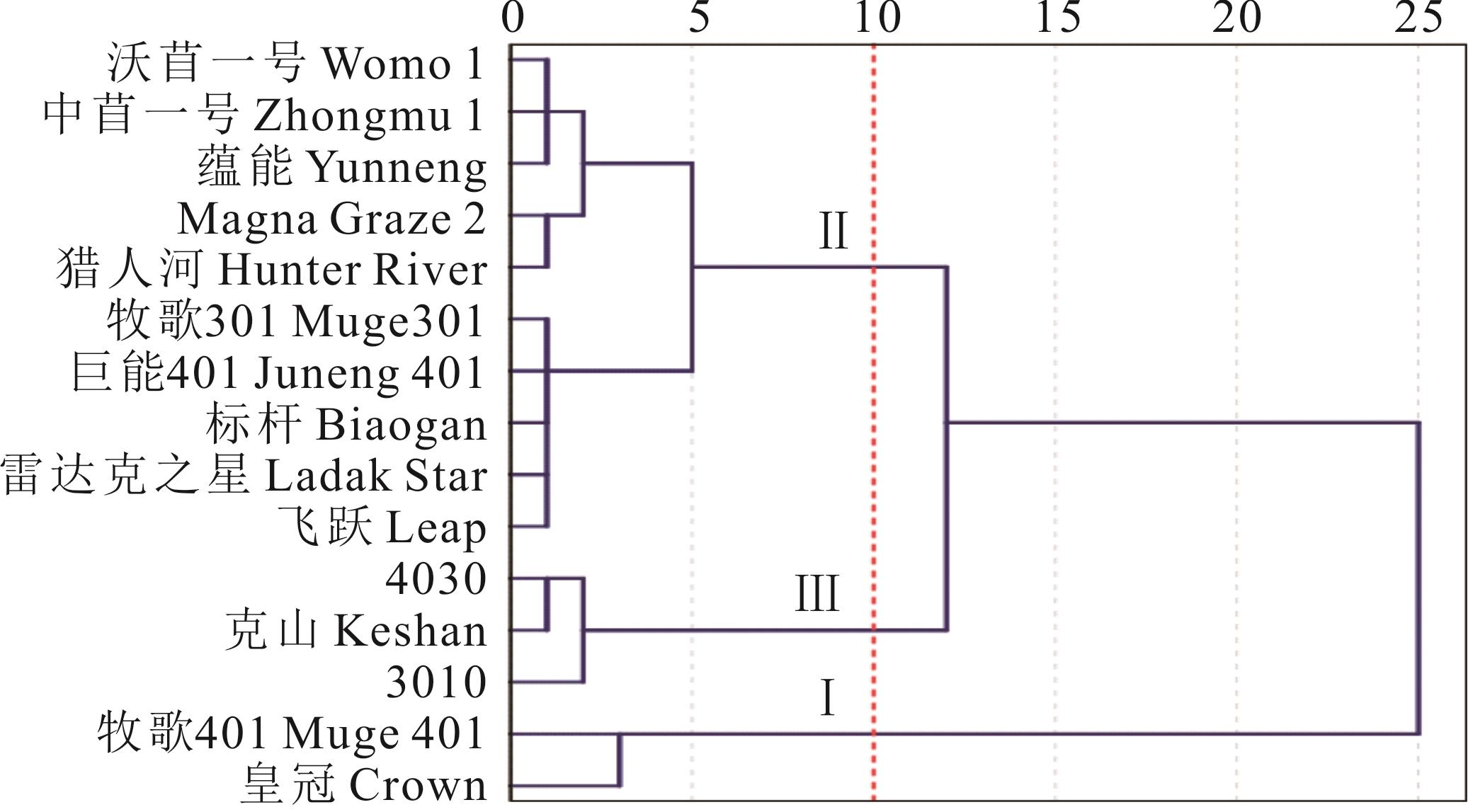
Fig.1 Systematic clustering analysis of 15 alfalfa germplasms for saline-alkaline tolerance

Fig.2 Effect of chitosan seed soaking treatment on germination percentage and germination energy of alfalfa seeds under saline-alkaline stress

Fig.3 Effect of chitosan seed soaking treatments on germination index and vigor index of alfalfa seeds under saline-alkaline stress
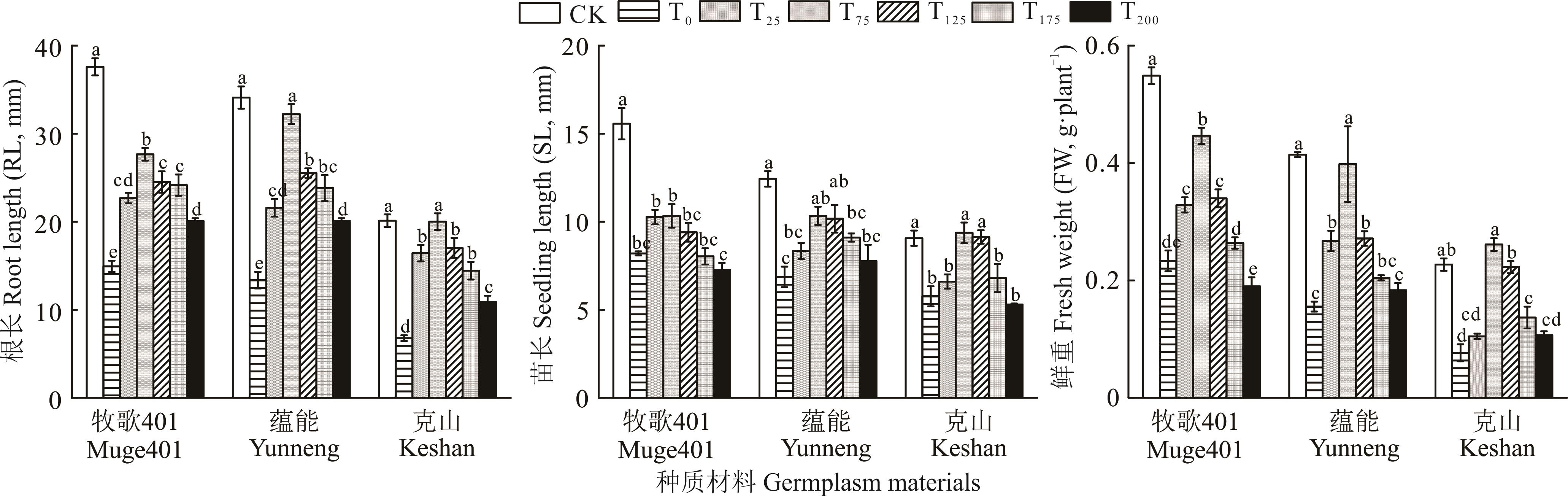
Fig.4 Effect of chitosan seed soaking treatments on root length, seedling length and fresh weight of alfalfa under saline-alkaline stress
指标 Index | 发芽率 Germination percentage (GP) | 发芽势 Germination energy (GE) | 发芽指数 Germination index (GI) | 活力指数 Vigor index (VI) | 根长 Root length (RL) | 苗长 Seedling length (SL) |
|---|---|---|---|---|---|---|
| 发芽势Germination energy (GE) | 0.993** | |||||
| 发芽指数Germination index (GI) | 0.866** | 0.870** | ||||
| 活力指数Vigor index (VI) | 0.858** | 0.875** | 0.887** | |||
| 根长Root length (RL) | 0.852** | 0.854** | 0.788** | 0.927** | ||
| 苗长Seedling length (SL) | 0.781** | 0.753** | 0.502** | 0.689** | 0.835** | |
| 鲜重Fresh weight (FW) | 0.790** | 0.767** | 0.828** | 0.882** | 0.836** | 0.670** |
Table 3 Correlation between various germination indexes of alfalfa seeds by different concentrations of chitosan soaking treatments
指标 Index | 发芽率 Germination percentage (GP) | 发芽势 Germination energy (GE) | 发芽指数 Germination index (GI) | 活力指数 Vigor index (VI) | 根长 Root length (RL) | 苗长 Seedling length (SL) |
|---|---|---|---|---|---|---|
| 发芽势Germination energy (GE) | 0.993** | |||||
| 发芽指数Germination index (GI) | 0.866** | 0.870** | ||||
| 活力指数Vigor index (VI) | 0.858** | 0.875** | 0.887** | |||
| 根长Root length (RL) | 0.852** | 0.854** | 0.788** | 0.927** | ||
| 苗长Seedling length (SL) | 0.781** | 0.753** | 0.502** | 0.689** | 0.835** | |
| 鲜重Fresh weight (FW) | 0.790** | 0.767** | 0.828** | 0.882** | 0.836** | 0.670** |
| [1] | Liu J X, Li S Y, Qu S M. Effects of plant growth regulators on growth and physiology of alfalfa under saline-alkali stress. Feed Research, 2025, 48(1): 113-118. |
| 刘佳欣, 李思宇, 曲善民. 植物生长调节剂对盐碱胁迫下苜蓿生长及生理的影响. 饲料研究, 2025, 48(1): 113-118. | |
| [2] | Yuan Y T, Wu L, Wei X X, et al. Production performance and quality evaluation of 12 alfalfa varieties in the semiarid region of Hexi Corridor. Acta Agrestia Sinica, (2025-05-14)[2025-06-16]. https://link.cnki.net/urlid/11.3362.S.20250514.0927.002. |
| 袁玉涛, 吴莉, 魏小星, 等. 河西走廊半干旱区12个紫花苜蓿品种生产性能及品质评价. 草地学报, (2025-05-14)[2025-06-16]. https://link.cnki.net/urlid/11.3362.S.20250514.0927.002. | |
| [3] | Han Y L, Kang W J, Shi S L, et al. Studies on the difference of symbiotic effect between Sinorhizobium meliloti QL2 and different alfalfa varieties. Acta Prataculturae Sinica, (2525-03-18)[2025-06-16]. https://link.cnki.net/urlid/62.1105.S.20250317.1723.038. |
| 韩宜霖, 康文娟, 师尚礼, 等. 中华根瘤菌株QL2与不同紫花苜蓿品种共生效应的差异. 草业学报, (2525-03-18)[2025-06-16]. https://link.cnki.net/urlid/62.1105.S.20250317.1723.038. | |
| [4] | Tian G, Nan L L, Wang L Q, et al. Effects of exogenous ABA on growth and physiological characteristics of sainfoin seedlings under NaCl stress. Acta Prataculturae Sinica, (2025-03-21)[2025-06-16]. https://link.cnki.net/urlid/62.1105.s.20250320.1405.002. |
| 田戈, 南丽丽, 王利群, 等. 盐胁迫下外源ABA对红豆草幼苗生长与生理特性的影响. 草业学报, (2025-03-21)[2025-06-16]. https://link.cnki.net/urlid/62.1105.s.20250320.1405.002. | |
| [5] | Jiang Y T, Li Y M, Liu M C, et al. Effects of exogenous SA on seed germination of Oenothera biennis L. under salt stress. Molecular Plant Breeding, (2025-03-20)[2025-03-20]. https://link.cnki.net/urlid/46.1068.S.20250320.0918.004. |
| 姜云天, 李玉梅, 刘洺畅, 等. 外源水杨酸对盐胁迫下长白山区月见草种子萌发的影响. 分子植物育种, (2025-03-20)[2025-03-20]. https://link.cnki.net/urlid/46.1068.S.20250320.0918.004. | |
| [6] | Wang X G, Gao L Y, Deng Y S, et al. Identification and evaluation of cotton salt tolerance during germination and seedling stages. Shandong Agricultural Sciences, 2025, 57(2): 29-37. |
| 王晓歌, 高利英, 邓永胜, 等. 棉花萌发出苗期耐盐性鉴定和评价. 山东农业科学, 2025, 57(2): 29-37. | |
| [7] | Liu Y, He C, Jin M, et al. Study on the physiological adaptation mechanism of Atraphaxis bracteata seedlings under different salinity stress. Pratacultural Science, (2025-03-18)[2025-03-20]. http://kns.cnki.net/kcms/detail/62.1069.S.20250318.0941.002.html. |
| 刘源, 何彩, 晋敏, 等. 沙木蓼幼苗在不同盐度胁迫下的生理适应机制. 草业科学, (2025-03-18)[2025-03-20]. http://kns.cnki.net/kcms/detail/62.1069.S.20250318.0941.002.html. | |
| [8] | Yang Y Q, Guo Y. Unraveling salt stress signaling in plants. Journal of Integrative Plant Biology, 2018, 60(9): 796-804. |
| [9] | Yu J D, Zhou C J, Gao Z K, et al. Effects of plant growth regulators on yield and related traits of continuous cropping soybean. Chinese Journal of Oil Crop Sciences, 2025, 47(2): 471-477. |
| 于吉东, 周长军, 高忠奎, 等. 植物生长调节剂对连作大豆产量及其相关性状的影响. 中国油料作物学报, 2025, 47(2): 471-477. | |
| [10] | Cao Y X, Liu H H, Zhang Y P, et al. Effects of chitosan on physiological metabolism and fruit quality of melon. Journal of Hebei Agricultural University, 2024, 47(4): 57-64. |
| 曹艳霞, 刘海河, 张彦萍, 等. 壳聚糖对甜瓜生理代谢及果实品质的影响. 河北农业大学学报, 2024, 47(4): 57-64. | |
| [11] | Liu S C, Tan J X, Pan J F, et al. Effect of exogenous substances on seed germination and seedlings growth of Amaranthus tricolor. Seed, 2018, 37(4): 66-70. |
| 刘生财, 谭吉祥, 潘君飞, 等. 外源物质对苋菜种子萌发及幼苗生长的影响. 种子, 2018, 37(4): 66-70. | |
| [12] | Wu Y Y, Pang C H, Zhang Y Q, et al. Influences of chitosan initiation on seed germination and seedling growth of quinoa under salt stress. Jiangsu Agricultural Sciences, 2024, 52(4): 114-121. |
| 毋悦悦, 庞春花, 张永清, 等. 壳聚糖引发对盐胁迫下藜麦种子萌发和幼苗生长的影响. 江苏农业科学, 2024, 52(4): 114-121. | |
| [13] | Li X L, Yang Z Y, Hua Z R. Effect of chitosan on seed germination and growth of Rhododendron lapponicum. Acta Agriculturae Jiangxi, 2023, 35(1): 64-69. |
| 李小玲, 杨紫逸, 华智锐. 壳聚糖浸种对高山杜鹃种子萌发及生长的影响研究. 江西农业学报, 2023, 35(1): 64-69. | |
| [14] | Wang Y F. Chitosan-modified biochar promotes seed germination and seedling growth of wheat under salt stress. Molecular Plant Breeding, 2023, 21(19): 6493-6499. |
| 王乙富. 壳聚糖改性生物炭促进盐胁迫下小麦种子萌发和幼苗生长. 分子植物育种, 2023, 21(19): 6493-6499. | |
| [15] | Yao L, Zhao Y, Cheng B Z, et al. Seed priming with chitosan improves germination characteristics associated with alterations in antioxidant defense and dehydration-responsive pathway in white clover under water stress. Plants, 2022, 11(15): 13. |
| [16] | Steven S, Islam M S, Ghimire A, et al. Chitosan-GSNO nanoparticles and silicon priming enhance the germination and seedling growth of soybean (Glycine max L.). Plants, 2024, 13(10): 1290. |
| [17] | Xu Y Z, Zeng X C, Fang Y, et al. Effects of salt and alkali stress on seed germination and mitosis of root apical cells of Brassica campestris L. Agricultural Research in the Arid Areas, 2014, 32(4): 14-19. |
| 许耀照, 曾秀存, 方彦, 等. 盐碱胁迫对油菜种子萌发和根尖细胞有丝分裂的影响. 干旱地区农业研究, 2014, 32(4): 14-19. | |
| [18] | Guo J C, Wang M G, Geng R, et al. Salinity characteristics analysis of saline alkali soil in Yinbei irrigation district of Ningxia. Chinese Agricultural Science Bulletin, 2021, 37(5): 38-42. |
| 郭军成, 王明国, 耿荣, 等. 宁夏银北灌区盐碱地盐渍化特征分析. 中国农学通报, 2021, 37(5): 38-42. | |
| [19] | Zuo J F, Lin Y C, Liu W W, et al. Effects of simulated drought stress with PEG-6000 on seed germination and seedling growth of three species of forage grasses. Acta Ecologica Sinica, 2025, 45(13): 1-13. |
| 作建芬, 林益超, 刘维维, 等. PEG-6000模拟干旱胁迫对三种牧草种子萌发及幼苗生长的影响. 生态学报, 2025, 45(13): 1-13. | |
| [20] | Ma F Q, Wang Y, Zheng X L, et al. Effects of exogenous abscisic acid on seed germination and seedling physiological characteristics of Astragalus cicer seedlings under salt stress. Journal of Nuclear Agricultural Sciences, (2025-05-14)[2025-06-16]. https://link.cnki.net/urlid/11.2265.s.20250512.2102.004. |
| 马福钦, 王彦, 郑晓琳, 等. 盐胁迫下外源脱落酸对鹰嘴紫云英种子萌发及幼苗生理特性的影响. 核农学报, (2025-05-14)[2025-06-16]. https://link.cnki.net/urlid/11.2265.s.20250512.2102.004. | |
| [21] | Zhu X H, Ji S, Yang H H, et al. Effects of biochar combined with nitrogen application on ‘Paulownia 1201’ seed germination under Cd stress. Journal of Northwest Forestry University, (2025-04-14)[2025-06-16]. https://link.cnki.net/urlid/61.1202.S.20250411.1721.010 . |
| 朱秀红, 纪爽, 杨会焕, 等. 生物炭配施氮素对Cd胁迫‘泡桐1201’种子萌发的影响. 西北林学院学报, (2025-04-14)[2025-06-16]. https://link.cnki.net/urlid/61.1202.S.20250411.1721.010. | |
| [22] | Wang R, Yu M Y, Cao Z J, et al. Effects of salt stress on seed germination characteristics of Poa pratensis L. Seed, 2024, 43(9): 86-93. |
| 王蓉, 于铭玥, 曹志坚, 等. 盐处理对草地早熟禾种子萌发特性的影响. 种子, 2024, 43(9): 86-93. | |
| [23] | Yao X J, Sun Q Y, Zhang Z, et al. Comprehensive evaluation on salt tolerance of 61 alfalfa cultivars during seed germination. Acta Agrestia Sinica, 2024, 33(4): 1-13. |
| 姚兴洁, 孙庆赢, 张昭, 等. 61个品种紫花苜蓿种子萌发期耐盐性综合评价. 草地学报, 2024, 33(4): 1-13. | |
| [24] | Wang N N, Luo X M, Chen M Y, et al. Effects of exogenous melatonin on seed germination and seedling growth of Cyperus esculentus L. under salt and drought stress. Journal of Agricultural Science and Technology, 2025, 27(2): 51-61. |
| 王宁宁, 罗雪梅, 陈明媛, 等. 外源褪黑素对盐旱复合胁迫下油莎豆种子萌发和幼苗生长的影响. 中国农业科技导报, 2025, 27(2): 51-61. | |
| [25] | Peng W X, Cai W Q, Pan J Y, et al. Molecular mechanisms of alfalfa response to abiotic stresses. Plants, 2025, 14(3): 14. |
| [26] | Zhou C F, Wei Y Q, Yang C Q, et al. Comprehensive evaluation of drought and saline-alkali tolerance of 15 oat varieties during germination period. Agricultural Research in the Arid Areas, 2025, 43(1): 1-11. |
| 周超凡, 魏玉清, 杨崇庆, 等. 15个燕麦品种萌发期耐旱、耐盐、耐碱性综合评价. 干旱地区农业研究, 2025, 43(1): 1-11. | |
| [27] | Cui C, Wang M Q, Zhao W L, et al. The effect on seed germination and seedling growth of soaking seeds with diethyl aminoethyl hexanoate in alfalfa under NaCl stress. Acta Prataculturae Sinica, 2025, 34(6): 1-13. |
| 崔灿, 王梦琦, 赵琬璐, 等. 胺鲜酯浸种对NaCl胁迫下紫花苜蓿种子萌发及幼苗生长的影响. 草业学报, 2025, 34(6): 1-13. | |
| [28] | Luo X, Wang X L, Luo Y, et al. Effect of chitosan on loquat fruit quality. Journal of Northwest A & F University (Natural Science Edition), 2025, 53(9): 1-9. |
| 罗弦, 王晓莉, 罗娅, 等. 壳聚糖对枇杷果实品质的影响. 西北农林科技大学学报(自然科学版), 2025, 53(9): 1-9. | |
| [29] | Wu F X. Effects of spermidine and nano titanium dioxide on growth and cadmium accumulation of Zea mays seedlings. Harbin: Northeast Agricultural University, 2023. |
| 吴凤雪. 亚精胺与纳米二氧化钛浸种对玉米幼苗生长及镉积累的影响. 哈尔滨: 东北农业大学, 2023. | |
| [30] | Ali A, Ferdosi F H, Sarwar M, et al. Inducing salt stress tolerance in bitter gourd (Momordica chanrantia) through seed treatment with chitosan. Frontiers in Plant Science, 2025, 15(2): 1-14. |
| [31] | Shu X, Su X L, Yan L J, et al. Effects of exogenous salicylic acid on seed germination and seedling of Elymus sibiricus under NaCl stress. Chinese Journal of Grassland, 2024, 46(1): 87-96. |
| 舒欣, 苏晓丽, 闫利军, 等. 外源水杨酸对NaCl胁迫下老芒麦种子萌发和幼苗的影响. 中国草地学报, 2024, 46(1): 87-96. | |
| [32] | Shi J Q, Xie N, Cui S Q, et al. Evaluation of salt tolerance of 16 alfalfa varieties under different salt concentration stress at germination stage. Acta Agrestia Sinica, 2025, 33(2): 472-480. |
| 石嘉琦, 谢楠, 崔素倩, 等. 不同盐浓度胁迫下16个紫花苜蓿品种萌发期耐盐性评价. 草地学报, 2025, 33(2): 472-480. | |
| [33] | Guan X L, Shen J. Research progress on physiological and molecular mechanisms of plant in response to salt alkali stress. Jiangsu Agricultural Sciences, 2024, 52(21): 10-16. |
| 关秀玲, 申健. 植物响应盐碱胁迫的生理和分子机制研究进展. 江苏农业科学, 2024, 52(21): 10-16. | |
| [34] | Yuan J M, Li C J, Zeng Y, et al. Evaluation of salt tolerance of 19 germplasm of Bromus inermis at germination stage. Acta Agrestia Sinica, 2025, 33(2): 524-534. |
| 袁嘉苗, 李陈建, 曾怡, 等. 19份无芒雀麦种质萌发期的耐盐性评价. 草地学报, 2025, 33(2): 524-534. | |
| [35] | Chen X M, Liu H J, Yang Z, et al. Effects of salt-alkali stress on seed germination traits of alfalfa and its salt tolerance evaluation. Heilongjiang Agricultural Sciences, 2024(3): 64-70. |
| 陈雪梅, 刘骅峻, 杨曌, 等. 盐碱胁迫对苜蓿种子萌发性状的影响及耐盐碱性评价. 黑龙江农业科学, 2024(3): 64-70. | |
| [36] | Zhang Z Y, Hou W J, Lyu W D, et al. Physiological response of Zhongmu No.1 alfalfa to mixed salt and alkaline stress. Grassland and Turf, 2023, 43(2): 126-132. |
| 张志莹, 侯文静, 吕卫东, 等. 中苜一号紫花苜蓿对混合盐和碱胁迫的生理响应. 草原与草坪, 2023, 43(2): 126-132. | |
| [37] | Wu X Y, Chen S Y, Zhu C L, et al. Influences of acid stress on osmotic regulatory substances and enzyme activities of Pinus massoniana seeds at different germination stages. Jiangsu Agricultural Sciences, 2022, 50(19): 156-163. |
| 武欣怡, 陈顺钰, 朱晨璐, 等. 酸胁迫对马尾松种子萌发不同时期体内渗透调节物质和酶活性的影响. 江苏农业科学, 2022, 50(19): 156-163. | |
| [38] | Sun B. Exogenous additives on the seed germination and seedling growth of Puccinellia distans and Nitraria tangutorum Bobr under salt-stress. Tai’an: Shandong Agricultural University, 2014. |
| 孙彬. 盐胁迫下几种外源添加物对碱茅和白刺萌发生长的影响. 泰安: 山东农业大学, 2014. | |
| [39] | Alenazi M M, El-Ebidy A M, El-Shehaby O A, et al. Chitosan and chitosan nanoparticles differentially alleviate salinity stress in Phaseolus vulgaris L. plants. Plants, 2024, 13(3): 398. |
| [40] | Pan L Q, Wei H Z, Zhang H, et al. Effects of chitosan on seed germination and seedling growth of Trifolium repens under salt stress. Molecular Plant Breeding, 2018, 16(11): 3740-3744. |
| 潘丽芹, 韦海忠, 张浩, 等. 壳聚糖对盐胁迫下白三叶种子萌发及幼苗生长的缓解作用. 分子植物育种, 2018, 16(11): 3740-3744. | |
| [41] | Wang Y P, Yu D, Li C, et al. Effect of chitosan on seed germination and seedling physiological characters of wheat under salt stress. Agricultural Research in the Arid Areas, 2016, 34(1): 180-185. |
| 王玉萍, 于丹, 李成, 等. 壳聚糖对盐胁迫下小麦种子萌发及幼苗生理特性的影响. 干旱地区农业研究, 2016, 34(1): 180-185. | |
| [42] | Saadat H, Sedghi M. The effect of seed priming with chitosan on the improvement of physiological and biochemical traits of soybean [Glycine max (L.) Merrill] under salinity stress. Russian Journal of Plant Physiology, 2024, 71(6): 1-11. |
| [43] | Hidangmayum A, Dwivedi P, Kumar P, et al. Seed priming and foliar application of chitosan ameliorate drought stress responses in mungbean genotypes through modulation of morpho-physiological attributes and increased antioxidative defense mechanism. Journal of Plant Growth Regulation, 2023, 42(10): 6137-6154. |
| [44] | Ye L M, Xia J H, Xu F F, et al. Effects of chitosan soaking on seed germination and seedling growth of rice. Guangdong Agricultural Sciences, 2010, 37(6): 21-22. |
| 叶利民, 夏瑾华, 徐芬芬, 等. 壳聚糖浸种对水稻种子萌发及幼苗生长的影响. 广东农业科学, 2010, 37(6): 21-22. | |
| [45] | He H, Li D D, Pan F F, et al. Effects of chitosan priming on seed germination and seedling growth of rice under salt stress. Acta Agriculturae Universitatis Jiangxiensis, 2022, 44(5): 1066-1074. |
| 何昊, 李丹丹, 潘非凡, 等. 壳聚糖引发对盐胁迫下水稻种子萌发及幼苗生长的影响. 江西农业大学学报, 2022, 44(5): 1066-1074. | |
| [46] | Zhang C R, Xu G H, Song Z Y, et al. Effects of sugar immersion on seed germination and seedling growth of maize under salt stress. Seed, 2021, 40(8): 51-56. |
| 张成冉, 徐广海, 宋朝玉, 等. 糖浸种对盐胁迫玉米种子萌发和幼苗生长的影响. 种子, 2021, 40(8): 51-56. | |
| [47] | Lyalina T, Shagdarova B, Zhuikova Y, et al. Effect of seed priming with chitosan hydrolysate on lettuce (Lactuca sativa) growth parameters. Molecules, 2023, 28(4): 1915. |
| [48] | Li X L, Liu R, Hua Z R. Effects of chitosan on seed germination and seedling drought resistance of Sctellaria baicalensis. Acta Agriculturae Jiangxi, 2020, 32(3): 75-81. |
| 李小玲, 刘荣, 华智锐. 壳聚糖对黄芩种子萌发及幼苗抗旱性的影响研究. 江西农业学报, 2020, 32(3): 75-81. | |
| [49] | Zhang J F, Li Q M, Duan X F, et al. Effects of chitosan on seed germination and seedling growth of Ziziphus acidojuba. Journal of Beijing Forestry University, 2010, 32(6): 146-150. |
| 张俊风, 李庆梅, 段新芳, 等. 壳聚糖对酸枣种子萌发及幼苗生长的影响. 北京林业大学学报, 2010, 32(6): 146-150. | |
| [50] | Zhang Z H, Xu J Y, Song M N, et al. Effects of NaCl stress on seed germination of Halogeton glomeratus in different regions of Gansu Province. Grassland and Turf, 2022, 42(5): 132-141. |
| 张泽华, 许静玉, 宋美妮, 等. NaCl胁迫对甘肃省不同地区盐生草种子萌发特性的影响. 草原与草坪, 2022, 42(5): 132-141. | |
| [51] | Zhu Y L, Gu D L, Wang W Z, et al. Effects of seed soaking by chitosan on emergence and active substances of wheat. Jiangsu Agricultural Sciences, 2019, 47(17): 85-88. |
| 朱云林, 顾大路, 王伟中, 等. 壳聚糖浸种对小麦出苗及活性物质的影响. 江苏农业科学, 2019, 47(17): 85-88. | |
| [52] | Feng Y X, Zhao C, Chen L Y, et al. Comprehensive evaluation of physio-morphological traits of alfalfa (Medicago sativa L.) varieties under salt stress. Physiologia Plantarum, 2025, 177(1): e70044. |
| [53] | Chang Q S, Zhang L X, Zhang Q M, et al. Effects of chitosan on germination characteristics of the seeds of Medicago sativa L. under drought stress. Seed, 2015, 34(3): 39-43. |
| 常青山, 张利霞, 张巧明, 等. 壳聚糖浸种对干旱胁迫下苜蓿种子发芽的缓解作用. 种子, 2015, 34(3): 39-43. |
| [1] | Jian-min DU, Zhan-jun WANG, Wei WANG, Xue-peng MA, Dong-ning LI, Ji-xiang LI. Response of drying rate and nutrient content changes to the main environmental factors during alfalfa natural drying in irrigation areas [J]. Acta Prataculturae Sinica, 2026, 35(2): 131-142. |
| [2] | Zhao-ming WANG, Li-na ZHENG, Yue-hua ZHANG, Wei ZHAO, Xiang CHEN, Zhen-yu JIA. Bacterial community assembly in the rhizosphere and endosphere of different perennial alfalfa varieties with low fall dormancy rates [J]. Acta Prataculturae Sinica, 2026, 35(2): 195-207. |
| [3] | Ji-yuan ZHANG, Hai-quan AN, Jing-yi PAN, Chang LIU, Si-si LONG, Li-li ZHAO. Drought resistance evaluation of seed germination and seedling growth of seven alfalfa cultivars [J]. Acta Prataculturae Sinica, 2026, 35(2): 68-82. |
| [4] | Hong-qian YU, Xue-peng MA, Han-guo ZENG, Xiao-yan SHAN, Man-li LI, Zhan-jun WANG. Effects of the amount and timing of subsurface drip irrigation on alfalfa seed production [J]. Acta Prataculturae Sinica, 2026, 35(1): 53-64. |
| [5] | Wei-peng ZOU, Yi LIU, Jia-xing ZHAI, Si-yi ZHOU, Zhi-yi GONG, Hui-fang CEN, Hui-sen ZHU, Tao XU. Cloning of MsNAC053 from alfalfa and analysis of its transcript profile in response to abiotic stresses [J]. Acta Prataculturae Sinica, 2025, 34(9): 121-133. |
| [6] | Ran XIAN, Yu DENG, Qiu-yue FU, Jing-xia JIANG, Jia-li TAO, Tao XU, Hui-sen ZHU, Hui-fang CEN. Cloning of alfalfa MsMYB86 and analysis of its transcriptional response to abiotic stress [J]. Acta Prataculturae Sinica, 2025, 34(9): 162-172. |
| [7] | Yi-xin LIU, Xiao-qing SUI, Xin-yao WANG, Meng-qing LANG, Ling-zi-yin SUN, Er-ge JIER. Mitigating effects of exogenous melatonin on alfalfa under salt stress [J]. Acta Prataculturae Sinica, 2025, 34(9): 206-214. |
| [8] | Ning CHEN, Feng-xuan BAO, Hui-xiang ZHAO, Nan WANG, Ru-yu JIANG, Guo-liang LI, Xiang-ping LIU, Shan-min QU, Wei-guang YANG. Physiological characteristics of the alfalfa root collar during overwintering under soda saline-alkali stress in cold areas [J]. Acta Prataculturae Sinica, 2025, 34(9): 78-86. |
| [9] | Hua-ying DU, Yu-zhou ZHANG, Nan ZHAO, Yan HU, Yi-dong WANG, Teng-da LIU, Pei-wen GU, Ze-yang YU. Trichoderma asperellum bai5 inhibits root rot pathogens of alfalfa (Medicago sativa) and promotes alfalfa plant growth [J]. Acta Prataculturae Sinica, 2025, 34(8): 179-190. |
| [10] | Yi-yin ZHANG, Bin WANG, Teng-fei WANG, Jian LAN, Hai-ying HU. Effects of intercropping triticale with alfalfa on system yield, resource utilization, and alfalfa seed yield [J]. Acta Prataculturae Sinica, 2025, 34(8): 43-53. |
| [11] | Wen-xiu LI, Tuo YAO, Chang-ning LI, Qian-min JIA, Ao-lei HE, Yang ZHOU. Screening of the best ratio of ‘attapulgite-organic matrix’ bacterial fertilizer carrier and its growth-promotion effect on alfalfa [J]. Acta Prataculturae Sinica, 2025, 34(8): 88-98. |
| [12] | Xue-qian JIANG, Qing-chuan YANG, Jun-mei KANG. Research progress on yield loss under drought stress and drought resistance genetics of alfalfa (Medicago sativa) [J]. Acta Prataculturae Sinica, 2025, 34(7): 219-234. |
| [13] | Xiao-Yue WEN, Ying ZHAO, Bao-qiang WANG, Xian WANG, Xiao-lin ZHU, Yi-zhen WANG, Xiao-hong WEI. Expression analysis of AP2/ERFs genes in alfalfa regulated by exogenous NO under drought stress [J]. Acta Prataculturae Sinica, 2025, 34(6): 154-167. |
| [14] | Ying-hao ZHANG, Chu-bo LIU, Kun ZHOU, Jia-cun GUO, Shi-peng LIU, Luan-zi SUN. Effects of jujube tree on the growth of alfalfa and orchardgrass in different positions within an orchard [J]. Acta Prataculturae Sinica, 2025, 34(6): 203-212. |
| [15] | Yan-xia ZENG, Zhi-long CHEN, Ji-hong SHANG, Xiao-di SHA, Juan WU, Cai-jin CHEN. Effects of space mutagenesis on the growth of alfalfa (Medicago sativa) seedlings under PEG-6000 simulated drought stress [J]. Acta Prataculturae Sinica, 2025, 34(6): 59-69. |
| Viewed | ||||||
|
Full text |
|
|||||
|
Abstract |
|
|||||
