

ISSN 1004-5759 CN 62-1105/S
草业学报 ›› 2025, Vol. 34 ›› Issue (8): 79-87.DOI: 10.11686/cyxb2024356
耿玉刚1( ), 杨红梅1, 王文武2(), 罗睿杰1, 赵保国2, 陈江红1, 秦昌盛3, 陈锐银1
收稿日期:2024-09-23
修回日期:2024-11-20
出版日期:2025-08-20
发布日期:2025-06-16
通讯作者:
王文武
作者简介:E-mail: 695019587@qq.com基金资助:
Yu-gang GENG1(), Hong-mei YANG1, Wen-wu WANG2(), Rui-jie LUO1, Bao-guo ZHAO2, Jiang-hong CHEN1, Chang-sheng QIN3, Rui-yin CHEN1
Received:2024-09-23
Revised:2024-11-20
Online:2025-08-20
Published:2025-06-16
Contact:
Wen-wu WANG
摘要:
随着青藏高原地区资源开发的加速,特别是光伏电站建设的推进,草甸的保护面临严峻挑战。本研究旨在系统评估不同堆存方式对青藏高原地区剥离草甸根系活性的影响,探索最佳的草甸根系保护措施。本研究选取了平铺法、镂空法、支架法、三层重叠法、五层重叠法和水土保持方案支架法(以下简称“水保支架法”),通过综合分析这6种方式下土壤的理化性质和草甸根系活性,评估其对剥离草甸保护的效果。测定了不同堆存方式下的土壤pH值、有机碳、全氮、全钾、全磷、有效磷、速效钾、碱解氮含量等理化指标,以及表征草甸根系活性的氯化三苯基四氮唑(TTC,mg·kg-1·h-1)还原强度,并探讨了这些指标与根系活性之间的关系。结果表明:不同堆存方式对于土壤理化性质的影响有限。水保支架法在维持草甸根系活性方面具有显著优势。根系TTC还原强度依次为:水保支架法(5.52 mg·kg-1·h-1)>支架法(4.52 mg·kg-1·h-1)>镂空法(4.02 mg·kg-1·h-1)>平铺法(3.74 mg·kg-1·h-1)>五层重叠法(3.71 mg·kg-1·h-1)>三层重叠法(3.54 mg·kg-1·h-1)。钾元素(全钾和速效钾)在促进根系生长、提高呼吸速率和增强抗逆性方面发挥重要作用,而土壤pH值、有机碳含量和磷元素对根系活性的影响较小。总的来说,本研究揭示了不同堆存方式对剥离草甸根系活性的影响,为草甸生态修复及可持续发展提供了科学依据。
耿玉刚, 杨红梅, 王文武, 罗睿杰, 赵保国, 陈江红, 秦昌盛, 陈锐银. 青藏高原剥离草甸不同堆存方式对根系活性的影响[J]. 草业学报, 2025, 34(8): 79-87.
Yu-gang GENG, Hong-mei YANG, Wen-wu WANG, Rui-jie LUO, Bao-guo ZHAO, Jiang-hong CHEN, Chang-sheng QIN, Rui-yin CHEN. Effects of stockpiling methods on root activity in stripped alpine meadows of the Qinghai-Tibet Plateau[J]. Acta Prataculturae Sinica, 2025, 34(8): 79-87.
堆存方式 Stockpiling method | 编号Number | 层 Layer | 描述 Description | 优缺点 Advantage and disadvantage |
|---|---|---|---|---|
平铺法 Flat-laying method | PP1 | 1 | 将草甸单层平铺在指定位置。Lay the turf flat in a single layer at the designated location. | 优点:根系活性保持较好,回铺后恢复快;缺点:占地面积较大。Advantages: The root system maintains good activity and recovers quickly after re-laying; Disadvantages: It occupies a relatively large area. |
镂空法 Hollow method | LK3 | 3 | 利用自身刚度使重叠堆放的草甸保持镂空。Utilize its own rigidity to keep the overlapped turf stacked with ventilation gaps. | 优点:堆存容量较大,通风好;缺点:对草甸自身刚性有要求,且保水效果一般。Advantages: The stockpiling capacity is relatively large and the ventilation is good; Disadvantages: There are requirements for the rigidity of the turf itself, and the water retention effect is average. |
支架法 Scaffold method | ZJ3 | 3 | 采用铝合金支架摆放草甸,形成3层堆存结构。Arrange the turf using aluminum alloy brackets to form a 3-layer stockpiling structure. | 优点:外观整洁,通风好;缺点:保水效果较差。Advantages: Neat appearance and good ventilation; Disadvantages: Poor water retention. |
三层重叠法 Three-layer overlapping method | CD3 | 3 | 将草甸重叠3层堆放。Stack the turf in three overlapping layers. | 优点:占地较少,保水性能好;缺点:通风效果差。Advantages: Requires less space and has good water retention; Disadvantages: Poor ventilation. |
五层重叠法 Five-layer overlapping method | CD5 | 5 | 将草甸重叠5层堆放。Stack the turf in five overlapping layers. | 优点:占地较少,堆存容量较大,保水性能好;缺点:通风效果差,底层承重大。Advantages: Takes up less space, has a large stockpiling capacity, and offers good water retention; Disadvantages: Poor ventilation and high load-bearing on the bottom layer. |
水保支架法 Conservation scaffold method | SZ3 | 3 | 利用钢管支架支撑草甸,形成3层堆存结构,下垫面铺设三维网。Support the turf with steel pipe brackets to form a 3-layer stockpiling structure, with a three-dimensional mesh laid underneath. | 优点:堆存后景观效果较整洁,通风和保水效果好;缺点:成本较高。Advantages: The landscape effect after stockpiling is neat, with good ventilation and water retention; Disadvantages: The cost is relatively high. |
表1 草甸堆存方案信息
Table 1 Information of meadow stockpiling methods
堆存方式 Stockpiling method | 编号Number | 层 Layer | 描述 Description | 优缺点 Advantage and disadvantage |
|---|---|---|---|---|
平铺法 Flat-laying method | PP1 | 1 | 将草甸单层平铺在指定位置。Lay the turf flat in a single layer at the designated location. | 优点:根系活性保持较好,回铺后恢复快;缺点:占地面积较大。Advantages: The root system maintains good activity and recovers quickly after re-laying; Disadvantages: It occupies a relatively large area. |
镂空法 Hollow method | LK3 | 3 | 利用自身刚度使重叠堆放的草甸保持镂空。Utilize its own rigidity to keep the overlapped turf stacked with ventilation gaps. | 优点:堆存容量较大,通风好;缺点:对草甸自身刚性有要求,且保水效果一般。Advantages: The stockpiling capacity is relatively large and the ventilation is good; Disadvantages: There are requirements for the rigidity of the turf itself, and the water retention effect is average. |
支架法 Scaffold method | ZJ3 | 3 | 采用铝合金支架摆放草甸,形成3层堆存结构。Arrange the turf using aluminum alloy brackets to form a 3-layer stockpiling structure. | 优点:外观整洁,通风好;缺点:保水效果较差。Advantages: Neat appearance and good ventilation; Disadvantages: Poor water retention. |
三层重叠法 Three-layer overlapping method | CD3 | 3 | 将草甸重叠3层堆放。Stack the turf in three overlapping layers. | 优点:占地较少,保水性能好;缺点:通风效果差。Advantages: Requires less space and has good water retention; Disadvantages: Poor ventilation. |
五层重叠法 Five-layer overlapping method | CD5 | 5 | 将草甸重叠5层堆放。Stack the turf in five overlapping layers. | 优点:占地较少,堆存容量较大,保水性能好;缺点:通风效果差,底层承重大。Advantages: Takes up less space, has a large stockpiling capacity, and offers good water retention; Disadvantages: Poor ventilation and high load-bearing on the bottom layer. |
水保支架法 Conservation scaffold method | SZ3 | 3 | 利用钢管支架支撑草甸,形成3层堆存结构,下垫面铺设三维网。Support the turf with steel pipe brackets to form a 3-layer stockpiling structure, with a three-dimensional mesh laid underneath. | 优点:堆存后景观效果较整洁,通风和保水效果好;缺点:成本较高。Advantages: The landscape effect after stockpiling is neat, with good ventilation and water retention; Disadvantages: The cost is relatively high. |
| 指标Indicator | PP1 | LK3 | ZJ3 | CD3 | CD5 | SZ3 | P值P value |
|---|---|---|---|---|---|---|---|
| pH | 4.99 | 4.90 | 5.09 | 5.11 | 4.98 | 4.96 | >0.05 |
| 有机碳Organic carbon (%) | 5.30 | 4.64 | 5.88 | 4.57 | 4.48 | 5.66 | >0.05 |
| 全氮Total nitrogen (%) | 0.36 | 0.32 | 0.41 | 0.31 | 0.31 | 0.39 | >0.05 |
| 全钾Total potassium (%) | 1.33 | 1.29 | 1.25 | 1.27 | 1.21 | 1.22 | >0.05 |
| 全磷Total phosphorus (mg·kg-1) | 836.85 | 761.71 | 872.27 | 724.88 | 681.63 | 864.74 | >0.05 |
| 有效磷Available phosphorus (mg·kg-1) | 2.31 | 1.97 | 1.86 | 1.72 | 2.16 | 1.57 | >0.05 |
| 速效钾Available potassium (mg·kg-1) | 179.35 | 123.74 | 216.24 | 163.56 | 161.09 | 193.74 | >0.05 |
| 碱解氮Alkaline hydrolyzable nitrogen (mg·kg-1) | 329.27 | 316.13 | 395.31 | 296.79 | 294.37 | 381.45 | >0.05 |
表2 土壤理化性质
Table 2 Soil physicochemical properties
| 指标Indicator | PP1 | LK3 | ZJ3 | CD3 | CD5 | SZ3 | P值P value |
|---|---|---|---|---|---|---|---|
| pH | 4.99 | 4.90 | 5.09 | 5.11 | 4.98 | 4.96 | >0.05 |
| 有机碳Organic carbon (%) | 5.30 | 4.64 | 5.88 | 4.57 | 4.48 | 5.66 | >0.05 |
| 全氮Total nitrogen (%) | 0.36 | 0.32 | 0.41 | 0.31 | 0.31 | 0.39 | >0.05 |
| 全钾Total potassium (%) | 1.33 | 1.29 | 1.25 | 1.27 | 1.21 | 1.22 | >0.05 |
| 全磷Total phosphorus (mg·kg-1) | 836.85 | 761.71 | 872.27 | 724.88 | 681.63 | 864.74 | >0.05 |
| 有效磷Available phosphorus (mg·kg-1) | 2.31 | 1.97 | 1.86 | 1.72 | 2.16 | 1.57 | >0.05 |
| 速效钾Available potassium (mg·kg-1) | 179.35 | 123.74 | 216.24 | 163.56 | 161.09 | 193.74 | >0.05 |
| 碱解氮Alkaline hydrolyzable nitrogen (mg·kg-1) | 329.27 | 316.13 | 395.31 | 296.79 | 294.37 | 381.45 | >0.05 |

图1 不同堆存方式下植被根系活性不同大写字母表示同一堆存方式下不同时期植被根系活性间差异显著(P<0.05),不同小写字母表示同一时期不同堆存方式间差异显著(P<0.05)。Different uppercase letters indicate significant differences in root activity of vegetation within the same stockpiling method across different periods (P<0.05); different lowercase letters indicate significant differences among different stockpiling methods within the same period (P<0.05).
Fig.1 Root activity of vegetation under different stockpiling methods
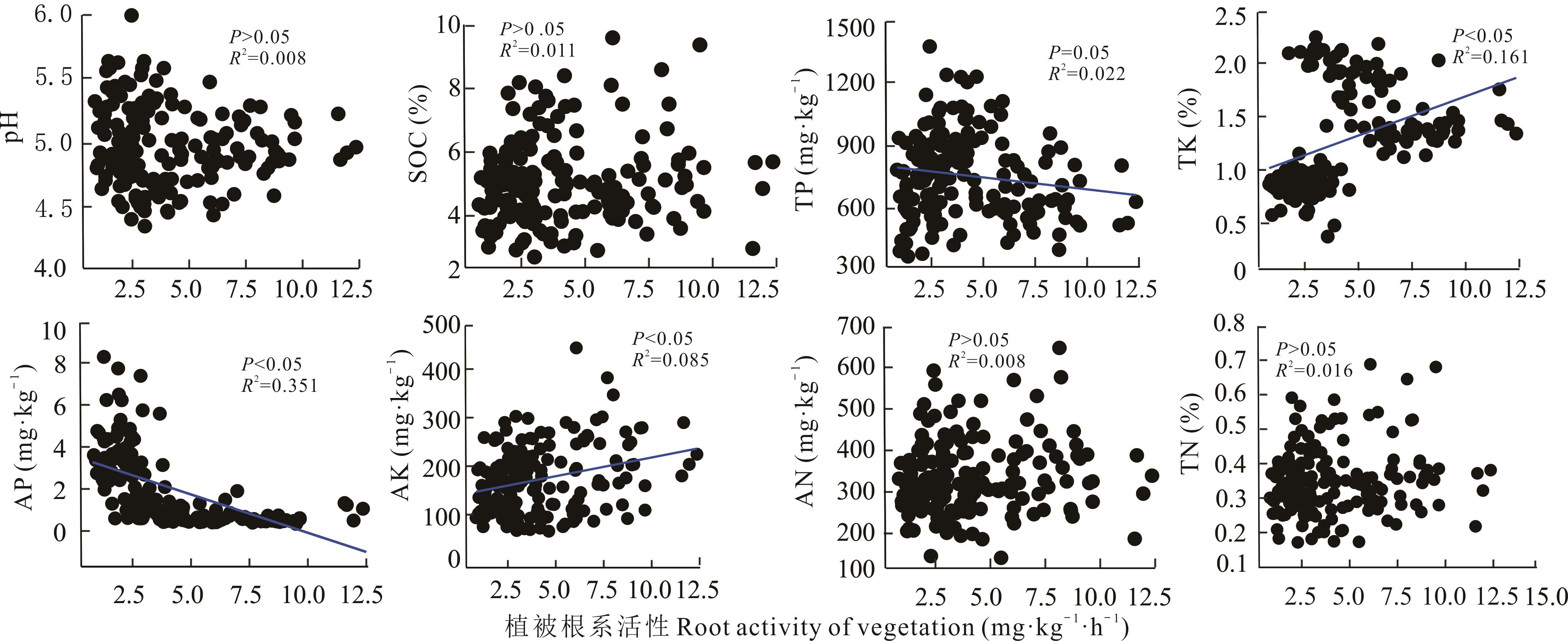
图2 植被根系活性与潜在影响因子回归分析SOC: 土壤有机碳Soil organic carbon; TP: 全磷Total phosphorus; TK: 全钾Total potassium; AP: 速效磷Available phosphorus; AK: 速效钾Available potassium; AN: 速效氮Available nitrogen; TN: 全氮Total nitrogen.
Fig.2 Regression analysis of root activity and potential influencing factors
| 1 | Yang X Y, Xia T Y, Wu T. Potassium nutrient stress in plants: A review. Chinese Agricultural Science Bulletin, 2023, 39(18): 101-106. |
| 杨晓燕, 夏体渊, 吴甜. 植物钾营养胁迫研究进展. 中国农学通报, 2023, 39(18): 101-106. | |
| 2 | Du Q, Zhao X H, Jiang C J, et al. Effect of potassium deficiency on root growth and nutrient uptake in maize (Zea mays L.). Agricultural Sciences, 2017, 8(11): 1263-1277. |
| 3 | Liu C E, Yang Y X, Yang Y. Distribution, accumulation and dynamics of kalium of wetland plants in upper shoal of the Jiuduansha, Shanghai. Wetland Science, 2008, 6(2): 185-191. |
| 刘长娥, 杨永兴, 杨杨. 九段沙上沙湿地植物钾元素的分布、积累与动态. 湿地科学, 2008, 6(2): 185-191. | |
| 4 | Luo T, Yin X D, Qu S M, et al. Effects of photovoltaic panels on quantitative characteristics of plant functional groups in meadow steppe. Grassland and Turf, 2023, 43(6): 32-37. |
| 罗厅, 尹晓冬, 曲善民, 等. 光伏电板对草甸草原植物功能群数量特征的影响. 草原与草坪, 2023, 43(6): 32-37. | |
| 5 | Tian Z Q, Zhang Y, Liu X, et al. Effects of photovoltaic power station construction on terrestrial environment: Retrospect and prospect. Environmental Science, 2024, 45(1): 239-247. |
| 田政卿, 张勇, 刘向, 等. 光伏电站建设对陆地生态环境的影响: 研究进展与展望. 环境科学, 2024, 45(1): 239-247. | |
| 6 | Liu L J. Study on spatial heterogeneity of soil water and soil total carbon of alpine area in eastern Qinghai-Tibetan Plateau. Chengdu: Sichuan Normal University, 2008. |
| 柳领君. 青藏高原东缘高寒地区土壤水分与土壤全碳空间异质性研究. 成都: 四川师范大学, 2008. | |
| 7 | Zhou Z Y, Cui B L, Chen K L, et al. Effects of simulated changes in precipitation on soil respiration in alpine lakeshore wetlands. Research of Soil and Water Conservation, 2023, 30(5): 130-137. |
| 周祉蕴, 崔博亮, 陈克龙, 等. 模拟降雨量变化对高寒湖滨湿地土壤呼吸的影响. 水土保持研究, 2023, 30(5): 130-137. | |
| 8 | Bao S D. Soil agricultural and chemical analysis (3rd edition). Beijing: China Agricultural Press, 1999. |
| 鲍士旦. 土壤农化分析(第3版). 北京: 中国农业出版社,1999. | |
| 9 | Ye B X, Mao D C, Liu X C. Study on the correlation of root activity and photosynthetic rate in the later growth duration of super-wheat. Shandong Agricultural Sciences, 2005(4): 4-16. |
| 叶宝兴, 毛达超, 刘学春. 超级小麦生育后期根系活力与净光合速率相关性的研究. 山东农业科学, 2005(4): 4-16. | |
| 10 | Mareri L, Parrotta L, Cai G. Environmental stress and plants. International Journal of Molecular Sciences, 2022, 23(10): 16-29. |
| 11 | Caboň M, Galvánek D, Etheredge A P, et al. Mulching has negative impact on fungal and plant diversity in Slovak oligotrophic grasslands. Basic and Applied Ecology, 2021, 52(2): 24-37. |
| 12 | Han X, Li Y H, Du X F, et al. Effect of grassland degradation on soil quality and soil biotic community in a semi-arid temperate steppe. Ecological Processes, 2020, 63(9): 1-11. |
| 13 | Li C X, Wu X B, Jin Y Z. Advances on plant-microbe interaction mediated by root metabolites. Acta Microbiologica Sinica, 2022, 62(9): 3318-3328. |
| 李春霞, 吴兴彪, 靳亚忠. 根系代谢物介导的植物-微生物互作的研究进展. 微生物学报, 2022, 62(9): 3318-3328. | |
| 14 | Wu J Q, Ma W W, Li G, et al. Effects of four vegetation types on soil physical characteristics and permeability in Loess Plateau. Journal of Soil and Water Conservation, 2018, 32(4): 133-138. |
| 吴江琪, 马维伟, 李广, 等. 黄土高原4种植被类型对土壤物理特征及渗透性的影响. 水土保持学报, 2018, 32(4): 133-138. | |
| 15 | You Y, Jiang W, Yi L, et al. Seeding alpine grasses in low altitude region increases global warming potential during early seedling growth. Journal of Environmental Management, 2024, 356(4): 120-138. |
| 16 | Jiang X Y, Yang S Q, Feng F, et al. Experimental study on the influence of vegetation roots on soil permeability. Journal of Hefei University of Technology (Natural Science), 2022, 45(3): 370-375. |
| 蒋希雁, 杨尚青, 冯峰, 等. 植被根系对土体渗透特性影响的试验研究.合肥工业大学学报(自然科学版), 2022, 45(3): 370-375. | |
| 17 | Papdi E, Veres A, Kovács F, et al. How different mulch materials regulate soil moisture and microbiological activity? Journal of Central European Green Innovation, 2022, 10(9): 26-38. |
| 18 | Wang T. The impact of photovoltaic power construction on soil and vegetation in Jingbian County. Yangling: Northwest A&F University, 2015. |
| 王涛. 光伏电站建设对靖边县土壤、植被的影响研究. 杨凌: 西北农林科技大学, 2015. | |
| 19 | Li L Z, Liu H, Shi X F, et al. A brief analysis of the impact of photovoltaic power stations on the environment. Science & Technology Information, 2012, 41(12): 91. |
| 李丽珍, 刘辉, 史学峰, 等. 浅析光伏电站对环境的影响. 科技信息, 2012, 41(12): 91. | |
| 20 | Geng X D, Xu R, Liu Y W. Responses of ecosystem carbon exchange to multi-level water addition in an alpine meadow in Namtso of Qinghai-Xizang Plateau, China.Chinese Journal of Plant Ecology, 2018, 42(3): 397-405. |
| 耿晓东, 旭日, 刘永稳. 青藏高原纳木错高寒草甸生态系统碳交换对多梯度增水的响应. 植物生态学报, 2018, 42(3): 397-405. | |
| 21 | Zhang J, Yuan M S, Zhang J, et al. Responses of the NDVI of alpine grasslands on the Qinghai-Tibetan Plateau to climate change and human activities over the last 30 years. Acta Ecologica Sinica, 2020, 40(18): 6269-6281. |
| 张江, 袁旻舒, 张婧, 等. 近30年来青藏高原高寒草地NDVI动态变化对自然及人为因子的响应. 生态学报, 2020, 40(18): 6269-6281. | |
| 22 | Rondina A B L, Tonon B C, Lescano L E A M, et al. Plants of distinct successional stages have different strategies for nutrient acquisition in an Atlantic rain forest ecosystem. International Journal of Plant Sciences, 2019, 180(3): 186-199. |
| 23 | Zheng Z, Wu X, Gong L, et al. Studies on the correlation between δ13C and nutrient elements in two desert plants. Forests, 2023, 14(12): 23-38. |
| 24 | Tang K, Zhu W W, Zhou W X, et al. Research progress on effects of soil pH on plant growth and development. Crop Research, 2013, 27(2): 207-212. |
| 唐琨, 朱伟文, 周文新, 等. 土壤pH对植物生长发育影响的研究进展. 作物研究, 2013, 27(2): 207-212. | |
| 25 | Lian M H, Sun L N, Hu X M, et al. Effect of pH on cadmium speciation in rhizosphere soil solutions of different cadmium accumulating plants. Chinese Journal of Ecology, 2015, 34(1): 130-137. |
| 廉梅花, 孙丽娜, 胡筱敏, 等. pH 对不同富集能力植物根际土壤溶液中镉形态的影响. 生态学杂志, 2015, 34(1): 130-137. | |
| 26 | Ni H J, Su W H, Fan S H, et al. Responses of forest soil nutrient cycling to nutrient input modes: A review. Chinese Journal of Ecology, 2019, 38(3): 863-872. |
| 倪惠菁, 苏文会, 范少辉, 等. 养分输入方式对森林生态系统土壤养分循环的影响研究进展. 生态学杂志, 2019, 38(3): 863-872. | |
| 27 | Centenaro G, Hudek C, Zanella A, et al. Root-soil physical and biotic interactions with a focus on tree root systems: A review. Applied Soil Ecology, 2018, 123(2): 318-327. |
| 28 | Yang J X, Yin W J, Yang X R. Application of turf stripping and re-laying technology in the Sichuan-Tibet power grid interconnection project. Technology Innovation and Appllication, 2014(19): 24-25. |
| 杨建霞, 尹武君, 杨晓瑞. 草皮剥离回铺技术在川藏联网工程中的应用. 科技创新与应用, 2014(19): 24-25. | |
| 29 | Kong Y Y, Luo Q Y, Chen Z. Study on the characteristics of vegetation composition and community succession of alpine meadow under three management modes. Journal of Yunnan Agricultural University (Natural Sciences), 2020, 35(6): 1046-1053. |
| 孔杨云, 罗巧玉, 陈志. 3种管理模式下高寒草甸植物群落构成及稳定性研究. 云南农业大学学报(自然科学), 2020, 35(6): 1046-1053. | |
| 30 | Xian G. Huadian Changdu New Energy Company: Top-level design draws a green blueprint, harmonious coexistence guards the third pole. (2024-06-06)[2025-01-03]. https://k.sina.com.cn/article_7517400647_1c0126e4705905939s.html. |
| 鲜敢. 华电昌都新能源公司: 顶层设计绘就绿蓝图, 和谐共生守护第三极. (2024-06-06)[2025-01-03]. https://k.sina.com.cn/article_7517400647_1c0126e4705905939s.html. |
| [1] | 王颖, 李明源, 麦日艳古·亚生null, 王继莲. 新疆托木尔峰不同植物根际土壤真菌群落结构比较研究[J]. 草业学报, 2025, 34(7): 83-94. |
| [2] | 刘文谨, 蒋福祯, 祁凯斌, 宋明丹, 李正鹏. 不同施肥量和播种量对高寒矿区植被恢复和土壤质量的影响及综合评价[J]. 草业学报, 2025, 34(5): 27-39. |
| [3] | 刘欢, 董凯, 仁增旺堆, 王敬龙, 刘云飞, 赵桂琴. 藏沙蒿与多年生禾草混播对西藏沙化草地植被及土壤真菌群落特征的影响[J]. 草业学报, 2023, 32(6): 45-57. |
| [4] | 闫晓红, 牛建明, 李元恒, 伊风艳, 孙世贤, 金轲, 李西良. 物种优先效应对植物群落构建的影响及其生态恢复意义[J]. 草业学报, 2022, 31(10): 217-225. |
| [5] | 任军, 石遥, 刘方, 田蓉, 刘兴. 贵州锰矿废渣堆场重金属污染风险评价及草本植物重金属吸收特征[J]. 草业学报, 2021, 30(8): 86-97. |
| [6] | 刘慧霞, 董乙强, 崔雨萱, 刘星宏, 何盘星, 孙强, 孙宗玖. 新疆阿勒泰地区荒漠草地土壤有机碳特征及其环境影响因素分析[J]. 草业学报, 2021, 30(10): 41-52. |
| [7] | 万志强, 杨九艳, 闫玉龙, 谷蕊, 杨劼, 高清竹. 不同刈割频度对大针茅草原土壤呼吸及其土壤因子的影响[J]. 草业学报, 2017, 26(7): 225-231. |
| [8] | 杨阳, 刘秉儒. 宁夏荒漠草原不同群落生物多样性与生物量关系及影响因子分析[J]. 草业学报, 2015, 24(10): 48-57. |
| [9] | 邓钰,柳小妮,闫瑞瑞,王旭,杨桂霞,任正超,辛晓平. 呼伦贝尔草甸草原土壤呼吸及其影响因子对不同放牧强度的响应[J]. 草业学报, 2013, 22(2): 22-29. |
| [10] | 黄玺,李春杰,南志标. 紫花苜蓿与醉马草的竞争效应[J]. 草业学报, 2012, 21(1): 59-65. |
| [11] | 李志刚,侯扶江*. 黄土高原不同地形封育草地的土壤呼吸日动态与影响因子分析[J]. 草业学报, 2010, 19(1): 42-49. |
| 阅读次数 | ||||||
|
全文 |
|
|||||
|
摘要 |
|
|||||
