

ISSN 1004-5759 CN 62-1105/S
草业学报 ›› 2026, Vol. 35 ›› Issue (1): 130-139.DOI: 10.11686/cyxb2025067
• 研究论文 • 上一篇
王若非( ), 李昕哲, 李祺策, 张嘉仪, 王焙钧, 谢文刚()
收稿日期:2025-03-04
修回日期:2025-04-15
出版日期:2026-01-20
发布日期:2025-11-13
通讯作者:
谢文刚
作者简介:E-mail: xiewg@lzu.edu.cn基金资助:
Ruo-fei WANG(), Xin-zhe LI, Qi-ce LI, Jia-yi ZHANG, Bei-jun WANG, Wen-gang XIE()
Received:2025-03-04
Revised:2025-04-15
Online:2026-01-20
Published:2025-11-13
Contact:
Wen-gang XIE
摘要:
本研究以老芒麦为材料,旨在评估不同浓度(0、50、100、150和200 mg·L-1)纳米硅处理对其苗期抗寒性的影响。通过低温胁迫试验和纳米硅处理,发现在低温胁迫下纳米硅处理显著促进了老芒麦根系的伸长(P<0.05),而对株高无显著影响(P>0.05)。此外,对试验中各指标全面综合分析表明,和对照相比,200 mg·L-1纳米硅处理组老芒麦幼苗的根长、脯氨酸含量、叶绿素含量分别提高了63.2%、178.6%和15.6%,相对电导率、丙二醛含量和脱落酸含量分别降低了17.5%、3.88%和2.23%。综上,纳米硅可通过调节细胞渗透压、维持光合作用效率以及调节植物激素水平等维持植物在低温胁迫下能正常进行生理代谢,以增强植物的抗寒性。本研究为纳米硅在牧草抗寒育种中的应用提供了理论支撑。
王若非, 李昕哲, 李祺策, 张嘉仪, 王焙钧, 谢文刚. 不同浓度的硅处理对老芒麦苗期抗寒性的影响[J]. 草业学报, 2026, 35(1): 130-139.
Ruo-fei WANG, Xin-zhe LI, Qi-ce LI, Jia-yi ZHANG, Bei-jun WANG, Wen-gang XIE. Effects of different concentrations of silicon on the cold resistance of Elymus sibiricus seedlings[J]. Acta Prataculturae Sinica, 2026, 35(1): 130-139.
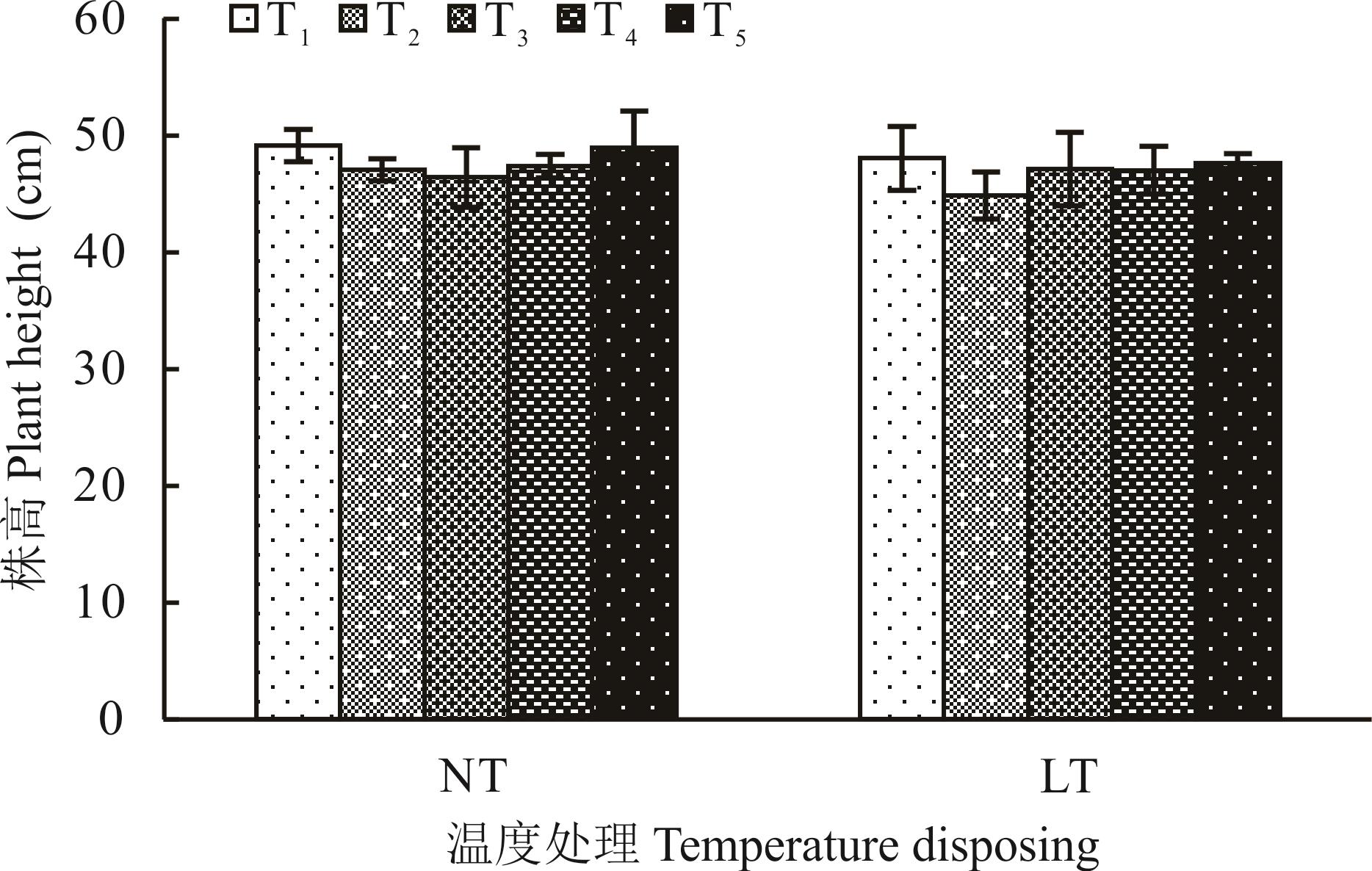
图1 不同浓度纳米硅处理对老芒麦幼苗株高的影响误差棒为标准差Error bars represent standard deviation (SD). T1~5: 0, 50, 100, 150, 200 mg·L-1纳米硅Nano silicon. NT: 常温组(22 ℃)Normal temperature group (22 ℃); LT: 低温组(4 ℃) Low temperature group (4 ℃). 下同The same below.
Fig.1 Effects of different concentrations of nano-silicon treatments on plant height of E. sibiricus seedlings
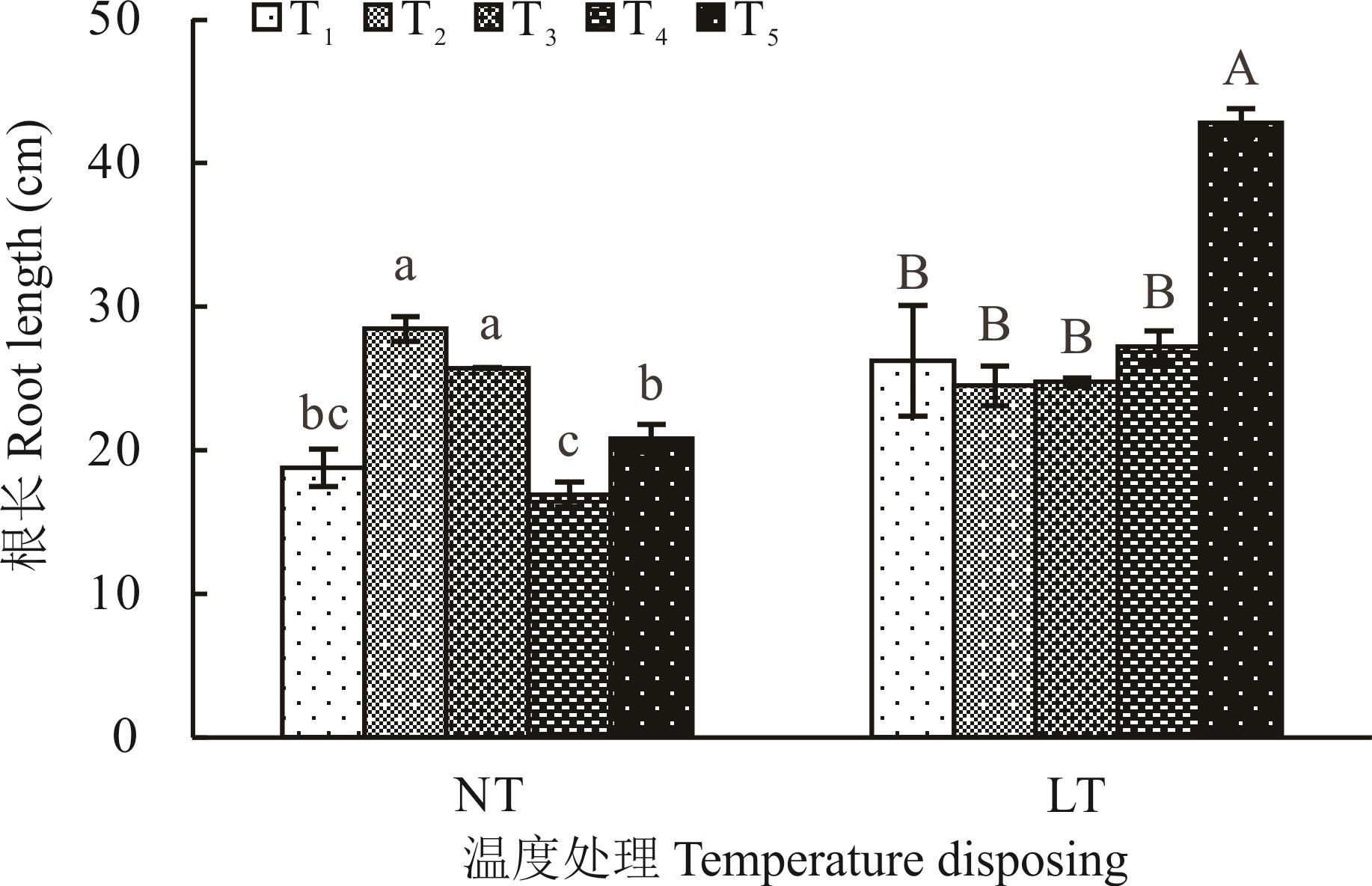
图2 不同浓度纳米硅处理对老芒麦幼苗根长的影响不同小写字母表示在常温处理下各组间有显著性差异(P<0.05);不同大写字母表示低温处理下各组间有差异显著(P<0.05)。Different lowercase letters indicate significant differences (P<0.05) among groups under normal temperature; Different uppercase letters denote significant differences (P<0.05) among groups under low temperature. 下同The same below.
Fig.2 Effects of different concentrations of nano-silicon treatments on root length of E. sibiricus seedlings
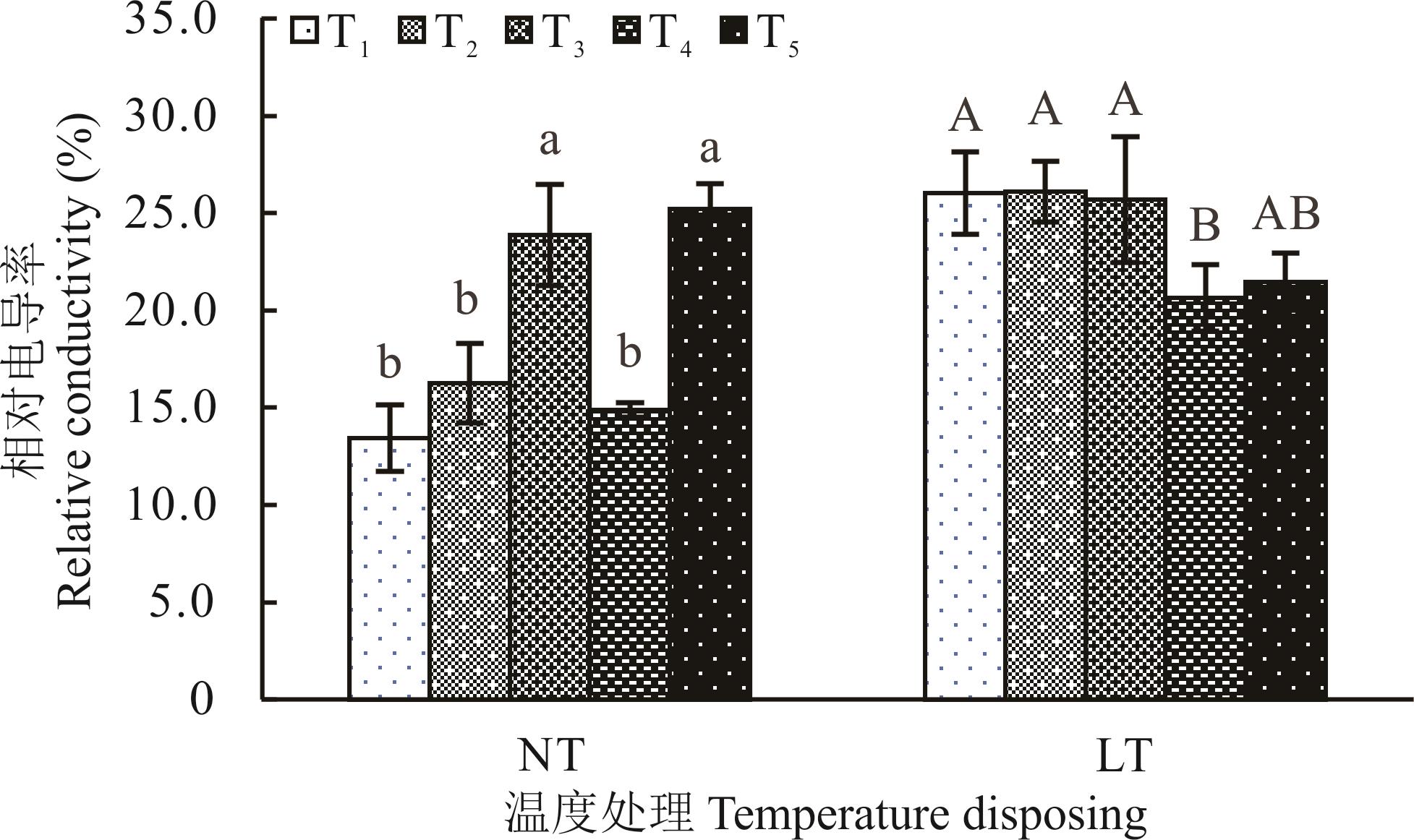
图3 不同浓度纳米硅处理对老芒麦幼苗相对电导率的影响
Fig.3 Effects of different concentrations of nano-silicon treatments on the relative conductivity of E. sibiricus seedlings
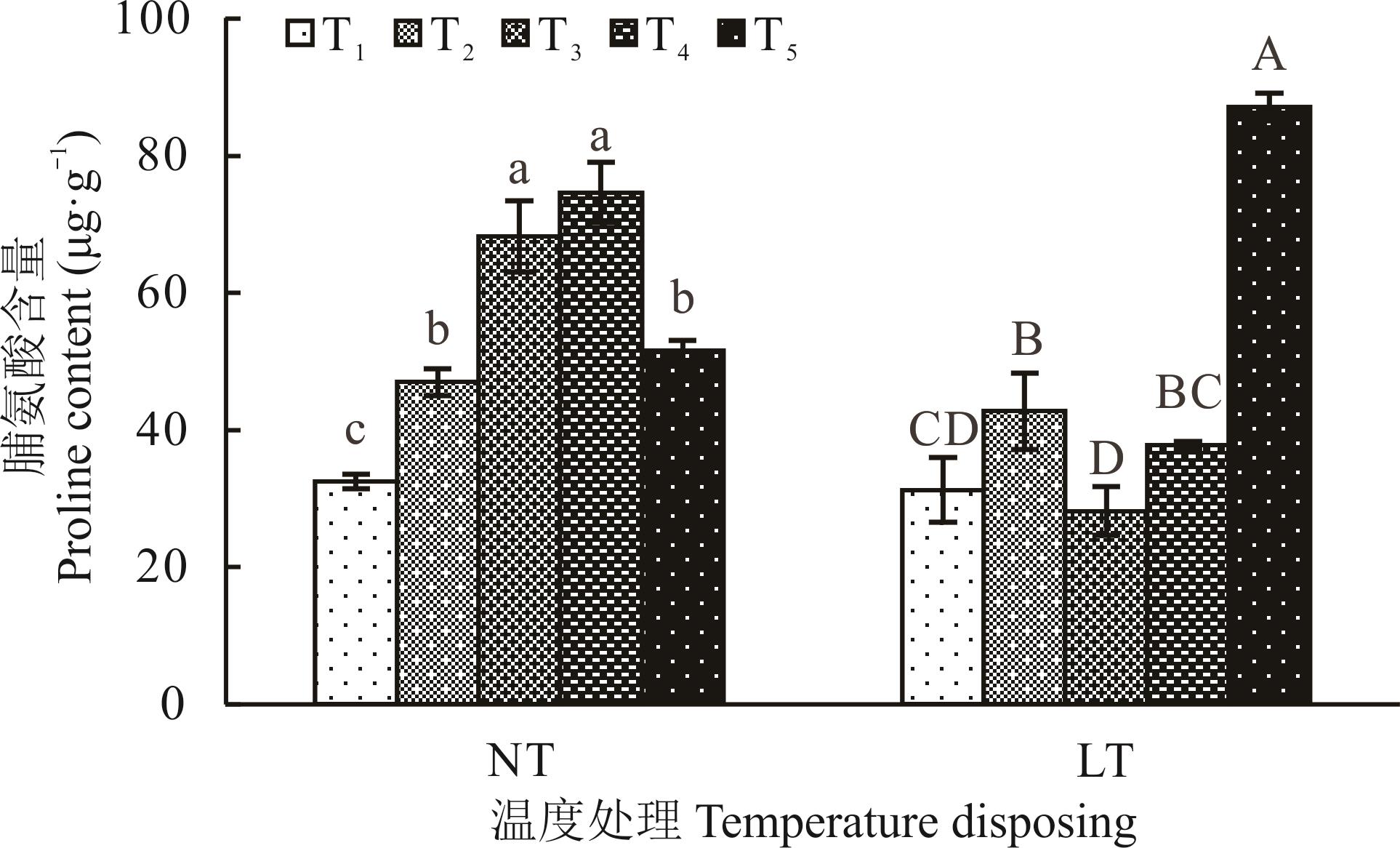
图4 不同浓度纳米硅处理对老芒麦幼苗脯氨酸含量的影响
Fig.4 Effects of different concentrations of nano-silicon treatments on proline content of E. sibiricus seedlings
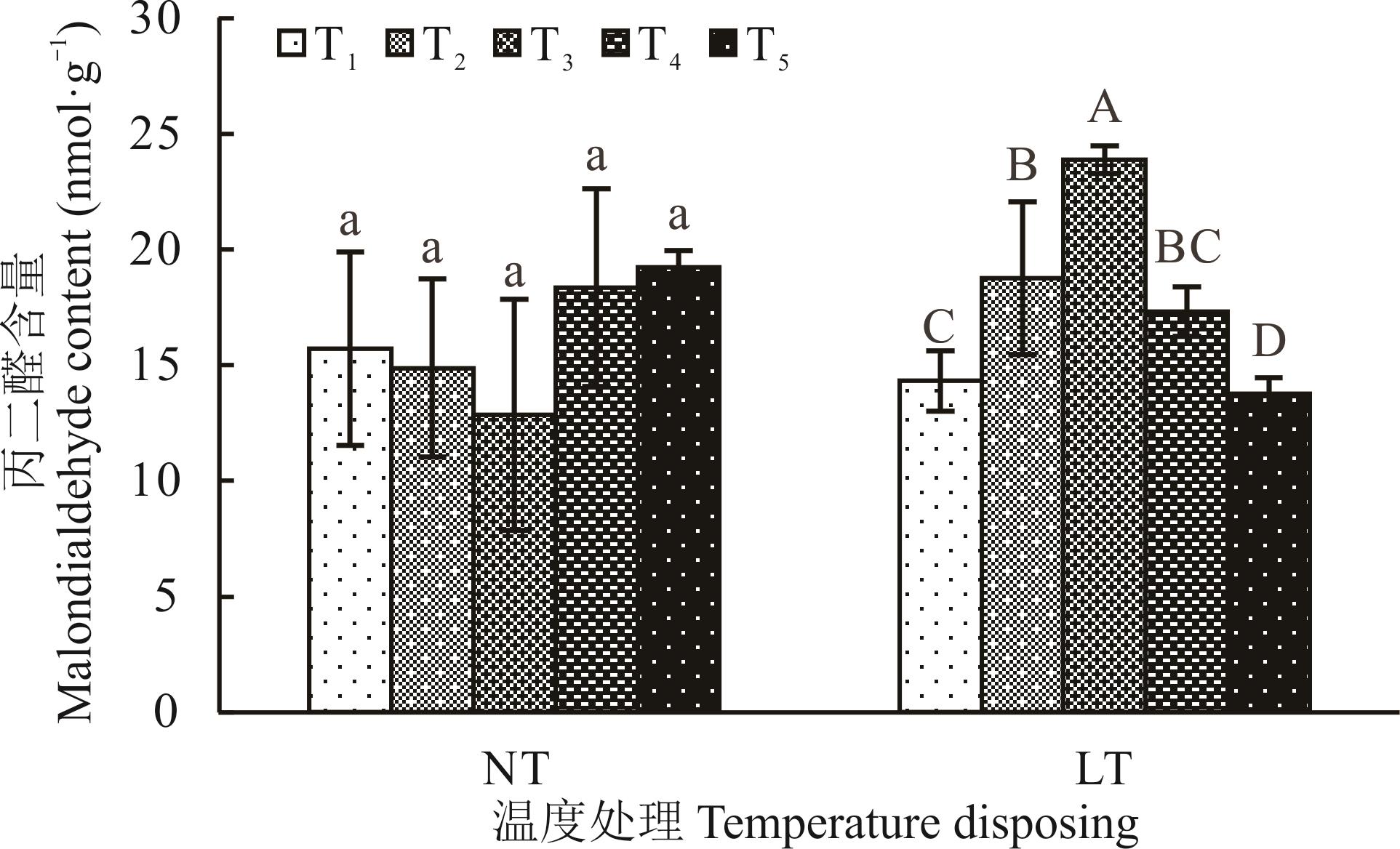
图5 不同浓度纳米硅处理对老芒麦幼苗丙二醛含量的影响
Fig.5 Effects of different concentrations of nano-silicon treatments on malondialdehyde content of E. sibiricus seedlings
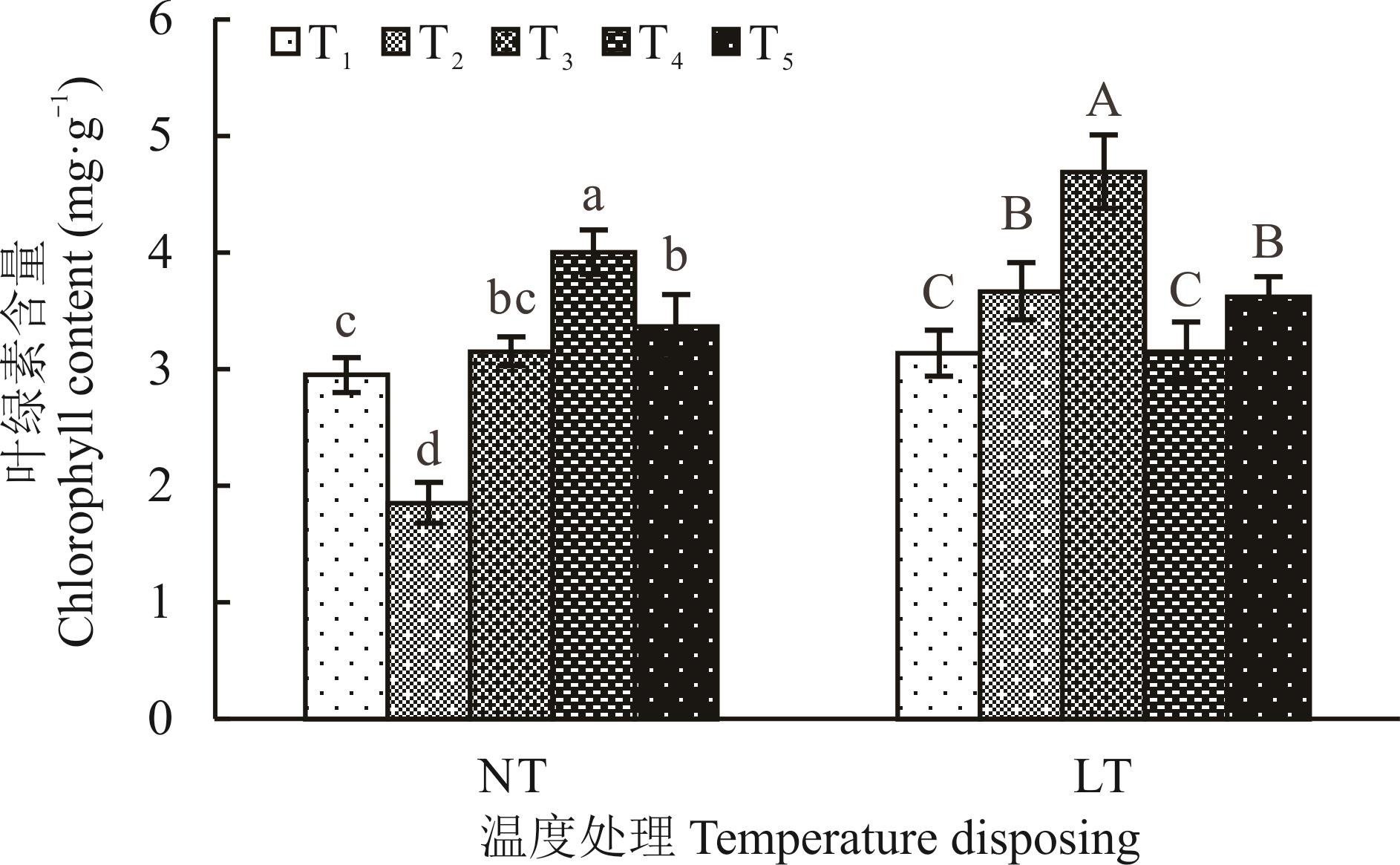
图6 不同浓度纳米硅处理对老芒麦幼苗叶绿素含量的影响
Fig.6 Effects of different concentrations of nano-silicon treatments on chlorophyll content of E. sibiricus seedlings
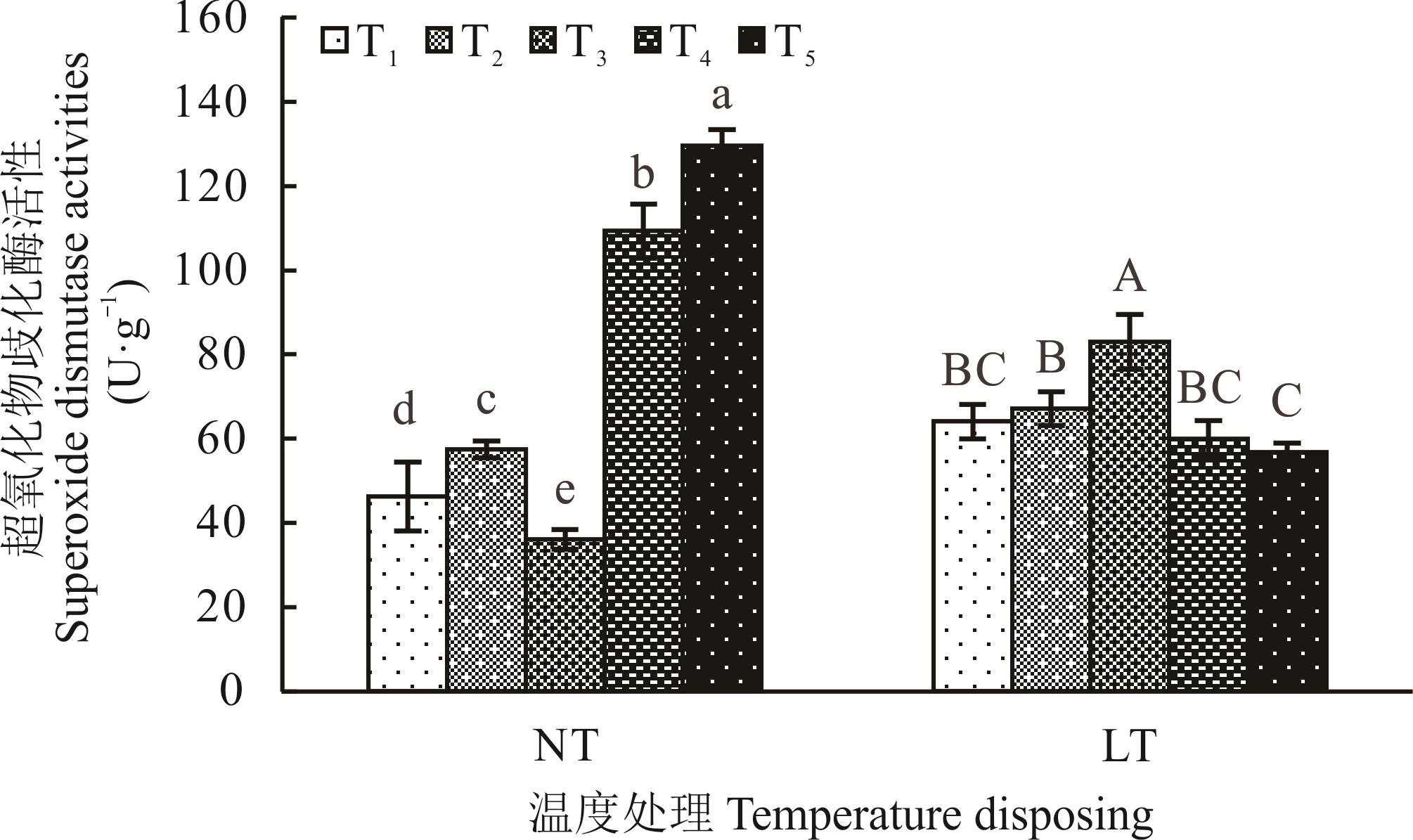
图7 不同浓度纳米硅处理对老芒麦幼苗超氧化物歧化酶活性的影响
Fig.7 Effects of different concentrations of nano-silicon treatments on superoxide dismutase activity of E. sibiricus seedlings
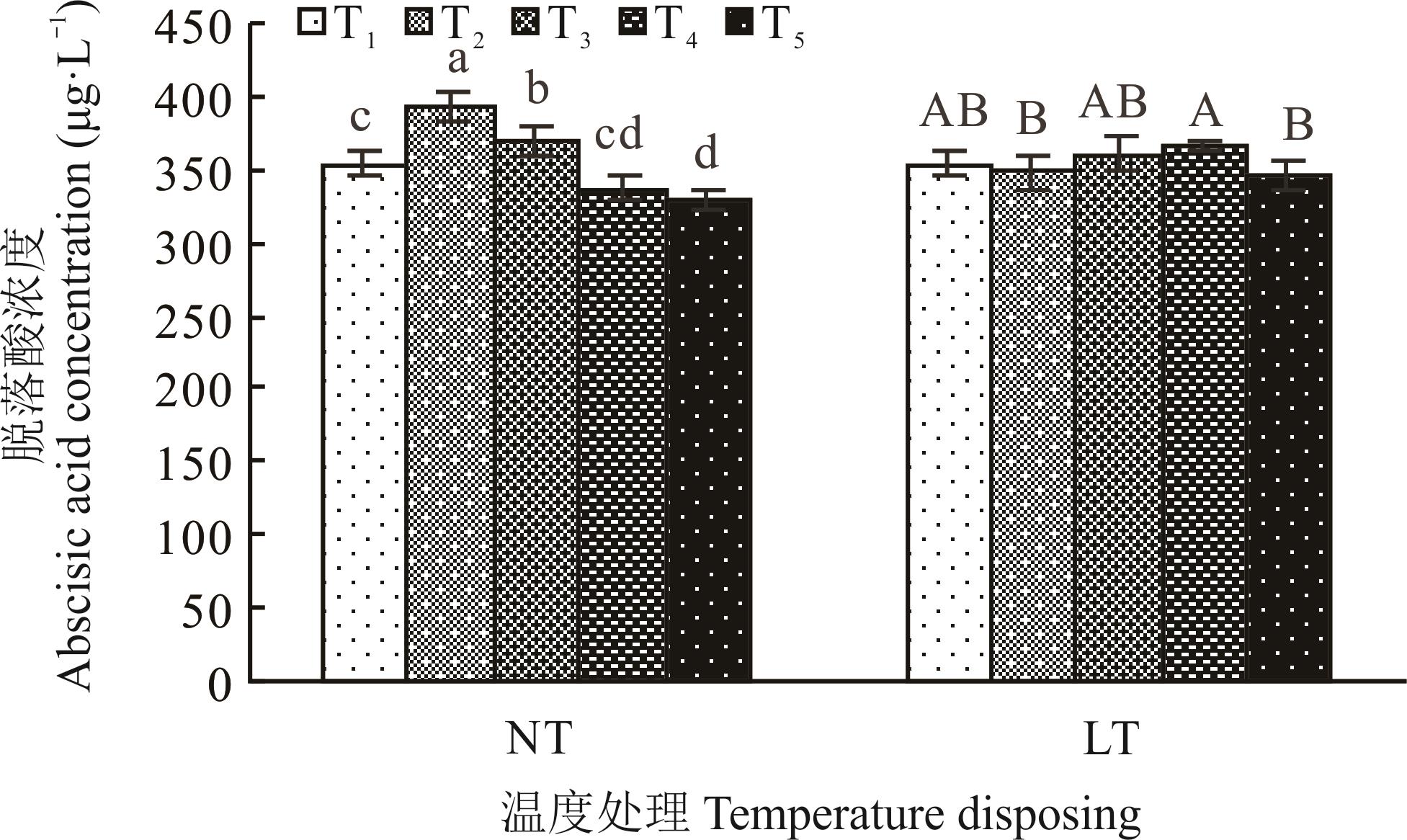
图8 不同浓度纳米硅处理对老芒麦幼苗脱落酸浓度的影响
Fig.8 Effects of different concentrations of nano-silicon treatments on abscisic acid concentration in E. sibiricus seedlings
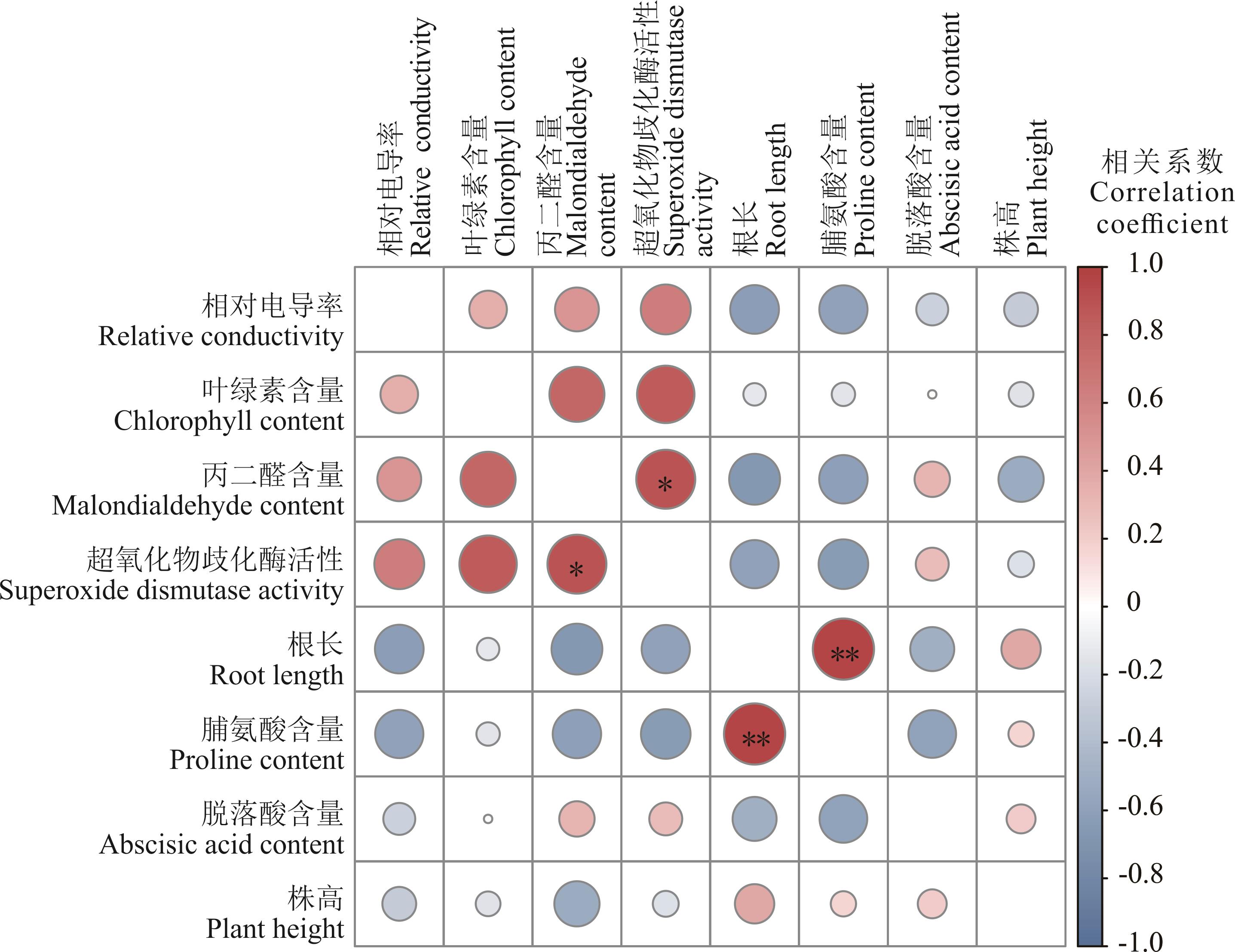
图9 抗寒指标相关性分析*用以标识变量间存在显著相关性(P<0.05),而**则指示变量间呈极显著的相关性(P<0.01)。* was used to identify the significant correlation between variables (P<0.05),while ** indicated that there was a extremely significant correlation between variables (P<0.01).
Fig.9 Correlation analysis of cold tolerance related traits
处理 Treatment | 隶属函数值Subordinate function values | 综合评价值 Comprehensive evaluation value | 排序 Rank | |||||
|---|---|---|---|---|---|---|---|---|
相对电导率 Relative conductivity | 脯氨酸 Proline | 丙二醛 Malondialdehyde | 叶绿素 Chlorophyll | 超氧化物歧化酶 Superoxide dismutase | 脱落酸 Abscisic acid | |||
| T1 | 0.0129 | 0.0523 | 0.9451 | 0 | 0.2796 | 0.3893 | 0.2799 | 4 |
| T2 | 0 | 0.2471 | 0.5071 | 0.3419 | 0.3951 | 0.0912 | 0.2637 | 5 |
| T3 | 0.0776 | 0 | 0 | 1.0000 | 1.0000 | 0.6945 | 0.4620 | 3 |
| T4 | 1.0000 | 0.1629 | 0.6491 | 0.0110 | 0.1250 | 1.0000 | 0.4913 | 2 |
| T5 | 0.8463 | 1.0000 | 1.0000 | 0.3133 | 0 | 0 | 0.5266 | 1 |
表1 不同浓度纳米硅处理下苗期老芒麦抗寒性隶属函数值及综合评价
Table 1 Membership function value and comprehensive evaluation of cold resistance of E. sibiricus under different concentrations of nano-silicon treatments
处理 Treatment | 隶属函数值Subordinate function values | 综合评价值 Comprehensive evaluation value | 排序 Rank | |||||
|---|---|---|---|---|---|---|---|---|
相对电导率 Relative conductivity | 脯氨酸 Proline | 丙二醛 Malondialdehyde | 叶绿素 Chlorophyll | 超氧化物歧化酶 Superoxide dismutase | 脱落酸 Abscisic acid | |||
| T1 | 0.0129 | 0.0523 | 0.9451 | 0 | 0.2796 | 0.3893 | 0.2799 | 4 |
| T2 | 0 | 0.2471 | 0.5071 | 0.3419 | 0.3951 | 0.0912 | 0.2637 | 5 |
| T3 | 0.0776 | 0 | 0 | 1.0000 | 1.0000 | 0.6945 | 0.4620 | 3 |
| T4 | 1.0000 | 0.1629 | 0.6491 | 0.0110 | 0.1250 | 1.0000 | 0.4913 | 2 |
| T5 | 0.8463 | 1.0000 | 1.0000 | 0.3133 | 0 | 0 | 0.5266 | 1 |
| [1] | He Y T, Hu Y, Duan H R, et al. Comprehensive evaluation of cold resistance of four Elymus forage varieties at the seedling stage. Pratacultural Science, 2024, 41(10): 2377-2388. |
| 何永涛, 胡宇, 段慧荣, 等. 披碱草属4个牧草品种苗期抗寒性综合评价. 草业科学, 2024, 41(10): 2377-2388. | |
| [2] | Zhang L. Climate adaptability analysis of returning farmland to forestry and grassland in central Gansu——taking Dingxi city as an example. Gansu Science and Technology, 2020, 36(18): 152-156, 137. |
| 张玲. 甘肃中部退耕还林还草气候适应性分析——以定西市为例. 甘肃科技, 2020, 36(18): 152-156, 137. | |
| [3] | Du H, Zhang L J, Zhu Q N, et al. Current situation of research on equipment and technology for facility temperature regulation. Journal of Ningxia Agriculture and Forestry Science and Technology, 2024, 65(7): 53-58. |
| 杜涵, 张丽娟, 朱倩楠, 等. 设施温度调控装置装备与技术研究现状. 宁夏农林科技, 2024, 65(7): 53-58. | |
| [4] | Shi J Y, Wang Y F, Mao P S. Effect of PEG priming on antioxidant physiology of deteriorated siberian wildrye seeds during imbibition. Chinese Journal of Grassland, 2024, 46(12): 24-32. |
| 石金玉, 王一帆, 毛培胜. PEG引发对老芒麦劣变种子吸胀过程中抗氧化生理的影响. 中国草地学报, 2024, 46(12): 24-32. | |
| [5] | Mao P S, Han J G, Wu X C. Effects of harvest time on seed yield of Siberian wildrye. Acta Agrestia Sinica, 2003, 11(1): 33-37. |
| 毛培胜, 韩建国, 吴喜才. 收获时间对老芒麦种子产量的影响. 草地学报, 2003, 11(1): 33-37. | |
| [6] | Liu X Y, Wang C X, Ye Q, et al. Research progress on the wound-healing mechanism and methods of tuber and root crop. Acta Horticulturae Sinica, 2024, 51(12): 2962-2976. |
| 刘晓宇, 王彩霞, 叶麒, 等. 薯类愈伤机制及其愈伤方法研究进展. 园艺学报, 2024, 51(12): 2962-2976. | |
| [7] | Feng Y M, Nong W, Chen X Y, et al. Physiological mechanism of aluminum tolerance of rice root border cells and root tips induced by nano silica biomineralization deposition. Scientia Agricultura Sinica, 2024, 57(24): 4871-4883. |
| 冯英明, 农伟, 陈醒韵, 等. 纳米硅生物矿化沉积赋予水稻根边缘细胞及根尖耐铝性的生理机制. 中国农业科学, 2024, 57(24): 4871-4883. | |
| [8] | Ji C, Guo S X, Zhao Y L, et al. Effect of nano-silicon on tomato root conformation and soil enzyme activity under low temperature stress. Shaanxi Journal of Agricultural Sciences, 2024, 70(4): 17-22. |
| 姬晨, 郭树勋, 赵晏俪, 等. 纳米硅对低温胁迫下番茄根系构型及土壤酶活性的影响. 陕西农业科学, 2024, 70(4): 17-22. | |
| [9] | Deng H H, Mo X L, Zhu X H, et al. Research progress on the effects of nano-silicon materials on plant growth and environmental response. Journal of Zhejiang Agricultural Sciences, 2024, 65(6): 1496-1501. |
| 邓欢欢, 莫小丽, 朱星辉, 等. 纳米硅材料对植物生长发育和环境响应的影响研究进展. 浙江农业科学, 2024, 65(6): 1496-1501. | |
| [10] | Wei Y X, Li T, Huang J, et al. Effect of soaking cuttings with chlormequat on Manihot esculenta Crantzgrowth at the seedling stage. Seed, 2024, 43(5): 16-23. |
| 魏云霞, 李天, 黄洁, 等. 矮壮素浸种对木薯苗期生长的影响. 种子, 2024, 43(5): 16-23. | |
| [11] | Chen X M, Tang Y K, Yin J J, et al. Effect of colonization ofmanganese oxidizing bacteria on the removal of manganese and ammonia nitrogen from water by floating plant Pistia stratiotes. Journal of Anhui Agricultural Sciences, 2024, 52(20): 59-64. |
| 陈学敏, 唐艳葵, 尹涓涓, 等. 锰氧化细菌定殖对漂浮植物大薸去除水中锰和氨氮的影响. 安徽农业科学, 2024, 52(20): 59-64. | |
| [12] | Zhu R J, Wen M M, Lang H S, et al. Physiological and biochemical response and related gene expression of Hongyang kiwiftuit seedlings under salt stress. Journal of Fruit Science, 2024, 41(11): 2224-2234. |
| 朱润洁, 闻蒙蒙, 郎红珊, 等. 红阳猕猴桃盐胁迫下生理生化响应及相关基因表达分析. 果树学报, 2024, 41(11): 2224-2234. | |
| [13] | Shu X, Su X L, Yan L J, et al. Effects of exogenous salicylic acid on seed germination and seedling of Elymus sibiricus under NaCl stress. Chinese Journal of Grassland, 2024, 46(1): 87-96. |
| 舒欣, 苏晓丽, 闫利军, 等. 外源水杨酸对NaCl胁迫下老芒麦种子萌发和幼苗的影响. 中国草地学报, 2024, 46(1): 87-96. | |
| [14] | Wang M, Li L, Jia R, et al. Evaluation of physiological characteristics and cold resistance of 10 alfalfa varieties under low temperature stress. Acta Prataculturae Sinica, 2024, 33(6): 76-88. |
| 王敏, 李莉, 贾蓉, 等. 10种紫花苜蓿在低温胁迫下的生理特性及耐寒性评价. 草业学报, 2024, 33(6): 76-88. | |
| [15] | Liu B H, Sa R N, Ge B B, et al. Growth-promoting effects of rhizosphere growth promoting bacteria A2 on germination and seedling stage of wheat under water stress. Chinese Agricultural Science Bulletin, 2016, 32(29): 64-69. |
| 刘炳花, 萨日娜, 葛蓓孛, 等. 在水分胁迫下根际促生菌A2对小麦萌芽期和苗期的促生效应. 中国农学通报, 2016, 32(29): 64-69. | |
| [16] | Ge Y, Lin W H, Gao H Y. Research progress on drought resistance of Chinese medicinal plantlicoriceand its application in desertification control. Journal of Agricultural Catastrophology, 2024, 14(9): 49-51. |
| 戈艳, 蔺万煌, 高鸿永. 中药材甘草植物抗旱性及其在沙漠治理中研究进展. 农业灾害研究, 2024, 14(9): 49-51. | |
| [17] | Zhao J S, Rao Y, Ren H M, et al. Effects of different amino acid water-soluble fertilizers on the growth and yield of Schisandra chinensis. Modernizing Agriculture, 2024(10): 21-23. |
| 赵峻生, 饶悦, 任鸿濛, 等. 不同氨基酸水溶肥对五味子生长和产量的影响. 现代化农业, 2024(10): 21-23. | |
| [18] | Bao X P, Wang M X, Cui L, et al. Evaluation on correlations of three kinds of osmoregulation substances in tea fresh leaves with low temperature during winter and spring respectively and their difference among cultivars. Scientia Agricultura Sinica, 2016, 49(19): 3807-3817. |
| 薄晓培, 王梦馨, 崔林, 等. 茶树3类渗透调节物质与冬春低温相关性及其品种间的差异评价. 中国农业科学, 2016, 49(19): 3807-3817. | |
| [19] | Chen Y E, Liang Q L. Research progress in the effects of plant abscisic acid and its receptor gene PYL9. Biotechnology Bulletin, 2024, 40(12): 1-11. |
| 陈应娥, 梁巧兰. 植物脱落酸及其受体基因PYL9的作用研究进展. 生物技术通报, 2024, 40(12): 1-11. | |
| [20] | He S X, Lai Y P, Yang L, et al. Progress in studies on cold stress tolerance of rice. Journal of Xichang University (Natural Science Edition), 2024, 38(1): 7-13. |
| 何思序, 赖运平, 杨林, 等. 水稻耐低温研究进展. 西昌学院学报(自然科学版), 2024, 38(1): 7-13. | |
| [21] | Chen Y, Zhang X, Liu J, et al. Effects of cold stress on plant growth and physiological characteristics in Lindera megaphylla seedlings. Plant Physiology Journal, 2024, 60(12): 1759-1768. |
| 陈云, 张新, 刘静, 等. 低温胁迫对黑壳楠幼苗生长及生理特性的影响. 植物生理学报, 2024, 60(12): 1759-1768. | |
| [22] | Zhang F, Li Y Z, Li M F, et al. Comprehensive evaluation of high temperature and high heat resistance of 22 Medicago sativa L. varieties. Journal of Grassland and Forage Science, 2024(6): 14-26. |
| 张菲, 李英主, 李明峰, 等. 耐热性紫花苜蓿新品种(系)筛选及其响应高温胁迫的生理机制研究. 草学, 2024(6): 14-26. | |
| [23] | Zeng L L, Zhang Z X, Li X S, et al. Physiological effects of low temperature on 3 Camellia varieties. Journal of Xinyang Normal University (Natural Science Edition), 2024, 37(4): 428-432. |
| 曾岚岚, 张钟心, 李学松, 等. 3个品种油茶对低温的生理响应. 信阳师范学院学报(自然科学版), 2024, 37(4): 428-432. | |
| [24] | Luo X, Yan L J, Li D X, et al. Screening and evaluation of drought resistance of wild Elymus nutans Griseb. Acta Agrestia Sinica, 2024, 32(7): 2158-2168. |
| 罗鑫, 闫利军, 李达旭, 等. 野生垂穗披碱草种质资源抗旱性筛选与评价. 草地学报, 2024, 32(7): 2158-2168. | |
| [25] | Zhu H X, Zhang L, Cheng L, et al. Preliminary study on the herbicidal mechanism of Fusarium avenaceum HY-041. Journal of Anhui Agricultural University, 2024, 51(6): 955-960. |
| 朱海霞, 张乐, 程亮, 等. 燕麦镰刀菌HY-041除草机理的初步研究. 安徽农业大学学报, 2024, 51(6): 955-960. | |
| [26] | Wu Z B, Li A S, Fu S H, et al. Research progress on quality components and efficacy of tea plant flowers. Anhui Agricultural Science Bulletin, 2024, 30(7): 94-98. |
| 吴钊豹, 李安生, 付仕皓, 等. 茶树花的品质成分及功效研究进展. 安徽农学通报, 2024, 30(7): 94-98. | |
| [27] | Li T X. Allelopathy and its mechanism of extract solution of Vaccinium fragile on Quercus acutissima in burned forestlands. Northern Horticulture, 2016(13): 77-81. |
| 李天星. 火烧迹地土千年健对麻栎化感作用及其机理研究. 北方园艺, 2016(13): 77-81. | |
| [28] | Wang H, Adila·Adili, Yang N B, et al. Correlation between secondary metabolites, protective enzymes in sugarcane and its borer-resistance property. Sugarcane and Canesugar, 2021, 50(6): 7-13. |
| 王辉, 阿迪拉·阿迪力, 杨乃博, 等. 甘蔗中次生代谢产物和保护酶与螟虫抗性的相关性研究. 甘蔗糖业, 2021, 50(6): 7-13. |
| [1] | 刘启林, 王小军, 王金兰, 刘文辉, 马巧玲, 李建辉, 张生原, 曹文侠, 李文. 氮磷配施对高寒区老芒麦饲草产量的影响[J]. 草业学报, 2025, 34(6): 193-202. |
| [2] | 曾燕霞, 陈志龙, 尚继红, 沙晓弟, 吴娟, 陈彩锦. 太空诱变对PEG-6000模拟干旱胁迫下紫花苜蓿材料苗期生长的影响[J]. 草业学报, 2025, 34(6): 59-69. |
| [3] | 宁小静, 任秋洁, 王丽娟, 贾小琳, 石孝均, 王洁. 不同丸化种衣剂配方对酿酒高粱出苗及生长的影响[J]. 草业学报, 2025, 34(6): 70-84. |
| [4] | 王文虎, 梁国玲, 刘文辉, 王凤宇, 李文. 青藏高原区8份老芒麦资源农艺性状与生产性能综合评价[J]. 草业学报, 2025, 34(2): 123-132. |
| [5] | 陆姣云, 田宏, 熊军波, 吴新江, 刘洋, 张鹤山. 14份乡土狼尾草材料幼苗的耐冷性综合评价[J]. 草业学报, 2024, 33(8): 98-111. |
| [6] | 王萌, 鲁雪莉, 王菊英, 张梦超, 宋奕汝, 孟晨, 张莉, 徐宗昌. 小黑麦种质萌发期苗期耐盐资源评价与筛选[J]. 草业学报, 2024, 33(5): 58-68. |
| [7] | 柳文蔚, 刘鑫, 雷映霞, 周青平, 刘志峰, 王沛. 老芒麦种质资源抗寒性综合评价及冷胁迫下的生理反应[J]. 草业学报, 2023, 32(8): 152-163. |
| [8] | 李春艳, 王艳, 李欣瑞, 李英主, 李明峰, 陈丽丽, 雷雄, 闫利军, 游明鸿, 季晓菲, 张昌兵, 吴婍, 苟文龙, 李达旭, 鄢家俊, 白史且. 中国野生老芒麦形态多样性研究与种质利用潜力分析[J]. 草业学报, 2023, 32(3): 67-79. |
| [9] | 徐宗昌, 鲁雪莉, 魏云冲, 孟晨, 张梦超, 张缘杨, 王萌, 王菊英, 张成省, 李义强. 航天诱变野大豆SP1群体苗期耐盐性鉴定与评价[J]. 草业学报, 2023, 32(11): 168-178. |
| [10] | 陈卫东, 张玉霞, 张庆昕, 刘庭玉, 王显国, 王东儒. 末次刈割时间对苜蓿根颈抗氧化系统及抗寒性的影响[J]. 草业学报, 2022, 31(9): 129-138. |
| [11] | 张永超, 魏小星, 梁国玲, 秦燕, 刘文辉, 贾志锋, 刘勇, 马祥. 老芒麦衰老过程形态特征变化规律及对养分添加的响应[J]. 草业学报, 2022, 31(6): 101-111. |
| [12] | 张永超, 梁国玲, 秦燕, 刘文辉, 贾志锋, 刘勇, 马祥. 老芒麦衰老过程中叶片叶绿素和光合作用变化特征及对养分的响应[J]. 草业学报, 2022, 31(1): 229-237. |
| [13] | 王传旗, 刘文辉, 张永超, 周青平. 野生老芒麦苗期耐旱性研究[J]. 草业学报, 2021, 30(8): 127-136. |
| [14] | 陆安桥, 张峰举, 许兴, 王学琴, 姚姗. 盐胁迫对湖南稷子苗期生长及生理特性的影响[J]. 草业学报, 2021, 30(5): 84-93. |
| [15] | 吴瑞, 刘文辉, 张永超, 秦燕, 魏小星, 刘敏洁. 青藏高原老芒麦落粒性及农艺性状相关性研究[J]. 草业学报, 2021, 30(4): 130-139. |
| 阅读次数 | ||||||
|
全文 |
|
|||||
|
摘要 |
|
|||||
