

ISSN 1004-5759 CN 62-1105/S
草业学报 ›› 2026, Vol. 35 ›› Issue (3): 83-95.DOI: 10.11686/cyxb2025131
臧家艺1,2,3( ), 徐明杰1,2,3, 谢济骋1,2,3, 沈禹颖1,2,3, 来兴发1,2,3()
收稿日期:2025-04-17
修回日期:2025-06-11
出版日期:2026-03-20
发布日期:2026-01-19
通讯作者:
来兴发
作者简介:Corresponding author. E-mail: laixingfa@lzu.edu.cn基金资助:
Jia-yi ZANG1,2,3(), Ming-jie XU1,2,3, Ji-cheng XIE1,2,3, Yu-ying SHEN1,2,3, Xing-fa LAI1,2,3()
Received:2025-04-17
Revised:2025-06-11
Online:2026-03-20
Published:2026-01-19
Contact:
Xing-fa LAI
摘要:
为探究有机肥等氮替代化肥和间作比例对黄土高原地区青贮玉米/饲用大豆间作系统饲草产量和水分利用效率的影响,于2024年在陇东黄土高原的台塬区西峰和丘陵沟壑区环县开展试验,设置100%无机氮肥模式下2行玉米/2行大豆间作(M2S2F)和4行玉米/2行大豆间作(M4S2F),有机肥等氮替代化肥模式下2行玉米/2行大豆间作(M2S2O)和4行玉米/2行大豆间作(M4S2O),青贮玉米单作(M)和饲用大豆单作(S),共6个处理,探究种植模式和有机肥等氮替代化肥对作物系统干物质产量、粗蛋白产量、土地当量比、种间竞争系数、水分利用效率及经济效益的影响。结果表明:有机肥等氮替代化肥在两地均表现出稳产效应,能有效减少化肥施用量。两地间作系统的干物质产量介于青贮玉米和饲用大豆单作之间,种植模式和有机肥等氮替代化肥对两地系统粗蛋白产量无显著影响。在西峰点,100%无机氮肥模式下的间作模式都具有间作优势且饲用大豆竞争力强于青贮玉米,各间作系统的水分利用效率都高于单作的加权平均值,其中M4S2F处理综合表现最优,其干物质产量、粗蛋白产量和干物质水分利用效率分别达到25.9 t·hm?2、2.86 t·hm?2和90.49 kg·hm?2·mm?1;干物质水分利用效率较单作提高了22.0%,净收入最高,为24690 CNY·hm-2。在环县点,2行玉米/2行大豆间作模式具有土地利用优势,青贮玉米在各间作处理下均处于竞争优势。M2S2O模式综合表现最优,其干物质产量、粗蛋白产量和干物质水分利用效率分别达到17.2 t·hm?2、1.98 t·hm?2和57.63 kg·hm?2·mm?1;干物质水分利用效率较单作提高了8.5%,净收入最高,为16052 CNY·hm-2。因此,建议在黄土高原的台塬区推广100%无机氮肥+4行玉米/2行大豆间作模式,在丘陵沟壑区推广有机肥等氮替代化肥+2行玉米/2行大豆间作模式。
臧家艺, 徐明杰, 谢济骋, 沈禹颖, 来兴发. 有机肥等氮替代化肥对旱作区青贮玉米/饲用大豆间作系统饲草产量和水分利用效率的影响[J]. 草业学报, 2026, 35(3): 83-95.
Jia-yi ZANG, Ming-jie XU, Ji-cheng XIE, Yu-ying SHEN, Xing-fa LAI. Effects of replacing chemical fertilizers with organic fertilizer at equivalent nitrogen levels on forage yield and water use efficiency in a silage maize/forage soybean intercropping system in dryland areas[J]. Acta Prataculturae Sinica, 2026, 35(3): 83-95.
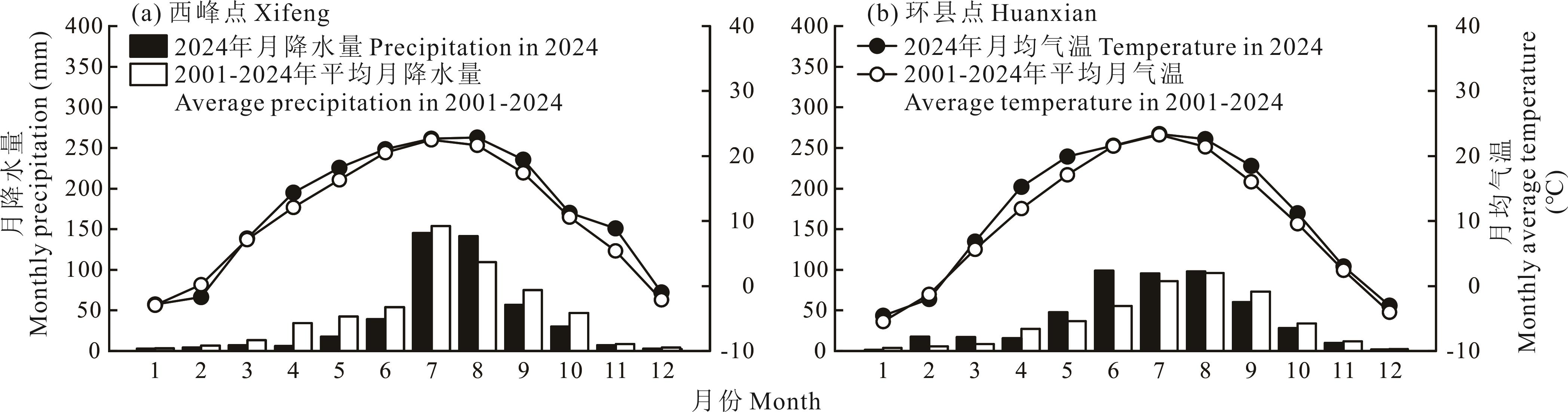
图1 2024年西峰点(a)和环县点(b)及多年(2001-2024)月降水量和月均气温
Fig.1 Monthly precipitation and temperature in 2024 and the long-term (2001-2024) average values at Xifeng (a) and Huanxian (b)
种植模式 Planting patterns | 施氮模式 Nitrogen fertilizer patterns | 处理编号 Codes of treatment |
|---|---|---|
| 青贮玉米单作Silage maize monoculture | 100%无机氮肥100% inorganic nitrogen fertilizer | M |
| 饲用大豆单作Forage soybean monoculture | 100%无机氮肥100% inorganic nitrogen fertilizer | S |
| 2行玉米/2行大豆2 rows of maize/2 rows of soybean | 100%无机氮肥100% inorganic nitrogen fertilizer | M2S2F |
| 有机肥等氮替代化肥Organic fertilizer substitution with equivalent nitrogen for chemical fertilizers | M2S2O | |
| 4行玉米/2行大豆4 rows of maize/2 rows of soybean | 100%无机氮肥100% chemical nitrogen fertilizers | M4S2F |
| 有机肥等氮替代化肥Organic fertilizer substitution with equivalent nitrogen for chemical fertilizers | M4S2O |
表1 试验设计
Table 1 Experiment design
种植模式 Planting patterns | 施氮模式 Nitrogen fertilizer patterns | 处理编号 Codes of treatment |
|---|---|---|
| 青贮玉米单作Silage maize monoculture | 100%无机氮肥100% inorganic nitrogen fertilizer | M |
| 饲用大豆单作Forage soybean monoculture | 100%无机氮肥100% inorganic nitrogen fertilizer | S |
| 2行玉米/2行大豆2 rows of maize/2 rows of soybean | 100%无机氮肥100% inorganic nitrogen fertilizer | M2S2F |
| 有机肥等氮替代化肥Organic fertilizer substitution with equivalent nitrogen for chemical fertilizers | M2S2O | |
| 4行玉米/2行大豆4 rows of maize/2 rows of soybean | 100%无机氮肥100% chemical nitrogen fertilizers | M4S2F |
| 有机肥等氮替代化肥Organic fertilizer substitution with equivalent nitrogen for chemical fertilizers | M4S2O |

图2 西峰点(A)和环县点(B)不同种植模式示意图图中(a)、(b)、(c)、(d)、(e)、(f)分别代表M2S2F、M2S2O、M4S2F、M、M4S2O和S;黑点代表化学氮肥,白点代表有机肥。Figures (a), (b), (c), (d), (e), and (f) represent M2S2F, M2S2O, M4S2F, M, M4S2O, and S, respectively; black dots represent chemical nitrogen fertilizers and white dots represent organic fertilizers.
Fig.2 Schematic diagram of different planting patterns at Xifeng (A) and Huanxian (B)

图3 西峰点和环县点两地青贮玉米/饲用大豆间作系统干物质产量(a, b)和粗蛋白产量(c, d)不同小写字母表示不同处理间在5%的概率水平上差异显著;分别对相同种植模式不同施肥模式下的系统干物质产量和粗蛋白产量进行独立样本T检验,ns表示两者差异不显著。Different lowercase letters indicate significant differences among treatments at the 5% probability level; Independent samples T-tests was performed for dry matter yield and crude protein yield of the systems under different fertilization patterns of the same cropping pattern, respectively, and ns indicates that the differences are not significant.
Fig.3 System dry matter yield (a, b) and crude protein yield (c, d) values in the silage maize/forage soybean intercropping systems at Xifeng and Huanxian
处理 Treatment | LERDM | |||||
|---|---|---|---|---|---|---|
| 西峰点Xifeng | 环县点Huanxian | |||||
| LERDM | LERDM_M | LERDM_S | LERDM | LERDM_M | LERDM_S | |
| M4S2F | 1.05±0.06a | 0.65±0.07ab | 0.40±0.09ab | 0.96±0.05a | 0.77±0.07a | 0.19±0.02c |
| M4S2O | 0.96±0.05a | 0.70±0.08a | 0.26±0.06b | 0.95±0.05a | 0.71±0.05a | 0.23±0.04bc |
| M2S2F | 1.04±0.01a | 0.52±0.07ab | 0.52±0.07a | 1.01±0.09a | 0.63±0.10a | 0.38±0.06ab |
| M2S2O | 0.93±0.05a | 0.47±0.04b | 0.46±0.08ab | 1.06±0.09a | 0.64±0.03a | 0.42±0.06a |
处理 Treatment | LERCP | |||||
| 西峰点Xifeng | 环县点Huanxian | |||||
| LERCP | LERCP_M | LERCP_S | LERCP | LERCP_M | LERCP_S | |
| M4S2F | 1.11±0.06a | 0.62±0.07a | 0.48±0.11a | 0.94±0.02a | 0.74±0.04a | 0.20±0.03b |
| M4S2O | 0.99±0.12a | 0.69±0.14a | 0.30±0.06b | 0.91±0.08a | 0.68±0.05a | 0.23±0.05b |
| M2S2F | 1.06±0.03a | 0.48±0.08a | 0.58±0.10a | 0.92±0.06a | 0.61±0.10a | 0.31±0.04ab |
| M2S2O | 1.03±0.04a | 0.49±0.08a | 0.53±0.08a | 1.13±0.19a | 0.62±0.05a | 0.51±0.14a |
表2 西峰点和环县点两地青贮玉米/饲用大豆间作系统基于干物质(DM)产量和粗蛋白质(CP)产量的土地当量比(LER)
Table 2 Land equivalent ratio (LER) based on dry matter (DM) yield and crude protein (CP) yield in the silage maize/forage soybean intercropping systems at Xifeng and Huanxian
处理 Treatment | LERDM | |||||
|---|---|---|---|---|---|---|
| 西峰点Xifeng | 环县点Huanxian | |||||
| LERDM | LERDM_M | LERDM_S | LERDM | LERDM_M | LERDM_S | |
| M4S2F | 1.05±0.06a | 0.65±0.07ab | 0.40±0.09ab | 0.96±0.05a | 0.77±0.07a | 0.19±0.02c |
| M4S2O | 0.96±0.05a | 0.70±0.08a | 0.26±0.06b | 0.95±0.05a | 0.71±0.05a | 0.23±0.04bc |
| M2S2F | 1.04±0.01a | 0.52±0.07ab | 0.52±0.07a | 1.01±0.09a | 0.63±0.10a | 0.38±0.06ab |
| M2S2O | 0.93±0.05a | 0.47±0.04b | 0.46±0.08ab | 1.06±0.09a | 0.64±0.03a | 0.42±0.06a |
处理 Treatment | LERCP | |||||
| 西峰点Xifeng | 环县点Huanxian | |||||
| LERCP | LERCP_M | LERCP_S | LERCP | LERCP_M | LERCP_S | |
| M4S2F | 1.11±0.06a | 0.62±0.07a | 0.48±0.11a | 0.94±0.02a | 0.74±0.04a | 0.20±0.03b |
| M4S2O | 0.99±0.12a | 0.69±0.14a | 0.30±0.06b | 0.91±0.08a | 0.68±0.05a | 0.23±0.05b |
| M2S2F | 1.06±0.03a | 0.48±0.08a | 0.58±0.10a | 0.92±0.06a | 0.61±0.10a | 0.31±0.04ab |
| M2S2O | 1.03±0.04a | 0.49±0.08a | 0.53±0.08a | 1.13±0.19a | 0.62±0.05a | 0.51±0.14a |
处理 Treatment | 西峰点Xifeng | 环县 Huanxian | ||
|---|---|---|---|---|
| AMS | CRMS | AMS | CRMS | |
| M4S2F | -0.002±0.000b | 0.928±0.236a | 0.580±0.098a | 2.147±0.522a |
| M4S2O | 0.437±0.121a | 1.473±0.367a | 0.484±0.076ab | 1.713±0.459a |
| M2S2F | -0.003±0.000b | 0.981±0.215a | 0.250±0.147b | 1.797±0.517a |
| M2S2O | 0.016±0.001ab | 1.115±0.240a | 0.219±0.036b | 1.575±0.177a |
表3 西峰点和环县点两地青贮玉米/饲用大豆间作系统的玉米相对于大豆的侵占力(AMS)和竞争比率(CRMS)
Table 3 The aggressivity of maize relative to soybean (AMS) and competition ratio (CRMS) in the silage maize/forage soybean intercropping systems at Xifeng and Huanxian
处理 Treatment | 西峰点Xifeng | 环县 Huanxian | ||
|---|---|---|---|---|
| AMS | CRMS | AMS | CRMS | |
| M4S2F | -0.002±0.000b | 0.928±0.236a | 0.580±0.098a | 2.147±0.522a |
| M4S2O | 0.437±0.121a | 1.473±0.367a | 0.484±0.076ab | 1.713±0.459a |
| M2S2F | -0.003±0.000b | 0.981±0.215a | 0.250±0.147b | 1.797±0.517a |
| M2S2O | 0.016±0.001ab | 1.115±0.240a | 0.219±0.036b | 1.575±0.177a |
处理 Treatment | 西峰点Xifeng | |||||
|---|---|---|---|---|---|---|
| WU (mm) | ?WU | WUEDM (kg·hm-2·mm-1) | ?WUEDM | WUECP (kg·hm-2·mm-1) | ?WUECP | |
| M | 344.5±3.5a | — | 82.23±0.85a | — | 6.09±0.06c | — |
| M4S2F | 286.8±10.8a | -0.15±0.03a | 90.49±3.52a | 0.22±0.05a | 9.99±0.39a* | 0.36±0.05a* |
| M4S2O | 305.0±13.1a | -0.10±0.02a | 81.70±3.42a | 0.10±0.01a | 7.90±0.33b* | 0.08±0.01b* |
| M2S2F | 303.6±22.1a | -0.09±0.02a | 81.48±6.38a | 0.16±0.04a | 9.55±0.75ab | 0.20±0.03ab |
| M2S2O | 291.1±28.3a | -0.13±0.03a | 77.23±8.04a | 0.10±0.02a | 9.62±1.00ab | 0.21±0.03ab |
| S | 325.7±7.0a | — | 57.97±1.25b | — | 9.85±0.21a | — |
处理 Treatment | 环县点Huanxian | |||||
| WU (mm) | ?WU | WUEDM (kg·hm-2·mm-1) | ?WUEDM | WUECP (kg·hm-2·mm-1) | ?WUECP | |
| M | 287.6±6.0a | — | 68.25±1.41a | — | 6.31±0.13ab | — |
| M4S2F | 335.2±12.9a | 0.16±0.03a | 51.62±2.03b | -0.11±0.02b | 4.99±0.20c | -0.19±0.03b |
| M4S2O | 303.0±23.8a | 0.05±0.01a | 55.31±4.03b | -0.05±0.01ab | 5.41±0.39bc | -0.12±0.03b |
| M2S2F | 309.5±22.2a | 0.07±0.01a | 54.11±3.83b | 0.02±0.00ab | 5.34±0.38bc* | -0.12±0.02b |
| M2S2O | 297.7±6.6a | 0.02±0.00a | 57.63±1.30b | 0.09±0.02a | 6.67±0.15a* | 0.10±0.01a |
| S | 293.4±19.2a | — | 37.93±2.66c | — | 5.86±0.41abc | — |
表4 西峰点和环县点两地青贮玉米/饲用大豆间作和单作系统的耗水量(WU)、水分利用效率(WUE)及间作系统相对于单作耗水量(?WU)和水分利用效率(?WUE)的变化量
Table 4 Water consumption (WU) and water use efficiency (WUE) of the silage maize/forage soybean intercropping and monoculture systems, and changes in water consumption (?WU) and water use efficiency (?WUE) of intercropping systems relative to monocultures at Xifeng and Huanxian
处理 Treatment | 西峰点Xifeng | |||||
|---|---|---|---|---|---|---|
| WU (mm) | ?WU | WUEDM (kg·hm-2·mm-1) | ?WUEDM | WUECP (kg·hm-2·mm-1) | ?WUECP | |
| M | 344.5±3.5a | — | 82.23±0.85a | — | 6.09±0.06c | — |
| M4S2F | 286.8±10.8a | -0.15±0.03a | 90.49±3.52a | 0.22±0.05a | 9.99±0.39a* | 0.36±0.05a* |
| M4S2O | 305.0±13.1a | -0.10±0.02a | 81.70±3.42a | 0.10±0.01a | 7.90±0.33b* | 0.08±0.01b* |
| M2S2F | 303.6±22.1a | -0.09±0.02a | 81.48±6.38a | 0.16±0.04a | 9.55±0.75ab | 0.20±0.03ab |
| M2S2O | 291.1±28.3a | -0.13±0.03a | 77.23±8.04a | 0.10±0.02a | 9.62±1.00ab | 0.21±0.03ab |
| S | 325.7±7.0a | — | 57.97±1.25b | — | 9.85±0.21a | — |
处理 Treatment | 环县点Huanxian | |||||
| WU (mm) | ?WU | WUEDM (kg·hm-2·mm-1) | ?WUEDM | WUECP (kg·hm-2·mm-1) | ?WUECP | |
| M | 287.6±6.0a | — | 68.25±1.41a | — | 6.31±0.13ab | — |
| M4S2F | 335.2±12.9a | 0.16±0.03a | 51.62±2.03b | -0.11±0.02b | 4.99±0.20c | -0.19±0.03b |
| M4S2O | 303.0±23.8a | 0.05±0.01a | 55.31±4.03b | -0.05±0.01ab | 5.41±0.39bc | -0.12±0.03b |
| M2S2F | 309.5±22.2a | 0.07±0.01a | 54.11±3.83b | 0.02±0.00ab | 5.34±0.38bc* | -0.12±0.02b |
| M2S2O | 297.7±6.6a | 0.02±0.00a | 57.63±1.30b | 0.09±0.02a | 6.67±0.15a* | 0.10±0.01a |
| S | 293.4±19.2a | — | 37.93±2.66c | — | 5.86±0.41abc | — |
处理 Treatment | 西峰点Xifeng | 环县点Huanxian | ||||
|---|---|---|---|---|---|---|
| 总投入Total input | 总产值Gross output | 净收入Net income | 总投入Total input | 总产值Gross output | 净收入Net income | |
| M | 10410 | 28633±960b | 18223±960b | 11025 | 23306±1087a | 12281±1087ab |
| M4S2F | 10290 | 34980±1811a | 24690±1811a | 10605 | 26115±1567a | 15510±1567a |
| M4S2O | 11415 | 35056±1812a | 23641±1812a | 11610 | 25204±1349a | 13594±1349a |
| M2S2F | 10290 | 34336±696a | 24046±696a | 10455 | 26178±2421a | 15723±2421a |
| M2S2O | 11130 | 32198±1477ab | 21068±1477ab | 11220 | 27272±2258a | 16052±2258a |
| S | 9420 | 19489±2046c | 10069±2046c | 9375 | 16581±789b | 7206±789b |
表5 西峰点与环县点两地青贮玉米/饲用大豆间作系统经济效益对比
Table 5 Comparison of economic benefits performance in the silage maize/forage soybean intercropping systems at Xifeng and Huanxian (CNY·hm-2)
处理 Treatment | 西峰点Xifeng | 环县点Huanxian | ||||
|---|---|---|---|---|---|---|
| 总投入Total input | 总产值Gross output | 净收入Net income | 总投入Total input | 总产值Gross output | 净收入Net income | |
| M | 10410 | 28633±960b | 18223±960b | 11025 | 23306±1087a | 12281±1087ab |
| M4S2F | 10290 | 34980±1811a | 24690±1811a | 10605 | 26115±1567a | 15510±1567a |
| M4S2O | 11415 | 35056±1812a | 23641±1812a | 11610 | 25204±1349a | 13594±1349a |
| M2S2F | 10290 | 34336±696a | 24046±696a | 10455 | 26178±2421a | 15723±2421a |
| M2S2O | 11130 | 32198±1477ab | 21068±1477ab | 11220 | 27272±2258a | 16052±2258a |
| S | 9420 | 19489±2046c | 10069±2046c | 9375 | 16581±789b | 7206±789b |
| [1] | Shou N, Gao W, Shen Y Y, et al. Effects of different nitrogen application rates on yield and water use efficiency of silage maize. Pratacultural Science, 2022, 38(7): 1351-1361. |
| 受娜, 高玮, 沈禹颖, 等. 不同施氮量对青贮玉米产量及水分利用效率的影响. 草业科学, 2022, 38(7): 1351-1361. | |
| [2] | Li Y J, Ma L S, Wu P T, et al. Yield, yield attributes and photosynthetic physiological characteristics of dryland wheat (Triticum aestivum L.)/maize (Zea mays L.) strip intercropping. Field Crops Research, 2020, 248: 107656. |
| [3] | Monicah M M, Pieter P, Daniel M, et al. A staggered maize-legume intercrop arrangement robustly increases crop yields and economic returns in the highlands of Central Kenya. Field Crops Research, 2009, 115(2): 132-139. |
| [4] | Weng Q Y, Huang X J, Xu H L, et al. Effects of corn/soybean intercropping model on yield, quality, soil nutrition and rhizosphere microorganisms of silage corn. Journal of Nuclear Agricultural Sciences, 2021, 35(2): 462-470. |
| 瓮巧云, 黄新军, 许翰林, 等. 玉米/大豆间作模式对青贮玉米产量、品质及土壤营养、根际微生物的影响. 核农学报, 2021, 35(2): 462-470. | |
| [5] | Jiang Z W, Liu G Y, An H Y, et al. Effects of planting density and nitrogen application on forage yield, quality and nitrogen use efficiency in a maize/forage soybean intercropping system. Acta Prataculturae Sinica, 2022, 31(7): 157-171. |
| 蒋紫薇, 刘桂宇, 安昊云, 等. 种植密度与施氮对玉米/秣食豆间作系统饲草产量、品质和氮肥利用的影响. 草业学报, 2022, 31(7): 157-171. | |
| [6] | Tang G, Sui D H, Wu X J, et al. Research progress on forage of silage corn in China. Heilongjiang Animal Science and Veterinary Medicine, 2021(9): 26-28, 33. |
| 唐贵, 隋冬华, 武新娟, 等. 我国青贮玉米饲用化研究进展. 黑龙江畜牧兽医, 2021(9): 26-28, 33. | |
| [7] | Ge J, Liu G H, Yang C J, et al. Research progress on mixed silage of Medicago sativa. Journal of Henan Agricultural Sciences, 2014, 43(9): 6-10, 17. |
| 葛剑, 刘贵河, 杨翠军, 等. 紫花苜蓿混合青贮研究进展. 河南农业科学, 2014, 43(9): 6-10, 17. | |
| [8] | Liu Q, Sun Q Z, Hao H, et al. Study on alfalfa and corn mixed silage. China Dairy Cattle, 2017(1): 59-62. |
| 柳茜, 孙启忠, 郝虎, 等. 紫花苜蓿与全株玉米混合青贮研究. 中国奶牛, 2017(1): 59-62. | |
| [9] | Islam M R, Hu Y G, Mao S S, et al. Effectiveness of a water-saving super-absorbent polymer in soil water conservation for maize (Zea mays L.) based on eco-physiological parameters. Journal of the Science of Food and Agriculture, 2011, 91(11): 1998-2005. |
| [10] | Cheng J M. Pathways and suggestions for agricultural and animal husbandry development in semi-arid regions of the Loess Plateau. Gansu Animal Husbandry and Veterinary Medicine, 2017, 47(9): 15, 23. |
| 程积民. 黄土高原半干旱区农牧业发展途径与建议. 甘肃畜牧兽医, 2017, 47(9): 15, 23. | |
| [11] | Li R, Tao R, Ling N, et al. Chemical, organic and bio-fertilizer management practices effect on soil physicochemical property and antagonistic bacteria abundance of a cotton field: Implications for soil biological quality. Soil and Tillage Research, 2017, 167: 30-38. |
| [12] | Duan Y H, Xu M G, Gao S D, et al. Nitrogen use efficiency in a wheat-maize cropping system from 15 years of manure and fertilizer applications. Field Crops Research, 2014, 157: 47-56. |
| [13] | Sebilo M, Mayer B, Nicolardot B, et al. Long-term fate of nitrate fertilizer in agricultural soils. Proceedings of the National Academy of Sciences, 2013, 110(45): 18185-18189. |
| [14] | Ji J P, Zhao X Y, Wu J G, et al. Replacing 20% of chemical nitrogen with manures to increase soil nutrient availability and maize yield in a chernozem soil. Journal of Plant Nutrition and Fertilizers, 2021, 27(3): 491-499. |
| 季佳鹏, 赵欣宇, 吴景贵, 等. 有机肥替代20%化肥提高黑钙土养分有效性及玉米产量. 植物营养与肥料学报, 2021, 27(3): 491-499. | |
| [15] | Wu J Z, Xiao H S, Guo J H, et al. Effects of straw returning combined with organic fertilizer replacing 1/3 chemical fertilizer on grain yield, grain protein and chemical fertilizer use efficiency in dryland maize-wheat double cropping system. Journal of Soil and Water Conservation, 2023, 37(4): 319-326. |
| 吴金芝, 肖慧淑, 郭锦花, 等. 秸秆还田和有机肥配合替代1/3化肥对旱地玉—麦产量、蛋白质含量和化肥利用效率影响. 水土保持学报, 2023, 37(4): 319-326. | |
| [16] | Xiao Z M, Fan X, Ma D X, et al. Determination of crude protein in feed-kjeldahl method: GB/T 6432-2018. Beijing: China Standards Press, 2018. |
| 肖志明, 樊霞, 马东霞, 等. 饲料中粗蛋白的测定—凯氏定氮法: GB/T 6432-2018. 北京: 中国标准出版社, 2018. | |
| [17] | Wu Y H. Light and water use of forage maize/alfalfa intercropping system in Loess Plateau. Lanzhou: Lanzhou University, 2021. |
| 吴玉环. 黄土高原饲用玉米/紫花苜蓿间作群体光能及水分利用研究. 兰州: 兰州大学, 2021. | |
| [18] | Jiang C Z, Shou N, Gao W, et al. A multivariate evaluation of production performance and nutritional quality of different varieties of silage maize in the dry plateau area of Longdong. Acta Prataculturae Sinica, 2023, 32(7): 216-228. |
| 蒋丛泽, 受娜, 高玮, 等. 陇东旱塬区不同青贮玉米品种生产性能和营养品质综合评价. 草业学报, 2023, 32(7): 216-228. | |
| [19] | Oweis T Y, Farahani H J, Hachum A Y. Evapotranspiration and water use of full and deficit irrigated cotton in the Mediterranean environment in Northern Syria. Agricultural Water Management, 2011, 98(8): 1239-1248. |
| [20] | Huang Y L, Chen L D, Fu B J, et al. The wheat yields and water-use efficiency in the Loess Plateau: straw mulch and irrigation effects. Agricultural Water Management, 2005, 72(3): 209-222. |
| [21] | Morris R A, Garrity D P. Resource capture and utilization in intercropping: water. Field Crops Research, 1993, 34(3): 303-317. |
| [22] | Yong T W, Liu X M, Song C, et al. Effect of planting patterns on crop yield, nutrients uptake and interspecific competition in maize-soybean relay strip intercropping system. Chinese Journal of Eco-Agriculture, 2015, 23(6): 659-667. |
| 雍太文, 刘小明, 宋春, 等. 种植方式对玉米-大豆套作体系中作物产量、养分吸收和种间竞争的影响. 中国生态农业学报, 2015, 23(6): 659-667. | |
| [23] | Yang W T, Li Z X, Wang J W, et al. Crop yield, nitrogen acquisition and sugarcane quality as affected by interspecific competition and nitrogen application. Field Crops Research, 2013, 146: 44-50. |
| [24] | Lithourgidis A S, Vlachostergios D N, Dordas C A, et al. Dry matter yield, nitrogen content, and competition in pea-cereal intercropping systems. European Journal of Agronomy, 2011, 34(4): 287-294. |
| [25] | Zhao K N, Wu J Z, Li J H, et al. Effects of combined straw and organic fertilizer application as partial replacement for chemical fertilizers on water use efficiency and soil nitrate residue. Journal of Plant Nutrition and Fertilizers, 2022, 28(10): 1770-1781. |
| 赵凯男, 吴金芝, 李俊红, 等. 秸秆和有机肥配合替代部分化肥提高作物水分利用率减少土壤硝态氮残留. 植物营养与肥料学报, 2022, 28(10): 1770-1781. | |
| [26] | Zhang W. Regulation of nitrogen use efficiency for dryland maize-soybean intercropping and its mechanism of root-soil response in Loess Plateau. Beijing: University of Chinese Academy of Sciences, 2021. |
| 章伟. 黄土旱塬玉米/大豆间作体系氮素增效调控及根土响应机制. 北京: 中国科学院大学, 2021. | |
| [27] | Ma Q X, Pan W K, Tang S, et al. Maize and soybean experience fierce competition from soil microorganisms for the uptake of organic and inorganic nitrogen and sulphur: A pot test using 13C, 15N, 14C, and 35S labelling. Soil Biology and Biochemistry, 2021, 157: 108260. |
| [28] | Cao M J, Wang J Y, Cui Y, et al. Effects of different maize and soybean intercropping ratios on photosynthetic characteristics and yield of soybean. Soybean Science, 2023, 42(1): 48-54. |
| 曹曼君, 王婧瑜, 崔悦, 等. 不同玉米大豆间作行比对大豆光合特性及产量的影响. 大豆科学, 2023, 42(1): 48-54. | |
| [29] | Zhao C J, Gao F, Li Z W, et al. Effects of different maize/soybean intercropping row ratios on photosynthetic physiological characteristics and yield of soybean. Journal of Sichuan Agricultural University, 2023, 41(5): 820-825, 848. |
| 赵长江, 高菲, 李祯玮, 等. 玉米大豆不同间作行比对大豆光合生理特性及产量的影响. 四川农业大学学报, 2023, 41(5): 820-825, 848. | |
| [30] | Ren Y Y. Study on water use of maize-soybean intercrops on the Loess Plateau, China. Beijing: University of Chinese Academy of Sciences, 2016. |
| 任媛媛. 黄土塬区玉米大豆间作系统水分利用研究. 北京: 中国科学院大学, 2016. | |
| [31] | Willey R W. Resource use in intercropping systems. Agricultural Water Management, 1990, 17(1): 215-231. |
| [32] | Chai Q, Yu A Z, Chen G P, et al. Soil evaporation under sole cropping and intercropping systems and the main driving factors. Chinese Journal of Eco-Agriculture, 2011, 19(6): 1307-1312. |
| 柴强, 于爱忠, 陈桂平, 等. 单作与间作的棵间蒸发量差异及其主要影响因子. 中国生态农业学报, 2011, 19(6): 1307-1312. | |
| [33] | An Y W, Shi S Q, Feng L S, et al. Productivity enhancement and water use efficiency of maize-soybean intercropping. Horticulture & Seed, 2016(9): 80-83. |
| 安颖蔚, 史书强, 冯良山, 等. 玉米/大豆间作提高农田生产力和水分利用效率研究. 园艺与种苗, 2016(9): 80-83. | |
| [34] | Chai Q. Research progress on mechanism of high efficient water utilization in intercropping system. Journal of Agricultural Science and Technology, 2008(4): 11-15. |
| 柴强. 间套复合群体水分高效利用机理研究进展. 中国农业科技导报, 2008(4): 11-15. | |
| [35] | Wang C L, Guo L Y, Li Y X, et al. Systematic comparison of C3 and C4 plants based on metabolic network analysis. BMC Systems Biology, 2012, 6(Supple 2): S9. |
| [1] | 张译尹, 王斌, 王腾飞, 兰剑, 胡海英. 苜蓿种子田间作小黑麦对饲草产量、水分利用及苜蓿种子产量的影响[J]. 草业学报, 2025, 34(8): 43-53. |
| [2] | 郭彬, 罗维成, 单立山, 安宁, 刘冰. 模拟增温对河西走廊典型荒漠灌木光合作用的影响[J]. 草业学报, 2025, 34(7): 145-157. |
| [3] | 刘启林, 王小军, 王金兰, 刘文辉, 马巧玲, 李建辉, 张生原, 曹文侠, 李文. 氮磷配施对高寒区老芒麦饲草产量的影响[J]. 草业学报, 2025, 34(6): 193-202. |
| [4] | 王弟成, 柴强, 樊志龙, 殷文, 范虹, 何蔚, 孙亚丽, 桑会哲, 胡发龙. 混作豆科饲草及减氮对青贮玉米生产系统土壤理化特性和产量的影响[J]. 草业学报, 2025, 34(12): 97-110. |
| [5] | 王茂鉴, 石薇, 常生华, 张程, 贾倩民, 侯扶江. 灌溉模式对河西灌区禾-豆间作系统饲草产量、品质和水分利用的影响[J]. 草业学报, 2023, 32(3): 13-29. |
| [6] | 高玮, 受娜, 蒋丛泽, 马仁诗, 沈禹颖, 杨宪龙. 施氮量对饲用高粱干物质积累、分配及水分利用效率的影响[J]. 草业学报, 2022, 31(9): 26-35. |
| [7] | 周大梁, 石薇, 蒋紫薇, 魏正业, 梁欢欢, 贾倩民. 沟垄集雨下密度和施氮对黄土高原青贮玉米叶片酶活性及水氮利用的影响[J]. 草业学报, 2022, 31(8): 126-143. |
| [8] | 牛伟玲, 陈辉, 侯慧新, 郭晨睿, 马娇林, 武建双. 10年禁牧未改变藏西北高寒荒漠植物水氮利用效率[J]. 草业学报, 2022, 31(8): 35-48. |
| [9] | 陈林, 陈高路, 宋乃平, 李学斌, 万红云, 何文强. 宁夏东部荒漠草原猪毛蒿光合特征和水分利用效率对降水变化的响应[J]. 草业学报, 2022, 31(10): 87-98. |
| [10] | 古丽娜扎尔·艾力null, 陶海宁, 王自奎, 沈禹颖. 基于APSIM模型的黄土旱塬区苜蓿——小麦轮作系统深层土壤水分及水分利用效率研究[J]. 草业学报, 2021, 30(7): 22-33. |
| [11] | 才璐, 王林林, 罗珠珠, 李玲玲, 牛伊宁, 蔡立群, 谢军红. 中国苜蓿产量及水分利用效率对种植年限响应的Meta分析[J]. 草业学报, 2020, 29(6): 27-38. |
| [12] | 方彦杰, 张绪成, 于显枫, 侯慧芝, 王红丽, 马一凡, 张国平, 雷康宁. 地膜覆盖和施肥对半干旱区苦荞土壤水分利用及产量的影响[J]. 草业学报, 2020, 29(11): 46-56. |
| [13] | 方彦杰, 张绪成, 于显枫, 侯慧芝, 王红丽, 马一凡, 张国平, 雷康宁. 立式深旋松耕对半干旱区饲草玉米水分利用和产量的影响[J]. 草业学报, 2020, 29(10): 161-171. |
| [14] | 李尚中, 樊廷录, 赵晖, 李城德, 赵贵宾, 赵刚, 党翼, 王磊, 张建军, 唐小明, 王淑英, 程万莉. 不同地膜覆盖栽培模式对玉米产量、水分利用效率和品质的影响[J]. 草业学报, 2020, 29(10): 182-191. |
| [15] | 王茜, 李志坚, 李晶, 周帮伟. 不同类型燕麦农艺和饲草品质性状分析[J]. 草业学报, 2019, 28(12): 149-158. |
| 阅读次数 | ||||||
|
全文 |
|
|||||
|
摘要 |
|
|||||
