

ISSN 1004-5759 CN 62-1105/S
草业学报 ›› 2025, Vol. 34 ›› Issue (12): 97-110.DOI: 10.11686/cyxb2024527
王弟成( ), 柴强, 樊志龙, 殷文, 范虹, 何蔚, 孙亚丽, 桑会哲, 胡发龙()
收稿日期:2024-12-31
修回日期:2025-03-19
出版日期:2025-12-20
发布日期:2025-10-20
通讯作者:
胡发龙
作者简介:E-mail: hufl@gsau.edu.cn基金资助:
Di-cheng WANG(), Qiang CHAI, Zhi-long FAN, Wen YIN, Hong FAN, Wei HE, Ya-li SUN, Hui-zhe SANG, Fa-long HU()
Received:2024-12-31
Revised:2025-03-19
Online:2025-12-20
Published:2025-10-20
Contact:
Fa-long HU
摘要:
针对河西绿洲灌区青贮玉米氮肥投入高、土壤质量下降等问题,本研究在减氮条件下,探讨混作豆科饲草对青贮玉米生产系统土壤理化特性及产量的影响,以期为该区土壤健康管理和青贮玉米可持续生产提供科学依据和理论支撑。试验于2023-2024年在武威绿洲农业综合试验站开展,采用裂区设计,主区为3个种植模式(M: 青贮玉米单作;MH: 青贮玉米-秣食豆混作;ML: 青贮玉米-拉巴豆混作),裂区为3个施氮水平(N3: 360 kg·hm-2; N2: 306 kg·hm-2; N1: 252 kg·hm-2)。结果表明,与M模式氮肥减施30%处理相比,MH和ML模式相同施氮水平下土壤容重分别降低5.5%和8.0%、孔隙度分别提高6.6%和10.8%、pH分别降低0.9%和1.0%、有机质分别提高3.9%和5.1%、全氮含量分别提高9.2%和10.4%、全磷含量分别提高8.7%和10.9%、全钾含量分别提高9.4%和12.0%、硝态氮含量分别提高26.4%和29.8%、铵态氮含量分别提高19.1%和25.1%、有效磷含量分别提高8.8%和10.6%、速效钾含量分别提高5.7%和10.1%。此外,与M模式相比,MH模式下饲草产量和能量产量分别提高23.1%和25.2%,ML模式下分别提高30.5%和33.6%;MH模式下减氮30%处理饲草产量和能量产量与传统施氮差异不显著,但ML模式下较之提高20.5%和17.8%;并且,与M模式传统施氮处理相比,MH模式减氮30%处理饲草产量和能量产量分别提高15.8%和17.8%,ML减氮30%处理分别提高23.8%和28.6%。因此,青贮玉米混作拉巴豆结合施氮量252 kg·hm-2可改善土壤理化性质、提高饲草产量,可作为绿洲灌区青贮玉米生产的适宜种植模式和施氮量。
王弟成, 柴强, 樊志龙, 殷文, 范虹, 何蔚, 孙亚丽, 桑会哲, 胡发龙. 混作豆科饲草及减氮对青贮玉米生产系统土壤理化特性和产量的影响[J]. 草业学报, 2025, 34(12): 97-110.
Di-cheng WANG, Qiang CHAI, Zhi-long FAN, Wen YIN, Hong FAN, Wei HE, Ya-li SUN, Hui-zhe SANG, Fa-long HU. Effects of mixed cropping of leguminous forage and reduced nitrogen fertilizer on soil physicochemical properties and forage yield in a silage maize production system[J]. Acta Prataculturae Sinica, 2025, 34(12): 97-110.
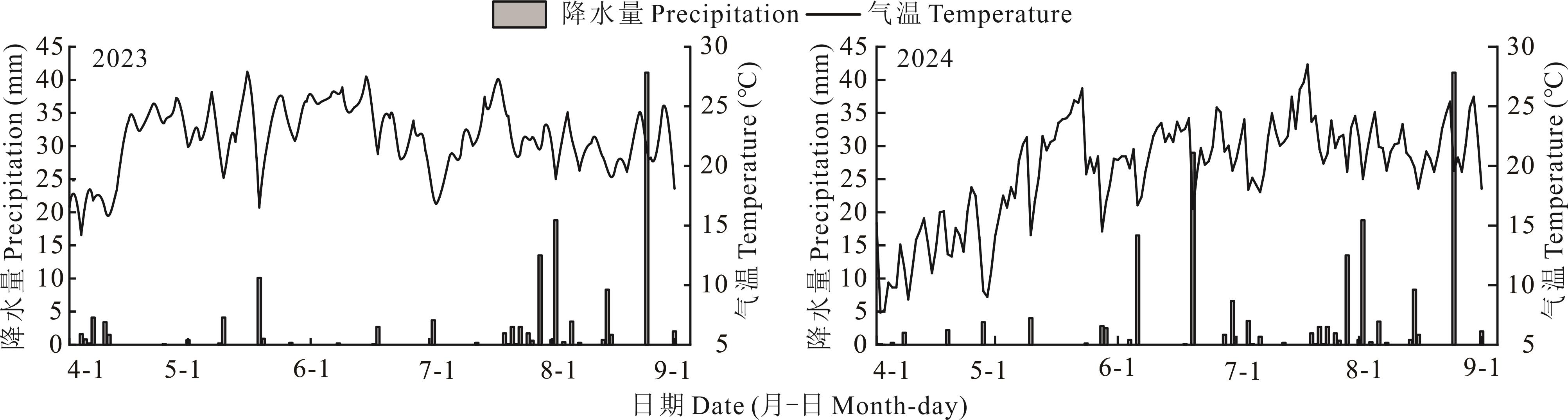
图1 试验站所属区域平均气温与降水量
Fig.1 Average temperature and precipitation at the experimental site
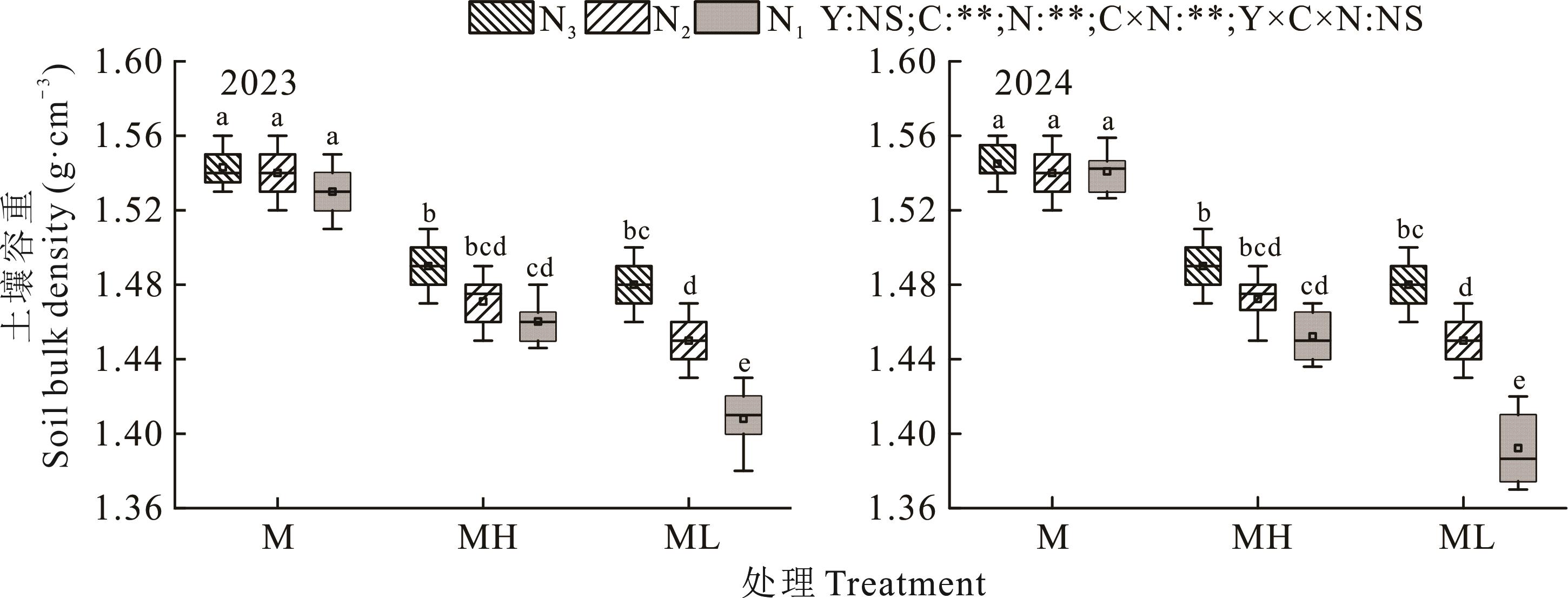
图2 不同种植模式和施氮水平下土壤容重Y: 年份Year; C: 种植模式Cropping pattern; N: 施氮水平Nitrogen application level; C×N: 种植模式与施氮制度的交互作用The interaction between cropping pattern and nitrogen application system; Y×C×N: 年份、种植模式和施氮的交互作用The interaction of year, cropping pattern and nitrogen application level; 不同小写字母代表各处理之间差异性显著(P<0.05) Different lowercase letters represent significant differences among treatments (P<0.05); *: P<0.05; **: P<0.01; NS: 差异不显著No significant.下同The same below.
Fig.2 Soil bulk density under different cropping patterns and nitrogen application levels
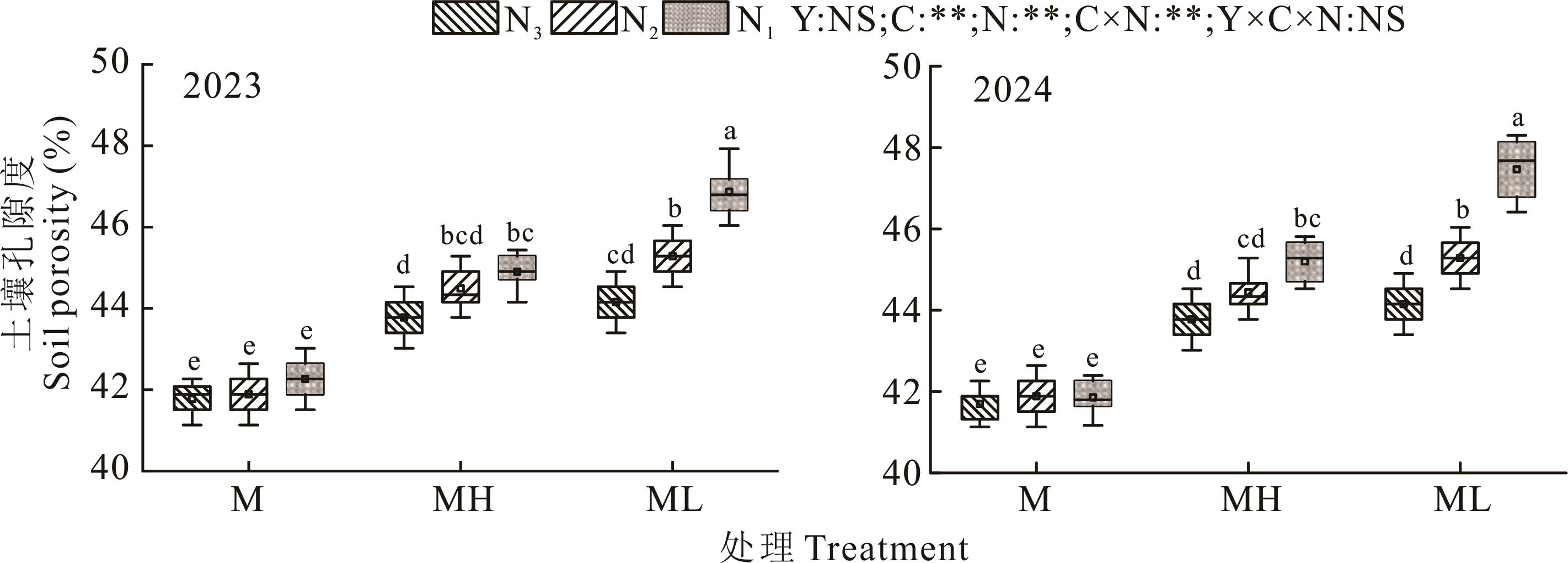
图3 不同种植模式和施氮水平下土壤孔隙度
Fig.3 Soil porosity under different cropping patterns and nitrogen application levels
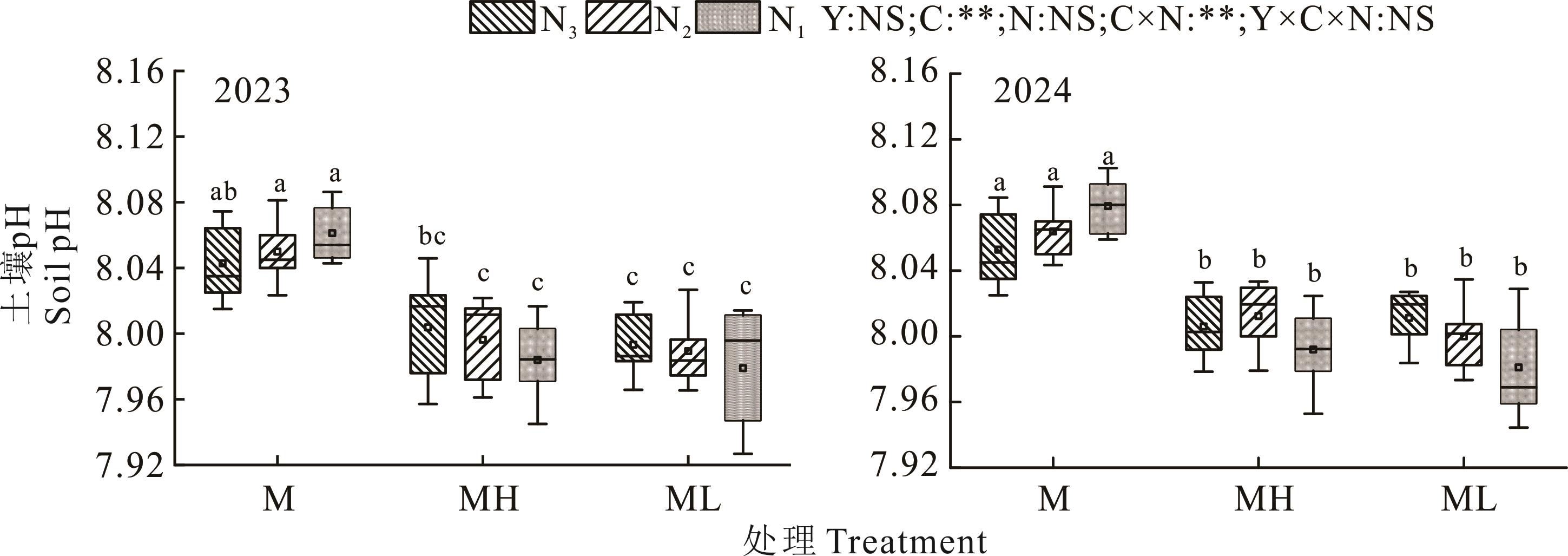
图4 不同种植模式和施氮水平下土壤pH
Fig.4 Soil pH under different cropping patterns and nitrogen application levels
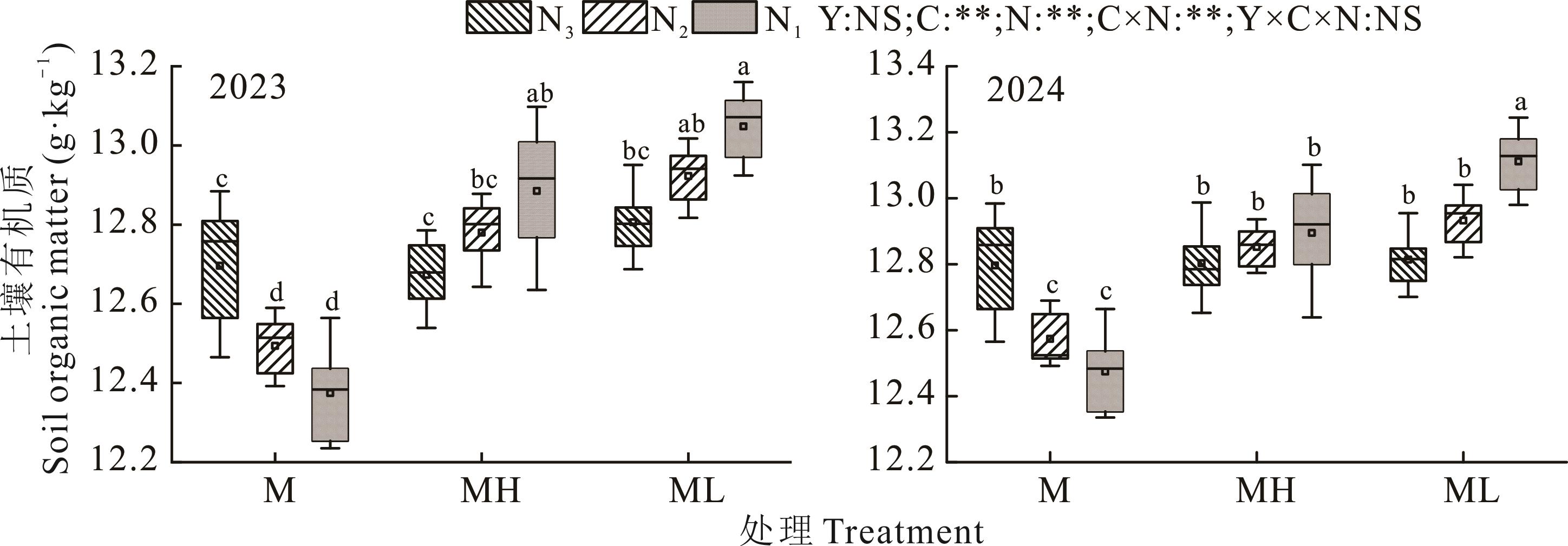
图5 不同种植模式和施氮水平下土壤有机质含量
Fig.5 Soil organic matter content under different cropping patterns and nitrogen application levels
种植模式 Cropping pattern | 施氮水平 N application rate | 全氮Total nitrogen | 全磷Total phosphorus | 全钾Total potassium | |||
|---|---|---|---|---|---|---|---|
| 2023 | 2024 | 2023 | 2024 | 2023 | 2024 | ||
| M | N3 | 1.05ef | 1.06d | 1.43e | 1.44e | 20.42d | 20.51d |
| N2 | 1.03f | 1.03e | 1.42e | 1.43e | 20.36d | 20.44d | |
| N1 | 0.96g | 0.98f | 1.41e | 1.43e | 20.25d | 20.34d | |
| MH | N3 | 1.08abc | 1.12ab | 1.51d | 1.50d | 21.50c | 21.54c |
| N2 | 1.07bcd | 1.10bc | 1.53c | 1.54c | 22.28b | 22.38b | |
| N1 | 1.06de | 1.07d | 1.56b | 1.55bc | 22.37b | 22.41b | |
| ML | N3 | 1.10a | 1.13a | 1.52cd | 1.52d | 21.58c | 21.59c |
| N2 | 1.09ab | 1.11ab | 1.56b | 1.57b | 22.25b | 22.29b | |
| N1 | 1.07cde | 1.09cd | 1.60a | 1.59a | 22.71a | 23.38a | |
| 显著性Significance (P value) | |||||||
| 种植模式Cropping pattern (C) | ** | ** | ** | ** | ** | ** | |
| 施氮水平Nitrogen application level (N) | ** | ** | ** | ** | ** | ** | |
| 年Year (Y) | NS | NS | NS | NS | NS | NS | |
| C×N | ** | ** | ** | ** | ** | ** | |
| Y×C×N | NS | NS | NS | NS | NS | NS | |
表1 不同种植模式和施氮水平下全生育期土壤全效养分含量
Table 1 Soil total nutrient content during the whole growth period under different cropping patterns and nitrogen application levels (g·kg-1)
种植模式 Cropping pattern | 施氮水平 N application rate | 全氮Total nitrogen | 全磷Total phosphorus | 全钾Total potassium | |||
|---|---|---|---|---|---|---|---|
| 2023 | 2024 | 2023 | 2024 | 2023 | 2024 | ||
| M | N3 | 1.05ef | 1.06d | 1.43e | 1.44e | 20.42d | 20.51d |
| N2 | 1.03f | 1.03e | 1.42e | 1.43e | 20.36d | 20.44d | |
| N1 | 0.96g | 0.98f | 1.41e | 1.43e | 20.25d | 20.34d | |
| MH | N3 | 1.08abc | 1.12ab | 1.51d | 1.50d | 21.50c | 21.54c |
| N2 | 1.07bcd | 1.10bc | 1.53c | 1.54c | 22.28b | 22.38b | |
| N1 | 1.06de | 1.07d | 1.56b | 1.55bc | 22.37b | 22.41b | |
| ML | N3 | 1.10a | 1.13a | 1.52cd | 1.52d | 21.58c | 21.59c |
| N2 | 1.09ab | 1.11ab | 1.56b | 1.57b | 22.25b | 22.29b | |
| N1 | 1.07cde | 1.09cd | 1.60a | 1.59a | 22.71a | 23.38a | |
| 显著性Significance (P value) | |||||||
| 种植模式Cropping pattern (C) | ** | ** | ** | ** | ** | ** | |
| 施氮水平Nitrogen application level (N) | ** | ** | ** | ** | ** | ** | |
| 年Year (Y) | NS | NS | NS | NS | NS | NS | |
| C×N | ** | ** | ** | ** | ** | ** | |
| Y×C×N | NS | NS | NS | NS | NS | NS | |
种植模式 Cropping pattern | 施氮水平 N application rate | 硝态氮 Nitrate nitrogen | 铵态氮 Ammonium nitrogen | 有效磷 Available phosphorus | 速效钾 Available potassium | ||||
|---|---|---|---|---|---|---|---|---|---|
| 2023 | 2024 | 2023 | 2024 | 2023 | 2024 | 2023 | 2024 | ||
| M | N3 | 16.83e | 17.42e | 7.36d | 8.96d | 28.66d | 28.74d | 148.44e | 148.96d |
| N2 | 15.82f | 16.82e | 7.07e | 8.67e | 28.55d | 28.61d | 148.39e | 148.39d | |
| N1 | 14.26g | 15.26f | 7.05e | 8.65e | 28.52d | 28.58d | 147.24e | 147.24d | |
| MH | N3 | 17.98d | 18.98d | 8.54c | 10.14c | 30.62c | 30.66c | 153.04d | 153.44c |
| N2 | 18.99bc | 19.99bc | 8.63c | 10.23c | 31.20b | 31.34b | 154.40cd | 155.20bc | |
| N1 | 19.57ab | 20.57b | 8.88b | 10.48b | 31.22b | 31.41b | 156.13bc | 156.13b | |
| ML | N3 | 18.16cd | 19.16cd | 8.57c | 10.17c | 30.69c | 30.71c | 155.41bc | 155.41bc |
| N2 | 19.05bc | 20.05bc | 8.68c | 10.28c | 31.23b | 31.41b | 156.89b | 156.89b | |
| N1 | 20.52a | 21.52a | 9.66a | 11.25a | 31.86a | 31.96a | 163.45a | 164.25a | |
| 显著性Significance | |||||||||
| 种植模式Cropping pattern (C) | ** | ** | ** | ** | ** | ** | ** | ** | |
| 施氮水平Nitrogen application level (N) | ** | ** | ** | ** | ** | ** | ** | ** | |
| 年Year (Y) | NS | NS | NS | NS | NS | NS | NS | NS | |
| C×N | ** | ** | ** | ** | ** | ** | ** | ** | |
| Y×C×N | NS | NS | NS | NS | NS | NS | NS | NS | |
表2 不同种植模式和施氮水平下全生育期土壤速效养分含量
Table 2 Soil available nutrient content during the whole growth period under different cropping patterns and nitrogen application levels (mg·kg-1)
种植模式 Cropping pattern | 施氮水平 N application rate | 硝态氮 Nitrate nitrogen | 铵态氮 Ammonium nitrogen | 有效磷 Available phosphorus | 速效钾 Available potassium | ||||
|---|---|---|---|---|---|---|---|---|---|
| 2023 | 2024 | 2023 | 2024 | 2023 | 2024 | 2023 | 2024 | ||
| M | N3 | 16.83e | 17.42e | 7.36d | 8.96d | 28.66d | 28.74d | 148.44e | 148.96d |
| N2 | 15.82f | 16.82e | 7.07e | 8.67e | 28.55d | 28.61d | 148.39e | 148.39d | |
| N1 | 14.26g | 15.26f | 7.05e | 8.65e | 28.52d | 28.58d | 147.24e | 147.24d | |
| MH | N3 | 17.98d | 18.98d | 8.54c | 10.14c | 30.62c | 30.66c | 153.04d | 153.44c |
| N2 | 18.99bc | 19.99bc | 8.63c | 10.23c | 31.20b | 31.34b | 154.40cd | 155.20bc | |
| N1 | 19.57ab | 20.57b | 8.88b | 10.48b | 31.22b | 31.41b | 156.13bc | 156.13b | |
| ML | N3 | 18.16cd | 19.16cd | 8.57c | 10.17c | 30.69c | 30.71c | 155.41bc | 155.41bc |
| N2 | 19.05bc | 20.05bc | 8.68c | 10.28c | 31.23b | 31.41b | 156.89b | 156.89b | |
| N1 | 20.52a | 21.52a | 9.66a | 11.25a | 31.86a | 31.96a | 163.45a | 164.25a | |
| 显著性Significance | |||||||||
| 种植模式Cropping pattern (C) | ** | ** | ** | ** | ** | ** | ** | ** | |
| 施氮水平Nitrogen application level (N) | ** | ** | ** | ** | ** | ** | ** | ** | |
| 年Year (Y) | NS | NS | NS | NS | NS | NS | NS | NS | |
| C×N | ** | ** | ** | ** | ** | ** | ** | ** | |
| Y×C×N | NS | NS | NS | NS | NS | NS | NS | NS | |
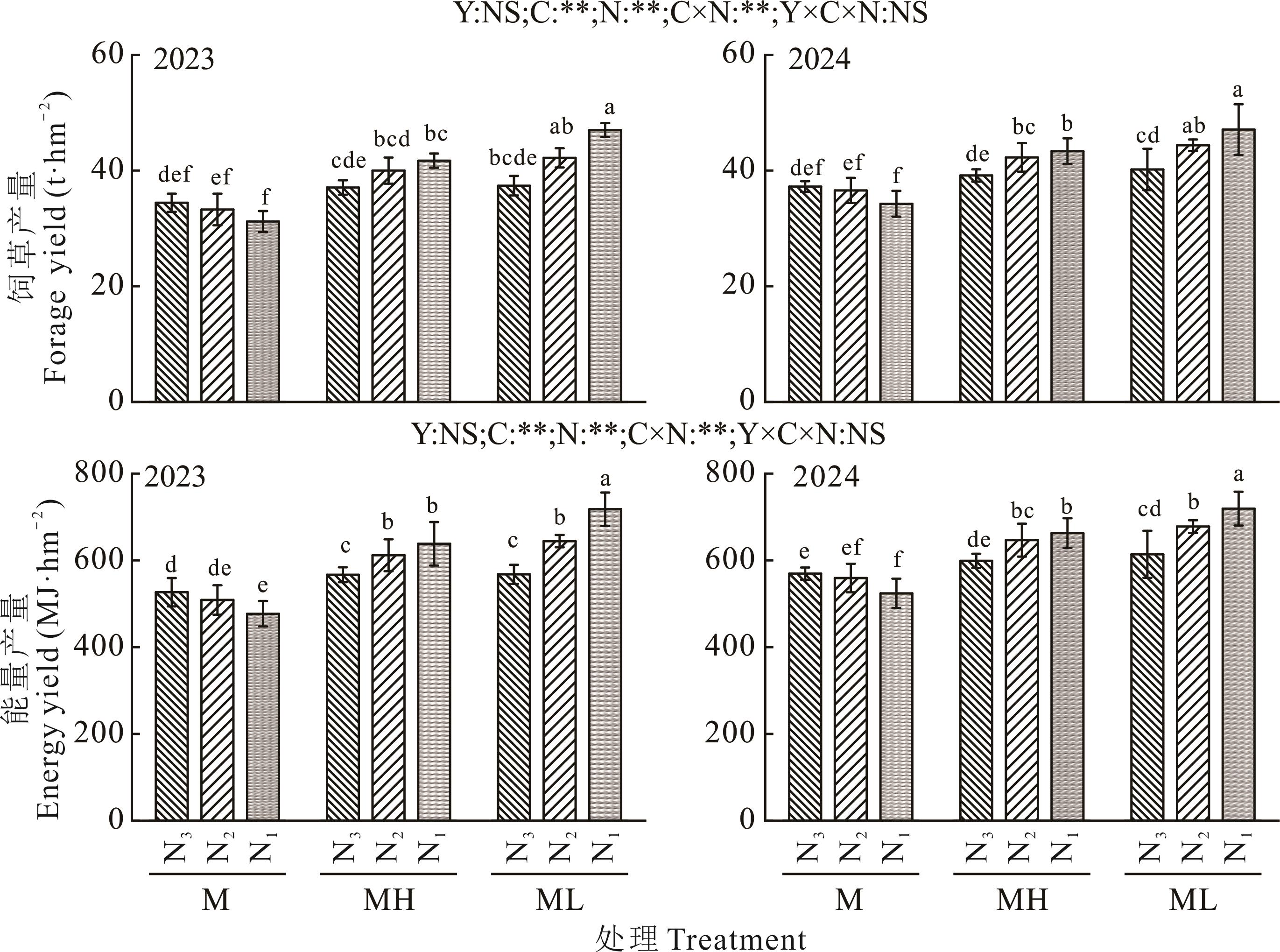
图6 不同种植模式和施氮水平下饲草产量和能量产量
Fig.6 Forage yield and energy yield under different cropping patterns and nitrogen application levels
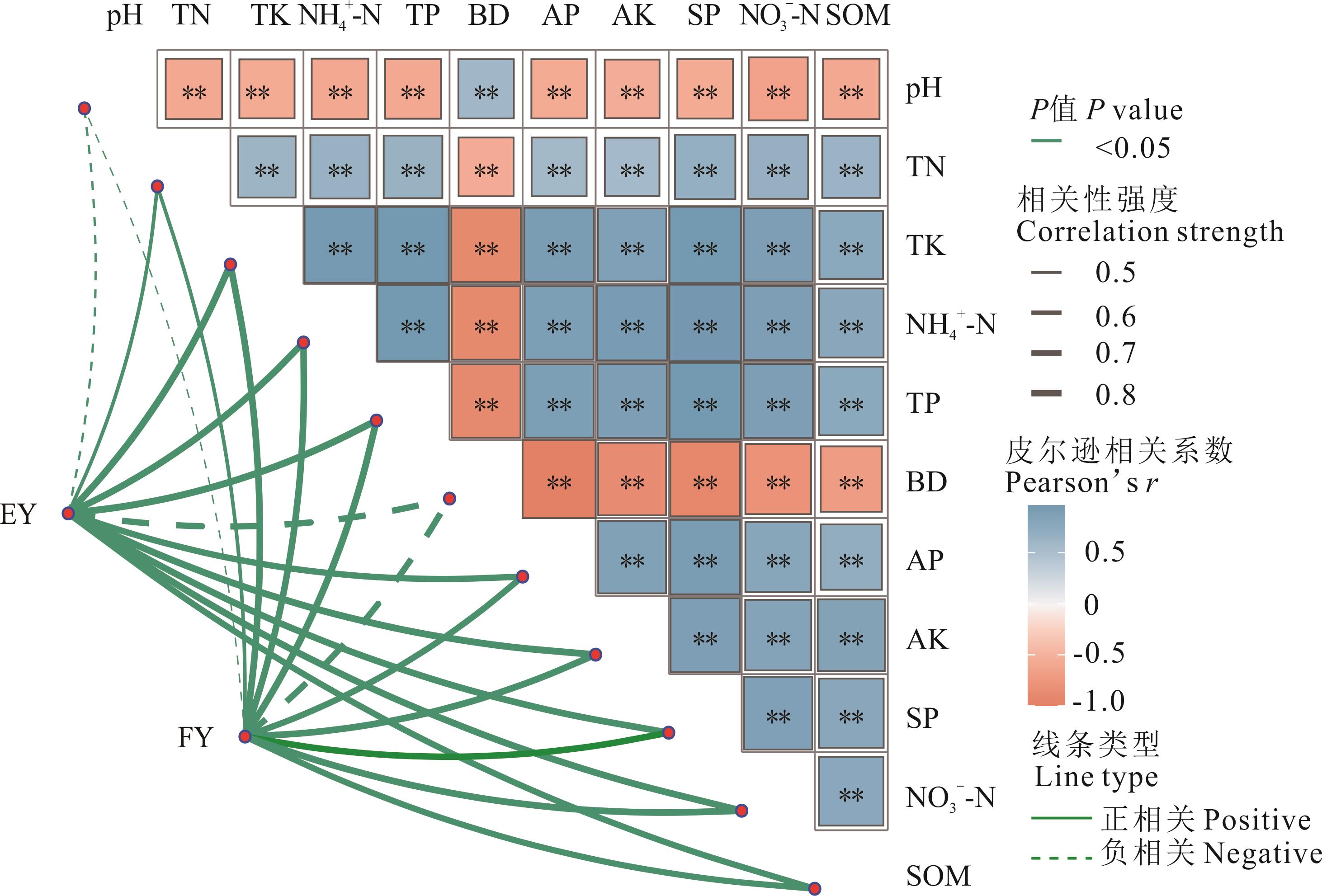
图7 土壤理化特征与饲草产量的关系EY: 能量产量Energy yield; FY: 饲草产量Forage yield; TN: 全氮Total nitrogen; TK: 全钾Total potassium; NH4+-N: 铵态氮Ammonium nitrogen; TP: 全磷Total phosphorus; BD: 容重Bulk density; AP: 有效磷Available phosphorus; AK: 速效钾Available potassium; SP: 孔隙度Soil porosity; NO3--N: 硝态氮Nitrate nitrogen; SOM: 有机质Soil organic matter.
Fig.7 Relationship between soil physical and chemical characteristics and forage yield
指标 Parameter | SCCY | DPC | 间接通径系数Indirect path coefficient | ||||||||||
|---|---|---|---|---|---|---|---|---|---|---|---|---|---|
| pH | TN | TK | NH4+-N | TP | BD | AP | AK | SP | NO3--N | SOM | |||
| pH | -0.548** | 0.160 | - | 0.005 | -0.091 | 0.201 | -0.319 | -0.061 | -0.014 | -0.265 | 0.194 | -0.255 | -0.103 |
| TN | 0.538** | -0.009 | -0.085 | - | 0.080 | -0.172 | 0.292 | 0.048 | 0.006 | 0.206 | -0.184 | 0.255 | 0.100 |
| TK | 0.820** | 0.131 | -0.111 | -0.006 | - | -0.247 | 0.431 | 0.077 | 0.019 | 0.324 | -0.258 | 0.339 | 0.120 |
| NH4+-N | 0.805** | -0.262 | -0.123 | -0.006 | 0.123 | - | 0.433 | 0.075 | 0.019 | 0.341 | -0.260 | 0.341 | 0.124 |
| TP | 0.842** | 0.454 | -0.112 | -0.006 | 0.125 | -0.251 | - | 0.076 | 0.018 | 0.333 | -0.257 | 0.343 | 0.123 |
| BD | -0.770** | -0.084 | 0.115 | 0.005 | -0.119 | 0.233 | -0.404 | - | -0.023 | -0.319 | 0.246 | -0.307 | -0.111 |
| AP | 0.356** | 0.035 | -0.064 | -0.002 | 0.070 | -0.138 | 0.233 | 0.057 | - | 0.170 | -0.152 | 0.116 | 0.307 |
| AK | 0.822** | 0.369 | -0.115 | -0.005 | 0.115 | -0.242 | 0.408 | 0.073 | 0.016 | - | -0.242 | 0.310 | 0.134 |
| SP | 0.798** | -0.269 | -0.115 | -0.006 | 0.126 | -0.253 | 0.432 | 0.077 | 0.019 | 0.331 | - | 0.332 | 0.125 |
| NO3--N | 0.826** | 0.380 | -0.107 | -0.006 | 0.117 | -0.235 | 0.408 | 0.069 | 0.011 | 0.302 | -0.235 | - | 0.123 |
| SOM | 0.755** | 0.158 | -0.104 | -0.006 | 0.099 | -0.205 | 0.351 | 0.060 | 0.007 | 0.312 | -0.212 | 0.295 | - |
表3 不同处理饲草产量与土壤理化因子的相关系数和通径系数
Table 3 Correlation coefficient and path coefficient between forage yield and soil physical and chemical factors under different treatments
指标 Parameter | SCCY | DPC | 间接通径系数Indirect path coefficient | ||||||||||
|---|---|---|---|---|---|---|---|---|---|---|---|---|---|
| pH | TN | TK | NH4+-N | TP | BD | AP | AK | SP | NO3--N | SOM | |||
| pH | -0.548** | 0.160 | - | 0.005 | -0.091 | 0.201 | -0.319 | -0.061 | -0.014 | -0.265 | 0.194 | -0.255 | -0.103 |
| TN | 0.538** | -0.009 | -0.085 | - | 0.080 | -0.172 | 0.292 | 0.048 | 0.006 | 0.206 | -0.184 | 0.255 | 0.100 |
| TK | 0.820** | 0.131 | -0.111 | -0.006 | - | -0.247 | 0.431 | 0.077 | 0.019 | 0.324 | -0.258 | 0.339 | 0.120 |
| NH4+-N | 0.805** | -0.262 | -0.123 | -0.006 | 0.123 | - | 0.433 | 0.075 | 0.019 | 0.341 | -0.260 | 0.341 | 0.124 |
| TP | 0.842** | 0.454 | -0.112 | -0.006 | 0.125 | -0.251 | - | 0.076 | 0.018 | 0.333 | -0.257 | 0.343 | 0.123 |
| BD | -0.770** | -0.084 | 0.115 | 0.005 | -0.119 | 0.233 | -0.404 | - | -0.023 | -0.319 | 0.246 | -0.307 | -0.111 |
| AP | 0.356** | 0.035 | -0.064 | -0.002 | 0.070 | -0.138 | 0.233 | 0.057 | - | 0.170 | -0.152 | 0.116 | 0.307 |
| AK | 0.822** | 0.369 | -0.115 | -0.005 | 0.115 | -0.242 | 0.408 | 0.073 | 0.016 | - | -0.242 | 0.310 | 0.134 |
| SP | 0.798** | -0.269 | -0.115 | -0.006 | 0.126 | -0.253 | 0.432 | 0.077 | 0.019 | 0.331 | - | 0.332 | 0.125 |
| NO3--N | 0.826** | 0.380 | -0.107 | -0.006 | 0.117 | -0.235 | 0.408 | 0.069 | 0.011 | 0.302 | -0.235 | - | 0.123 |
| SOM | 0.755** | 0.158 | -0.104 | -0.006 | 0.099 | -0.205 | 0.351 | 0.060 | 0.007 | 0.312 | -0.212 | 0.295 | - |
| [1] | Sun Y Q, Wang Y W, Fan X Q, et al. Effects of silage maize and feeding millet intercropping on their yield. Pratacultural Science, 2023, 40(12): 3138-3149. |
| 孙颖琦, 王钰文, 范晓庆, 等. 青贮玉米与饲用谷子间作对产量相关性状的影响. 草业科学, 2023, 40(12): 3138-3149. | |
| [2] | Wang P F, Yu A Z, Wang Y L, et al. Effects of multiple cropping green manure after wheat harvest combined with reduced nitrogen application on soil hydrothermal characteristics and maize yield. Acta Agronomica Sinica, 2023, 49(10): 2793-2805. |
| 王鹏飞, 于爱忠, 王玉珑, 等. 麦后复种绿肥翻压还田结合减氮对土壤水热特性及玉米产量的影响. 作物学报, 2023, 49(10): 2793-2805. | |
| [3] | Li R, Mian Y M, Hou X Q, et al. Effects of straw returning with nitrogen application on soil properties, water and nitrogen use efficiency of maize. Acta Agronomica Sinica, 2023, 49(10): 2820-2832. |
| 李荣, 勉有明, 侯贤清, 等. 秸秆还田配施氮肥对土壤性质及玉米水氮利用效率的影响. 作物学报, 2023, 49(10): 2820-2832. | |
| [4] | Gao R M, Yan J, Zou S, et al. Effects of nitrogen fertilizer on microbial community and metabolism in rhizosphere soil of soybean. Soils and Crops, 2023, 12(4): 373-384. |
| 高瑞敏, 严君, 邹狮, 等. 氮肥对大豆根际土壤微生物群落和代谢的影响. 土壤与作物, 2023, 12(4): 373-384. | |
| [5] | Wei Z Y, Zhang H X, Shi W, et al. Effects of planting methods and nitrogen application on forage crop yield, quality and water use in arid area of northwest China. Acta Agronomica Sinica, 2022, 48(10): 2638-2653. |
| 魏正业, 张海星, 石薇, 等. 种植方式与施氮对西北旱区饲草作物产量、品质和水分利用的影响. 作物学报, 2022, 48(10): 2638-2653. | |
| [6] | Yang R J, Wen M M, Liu Y, et al. Effects of summer green manure and nitrogen application on soil nitrogen composition in a dryland winter wheat field. Journal of Plant Nutrition and Fertilizers, 2024, 30(9): 1639-1649. |
| 杨蕊嘉, 温萌萌, 刘洋, 等. 绿肥填闲种植和施氮对旱作冬小麦农田土壤氮组分的影响. 植物营养与肥料学报, 2024, 30(9): 1639-1649. | |
| [7] | Wei X J, Feng T X, Dekejia, et al. Study on the effect of different grass and bean mixture treatments on forage quality and soil nutrients in the Sanjiangyuan area. Pratacultural Science, 2023, 40(9): 2348-2362. |
| 魏希杰, 冯廷旭, 德科加, 等. 三江源区不同禾豆混播处理对饲草品质及土壤养分的影响. 草业科学, 2023, 40(9): 2348-2362. | |
| [8] | Gu J C, Wang W M, Wang Z, et al. Effects of maize and soybean intercropping on soil phosphorus bioavailability and microbial community structure in rhizosphere. Chinese Journal of Applied Ecology, 2023, 34(11): 3030-3038. |
| 顾嘉诚, 王文敏, 王振, 等. 玉米/大豆间作对根际土壤磷素生物有效性和微生物群落结构的影响. 应用生态学报, 2023, 34(11): 3030-3038. | |
| [9] | Zhao B W, Zhan Y, Fang J Q, et al. Mixing ratios effects on production performance and quality in oat and common vetch intercropping systems. Chinese Journal of Grassland, 2024, 46(3): 81-90. |
| 赵保文, 詹圆, 方嘉琪, 等. 混播比例对燕麦与箭筈豌豆生产性能的影响. 中国草地学报, 2024, 46(3): 81-90. | |
| [10] | Han F R, Li J Y, Tian G F. Development overview of the forage industry in Gansu Province. Gansu Animal Husbandry and Veterinary Medicine, 2023, 53(4): 9-13. |
| 韩芙蓉, 李积友, 田贵丰. 甘肃省饲草产业发展概况. 甘肃畜牧兽医, 2023, 53(4): 9-13. | |
| [11] | E S Z, Che Z X, Zeng X B, et al. Effects of long-term fertilization on irrigated desert soil organic carbon stock and soil aggregate in Hexi oasis. Chinese Journal of Soil Science, 2014, 45(5): 1157-1163. |
| 俄胜哲, 车宗贤, 曾希柏, 等. 长期施肥对河西绿洲灌漠土有机碳库储量及水稳性团聚体的影响. 土壤通报, 2014, 45(5): 1157-1163. | |
| [12] | Jensen E S, Carlsson G, Hauggaard-Nielsen H. Intercropping of grain legumes and cereals improves the use of soil N resources and reduces the requirement for synthetic fertilizer N: A global-scale analysis. Agronomy for Sustainable Development, 2020, 40(1): 1-9. |
| [13] | Bao S D. Soil agrochemical analysis (the third edition). Beijing: China Agriculture Press, 2000. |
| 鲍士旦. 土壤农化分析(第3版). 北京: 中国农业出版社, 2000. | |
| [14] | Chen F. Agroecology. Beijing: China Agriculture Press, 2022: 316. |
| 陈阜. 农业生态学. 北京: 中国农业出版社, 2022: 316. | |
| [15] | Bian Y Y, Zhang Z M, Fu Z, et al. Distribution characteristics of soil microbial communities of different vegetation restoration models and their correlation with soil physical and chemical properties in desert steppe. Acta Agrestia Sinica, 2021, 29(4): 655-663. |
| 卞莹莹, 张志敏, 付镇, 等. 荒漠草原区不同植被恢复模式土壤微生物菌落分布特征及其与土壤理化性质的相关性. 草地学报, 2021, 29(4): 655-663. | |
| [16] | Han C W, Kong X M, Song C L, et al. Effects of different soil bulk density on growth and yield of corn under cinnamon soil in Shandong Province. Soil and Fertilizer Sciences in China, 2017(6): 143-148. |
| 韩成卫, 孔晓民, 宋春林, 等. 山东省褐土土壤容重对玉米生长发育及产量形成的影响. 中国土壤与肥料, 2017(6): 143-148. | |
| [17] | Jia A Y, Zhang Y Y, Zhao W Z, et al. Characteristics of soil macropores and water infiltration in oasis croplands in an arid region. Acta Pedologica Sinica, 2022, 59(2): 486-497. |
| 贾昂元, 张勇勇, 赵文智, 等. 干旱区绿洲农田土壤大孔隙与水分入渗特征. 土壤学报, 2022, 59(2): 486-497. | |
| [18] | Yang Y D, Ma J L, Ma H B, et al. Effects of grazing exclusion on root trait characteristics of dominant plants in the desert steppe. Pratacultural Science, 2023, 40(6): 1507-1517. |
| 杨彦东, 马静利, 马红彬, 等. 封育对荒漠草原优势植物根系性状特征的影响. 草业科学, 2023, 40(6): 1507-1517. | |
| [19] | Xu Q, Tian X H, Du W H. Effects of mix-sowing of triticale and legume forage on surface soil fertility in alpine pastoral areas. Grassland and Turf, 2023, 43(2): 107-115. |
| 徐强, 田新会, 杜文华. 高寒牧区小黑麦与3种豆科牧草混播草地的土壤肥力特征. 草原与草坪, 2023, 43(2): 107-115. | |
| [20] | Wang M T, Miao Y J, Zhao Y H, et al. Effects of different artificial grasslands on soil nutrient content in river valley of Nyingchi City. Chinese Journal of Grassland, 2023, 45(10): 144-150. |
| 王明涛, 苗彦军, 赵玉红, 等. 林芝市河谷地带不同人工草地建植对土壤养分含量的影响. 中国草地学报, 2023, 45(10): 144-150. | |
| [21] | Pang D W, Chen J, Tang Y H, et al. Effect of returning methods of maize straw and nitrogen treatments on soil physicochemical property and yield of winter wheat. Acta Agronomica Sinica, 2016, 42(11): 1689-1699. |
| 庞党伟, 陈金, 唐玉海, 等. 玉米秸秆还田方式和氮肥处理对土壤理化性质及冬小麦产量的影响. 作物学报, 2016, 42(11): 1689-1699. | |
| [22] | Guo C Y, Wang W, Peng D, et al. Effect of sowing method and row spacing on soil physicochemical properties of oat/forage pea grassland in alpine regions. Pratacultural Science, 2023, 40(3): 654-664. |
| 郭常英, 王伟, 彭丹, 等. 播种方式和行距对高寒地区燕麦/饲用豌豆草地土壤理化特性的影响. 草业科学, 2023, 40(3): 654-664. | |
| [23] | Huo Y Y, Cao H, Chai S X, et al. Effects of mixed sowing of different forage on soil texture and fertility. Agricultural Research in the Arid Areas, 2020, 38(3): 238-244. |
| 霍雅媛, 曹宏, 柴守玺, 等. 不同豆禾牧草混播对土壤质地及肥力的影响. 干旱地区农业研究, 2020, 38(3): 238-244. | |
| [24] | Meng L Y, Tang J H, Xu W X, et al. Response of soil nutrients and cotton yield to nitrogen reduction rate in continuous cropping cotton field. Journal of Plant Nutrition and Fertilizers, 2024, 30(6): 1234-1242. |
| 孟令贻, 唐江华, 徐文修, 等. 连作棉田土壤养分、棉花产量对减施氮肥的响应. 植物营养与肥料学报, 2024, 30(6): 1234-1242. | |
| [25] | Wang Z H, Zhang H H, Chang L Y, et al. Effects of optimal multifunctional growth-promoting bacteria ‘HS3’ on maize and peanut growth in a maize-peanut intercropping system. Journal of Plant Nutrition and Fertilizers, 2023, 29(1): 142-157. |
| 王中华, 张辉红, 常泸尹, 等. 酸快生芽孢杆菌‘HS3’培养条件的优化及其在玉米花生间作体系中的促生效果. 植物营养与肥料学报, 2023, 29(1): 142-157. | |
| [26] | Cheng Q, Mao X L, Sun T, et al. Effects of long-term combined application of chemical fertilizers with different organic materials on soil microbial ecological stoichiometry and community structure. Journal of Plant Nutrition and Fertilizers, 2024, 30(2): 209-220. |
| 程琪, 毛霞丽, 孙涛, 等. 长期化肥与不同有机物料配施对土壤微生物生态化学计量特征和群落结构的影响. 植物营养与肥料学报, 2024, 30(2): 209-220. | |
| [27] | Du S S, Qi J, Li X, et al. Effects of alfalfa and Elymus sibiricus mixed sowing on forage yield and soil nutrients. Chinese Journal of Grassland, 2024, 46(2): 74-82. |
| 独双双, 祁娟, 李霞, 等. 苜蓿与老芒麦混播对牧草产量及土壤养分的影响. 中国草地学报, 2024, 46(2): 74-82. | |
| [28] | Wang Y F, Liu H Q, Zhao X N, et al. Effects of water and root separation on nitrogen uptake, utilization and transfer in a gramineae-legume intercropping system. Journal of Soil and Water Conservation, 2024, 38(4): 279-287. |
| 王一帆, 刘华清, 赵西宁, 等. 禾豆间作系统水分和根系分隔对牧草氮素吸收利用及转移的影响. 水土保持学报, 2024, 38(4): 279-287. | |
| [29] | Zhang W, Lu J S, Bai J, et al. Introduction of soybean into maize field reduces N2O emission intensity via optimizing nitrogen source utilization. Journal of Cleaner Production, 2024, 442(25): 141051-141052. |
| [30] | Luo Y, Zhang J D, Zhou G P, et al. Intercropping maize with green manure crops at various utilization patterns improves maize yield and soil fertility in Hexi Oasis irrigated area. Journal of Plant Nutrition and Fertilizers, 2022, 28(3): 402-413. |
| 罗跃, 张久东, 周国朋, 等. 河西绿洲灌区间作绿肥及其不同利用方式对玉米产量及土壤肥力的提升效应. 植物营养与肥料学报, 2022, 28(3): 402-413. | |
| [31] | Shi X L, Guo P, Ren J Y, et al. A salt stress tolerance effect study in peanut based on peanut//sorghum intercropping system. Scientia Agricultura Sinica, 2022, 55(15): 2927-2937. |
| 史晓龙, 郭佩, 任婧瑶, 等. 基于花生//高粱间作模式的花生盐胁迫耐受性效应研究. 中国农业科学, 2022, 55(15): 2927-2937. | |
| [32] | Su B B, Zhang Y, Daorina. Correlation analysis between fungal community characteristics and soil physicochemical factors in the rhizosphere of four legumes. Acta Agrestia Sinica, 2021, 29(12): 2670-2677. |
| 苏贝贝, 张英, 道日娜. 4种豆科植物根际土壤真菌群落特征与土壤理化因子间相关性分析. 草地学报, 2021, 29(12): 2670-2677. | |
| [33] | Wang M J, Shi W, Chang S H, et al. Effects of irrigation modes on forage yield, quality and water use of corn-legume intercropping systems in the Hexi irrigation area. Acta Prataculturae Sinica, 2023, 32(3): 13-29. |
| 王茂鉴, 石薇, 常生华, 等. 灌溉模式对河西灌区禾-豆间作系统饲草产量、品质和水分利用的影响. 草业学报, 2023, 32(3): 13-29. | |
| [34] | Ben C Z, Ying Z, Ping C, et al. Maize-legume intercropping promote N uptake through changing the root spatial distribution, legume nodulation capacity, and soil N availability. Journal of Integrative Agriculture, 2022, 21(6): 1755-1771. |
| [35] | Wang B, Shi J M, Wang T F, et al. Effects of nitrogen application on productive performance and nitrogen fertilizer contribution rate of forage sorghum/lablab bean mixed cropping. Acta Prataculturae Sinica, 2025, 34(4): 53-63. |
| 王斌, 史佳梅, 王腾飞, 等. 施氮对饲用高粱/拉巴豆混播草地生产性能和氮肥贡献率的影响. 草业学报, 2025, 34(4): 53-63. | |
| [36] | Wang W, Li M Y, Gong D S, et al. Water use of intercropped species: Maize-soybean, soybean-wheat and wheat-maize. Agricultural Water Management, 2022, 269(7): 107690. |
| [37] | Jiang Z W, Liu G Y, An H Y, et al. Effects of planting density and nitrogen application on forage yield, quality and nitrogen use efficiency in a maize/forage soybean intercropping system. Acta Prataculturae Sinica, 2022, 31(7): 157-171. |
| 蒋紫薇, 刘桂宇, 安昊云, 等. 种植密度与施氮对玉米/秣食豆间作系统饲草产量、品质和氮肥利用的影响. 草业学报, 2022, 31(7): 157-171. | |
| [38] | Chen X, Chen H Y H. Plant mixture balances terrestrial ecosystem C∶N∶P stoichiometry. Nature Communications, 2021, 12(1): 4562. |
| [39] | Wei P Z, Dario F, Guang C L, et al. Interspecific interactions affect N and P uptake rather than N∶P ratios of plant species: Evidence from intercropping. Journal of Plant Ecology, 2022, 15(2): 223-236. |
| [40] | Zhang W P, Surigaoge S, Yang H, et al. Diversified cropping systems with complementary root growth strategies improve crop adaptation to and remediation of hostile soils. Plant and Soil, 2024, 502(1): 7-30. |
| [41] | Yu R P, Yang H, Xing Y, et al. Belowground processes and sustainability in agroecosystems with intercropping. Plant and Soil, 2022, 476(1): 263-288. |
| [42] | Wang Z, Tao T T, Hu W, et al. Forms of nitrogen inputs regulate the intensity of soil acidification. Global Change Biology, 2023, 29(14): 4044-4055. |
| [43] | Zhang X Q, Huang G Q, Bian X M, et al. Effects of nitrogen fertilization and root separation on agronomic traits of intercropping soybean, quantity of micro organisms and activity of enzymes in soybean rhizosphere. Acta Pedologica Sinica, 2012, 49(4): 731-739. |
| 张向前, 黄国勤, 卞新民, 等. 施氮肥与隔根对间作大豆农艺性状和根际微生物数量及酶活性的影响. 土壤学报, 2012, 49(4): 731-739. | |
| [44] | Chen P, Du Q, Liu X M, et al. Effects of reduced nitrogen inputs on crop yield and nitrogen use efficiency in a long-term maize-soybean relay strip intercropping system. PLoS One, 2017, 12(9): e0184503. |
| [1] | 张琨, 乔建霞, 李金升, 王育鹏, 刘克思. 不同修复材料对退化高寒草地土壤理化性质及微生物群落的影响[J]. 草业学报, 2025, 34(8): 132-148. |
| [2] | 孔天赐, 马学青, 贺晨帮, 樊泰延, 芦光新, 祁鹤兴. 青贮玉米真菌性病害对青贮发酵微生物多样性的影响[J]. 草业学报, 2025, 34(7): 95-106. |
| [3] | 刘启林, 王小军, 王金兰, 刘文辉, 马巧玲, 李建辉, 张生原, 曹文侠, 李文. 氮磷配施对高寒区老芒麦饲草产量的影响[J]. 草业学报, 2025, 34(6): 193-202. |
| [4] | 秦文利, 张静, 肖广敏, 崔素倩, 叶建勋, 智健飞, 张立锋, 谢楠, 冯伟, 刘振宇, 潘璇, 代云霞, 刘忠宽. 绿肥部分替代化肥氮对土壤物理性状的影响[J]. 草业学报, 2025, 34(6): 27-45. |
| [5] | 蒋鹏, 李磊, 解昊郡, 徐得甲, 王锐, 虎强, 孙权. 净化沼液滴灌对砂壤土质量、青贮玉米生产力的影响及安全消纳容量分析[J]. 草业学报, 2025, 34(4): 64-81. |
| [6] | 李浩晶, 张丹珂, 李海润, 曹静, 徐国伟. 施氮对不同食味品质水稻根系生长及分泌有机酸的影响[J]. 草业学报, 2025, 34(2): 163-173. |
| [7] | 欧翔, 连海, 陈荣强, 邱静芸, 吴丽娟, 操贤洪, 张强, 雷小文. 不同施肥处理种植王草后对稀土尾矿土壤理化性质和酶活性的影响[J]. 草业学报, 2025, 34(2): 94-108. |
| [8] | 鲍平安, 文志林, 王炎, 陈彦虎, 季波, 王占军, 吴旭东, 蒋齐. 不同牧草补播模式对荒漠草原植物群落结构及土壤特性的影响[J]. 草业学报, 2025, 34(10): 62-73. |
| [9] | 王新友, 王小兰, 张万昌, 李颖, 马永玲, 王晓寅, 王建刚, 王海青, 岳贝凡, 刘永福, 王永宏, 刘珊, 白美婷. 陇东南部林缘山区青贮玉米品种筛选及其高效栽培研究[J]. 草业学报, 2025, 34(1): 191-202. |
| [10] | 杜文盼, 赵桂琴, 柴继宽, 杨莉, 张建贵, 史怡超, 张官禄. 根系分隔方式对燕麦/豌豆间作地上生物量、土壤养分及根系性状的影响[J]. 草业学报, 2024, 33(8): 25-36. |
| [11] | 岳海旺, 魏建伟, 王广才, 刘朋程, 陈淑萍, 卜俊周. 基于环境型鉴定技术划分生态区综合评价黄淮海青贮玉米品种[J]. 草业学报, 2024, 33(3): 120-138. |
| [12] | 孟超楠, 赵玉洁, 陈佳欣, 张旖璐, 王彦佳, 冯丽荣, 孙玉刚, 郭长虹. 2株青贮玉米根际固氮菌的筛选鉴定及促生作用研究[J]. 草业学报, 2024, 33(3): 174-185. |
| [13] | 鲍平安, 季波, 孙果, 张娜, 吴旭东, 何建龙, 王占军, 田英. 光伏电站建设对植物群落与土壤特征的影响[J]. 草业学报, 2024, 33(12): 23-33. |
| [14] | 张仲鹃, 郝曦煜, 王雪, 李峰, 李文龙. 齐齐哈尔地区适宜青贮玉米品种的筛选及综合评价[J]. 草业学报, 2024, 33(11): 228-240. |
| [15] | 田晴华, 刘丹, 廖小琴, 宋小艳, 胡雷, 王长庭. 施氮对高寒草地土壤团聚体生物胶结物质及稳定性的影响[J]. 草业学报, 2024, 33(11): 46-57. |
| 阅读次数 | ||||||
|
全文 |
|
|||||
|
摘要 |
|
|||||
