

ISSN 1004-5759 CN 62-1105/S
草业学报 ›› 2025, Vol. 34 ›› Issue (6): 193-202.DOI: 10.11686/cyxb2023459
• 研究论文 • 上一篇
刘启林1,2( ), 王小军2, 王金兰3, 刘文辉2, 马巧玲4, 李建辉4, 张生原4, 曹文侠1, 李文2()
收稿日期:2023-11-29
修回日期:2024-01-03
出版日期:2025-06-20
发布日期:2025-04-03
通讯作者:
曹文侠,李文
作者简介:lw@qhu.edu.cn基金资助:
Qi-lin LIU1,2(), Xiao-jun WANG2, Jin-lan WANG3, Wen-hui LIU2, Qiao-ling MA4, Jian-hui LI4, Sheng-yuan ZHANG4, Wen-xia CAO1, Wen LI2()
Received:2023-11-29
Revised:2024-01-03
Online:2025-06-20
Published:2025-04-03
Contact:
Wen-xia CAO,Wen LI
摘要:
为探讨氮磷肥配施对高寒区老芒麦饲草产量的影响,本研究以青牧2号老芒麦(Qingmu No.2)为材料,设置了4个氮肥(纯N,0、60、90、120 kg·hm-2)和4个磷肥(纯P,0、30、60、90 kg·hm-2)水平,分析不同氮磷配施处理下老芒麦生长性状、饲草产量及经济效益的变化,并采用结构方程模型探讨氮磷配施对老芒麦饲草产量的影响过程及其路径系数,以期为高寒区优质饲草高效生产提供数据支撑。结果表明:1)氮磷配施显著提高了老芒麦的株高、茎粗、分蘖数、生殖枝数、饲草产量及经济效益,在同一施氮水平下,随施磷量的增加,以上指标均呈先增后降的变化趋势;2)在60 kg N·hm-2与60 kg P·hm-2配施时,老芒麦饲草产量及增产净收益均最大,分别为12154.14 kg·hm-2和3370.49元·hm-2;3)结构方程模型表明,氮磷配施主要通过促进分蘖来提高老芒麦的饲草产量;4)TOPSIS-多准则决策模型分析表明,60 kg N·hm-2与60 kg P·hm-2配施不但可以保持较高的饲草产量,还可显著提高经济效益,是适宜于高寒地区老芒麦饲草生产的最佳氮磷配施量。
刘启林, 王小军, 王金兰, 刘文辉, 马巧玲, 李建辉, 张生原, 曹文侠, 李文. 氮磷配施对高寒区老芒麦饲草产量的影响[J]. 草业学报, 2025, 34(6): 193-202.
Qi-lin LIU, Xiao-jun WANG, Jin-lan WANG, Wen-hui LIU, Qiao-ling MA, Jian-hui LI, Sheng-yuan ZHANG, Wen-xia CAO, Wen LI. Effect of nitrogen and phosphorus combined application on forage yield of Elymus sibiricus in an alpine region[J]. Acta Prataculturae Sinica, 2025, 34(6): 193-202.

图1 氮磷配施对老芒麦农艺性状的影响不同小写字母表示同一氮肥处理下不同磷肥处理间差异显著(P<0.05),不同大写字母表示所有施肥处理间差异显著(P<0.05),下同。Different lowercase letters indicate significant differences among phosphate treatments under the same nitrogen fertilizer treatment (P<0.05), different capital letters indicated significant differences among all fertilization treatments (P<0.05), the same below.
Fig.1 Effects of nitrogen and phosphorus combined application on agronomic traits of E. sibiricus
项目 Item | 处理 Treatment | 平方和 Square sum | 自由度 Degree of freedom | 均方 Mean square | F | P |
|---|---|---|---|---|---|---|
株高 Plant height | 氮N | 2562.69 | 3 | 854.23 | 28.89 | 0.000 |
| 磷P | 1698.03 | 3 | 566.01 | 19.14 | 0.000 | |
| 氮×磷N×P | 1150.11 | 9 | 127.79 | 4.32 | 0.000 | |
茎粗 Stem diameter | 氮N | 0.22 | 3 | 0.07 | 2.12 | 0.103 |
| 磷P | 0.57 | 3 | 0.19 | 5.55 | 0.002 | |
| 氮×磷N×P | 0.46 | 9 | 0.05 | 1.49 | 0.162 | |
分蘖数 Tillers | 氮N | 189114.83 | 3 | 63038.28 | 16.78 | 0.000 |
| 磷P | 212420.99 | 3 | 70807.00 | 18.85 | 0.000 | |
| 氮×磷N×P | 33062.33 | 9 | 3673.59 | 0.98 | 0.487 | |
生殖枝数 Fertile tillers | 氮N | 160463.84 | 3 | 53487.95 | 12.72 | 0.000 |
| 磷P | 316125.07 | 3 | 105375.02 | 25.06 | 0.000 | |
| 氮×磷N×P | 56836.60 | 9 | 6315.18 | 1.50 | 0.214 | |
干鲜比 Dry-fresh ratio | 氮N | 0.010 | 3 | 0.003 | 2.547 | 0.085 |
| 磷P | 0.002 | 3 | 0.001 | 0.704 | 0.561 | |
| 氮×磷N×P | 0.020 | 9 | 0.002 | 1.702 | 0.154 | |
茎叶比 Stem-leaf ratio | 氮N | 0.207 | 3 | 0.069 | 6.152 | 0.004 |
| 磷P | 0.105 | 3 | 0.035 | 3.129 | 0.049 | |
| 氮×磷N×P | 0.138 | 9 | 0.015 | 1.361 | 0.269 | |
饲草产量 Forage yield | 氮N | 16856498.0 | 3 | 5618833.0 | 27.241 | 0.000 |
| 磷P | 4639826.0 | 3 | 1546609.0 | 7.498 | 0.001 | |
| 氮×磷N×P | 5980822.0 | 9 | 664535.7 | 3.222 | 0.014 |
表1 氮磷配施对老芒麦农艺性状的双因素方差分析
Table 1 Two-factor analysis of variance of nitrogen and phosphorus combined application on agronomic traits of E. sibiricus
项目 Item | 处理 Treatment | 平方和 Square sum | 自由度 Degree of freedom | 均方 Mean square | F | P |
|---|---|---|---|---|---|---|
株高 Plant height | 氮N | 2562.69 | 3 | 854.23 | 28.89 | 0.000 |
| 磷P | 1698.03 | 3 | 566.01 | 19.14 | 0.000 | |
| 氮×磷N×P | 1150.11 | 9 | 127.79 | 4.32 | 0.000 | |
茎粗 Stem diameter | 氮N | 0.22 | 3 | 0.07 | 2.12 | 0.103 |
| 磷P | 0.57 | 3 | 0.19 | 5.55 | 0.002 | |
| 氮×磷N×P | 0.46 | 9 | 0.05 | 1.49 | 0.162 | |
分蘖数 Tillers | 氮N | 189114.83 | 3 | 63038.28 | 16.78 | 0.000 |
| 磷P | 212420.99 | 3 | 70807.00 | 18.85 | 0.000 | |
| 氮×磷N×P | 33062.33 | 9 | 3673.59 | 0.98 | 0.487 | |
生殖枝数 Fertile tillers | 氮N | 160463.84 | 3 | 53487.95 | 12.72 | 0.000 |
| 磷P | 316125.07 | 3 | 105375.02 | 25.06 | 0.000 | |
| 氮×磷N×P | 56836.60 | 9 | 6315.18 | 1.50 | 0.214 | |
干鲜比 Dry-fresh ratio | 氮N | 0.010 | 3 | 0.003 | 2.547 | 0.085 |
| 磷P | 0.002 | 3 | 0.001 | 0.704 | 0.561 | |
| 氮×磷N×P | 0.020 | 9 | 0.002 | 1.702 | 0.154 | |
茎叶比 Stem-leaf ratio | 氮N | 0.207 | 3 | 0.069 | 6.152 | 0.004 |
| 磷P | 0.105 | 3 | 0.035 | 3.129 | 0.049 | |
| 氮×磷N×P | 0.138 | 9 | 0.015 | 1.361 | 0.269 | |
饲草产量 Forage yield | 氮N | 16856498.0 | 3 | 5618833.0 | 27.241 | 0.000 |
| 磷P | 4639826.0 | 3 | 1546609.0 | 7.498 | 0.001 | |
| 氮×磷N×P | 5980822.0 | 9 | 664535.7 | 3.222 | 0.014 |

图2 氮磷配施对老芒麦饲草产量及产量增幅的影响
Fig.2 Effects of nitrogen and phosphorus combined application on forage yield and yield increase of E. sibiricus

图3 氮磷配施对老芒麦饲草经济效益的影响
Fig.3 Effects of nitrogen and phosphorus combined application on economic benefits of E. sibiricus
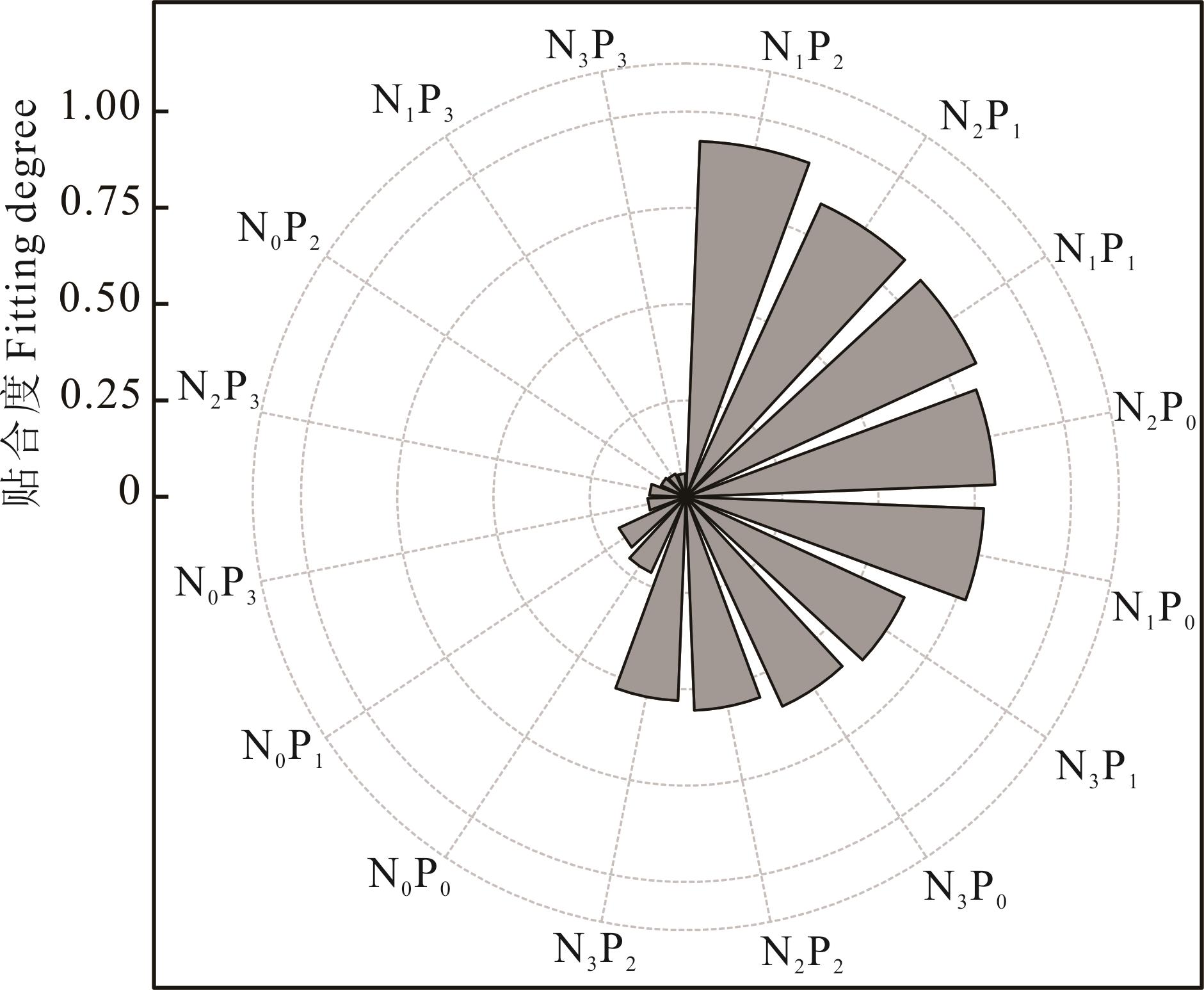
图4 老芒麦氮磷配施处理综合评价
Fig.4 Comprehensive evaluation of nitrogen and phosphorus combined treatment of E. sibiricus

图5 结构方程模型分析氮磷配施对老芒麦饲草产量的影响路径(a)及各影响因子的标准化效应值(b)实线和虚线箭头分别表示显著正和负的路径关系。数值为标准化路径系数。*表示在0.05水平上差异显著,**表示在0.01水平上差异显著,***表示在0.001水平上差异显著。Solid and dashed arrows represent significantly positive or negative effects at the 0.05 level,respectively. The significant standard path coefficients were shown on arrows. *P<0.05,**P<0.01, ***P<0.001.
Fig.5 Structural equation model to analyze the effects of nitrogen and phosphorus combined application on forage yield of E. sibiricus (a) and standardized effect sizes for each impact factor (b)
| 1 | Liu Y Q, Lv C H, Fu B J, et al. Terrestrial ecosystem classification and its spatiotemporal changes in China during last 20 years. Acta Ecologica Sinica, 2021, 41(10): 3975-3987. |
| 刘亚群, 吕昌河, 傅伯杰, 等. 中国陆地生态系统分类识别及其近20年的时空变化. 生态学报, 2021, 41(10): 3975-3987. | |
| 2 | Chen S T, Guo B, Yang F, et al. Spatial and temporal patterns of NPP and its response to climate change in the Qinghai-Tibet Plateau from 2000 to 2015. Journal of Natural Resources, 2020, 35(10): 2511-2527. |
| 陈舒婷, 郭兵, 杨飞, 等. 2000-2015年青藏高原植被NPP时空变化格局及其对气候变化的响应. 自然资源学报, 2020, 35(10): 2511-2527. | |
| 3 | Cao J, Holden N, Lu X, et al. The effect of grazing management on plant species richness on the Qinghai-Tibetan Plateau. Grass & Forage Science, 2011, 66(3): 333-336. |
| 4 | Mo X G, Liu W, Meng C C, et al. Variations of forage yield and forage-livestock balance in grasslands over the Tibetan Plateau, China. Chinese Journal of Applied Ecology, 2021, 32(7): 2415-2425. |
| 莫兴国, 刘文, 孟铖铖, 等. 青藏高原草地产量与草畜平衡变化. 应用生态学报, 2021, 32(7): 2415-2425. | |
| 5 | Wu S N, Zhang X, Gao X X, et al. Succession dynamics of a plant community of degraded alpine meadow during the human-induced restoration process in the Three Rivers Source region. Acta Ecologica Sinica, 2019, 39(7): 2444-2453. |
| 武胜男, 张曦, 高晓霞, 等. 三江源区“黑土滩”型退化草地人工恢复植物群落的演替动态. 生态学报, 2019, 39(7): 2444-2453. | |
| 6 | Ren C Y, Liang G L, Liu W H, et al. Screening and adaptability evaluation of early maturing oats in alpine regions of the Qinghai-Tibetan Plateau. Acta Prataculturae Sinica, 2023, 32(9): 116-129. |
| 任春燕, 梁国玲, 刘文辉, 等. 青藏高原高寒地区早熟燕麦资源筛选和适应性评价. 草业学报, 2023, 32(9): 116-129. | |
| 7 | Zhou J J, Wei W. Interactive effect of fertilization and cutting on community dynamics and transgressive over yielding effect of grass pasture in the northern Tibetan Plateau. Acta Prataculturae Sinica, 2023, 32(10): 28-39. |
| 周娟娟, 魏巍. 施肥和刈割协同对藏北高原禾草混播群落动态和超产的影响. 草业学报, 2023, 32(10): 28-39. | |
| 8 | Li W, Wang J L, Zhang X J, et al. Effect of degradation and rebuilding of artificial grasslands on soil respiration and carbon and nitrogen pools on an alpine meadow of the Qinghai-Tibetan Plateau. Ecological Engineering, 2018, 111: 134-142. |
| 9 | Chen X, Zhang T, Guo R, et al. Fencing enclosure alters nitrogen distribution patterns and tradeoff strategies in an alpine meadow on the Qinghai-Tibetan Plateau. Catena, 2021, 197: 104948. |
| 10 | Wan Q, Wang J, Wang X T, et al. Effects of different meadow use types on the fractal characteristics of soil particle in the Qinghai-Tibet Plateau. Acta Ecologica Sinica, 2022, 42(5): 1716-1726. |
| 宛倩, 王杰, 王向涛, 等. 青藏高原不同草地利用方式对土壤粒径分形特征的影响. 生态学报, 2022, 42(5): 1716-1726. | |
| 11 | Gao Z H, Lei Y X, Zhou Q P. Research progress of molecular systematics of Elymus and its related genera. Chinese Journal of Grassland, 2022, 44(2): 107-115. |
| 高子涵, 雷映霞, 周青平. 广义披碱草属及其近缘属植物的分子系统学研究现状. 中国草地学报, 2022, 44(2): 107-115. | |
| 12 | Zhao Y C, Chen L T. Soil nutrients modulate response of aboveground biomass to warming in alpine grassland on the Qingzang Plateau. Chinese Journal of Plant Ecology, 2023, 47(8): 1071-1081. |
| 赵艳超, 陈立同. 土壤养分对青藏高原高寒草地生物量响应增温的调节作用. 植物生态学报, 2023, 47(8): 1071-1081. | |
| 13 | De K J, Zhang D G, Wang W, et al. Effects of fertilizers on the alpine meadow plant and soil N, P, K contents. Acta Agrestia Sinica, 2014, 22(2): 299-305. |
| 德科加, 张德罡, 王伟, 等. 施肥对高寒草甸植物及土壤N, P, K的影响. 草地学报, 2014, 22(2): 299-305. | |
| 14 | Chen L L, Ren W, Mao P S, et al. Effects of nitrogen application on seed yield and nitrogen accumulation in alfalfa (Medicago sativa). Acta Prataculturae Sinica, 2017, 26(6): 98-104. |
| 陈玲玲, 任伟, 毛培胜, 等. 氮素对紫花苜蓿种子产量与氮累积动态变化的影响. 草业学报, 2017, 26(6): 98-104. | |
| 15 | Yu X N, Zhu P, Mao P S. Effects of nitrogenous fertilizer and phosphorus fertilizer applications on roots and seed yield of Elymus sibiricus. Acta Agrestia Sinica, 2011, 19(4): 637-643. |
| 于晓娜, 朱萍, 毛培胜. 氮磷处理对老芒麦根系及种子产量的影响. 草地学报, 2011, 19(4): 637-643. | |
| 16 | Yu A, Yang F, Zhang Y, et al.Influences of different phosphorus concentrations on the root distribution of Stylosanthes and black seed Paspalum. Acta Prataculturae Sinica, 2011, 20(3): 219-224. |
| 余爱, 杨帆, 张宇, 等. 不同施磷浓度对柱花草和黑籽雀稗根系分布的影响. 草业学报, 2011, 20(3): 219-224. | |
| 17 | Agnew J, Sprenger C, Kendel Z, et al. The effect of nitrogen fertility rate and seeding rate on yield, nutritive value and economics of forage corn in a low corn heat unit region of Western Canada. Field Crops Research, 2022, 283: 108520. |
| 18 | Peng Y, Sun J Y, Ma S J, et al. Effects of nitrogen and phosphorus addition on production performance and nutritive value of pasture species in Northern Tibet. Acta Prataculturae Sinica, 2021, 30(5): 52-64. |
| 彭艳, 孙晶远, 马素洁, 等. 氮磷添加对藏北人工牧草生产性能和品质的评价. 草业学报, 2021, 30(5): 52-64. | |
| 19 | Zhang Y C, Wei X X, Liang G L, et al. Phenotype changes during aging over six years of Elymus sibiricus stands and the effects of nutrient addition. Acta Prataculturae Sinica, 2022, 31(6): 101-111. |
| 张永超, 魏小星, 梁国玲, 等. 老芒麦衰老过程形态特征变化规律及对养分添加的响应. 草业学报, 2022, 31(6): 101-111. | |
| 20 | Zhang Y C, Liang G L, Qin Y, et al. Characteristics of chlorophyll and photosynthesis in leaves and their response to nutrients during aging of Elymus sibiricus. Acta Prataculturae Sinica, 2022, 31(1): 229-237. |
| 张永超, 梁国玲, 秦燕, 等. 老芒麦衰老过程中叶片叶绿素和光合作用变化特征及对养分的响应. 草业学报, 2022, 31(1): 229-237. | |
| 21 | Li C R, Luo Y Y, Wang Q N. Effects of different fertilization and soil moisture treatments on growth and yield of forage grasses in Xikang-Tibet Plateau. Acta Agriculturae Boreali-Occidentalis Sinica, 2020, 29(7): 990-999. |
| 李春容, 罗言云, 王倩娜. 不同施肥和土壤保湿处理对康藏高原牧草生长和产量的影响. 西北农业学报, 2020, 29(7): 990-999. | |
| 22 | Gao L M, Chen C, Shen Y X. Effects of nitrogen and phosphorus fertilizer rates on forage dry matter yield and regrowth of alfalfa in seasonal cultivation systems. Acta Prataculturae Sinica, 2022, 31(4): 43-52. |
| 高丽敏, 陈春, 沈益新. 氮磷肥对季节性栽培紫花苜蓿生长及再生的影响. 草业学报, 2022, 31(4): 43-52. | |
| 23 | Liu W H, Zhou Q P, Yan H B, et al. The effect of fertilization to the hay and seed yield of Elymus breviaristatus in alpine region. Acta Agrestia Sinica, 2007, 15(2): 193-195. |
| 刘文辉, 周青平, 颜红波, 等. 高寒地区施肥对短芒老芒麦草产量和种子产量的影响. 草地学报, 2007, 15(2): 193-195. | |
| 24 | Wang M Y. Roles of nitrogen application on seed yield and yield components in Siberian wildrye. Beijing: China Agricultural University, 2018. |
| 王明亚. 施氮对老芒麦种子产量及产量因子的作用. 北京: 中国农业大学, 2018. | |
| 25 | Battisti M, Moretti B, Blandino M, et al. Maize response to nitrogen and phosphorus starter fertilisation in mineral-fertilised or manured systems. The Crop Journal, 2023, 11(3): 922-932. |
| 26 | Long H Y, Zhang D, Zeng L P, et al. Herbage accumulation, and nitrogen and phosphorus absorption responses of three forage species following addition of nitrogen and phosphorus fertilizer. Acta Prataculturae Sinica, 2019, 28(5): 171-177. |
| 龙会英, 张德, 曾丽萍, 等. 氮磷肥对3种牧草的生长效应和氮磷吸收的影响. 草业学报, 2019, 28(5): 171-177. | |
| 27 | Luo K, Zhang J Y, Wang Y R. Effect of planting density and phosphorus fertiliser on seed yield of Melilotus officinalis. Acta Prataculturae Sinica, 2018, 27(7): 112-119. |
| 骆凯, 张吉宇, 王彦荣. 种植密度和施磷肥对黄花草木樨种子产量的影响. 草业学报, 2018, 27(7): 112-119. | |
| 28 | Fu B Z, Zhou Y F, Li X, et al. Effect of water and fertilizer coupling on Leymus chinensis in the Ningxia irrigation area. Acta Prataculturae Sinica, 2020, 29(5): 98-108. |
| 伏兵哲, 周燕飞, 李雪, 等. 宁夏引黄灌区羊草水肥耦合效应研究. 草业学报, 2020, 29(5): 98-108. | |
| 29 | You Y L, Li Y, Zhao H M, et al. Effects of nitrogen and phosphate fertilizer application on yield and forage quality of forage triticale on the Haihe Plain. Acta Prataculturae Sinica, 2020, 29(3): 137-146. |
| 游永亮, 李源, 赵海明, 等. 海河平原区施氮磷肥对饲用小黑麦生产性能及营养品质的影响. 草业学报, 2020, 29(3): 137-146. | |
| 30 | Chen W Y, Wang L, Gengqiu B M, et al. Effect of N and P addition on production performance of aging artificial pasture. Journal of Qinghai University, 2019, 37(2): 15-21. |
| 陈伟元, 王玲, 更求巴毛, 等. 氮、磷添加对老龄人工草地生产性能的影响. 青海大学学报, 2019, 37(2): 15-21. | |
| 31 | Zhao Z W, Zhao B, Xie M, et al. Effects of combination of nitrogen,phosphorus and potassium on the yield and nutrient utilization in Chenopodium quinoa Willd. Journal of Arid Land Resources and Environment, 2023, 37(2): 157-164. |
| 赵志伟, 赵博, 谢岷, 等. 氮磷钾配施对藜麦产量及养分吸收利用的影响. 干旱区资源与环境, 2023, 37(2): 157-164. | |
| 32 | Jiang J, Wang Y P, Yang Y, et al. Interactive effects of nitrogen and phosphorus additions on plant growth vary with ecosystem type. Plant and Soil, 2019, 440: 523-537. |
| 33 | Shi Z H, Liu W H, Zhang Y C, et al. Effects of nitrogen and phosphorus fertilizers combined application on diurnal variations of leaves photosynthetic characteristics in Festuca kryloviana. Acta Prataculturae Sinica, 2019, 28(11): 75-85. |
| 石正海, 刘文辉, 张永超, 等. 氮磷肥配施对西北羊茅开花期叶片光合特性日变化的影响. 草业学报, 2019, 28(11): 75-85. | |
| 34 | Shi Z H, Liu W H, Zhang Y C, et al. Seasonal nitrogen and phosphorus co-application enhances productivity of Festuca kryloviana cv. Huanhu. Acta Prataculturae Sinica, 2024, 33(1): 149-158. |
| 石正海, 刘文辉, 张永超, 等. 季节性氮磷配施提升环湖寒生羊茅生产性能. 草业学报, 2024, 33(1): 149-158. | |
| 35 | Song J C, Yang H, Yu X J, et al. Effect of combined application of nitrogen and phosphorus fertilizer on the forage yield and nutritional quality of Elymus nutans in alpine region. Acta Agrestia Sinica, 2022, 30(3): 731-742. |
| 宋建超, 杨航, 鱼小军, 等. 氮磷肥配施对高寒区垂穗披碱草饲草产量及营养品质的影响. 草地学报, 2022, 30(3): 731-742. | |
| 36 | Wang M Y, Hou L Y, Zhu Y Q, et al. Siberian wildrye seed yield limited by assimilate source. Field Crops Research, 2018, 218: 18-23. |
| 37 | Li W, Wei T H, A B D, et al. Effects of reduction of chemical fertilizer and organic manure supplement on oat nutrient quality and soil nutrient in alpine cold region. Acta Agrestia Sinica, 2021, 29(12): 2878-2886. |
| 李文, 魏廷虎, 阿保地, 等. 化肥减施配合有机肥对高寒区燕麦营养品质和土壤养分的影响. 草地学报, 2021, 29(12): 2878-2886. | |
| 38 | Li T Y, Zhou Q P, Chen Y J, et al. Effects of nitrogen application rate on seed yield and nitrogen use efficiency of Elymus. Acta Prataculturae Sinica, 2023, 32(3): 80-90. |
| 李彤瑶, 周青平, 陈有军, 等. 氮肥用量对披碱草属牧草种子产量和氮肥利用效率的影响. 草业学报, 2023, 32(3): 80-90. | |
| 39 | Zhang D, Long H Y, Jin J, et al. Effects of growth interaction effect of Leguminous and Gramineous pasture intercropping and absorption of nutrient and phosphorus on pasture expression. Acta Prataculturae Sinica, 2018, 27(10): 15-22. |
| 张德, 龙会英, 金杰, 等. 豆科与禾本科牧草间作的生长互作效应及对氮、磷养分吸收的影响. 草业学报, 2018, 27(10): 15-22. |
| [1] | 王腾飞, 马霞, 刘金龙, 王斌, 张译尹, 李佳旺, 马江萍, 王小兵, 兰剑. 引黄灌区复种饲用燕麦种植模式产量、品质及经济效益分析[J]. 草业学报, 2025, 34(4): 27-37. |
| [2] | 王文虎, 梁国玲, 刘文辉, 王凤宇, 李文. 青藏高原区8份老芒麦资源农艺性状与生产性能综合评价[J]. 草业学报, 2025, 34(2): 123-132. |
| [3] | 柳文蔚, 刘鑫, 雷映霞, 周青平, 刘志峰, 王沛. 老芒麦种质资源抗寒性综合评价及冷胁迫下的生理反应[J]. 草业学报, 2023, 32(8): 152-163. |
| [4] | 廖小琴, 王长庭, 刘丹, 唐国, 毛军. 氮磷配施对高寒草甸植物根系特征的影响[J]. 草业学报, 2023, 32(7): 160-174. |
| [5] | 李春艳, 王艳, 李欣瑞, 李英主, 李明峰, 陈丽丽, 雷雄, 闫利军, 游明鸿, 季晓菲, 张昌兵, 吴婍, 苟文龙, 李达旭, 鄢家俊, 白史且. 中国野生老芒麦形态多样性研究与种质利用潜力分析[J]. 草业学报, 2023, 32(3): 67-79. |
| [6] | 张永超, 魏小星, 梁国玲, 秦燕, 刘文辉, 贾志锋, 刘勇, 马祥. 老芒麦衰老过程形态特征变化规律及对养分添加的响应[J]. 草业学报, 2022, 31(6): 101-111. |
| [7] | 张永超, 梁国玲, 秦燕, 刘文辉, 贾志锋, 刘勇, 马祥. 老芒麦衰老过程中叶片叶绿素和光合作用变化特征及对养分的响应[J]. 草业学报, 2022, 31(1): 229-237. |
| [8] | 王传旗, 刘文辉, 张永超, 周青平. 野生老芒麦苗期耐旱性研究[J]. 草业学报, 2021, 30(8): 127-136. |
| [9] | 索效军, 张年, 杨前平, 陶虎, 熊琪, 李晓锋, 张凤, 陈明新. 日粮添加花生秧和苜蓿草粉对波麻杂交羊增重性能、内脏器官发育及血液指标的影响[J]. 草业学报, 2021, 30(5): 146-154. |
| [10] | 吴瑞, 刘文辉, 张永超, 秦燕, 魏小星, 刘敏洁. 青藏高原老芒麦落粒性及农艺性状相关性研究[J]. 草业学报, 2021, 30(4): 130-139. |
| [11] | 王辛有, 曹文侠, 王小军, 刘玉祯, 高瑞, 王世林, 安海涛, 邓秀霞, 王文虎. 河西地区豆禾混播草地生产性能对刈割高度与施肥的响应[J]. 草业学报, 2021, 30(4): 99-110. |
| [12] | 吴勇, 刘晓静, 蔺芳, 童长春. 河西荒漠灌区紫花苜蓿施肥效应及其基于数据包络分析法的经济效益研究[J]. 草业学报, 2020, 29(9): 94-105. |
| [13] | 王茜, 李志坚, 李晶, 周帮伟. 不同类型燕麦农艺和饲草品质性状分析[J]. 草业学报, 2019, 28(12): 149-158. |
| [14] | 石正海, 刘文辉, 张永超, 秦燕, 魏小星. 氮磷肥配施对西北羊茅开花期叶片光合特性日变化的影响[J]. 草业学报, 2019, 28(11): 75-85. |
| [15] | 孙雪丽, 李秋凤, 刘英财, 曹玉凤, 王增林, 李艺, 赵洋洋, 葛瀚聪, 刘桃桃, 赵立新. 全株青贮玉米对西门塔尔杂交牛生产性能、表观消化率及血液生化指标的影响[J]. 草业学报, 2018, 27(9): 201-209. |
| 阅读次数 | ||||||
|
全文 |
|
|||||
|
摘要 |
|
|||||
