

ISSN 1004-5759 CN 62-1105/S
草业学报 ›› 2025, Vol. 34 ›› Issue (9): 38-52.DOI: 10.11686/cyxb2024462
冉健民1,2( ), 宋小艳1,2(), 王丹1,2,3, 王长庭1,2
收稿日期:2024-11-21
修回日期:2025-01-17
出版日期:2025-09-20
发布日期:2025-07-02
通讯作者:
宋小艳
作者简介:E-mail: songxy@swun.edu.cn基金资助:
Jian-min RAN1,2(), Xiao-yan SONG1,2(), Dan WANG1,2,3, Chang-ting WANG1,2
Received:2024-11-21
Revised:2025-01-17
Online:2025-09-20
Published:2025-07-02
Contact:
Xiao-yan SONG
摘要:
为探究青藏高原退化高寒草甸土壤有机碳(SOC)组分变化以及各退化程度碳增汇潜力,本研究采用国际推荐的将SOC分组为颗粒态有机碳(POC)与矿物结合态有机碳(MAOC)的物理分组方法,分析了不同退化程度[未退化(ND)、轻度退化(LD)、中度退化(MD)、重度退化(HD)]下高寒草甸土壤有机碳组分变化特征与退化高寒草甸恢复增汇潜力,并探究其关键影响因子。结果显示:1)轻度、中度和重度退化导致高寒草甸0~30 cm土壤有机碳分别降低24.54%、34.45%和34.81%,其中0~10 cm与10~20 cm土层受退化影响显著(P<0.05)。退化使高寒草甸0~30 cm土壤POC降低43.47%~56.01%,MAOC降低17.61%~31.20%,POC是SOC流失的主要组分。2)随机森林分析结果显示土壤全氮(TN)、容重(BD)、pH是土壤有机碳及其组分变化的主要影响因子,其中土壤TN对土壤有机碳及其组分的影响最关键(P<0.01)。相关性分析结果显示SOC、POC和MAOC分别与TN呈正相关,与BD、pH呈负相关。3)研究估算,轻度、中度和重度退化高寒草甸恢复的土壤(0~30 cm)碳增汇潜力分别为1.97、2.78和2.86 kg·m-2。就土层来看,表层(0~10 cm)占总增汇量的54.93%,是该区域高寒草甸碳增汇潜力的核心土层。研究结果可为退化高寒草甸恢复提供理论依据,同时为青藏高原草地生态系统碳增汇提供科学支撑。
冉健民, 宋小艳, 王丹, 王长庭. 退化高寒草甸土壤有机碳组分变化与增汇潜力研究[J]. 草业学报, 2025, 34(9): 38-52.
Jian-min RAN, Xiao-yan SONG, Dan WANG, Chang-ting WANG. Changes in soil organic carbon fractions and carbon sequestration potential of degraded alpine meadows[J]. Acta Prataculturae Sinica, 2025, 34(9): 38-52.
项目 Item | 未退化 None degradation | 轻度退化 Light degradation | 中度退化 Moderate degradation | 重度退化 Heavily degradation |
|---|---|---|---|---|
| 地上生物量Above-ground biomass (g·m-2) | 297.51±15.74a | 203.53±15.61b | 137.00±19.17c | 123.52±21.95c |
| 0~30 cm地下生物量Below-ground biomass in 0-30 cm (g·m-2) | 519.95±69.59ab | 627.41±113.33ab | 908.18±192.67a | 248.42±35.03b |
| 高度Height (cm) | 23.58±0.56a | 18.01±0.58b | 15.56±0.25c | 14.53±0.12d |
| 盖度Coverage (%) | 87.4±2.5a | 73.4±1.3b | 63.0±1.6c | 62.0±1.6c |
| 香农-威纳指数Shannon-Wiener index | 2.71±0.04a | 2.58±0.04a | 2.35±0.09b | 2.38±0.06b |
| 辛普森指数Simpson index | 0.9271±0.0073a | 0.9339±0.0020a | 0.9225±0.0047a | 0.9305±0.0044a |
| 丰富度指数Richness index | 20.67±0.94a | 19.33±0.29a | 16.20±0.46b | 17.20±0.31b |
| 均匀度指数Pielou index | 0.90±0.06a | 0.87±0.02ab | 0.85±0.01ab | 0.84±0.02b |
表1 植被特征
Table 1 Vegetation characteristics
项目 Item | 未退化 None degradation | 轻度退化 Light degradation | 中度退化 Moderate degradation | 重度退化 Heavily degradation |
|---|---|---|---|---|
| 地上生物量Above-ground biomass (g·m-2) | 297.51±15.74a | 203.53±15.61b | 137.00±19.17c | 123.52±21.95c |
| 0~30 cm地下生物量Below-ground biomass in 0-30 cm (g·m-2) | 519.95±69.59ab | 627.41±113.33ab | 908.18±192.67a | 248.42±35.03b |
| 高度Height (cm) | 23.58±0.56a | 18.01±0.58b | 15.56±0.25c | 14.53±0.12d |
| 盖度Coverage (%) | 87.4±2.5a | 73.4±1.3b | 63.0±1.6c | 62.0±1.6c |
| 香农-威纳指数Shannon-Wiener index | 2.71±0.04a | 2.58±0.04a | 2.35±0.09b | 2.38±0.06b |
| 辛普森指数Simpson index | 0.9271±0.0073a | 0.9339±0.0020a | 0.9225±0.0047a | 0.9305±0.0044a |
| 丰富度指数Richness index | 20.67±0.94a | 19.33±0.29a | 16.20±0.46b | 17.20±0.31b |
| 均匀度指数Pielou index | 0.90±0.06a | 0.87±0.02ab | 0.85±0.01ab | 0.84±0.02b |
土层 Soil layer (cm) | 项目 Item | 未退化 None degradation | 轻度退化 Light degradation | 中度退化 Moderate degradation | 重度退化 Heavily degradation |
|---|---|---|---|---|---|
| 0~10 | 土壤含水量Soil water content (%) | 32.67±2.06a | 25.90±1.52a | 28.50±1.44a | 28.56±1.16a |
| 容重Bulk density (g·cm-3) | 1.02±0.04b | 1.14±0.02ab | 1.19±0.02a | 1.19±0.02a | |
| 黏粒含量Clay concentration (%) | 5.76±1.23b | 9.02±0.22ab | 8.41±1.64ab | 11.46±0.32a | |
| 粉粒含量Silt concentration (%) | 32.67±5.59b | 49.14±2.16ab | 40.41±7.71ab | 54.10±1.29a | |
| 团聚体平均重量直径Mean weight diameter (mm) | 1.18±0.03a | 1.18±0.03a | 1.02±0.01b | 1.00±0.03b | |
| pH | 5.84±0.01a | 5.86±0.06a | 5.87±0.06a | 6.02±0.06a | |
| 全氮含量Total nitrogen concentration (mg·g-1) | 2.97±0.35a | 2.07±0.03b | 1.67±0.24b | 1.83±0.09b | |
| 全磷含量Total phosphorus concentration (mg·g-1) | 1.98±0.23a | 1.76±0.28a | 1.54±0.02a | 1.50±0.22a | |
| 速效磷含量Available phosphorus concentration (mg·kg-1) | 34.80±1.50b | 49.50±0.30a | 47.90±1.60a | 13.60±1.40c | |
| 铵态氮NH4+-N (mg·kg-1) | 14.50±2.60a | 11.19±1.30ab | 7.50±1.30b | 7.20±0.60b | |
| 硝态氮NO3--N (mg·kg-1) | 62.80±20.30a | 28.00±10.40ab | 18.00±7.40b | 10.10±4.40b | |
| 可溶性有机碳Dissolved organic carbon (mg·g-1) | 0.30±0.06a | 0.30±0.04a | 0.23±0.04a | 0.21±0.01a | |
| 微生物生物量碳Microbial biomass carbon (mg·g-1) | 0.53±0.10a | 0.66±0.10a | 0.57±0.11a | 0.58±0.11a | |
| 10~20 | 土壤含水量Soil water content (%) | 27.74±3.34a | 24.88±0.46a | 23.66±2.11a | 28.92±3.64a |
| 容重Bulk density (g·cm-3) | 1.19±0.06a | 1.28±0.03a | 1.31±0.05a | 1.28±0.06a | |
| 黏粒含量Clay concentration (%) | 9.13±0.69b | 9.40±0.31b | 7.44±1.30b | 11.97±0.13a | |
| 粉粒含量Silt concentration (%) | 53.10±4.52a | 48.00±2.57a | 34.17±5.17b | 55.97±2.00a | |
| 团聚体平均重量直径Mean weight diameter (mm) | 1.10±0.03a | 1.08±0.01a | 1.01±0.03a | 1.05±0.01a | |
| pH | 5.79±0.04b | 6.05±0.06a | 6.01±0.05ab | 6.07±0.04a | |
| 全氮含量Total nitrogen concentration (mg·g-1) | 1.50±0.06a | 1.13±0.09a | 1.07±0.07a | 1.07±0.22a | |
| 全磷含量Total phosphorus concentration (mg·g-1) | 2.01±0.29a | 1.59±0.18a | 1.65±0.25a | 1.60±0.15a | |
| 速效磷含量Available phosphorus concentration (mg·kg-1) | 39.30±0.10b | 52.00±0.80a | 36.70±2.20b | 10.70±0.50c | |
| 铵态氮NH4+-N (mg·kg-1) | 12.60±1.80a | 9.00±1.10ab | 7.10±1.70b | 7.60±0.80b | |
| 硝态氮NO3--N (mg·kg-1) | 16.10±4.20a | 16.80±7.10a | 24.40±7.80a | 10.70±4.20a | |
| 可溶性有机碳Dissolved organic carbon (mg·g-1) | 0.30±0.02a | 0.24±0.03ab | 0.17±0.02b | 0.18±0.03b | |
| 微生物生物量碳Microbial biomass carbon (mg·g-1) | 0.46±0.10a | 0.49±0.12a | 0.36±0.13a | 0.17±0.03a | |
| 20~30 | 土壤含水量Soil water content (%) | 21.31±1.45a | 18.43±2.26a | 21.82±1.65a | 23.53±0.76a |
| 容重Bulk density (g·cm-3) | 1.31±0.01a | 1.38±0.07a | 1.35±0.03a | 1.38±0.03a | |
| 黏粒含量Caly concentration (%) | 0.24±0.11b | 0.15±0.20b | 0.28±0.07b | 0.99±0.08a | |
| 粉粒含量Silt concentration (%) | 28.50±5.05b | 23.70±0.77b | 33.86±4.01b | 54.34±2.40a | |
| 团聚体平均重量直径Mean weight diameter (mm) | 0.99±0.03a | 0.92±0.01ab | 0.84±0.05b | 0.78±0.04b | |
| pH | 5.98±0.05a | 6.16±0.04a | 6.20±0.08a | 6.20±0.03a | |
| 全氮含量Total nitrogen concentration (mg·g-1) | 1.03±0.09a | 0.83±0.15a | 0.83±0.03a | 0.73±0.15a | |
| 全磷含量Total phosphorus concentration (mg·g-1) | 1.86±0.28a | 1.82±0.03a | 1.43±0.20a | 1.70±0.08a | |
| 速效磷含量Available phosphorus concentration (mg·kg-1) | 44.30±0.80b | 50.80±0.50a | 20.70±2.10c | 10.60±8.00d | |
| 铵态氮NH4+-N (mg·kg-1) | 21.10±9.50a | 12.70±5.80a | 7.60±1.20a | 6.40±0.40a | |
| 硝态氮NO3--N (mg·kg-1) | 29.20±11.40a | 31.60±21.60a | 17.10±5.90a | 13.20±3.70a | |
| 可溶性有机碳Dissolved organic carbon (mg·g-1) | 0.25±0.04a | 0.17±0.02a | 0.21±0.06a | 0.19±0.03a | |
| 微生物生物量碳Microbial biomass carbon (mg·g-1) | 0.24±0.06a | 0.33±0.06a | 0.35±0.11a | 0.08±0.01a |
表2 土壤理化性质
Table 2 Soil physical and chemical properties
土层 Soil layer (cm) | 项目 Item | 未退化 None degradation | 轻度退化 Light degradation | 中度退化 Moderate degradation | 重度退化 Heavily degradation |
|---|---|---|---|---|---|
| 0~10 | 土壤含水量Soil water content (%) | 32.67±2.06a | 25.90±1.52a | 28.50±1.44a | 28.56±1.16a |
| 容重Bulk density (g·cm-3) | 1.02±0.04b | 1.14±0.02ab | 1.19±0.02a | 1.19±0.02a | |
| 黏粒含量Clay concentration (%) | 5.76±1.23b | 9.02±0.22ab | 8.41±1.64ab | 11.46±0.32a | |
| 粉粒含量Silt concentration (%) | 32.67±5.59b | 49.14±2.16ab | 40.41±7.71ab | 54.10±1.29a | |
| 团聚体平均重量直径Mean weight diameter (mm) | 1.18±0.03a | 1.18±0.03a | 1.02±0.01b | 1.00±0.03b | |
| pH | 5.84±0.01a | 5.86±0.06a | 5.87±0.06a | 6.02±0.06a | |
| 全氮含量Total nitrogen concentration (mg·g-1) | 2.97±0.35a | 2.07±0.03b | 1.67±0.24b | 1.83±0.09b | |
| 全磷含量Total phosphorus concentration (mg·g-1) | 1.98±0.23a | 1.76±0.28a | 1.54±0.02a | 1.50±0.22a | |
| 速效磷含量Available phosphorus concentration (mg·kg-1) | 34.80±1.50b | 49.50±0.30a | 47.90±1.60a | 13.60±1.40c | |
| 铵态氮NH4+-N (mg·kg-1) | 14.50±2.60a | 11.19±1.30ab | 7.50±1.30b | 7.20±0.60b | |
| 硝态氮NO3--N (mg·kg-1) | 62.80±20.30a | 28.00±10.40ab | 18.00±7.40b | 10.10±4.40b | |
| 可溶性有机碳Dissolved organic carbon (mg·g-1) | 0.30±0.06a | 0.30±0.04a | 0.23±0.04a | 0.21±0.01a | |
| 微生物生物量碳Microbial biomass carbon (mg·g-1) | 0.53±0.10a | 0.66±0.10a | 0.57±0.11a | 0.58±0.11a | |
| 10~20 | 土壤含水量Soil water content (%) | 27.74±3.34a | 24.88±0.46a | 23.66±2.11a | 28.92±3.64a |
| 容重Bulk density (g·cm-3) | 1.19±0.06a | 1.28±0.03a | 1.31±0.05a | 1.28±0.06a | |
| 黏粒含量Clay concentration (%) | 9.13±0.69b | 9.40±0.31b | 7.44±1.30b | 11.97±0.13a | |
| 粉粒含量Silt concentration (%) | 53.10±4.52a | 48.00±2.57a | 34.17±5.17b | 55.97±2.00a | |
| 团聚体平均重量直径Mean weight diameter (mm) | 1.10±0.03a | 1.08±0.01a | 1.01±0.03a | 1.05±0.01a | |
| pH | 5.79±0.04b | 6.05±0.06a | 6.01±0.05ab | 6.07±0.04a | |
| 全氮含量Total nitrogen concentration (mg·g-1) | 1.50±0.06a | 1.13±0.09a | 1.07±0.07a | 1.07±0.22a | |
| 全磷含量Total phosphorus concentration (mg·g-1) | 2.01±0.29a | 1.59±0.18a | 1.65±0.25a | 1.60±0.15a | |
| 速效磷含量Available phosphorus concentration (mg·kg-1) | 39.30±0.10b | 52.00±0.80a | 36.70±2.20b | 10.70±0.50c | |
| 铵态氮NH4+-N (mg·kg-1) | 12.60±1.80a | 9.00±1.10ab | 7.10±1.70b | 7.60±0.80b | |
| 硝态氮NO3--N (mg·kg-1) | 16.10±4.20a | 16.80±7.10a | 24.40±7.80a | 10.70±4.20a | |
| 可溶性有机碳Dissolved organic carbon (mg·g-1) | 0.30±0.02a | 0.24±0.03ab | 0.17±0.02b | 0.18±0.03b | |
| 微生物生物量碳Microbial biomass carbon (mg·g-1) | 0.46±0.10a | 0.49±0.12a | 0.36±0.13a | 0.17±0.03a | |
| 20~30 | 土壤含水量Soil water content (%) | 21.31±1.45a | 18.43±2.26a | 21.82±1.65a | 23.53±0.76a |
| 容重Bulk density (g·cm-3) | 1.31±0.01a | 1.38±0.07a | 1.35±0.03a | 1.38±0.03a | |
| 黏粒含量Caly concentration (%) | 0.24±0.11b | 0.15±0.20b | 0.28±0.07b | 0.99±0.08a | |
| 粉粒含量Silt concentration (%) | 28.50±5.05b | 23.70±0.77b | 33.86±4.01b | 54.34±2.40a | |
| 团聚体平均重量直径Mean weight diameter (mm) | 0.99±0.03a | 0.92±0.01ab | 0.84±0.05b | 0.78±0.04b | |
| pH | 5.98±0.05a | 6.16±0.04a | 6.20±0.08a | 6.20±0.03a | |
| 全氮含量Total nitrogen concentration (mg·g-1) | 1.03±0.09a | 0.83±0.15a | 0.83±0.03a | 0.73±0.15a | |
| 全磷含量Total phosphorus concentration (mg·g-1) | 1.86±0.28a | 1.82±0.03a | 1.43±0.20a | 1.70±0.08a | |
| 速效磷含量Available phosphorus concentration (mg·kg-1) | 44.30±0.80b | 50.80±0.50a | 20.70±2.10c | 10.60±8.00d | |
| 铵态氮NH4+-N (mg·kg-1) | 21.10±9.50a | 12.70±5.80a | 7.60±1.20a | 6.40±0.40a | |
| 硝态氮NO3--N (mg·kg-1) | 29.20±11.40a | 31.60±21.60a | 17.10±5.90a | 13.20±3.70a | |
| 可溶性有机碳Dissolved organic carbon (mg·g-1) | 0.25±0.04a | 0.17±0.02a | 0.21±0.06a | 0.19±0.03a | |
| 微生物生物量碳Microbial biomass carbon (mg·g-1) | 0.24±0.06a | 0.33±0.06a | 0.35±0.11a | 0.08±0.01a |
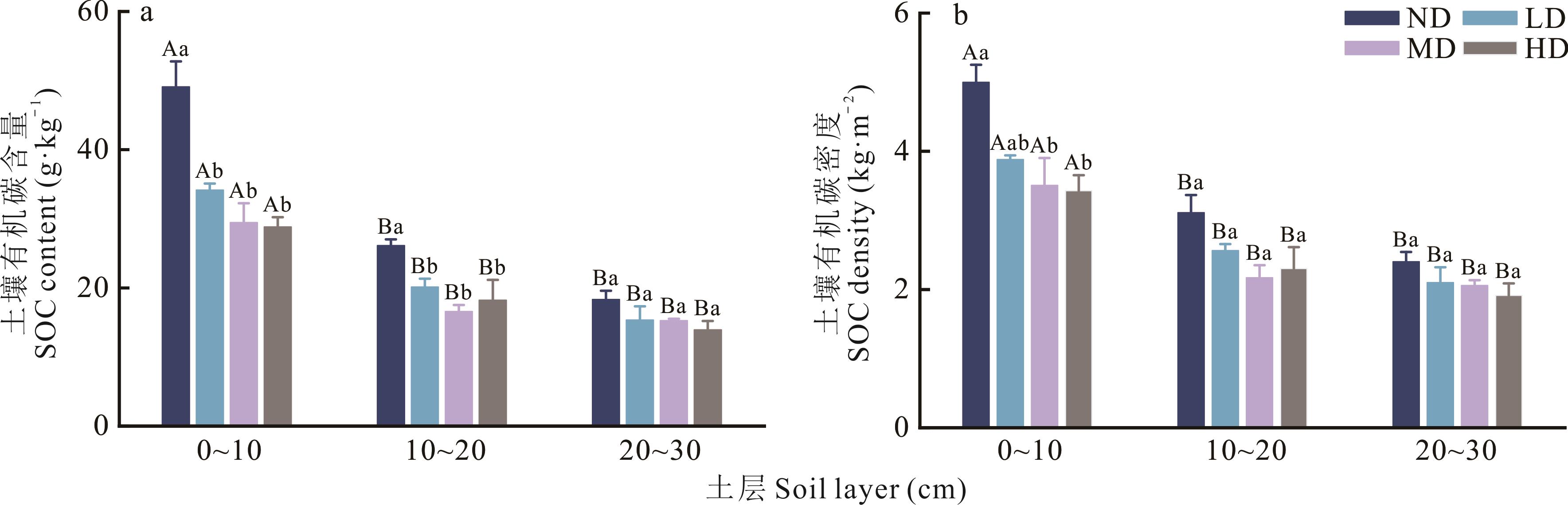
图1 不同退化程度高寒草甸的土壤有机碳含量与密度SOC: 土壤有机碳Soil organic carbon; ND: 未退化None degradation; LD: 轻度退化Light degradation; MD: 中度退化Moderate degradation; HD: 重度退化Heavily degradation. 不同大写字母表示相同退化程度下不同土层间差异显著(P<0.05),不同小写字母表示相同土层下不同退化程度间差异显著(P<0.05)。Different uppercase letters indicate significant difference among different soil layers under the same degree of degradation (P<0.05), different lowercase letters indicate significant difference among different degrees of degradation under the same soil layer (P<0.05);下同The same below.
Fig.1 Soil organic carbon content and density of alpine meadow under different degradation degrees

图2 不同退化程度高寒草甸土壤有机碳组分含量FPOC: 游离颗粒态有机碳Free particulate organic carbon; OPOC: 闭蓄颗粒态有机碳Occluded particulate organic carbon; POC: 颗粒态有机碳Particulate organic carbon; MAOC: 矿物结合态有机碳Mineral-associated organic carbon. 下同The same below.
Fig.2 Soil organic carbon fractions content of alpine meadow under different degradation degrees
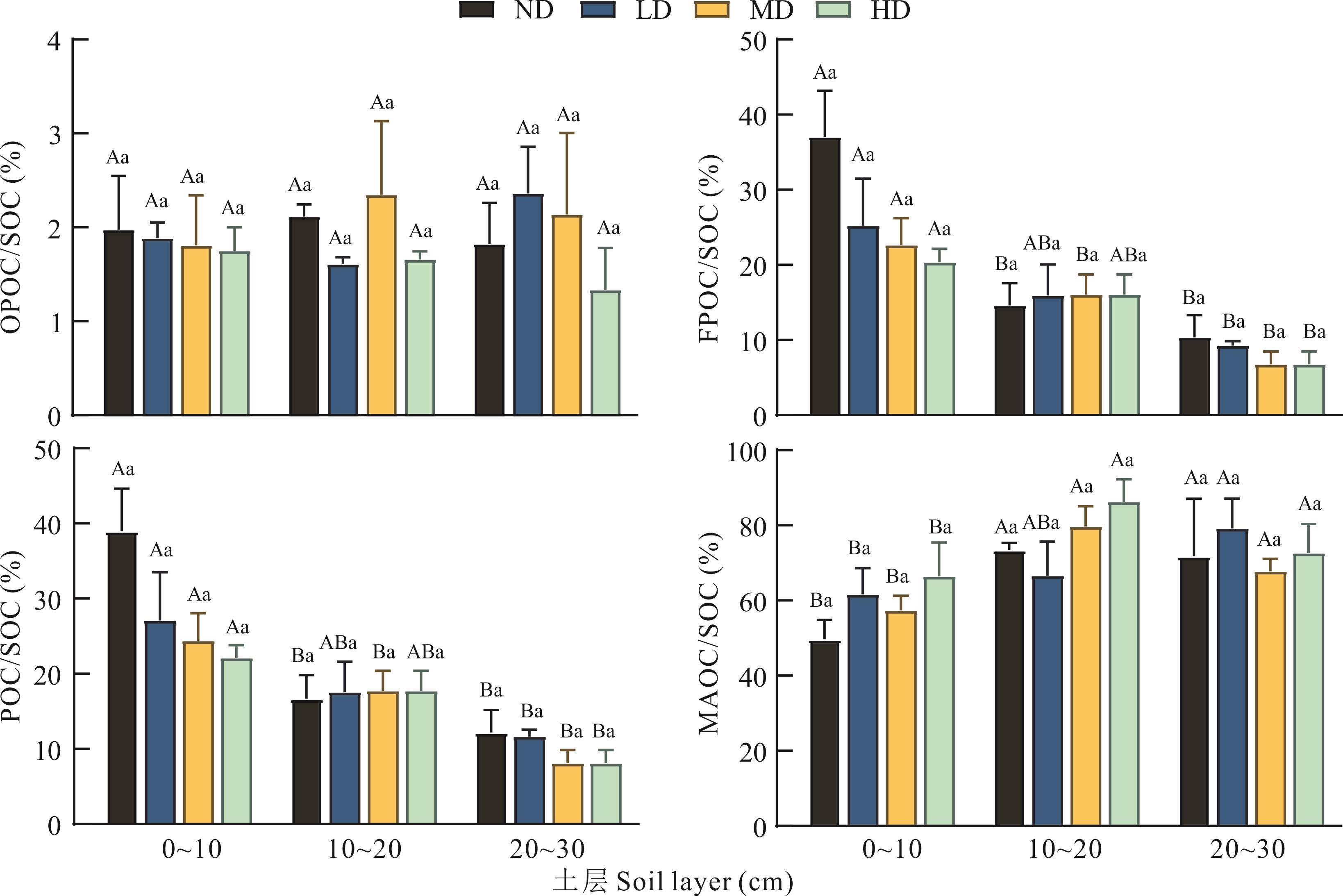
图3 不同退化程度高寒草甸土壤有机碳组分贡献率FPOC/SOC: 游离颗粒态有机碳在土壤有机碳中的占比Proportion of free particulate organic carbon in soil organic carbon; OPOC/SOC: 闭蓄颗粒态有机碳在土壤有机碳中的占比Proportion of occluded particulate organic carbon in soil organic carbon; POC/SOC: 颗粒态有机碳在土壤有机碳中的占比Proportion of particulate organic carbon in soil organic carbon; MAOC/SOC: 矿物结合态有机碳在土壤有机碳中的占比Proportion of mineral-associated organic carbon in soil organic carbon.
Fig.3 Contribution rate of soil organic carbon fraction of alpine meadow under different degradation degrees

图4 环境因子对土壤有机碳及其组分影响相对重要性的随机森林分析*: P<0.05; **: P<0.01. Increase in MES (%): 均方误差百分比Increase in mean square error (%); Var explained: 方差解释度Variance explained; TN: 全氮Total nitrogen; BD: 容重Bulk density; MWD: 平均重量直径Mean weight diameter; MBC: 微生物生物量碳Microbial biomass carbon; SWC: 含水量Soil water content; NO3--N: 硝态氮Nitrate nitrogen; NH4+-N: 铵态氮Ammonium nitrogen; AP: 速效磷Available phosphorus; Silt & clay: 粉粒与黏粒Silt and clay; DOC: 可溶性有机碳Dissolved organic carbon; Richness: 物种丰富度指数Species richness index; TP: 全磷Total phosphorus concentration; Pielou: 均匀度指数Species evenness index; Height: 植物群落高度Plant community height; Coverage: 植被盖度Vegetation coverage; AGB: 地上生物量Above-ground biomass; Shannon: 香农-威纳指数Shannon-Wiener index; Simpson: 辛普森指数Simpson index; Dm: 分形维数Fractal dimension. 下同The same below.
Fig. 4 Relative importance of environmental factors to soil organic carbon and its fractions from random forest analysis

图5 土壤有机碳组分与主要土壤因子间的关系
Fig.5 Relationships of soil organic carbon fractions with dominate soil properties
退化程度 Degradation degree | 土层 Soil layer (cm) | 理论土壤有机碳增汇潜力 Theoretical potential of SOC increment (kg·m-2) |
|---|---|---|
轻度退化 Light degradation | 0~10 | 1.12±0.06Aa |
| 10~20 | 0.55±0.09ABa | |
| 20~30 | 0.30±0.22Ba | |
| 0~30 | 1.97±0.32a | |
中度退化 Moderate degradation | 0~10 | 1.49±0.40Aa |
| 10~20 | 0.94±0.18ABa | |
| 20~30 | 0.34±0.08Ba | |
| 0~30 | 2.78±0.61a | |
重度退化 Heavily degradation | 0~10 | 1.57±0.23Aa |
| 10~20 | 0.81±0.31ABa | |
| 20~30 | 0.49±0.17Ba | |
| 0~30 | 2.86±0.35a |
表3 不同退化程度高寒草甸理论土壤有机碳增汇潜力
Table 3 Theoretical soil organic carbon increment potential of alpine meadow with different degrees of degradation
退化程度 Degradation degree | 土层 Soil layer (cm) | 理论土壤有机碳增汇潜力 Theoretical potential of SOC increment (kg·m-2) |
|---|---|---|
轻度退化 Light degradation | 0~10 | 1.12±0.06Aa |
| 10~20 | 0.55±0.09ABa | |
| 20~30 | 0.30±0.22Ba | |
| 0~30 | 1.97±0.32a | |
中度退化 Moderate degradation | 0~10 | 1.49±0.40Aa |
| 10~20 | 0.94±0.18ABa | |
| 20~30 | 0.34±0.08Ba | |
| 0~30 | 2.78±0.61a | |
重度退化 Heavily degradation | 0~10 | 1.57±0.23Aa |
| 10~20 | 0.81±0.31ABa | |
| 20~30 | 0.49±0.17Ba | |
| 0~30 | 2.86±0.35a |
| [1] | Fu B J, Ouyang Z Y, Shi P, et al. Current condition and protection strategies of Qinghai-Tibet Plateau ecological security barrier. Bulletin of Chinese Academy of Sciences, 2021, 36(11): 1298-1306. |
| 傅伯杰, 欧阳志云, 施鹏, 等. 青藏高原生态安全屏障状况与保护对策. 中国科学院院刊, 2021, 36(11): 1298-1306. | |
| [2] | Chen B X, Zhang X Z, Tao J, et al. The impact of climate change and anthropogenic activities on alpine grassland over the Qinghai-Tibet Plateau. Agricultural and Forest Meteorology, 2014, 189/190: 11-18. |
| [3] | Wang Z Q, Zhang Y Z, Yang Y, et al. Quantitative assess the driving forces on the grassland degradation in the Qinghai-Tibet Plateau, in China. Ecological Informatics, 2016, 33: 32-44. |
| [4] | Shi M M, Wang Z, Zhou B R, et al. Characteristics of grassland degradation and its relationship with climate factors on Qinghai-Tibetan Plateau, China. Chinese Journal of Applied Ecology, 2022, 33(12): 3271-3278. |
| 石明明, 王喆, 周秉荣, 等. 青藏高原草地退化特征及其与气候因子的关系. 应用生态学报, 2022, 33(12): 3271-3278. | |
| [5] | Wen L, Dong S X, Li Y Y, et al. The impact of land degradation on the C pools in alpine grasslands of the Qinghai-Tibet Plateau. Plant and Soil, 2013, 368(1/2): 329-340. |
| [6] | Garsia A, Moinet A, Vazquez C, et al. The challenge of selecting an appropriate soil organic carbon simulation model: A comprehensive global review and validation assessment. Global Change Biology, 2023, 29(20): 5760-5774. |
| [7] | Zhang W L, Kolbe H, Zhang R L, et al. Research progress of SOC functions and transformation mechanisms. Scientia Agricultura Sinica, 2020, 53(2): 317-331. |
| 张维理, Kolbe H, 张认连, 等. 土壤有机碳作用及转化机制研究进展. 中国农业科学, 2020, 53(2): 317-331. | |
| [8] | Ren S, Wang T, Guenet B, et al. Projected soil carbon loss with warming in constrained earth system models. Nature Communications, 2024, 15(1): 102. |
| [9] | Spohn M, Bagchi S, Biederman L A, et al. The positive effect of plant diversity on soil carbon depends on climate. Nature Communications, 2023, 14(1): 6624. |
| [10] | Kramer M G, Chadwick O A. Climate-driven thresholds in reactive mineral retention of soil carbon at the global scale. Nature Climate Change, 2018, 8(12): 1104-1108. |
| [11] | Wang G X, Cheng G D, Shen Y P. Soil organic carbon pool of grasslands on the Tibetan Plateau and its global implication. Journal of Glaciology and Geocryology, 2002, 24(6): 693-700. |
| 王根绪, 程国栋, 沈永平. 青藏高原草地土壤有机碳库及其全球意义. 冰川冻土, 2002, 24(6): 693-700. | |
| [12] | Wang T, Wang X Y, Liu D, et al. The current and future of terrestrial carbon balance over the Tibetan Plateau. Science China Earth Sciences, 2023, 53(7): 1506-1516. |
| 汪涛, 王晓昳, 刘丹, 等. 青藏高原碳汇现状及其未来趋势. 中国科学: 地球科学, 2023, 53(7): 1506-1516. | |
| [13] | Lavallee J M, Soong J L, Cotrufo M F, et al. Conceptualizing soil organic matter into particulate and mineral-associated forms to address global change in the 21st century. Global Change Biology, 2020, 26(1): 261-273. |
| [14] | Xue Z J, Li X Y, Jiao L, et al. Advance in the formation and stabilization mechanisms of soil mineral-associated organic carbon. Journal of Soil and Water Conservation, 2023, 37(5): 12-23. |
| 薛志婧, 李霄云, 焦磊, 等. 土壤矿质结合态有机碳形成及稳定机制的研究进展. 水土保持学报, 2023, 37(5): 12-23. | |
| [15] | Angst G, Mueller K E, Castellano M J, et al. Unlocking complex soil systems as carbon sinks: multi-pool management as the key. Nature Communications, 2023, 14(1): 2967. |
| [16] | Dong L J, Li J H, Chen S, et al. Changes in soil organic carbon content and their causes during the degradation of alpine meadows in Zoigê Wetland. Chinese Journal of Plant Ecology, 2021, 45(5): 507-515. |
| 董利军, 李金花, 陈珊, 等. 若尔盖湿地高寒草甸退化过程中土壤有机碳含量变化及成因分析. 植物生态学报, 2021, 45(5): 507-515. | |
| [17] | Liu Y H, Wei W D, Wen X C, et al. Characteristics of soil organic carbon fractions in alpine meadow with different degradation. Acta Agriculturae Boreali-occidentalis Sinica, 2015, 24(2): 168-174. |
| 刘育红, 魏卫东, 温小成, 等. 退化高寒草甸土壤有机碳组分特征. 西北农业学报, 2015, 24(2): 168-174. | |
| [18] | Song X Y, Wang C T, Hu L, et al. Changes in soil aggregate-associated organic carbon of degraded alpine meadow in the Zoigê plateau. Acta Ecologica Sinica, 2022, 42(4): 1538-1548. |
| 宋小艳, 王长庭, 胡雷, 等. 若尔盖退化高寒草甸土壤团聚体结合有机碳的变化. 生态学报, 2022, 42(4): 1538-1548. | |
| [19] | Xu Y D. Conservation agriculture-mediated soil carbon sequestration: A review. Chinese Journal of Eco-Agriculture, 2022, 30(4): 658-670. |
| 徐英德. 基于保护性农业的土壤固碳过程研究进展. 中国生态农业学报, 2022, 30(4): 658-670. | |
| [20] | Chang L X, Liang X R, Wang L, et al. Characteristics and influencing factors of soil organic carbon sink in paddy fields in China: A review. Soils, 2023, 55(3): 487-493. |
| 常琳溪, 梁新然, 王磊, 等. 中国稻田土壤有机碳汇特征与影响因素的研究进展. 土壤, 2023, 55(3): 487-493. | |
| [21] | Sichuan Provincial Bureau of Quality and Technical Supervision. Classification of grazing degradation in alpine meadows in northwestern Sichuan: DB51/T 1978-2015. Chengdu: Sichuan Standards Press, 2015. |
| 四川省质量技术监督局. 川西北高寒草甸草地放牧退化分级: DB51/T 1978-2015. 成都: 四川省标准出版社, 2015. | |
| [22] | Liu W H, Song X Y, Wang C T, et al. Effects of the degree of degradation on roots morphological traits and biomass of different dominant plant species in alpine meadows. Chinese Journal of Plant Ecology, 2024, 48(12): 1666-1682. |
| 刘位会, 宋小艳, 王长庭, 等. 退化程度对高寒草甸不同优势种植物根系形态性状和生物量的影响. 植物生态学报, 2024, 48(12): 1666-1682. | |
| [23] | Chen Y H, Xie Z Q, Xue L P. Process optimization for measurements of soil and plant samples with carbon/nitrogen element analyzer. Modern Chemical Industry, 2016, 36(4): 185-187, 189. |
| 陈雅涵, 谢宗强, 薛丽萍. 碳氮元素分析仪测试土壤与植物样品的流程优化. 现代化工, 2016, 36(4): 185-187, 189. | |
| [24] | Bao S D. Agrochemical analysis of soil. Beijing: China Agriculture Press, 2000. |
| 鲍士旦. 土壤农化分析. 北京: 中国农业出版社, 2000. | |
| [25] | Deng Z H, Chen Z J, Han S J, et al. The impact of nitrogen application on the stoichiometry of soil and microorganisms in secondary forests of Changbai Mountain. Journal of Forest and Environment, 2025, 45(1): 20-30. |
| 邓子豪, 陈志杰, 韩士杰, 等. 施氮对长白山次生林土壤与微生物化学计量比的影响. 森林与环境学报, 2025, 45(1): 20-30. | |
| [26] | Wang X Y, Gao X F, Liu H P, et al. Review of analytical methods for aggregate size distribution and water-stability of soil macro-aggregates. Science of Soil and Water Conservation, 2011, 9(3): 106-113. |
| 王秀颖, 高晓飞, 刘和平, 等. 土壤水稳性大团聚体测定方法综述. 中国水土保持科学, 2011, 9(3): 106-113. | |
| [27] | Yang P L, Luo Y P, Shi Y C. The fractal characteristics of soil characterized by the weight distribution of particle sizes. Chinese Science Bulletin, 1993(20): 1896-1899. |
| 杨培岭, 罗远培, 石元春. 用粒径的重量分布表征的土壤分形特征. 科学通报, 1993(20): 1896-1899. | |
| [28] | Cotrufo M F, Ranalli M G, Haddix M L, et al. Soil carbon storage informed by particulate and mineral-associated organic matter. Nature Geoscience, 2019, 12(12): 989-994. |
| [29] | Huang Y Z, Xin Z B, Liu J H, et al. Divergences of soil carbon turnover and regulation in alpine steppes and meadows on the Tibetan Plateau. Science of the Total Environment, 2022, 814: 152687. |
| [30] | Liu Y H, Li X L, Li C H, et al. Vegetation decline and reduction of soil organic carbon stock in high-altitude meadow grasslands in the source area of Three major rivers of China. Journal of Agro-Environment Science, 2009, 28(12): 2559-2567. |
| 刘育红, 李希来, 李长慧, 等. 三江源区高寒草甸湿地植被退化与土壤有机碳损失. 农业环境科学学报, 2009, 28(12): 2559-2567. | |
| [31] | Chen L Y, Fang K, Wei B, et al. Soil carbon persistence governed by plant input and mineral protection at regional and global scales. Ecology Letters, 2021, 24(5): 1018-1028. |
| [32] | Yang Y, Wang B R, Dou Y X, et al. Advances in the research of transformation and stabilization of soil organic carbon from plant and microbe. Chinese Journal of Applied Ecology, 2024, 35(1): 111-123. |
| 杨阳, 王宝荣, 窦艳星, 等. 植物源和微生物源土壤有机碳转化与稳定研究进展. 应用生态学报, 2024, 35(1): 111-123. | |
| [33] | Deng Y, Li F, Yao S R, et al. Vegetation and soil characteristics of degraded grassland and their relationship. Pratacultural Science, 2021, 38(7): 1260-1269. |
| 邓燕, 李钒, 姚树冉, 等. 不同程度退化草地的植被土壤特征及其相互间的关系. 草业科学, 2021, 38(7): 1260-1269. | |
| [34] | He Y L, Zhang Q, Zhang Z H, et al. Research progress on the impact of high-altitude grassland degradation on soil microorganisms in the Qinghai-Tibet Plateau. Chinese Qinghai Journal of Animal and Veterinary Sciences, 2020, 50(6): 43-51. |
| 贺有龙, 张骞, 张中华, 等. 青藏高原高寒草地退化对土壤微生物影响研究进展. 青海畜牧兽医杂志, 2020, 50(6): 43-51. | |
| [35] | Chen Q J, Zhang N N, Zhong B, et al. Change of soil nutrient and aggregate structure during the desertification process of grassland in Zoigê. Ecological Science, 2019, 38(4): 13-20. |
| 陈秋捷, 张楠楠, 仲波, 等. 若尔盖高寒草地退化沙化过程中土壤养分与团聚体结构的变化特征. 生态科学, 2019, 38(4): 13-20. | |
| [36] | Li L Z, Ma Y, Zhang X Y, et al. Distribution characteristics of soil aggregates and its organic carbon with different degradation degrees in alpine meadow. Acta Agrestia Sinica, 2023, 31(1): 210-219. |
| 李林芝, 马源, 张小燕, 等. 不同退化程度高寒草甸土壤团聚体及其有机碳分布特征. 草地学报, 2023, 31(1): 210-219. | |
| [37] | Huang W G, Kuzyakov Y, Niu S L, et al. Drivers of microbially and plant-derived carbon in topsoil and subsoil. Global Change Biology, 2023, 29(22): 6188-6200. |
| [38] | Bahram M, Hildebrand F, Forslund S K, et al. Structure and function of the global topsoil microbiome. Nature, 2018, 560(7717): 233-237. |
| [39] | Wang C T, Long R J, Wang Q L, et al. Changes in soil organic carbon and microbial biomass carbon at different degradation successional stages of alpine meadows in the headwater region of three rivers in China. Chinese Journal of Applied & Environmental Biology, 2008, 14(2): 225-230. |
| 王长庭, 龙瑞军, 王启兰, 等. 三江源区高寒草甸不同退化演替阶段土壤有机碳和微生物量碳的变化. 应用与环境生物学报, 2008, 14(2): 225-230. | |
| [40] | Liang C, Balser T C. Preferential sequestration of microbial carbon in subsoils of a glacial-landscape toposequence, Dane County, WI, USA. Geoderma, 2008, 148(1): 113-119. |
| [41] | Georgiou K, Jackson R B, Vindušková O, et al. Global stocks and capacity of mineral-associated soil organic carbon. Nature Communications, 2022, 13(1): 3797. |
| [42] | Hu Y L, FU L C, AO G, et al. Climate, plant and microorganisms jointly influence soil organic matter fractions in temperate grasslands. Science of the Total Environment, 2025, 958: 178133. |
| [43] | Niu G, Liu L, Wang Y, et al. Effects of decadal nitrogen addition on carbon and nitrogen stocks in different organic matter fractions of typical steppe soils. Ecological Indicators, 2022, 144: 109471. |
| [44] | An L W, Li Z G. Effects of the degraded desert grassland restoration on soil organic carbon and its driving factors. Acta Ecologica Sinica, 2024, 44(13) : 5519-5531. |
| 安立伟, 李志刚. 退化荒漠草地恢复对土壤有机碳及其驱动因子的影响. 生态学报, 2024, 44(13): 5519-5531. | |
| [45] | Han X R, Wang L L, Yang J F, et al. Effect of long-term fertilizations on particulate organic carbon and enzyme activities in a brown earth. Chinese Journal of Soil Science, 2008, 39(2): 266-269. |
| 韩晓日, 王玲莉, 杨劲峰, 等. 长期施肥对土壤颗粒有机碳和酶活性的影响. 土壤通报, 2008, 39(2): 266-269. | |
| [46] | Lehmann J, Kleber M. The contentious nature of soil organic matter. Nature, 2015, 528(7580): 60-68. |
| [47] | Zhou Z H, Ren C J, Wang C K, et al. Global turnover of soil mineral-associated and particulate organic carbon. Nature Communications, 2024, 15(1): 5329. |
| [48] | Li L S, Cheng S L, Fang H J, et al. Effects of nitrogen enrichment on transfer and accumulation of soil organic carbon in alpine meadows on the Qinghai-Tibetan Plateau. Acta Pedologica Sinica, 2015, 52(1): 183-193. |
| 李林森, 程淑兰, 方华军, 等. 氮素富集对青藏高原高寒草甸土壤有机碳迁移和累积过程的影响. 土壤学报, 2015, 52(1): 183-193. | |
| [49] | Tang B, Rocci K S, Lehmann A, et al. Nitrogen increases soil organic carbon accrual and alters its functionality. Global Change Biology, 2023, 29(7): 1971-1983. |
| [50] | Neff J C, Townsend A R, Gleixner G, et al. Variable effects of nitrogen additions on the stability and turnover of soil carbon. Nature, 2002, 419(6910): 915-917. |
| [51] | Wang L, Wang K, Sheng M, et al. Changes in land use are associated with the accumulation of soil phytolith-occluded organic carbon. Ecological Indicators, 2023, 151: 110300. |
| [52] | Sun F D, Lu H, Hu Y X, et al. The soil organic carbon storage and its spatial characteristics in an alpine degraded grassland of Zoigê, Southwest China. Chinese Journal of Grassland, 2016, 38(6): 78-84. |
| 孙飞达, 路慧, 胡亚茜, 等. 若尔盖高寒退化草地土壤有机碳储量空间分异特征. 中国草地学报, 2016, 38(6): 78-84. | |
| [53] | Yang C, Sun J. Impact of soil degradation on plant communities in an overgrazed Tibetan alpine meadow. Journal of Arid Environments, 2021, 193(10): 104586. |
| [54] | Guo L, Qu C, Zhou Y, et al. Trade-off between pore-throat structure and mineral composition in modulating the stability of soil organic carbon. Environmental Science & Technology, 2024, 58(23): 10084-10094. |
| [55] | Fang K, Kou D, Wang G, et al. Decreased soil cation exchange capacity across northern China’s grasslands over the last three decades. Journal of Geophysical Research: Biogeosciences, 2017, 122(11): 3088-3097. |
| [56] | Zhao Y F, Wang X, Chen F, et al. Soil organic matter enhances aboveground biomass in alpine grassland under drought. Geoderma, 2023, 433: 116430. |
| [57] | Liu S B, Zamanian K, Schleuss P-M, et al. Degradation of Tibetan grasslands: Consequences for carbon and nutrient cycles. Agriculture, Ecosystems & Environment, 2018, 252: 93-104. |
| [58] | Bull I D, Bergen P F, Nott C J, et al. Organic geochemical studies of soils from the Rothamsted classical experiments-V. The fate of lipids in different long-term experiments. Organic Geochemistry, 2000, 31(5): 389-408. |
| [59] | Chen K, Huo T, Zhang Y, et al. Response of soil organic carbon decomposition to intensified water variability co-determined by the microbial community and aggregate changes in a temperate grassland soil of northern China. Soil Biology and Biochemistry, 2023, 176: 108875. |
| [60] | Tang X L, Zhao X, Bai Y F, et al. Carbon pools in China’s terrestrial ecosystems: New estimates based on an intensive field survey. Proceedings of the National Academy of Sciences of the United States of America, 2018, 115(16): 4021-4026. |
| [61] | Lu H Y, Li W J, Yu S Y, et al. 137Cs-based estimation of soil erosion and organic carbon loss in alpine meadow soil on Tibetan Plateau. Bulletin of Soil and Water Conservation, 2023, 43(3): 330-337, 348. |
| 卢海涯, 栗文佳, 于世永, 等. 基于137Cs的青藏高原高寒草甸土壤侵蚀及碳流失估算. 水土保持通报, 2023, 43(3): 330-337, 348. | |
| [62] | Li Y N, Xu S X, Zhao L, et al. Carbon sequestration potential of vegetation and soil of degenerative alpine meadows in southern Qinghai Province. Journal of Glaciology and Geocryology, 2012, 34(5): 1157-1164. |
| 李英年, 徐世晓, 赵亮, 等. 青南退化高寒草甸植被土壤固碳潜力. 冰川冻土, 2012, 34(5): 1157-1164. | |
| [63] | Cao G M, Long R J, Zhang F W, et al. A method to estimate carbon storage potential in alpine Kobresia meadows on the Qinghai-Tibetan Plateau. Acta Ecologica Sinica, 2010, 30(23): 6591-6597. |
| 曹广民, 龙瑞军, 张法伟, 等. 青藏高原高寒矮嵩草草甸碳增汇潜力估测方法. 生态学报, 2010, 30(23): 6591-6597. | |
| [64] | Jiang M H, Lü M K, Lin W S, et al. Effects of ecological restoration on soil organic carbon components and stability in a red soil erosion area. Acta Ecologica Sinica, 2018, 38(13) : 4861-4868. |
| 江淼华, 吕茂奎, 林伟盛, 等. 生态恢复对红壤侵蚀地土壤有机碳组成及稳定性的影响. 生态学报, 2018, 38(13): 4861-4868. | |
| [65] | Li Y, Zhang X, Wang B, et al. Revegetation promotes soil mineral-associated organic carbon sequestration and soil carbon stability in the Tengger Desert, northern China. Soil Biology and Biochemistry, 2023, 185: 109155. |
| [1] | 王玉霞, 杜灵通, 易志远, 罗霄, 苏丽, 乔成龙, 薛斌. 宁夏贺兰山东麓葡萄产区土壤有机碳库空间变异及影响因素[J]. 草业学报, 2025, 34(7): 41-53. |
| [2] | 秦文利, 张静, 肖广敏, 崔素倩, 叶建勋, 智健飞, 张立锋, 谢楠, 冯伟, 刘振宇, 潘璇, 代云霞, 刘忠宽. 绿肥部分替代化肥氮对土壤物理性状的影响[J]. 草业学报, 2025, 34(6): 27-45. |
| [3] | 马源, 王晓丽, 马玉寿, 张德罡. 高寒草甸退化程度对优势物种根际土壤真菌群落和生态网络的影响[J]. 草业学报, 2024, 33(2): 125-137. |
| [4] | 魏孔钦, 赵俊威, 张前兵. 施磷对紫花苜蓿土壤呼吸速率及活性有机碳组分的影响[J]. 草业学报, 2024, 33(2): 80-92. |
| [5] | 李思媛, 崔雨萱, 孙宗玖, 刘慧霞, 冶华薇. 封育对蒿类荒漠草地土壤有机碳及土壤微生物生物量生态化学计量特征的影响[J]. 草业学报, 2023, 32(6): 58-70. |
| [6] | 郭鑫, 罗欢, 许雪梅, 马爱霞, 尚振艳, 韩天虎, 牛得草, 文海燕, 李旭东. 不同品质凋落物分解对黄土高原草地土壤有机碳及其稳定性的影响[J]. 草业学报, 2023, 32(5): 83-93. |
| [7] | 韩枫, 张志涛, 张鑫, 王建浩, 王浩. 美国公共牧草地法治管理进程的经验借鉴与若干启示[J]. 草业学报, 2022, 31(9): 220-232. |
| [8] | 韩小雨, 郭宁, 李冬冬, 谢明阳, 焦峰. 氮添加对内蒙古不同草原生物量及土壤碳氮变化特征的影响[J]. 草业学报, 2022, 31(1): 13-25. |
| [9] | 王星, 于双, 许冬梅, 宋珂辰. 不同恢复措施对退化荒漠草原土壤碳氮及其组分特征的影响[J]. 草业学报, 2022, 31(1): 26-35. |
| [10] | 刘慧霞, 董乙强, 崔雨萱, 刘星宏, 何盘星, 孙强, 孙宗玖. 新疆阿勒泰地区荒漠草地土壤有机碳特征及其环境影响因素分析[J]. 草业学报, 2021, 30(10): 41-52. |
| [11] | 季波, 何建龙, 吴旭东, 王占军, 谢应忠, 蒋齐. 宁夏典型天然草地土壤有机碳及其活性组分变化特征[J]. 草业学报, 2021, 30(1): 24-35. |
| [12] | 李成一, 李希来, 杨元武, 李宏林, 梁德飞. 氮添加对不同坡度退化高寒草甸土壤细菌多样性的影响[J]. 草业学报, 2020, 29(12): 161-170. |
| [13] | 王晓娇, 齐鹏, 蔡立群, 陈晓龙, 谢军红, 甘慧炯, 张仁陟. 培肥措施对旱地农田产量可持续性及土壤有机碳库稳定性的影响[J]. 草业学报, 2020, 29(10): 58-69. |
| [14] | 于双, 许冬梅, 许爱云, 刘金龙, 陶利波. 不同恢复措施对宁夏荒漠草原土壤碳氮储量的影响[J]. 草业学报, 2019, 28(3): 12-19. |
| [15] | 张苗苗, 陈伟, 林丽, 张德罡, 吴玉鑫, 肖海龙. 青海省不同高寒草地土壤主要养分及可溶性有机碳特性研究[J]. 草业学报, 2019, 28(3): 20-28. |
| 阅读次数 | ||||||
|
全文 |
|
|||||
|
摘要 |
|
|||||
