

ISSN 1004-5759 CN 62-1105/S
草业学报 ›› 2026, Vol. 35 ›› Issue (9): 142-153.DOI: 10.11686/cyxb2025335
• 研究论文 • 上一篇
张琼( ), 李奕雅, 陆銮眉, 陈郑镔, 朱丽霞
收稿日期:2025-08-18
修回日期:2025-11-03
出版日期:2026-09-20
发布日期:2026-07-27
通讯作者:
张琼
作者简介:Corresponding author. E-mail: 349369029@qq.com基金资助:
Qiong ZHANG(), Yi-ya LI, Luan-mei LU, Zheng-bin CHEN, Li-xia ZHU
Received:2025-08-18
Revised:2025-11-03
Online:2026-09-20
Published:2026-07-27
Contact:
Qiong ZHANG
摘要:
翼茎阔苞菊原产南美洲,是近年我国多省份陆续报道的外来入侵植物,在一些地区已经造成了严重的生态危害。本研究通过野外观测对翼茎阔苞菊种群特征、生物量分配模式、开花物候及种子萌发特性进行了系统研究,并对其入侵性进行定量分析,探讨其生态适应机制及其入侵潜力,以期为翼茎阔苞菊的预防和控制提供依据。结果表明:该物种为多年生草本植物,呈现典型的集群分布格局;在营养生长期,翼茎阔苞菊植株总生物量随株高增加而增加,两者之间存在极显著的指数函数关系,其茎器官生物量分配占比最高(达总生物量的52.14%),通过快速高生长策略有效占据生态位并获取光资源;物候观测显示,在福建漳州地区其花期持续在5-11月,盛花期集中于夏季(6-8月),单花序从现蕾至种子成熟仅需20~30 d;该植物兼具根系横向扩展的无性繁殖和异交有性繁殖双重策略,其头状花序外围着生大量可育雌花,花粉粒具独特锥状刺突(直径20.19 μm),属于“淀粉型”花粉,授粉依赖传粉昆虫;种子自然萌发率达20.33%;翼茎阔苞菊入侵风险值为68,依据评估技术规范等级划分标准判定其应严禁引入,建议列入管制名单。由此可见翼茎阔苞菊生长迅速,有强大的无性和有性繁殖能力,入侵风险较高。
张琼, 李奕雅, 陆銮眉, 陈郑镔, 朱丽霞. 入侵植物翼茎阔苞菊生物学特性和入侵风险分析[J]. 草业学报, 2026, 35(9): 142-153.
Qiong ZHANG, Yi-ya LI, Luan-mei LU, Zheng-bin CHEN, Li-xia ZHU. Biological characteristics and risk analysis of the alien invasive plant Pluchea sagittalis[J]. Acta Prataculturae Sinica, 2026, 35(9): 142-153.
指标 Index | 最小值 Minimum value | 最大值 Maximum value | 平均值 Mean value |
|---|---|---|---|
| 密度Density (plant·m-2) | 1 | 15 | 4.03±0.60 |
| 平均高度Average height (cm) | 10 | 250 | 64.98±7.70 |
| 盖度Coverage (cm2) | 100 | 6000 | 1509.14±253.67 |
| 相对盖度Relative coverage (%) | 1 | 99 | 15.51±3.78 |
表1 翼茎阔苞菊的种群特征
Table 1 Population characteristics of P. sagittalis
指标 Index | 最小值 Minimum value | 最大值 Maximum value | 平均值 Mean value |
|---|---|---|---|
| 密度Density (plant·m-2) | 1 | 15 | 4.03±0.60 |
| 平均高度Average height (cm) | 10 | 250 | 64.98±7.70 |
| 盖度Coverage (cm2) | 100 | 6000 | 1509.14±253.67 |
| 相对盖度Relative coverage (%) | 1 | 99 | 15.51±3.78 |
| 物种Species | 科名Family | 重要值Important value |
|---|---|---|
| 马尼拉草Zoysia matrella | 禾本科Gramineae | 0.8661 |
| 翼茎阔苞菊P. sagittalis | 菊科Compositae | 0.3194 |
| 扁穗莎草Cyperus compressus | 莎草科Cyperaceae | 0.2402 |
| 钻叶紫菀Symphyotrichum subulatum | 菊科Compositae | 0.1377 |
| 白花蛇舌草Scleromitrion diffusum | 茜草科Rubiaceae | 0.0974 |
| 一点红Emilia sonchifolia | 菊科Compositae | 0.0599 |
| 白花鬼针草Bidens alba | 菊科Compositae | 0.0566 |
| 异型莎草Cyperus difformis | 莎草科Cyperaceae | 0.0430 |
| 苏门白酒草Erigeron sumatrensis | 菊科Compositae | 0.0426 |
| 毛蕨Cyclosorus interruptus | 金星蕨科Thelypteridaceae | 0.0366 |
| 鸡屎藤Paederia foetida | 茜草科Rubiaceae | 0.0187 |
| 叶下珠Phyllanthus urinaria | 叶下珠科Euphorbiaceae | 0.0127 |
| 假臭草Praxelis clematidea | 菊科Compositae | 0.0072 |
| 黄花酢浆草Oxalis pes-caprae | 酢浆草科Oxalidaceae | 0.0072 |
| 鳢肠Eclipta prostrata | 菊科Compositae | 0.0071 |
| 铁苋菜Acalypha australis | 大戟科Euphorbiaceae | 0.0071 |
| 通泉草Mazus pumilus | 通泉草科Mazaceae | 0.0069 |
| 南雀稗Paspalum scrobiculatum var. bispicatum | 禾本科Gramineae | 0.0064 |
| 马唐Digitaria sanguinalis | 禾本科Gramineae | 0.0046 |
| 野甘草Scoparia dulcis | 车前科Plantaginaceae | 0.0041 |
| 藿香蓟Ageratum conyzoides | 菊科Compositae | 0.0041 |
| 蜈蚣凤尾蕨Pteris vittata | 凤尾蕨科Pteridaceae | 0.0037 |
| 海金沙Lygodium japonicum | 海金沙科Lygodiaceae | 0.0035 |
| 黄鹌菜Youngia japonica | 菊科Compositae | 0.0035 |
| 野茼蒿Crassocephalum crepidioides | 菊科Compositae | 0.0035 |
表2 翼茎阔苞菊分布草地生境中的伴生植物种类
Table 2 Companion plant species in the grassland habitats where P. sagittalis is distributed
| 物种Species | 科名Family | 重要值Important value |
|---|---|---|
| 马尼拉草Zoysia matrella | 禾本科Gramineae | 0.8661 |
| 翼茎阔苞菊P. sagittalis | 菊科Compositae | 0.3194 |
| 扁穗莎草Cyperus compressus | 莎草科Cyperaceae | 0.2402 |
| 钻叶紫菀Symphyotrichum subulatum | 菊科Compositae | 0.1377 |
| 白花蛇舌草Scleromitrion diffusum | 茜草科Rubiaceae | 0.0974 |
| 一点红Emilia sonchifolia | 菊科Compositae | 0.0599 |
| 白花鬼针草Bidens alba | 菊科Compositae | 0.0566 |
| 异型莎草Cyperus difformis | 莎草科Cyperaceae | 0.0430 |
| 苏门白酒草Erigeron sumatrensis | 菊科Compositae | 0.0426 |
| 毛蕨Cyclosorus interruptus | 金星蕨科Thelypteridaceae | 0.0366 |
| 鸡屎藤Paederia foetida | 茜草科Rubiaceae | 0.0187 |
| 叶下珠Phyllanthus urinaria | 叶下珠科Euphorbiaceae | 0.0127 |
| 假臭草Praxelis clematidea | 菊科Compositae | 0.0072 |
| 黄花酢浆草Oxalis pes-caprae | 酢浆草科Oxalidaceae | 0.0072 |
| 鳢肠Eclipta prostrata | 菊科Compositae | 0.0071 |
| 铁苋菜Acalypha australis | 大戟科Euphorbiaceae | 0.0071 |
| 通泉草Mazus pumilus | 通泉草科Mazaceae | 0.0069 |
| 南雀稗Paspalum scrobiculatum var. bispicatum | 禾本科Gramineae | 0.0064 |
| 马唐Digitaria sanguinalis | 禾本科Gramineae | 0.0046 |
| 野甘草Scoparia dulcis | 车前科Plantaginaceae | 0.0041 |
| 藿香蓟Ageratum conyzoides | 菊科Compositae | 0.0041 |
| 蜈蚣凤尾蕨Pteris vittata | 凤尾蕨科Pteridaceae | 0.0037 |
| 海金沙Lygodium japonicum | 海金沙科Lygodiaceae | 0.0035 |
| 黄鹌菜Youngia japonica | 菊科Compositae | 0.0035 |
| 野茼蒿Crassocephalum crepidioides | 菊科Compositae | 0.0035 |

图1 不同立地条件下翼茎阔苞菊植株的生长状况
Fig.1 The growth status of P. sagittalis plants under different site conditions
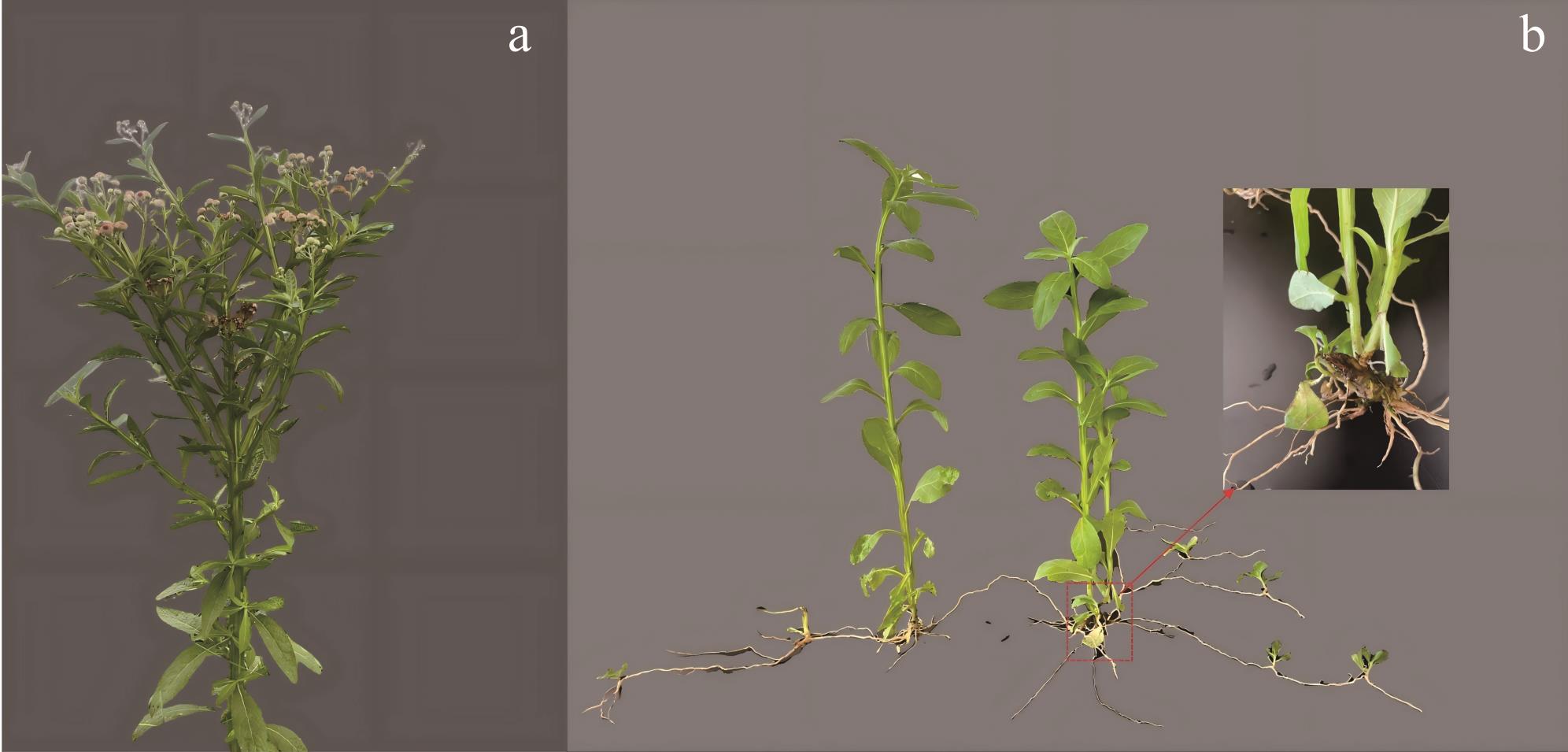
图2 翼茎阔苞菊的分枝和萌蘖
Fig.2 Branches and sprouts of P. sagittalis
| 项目Item | 构件比值Proportion of components (%) | 构件Component | 含水量Water content (%) |
|---|---|---|---|
| 根茎比Root to stem ratio | 18.52±1.55 | 根Root | 62.56±1.10 |
| 根生物量占比Root mass fraction | 15.44±1.08 | 茎Stem | 77.98±0.63 |
| 茎生物量占比Stem mass fraction | 52.14±1.94 | 叶Leaf | 79.87±0.43 |
| 叶生物量占比Leaf mass fraction | 31.99±1.52 |
表3 翼茎阔苞菊各构件生物量特征
Table 3 Biomass characteristics of each component of P. sagittalis
| 项目Item | 构件比值Proportion of components (%) | 构件Component | 含水量Water content (%) |
|---|---|---|---|
| 根茎比Root to stem ratio | 18.52±1.55 | 根Root | 62.56±1.10 |
| 根生物量占比Root mass fraction | 15.44±1.08 | 茎Stem | 77.98±0.63 |
| 茎生物量占比Stem mass fraction | 52.14±1.94 | 叶Leaf | 79.87±0.43 |
| 叶生物量占比Leaf mass fraction | 31.99±1.52 |
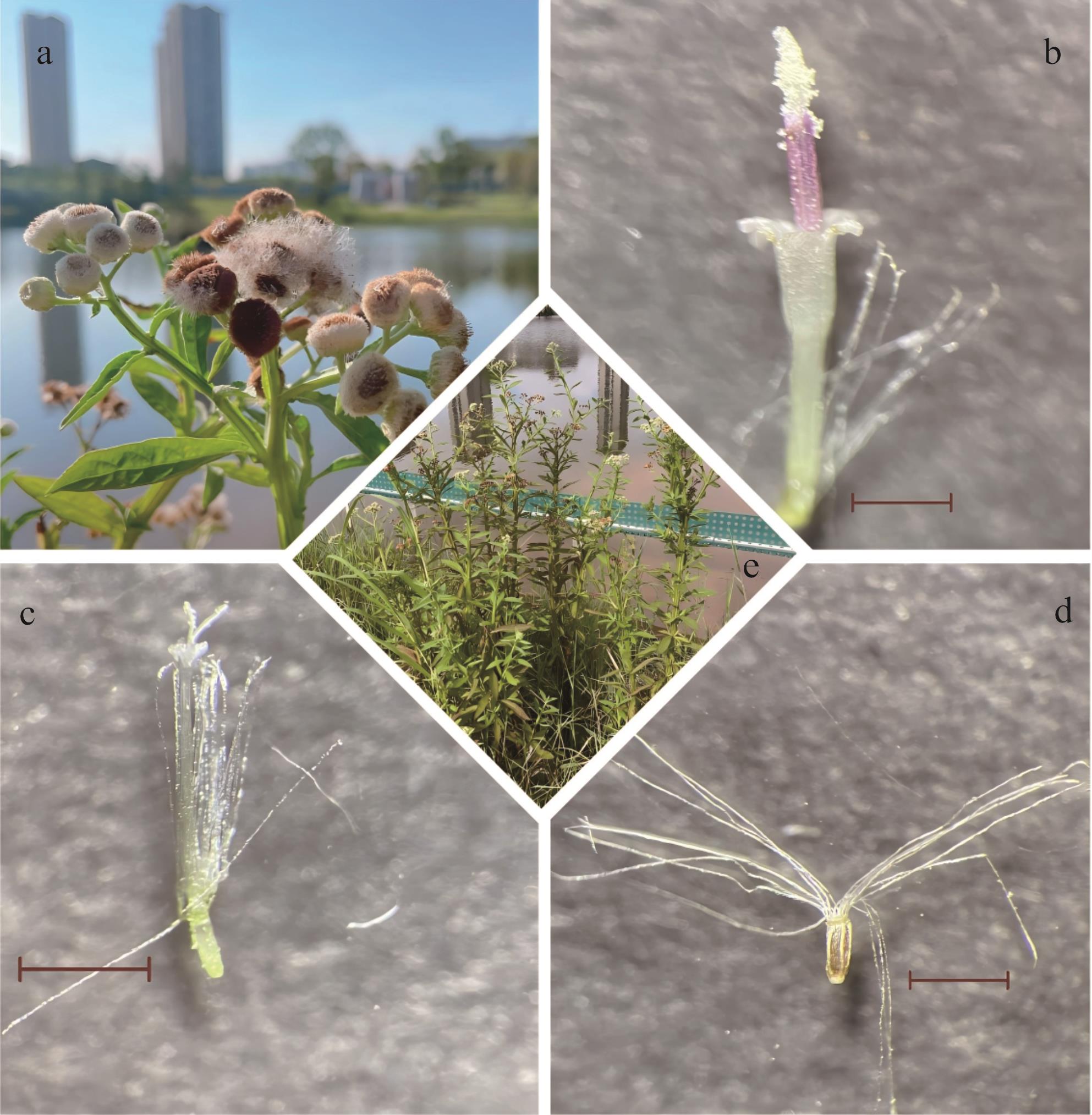
图3 翼茎阔苞菊及其花与瘦果a: 花序Inflorescence; b: 两性花(不育)Hermaphroditic flower (sterile); c: 雌花Female flower; d: 瘦果Achene; e: 盛花阶段植株Plant at full-bloom stage. 标尺Scale bar: 1 mm.
Fig.3 P. sagittalis and its flower and achene
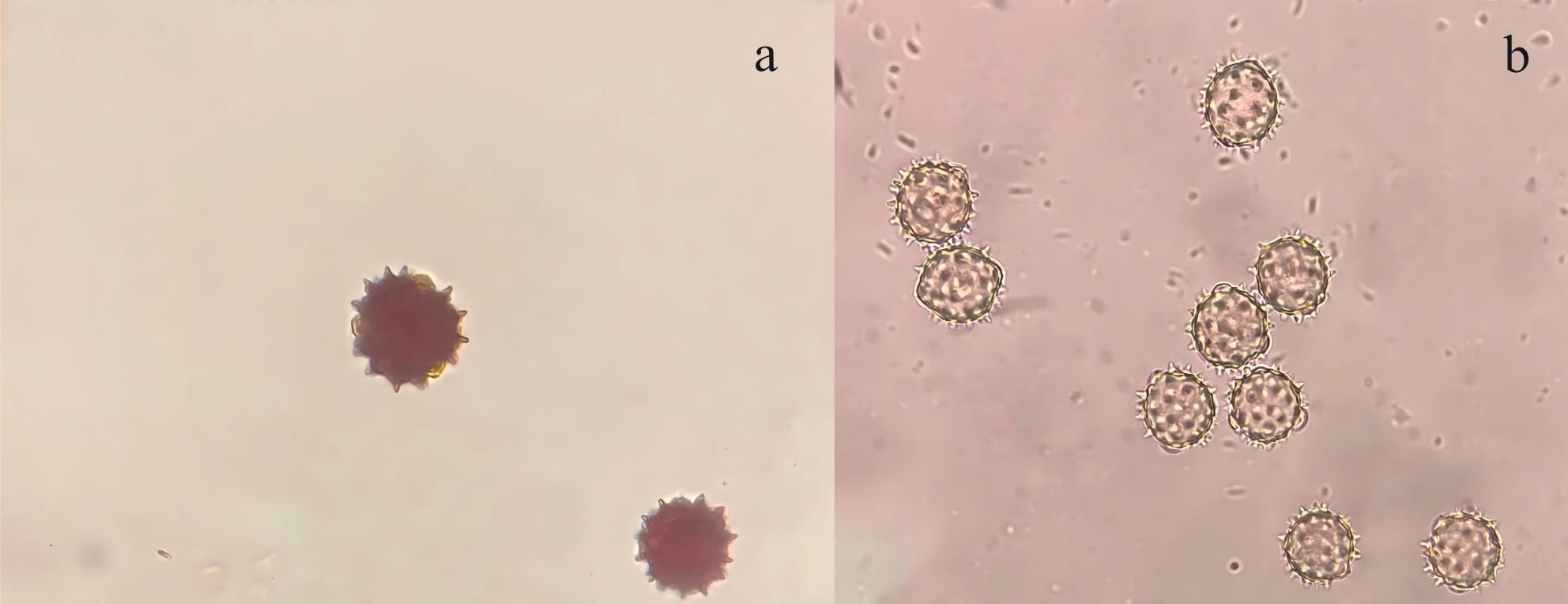
图4 染色后的翼茎阔苞菊花粉(放大倍率:400×)a为I-KI染色后的花粉;b为苏丹Ⅲ染色后的花粉。a is pollen stained with I-KI; b is pollen stained with Sudan Ⅲ.
Fig.4 Stained pollen of P. sagittalis (Magnification: 400×)
| 一级指标(权重)First-level indicators (weights) | 二级指标 Second-level indicators | 三级指标 Third-level indicators | 评价指标 Evaluation indicators | 赋值 Assignment | 得分 Score |
|---|---|---|---|---|---|
基本情况 Basic information (R1, 8%) | 国内情况 Domestic situation (R11) | 国内分布范围 Domestic distribution range (R111) | 个别省(自治区,直辖市)有零星分布 Sporadic distribution in a few provinces (autonomous regions, municipalities) | 1 | 1 |
| 大约1/3省(自治区,直辖市)有分布Distributed in about 1/3 of provinces (autonomous regions, municipalities) | 0.5 | - | |||
| 大多数省(自治区,直辖市)均有分布Distributed in most provinces (autonomous regions, municipalities) | 0 | - | |||
国内入侵状况 Domestic invasion status (R112) | 在国内有多处报道其成功入侵危害的情况 Reported in multiple domestic locations with significant damage | 1 | - | ||
| 在国内有报道扩散,但危害并不严重Domestic spread reported with minor harm | 0.5 | 0.5 | |||
引入途径 Introduction pathway (R113) | 通过无意进入国内Unintentional introduction | 2 | 2 | ||
| 通过自然传入国内Natural introduction | 1 | - | |||
| 通过合法途径引入国内Introduced through legal means | 0 | - | |||
境外情况 Foreign situation (R12) | 境外重视程度 International attention level (R121) | >10个国家(地区)列为检疫对象Listed as a quarantine target in more than 10 countries (regions) | 2 | - | |
| 有1~10个国家(地区)列为检疫对象Listed as a quarantine target in 1 to 10 countries (regions) | 1 | 1 | |||
| 属于一般性防治的常规有害生物Considered a conventional pest under general control measures | 0 | - | |||
境外分布情况 International distribution (R122) | 极广:分布区域>3个以上的气候带Extremely broad: Distributed across more than 3 climate zones | 2 | - | ||
| 广:分布区域在2~3个气候带Broad: Distributed across 2-3 climate zones | 1 | 1 | |||
| 局部:分布区域在1个气候带Localized: Confined to a single climate zone | 0.5 | - | |||
植物生物学属性 Plant biological attributes (R2, 9%) | 生活史 Life history (R21) | 生活周期 Life cycle (R211) | 多年生草本植物Perennial herb | 2 | 2 |
| 二年生草本植物Biennial herb | 1 | - | |||
| 一年生草本植物Annual herb | 0.5 | - | |||
生长能力 Growth capability (R22) | 抗逆性 Stress resistance (R221) | 对生长过程中的多种逆境有良好的适应性和耐受性Strong adaptability and tolerance to multiple environmental stresses | 1 | - | |
| 对生长过程中的某种逆境有良好的适应性和耐受性Strong adaptability and tolerance to a specific environmental stress | 0.5 | 0.5 | |||
| 对逆境耐受能力差Poor stress tolerance | 0 | - | |||
遗传特性 Genetic characteristics (R23) | 遗传稳定性 Genetic stability (R231) | 遗传物质10代以内会改变,不稳定Unstable: Genetic material may alter within 10 generations | 1 | - | |
| 遗传物质可以保持10代以上不改变,稳定Stable: Genetic material can remain unchanged for over 10 generations | 0 | 0 | |||
致害性 Harmfulness (R24) | 对人或动物健康的影响Impact on human/animal health (R241) | 植物体有毒或分泌毒素,影响人或动物健康Toxic: The plant is toxic or secretes toxins, posing a risk to human or animal health | 3 | - | |
| 植物体无毒或不分泌毒素,不影响人或动物健康Non-toxic: The plant is not toxic and does not secrete toxins, posing no risk to human or animal health | 0 | 0 | |||
| 是否携带有害生物Whether pests are carried (R25) | 是否是有害生物寄生Whether it serves as a host for pests (R251) | 是有害生物寄生Host to pests | 2 | - | |
| 不是有害生物寄生Not a host to pests | 0 | 0 | |||
繁殖与扩散能力 Reproduction & dispersal capacity (R3, 43%) | 繁殖能力 Reproductive capacity (R31) | 繁殖方式 Reproduction mode (R311) | 有性繁殖和无性繁殖皆有Both sexual and asexual reproduction | 15 | 15 |
| 仅有性繁殖Sexual reproduction only | 8 | - | |||
| 仅无性繁殖Asexual reproduction only | 3 | - | |||
繁殖体数量 Propagule quantity (R312) | 每个繁殖周期单株种子产量≥1000粒或单株分生≥10株Per reproductive cycle, the seed production per plant is ≥1000 grains, or the tillering capacity per plant is ≥10 shoots | 7 | 7 | ||
| 每个繁殖周期单株200粒≤种子产量<1000粒,或3株≤单株分生<10株Per reproductive cycle, the seed production per plant is between 200 and 1000 grains (inclusive of 200 but exclusive of 1000), or the tillering capacity per plant is between 3 and 10 shoots (inclusive of 3 but exclusive of 10) | 3 | - | |||
| 每个繁殖周期单株种子产量<200粒,或单株分生<3株Per reproductive cycle, the seed production per plant is <200 grains, or the tillering capacity per plant is <3 shoots | 0 | - | |||
萌芽率 Germination rate (R313) | 适宜条件下繁殖体萌芽率≥60% Germination rate ≥60% under suitable conditions | 2 | - | ||
| 25%≤适宜条件下繁殖体萌芽率<60% Germination rate is between 25% and 60% (inclusive of 25% but exclusive of 60%) under suitable conditions | 1 | - | |||
| 适宜条件下繁殖体萌芽率<25% Germination rate <25% under suitable conditions | 0 | 0 | |||
种子库种子存活率 Seed viability in the seed bank (R314) | 种子在土壤中保持较长的活性,时间≥1年Seeds remain viable in the soil for a long time, with a viability duration of 1 year or more | 2 | - | ||
| 种子在土壤中保持活性的时间<1年Seeds remain viable in the soil for less than 1 year | 0 | 0 | |||
扩散能力 Dispersal capacity (R32) | 扩散方式 Dispersal mode (R321) | 可通过自然因素(风力,水流等)和生物因素(动物和人类)等多种方式进行扩散Multiple pathways: Capable of dispersal via both natural factors (e.g., wind, water) and biological factors (animals, humans) | 4 | 4 | |
| 仅能通过自然因素进行扩散Natural only: Dispersal relies solely on natural factors | 2 | - | |||
| 仅能通过生物因素进行扩散Biological only: Dispersal relies solely on biological factors | 1 | - | |||
生物扩散力 Biological dispersal capacity (R322) | 自身及其扩散媒介生物移动能力强(≥1000 m)High mobility: Both the organism itself and its dispersal agents exhibit strong movement capacity (≥1000 m) | 8 | - | ||
| 自身及其扩散媒介生物移动能力较强(10 m≤移动能力<1000 m)Moderate mobility: Movement capacity of the organism and its dispersal agents ranges from 10 to 1000 m | 4 | 4 | |||
| 自身及其扩散媒介生物移动能力弱(<10 m)Low mobility: Movement capacity of the organism and its dispersal agents is limited to 10 m | 0 | - | |||
自然扩散能力 Natural dispersal capacity (R323) | 能够长距离传播Long-distance dispersal capability | 5 | - | ||
| 能够短距离传播Short-distance dispersal capability | 2 | 2 | |||
| 基本不能够传播Negligible natural dispersal | 0 | - | |||
环境与危害评估 Environmental and hazard assessment (R4, 26%) | 环境适应性 Environmental adaptability (R41) | 温度适宜度 Temperature suitability (R411) | 原产地温度与评估区域内大多数地区类似High similarity: Temperatures in the region of origin are largely comparable to those in most parts of the assessment area | 2 | 2 |
| 原产地温度与评估区域内大多数地区差异很大Low similarity: Temperatures in the region of origin differ significantly from those in most parts of the assessment area | 0 | - | |||
光照适宜度 Light suitability (R412) | 原产地光照条件与评估区域内大多数地区类似High similarity: Light conditions in the region of origin are largely comparable to those in most parts of the assessment area | 1 | 1 | ||
| 原产地光照条件与评估区域内大多数地区差异很大Low similarity: Light conditions in the region of origin differ significantly from those in most parts of the assessment area | 0 | - | |||
降水量适宜度 Precipitation suitability (R413) | 原产地降水量与评估区域内大多数地区类似High similarity: Precipitation levels in the region of origin are largely comparable to those in most parts of the assessment area | 1 | 1 | ||
| 原产地降水量与评估区域内大多数地区差异很大Low similarity: Precipitation levels in the region of origin differ significantly from those in most parts of the assessment area | 0 | - | |||
生态危害 Ecological hazards (R42) | 能否高密度占领生境Capability for high-density habitat occupation (R421) | 能高密度占领生境Capable of high-density occupation in habitats | 6 | 6 | |
| 仅能占领物种较为单一生境Can only occupy relatively singular/specific habitat types | 3 | - | |||
| 不能高密度占领生境Incapable of high-density habitat occupation | 0 | - | |||
| 能否与本地近缘种植物杂交Capability to hybridize with native congeners/related plant species (R422) | 能够与本地近缘种植物杂交Capable of hybridization: Can hybridize with native congeners/related plant species | 2 | 2 | ||
| 不能够与本地近缘种植物杂交Incapable of hybridization: Cannot hybridize with native congeners/related plant species | 0 | - | |||
| 对其他物种是否有化感作用Presence of allelopathy effects on other species (R423) | 有很强化感作用,抑制其他物种正常生长,形成单一优势群 Strong: Exhibits potent allelopathy effects that suppress normal growth of other species, leading to the formation of monoculture-like stands | 7 | - | ||
| 有化感作用,严重影响部分物种正常生长Moderate: Demonstrates allelopathy effects that severely impact the normal growth of some species | 3 | 3 | |||
| 无化感作用,不影响其他物种正常生长None: Shows no allelopathy effects and does not affect the normal growth of other species | 0 | - | |||
生物链影响 Food web impacts (R43) | 天敌(捕食昆虫、动物和病原菌)控制力Control by natural enemies (predators, parasitoids & pathogens) (R431) | 无天敌Absent: No natural enemies present | 3 | - | |
| 天敌数量少,控制力弱Weak: Natural enemy populations are low, with weak control capability | 2 | - | |||
| 天敌控制力强,且广泛存在Strong: Natural enemies have strong control capability and are widely present | 0 | 0 | |||
| 竞争种Competitor species (R432) | 无竞争种植物No competing plant species | 4 | - | ||
| 竞争种植物数量一般Moderate number of competitors | 2 | 2 | |||
| 竞争种植物广泛存在Abundant competing species | 0 | - | |||
危害控制 Hazard control (R5, 14%) | 防控措施 Control measures (R51) | 检疫难度 Quarantine difficulty (R511) | 不易辨别,需要专业人员经实验室专业仪器设备才能鉴定Difficult to distinguish, requires professional personnel and specialized laboratory equipment for identification | 1 | 1 |
| 专业人员现场即可辨别Field identification possible by professionals | 0.1 | - | |||
| 一般工作人员现场就可以鉴定Field identification possible by general staff | 0 | - | |||
防控方式 Control and prevention measures (R512) | 目前没有有效防控手段No effective control measures are currently available | 7 | - | ||
| 防控手段单一,短期内效果显著Relies on a single control method with significant short-term effects | 4 | 4 | |||
| 物理防治,生物防治,化学防治等多种手段均有显著效果Multiple methods (physical, biological, chemical control) demonstrate significant efficacy | 0 | - | |||
防控难度 Difficulty of control and prevention (R52) | 除害处理难度 Difficulty of prevention and control treatment (R521) | 除害处理困难,成本高,效果差Prevention and control are challenging, with high costs and poor effectiveness | 6 | 6 | |
| 效果好,但除害处理较困难,成本高Good effectiveness, but prevention and control are relatively difficult and costly | 3 | - | |||
| 容易处理,成本低,效果好Prevention and control are easy, with low costs and good effectiveness | 0 | - | |||
| 合计Total | 68 |
表4 翼茎阔苞菊的入侵风险分析
Table 4 Invasion risk analysis of P. sagittalis
| 一级指标(权重)First-level indicators (weights) | 二级指标 Second-level indicators | 三级指标 Third-level indicators | 评价指标 Evaluation indicators | 赋值 Assignment | 得分 Score |
|---|---|---|---|---|---|
基本情况 Basic information (R1, 8%) | 国内情况 Domestic situation (R11) | 国内分布范围 Domestic distribution range (R111) | 个别省(自治区,直辖市)有零星分布 Sporadic distribution in a few provinces (autonomous regions, municipalities) | 1 | 1 |
| 大约1/3省(自治区,直辖市)有分布Distributed in about 1/3 of provinces (autonomous regions, municipalities) | 0.5 | - | |||
| 大多数省(自治区,直辖市)均有分布Distributed in most provinces (autonomous regions, municipalities) | 0 | - | |||
国内入侵状况 Domestic invasion status (R112) | 在国内有多处报道其成功入侵危害的情况 Reported in multiple domestic locations with significant damage | 1 | - | ||
| 在国内有报道扩散,但危害并不严重Domestic spread reported with minor harm | 0.5 | 0.5 | |||
引入途径 Introduction pathway (R113) | 通过无意进入国内Unintentional introduction | 2 | 2 | ||
| 通过自然传入国内Natural introduction | 1 | - | |||
| 通过合法途径引入国内Introduced through legal means | 0 | - | |||
境外情况 Foreign situation (R12) | 境外重视程度 International attention level (R121) | >10个国家(地区)列为检疫对象Listed as a quarantine target in more than 10 countries (regions) | 2 | - | |
| 有1~10个国家(地区)列为检疫对象Listed as a quarantine target in 1 to 10 countries (regions) | 1 | 1 | |||
| 属于一般性防治的常规有害生物Considered a conventional pest under general control measures | 0 | - | |||
境外分布情况 International distribution (R122) | 极广:分布区域>3个以上的气候带Extremely broad: Distributed across more than 3 climate zones | 2 | - | ||
| 广:分布区域在2~3个气候带Broad: Distributed across 2-3 climate zones | 1 | 1 | |||
| 局部:分布区域在1个气候带Localized: Confined to a single climate zone | 0.5 | - | |||
植物生物学属性 Plant biological attributes (R2, 9%) | 生活史 Life history (R21) | 生活周期 Life cycle (R211) | 多年生草本植物Perennial herb | 2 | 2 |
| 二年生草本植物Biennial herb | 1 | - | |||
| 一年生草本植物Annual herb | 0.5 | - | |||
生长能力 Growth capability (R22) | 抗逆性 Stress resistance (R221) | 对生长过程中的多种逆境有良好的适应性和耐受性Strong adaptability and tolerance to multiple environmental stresses | 1 | - | |
| 对生长过程中的某种逆境有良好的适应性和耐受性Strong adaptability and tolerance to a specific environmental stress | 0.5 | 0.5 | |||
| 对逆境耐受能力差Poor stress tolerance | 0 | - | |||
遗传特性 Genetic characteristics (R23) | 遗传稳定性 Genetic stability (R231) | 遗传物质10代以内会改变,不稳定Unstable: Genetic material may alter within 10 generations | 1 | - | |
| 遗传物质可以保持10代以上不改变,稳定Stable: Genetic material can remain unchanged for over 10 generations | 0 | 0 | |||
致害性 Harmfulness (R24) | 对人或动物健康的影响Impact on human/animal health (R241) | 植物体有毒或分泌毒素,影响人或动物健康Toxic: The plant is toxic or secretes toxins, posing a risk to human or animal health | 3 | - | |
| 植物体无毒或不分泌毒素,不影响人或动物健康Non-toxic: The plant is not toxic and does not secrete toxins, posing no risk to human or animal health | 0 | 0 | |||
| 是否携带有害生物Whether pests are carried (R25) | 是否是有害生物寄生Whether it serves as a host for pests (R251) | 是有害生物寄生Host to pests | 2 | - | |
| 不是有害生物寄生Not a host to pests | 0 | 0 | |||
繁殖与扩散能力 Reproduction & dispersal capacity (R3, 43%) | 繁殖能力 Reproductive capacity (R31) | 繁殖方式 Reproduction mode (R311) | 有性繁殖和无性繁殖皆有Both sexual and asexual reproduction | 15 | 15 |
| 仅有性繁殖Sexual reproduction only | 8 | - | |||
| 仅无性繁殖Asexual reproduction only | 3 | - | |||
繁殖体数量 Propagule quantity (R312) | 每个繁殖周期单株种子产量≥1000粒或单株分生≥10株Per reproductive cycle, the seed production per plant is ≥1000 grains, or the tillering capacity per plant is ≥10 shoots | 7 | 7 | ||
| 每个繁殖周期单株200粒≤种子产量<1000粒,或3株≤单株分生<10株Per reproductive cycle, the seed production per plant is between 200 and 1000 grains (inclusive of 200 but exclusive of 1000), or the tillering capacity per plant is between 3 and 10 shoots (inclusive of 3 but exclusive of 10) | 3 | - | |||
| 每个繁殖周期单株种子产量<200粒,或单株分生<3株Per reproductive cycle, the seed production per plant is <200 grains, or the tillering capacity per plant is <3 shoots | 0 | - | |||
萌芽率 Germination rate (R313) | 适宜条件下繁殖体萌芽率≥60% Germination rate ≥60% under suitable conditions | 2 | - | ||
| 25%≤适宜条件下繁殖体萌芽率<60% Germination rate is between 25% and 60% (inclusive of 25% but exclusive of 60%) under suitable conditions | 1 | - | |||
| 适宜条件下繁殖体萌芽率<25% Germination rate <25% under suitable conditions | 0 | 0 | |||
种子库种子存活率 Seed viability in the seed bank (R314) | 种子在土壤中保持较长的活性,时间≥1年Seeds remain viable in the soil for a long time, with a viability duration of 1 year or more | 2 | - | ||
| 种子在土壤中保持活性的时间<1年Seeds remain viable in the soil for less than 1 year | 0 | 0 | |||
扩散能力 Dispersal capacity (R32) | 扩散方式 Dispersal mode (R321) | 可通过自然因素(风力,水流等)和生物因素(动物和人类)等多种方式进行扩散Multiple pathways: Capable of dispersal via both natural factors (e.g., wind, water) and biological factors (animals, humans) | 4 | 4 | |
| 仅能通过自然因素进行扩散Natural only: Dispersal relies solely on natural factors | 2 | - | |||
| 仅能通过生物因素进行扩散Biological only: Dispersal relies solely on biological factors | 1 | - | |||
生物扩散力 Biological dispersal capacity (R322) | 自身及其扩散媒介生物移动能力强(≥1000 m)High mobility: Both the organism itself and its dispersal agents exhibit strong movement capacity (≥1000 m) | 8 | - | ||
| 自身及其扩散媒介生物移动能力较强(10 m≤移动能力<1000 m)Moderate mobility: Movement capacity of the organism and its dispersal agents ranges from 10 to 1000 m | 4 | 4 | |||
| 自身及其扩散媒介生物移动能力弱(<10 m)Low mobility: Movement capacity of the organism and its dispersal agents is limited to 10 m | 0 | - | |||
自然扩散能力 Natural dispersal capacity (R323) | 能够长距离传播Long-distance dispersal capability | 5 | - | ||
| 能够短距离传播Short-distance dispersal capability | 2 | 2 | |||
| 基本不能够传播Negligible natural dispersal | 0 | - | |||
环境与危害评估 Environmental and hazard assessment (R4, 26%) | 环境适应性 Environmental adaptability (R41) | 温度适宜度 Temperature suitability (R411) | 原产地温度与评估区域内大多数地区类似High similarity: Temperatures in the region of origin are largely comparable to those in most parts of the assessment area | 2 | 2 |
| 原产地温度与评估区域内大多数地区差异很大Low similarity: Temperatures in the region of origin differ significantly from those in most parts of the assessment area | 0 | - | |||
光照适宜度 Light suitability (R412) | 原产地光照条件与评估区域内大多数地区类似High similarity: Light conditions in the region of origin are largely comparable to those in most parts of the assessment area | 1 | 1 | ||
| 原产地光照条件与评估区域内大多数地区差异很大Low similarity: Light conditions in the region of origin differ significantly from those in most parts of the assessment area | 0 | - | |||
降水量适宜度 Precipitation suitability (R413) | 原产地降水量与评估区域内大多数地区类似High similarity: Precipitation levels in the region of origin are largely comparable to those in most parts of the assessment area | 1 | 1 | ||
| 原产地降水量与评估区域内大多数地区差异很大Low similarity: Precipitation levels in the region of origin differ significantly from those in most parts of the assessment area | 0 | - | |||
生态危害 Ecological hazards (R42) | 能否高密度占领生境Capability for high-density habitat occupation (R421) | 能高密度占领生境Capable of high-density occupation in habitats | 6 | 6 | |
| 仅能占领物种较为单一生境Can only occupy relatively singular/specific habitat types | 3 | - | |||
| 不能高密度占领生境Incapable of high-density habitat occupation | 0 | - | |||
| 能否与本地近缘种植物杂交Capability to hybridize with native congeners/related plant species (R422) | 能够与本地近缘种植物杂交Capable of hybridization: Can hybridize with native congeners/related plant species | 2 | 2 | ||
| 不能够与本地近缘种植物杂交Incapable of hybridization: Cannot hybridize with native congeners/related plant species | 0 | - | |||
| 对其他物种是否有化感作用Presence of allelopathy effects on other species (R423) | 有很强化感作用,抑制其他物种正常生长,形成单一优势群 Strong: Exhibits potent allelopathy effects that suppress normal growth of other species, leading to the formation of monoculture-like stands | 7 | - | ||
| 有化感作用,严重影响部分物种正常生长Moderate: Demonstrates allelopathy effects that severely impact the normal growth of some species | 3 | 3 | |||
| 无化感作用,不影响其他物种正常生长None: Shows no allelopathy effects and does not affect the normal growth of other species | 0 | - | |||
生物链影响 Food web impacts (R43) | 天敌(捕食昆虫、动物和病原菌)控制力Control by natural enemies (predators, parasitoids & pathogens) (R431) | 无天敌Absent: No natural enemies present | 3 | - | |
| 天敌数量少,控制力弱Weak: Natural enemy populations are low, with weak control capability | 2 | - | |||
| 天敌控制力强,且广泛存在Strong: Natural enemies have strong control capability and are widely present | 0 | 0 | |||
| 竞争种Competitor species (R432) | 无竞争种植物No competing plant species | 4 | - | ||
| 竞争种植物数量一般Moderate number of competitors | 2 | 2 | |||
| 竞争种植物广泛存在Abundant competing species | 0 | - | |||
危害控制 Hazard control (R5, 14%) | 防控措施 Control measures (R51) | 检疫难度 Quarantine difficulty (R511) | 不易辨别,需要专业人员经实验室专业仪器设备才能鉴定Difficult to distinguish, requires professional personnel and specialized laboratory equipment for identification | 1 | 1 |
| 专业人员现场即可辨别Field identification possible by professionals | 0.1 | - | |||
| 一般工作人员现场就可以鉴定Field identification possible by general staff | 0 | - | |||
防控方式 Control and prevention measures (R512) | 目前没有有效防控手段No effective control measures are currently available | 7 | - | ||
| 防控手段单一,短期内效果显著Relies on a single control method with significant short-term effects | 4 | 4 | |||
| 物理防治,生物防治,化学防治等多种手段均有显著效果Multiple methods (physical, biological, chemical control) demonstrate significant efficacy | 0 | - | |||
防控难度 Difficulty of control and prevention (R52) | 除害处理难度 Difficulty of prevention and control treatment (R521) | 除害处理困难,成本高,效果差Prevention and control are challenging, with high costs and poor effectiveness | 6 | 6 | |
| 效果好,但除害处理较困难,成本高Good effectiveness, but prevention and control are relatively difficult and costly | 3 | - | |||
| 容易处理,成本低,效果好Prevention and control are easy, with low costs and good effectiveness | 0 | - | |||
| 合计Total | 68 |
| [1] | Tian X S, Qi G J, Hu X N, et al. Advances on early-warning, prevention and control of major agricultural invasive pests in China and the ASEAN region. Journal of Biosafety, 2016, 25(3): 153-160. |
| 田兴山, 齐国君, 胡学难, 等. 中国-东盟重大农业入侵有害生物预警与防控研究进展. 生物安全学报, 2016, 25(3): 153-160. | |
| [2] | Chen J, Zhang Y J, Liu W, et al. Distribution patterns and determinants of invasive alien plants in China. Plants (Basel, Switzerland), 2023, 12(12): 2341. |
| [3] | Early R, Bradley B A, Dukes J S, et al. Global threats from invasive alien species in the twenty-first century and national response capacities. Nature Communications, 2016, 7(1): 12485. |
| [4] | Liu B, Yan J, Li W, et al. Mikania micrantha genome provides insights into the molecular mechanism of rapid growth. Nature Communications, 2020, 11(1): 1-13. |
| [5] | Yu S P, Tian M J, Zhang N N, et al. Prediction and risk analysis of suitable growth area of invasive plant Chromolaena odorata in Guizhou. Journal of West China Forestry Science, 2021, 50(4): 125-130. |
| 喻三鹏, 田茂娟, 张念念, 等. 入侵植物飞机草在贵州的适生区预测及风险分析. 西部林业科学, 2021, 50(4): 125-130. | |
| [6] | Ren M X, Zhang Q G. Clonal diversity and structure of the invasive aquatic plant Eichhornia crassipes in China. Aquatic Botany, 2007, 87(3): 242-246. |
| [7] | Chen J, Liu X F, Luo J J, et al. First report of invasive species of Pluchea sagittalis (Asteraceae) in Sichuan Province, China. Journal of Sichuan Normal University (Natural Science), 2022, 45(6): 797-799. |
| 陈嘉, 刘小凤, 罗俊佳, 等. 首次发现四川省菊科外来入侵杂草——翼茎阔苞菊. 四川师范大学学报(自然科学版), 2022, 45(6): 797-799. | |
| [8] | Jiang A L, Zhu S S, Li X Y, et al. Dynamic changes in alien invasive plants in Guangzhou during 2008-2016. Journal of Tropical and Subtropical Botany, 2017, 25(3): 288-298. |
| 蒋奥林, 朱双双, 李晓瑜, 等. 2008-2016年间广州市外来入侵植物的变化分析. 热带亚热带植物学报, 2017, 25(3): 288-298. | |
| [9] | Yue M F, Pan B L, Tian X S, et al. Investigation and hazard evaluation of exotic invasive plants in agricultural ecosystems in Guangdong Province. Journal of Biosafety, 2011, 20(2): 141-146. |
| 岳茂峰, 樊蓓莉, 田兴山, 等. 广东省农业生态系统外来入侵植物的种类调查与危害评估. 生物安全学报, 2011, 20(2): 141-146. | |
| [10] | Ma J S. Alien invasive flora of China. Shanghai: Shanghai Jiao Tong University Press, 2020. |
| 马金双. 中国外来入侵植物志. 上海: 上海交通大学出版社, 2020. | |
| [11] | Figueredua S M, Nascimentoa F P, Freitas C S, et al. Antinociceptive and gastroprotective actions of ethanolic extract from Pluchea sagittalis (Lam.) Cabrera. Journal of Ethnopharmacology, 2011, 135: 603-609. |
| [12] | Pérez-garcía F, Marín E, Parella T, et al. Activity of taraxasteryl acetate on inflammation and heat shock protein synthesis. Phytomedicine, 2005, 12(4): 278-284. |
| [13] | Rossato L V, Nicoloso F T, Farias J G, et al. Effects of lead on the growth, lead accumulation and physiological responses of Pluchea sagittalis. Ecotoxicology, 2012, 21(1): 111-123. |
| [14] | Zhang J T. Quantitative ecology. Beijing: Science Press, 2004. |
| 张金屯. 数量生态学. 北京: 科学出版社, 2004. | |
| [15] | Zhou K H, Wu S L, Ke J H, et al. Study on population and community characteristics of invasive plant Rorippa amphibia. Pratacultural Science, 2022, 39(5): 888-898. |
| 周凯华, 吴锁龙, 柯杰瀚, 等. 两栖蔊菜种群及其入侵群落特征. 草业科学, 2022, 39(5): 888-898. | |
| [16] | Wei C Q. Studies on reproductive biology and ecological adaptability of invasive plant Parthenium hysterophorus L. Guilin: Guangxi Normal University, 2010. |
| 韦春强. 入侵植物银胶菊的繁殖生物学与生态适应性研究. 桂林: 广西师范大学, 2010. | |
| [17] | Ministry of Agriculture and Rural Affairs of the People’s Republic of China. Technical specification for safety assessment of alien herbaceous plants: NY/T 3669-2020. Beijing: China Agriculture Press, 2020. |
| 中华人民共和国农业农村部. 外来草本植物安全性评估技术规范: NY/T 3669-2020. 北京: 中国农业出版社, 2020. | |
| [18] | Fujian Provincial Entry-exit Inspection and Quarantine Bureau. Detection and identification of Pluchea sagittalis (Lam.) Cabrera: DB35/T 1749-2018. Beijing: Standards Press of China, 2018. |
| 福建省出入境检验检疫局. 翼茎阔苞菊检疫鉴定方法: DB35/T 1749-2018. 北京: 中国标准出版社, 2018. | |
| [19] | Guo H L, Liu J. Overview of invasion patterns of alien plants and predominant influence in road-region ecosystem. Journal of Yunnan University (Natural Science Edition), 2014, 36(S1): 148-153. |
| 国怀亮, 柳江. 路域生态系统中外来入侵植物分布格局及其影响因素研究综述. 云南大学学报(自然科学版), 2014, 36(S1): 148-153. | |
| [20] | Lockwood J L, Cassey P, Blackburn T, et al. The role of propagule pressure in explaining species invasions. Trends Ecollogy & Evolution, 2005, 20: 223-228. |
| [21] | Diao S F, Shao W H, Jiang J M, et al. Phenotypic diversity in natural populations of Sapindus mukorossi based on fruit and seed traits. Acta Ecologica Sinica, 2014, 34(6): 1451-1460. |
| 刁松锋, 邵文豪, 姜景民, 等. 基于种实性状的无患子天然群体表型多样性研究. 生态学报, 2014, 34(6): 1451-1460. | |
| [22] | Sax D F, Brown J H. The paradox of invasion. Global Ecology and Biogeography, 2000, 9(5): 363-371. |
| [1] | 刘晶, 杨艺涵, 钱永强, 陈雨峰, 刘丹, 解孝满, 刘岳含, 柳鑫, 邹博坤. 尼山-峄山区外来入侵草本植物风险评估[J]. 草业学报, 2024, 33(11): 1-14. |
| [2] | 马仁诗, 蒋丛泽, 高玮, 李中利, 沈禹颖, 杨宪龙. 不同水分条件下缓释氮肥对饲用甜高粱生长和水氮利用效率的影响[J]. 草业学报, 2023, 32(10): 71-81. |
| [3] | 曲婷, 周立业. 入侵植物少花蒺藜草异型种子萌发策略及其幼苗生长特性[J]. 草业学报, 2022, 31(6): 91-100. |
| [4] | 张桐瑞, 李富翠, 韩烈保, 陈雨峰, 宋桂龙, 张亚楠, 陈佳宝, 唐斌, 窦玮豪. 践踏对草垫式人造-天然混合草坪质量的影响[J]. 草业学报, 2021, 30(10): 26-40. |
| [5] | 赵刚, 李尚中, 张建军, 王磊, 党翼, 樊廷录, 王淑英, 程万莉. 不同播种方式对陇东旱塬区全膜双垄沟玉米播种质量和生长发育的影响[J]. 草业学报, 2018, 27(12): 145-155. |
| [6] | 汪毅, 郭海林, 陈静波, 宗俊勤, 李丹丹, 姜亦巍, 刘建秀. 国审品种‘苏植1号’杂交结缕草抗旱性初步评价与分析[J]. 草业学报, 2016, 25(5): 30-39. |
| [7] | 杨彬, 吕世奇, 寇一翾, 孙杉, 赵长明. 半干旱地区不同生育期菊芋生长特性与气体交换特征[J]. 草业学报, 2016, 25(10): 77-85. |
| [8] | 鱼小军, 景媛媛, 徐长林, 师尚礼, 张建文, 陈陆军, 杨海磊, 肖红. 高寒区垄沟覆膜方式对苜蓿生长、根颈及根系特征的影响[J]. 草业学报, 2015, 24(6): 43-52. |
| [9] | 杨海霞,刘润进,郭绍霞. AM真菌摩西球囊霉对盐胁迫条件下高羊茅生长特性的影响[J]. 草业学报, 2014, 23(4): 195-203. |
| 阅读次数 | ||||||
|
全文 |
|
|||||
|
摘要 |
|
|||||
