
ISSN 1004-5759 CN 62-1105/S
Acta Prataculturae Sinica ›› 2026, Vol. 35 ›› Issue (5): 61-71.DOI: 10.11686/cyxb2025233
Previous Articles Next Articles
Ying-ying NIE1( ), Li-jun XU1(), Xiu-yuan XU1, Wei XUE2, Xin-jia WU3, Bo YUAN1,4, Zhao ZHANG5, Hong-zhi ZHANG1, Qiong ZHOU6, Yu-lin LI7
Received:2025-06-10
Revised:2025-07-10
Online:2026-05-20
Published:2026-03-11
Contact:
Li-jun XU
Ying-ying NIE, Li-jun XU, Xiu-yuan XU, Wei XUE, Xin-jia WU, Bo YUAN, Zhao ZHANG, Hong-zhi ZHANG, Qiong ZHOU, Yu-lin LI. Effects of nutrient addition on plant diversity and aboveground biomass of saline-alkali grassland in Horqin[J]. Acta Prataculturae Sinica, 2026, 35(5): 61-71.
处理 Treatment | 无机肥施用量Inorganic fertilizer application rate (kg·hm-2) | 有效活菌数 Viable bacterial count | 微肥/有机肥用量Micronutrient fertilizer/organic fertilizer application rate (kg·hm-2) |
|---|---|---|---|
| CK | 0 | 0 | 0 |
| NG | 200 | 有效活菌数>50.0亿·g-1。Viable bacterial count>5.0×10⁹ CFU·g-1. | 15 |
| NN | 200 | 枯草芽孢杆菌0.2亿·g-1,有效活菌数>0.20亿·g-1。Bacillus subtilis: 2.0×10? CFU·g-1, viable bacterial count: >2.0×10⁷ CFU·g-1. | 675 |
| NO | 200 | 枯草芽孢杆菌0.2亿·g-1,有效活性菌数>5亿·g-1。Bacillus subtilis: 2.0×10⁷ CFU·g-1, total viable bacterial count: >5.0×10⁸ CFU·g-1. | 675 |
| NPG | 360 | 有效活菌数>50.0亿·g-1。Viable bacterial count>5.0×10⁹ CFU·g-1. | 15 |
| NPN | 360 | 枯草芽孢杆菌0.2亿·g-1,有效活菌数>0.20亿·g-1。Bacillus subtilis: 2.0×10⁷ CFU·g-1, viable bacterial count: >2.0×10⁷ CFU·g-1. | 675 |
| NPO | 360 | 枯草芽孢杆菌0.2亿·g-1,有效活性菌数>5亿·g-1。Bacillus subtilis: 2.0×10⁷ CFU·g-1, total viable bacterial count: >5.0×10⁸ CFU·g-1. | 675 |
Table 1 The amount of nutrient addition
处理 Treatment | 无机肥施用量Inorganic fertilizer application rate (kg·hm-2) | 有效活菌数 Viable bacterial count | 微肥/有机肥用量Micronutrient fertilizer/organic fertilizer application rate (kg·hm-2) |
|---|---|---|---|
| CK | 0 | 0 | 0 |
| NG | 200 | 有效活菌数>50.0亿·g-1。Viable bacterial count>5.0×10⁹ CFU·g-1. | 15 |
| NN | 200 | 枯草芽孢杆菌0.2亿·g-1,有效活菌数>0.20亿·g-1。Bacillus subtilis: 2.0×10? CFU·g-1, viable bacterial count: >2.0×10⁷ CFU·g-1. | 675 |
| NO | 200 | 枯草芽孢杆菌0.2亿·g-1,有效活性菌数>5亿·g-1。Bacillus subtilis: 2.0×10⁷ CFU·g-1, total viable bacterial count: >5.0×10⁸ CFU·g-1. | 675 |
| NPG | 360 | 有效活菌数>50.0亿·g-1。Viable bacterial count>5.0×10⁹ CFU·g-1. | 15 |
| NPN | 360 | 枯草芽孢杆菌0.2亿·g-1,有效活菌数>0.20亿·g-1。Bacillus subtilis: 2.0×10⁷ CFU·g-1, viable bacterial count: >2.0×10⁷ CFU·g-1. | 675 |
| NPO | 360 | 枯草芽孢杆菌0.2亿·g-1,有效活性菌数>5亿·g-1。Bacillus subtilis: 2.0×10⁷ CFU·g-1, total viable bacterial count: >5.0×10⁸ CFU·g-1. | 675 |
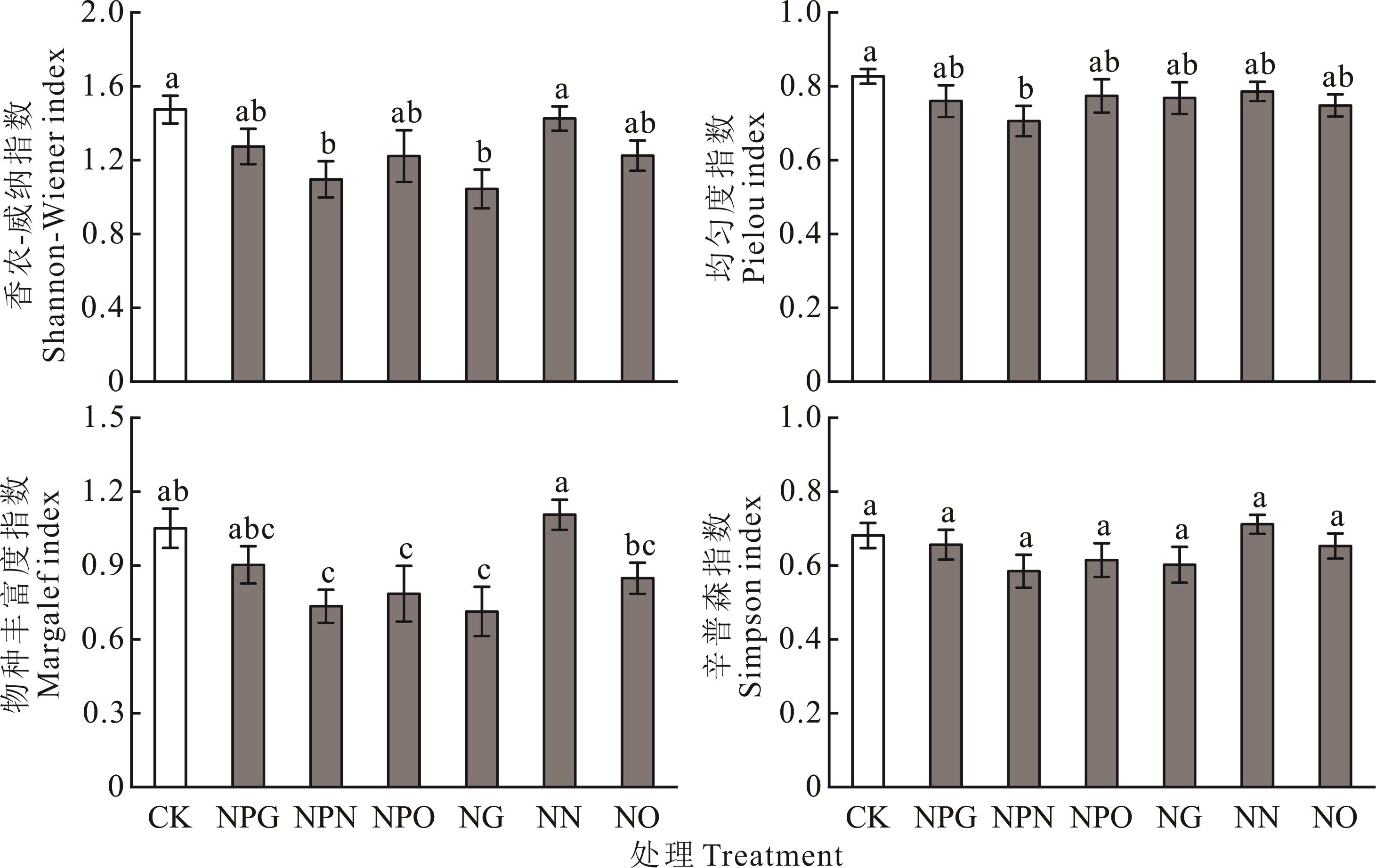
Fig.1 Response of plant diversity to nutrient addition
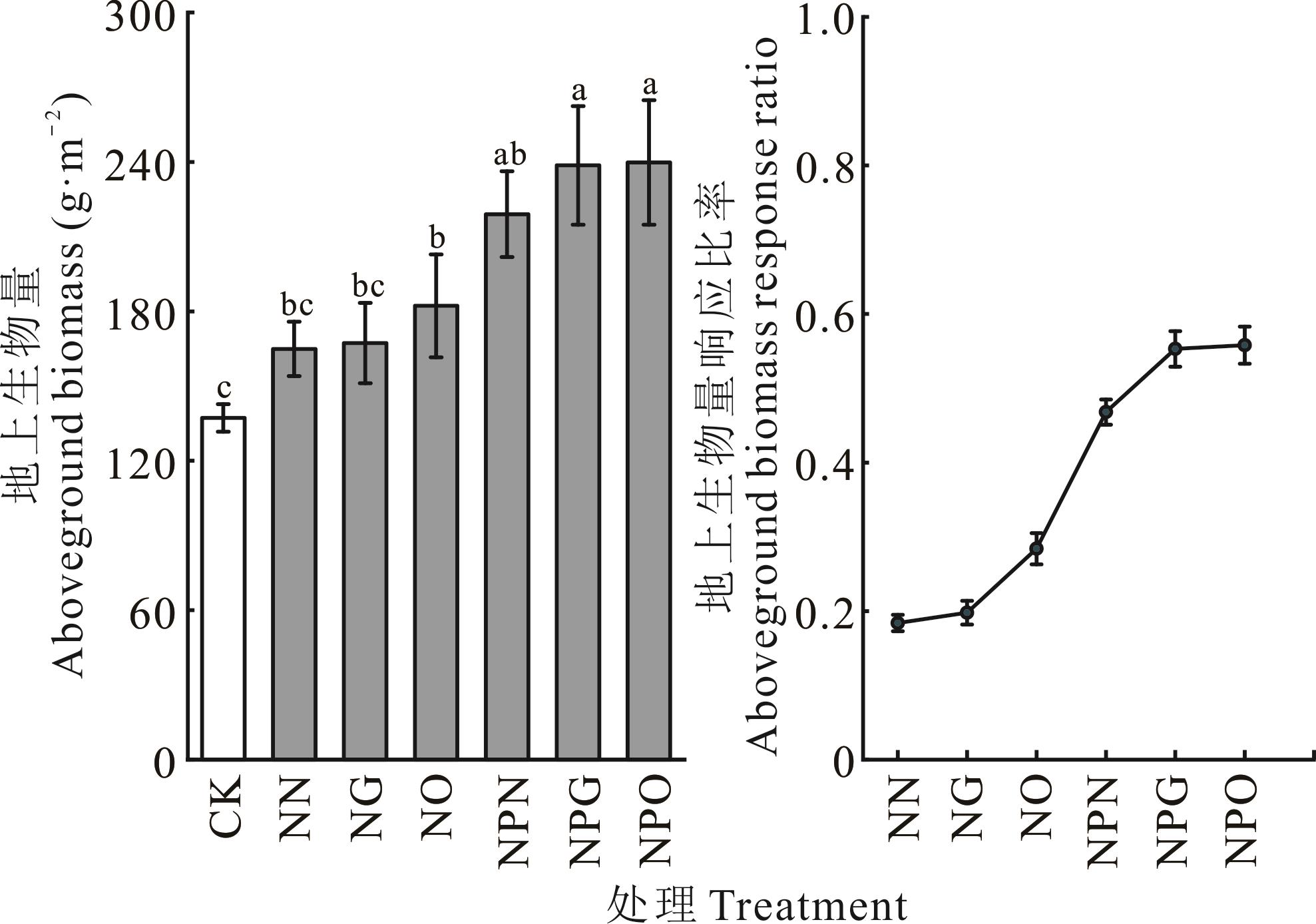
Fig.2 Effects of nutrient addition on community aboveground biomass and its response ratio
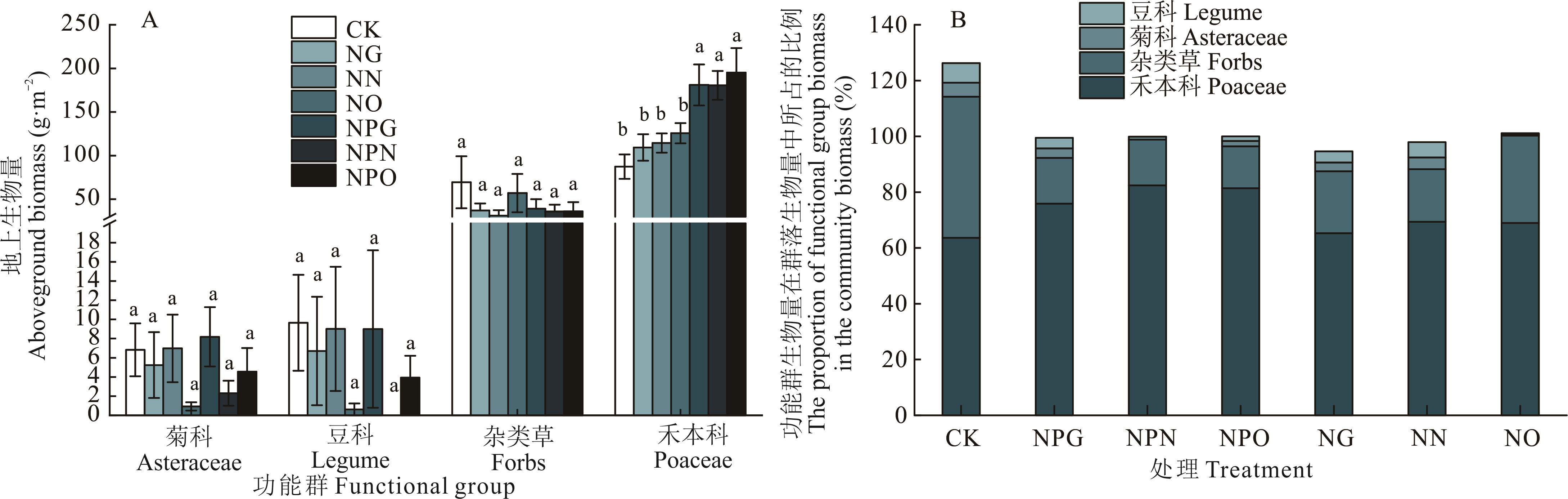
Fig.3 Effects of nutrient addition on community aboveground biomass and the proportion of functional group biomass
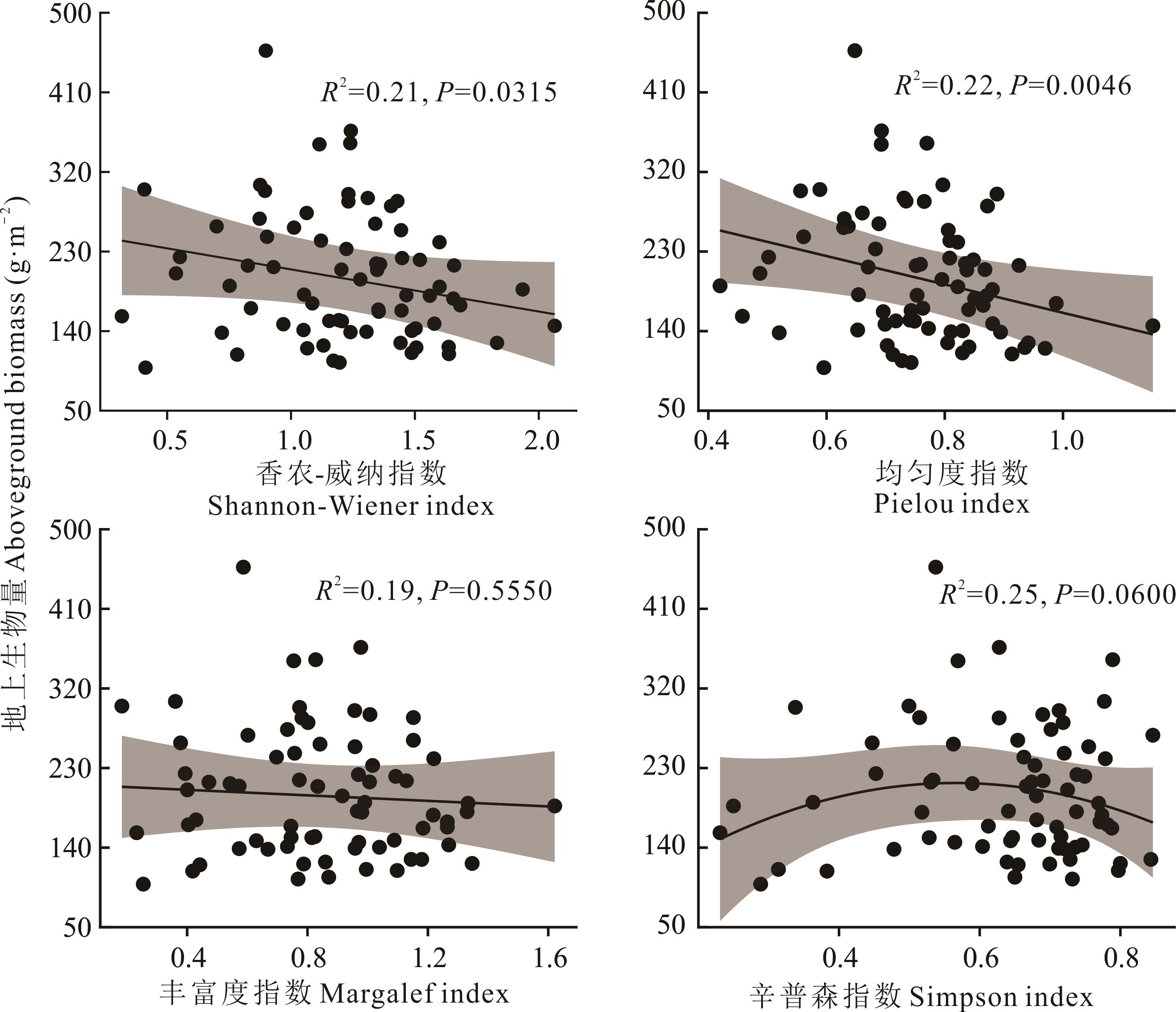
Fig.4 Relationship between plant diversity and aboveground biomass under nutrient addition treatment
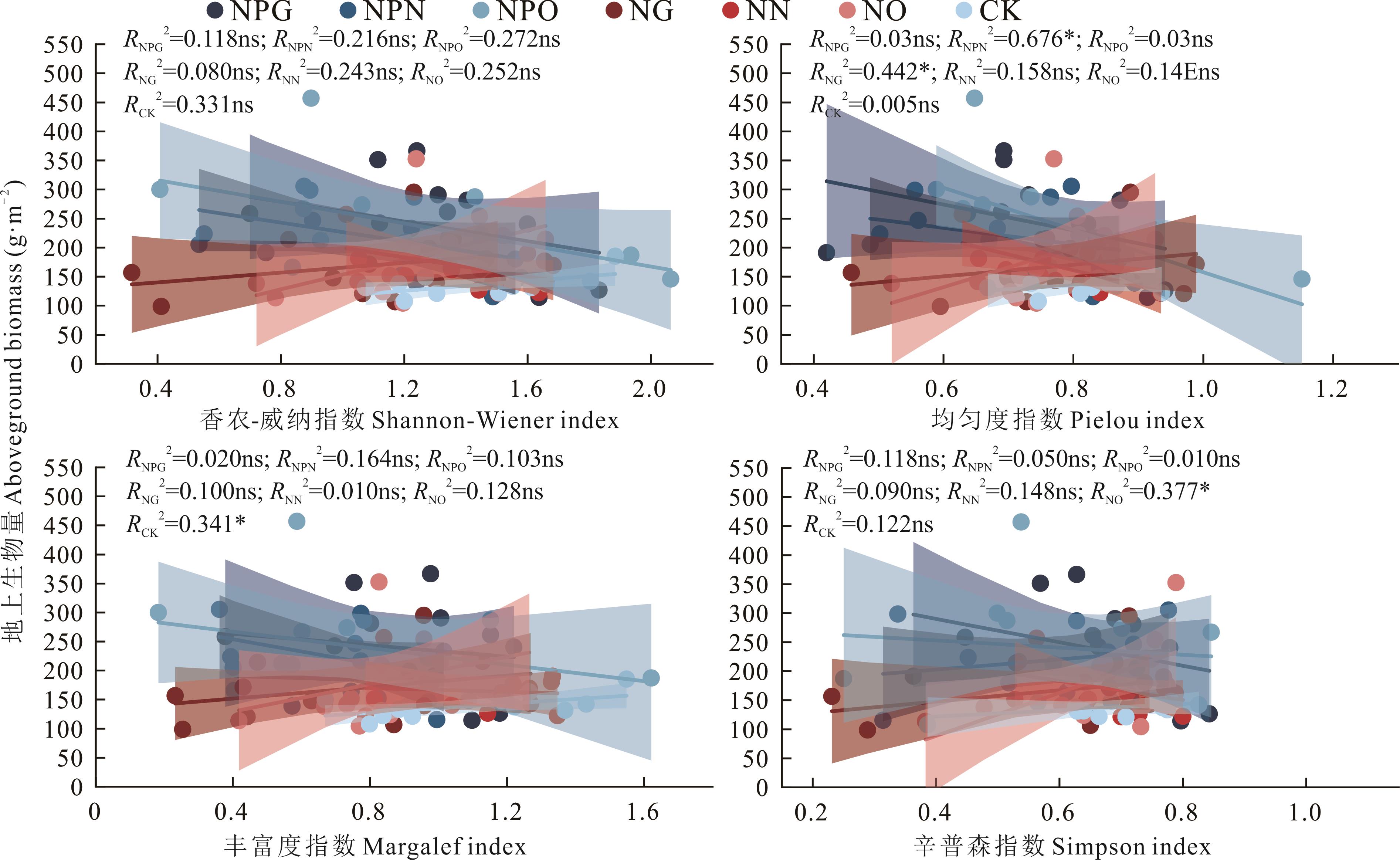
Fig.5 Relationship between plant diversity and aboveground biomass under different nutrient addition treatments
| [1] | Alberti J, Bakker E S, van Klink R, et al. Herbivore exclusion promotes a more stochastic plant community assembly in a natural grassland. Ecology, 2017, 98(4): 961-970. |
| [2] | He M, Pan Y H, Zhou G Y, et al. Grazing and global change factors differentially affect biodiversity-ecosystem functioning relationships in grassland ecosystems. Global Change Biology, 2022, 28(18): 5492-5504. |
| [3] | Yu L, Zhao J N, Wang H, et al. Effects of nutrient addition on plant diversity and productivity in a Stipa baicalensis grassland in Inner Mongolia, China. Acta Ecologica Sinica, 2015, 35(24): 8165-8173. |
| 于丽, 赵建宁, 王慧, 等. 养分添加对内蒙古贝加尔针茅草原植物多样性与生产力的影响. 生态学报, 2015, 35(24): 8165-8173. | |
| [4] | Bai Y F, Cotrufo M F. Grassland soil carbon sequestration: Current understanding, challenges, and solutions. Science, 2022, 377(6606): 603-608. |
| [5] | Luo W T, Shi Y, Wilkins K, et al. Plant traits modulate grassland stability during drought and post-drought periods. Functional Ecology, 2023, 37(10): 2611-2620. |
| [6] | Bardgett R D, Bullock J M, Lavorel S, et al. Combatting global grassland degradation. Nature Reviews Earth & Environment, 2021, 2(10): 720-735. |
| [7] | Han X, Li Y H, Du X F, et al. Effect of grassland degradation on soil quality and soil biotic community in a semi-arid temperate steppe. Ecological Processes, 2020, 9(1): 1-11. |
| [8] | Yang Y H, Zhang D Y, Wei B, et al. Nonlinear responses of community ecosystems to external nitrogen input diversity, carbon and nitrogen cycles of grassland. Chinese Journal of Plant Ecology, 2023, 47(1): 1-24. |
| 杨元合, 张典业, 魏斌, 等. 草地群落多样性和生态系统碳氮循环对氮输入的非线性响应及其机制. 植物生态学报, 2023, 47(1): 1-24. | |
| [9] | Zhao Y N, Yang B, Li M X, et al. Community composition, structure and productivity in response to nitrogen and phosphorus additions in a temperate meadow. Science of the Total Environment, 2019, 654: 863-871. |
| [10] | Niu D C, Yuan X B, Cease A J, et al. The impact of nitrogen enrichment on grassland ecosystem stability depends on nitrogen addition level. Science of the Total Environment, 2018, 618: 1529-1538. |
| [11] | Xu Y F, Shen Y Z, Zhang W T, et al. Control of nitrogen leaching and ammonia volatilization by developing a kind of humic acid-matrix slow release urea. Journal of Plant Nutrition and Fertilizers, 2024, 30(4): 801-811. |
| 徐宇帆, 申亚珍, 张文太, 等. 腐植酸基质缓释尿素对氮素淋失和氨挥发的阻控. 植物营养与肥料学报, 2024, 30(4): 801-811. | |
| [12] | Bai Y F, Wu J G, Clark C M, et al. Tradeoffs and thresholds in the effects of nitrogen addition on biodiversity and ecosystem functioning: Evidence from Inner Mongolia grasslands. Global Change Biology, 2020, 16(1): 358-372. |
| [13] | Wang K L, Yang H L, Xiao H, et al. Effects of nitrogen application and clipping height on vegetation productivity and plant community composition of haying meadow steppe. Scientia Agricultura Sinica, 2020, 53(13): 2625-2636. |
| 王开丽, 杨合龙, 肖红, 等. 施氮与刈割留茬高度对草场生产力及植物群落组成的影响. 中国农业科学, 2020, 53(13): 2625-2636. | |
| [14] | Yang Q, Wang W, Zeng H. Effects of nitrogen addition on the plant diversity and biomass of degraded grasslands of Nei Mongol, China. Chinese Journal of Plant Ecology, 2018, 42(4): 430-441. |
| 杨倩, 王娓, 曾辉. 氮添加对内蒙古退化草地植物群落多样性和生物量的影响. 植物生态学报, 2018, 42(4): 430-441. | |
| [15] | Wang H Y, Chang J F, Wang Z W. Responses of community species diversity and productivity to nitrogen and phosphorus addition during restoration of degraded grassland. Scientia Agricultura Sinica, 2020, 53(13): 2604-2613. |
| 王洪义, 常继方, 王正文. 退化草地恢复过程中群落物种多样性及生产力对氮磷养分的响应. 中国农业科学, 2020, 53(13): 2604-2613. | |
| [16] | Elser J J, Brachen M E S, Cleland E E, et al. Global analysis of nitrogen and phosphorus limitation of primary producers in freshwater, marine and terrestrial ecosystems. Ecology Letters, 2007, 10(12): 1135-1142. |
| [17] | Bai X, Cheng J H, Zheng S X, et al. Ecophysiological responses of Leymus chinensis to nitrogen and phosphorus additions in a typical steppe. Chinese Journal of Plant Ecology, 2014, 38(2): 103-115. |
| 白雪, 程军回, 郑淑霞, 等. 典型草原建群种羊草对氮磷添加的生理生态响应. 植物生态学报, 2014, 38(2): 103-115. | |
| [18] | Yang Y W, Zhou H K, Li X L, et al. Initial response of species diversity and productivity to nutrients addition on alpine meadow. Acta Agriculturae Boreali-occidentalis Sinica, 2017, 26(2): 159-166. |
| 杨元武, 周华坤, 李希来, 等. 高寒草甸物种多样性和生产力对养分添加的初期响应. 西北农业学报, 2017, 26(2): 159-166. | |
| [19] | Wang D J, Zhou H K, Yao B Q, et al. Effects of nutrient addition on degraded alpine grasslands of the Qinghai-Tibetan plateau: A meta-analysis. Agriculture, Ecosystems & Environment, 2020, 301(10): 106970. |
| [20] | Liu K L, Zhang H M, Han T F, et al. Effects of long-term application of chemical and organic fertilizers on root biomass and nutrient in double cropping rice system. Scientia Agricultura Sinica, 2017, 50(18): 3540-3548. |
| 柳开楼, 张会民, 韩天富, 等. 长期化肥和有机肥施用对双季稻根茬生物量及养分积累特征的影响. 中国农业科学, 2017, 50(18): 3540-3548. | |
| [21] | Zhang T H, Cong A Q, Lian J, et al. Thinking from Horqin Grassland to Horqin Sandy Land. Chinese Journal of Applied Ecology, 2024, 35(1): 25-30. |
| 张铜会, 丛安琪, 连杰, 等. 从科尔沁草原到科尔沁沙地的思考. 应用生态学报, 2024, 35(1): 25-30. | |
| [22] | Wu C. Response of litter decomposition to different restoration measures in Horqin saline-alkali grassland. Hohhot: Inner Mongolia Agricultural University, 2021. |
| 吴朝. 科尔沁盐碱化草地枯落物分解对不同修复措施的响应. 呼和浩特: 内蒙古农业大学, 2021. | |
| [23] | Wang D L. Effects of fertilizer application on the characteristics of vegetation functional groups and soil physicochemical properties in degraded grasslands of Horqin. Hohhot: Inner Mongolia Agricultural University, 2022. |
| 王东磊. 施肥对科尔沁退化草地植被功能群特征及土壤理化性质的影响. 呼和浩特: 内蒙古农业大学, 2022. | |
| [24] | Stevens C J, Dise N B, Mountford J O, et al. Impact of nitrogen deposition on the species richness of grasslands. Science, 2004, 303(5665): 1876-1879. |
| [25] | Clark C M, Tilman D. Loss of plant species after chronic low-level nitrogen deposition to prairie grasslands. Nature, 2008, 451(7179): 712-715. |
| [26] | Zong N, Shi P L, Niu B, et al. Effects of nitrogen and phosphorous fertilization on community structure and productivity of degraded alpine meadows in northern Tibet, China. Chinese Journal of Applied Ecology, 2014, 25(12): 3458-3468. |
| 宗宁, 石培礼, 牛犇, 等. 氮磷配施对藏北退化高寒草甸群落结构和生产力的影响. 应用生态学报, 2014, 25(12): 3458-3468. | |
| [27] | Pan Z Z, Wang R B, Chen H, et al. Response of aboveground productivity to nutrient addition driven by species diversity in an alpine meadow community. Acta Ecologica Sinica, 2025, 45(4): 1865-1877. |
| 潘珍珍, 王瑞兵, 陈欢, 等. 物种多样性驱动高寒草甸地上生产力对养分添加的响应. 生态学报, 2025, 45(4): 1865-1877. | |
| [28] | Cleland E E, Harpole W S. Nitrogen enrichment and plant communities. Annals of the New York Academy of Sciences, 2010, 1195(1): 46-61. |
| [29] | Si H L, Ji L D, Li L, et al. Effects of long-term application of bioorganic fertilizer on soil nutrients and biological characteristics of saline alkali land in Ningxia. Soils, 2022, 54(6): 1124-1131. |
| 司海丽, 纪立东, 李磊, 等. 生物有机肥对宁夏盐碱地土壤养分和生物学特性的影响. 土壤, 2022, 54(6): 1124-1131. | |
| [30] | Lu P N, Liu J H, Zhao B P, et al. Effects of microbial fertilizer on soil characteristics and root exudates of oats in saline-alkali land. Crops, 2017(5): 85-92. |
| 卢培娜, 刘景辉, 赵宝平, 等. 菌肥对盐碱地土壤特性及燕麦根系分泌物的影响. 作物杂志, 2017(5): 85-92. | |
| [31] | Yang X X, Ren F, Zhou H K, et al. Responses of plant community biomass to nitrogen and phosphorus additions in an alpine meadow on the Qinghai-Xizang Plateau. Chinese Journal of Plant Ecology, 2014, 38(2): 159-166. |
| 杨晓霞, 任飞, 周华坤, 等. 青藏高原高寒草甸植物群落生物量对氮、磷添加的响应. 植物生态学报, 2014, 38(2): 159-166. | |
| [32] | Flynn D F, Mirotchnick N, Jain M, et al. Functional and phylogenetic diversity as predictors of biodiversity-ecosystem-function relationships. Ecology, 2011, 92(8): 1573-1581. |
| [33] | Li D, Nie Y Y, Xu L J, et al. Enclosure in combination with mowing simultaneously promoted grassland biodiversity and biomass productivity. Plants, 2022, 11(15): 2037. |
| [34] | Nie Y Y, Xu L J, Xin X P, et al. Long-term grassland diversity-productivity relationship regulated by management regimes in northern China. Science of the Total Environment, 2024, 949: 175084. |
| [35] | Lasky J R, Uriarte M, Boukili V K, et al. The relationship between tree biodiversity and biomass dynamics changes with tropical forest succession. Ecology Letters, 2014, 17(9): 1158-1167. |
| [36] | Wang Y F, Du J Q, Pang Z, et al. Unimodal productivity-biodiversity relationship along the gradient of multidimensional resources across Chinese grasslands. National Science Review, 2022, 9(12): nwac165. |
| [37] | Guo Q. Temporal species richness-biomass relationships along successional gradients. Journal of Vegetation Science, 2003, 14(1): 121-128. |
| [38] | Hecter A, Bagchi R. Biodiversity and ecosystem multifunctionality. Nature, 2007, 448(7150): 188-190. |
| [39] | Dee L E, Ferraro P J, Severev C N, et al. Clarifying the effect of biodiversity on productivity in natural ecosystems with longitudinal data and methods for causal inference. Nature Communications, 2023, 14(1): 2607. |
| [40] | Ren Z W, Li Q, Chu C J, et al. Effects of resource additions on species richness and ANPP in an alpine meadow community. Journal of Plant Ecology, 2010, 3(1): 25-31. |
| [41] | Allan E, Manning P, Alt F, et al. Land use intensification alters ecosystem multifunctionality via loss of biodiversity and changes to functional composition. Ecology Letters, 2015, 18(8): 834-843. |
| [1] | Meng YAN, Ying-zhi GAO. Progress in research on the impact of grazing on symbiotic nitrogen fixation of plant root nodules [J]. Acta Prataculturae Sinica, 2026, 35(5): 212-224. |
| [2] | Xue-qin YANG, Jian-ping LI, Jing CHEN, Jia-li LIAN, Cui HAN, Xu LUO, Ying ZHAO. The impact of precipitation changes on carbon and nitrogen storage and retention rates in desert steppe ecosystems [J]. Acta Prataculturae Sinica, 2026, 35(5): 48-60. |
| [3] | Ping MA, Zhi-guo LIU, Yu-shu SHA, Ya-ling LIU, Xiao-mei TUO, Bing-zhe FU, Xue-qing GAO. Nitrogen utilization characteristics of alfalfa at the seedling stage and screening of nitrogen-efficient varieties [J]. Acta Prataculturae Sinica, 2026, 35(4): 112-123. |
| [4] | Chang LIU, Ji-shan CHEN, Rui-fen ZHU, Wan-bin SUN, Bo YAO, Shi-kui DONG. Mitigation of soil microbial carbon and phosphorus limitations through organic fertilizer and biochar inputs in subtropical cultivated grassland [J]. Acta Prataculturae Sinica, 2026, 35(4): 54-66. |
| [5] | Jia-yi ZANG, Ming-jie XU, Ji-cheng XIE, Yu-ying SHEN, Xing-fa LAI. Effects of replacing chemical fertilizers with organic fertilizer at equivalent nitrogen levels on forage yield and water use efficiency in a silage maize/forage soybean intercropping system in dryland areas [J]. Acta Prataculturae Sinica, 2026, 35(3): 83-95. |
| [6] | Hui PENG, Lin MU, Jia-xin SHEN, Jing-xuan WANG, Jing HUANG, Yu-xun HUANG, Zhi-fei ZHANG. Creation of ethyl methanesulfonate chemical mutants of Hemarthria compressa seed stem [J]. Acta Prataculturae Sinica, 2026, 35(2): 95-106. |
| [7] | Jia-hui KANG, Min-na ZHENG, Rui-jie GONG, Zhi-shun HAN, Yan-ni CHEN, Xiu-zhi LIANG. Effects of nitrogen and phosphorus supplementation on ecological stoichiometric characteristics of soil microbial-extracellular enzymes in annual artificial grassland [J]. Acta Prataculturae Sinica, 2026, 35(1): 13-24. |
| [8] | Yi-yin ZHANG, Ai-ping XIAO, Bin WANG, Teng-fei WANG, Hai-ying HU, Jian LAN. Effect of nitrogen application on grass productivity and energy use efficiency in a mixed forage sorghum/lablab planting [J]. Acta Prataculturae Sinica, 2026, 35(1): 40-52. |
| [9] | Fan-xi KONG, Bang-jie TANG, A-li-mi-ri ALIMUJIANG, Ge-ge ADE, Mao-guo YUAN, Jun CHEN. Species spatial distribution patterns in grassland under restoration in ‘hill and gully’ regions of the Loess Plateau [J]. Acta Prataculturae Sinica, 2025, 34(9): 1-11. |
| [10] | Wen-juan FAN, Jian-chao SONG, Xiao-juan ZHANG, Yu-hang SHENG, Jin-tao SHI, Long-ji ZHANG, Xiao-jun YU. The effects of combined nitrogen and phosphorus fertilization on seed yield and quality of Medicago ruthenica in the Wuwei irrigation district, Gansu Province [J]. Acta Prataculturae Sinica, 2025, 34(8): 54-65. |
| [11] | Ling-fei XIANG, Feng-ju ZHANG, Dong-mei MA, Jin-long LIU, Jian LAN, Jian-qiang DENG, Hai-ying HU, Bin WANG, Chun-jiang CAI, Qiao-li MA. Effects of nitrogen, phosphorus and potassium rationing on production performance and nutritional quality of Echinochloa frumentacea in saline soil [J]. Acta Prataculturae Sinica, 2025, 34(7): 185-195. |
| [12] | Xin-yu CHEN, Zheng-xin DENG, Zi-fang WANG, Jun XIE, Wen-cai DAI, Ming GAO. The impact of ammonium nitrogen fertilizer application rates on nitrogen leaching and surface electrochemical properties of various purple soils [J]. Acta Prataculturae Sinica, 2025, 34(7): 69-82. |
| [13] | Qi-lin LIU, Xiao-jun WANG, Jin-lan WANG, Wen-hui LIU, Qiao-ling MA, Jian-hui LI, Sheng-yuan ZHANG, Wen-xia CAO, Wen LI. Effect of nitrogen and phosphorus combined application on forage yield of Elymus sibiricus in an alpine region [J]. Acta Prataculturae Sinica, 2025, 34(6): 193-202. |
| [14] | Wen-li QIN, Jing ZHANG, Guang-min XIAO, Su-qian CUI, Jian-xun YE, Jian-fei ZHI, Li-feng ZHANG, Nan XIE, Wei FENG, Zhen-yu LIU, Xuan PAN, Yun-xia DAI, Zhong-kuan LIU. Effects of partial replacement of chemical nitrogen fertilizers with green manure on soil physical properties and maize (Zea mays) yield [J]. Acta Prataculturae Sinica, 2025, 34(6): 27-45. |
| [15] | Rui-bing WANG, Huan CHEN, Zhen-zhen PAN, Wei ZHAO, Shao-hao BANG, Xiao-long ZHOU, Zheng-wei REN. Mechanisms of species diversity loss in an alpine meadow community after adding different types and numbers of resources [J]. Acta Prataculturae Sinica, 2025, 34(5): 1-11. |
| Viewed | ||||||
|
Full text |
|
|||||
|
Abstract |
|
|||||
