

ISSN 1004-5759 CN 62-1105/S
草业学报 ›› 2026, Vol. 35 ›› Issue (9): 154-168.DOI: 10.11686/cyxb2025405
• 研究论文 • 上一篇
刘佳伟( ), 王浩, 万超越, 陈阳, 南晓, 李克梅()
收稿日期:2025-09-30
修回日期:2025-11-12
出版日期:2026-09-20
发布日期:2026-07-27
通讯作者:
李克梅
作者简介:Corresponding author. E-mail: likemei@xjau.edu.cn基金资助:
Jia-wei LIU(), Hao WANG, Chao-yue WAN, Yang CHEN, Xiao NAN, Ke-mei LI()
Received:2025-09-30
Revised:2025-11-12
Online:2026-09-20
Published:2026-07-27
Contact:
Ke-mei LI
摘要:
绿草莓是昭苏县部分天然草原上的优势物种,叶斑病发生普遍。为明确引起绿草莓叶斑病的病原种类及生物学特性,本研究对新疆维吾尔自治区昭苏县采集的绿草莓叶斑病病样进行分离鉴定,分离的真菌根据形态学和多基因联合系统发育树进行鉴定。结果表明,共分离得到3种病原真菌,分别为交链格孢、Colletotrichum tibetense、Ascochyta nigripycnidia。生物学特性研究结果显示,三者均在25 ℃时生长最快,且可耐受pH范围较宽,为4~11,当pH为7~8时,菌丝发育最佳,此时测得的菌落直径显著大于其他pH条件(P<0.05)。交链格孢的最适培养基为玉米粉琼脂培养基(CMA),最适碳源、氮源分别为可溶性淀粉和蛋白胨;A. nigripycnidia在不同供试培养基中生长均较为缓慢,最适生长培养基为马铃薯胡萝卜琼脂培养基(PCA),在菌丝生长过程中,硫酸铵和可溶性淀粉分别作为氮源和碳源,展现出最好的利用效率(P<0.05);可溶性淀粉与蛋白胨分别为C. tibetense菌丝生长最理想的碳源与氮源(P<0.05),且该菌在马铃薯葡萄糖琼脂(PDA)培养基上菌丝生长最为迅速。3种病原菌在不同光照条件下菌丝生长较好。通过致病性测定,发现交链格孢、C. tibetense、A. nigripycnidia均为绿草莓叶斑病的致病菌。其中A. nigripycnidia分离频率最高,为40.15%,为绿草莓叶斑病的主要致病菌。
刘佳伟, 王浩, 万超越, 陈阳, 南晓, 李克梅. 昭苏县绿草莓叶斑病病原鉴定及其生物学特性[J]. 草业学报, 2026, 35(9): 154-168.
Jia-wei LIU, Hao WANG, Chao-yue WAN, Yang CHEN, Xiao NAN, Ke-mei LI. Identification of the pathogen and biological characteristics of Fragaria viridis leaf spot in Zhaosu County, China[J]. Acta Prataculturae Sinica, 2026, 35(9): 154-168.
| 级别Grade | 分级标准Grading criteria |
|---|---|
| 0级Grade 0 | 无症状表现Asymptomatic manifestation |
| 1级Grade 1 | 病斑面积<叶面积的5% Lesion area accounting for less than 5% of leaf area |
| 2级Grade 2 | 病斑面积占叶面积的5%~25% Lesion area accounting for 5% to 25% of leaf area |
| 3级Grade 3 | 病斑面积占叶面积的25%~50% Lesion area accounting for 25% to 50% of leaf area |
| 4级Grade 4 | 病斑面积>叶面积的50% Lesion area accounting for more than 50% of leaf area |
表1 叶斑病分级标准
Table 1 Leaf spot disease grading criteria
| 级别Grade | 分级标准Grading criteria |
|---|---|
| 0级Grade 0 | 无症状表现Asymptomatic manifestation |
| 1级Grade 1 | 病斑面积<叶面积的5% Lesion area accounting for less than 5% of leaf area |
| 2级Grade 2 | 病斑面积占叶面积的5%~25% Lesion area accounting for 5% to 25% of leaf area |
| 3级Grade 3 | 病斑面积占叶面积的25%~50% Lesion area accounting for 25% to 50% of leaf area |
| 4级Grade 4 | 病斑面积>叶面积的50% Lesion area accounting for more than 50% of leaf area |
基因 Gene | 引物 Primer | 序列 Sequences | 退火温度 Annealing temperature (℃) | 参考文献 References |
|---|---|---|---|---|
| ITS | ITS1 | TCCGTAGGTGAACCTGCGG | 56 | [ |
| ITS4 | TCCTCCGCTTATTGATATGC | |||
| LSU | NL1 | GCATATCAATAAGCGGAGGAAAAG | 55 | [ |
| NL4 | GGTCCGTGTTTCAAGACGG | |||
| TUB2 | BT2A | GGTAACCAAATCGGTGCTGCTTTC | 58 | [ |
| BT2B | ACCCTCAGTGTAGTGACCCTTGGC | |||
| GAPDH | GDF1 | GCCGTCAACGACCCCTTCATTGA | 60 | [ |
| GDR1 | GGGTGGAGTCGTACTTGAGCATGT | |||
| TEF | EF1-728F | CATCGAGAAGTTCGAGG | 55 | [ |
| EF1-986R | TACTTGAAGGAACCCTTACC | |||
| ALT | ALT-F | ATGCAGTTCACCACCATCGC | 55 | [ |
| ALT-R | ACGAGGGTGAYGTAGGCGTC | |||
| CHS | CHS-79F | TGGGGCAAGGATGCTTGGAAGAAG | 55 | [ |
| CHS-345R | TGGAAGAACCATCTGTGAGAGTTG | |||
| ACT | 512F | ATGTGCAAGGCCGGTTTCGC | 58 | [ |
| 783R | TACGAGTCCTTCTGGCCCAT |
表2 PCR引物信息
Table 2 PCR primer information
基因 Gene | 引物 Primer | 序列 Sequences | 退火温度 Annealing temperature (℃) | 参考文献 References |
|---|---|---|---|---|
| ITS | ITS1 | TCCGTAGGTGAACCTGCGG | 56 | [ |
| ITS4 | TCCTCCGCTTATTGATATGC | |||
| LSU | NL1 | GCATATCAATAAGCGGAGGAAAAG | 55 | [ |
| NL4 | GGTCCGTGTTTCAAGACGG | |||
| TUB2 | BT2A | GGTAACCAAATCGGTGCTGCTTTC | 58 | [ |
| BT2B | ACCCTCAGTGTAGTGACCCTTGGC | |||
| GAPDH | GDF1 | GCCGTCAACGACCCCTTCATTGA | 60 | [ |
| GDR1 | GGGTGGAGTCGTACTTGAGCATGT | |||
| TEF | EF1-728F | CATCGAGAAGTTCGAGG | 55 | [ |
| EF1-986R | TACTTGAAGGAACCCTTACC | |||
| ALT | ALT-F | ATGCAGTTCACCACCATCGC | 55 | [ |
| ALT-R | ACGAGGGTGAYGTAGGCGTC | |||
| CHS | CHS-79F | TGGGGCAAGGATGCTTGGAAGAAG | 55 | [ |
| CHS-345R | TGGAAGAACCATCTGTGAGAGTTG | |||
| ACT | 512F | ATGTGCAAGGCCGGTTTCGC | 58 | [ |
| 783R | TACGAGTCCTTCTGGCCCAT |
月份 Month | 吐格勒勤布拉克草原Tugelqin bulak grassland | 巴勒克苏星空草原Balkasu starry sky grassland | 开斯克草场Kaisik pasture | |||
|---|---|---|---|---|---|---|
发病率 Disease incidence (%) | 病情指数 Disease index | 发病率 Disease incidence (%) | 病情指数 Disease index | 发病率 Disease incidence (%) | 病情指数 Disease index | |
| 5 | 46.88±0.85d | 17.87±0.42d | 44.06±0.78d | 14.93±0.18d | 43.07±0.65d | 13.85±0.16c |
| 6 | 50.72±0.62c | 19.79±0.77c | 48.97±0.71c | 17.84±0.40c | 45.14±0.64c | 15.76±0.15b |
| 7 | 56.86±0.42b | 23.68±0.81b | 52.92±0.30b | 21.31±0.35b | 49.61±0.34b | 20.68±1.37a |
| 8 | 59.69±0.31a | 26.63±0.86a | 54.89±0.60a | 23.09±0.29a | 50.70±0.61a | 21.90±0.77a |
表3 3个调查地点5-8月发病率及病情指数
Table 3 Disease incidence and disease index of three survey sites from May to August
月份 Month | 吐格勒勤布拉克草原Tugelqin bulak grassland | 巴勒克苏星空草原Balkasu starry sky grassland | 开斯克草场Kaisik pasture | |||
|---|---|---|---|---|---|---|
发病率 Disease incidence (%) | 病情指数 Disease index | 发病率 Disease incidence (%) | 病情指数 Disease index | 发病率 Disease incidence (%) | 病情指数 Disease index | |
| 5 | 46.88±0.85d | 17.87±0.42d | 44.06±0.78d | 14.93±0.18d | 43.07±0.65d | 13.85±0.16c |
| 6 | 50.72±0.62c | 19.79±0.77c | 48.97±0.71c | 17.84±0.40c | 45.14±0.64c | 15.76±0.15b |
| 7 | 56.86±0.42b | 23.68±0.81b | 52.92±0.30b | 21.31±0.35b | 49.61±0.34b | 20.68±1.37a |
| 8 | 59.69±0.31a | 26.63±0.86a | 54.89±0.60a | 23.09±0.29a | 50.70±0.61a | 21.90±0.77a |
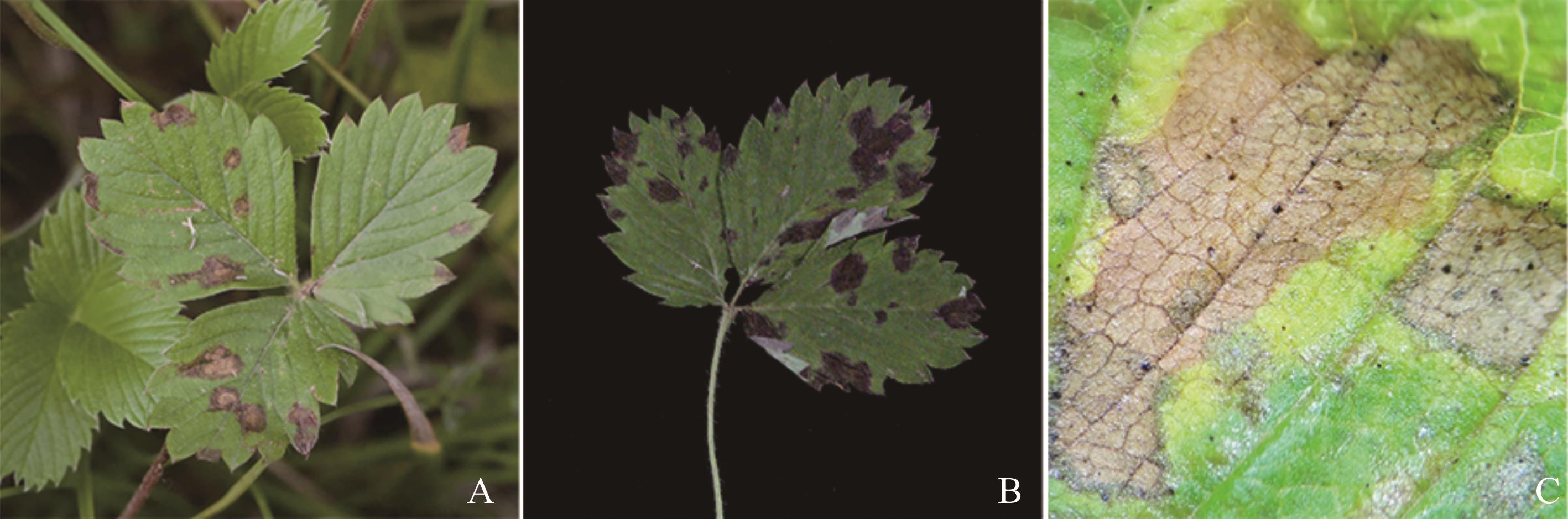
图1 昭苏县绿草莓叶斑病A: 田间症状Field symptom; B: 标本Specimen; C: 分生孢子器Pycnidia.
Fig.1 Leaf spot disease of F. viridis in Zhaosu County

图2 菌株XJZSYCM-1的形态特征A: 菌落正面Obverse of colony morphology; B: 菌落反面Reverse of colony morphology; C: 分生孢子Conidia; D: 产孢结构Sporulation structure. 下同The same below.
Fig.2 Morphological characteristics of strain XJZSYCM-1
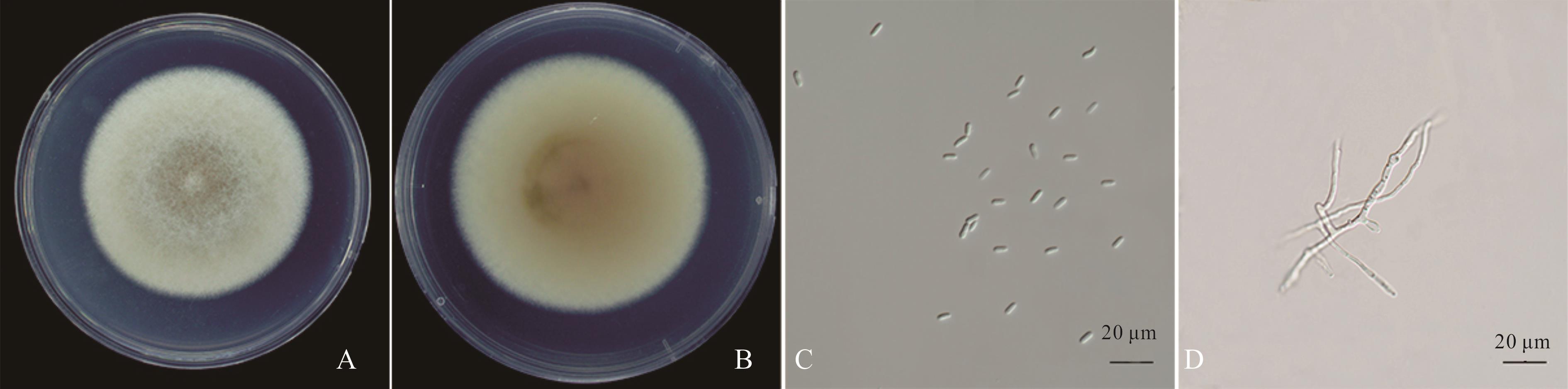
图3 菌株XJZSYCM-2的形态特征
Fig.3 Morphological characteristics of strain XJZSYCM-2
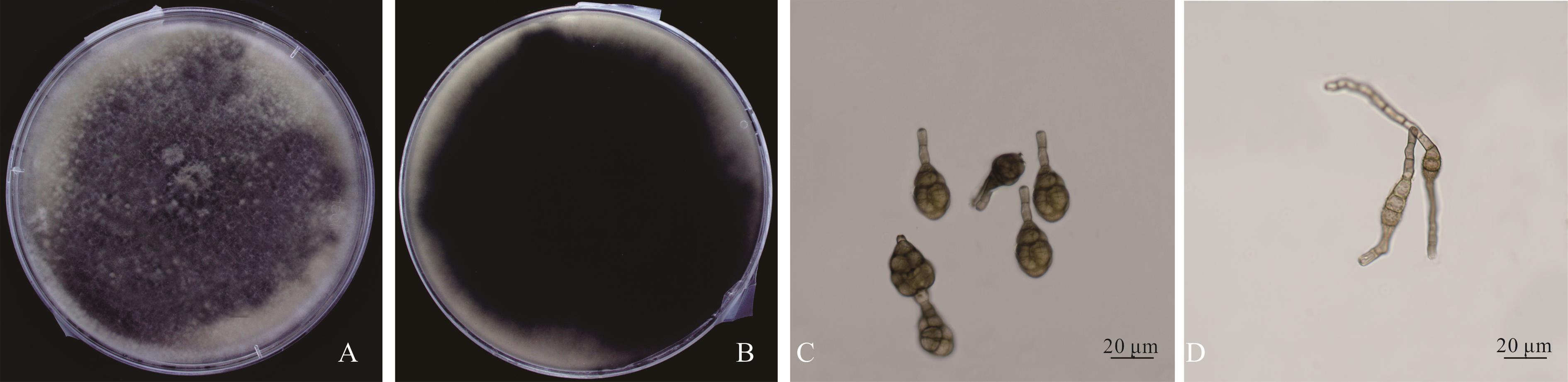
图4 菌株XJZSYCM-3形态特征
Fig.4 Morphological characteristics of strain XJZSYCM-3
种名 Species name | 菌株 Strains | GenBank登录号GenBank accession number | ||||
|---|---|---|---|---|---|---|
| ITS | CHS-1 | GAPDH | ACT | TUB2 | ||
| 尖孢炭疽菌Colletotrichum acutatum | CBS 112996 | JQ005776 | JQ005797 | JQ948677 | JQ005839 | JQ005860 |
| 博宁炭疽菌Colletotrichum boninense | CBS 123755 | JQ005153 | JQ005327 | JQ005240 | JQ005501 | JQ005588 |
| 菱孢炭疽菌Colletotrichum rhombiforme | CBS 129953 | JQ948457 | JQ949118 | JQ948788 | JQ949778 | JQ950108 |
| 大豆炭疽菌Colletotrichum sojae | CBS 13487 | MG600752 | MG600863 | MG600813 | MG600957 | MG601019 |
| 大豆炭疽菌C. sojae | CBS 18181 | MG600753 | MG600864 | MG600814 | MG600958 | MG601020 |
| 毁灭炭疽菌Colletotrichum destructivum | CBS 128509 | KM105214 | KM105284 | KM105569 | KM105424 | KM105494 |
| 毁灭炭疽菌C. destructivum | CBS 520.97 | KM105217 | KM105287 | KM105572 | KM105427 | KM105497 |
| 毁灭炭疽菌C. destructivum | CBS 114801 | KM105219 | KM105289 | KM105574 | KM105429 | KM105499 |
| 香蕉炭疽菌Colletotrichum musae | CBS 207.80 | KC566790 | KC566357 | KC566644 | KC566936 | KC566212 |
| 多主炭疽菌Colletotrichum plurivorum | CBS 125473 | MG600717 | MG600840 | MG600780 | MG600924 | MG600984 |
| 多主炭疽菌C. plurivorum | CBS 125474 | MG600718 | MG600841 | MG600781 | MG600925 | MG600985 |
| Colletotrichum acerbum | CBS 128530 | JQ948459 | JQ949120 | JQ948790 | JQ949780 | JQ950110 |
| 兰花炭疽菌Colletotrichum cliviicola | CBS 125375 | MG600733 | MG600850 | MG600795 | MG600939 | MG601000 |
| 兰花炭疽菌C. cliviicola | CBS 133705 | MG600732 | MG600849 | MG600794 | MG600938 | MG600999 |
| Colletotrichum orchidearum | CBS 135131 | MG600738 | MG600855 | MG600800 | MG600944 | MG601005 |
| C. orchidearum | CBS 136877 | MG600739 | MG600856 | MG600801 | MG600945 | MG601006 |
| 平头刺盘孢菌Colletotrichum truncatum | CBS 125327 | GU227887 | GU228377 | GU228279 | GU227985 | GU228181 |
| 平头刺盘孢菌C. truncatum | CBS 151.35 | GU227862 | GU228352 | GU228254 | GU227960 | GU228156 |
| Colletotrichum tibetense | LC 7364 | MZ595840 | MZ799339 | MZ772866 | MZ664138 | MZ673961 |
| 长直孢炭疽菌Colletotrichum gigasporum | CBS 15975 | KF687726 | KF687776 | KF687839 | KF687783 | KF687884 |
| 长直孢炭疽菌C. gigasporum | CBS 125731 | KF687727 | KF687771 | KF687837 | KF687794 | KF687879 |
| 长直孢炭疽菌C. gigasporum | CBS 18152 | KF687734 | KF687775 | KF687838 | KF687799 | KF687885 |
| 甘薯黑痣病菌M. infuscans | CBS 869.96 | JQ005780 | JQ005801 | JX546612 | JQ005843 | JQ005864 |
表4 炭疽菌属构建系统发育树的菌株信息
Table 4 Information on the strains of Colletotrichum sp. constructing the phylogenetic tree
种名 Species name | 菌株 Strains | GenBank登录号GenBank accession number | ||||
|---|---|---|---|---|---|---|
| ITS | CHS-1 | GAPDH | ACT | TUB2 | ||
| 尖孢炭疽菌Colletotrichum acutatum | CBS 112996 | JQ005776 | JQ005797 | JQ948677 | JQ005839 | JQ005860 |
| 博宁炭疽菌Colletotrichum boninense | CBS 123755 | JQ005153 | JQ005327 | JQ005240 | JQ005501 | JQ005588 |
| 菱孢炭疽菌Colletotrichum rhombiforme | CBS 129953 | JQ948457 | JQ949118 | JQ948788 | JQ949778 | JQ950108 |
| 大豆炭疽菌Colletotrichum sojae | CBS 13487 | MG600752 | MG600863 | MG600813 | MG600957 | MG601019 |
| 大豆炭疽菌C. sojae | CBS 18181 | MG600753 | MG600864 | MG600814 | MG600958 | MG601020 |
| 毁灭炭疽菌Colletotrichum destructivum | CBS 128509 | KM105214 | KM105284 | KM105569 | KM105424 | KM105494 |
| 毁灭炭疽菌C. destructivum | CBS 520.97 | KM105217 | KM105287 | KM105572 | KM105427 | KM105497 |
| 毁灭炭疽菌C. destructivum | CBS 114801 | KM105219 | KM105289 | KM105574 | KM105429 | KM105499 |
| 香蕉炭疽菌Colletotrichum musae | CBS 207.80 | KC566790 | KC566357 | KC566644 | KC566936 | KC566212 |
| 多主炭疽菌Colletotrichum plurivorum | CBS 125473 | MG600717 | MG600840 | MG600780 | MG600924 | MG600984 |
| 多主炭疽菌C. plurivorum | CBS 125474 | MG600718 | MG600841 | MG600781 | MG600925 | MG600985 |
| Colletotrichum acerbum | CBS 128530 | JQ948459 | JQ949120 | JQ948790 | JQ949780 | JQ950110 |
| 兰花炭疽菌Colletotrichum cliviicola | CBS 125375 | MG600733 | MG600850 | MG600795 | MG600939 | MG601000 |
| 兰花炭疽菌C. cliviicola | CBS 133705 | MG600732 | MG600849 | MG600794 | MG600938 | MG600999 |
| Colletotrichum orchidearum | CBS 135131 | MG600738 | MG600855 | MG600800 | MG600944 | MG601005 |
| C. orchidearum | CBS 136877 | MG600739 | MG600856 | MG600801 | MG600945 | MG601006 |
| 平头刺盘孢菌Colletotrichum truncatum | CBS 125327 | GU227887 | GU228377 | GU228279 | GU227985 | GU228181 |
| 平头刺盘孢菌C. truncatum | CBS 151.35 | GU227862 | GU228352 | GU228254 | GU227960 | GU228156 |
| Colletotrichum tibetense | LC 7364 | MZ595840 | MZ799339 | MZ772866 | MZ664138 | MZ673961 |
| 长直孢炭疽菌Colletotrichum gigasporum | CBS 15975 | KF687726 | KF687776 | KF687839 | KF687783 | KF687884 |
| 长直孢炭疽菌C. gigasporum | CBS 125731 | KF687727 | KF687771 | KF687837 | KF687794 | KF687879 |
| 长直孢炭疽菌C. gigasporum | CBS 18152 | KF687734 | KF687775 | KF687838 | KF687799 | KF687885 |
| 甘薯黑痣病菌M. infuscans | CBS 869.96 | JQ005780 | JQ005801 | JX546612 | JQ005843 | JQ005864 |

图5 菌株XJZSYCM-1基于ITS、TUB2、GAPDH、CHS-1、ACT多基因序列的贝叶斯系统发育树
Fig.5 Bayesian inference (BI) phylogenetic tree of strain XJZSYCM-1 based on ITS, TUB2, GAPDH, CHS-1 and ACT multi-gene sequences
种名 Species name | 菌株 Strains | GenBank登录号GenBank accession number | ||
|---|---|---|---|---|
| ITS | LSU | TUB2 | ||
| 蚕豆壳二孢Ascochyta fabae | CBS 524.77 | GU237880 | GU237963 | GU237526 |
| 蚕豆壳二孢A. fabae | CBS 649.71 | GU237902 | GU237964 | GU237527 |
| 苜蓿壳二孢 大孢变种Ascochyta medicaginicola var. macrospora | CBS 112.53 | GU237749 | GU238101 | GU237628 |
| 苜蓿壳二孢 大孢变种A. medicaginicola var. macrospora | CBS 404.65 | GU237859 | GU238102 | GU237629 |
| Ascochyta nigripycnidia | XJAU HC77 | OM701805 | OM701910 | OM891441 |
| 豌豆褐斑病菌Ascochytapisi | CBS 122750 | KT389477 | KT389694 | KT389769 |
| 豌豆褐斑病菌A.pisi | CBS 122751 | KP330432 | KP330444 | KT389771 |
| 丁香壳二孢Ascochyta syringae | CBS 545.72 | KT389483 | KT389700 | KT389772 |
| Preussia minima | CBS 524.50 | MH856741 | MH868263 | KT389777 |
表5 壳二孢属构建系统发育树的菌株信息
Table 5 Information on the strains of Ascochyta sp. constructing the phylogenetic tree
种名 Species name | 菌株 Strains | GenBank登录号GenBank accession number | ||
|---|---|---|---|---|
| ITS | LSU | TUB2 | ||
| 蚕豆壳二孢Ascochyta fabae | CBS 524.77 | GU237880 | GU237963 | GU237526 |
| 蚕豆壳二孢A. fabae | CBS 649.71 | GU237902 | GU237964 | GU237527 |
| 苜蓿壳二孢 大孢变种Ascochyta medicaginicola var. macrospora | CBS 112.53 | GU237749 | GU238101 | GU237628 |
| 苜蓿壳二孢 大孢变种A. medicaginicola var. macrospora | CBS 404.65 | GU237859 | GU238102 | GU237629 |
| Ascochyta nigripycnidia | XJAU HC77 | OM701805 | OM701910 | OM891441 |
| 豌豆褐斑病菌Ascochytapisi | CBS 122750 | KT389477 | KT389694 | KT389769 |
| 豌豆褐斑病菌A.pisi | CBS 122751 | KP330432 | KP330444 | KT389771 |
| 丁香壳二孢Ascochyta syringae | CBS 545.72 | KT389483 | KT389700 | KT389772 |
| Preussia minima | CBS 524.50 | MH856741 | MH868263 | KT389777 |

图6 菌株XJZSYCM-2基于ITS、TUB2、LSU多基因序列的贝叶斯系统发育树
Fig.6 Bayesian inference (BI) phylogenetic tree of strain XJZSYCM-2 based on ITS, TUB2 and LSU multi-gene sequences
种名 Species name | 菌株 Strains | GenBank登录号GenBank accession number | |||
|---|---|---|---|---|---|
| ITS | GAPDH | ALT | TEF | ||
| 六出花链格孢Alternaria alstroemeriae | CBS 118808 | KP124296 | KP124153 | KP123845 | KP125071 |
| 梨黑斑链格孢Alternaria gaisen | CBS 118488 | KP124427 | KP124278 | KP123975 | KP125206 |
| 交链格孢A. alternata | CBS 612.72 | KP124308 | KP124165 | KP123861 | KP125084 |
| 棉链格孢Alternaria gossypina | CBS 104.32 | KP124430 | JQ646312 | JQ646395 | KP125209 |
| 交链孢霉Alternaria jacinthicola | CBS 133751 | KP124438 | KP124287 | KP123984 | KP125217 |
| 番茄链格孢Alternaria tomato | CBS 114.35 | KP124446 | KP124295 | KP123992 | KP125225 |
| 巴斯基链格孢Alternaria burnsii | CBS 118816 | KP124423 | KP124273 | KP123970 | KP125201 |
| 囊状匍柄霉Stemphylium vesicarium | CBS 191.86 | MH861935 | - | - | KC584731 |
表6 链格孢属构建系统发育树的菌株信息
Table 6 Information on the strains of Alternaria sp. constructing the phylogenetic tree
种名 Species name | 菌株 Strains | GenBank登录号GenBank accession number | |||
|---|---|---|---|---|---|
| ITS | GAPDH | ALT | TEF | ||
| 六出花链格孢Alternaria alstroemeriae | CBS 118808 | KP124296 | KP124153 | KP123845 | KP125071 |
| 梨黑斑链格孢Alternaria gaisen | CBS 118488 | KP124427 | KP124278 | KP123975 | KP125206 |
| 交链格孢A. alternata | CBS 612.72 | KP124308 | KP124165 | KP123861 | KP125084 |
| 棉链格孢Alternaria gossypina | CBS 104.32 | KP124430 | JQ646312 | JQ646395 | KP125209 |
| 交链孢霉Alternaria jacinthicola | CBS 133751 | KP124438 | KP124287 | KP123984 | KP125217 |
| 番茄链格孢Alternaria tomato | CBS 114.35 | KP124446 | KP124295 | KP123992 | KP125225 |
| 巴斯基链格孢Alternaria burnsii | CBS 118816 | KP124423 | KP124273 | KP123970 | KP125201 |
| 囊状匍柄霉Stemphylium vesicarium | CBS 191.86 | MH861935 | - | - | KC584731 |
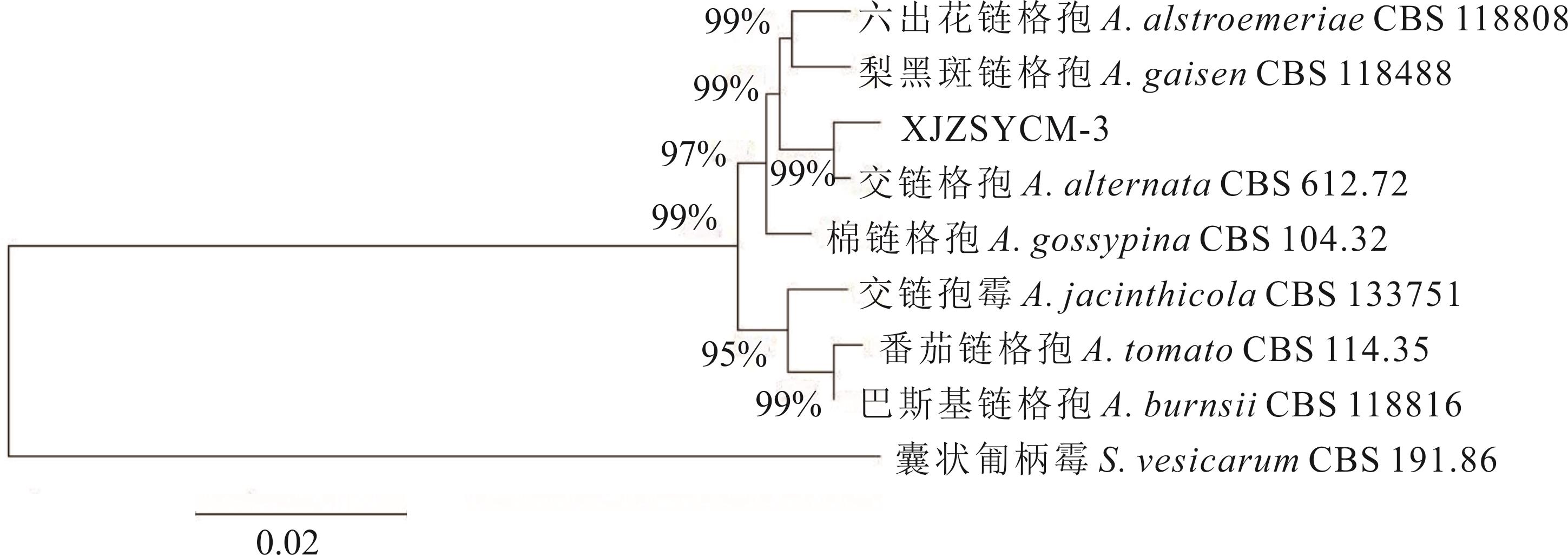
图7 菌株XJZSYCM-3基于ITS、ALT、GAPDH、TEF多基因序列的最大似然系统发育树
Fig.7 Maximum likelihood phylogenetic tree of strain XJZSYCM-3 based on ITS, ALT, GAPDH and TEF multi-gene sequences
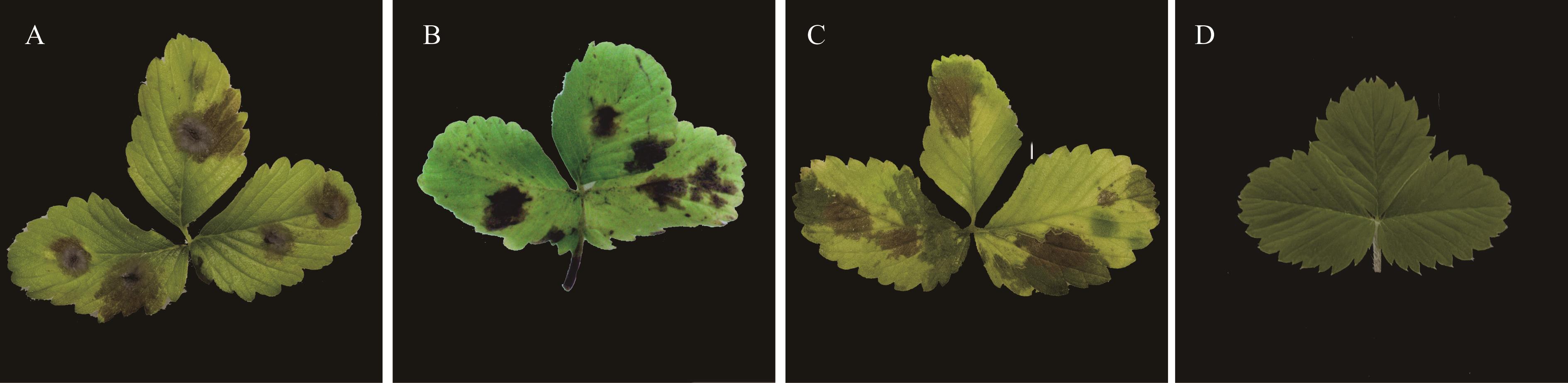
图8 绿草莓叶斑病接种7 d叶片发病症状A~C:C. tibetense、交链格孢和A. nigripycnidia的致病性测定,D:对照。A-C: Pathogenicity tests of C. tibetense, A. alternata, and A. nigripycnidia; D: Control.
Fig.8 Symptoms of leaf spot disease on F. viridis seven days after inoculation
| 处理Treatment | 培养条件Culture condition | 交链格孢A. alternata | A. nigripycnidia | C. tibetense |
|---|---|---|---|---|
培养基 Medium | 马铃薯葡萄糖琼脂Potato dextrose agar | 52.89±2.05a | 28.69±0.41ab | 47.11±1.40a |
| 马铃薯胡萝卜琼脂Potato carrot agar | 52.05±1.71a | 31.30±1.48a | 41.67±2.02b | |
| 马铃薯蔗糖琼脂Potato sucrose agar | 54.19±0.60a | 19.99±1.23c | 45.79±0.96a | |
| 燕麦片琼脂Oatmeal agar | 48.08±3.05b | 26.82±1.69b | 23.91±1.08d | |
| 玉米粉琼脂Corn meal agar | 54.70±1.87a | 29.33±2.69ab | 26.42±2.22d | |
| 水琼脂Water agar | 21.02±1.93c | 12.79±0.92d | 26.29±1.37d | |
| 胡萝卜水琼脂Carrot agar | 53.09±0.84a | 30.43±1.27a | 46.02±0.32a | |
| 查氏培养基Czapek agar | 48.33±1.53b | 21.35±0.70c | 32.49±2.16c | |
温度 Temperature (℃) | 5 | 8.34±2.12f | 7.57±0.75d | 5.97±0.26d |
| 10 | 19.39±0.63e | 14.66±2.21c | 21.67±1.31c | |
| 15 | 23.69±1.97d | 23.12±1.91b | 23.61±0.95c | |
| 20 | 41.34±1.21c | 24.28±1.24b | 44.37±1.09b | |
| 25 | 47.61±1.69a | 34.48±0.78a | 55.95±2.95a | |
| 30 | 44.90±1.50b | 25.19±0.47b | 53.67±2.72a | |
| 35 | 39.89±0.59c | 13.95±1.47c | 44.57±1.53b | |
碳源 Carbon source | D-果糖D-fructose | 40.58±1.00e | 12.70±0.47d | 19.67±1.37bc |
| 山梨醇Sorbitol | 43.24±0.93d | 6.92±0.02f | 12.66±0.09d | |
| 乳糖Lactose | 49.35±1.29c | 10.41±0.44de | 15.35±0.14cd | |
| 麦芽糖Maltose | 59.73±0.74b | 9.66±0.77ef | 11.27±1.81d | |
| 葡萄糖Glucose | 58.80±1.13b | 16.53±0.83c | 18.78±0.68bc | |
| 甘露醇Mannitol | 43.79±1.38d | 15.79±0.85c | 24.51±2.51b | |
| 菊糖Inulin | 65.24±0.57a | 27.78±3.07b | 19.86±0.73bc | |
| 可溶性淀粉Amylogen | 66.26±0.51a | 33.54±2.42a | 30.78±7.86a | |
氮源 Nitrogen source | 硝酸钾Potassium nitrate | 42.02±1.36b | 10.74±0.81de | 26.45±0.72e |
| 蛋白胨Peptone | 58.52±3.07a | 13.85±1.43c | 56.14±1.06a | |
| 牛肉膏Beef extract | 56.16±3.24a | 12.93±1.31cd | 36.42±1.28cd | |
| 酵母浸粉Yeast extract | 56.55±0.74a | 19.18±2.49b | 42.99±2.29b | |
| 尿素Urea | 17.13±2.64d | 8.00±0.59f | 34.08±1.37d | |
| 氯化铵Ammonium chloride | 32.15±4.24c | 10.08±0.49ef | 26.96±1.34e | |
| 硫酸铵Ammonia sulfate | 35.15±0.97c | 22.99±1.00a | 38.05±1.04c | |
| 甘氨酸Glycine | 33.73±4.34c | 11.89±1.49cde | 18.82±1.36f | |
| pH | 4 | 51.16±1.23c | 14.46±2.39e | 38.81±2.50e |
| 5 | 52.91±2.02c | 33.14±2.38cd | 49.93±2.53c | |
| 6 | 57.83±4.57b | 35.92±1.80bc | 53.32±0.91b | |
| 7 | 63.28±1.95a | 53.04±2.09a | 58.41±1.96a | |
| 8 | 62.64±2.38a | 52.63±3.12a | 56.53±1.06a | |
| 9 | 59.21±1.46ab | 39.45±7.05b | 48.40±0.71c | |
| 10 | 49.26±1.63c | 28.69±2.26d | 43.73±2.18d | |
| 11 | 48.92±1.09c | 10.77±0.81e | 38.60±1.01e | |
| 光照Light | 全黑暗Full darkness | 47.97±2.49b | 32.33±0.81a | 56.21±1.77a |
| 12 h光照/12 h黑暗12 hours dark/12 hours light | 55.43±0.79a | 31.51±0.56a | 53.72±1.28a | |
| 全光照Full light | 46.60±1.21b | 28.61±1.23b | 46.60±1.21b |
表7 不同培养条件下3种病原菌菌落生长直径
Table 7 Colony diameters of three pathogenic fungi under different culture conditions
| 处理Treatment | 培养条件Culture condition | 交链格孢A. alternata | A. nigripycnidia | C. tibetense |
|---|---|---|---|---|
培养基 Medium | 马铃薯葡萄糖琼脂Potato dextrose agar | 52.89±2.05a | 28.69±0.41ab | 47.11±1.40a |
| 马铃薯胡萝卜琼脂Potato carrot agar | 52.05±1.71a | 31.30±1.48a | 41.67±2.02b | |
| 马铃薯蔗糖琼脂Potato sucrose agar | 54.19±0.60a | 19.99±1.23c | 45.79±0.96a | |
| 燕麦片琼脂Oatmeal agar | 48.08±3.05b | 26.82±1.69b | 23.91±1.08d | |
| 玉米粉琼脂Corn meal agar | 54.70±1.87a | 29.33±2.69ab | 26.42±2.22d | |
| 水琼脂Water agar | 21.02±1.93c | 12.79±0.92d | 26.29±1.37d | |
| 胡萝卜水琼脂Carrot agar | 53.09±0.84a | 30.43±1.27a | 46.02±0.32a | |
| 查氏培养基Czapek agar | 48.33±1.53b | 21.35±0.70c | 32.49±2.16c | |
温度 Temperature (℃) | 5 | 8.34±2.12f | 7.57±0.75d | 5.97±0.26d |
| 10 | 19.39±0.63e | 14.66±2.21c | 21.67±1.31c | |
| 15 | 23.69±1.97d | 23.12±1.91b | 23.61±0.95c | |
| 20 | 41.34±1.21c | 24.28±1.24b | 44.37±1.09b | |
| 25 | 47.61±1.69a | 34.48±0.78a | 55.95±2.95a | |
| 30 | 44.90±1.50b | 25.19±0.47b | 53.67±2.72a | |
| 35 | 39.89±0.59c | 13.95±1.47c | 44.57±1.53b | |
碳源 Carbon source | D-果糖D-fructose | 40.58±1.00e | 12.70±0.47d | 19.67±1.37bc |
| 山梨醇Sorbitol | 43.24±0.93d | 6.92±0.02f | 12.66±0.09d | |
| 乳糖Lactose | 49.35±1.29c | 10.41±0.44de | 15.35±0.14cd | |
| 麦芽糖Maltose | 59.73±0.74b | 9.66±0.77ef | 11.27±1.81d | |
| 葡萄糖Glucose | 58.80±1.13b | 16.53±0.83c | 18.78±0.68bc | |
| 甘露醇Mannitol | 43.79±1.38d | 15.79±0.85c | 24.51±2.51b | |
| 菊糖Inulin | 65.24±0.57a | 27.78±3.07b | 19.86±0.73bc | |
| 可溶性淀粉Amylogen | 66.26±0.51a | 33.54±2.42a | 30.78±7.86a | |
氮源 Nitrogen source | 硝酸钾Potassium nitrate | 42.02±1.36b | 10.74±0.81de | 26.45±0.72e |
| 蛋白胨Peptone | 58.52±3.07a | 13.85±1.43c | 56.14±1.06a | |
| 牛肉膏Beef extract | 56.16±3.24a | 12.93±1.31cd | 36.42±1.28cd | |
| 酵母浸粉Yeast extract | 56.55±0.74a | 19.18±2.49b | 42.99±2.29b | |
| 尿素Urea | 17.13±2.64d | 8.00±0.59f | 34.08±1.37d | |
| 氯化铵Ammonium chloride | 32.15±4.24c | 10.08±0.49ef | 26.96±1.34e | |
| 硫酸铵Ammonia sulfate | 35.15±0.97c | 22.99±1.00a | 38.05±1.04c | |
| 甘氨酸Glycine | 33.73±4.34c | 11.89±1.49cde | 18.82±1.36f | |
| pH | 4 | 51.16±1.23c | 14.46±2.39e | 38.81±2.50e |
| 5 | 52.91±2.02c | 33.14±2.38cd | 49.93±2.53c | |
| 6 | 57.83±4.57b | 35.92±1.80bc | 53.32±0.91b | |
| 7 | 63.28±1.95a | 53.04±2.09a | 58.41±1.96a | |
| 8 | 62.64±2.38a | 52.63±3.12a | 56.53±1.06a | |
| 9 | 59.21±1.46ab | 39.45±7.05b | 48.40±0.71c | |
| 10 | 49.26±1.63c | 28.69±2.26d | 43.73±2.18d | |
| 11 | 48.92±1.09c | 10.77±0.81e | 38.60±1.01e | |
| 光照Light | 全黑暗Full darkness | 47.97±2.49b | 32.33±0.81a | 56.21±1.77a |
| 12 h光照/12 h黑暗12 hours dark/12 hours light | 55.43±0.79a | 31.51±0.56a | 53.72±1.28a | |
| 全光照Full light | 46.60±1.21b | 28.61±1.23b | 46.60±1.21b |
菌株 Strains | 温度Temperature (℃) | ||||||||||||
|---|---|---|---|---|---|---|---|---|---|---|---|---|---|
| 45 | 50 | 51 | 52 | 53 | 54 | 55 | 60 | 61 | 62 | 63 | 64 | 65 | |
| 交链格孢A. alternata | + | + | + | + | + | + | - | - | - | - | - | - | - |
| A. nigripycnidia | + | + | + | + | + | + | - | - | - | - | - | - | - |
| C. tibetense | + | + | + | + | + | + | + | + | + | + | + | - | - |
表8 3种病原菌菌丝致死温度
Table 8 The lethal temperature of mycelium for three pathogens
菌株 Strains | 温度Temperature (℃) | ||||||||||||
|---|---|---|---|---|---|---|---|---|---|---|---|---|---|
| 45 | 50 | 51 | 52 | 53 | 54 | 55 | 60 | 61 | 62 | 63 | 64 | 65 | |
| 交链格孢A. alternata | + | + | + | + | + | + | - | - | - | - | - | - | - |
| A. nigripycnidia | + | + | + | + | + | + | - | - | - | - | - | - | - |
| C. tibetense | + | + | + | + | + | + | + | + | + | + | + | - | - |
| [1] | Yu H Y, Feng J Y, Wen Y Q. Investigation and classification of wild strawberry germplasm resources in Qinba Mountain area. Shaanxi Journal of Agricultural Sciences, 2024, 70(9): 1-9. |
| 于海燕, 冯嘉玥, 文颖强. 秦巴山区野生草莓种质资源调查及分类研究. 陕西农业科学, 2024, 70(9): 1-9. | |
| [2] | Lei J J, Yang G, Dai H P, et al. Wild germplasm resources of strawberry in China. Journal of Fruit Science, 1997, 14(3): 198-200. |
| 雷家军, 杨高, 代汉平, 等. 我国的草莓野生种质资源. 果树科学, 1997, 14(3): 198-200. | |
| [3] | Lei J J, Deng M Q, Wu L P, et al. Fragaria viridis Duch. distributed in China was certified by classificatory observation and RAPD analysis. Acta Horticulturae Sinica, 2001, 28(2): 119-122. |
| 雷家军, 邓明琴, 吴禄平, 等. 新疆天山野生草莓与绿色草莓(Fragaria viridis Duch.)同一性的鉴定. 园艺学报, 2001, 28(2): 119-122. | |
| [4] | Lei J J, Tatsuya M, Deng M Q. Studies on the diploid strawberry species Fragaria mandschurica Staudt. Journal of Fruit Science, 2001, 18(6): 337-340. |
| 雷家军, 望月龙也, 邓明琴. 草莓属二倍体种东北草莓(Fragaria mandschurica Staudt)研究. 果树学报, 2001, 18(6): 337-340. | |
| [5] | Lei J J, Xue L, Dai H P, et al. Species and distribution of the Fragaria in the world//Advance of strawberry research (Ⅳ). Beijing: China Agriculture Press, 2015: 364-375. |
| 雷家军, 薛莉, 代汉萍, 等. 世界草莓属(Fragaria)植物的种类与分布//草莓研究进展(Ⅳ). 北京: 中国农业出版社, 2015: 364-375. | |
| [6] | Li W X, Ma S M, Yuan Z F. The germplasm resources and breeding of good strains on strawberry of China. Journal of Xinyang Agricultural College, 2011, 21(4): 112-114. |
| 李先文, 马世民, 袁正仿. 中国草莓的种质资源和良种培育. 信阳农业高等专科学校学报, 2011, 21(4): 112-114. | |
| [7] | Zhao J N, Ma Z, Liu Z P, et al. Pestalotiopsis clavispora causing leaf spot on strawberry. Mycosystema, 2016, 35(1): 114-120. |
| 赵景楠, 马喆, 刘正坪, 等. 草莓拟盘多毛孢叶斑病的病原菌. 菌物学报, 2016, 35(1): 114-120. | |
| [8] | Zhu X Q, Zhang Q, Zheng A Z, et al. Isolation and identification of strawberry leaf spot disease in Shangqiu. Northern Horticulture, 2021(17): 38-43. |
| 朱晓琴, 张奇, 郑爱珍, 等. 商丘地区草莓叶斑病的分离与鉴定. 北方园艺, 2021(17): 38-43. | |
| [9] | Baggio J S, Forcelini B B, Wang N Y, et al. Outbreak of leaf spot and fruit rot in Florida strawberry caused by Neopestalotiopsis spp. Plant Disease, 2021, 105(2): 305-315. |
| [10] | Mehmood N, Riaz A, Naz F, et al. First report of strawberry leaf spot caused by Alternaria alternata in Pakistan. Plant Disease, 2018, 102(4): 820. |
| [11] | Xu Y H, Zhao Y, Gao C L, et al. Identification of pathogens causing strawberry leaf spot and determination of fungicide sensitivity. Journal of Jilin Agricultural University, 2025, 47(1): 34-39. |
| 许永华, 赵玥, 高成林, 等. 草莓叶斑病的病原菌鉴定及杀菌剂敏感性测定. 吉林农业大学学报, 2025, 47(1): 34-39. | |
| [12] | Wan C Y. Investigation of foliar fungal diseases in alpine grassland plants of Bayanbulak and the effects of major disease on forage quality. Urumqi: Xinjiang Agricultural University, 2025. |
| 万超越. 巴音布鲁克高寒草地植物叶部真菌病害调查及主要病害对牧草品质的影响. 乌鲁木齐: 新疆农业大学, 2025. | |
| [13] | Li Y Z, Nan Z B. Diagnosis and assessment methods for forage crop diseases. Nanjing: Jiangsu Phoenix Science and Technology Publishing House, 2015. |
| 李彦忠, 南志标. 牧草病害诊断调查与损失评定方法. 南京: 江苏凤凰科学技术出版社, 2015. | |
| [14] | Fang Z D. Method of study on plant pathogen (the third edition). Beijing: Chinese Agricultural Press, 1998. |
| 方中达. 植病研究方法(第三版). 北京: 中国农业出版社, 1998. | |
| [15] | Gong G S, Xu Q, Zhang M, et al. A simple method for single fungal spore isolation. Journal of Maize Sciences, 2010, 18(1): 126-127, 134. |
| 龚国淑, 徐琴, 张敏, 等. 一种简便的病原真菌单孢分离方法研究. 玉米科学, 2010, 18(1): 126-127, 134. | |
| [16] | Liu F, Zulpya A, Li K M, et al. Identification of new pathogens of alfalfa anthracnose (Colletotrichum liriopes) and preliminary studyon biological characteristics. Xinjiang Agricultural Sciences, 2024, 61(3): 690-698. |
| 柳丰, 祖丽皮耶·安外尔, 李克梅, 等. 紫花苜蓿炭疽病病原新记录种(Colletotrichum liriopes)的鉴定及生物学特性分析. 新疆农业科学, 2024, 61(3): 690-698. | |
| [17] | Wei J C. Handbook of fungal identification. Shanghai: Shanghai Scientific & Technical Publishers, 1979. |
| 魏景超. 真菌鉴定手册. 上海: 上海科学技术出版社, 1979. | |
| [18] | Zang M. Annals of fungi in China. Beijing: Science Press, 2013. |
| 臧穆. 中国真菌志. 北京: 科学出版社, 2013. | |
| [19] | Yi R H, Zhu X R, Zhou E X. Simplified CTAB method for rapid micro-extraction of filamentous fungal DNA. Journal of Zhanjiang Ocean University, 2003, 23(6): 72-73. |
| 易润华, 朱西儒, 周而勋. 简化CTAB法快速微量提取丝状真菌DNA. 湛江海洋大学学报, 2003, 23(6): 72-73. | |
| [20] | Zhang G F, Yang X F, Yu Y W, et al. Identification, pathogenicity analysis, and fungicide screening of Colletotrichum species causing strawberry anthracnose in Zhejiang province. Plant Protection, 2025, 51(3): 206-217. |
| 张国芳, 杨肖芳, 郁瑜雯, 等. 浙江省草莓炭疽病病原菌鉴定、致病力分析及室内药剂筛选. 植物保护, 2025, 51(3): 206-217. | |
| [21] | Jing Z Q, Guo Z J, Sun Q, et al. Identification of pathogen causing anthracnose of pepper (Capsicum annuum L.) in Gansu Province. Northern Horticulture, 2024(15): 1-7. |
| 荆卓琼, 郭致杰, 孙倩, 等. 甘肃省辣椒炭疽病病原菌鉴定. 北方园艺, 2024(15): 1-7. | |
| [22] | Zhang X K. The identification, biological characteristics and fungicide screening of the root rot pathogen on Trifolium repens. Urumqi: Xinjiang Agricultural University, 2024. |
| 张许可. 白三叶草根腐病病原鉴定、生物学特性研究及室内药剂筛选. 乌鲁木齐: 新疆农业大学, 2024. | |
| [23] | Deng Q Q, Xu S Q, Mei Y, et al. Research progress on anthracnose and its pathogens in Amomi fructus. Chinese Agricultural Science Bulletin, 2024, 40(17): 120-126. |
| 邓权清, 徐世强, 梅瑜, 等. 砂仁炭疽病及其致病病原菌研究进展. 中国农学通报, 2024, 40(17): 120-126. | |
| [24] | Chen Q. Phylogenetic and taxonomic studies on Didymellaceae. Beijing: China Agricultural University, 2015. |
| 陈倩. 亚隔孢壳科的系统演化及分类学研究. 北京: 中国农业大学, 2015. | |
| [25] | Du L, Yuan X E, Cheng S Y, et al. Identification of the pathogen of Alternaria leaf spot on iris. Plant Protection, 2024, 50(6): 209-214, 220. |
| 杜磊, 袁信恩, 程淑媛, 等. 鸢尾链格孢叶斑病病原菌鉴定. 植物保护, 2024, 50(6): 209-214, 220. | |
| [26] | White T J, Bruns T D, Lee S, et al. Amplification and direct sequencing of fungal ribosomal RNA genes for phylogenetics. PCR Protocols: A Guide to Methods and Applications, 1990, 18(1): 315-322. |
| [27] | Myllys L, Stenroos S, Thell A. New genes for phylogenetic studies of lichenized fungi: glyceraldehyde-3-phosphate dehydrogenase and beta-tubulin genes. The Lichenologist, 2002, 34(3): 237-246. |
| [28] | Jaklitsch W M, Komon M, Kubicek C P, et al. Hypocrea voglmayrii sp. nov. from the Austrian Alps represents a new phylogenetic clade in Hypocrea/Trichoderma. Mycologia, 2005, 97(6): 1365-1378. |
| [29] | Carbone I, Kohn L M. A method for designing primer sets for speciation studies in filamentous Ascomycetes. Mycologia, 1999, 91(3): 553-556. |
| [30] | Aime M C. Toward resolving family-level relationships in rust fungi (Uredinales). Mycoscience, 2006, 47(3): 112-122. |
| [31] | Hong S G, Cramer R A, Lawrence C B, et al. Alt a 1 allergen homologs from Alternaria and related taxa: analysis of phylogenetic content and secondary structure. Fungal Genetics and Biology, 2005, 42(2): 119-129. |
| [32] | Guerber J C, Liu B, Correll J C, et al. Characterization of diversity in Colletotrichum acutatum sensu lato by sequence analysis of two gene introns, mtDNA and intron RFLPs, and mating compatibility. Mycologia, 2003, 95(5): 872-895. |
| [33] | O’Donnell K, Sarver B A J, Brandt M, et al. Phylogenetic diversity and microsphere array-based genotyping of human pathogenic Fusaria, including isolates from the multistate contact lens-associated U.S. keratitis outbreaks of 2005 and 2006. Journal of Clinical Microbiology, 2007, 45(7): 2235-2248. |
| [34] | Pan L Q, Zhang L, Yang C D, et al. Identification and biological characteristics of Fusarium sporotrichioide isolated from Medicago sativa root. Acta Prataculturae Sinica, 2015, 24(10): 88-98. |
| 潘龙其, 张丽, 杨成德, 等. 紫花苜蓿根腐病原菌——拟枝孢镰刀菌的鉴定及其生物学特性研究. 草业学报, 2015, 24(10): 88-98. | |
| [35] | Zhang L L, Luo T, Li Y Z. Identification and biological characteristics of Colletotrichum americae-borealis causing alfalfa anthracnose in Heilongiiang. Pratacultural Science, 2020, 37(10): 2057-2068. |
| 张梨梨, 罗庭, 李彦忠. 黑龙江苜蓿炭疽病病原鉴定及其生物学特性. 草业科学, 2020, 37(10): 2057-2068. | |
| [36] | Xi Z G, You J M, Zheng L, et al. Identification and biological characteristics of the pathogen causing leaf spot on Coptis chinensis in Hubei Province. Journal of Plant Protection, 2018, 45(2): 315-321. |
| 席中刚, 游景茂, 郑露, 等. 湖北省黄连叶斑病病原鉴定及其生物学特性. 植物保护学报, 2018, 45(2): 315-321. | |
| [37] | Yang C D, Bian J, Chen T X, et al. Biological characteristics of the Angelica sinensis anthracnose causal agent, Colletotrichum dematium. Acta Prataculturae Sinica, 2017, 26(6): 139-144. |
| 杨成德, 卞静, 陈泰祥, 等. 当归炭疽病菌的生物学特性研究. 草业学报, 2017, 26(6): 139-144. | |
| [38] | Zhang X K, Xia H F, Chen G L, et al. ldentification and biological characterisation of Fusarium root rot pathogens of white clover. Acta Prataculturae Sinica, 2024, 33(12): 175-187. |
| 张许可, 夏红飞, 陈国立, 等. 白三叶草镰刀菌根腐病病原鉴定及其生物学特性. 草业学报, 2024, 33(12): 175-187. | |
| [39] | Zhang T Y. Annals of fungi in China (volume 16) Alternaria sp. Beijing: Science Press, 2003. |
| 张天宇. 中国真菌志(第十六卷)链格孢属. 北京: 科学出版社, 2003. | |
| [40] | Chen M H, Song S, Cui X F, et al. Isolation, identification of pathogens causing leaf spot disease on gramineous forages in natural grasslands of China and screening of sensitive fungicides//Proceedings of the 2024 academic annual meeting of Chinese Society for Plant Pathology. Changchun: China Agricultural Science and Technology Press, 2024. |
| 陈梦淮, 宋爽, 崔秀芬, 等. 我国天然草原禾本科牧草叶斑病病原菌的分离鉴定及其敏感药剂筛选//中国植物病理学会2024年学术年会论文集. 长春: 中国农业科学技术出版社, 2024. | |
| [41] | Ji Y, Li X, Gao Q H, et al. Colletotrichum species pathogenic to strawberry: Discovery history, global diversity, prevalence in China, and the host range of top two species. Phytopathology Research, 2022, 4(1): 42. |
| [42] | Boerema G H, de Gruyter J, Noordeloos M E. Contributions towards a monograph of Phoma (Coelomycetes)-Ⅳ. Section Heterospora: taxa with large sized conidial dimorphs, in vivo sometimes as Stagonosporopsis synanamorphs. Persoonia, 1997, 16(3): 335-371. |
| [43] | Hou L J. Investigation on main fungal diseases of forest trees in the wild fruit forest in Yili. Urumqi: Xinjiang Agricultural University, 2022. |
| 侯刘娟. 伊犁野果林中林木主要菌物病害的调查. 乌鲁木齐: 新疆农业大学, 2022. | |
| [44] | Ghiat N, Meamiche-Neddaf H, Infantino A, et al. Pathogenicity of Ascochyta nigripycnidia, Didymella pinodella and Boeremia exigua isolated from Trifolium alexandrinum in Algeria and assessment of their host range on some Fabaceae. Journal of Plant Pathology, 2025, 107(2): 1133-1146. |
| [45] | Deng X Y, Gao M C, Yang C D. Biological characteristics of Alternaria alternate causing walnut branch blight in Longnan City, Gansu Province. Journal of Anhui Agricultural Sciences, 2024, 52(17): 133-137. |
| 邓小芸, 高孟春, 杨成德. 甘肃省陇南市核桃枝枯病菌Alternaria alternate的生物学特性. 安徽农业科学, 2024, 52(17): 133-137. | |
| [46] | Gu Q Y, Huang C C, Wu Z P, et al. Identification, biological characteristics and botanical pesticide screening of the pathogen of black spot on Paeonia lactiflora. Journal of Chinese Medicinal Materials, 2024, 47(10): 2428-2433. |
| 谷清义, 黄晨晨, 武志鹏, 等. 芍药黑斑病病原菌的分离鉴定、生物学特性及植物源药剂筛选. 中药材, 2024, 47(10): 2428-2433. | |
| [47] | Haque M E. Alternaria alternata causing disease on sugar beet (Beta vulgaris) steckling in Arizona, USA. Journal of Advanced Agriculture & Horticulture Research, 2022, 2(1): 43-44. |
| [1] | 付瑶, 王子贤, 陈泰祥, 晋玲, 马晓辉, 王艳. 党参黄芯病菌的鉴定及绿色荧光蛋白基因转化[J]. 草业学报, 2025, 34(11): 136-149. |
| [2] | 邹晓璐, 张文静, 吕红, 秦楠, 赵晓军, 殷辉, 任璐. 醉鱼草内生细菌 ZJ1的生物学特性及防病促生效果[J]. 草业学报, 2024, 33(5): 106-114. |
| [3] | 张许可, 夏红飞, 陈国立, 李德州, 张晓伟, 李克梅, 王丽丽. 白三叶草镰刀菌根腐病病原鉴定及其生物学特性[J]. 草业学报, 2024, 33(12): 175-187. |
| [4] | 王正, 李新, 张建贵, 柴继宽, 赵桂琴, 牛奎举. 外源褪黑素介导抗氧化和苯丙烷代谢提高燕麦叶斑病抗性的研究[J]. 草业学报, 2024, 33(10): 135-146. |
| [5] | 李晨芹, 李军乔, 王鑫慈, 牛永昆, 曲俊儒. 蕨麻根腐病病原菌的分离鉴定及其生物学特性研究[J]. 草业学报, 2022, 31(4): 113-123. |
| [6] | 蒋晶晶, 杜蕙, 陈爱昌, 李雪萍, 李敏权, 漆永红. 甘肃省党参菌核病病原菌鉴定及其生物学特性研究[J]. 草业学报, 2022, 31(12): 181-190. |
| [7] | 杨凯, 史娟, 袁玉涛, 王立婷. 白三叶草叶片感染白粉病的细胞生理变化及其病原鉴定[J]. 草业学报, 2021, 30(10): 92-104. |
| [8] | 王琼, 段廷玉, 南志标. 箭筈豌豆炭疽病病原菌分离鉴定[J]. 草业学报, 2020, 29(6): 127-136. |
| [9] | 王春明, 元维伟, 张小杰, 周天旺, 郭成, 金社林. 二月兰叶斑病病原甘蓝链格孢的分离鉴定及生物学特性研究[J]. 草业学报, 2020, 29(5): 88-97. |
| [10] | 聂秀美, 赵桂琴, 孙浩洋, 柴继宽, 兰晓君, 周恒, 黎蓉, 琚泽亮, 焦润安, 孙雷雷. 甘肃省燕麦主产区叶斑病调查及病原鉴定[J]. 草业学报, 2020, 29(4): 157-167. |
| [11] | 孙海荣, 车昭碧, 陈乙实, 鲁为华, 王树林, 李娜娜, 辛怀璐. 荒漠植物囊果草生物学特性及其种群分布格局的生态适应意义[J]. 草业学报, 2019, 28(7): 198-207. |
| [12] | 李建宏, 李雪萍, 李昌宁, 韩冰, 徐万里, 姚拓. 一株植物根际促生菌Gnyt1的特性研究及分类地位的确定[J]. 草业学报, 2019, 28(5): 55-67. |
| [13] | 丁爱强, 徐先英, 张雯, 刘江, 富丽, 付贵全. 不同退化程度柽柳灌丛的土壤理化和生物学特性[J]. 草业学报, 2019, 28(2): 1-11. |
| [14] | 杨成德, 卞静, 陈泰祥, 陈秀蓉, 王涵琦, 杨小利, 王艳. 当归炭疽病菌的生物学特性研究[J]. 草业学报, 2017, 26(6): 139-144. |
| [15] | 贺春贵, 何振富, 王斐. 光敏型高丹草复种穴播高效栽培模式研究[J]. 草业学报, 2017, 26(5): 70-80. |
| 阅读次数 | ||||||
|
全文 |
|
|||||
|
摘要 |
|
|||||
