

ISSN 1004-5759 CN 62-1105/S
草业学报 ›› 2026, Vol. 35 ›› Issue (12): 150-164.DOI: 10.11686/cyxb2025504
• 研究论文 • 上一篇
牛晓花1,2( ), 胡雅铭1,2, 李岩1,2, 张玟1,2, 孙勤哲1,2, 刘磊1,2, 宋丽雯1,2, 向兴1,2, 刘欢1,2(), 王森山1,2()
收稿日期:2025-12-10
修回日期:2026-03-23
出版日期:2026-12-20
发布日期:2026-11-02
通讯作者:
刘欢,王森山
作者简介:E-mail: wangsenshan@gsau.edu.cn基金资助:
Xiao-hua NIU1,2(), Ya-ming HU1,2, Yan LI1,2, Wen ZHANG1,2, Qin-zhe SUN1,2, Lei LIU1,2, Li-wen SONG1,2, Xing XIANG1,2, Huan LIU1,2(), Sen-shan WANG1,2()
Received:2025-12-10
Revised:2026-03-23
Online:2026-12-20
Published:2026-11-02
Contact:
Huan LIU,Sen-shan WANG
摘要:
在植物与植食性昆虫协同进化过程中,次生代谢物是植物化学防御的核心。豆科植物富含黄酮类化合物,这类物质具有重要的抗虫作用,但其对豌豆蚜生物学特性及解毒酶活性的影响尚不明确。本研究采用离体叶片饲喂法,评估6种黄酮类化合物在不同浓度下对豌豆蚜体重、死亡率和单雌产蚜量的影响,并采用微量法和酶联免疫吸附法检测了谷胱甘肽S-转移酶(GST)、羧酸酯酶(CarE)、细胞色素P450酶(CYP450)和尿苷二磷酸葡萄糖醛酸转移酶(UGT)的活性变化。结果表明,6种黄酮类化合物均显著抑制豌豆蚜的存活与繁殖。其中,木犀草素、芹菜素和槲皮素处理显著降低豌豆蚜体重,10 g·L-1木犀草素处理后的单头体重(1.26 mg)显著低于对照(2.63 mg);槲皮素和大豆苷元表现出强致死效应,最高浓度(0.10与10.00 g·L-1)下死亡率分别达93.33%和100.00%,且0.05 g·L-1槲皮素处理8 d后产蚜量较对照减少92.54%。酶活性分析表明,槲皮素显著抑制4种解毒酶活性,在大豆苷元处理96 h后,酶活性随浓度升高呈逐渐下降趋势。综上,6种黄酮类化合物均可抑制豌豆蚜种群增长,其中木犀草素、槲皮素和大豆苷元具有显著的生物活性和防控潜力。本研究为开发环境友好型植物源杀虫剂提供了理论依据。
牛晓花, 胡雅铭, 李岩, 张玟, 孙勤哲, 刘磊, 宋丽雯, 向兴, 刘欢, 王森山. 6种豆科黄酮类化合物对豌豆蚜存活和解毒酶活性的影响[J]. 草业学报, 2026, 35(12): 150-164.
Xiao-hua NIU, Ya-ming HU, Yan LI, Wen ZHANG, Qin-zhe SUN, Lei LIU, Li-wen SONG, Xing XIANG, Huan LIU, Sen-shan WANG. Effects of six leguminous flavonoids on the survival and detoxifing enzyme activity of the pea aphid (Acyrthosiphon pisum)[J]. Acta Prataculturae Sinica, 2026, 35(12): 150-164.
化合物及试剂名称 Names of compounds and reagents | CAS号/试剂盒型号 CAS number/kit model number | 生产厂家 Manufacturer |
|---|---|---|
| 木犀草素 Luteolin | 491-70-3 | 上海源叶生物科技有限公司Shanghai Yuanye Bio-Technology Co., Ltd. |
| 染料木素 Genistein | 446-72-0 | |
| 芹菜素 Apigenin | 520-36-5 | |
| 芦丁 Rutin | 153-18-4 | |
| 槲皮素 Quercitrin | 117-39-5 | |
| 大豆苷元 Daidzein | 486-66-8 | |
| 二甲基亚砜 Dimethyl sulfoxide (DMSO) | 67-68-5 | |
| 羧酸酯酶 Carboxylesterase (CarE) | BC0840 | 北京索莱宝科技有限公司Beijing Solarbio Science & Technology Co., Ltd. |
| 谷胱甘肽S-转移酶 Glutathione S-transferases (GST) | BC0350 | |
| 细胞色素P450酶 Cytochrome P450 enzyme (CYP450) | YX-0325161 | 上海优选生物科技有限公司Shanghai Sinobest Biotechnology Co., Ltd. |
| UDP-葡萄糖醛酸转移酶 UDP-glucuronosyl transferases (UGT) | YX-20136I |
表1 主要试剂及试剂盒
Table 1 Main reagents and kits
化合物及试剂名称 Names of compounds and reagents | CAS号/试剂盒型号 CAS number/kit model number | 生产厂家 Manufacturer |
|---|---|---|
| 木犀草素 Luteolin | 491-70-3 | 上海源叶生物科技有限公司Shanghai Yuanye Bio-Technology Co., Ltd. |
| 染料木素 Genistein | 446-72-0 | |
| 芹菜素 Apigenin | 520-36-5 | |
| 芦丁 Rutin | 153-18-4 | |
| 槲皮素 Quercitrin | 117-39-5 | |
| 大豆苷元 Daidzein | 486-66-8 | |
| 二甲基亚砜 Dimethyl sulfoxide (DMSO) | 67-68-5 | |
| 羧酸酯酶 Carboxylesterase (CarE) | BC0840 | 北京索莱宝科技有限公司Beijing Solarbio Science & Technology Co., Ltd. |
| 谷胱甘肽S-转移酶 Glutathione S-transferases (GST) | BC0350 | |
| 细胞色素P450酶 Cytochrome P450 enzyme (CYP450) | YX-0325161 | 上海优选生物科技有限公司Shanghai Sinobest Biotechnology Co., Ltd. |
| UDP-葡萄糖醛酸转移酶 UDP-glucuronosyl transferases (UGT) | YX-20136I |
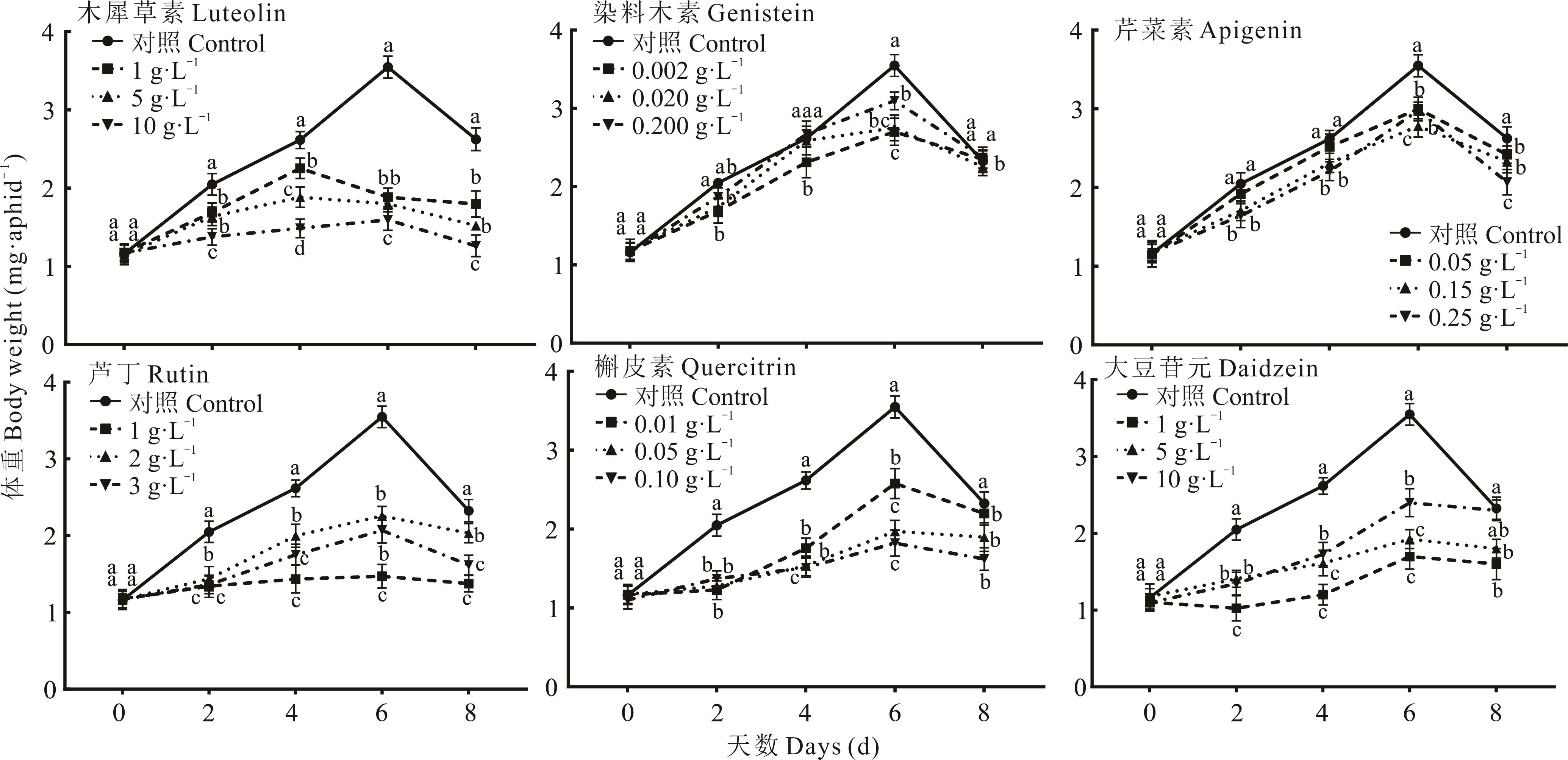
图1 取食不同浓度黄酮类化合物处理的蚕豆叶片后豌豆蚜体重的变化图中数据均为平均值±标准误。不同小写字母表示同一时间各浓度处理间存在显著差异(P<0.05),下同。Data in the Figure are presented as mean±standard error (SE). Different lowercase letters indicate significant differences among the different concentration treatments at the same time (P<0.05). The same below.
Fig.1 Body weight changes of A. pisum after feeding on V. faba leaves treated with different concentrations of flavonoids
| 参数Parameters | 来源Source | 木犀草素Luteolin | 染料木素Genistein | 芹菜素Apigenin | 芦丁Rutin | 槲皮素Quercitrin | 大豆苷元Daidzein | ||||||||||||
|---|---|---|---|---|---|---|---|---|---|---|---|---|---|---|---|---|---|---|---|
| df | F | P | df | F | P | df | F | P | df | F | P | df | F | P | df | F | P | ||
| 体重Body weight | C | 4 | 50.34 | <0.0001 | 4 | 615.20 | <0.0001 | 4 | 684.50 | <0.0001 | 4 | 254.40 | <0.0001 | 4 | 337.30 | <0.0001 | 4 | 274.20 | <0.0001 |
| T | 3 | 255.40 | <0.0001 | 3 | 26.97 | <0.0001 | 3 | 50.28 | <0.0001 | 3 | 289.80 | <0.0001 | 3 | 241.70 | <0.0001 | 3 | 269.20 | <0.0001 | |
| C×T | 12 | 380.60 | <0.0001 | 12 | 9.26 | <0.0001 | 12 | 7.05 | <0.0001 | 12 | 35.83 | <0.0001 | 12 | 32.07 | <0.0001 | 12 | 30.77 | <0.0001 | |
| Error | 100 | 100 | 100 | 100 | 100 | 100 | |||||||||||||
| 死亡率Mortality | C | 3 | 310.90 | <0.0001 | 3 | 169.40 | <0.0001 | 3 | 252.40 | <0.0001 | 3 | 158.90 | <0.0001 | 3 | 158.90 | <0.0001 | 3 | 156.10 | <0.0001 |
| T | 3 | 68.82 | <0.0001 | 3 | 24.02 | <0.0001 | 3 | 84.64 | <0.0001 | 3 | 109.30 | <0.0001 | 3 | 109.30 | <0.0001 | 3 | 136.10 | <0.0001 | |
| C×T | 9 | 27.46 | <0.0001 | 9 | 8.69 | <0.0001 | 9 | 17.78 | <0.0001 | 9 | 8.42 | <0.0001 | 9 | 8.42 | <0.0001 | 9 | 9.49 | <0.0001 | |
| Error | 64 | 64 | 64 | 64 | 64 | 64 | |||||||||||||
单雌产蚜量 Average fecundity per aphid | C | 3 | 378.80 | <0.0001 | 3 | 362.30 | <0.0001 | 3 | 289.20 | <0.0001 | 3 | 239.50 | <0.0001 | 3 | 166.90 | <0.0001 | 3 | 247.00 | <0.0001 |
| T | 3 | 182.50 | <0.0001 | 3 | 82.70 | <0.0001 | 3 | 80.45 | <0.0001 | 3 | 144.00 | <0.0001 | 3 | 190.90 | <0.0001 | 3 | 353.70 | <0.0001 | |
| C×T | 9 | 58.28 | <0.0001 | 9 | 25.61 | <0.0001 | 9 | 27.15 | <0.0001 | 9 | 44.63 | <0.0001 | 9 | 60.31 | <0.0001 | 9 | 113.60 | <0.0001 | |
| Error | 64 | 64 | 64 | 64 | 64 | 64 | |||||||||||||
谷胱甘肽S-转移酶活性 GSTs activity | C | 1 | 0.11 | 0.7526 | 1 | 15.14 | 0.0013 | 1 | 5.30 | 0.0350 | 1 | 21.58 | 0.0003 | 1 | 15.70 | 0.0011 | 1 | 0.39 | 0.5422 |
| T | 3 | 29.77 | <0.0001 | 3 | 213.80 | <0.0001 | 3 | 16.35 | <0.0001 | 3 | 16.09 | <0.0001 | 3 | 7.86 | 0.0019 | 3 | 11.36 | 0.0003 | |
| C×T | 3 | 2.53 | 0.0937 | 3 | 19.14 | <0.0001 | 3 | 13.66 | 0.0001 | 3 | 1.01 | 0.4176 | 3 | 0.94 | 0.4449 | 3 | 8.79 | 0.0011 | |
| Error | 16 | 16 | 16 | 16 | 16 | 16 | |||||||||||||
羧酸酯酶活性 CarE activity | C | 1 | 15.89 | 0.0011 | 1 | 35.44 | <0.0001 | 1 | 6.45 | 0.0219 | 1 | 102.80 | <0.0001 | 1 | 186.50 | <0.0001 | 1 | 67.21 | <0.0001 |
| T | 3 | 21.75 | <0.0001 | 3 | 39.04 | <0.0001 | 3 | 20.92 | <0.0001 | 3 | 39.71 | <0.0001 | 3 | 13.96 | <0.0001 | 3 | 36.16 | <0.0001 | |
| C×T | 3 | 35.52 | <0.0001 | 3 | 23.84 | <0.0001 | 3 | 30.60 | <0.0001 | 3 | 8.92 | 0.0011 | 3 | 3.96 | 0.0274 | 3 | 11.97 | 0.0002 | |
| Error | 16 | 16 | 16 | 16 | 16 | 16 | |||||||||||||
细胞色素P450酶活性 CYP450 activity | C | 1 | 21.32 | 0.0275 | 1 | 46.31 | <0.0001 | 1 | 64.18 | <0.0001 | 1 | 36.32 | <0.0001 | 1 | 109.50 | <0.0001 | 1 | 5.61 | 0.0308 |
| T | 3 | 47.63 | <0.0001 | 3 | 25.96 | <0.0001 | 3 | 10.33 | 0.0005 | 3 | 33.61 | <0.0001 | 3 | 18.12 | <0.0001 | 3 | 8.05 | 0.0017 | |
| C×T | 3 | 24.57 | <0.0001 | 3 | 4.16 | 0.0234 | 3 | 53.13 | <0.0001 | 3 | 4.64 | 0.0161 | 3 | 2.23 | 0.1241 | 3 | 22.15 | <0.0001 | |
| Error | 16 | 16 | 16 | 16 | 16 | 16 | |||||||||||||
UDP-葡萄糖醛酸转移酶活性 UGTs activity | C | 1 | 51.73 | <0.0001 | 1 | 281.50 | <0.0001 | 1 | 6.68 | 0.0200 | 1 | 118.20 | <0.0001 | 1 | 290.80 | <0.0001 | 1 | 159.90 | <0.0001 |
| T | 3 | 6.69 | 0.0039 | 3 | 6.88 | 0.0034 | 3 | 13.87 | 0.0001 | 3 | 46.07 | <0.0001 | 3 | 16.43 | <0.0001 | 3 | 27.86 | <0.0001 | |
| C×T | 3 | 18.19 | <0.0001 | 3 | 0.73 | 0.5464 | 3 | 25.06 | <0.0001 | 3 | 12.90 | 0.0002 | 3 | 2.70 | 0.0806 | 3 | 5.43 | 0.0091 | |
| Error | 16 | 16 | 16 | 16 | 16 | 16 | |||||||||||||
表2 化合物浓度和处理时间对豌豆蚜生物学指标及解毒酶活性的交互效应
Table 2 Interactive effects of compound concentration and treatment time on the biological parameters and detoxification enzyme activity in A. pisum
| 参数Parameters | 来源Source | 木犀草素Luteolin | 染料木素Genistein | 芹菜素Apigenin | 芦丁Rutin | 槲皮素Quercitrin | 大豆苷元Daidzein | ||||||||||||
|---|---|---|---|---|---|---|---|---|---|---|---|---|---|---|---|---|---|---|---|
| df | F | P | df | F | P | df | F | P | df | F | P | df | F | P | df | F | P | ||
| 体重Body weight | C | 4 | 50.34 | <0.0001 | 4 | 615.20 | <0.0001 | 4 | 684.50 | <0.0001 | 4 | 254.40 | <0.0001 | 4 | 337.30 | <0.0001 | 4 | 274.20 | <0.0001 |
| T | 3 | 255.40 | <0.0001 | 3 | 26.97 | <0.0001 | 3 | 50.28 | <0.0001 | 3 | 289.80 | <0.0001 | 3 | 241.70 | <0.0001 | 3 | 269.20 | <0.0001 | |
| C×T | 12 | 380.60 | <0.0001 | 12 | 9.26 | <0.0001 | 12 | 7.05 | <0.0001 | 12 | 35.83 | <0.0001 | 12 | 32.07 | <0.0001 | 12 | 30.77 | <0.0001 | |
| Error | 100 | 100 | 100 | 100 | 100 | 100 | |||||||||||||
| 死亡率Mortality | C | 3 | 310.90 | <0.0001 | 3 | 169.40 | <0.0001 | 3 | 252.40 | <0.0001 | 3 | 158.90 | <0.0001 | 3 | 158.90 | <0.0001 | 3 | 156.10 | <0.0001 |
| T | 3 | 68.82 | <0.0001 | 3 | 24.02 | <0.0001 | 3 | 84.64 | <0.0001 | 3 | 109.30 | <0.0001 | 3 | 109.30 | <0.0001 | 3 | 136.10 | <0.0001 | |
| C×T | 9 | 27.46 | <0.0001 | 9 | 8.69 | <0.0001 | 9 | 17.78 | <0.0001 | 9 | 8.42 | <0.0001 | 9 | 8.42 | <0.0001 | 9 | 9.49 | <0.0001 | |
| Error | 64 | 64 | 64 | 64 | 64 | 64 | |||||||||||||
单雌产蚜量 Average fecundity per aphid | C | 3 | 378.80 | <0.0001 | 3 | 362.30 | <0.0001 | 3 | 289.20 | <0.0001 | 3 | 239.50 | <0.0001 | 3 | 166.90 | <0.0001 | 3 | 247.00 | <0.0001 |
| T | 3 | 182.50 | <0.0001 | 3 | 82.70 | <0.0001 | 3 | 80.45 | <0.0001 | 3 | 144.00 | <0.0001 | 3 | 190.90 | <0.0001 | 3 | 353.70 | <0.0001 | |
| C×T | 9 | 58.28 | <0.0001 | 9 | 25.61 | <0.0001 | 9 | 27.15 | <0.0001 | 9 | 44.63 | <0.0001 | 9 | 60.31 | <0.0001 | 9 | 113.60 | <0.0001 | |
| Error | 64 | 64 | 64 | 64 | 64 | 64 | |||||||||||||
谷胱甘肽S-转移酶活性 GSTs activity | C | 1 | 0.11 | 0.7526 | 1 | 15.14 | 0.0013 | 1 | 5.30 | 0.0350 | 1 | 21.58 | 0.0003 | 1 | 15.70 | 0.0011 | 1 | 0.39 | 0.5422 |
| T | 3 | 29.77 | <0.0001 | 3 | 213.80 | <0.0001 | 3 | 16.35 | <0.0001 | 3 | 16.09 | <0.0001 | 3 | 7.86 | 0.0019 | 3 | 11.36 | 0.0003 | |
| C×T | 3 | 2.53 | 0.0937 | 3 | 19.14 | <0.0001 | 3 | 13.66 | 0.0001 | 3 | 1.01 | 0.4176 | 3 | 0.94 | 0.4449 | 3 | 8.79 | 0.0011 | |
| Error | 16 | 16 | 16 | 16 | 16 | 16 | |||||||||||||
羧酸酯酶活性 CarE activity | C | 1 | 15.89 | 0.0011 | 1 | 35.44 | <0.0001 | 1 | 6.45 | 0.0219 | 1 | 102.80 | <0.0001 | 1 | 186.50 | <0.0001 | 1 | 67.21 | <0.0001 |
| T | 3 | 21.75 | <0.0001 | 3 | 39.04 | <0.0001 | 3 | 20.92 | <0.0001 | 3 | 39.71 | <0.0001 | 3 | 13.96 | <0.0001 | 3 | 36.16 | <0.0001 | |
| C×T | 3 | 35.52 | <0.0001 | 3 | 23.84 | <0.0001 | 3 | 30.60 | <0.0001 | 3 | 8.92 | 0.0011 | 3 | 3.96 | 0.0274 | 3 | 11.97 | 0.0002 | |
| Error | 16 | 16 | 16 | 16 | 16 | 16 | |||||||||||||
细胞色素P450酶活性 CYP450 activity | C | 1 | 21.32 | 0.0275 | 1 | 46.31 | <0.0001 | 1 | 64.18 | <0.0001 | 1 | 36.32 | <0.0001 | 1 | 109.50 | <0.0001 | 1 | 5.61 | 0.0308 |
| T | 3 | 47.63 | <0.0001 | 3 | 25.96 | <0.0001 | 3 | 10.33 | 0.0005 | 3 | 33.61 | <0.0001 | 3 | 18.12 | <0.0001 | 3 | 8.05 | 0.0017 | |
| C×T | 3 | 24.57 | <0.0001 | 3 | 4.16 | 0.0234 | 3 | 53.13 | <0.0001 | 3 | 4.64 | 0.0161 | 3 | 2.23 | 0.1241 | 3 | 22.15 | <0.0001 | |
| Error | 16 | 16 | 16 | 16 | 16 | 16 | |||||||||||||
UDP-葡萄糖醛酸转移酶活性 UGTs activity | C | 1 | 51.73 | <0.0001 | 1 | 281.50 | <0.0001 | 1 | 6.68 | 0.0200 | 1 | 118.20 | <0.0001 | 1 | 290.80 | <0.0001 | 1 | 159.90 | <0.0001 |
| T | 3 | 6.69 | 0.0039 | 3 | 6.88 | 0.0034 | 3 | 13.87 | 0.0001 | 3 | 46.07 | <0.0001 | 3 | 16.43 | <0.0001 | 3 | 27.86 | <0.0001 | |
| C×T | 3 | 18.19 | <0.0001 | 3 | 0.73 | 0.5464 | 3 | 25.06 | <0.0001 | 3 | 12.90 | 0.0002 | 3 | 2.70 | 0.0806 | 3 | 5.43 | 0.0091 | |
| Error | 16 | 16 | 16 | 16 | 16 | 16 | |||||||||||||
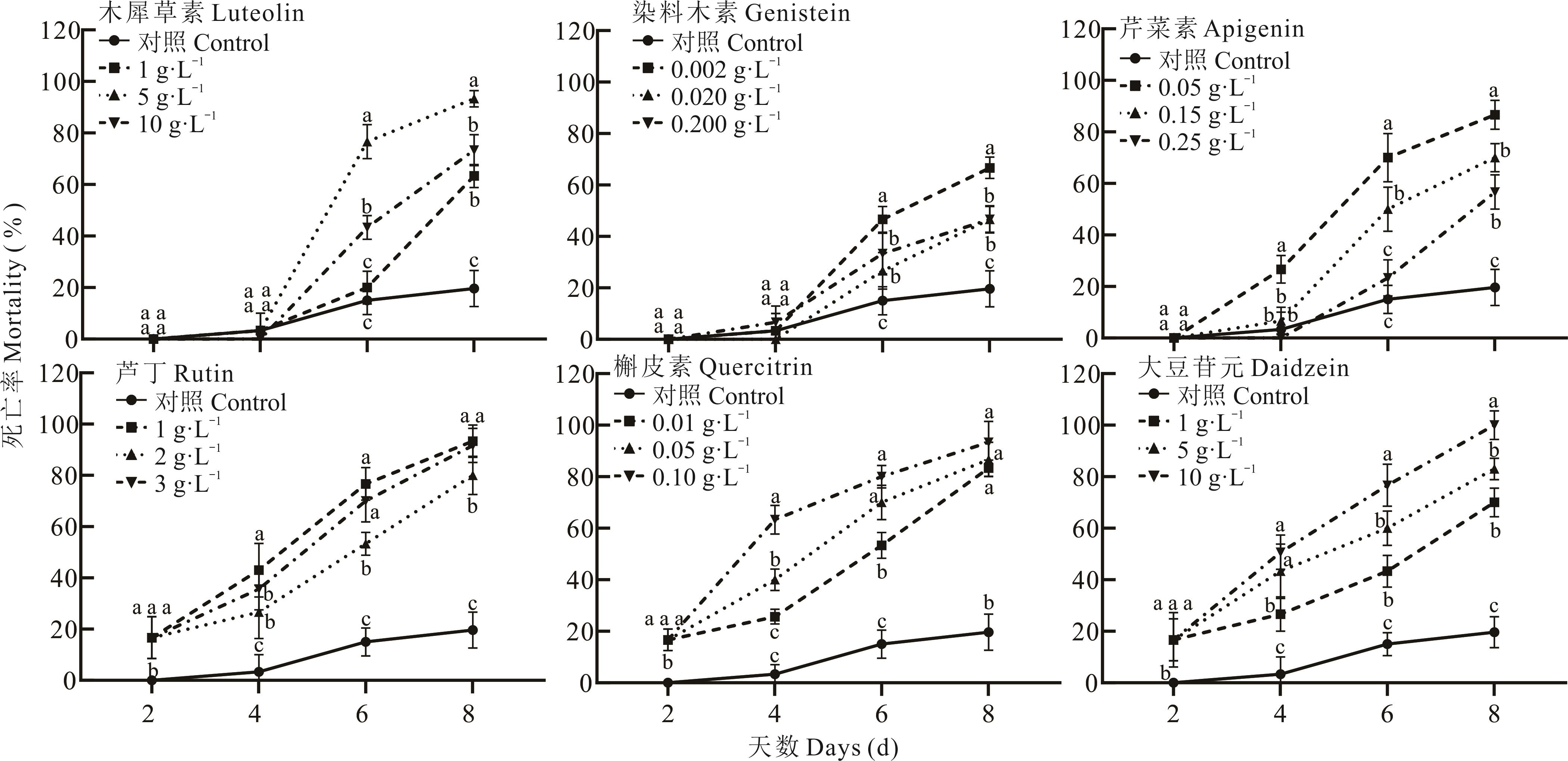
图2 豌豆蚜取食不同浓度黄酮类化合物处理的蚕豆叶片后的死亡率
Fig.2 The mortality of A. pisum after feeding on V. faba leaves treated with different concentrations of flavonoids
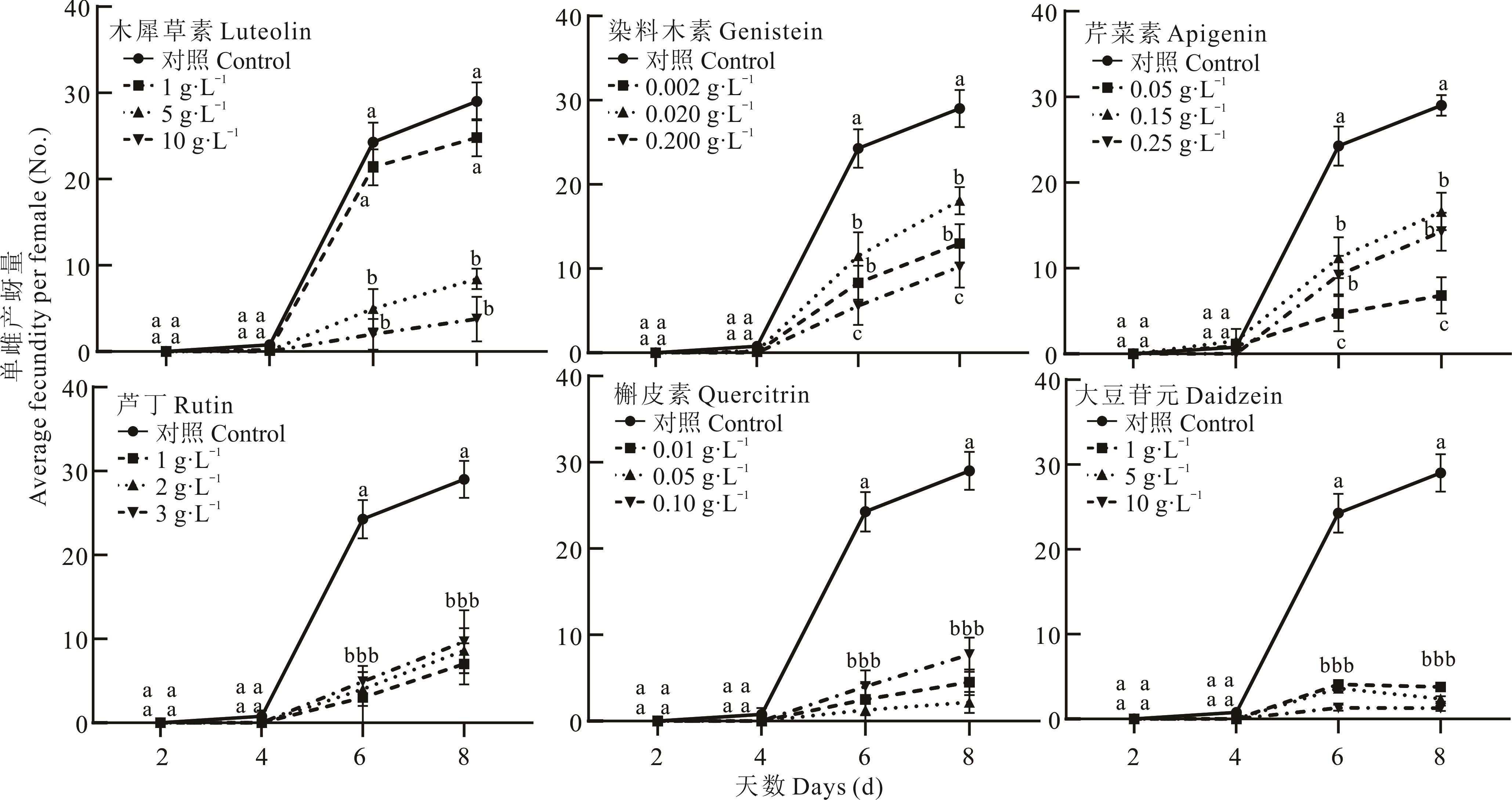
图3 豌豆蚜取食不同浓度黄酮类化合物处理的蚕豆叶片后的繁殖情况
Fig.3 The average fecundity per female of A. pisum after feeding on V. faba leaves treated with different concentrations of flavonoids

图4 豌豆蚜取食不同浓度黄酮类化合物处理的蚕豆叶片后体内谷胱甘肽S-转移酶活性的变化
Fig.4 The changes in the activity of glutathione S-transferase(GST)of A. pisum after feeding on V. faba leaves treated with different concentrations of flavonoids

图5 豌豆蚜取食不同浓度黄酮类化合物处理的蚕豆叶片后体内羧酸酯酶活性的变化
Fig.5 The changes in carboxylesterase(CarE)activity of A. pisum after feeding on V. faba leaves treated with different concentrations of flavonoids

图6 豌豆蚜取食不同浓度黄酮类化合物处理的蚕豆叶片后体内细胞色素P450酶活性的变化
Fig.6 The changes in the activity of cytochrome P450 enzymes (CYP450) of A. pisum after feeding on V. faba leaves treated with different concentrations of flavonoids

图7 豌豆蚜取食不同浓度黄酮类化合物处理的蚕豆叶片后体内UDP-葡萄糖醛酸转移酶活性的变化
Fig.7 The changes in UDP-glucuronosyl transferase(UGT)activity of A. pisum after feeding on V. faba leaves treated with different concentrations of flavonoid
| [1] | Tesfaye A, Wale M, Azerefegne F. Acyrthosiphon pisum (Harris) (Homoptera: Aphididae) feeding preference and performance on cool-season food legumes in northwestern Ethiopia. International Journal of Pest Management, 2013, 59(4): 319-328. |
| [2] | Bhandari K B, Rusch H L, Heuschele D J. Alfalfa stem cell wall digestibility: current knowledge and future research directions. Agronomy, 2023, 13(12): 2875. |
| [3] | Brault V, Uzest M, Monsion B, et al. Aphids as transport devices for plant viruses. Comptes Rendus Biologies, 2010, 333(6/7): 524-538. |
| [4] | Ma Y L, Liu C Z. Review on ecological characteristics and control of aphids. Pratacultural Science, 2014, 31(3): 519-525. |
| 马亚玲, 刘长仲. 蚜虫的生态学特性及其防治. 草业科学, 2014, 31(3): 519-525. | |
| [5] | Sandhi R K, Reddy G V P. Biology, ecology, and management strategies for pea aphid (Hemiptera: Aphididae) in pulse crops. Journal of Integrated Pest Management, 2020, 11(1): 18. |
| [6] | Pan F, Zhu K H, Tu X B, et al. Effects of plant secondary metabolite DIMBOA on Therioaphis trifolii Monel (Homptera: Aphididae). Chinese Journal of Biological Control, 2023, 39(5): 1143-1147. |
| 潘凡, 朱凯辉, 涂雄兵, 等. 植物次生代谢物丁布对苜蓿斑蚜的控制作用. 中国生物防治学报, 2023, 39(5): 1143-1147. | |
| [7] | Shi B M, Liu Y, Bai G D, et al. Research progress on toxicity of pesticide residues in feed to animals and its elimination technology. Chinese Journal of Animal Nutrition, 2020, 32(10): 4785-4792. |
| 石宝明, 刘洋, 白广栋, 等. 饲料中农药残留对动物的毒性作用及其消除技术研究进展. 动物营养学报, 2020, 32(10): 4785-4792. | |
| [8] | Tamborindeguy C, Monsion B, Brault V, et al. A genomic analysis of transcytosis in the pea aphid, Acyrthosiphon pisum, a mechanism involved in virus transmission. Insect Molecular Biology, 2010, 19(2): 259-272. |
| [9] | Ollivier M, Legeai F, Rispe C. Comparative analysis of the Acyrthosiphon pisum genome and expressed sequence tag-based gene sets from other aphid species. Insect Molecular Biology, 2010, 19(2): 33-45. |
| [10] | Woźniak A, Bednarski W, Dancewicz K, et al. Oxidative stress links response to lead and Acyrthosiphon pisum in Pisum sativum L. Journal of Plant Physiology, 2019, 240: 152996. |
| [11] | Goławska S, Łukasik I. Antifeedant activity of luteolin and genistein against the pea aphid, Acyrthosiphon pisum. Journal of Pest Science, 2012, 85(4): 443-450. |
| [12] | Zhang Q, Wang Q Q, Wyckhuys K A G, et al. Flavonoids mediate systemic defenses induced by root feeding in cotton. Entomologia Generalis, 2024, 44(3): 591. |
| [13] | Hu R, Ma Y Z, Liu S S, et al. Effects of Sapindus saponin on the growth, development and reproduction of Spodoptera exigua and analysis of its chemical composition. Plant Protection, 2023, 49(2): 201-205, 226. |
| 胡榕, 马英姿, 刘思思, 等. 无患子皂苷对甜菜夜蛾的影响及其化学成分分析. 植物保护, 2023, 49(2): 201-205, 226. | |
| [14] | Aboshi T, Ishiguri S, Shiono Y, et al. Flavonoid glycosides in Malabar spinach Basella alba inhibit the growth of Spodoptera litura larvae. Bioscience, Biotechnology, and Biochemistry, 2018, 82(1): 9-14. |
| [15] | Peng B, Cui X N, Zhang B, et al. Toxicity of 10 insecticides to alfalfa aphid Therioaphis trifolii and thrip Odontothrips loti and assessment of their field efficacy. Acta Prataculturae Sinica, 2024, 33(12): 201-213. |
| 彭斌, 崔晓宁, 张勃, 等. 10种杀虫剂对苜蓿斑蚜和牛角花齿蓟马的毒力测定及田间药效评价. 草业学报, 2024, 33(12): 201-213. | |
| [16] | Brown D E, Rashotte A M, Murphy A S, et al. Flavonoids act as negative regulators of auxin transport in vivo in Arabidopsis. Plant Physiology, 2001, 126(2): 524-535. |
| [17] | Mithöfer A, Boland W. Plant defense against herbivores: chemical aspects. Annual Review of Plant Biology, 2012, 63(1): 431-450. |
| [18] | Gautam H, Sharma A, Trivedi P K. The role of flavonols in insect resistance and stress response. Current Opinion in Plant Biology, 2023, 73: 102353. |
| [19] | Zhang Y, Wang X H, Bian Z P, et al. Application of flavonoid compounds suppresses the cotton aphid, Aphis gossypii. Frontiers in Plant Science, 2025, 16: 1545499. |
| [20] | Zhang Z, Cui B, Yan S, et al. Evaluation of tricin, a stylet probing stimulant of brown planthopper, in infested and non-infested rice plants. Journal of Applied Entomology, 2017, 141(5): 393-401. |
| [21] | Zhang Z F, Cui B Y, Zhang Y. Electrical penetration graphs indicate that tricin is a key secondary metabolite of rice, inhibiting phloem feeding of brown planthopper, Nilaparvata lugens. Entomologia Experimentalis et Applicata, 2015, 156(1): 14-27. |
| [22] | Romanelli G P, Virla E G, Duchowicz P R, et al. Sustainable synthesis of flavonoid derivatives, QSAR study and insecticidal activity against the fall armyworm, Spodoptera frugiperda (Lep.: Noctuidae). Journal of Agricultural and Food Chemistry, 2010, 58(10): 6290-6295. |
| [23] | Shi Y, Liu Q Q, Lu W J, et al. Divergent amplifications of CYP9A cytochrome P450 genes provide two noctuid pests with differential protection against xenobiotics. Proceedings of the National Academy of Sciences, 2023, 120(37): e2308685120. |
| [24] | Diaz N G N, Palacios S M. Bioinsecticidal effect of the flavonoids pinocembrin and quercetin against Spodoptera frugiperda. Journal of Pest Science, 2015, 88(3): 629-635. |
| [25] | Bentivenha J P F, Canassa V F, Baldin E L L, et al. Role of the rutin and genistein flavonoids in soybean resistance to Piezodorus guildinii (Hemiptera: Pentatomidae). Arthropod-Plant Interactions, 2018, 12(2): 311-320. |
| [26] | Goławska S, Łukasik I, Czerniewicz P. Genistein and naringenin as defense molecules. Molecules, 2024, 29(23): 5505. |
| [27] | Fiteni E, Durand K, Gimenez S, et al. Host-plant adaptation as a driver of incipient speciation in the fall armyworm (Spodoptera frugiperda). BMC Ecology and Evolution, 2022, 22(1): 133. |
| [28] | Després L, David J P, Gallet C. The evolutionary ecology of insect resistance to plant chemicals. Trends in Ecology & Evolution, 2007, 22(6): 298-307. |
| [29] | Kazana E, Pope T W, Tibbles L, et al. The cabbage aphid: a walking mustard oil bomb. Proceedings of the Royal Society B: Biological Sciences, 2007, 274(1623): 2271-2277. |
| [30] | Kansman J, Nalam V, Nachappa P, et al. Plant water stress intensity mediates aphid host choice and feeding behaviour. Ecological Entomology, 2020, 45(6): 1437-1444. |
| [31] | Kant M R, Jonckheere W, Knegt B, et al. Mechanisms and ecological consequences of plant defence induction and suppression in herbivore communities. Annals of Botany, 2015, 115(7): 1015-1051. |
| [32] | Li S Y, Li H, Guo J Y, et al. Role of cytochrome P450 in the adaptation of Pagiophloeus tsushimanus (Coleoptera: Curculionidae) to the stress of terpenoids from its host. Acta Entomologica Sinica, 2025, 68(11): 1534-1546. |
| 李寿银, 李慧, 郭金燕, 等. 细胞色素P450在香樟齿喙象适应寄主萜类化合物胁迫中的作用. 昆虫学报, 2025, 68(11): 1534-1546. | |
| [33] | Wang H D, Shi Y, Wang L, et al. CYP6AE gene cluster knockout in Helicoverpa armigera reveals role in detoxification of phytochemicals and insecticides. Nature Communications, 2018, 9(1): 4820. |
| [34] | Shi Y, Qu Q, Wang C Y, et al. Involvement of CYP2 and mitochondrial clan P450s of Helicoverpa armigera in xenobiotic metabolism. Insect Biochemistry and Molecular Biology, 2022, 140: 103696. |
| [35] | Wang R L, He Y N, Staehelin C, et al. Identification of two cytochrome monooxygenase P450 genes, CYP321A7 and CYP321A9, from the tobacco cutworm moth (Spodoptera litura) and their expression in response to plant allelochemicals. International Journal of Molecular Sciences, 2017, 18(11): 2278. |
| [36] | Zhao P, Xue H, Zhu X Z, et al. Silencing of cytochrome P450 gene CYP321A1 effects tannin detoxification and metabolism in Spodoptera litura. International Journal of Biological Macromolecules, 2022, 194: 895-902. |
| [37] | Xiao T X, Wang W X, Deng M Q, et al. CYP321A subfamily P450s contribute to the detoxification of phytochemicals and pyrethroids in Spodoptera litura. Journal of Agricultural and Food Chemistry, 2023, 71(41): 14989-15002. |
| [38] | Hafeez M, Liu S S, Jan S, et al. Knock-down of gossypol-inducing cytochrome P450 genes reduced deltamethrin sensitivity in Spodoptera exigua (Hübner). International Journal of Molecular Sciences, 2019, 20(9): 2248. |
| [39] | Chen J L, Ni H X, Sun J R, et al. Effects of major secondary chemicals of wheat plants on enzyme activity in Sitobion avenae. Acta Entomologica Sinica, 2003(2): 144-149. |
| 陈巨莲, 倪汉祥, 孙京瑞, 等. 小麦几种主要次生物质对麦长管蚜几种酶活力的影响. 昆虫学报, 2003(2): 144-149. | |
| [40] | Ruttanaphan T, Songoen W, Pluempanupat W, et al. Potential insecticidal extracts from Artocarpus lacucha against Spodoptera litura (Lepidoptera: Noctuidae) larvae. Journal of Economic Entomology, 2023, 116(4): 1205-1210. |
| [41] | Heidel-Fischer H M, Vogel H. Molecular mechanisms of insect adaptation to plant secondary compounds. Current Opinion in Insect Science, 2015, 8: 8-14. |
| [42] | Silva A X, Bacigalupe L D, Luna-Rudloff M, et al. Insecticide resistance mechanisms in the green peach aphid Myzus persicae (Hemiptera: Aphididae) Ⅱ: costs and benefits. PLoS One, 2012, 7(6): e36810. |
| [43] | Bass C, Puinean A M, Zimmer C T, et al. The evolution of insecticide resistance in the peach potato aphid, Myzus persicae. Insect Biochemistry and Molecular Biology, 2014, 51: 41-51. |
| [44] | Ye C, Jiang Y D, An X, et al. Effects of RNAi-based silencing of chitin synthase gene on moulting and fecundity in pea aphids (Acyrthosiphon pisum). Scientific Reports, 2019, 9(1): 3694. |
| [45] | Zhang K X. Response of Myzus persicae to salicylic acid-induced potato defense and its physiological mechanism. Lanzhou: Gansu Agricultural University, 2025. |
| 张克信. 桃蚜对水杨酸诱导马铃薯防御的响应及生理机制. 兰州: 甘肃农业大学, 2025. | |
| [46] | Liu Q, Gao H H, Zhai Y F, et al. Toxicities of six pesticides and their effects on detoxification enzymes in the adults of two Drosophila species in the laboratory. Journal of Plant Protection, 2018, 45(6): 1342-1348. |
| 刘倩, 高欢欢, 翟一凡, 等. 六种农药对两种果蝇成虫室内毒力和主要解毒酶活性的影响. 植物保护学报, 2018, 45(6): 1342-1348. | |
| [47] | Maag D, Erb M, Köllner T G, et al. Defensive weapons and defense signals in plants: Some metabolites serve both roles. BioEssays, 2015, 37(2): 167-174. |
| [48] | Divekar P A, Narayana S, Divekar B A, et al. Plant secondary metabolites as defense tools against herbivores for sustainable crop protection. International Journal of Molecular Sciences, 2022, 23(5): 2690. |
| [49] | Lai C L, Zhang J, Shentu X P, et al. Review of how secondary metabolites defend plants against herbivorous insects. Chinese Journal of Applied Entomology, 2022, 59(5): 969-978. |
| 赖城玲, 张珺, 申屠旭萍, 等. 植物次生代谢物对植食性昆虫防御作用的研究进展. 应用昆虫学报, 2022, 59(5): 969-978. | |
| [50] | Pereira V, Figueira O, Castilho P C. Flavonoids as insecticides in crop protection-A review of current research and future prospects. Plants, 2024, 13(6): 776. |
| [51] | Brattsten L B, Holyoke C W, Leeper J R, et al. Insecticide resistance: challenge to pest management and basic research. Science, 1986, 231(4743): 1255-1260. |
| [52] | Cui J R, Yao X J, Ni Z H, et al. Identification of salivary proteins in the rice leaf folder Cnaphalocrocis medinalis by transcriptome and LC-MS/MS analyses. Insect Biochemistry and Molecular Biology, 2024, 174: 104191. |
| [53] | Huber M, Roder T, Irmisch S, et al. A beta-glucosidase of an insect herbivore determines both toxicity and deterrence of a dandelion defense metabolite. eLife, 2021, 10: e68642. |
| [54] | Farhan M, Pan J L, Hussain H, et al. Aphid-resistant plant secondary metabolites: types, insecticidal mechanisms, and prospects for utilization. Plants, 2024, 13(16): 2332. |
| [55] | Wang W Q, Zheng Y Q, Chen B, et al. Effects of different host plants on the growth, development and fecundity of potato tuber moth Phthorimaea operculella based on the age-stage two-sex life table. Journal of Plant Protection, 2020, 47(3): 488-496. |
| 王文倩, 郑亚强, 陈斌, 等. 基于年龄-阶段两性生命表的不同寄主对马铃薯块茎蛾生长发育和繁殖力的影响. 植物保护学报, 2020, 47(3): 488-496. | |
| [56] | War A R, Paulraj M G, Hussain B, et al. Effect of plant secondary metabolites on legume pod borer, Helicoverpa armigera. Journal of Pest Science, 2013, 86(3): 399-408. |
| [57] | Ayyanath M M. Effect of sublethal concentrations of imidacloprid and precocene on green peach aphid, Myzus persicae (Sulzer) (Hemiptera: Aphididae): a study of hormesis at the gene, individual and population level. Ontario: The University of Guelph, 2013. |
| [58] | Goławska S, Łukasik I, Chojnacki A A. Luteolin and quercetin affect aphid feeding behavior. The European Zoological Journal, 2024, 91(1): 318-331. |
| [59] | Ma T, Yan H, Shi X L, et al. Comprehensive evaluation of effective constituents in total alkaloids from Sophora alopecuroides L. and their joint action against aphids by laboratory toxicity and field efficacy. Industrial Crops and Products, 2018, 111: 149-157. |
| [60] | Hao N, Zhang S A, Wang Y Y, et al. Obscuroside E: A novel alkaloid glycoside from Clematis obscura as an insecticide lead candidate against Acyrthosiphon pisum and Plutella xylostella. Journal of Agricultural and Food Chemistry, 2025, 73(20): 12184-12194. |
| [61] | Punia A, Chauhan N S. Effect of daidzein on growth, development and biochemical physiology of insect pest, Spodoptera litura (Fabricius). Comparative Biochemistry and Physiology Part C: Toxicology & Pharmacology, 2022, 262: 109465. |
| [62] | Hohenstein J D, Studham M E, Klein A, et al. Transcriptional and chemical changes in soybean leaves in response to long-term aphid colonization. Frontiers in Plant Science, 2019, 10: 310. |
| [63] | Kshatriya K, Gershenzon J. Disarming the defenses: Insect detoxification of plant defense-related specialized metabolites. Current Opinion in Plant Biology, 2024, 81: 102577. |
| [64] | Zhang Y D, Zhang X C, Tian Q H, et al. Toxicological and biochemical description of synergism of Beauveria bassiana and emamectin benzoate against Megalurothrips usitatus (Bagrall). Journal of Fungi, 2022, 8(9): 916. |
| [65] | Wang X X, Wang Y, Wang K Q, et al. Effects of sublethal concentrations of azadirachtin and celangulin on the activities of detoxification enzymes in Ostrinia furnacalis (Lepidoptera: Crambidae). Acta Entomologica Sinica, 2025, 68(9): 2-10. |
| 王晓曦, 王宇, 王克勤, 等. 亚致死浓度下印楝素和苦皮藤素对亚洲玉米螟解毒酶活性的影响. 昆虫学报, 2025, 68(9): 2-10. | |
| [66] | Giraudo M, Hilliou F, Fricaux T, et al. Cytochrome P450s from the fall armyworm (Spodoptera frugiperda): responses to plant allelochemicals and pesticides. Insect Molecular Biology, 2015, 24(1): 115-128. |
| [67] | Boušová I, Skálová L. Inhibition and induction of glutathione S-transferases by flavonoids: possible pharmacological and toxicological consequences. Drug Metabolism Reviews, 2012, 44(4): 267-286. |
| [68] | Lowry O, Rosebrough N J, Farr A L, et al. Protein measurement with the folin phenol reagent. Journal of Biological Chemistry, 1951, 193(1): 265-275. |
| [69] | Zhou X L, Song L W, Yang S Y, et al. Analysis of detoxification enzyme genes in the multiple pesticide-resistant strain of Tetranychus urticae. Scientia Agricultura Sinica, 2016, 49(9): 1696-1704. |
| 周兴隆, 宋丽雯, 杨顺义, 等. 二斑叶螨多重抗性品系解毒酶基因表达模式解析. 中国农业科学, 2016, 49(9): 1696-1704. |
| [1] | 刘昊臻, 赵士钦, 冯树蓉, 王成, 张景鈜, 孙守江. 豆科植物种子休眠的生理及分子机制研究进展[J]. 草业学报, 2026, 35(8): 207-220. |
| [2] | 马瑞, 吴宜亭, 李岩, 于展姿, 刘磊, 王森山. 豌豆蚜组织蛋白酶K基因(ApCtsk1)的鉴定及功能研究[J]. 草业学报, 2025, 34(2): 174-183. |
| [3] | 马亚玲, 刘辉, 刘阳, 李春杰. 两种色型豌豆蚜生物学特征对不同大豆品种的响应[J]. 草业学报, 2020, 29(3): 96-102. |
| [4] | 李应德, 丁婷婷, 段廷玉. AM真菌对紫花苜蓿应答蚜虫胁迫的影响[J]. 草业学报, 2020, 29(1): 155-162. |
| [5] | 占今舜, 邬彩霞, 刘明美, 苏效双, 詹康, 赵国琦. 饲粮添加苜蓿黄酮对奶牛瘤胃菌群的影响[J]. 草业学报, 2017, 26(7): 82-89. |
| [6] | 李润红, 刘长仲. 大气CO2浓度升高对绿色型豌豆蚜生长发育和繁殖的影响[J]. 草业学报, 2017, 26(3): 111-120. |
| [7] | 何树斌, 郭理想, 李菁, 王燚, 刘泽民, 程宇阳, 呼天明, 龙明秀. 丛枝菌根真菌与豆科植物共生体研究进展[J]. 草业学报, 2017, 26(1): 187-194. |
| [8] | 马建华, 魏淑花, 张洪英, 张蓉, 李克昌, 罗晓玲, 张宇. 宁夏主栽苜蓿品种(系)对豌豆蚜的抗性评价[J]. 草业学报, 2016, 25(6): 190-197. |
| [9] | 杜军利, 武德功, 吕宁, 刘长仲. 不同温度条件下两种色型豌豆蚜的种群参数[J]. 草业学报, 2015, 24(11): 91-99. |
| [10] | 丁效东, 张士荣, 刘阳超, 冯固. 真盐生植物梭梭和囊果碱蓬幼苗耐干旱能力的研究[J]. 草业学报, 2015, 24(11): 240-246. |
| [11] | 达丽婷, 朱亚灵, 宋丽雯, 胡桂馨, 王森山. 不同苜蓿品种对豌豆蚜中肠消化酶活性的影响[J]. 草业学报, 2015, 24(10): 80-87. |
| [12] | 王小强,刘长仲,邢亚田,石周. 吡虫啉、阿维菌素和高效氯氰菊酯亚致死剂量对绿色型豌豆蚜发育及繁殖的影响[J]. 草业学报, 2014, 23(5): 279-286. |
| [13] | 李强,周道玮,宋彦涛. 松嫩草地两种广布豆科植物分布特征及其与土壤因子关系[J]. 草业学报, 2014, 23(1): 31-40. |
| [14] | 金娟,梁金,贺春贵. 苜蓿品种对2种色型豌豆蚜的抗生性[J]. 草业学报, 2013, 22(6): 335-340. |
| 阅读次数 | ||||||
|
全文 |
|
|||||
|
摘要 |
|
|||||
