

ISSN 1004-5759 CN 62-1105/S
草业学报 ›› 2026, Vol. 35 ›› Issue (12): 139-149.DOI: 10.11686/cyxb2025497
• 研究论文 • 上一篇
陈妮1( ), 申洁1, 石多文2, 沈佳1, 翁秀秀1, 李万宏1()
收稿日期:2025-12-09
修回日期:2026-01-12
出版日期:2026-12-20
发布日期:2026-11-02
通讯作者:
李万宏
作者简介:E-mail: limh@lzu.edu.cn基金资助:
Ni CHEN1(), Jie SHEN1, Duo-wen SHI2, Jia SHEN1, Xiu-xiu WENG1, Wan-hong LI1()
Received:2025-12-09
Revised:2026-01-12
Online:2026-12-20
Published:2026-11-02
Contact:
Wan-hong LI
摘要:
本试验旨在探究日粮中添加亚麻籽油和葵花籽油对湖羊母羔生长性能、屠宰性能、脏器发育、瘤胃挥发性脂肪酸及血液参数的影响。选取3月龄、体重[(18.86±0.37) kg]且体况接近的健康湖羊母羔30只,随机分为3组,每组10只。对照组(CK)饲喂含4%过瘤胃棕榈酸脂肪粉日粮,试验组分别饲喂添加4%亚麻籽油(LO,富含n-3多不饱和脂肪酸,PUFA)或4%葵花籽油(SO,富含n-6 PUFA)替代棕榈酸脂肪粉的日粮。整个试验期为91 d,其中预试期7 d。结果表明:生长性能方面,LO组57~84 d阶段日增重(0.28 kg·d-1)及全期平均日增重(0.26 kg·d-1)均显著高于SO组(0.19、0.22 kg·d-1)和CK组(0.23、0.25 kg·d-1)(P<0.05),3组平均日采食量无显著差异(P>0.05)。体尺与屠宰性能上,3组间均无显著差异(P>0.05)。脏器发育方面,CK组脾重(0.06 kg)和脾脏指数(0.16%)均显著高于LO(0.05 kg、0.13%)和SO组(0.04 kg、0.13%)(P<0.05),LO组肺重(0.63 kg)显著高于CK组(0.56 kg)和SO组(0.54 kg)(P<0.05)。瘤胃发酵参数方面,LO组和SO组瘤胃液总挥发性脂肪酸(54.56、61.86 mmol·L-1)、丙酸(22.84%、25.19%)、丁酸(12.19%、10.72%)浓度均显著高于CK(39.42 mmol·L-1、21.31%、6.11%)(P<0.05),而乙酸/丙酸显著低于CK组(P<0.05)。各组间瘤胃形态学指标无显著差异(P>0.05)。血液参数方面,LO组血红蛋白(11.76 g·dL-1)和红细胞压积(31.06%)显著低于CK(12.58 g·dL-1、36.50%)和SO组(12.51 g·dL-1、35.34%)(P<0.05),但所有值均在正常生理范围内。综上所述,日粮中添加4%亚麻籽油与葵花籽油均可影响瘤胃发酵,且亚麻籽油在促进湖羊母羔生长方面效果更佳。
陈妮, 申洁, 石多文, 沈佳, 翁秀秀, 李万宏. 日粮添加不同油脂对羔羊屠宰性能、血液参数及瘤胃挥发性脂肪酸的影响[J]. 草业学报, 2026, 35(12): 139-149.
Ni CHEN, Jie SHEN, Duo-wen SHI, Jia SHEN, Xiu-xiu WENG, Wan-hong LI. The effects of dietary supplementation with different oils on growth rate, slaughter performance, blood parameters and rumen volatile fatty acid levels in female Hu lambs[J]. Acta Prataculturae Sinica, 2026, 35(12): 139-149.
项目 Item | 对照组 CK | 亚麻籽油组 LO | 葵花籽油组 SO |
|---|---|---|---|
| 原料Ingredient | |||
| 玉米秸秆Corn stover (%) | 24.0 | 24.0 | 24.0 |
| 玉米皮Corn bran (%) | 8.0 | 8.0 | 8.0 |
| 破碎玉米Crushed corn (%) | 26.0 | 26.0 | 26.0 |
| 豆粕Soybean meal (%) | 5.0 | 5.0 | 5.0 |
| 棉籽粕Cottonseed meal (%) | 6.0 | 6.0 | 6.0 |
| 玉米胚芽粕Corn germ meal (%) | 20.0 | 20.0 | 20.0 |
| 过瘤胃脂肪-棕榈酸RPPFA (%) | 4.0 | 0 | 0 |
| 葵花籽油Sunflower oil (%) | 0 | 0 | 4.0 |
| 亚麻籽油Linseed oil (%) | 0 | 4.0 | 0 |
| 膨化尿素Expanded urea (%) | 1.0 | 1.0 | 1.0 |
| 糖蜜Molasses (%) | 3.0 | 3.0 | 3.0 |
| 食盐NaCl (%) | 0.5 | 0.5 | 0.5 |
| 石粉Limestone (%) | 1.2 | 1.2 | 1.2 |
| 碳酸氢钠NaHCO3(%) | 0.8 | 0.8 | 0.8 |
| 1)预混料Premix | 0.5 | 0.5 | 0.5 |
| 合计Total | 100.0 | 100.0 | 100.0 |
| 营养水平Nutrient level | |||
| 干物质Dry matter (DM, %) | 92.26 | 90.92 | 91.45 |
| 粗蛋白Crude protein (CP, %) | 15.42 | 15.48 | 15.41 |
| 中性洗涤纤维NDF (%) | 31.43 | 32.76 | 32.10 |
| 酸性洗涤纤维ADF (%) | 15.60 | 14.14 | 14.13 |
| 2)代谢能ME (MJ·kg-1) | 12.57 | 12.64 | 12.57 |
表1 基础日粮组成及营养水平
Table 1 Composition and nutrient levels of the basal diet
项目 Item | 对照组 CK | 亚麻籽油组 LO | 葵花籽油组 SO |
|---|---|---|---|
| 原料Ingredient | |||
| 玉米秸秆Corn stover (%) | 24.0 | 24.0 | 24.0 |
| 玉米皮Corn bran (%) | 8.0 | 8.0 | 8.0 |
| 破碎玉米Crushed corn (%) | 26.0 | 26.0 | 26.0 |
| 豆粕Soybean meal (%) | 5.0 | 5.0 | 5.0 |
| 棉籽粕Cottonseed meal (%) | 6.0 | 6.0 | 6.0 |
| 玉米胚芽粕Corn germ meal (%) | 20.0 | 20.0 | 20.0 |
| 过瘤胃脂肪-棕榈酸RPPFA (%) | 4.0 | 0 | 0 |
| 葵花籽油Sunflower oil (%) | 0 | 0 | 4.0 |
| 亚麻籽油Linseed oil (%) | 0 | 4.0 | 0 |
| 膨化尿素Expanded urea (%) | 1.0 | 1.0 | 1.0 |
| 糖蜜Molasses (%) | 3.0 | 3.0 | 3.0 |
| 食盐NaCl (%) | 0.5 | 0.5 | 0.5 |
| 石粉Limestone (%) | 1.2 | 1.2 | 1.2 |
| 碳酸氢钠NaHCO3(%) | 0.8 | 0.8 | 0.8 |
| 1)预混料Premix | 0.5 | 0.5 | 0.5 |
| 合计Total | 100.0 | 100.0 | 100.0 |
| 营养水平Nutrient level | |||
| 干物质Dry matter (DM, %) | 92.26 | 90.92 | 91.45 |
| 粗蛋白Crude protein (CP, %) | 15.42 | 15.48 | 15.41 |
| 中性洗涤纤维NDF (%) | 31.43 | 32.76 | 32.10 |
| 酸性洗涤纤维ADF (%) | 15.60 | 14.14 | 14.13 |
| 2)代谢能ME (MJ·kg-1) | 12.57 | 12.64 | 12.57 |
项目 Item | 对照 CK | 亚麻籽油 LO | 葵花籽油 SO | 标准误 SEM | P值P-value | ||
|---|---|---|---|---|---|---|---|
| 处理Treatment (Tr) | 时间Time (T) | 处理×时间Tr×T | |||||
| 体重 | 0.799 | <0.001 | <0.001 | ||||
| 0 d | 19.28a | 19.34a | 19.75a | 0.40 | 0.894 | ||
| 28 d | 25.66a | 25.16a | 25.38a | 0.51 | 0.924 | ||
| 56 d | 33.88a | 33.79a | 32.71a | 0.66 | 0.760 | ||
| 84 d | 40.19a | 41.49a | 38.16a | 0.77 | 0.232 | ||
| 阶段日增重 | 0.015 | 0.021 | 0.010 | ||||
| 0~28 d | 0.23a | 0.21a | 0.20a | 0.01 | 0.301 | ||
| 29~56 d | 0.29a | 0.31a | 0.26a | 0.01 | 0.062 | ||
| 57~84 d | 0.23b | 0.28a | 0.19b | 0.01 | 0.001 | ||
| ADG (kg·d-1) | 0.25a | 0.26a | 0.22b | 0.01 | 0.015 | ||
| ADFI (kg·d-1) | 1.58a | 1.57a | 1.46a | 0.01 | - | ||
| F/G | 6.43a | 6.07a | 6.74a | 0.15 | - | ||
表2 日粮添加亚麻籽油和葵花籽油对母羔育肥性能的影响
Table 2 Effects of dietary supplementation with linseed oil and sunflower oil on growth performance of ewe lambs
项目 Item | 对照 CK | 亚麻籽油 LO | 葵花籽油 SO | 标准误 SEM | P值P-value | ||
|---|---|---|---|---|---|---|---|
| 处理Treatment (Tr) | 时间Time (T) | 处理×时间Tr×T | |||||
| 体重 | 0.799 | <0.001 | <0.001 | ||||
| 0 d | 19.28a | 19.34a | 19.75a | 0.40 | 0.894 | ||
| 28 d | 25.66a | 25.16a | 25.38a | 0.51 | 0.924 | ||
| 56 d | 33.88a | 33.79a | 32.71a | 0.66 | 0.760 | ||
| 84 d | 40.19a | 41.49a | 38.16a | 0.77 | 0.232 | ||
| 阶段日增重 | 0.015 | 0.021 | 0.010 | ||||
| 0~28 d | 0.23a | 0.21a | 0.20a | 0.01 | 0.301 | ||
| 29~56 d | 0.29a | 0.31a | 0.26a | 0.01 | 0.062 | ||
| 57~84 d | 0.23b | 0.28a | 0.19b | 0.01 | 0.001 | ||
| ADG (kg·d-1) | 0.25a | 0.26a | 0.22b | 0.01 | 0.015 | ||
| ADFI (kg·d-1) | 1.58a | 1.57a | 1.46a | 0.01 | - | ||
| F/G | 6.43a | 6.07a | 6.74a | 0.15 | - | ||
| 时间Time | 项目Item | 对照CK | 亚麻籽油LO | 葵花籽油SO | 标准误SEM | P值P-value |
|---|---|---|---|---|---|---|
| 0 d | 体高 | 58.30a | 57.55a | 58.50a | 0.51 | 0.734 |
| 体斜长 | 61.80a | 60.91a | 62.38a | 0.45 | 0.422 | |
| 胸围 | 65.90a | 66.09a | 67.00a | 0.50 | 0.676 | |
| 管围 | 7.00a | 7.00a | 7.19a | 0.07 | 0.522 | |
| 84 d | 体高 | 66.00a | 66.18a | 64.75a | 0.39 | 0.310 |
| 体斜长 | 72.20a | 72.64a | 72.00a | 0.50 | 0.874 | |
| 胸围 | 86.60a | 84.82a | 86.13a | 0.59 | 0.426 | |
| 管围Cannon circumference | 8.15a | 8.05a | 7.69a | 0.09 | 0.098 |
表3 日粮添加亚麻籽油和葵花籽油对母羔体尺指标的影响
Table 3 Effects of dietary supplementation with linseed oil and sunflower oil on body measurements of ewe lambs (cm)
| 时间Time | 项目Item | 对照CK | 亚麻籽油LO | 葵花籽油SO | 标准误SEM | P值P-value |
|---|---|---|---|---|---|---|
| 0 d | 体高 | 58.30a | 57.55a | 58.50a | 0.51 | 0.734 |
| 体斜长 | 61.80a | 60.91a | 62.38a | 0.45 | 0.422 | |
| 胸围 | 65.90a | 66.09a | 67.00a | 0.50 | 0.676 | |
| 管围 | 7.00a | 7.00a | 7.19a | 0.07 | 0.522 | |
| 84 d | 体高 | 66.00a | 66.18a | 64.75a | 0.39 | 0.310 |
| 体斜长 | 72.20a | 72.64a | 72.00a | 0.50 | 0.874 | |
| 胸围 | 86.60a | 84.82a | 86.13a | 0.59 | 0.426 | |
| 管围Cannon circumference | 8.15a | 8.05a | 7.69a | 0.09 | 0.098 |
| 项目Item | 对照CK | 亚麻籽油LO | 葵花籽油SO | 标准误SEM | P值P-value |
|---|---|---|---|---|---|
| 红细胞总数Red blood cell count (RBC, M·μL-1) | 14.76a | 14.11a | 15.17a | 0.22 | 0.136 |
| 血红蛋白Hemoglobin (HGB, g·dL?1) | 12.58a | 11.76b | 12.51a | 0.16 | 0.048 |
| 红细胞平均体积Mean corpuscular volume ( | 24.86a | 22.08b | 23.34ab | 2.56 | 0.039 |
| 红细胞压积Hematocrit ( | 36.50a | 31.06b | 35.34a | 0.71 | 0.001 |
| 平均血红蛋白量Mean corpuscular hemoglobin ( | 8.54a | 8.36a | 8.26a | 0.09 | 0.449 |
| 红细胞平均血红蛋白浓度 | 34.58b | 38.10a | 35.48b | 0.50 | 0.004 |
| 网织红细胞计数Reticulocyte count ( | 4.93a | 2.83b | 5.14a | 0.41 | 0.031 |
| 血小板计数Platelet count ( | 496.00a | 542.45a | 585.14a | 24.67 | 0.397 |
| 白细胞计数White blood cell count ( | 11.86a | 11.51a | 10.83a | 0.37 | 0.556 |
| 嗜中性粒细胞数Neutrophil count ( | 4.84a | 4.59a | 4.04a | 0.28 | 0.535 |
| 单核细胞数Monocyte count ( | 0.83a | 0.72a | 1.03a | 0.09 | 0.369 |
| 淋巴细胞数Lymphocyte count ( | 5.45a | 5.90a | 5.60a | 0.25 | 0.757 |
| 嗜碱性粒细胞数Basophil count ( | 0.08a | 0.09a | 0.08a | 0.01 | 0.949 |
| 嗜酸性粒细胞数Eosinophil count ( | 0.07a | 0.07a | 0.09a | 0.01 | 0.686 |
表4 日粮添加亚麻籽油和葵花籽油对母羊血常规指标的影响
Table 4 Effects of dietary supplementation with linseed oil and sunflower oil on hematological parameters in ewe lambs
| 项目Item | 对照CK | 亚麻籽油LO | 葵花籽油SO | 标准误SEM | P值P-value |
|---|---|---|---|---|---|
| 红细胞总数Red blood cell count (RBC, M·μL-1) | 14.76a | 14.11a | 15.17a | 0.22 | 0.136 |
| 血红蛋白Hemoglobin (HGB, g·dL?1) | 12.58a | 11.76b | 12.51a | 0.16 | 0.048 |
| 红细胞平均体积Mean corpuscular volume ( | 24.86a | 22.08b | 23.34ab | 2.56 | 0.039 |
| 红细胞压积Hematocrit ( | 36.50a | 31.06b | 35.34a | 0.71 | 0.001 |
| 平均血红蛋白量Mean corpuscular hemoglobin ( | 8.54a | 8.36a | 8.26a | 0.09 | 0.449 |
| 红细胞平均血红蛋白浓度 | 34.58b | 38.10a | 35.48b | 0.50 | 0.004 |
| 网织红细胞计数Reticulocyte count ( | 4.93a | 2.83b | 5.14a | 0.41 | 0.031 |
| 血小板计数Platelet count ( | 496.00a | 542.45a | 585.14a | 24.67 | 0.397 |
| 白细胞计数White blood cell count ( | 11.86a | 11.51a | 10.83a | 0.37 | 0.556 |
| 嗜中性粒细胞数Neutrophil count ( | 4.84a | 4.59a | 4.04a | 0.28 | 0.535 |
| 单核细胞数Monocyte count ( | 0.83a | 0.72a | 1.03a | 0.09 | 0.369 |
| 淋巴细胞数Lymphocyte count ( | 5.45a | 5.90a | 5.60a | 0.25 | 0.757 |
| 嗜碱性粒细胞数Basophil count ( | 0.08a | 0.09a | 0.08a | 0.01 | 0.949 |
| 嗜酸性粒细胞数Eosinophil count ( | 0.07a | 0.07a | 0.09a | 0.01 | 0.686 |
| 项目Item | 对照组CK | 亚麻籽油组LO | 葵花籽油组SO | 标准误SEM | P值P-value |
|---|---|---|---|---|---|
| 宰前活重 | 37.85a | 38.94a | 35.43a | 0.78 | 0.187 |
| 胴体重 | 20.84a | 21.45a | 19.56a | 0.49 | 0.283 |
| 屠宰率 | 55.03a | 54.97a | 55.12a | 0.29 | 0.978 |
| 胴体长 | 61.90a | 61.64a | 55.11a | 2.09 | 0.359 |
| 胴体胸围 | 71.20a | 70.91a | 70.11a | 0.52 | 0.707 |
| 臀周长 | 62.30a | 54.64a | 47.89a | 3.38 | 0.244 |
表5 日粮添加亚麻籽油和葵花籽油对母羊屠宰性能的影响
Table 5 Effects of dietary supplementation with linseed oil and sunflower oil on slaughter performance in ewe lambs
| 项目Item | 对照组CK | 亚麻籽油组LO | 葵花籽油组SO | 标准误SEM | P值P-value |
|---|---|---|---|---|---|
| 宰前活重 | 37.85a | 38.94a | 35.43a | 0.78 | 0.187 |
| 胴体重 | 20.84a | 21.45a | 19.56a | 0.49 | 0.283 |
| 屠宰率 | 55.03a | 54.97a | 55.12a | 0.29 | 0.978 |
| 胴体长 | 61.90a | 61.64a | 55.11a | 2.09 | 0.359 |
| 胴体胸围 | 71.20a | 70.91a | 70.11a | 0.52 | 0.707 |
| 臀周长 | 62.30a | 54.64a | 47.89a | 3.38 | 0.244 |
| 项目Item | 对照组CK | 亚麻籽油组LO | 葵花籽油组SO | 标准误SEM | P值P-value |
|---|---|---|---|---|---|
| 心重 | 0.16a | 0.17a | 0.16a | 0.004 | 0.427 |
| 心脏指数 | 0.43a | 0.43a | 0.44a | 0.010 | 0.901 |
| 肝重 | 0.74a | 0.81a | 0.74a | 0.020 | 0.278 |
| 肝脏指数 | 1.94a | 2.07a | 2.09a | 0.030 | 0.066 |
| 脾重 | 0.06a | 0.05b | 0.04b | 0.002 | 0.001 |
| 脾脏指数 | 0.16a | 0.13b | 0.13b | 0.010 | 0.027 |
| 肺重 | 0.56b | 0.63a | 0.54b | 0.014 | 0.013 |
| 肺脏指数 | 1.48a | 1.64a | 1.53a | 0.040 | 0.288 |
| 肾重 | 0.15a | 0.14a | 0.12a | 0.013 | 0.740 |
| 肾脏指数 | 0.39a | 0.35a | 0.35a | 0.030 | 0.834 |
| 0.53a | 0.62a | 0.46a | 0.052 | 0.437 | |
| 1.04a | 0.86a | 1.04a | 0.045 | 0.133 | |
| 尾脂重 | 0.71a | 0.70a | 0.65a | 0.043 | 0.872 |
| 脂肪总重 | 2.28a | 2.18a | 2.15a | 0.101 | 0.874 |
表6 日粮添加亚麻籽油和葵花籽油对母羊各器官及脂肪重量的影响
Table 6 Effects of dietary supplementation with linseed oil and sunflower oil on organ weights and adipose tissue deposition in ewes
| 项目Item | 对照组CK | 亚麻籽油组LO | 葵花籽油组SO | 标准误SEM | P值P-value |
|---|---|---|---|---|---|
| 心重 | 0.16a | 0.17a | 0.16a | 0.004 | 0.427 |
| 心脏指数 | 0.43a | 0.43a | 0.44a | 0.010 | 0.901 |
| 肝重 | 0.74a | 0.81a | 0.74a | 0.020 | 0.278 |
| 肝脏指数 | 1.94a | 2.07a | 2.09a | 0.030 | 0.066 |
| 脾重 | 0.06a | 0.05b | 0.04b | 0.002 | 0.001 |
| 脾脏指数 | 0.16a | 0.13b | 0.13b | 0.010 | 0.027 |
| 肺重 | 0.56b | 0.63a | 0.54b | 0.014 | 0.013 |
| 肺脏指数 | 1.48a | 1.64a | 1.53a | 0.040 | 0.288 |
| 肾重 | 0.15a | 0.14a | 0.12a | 0.013 | 0.740 |
| 肾脏指数 | 0.39a | 0.35a | 0.35a | 0.030 | 0.834 |
| 0.53a | 0.62a | 0.46a | 0.052 | 0.437 | |
| 1.04a | 0.86a | 1.04a | 0.045 | 0.133 | |
| 尾脂重 | 0.71a | 0.70a | 0.65a | 0.043 | 0.872 |
| 脂肪总重 | 2.28a | 2.18a | 2.15a | 0.101 | 0.874 |
| 项目Item | 对照CK | 亚麻籽油LO | 葵花籽油SO | P值P-value |
|---|---|---|---|---|
| 乳头高度 | 1584.38±106.17a | 1723.48±212.09a | 2146.03±346.26a | 0.25 |
| 乳头宽度 | 333.14±17.82a | 331.58±33.65a | 335.77±11.19a | 0.99 |
| 角质层厚度 | 25.12±2.85a | 33.21±3.33a | 29.40±4.92a | 0.41 |
| 肌层厚度 | 1283.29±109.43a | 1342.08±95.34a | 1317.77±114.87a | 0.93 |
| 黏膜下层厚度 | 253.68±20.84a | 330.12±32.99a | 282.86±28.78a | 0.21 |
表7 日粮添加亚麻籽油和葵花籽油对母羔瘤胃形态学的影响
Table 7 Effects of dietary supplementation with linseed oil and sunflower oil on rumen morphological development in ewe lambs (μm)
| 项目Item | 对照CK | 亚麻籽油LO | 葵花籽油SO | P值P-value |
|---|---|---|---|---|
| 乳头高度 | 1584.38±106.17a | 1723.48±212.09a | 2146.03±346.26a | 0.25 |
| 乳头宽度 | 333.14±17.82a | 331.58±33.65a | 335.77±11.19a | 0.99 |
| 角质层厚度 | 25.12±2.85a | 33.21±3.33a | 29.40±4.92a | 0.41 |
| 肌层厚度 | 1283.29±109.43a | 1342.08±95.34a | 1317.77±114.87a | 0.93 |
| 黏膜下层厚度 | 253.68±20.84a | 330.12±32.99a | 282.86±28.78a | 0.21 |
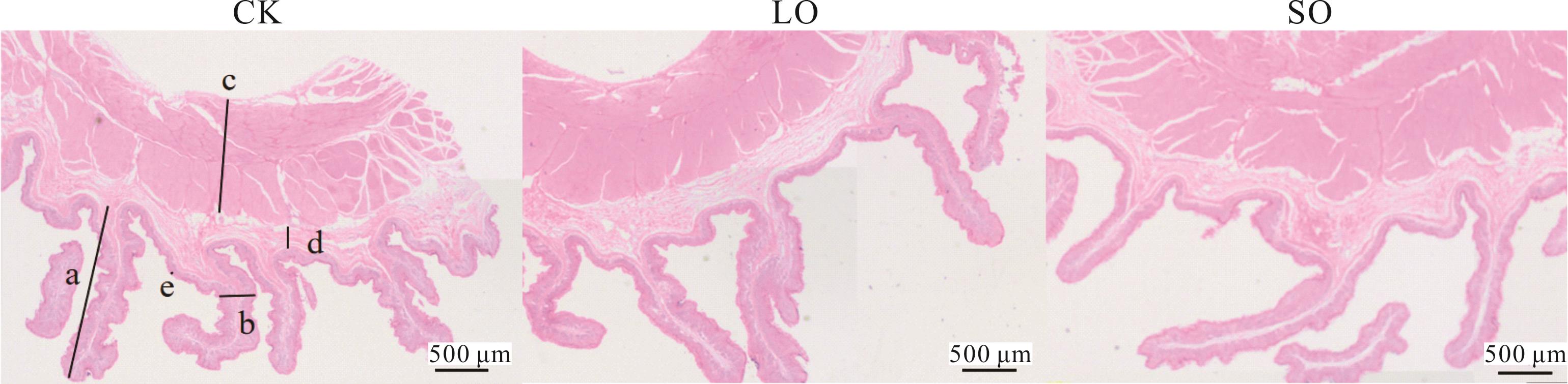
图1 日粮添加亚麻籽油和葵花籽油后的瘤胃组织切片a: 乳头高度Papillae height; b: 乳头宽度Papillae width; c: 肌层厚度Muscular layer thickness; d: 黏膜下层厚度Submucosa layer thickness; e: 角质层厚度Stratum corneum thickness.
Fig.1 Rumen histology after dietary supplementation with linseed oils and sunflower oils
| 项目Item | 对照CK | 亚麻籽油LO | 葵花籽油SO | P值P-value |
|---|---|---|---|---|
| 乙酸 | 65.93a | 56.62a | 55.63a | 0.201 |
| 丙酸 | 21.31b | 22.84a | 25.19a | 0.005 |
| 异丁酸Isobutyrate | 1.90b | 2.24a | 2.28a | 0.005 |
| 丁酸Butyrate | 6.11b | 12.19a | 10.72a | 0.002 |
| 异戊酸Isovalerate | 3.25b | 4.12a | 4.15a | 0.010 |
| 戊酸 Valerate | 1.50b | 1.98a | 2.05a | 0.003 |
| TVFA (mmol·L-1) | 39.42±7.93b | 54.56±12.38a | 61.86±7.69a | 0.026 |
| 乙酸/丙酸A∶P | 3.20±0.23a | 2.47±0.22b | 2.30±0.28b | <0.001 |
表8 日粮添加亚麻籽油和葵花籽油对母羔瘤胃挥发性脂肪酸的影响
Table 8 Effects of dietary supplementation with linseed oil and sunflower oil on volatile fatty acids (VFA) in the rumen of ewe lambs
| 项目Item | 对照CK | 亚麻籽油LO | 葵花籽油SO | P值P-value |
|---|---|---|---|---|
| 乙酸 | 65.93a | 56.62a | 55.63a | 0.201 |
| 丙酸 | 21.31b | 22.84a | 25.19a | 0.005 |
| 异丁酸Isobutyrate | 1.90b | 2.24a | 2.28a | 0.005 |
| 丁酸Butyrate | 6.11b | 12.19a | 10.72a | 0.002 |
| 异戊酸Isovalerate | 3.25b | 4.12a | 4.15a | 0.010 |
| 戊酸 Valerate | 1.50b | 1.98a | 2.05a | 0.003 |
| TVFA (mmol·L-1) | 39.42±7.93b | 54.56±12.38a | 61.86±7.69a | 0.026 |
| 乙酸/丙酸A∶P | 3.20±0.23a | 2.47±0.22b | 2.30±0.28b | <0.001 |
| [1] | Zhang K, Xu Y B, Yang Y X, et al. Gut microbiota-derived metabolites contribute negatively to hindgut barrier function development at the early weaning goat model. Animal Nutrition, 2022, 10(3): 111-123. |
| [2] | McCoard S A, Cristobal-Carballo O, Knol F W, et al. Impact of early weaning on small intestine, metabolic, immune and endocrine system development, growth and body composition in artificially reared lambs. Journal of Animal Science, 2020, 98(1): skz356. |
| [3] | Guo J P, Pan J Z, Li F D, et al. Effect of different early weaned day on morphological development of stomach for housed lambs. Acta Veterinaria et Zootechnica Sinica, 2018, 49(5): 971-985. |
| 郭江鹏, 潘建忠, 李发弟, 等. 不同早期断奶日龄对舍饲肉用羔羊胃组织形态发育变化的影响.畜牧兽医学报, 2018, 49(5): 971-985. | |
| [4] | Wang X, Liu J G, Ma Y J, et al. Effects of compound Chinese herbal medicine additives on slaughter performance, meat quality and rumen histomorphology of Hu sheep. China Herbivore Science, 2019, 39(3): 22-25. |
| 王霞, 刘建国, 马友记, 等. 复方中草药添加剂对湖羊屠宰性能、肉品质及瘤胃组织形态学的影响. 中国草食动物科学, 2019, 39(3): 22-25. | |
| [5] | Simionatto M, Maeda M E, Silveira D F M, et al. Effect of adding different levels of palm oil-protected fat in the diet of lambs concerning rumen parameters. Animal Feed Science and Technology, 2024, 310: 115929. |
| [6] | Gu S Q, Zhu X F. Effects of dietary oil supplementation on growth performance and nutrient digestibility of fattening goats. China Feed, 2022(10): 72-75. |
| 谷树乾, 朱雪峰. 饲料中添加油脂对育肥山羊生长性能和养分消化率的影响. 中国饲料, 2022(10): 72-75. | |
| [7] | Zhang M, Wang S X, Cheng C X, et al. Effects of different flaxseed level diets on growth performance, serum biochemical indexes, rumen fermentation parameters and rumen microbiota structure of house-fed yaks. Chinese Journal of Animal Nutrition, 2024, 36(11): 7081-7096. |
| 张曼, 王书祥, 程晨旭, 等. 不同亚麻籽水平饲粮对舍饲牦牛生长性能、血清生化指标、瘤胃发酵参数及瘤胃菌群结构的影响.动物营养学报, 2024, 36(11): 7081-7096. | |
| [8] | Wang X L, Shen X Z, Yang J H, et al. Effects of sunflower seed oil supplementation on rumen digestion and fatty acids composition in goats. Acta Veterinaria et Zootechnica Sinica, 2007, 38(4): 356-361. |
| 王喜乐, 沈向真, 杨俊花, 等. 添喂葵花籽油对山羊瘤胃消化代谢与瘤胃液脂肪酸组成的影响.畜牧兽医学报, 2007, 38(4): 356-361. | |
| [9] | Wahle W K, Heys D, Rotondo D. Conjugated linoleic acids: Are they beneficial or detrimental to health? Progress in Lipid Research, 2004, 43(6): 553-587. |
| [10] | Pilajun R, Wanapat M. Effect of coconut oil and mangosteen peel supplementation on ruminal fermentation, microbial population, and microbial protein synthesis in swamp buffaloes. Livestock Science, 2011, 141(2/3): 148-154. |
| [11] | Wu Y N, Cao Y F, Gao Y X, et al. Effects of dietary linseed supplementation on performance, carcass characteristics and meat quality of lamb. Acta Veterinaria et Zootechnica Sinica, 2012, 43(9): 1392-1400. |
| 武雅楠, 曹玉凤, 高艳霞, 等. 日粮中添加亚麻籽对羔羊产肉性能和肉品质的影响. 畜牧兽医学报, 2012, 43(9): 1392-1400. | |
| [12] | Guo J J, Chen X Q, Zhu H L, et al. Effects of dietary n-6/n-3 PUFA ratio on growth performance and lipid metabolism in nursery pigs. Frontiers in Veterinary Science, 2025, 12:1643724. |
| [13] | Zhang Z L, Li X X, Wang Y C, et al. Effect of yeast cultures on growth performance, blood physiological and biochemical indexes and rumen fermentation parameters in lambs. China Animal Husbandry & Veterinary Medicine, 2025, 52(8): 3563-3573. |
| 张兆玲, 李雄雄, 汪炎池,等. 酵母培养物对羔羊生长性能、血液生理生化指标及瘤胃发酵参数的影响. 中国畜牧兽医, 2025, 52(8): 3563-3573. | |
| [14] | Hou L P, Liu K L, Tang D F. Effect of supplemented with flaxseed cake on performance and meat quality of fattening lambs. China Feed, 2021 (11): 129-134. |
| 侯丽萍, 刘克礼, 唐德富. 饲粮添加亚麻籽饼对育肥羔羊生产性能和肉品质的影响.中国饲料, 2021(11): 129-134. | |
| [15] | Wei Z Y, Wang W, Zhou L Y, et al. Effects of dietary extruded linseed and microalgae supplementation on serum antioxidant indexes and muscle fatty acid content of Hu sheep. Animal Husbandry & Veterinary Medicine, 2024, 56(4): 24-28. |
| 魏宗友, 王伟, 周丽雅, 等. 饲粮中添加膨化亚麻籽和微藻对湖羊血清抗氧化指标和肌肉脂肪酸含量的影响. 畜牧与兽医, 2024, 56(4): 24-28. | |
| [16] | Ministry of Agriculture of the PRC. Nutrient requirements of meat-type sheep and goats: NY/T 816-2021. Beijing: China Agriculture Press, 2021. |
| 中华人民共和国农业农村部.肉羊营养需要量: NY/T 816-2021. 北京: 中国农业出版社, 2021. | |
| [17] | General Administration of Quality Supervision, Inspection And Quarantine of the People’s Republic of China, Standardization Administration of the People’s Republic of China. GB/T 9961-2008 Fresh and frozen mutton carcass. Beijing: Standards Press of China, 2008. |
| 中华人民共和国国家质量监督检验检疫总局, 中国国家标准化管理委员会. GB/T 9961-2008 鲜、冻胴体羊肉. 北京: 中国标准出版社, 2008. | |
| [18] | Odongo N, Alzahal O, Lindinger M, et al. Effects of mild heat stress and grain challenge on acid-base balance and rumen tissue histology in lambs. Journal of Animal Science, 2006, 84(2): 447-455. |
| [19] | Mi X M, Chai X, Zhao R Y, et al. Effects of flaxseed on performance and fatty acid content in meat sheep. China Feed, 2018(10): 52-55. |
| 米晓民, 柴霞, 赵瑞媛, 等. 亚麻籽对肉羊生产性能和脂肪酸含量的影响.中国饲料, 2018(10): 52-55. | |
| [20] | Duan W P, Li T X. Effect of flaxseed on growth performance, antioxidant capacity and serum pro-inflammatory cytokines of weaned piglets. China Feed, 2021(24): 41-45. |
| 段卫平, 李同新. 亚麻籽对断奶仔猪生长性能、抗氧化功能和血清促炎因子含量的影响.中国饲料, 2021(24): 41-45. | |
| [21] | Hartanto R, Cai L Y, Yu J K, et al. Effects of sunflower oil supplementation on performance, nutrient digestibility, rumen fermentation and blood metabolites in crossbred (Macheng Black×Boer) goats. Emirates Journal of Food and Agriculture, 2019, 31(1): 1-6. |
| [22] | Mitchaothai J, Everts H, Yuangklang C, et al. Digestion and deposition of individual fatty acids in growing-finishing pigs fed diets containing either beef tallow or sunflower oil. Journal of Animal Physiology and Animal Nutrition, 2008, 92(4): 502-510. |
| [23] | Nguyen D V, Malau-Aduli B S, Nichols P D, et al. Growth performance and carcass characteristics of Australian prime lambs supplemented with pellets containing canola oil or flaxseed oil. Animal Production Science, 2018, 58(11): 2100-2108. |
| [24] | Wang F W, Luo X Y, Wang Z F, et al. Research progress on the development of animal spleen. Journal of Domestic Animal Ecology, 2021, 42(12): 9-13. |
| 汪富文, 罗小雨, 王朝飞, 等. 动物脾脏发育研究进展. 家畜生态学报, 2021, 42(12): 9-13. | |
| [25] | Li X. Effect of compound probiotics preparation on growth performance, diarrhea rate and immune function of weaned piglets. China Feed, 2023(6): 53-56. |
| 李雄. 复合益生菌制剂对断奶仔猪生长性能、腹泻率及免疫功能的影响.中国饲料, 2023(6): 53-56. | |
| [26] | Jiang J L, Xi M J, Wang B, et al. Effects of methionine on liver health of ruminants and its mechanisms. Chinese Journal of Animal Nutrition, 2024, 36(11): 6853-6863. |
| 姜佳利, 席敏杰, 王博, 等. 蛋氨酸对反刍动物肝脏健康的影响及其机制. 动物营养学报, 2024, 36(11): 6853-6863. | |
| [27] | Lesmeister K E, Tozer P R, Heinrichs A J. Development and analysis of a rumen tissue sampling procedure. Journal of Dairy Science, 2004, 87(5): 1336-1344. |
| [28] | Suárez B J, Van Reenen C G, Stockhofe N, et al. Effect of roughage source and roughage to concentrate ratio on animal performance and rumen development in veal calves. Journal of Dairy Science, 2007, 90(5): 2390-2403. |
| [29] | Beiranvand H, Ghorbani G R, Khorvash M, et al. Forage and sugar in dairy calves’starter diet and their interaction on performance, weaning age and rumen fermentation. Journal of Animal Physiology and Animal Nutrition, 2014, 98(3): 439-445. |
| [1] | 许江博, 梅昌伟, 陈东, 蒋润瑶, 郭松长, 吴秀鸿, 罗巨英, 黄海元, 刘芳. 苜蓿草粉对凉伞猪不同杂交组合生产性能、屠宰性能、肉品质和血清生化指标的影响[J]. 草业学报, 2026, 35(6): 202-215. |
| [2] | 占今舜, 江浩筠, 贾浩滨, 王海波, 谷志勇, 潘月, 钟小军, 霍俊宏. 不同杂交组合绵羊生长性能、血液生化指标和瘤胃发酵的比较研究[J]. 草业学报, 2026, 35(4): 197-210. |
| [3] | 姚东旭, 王彩忠, 郑琛. 猫尾草对幼龄肉兔生长性能、屠宰性能及肉品质的影响[J]. 草业学报, 2026, 35(3): 185-194. |
| [4] | 罗芳, 李飞, 郭龙, 马志远, 张智安, 郭涛, 王力, 焦帅, 张天西, 田文锦, 王新基, 许辉. 茴香渣和甘草秧混合替代部分玉米秸秆对澳湖羊生长性能、瘤胃发酵参数和肉品质的影响[J]. 草业学报, 2026, 35(11): 76-87. |
| [5] | 张敏, 杨锐, 黄逸州, 林芷昕, 郑贤跃, 刘庆华, 高玉云, 林冬梅, 林占熺, 金灵. 巨菌草对育肥从江香猪生长性能及肠道健康的影响[J]. 草业学报, 2025, 34(5): 171-188. |
| [6] | 祁帅, 张艳丽, 万永杰, 牛伟强, 张积鑫, 高雪, 茆达干. 菌酶协同发酵豆秸对湖羊生长性能、血清指标和瘤胃微生物的影响[J]. 草业学报, 2025, 34(5): 189-201. |
| [7] | 靳生伟, 韩银仓, 孙永刚, 丁维芹, 刘亚倩, 祁增源, 周建强. 冷季不同饲养方式对牦牛生长性能及血液生理生化指标的影响[J]. 草业学报, 2025, 34(1): 215-225. |
| [8] | 苏东遥, 李永亮, 董晴, 赵心念, 李晓宇, 金晓东, 王亚男, 田树军, 高玉红, 孙新胜. 发酵床对哺乳期湖羔羊生长、消化以及血液理化特性的影响[J]. 草业学报, 2024, 33(8): 86-97. |
| [9] | 申迪, 曾子铭, 庞凯悦, 柴沙驼, 聂洪辛, 李毓敏, 廖扬, 王迅, 黄伟华, 刘书杰, 杨英魁, 王书祥. 低精料日粮和高精料日粮对牦牛生长性能和瘤胃菌群结构的影响[J]. 草业学报, 2024, 33(5): 155-165. |
| [10] | 张瑞, 安雪姣, 李建烨, 卢曾奎, 牛春娥, 徐振飞, 张金霞, 耿智广, 岳耀敬, 杨博辉. 湖羊及其不同杂交组合生长性能、产肉性能及肌肉品质比较分析[J]. 草业学报, 2024, 33(3): 186-197. |
| [11] | 彭超, 李自健, 王虎成, 冯强, 沈禹颖. 黄土高原丘陵沟壑区放牧补饲和舍饲肉羊的屠宰与肉质性能比较研究[J]. 草业学报, 2023, 32(2): 140-147. |
| [12] | 杨乾龙, 魏倩倩, 赵德辉, 郭肖兰, 张铁涛, 王晓旭, 鲍坤, 王凯英. 饲粮添加过瘤胃半胱氨酸对育成期梅花鹿生长性能、营养物质表观消化率和血清生化指标的影响[J]. 草业学报, 2023, 32(2): 148-159. |
| [13] | 吴刀知才让, 裴成芳, 马志远, 刘红山, 曹旭亮, 刘虎, 周建伟. 燕麦干草不同饲喂水平对牦牛日增重、血液生理生化指标及瘤胃发酵参数的影响[J]. 草业学报, 2023, 32(11): 119-129. |
| [14] | 王钊, 刘静, 于昊, 李鹏, 牛伟强, 万永杰, 张艳丽, 茆达干. 日粮添加蚕豆皮对湖羊生长性能、屠宰性能、器官发育和肉品质的影响[J]. 草业学报, 2023, 32(10): 162-172. |
| [15] | 张耀, 黄小云, 陈鑫珠, 黄勤楼, 黄秀声, 韩海东. 海鲜菇菌糠发酵饲料对山羊屠宰性能及肉品质的影响[J]. 草业学报, 2022, 31(9): 195-205. |
| 阅读次数 | ||||||
|
全文 |
|
|||||
|
摘要 |
|
|||||
