

ISSN 1004-5759 CN 62-1105/S
草业学报 ›› 2025, Vol. 34 ›› Issue (10): 51-61.DOI: 10.11686/cyxb2024469
明艳1,2( ), 窦梓镱1,2(), 郑伟1,2(), 王宁欣1,2, 陈雪1,2
收稿日期:2024-11-25
修回日期:2025-01-16
出版日期:2025-10-20
发布日期:2025-07-11
通讯作者:
郑伟
作者简介:E-mail: zw065@126.com基金资助:
Yan MING1,2(), Zi-yi DOU1,2(), Wei ZHENG1,2(), Ning-xin WANG1,2, Xue CHEN1,2
Received:2024-11-25
Revised:2025-01-16
Online:2025-10-20
Published:2025-07-11
Contact:
Wei ZHENG
摘要:
在库尔勒香梨行间种植豆科牧草增加库尔勒香梨氮素供应已被大家所证实,但豆科牧草与库尔勒香梨间作下氮素利用与转移的具体途径还不清晰。本研究以紫花苜蓿与库尔勒香梨间作为对象,设置紫花苜蓿与库尔勒香梨根系间完全隔离(PS)、仅无机氮离子转移(NS)、有菌丝通道(J)和完全不隔离(S)4种氮素转移途径,利用15N同位素示踪法定量测定紫花苜蓿与库尔勒香梨间作体系的生物固氮能力、氮素转移能力及二者影响因素,量化分析氮素转移途径及其贡献。结果表明:1)与单作紫花苜蓿相比,间作紫花苜蓿的固氮量为4.74 g·m-2,提升了0.18 g·m-2。2)与完全隔离(PS)途径相比,完全不隔离(S)和无机氮离子转移(NS)途径固氮量分别增加了33.6%、5.4%,有菌丝通道(J)途径则下降了71.7%,转氮量分别增加了224.8%、119.8%和4.7%;4种途径下的转氮效率呈S(0.92%)>NS(0.63%)>J(0.30%)>PS(0.28%)的规律。3)固氮酶活性极显著影响豆科牧草固氮量(P<0.01),土壤菌丝密度则显著影响固氮率(P<0.05);AM真菌侵染强度和频度显著影响转氮率和转氮量(P<0.05)。因此,紫花苜蓿与梨树间作下的氮素转移途径主要为无机氮离子和AM真菌菌丝共同存在下的完全不隔离途径,库尔勒香梨从与紫花苜蓿间作中共收益了33.61%的氮素。这为林草间作体系的氮素高效利用,节约土地资源,解决肥料短缺等方面提供了新的有效方法。
明艳, 窦梓镱, 郑伟, 王宁欣, 陈雪. 紫花苜蓿与库尔勒香梨间作体系氮素转移途径的定量分析[J]. 草业学报, 2025, 34(10): 51-61.
Yan MING, Zi-yi DOU, Wei ZHENG, Ning-xin WANG, Xue CHEN. Quantitative analysis of nitrogen transfer pathways in intercropping systems between alfalfa and Korla pear[J]. Acta Prataculturae Sinica, 2025, 34(10): 51-61.
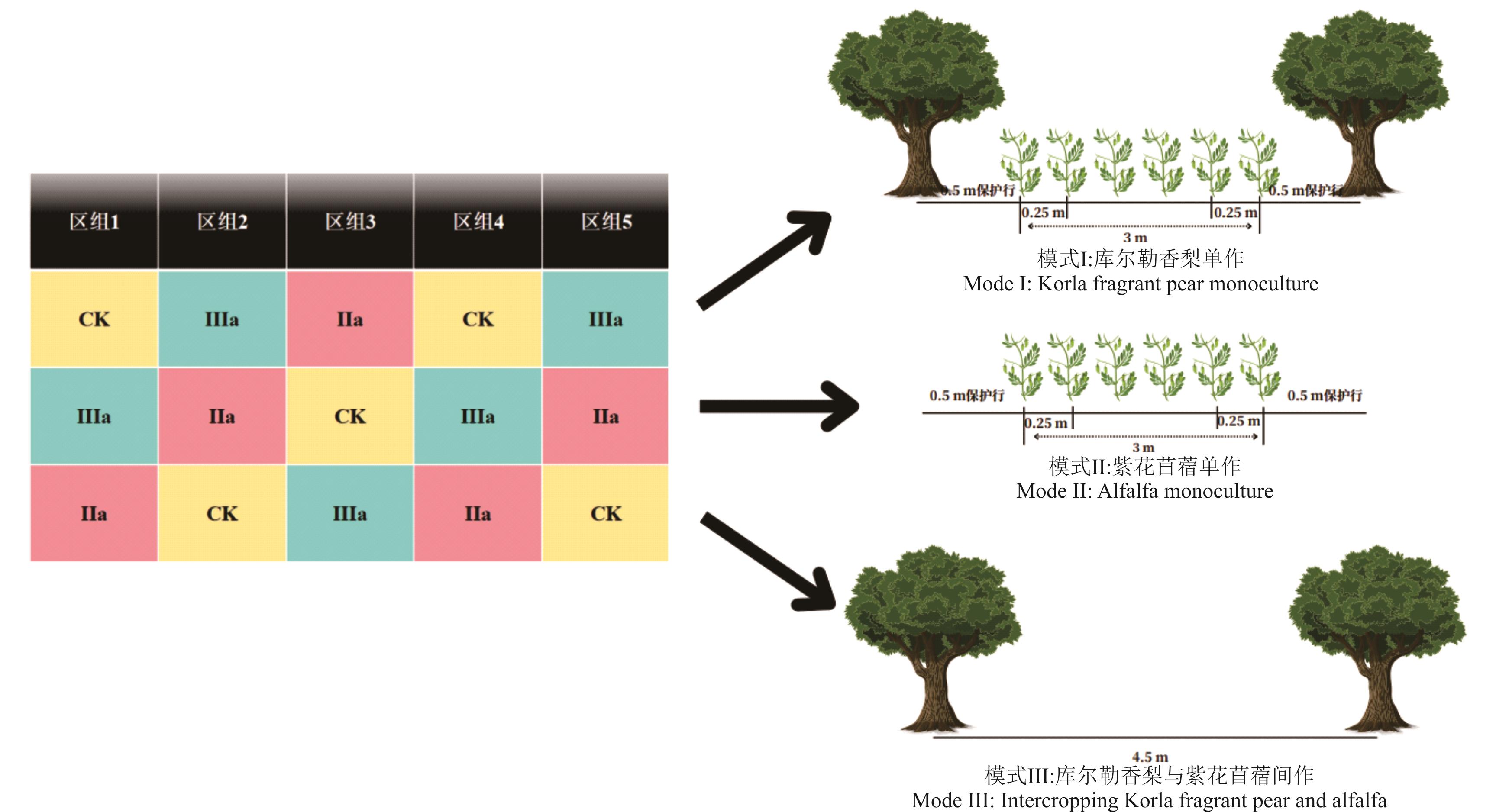
图1 田间试验种植模式保护行Protection row. 区组District group.
Fig.1 Field trial planting mode
间作模式 Intercropping mode | 氮素转移途径 Nitrogen transfer pathway | 播量 Sowing quantity |
|---|---|---|
| CK | - | 16棵 |
| IIa | - | 7.8×10⁻⁴ |
| IIIa | S | 16.0棵:7.8×10⁻⁴ |
| NS | ||
| J | ||
| PS |
表1 各小区不同种植模式下林草间作氮素转移途径与播种量
Table 1 Nitrogen transfer pathway and seeding rate of forest-grass intercropping under different cropping patterns in each plot (g·m-2)
间作模式 Intercropping mode | 氮素转移途径 Nitrogen transfer pathway | 播量 Sowing quantity |
|---|---|---|
| CK | - | 16棵 |
| IIa | - | 7.8×10⁻⁴ |
| IIIa | S | 16.0棵:7.8×10⁻⁴ |
| NS | ||
| J | ||
| PS |
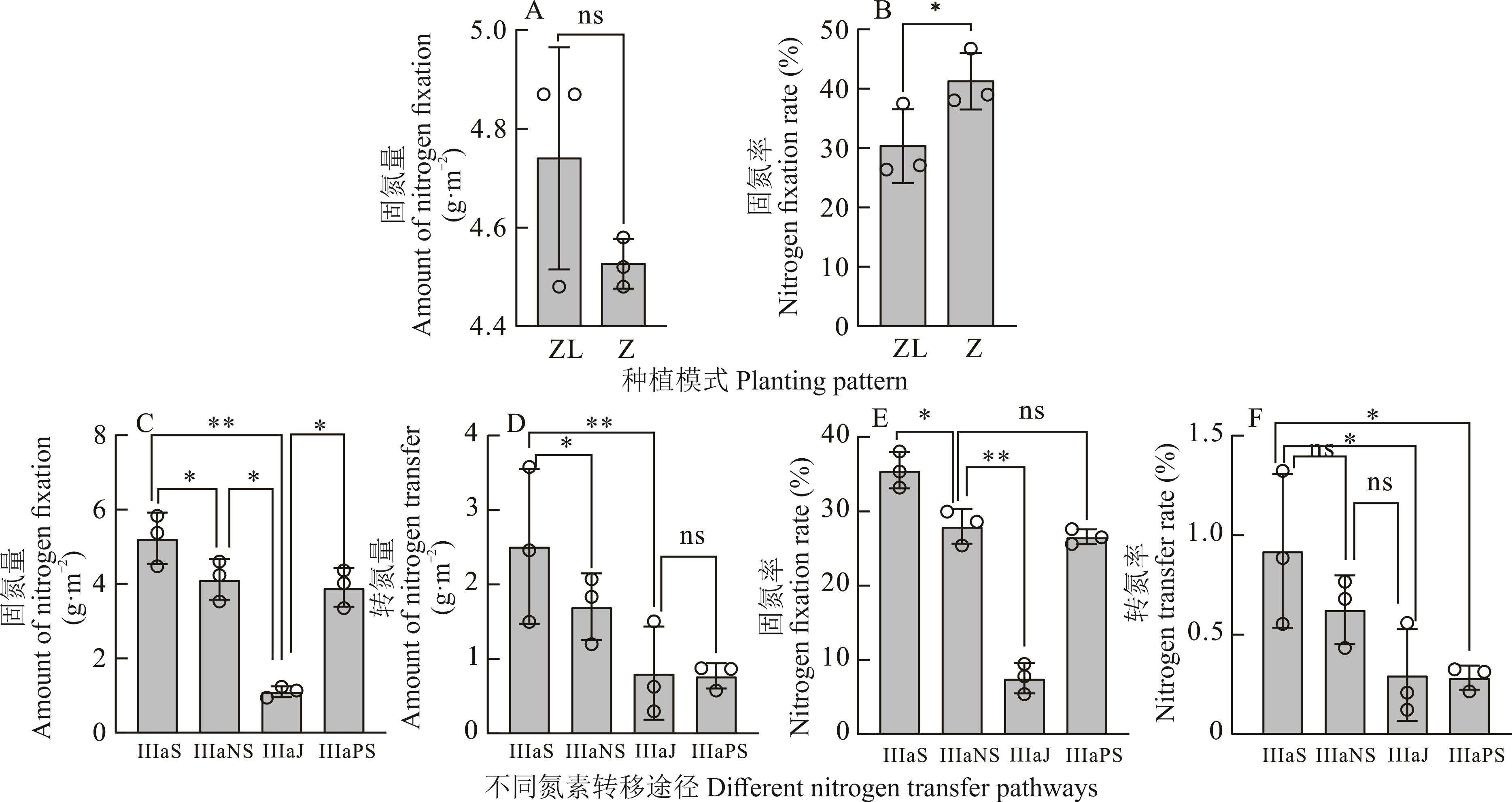
图2 紫花苜蓿与梨树体系间作在不同氮转移途径下氮素利用效率的比较ZL、Z代表紫花苜蓿间作与单作;A、B代表不同间作模式下固氮量、固氮率比较;C、D、E、F代表不同氮素转移途径下固氮量、转氮量、固氮率、转氮率比较。*表示 0.05水平,显著性相关;**表示0.01水平,极显著性相关,***表示0.001水平,极显著性相关,ns表示无显著性,下同。ZL and Z represent intercropping and monocropping of alfalfa, respectively. A and B denote comparisons of nitrogen fixation amount and nitrogen fixation rate under different intercropping patterns. C, D, E, and F represent comparisons of nitrogen fixation amount, nitrogen transfer amount nitrogen fixation rate and nitrogen transfer rate under different nitrogen transfer pathways. The asterisk * indicates significance at the 0.05 level, ** indicates extremely significant difference at the 0.01 level, *** indicates highly significant difference at the 0.001 level, and “ns” denotes no significant difference. The same below.
Fig.2 Comparison of nitrogen use efficiency between alfalfaand Korla pear intercropping under different nitrogen transfer pathways
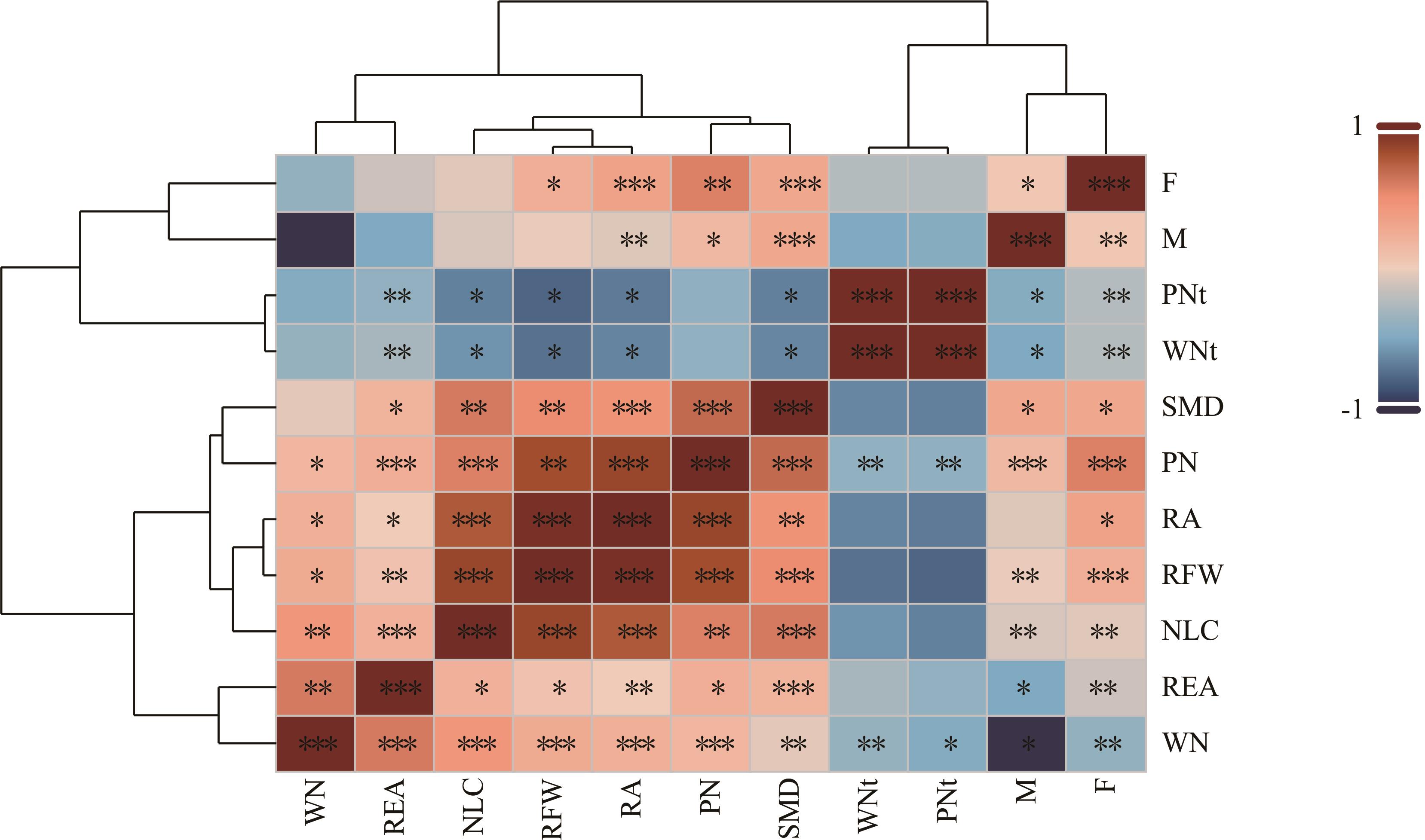
图3 紫花苜蓿与梨树间作系统下氮转移效率与影响因素的相关性分析F:AM真菌侵染强度;M:AM真菌侵染频度;PNt:转氮率;WNt:转氮量;SMD:土壤菌丝密度;PN:固氮率;RA:根瘤数;RFW:根瘤重;NLC:豆血红蛋白;REA:固氮酶活性;WN:固氮量。F: Arbuscular mycorrhizal (AM) fungal infection intensity; M: AM fungal infection frequency; PNt: Nitrogen transfer rate; WNt: Nitrogen transfer amount; SMD: Hyphal density; PN: Nitrogen fixation rate; RA: Nodule number; RFW: Nodule weight; NLC: Leguminous hemoglobin; REA: Nitrogenase activity; WN: Nitrogen fixation amount. 下同。The same below.
Fig.3 Correlation analysis of nitrogen transfer efficiency and influencing factors between alfalfaand Korla pear intercropping
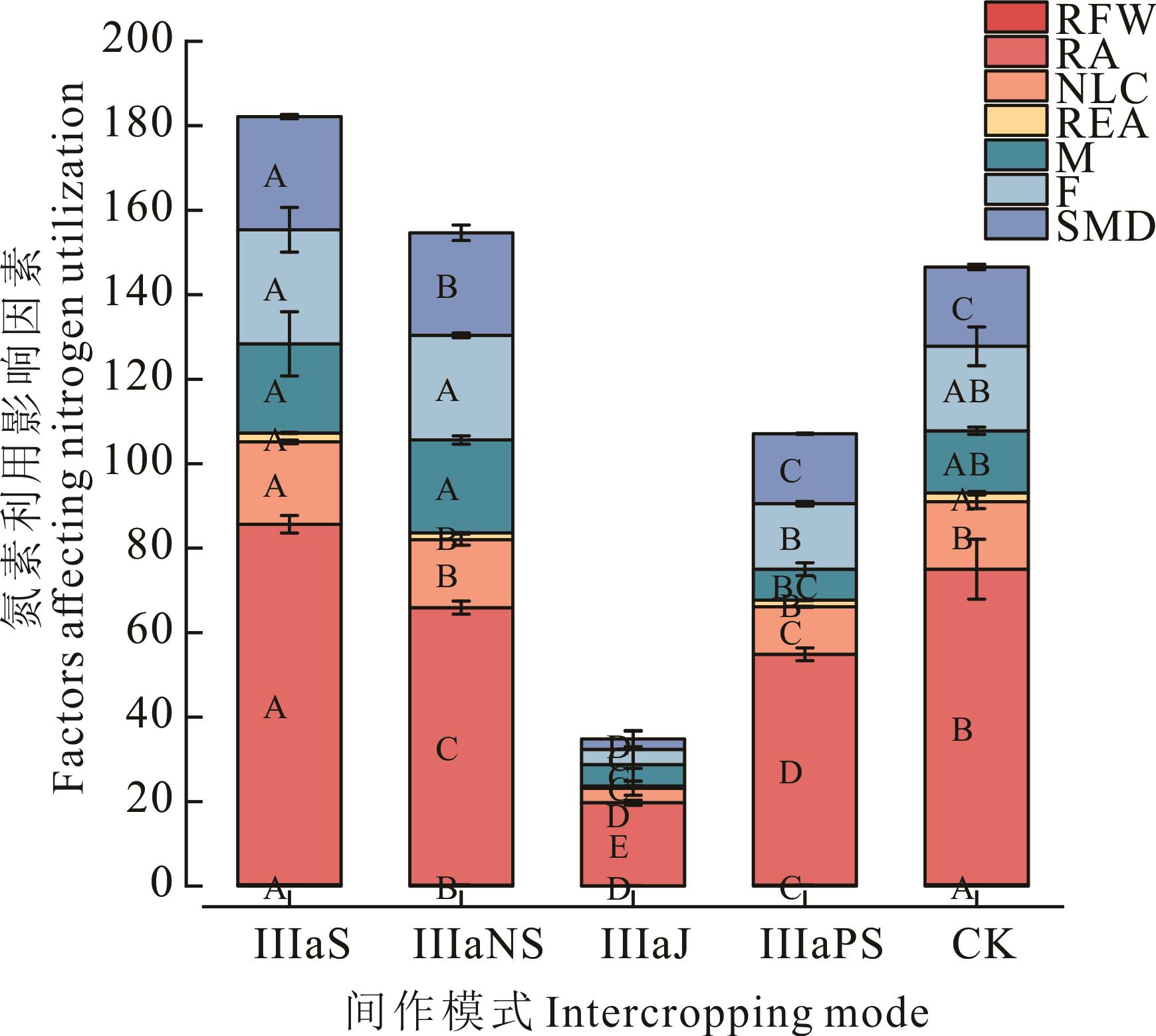
图4 紫花苜蓿与梨树间作在不同氮转移途径下影响因素比较不同字母表示4种氮素转移途径与单作各影响因素之间的差异性。The difference letters indicates the differences among the four nitrogen transfer pathways and the influencing factors of mono-cropping. A、B、C、D表示总高度=总影响,分段=各因素贡献;分段处A、B、C表示4种氮素转移途径与单作各影响因素之间的差异性。A, B, C and D represent that the total height=total impact, and the segmentation=contributions of various factors; A, B and C at the segmentation points indicate the differences among the four nitrogen transfer pathways and the influencing factors of sole cropping.
Fig.4 Comparisons of influencing factors between alfalfaand Korla pear intercropping under different nitrogen transfer pathways
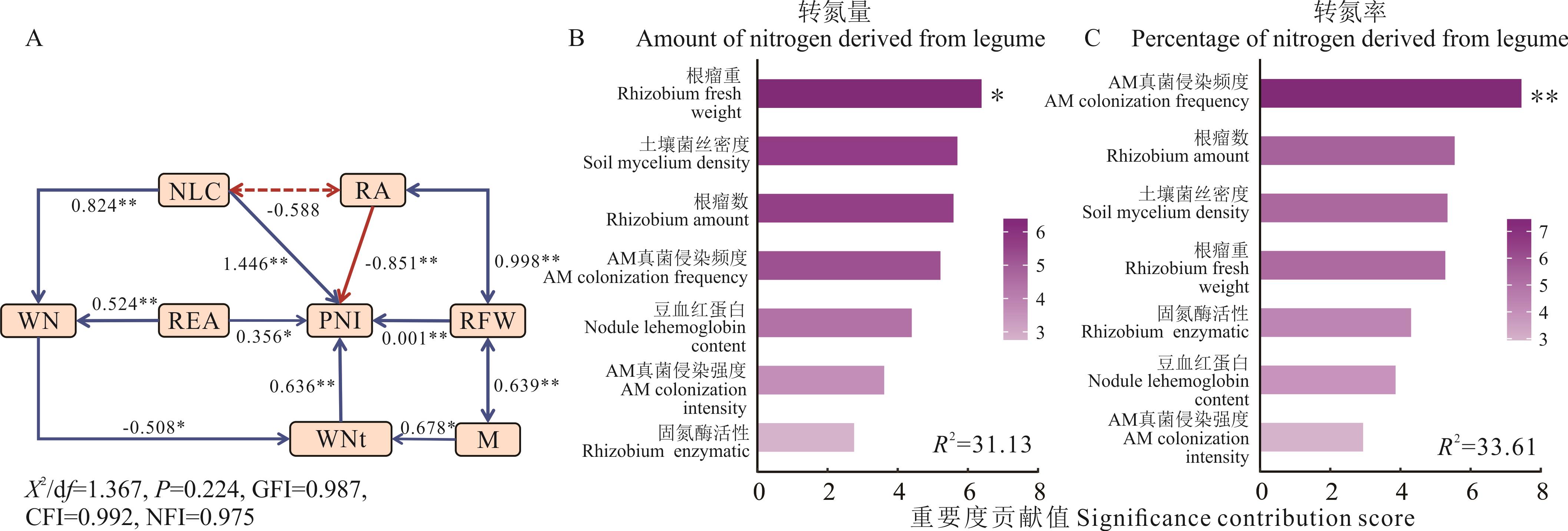
图5 基于影响因子对氮素转移重要度的结构方程模型和随机森林分析模型PNI为梨树氮素增量;X2/df为卡方值与自由度的比值;P值为相关系数;GFI为拟合优度指数;CFI为比较拟合指数;NFI为规范拟合指数。PNI was the increase of nitrogen in pear trees; X2/df is the ratio of the chi-square value to the degrees of freedom; The P-value is the interaction coefficient; GFI is the goodness-of-fit index; CFI is a comparative fitting index; NFI is a canonical fit index.
Fig.5 Structural equation model and random forest analysis model based on influencing factors for the importance of nitrogen transfer
| [1] | Li L. Research progress and application prospects of intercropping and relay cropping in strengthening the ecosystem services of farmland. Chinese Journal of Eco-Agriculture, 2016, 24(4): 403-415. |
| 李隆. 间套作强化农田生态系统服务功能的研究进展与应用展望. 中国生态农业学报, 2016, 24(4): 403-415. | |
| [2] | Yang H, Zhao Y J, Liu X J. Photosynthetic characteristics of alfalfa/oat intercropping and its regulatory effects on yield. Acta Agrestia Sinica, 2023, 31(1): 187-195. |
| 杨航, 赵雅姣, 刘晓静. 紫花苜蓿/燕麦间作的光合特征及其对产量的调控效应.草地学报, 2023, 31(1): 187-195. | |
| [3] | Tang L B, Wang J H, Wang L T, et al. Effects of maize-white clover intercropping on soil nutrients and crop production performance in Karst mountainous area. Chinese Journal of Grassland, 2022, 44(5): 31-39. |
| 唐柳办, 王家豪, 王雷挺, 等. 岩溶山区玉米白三叶间作对土壤养分及作物生产性能的影响. 中国草地学报, 2022, 44(5): 31-39. | |
| [4] | Wang Y. Research of intercropping benefit and nitrogen absorption mechanism of alfalfa//oat intercropping systems. Changchun: Northeast Normal University, 2019. |
| 王妍. 紫花苜蓿-燕麦间作效应及氮素吸收机理研究. 长春: 东北师范大学, 2019. | |
| [5] | Li Q, Huang Y X, Zhou D Y, et al. Influence of mycorrhizal fungi on growth and biological nitrogen fixation and phosphorus uptake in legume crops. Journal of Plant Ecology, 2021, 32(5): 1761-1767. |
| [6] | Zhang F S, Wang J Q, Zhang W F, et al. The current situation and ways to improve the fertilizer utilization efficiency of major grain crops in China. Journal of Soil Science, 2008, 45(5): 915-924. |
| 张福锁, 王激清, 张卫峰, 等. 中国主要粮食作物肥料利用率现状与提高途径. 土壤学报, 2008, 45(5): 915-924. | |
| [7] | Vandermeey J. The ecology of intercropping.New York: Cambridge University Press, 1989. |
| [8] | Li S S. Effect of mixed planting of Vicia sativa or fertilization on weight loss and efficiency enhancement of Avena sativa pastures. Urumqi: Xinjiang Agricultural University, 2021. |
| 黎松松. 混播箭筈豌豆或施肥对燕麦草地减肥增效的影响. 乌鲁木齐: 新疆农业大学, 2021. | |
| [9] | Zhang D S.Efficient capture and utilization of light energy in corn/peanut intercropping in wind sand semi arid areas. Beijing: China Agricultural University, 2018. |
| 张东升. 风沙半干旱区玉米/花生间作光能高效捕获和利用. 北京: 中国农业大学, 2018. | |
| [10] | Chen J, Arafat Y, Wu L, et al. Shifts in soil microbial community, soil enzymes and crop yield under peanut/maize intercropping with reduced nitrogen levels. Applied Soil Ecology, 2018, 124: 327-334. |
| [11] | Feng X M, Gao X, Zang H D, et al. The intercropping effect and nitrogen transfer characteristics between oats and mung beans. Acta Botanica Sinica, 2023, 58(1): 122-131. |
| 冯晓敏, 高翔, 臧华栋, 等. 燕麦-绿豆间作效应及氮素转移特性. 植物学报, 2023, 58(1): 122-131. | |
| [12] | Willey R W. Intercropping-its importance and research needs. Part 2. Agronomy and research approaches. Field Crop Abstracts, 1979, 32: 73-85. |
| [13] | Heap A J, Newman E I. Links between roots by hyphae of vesicular-arbuscular mycorrhizas. New Phytologist, 1980, 85(2): 169-171. |
| [14] | Zhao Y J, Liu X J, Tong C C, et al. Effect of alfalfa/maize intercropping on the nodulation and nitrogen fixation characteristics of alfalfa. Acta Prataculturae Sinica, 2020, 29(1): 95-105. |
| 赵雅姣, 刘晓静, 童长春, 等. 紫花苜蓿/玉米间作对紫花苜蓿结瘤固氮特性的影响. 草业学报, 2020, 29(1): 95-105. | |
| [15] | Wang Y F, Liu H Q, Zhao X N, et al. Effects of water and root separation on nitrogen uptake, utilization and transfer in a gramineae-legume intercropping system. Journal of Soil and Water Conservation, 2024, 38(4): 279-287. |
| 王一帆, 刘华清, 赵西宁, 等. 禾豆间作系统水分和根系分隔对牧草氮素吸收利用及转移的影响. 水土保持学报, 2024, 38(4): 279-287. | |
| [16] | Zhu Y Q, Li S S, Wang N X, et al. Effects of rhizobium-root system-arbuscular mycorrhizal fungi features on nitrogen fixation and transfer efficiency of mixed sowing meadow. Chinese Journal of Grassland, 2022, 44(11): 18-31. |
| 朱亚琼, 黎松松, 王宁欣, 等. 根瘤菌-根系构型-丛枝菌根真菌对混播草地氮素固定与转移效率的影响. 中国草地学报, 2022, 44(11): 18-31. | |
| [17] | Ren J, Liu X Y, Liu F, et al. Absorption, utilization and transfer efficiency of nitrogen in walnut-soybean intercropping pattern. Nonwood Forest Research, 2022, 40(1): 1-10. |
| 任静, 刘小勇, 刘芬, 等. 核桃/大豆间作对氮素吸收利用及转移的影响. 经济林研究, 2022, 40(1): 1-10. | |
| [18] | Fan F L, Zhang F S, Song Y N, et al. Nitrogen fixation of faba bean (Vicia faba L.) interacting with a non-legume in two contrasting intercropping systems. Plant & Soil, 2006, 283(1/2): 275-286. |
| [19] | Yoneyama T, Yamada N, Kojima H, et al. Variations of natural 15N abundances in leguminous plants and nodule fractions. Plant and Cell Physiology, 1984, 25(8): 1561-1565. |
| [20] | Fang L, Xu J, Yang C.Arbuscular mycorrhizal fungi alleviates salt-alkali stress demage on syneilesis aconitifolia. Phyton, (0031-9457), 2023, 92(12). |
| [21] | Jakobsen I, Abbott L K, Robson A D. External hyphae of vesicular-arbuscular mycorrhizal fungi associated with Trifolium subterraneum L: I. Spread of hyphae and phosphorus inflow into roots. New Phytologist, 1992, 120(3): 371-380. |
| [22] | Giovannett M, Mosse B. An evaluation of techniques for measuring vesicular arbuscular mycorrhizal infection in root. New Phytologist, 1980, 84: 489-500. |
| [23] | Lin B, Zheng X, Zheng S, et al. Metabolomics analysis of ammonia secretion during the fermentation of Klebsiella variicola GN02 with highly efficient endophytic nitrogen-fixing bacteria. Applied Biochemistry and Microbiology, 2020, 56(4): 400-411. |
| [24] | Lin B S, Fan J L, Song Z Z, et al. Endophytic diazotrophs composition of Pennisetum sp. at different growth stages. Microbiology China, 2018, 45(7): 1479-1490. |
| 林标声, 范锦琳, 宋昭昭, 等. 巨菌草不同生长时期的内生固氮菌群组成分析. 微生物学通报, 2018, 45(7): 1479-1490. | |
| [25] | Wang S Q, Han X Z, Qiao Y F, et al. Effects of low molecular organic acids on nitrogen accumulation,nodulation,and nitrogen fixation of soybean (Glycine max L.) under phosphorus deficiency stress. Chinese Journal of Applied Ecology, 2009, 20(5): 1079-1084. |
| 王树起, 韩晓增, 乔云发, 等. 缺磷条件下低分子量有机酸对大豆氮积累和结瘤固氮的影响. 应用生态学报, 2009, 20(5): 1079-1084. | |
| [26] | Zuo Y M, Liu Y X, Zhang F S. Effects of improvement of iron nutrition by mixed cropping with maize on nodule microstructure and leghaemoglobin content of peanut. Journal of Plant Physiology and Molecular Biology, 2003(1): 33-38. |
| 左元梅, 刘永秀, 张福锁. 与玉米混作改善花生铁营养对其根瘤形态结构及豆血红蛋白含量的影响. 植物生理与分子生物学学报, 2003(1): 33-38. | |
| [27] | Beijing Xinzhi Shudu Technology Limited Company. SPSSAU. (Version 28.0). [2024.10]. https://www.spssau.com/. |
| 北京心知数度科技有限公司. SPSSAU. (Version 28.0). [2024.10]. https://www.spssau.com/. | |
| [28] | Malézieux E, Crozat Y, Dupraz C, et al. Mixing plant species in cropping systems: concepts, tools and models. A review.Agronomy for Sustainable Development, 2009, 29(1): 329-353. |
| [29] | Vandermeer J, Van Noordwijk M, Anderson J, et al. Global chane and multi-species agroecosystems: concepts and issues. Agriculture, Ecosystems and Environment, 1998, 67: 1-22. |
| [30] | Li C, Hofand E, Kuyper T W, et al. Syndromes of production in intercropping impact yield gains. Nature Plants, 2020, 6(6): 653-660. |
| [31] | Yu Y, Stomph T J, Makowski D, et al. Temporal niche differentiation increases the land equivalent ratio of annual intercrops: a meta-analysis. Field Crops Research, 2015, 184: 133-144. |
| [32] | Li X F, Wang Z G, Bao X G, et al. Long-term increased grain yield and soil fertility from intercropping. Nature Sustainability, 2021, 4(11): 943-950. |
| [33] | Stomph T, Dordas C, Baranger A, et al. Designing intercrops for high yield, yield stability and effcient use of resources: are there principles. Advances in Agronomy, 2020, 160(1): 1-50. |
| [34] | Fan K K, Delgado-Baquerizo M, Guo X S, et al. Suppressed N fixation and diazotrophs after four decades of fertilization. Microbiome, 2019, 7(1): 143. |
| [35] | Chu G X, Shen Q R, Cao J L, et al. Biological nitrogen fixation and nitrogen export of groundnut intercropped with rice cultivated in aerobic soil and its effect on soil nitrogen fertility. Acta Pedologica Sinica, 2003(5): 717-723. |
| 褚贵新, 沈其荣, 曹金留, 等. 旱作水稻与花生间作系统中的氮素固定与转移及其对土壤肥力的影响. 土壤学报, 2003(5): 717-723. | |
| [36] | Li Y Y, Yu C B, Cheng X, et al. Intercropping alleviates the inhibitory effect of N fertilization on nodulation and symbiotic N2 fixation of faba bean. Plant and Soil, 2009, 323(1): 295-308. |
| [37] | Corre-Hellou G, Fustec J, Crozat Y. Interspecific competition for soil N and its interaction with N2 fixation, leaf expansion and crop growth in pea-barley intercrops. Plant and Soil, 2006, 282(1/2): 195-208. |
| [38] | Bedoussac L, Justes E. Dynamic analysis of competition and complementarity for light and N use to understand the yield and the protein content of a durum wheat-winter pea intercrop. Plant and Soil, 2010, 330(1/2): 37-54. |
| [39] | Hauggaard-Nielsen H, Ambus P, Jensen E S. The comparison of nitrogen use and leaching in sole cropped versus intercropped pea and barley. Nutrient Cycling in Agroecosystems, 2003, 65(3): 289-300. |
| [40] | Ding T T, Duan T Y. Research progress on the influence of orchard green manure on fruit tree soil microbial system. Journal of Fruit Science, 2021, 38(12): 2196-2208. |
| 丁婷婷, 段廷玉. 果园绿肥对果树-土壤-微生物系统影响研究进展. 果树学报, 2021, 38(12): 2196-2208. | |
| [41] | Jiang S, Jardinaud M F, Gao J, et al. NIN-like protein transcription factors regulate leghemoglobin genes in legume nodules. Science, 2021, 374(6567): 625-628. |
| [42] | Zang H D, Yang X C, Feng X M, et al. Rhizodeposition of nitrogen and carbon by mungbean (Vigna radiata L.) and its contribution to intercropped oats (Avena nuda L.). PLoS One, 2017, 10(3): e0121132. |
| [43] | Dong Z X, Sun B, Yin S X, et al. Impacts of climate and cropping on community diversity of diazotrophs in pachic udic argiboroll and fluventic ustochrept. Acta Pedologica Sinica, 2012, 49(1): 130-138. |
| 董志新, 孙波, 殷士学, 等.气候条件和作物对黑土和潮土固氮微生物群落多样性的影响. 土壤学报, 2012, 49(1): 130-138. |
| [1] | 牛伟玲, 陈辉, 侯慧新, 郭晨睿, 马娇林, 武建双. 10年禁牧未改变藏西北高寒荒漠植物水氮利用效率[J]. 草业学报, 2022, 31(8): 35-48. |
| [2] | 郭家萌, 何灵芝, 闫东良, 李卓, 王泳超, 邵瑞鑫, 杨青华. 控释氮肥和尿素配比对不同品种夏玉米氮素累积、转移及其利用效率的影响[J]. 草业学报, 2021, 30(1): 81-95. |
| [3] | 朱亚琼, 于辉, 郑伟, 黎松松, 娜尔克孜, 刘岳含, 郝帅, 艾丽菲热. 燕麦+箭筈豌豆混播草地混播优势的测度与影响因素分析[J]. 草业学报, 2020, 29(1): 74-85. |
| [4] | 朱亚琼, 关正翾, 郑伟, 王祥. 混播种类和群体结构对豆禾牧草混播系统氮素利用效率的影响[J]. 草业学报, 2018, 27(10): 1-14. |
| [5] | 戢林,杨欢,李廷轩,张锡洲,余海英. 氮高效利用基因型水稻干物质生产和氮素积累特性[J]. 草业学报, 2014, 23(6): 327-335. |
| 阅读次数 | ||||||
|
全文 |
|
|||||
|
摘要 |
|
|||||
