

ISSN 1004-5759 CN 62-1105/S
草业学报 ›› 2025, Vol. 34 ›› Issue (3): 134-143.DOI: 10.11686/cyxb2024163
• 研究论文 • 上一篇
李雪梅( ), 姚拓(), 李昌宁, 杨晓蕾, 王晚霞, 张怡忻
收稿日期:2024-05-06
修回日期:2024-06-17
出版日期:2025-03-20
发布日期:2025-01-02
通讯作者:
姚拓
作者简介:E-mail: yaotuo@gsau.edu.cn基金资助:
Xue-mei LI(), Tuo YAO(), Chang-ning LI, Xiao-lei YANG, Wan-xia WANG, Yi-xin ZHANG
Received:2024-05-06
Revised:2024-06-17
Online:2025-03-20
Published:2025-01-02
Contact:
Tuo YAO
摘要:
为进一步挖掘高寒草地野生天蓝苜蓿根瘤菌资源,筛选与宿主植物高效共生的菌株。本研究利用YMA刚果红培养基从野生天蓝苜蓿中分离根瘤菌,通过菌落形态观察、产酸产碱反应结合16S rRNA基因序列分析进行菌株鉴定,原宿主回接验证其促生特性,离体耐酸、耐碱及温度耐受性测定菌株抗逆能力。结果表明:从野生天蓝苜蓿中分离得到4株菌株,菌落形态和产酸产碱结果符合根瘤菌特性,经鉴定菌株GNT1和GNT6为苜蓿中华根瘤菌,菌株GNT2为吉氏副根瘤菌,菌株GNT4为豆根副根瘤菌。4株根瘤菌回接后植株单株结瘤数、株高、根长及植株干重分别是不接种处理的2.06~3.64倍、0.75~3.17倍、0.21~0.38倍和0.55~2.82倍,有效结瘤数和固氮酶活性分别为11.33~18.00个、5.71~10.97 μmol C2H4·g-1·h-1,不接种处理下根瘤为无效根瘤且不具有固氮酶活性。4株菌株均能在pH为11时生长,以菌株GNT2生长最佳;不同菌株对NaCl耐受能力不同,其中菌株GNT6耐受5% NaCl,且仅菌株GNT6在4 ℃低温下能够生长,具有在高寒草地应用的潜力。因此,筛选出的苜蓿中华根瘤菌GNT6可作为候选菌株为高寒草地的修复提供优良菌株资源。
李雪梅, 姚拓, 李昌宁, 杨晓蕾, 王晚霞, 张怡忻. 甘南野生天蓝苜蓿高效共生、抗逆根瘤菌筛选鉴定[J]. 草业学报, 2025, 34(3): 134-143.
Xue-mei LI, Tuo YAO, Chang-ning LI, Xiao-lei YANG, Wan-xia WANG, Yi-xin ZHANG. Screening and identification of symbiotically efficient and stress-resistant rhizobia of wild Medicago lupulina in Gannan[J]. Acta Prataculturae Sinica, 2025, 34(3): 134-143.
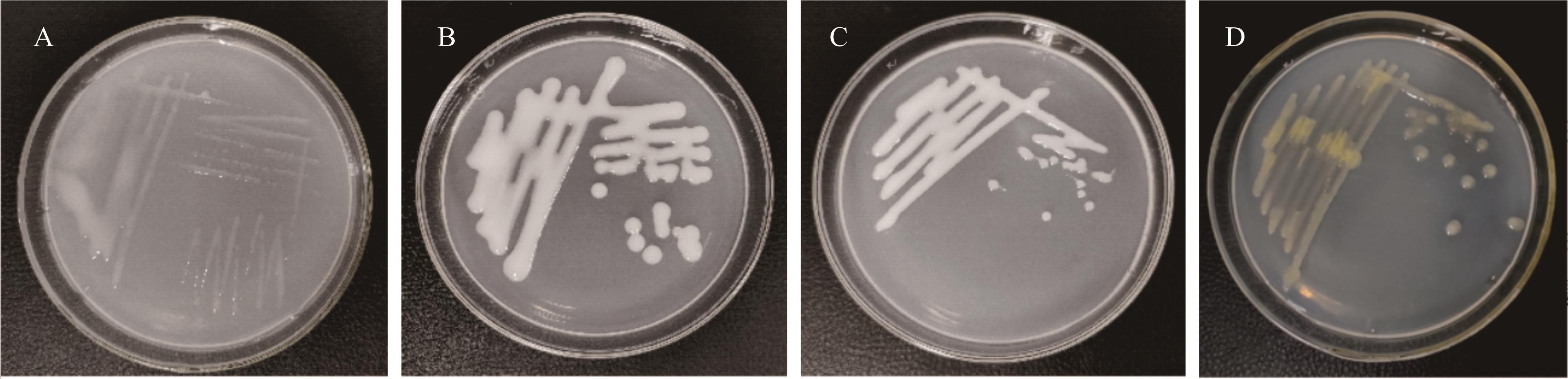
图1 不同菌株菌落形态A: 菌株GNT1菌落形态Colony morphology of strain GNT1; B: 菌株GNT2菌落形态Colony morphology of strain GNT2; C: 菌株GNT4菌落形态Colony morphology of strain GNT4; D: 菌株GNT6菌落形态Colony morphology of strain GNT6.
Fig.1 Colony morphology of different strains
| 菌株编号Strain number | 菌落形态 Colony morphology | 产酸产碱能力 Acid and alkali production |
|---|---|---|
| GNT1 | 灰白色圆形;菌落凸起、质黏,边缘整齐,半透明;生长速度较快。Grayish-white round; colony convex, slimy, neatly edged, translucent; growing fast. | + |
| GNT2 | 乳白色圆形;菌落凸起、质黏,边缘整齐,不透明;生长速度快。Milky-white round; colony convex, slimy, neatly edged, opaque; growing faster. | ++ |
| GNT4 | 乳白色圆形;菌落凸起、质黏,边缘整齐,不透明;生长速度快。Milky-white round; colony convex, slimy, neatly edged, opaque; growing faster. | + |
| GNT6 | 生长前期灰白色,后期黄色;菌落凸起、质黏,半透明;生长速度快。Pre-growth grayish-white, later yellow; colony convex, sticky, translucent; growing faster. | +++ |
表1 菌株菌落形态及产酸产碱能力
Table 1 Colony morphology and acid-alkali production capacity of strains
| 菌株编号Strain number | 菌落形态 Colony morphology | 产酸产碱能力 Acid and alkali production |
|---|---|---|
| GNT1 | 灰白色圆形;菌落凸起、质黏,边缘整齐,半透明;生长速度较快。Grayish-white round; colony convex, slimy, neatly edged, translucent; growing fast. | + |
| GNT2 | 乳白色圆形;菌落凸起、质黏,边缘整齐,不透明;生长速度快。Milky-white round; colony convex, slimy, neatly edged, opaque; growing faster. | ++ |
| GNT4 | 乳白色圆形;菌落凸起、质黏,边缘整齐,不透明;生长速度快。Milky-white round; colony convex, slimy, neatly edged, opaque; growing faster. | + |
| GNT6 | 生长前期灰白色,后期黄色;菌落凸起、质黏,半透明;生长速度快。Pre-growth grayish-white, later yellow; colony convex, sticky, translucent; growing faster. | +++ |

图2 菌株溴百里香酚蓝检测情况
Fig.2 Bromothymol blue detection of strains
菌株 Strains | 片段长度 Length (bp) | 同源性最高序列的菌株 Strains with the highest homology sequence | 相似度 Similarity (%) |
|---|---|---|---|
| GNT1 | 1359 | 苜蓿中华根瘤菌S. meliloti LMG-6311 (X67222) | 99.41 |
| GNT2 | 1374 | 吉氏副根瘤菌P. giardinii H152 (ARBG01000149) | 99.85 |
| GNT4 | 1346 | 豆根副根瘤菌P. herbae CCBAU 83011 (GU565534) | 99.62 |
| GNT6 | 1377 | 苜蓿中华根瘤菌S. meliloti LMG-6311 (X67222) | 99.48 |
表2 分离菌株分子生物学鉴定
Table 2 Molecular biology identification of isolated strains
菌株 Strains | 片段长度 Length (bp) | 同源性最高序列的菌株 Strains with the highest homology sequence | 相似度 Similarity (%) |
|---|---|---|---|
| GNT1 | 1359 | 苜蓿中华根瘤菌S. meliloti LMG-6311 (X67222) | 99.41 |
| GNT2 | 1374 | 吉氏副根瘤菌P. giardinii H152 (ARBG01000149) | 99.85 |
| GNT4 | 1346 | 豆根副根瘤菌P. herbae CCBAU 83011 (GU565534) | 99.62 |
| GNT6 | 1377 | 苜蓿中华根瘤菌S. meliloti LMG-6311 (X67222) | 99.48 |
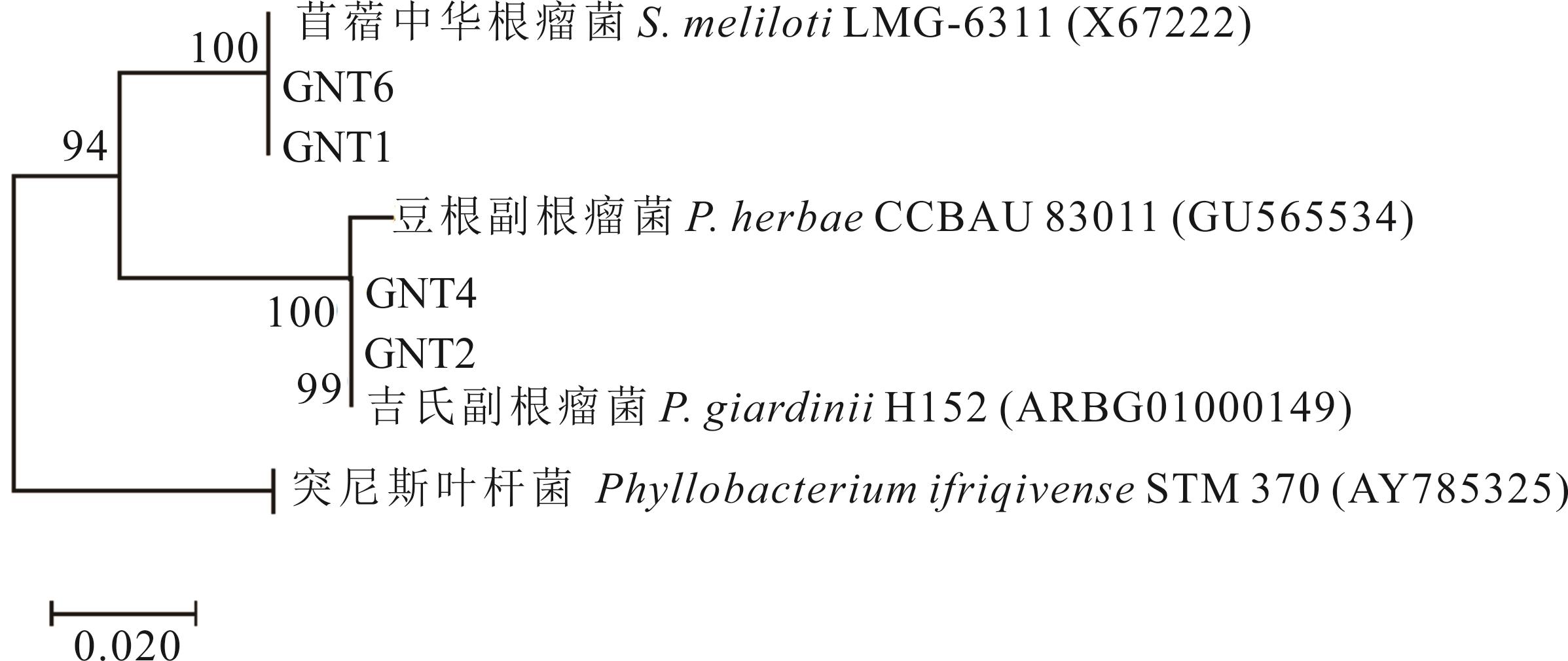
图3 分离菌株16S rRNA基因序列构建的系统发育树
Fig.3 Phylogenetic tree constructed based on 16S rRNA gene sequences of screening strains
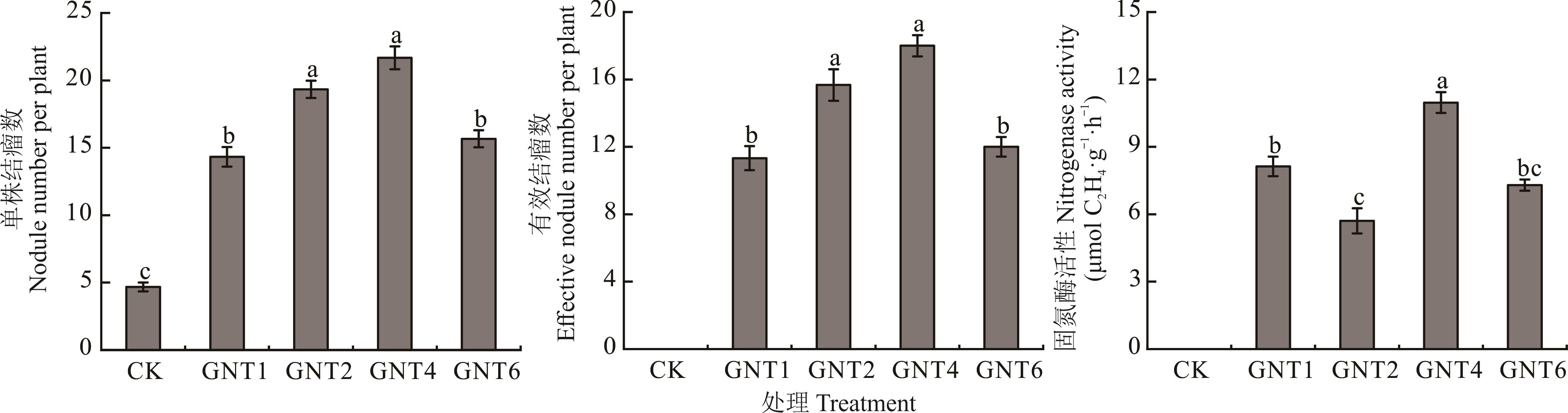
图4 菌株处理对天蓝苜蓿单株结瘤数、有效结瘤数及固氮酶活性的影响不同小写字母表示不同菌株处理间差异显著(P<0.05)。Different lowercase letters indicated that there was a significant differences among different strains (P<0.05). 下同The same below.
Fig.4 Effects of strain treatment on nodule number, effective nodule number and nitrogenase activity of M. lupulina
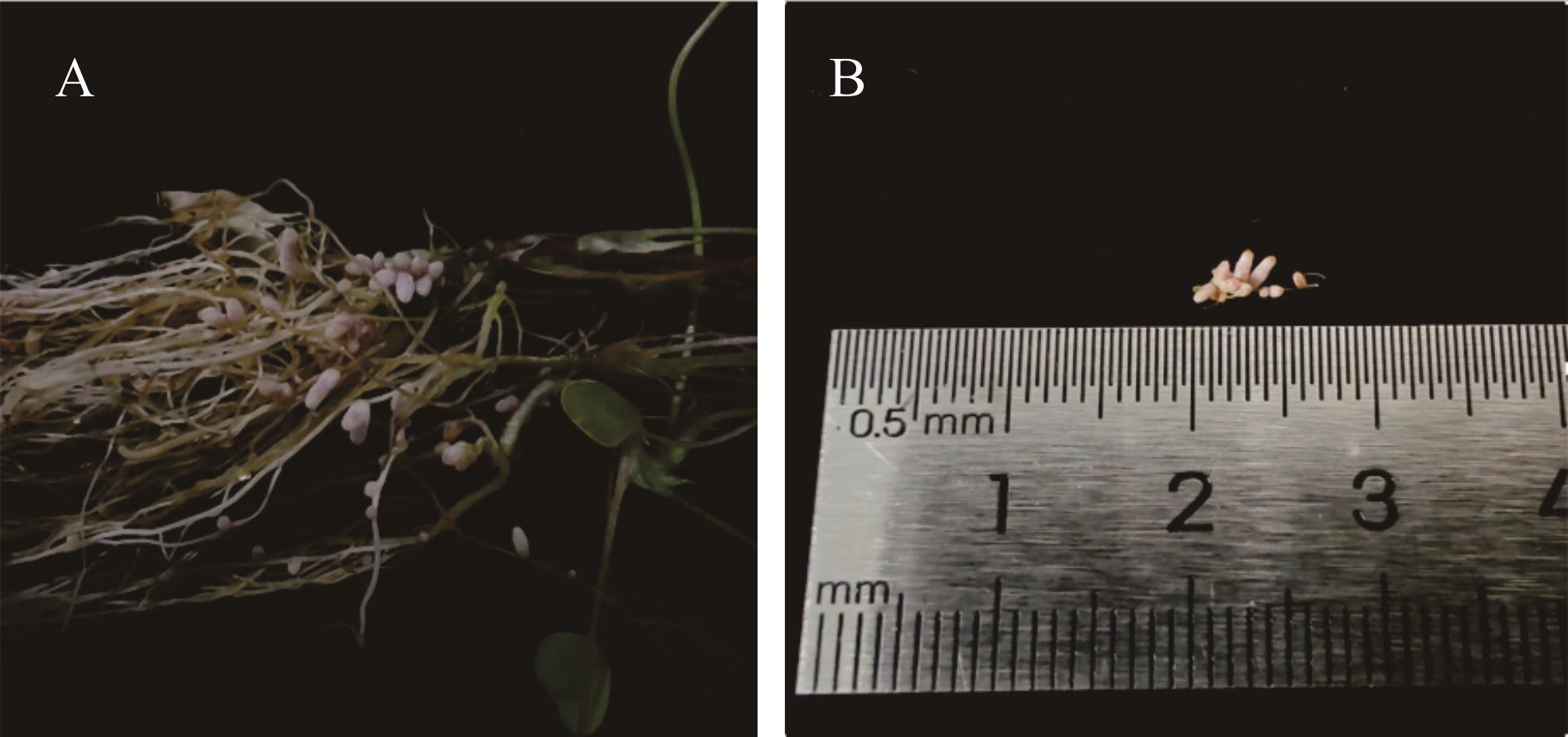
图5 菌株GNT4回接结瘤(A)、单个根瘤大小(B)情况
Fig.5 Nodulation (A) and single nodule size (B) of strain GNT4
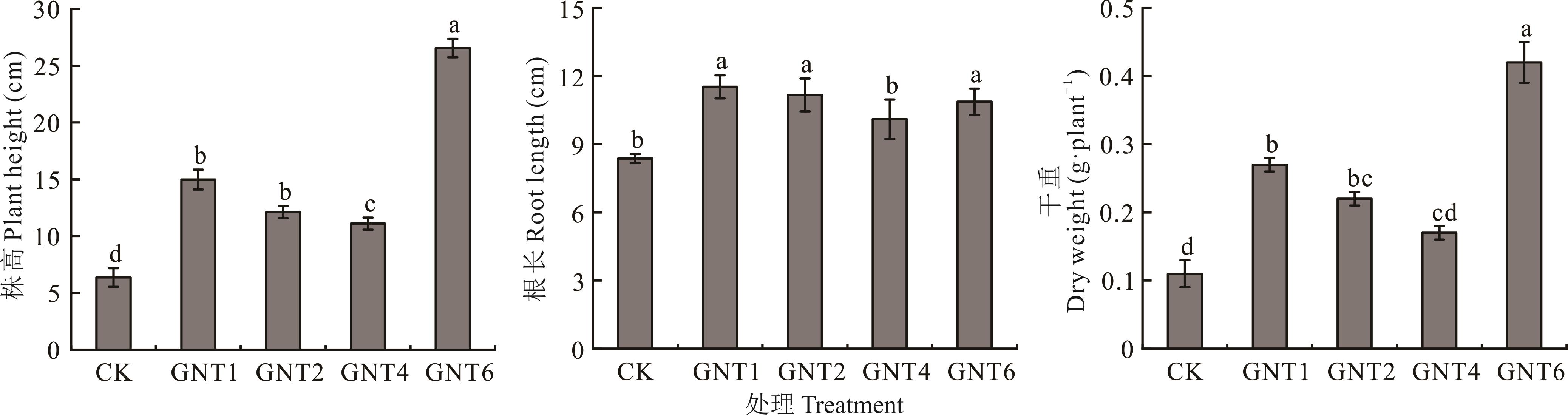
图6 菌株处理对天蓝苜蓿株高、根长及干重的影响
Fig.6 Effects of strain treatment on plant height, root length and dry weight of M. lupulina
菌株编号 Strain number | 氯化钠浓度NaCl concentration | ||
|---|---|---|---|
| 1% | 3% | 5% | |
| GNT1 | +++ | + | + |
| GNT2 | +++ | + | - |
| GNT4 | +++ | + | - |
| GNT6 | +++ | +++ | +++ |
表3 菌株NaCl耐受性
Table 3 NaCl tolerance of the strain
菌株编号 Strain number | 氯化钠浓度NaCl concentration | ||
|---|---|---|---|
| 1% | 3% | 5% | |
| GNT1 | +++ | + | + |
| GNT2 | +++ | + | - |
| GNT4 | +++ | + | - |
| GNT6 | +++ | +++ | +++ |
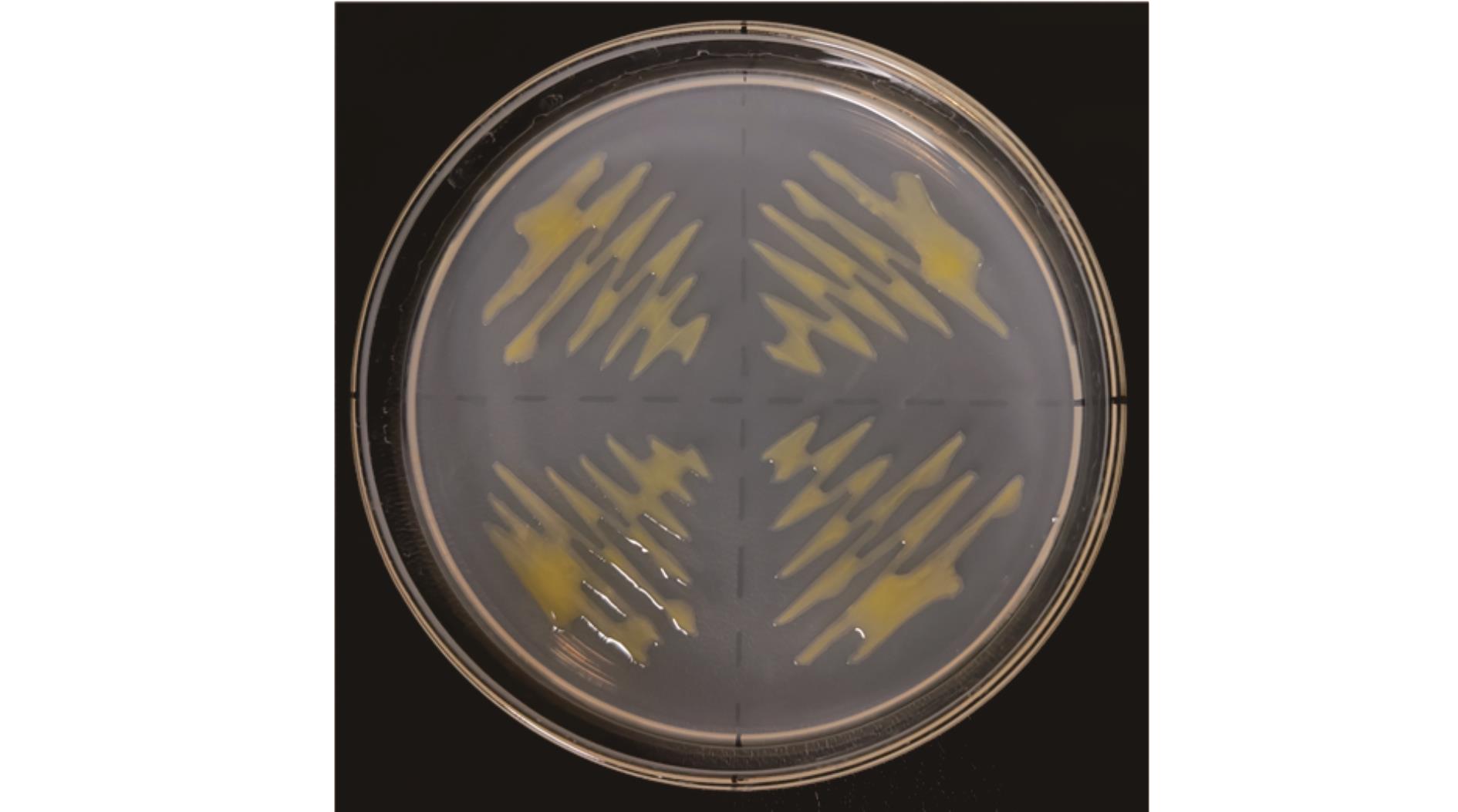
图7 菌株GNT6在5% NaCl条件下的生长状态
Fig.7 Growth status of strain GNT6 under 5% NaCl stress
菌株编号 Strain number | 4 ℃ | 16 ℃ | 28 ℃ | 40 ℃ |
|---|---|---|---|---|
| GNT1 | - | + | +++ | +++ |
| GNT2 | - | + | +++ | + |
| GNT4 | - | + | +++ | - |
| GNT6 | + | + | +++ | +++ |
表4 菌株温度耐受性
Table 4 Temperature tolerance of the strain
菌株编号 Strain number | 4 ℃ | 16 ℃ | 28 ℃ | 40 ℃ |
|---|---|---|---|---|
| GNT1 | - | + | +++ | +++ |
| GNT2 | - | + | +++ | + |
| GNT4 | - | + | +++ | - |
| GNT6 | + | + | +++ | +++ |
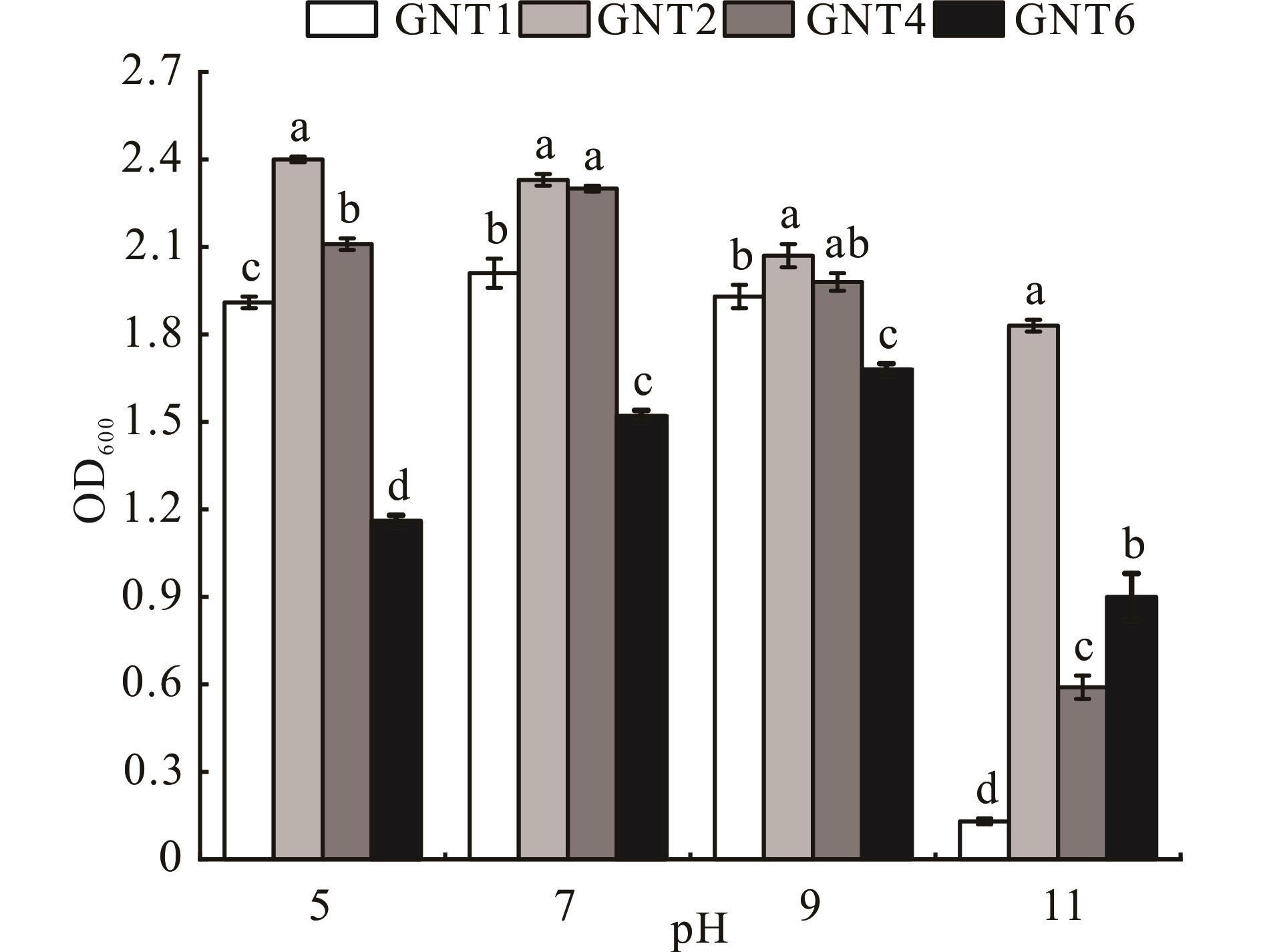
图8 不同pH对菌株OD600的影响
Fig.8 The effect of different pH on the strain OD600
| 1 | Zhang C J, Wang X Y, Yao B H, et al. Diet composition and trophic niche characteristics of three rodents in Gannan meadow. Acta Agrestia Sinica, 2021, 29(7): 1484-1490. |
| 张彩军, 王小燕, 姚宝辉, 等. 甘南草原3种啮齿动物的食性及其营养生态位特征. 草地学报, 2021, 29(7): 1484-1490. | |
| 2 | Guo W W, Jin L, Li W, et al. Assessing the vulnerability of grasslands in Gannan of China under the dual effects of climate change and human activities. Ecological Indicators, 2023, 148(3): 110100. |
| 3 | Li Y C, Hou M J, Ge J, et al. NDVI changes and driving factors of grassland vegetation in Gannan prefecture and northwest Sichuan region. Acta Agrestia Sinica, 2020, 28(6): 1690-1701. |
| 李元春, 侯蒙京, 葛静, 等. 甘南和川西北地区草地植被NDVI变化及其驱动因素研究. 草地学报, 2020, 28(6): 1690-1701. | |
| 4 | Hasi M, Zhang X Y, Niu G X, et al. Soil moisture, temperature and nitrogen availability interactively regulate carbon exchange in a meadow steppe ecosystem. Agricultural and Forest Meteorology, 2021, 304(9): 108389. |
| 5 | Gu S S, Zhou X L, Yu H, et al. Microbial and chemical fertilizers for restoring degraded alpine grassland. Biology and Fertility of Soils, 2023, 59(8): 911-926. |
| 6 | Li X X, Xu R N, Liao H. Contributions of symbiotic nitrogen fixation in soybean to reducing fertilization while increasing efficiency in agriculture. Soybean Science, 2016, 35(4): 531-535. |
| 李欣欣, 许锐能, 廖红. 大豆共生固氮在农业减肥增效中的贡献及应用潜力. 大豆科学, 2016, 35(4): 531-535. | |
| 7 | Oleńska E, Małek W, Wójcik M, et al. Beneficial features of plant growth-promoting rhizobacteria for improving plant growth and health in challenging conditions: A methodical review. Science of the Total Environment, 2020, 743(46): 140682. |
| 8 | Lagunas B, Richards L, Sergaki C, et al. Rhizobial nitrogen fixation efficiency shapes endosphere bacterial communities and Medicago truncatula host growth. Microbiome, 2023, 11(1): 146. |
| 9 | Ji Z J, Yan H, Cui Q G, et al. Competition between rhizobia under different environmental conditions affects the nodulation of a legume. Systematic and Applied Microbiology, 2017, 40(2): 114-119. |
| 10 | Zahran H H. Conditions for successful Rhizobium-legume symbiosis in saline environments. Biology and Fertility of Soils, 1991, 12(1): 73-80. |
| 11 | Atieno M, Lesueur D. Opportunities for improved legume inoculants: enhanced stress tolerance of rhizobia and benefits to agroecosystems. Symbiosis, 2019, 77(3): 191-205. |
| 12 | Megu M, Paul A, Deb C R. Isolation and screening of stress tolerant and plant growth promoting root nodulating rhizobial bacteria from some wild legumes of Nagaland, India. South African Journal of Botany, 2024, 168(5): 260-269. |
| 13 | Ren H L, Wei Z W, Chen X. Cross-species markers developed from genome sequencing in Medicago truncatula, Medicago lupulina and Medicago polymorpha. Acta Prataculturae Sinica, 2017, 26(4): 188-195. |
| 任海龙, 魏臻武, 陈祥. 蒺藜苜蓿、天蓝苜蓿、金花菜基因组SNP穿梭标记开发. 草业学报, 2017, 26(4): 188-195. | |
| 14 | Zeng Q F, Wei X D, Wei X, et al. Research on resource exploration, nitrogen fixation characteristics and diversity of rhizobia of Medicago lupulina in karst mountainous area of Guizhou. Acta Agrestia Sinica, 2022, 30(7): 1891-1899. |
| 曾庆飞, 韦兴迪, 韦鑫, 等. 贵州岩溶山区野生天蓝苜蓿根瘤菌资源发掘、固氮特性及其多样性研究. 草地学报, 2022, 30(7): 1891-1899. | |
| 15 | Ma N. Phenotypic diversity and analysis of 16S rDNA RFLP on rhizobia isolated from leguminous plants in some mining areas of northwest China. Yangling: Northwest A&F University, 2010. |
| 马宁. 西北部分矿区豆科植物根瘤菌表型多样性及16S rDNA RFLP分析. 杨凌: 西北农林科技大学, 2010. | |
| 16 | Feng C S. Phylogeny of rhizobium isolated from Medicago lupulina in northwest of China. Yangling: Northwest A&F University, 2008. |
| 冯春生. 西北地区天蓝苜蓿根瘤菌系统发育研究. 杨凌: 西北农林科技大学, 2008. | |
| 17 | Li S L. Soil physicochemical properties of alpine grasslands under different desertification degrees in Maqu, Gansu, China. Journal of Desert Research, 2022, 42(6): 44-52. |
| 李世龙. 青藏高原东缘玛曲沙化高寒草地土壤理化性质. 中国沙漠, 2022, 42(6): 44-52. | |
| 18 | Lan X J. Screening and evaluation of PGPR resources from 6 Gansu native grass and research on growth promoting mechanism. Lanzhou: Gansu Agricultural University, 2022. |
| 兰晓君. 六种甘肃乡土草根际促生菌资源筛选、评价及促生机理研究. 兰州: 甘肃农业大学, 2022. | |
| 19 | Raghupathy S, Arunachalam S. Trends in legume-rhizobia symbiosis in remediation of mercury-contaminated agricultural soils. Communications in Soil Science and Plant Analysis, 2024, 55(6): 916-930. |
| 20 | Yan W. The screening and application research of plant growth promoting rhizobacteria of alfalfa in the salinized area of Tumochuan plain. Hohhot: Inner Mongolia Agricultural University, 2023. |
| 闫伟. 土默川平原盐碱化区域苜蓿根际促生菌的筛选及应用研究. 呼和浩特: 内蒙古农业大学, 2023. | |
| 21 | Wei X D. Investigation and floristic analysis of rhizobial resources of natural leguminous grass in Guizhou Province. Guiyang: Guizhou University, 2019. |
| 韦兴迪. 贵州天然豆科牧草根瘤菌资源调查与区系分析. 贵阳: 贵州大学, 2019. | |
| 22 | Wang L, Cao Y, Wang E T, et al. Biodiversity and biogeography of rhizobia associated with common bean (Phaseolus vulgaris L.) in Shaanxi Province. Systematic and Applied Microbiology, 2016, 39(3): 211-219. |
| 23 | Gan Y N. Screening of PGPR strains of typical leguminous on alpine grassland and construction of synthetic microbial communities. Lanzhou: Lanzhou University, 2024. |
| 甘雅楠. 高寒草地典型豆科植物PGPR菌株筛选及合成菌群的构建. 兰州: 兰州大学, 2024. | |
| 24 | Wang X C, Ma X T, Han M, et al. Screening of rhizobia of common vetch (Vicia sativa) in Qinghai, and assessment of symbiont salt tolerance. Acta Prataculturae Sinica, 2016, 25(8): 145-153. |
| 王雪翠, 马晓彤, 韩梅, 等. 青海箭筈豌豆根瘤菌的筛选及其共生体耐盐性研究. 草业学报, 2016, 25(8): 145-153. | |
| 25 | Li Y M, Zhong Y Z, Tan Y, et al. Diversity of rhizobia nodulating Astragalus sinicus, Medicago sativa and Trifolium repens in nodulated soybean rhizosphere soil in Sichuan. Chinese Journal of Applied and Environmental Biology, 2015, 21(2): 234-241. |
| 李艳梅, 钟宇舟, 谭渊, 等. 四川地区结瘤大豆根际土壤中紫云英、苜蓿和三叶草根瘤菌的多样性分析. 应用与环境生物学报, 2015, 21(2): 234-241. | |
| 26 | Chen D M, Zeng Z H, Sui X H, et al. Screening of high efficient symbiontic rhizobium on alfalfa. Pratacultural Science, 2002, 19(6): 27-31. |
| 陈丹明, 曾昭海, 隋新华, 等. 紫花苜蓿高效共生根瘤菌的筛选. 草业科学, 2002, 19(6): 27-31. | |
| 27 | He L, Shi S L, Kang W J, et al. Location and sterilization of endogenous rhizobia in alfalfa seeds. Acta Agrestia Sinica, 2022, 30(11): 2892-2898. |
| 何龙, 师尚礼, 康文娟, 等. 紫花苜蓿种子内生根瘤菌定位及灭菌方法研究. 草地学报, 2022, 30(11): 2892-2898. | |
| 28 | Kumar P S, Rangasamy G, Gayathri K V, et al. Rhizobium mayense sp. Nov., an efficient plant growth-promoting nitrogen-fixing bacteria isolated from rhizosphere soil. Environmental Research, 2023, 220(5): 115200. |
| 29 | Chang D N, Ma X T, Zhou G P, et al. Symbiotic compatibility of different rhizobia strains with important Chinese milk vetch(Astragalus sinicus) cultivars. Acta Prataculturae Sinica, 2022, 31(12): 171-180. |
| 常单娜, 马晓彤, 周国朋, 等. 不同根瘤菌与紫云英主栽品种的共生匹配性. 草业学报, 2022, 31(12): 171-180. | |
| 30 | Buckel W, Thauer R K. Flavin-based electron bifurcation, a new mechanism of biological energy coupling. Chemical Reviews, 2018, 118(7): 3862-3886. |
| 31 | Zhang W H, Hou L Y, Yang J, et al. Establishment and management of alfalfa pasture in cold regions of China. Chinese Science Bulletin, 2018, 63(17): 1651-1663. |
| 张文浩, 侯龙鱼, 杨杰, 等. 高寒地区苜蓿人工草地建植技术. 科学通报, 2018, 63(17): 1651-1663. | |
| 32 | D’ Amours E, Bertrand A, Cloutier J, et al. Selection of effective and competitive Sinorhizobium meliloti strains that nodulate alfalfa under low temperature. Rhizosphere, 2024, 29(1): 100860. |
| 33 | Li S S, Zhang Z Q, Wang Y F, et al. Effect of symbiotic rhizobium in alfalfa on physiological change under cold stress. Acta Agrestia Sinica, 2016, 24(2): 377-383. |
| 李莎莎, 张志强, 王亚芳, 等. 根瘤菌共生对低温胁迫下紫花苜蓿抗寒生理变化的影响. 草地学报, 2016, 24(2): 377-383. | |
| 34 | Chen L Y, Zhang H L, Zhou Z Y. Technical detection of RAPD molecule maker and saline alkali tolerance experiments on rhizobia. Agricultural Research in the Arid Areas, 2010, 28(6): 212-216. |
| 陈利云, 张海林, 周志宇. 根瘤菌的RAPD分子标记技术检测和耐盐碱筛选. 干旱地区农业研究, 2010, 28(6): 212-216. | |
| 35 | Song T T, Sun N, Dong L, et al. Enhanced alkali tolerance of rhizobia-inoculated alfalfa correlates with altered proteins and metabolic processes as well as decreased oxidative damage. Plant Physiology and Biochemistry, 2021, 159(2): 301-311. |
| 36 | Dai J X, Wang Y J, Guo J J, et al. Analysis of stress resistance and phylogenesis of rhizobia isolated from Caragsana spp.. Agricultural Research in the Arid Areas, 2011, 29(4): 223-227. |
| 代金霞, 王玉炯, 郭晶静, 等. 荒漠植物柠条根瘤菌的抗逆性及其系统发育分析. 干旱地区农业研究, 2011, 29(4): 223-227. | |
| 37 | Kang W J, Shi S L, Wang Z Y, et al. Analysis of functional differences among three Medicago sativa endophytic rhizobial strains. Pratacultural Science, 2018, 35(7): 1614-1623. |
| 康文娟, 师尚礼, 王泽一, 等. 3株紫花苜蓿内生根瘤菌功能差异性分析. 草业科学, 2018, 35(7): 1614-1623. |
| [1] | 杜媛媛, 康文娟, 师尚礼, 韩宜霖, 何富强. 外源激素对紫花苜蓿种子内生根瘤菌增殖及幼苗生长的影响[J]. 草业学报, 2025, 34(2): 81-93. |
| [2] | 卜祥琪, 李姗姗, 段莹娜, 王迎春, 郑琳琳. 一氧化氮对盐碱胁迫下盐地碱蓬抗逆性及饲用品质的影响[J]. 草业学报, 2024, 33(9): 60-69. |
| [3] | 伍国强, 于祖隆, 魏明. PGPR调控植物响应逆境胁迫的作用机制[J]. 草业学报, 2024, 33(6): 203-218. |
| [4] | 段海霞, 师茜, 康生萍, 苟海青, 罗崇亮, 熊友才. 丛枝菌根真菌和根瘤菌与植物共生研究进展[J]. 草业学报, 2024, 33(5): 166-182. |
| [5] | 刘彩婷, 毛丽萍, 阿依谢木, 于应文, 沈禹颖. 紫花苜蓿与垂穗披碱草混播比例对其抗寒生长生理特征的影响[J]. 草业学报, 2022, 31(7): 133-143. |
| [6] | 常单娜, 马晓彤, 周国朋, 高嵩涓, 刘蕊, 曹卫东. 不同根瘤菌与紫云英主栽品种的共生匹配性[J]. 草业学报, 2022, 31(12): 171-180. |
| [7] | 陈永岗, 康文娟, 吴芳, 阿芸, 师尚礼, 张翠梅, 李自立. 硼对根瘤菌胞外多糖和吲哚乙酸分泌的调控研究[J]. 草业学报, 2021, 30(5): 42-51. |
| [8] | 魏志敏, 孙斌, 方成, 代子雯, 刘满强, 焦加国, 胡锋, 李辉信, 徐莉. 根瘤菌与固氮菌联合对毛叶苕子的促生效果[J]. 草业学报, 2021, 30(5): 94-102. |
| [9] | 邢易梅, 蕫理, 战力峰, 才华, 杨圣秋, 孙娜. 混合接种摩西球囊霉和根瘤菌对紫花苜蓿耐碱能力的影响[J]. 草业学报, 2020, 29(9): 136-145. |
| [10] | 何国兴, 宋建超, 温雅洁, 刘彩婷, 祁娟. 不同根瘤菌肥对紫花苜蓿生产力及土壤肥力的综合影响[J]. 草业学报, 2020, 29(5): 109-120. |
| [11] | 王沛, 陈玖红, 王平, 马清, 田莉华, 陈有军, 周青平. 披碱草属植物抗逆性研究现状和存在的问题[J]. 草业学报, 2019, 28(5): 151-162. |
| [12] | 康文娟, 师尚礼, 苗阳阳. 紫花苜蓿根瘤菌分子分型和生物型划分研究[J]. 草业学报, 2019, 28(2): 88-101. |
| [13] | 严警, 夏丽, 盛下放, 何琳燕. 耐重金属苜蓿中华根瘤菌的筛选及其与能源植物联合富集铜的特性[J]. 草业学报, 2019, 28(2): 102-111. |
| [14] | 高慧娟, 吕昕培, 王润娟, 任伟, 程济南, 汪永平, 邵坤仲, 张金林. 转录组测序在林草植物抗逆性研究中的应用[J]. 草业学报, 2019, 28(12): 184-196. |
| [15] | 白刚, 郭凤霞, 陈垣, 袁洪超, 肖婉君. 岷县生荒地和熟地育成当归苗抗逆生理特性的差异[J]. 草业学报, 2019, 28(11): 86-95. |
| 阅读次数 | ||||||
|
全文 |
|
|||||
|
摘要 |
|
|||||
