
ISSN 1004-5759 CN 62-1105/S
Acta Prataculturae Sinica ›› 2025, Vol. 34 ›› Issue (11): 184-194.DOI: 10.11686/cyxb2024501
Shi-xuan SUN1( ), Qun-sen WANG1, Zhi-min YANG1, Ning-li FAN1, Tian HAO1, Nan-qing LIU2, Jing-jin YU1()
Received:2024-12-23
Revised:2025-03-10
Online:2025-11-20
Published:2025-10-09
Contact:
Jing-jin YU
Shi-xuan SUN, Qun-sen WANG, Zhi-min YANG, Ning-li FAN, Tian HAO, Nan-qing LIU, Jing-jin YU. Evaluation of heat tolerance and post-heat recovery capacity of new varieties of tall fescue[J]. Acta Prataculturae Sinica, 2025, 34(11): 184-194.
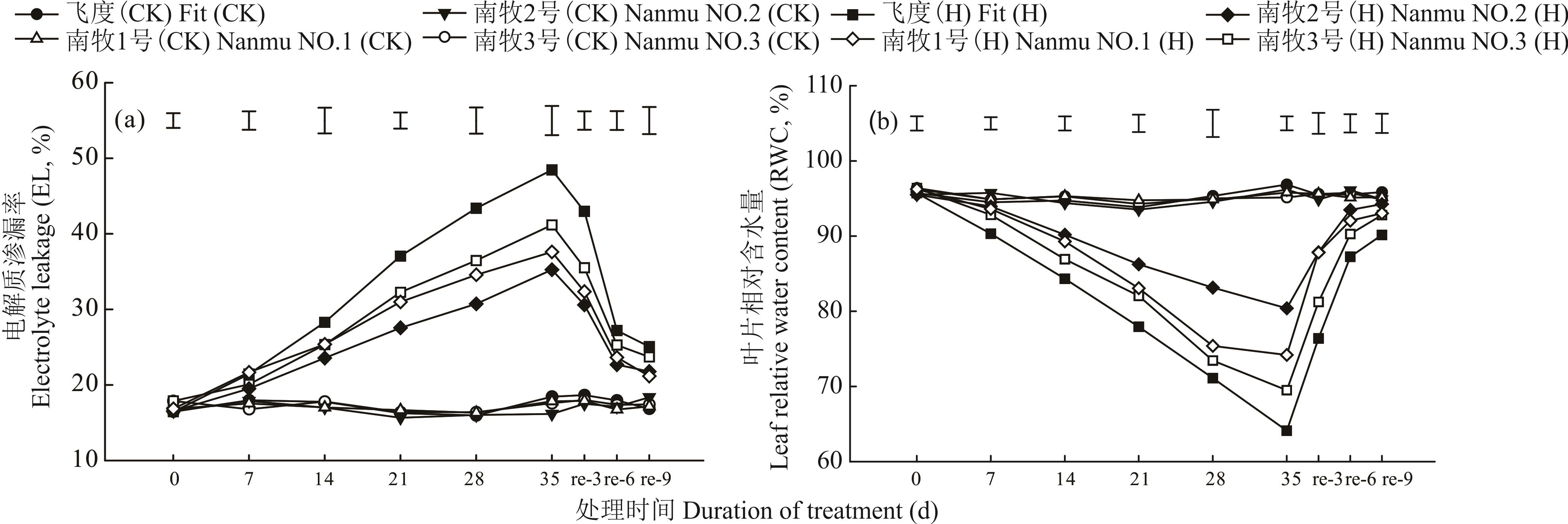
Fig.1 Effects of heat stress and post-heat recovery on electrolyte leakage and leaf relative water content in tall fescue
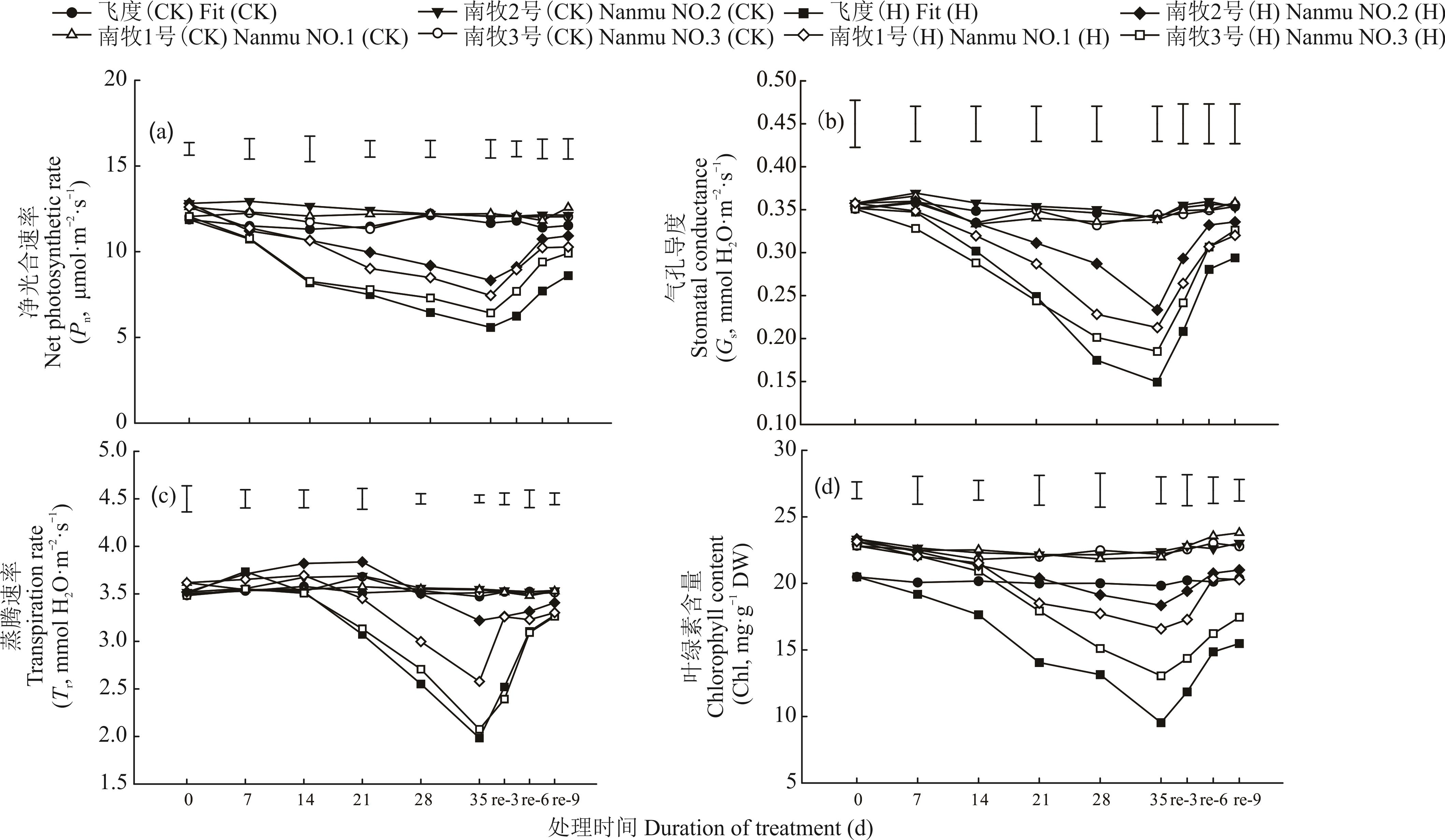
Fig.2 Effects of heat stress and post-heat recovery on photosynthetic indices in tall fescue
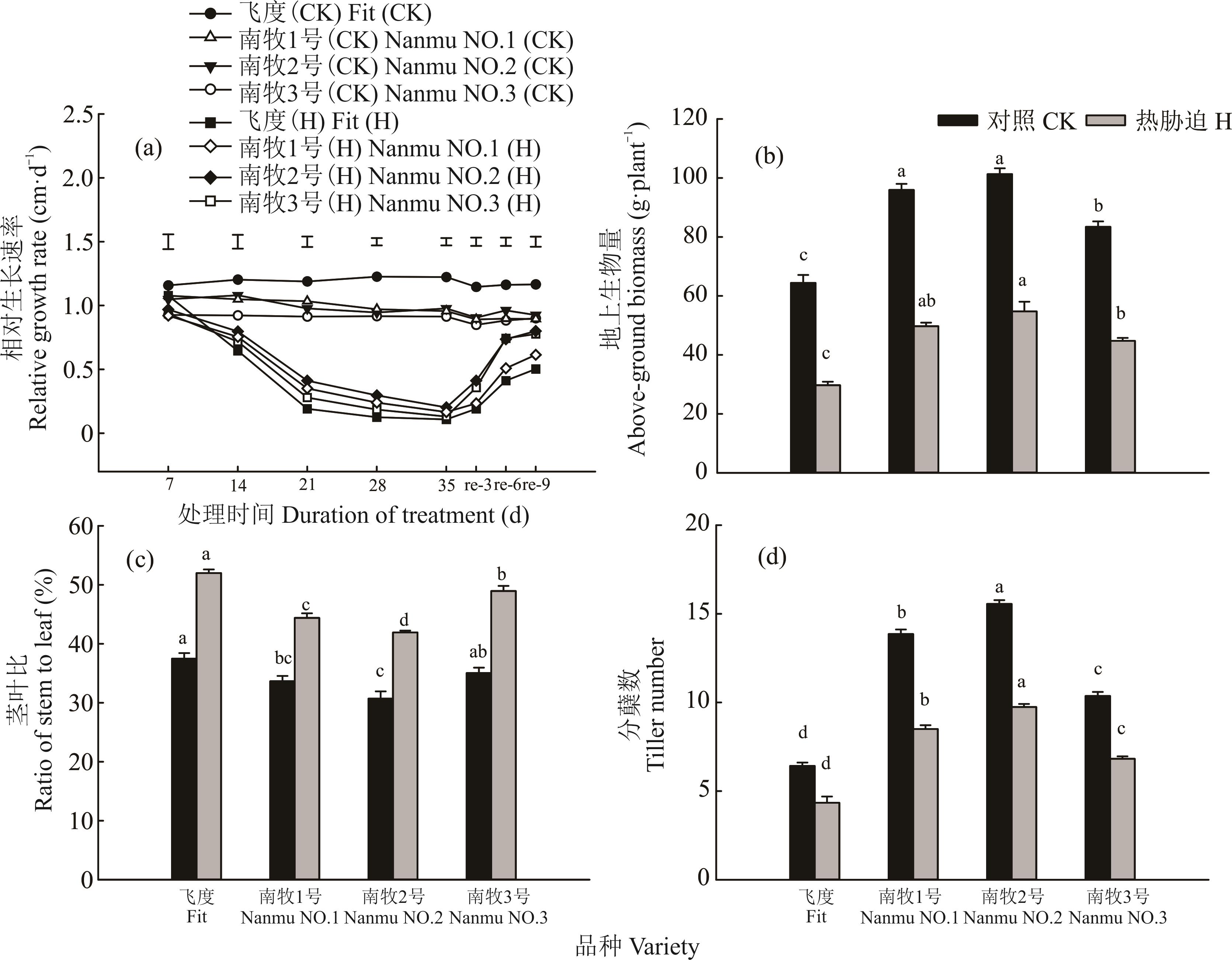
Fig.3 Effects of heat stress and post-heat recovery on plant growth in tall fescue

Fig.4 Effects of heat stress on nutritional indicators in tall fescue
| [1] | Li S S, Lu J Y, Yan J P, et al. Spatiotemporal variability of temperature in northern and southern Qinling Mountains and its influence on climatic boundary. Acta Geographica Sinica, 2018, 73(1): 13-24. |
| 李双双, 芦佳玉, 延军平, 等. 1970-2015年秦岭南北气温时空变化及其气候分界意义. 地理学报, 2018, 73(1): 13-24. | |
| [2] | Liu D L, Wang X P, Hu K Q, et al. Adaptability evaluation of cool-season turf grasses in Yangzhou. Acta Agrestia Sinica, 2012, 20(5): 967-971. |
| 刘大林, 王秀萍, 胡楷崎, 等. 15种冷季型草坪草在扬州地区的适应性评价. 草地学报, 2012, 20(5): 967-971. | |
| [3] | Ye Z W, Ji X, Liu Y X. Temporal change of air temperature in a typical north-south transitional climatic zone-a case study in Huaihe river basin. Chinese Journal of Agricultural Resources and Regional Planning, 2018, 39(3): 122-131. |
| 叶正伟, 纪旭, 刘育秀. 典型南北气候过渡带地区气温的时间变化特征—以淮河流域为例. 中国农业资源与区划, 2018, 39(3): 122-131. | |
| [4] | Young C A, Hume D E, Mcculley R L. Forages and pastures symposium: Fungal endophytes of tall fescue and perennial ryegrass: pasture friend or foe? Journal of Animal Science, 2013, 91(5): 2379-2394. |
| [5] | Xie X H, Ma Z J. Research on adaptability of the cool season turfgrasses in transitional climatic zone. Grassland of China, 2000(5): 56-59. |
| 谢晓鸿, 马子骏. 冷季型草坪草在过渡气候带的适应性研究. 中国草地, 2000(5): 56-59. | |
| [6] | Wang M T, Zhao Y H, Fang J P, et al. Evaluation of production performance and nutritional quality of two gramineae grasses in Linzhi City, Tibet. Feed Research, 2022, 45(1): 113-117. |
| 王明涛, 赵玉红, 方江平, 等. 西藏林芝2种禾草生产性能和营养品质评价. 饲料研究, 2022, 45(1): 113-117. | |
| [7] | Sun J X. Introduction test of nine American forage species in the eastern section of Gansu Hexi Corridor. Journal of Gansu Agricultural University, 1995, 30(4): 312-315. |
| 孙吉雄. 美国九种饲草在甘肃河西走廊东段的引种试验. 甘肃农业大学学报, 1995, 30(4): 312-315. | |
| [8] | Li Z H, Liu Y X, Wang H S. Study on the growth characteristics and quality of hybrid progeny between multiflora ryegrass×reedy fescue. Pratacultural Science, 1999, 16(4): 22-24. |
| 李志华, 刘亚雄, 王槐三. 多花黑麦草×苇状羊茅属间杂交后代生长特性及品质的研究. 草业科学, 1999, 16(4): 22-24. | |
| [9] | Wu J H, Mu Q, Tang C B, et al. Breeding of Qiancao 1, a new Festuca arundinacea variety. Guizhou Agricultural Sciences, 2006, 34(4): 75-79. |
| 吴佳海, 牟琼, 唐成斌, 等. 牧草新品种黔草1号高羊茅的选育. 贵州农业科学, 2006, 34(4): 75-79. | |
| [10] | Wang Y F, Li W, Han Y S, et al. Evaluation on nutritional value of six forages and straws. Modern Animal Husbandry Science & Technology, 2023, 103(12): 65-68. |
| 王艳菲, 李伟, 韩永胜, 等. 6种禾本科牧草及秸秆的营养品质评价. 现代畜牧科技, 2023, 103(12): 65-68. | |
| [11] | Cao Y H, Yang F, Chen S M, et al. Nutritional value analysis of seven common forage plants in southern China. China Feed, 2020(17): 117-121. |
| 曹艳红, 杨帆, 陈少梅, 等. 南方七种常见饲用植物营养价值分析. 中国饲料, 2020(17): 117-121. | |
| [12] | Yu J J, Du H M, Xu M, et al. Metabolic responses to heat stress under elevated atmospheric CO2 concentration in a cool-season grass species. Journal of the American Society for Horticultural Science, 2012, 137(4): 221-228. |
| [13] | Yu J J, Yang Z M, Jespersen D, et al. Photosynthesis and protein metabolism associated with elevated CO2 mitigation of heat stress damages in tall fescue. Environmental and Experimental Botany, 2014, 99: 75-85. |
| [14] | Yu J J, Chen L H, Xu M, et al. Effects of elevated CO2 on physiological responses of tall fescue to elevated temperature, drought stress, and the combined stresses. Crop Science, 2012, 52(4): 1848-1858. |
| [15] | Yun X J, Yuan Q H, Su J K, et al. Code of practice for herbage variety registration: GB/T 30395-2013. Beijing: China Standard Press, 2014. |
| 贠旭疆, 袁庆华, 苏加楷, 等. 草品种审定技术规程: GB/T 30395-2013. 北京: 中国标准出版社, 2014. | |
| [16] | Zhang L Y. Feed analysis and feed quality testing technology. Beijing: China Agricultural University Press, 2007. |
| 张丽英. 饲料分析及饲料质量检测技术. 北京: 中国农业大学出版社, 2007. | |
| [17] | Liang Y L, Xiang Q H, Zhang D H. The influence of illumination intensity and temperature on tillering of Festuca rubra L. Pennlawn. Journal of Grassland and Forage Science, 1999(2): 32-34. |
| 梁应林, 向清华, 张定红. 光照强度和温度对紫羊茅分蘖的影响. 四川草原, 1999(2): 32-34. | |
| [18] | Yang Y W, Liu D L, Wang L. Research progress on the effects of high temperature stress on Festuca arundinacea. Journal of Grassland and Forage Science, 2022(1): 15-22. |
| 杨雨薇, 刘大林, 王琳. 高羊茅对高温胁迫应答机制的研究进展. 草学, 2022(1): 15-22. | |
| [19] | Ran M L, Song M, Song H, et al. Study on the identification technique system of heat tolerance for radish. Chinese Agricultural Science Bulletin, 2006, 22(11): 248-252. |
| 冉茂林, 宋明, 宋华, 等. 萝卜耐热性鉴定技术体系研究. 中国农学通报, 2006, 22(11): 248-252. | |
| [20] | Wang Q, Wang K, Yu J J, et al. Effects of LBD on improving heat tolerance in creeping bentgrass. Pratacultural Science, 2020, 37(6): 1066-1073. |
| 王茜, 王恺, 于景金, 等. 绿比多对匍匐剪股颖耐热性的影响. 草业科学, 2020, 37(6): 1066-1073. | |
| [21] | Chu M, Zhuang Z Q, Wang X F, et al. Physiological responses of radish seedlings with different heat tolerance to high temperature stress. Journal of Shandong Agricultural University, 2014, 45(3): 334-339. |
| 初敏, 庄志群, 王秀峰, 等. 不同耐热性萝卜幼苗对高温胁迫的生理响应. 山东农业大学学报, 2014, 45(3): 334-339. | |
| [22] | Jia K Z, Chen G L. Tolerance of different eggplant varieties at seedling stage to high temperature stress. Chinese Journal of Ecology, 2005, 24(4): 398-401. |
| 贾开志, 陈贵林. 高温胁迫下不同茄子品种幼苗耐热性研究. 生态学杂志, 2005, 24(4): 398-401. | |
| [23] | Liu Q, Sun H, He D W. Plant responses to the high temperature and moisture stress. Journal of China West Normal University (Natural Sciences Edition), 2005, 26(4): 364-368. |
| 刘琴, 孙辉, 何道文. 干旱和高温对植物胁迫效应的研究进展. 西华师范大学学报(自然科学版), 2005, 26(4): 364-368. | |
| [24] | Ji P, Liu J W, Wang X T, et al. Response of leaf physiological characteristics of different rice varieties to heat stress at seedling stage. Journal of Northwest A & F University (Natural Science Edition), 2024, 52(1): 36-48. |
| 季平, 刘经威, 王欣婷, 等. 不同水稻品种苗期叶片生理特性对高温胁迫的响应. 西北农林科技大学学报(自然科学版), 2024, 52(1): 36-48. | |
| [25] | Yan L, Li X T, Chao Y. Study advance on inheritance and breeding in tall fescue. Modern Agricultural Science and Technology, 2014(11): 275-276. |
| 颜兰, 李选统, 晁赢. 高羊茅遗传育种研究进展. 现代农业科技, 2014(11): 275-276. | |
| [26] | Gao G L, Feng Q, Zhang X Y, et al. An overview of stomatal and non-stomatal limitations to photosynthesis of plants. Arid Zone Research, 2018, 35(4): 929-937. |
| 高冠龙, 冯起, 张小由, 等. 植物叶片光合作用的气孔与非气孔限制研究综述. 干旱区研究, 2018, 35(4): 929-937. | |
| [27] | Zhao Z J, Hu L X, Hu T, et al. Differential metabolic responses of two tall fescue genotypes to heat stress. Acta Prataculturae Sinica, 2015, 24(3): 58-69. |
| 赵状军, 胡龙兴, 胡涛, 等. 不同品系高羊茅应答高温胁迫的初级代谢产物分析. 草业学报, 2015, 24(3): 58-69. | |
| [28] | Chen H Y, Ma S X, Guo P H. Research progress of high temperature stress on physiological characteristics of plants. Anhui Agricultural Science Bulletin, 2021, 27(5): 11-13. |
| 陈慧颖, 马石霞, 郭鹏辉. 热胁迫对植物生理影响的研究进展. 安徽农学通报, 2021, 27(5): 11-13. | |
| [29] | Lensch M, Herrmann R G, Sokolenko A. Identification and characterization of SppA, a novel light inducible chloroplast protease complex associated with thylakoid membranes. Journal of Biological Chemistry, 2001, 276(36): 33645-33651. |
| [30] | Wang X T, Liu X N, Tang J W, et al. Comparison of yield and nutritional quality of 4 graminaceous forages on plateau under arid environment. Grassland and Turf, 2022, 42(1): 57-61, 68. |
| 王晓彤, 柳小妮, 唐俊伟, 等. 干旱环境下4种高原禾本科牧草产量及营养品质比较. 草原与草坪, 2022, 42(1): 57-61, 68. | |
| [31] | Chen Y, Wang Q, Chen X, et al. Effects of nitrogen deficiency stress on physiological characteristics of Festuca arundinacea at seedling stage. Chinese Journal of Grassland, 2022, 44(2): 9-15. |
| 陈莹, 王茜, 陈锡, 等. 低氮胁迫对高羊茅苗期生理特性的影响. 中国草地学报, 2022, 44(2): 9-15. | |
| [32] | Sun X X, Peng J, Jiang Y F, et al. Nutritional value and molecular structure characteristics in different parts of Festuca sinensis from Qinghai-Tibet Plateau. Chinese Journal of Animal Nutrition, 2023, 35(3): 1850-1862. |
| 孙晓旭, 彭婧, 江雨霏, 等. 青藏高原中华羊茅不同部位的营养价值及分子结构特性研究. 动物营养学报, 2023, 35(3): 1850-1862. | |
| [33] | Li J Q, Wang L H, Zhan Q W, et al. The correlation study of SPAD value, chlorophyll content and crude protein content in two varieties of Lolium perenne. Pratacultural Science, 2010, 27(10): 39-42. |
| 李杰勤, 王丽华, 詹秋文, 等. 2个黑麦草品种SPAD值和叶绿素及粗蛋白含量的相关性研究. 草业科学, 2010, 27(10): 39-42. | |
| [34] | Wang H L, Zhang Y K, Zhao C C, et al. Effects of nitrogen levels on photosynthetic physiology and feeding quality of bermudagrass. Pratacultural Science, 2021, 38(3): 514-522. |
| 王宏力, 张寅坤, 赵春程, 等. 氮素水平对狗牙根光合生理及饲用品质的影响. 草业科学, 2021, 38(3): 514-522. | |
| [35] | Wang M T, Zhao Y H, Miao Y J, et al. Study on forage quality of mixed planting Medicago sativa L. and Festuca elata Keng ex E. Alexeev in Nyingchi Valley, Tibet. Acta Agrestia Sinica, 2022, 30(6): 1590-1596. |
| 王明涛, 赵玉红, 苗彦军, 等. 西藏林芝河谷地带紫花苜蓿和高羊茅混播牧草品质研究. 草地学报, 2022, 30(6): 1590-1596. | |
| [36] | Zhang X Q, Jin Y M, Tian J C, et al. Seasonal changes of nutrient content and in vitro digestibility of five grass species in Tibetan alpine grassland. Chinese Journal of Grassland, 2022, 44(1): 71-77. |
| 张晓庆, 金艳梅, 田峻成, 等. 西藏高寒草原5种牧草养分含量及体外消化率季节变化. 中国草地学报, 2022, 44(1): 71-77. |
| [1] | Qing-yuan DENG, Dong-qing FU, Rong-zheng HUANG, Fan-fan ZHANG, Guo-jun SUN. Effects of pine needle essential oil on the quality and aerobic stability of Broussonetia papyrifera silage [J]. Acta Prataculturae Sinica, 2025, 34(10): 85-94. |
| [2] | Shi-yang ZHANG, Feng-min LIU, Jun-tao CUI, Lei HE, Yue-yan FENG, Wei-li ZHANG. Effects of three exogenous substances on the physiological and fluorescence characteristics of Stylosanthes guianensis under low-temperature stress [J]. Acta Prataculturae Sinica, 2023, 32(6): 85-99. |
| [3] | Ai-yu LIU, Chao WANG, Zhan-jun WU, Shou-pei ZHAO, Li-chen ZHAO, Xiao-yu LI, Wei-tao ZHANG, Le-tian WANG, Yu-hong GAO. Impact of heat stress on growth rate, serum antioxidant properties, and rumen flora in weaned lambs [J]. Acta Prataculturae Sinica, 2023, 32(4): 173-182. |
| [4] | Meng-jun LIU, Yue REN. Meat quality and nutritional indexes of three muscles of the F1 generation of crossbred sheep (Suffolk×river valley-type Tibetan) raised under grazing conditions [J]. Acta Prataculturae Sinica, 2023, 32(11): 140-154. |
| [5] | Juan-juan ZHAO, Da-lu CHE, Wei-ting GUO, Wei-tao ZHANG, Lian-chao LIU, Li-chen ZHAO, Yu-hong GAO, Xin-sheng SUN, Xue-mei LI, Yuan WANG. Effect of a Chinese medicine formula on the performance and physiological and blood biochemical parameters of hybrid Small-Tail Han sheep under heat stress [J]. Acta Prataculturae Sinica, 2022, 31(5): 178-189. |
| [6] | Wen-rui CHEN, Zhao JIANG, Qi-xin ZHOU, Yun-qin WANG, column:LI Chun-ming, Peng-hui GUO, Hui-xia LIU. Effects of silicon on biomass allocation and uptake and utilization of nitrogen, phosphorus, and potassium in two tall fescue (Festuca arundinacea) cultivars under different salinity conditions [J]. Acta Prataculturae Sinica, 2022, 31(5): 51-60. |
| [7] | Ning ZHAO, Hui-ling MA, Ran ZHANG, Jin-qing ZHANG, Yi SHI. Regulatory effects of butanediol on the expression level of endogenous hormones and related genes in creeping bentgrass under heat stress [J]. Acta Prataculturae Sinica, 2022, 31(12): 118-132. |
| [8] | Zhi-min YANG, Rui XING, Yun-jia DING, Li-li ZHUANG. Analysis of differentially expressed genes in relation to tiller development and plant height based on transcriptomic sequencing of two tall fescue cultivars [J]. Acta Prataculturae Sinica, 2022, 31(1): 145-163. |
| [9] | Tao-tao LIU, Si-wei WANG, Qiu-feng LI, Yu-feng CAO, Kun WANG, Li-juan WANG, Yi-zhao SHEN, Xue-li SUN, Mei-qi ZHANG, Jin-ling YAN, Jian-guo LI, Yan-xia GAO, Mei-mei WANG. Ruminal degradation characteristics of whole maize plant material before and after ensiling in beef cattle as determined in situ using the nylon bag method [J]. Acta Prataculturae Sinica, 2021, 30(1): 159-169. |
| [10] | ZHANG Rong, CHEN Guang-ji, SHANG Yi-shun, LI Shi-ge, LI Xiao-dong, XIONG Xian-qin, MU Qiong, WANG Xiao-li, RAN Wei-nan, BAN Song-zhi. Effects of fresh feeding Fagopyrum dibotrys on performance, egg quality and serum index of heat stressed laying hens [J]. Acta Prataculturae Sinica, 2020, 29(9): 179-189. |
| [11] | ZHAO Na, YANG Xue-hai, WEI Jin-tao, GUO Wan-zheng, CHEN Fang, ZHOU Guang-sheng, FU Ting-dong. Nutritional composition of forage rape and its rumen degradation characteristics in goats [J]. Acta Prataculturae Sinica, 2020, 29(5): 50-57. |
| [12] | LIU Hong-qing, FU Dan-dan, WU Hai-jie, MIAO Fu-hong, SUN Juan, YANG Guo-feng. Effects of rotation systems on yields and physiological indicators of wheat [J]. Acta Prataculturae Sinica, 2018, 27(8): 59-66. |
| [13] | ZHUANG Li-li, WANG Jian, YANG Zhi-min. Transcriptome-wide identification and expression analysis of HD-Zip I transcription factors in Festuca arundinacea [J]. Acta Prataculturae Sinica, 2018, 27(3): 67-77. |
| [14] | LIANG Xiao-yu, JI Yang, YI Jun, FU Mao-zhong, HU Yuan-bin. Effects of mixing ratio and additives on ensilage efficiency of mixed chicory and silage maize [J]. Acta Prataculturae Sinica, 2018, 27(2): 173-181. |
| [15] | LIU Hui-xia, LIN Li-guo, WU Wen-li, LIN Xuan-dong, SONG Rui. Effect of silicon supply on the salt tolerance of two tall fescue (Festuca arundinacea) varieties with different salt resistance levels [J]. Acta Prataculturae Sinica, 2018, 27(10): 84-92. |
| Viewed | ||||||
|
Full text |
|
|||||
|
Abstract |
|
|||||
