
ISSN 1004-5759 CN 62-1105/S
Acta Prataculturae Sinica ›› 2025, Vol. 34 ›› Issue (9): 78-86.DOI: 10.11686/cyxb2024386
Previous Articles Next Articles
Ning CHEN1( ), Feng-xuan BAO2, Hui-xiang ZHAO2, Nan WANG2, Ru-yu JIANG2, Guo-liang LI2, Xiang-ping LIU2, Shan-min QU2, Wei-guang YANG2()
Received:2024-10-10
Revised:2024-11-25
Online:2025-09-20
Published:2025-07-02
Contact:
Wei-guang YANG
Ning CHEN, Feng-xuan BAO, Hui-xiang ZHAO, Nan WANG, Ru-yu JIANG, Guo-liang LI, Xiang-ping LIU, Shan-min QU, Wei-guang YANG. Physiological characteristics of the alfalfa root collar during overwintering under soda saline-alkali stress in cold areas[J]. Acta Prataculturae Sinica, 2025, 34(9): 78-86.
品种 Variety | 来源 Source | 抗寒级 Cold resistance | 秋眠级 Fall dormancy | 越冬率 Wintering rate (%) |
|---|---|---|---|---|
龙牧801 Longmu No.801 M. ruthenica Sojak×M. sativa ‘Longmu No.801’ | 黑龙江省农业科学院Heilongjiang Academy of Agricultural Sciences | - | 1.0 | 96.59±1.04a |
| 骑士T Stockpile M. sativa ‘Stockpile’ | 北京佰青源畜牧业科技发展有限公司Beijing Baiqingyuan Animal Husbandry Technology Development Co., Ltd. | 1.4 | 3.9 | 83.54±0.99b |
Table 1 Source and materials of tested alfalfa
品种 Variety | 来源 Source | 抗寒级 Cold resistance | 秋眠级 Fall dormancy | 越冬率 Wintering rate (%) |
|---|---|---|---|---|
龙牧801 Longmu No.801 M. ruthenica Sojak×M. sativa ‘Longmu No.801’ | 黑龙江省农业科学院Heilongjiang Academy of Agricultural Sciences | - | 1.0 | 96.59±1.04a |
| 骑士T Stockpile M. sativa ‘Stockpile’ | 北京佰青源畜牧业科技发展有限公司Beijing Baiqingyuan Animal Husbandry Technology Development Co., Ltd. | 1.4 | 3.9 | 83.54±0.99b |
土壤类型 Soil type | pH | 电导率 Conductivity (mS·cm-1) | CO32-含量 CO32- content (g·kg-1) | HCO3-含量HCO3- content (g·kg-1) | Cl-含量 Cl- content (g·kg-1) | SO42-含量 SO42- content (g·kg-1) | Na+含量 Na+ content (g·kg-1) | 碱解氮含量 Available nitrogen (mg·kg-1) | 有效磷含量 Available phosphorus (mg·kg-1) |
|---|---|---|---|---|---|---|---|---|---|
| 苏打盐碱土Soda saline-alkali soil | 8.9 | 0.22 | 0.0026 | 0.81 | 0.32 | 0.62 | 1.63 | 102.75 | 12.31 |
Table 2 Soil types and physical and chemical properties of sample area
土壤类型 Soil type | pH | 电导率 Conductivity (mS·cm-1) | CO32-含量 CO32- content (g·kg-1) | HCO3-含量HCO3- content (g·kg-1) | Cl-含量 Cl- content (g·kg-1) | SO42-含量 SO42- content (g·kg-1) | Na+含量 Na+ content (g·kg-1) | 碱解氮含量 Available nitrogen (mg·kg-1) | 有效磷含量 Available phosphorus (mg·kg-1) |
|---|---|---|---|---|---|---|---|---|---|
| 苏打盐碱土Soda saline-alkali soil | 8.9 | 0.22 | 0.0026 | 0.81 | 0.32 | 0.62 | 1.63 | 102.75 | 12.31 |
编号 Code | 采样日期 Sampling date | 最高温度 Maximum temperature (℃) | 最低温度 Minimum temperature (℃) |
|---|---|---|---|
| T1 | 2023-09-26 | 22 | 14 |
| T2 | 2023-10-28 | 13 | 2 |
| T3 | 2023-11-28 | -12 | -18 |
| T4 | 2023-12-30 | -13 | -17 |
| T5 | 2024-02-28 | -6 | -15 |
| T6 | 2024-04-24 | 18 | 10 |
Table 3 Sampling period and temperature
编号 Code | 采样日期 Sampling date | 最高温度 Maximum temperature (℃) | 最低温度 Minimum temperature (℃) |
|---|---|---|---|
| T1 | 2023-09-26 | 22 | 14 |
| T2 | 2023-10-28 | 13 | 2 |
| T3 | 2023-11-28 | -12 | -18 |
| T4 | 2023-12-30 | -13 | -17 |
| T5 | 2024-02-28 | -6 | -15 |
| T6 | 2024-04-24 | 18 | 10 |
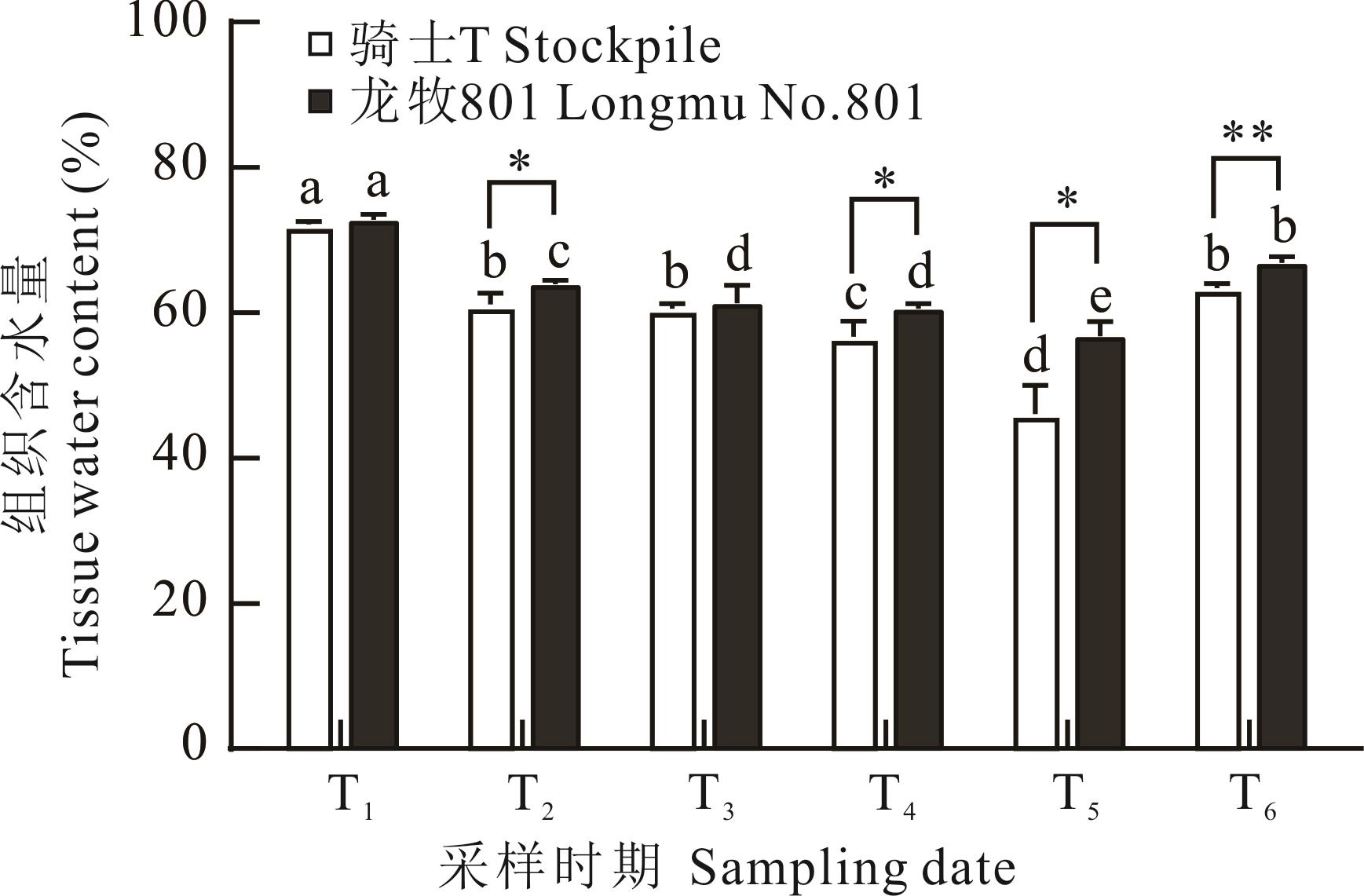
Fig.1 The tissue water content in root collar of different alfalfa varieties during overwintering stage
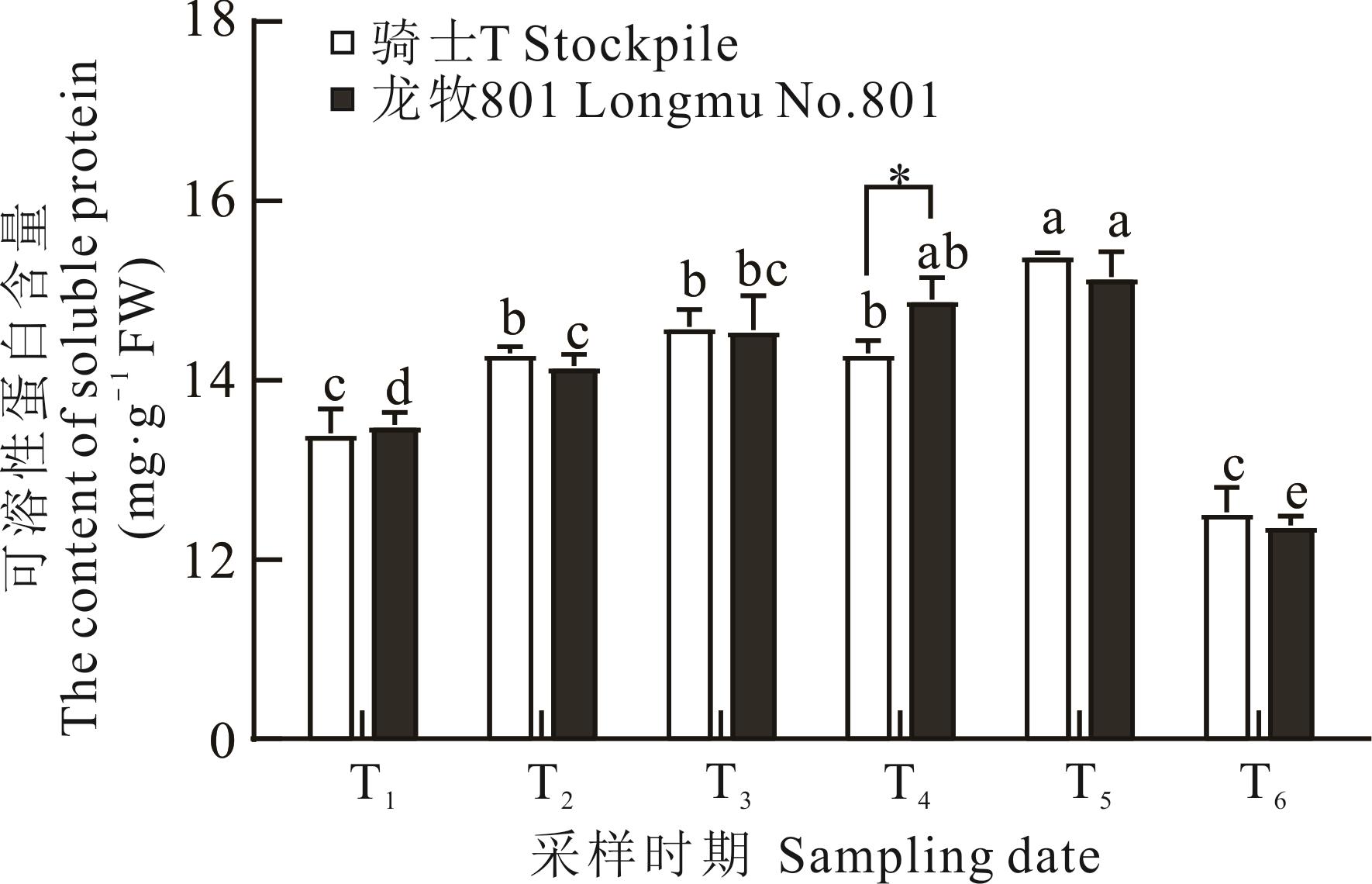
Fig.2 The soluble protein content in root collar of different alfalfa varieties during overwintering stage
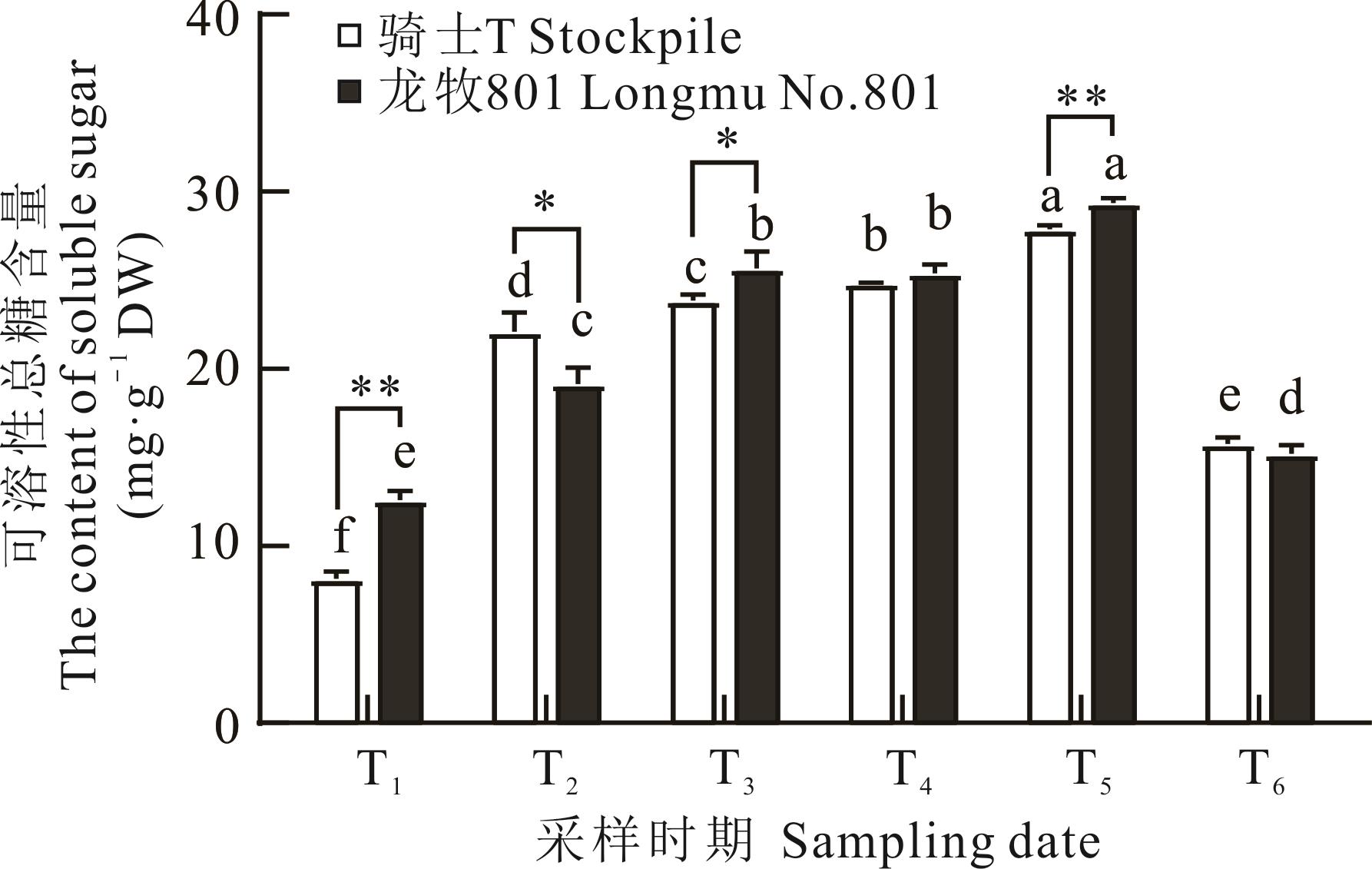
Fig.3 The soluble sugar content in root collar of different alfalfa varieties during overwintering stage
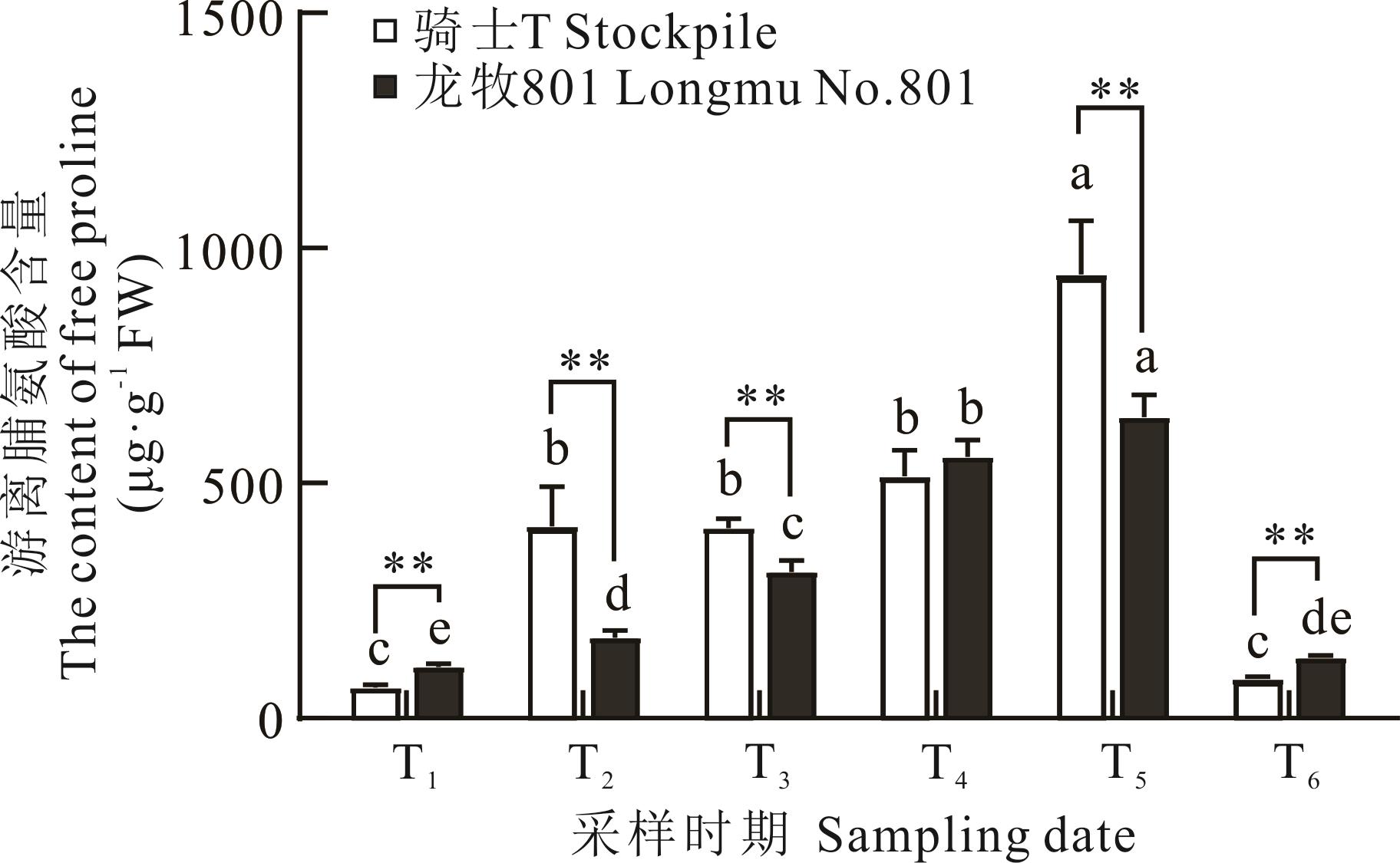
Fig.4 The content of free proline in root collar of different alfalfa varieties during overwintering stage
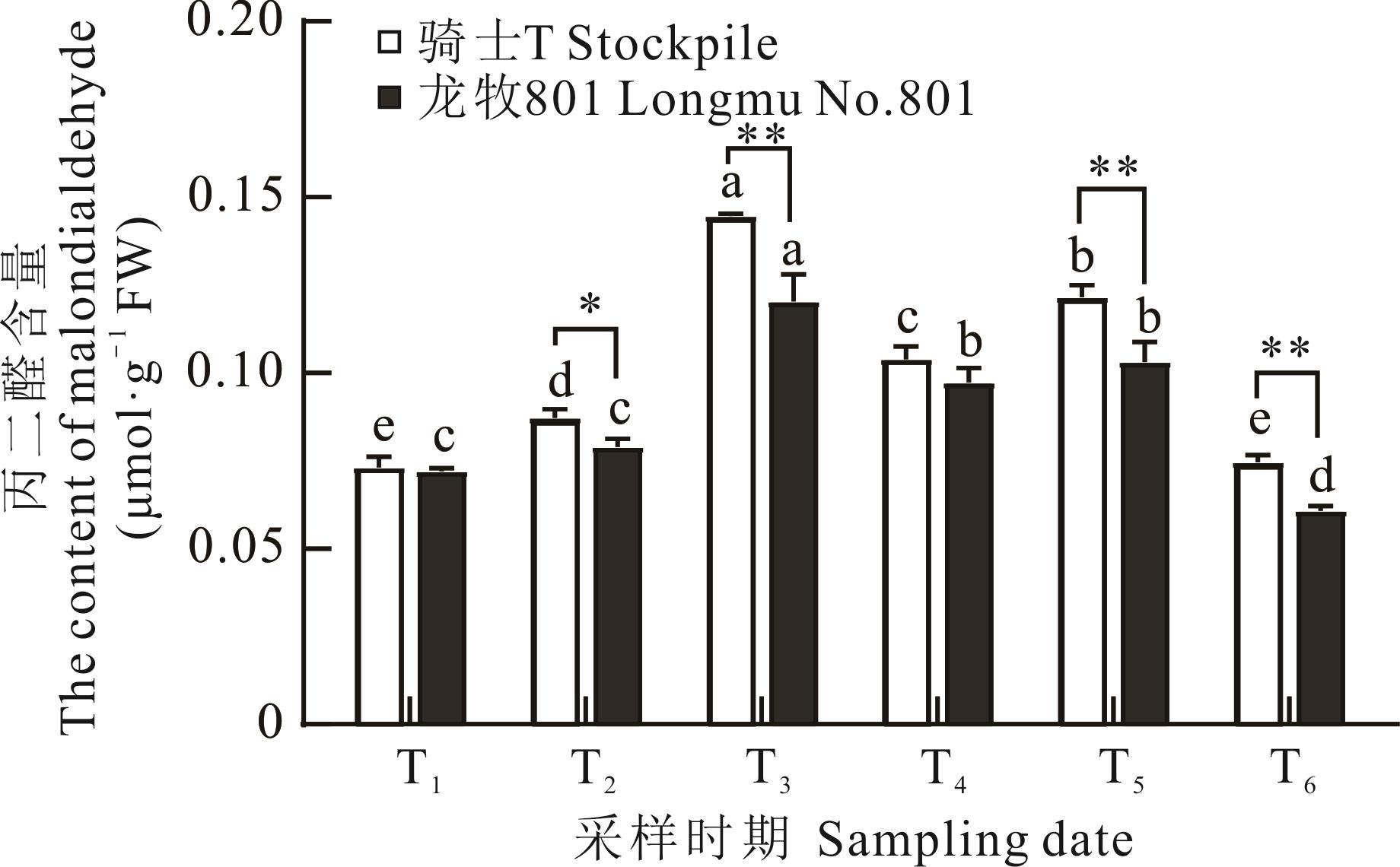
Fig.5 The malondialdehyde content in root collar of different alfalfa varieties during overwintering stage
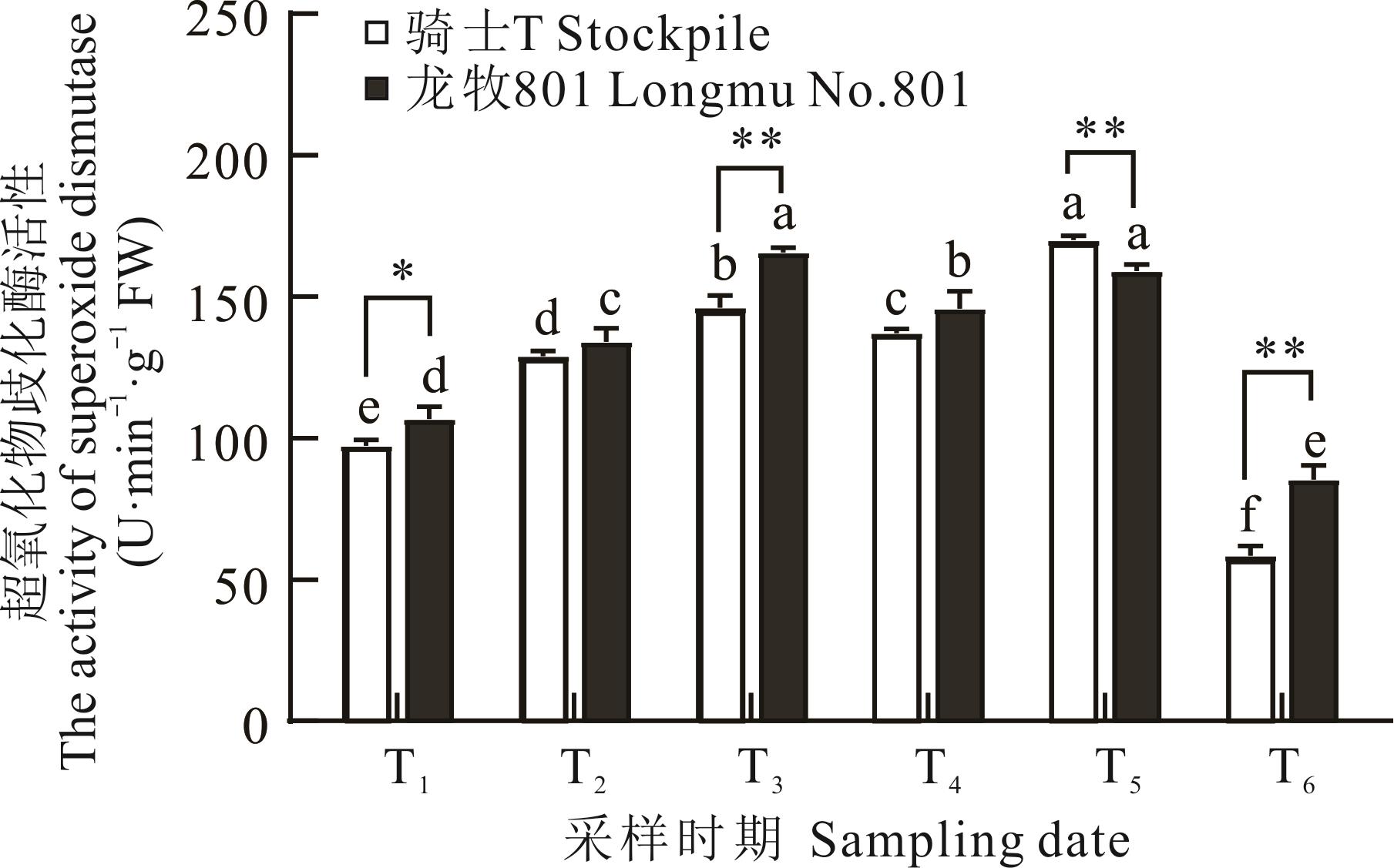
Fig.6 The superoxide dismutase activity in root collar of different alfalfa varieties during overwintering stage
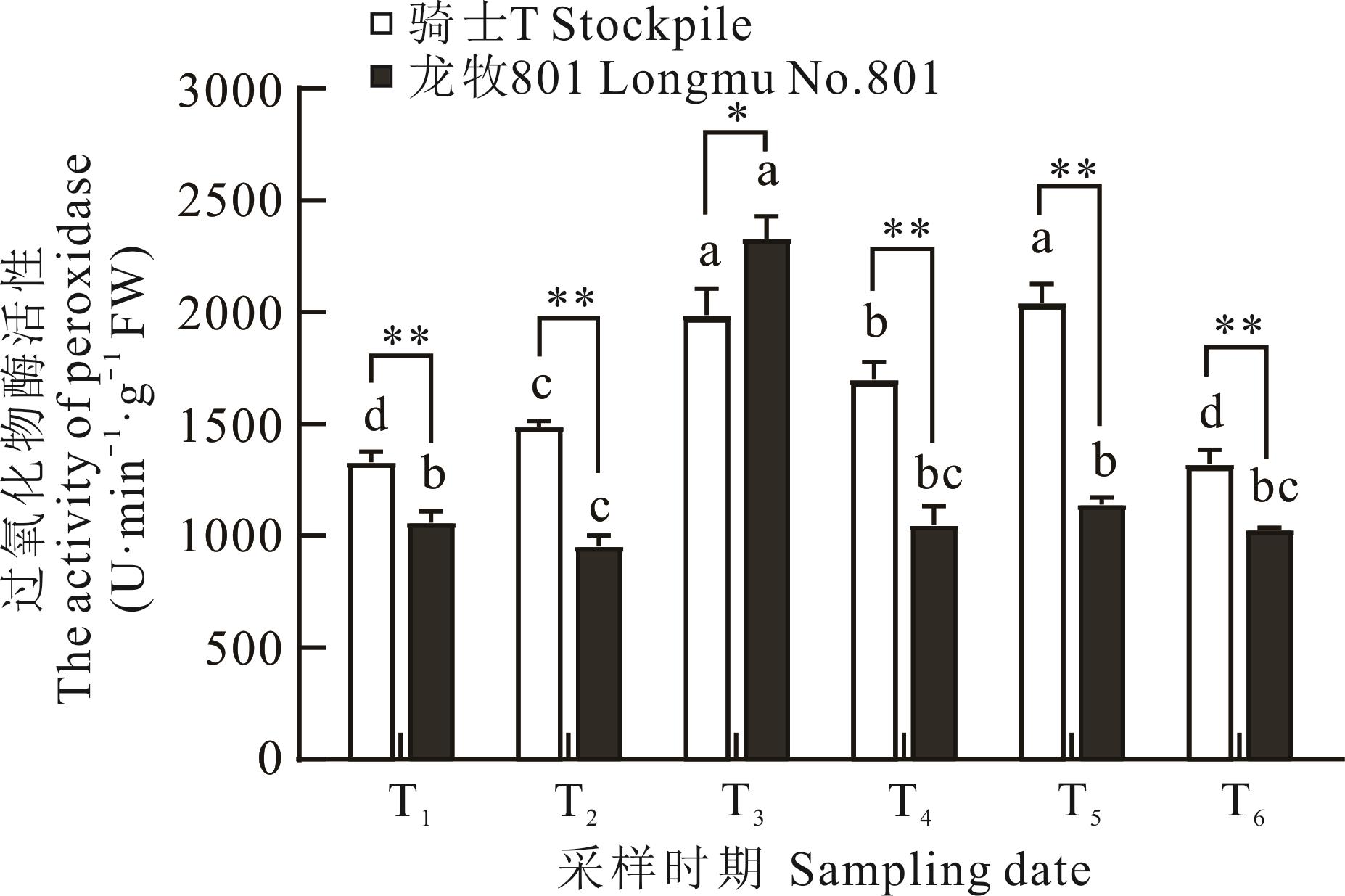
Fig.7 The peroxidase activity in root collar of different alfalfa varieties during overwintering stage
| [1] | Zhou C J, Wu Y K, Yu J D, et al. Current situation and technical requirements of soybean production in saline-alkali areas in western Heilongjiang Province. Heilongjiang Agricultural Sciences, 2023, 2(10): 72-77. |
| 周长军, 吴耀坤, 于吉东, 等. 黑龙江省西部盐碱核心区大豆生产现状与技术需求. 黑龙江农业科学, 2023, 2(10): 72-77. | |
| [2] | Cui W L. Soil salinization in Daqing area based on GIS technology feature analysis. Harbin: Heilongjiang University, 2024. |
| 崔文龙. 基于GIS技术的大庆地区土壤盐渍化特征分析. 哈尔滨: 黑龙江大学, 2024. | |
| [3] | Wang D, Li D, Sun P P, et al. Extension increment-current situation and countermeasure of grass improvement in saline-alkali land. Agriculture and Technology, 2024, 44(17): 1-4. |
| 王笛, 李达, 孙萍萍, 等. 拓面增量-盐碱地种草改良现状及对策. 农业与技术, 2024, 44(17): 1-4. | |
| [4] | Li Y, Ma F L, Han L, et al. Productivity and adaptability of ‘WL’ alfalfa varieties with different fall dormancy in the extremely arid region of Southern Xinjiang. Acta Prataculturae Sinica, 2024, 33(3): 139-149. |
| 李妍, 马富龙, 韩路, 等. 美国‘WL’系列不同秋眠级苜蓿品种在南疆的生产性能与适应性评价. 草业学报, 2024, 33(3): 139-149. | |
| [5] | Wang Q, Wu J, Di G, et al. Identification of cold tolerance transcriptional regulatory genes in seedlings of Medicago sativa L. and Medicago falcata L. International Journal of Molecular Sciences, 2024, 25(19): 10345. |
| [6] | Huo Z H, Song L L, Chen Y, et al. Research progress on genetic breeding of alfalfa and cold resistant resources. Prataculture & Animal Husbandry, 2015, 36(1): 8-11. |
| 霍智慧, 宋丽莉, 陈月, 等. 紫花苜蓿耐寒育种研究进展. 草业与畜牧, 2015, 36(1): 8-11. | |
| [7] | Li Y F, Bao G Z, Liu X T, et al. Physiological response of Medicago sativa under freezing-thawing and salinity-alkalinity stress. Jiangsu Agricultural Sciences, 2016, 44(7): 278-281. |
| 李艳芳, 包国章, 刘晓婷, 等. 冻融及碱性盐胁迫下紫花苜蓿幼苗的生理响应. 江苏农业科学, 2016, 44(7): 278-281. | |
| [8] | Sun Q Z, Gui R, Han J G. Research on winter injury and prevent technique of alfalfa (Medicago sativa L. cv. ‘Aohan’) in Chifeng Region. Acta Agrestia Sinica, 2001, 9(1): 50-57. |
| 孙启忠, 桂荣, 韩建国. 赤峰地区敖汉苜蓿冻害及其防御技术. 草地学报, 2001, 9(1): 50-57. | |
| [9] | Liu X P, Li G L, Cui G W. Research progress of alfalfa cold resistance. Feed Review, 2006, 18(12): 11-13. |
| 刘香萍, 李国良, 崔国文. 紫花苜蓿抗寒性研究进展. 饲料博览, 2006, 18(12): 11-13. | |
| [10] | Han Q F, Wu X W, Jia Z K, et al. Analysis on dynamic variety of crown characteristics of different fall dormancy Medicago sativa cultivars. Acta Prataculturae Sinica, 2008, 17(4): 85-91. |
| 韩清芳, 吴新卫, 贾志宽, 等. 不同秋眠级数苜蓿品种根颈变化特征分析. 草业学报, 2008, 17(4): 85-91. | |
| [11] | Zhu K, Fang Z J, Li S, et al. Effects of double stress of freezing thawing and saline alkali on the absorption and transportation of mineral ions in the vegetative organs of alfalfa seedlings. Acta Agrestia Sinica, 2023, 31(6): 1818-1825. |
| 朱琨, 方志坚, 李帅, 等. 冻融及盐碱双重胁迫对苜蓿幼苗营养器官矿质离子吸收及运输的影响. 草地学报, 2023, 31(6): 1818-1825. | |
| [12] | Zhu C C, Shi K, He Q K, et al. Response of ‘Zhongmu No.1’ alfalfa seedlings to mixed saline-alkali stress. Chinese Journal of Grassland, 2024, 46(8): 1-9. |
| 朱晨晨, 史昆, 何沁坤, 等. 中苜一号紫花苜蓿幼苗对混合盐碱胁迫的响应. 中国草地学报, 2024, 46(8): 1-9. | |
| [13] | Wang M, Li L, Jia R, et al. Evaluation of physiological characteristics and cold resistance of 10 alfalfa varieties under low temperature stress. Acta Prataculturae Sinica, 2024, 33(6): 76-88. |
| 王敏, 李莉, 贾蓉, 等. 10种紫花苜蓿在低温胁迫下的生理特性及耐寒性评价. 草业学报, 2024, 33(6): 76-88. | |
| [14] | Su L H, Zhang F F, Wang X Z, et al. Effects of natural snow cover on winter survival rate and cold resistance of five different fall dormancy alfalfa. Xinjiang Agricultural Sciences, 2021, 58(11): 2122-2132. |
| 苏力合, 张凡凡, 王旭哲, 等. 自然覆雪对5个不同秋眠级紫花苜蓿越冬率及抗寒性的影响. 新疆农业科学, 2021, 58(11): 2122-2132. | |
| [15] | Yue Y F, Wang X Z, Miao F, et al. Effects of snow cover thickness on cold resistance and winter survival rates in alfalfa cultivars with different fall dormancies. Acta Prataculturae Sinica, 2016, 25(8): 98-106. |
| 岳亚飞, 王旭哲, 苗芳, 等. 覆雪厚度对不同秋眠级苜蓿抗寒性及越冬率的影响. 草业学报, 2016, 25(8): 98-106. | |
| [16] | Wang X, Kang W, Wu F, et al. Comparative transcriptome analysis reveals new insight of alfalfa (Medicago sativa L.) cultivars in response to abrupt freezing stress. Frontiers in Plant Science, 2022, 13(3): 798118. |
| [17] | Liu L, Si L, Zhang L, et al. Metabolomics and transcriptomics analysis revealed the response mechanism of alfalfa to combined cold and saline-alkali stress. Plant Journal, 2024, 119(4): 1900-1919. |
| [18] | Li H, Li B, Fang Z J, et al. Physiological response of alfalfa seedlings to freeze-thaw or freeze-thaw versus soda saline-alkali stress. Acta Agrestia Sinica, 2021, 29(7): 1469-1476. |
| 李红, 李波, 方志坚, 等. 冻融和冻融+苏打盐碱复合胁迫下苜蓿幼苗的生理响应. 草地学报, 2021, 29(7): 1469-1476. | |
| [19] | Shi S D, Yuan S Y, Qing Y, et al. Experimental supervision of plant physiology. Beijing: China Forestry Publishing House, 2011. |
| 史树德, 袁孙亚, 卿袁, 等. 植物生理学实验指导. 北京: 中国林业出版社, 2011. | |
| [20] | Panjtandoust M, Wolyn D J. Freezing tolerance attributes during spring deacclimation for three asparagus cultivars with varying adaptation to Southern Ontario. Journal of the American Society for Horticultural Science, 2016, 141(1): 22-33. |
| [21] | Khalifa G S, Abdelrassoul M, Hegazi A M, et al. Attenuation of negative effects of saline stress in two lettuce cultivars by salicylic acid and glycine betaine. Gesunde Pflanzen, 2016, 68(4): 177-189. |
| [22] | Zhang M Y. Physiological effects of alkaline salt stress and cutting disturbance on Secale cereale L. seedlings in freeze-thaw environment. Changchun: Jilin University, 2020. |
| 张梦瑜. 冻融环境下碱性盐胁迫及刈割干扰对黑麦的生理影响. 长春: 吉林大学, 2020. | |
| [23] | Xu H Y, Zhen L L, Li Y Y, et al. Effect of freeze-drying environment on freezing tolerance of alfalfa crowns. Acta Agrestia Sinica, 2021, 29(4): 724-733. |
| 徐洪雨, 甄莉丽, 李钰莹, 等. 低温干旱环境对紫花苜蓿根颈耐寒性的影响. 草地学报, 2021, 29(4): 724-733. | |
| [24] | Quan W, Xue W T, Zhao T Y, et al. A review on the response mechanism of plant to low temperature stress. Journal of China Agricultural University, 2023, 28(2): 14-22. |
| 权威, 薛文通, 赵天瑶, 等. 植物对低温胁迫的响应机制研究进展. 中国农业大学学报, 2023, 28(2): 14-22. | |
| [25] | Shen X H, Jiang C, Feng P, et al. Comparison of MDA content and antioxidant enzymes activity of several alfalfa roots in cold region. Crops, 2015, 18(4): 88-91. |
| 申晓慧, 姜成, 冯鹏, 等. 寒区6个紫花苜蓿品种根系中MDA含量及抗氧化酶活性的比较研究. 作物杂志, 2015, 18(4): 88-91. | |
| [26] | Li Q, Li C H, Sun Q Z, et al. Study on cold resistance of three alfalfas successfully overwintered in Menyuan County. Acta Agrestia Sinica, 2021, 29(3): 631-634. |
| 李倩, 李长慧, 孙启忠, 等. 门源县越冬成功的3种紫花苜蓿抗寒性研究. 草地学报, 2021, 29(3): 631-634. | |
| [27] | Zhao J M, Yin G M, Sun J J, et al. The relationship between the transformation and transport of non-structural carbohydrates and cold resistance in Medicago sativa during cold hardening. Acta Prataculturae Sinica, 2023, 32(12): 181-188. |
| 赵金梅, 殷国梅, 孙娟娟, 等. 抗寒锻炼中紫花苜蓿非结构性碳水化合物转化转运与抗寒性关系. 草业学报, 2023, 32(12): 181-188. | |
| [28] | Liu Z Y, Baoyin T, Li X L, et al. How fall dormancy benefits alfalfa winter-survival? Physiologic and transcriptomic analyses of dormancy process. BMC Plant Biology, 2019, 19(1): 205. |
| [29] | Gong Z. Physiological characteristics of rye seedlings under freezing-thawing and alkaline salt stress. Changchun: Jilin University, 2018. |
| 巩泽. 冻融及碱性盐胁迫下黑麦草幼苗的生理响应特征. 长春: 吉林大学, 2018. | |
| [30] | Bertrand A, Paquin R. Influence of hardening temperature on frost tolerance of alfalfa and its sugar, starch and proline contents. Canadian Journal of Plant Science, 1991, 71(3): 737-747. |
| [31] | Wanner L A, Junttila O. Cold-induced freezing tolerance in Arabidopsis. Plant Physiology, 1999, 120(2): 391-400. |
| [32] | Xing K, Li T J, Liu Y F, et al. Antifungal and eliciting properties of chitosan against Ceratocystis fimbriata in sweet potato. Food Chemistry, 2018, 268(1): 188-195. |
| [33] | Bela K, Bangash S A K, Riyazuddin, et al. Plant glutathione peroxidases: Antioxidant enzymes in plant stress responses and tolerance. Berlin: Springer International Publishing, 2017. |
| [34] | Hashempour A, Ghasemnezhad M, Ghazvini R F, et al. Olive (Olea europaea L.) freezing tolerance related to antioxidant enzymes activity during cold acclimation and non acclimation. Acta Physiologiae Plantarum, 2014, 36(1): 3231-3249. |
| [35] | Wang X L, Yang Z, Lai Y C, et al. Study on root physiological metabolism response of different alfalfa in winter. China Feed, 2023, 34(23): 126-131. |
| 王晓龙, 杨曌, 来永才, 等. 不同苜蓿越冬期根系生理代谢响应研究. 中国饲料, 2023, 34(23): 126-131. | |
| [36] | Zhao Y H, Meng L D, Zhang X M, et al. Evaluation of physiological response and cold resistance of four alfalfa cultivars to low temperature stress. Pratacultural Science, 2021, 38(4): 683-692. |
| 赵一航, 孟令东, 张晓萌, 等. 4个紫花苜蓿品种对低温胁迫的生理响应及抗寒性评价. 草业科学, 2021, 38(4): 683-692. | |
| [37] | Li Y F. Physiological response characteristics of Medicago sativa under freezing-thawing and salinity-alkalinity compound stress. Changchun: Jilin University, 2017. |
| 李艳芳. 紫花苜蓿幼苗对冻融及盐碱复合胁迫的生理响应特征. 长春: 吉林大学, 2017. | |
| [38] | Zhang Y X, Cong B M, Wang X G, et al. Correlation analysis of cold resistance and antioxidant enzyme activities in alfalfa roots. Acta Agrestia Sinica, 2021, 29(2): 244-249. |
| 张玉霞, 丛百明, 王显国, 等. 苜蓿抗寒性与根系抗氧化酶活性相关性分析. 草地学报, 2021, 29(2): 244-249. |
| [1] | Wei-peng ZOU, Yi LIU, Jia-xing ZHAI, Si-yi ZHOU, Zhi-yi GONG, Hui-fang CEN, Hui-sen ZHU, Tao XU. Cloning of MsNAC053 from alfalfa and analysis of its transcript profile in response to abiotic stresses [J]. Acta Prataculturae Sinica, 2025, 34(9): 121-133. |
| [2] | Ran XIAN, Yu DENG, Qiu-yue FU, Jing-xia JIANG, Jia-li TAO, Tao XU, Hui-sen ZHU, Hui-fang CEN. Cloning of alfalfa MsMYB86 and analysis of its transcriptional response to abiotic stress [J]. Acta Prataculturae Sinica, 2025, 34(9): 162-172. |
| [3] | Yi-xin LIU, Xiao-qing SUI, Xin-yao WANG, Meng-qing LANG, Ling-zi-yin SUN, Er-ge JIER. Mitigating effects of exogenous melatonin on alfalfa under salt stress [J]. Acta Prataculturae Sinica, 2025, 34(9): 206-214. |
| [4] | Hua-ying DU, Yu-zhou ZHANG, Nan ZHAO, Yan HU, Yi-dong WANG, Teng-da LIU, Pei-wen GU, Ze-yang YU. Trichoderma asperellum bai5 inhibits root rot pathogens of alfalfa (Medicago sativa) and promotes alfalfa plant growth [J]. Acta Prataculturae Sinica, 2025, 34(8): 179-190. |
| [5] | Yi-yin ZHANG, Bin WANG, Teng-fei WANG, Jian LAN, Hai-ying HU. Effects of intercropping triticale with alfalfa on system yield, resource utilization, and alfalfa seed yield [J]. Acta Prataculturae Sinica, 2025, 34(8): 43-53. |
| [6] | Wen-xiu LI, Tuo YAO, Chang-ning LI, Qian-min JIA, Ao-lei HE, Yang ZHOU. Screening of the best ratio of ‘attapulgite-organic matrix’ bacterial fertilizer carrier and its growth-promotion effect on alfalfa [J]. Acta Prataculturae Sinica, 2025, 34(8): 88-98. |
| [7] | Xue-qian JIANG, Qing-chuan YANG, Jun-mei KANG. Research progress on yield loss under drought stress and drought resistance genetics of alfalfa (Medicago sativa) [J]. Acta Prataculturae Sinica, 2025, 34(7): 219-234. |
| [8] | Xiao-Yue WEN, Ying ZHAO, Bao-qiang WANG, Xian WANG, Xiao-lin ZHU, Yi-zhen WANG, Xiao-hong WEI. Expression analysis of AP2/ERFs genes in alfalfa regulated by exogenous NO under drought stress [J]. Acta Prataculturae Sinica, 2025, 34(6): 154-167. |
| [9] | Ying-hao ZHANG, Chu-bo LIU, Kun ZHOU, Jia-cun GUO, Shi-peng LIU, Luan-zi SUN. Effects of jujube tree on the growth of alfalfa and orchardgrass in different positions within an orchard [J]. Acta Prataculturae Sinica, 2025, 34(6): 203-212. |
| [10] | Yan-xia ZENG, Zhi-long CHEN, Ji-hong SHANG, Xiao-di SHA, Juan WU, Cai-jin CHEN. Effects of space mutagenesis on the growth of alfalfa (Medicago sativa) seedlings under PEG-6000 simulated drought stress [J]. Acta Prataculturae Sinica, 2025, 34(6): 59-69. |
| [11] | Kong-qin WEI, Ying-ying ZHANG, Jin-feng HUI, Chun-hui MA, Qian-bing ZHANG. Effect of phosphate-solubilizing bacteria and phosphorus on non-structural carbohydrate content and the carbon∶nitrogen∶phosphorus stoichiometry of alfalfa roots [J]. Acta Prataculturae Sinica, 2025, 34(5): 40-50. |
| [12] | Ya-qi FENG, Jia-hui CHEN, Jing-ni ZHANG, Chao SUI, Ji-wei CHEN, Zhi-peng LIU, Qiang ZHOU, Wen-xian LIU. Development of high-protein and high-yield associated InDel molecular markers based on re-sequencing in alfalfa [J]. Acta Prataculturae Sinica, 2025, 34(4): 137-149. |
| [13] | Cai-jin CHEN, Ming-fang BAO, Wen-hu WANG, Ji-hong SHANG, Yan-xia ZENG, Xiao-di SHA, Xin-zhong ZHU, Xue-min WANG, Wen-hui LIU. Current situation and prospects for drought-resistance breeding in Medicago sativa [J]. Acta Prataculturae Sinica, 2025, 34(3): 204-223. |
| [14] | Peng-fei HU, Yu-nong YE, Tong-rui WANG, Jing WANG, Xing WANG, Bing-zhe FU, Xue-qin GAO. Analysis of genetic variation in agronomic of half-sib families of Medicago sativa [J]. Acta Prataculturae Sinica, 2025, 34(3): 85-96. |
| [15] | Chao MA, Xi-jing SUN, Ya-lan FENG, Shuang ZHOU, Ji-hao JU, Yi WU, Tian-ning WANG, Bin-bin GUO, Jun ZHANG. Genome-wide identification of the GLK gene family in alfalfa and their transcript profiles under osmotic stress [J]. Acta Prataculturae Sinica, 2025, 34(1): 174-190. |
| Viewed | ||||||
|
Full text |
|
|||||
|
Abstract |
|
|||||
