

ISSN 1004-5759 CN 62-1105/S
草业学报 ›› 2026, Vol. 35 ›› Issue (2): 167-178.DOI: 10.11686/cyxb2025089
宋一欣1,2( ), 李明源1,2, 麦日艳古·亚生1,2, 王继莲1,2()
收稿日期:2025-03-20
修回日期:2025-05-21
出版日期:2026-02-20
发布日期:2025-12-24
通讯作者:
王继莲
作者简介:Corresponding author. E-mail: wjilian0710@163.com基金资助:
Yi-xin SONG1,2(), Ming-yuan LI1,2, Ya-sheng MAIRIYANGU1,2, Ji-lian WANG1,2()
Received:2025-03-20
Revised:2025-05-21
Online:2026-02-20
Published:2025-12-24
Contact:
Ji-lian WANG
摘要:
为探究高寒草地植物根际土壤真菌群落结构和生态功能,利用高通量测序技术分析新疆克孜勒苏柯尔克孜自治州高寒草地3种植物蒲公英、早熟禾和野胡萝卜根际土壤真菌群落结构差异,并分析其与土壤理化因子间的关系。结果显示,不同植物间真菌群落α多样性无明显差异,但相似性分析(ANOSIM)组间差异检验表明,早熟禾与另两种植物真菌群落结构差异显著。优势菌门包括子囊菌门、担子菌门和被孢霉门;优势菌属为古根菌属、湿伞属、寡囊盘菌属和柄孢壳属。LefSe分析表明,柄孢壳属、湿伞属和古根菌属分别是蒲公英、早熟禾和野胡萝卜的差异标志物。FUNGuild功能预测表明,各样品真菌营养模式以腐生型占主导(相对丰度为27.1%~28.6%),而未定义腐生真菌是最优势功能菌群(相对丰度为18.5%~24.9%)。土壤有机质、碱解氮、速效磷和全氮是影响真菌多样性的关键因子。由此可见,新疆克孜勒苏柯尔克孜自治州高寒草地根际土壤真菌群落结构具有植物种类特异性,研究结果可为解析植物-微生物互作机制及退化草地可持续管理策略的制定提供科学依据。
宋一欣, 李明源, 麦日艳古·亚生, 王继莲. 新疆高寒草地3种植物根际土壤真菌群落结构及功能多样性[J]. 草业学报, 2026, 35(2): 167-178.
Yi-xin SONG, Ming-yuan LI, Ya-sheng MAIRIYANGU, Ji-lian WANG. The community structure and functional diversity of rhizosphere soil fungi of three plant species in the alpine grassland of Xinjiang[J]. Acta Prataculturae Sinica, 2026, 35(2): 167-178.
植被类型 Vegetation type | pH | 土壤有机质 Soil organic matter (g·kg-1) | 全氮 Total nitrogen (g·kg-1) | 全磷 Total phosphorus (g·kg-1) | 全钾 Total potassium (g·kg-1) | 碱解氮 Alkali-hydrolyzable nitrogen (mg·kg-1) | 速效磷 Available phosphorus (mg·kg-1) | 速效钾 Available potassium (mg·kg-1) |
|---|---|---|---|---|---|---|---|---|
蒲公英 T. mongolicum | 7.92±0.05a | 65.46±3.11b | 3.79±0.07c | 0.97±0.02a | 13.71±0.62a | 220.25±7.75c | 10.06±0.11c | 216.57±3.61a |
早熟禾 P. annua | 7.85±0.08a | 73.65±2.28b | 4.62±0.13b | 0.97±0.05a | 12.61±0.34a | 254.23±5.08b | 11.77±0.19b | 213.01±2.08a |
野胡萝卜 D. carota | 7.69±0.04a | 92.18±3.06a | 5.93±0.08a | 1.01±0.06a | 11.86±0.37a | 343.67±4.09a | 15.51±0.22a | 217.48±3.78a |
表1 3种优势植物根际土壤理化性质
Table 1 Physical and chemical properties of rhizosphere soil of three dominant plant species
植被类型 Vegetation type | pH | 土壤有机质 Soil organic matter (g·kg-1) | 全氮 Total nitrogen (g·kg-1) | 全磷 Total phosphorus (g·kg-1) | 全钾 Total potassium (g·kg-1) | 碱解氮 Alkali-hydrolyzable nitrogen (mg·kg-1) | 速效磷 Available phosphorus (mg·kg-1) | 速效钾 Available potassium (mg·kg-1) |
|---|---|---|---|---|---|---|---|---|
蒲公英 T. mongolicum | 7.92±0.05a | 65.46±3.11b | 3.79±0.07c | 0.97±0.02a | 13.71±0.62a | 220.25±7.75c | 10.06±0.11c | 216.57±3.61a |
早熟禾 P. annua | 7.85±0.08a | 73.65±2.28b | 4.62±0.13b | 0.97±0.05a | 12.61±0.34a | 254.23±5.08b | 11.77±0.19b | 213.01±2.08a |
野胡萝卜 D. carota | 7.69±0.04a | 92.18±3.06a | 5.93±0.08a | 1.01±0.06a | 11.86±0.37a | 343.67±4.09a | 15.51±0.22a | 217.48±3.78a |
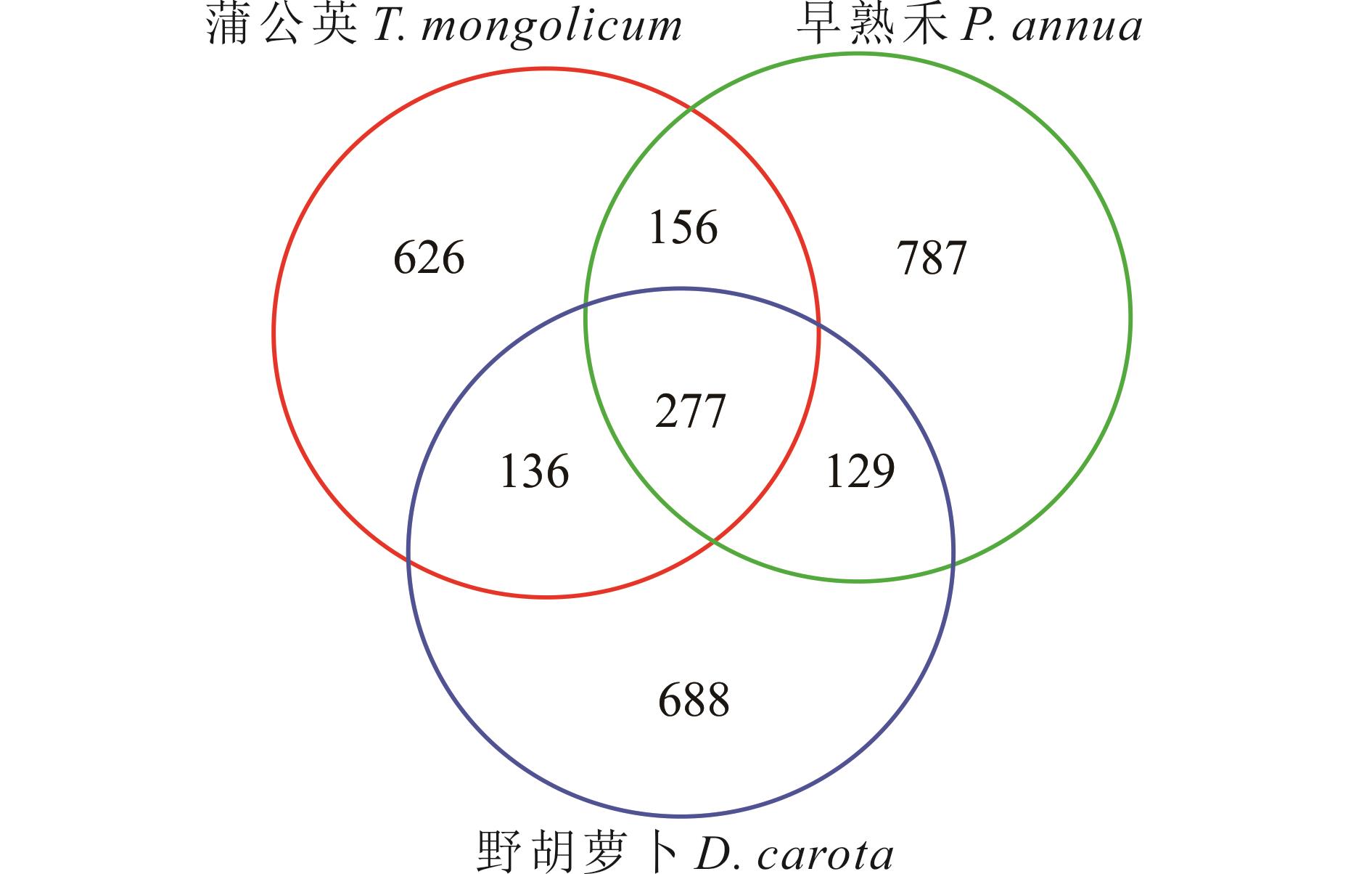
图1 3种植物根际土壤真菌扩增子序列变体分析
Fig.1 The analysis of fungi amplicon sequence variants among three plant species
植被类型 Vegetation type | 覆盖深度 Coverage | 观测特征指数 Observed features index | 查普曼指数 Chao1 index | 优势度指数 Dominance index | 均匀度指数 Pielou index | 香农指数 Shannon index | 辛普森指数 Simpson index |
|---|---|---|---|---|---|---|---|
| 蒲公英 T. mongolicum | 1.0000±0.0000a | 441.0000± 46.5743a | 446.4583±50.2776a | 0.0309±0.0066a | 0.7657±0.0341a | 6.6948±0.1990a | 0.9691±0.0066a |
| 早熟禾 P. annua | 1.0000±0.0000a | 529.0000± 50.5602a | 541.3155±58.4673a | 0.0210±0.0032a | 0.7948±0.0153a | 7.1703±0.0608a | 0.9790±0.0032a |
| 野胡萝卜 D. carota | 0.9998±0.0002a | 453.5000± 50.9485a | 471.9364±59.7400a | 0.0213±0.0054a | 0.7854±0.0371a | 6.8955±0.2211a | 0.9787±0.0054a |
表2 3种植物根际土壤真菌群落α多样性分析
Table 2 Alpha diversity analysis of soil fungal communities in the rhizosphere of three plant species
植被类型 Vegetation type | 覆盖深度 Coverage | 观测特征指数 Observed features index | 查普曼指数 Chao1 index | 优势度指数 Dominance index | 均匀度指数 Pielou index | 香农指数 Shannon index | 辛普森指数 Simpson index |
|---|---|---|---|---|---|---|---|
| 蒲公英 T. mongolicum | 1.0000±0.0000a | 441.0000± 46.5743a | 446.4583±50.2776a | 0.0309±0.0066a | 0.7657±0.0341a | 6.6948±0.1990a | 0.9691±0.0066a |
| 早熟禾 P. annua | 1.0000±0.0000a | 529.0000± 50.5602a | 541.3155±58.4673a | 0.0210±0.0032a | 0.7948±0.0153a | 7.1703±0.0608a | 0.9790±0.0032a |
| 野胡萝卜 D. carota | 0.9998±0.0002a | 453.5000± 50.9485a | 471.9364±59.7400a | 0.0213±0.0054a | 0.7854±0.0371a | 6.8955±0.2211a | 0.9787±0.0054a |
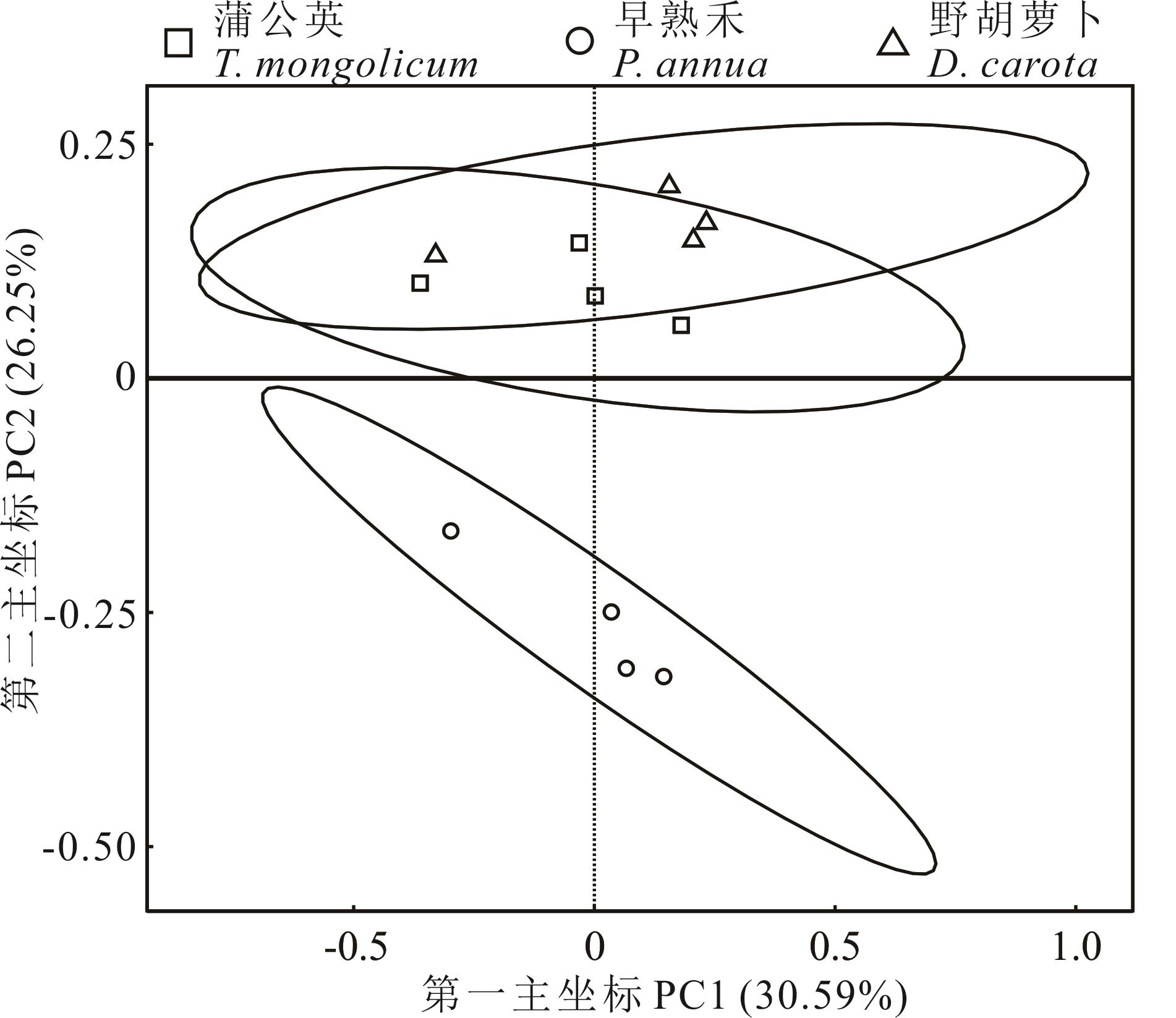
图2 3种植物根际土壤真菌群落主坐标分析
Fig.2 Principal coordinates analysis (PCoA) of rhizosphere fungal communities among three plant species
组别 Group | R值 R valve | P值 P valve |
|---|---|---|
| 蒲公英-早熟禾T. mongolicum-P. annua | 0.7292 | 0.0398 |
| 早熟禾-野胡萝卜P. annua-D. carota | 0.6251 | 0.0249 |
| 蒲公英-野胡萝卜T. mongolicum-D. carota | 0.2917 | 0.1542 |
表3 植物根际土壤真菌群落相似性分析组间差异检验
Table 3 Analysis of similarities (ANOSIM) analysis of rhizosphere soil fungal communities among plant species
组别 Group | R值 R valve | P值 P valve |
|---|---|---|
| 蒲公英-早熟禾T. mongolicum-P. annua | 0.7292 | 0.0398 |
| 早熟禾-野胡萝卜P. annua-D. carota | 0.6251 | 0.0249 |
| 蒲公英-野胡萝卜T. mongolicum-D. carota | 0.2917 | 0.1542 |

图3 门水平上3种植物根际土壤真菌群落分布特征
Fig.3 Distribution characteristics of rhizosphere fungal communities among plant species at phylum level

图4 属水平上3种植物根际土壤真菌群落分布特征*表示存在显著相关性(P<0.05),**表示存在极显著相关性(P<0.01),下同。* indicates a significant correlation (P<0.05), ** indicates an extremely significant correlation (P<0.01). The same below.
Fig.4 Distribution characteristics of rhizosphere fungal communities among plant species at genus level
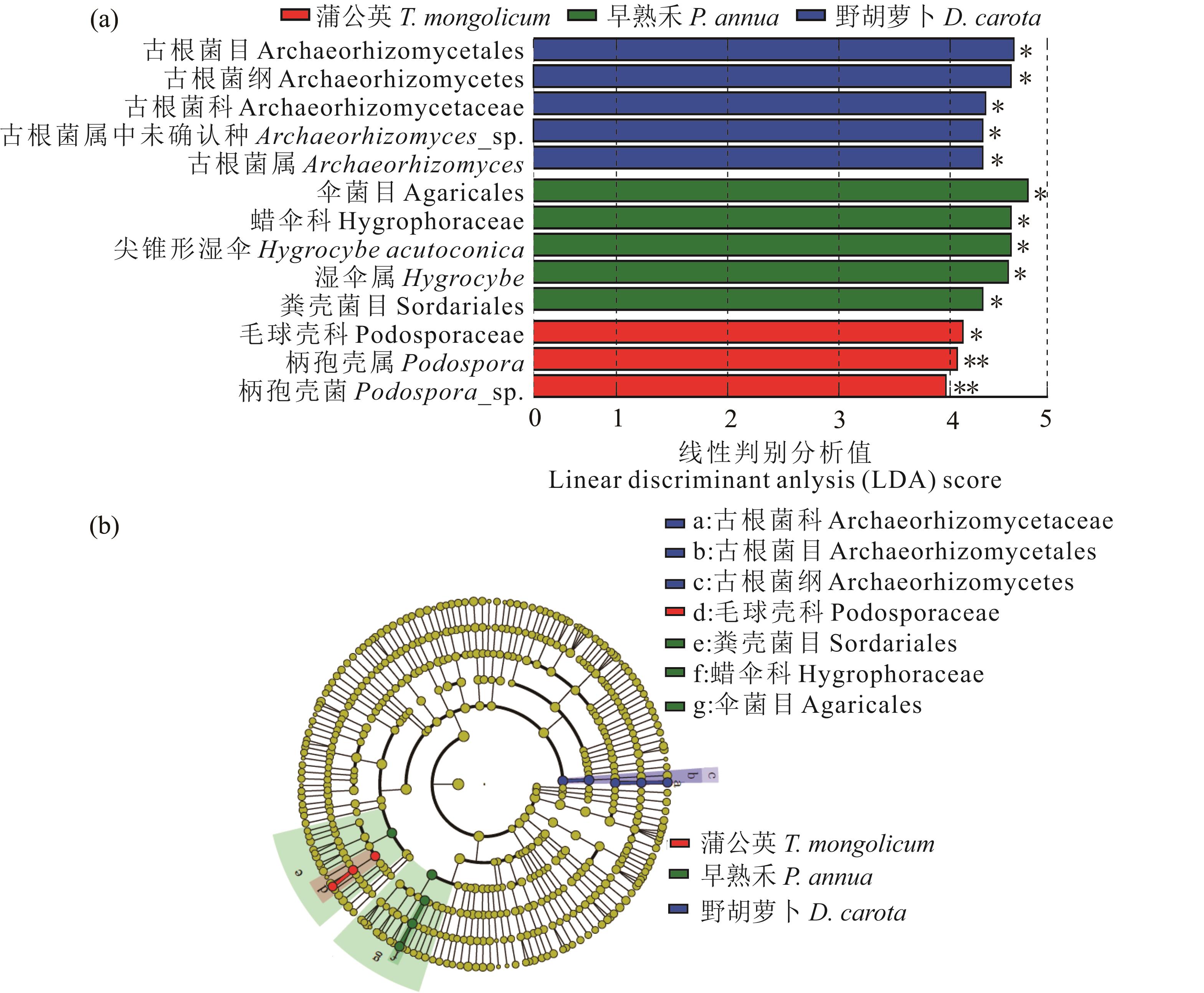
图5 基于LefSe分析3种植物根际土壤真菌生物标志物
Fig.5 Identification of fungal biomarkers in the rhizosphere soil of three plant species based on LefSe analysis
| 样品名称Sample name | 未分配Unassigned | 腐生营养型Saprotroph | 复合营养型Polytroph | 共生营养型Symbiotroph | 病理营养型Pathotroph |
|---|---|---|---|---|---|
| 蒲公英T. mongolicum | 0.529±0.045ab | 0.271±0.052a | 0.108±0.012b | 0.048±0.015a | 0.044±0.018a |
| 早熟禾P. annua | 0.412±0.018b | 0.286±0.036a | 0.189±0.018a | 0.076±0.021a | 0.037±0.007a |
| 野胡萝卜D. carota | 0.573±0.043a | 0.274±0.041a | 0.081±0.016b | 0.052±0.016a | 0.021±0.004a |
表4 3种植物根际土壤真菌群落营养模式相对丰度
Table 4 Relative abundance of nutritional modes in rhizosphere fungal communities among three plant species
| 样品名称Sample name | 未分配Unassigned | 腐生营养型Saprotroph | 复合营养型Polytroph | 共生营养型Symbiotroph | 病理营养型Pathotroph |
|---|---|---|---|---|---|
| 蒲公英T. mongolicum | 0.529±0.045ab | 0.271±0.052a | 0.108±0.012b | 0.048±0.015a | 0.044±0.018a |
| 早熟禾P. annua | 0.412±0.018b | 0.286±0.036a | 0.189±0.018a | 0.076±0.021a | 0.037±0.007a |
| 野胡萝卜D. carota | 0.573±0.043a | 0.274±0.041a | 0.081±0.016b | 0.052±0.016a | 0.021±0.004a |
功能类型 Functional group | 蒲公英 T. mongolicum | 早熟禾 P. annua | 野胡萝卜 D. carota |
|---|---|---|---|
| 未定义腐生菌 Undefined saprotroph | 0.2486±0.0478a | 0.2096±0.0394a | 0.1851±0.0558a |
| 土壤腐生菌 Soil saprotroph | 0.0107±0.0052b | 0.0594±0.0072ab | 0.0758±0.0212a |
| 丛枝菌根真菌 Arbuscular mycorrhizal fungi | 0.0364±0.0126a | 0.0636±0.0192a | 0.0445±0.0154a |
| 兰花菌根菌 Orchid mycorrhizal | 0.0039±0.0009a | 0.0063±0.0013a | 0.0044±0.0009a |
| 外生菌根 Ectomycorrhizal | 0.0067±0.0026a | 0.0037±0.0015a | 0.0014±0.0002a |
| 植物病原菌 Plant pathogen | 0.0419±0.0181a | 0.0356±0.0072a | 0.0162±0.0039a |
| 未定义腐生-未定义的生物营养菌 Undefined saprotroph-undefined biotroph | 0.0044±0.0022b | 0.0983±0.0196a | 0.0007±0.0003b |
粪腐生-内生-凋落物腐生-未定义腐生菌 Dung saprotroph-endophyte-litter saprotroph-undefined saprotroph | 0.0459±0.0079a | 0.0259±0.0046a | 0.0021±0.0011b |
动物病原-内生-植物病原-木质腐生菌 Animal pathogen-endophyte-plant pathogen-wood saprotroph | 0.0202±0.0044a | 0.0173±0.0043a | 0.0312±0.0077a |
| 内生-植物病原菌 Endophyte-plant pathogen | 0.0122±0.0024a | 0.0188±0.0021a | 0.0223±0.0061a |
| 植物病原-土壤腐生-木质腐生菌 Plant pathogen-soil saprotroph-wood saprotroph | 0.0061±0.0015a | 0.0043±0.0031a | 0.0169±0.0053a |
| 植物病原-未定义腐生菌 Plant pathogen-undefined saprotroph | 0.0034±0.0018ab | 0.0137±0.0041a | 0.0026±0.0017b |
表5 3种植物根际土壤真菌群落功能类型相对丰度
Table 5 Relative abundance of functional types of fungal communities in rhizosphere soil of three plant species
功能类型 Functional group | 蒲公英 T. mongolicum | 早熟禾 P. annua | 野胡萝卜 D. carota |
|---|---|---|---|
| 未定义腐生菌 Undefined saprotroph | 0.2486±0.0478a | 0.2096±0.0394a | 0.1851±0.0558a |
| 土壤腐生菌 Soil saprotroph | 0.0107±0.0052b | 0.0594±0.0072ab | 0.0758±0.0212a |
| 丛枝菌根真菌 Arbuscular mycorrhizal fungi | 0.0364±0.0126a | 0.0636±0.0192a | 0.0445±0.0154a |
| 兰花菌根菌 Orchid mycorrhizal | 0.0039±0.0009a | 0.0063±0.0013a | 0.0044±0.0009a |
| 外生菌根 Ectomycorrhizal | 0.0067±0.0026a | 0.0037±0.0015a | 0.0014±0.0002a |
| 植物病原菌 Plant pathogen | 0.0419±0.0181a | 0.0356±0.0072a | 0.0162±0.0039a |
| 未定义腐生-未定义的生物营养菌 Undefined saprotroph-undefined biotroph | 0.0044±0.0022b | 0.0983±0.0196a | 0.0007±0.0003b |
粪腐生-内生-凋落物腐生-未定义腐生菌 Dung saprotroph-endophyte-litter saprotroph-undefined saprotroph | 0.0459±0.0079a | 0.0259±0.0046a | 0.0021±0.0011b |
动物病原-内生-植物病原-木质腐生菌 Animal pathogen-endophyte-plant pathogen-wood saprotroph | 0.0202±0.0044a | 0.0173±0.0043a | 0.0312±0.0077a |
| 内生-植物病原菌 Endophyte-plant pathogen | 0.0122±0.0024a | 0.0188±0.0021a | 0.0223±0.0061a |
| 植物病原-土壤腐生-木质腐生菌 Plant pathogen-soil saprotroph-wood saprotroph | 0.0061±0.0015a | 0.0043±0.0031a | 0.0169±0.0053a |
| 植物病原-未定义腐生菌 Plant pathogen-undefined saprotroph | 0.0034±0.0018ab | 0.0137±0.0041a | 0.0026±0.0017b |
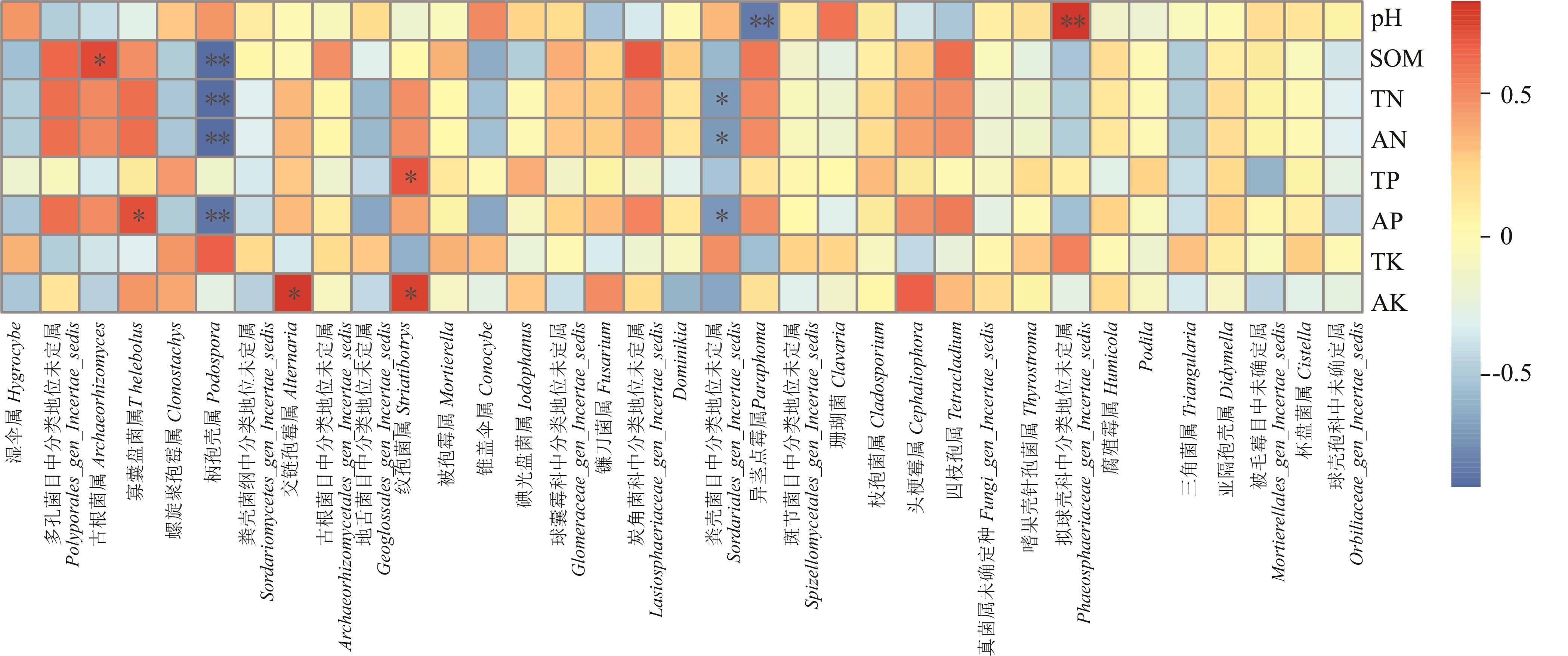
图6 属水平上物种丰富度与土壤理化因子Spearman相关性分析SOM: 土壤有机质Soil organic matter; TN: 全氮Total nitrogen; AN: 碱解氮Available nitrogen; TP: 全磷Total phosphorus; AP: 速效磷Available phosphorus; TK: 全钾Total potassium; AK: 速效钾Available potassium. 下同The same below.
Fig.6 Spearman correlation analysis of species richness and soil physicochemistry factor at genus level
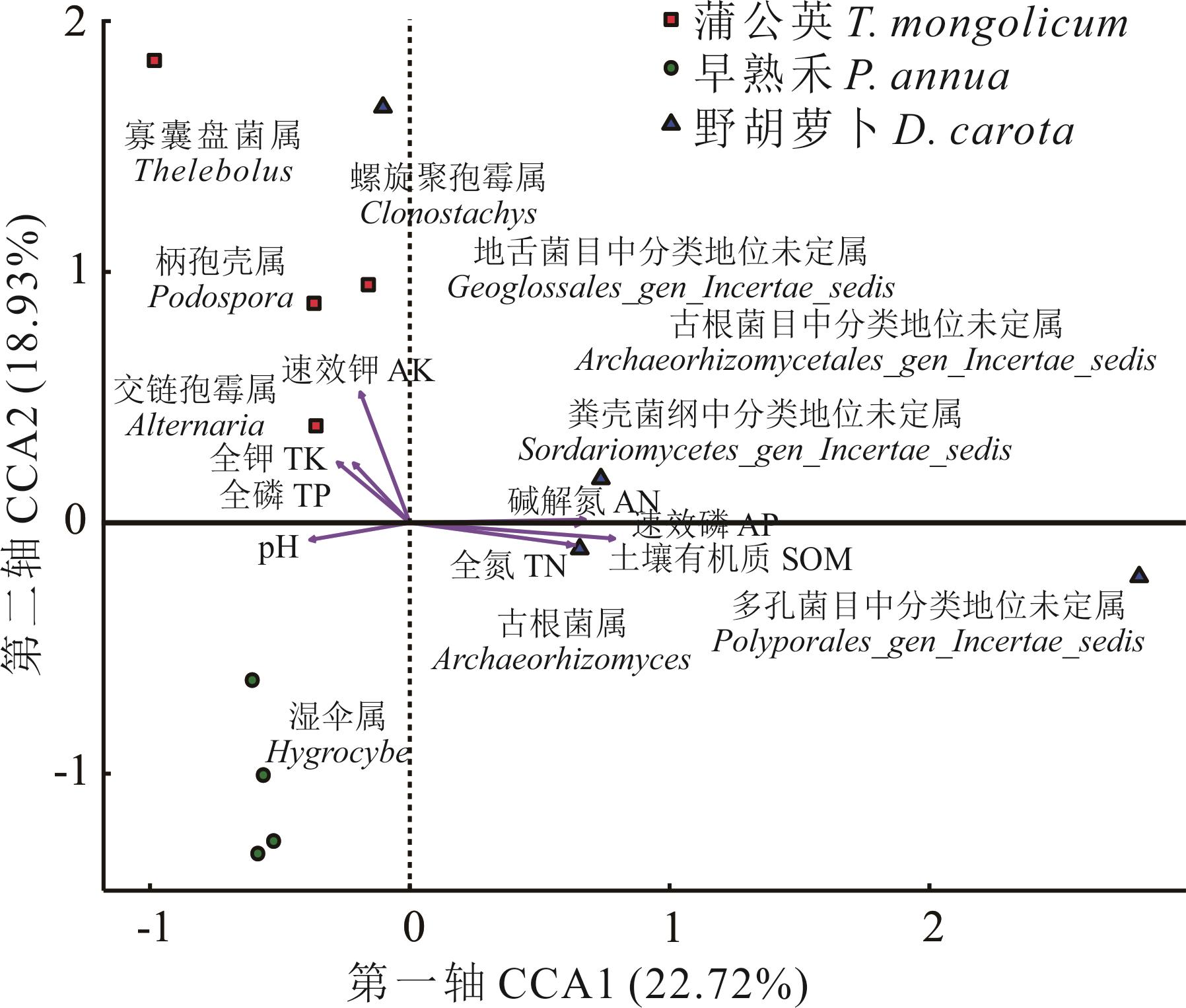
图7 优势真菌类群与土壤环境因子的典范对应分析
Fig.7 Canonical correspondence analysis of dominant fungal groups and soil environmental factors
| [1] | Liu L L, Sheng J D, Cheng J H, et al. Relationship between plant species characteristics and climate factors in different grassland types of Xinjiang. Acta Prataculturae Sinica, 2016, 25(5): 1-12. |
| 刘利利, 盛建东, 程军回, 等. 新疆不同草地类型植物物种特征与水热因子的关系研究. 草业学报, 2016, 25(5): 1-12. | |
| [2] | Chu S L, Yun J, Asiya·Manlike, et al. Evaluation of grassland productivity in Kizilsu Kirgiz autonomous prefecture of Xinjiang. Pratacultural Science, 2011, 28(1): 53-58. |
| 储少林, 贠静, 阿斯娅·曼力克, 等. 克州地区天然草地生产力评价. 草业科学, 2011, 28(1): 53-58. | |
| [3] | Lv L L, Huang H L, Lv J T, et al. Unique dissolved organic matter molecules and microbial communities in rhizosphere of three typical crop soils and their significant associations based on FT-ICR-MS and high-throughput sequencing analysis. Science of the Total Environment, 2024, 919: 170904. |
| [4] | Tan W Y, Nian H, Tran L S P, et al. Small peptides: Novel targets for modulating plant-rhizosphere microbe interactions. Trends in Microbiology, 2024, 2385: 12. |
| [5] | Mesny F, Hacquard S, Thomma B P. Co-evolution within the plant holobiont drives host performance. EMBO Reports, 2023, 24(9): e57455. |
| [6] | Warnasuriya S D, Udayanga D, Manamgoda D S, et al. Fungi as environmental bioindicators. Science of the Total Environment, 2023, 892: 164583. |
| [7] | Koziol L, Bever J D. The missing link in grassland restoration: arbuscular mycorrhizal fungi inoculation increases plant diversity and accelerates succession. Journal of Applied Ecology, 2017, 54(5): 1301-1309. |
| [8] | Sweeney C J, Vries F T, Dongen B E, et al. Root traits explain rhizosphere fungal community composition among temperate grassland plant species. New Phytologist, 2021, 229(3): 1492-1507. |
| [9] | Oliveira T B, Lucas R C, Scarcella A S A, et al. Fungal communities differentially respond to warming and drought in tropical grassland soil. Molecular Ecology, 2020, 29(8): 1550-1559. |
| [10] | Zhou Q, Wang J L, Zhang T, et al. Special fungal community structure formed by typical halophytes in the rhizosphere soil under the synergistic action of different saline and alkaline environments. Journal of Plant Growth Regulation, 2024, 43(12): 4635-4652. |
| [11] | Ma Y, Wang X L, Ma Y S, et al. Effects of the degree of alpine meadow degradation on the rhizosphere soil fungal community and the ecological network of dominant species. Acta Prataculturae Sinica, 2024, 33(2): 125-137. |
| 马源, 王晓丽, 马玉寿, 等. 高寒草甸退化程度对优势物种根际土壤真菌群落和生态网络的影响. 草业学报, 2024, 33(2): 125-137. | |
| [12] | Mao W Y, Yao J Q, Chen J, et al. Change characteristics of extreme temperature-rising process in the east Pamirs during 1961-2017. Arid Zone Research, 2019, 36(6): 1368-1378. |
| 毛炜峄, 姚俊强, 陈静, 等. 1961-2017年东帕米尔高原极端升温过程气候变化特征. 干旱区研究, 2019, 36(6): 1368-1378. | |
| [13] | Chen H M, Li W J, Qiu J, et al. A checklist of wild vascular plants in Xinjiang, China. Biodiversity Science, 2023, 31(9): 56-62. |
| 陈慧妹, 李文军, 邱娟, 等. 新疆野生维管植物名录. 生物多样性, 2023, 31(9): 56-62. | |
| [14] | Li M Y, Wang J L, Zhou Q, et al. Analysis on the rhizosphere fungal community structure of four halophytes in Southern Xinjiang. Acta Ecologica Sinica, 2021, 41(21): 8484-8495. |
| 李明源, 王继莲, 周茜, 等. 南疆四种盐生植物根际土壤真菌群落结构特征. 生态学报, 2021, 41(21): 8484-8495. | |
| [15] | Bao S D. Soil agrochemical analysis (the third edition). Beijing: China Agriculture Press, 2000. |
| 鲍士旦. 土壤农化分析(第三版). 北京: 中国农业出版社, 2000. | |
| [16] | Su Z X, Su B Q, Wu Y, et al. A less complex but more specialized microbial network resulted in faster fine-root decomposition in young stands of Robinia pseudoacacia. Applied Soil Ecology, 2023, 182: 104735. |
| [17] | Liu H Q, Sun W C, Guo Q, et al. Ecological benefit analysis of winter rapeseed rhizosphere soil fungi driving and influencing soil fertility. Acta Ecologica Sinica, 2025, 45(1): 80-90. |
| 刘海卿, 孙万仓, 郭倩, 等. 冬油菜根际土壤真菌驱动及其影响土壤肥力的生态效益分析. 生态学报, 2025, 45(1): 80-90. | |
| [18] | Yang H Q, Xiang Y Q, Lv Q, et al. A comparative study on the soil fungal community structure across three mixed forests at the initial stage of afforestation. Acta Ecologica Sinica, 2024, 44(8): 3360-3371. |
| 杨慧琴, 向涌旗, 吕倩, 等. 3种混交林造林初期土壤真菌群落结构特征. 生态学报, 2024, 44(8): 3360-3371. | |
| [19] | Wang S H, Chang S L, Li X, et al. Soil fungal diversity and its community structure in Tianshan Forest. Acta Ecologica Sinica, 2021, 41(1): 124-134. |
| 王诗慧, 常顺利, 李鑫, 等. 天山林区土壤真菌多样性及其群落结构. 生态学报, 2021, 41(1): 124-134. | |
| [20] | Geml J, Arnold A E, Semenova-Nelsen T A, et al. Community dynamics of soil-borne fungal communities along elevation gradients in neotropical and palaeotropical forests. Molecular Ecology, 2022, 31(7): 2044-2060. |
| [21] | Zhang Y, Cao H Y, Zhao P S, et al. Evolution of soil fungal community with the stand aging of Pinus sylvestris var. mongolica forests in semi-arid and dry sub-humid regions. Environmental Science, 2025, 46(6): 3975-3984. |
| 张英, 曹红雨, 赵珮杉, 等. 半干旱-亚湿润干旱区樟子松林地土壤真菌群落随林龄增长的演变. 环境科学, 2025, 46(6): 3975-3984. | |
| [22] | Williams A, Vries F T. Plant root exudation under drought: implications for ecosystem functioning. New Phytologist, 2020, 225(5): 1899-1905. |
| [23] | Ma C X, Yu Q, Liu Y J, et al. The characteristics of rhizosphere soil fungal community of restored vegetation in Inner Mongolia open pit mine dump. Acta Ecologica Sinica, 2025, 45(4): 1974-1986. |
| 马晨鑫, 俞琦, 刘永杰, 等. 内蒙古露天煤矿排土场植物恢复根际土壤真菌群落特征. 生态学报, 2025, 45(4): 1974-1986. | |
| [24] | Liu B C, Li F Y, Zhao Q H, et al. Research progress on remediation of polycyclic aromatic hydrocarbons contaminated soil by Gramineae plants. Chemical Industry and Engineering Progress, 2023, 42(7): 3736-3748. |
| 刘柏成, 李法云, 赵琦慧, 等. 禾本科植物修复多环芳烃污染土壤研究进展. 化工进展, 2023, 42(7): 3736-3748. | |
| [25] | Feng L, Li Z K, Wang H, et al. Changes of rhizosphere soil microbial community structure of Stellaria dichotoma L.var. lanceolata Bge. planted for different years. Microbiology China, 2024, 51(10): 4132-4148. |
| 冯璐, 李振凯, 王红, 等. 不同种植年限银柴胡根际土壤微生物群落结构变化. 微生物学通报, 2024, 51(10): 4132-4148. | |
| [26] | Nie J M, Zhang X F, Zhang Q D, et al. Responses of soil fungal community structure to seasonal soil layer interactions in typical grassland of Inner Mongolia. Acta Agrestia Sinica, 2024, 32(11): 3408-3416. |
| 聂佳明, 张晓馥, 张起迪, 等. 内蒙古典型草原土壤真菌群落结构对季节土层交互的响应. 草地学报, 2024, 32(11): 3408-3416. | |
| [27] | Zhang Y C, Yang W Q, Wei X Y, et al. Study on vegetation and soil characteristics of different types of grassland in Qilian Mountain National Park. Chinese Journal of Grassland, 2024, 46(11): 23-34. |
| 张阳灿, 杨文权, 魏兴勇, 等. 祁连山国家公园不同类型草地植被及土壤特征研究. 中国草地学报, 2024, 46(11): 23-34. | |
| [28] | Zhang C B, Ren C H, Wang Y L, et al. Uncovering fungal community composition in natural habitat of Ophiocordyceps sinensis using high-throughput sequencing and culture-dependent approaches. BMC Microbiology, 2020, 20(1): 331. |
| [29] | Patkowska E, Mielniczuk E, Jamiołkowska A, et al. The influence of Trichoderma harzianum Rifai T-22 and other biostimulants on rhizosphere beneficial microorganisms of carrot. Agronomy, 2020, 10(11): 1637. |
| [30] | Zhang H, Li W H, Zhao H X, et al. Effects of invasive Compositae plants on soil nitrogen content. Pratacultural Science, 2023, 40(7): 1766-1778. |
| 张涵, 李伟华, 赵海霞, 等. 菊科植物改变土壤氮素的可利用性. 草业科学, 2023, 40(7): 1766-1778. | |
| [31] | Guo Z M, Zhang X Y, Dungait J A J, et al. Contribution of soil microbial necromass to SOC stocks during vegetation recovery in a subtropical Karst ecosystem. Science of the Total Environment, 2021, 761: 143945. |
| [32] | Priyashantha A K H, Dai D Q, Bhat D J, et al. Plant-fungi interactions: Where it goes? Biology, 2023, 12(6): 809. |
| [33] | Sui J K, Li C Y, Wang Y P, et al. Microecological shifts in the rhizosphere of perennial large trees and seedlings in continuous cropping of poplar. Microorganisms, 2023, 12(1): 58. |
| [34] | Dong L, Li J J, Sun J, et al. Soil degradation influences soil bacterial and fungal community diversity in overgrazed alpine meadows of the Qinghai-Tibet Plateau. Scientific Reports, 2021, 11: 11538. |
| [35] | Gong M X, Wang J L, Li M Y. Plant species shaping rhizosphere fungal community structure in the subalpine forest steppe belt. Rhizosphere, 2025, 33: 100999. |
| [36] | Hauchhum R, Tripathi S K. Impact of rhizosphere microbes of three early colonizing annual plants on improving soil fertility during vegetation establishment under different fallow periods following shifting cultivation. Agricultural Research, 2020, 9(2): 213-221. |
| [1] | 张琨, 乔建霞, 李金升, 王育鹏, 刘克思. 不同修复材料对退化高寒草地土壤理化性质及微生物群落的影响[J]. 草业学报, 2025, 34(8): 132-148. |
| [2] | 朱炳淑, 樊江文, 张海燕, 黄麟, 田海静, 王林, 王守兴, 杨明新, 郭炎明. 三江源国家公园黄河源园区高寒草地健康评价[J]. 草业学报, 2025, 34(7): 13-27. |
| [3] | 王颖, 李明源, 麦日艳古·亚生null, 王继莲. 新疆托木尔峰不同植物根际土壤真菌群落结构比较研究[J]. 草业学报, 2025, 34(7): 83-94. |
| [4] | 罗顺华, 刘新宇, 孟宝平, 陈璇黎, 胡仁杰, 于红妍, 王贤颖, 张勃, 秦彧. 祁连山国家公园高寒草地功能群多样性与生产力研究[J]. 草业学报, 2025, 34(6): 14-26. |
| [5] | 邓文辉, 宋珂辰, 张浩, 管思雨, 雍嘉仪, 胡海英. 降水变化条件下荒漠草原优势植物根际微生物群落结构和多样性特征研究[J]. 草业学报, 2025, 34(5): 12-26. |
| [6] | 王守兴, 周华坤, 欧立鹏, 李成先, 王雁鹤, 宁晓春, 谷强, 魏代军, 杨明新. 三江源不同草地类型植被及土壤微生物多样性与土壤因子特征的研究[J]. 草业学报, 2025, 34(4): 16-26. |
| [7] | 贺聪, 马永才, 字洪标. 不同围封年限对高寒草地植物群落的影响[J]. 草业学报, 2025, 34(11): 17-30. |
| [8] | 郑荣春, 南志标, 段廷玉. 四个品种红三叶种带真菌多样性研究[J]. 草业学报, 2024, 33(8): 170-180. |
| [9] | 徐玲玲, 牛犇, 张宪洲, 何永涛, 石培礼, 宗宁, 武建双, 王向涛. 藏北两个临近不同高寒草地碳通量对气候条件的响应[J]. 草业学报, 2024, 33(6): 1-16. |
| [10] | 马源, 王晓丽, 马玉寿, 张德罡. 高寒草甸退化程度对优势物种根际土壤真菌群落和生态网络的影响[J]. 草业学报, 2024, 33(2): 125-137. |
| [11] | 石昊, 杨彩红, 夏菲, 王军强, 魏巍, 王敬龙, 薛云尹, 郑晒坤, 吴皓阳, 冉林灵, 严双, 姜晓敏. 短期增温对修复过程中藏北高寒退化草地生产力的初期影响[J]. 草业学报, 2024, 33(11): 30-45. |
| [12] | 田晴华, 刘丹, 廖小琴, 宋小艳, 胡雷, 王长庭. 施氮对高寒草地土壤团聚体生物胶结物质及稳定性的影响[J]. 草业学报, 2024, 33(11): 46-57. |
| [13] | 张东, 侯晨, 马文明, 王长庭, 邓增卓玛, 张婷. 高寒草地不同灌丛化梯度下土壤酶活性研究[J]. 草业学报, 2023, 32(9): 79-92. |
| [14] | 张振粉, 黄荣, 李向阳, 姚博, 赵桂琴. 基于Illumina MiSeq高通量测序的燕麦种带细菌多样性及功能分析[J]. 草业学报, 2023, 32(7): 96-108. |
| [15] | 刘欢, 董凯, 仁增旺堆, 王敬龙, 刘云飞, 赵桂琴. 藏沙蒿与多年生禾草混播对西藏沙化草地植被及土壤真菌群落特征的影响[J]. 草业学报, 2023, 32(6): 45-57. |
| 阅读次数 | ||||||
|
全文 |
|
|||||
|
摘要 |
|
|||||
