

ISSN 1004-5759 CN 62-1105/S
草业学报 ›› 2026, Vol. 35 ›› Issue (10): 1-14.DOI: 10.11686/cyxb2025433
• 研究论文 •
司静1,2( ), 王瑶1,2, 许仲林1,3,4,5()
收稿日期:2025-10-20
修回日期:2025-12-09
出版日期:2026-10-20
发布日期:2026-09-09
通讯作者:
许仲林
作者简介:E-mail: zlxu@xju.edu.cn基金资助:
Jing SI1,2(), Yao WANG1,2, Zhong-lin XU1,3,4,5()
Received:2025-10-20
Revised:2025-12-09
Online:2026-10-20
Published:2026-09-09
Contact:
Zhong-lin XU
摘要:
矿物结合态有机碳(mineral-associated organic carbon, MAOC)是土壤有机碳中较为稳定的重要组分,其含量变化直接影响土壤碳库的组成与长期稳定性,尤其在干旱区草地生态系统中,对碳的长期固存与碳汇功能发挥关键作用。目前,对中亚干旱与半干旱区草地MAOC空间格局及其主控因子的研究尚有不足。本研究以新疆天山北坡草地为对象,从草地类型、土壤剖面及地形-气候-土壤因子3个维度,探讨MAOC的空间分布特征及其驱动机制。结果表明:1)MAOC含量随土层深度增加而降低,不同草地类型间依次为山地草甸>典型草原>荒漠草原;2)相关性分析表明,MAOC含量与气温和土壤pH呈显著负相关关系,而与海拔、坡度、速效磷与全氮含量呈显著正相关关系;3)碳稳定性指数(carbon stability index, CSI)显示,深层土壤CSI值越高,碳稳定性越好;4)基于多元回归分析构建MAOC的空间预测模型揭示,MAOC含量呈现由西北向东南递增的空间异质性格局。研究结果有助于深入理解干旱半干旱区草地生态系统MAOC的空间特征与影响因素,为新疆及干旱区“双碳”战略背景下制定陆地碳管理政策提供科学支撑。
司静, 王瑶, 许仲林. 天山北坡草地矿物结合态有机碳的空间分异[J]. 草业学报, 2026, 35(10): 1-14.
Jing SI, Yao WANG, Zhong-lin XU. Spatial variation of mineral-associated organic carbon in grassland on the northern slopes of the Tianshan Mountains[J]. Acta Prataculturae Sinica, 2026, 35(10): 1-14.
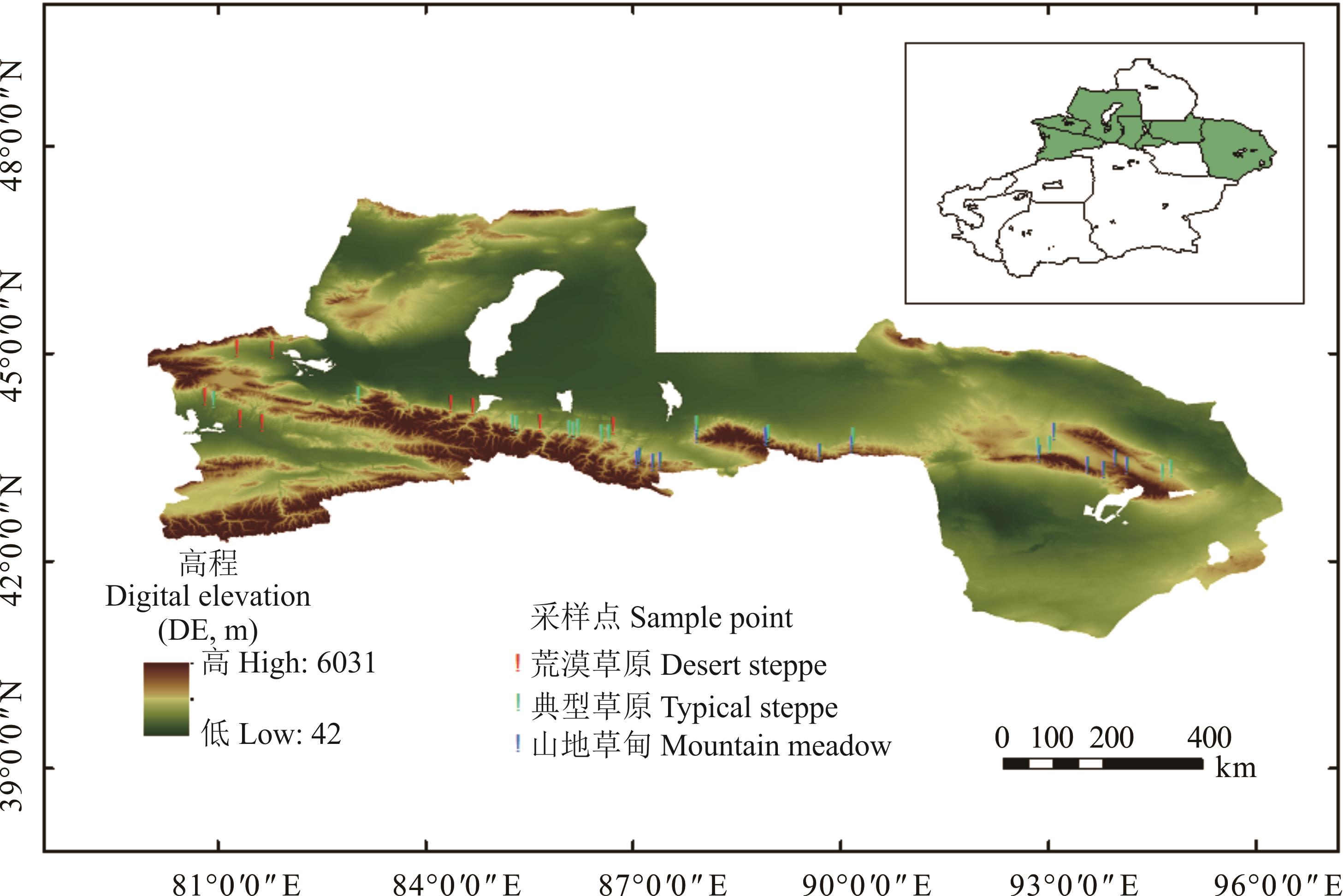
图1 天山北坡地理位置及土壤采样点分布基于自然资源部标准地图服务网站GS(2024)0650号标准地图制作,底图边界无修改。Based on the standard map service website GS (2024)0650 of the Ministry of Natural Resources, the boundary of the base map is not modified.
Fig. 1 Geographical location of the northern slpoes of the Tianshan Mountains and distribution of soil sampling sites
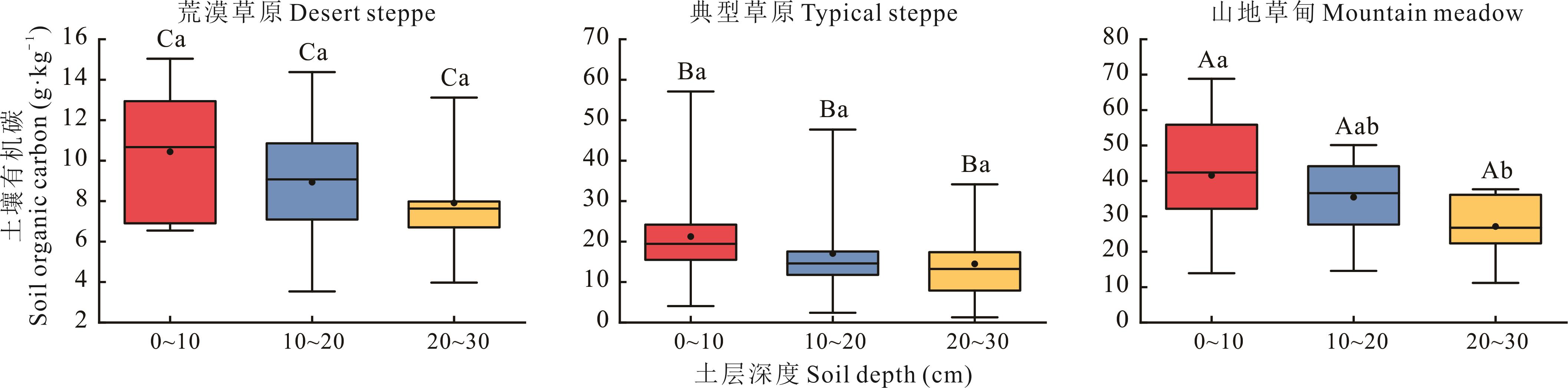
图2 不同草地类型下土壤有机碳含量分布特征不同大写字母表示同一土层不同草地类型间差异显著(P<0.05);不同小写字母表示同一草地类型不同土层间差异显著(P<0.05)。Different uppercase letters indicate significant differences (P<0.05) among different grassland types in the same soil layer; different lowercase letters indicate significant differences (P<0.05) among different soil layers in the same grassland type.
Fig.2 Distribution characteristics of soil organic carbon content under different grassland types
草地类型 Grassland types | 土层深度 Soil depth (cm) | 最小值 Minimum (g·kg-1) | 最大值 Maximum (g·kg-1) | 平均值 Mean (g·kg-1) | 标准差 Standard deviation | 变异系数 Coefficients of variation (%) |
|---|---|---|---|---|---|---|
荒漠草原 Desert steppe | 0~10 | 1.45 | 5.58 | 3.28Ba | 1.48 | 45.13 |
| 10~20 | 1.03 | 4.74 | 2.86Ba | 1.34 | 47.08 | |
| 20~30 | 0.58 | 4.07 | 2.01Ba | 1.21 | 60.57 | |
典型草原 Typical steppe | 0~10 | 0.94 | 18.51 | 6.61Ba | 3.92 | 59.20 |
| 10~20 | 1.18 | 16.46 | 4.88Bab | 3.53 | 72.25 | |
| 20~30 | 0.37 | 10.01 | 3.44Bb | 2.06 | 60.00 | |
山地草甸 Mountain meadow | 0~10 | 3.88 | 23.65 | 13.15Aa | 5.61 | 42.68 |
| 10~20 | 4.03 | 18.63 | 11.64Aa | 3.92 | 33.66 | |
| 20~30 | 2.49 | 12.85 | 8.17Ab | 2.55 | 31.20 |
表1 3种草原类型各土层颗粒态有机碳含量
Table 1 Particulate organic carbon content of soil layer in three grassland types
草地类型 Grassland types | 土层深度 Soil depth (cm) | 最小值 Minimum (g·kg-1) | 最大值 Maximum (g·kg-1) | 平均值 Mean (g·kg-1) | 标准差 Standard deviation | 变异系数 Coefficients of variation (%) |
|---|---|---|---|---|---|---|
荒漠草原 Desert steppe | 0~10 | 1.45 | 5.58 | 3.28Ba | 1.48 | 45.13 |
| 10~20 | 1.03 | 4.74 | 2.86Ba | 1.34 | 47.08 | |
| 20~30 | 0.58 | 4.07 | 2.01Ba | 1.21 | 60.57 | |
典型草原 Typical steppe | 0~10 | 0.94 | 18.51 | 6.61Ba | 3.92 | 59.20 |
| 10~20 | 1.18 | 16.46 | 4.88Bab | 3.53 | 72.25 | |
| 20~30 | 0.37 | 10.01 | 3.44Bb | 2.06 | 60.00 | |
山地草甸 Mountain meadow | 0~10 | 3.88 | 23.65 | 13.15Aa | 5.61 | 42.68 |
| 10~20 | 4.03 | 18.63 | 11.64Aa | 3.92 | 33.66 | |
| 20~30 | 2.49 | 12.85 | 8.17Ab | 2.55 | 31.20 |
草地类型 Grassland types | 土层深度 Soil depth (cm) | 最小值 Minimum (g·kg-1) | 最大值 Maximum (g·kg-1) | 平均值 Mean (g·kg-1) | 标准差 Standard deviation | 变异系数 Coefficients of variation (%) |
|---|---|---|---|---|---|---|
荒漠草原 Desert steppe | 0~10 | 4.99 | 10.34 | 7.16Ba | 1.87 | 26.10 |
| 10~20 | 2.50 | 9.64 | 6.08Ca | 2.39 | 39.28 | |
| 20~30 | 3.39 | 9.33 | 5.90Ca | 1.98 | 33.46 | |
典型草原 Typical steppe | 0~10 | 3.14 | 38.58 | 14.64Ba | 8.58 | 58.63 |
| 10~20 | 1.23 | 31.23 | 12.17Ba | 7.79 | 64.02 | |
| 20~30 | 0.92 | 29.46 | 11.05Ba | 7.48 | 67.66 | |
山地草甸 Mountain meadow | 0~10 | 10.04 | 50.89 | 28.40Aa | 11.63 | 40.96 |
| 10~20 | 10.55 | 34.49 | 23.74Aab | 7.44 | 31.35 | |
| 20~30 | 8.69 | 27.37 | 18.95Ab | 5.87 | 30.97 |
表2 3种草原类型各土层矿物结合态有机碳含量
Table 2 Mineral-associated organic carbon content of soil layer in three grassland types
草地类型 Grassland types | 土层深度 Soil depth (cm) | 最小值 Minimum (g·kg-1) | 最大值 Maximum (g·kg-1) | 平均值 Mean (g·kg-1) | 标准差 Standard deviation | 变异系数 Coefficients of variation (%) |
|---|---|---|---|---|---|---|
荒漠草原 Desert steppe | 0~10 | 4.99 | 10.34 | 7.16Ba | 1.87 | 26.10 |
| 10~20 | 2.50 | 9.64 | 6.08Ca | 2.39 | 39.28 | |
| 20~30 | 3.39 | 9.33 | 5.90Ca | 1.98 | 33.46 | |
典型草原 Typical steppe | 0~10 | 3.14 | 38.58 | 14.64Ba | 8.58 | 58.63 |
| 10~20 | 1.23 | 31.23 | 12.17Ba | 7.79 | 64.02 | |
| 20~30 | 0.92 | 29.46 | 11.05Ba | 7.48 | 67.66 | |
山地草甸 Mountain meadow | 0~10 | 10.04 | 50.89 | 28.40Aa | 11.63 | 40.96 |
| 10~20 | 10.55 | 34.49 | 23.74Aab | 7.44 | 31.35 | |
| 20~30 | 8.69 | 27.37 | 18.95Ab | 5.87 | 30.97 |
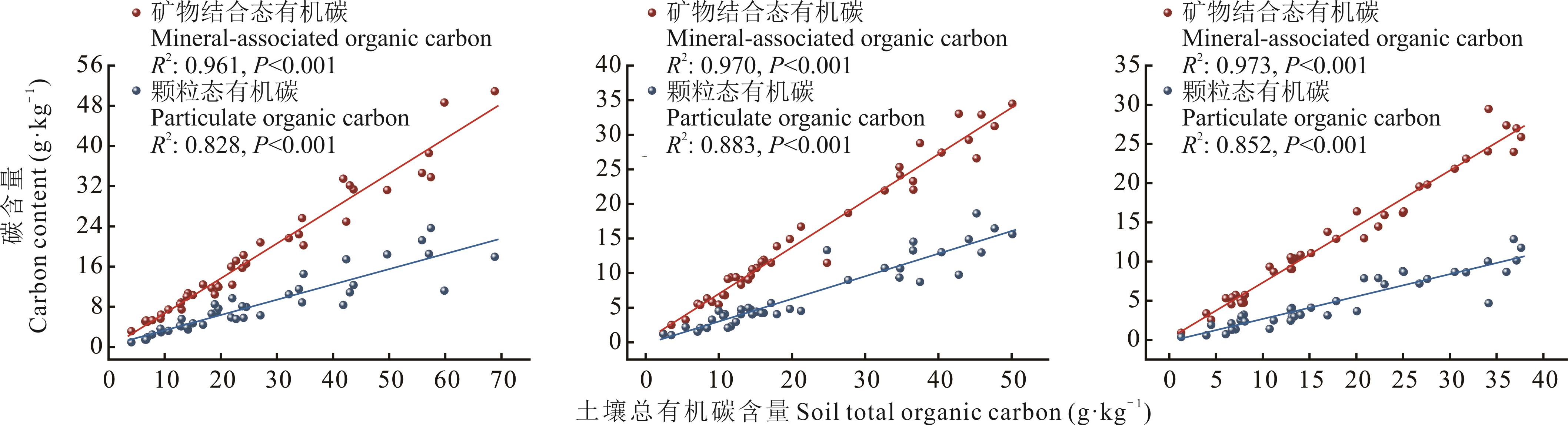
图3 土壤有机碳组分与总有机碳的关系
Fig.3 Relationship between soil organic carbon fractions and soil total organic carbon
草地类型 Grassland types | 土层 Soil depth (cm) | pH | 电导率 Electric conductivity (dS·m-1) | 全氮 Total nitrogen (g·kg-1) | 全磷 Total phosphorus (g·kg-1) | 速效磷 Available phosphorous (g·kg-1) |
|---|---|---|---|---|---|---|
荒漠草原 Desert steppe | 0~10 | 7.83±0.30Aa | 0.86±1.04Aa | 0.22±0.05Aa | 0.03±0.01Aa | 12.91±3.76Aa |
| 10~20 | 7.78±0.30Ab | 0.80±0.96Ab | 0.17±0.03ABa | 0.02±0.01Aa | 9.08±1.47Aa | |
| 20~30 | 7.74±0.28Ac | 0.76±0.90Aa | 0.14±0.02Ba | 0.03±0.01Aa | 7.07±1.07Aa | |
典型草原 Typical steppe | 0~10 | 7.66±0.27Ab | 0.38±0.23Aa | 0.29±0.11Aa | 0.03±0.01Aa | 14.36±4.39Aa |
| 10~20 | 7.61±0.27Aa | 0.36±0.23Ab | 0.19±0.04ABa | 0.02±0.01Aa | 9.34±3.54Aa | |
| 20~30 | 7.57±0.27Ab | 0.35±0.22Aa | 0.14±0.03Ba | 0.02±0.01Aa | 7.83±2.35Aa | |
山地草甸 Mountain meadow | 0~10 | 7.52±0.22Aa | 0.89±2.25Aa | 0.33±0.14Aa | 0.03±0.01Aa | 26.40±29.72Aa |
| 10~20 | 7.48±0.22Ab | 0.88±2.20Ab | 0.24±0.12ABa | 0.03±0.01Aa | 18.68±21.49Aa | |
| 20~30 | 7.43±0.22Ac | 0.87±2.18Aa | 0.15±0.04Ba | 0.03±0.01Aa | 13.45±17.18Aa |
表3 天山北坡草地不同土层的土壤理化性质
Table 3 Soil physicochemical properties across soil layers in northern slope of Tianshan Mountains grasslands
草地类型 Grassland types | 土层 Soil depth (cm) | pH | 电导率 Electric conductivity (dS·m-1) | 全氮 Total nitrogen (g·kg-1) | 全磷 Total phosphorus (g·kg-1) | 速效磷 Available phosphorous (g·kg-1) |
|---|---|---|---|---|---|---|
荒漠草原 Desert steppe | 0~10 | 7.83±0.30Aa | 0.86±1.04Aa | 0.22±0.05Aa | 0.03±0.01Aa | 12.91±3.76Aa |
| 10~20 | 7.78±0.30Ab | 0.80±0.96Ab | 0.17±0.03ABa | 0.02±0.01Aa | 9.08±1.47Aa | |
| 20~30 | 7.74±0.28Ac | 0.76±0.90Aa | 0.14±0.02Ba | 0.03±0.01Aa | 7.07±1.07Aa | |
典型草原 Typical steppe | 0~10 | 7.66±0.27Ab | 0.38±0.23Aa | 0.29±0.11Aa | 0.03±0.01Aa | 14.36±4.39Aa |
| 10~20 | 7.61±0.27Aa | 0.36±0.23Ab | 0.19±0.04ABa | 0.02±0.01Aa | 9.34±3.54Aa | |
| 20~30 | 7.57±0.27Ab | 0.35±0.22Aa | 0.14±0.03Ba | 0.02±0.01Aa | 7.83±2.35Aa | |
山地草甸 Mountain meadow | 0~10 | 7.52±0.22Aa | 0.89±2.25Aa | 0.33±0.14Aa | 0.03±0.01Aa | 26.40±29.72Aa |
| 10~20 | 7.48±0.22Ab | 0.88±2.20Ab | 0.24±0.12ABa | 0.03±0.01Aa | 18.68±21.49Aa | |
| 20~30 | 7.43±0.22Ac | 0.87±2.18Aa | 0.15±0.04Ba | 0.03±0.01Aa | 13.45±17.18Aa |
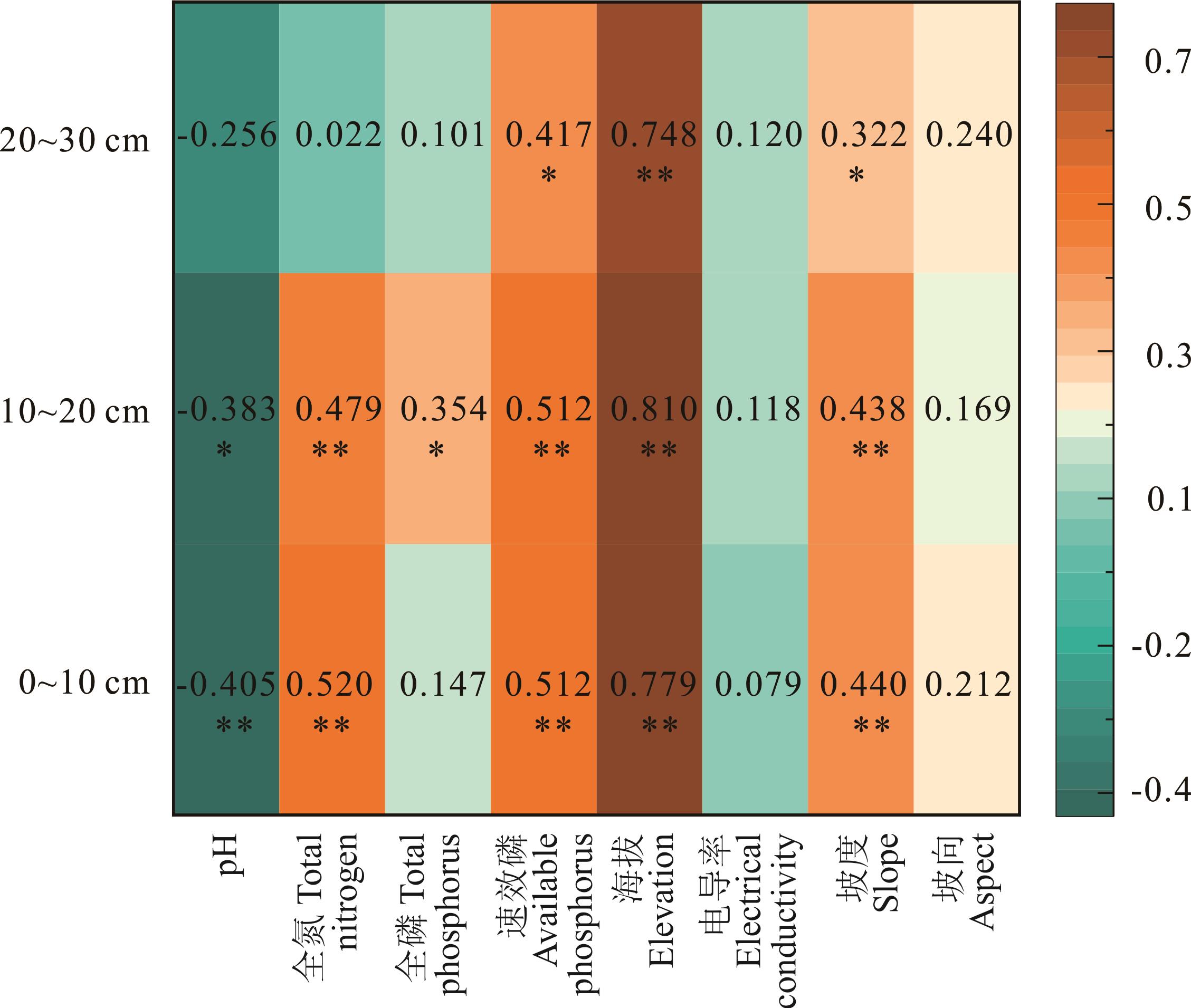
图4 矿物结合态有机碳含量与各影响因子的相关性分析*和**分别表示显著水平为P<0.05和P<0.01。* and ** indicate significance at P<0.05 and P<0.01, respectively.
Fig.4 Correlation analysis between mineral-associated organic carbon content and influencing factors
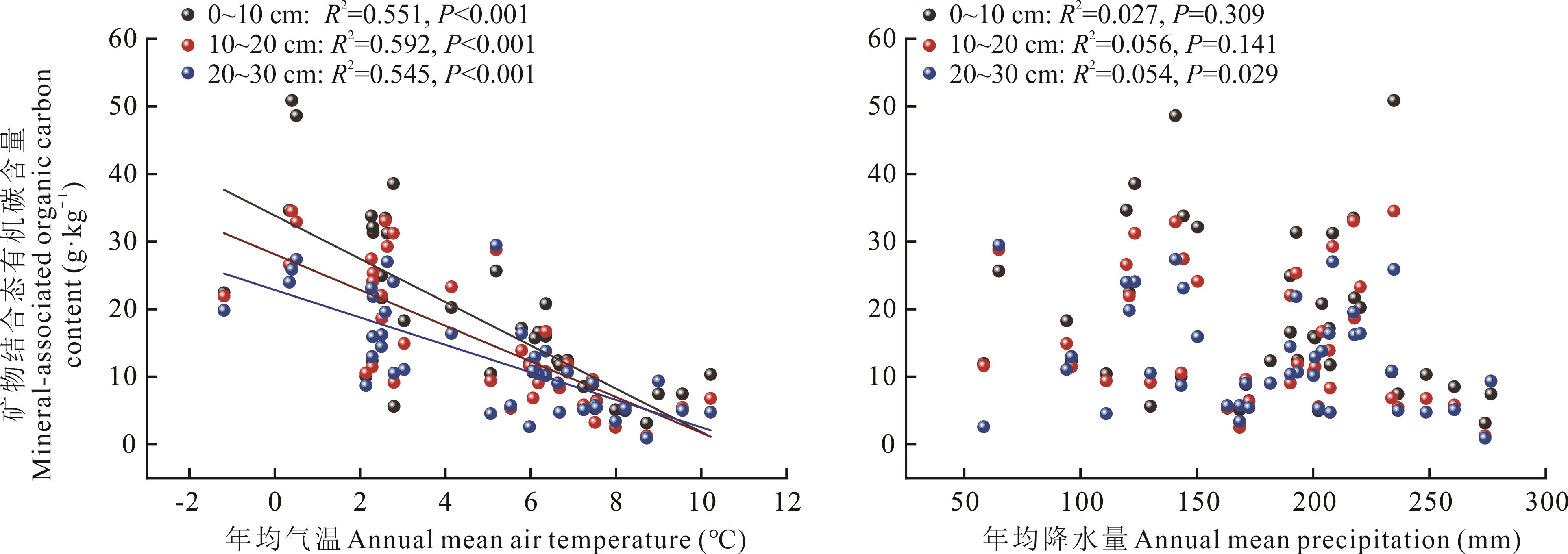
图5 矿物结合态有机碳含量与年均气温和降水量的关系
Fig.5 Relationship between mineral-associated organic carbon content and annual mean air temperature and precipitation
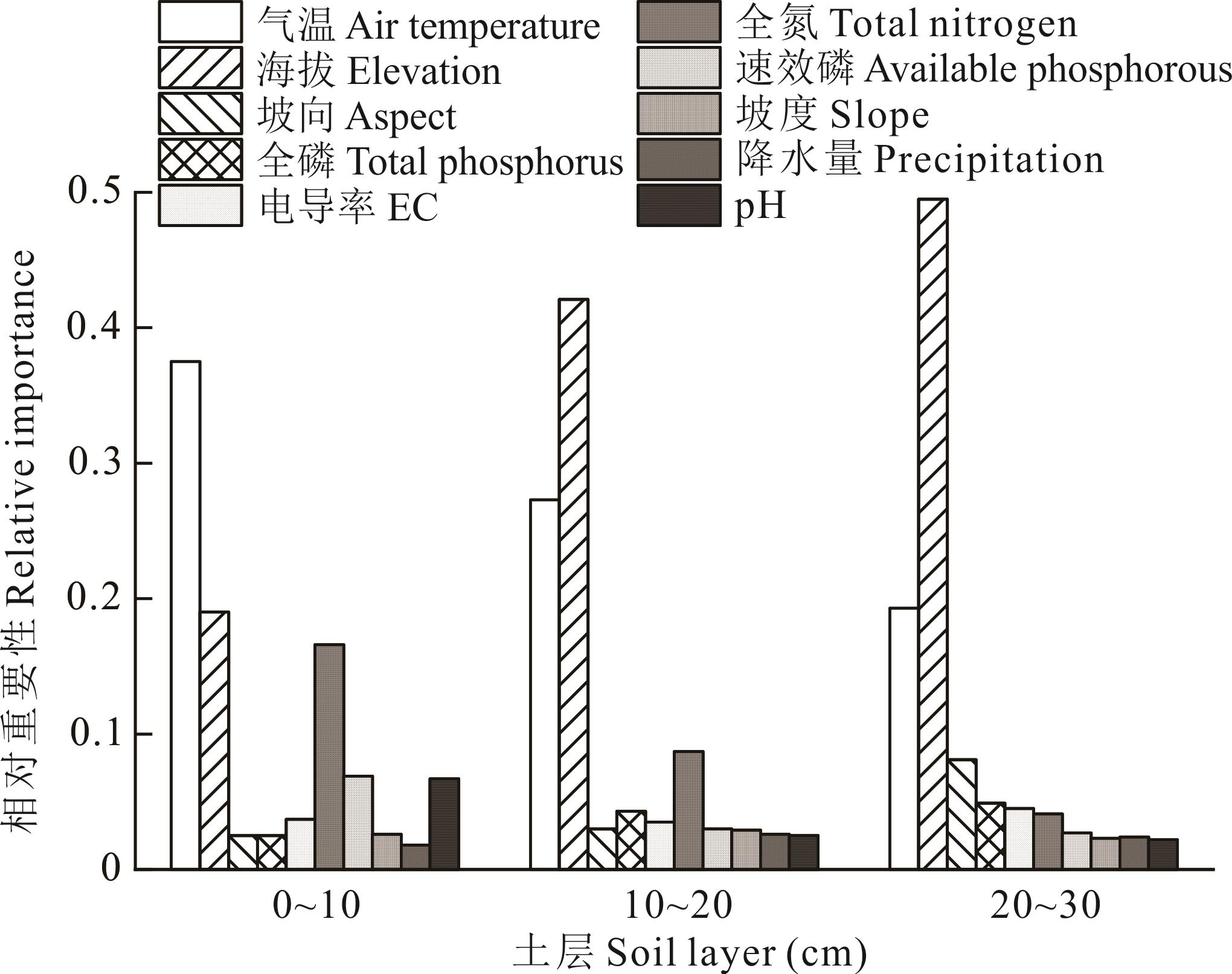
图6 各影响因素对矿物结合态有机碳含量的相对重要性
Fig.6 Relative importance of factors influencing mineral-associated organic carbon content
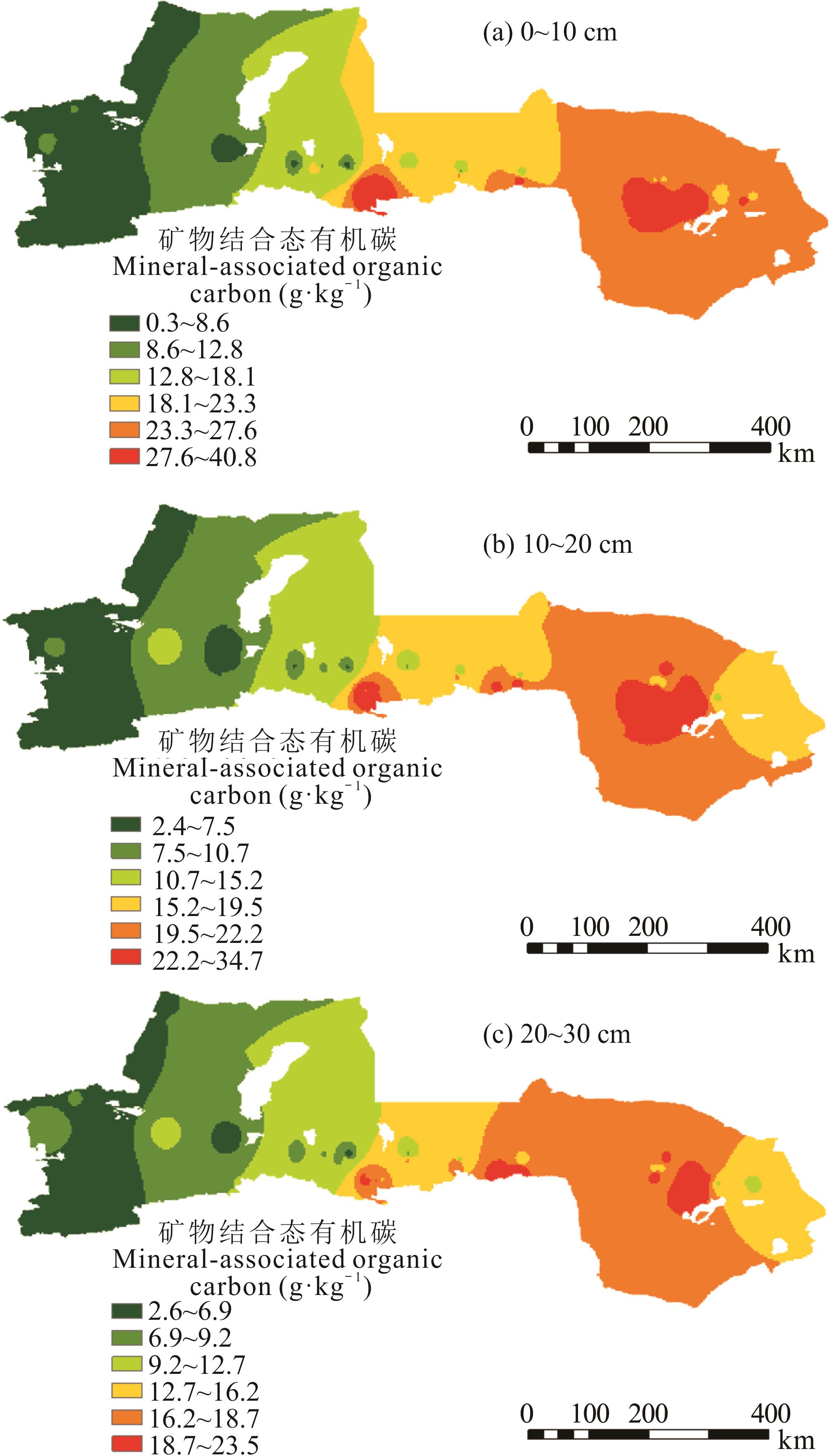
图7 各土层矿物结合态有机碳含量的分布特征基于自然资源部标准地图服务网站GS(2024)0650号标准地图制作,底图边界无修改。Based on the standard map service website GS (2024) 0650 of the Ministry of Natural Resources, the boundary of the base map is not modified.
Fig.7 Distribution characteristics of mineral-associated organic carbon content across soil layers
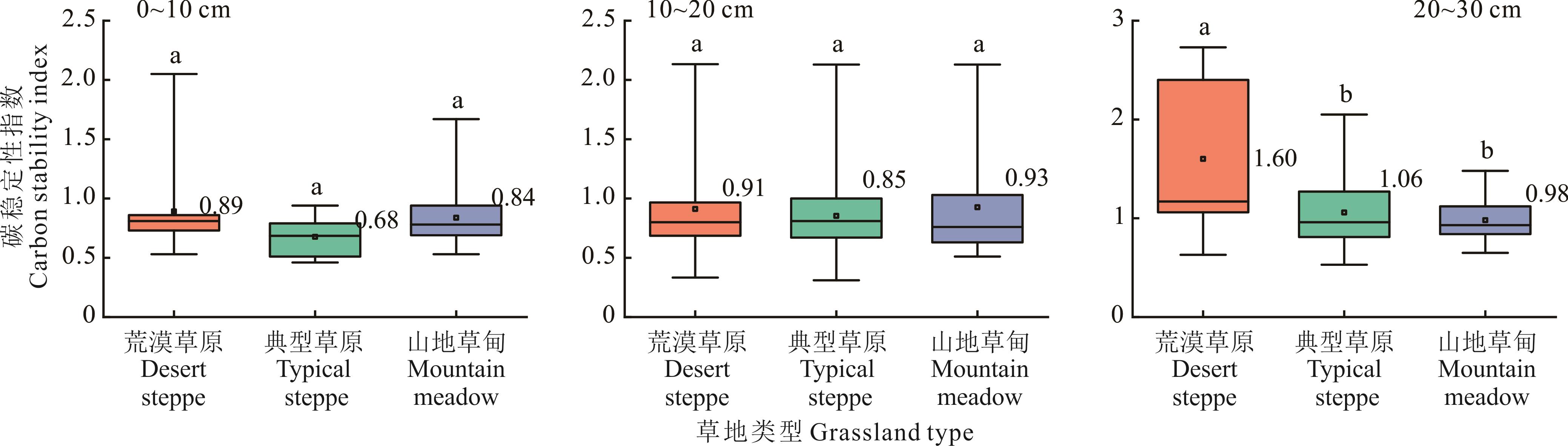
图8 不同草地类型下碳稳定性指数的垂直分布特征不同小写字母表示同一土层不同草地类型之间差异显著(P<0.05)。Different lowercase letters indicate significant differences (P<0.05) among grassland types within the same soil layer.
Fig.8 Vertical distribution characteristics of the carbon stability index (CSI) under different grassland types
| [1] | Wang Y, Huang L M, Jia X X, et al. Distribution characteristics and controls of soil organic carbon at different spatial scales in China’s Loess Plateau. Journal of Environmental Management, 2021, 293: 112943. |
| [2] | Zhang R, Zhao X Y, Wang R X, et al. Review of the effects of land use/cover change on soil organic carbon dynamic in arid and semi-arid areas. Chinese Journal of Ecology, 2024, 43(7): 2222-2230. |
| 张蕊, 赵学勇, 王瑞雄, 等. 干旱半干旱区土地利用/覆被类型变化对土壤有机碳动态影响的研究进展. 生态学杂志, 2024, 43(7): 2222-2230. | |
| [3] | Batjes N H. Harmonized soil property values for broad-scale modelling (WISE30sec) with estimates of global soil carbon stocks. Geoderma, 2016, 269: 61-68. |
| [4] | Balesdent J, Basile-Doelsch I, Chadoeuf J, et al. Atmosphere-soil carbon transfer as a function of soil depth. Nature, 2018, 559(7715): 599-602. |
| [5] | Heckman K, Hicks Pries C E, Lawrence C R, et al. Beyond bulk: Density fractions explain heterogeneity in global soil carbon abundance and persistence. Global Change Biology, 2022, 28(3): 1178-1196. |
| [6] | Sokol N W, Whalen E D, Jilling A, et al. Global distribution, formation and fate of mineral-associated soil organic matter under a changing climate: A trait-based perspective. Functional Ecology, 2022, 36(6): 1411-1429. |
| [7] | Mikutta R, Mikutta C, Kalbitz K, et al. Biodegradation of forest floor organic matter bound to minerals via different binding mechanisms. Geochimica et Cosmochimica Acta, 2007, 71(10): 2569-2590. |
| [8] | von Lützow M, Kögel-Knabner I, Ekschmitt K, et al. SOM fractionation methods: relevance to functional pools and to stabilization mechanisms. Soil Biology and Biochemistry, 2007, 39(9): 2183-2207. |
| [9] | Trumbore S E, Czimczik C I. An uncertain future for soil carbon. Science, 2008, 321(5895): 1455-1456. |
| [10] | Paustian K, Lehmann J, Ogle S, et al. Climate-smart soils. Nature, 2016, 532(7597): 49-57. |
| [11] | Angst G, Mueller K E, Nierop K G J, et al. Plant-or microbial-derived? A review on the molecular composition of stabilized soil organic matter. Soil Biology and Biochemistry, 2021, 156: 108189. |
| [12] | Qiu X. The effect of grazing and climate change on characteristics of vegetation and cycle of soil carbon and nitrogen in grassland ecosystem. Hohhot: Inner Mongolia Agricultural University, 2022. |
| 邱晓. 放牧和模拟气候变化对草地生态系统植被与土壤碳氮循环特征的影响. 呼和浩特: 内蒙古农业大学, 2022. | |
| [13] | Zhao J L, Liu Y J, Tang F L, et al. Evaluation of the necessity of grassland natural park establishment in China. Chinese Journal of Grassland, 2020, 42(4): 1-7. |
| 赵金龙, 刘永杰, 唐芳林, 等. 中国草原自然公园建设的必要性. 中国草地学报, 2020, 42(4): 1-7. | |
| [14] | Fang J Y, Yang Y H, Ma W H, et al. Ecosystem carbon stocks and their changes in China’s grasslands. Scientia Sinica (Vitae), 2010, 40(7): 566-576. |
| 方精云, 杨元合, 马文红, 等. 中国草地生态系统碳库及其变化. 中国科学: 生命科学, 2010, 40(7): 566-576. | |
| [15] | Ding J M, Wang W Z, Mi W B, et al. Spatial characteristics of soil organic carbon in grassland of Ningxia and its influencing factors. Acta Ecologica Sinica, 2023, 43(5): 1913-1922. |
| 丁金梅, 王维珍, 米文宝, 等. 宁夏草地土壤有机碳空间特征及其影响因素. 生态学报, 2023, 43(5): 1913-1922. | |
| [16] | Chang S, Yu H B, Cao C M, et al. Distribution characteristics of soil organic carbon in Xilin Gol steppe and its influencing factors. Arid Zone Research, 2021, 38(5): 1355-1366. |
| 常帅, 于红博, 曹聪明, 等. 锡林郭勒草原土壤有机碳分布特征及其影响因素. 干旱区研究, 2021, 38(5): 1355-1366. | |
| [17] | Yin S L, Wang X Q, Li S H. A study on the soil carbon density of different artificial shrub community in Gonghe Basin in Qinghai Province. Soils, 2016, 48(2): 409-413. |
| 尹书乐, 王学全, 李少华. 青海共和盆地不同人工灌木群落土壤碳密度研究. 土壤, 2016, 48(2): 409-413. | |
| [18] | Zhu M, Feng Q, Zhang M X, et al. Patterns and influencing factors of soil organic carbon in grassland of the middle Qilian Mountains. Acta Agrestia Sincia, 2018, 26(6): 1322-1329. |
| 朱猛, 冯起, 张梦旭, 等. 祁连山中段草地土壤有机碳分布特征及其影响因素. 草地学报, 2018, 26(6): 1322-1329. | |
| [19] | Li L, Jiang L N, Bai J H. Multi-scale correlations between spatial variability of soil organic carbon and its influencing factors in semiarid zone. Science of Soil and Water Conservation, 2018, 16(5): 40-48. |
| 李龙, 姜丽娜, 白建华. 半干旱区土壤有机碳空间变异及其影响因素的多尺度相关分析. 中国水土保持科学, 2018, 16(5): 40-48. | |
| [20] | Lugato E, Lavallee J M, Haddix M L, et al. Different climate sensitivity of particulate and mineral-associated soil organic matter. Nature Geoscience, 2021, 14(5): 295-300. |
| [21] | Liu F T, Qin S Q, Fang K, et al. Divergent changes in particulate and mineral-associated organic carbon upon permafrost thaw. Nature Communications, 2022, 13(1): 5073. |
| [22] | Lavallee J M, Soong J L, Cotrufo M F. Conceptualizing soil organic matter into particulate and mineral-associated forms to address global change in the 21st century. Global Change Biology, 2020, 26(1): 261-273. |
| [23] | Cotrufo M F, Ranalli M G, Haddix M L, et al. Soil carbon storage informed by particulate and mineral-associated organic matter. Nature Geoscience, 2019, 12(12): 989-994. |
| [24] | Luo Z K, Viscarra Rossel R A, Shi Z. Distinct controls over the temporal dynamics of soil carbon fractions after land use change. Global Change Biology, 2020, 26(8): 4614-4625. |
| [25] | Georgiou K, Jackson R B, Vindušková O, et al. Global stocks and capacity of mineral-associated soil organic carbon. Nature Communications, 2022, 13(1): 3797. |
| [26] | Du X, Wang H Y. Active components of forest soil organic carbon and its influencing factors in China. World Forestry Research, 2022, 35(1): 76-81. |
| 杜雪, 王海燕. 中国森林土壤有机碳活性组分及其影响因素. 世界林业研究, 2022, 35(1): 76-81. | |
| [27] | Dong Y Q, Guan P, Lu Y, et al. Fraction and content of soil organic carbon at different elevations in Maoer Mountain. Chinese Journal of Soil Science, 2020, 51(5): 1142-1151. |
| 董玉清, 官鹏, 卢瑛, 等. 猫儿山不同海拔土壤有机碳组分构成及含量特征. 土壤通报, 2020, 51(5): 1142-1151. | |
| [28] | Wang Y B, Zhao R F, Zhang L H, et al. Soil organic carbon and its influencing factors on the different plant communities in the middle reaches of the Heihe River wetland. Pratacultural Science, 2020, 37(5): 833-844. |
| 王園博, 赵锐锋, 张丽华, 等. 黑河中游湿地不同植物群落土壤有机碳分布及影响因素. 草业科学, 2020, 37(5): 833-844. | |
| [29] | Zhao Z Z, Zhao Z, Fu B, et al. Characteristics of soil organic carbon fractions under different land use patterns in a tropical area. Journal of Soils and Sediments, 2021, 21(2): 689-697. |
| [30] | Bao S D. Soil and agricultural chenmistry analysis (the 3rd edition). Beijing: China Agriculture Press, 2005. |
| 鲍士旦. 土壤农化分析(第三版). 北京: 中国农业出版社, 2005. | |
| [31] | Cambardella C A, Elliott E T. Particulate soil organic matter change across a grassland cultivation sequence. Soil Science Society of America Journal, 1992, 56: 777-783. |
| [32] | Chen L Y, Liu L I, Qin S Q, et al. Regulation of priming effect by soil organic matter stability over a broad geographic scale. Nature Communications, 2019, 10(1): 5112. |
| [33] | Zhang Y H, Li Y, Zhou Y, et al. Changes of soil nutrients and organic carbon fractions in Caragana korshinskii forests with different restoration years in mountainous areas of southern Ningxia, China. Chinese Journal of Applied Ecology, 2024, 35(3): 639-647. |
| 张羽涵, 李瑶, 周玥, 等. 宁南山区不同恢复年限柠条林土壤养分及有机碳组分变化特征. 应用生态学报, 2024, 35(3): 639-647. | |
| [34] | Wang J Q, Li F D, Li J F, et al. Distribution characteristics and influencing factors of soil organic carbon in the Manas River Basin on the northern slope of Tianshan Mountain. Chinese Journal of Eco-Agriculture, 2025, 33(3): 449-461. |
| 王健祺, 李发东, 李俊峰, 等. 天山北坡玛纳斯河流域土壤有机碳分布特征与影响因素. 中国生态农业学报, 2025, 33(3): 449-461. | |
| [35] | Haddix M L, Gregorich E G, Helgason B L, et al. Climate, carbon content, and soil texture control the independent formation and persistence of particulate and mineral-associated organic matter in soil. Geoderma, 2020, 363: 114160. |
| [36] | Li W D, Chen D, Cheng J L, et al. Characteristics and influencing factors of soil particulate and mineral-associated organic carbon in cropland soil across Sichuan Basin. Environment Science, 2025, 46(1): 388-398. |
| 李文丹, 陈丹, 成金礼, 等. 四川盆地耕地土壤颗粒态和矿物结合态有机碳含量特征及其影响因素. 环境科学, 2025, 46(1): 388-398. | |
| [37] | Pu N N, Sun Z J, Fan Y M, et al. Influencing of grazing intensity on the soil organic carbon and microbial biomass carbon of meadow steppe in Zhaosu area. Journal of Xinjiang Agricultural University, 2013(1): 66-70. |
| 蒲宁宁, 孙宗玖, 范燕敏, 等. 放牧强度对昭苏草甸草原土壤有机碳及微生物碳的影响. 新疆农业大学学报, 2013(1): 66-70. | |
| [38] | Zheng J J, Fang H J, Cheng S L, et al. Effects of N addition on soil organic carbon components in an alpine meadow on the eastern Qinghai-Tibetan Plateau. Acta Ecologica Sinica, 2012, 32(17): 5363-5372. |
| 郑娇娇, 方华军, 程淑兰, 等. 增氮对青藏高原东缘典型高寒草甸土壤有机碳组成的影响. 生态学报, 2012, 32(17): 5363-5372. | |
| [39] | Chen R, Yin L, Wang X, et al. Mineral-associated organic carbon predicts the variations in microbial biomass and specific enzyme activities in a subtropical forest. Geoderma, 2023, 439: 116671. |
| [40] | Zhang L, Zhou G S, Ji Y H, et al. Spatiotemporal dynamic simulation of grassland carbon storage in China. Scientia Sinica(Terrae), 2016, 46(10): 1392-1405. |
| 张利, 周广胜, 汲玉河, 等. 中国草地碳储量时空动态模拟研究. 中国科学: 地球科学, 2016, 46(10): 1392-1405. | |
| [41] | Liu W, Cheng J M, Gao Y, et al. Distribution of soil organic carbon in grassland on Loess Plateau and its influencing factors. Acta Pedologica Sinica, 2012, 49(1): 68-76. |
| 刘伟, 程积民, 高阳, 等. 黄土高原草地土壤有机碳分布及其影响因素. 土壤学报, 2012, 49(1): 68-76. | |
| [42] | Zhou X Q, Wu F Z, Yang W Q, et al. Dynamics of microbial biomass during litter decomposition in the alpine forest. Acta Ecologica Sinica, 2011, 31(14): 4144-4152. |
| 周晓庆, 吴福忠, 杨万勤, 等. 高山森林凋落物分解过程中的微生物生物量动态. 生态学报, 2011, 31(14): 4144-4152. | |
| [43] | Mu M. Analysis of spatial and temporal changes and influencing factors of key attributes of soil organic carbon pool in Anhui Province. Hefei: Anhui University of Science and Technology, 2023. |
| 慕明. 安徽省土壤有机碳库关键属性时空变化及影响因素分析研究. 合肥: 安徽理工大学, 2023. | |
| [44] | Yan A. Spatial distribution and storages estimation of soil organic carbon and soil inorganic carbon in Xinjiang, China. Beijing: China Agricultural University, 2015. |
| 颜安. 新疆土壤有机碳/无机碳空间分布特征及储量估算. 北京: 中国农业大学, 2015. | |
| [45] | Wang B Q. The dynamics and transfer of soil organic carbon and nitrogen in the scenario of erosion and aridity in the loessial region. Yangling: Northwest A&F University, 2004. |
| 王百群. 黄土区侵蚀与干旱环境中土壤有机碳氮的变化与迁移. 杨凌: 西北农林科技大学, 2004. | |
| [46] | Díaz-Martínez P, Maestre F T, Moreno-Jiménez E, et al. Vulnerability of mineral-associated soil organic carbon to climate across global drylands. Nature Climate Change, 2024, 14(9): 976-982. |
| [47] | Apori S O, Giltrap M, Tian F R. Topsoil organic carbon and soil pH across different peatland use types in Co-offaly, Ireland. Soil Science Annual, 2024, 74(4): 1-7. |
| [48] | Zhou Z F, Zhang L, Wu T, et al. Changes in ecosystem service values of forests in southwest China’s karst regions from 2001-2020. Forests, 2023, 14(8): 1534. |
| [49] | Shen Z, Han T F, Huang J, et al. Soil organic carbon regulation by pH in acidic red soil subjected to long-term liming and straw incorporation. Journal of Environmental Management, 2024, 367: 122063. |
| [50] | Liu F C, Yang Y H, Jiang J, et al. Effects of acid rain on soil respiration in Chinese terrestrial ecosystems: A meta-analysis. Acta Ecologica Sinica, 2022, 42(24): 10191-10200. |
| 刘丰彩, 杨燕华, 江军, 等. 酸雨对中国陆地生态系统土壤呼吸影响的整合分析. 生态学报, 2022, 42(24): 10191-10200. | |
| [51] | Guo N, Degen A A, Deng B, et al. Changes in vegetation parameters and soil nutrients along degradation and recovery successions on alpine grasslands of the Tibetan Plateau. Agriculture, Ecosystems & Environment, 2019, 284: 106593. |
| [52] | Müller M, Oelmann Y, Schickhoff U, et al. Himalayan treeline soil and foliar C∶N∶P stoichiometry indicate nutrient shortage with elevation. Geoderma, 2017, 291: 21-32. |
| [53] | Zhang T. Soil organic carbon components and carbon source metabolism characteristics and their influencing factors in the Qilian Mountain. Lanzhou: Lanzhou Jiaotong University, 2024. |
| 张婷. 祁连山土壤有机碳组分和碳源代谢特征及其影响因素. 兰州: 兰州交通大学, 2024. |
| [1] | 冉健民, 宋小艳, 王丹, 王长庭. 退化高寒草甸土壤有机碳组分变化与增汇潜力研究[J]. 草业学报, 2025, 34(9): 38-52. |
| [2] | 敬一胜, 孙宗玖, 刘慧霞, 迪达尔·比苏力旦null, 李美莎, 周晨烨, 周磊, 于冰洁, 李有政, 郑丽, 阿斯太肯·居力海提null. 准噶尔盆地沙质荒漠草地土壤pH分布特征及其环境影响因素分析[J]. 草业学报, 2025, 34(7): 54-68. |
| [3] | 景煜都, 刘小伟, 梁可, 封俊豪, 于强, 郭梁. 灌丛化对黄土高原草地土壤有机碳组分与稳定性的影响及其微生物调控机制[J]. 草业学报, 2025, 34(12): 1-15. |
| [4] | 余万洋, 陈怡帆, 方发永, 张金鑫, 李舟, 赵龙山. 1980-2020年贵州省草地空间分布格局演变及驱动力分析[J]. 草业学报, 2024, 33(1): 1-18. |
| [5] | 吴金蕊, 李梦真, 杨勇, 刘爱军, 王普昶, 哈斯巴根null, 吕世杰, 运向军. 典型草原不同放牧强度下羊草种群空间分布的研究[J]. 草业学报, 2023, 32(12): 68-76. |
| [6] | 张彩荷, 李纯斌, 吴静. 基于草原综合顺序分类法的中国山地草地亚类分类研究[J]. 草业学报, 2022, 31(3): 16-25. |
| [7] | 张峰, 孙嘉伟, 孙宇, 郑佳华, 乔荠瑢, 赵萌莉. 不同载畜率对短花针茅荒漠草原优势物种间关系及其空间分布特征的影响[J]. 草业学报, 2021, 30(8): 1-11. |
| [8] | 张殿岱, 王雪梅, 昝梅. 基于Landsat 8 OLI影像的渭-库绿洲植被地上生物量估算[J]. 草业学报, 2021, 30(11): 1-12. |
| [9] | 马涛, 吕文强, 李泽霞, 陈爱华, 董彦丽. 黄土高原丘陵沟壑区轮作休耕模式下5种土地利用方式土壤剖面水分分布特征[J]. 草业学报, 2020, 29(7): 30-39. |
| [10] | 许爱云, 许冬梅, 曹兵, 刘金龙, 于双, 郭艳菊, 马晓静. 宁夏荒漠草原不同群落蒙古冰草种群空间格局及种间关联性[J]. 草业学报, 2020, 29(3): 171-178. |
| [11] | 董斅晓, 薄元超, 孙建平, 张晓琳, 王常慧, 董宽虎. 农牧交错带半干旱草地生态系统CO2交换对短期不同水平氮添加的响应[J]. 草业学报, 2019, 28(5): 163-170. |
| [12] | 张瑶瑶, 冷若琳, 崔霞, 宋清洁, 胥刚. 甘南州高寒草地土壤氮磷空间分布特征[J]. 草业学报, 2018, 27(12): 12-21. |
| [13] | 白娜, 王立, 孔东升. 黑河自然保护区沼泽湿地土壤化学性质的空间分布特征研究[J]. 草业学报, 2017, 26(5): 15-28. |
| [14] | 田耀武, 贺春玲, 刘龙昌, 王宁, 徐少君, 刘晶, 李东升. 退耕草地土壤有机碳密度的空间分布及动态变化[J]. 草业学报, 2016, 25(8): 48-55. |
| [15] | 杨阳,刘秉儒,宋乃平,杨新国. 人工柠条灌丛密度对荒漠草原土壤养分空间分布的影响[J]. 草业学报, 2014, 23(5): 107-115. |
| 阅读次数 | ||||||
|
全文 |
|
|||||
|
摘要 |
|
|||||
