

ISSN 1004-5759 CN 62-1105/S
草业学报 ›› 2026, Vol. 35 ›› Issue (12): 54-63.DOI: 10.11686/cyxb2025527
杨昀睿1( ), 陈金宇1, 赵丹1, 杨帆1, 侯双利2, 王智慧1, 王洪义1()
收稿日期:2025-12-25
修回日期:2026-03-09
出版日期:2026-12-20
发布日期:2026-11-02
通讯作者:
王洪义
作者简介:E-mail: why021@163.com基金资助:
Yun-rui YANG1(), Jin-yu CHEN1, Dan ZHAO1, Fan YANG1, Shuang-li HOU2, Zhi-hui WANG1, Hong-yi WANG1()
Received:2025-12-25
Revised:2026-03-09
Online:2026-12-20
Published:2026-11-02
Contact:
Hong-yi WANG
摘要:
豆科植物是重要的生物固氮功能群,在提高草地生产力、维持群落稳定性和保障生态系统可持续性方面具有重要作用。为揭示长期氮、磷输入对豆科功能群特征及物种多样性的影响,依托位于内蒙古呼伦贝尔草甸草原的氮、磷添加控制试验平台2014-2024年连续观测数据,系统分析豆科功能群的盖度、高度、生物量、重要值和物种多样性变化。结果表明:1)短期内(第1和2年),氮添加提高了豆科功能群的相对盖度、相对生物量和地上生物量,在中长期(第3年以后),氮添加显著降低了豆科功能群的相对盖度、相对生物量及重要值;而磷添加则对上述指标具有显著正向效应。2)氮添加(N10P0)和氮磷添加(N10P4)处理显著降低了豆科植物物种多样性,自试验第3年起豆科物种数由7种降至1种;与CK相比,磷添加(N0P4)处理显著增加了豆科植物物种多样性,使其出现频次平均提高了45.35%,其中药用植物黄芪属的糙叶黄芪、斜茎黄芪和草木樨状黄芪增加明显。3)氮、磷添加对豆科功能群相对盖度、相对生物量、地上生物量、重要值具有显著交互作用,但磷添加难以缓解氮增加导致的豆科物种丧失及对豆科功能群的负面影响。综上所述,长期氮添加对呼伦贝尔草甸草原豆科功能群具有显著抑制作用,磷添加对豆科功能群具有显著正向效应,从增加天然草原固氮植物角度来看未来草地管理应重视磷肥的施入。
杨昀睿, 陈金宇, 赵丹, 杨帆, 侯双利, 王智慧, 王洪义. 长期氮磷添加对呼伦贝尔草甸草原豆科功能群的影响[J]. 草业学报, 2026, 35(12): 54-63.
Yun-rui YANG, Jin-yu CHEN, Dan ZHAO, Fan YANG, Shuang-li HOU, Zhi-hui WANG, Hong-yi WANG. Effects of long-term nitrogen and phosphorus addition on the legume functional group in the Hulunbuir meadow steppe[J]. Acta Prataculturae Sinica, 2026, 35(12): 54-63.
处理 Treatment | 豆科相对生物量Legume relative biomass | 豆科地上生物量 Legume aboveground biomass | 群落地上总生物量 Total aboveground biomass | 豆科相对盖度 Legume relative coverage | 豆科相对高度 Legume relative height | 豆科重要值 Legume importance values |
|---|---|---|---|---|---|---|
| Y | 78.11*** | 120.23*** | 360.11*** | 4.62*** | 7.52*** | 19.02*** |
| N | 17.96*** | 400.38*** | 223.23*** | 1.25ns | 6.46* | 4.78* |
| P | 799.81*** | 1104.15*** | 21.52*** | 59.58*** | 11.55** | 150.79*** |
| Y×N | 276.71*** | 524.91*** | 67.60*** | 28.73*** | 12.98*** | 65.40*** |
| Y×P | 60.81*** | 13.75*** | 10.19*** | 5.21*** | 12.28*** | 25.28*** |
| N×P | 44.57*** | 22.10*** | 3.57ns | 10.35** | 0.11ns | 11.74** |
| Y×N×P | 78.10*** | 58.50*** | 0.02ns | 0.78ns | 0.05ns | 2.32ns |
表1 豆科功能群特征与群落地上生物量三因素方差分析
Table 1 Three-way ANOVA of legume functional group characteristics and community aboveground biomass
处理 Treatment | 豆科相对生物量Legume relative biomass | 豆科地上生物量 Legume aboveground biomass | 群落地上总生物量 Total aboveground biomass | 豆科相对盖度 Legume relative coverage | 豆科相对高度 Legume relative height | 豆科重要值 Legume importance values |
|---|---|---|---|---|---|---|
| Y | 78.11*** | 120.23*** | 360.11*** | 4.62*** | 7.52*** | 19.02*** |
| N | 17.96*** | 400.38*** | 223.23*** | 1.25ns | 6.46* | 4.78* |
| P | 799.81*** | 1104.15*** | 21.52*** | 59.58*** | 11.55** | 150.79*** |
| Y×N | 276.71*** | 524.91*** | 67.60*** | 28.73*** | 12.98*** | 65.40*** |
| Y×P | 60.81*** | 13.75*** | 10.19*** | 5.21*** | 12.28*** | 25.28*** |
| N×P | 44.57*** | 22.10*** | 3.57ns | 10.35** | 0.11ns | 11.74** |
| Y×N×P | 78.10*** | 58.50*** | 0.02ns | 0.78ns | 0.05ns | 2.32ns |
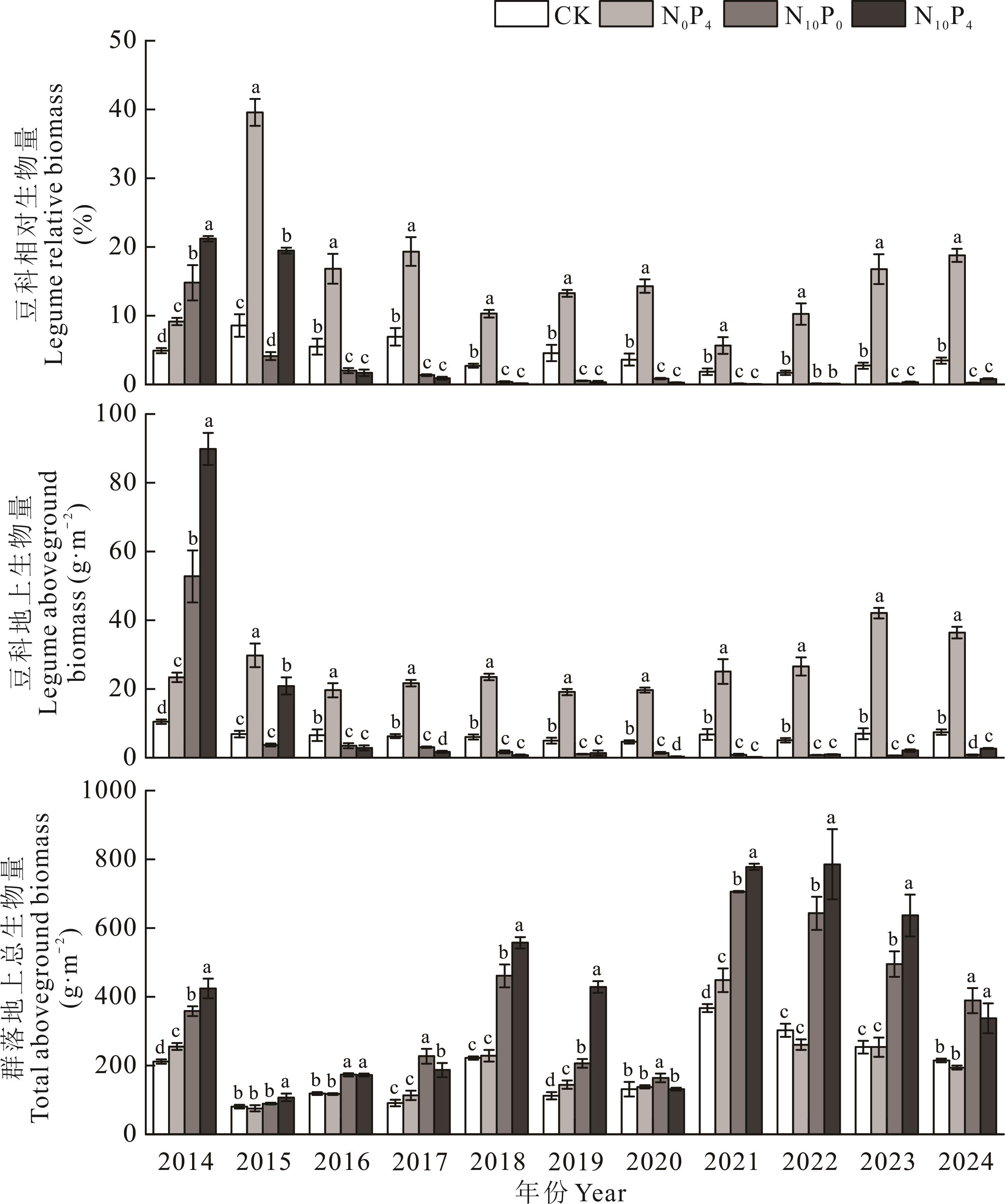
图1 不同氮磷添加处理下豆科相对生物量、地上生物量及群落地上总生物量的年际变化不同小写字母表示同一年份不同处理间差异显著(P<0.05),下同 Different lowercase letters indicate significant differences among treatments in the same year (P<0.05), the same below.
Fig.1 Interannual variation in the relative biomass and aboveground biomass of legumes, and total aboveground biomass under different nitrogen and phosphorus addition treatments
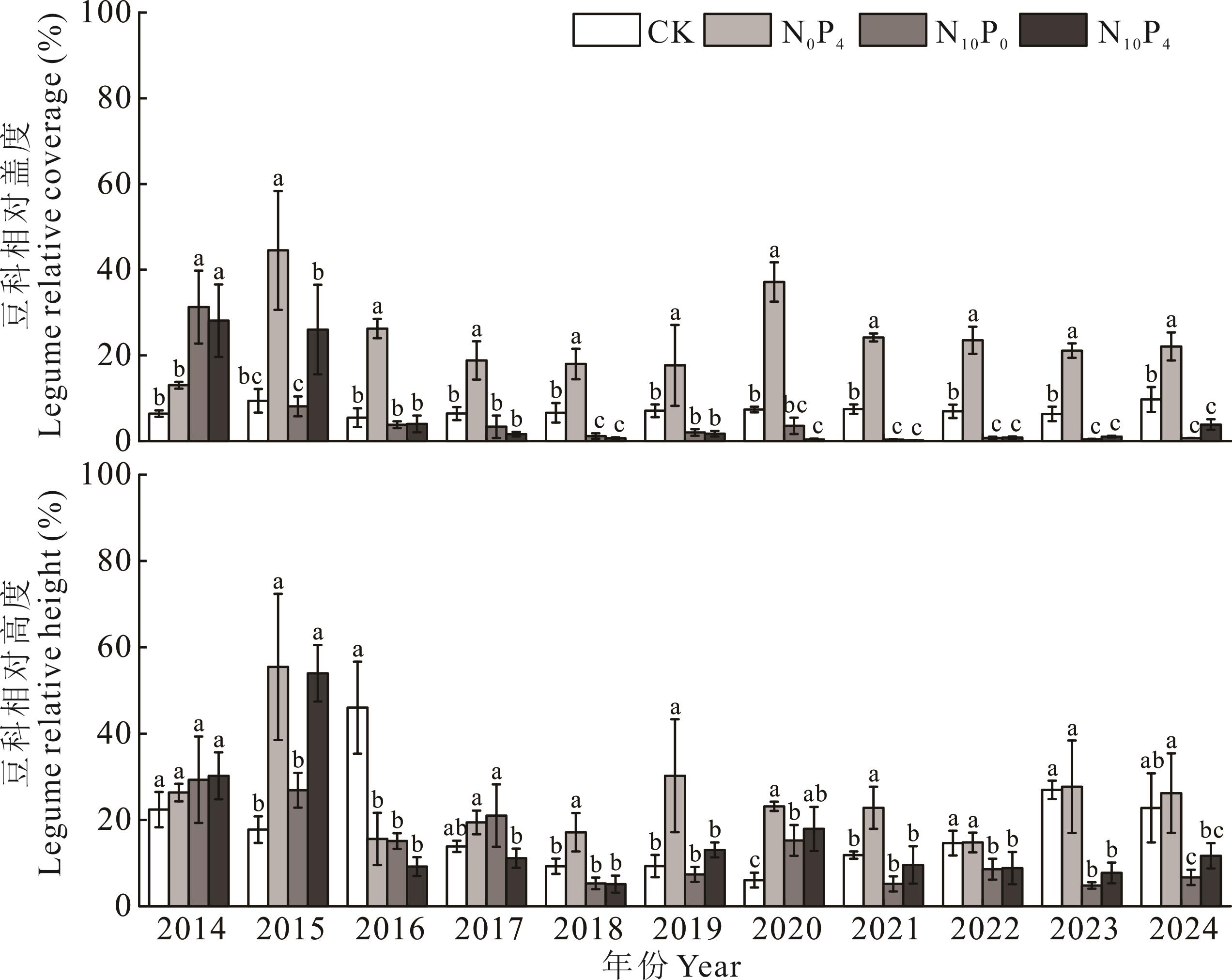
图2 不同氮磷添加处理下豆科相对盖度和相对高度的年际变化
Fig.2 Interannual variation in the relative coverage and relative height of legumes under different nitrogen and phosphorus addition treatments
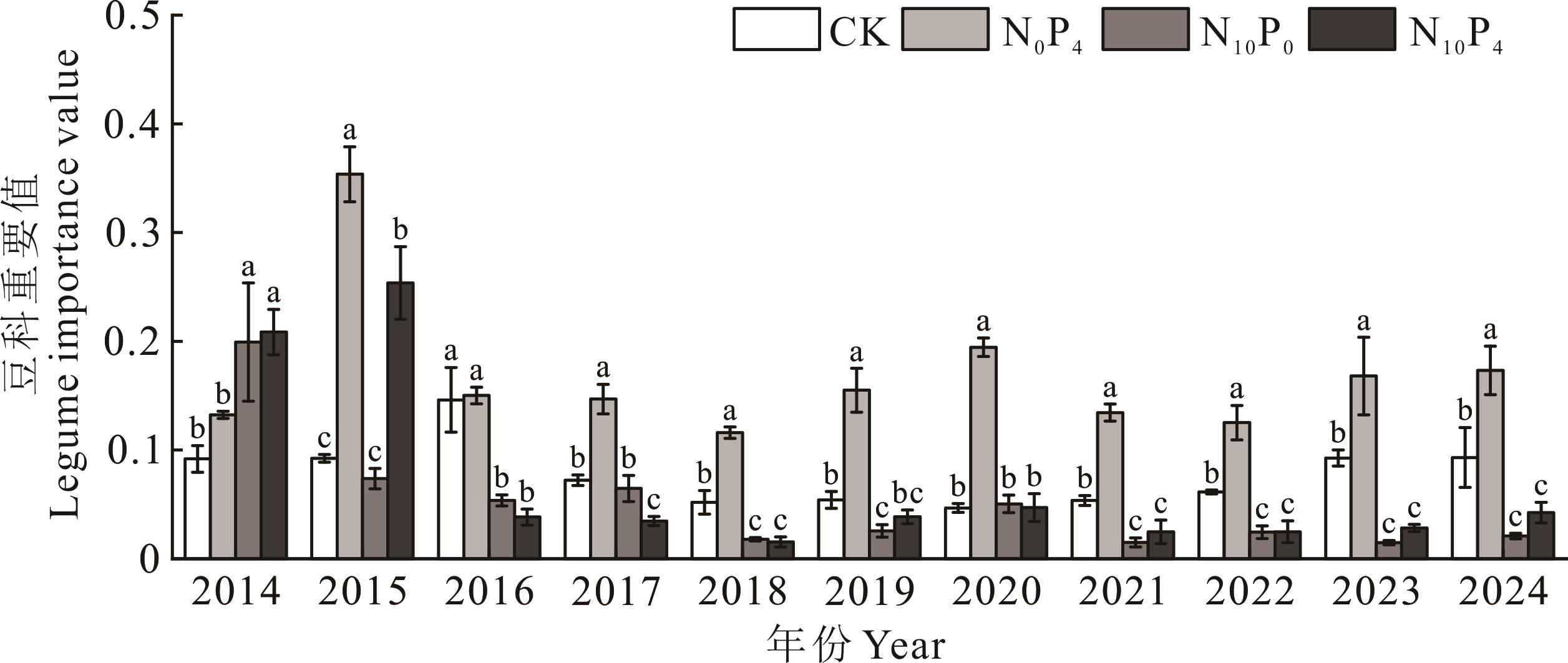
图3 不同氮磷添加处理下豆科重要值的年际变化
Fig.3 Interannual variation in the importance value of legumes under different nitrogen and phosphorus addition treatments
年份 Year | Margalef丰富度指数 Margalef richness index | Shannon-Wiener多样性指数 Shannon-Wiener diversity index | Pielou均匀度指数 Pielou evenness index | |||||||||
|---|---|---|---|---|---|---|---|---|---|---|---|---|
| CK | N0P4 | N10P0 | N10P4 | CK | N0P4 | N10P0 | N10P4 | CK | N0P4 | N10P0 | N10P4 | |
| 2014 | 1.89±0.13a | 1.81±0.01a | 1.43±0.04b | 1.38±0.06b | 1.47±0.09a | 1.47±0.01a | 1.24±0.04b | 1.13±0.04c | 0.75±0.04a | 0.75±0.01a | 0.69±0.02a | 0.63±0.02b |
| 2015 | 0.77±0.04c | 1.52±0.02b | 0.73±0.18c | 1.79±0.07a | 0.79±0.04b | 1.33±0.12a | 0.43±0.09c | 1.38±0.01a | 0.72±0.04a | 0.74±0.06a | 0.63±0.13a | 0.71±0.01a |
| 2016 | 1.36±0.07 | 0.36±0.01 | 0 | 0 | 0.84±0.18 | 0.48±0.02 | 0 | 0 | 0.52±0.11 | 0.70±0.03 | - | - |
| 2017 | 0.70±0.01 | 0.70±0.01 | 0 | 0 | 0.53±0.02 | 0.92±0.02 | 0 | 0 | 0.49±0.02 | 0.84±0.02 | - | - |
| 2018 | 0.32±0.02 | 0.62±0.01 | 0 | 0 | 0.44±0.02 | 0.97±0.01 | 0 | 0 | 0.64±0.03 | 0.88±0.01 | - | - |
| 2019 | 0 | 0.68±0.01 | 0 | 0 | 0 | 0.70±0.04 | 0 | 0 | - | 0.64±0.04 | - | - |
| 2020 | 0.56±0.05 | 0.33±0.02 | 0 | 0 | 0.66±0.02 | 0.69±0.01 | 0 | 0 | 0.96±0.03 | 0.99±0.01 | - | - |
| 2021 | 0 | 0.92±0.05 | 0 | - | 0 | 1.05±0.07 | 0 | 0 | - | 0.76±0.05 | - | - |
| 2022 | 0.99±0.05 | 0.33±0.01 | 0 | - | 0.69±0.02 | 0.68±0.02 | 0 | 0 | 0.50±0.01 | 0.97±0.03 | - | - |
| 2023 | 1.04±0.05 | 0.88±0.05 | 0 | 0 | 0.87±0.02 | 1.19±0.03 | 0 | 0 | 0.63±0.01 | 0.86±0.02 | - | - |
| 2024 | 0.74±0.08 | 0.61±0.01 | 0 | - | 0.68±0.02 | 0.89±0.05 | 0 | - | 0.62±0.02 | 0.81±0.05 | - | - |
表2 不同氮磷添加处理下豆科功能群内物种多样性指数的年际变化
Table 2 Interannual variation in the diversity indices of the legume functional group under different nitrogen and phosphorus addition treatments
年份 Year | Margalef丰富度指数 Margalef richness index | Shannon-Wiener多样性指数 Shannon-Wiener diversity index | Pielou均匀度指数 Pielou evenness index | |||||||||
|---|---|---|---|---|---|---|---|---|---|---|---|---|
| CK | N0P4 | N10P0 | N10P4 | CK | N0P4 | N10P0 | N10P4 | CK | N0P4 | N10P0 | N10P4 | |
| 2014 | 1.89±0.13a | 1.81±0.01a | 1.43±0.04b | 1.38±0.06b | 1.47±0.09a | 1.47±0.01a | 1.24±0.04b | 1.13±0.04c | 0.75±0.04a | 0.75±0.01a | 0.69±0.02a | 0.63±0.02b |
| 2015 | 0.77±0.04c | 1.52±0.02b | 0.73±0.18c | 1.79±0.07a | 0.79±0.04b | 1.33±0.12a | 0.43±0.09c | 1.38±0.01a | 0.72±0.04a | 0.74±0.06a | 0.63±0.13a | 0.71±0.01a |
| 2016 | 1.36±0.07 | 0.36±0.01 | 0 | 0 | 0.84±0.18 | 0.48±0.02 | 0 | 0 | 0.52±0.11 | 0.70±0.03 | - | - |
| 2017 | 0.70±0.01 | 0.70±0.01 | 0 | 0 | 0.53±0.02 | 0.92±0.02 | 0 | 0 | 0.49±0.02 | 0.84±0.02 | - | - |
| 2018 | 0.32±0.02 | 0.62±0.01 | 0 | 0 | 0.44±0.02 | 0.97±0.01 | 0 | 0 | 0.64±0.03 | 0.88±0.01 | - | - |
| 2019 | 0 | 0.68±0.01 | 0 | 0 | 0 | 0.70±0.04 | 0 | 0 | - | 0.64±0.04 | - | - |
| 2020 | 0.56±0.05 | 0.33±0.02 | 0 | 0 | 0.66±0.02 | 0.69±0.01 | 0 | 0 | 0.96±0.03 | 0.99±0.01 | - | - |
| 2021 | 0 | 0.92±0.05 | 0 | - | 0 | 1.05±0.07 | 0 | 0 | - | 0.76±0.05 | - | - |
| 2022 | 0.99±0.05 | 0.33±0.01 | 0 | - | 0.69±0.02 | 0.68±0.02 | 0 | 0 | 0.50±0.01 | 0.97±0.03 | - | - |
| 2023 | 1.04±0.05 | 0.88±0.05 | 0 | 0 | 0.87±0.02 | 1.19±0.03 | 0 | 0 | 0.63±0.01 | 0.86±0.02 | - | - |
| 2024 | 0.74±0.08 | 0.61±0.01 | 0 | - | 0.68±0.02 | 0.89±0.05 | 0 | - | 0.62±0.02 | 0.81±0.05 | - | - |
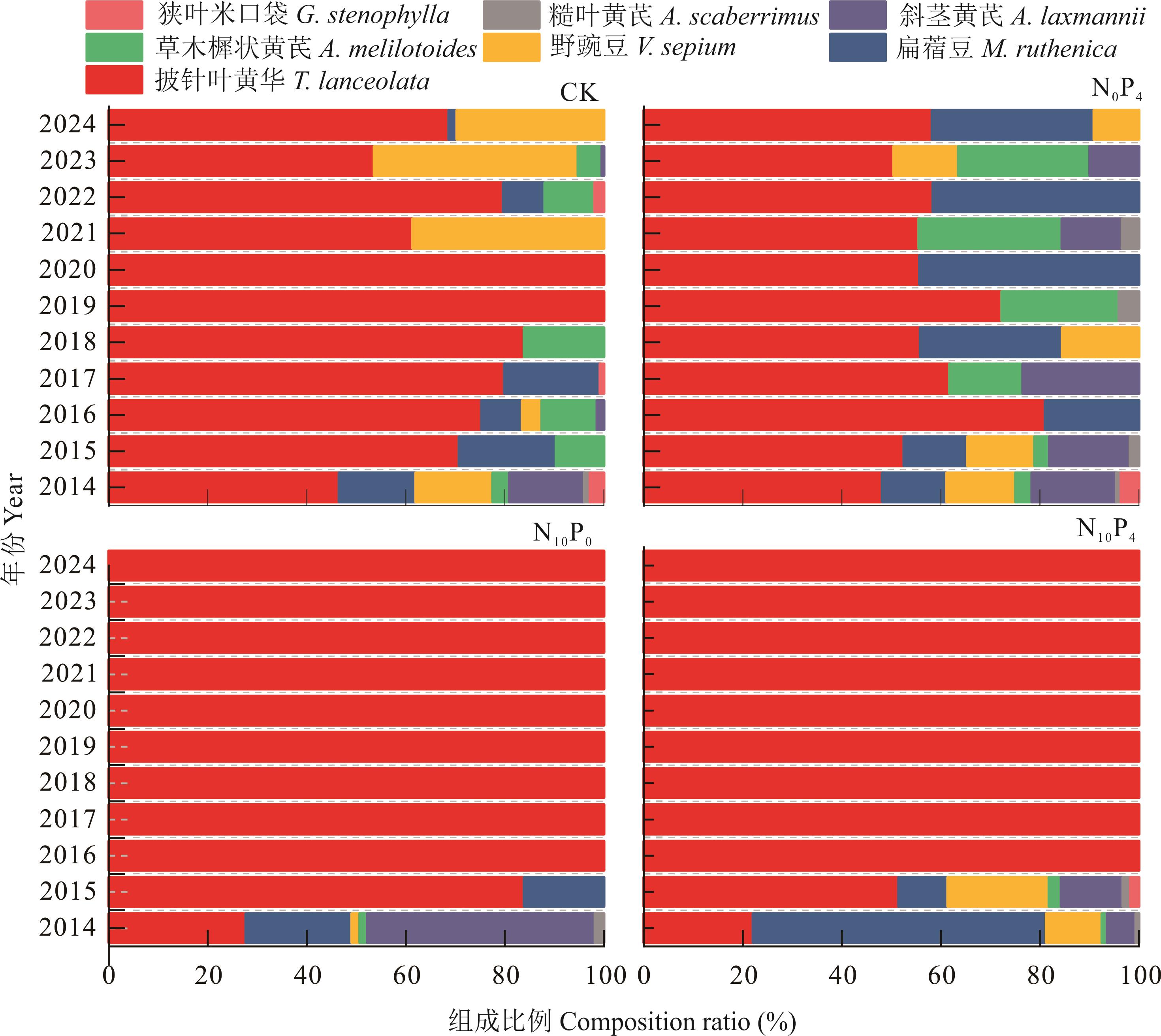
图4 不同氮磷添加处理下豆科功能群内各物种生物量组成比例的年际变化
Fig.4 Interannual variation in biomass composition ratio of legume species within the legume functional group under different nitrogen and phosphorus addition treatments
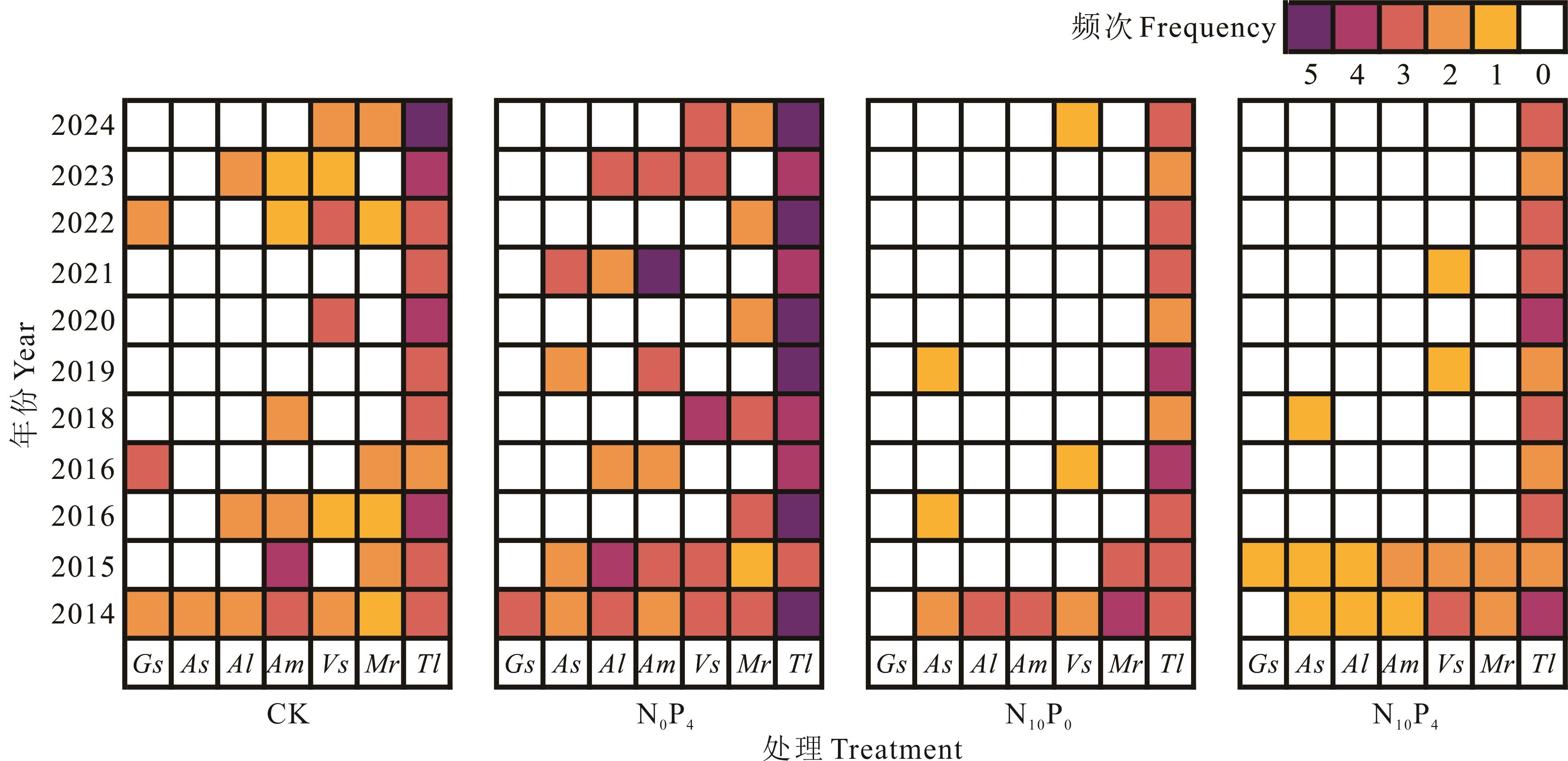
图5 不同氮磷添加处理下豆科物种出现频次Gs: 狭叶米口袋G. stenophylla; As: 糙叶黄芪A. scaberrimus; Al: 斜茎黄芪A. laxmannii; Am: 草木樨状黄芪A. melilotoides、Vs: 野豌豆V. sepium; Mr: 扁蓿豆M. ruthenica; Tl: 披针叶黄华T. lanceolata.
Fig.5 Frequency of occurrence of legume species under different nitrogen and phosphorus addition treatments
| [1] | Zhao Y Y, Liu Z F, Wu J G. Grassland ecosystem services: A systematic review of research advances and future directions. Landscape Ecology, 2020, 35(4): 793-814. |
| [2] | Katoch R, Parmar V, Sankhyan N K, et al. Grasslands in focus: Evaluating and monitoring ecosystem services//Revealing ecosystem services through geospatial technologies: Beyond the surface. Cham: Springer Nature Switzerland, 2025: 59-80. |
| [3] | Galloway J N, Townsend A R, Erisman J W, et al. Transformation of the nitrogen cycle: Recent trends, questions, and potential solutions. Science, 2008, 320(5878): 889-892. |
| [4] | Han W J, Cao J Y, Liu J L, et al. Impacts of nitrogen deposition on terrestrial plant diversity: A Meta-analysis in China. Journal of Plant Ecology, 2019, 12(6): 1025-1033. |
| [5] | Yang B J, Qiao N, Xu X L, et al. Symbiotic nitrogen fixation by legumes in two Chinese grasslands estimated with the 15N dilution technique. Nutrient Cycling in Agroecosystems, 2011, 91(1): 91-98. |
| [6] | Xie K Y, Wang Y X, Wan J C, et al. Mechanisms and factors affecting nitrogen transfer in mixed legume/grass swards: A review. Acta Prataculturae Sinica, 2020, 29(3): 157-170. |
| 谢开云, 王玉祥, 万江春, 等. 混播草地中豆科/禾本科牧草氮转移机理及其影响因素. 草业学报, 2020, 29(3): 157-170. | |
| [7] | Tang J, Li W, Wei T, et al. Patterns and mechanisms of legume responses to nitrogen enrichment: A global Meta-analysis. Plants, 2024, 13(22): 3244. |
| [8] | Tognetti P M, Prober S M, Báez S, et al. Negative effects of nitrogen override positive effects of phosphorus on grassland legumes worldwide. Proceedings of the National Academy of Sciences, 2021, 118(28): e2023718118. |
| [9] | Ren F, Song W M, Chen L, et al. Phosphorus does not alleviate the negative effect of nitrogen enrichment on legume performance in an alpine grassland. Journal of Plant Ecology, 2017, 10(5): 822-830. |
| [10] | Vázquez E, Schleuss P M, Borer E T, et al. Nitrogen but not phosphorus addition affects symbiotic N2 fixation by legumes in natural and semi-natural grasslands located on four continents. Plant and Soil, 2022, 478(1): 689-707. |
| [11] | Shen H, Dong S K, Ditommaso A, et al. Eco-physiological processes are more sensitive to simulated N deposition in leguminous forbs than non-leguminous forbs in an alpine meadow of the Qinghai-Tibetan Plateau. Science of the Total Environment, 2020, 744: 140612. |
| [12] | Yang Y F. Vegegraphy of China (Volume 18, Part 1: Leymus chinensis grassland). Beijing: Science Press, 2025. |
| 杨允菲. 中国植被志(第十八卷第一册羊草草地). 北京: 科学出版社, 2025. | |
| [13] | Magurran A E. Measuring biological diversity. Oxford: Blackwell Publishing, 2003. |
| [14] | R Core Team. R: A language and environment for statistical computing. Vienna, Austria: R foundation for statistical computing, 2021. |
| [15] | Wickham H. Data analysis//ggplot2: Elegant graphics for data analysis. Cham: Springer International Publishing, 2016: 189-201. |
| [16] | Borer E T, Seabloom E W, Gruner D S, et al. Herbivores and nutrients control grassland plant diversity via light limitation. Nature, 2014, 508(7497): 517-520. |
| [17] | Song L, Bao X M, Liu X J, et al. Nitrogen enrichment enhances the dominance of grasses over forbs in a temperate steppe ecosystem. Biogeosciences, 2011, 8(8): 2341-2350. |
| [18] | Wang Y L, Niu G X, Rousk K, et al. Nitrogen addition drives local extinction of legumes in meadow steppe. Journal of Ecology, 2025. 113: 2248-2262. |
| [19] | Luo Z P, Xie F. Mechanisms of nitrate regulation of symbiotic nitrogen fixation in legumes and rhizobia. Biotechnology Bulletin, 2019, 35(10): 34-39. |
| 罗振鹏, 谢芳. 硝酸盐调控豆科植物与根瘤菌共生固氮的机制研究. 生物技术通报, 2019, 35(10): 34-39. | |
| [20] | Streeter J, Wong P P. Inhibition of legume nodule formation and N2 fixation by nitrate. Critical Reviews in Plant Sciences, 1988, 7(1): 1-23. |
| [21] | Yao Y B, Yuan H M, Wu G W, et al. Nitrogen fixation capacity and metabolite responses to phosphorus in soybean nodules. Symbiosis, 2022, 88(1): 21-35. |
| [22] | Chen H, Wang R B, Pan Z Z, et al. Effects of nitrogen and phosphorus addition on plant biomass and species diversity in alpine meadows of the Gannan region. Chinese Journal of Grassland, 2025, 47(6): 1-9. |
| 陈欢, 王瑞兵, 潘珍珍, 等. 氮磷添加对甘南高寒草甸植物生物量和物种多样性的影响. 中国草地学报, 2025, 47(6): 1-9. | |
| [23] | Zong N, Shi P L. Differential responses of community structure and production, and the sensitivities of different alpine grasslands to nitrogen addition. Acta Ecologica Sinica, 2020, 40(12): 4000-4010. |
| 宗宁, 石培礼. 不同类型高寒草地群落结构与生产对施氮的响应及其敏感性. 生态学报, 2020, 40(12): 4000-4010. | |
| [24] | Ren Z W, Zhao W, Bang S H, et al. The role of nutrients, light, and litter in species loss in an alpine meadow community. Acta Oecologica, 2024, 122: 103984. |
| [25] | Tian D S, Niu S L. A global analysis of soil acidification caused by nitrogen addition. Environmental Research Letters, 2015, 10(2): 024019. |
| [26] | Stevens C J, Duprè C, Dorland E, et al. Nitrogen deposition threatens species richness of grasslands across Europe. Environmental Pollution, 2010, 158(9): 2940-2945. |
| [27] | Wang Y B, Sun Y H, Ding W, et al. Effects and pathways of long-term nitrogen addition on plant diversity and primary productivity in a typical steppe. Chinese Journal of Plant Ecology, 2020, 44(1): 22-32. |
| 王玉冰, 孙毅寒, 丁威, 等. 长期氮添加对典型草原植物多样性与初级生产力的影响及途径. 植物生态学报, 2020, 44(1): 22-32. | |
| [28] | Tian Q Y, Liu N N, Bai W M, et al. A novel soil manganese mechanism drives plant species loss with increased nitrogen deposition in a temperate steppe. Ecology, 2016, 97(1): 65-74. |
| [29] | Lan Z C, Bai Y F. Testing mechanisms of N-enrichment-induced species loss in a semiarid Inner Mongolia grassland: Critical thresholds and implications for long-term ecosystem responses. Philosophical Transactions of the Royal Society B: Biological Sciences, 2012, 367(1606): 3125-3134. |
| [30] | Schwember A R, Schulze J, Del Pozo A, et al. Regulation of symbiotic nitrogen fixation in legume root nodules. Plants, 2019, 8(9): 333. |
| [31] | Li Q, Philp J, Denton M D, et al. Stoichiometric homeostasis of N∶P ratio drives species-specific symbiotic N fixation inhibition under N addition. Frontiers in Plant Science, 2023, 14: 1076894. |
| [1] | 康佳惠, 郑敏娜, 龚瑞杰, 韩志顺, 陈燕妮, 梁秀芝. 氮磷添加对一年生人工草地土壤微生物-胞外酶生态化学计量特征的影响[J]. 草业学报, 2026, 35(1): 13-24. |
| [2] | 鲍根生, 李媛, 冯晓云, 赵倩. 施氮量和混播方式对燕麦/饲用豌豆间作系统氮素吸收和干物质产量的影响[J]. 草业学报, 2025, 34(11): 161-173. |
| [3] | 曲艳, 赵坤, 韩子晨, 吕世海, 沃强, 戎郁萍. 短期氮磷添加对呼伦贝尔辉河流域草地土壤温室气体排放的影响[J]. 草业学报, 2024, 33(2): 68-79. |
| [4] | 杨斯琪, 鲍雅静, 叶佳琦, 吴帅, 张萌, 徐梦冉, 赵钰, 吕晓涛, 韩兴国. 氮添加和刈割条件下羊草光合-CO2响应过程及模型比较研究[J]. 草业学报, 2023, 32(9): 160-172. |
| [5] | 苏乐乐, 秦燕, 王瞾敏, 张永超, 刘文辉. 氮磷添加对燕麦与箭筈豌豆不同种植方式草地土壤微生物-胞外酶化学计量特征的影响[J]. 草业学报, 2023, 32(3): 56-66. |
| [6] | 杜鹏冲, 潘昱臻, 侯双利, 王智慧, 王洪义. 氮磷添加对呼伦贝尔草地凋落物分解的影响[J]. 草业学报, 2023, 32(2): 44-53. |
| [7] | 周娟娟, 刘云飞, 王敬龙, 魏巍. 短期养分添加对西藏沼泽化高寒草甸地上生物量、植物多样性和功能性状的影响[J]. 草业学报, 2023, 32(11): 17-29. |
| [8] | 游郭虹, 刘丹, 王艳丽, 王长庭. 高寒草甸植物叶片生态化学计量特征对长期氮肥添加的响应[J]. 草业学报, 2022, 31(9): 50-62. |
| [9] | 李鑫, 魏雪, 王长庭, 任晓, 吴鹏飞. 外源性养分添加对高寒草甸土壤节肢动物群落的影响[J]. 草业学报, 2022, 31(4): 155-164. |
| [10] | 韩小雨, 郭宁, 李冬冬, 谢明阳, 焦峰. 氮添加对内蒙古不同草原生物量及土壤碳氮变化特征的影响[J]. 草业学报, 2022, 31(1): 13-25. |
| [11] | 汪梦寒, 董利利, 李富翠, 韩烈保, 王祥. 不同有机/无机氮添加对草原土壤氮素分配和转化特征的影响[J]. 草业学报, 2022, 31(1): 36-46. |
| [12] | 唐立涛, 毛睿, 王长庭, 李洁, 胡雷, 字洪标. 氮磷添加对高寒草甸植物群落根系特征的影响[J]. 草业学报, 2021, 30(9): 105-116. |
| [13] | 彭艳, 孙晶远, 马素洁, 王向涛, 孙磊, 魏学红. 氮磷添加对藏北人工牧草生产性能和品质的评价[J]. 草业学报, 2021, 30(5): 52-64. |
| [14] | 郭剑波, 赵国强, 贾书刚, 董俊夫, 陈龙, 王淑平. 施肥对高寒草原草地质量指数及土壤性质影响的综合评价[J]. 草业学报, 2020, 29(9): 85-93. |
| [15] | 刘红梅, 张海芳, 赵建宁, 王慧, 秦洁, 杨殿林, 张乃芹. 氮添加对贝加尔针茅草原土壤活性有机碳和碳库管理指数的影响[J]. 草业学报, 2020, 29(8): 18-26. |
| 阅读次数 | ||||||
|
全文 |
|
|||||
|
摘要 |
|
|||||
