

ISSN 1004-5759 CN 62-1105/S
草业学报 ›› 2026, Vol. 35 ›› Issue (1): 13-24.DOI: 10.11686/cyxb2025065
康佳惠1,2( ), 郑敏娜1,2, 龚瑞杰3, 韩志顺1,2, 陈燕妮1,2, 梁秀芝1,2
收稿日期:2025-03-04
修回日期:2025-04-28
出版日期:2026-01-20
发布日期:2025-11-13
作者简介:康佳惠(1985-),女,山西大同人,助理研究员,硕士。E-mail: kangjiahui09@163.com
基金资助:
Jia-hui KANG1,2(), Min-na ZHENG1,2, Rui-jie GONG3, Zhi-shun HAN1,2, Yan-ni CHEN1,2, Xiu-zhi LIANG1,2
Received:2025-03-04
Revised:2025-04-28
Online:2026-01-20
Published:2025-11-13
摘要:
为探讨不同氮磷水平施肥对一年生燕麦和苜蓿单播、混播人工草地土壤微生物特性的影响,本研究以燕麦、苜蓿单播及燕麦×苜蓿1∶1混播3种类型的人工草地为对象,共设9个施肥处理,分别为N0P0(CK)、N0P2.5、N0P5、N5P0、N5P2.5、N5P5、N10P0、N10P2.5、N10P5,包括3个氮肥水平(纯氮0、75和150 kg·hm-2)和3个磷肥水平(纯磷0、37.5和75 kg·hm-2),分析比较了不同氮磷添加水平下3种类型的人工草地上土壤微生物生物量碳氮磷含量、土壤胞外酶活性及其生态化学计量比的变化特征。研究结果表明:1)不同氮磷添加水平对土壤微生物养分代谢特征具有显著影响。在燕麦单播草地中,高氮低磷(N10P2.5)的施肥处理对土壤微生物生物量碳、氮具有显著的抑制作用;在苜蓿单播草地中,低氮高磷(N5P5)配施有利于提升土壤微生物生物量碳、氮;在混播草地中,施肥处理对土壤微生物生物量的影响较为复杂,高磷(N0P5)的施肥处理对土壤微生物生物量均有抑制作用。2)燕麦单播草地中β-1,4-葡萄糖苷酶、亮氨酸氨基肽酶和碱性磷酸酶活性受氮磷施肥处理的影响较大,而苜蓿单播草地和燕麦×苜蓿混播草地中则相对较为稳定,且3种草地类型的土壤N∶P酶活性比均小于1,说明试验地土壤微生物磷限制大于氮限制。综上所述,在晋北地区燕麦单播和苜蓿单播草地生产中低氮高磷(施氮75 kg·hm-2,施磷75 kg·hm-2)配施较适宜,而在燕麦×苜蓿混播人工草地的肥料管理中,应优先考虑低氮低磷(施氮75 kg·hm-2,施磷37.5 kg·hm-2)配施。
康佳惠, 郑敏娜, 龚瑞杰, 韩志顺, 陈燕妮, 梁秀芝. 氮磷添加对一年生人工草地土壤微生物-胞外酶生态化学计量特征的影响[J]. 草业学报, 2026, 35(1): 13-24.
Jia-hui KANG, Min-na ZHENG, Rui-jie GONG, Zhi-shun HAN, Yan-ni CHEN, Xiu-zhi LIANG. Effects of nitrogen and phosphorus supplementation on ecological stoichiometric characteristics of soil microbial-extracellular enzymes in annual artificial grassland[J]. Acta Prataculturae Sinica, 2026, 35(1): 13-24.
| 处理Treatment | 纯氮Pure nitrogen | 纯磷Pure phosphorus |
|---|---|---|
| N0P0 (CK) | 0 | 0 |
| N0P2.5 | 0 | 37.5 |
| N0P5 | 0 | 75.0 |
| N5P0 | 75 | 0 |
| N5P2.5 | 75 | 37.5 |
| N5P5 | 75 | 75.0 |
| N10P0 | 150 | 0 |
| N10P2.5 | 150 | 37.5 |
| N10P5 | 150 | 75.0 |
表1 各试验小区氮、磷肥施用量
Table 1 Application amount of nitrogen and phosphate fertilizer for each test treatment (kg·hm-2)
| 处理Treatment | 纯氮Pure nitrogen | 纯磷Pure phosphorus |
|---|---|---|
| N0P0 (CK) | 0 | 0 |
| N0P2.5 | 0 | 37.5 |
| N0P5 | 0 | 75.0 |
| N5P0 | 75 | 0 |
| N5P2.5 | 75 | 37.5 |
| N5P5 | 75 | 75.0 |
| N10P0 | 150 | 0 |
| N10P2.5 | 150 | 37.5 |
| N10P5 | 150 | 75.0 |
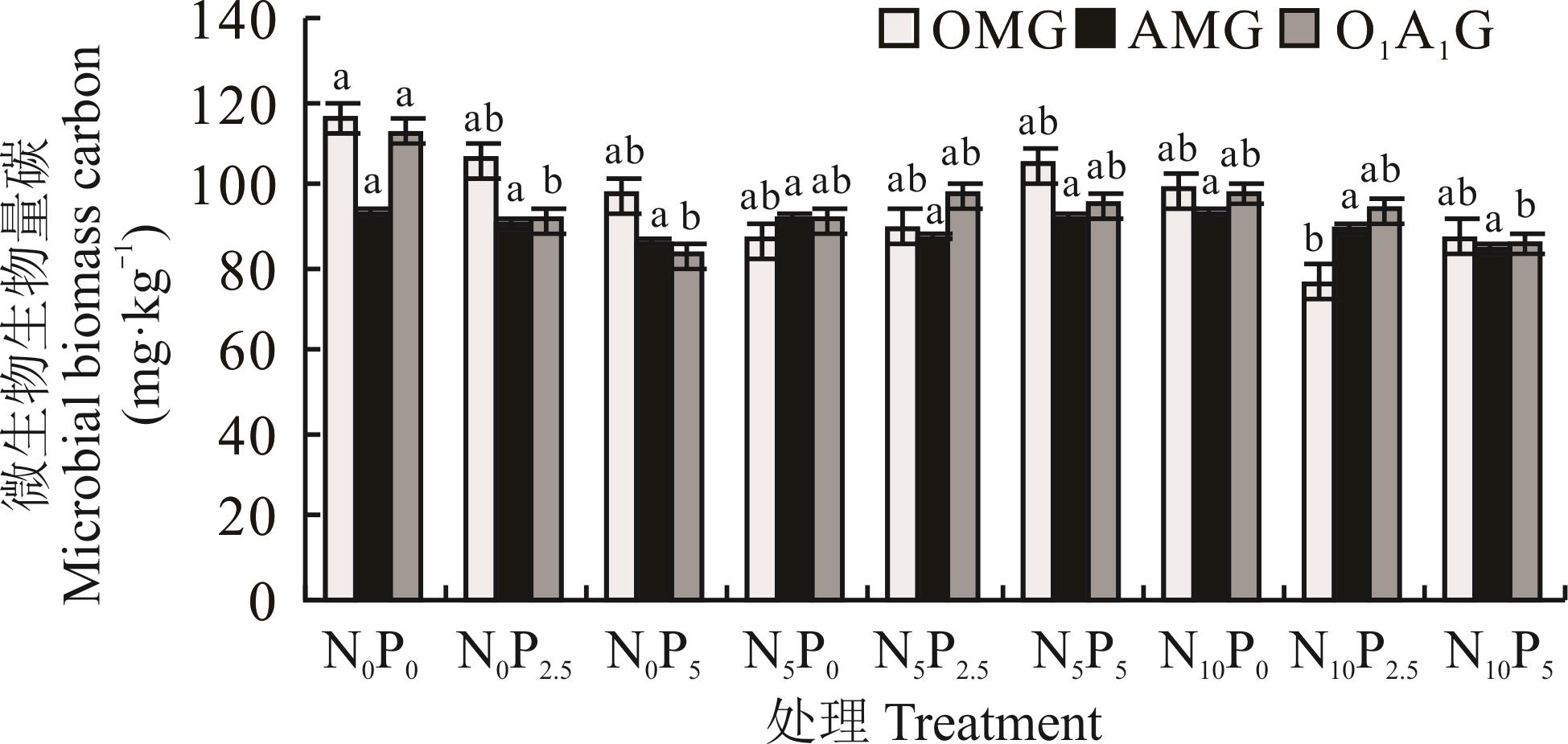
图1 不同氮磷添加水平下土壤微生物生物量碳含量OMG: 燕麦单播草地Oat monoculture grassland; AMG: 苜蓿单播草地Alfalfa monoculture grassland; O1A1G: 燕麦×苜蓿(1∶1)混播草地Oat×alfalfa mixed grassland (1∶1). 同一播种方式下不同字母表示差异显著(P<0.05),下同。Different letters of the same sowing method indicated significant difference (P<0.05), the same below.
Fig.1 Soil microbial biomass carbon content under different nitrogen and phosphorus addition levels
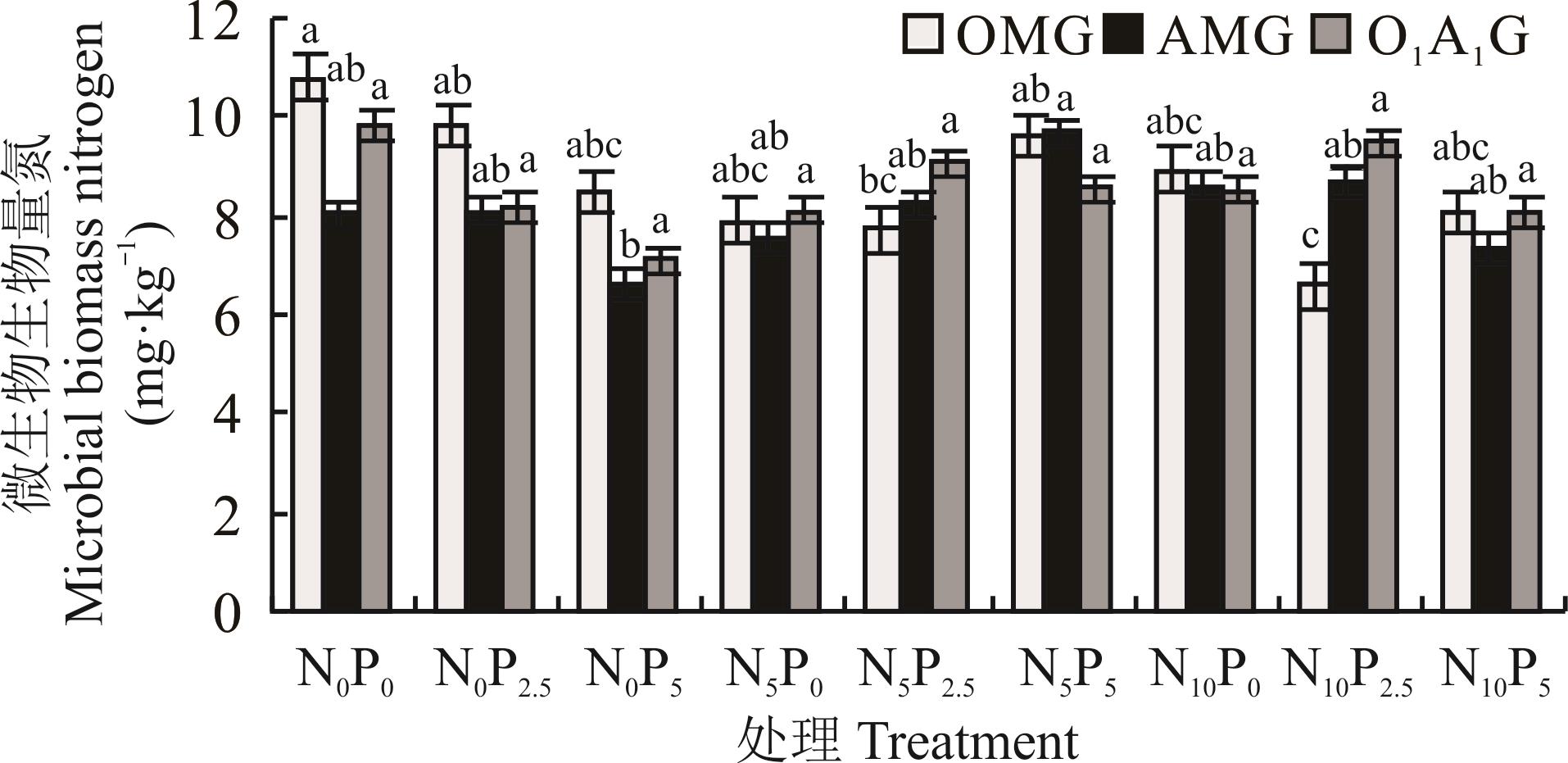
图2 不同氮磷添加水平下土壤微生物生物量氮含量
Fig.2 Soil microbial biomass nitrogen content under different nitrogen and phosphorus addition levels
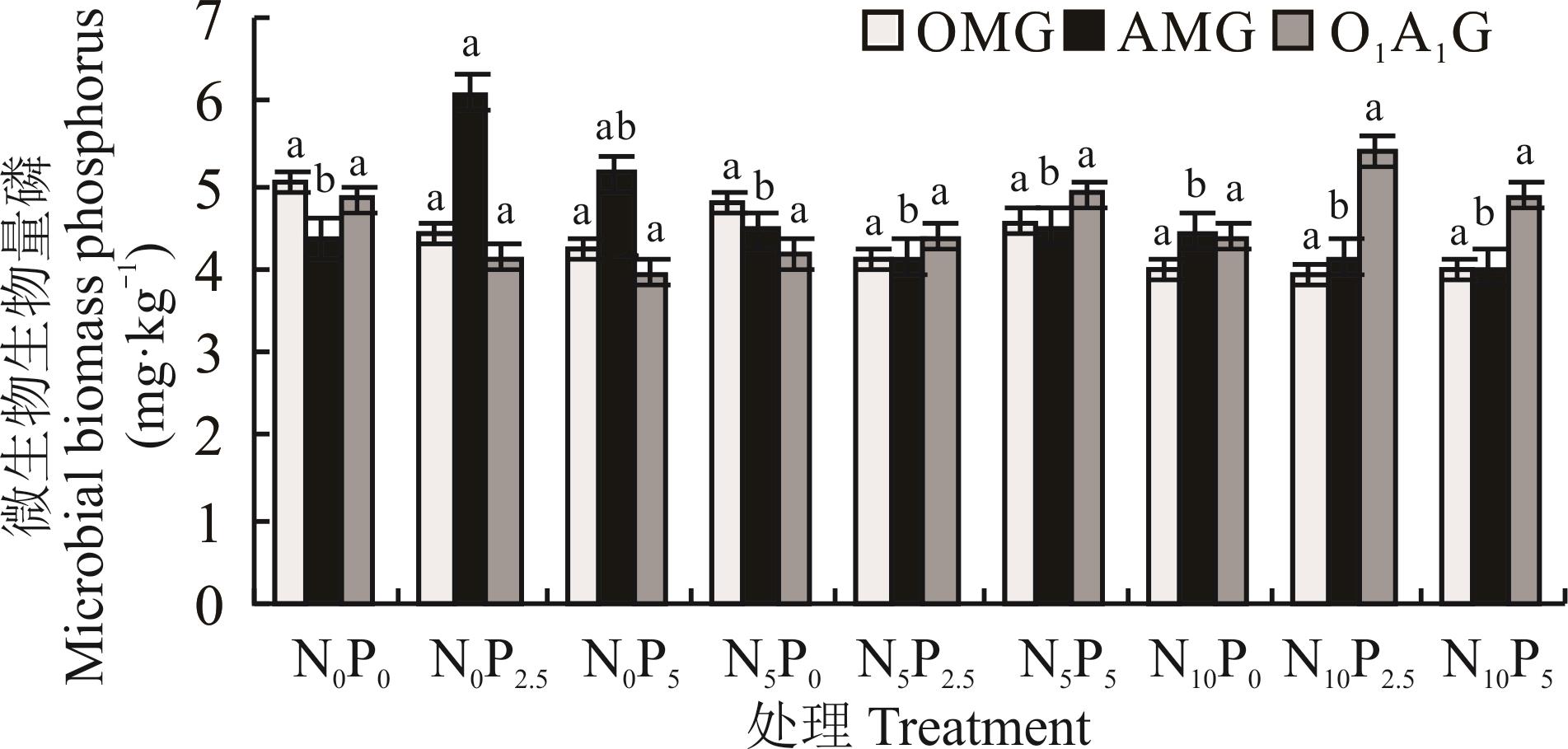
图3 不同氮磷添加水平下土壤微生物生物量磷含量
Fig.3 Soil microbial biomass phosphorus content under different nitrogen and phosphorus addition levels
| 指标Index | 处理Treatment | OMG | AMG | O1A1G |
|---|---|---|---|---|
土壤微生物生物量碳氮比 SMBC∶SMBN | N0P0 | 10.69±0.17a | 11.97±1.23abc | 11.69±0.94a |
| N0P2.5 | 10.81±0.36a | 11.28±0.81abc | 11.28±0.64a | |
| N0P5 | 11.50±0.17a | 13.32±1.13a | 11.69±0.56a | |
| N5P0 | 10.92±0.35a | 12.83±0.39ab | 11.33±0.57a | |
| N5P2.5 | 11.60±0.38a | 10.69±0.46bc | 10.75±0.11a | |
| N5P5 | 10.87±0.34a | 9.92±0.30c | 11.10±0.24a | |
| N10P0 | 10.99±0.09a | 10.84±0.68bc | 11.53±0.44a | |
| N10P2.5 | 11.82±0.67a | 10.41±0.64bc | 10.12±0.89a | |
| N10P5 | 10.86±0.45a | 11.61±0.28abc | 10.64±0.35a | |
土壤微生物生物量碳磷比 SMBC∶SMBP | N0P0 | 23.29±0.53a | 17.03±0.38b | 23.32±0.19a |
| N0P2.5 | 23.82±0.73a | 14.94±0.49c | 22.11±0.10a | |
| N0P5 | 23.09±0.54a | 17.29±2.09b | 20.99±0.83ab | |
| N5P0 | 18.57±3.01c | 21.67±1.11a | 21.88±1.92a | |
| N5P2.5 | 21.70±1.24bc | 21.59±1.82a | 22.53±0.51a | |
| N5P5 | 21.05±0.64bc | 21.31±2.05a | 20.21±1.27ab | |
| N10P0 | 22.36±1.40b | 21.23±1.54a | 18.32±1.98b | |
| N10P2.5 | 19.35±1.68bc | 21.85±1.47a | 17.42±0.68b | |
| N10P5 | 21.81±0.82bc | 21.21±0.30a | 17.72±0.74b | |
土壤微生物生物量氮磷比 SMBN∶SMBP | N0P0 | 2.18±0.07a | 1.79±0.16a | 2.02±0.15a |
| N0P2.5 | 2.21±0.09a | 1.33±0.07b | 1.98±0.19a | |
| N0P5 | 2.01±0.03ab | 1.30±0.15b | 1.79±0.09a | |
| N5P0 | 1.69±0.23b | 1.81±0.11a | 1.94±0.09a | |
| N5P2.5 | 1.87±0.06ab | 2.01±0.09a | 2.09±0.10a | |
| N5P5 | 2.12±0.08a | 2.15±0.20a | 1.83±0.21a | |
| N10P0 | 2.22±0.11a | 1.99±0.27a | 1.94±0.08a | |
| N10P2.5 | 1.66±0.20b | 2.11±0.13a | 1.75±0.16a | |
| N10P5 | 2.02±0.14ab | 1.83±0.07a | 1.67±0.20a |
表2 不同氮磷添加水平下土壤微生物生物量碳、氮、磷化学计量比
Table 2 Stoichiometric ratios of soil microbial biomass of carbon, nitrogen and phosphorus under different nitrogen and phosphorus addition levels
| 指标Index | 处理Treatment | OMG | AMG | O1A1G |
|---|---|---|---|---|
土壤微生物生物量碳氮比 SMBC∶SMBN | N0P0 | 10.69±0.17a | 11.97±1.23abc | 11.69±0.94a |
| N0P2.5 | 10.81±0.36a | 11.28±0.81abc | 11.28±0.64a | |
| N0P5 | 11.50±0.17a | 13.32±1.13a | 11.69±0.56a | |
| N5P0 | 10.92±0.35a | 12.83±0.39ab | 11.33±0.57a | |
| N5P2.5 | 11.60±0.38a | 10.69±0.46bc | 10.75±0.11a | |
| N5P5 | 10.87±0.34a | 9.92±0.30c | 11.10±0.24a | |
| N10P0 | 10.99±0.09a | 10.84±0.68bc | 11.53±0.44a | |
| N10P2.5 | 11.82±0.67a | 10.41±0.64bc | 10.12±0.89a | |
| N10P5 | 10.86±0.45a | 11.61±0.28abc | 10.64±0.35a | |
土壤微生物生物量碳磷比 SMBC∶SMBP | N0P0 | 23.29±0.53a | 17.03±0.38b | 23.32±0.19a |
| N0P2.5 | 23.82±0.73a | 14.94±0.49c | 22.11±0.10a | |
| N0P5 | 23.09±0.54a | 17.29±2.09b | 20.99±0.83ab | |
| N5P0 | 18.57±3.01c | 21.67±1.11a | 21.88±1.92a | |
| N5P2.5 | 21.70±1.24bc | 21.59±1.82a | 22.53±0.51a | |
| N5P5 | 21.05±0.64bc | 21.31±2.05a | 20.21±1.27ab | |
| N10P0 | 22.36±1.40b | 21.23±1.54a | 18.32±1.98b | |
| N10P2.5 | 19.35±1.68bc | 21.85±1.47a | 17.42±0.68b | |
| N10P5 | 21.81±0.82bc | 21.21±0.30a | 17.72±0.74b | |
土壤微生物生物量氮磷比 SMBN∶SMBP | N0P0 | 2.18±0.07a | 1.79±0.16a | 2.02±0.15a |
| N0P2.5 | 2.21±0.09a | 1.33±0.07b | 1.98±0.19a | |
| N0P5 | 2.01±0.03ab | 1.30±0.15b | 1.79±0.09a | |
| N5P0 | 1.69±0.23b | 1.81±0.11a | 1.94±0.09a | |
| N5P2.5 | 1.87±0.06ab | 2.01±0.09a | 2.09±0.10a | |
| N5P5 | 2.12±0.08a | 2.15±0.20a | 1.83±0.21a | |
| N10P0 | 2.22±0.11a | 1.99±0.27a | 1.94±0.08a | |
| N10P2.5 | 1.66±0.20b | 2.11±0.13a | 1.75±0.16a | |
| N10P5 | 2.02±0.14ab | 1.83±0.07a | 1.67±0.20a |

图4 不同氮磷添加水平下土壤胞外酶活性
Fig.4 Soil extracellular enzyme activities under different nitrogen and phosphorus addition levels
| 指标Index | 处理Treatment | OMG | AMG | O1A1G |
|---|---|---|---|---|
土壤C∶N酶活性比 ln BG∶ln(NDG+LA) | N0P0 | 0.846±0.019abc | 0.847±0.0015a | 0.886±0.0120a |
| N0P2.5 | 0.874±0.005ab | 0.795±0.0096ab | 0.862±0.0182a | |
| N0P5 | 0.878±0.010ab | 0.805±0.0151ab | 0.884±0.0135a | |
| N5P0 | 0.834±0.015bc | 0.810±0.0107ab | 0.758±0.0108b | |
| N5P2.5 | 0.819±0.011c | 0.792±0.0130b | 0.839±0.0090a | |
| N5P5 | 0.836±0.024bc | 0.796±0.0329ab | 0.837±0.0200a | |
| N10P0 | 0.875±0.010ab | 0.808±0.0119ab | 0.857±0.0149a | |
| N10P2.5 | 0.891±0.022a | 0.808±0.0176ab | 0.855±0.0095a | |
| N10P5 | 0.838±0.020abc | 0.813±0.0116ab | 0.852±0.0275a | |
土壤C∶P酶活性比 ln BG∶ln AP | N0P0 | 0.810±0.029ab | 0.813±0.0036a | 0.822±0.0162a |
| N0P2.5 | 0.833±0.010ab | 0.781±0.0068a | 0.815±0.0215a | |
| N0P5 | 0.832±0.011ab | 0.795±0.0080a | 0.825±0.0122a | |
| N5P0 | 0.784±0.012c | 0.781±0.0082a | 0.791±0.0198a | |
| N5P2.5 | 0.786±0.015c | 0.751±0.0307a | 0.802±0.0032a | |
| N5P5 | 0.789±0.026c | 0.757±0.0254a | 0.800±0.0153a | |
| N10P0 | 0.814±0.009ab | 0.766±0.0109a | 0.813±0.0166a | |
| N10P2.5 | 0.849±0.012a | 0.765±0.0153a | 0.794±0.0029a | |
| N10P5 | 0.787±0.016c | 0.810±0.0412a | 0.809±0.0213a | |
土壤N∶P酶活性比 ln(NDG+LA)∶ln AP | N0P0 | 0.956±0.013a | 0.961±0.0027a | 0.928±0.0067a |
| N0P2.5 | 0.953±0.009a | 0.983±0.0034a | 0.947±0.0349a | |
| N0P5 | 0.948±0.003a | 0.988±0.0108a | 0.934±0.0034a | |
| N5P0 | 0.940±0.008a | 0.964±0.0029a | 0.947±0.0128a | |
| N5P2.5 | 0.961±0.024a | 0.947±0.0259a | 0.957±0.0066a | |
| N5P5 | 0.944±0.005a | 0.952±0.0098a | 0.956±0.0055a | |
| N10P0 | 0.930±0.006a | 0.948±0.0005a | 0.948±0.0041a | |
| N10P2.5 | 0.953±0.013a | 0.947±0.0019a | 0.928±0.0137a | |
| N10P5 | 0.939±0.011a | 0.995±0.0375a | 0.951±0.0095a |
表3 不同氮磷添加水平下土壤胞外酶化学计量比
Table 3 Soil extracellular enzyme stoichiometric ratios under different nitrogen and phosphorus addition levels
| 指标Index | 处理Treatment | OMG | AMG | O1A1G |
|---|---|---|---|---|
土壤C∶N酶活性比 ln BG∶ln(NDG+LA) | N0P0 | 0.846±0.019abc | 0.847±0.0015a | 0.886±0.0120a |
| N0P2.5 | 0.874±0.005ab | 0.795±0.0096ab | 0.862±0.0182a | |
| N0P5 | 0.878±0.010ab | 0.805±0.0151ab | 0.884±0.0135a | |
| N5P0 | 0.834±0.015bc | 0.810±0.0107ab | 0.758±0.0108b | |
| N5P2.5 | 0.819±0.011c | 0.792±0.0130b | 0.839±0.0090a | |
| N5P5 | 0.836±0.024bc | 0.796±0.0329ab | 0.837±0.0200a | |
| N10P0 | 0.875±0.010ab | 0.808±0.0119ab | 0.857±0.0149a | |
| N10P2.5 | 0.891±0.022a | 0.808±0.0176ab | 0.855±0.0095a | |
| N10P5 | 0.838±0.020abc | 0.813±0.0116ab | 0.852±0.0275a | |
土壤C∶P酶活性比 ln BG∶ln AP | N0P0 | 0.810±0.029ab | 0.813±0.0036a | 0.822±0.0162a |
| N0P2.5 | 0.833±0.010ab | 0.781±0.0068a | 0.815±0.0215a | |
| N0P5 | 0.832±0.011ab | 0.795±0.0080a | 0.825±0.0122a | |
| N5P0 | 0.784±0.012c | 0.781±0.0082a | 0.791±0.0198a | |
| N5P2.5 | 0.786±0.015c | 0.751±0.0307a | 0.802±0.0032a | |
| N5P5 | 0.789±0.026c | 0.757±0.0254a | 0.800±0.0153a | |
| N10P0 | 0.814±0.009ab | 0.766±0.0109a | 0.813±0.0166a | |
| N10P2.5 | 0.849±0.012a | 0.765±0.0153a | 0.794±0.0029a | |
| N10P5 | 0.787±0.016c | 0.810±0.0412a | 0.809±0.0213a | |
土壤N∶P酶活性比 ln(NDG+LA)∶ln AP | N0P0 | 0.956±0.013a | 0.961±0.0027a | 0.928±0.0067a |
| N0P2.5 | 0.953±0.009a | 0.983±0.0034a | 0.947±0.0349a | |
| N0P5 | 0.948±0.003a | 0.988±0.0108a | 0.934±0.0034a | |
| N5P0 | 0.940±0.008a | 0.964±0.0029a | 0.947±0.0128a | |
| N5P2.5 | 0.961±0.024a | 0.947±0.0259a | 0.957±0.0066a | |
| N5P5 | 0.944±0.005a | 0.952±0.0098a | 0.956±0.0055a | |
| N10P0 | 0.930±0.006a | 0.948±0.0005a | 0.948±0.0041a | |
| N10P2.5 | 0.953±0.013a | 0.947±0.0019a | 0.928±0.0137a | |
| N10P5 | 0.939±0.011a | 0.995±0.0375a | 0.951±0.0095a |

《草业学报》2025年承蒙以下专家审稿,特此表示感谢
| 毕玉蓉 | 边疆晖 | 曹成有 | 陈长青 | 程建峰 | 戴其根 | 戴伟民 | 丁成龙 | 丁国华 | 董召荣 |
|---|---|---|---|---|---|---|---|---|---|
| 杜自强 | 段廷玉 | 方香玲 | 高丽倩 | 高学文 | 耿玉清 | 郭 丁 | 郭继勋 | 郭 龙 | 郭正刚 |
| 韩云华 | 杭苏琴 | 何树斌 | 贺 晓 | 胡 涛 | 黄晓东 | 贾倩民 | 贾善刚 | 井 新 | 雷 蕾 |
| 李 飞 | 李辉信 | 李建龙 | 李克梅 | 李万宏 | 李伟斌 | 李旭东 | 李彦忠 | 李镇清 | 林慧龙 |
| 蔺吉祥 | 凌 宁 | 刘慧霞 | 刘金荣 | 刘 权 | 刘世亮 | 刘文献 | 刘永杰 | 刘宇婧 | 刘志民 |
| 吕晓涛 | 马景永 | 马 啸 | 马永清 | 毛培胜 | 穆春生 | 庞晓攀 | 尚占环 | 邵 涛 | 沈禹颖 |
| 时 磊 | 宋秋艳 | 孙丽娟 | 田 沛 | 汪诗平 | 王虎成 | 王剑峰 | 王 俊 | 王丽佳 | 王三根 |
| 王晓娟 | 吴鹏飞 | 谢文刚 | 徐世健 | 闫 涛 | 杨成德 | 杨惠敏 | 杨宪龙 | 姚 拓 | 尹红菊 |
| 于 卓 | 袁明龙 | 曾彦军 | 张吉宇 | 张建国 | 张金屯 | 张 雷 | 张世挺 | 张万军 | 张兴旭 |
| 赵 宁 | 赵 祺 | 赵 威 | 朱 宏 | 朱剑霄 |
(以姓氏拼音为序)
| 毕玉蓉 | 边疆晖 | 曹成有 | 陈长青 | 程建峰 | 戴其根 | 戴伟民 | 丁成龙 | 丁国华 | 董召荣 |
|---|---|---|---|---|---|---|---|---|---|
| 杜自强 | 段廷玉 | 方香玲 | 高丽倩 | 高学文 | 耿玉清 | 郭 丁 | 郭继勋 | 郭 龙 | 郭正刚 |
| 韩云华 | 杭苏琴 | 何树斌 | 贺 晓 | 胡 涛 | 黄晓东 | 贾倩民 | 贾善刚 | 井 新 | 雷 蕾 |
| 李 飞 | 李辉信 | 李建龙 | 李克梅 | 李万宏 | 李伟斌 | 李旭东 | 李彦忠 | 李镇清 | 林慧龙 |
| 蔺吉祥 | 凌 宁 | 刘慧霞 | 刘金荣 | 刘 权 | 刘世亮 | 刘文献 | 刘永杰 | 刘宇婧 | 刘志民 |
| 吕晓涛 | 马景永 | 马 啸 | 马永清 | 毛培胜 | 穆春生 | 庞晓攀 | 尚占环 | 邵 涛 | 沈禹颖 |
| 时 磊 | 宋秋艳 | 孙丽娟 | 田 沛 | 汪诗平 | 王虎成 | 王剑峰 | 王 俊 | 王丽佳 | 王三根 |
| 王晓娟 | 吴鹏飞 | 谢文刚 | 徐世健 | 闫 涛 | 杨成德 | 杨惠敏 | 杨宪龙 | 姚 拓 | 尹红菊 |
| 于 卓 | 袁明龙 | 曾彦军 | 张吉宇 | 张建国 | 张金屯 | 张 雷 | 张世挺 | 张万军 | 张兴旭 |
| 赵 宁 | 赵 祺 | 赵 威 | 朱 宏 | 朱剑霄 |
| [1] | Wu G L, Liu Z H, Zhang L, et al. Effects of artificial grassland establishment on soil nutrients and carbon properties in a black-soil-type degraded grassland. Plant and Soil, 2010, 333(1): 469-479. |
| [2] | Cao X Q, Lin Y, Zhao L J, et al. Effects of mixed sowing of forage oats and legumes on forage yield and stem-leaf ratio. Chinese Journal of Grassland, 2024, 46(11): 58-65. |
| 曹雪乔, 林悦, 赵丽娟, 等. 饲用燕麦与豆科牧草混播对饲草产量及茎叶比的影响. 中国草地学报, 2024, 46(11): 58-65. | |
| [3] | Liu Q Y, Yun L, Chen Y F, et al. The dynamic analysis of forage yield and interspecific competition in alfalfa-grass mixed pasture. Acta Prataculturae Sinica, 2022, 31(3): 181-191. |
| 刘启宇, 云岚, 陈逸凡, 等. 苜蓿-禾草混播草地牧草产量及种间竞争关系的动态研究. 草业学报, 2022, 31(3): 181-191. | |
| [4] | Zhang Y L, Teng Z, Hao F, et al. Effects of different mixed sowing patterns and sowing ratios of alfalfa on grassland productivity and community stability in grass-legume mixtures. Acta Prataculturae Sinica, 2024, 33(2): 185-197. |
| 张永亮, 滕泽, 郝凤, 等. 苜蓿混播方式及比例对混播草地生产力和稳定性的影响. 草业学报, 2024, 33(2): 185-197. | |
| [5] | Qi F, Li H G, Chen W W, et al. Effects of nitrogen and phosphorus fertilization on yield of Medicago sativa-Leymus chinensis mixed grassland. Chinese Journal of Grassland, 2024, 46(6): 49-56. |
| 齐非, 李海港, 陈薇薇, 等. 氮磷添加对紫花苜蓿-羊草混播草地生产力的影响. 中国草地学报, 2024, 46(6): 49-56. | |
| [6] | Adi H Z, Chang T, Qin R M, et al. Changes in soil carbon, nitrogen, phosphorus content and stoichiometric characteristics of artificial grassland soils. Acta Agrestia Sinica, 2024, 32(3): 827-837. |
| 阿的哈则, 常涛, 秦瑞敏, 等. 人工草地土壤碳氮磷含量变化及化学计量特征研究. 草地学报, 2024, 32(3): 827-837. | |
| [7] | Lin W S, De K J, Zhang L, et al. Meta-analysis of the effects of nitrogen and phosphorus addition on the stoichiometric characteristics of soils carbon, nitrogen and phosphorus in Tibetan alpine meadow. Acta Agrestia Sinica, 2022, 30(12): 3345-3354. |
| 林伟山, 德科加, 张琳, 等. 氮、磷添加对青藏高寒草甸土壤碳氮磷化学计量特征影响的Meta分析. 草地学报, 2022, 30(12): 3345-3354. | |
| [8] | Zeng D P, Jiang L L, Zeng C S, et al. Reviews on the ecological stoichiometry characteristics and its applications. Acta Ecologica Sinica, 2013, 33(18): 5484-5492. |
| 曾冬萍, 蒋利玲, 曾从盛, 等. 生态化学计量学特征及其应用研究进展. 生态学报, 2013, 33(18): 5484-5492. | |
| [9] | Ma Y, Xu Z H, Zeng Q H, et al. Impact of nitrogen addition on stoichiometric characteristics of herbaceous species in desert steppe. Acta Prataculturae Sinica, 2021, 30(6): 64-72. |
| 马英, 许志豪, 曾巧红, 等. 氮素添加对荒漠化草原草本植物养分化学计量特征的影响. 草业学报, 2021, 30(6): 64-72. | |
| [10] | Yue K, Fornara D A, Yang W, et al. Effects of three global change drivers on terrestrial C∶N∶P stoichiometry: A global synthesis. Global Change Biology, 2017, 23(6): 2450-2463. |
| [11] | Niu S Q, Ren L N, Song L J, et al. Plant stoichiometry characteristics and relationships with soil nutrients in Robinia pseudoacacia communities of different planting ages. Acta Ecologica Sinica, 2017, 37(6): 355-362. |
| [12] | Wang S Q, Yu G R. Ecological stoichiometry characteristics of ecosystem carbon, nitrogen and phosphorus elements. Acta Ecologica Sinica, 2008, 28(8): 3937-3947. |
| 王绍强, 于贵瑞. 生态系统碳氮磷元素的生态化学计量学特征. 生态学报, 2008, 28(8): 3937-3947. | |
| [13] | Cheng Q, Mao X L, Sun T, et al. Effects of long-term combined application of chemical fertilizers with different organic materials on soil microbial ecological stoichiometry and community structure. Journal of Plant Nutrition and Fertilizers, 2024, 30(2): 209-220. |
| 程琪, 毛霞丽, 孙涛, 等. 长期化肥与不同有机物料配施对土壤微生物生态化学计量特征和群落结构的影响. 植物营养与肥料学报, 2024, 30(2): 209-220. | |
| [14] | Tong Y S, Zhang C P, Dong Q M, et al. Response of soil microbial biomass and its stoichiometric characteristics to nitrogen addition in perennial alpine cultivated grassland. Soil and Fertilizer Sciences in China, 2024(10): 35-42. |
| 童永尚, 张春平, 董全民, 等. 多年生高寒栽培草地土壤微生物生物量及其化学计量特征对氮添加的响应. 中国土壤与肥料, 2024(10): 35-42. | |
| [15] | Zhou X M. Kobresia meadow in China. Beijing: Science Press, 2001. |
| 周兴民. 中国嵩草草甸. 北京: 科学出版社, 2001. | |
| [16] | Li X R, Lin H, Cao P L, et al. Long-term nitrogen application exacerbates soil phosphorus limitation at different depths in subtropical natural Castanopsis carlesii forest: Based on soil extracellular enzymes and their stoichiometric ratios. Soils, 2024, 56(5): 963-974. |
| 李欣冉, 林浩, 曹平丽, 等. 长期施氮加剧亚热带米槠天然林不同深度土壤磷限制: 基于土壤胞外酶活性及其化学计量比角度. 土壤, 2024, 56(5): 963-974. | |
| [17] | Sun J, Liang J X, Li F X, et al. Effects of fertilization on C∶N∶P stoichiometry of soil, microbes and ectoenzymes in major soil types in Ningxia. Journal of Northwest A&F University (Natural Science Edition), 2023, 51(11): 125-135. |
| 孙娇, 梁锦秀, 李凤霞, 等. 施肥对宁夏主要类型土壤-微生物-胞外酶化学计量特征的影响. 西北农林科技大学学报(自然科学版), 2023, 51(11): 125-135. | |
| [18] | Wang H. Effects of application of organic and inorganic fertilizers on vegetable δ15N and soil microbial properties. Tai’an: Shandong Agricultural University, 2012. |
| 王会. 有机无机肥配施对蔬菜δ15N和土壤生物学性质的影响. 泰安: 山东农业大学, 2012. | |
| [19] | Verchot L V, Borelli T. Application of para-nitrophenol (pNP) enzyme assays in degraded tropical soils. Soil Biology and Biochemistry, 2004, 37(4): 625-633. |
| [20] | Su L L, Qin Y, Wang Z M, et al. Soil nutrient and microbial activity responses to nitrogen and phosphorus addition in oats and arrowhead peas in monocrop and mixed sowings. Acta Prataculturae Sinica, 2023, 32(3): 56-66. |
| 苏乐乐, 秦燕, 王瞾敏, 等. 氮磷添加对燕麦与箭筈豌豆不同种植方式草地土壤微生物-胞外酶化学计量特征的影响. 草业学报, 2023, 32(3): 56-66. | |
| [21] | Jiang H X, Liu D, Zhai G Y, et al. Effects of fertilizer combinations of nitrogen, phosphorus and potassium on the forage yield of Medicago sativa. Pratacultural Science, 2012, 29(9): 1441-1445. |
| 姜慧新, 刘栋, 翟桂玉, 等. 氮、磷、钾配合施肥对紫花苜蓿产草量的影响. 草业科学, 2012, 29(9): 1441-1445. | |
| [22] | Shen R F, Zhao X Q. Role of soil microbes in the acquisition of nutrients by plants. Acta Ecologica Sinica, 2015, 35(20): 6584-6591. |
| 沈仁芳, 赵学强. 土壤微生物在植物获得养分中的作用. 生态学报, 2015, 35(20): 6584-6591. | |
| [23] | Zhai J Y. Effects of nitrogen and phosphorus addition on soil microbes and stoichiometric characteristic of alpine meadow in Qinghai-Tibet Plateau. Xianyang: University of Chinese Academy of Sciences (Institute of Soil and Water Conservation, Chinese Academy of Sciences, Ministry of Water Resources), 2020. |
| 翟珈莹. 氮磷添加对青藏高原高寒草地土壤微生物及化学计量特征的影响. 咸阳: 中国科学院大学(中国科学院教育部水土保持与生态环境研究中心), 2020. | |
| [24] | Chen D D, Li Q, Chen X, et al. Response of soil microbial biomass C and N, C metabolism characteristics of microbes to grass-legume mixtures of annual artificial grassland in Sanjiangyuan region. Acta Agrestia Sinica, 2018, 26(5): 1064-1070. |
| 陈懂懂, 李奇, 陈昕, 等. 三江源农牧交错区土壤微生物碳、氮以及群落碳代谢特征对一年生禾豆混播的响应. 草地学报, 2018, 26(5): 1064-1070. | |
| [25] | Hu W, Zhang Y H, Li P, et al. Effects of water and nitrogen supply under drip irrigation on the production performance rate and water and nitrogen use efficiency of alfalfa. Acta Prataculturae Sinica, 2019, 28(2): 41-50. |
| 胡伟, 张亚红, 李鹏, 等. 水氮供应对地下滴灌紫花苜蓿生产性能及水氮利用效率的影响. 草业学报, 2019, 28(2): 41-50. | |
| [26] | Zheng M N, Liang X Z, Han Z S, et al. Effects of phosphorus application levels on phosphorus accumulation and seed yield factors of alfalfa (Medicago sativa). Acta Agrestia Sinica, 2020, 28(1): 80-87. |
| 郑敏娜, 梁秀芝, 韩志顺, 等. 不同磷素水平对紫花苜蓿磷累积动态和种子产量构成因子的影响. 草地学报, 2020, 28(1): 80-87. | |
| [27] | Wang Q, Wang K Q, Song Y L, et al. Response of soil-microbe-extracellular enzyme stoichiometric characteristics to nitrogen deposition in a Pinus yunnanensis forest in central Yunnan Province, Southwest China. Chinese Journal of Applied Ecology, 2024, 35(7): 1789-1798. |
| 王倩, 王克勤, 宋娅丽, 等. 滇中云南松林土壤-微生物-胞外酶化学计量特征对氮沉降的响应. 应用生态学报, 2024, 35(7): 1789-1798. | |
| [28] | Xiao X Q, Zhang H K, Feng Y S, et al. Effects of plant residues on C∶N∶P of soil, microbial biomass, and extracellular enzyme in an alpine meadow on the Qinghai-Tibetan Plateau, China. Chinese Journal of Applied Ecology, 2023, 34(1): 58-66. |
| 肖向前, 张海阔, 冯娅斯, 等. 植物残体对青藏高原高寒草甸土壤、微生物和胞外酶C∶N∶P化学计量特征的影响. 应用生态学报, 2023, 34(1): 58-66. | |
| [29] | Bell C W, Acosta-Martinez V, McIntyre N E, et al. Linking microbial community structure and function to seasonal differences in soil moisture and temperature in a Chihuahuan desert grassland. Microbial Ecology, 2009, 58(4): 827-842. |
| [30] | Sinsabaugh R L, Shah J J F. Ecoenzymatic stoichiometry and ecological theory. Annual Review of Ecology Evolution Systematics, 2012, 43(1): 313-343. |
| [31] | Zhang X X, Yang L M, Chen Z, et al. Patterns of ecoenzymatic stoichiometry on types of forest soils form different parent materials in subtropical areas. Acta Ecologica Sinica, 2018, 38(16): 5828-5836. |
| 张星星, 杨柳明, 陈忠, 等. 中亚热带不同母质和森林类型土壤生态酶化学计量特征. 生态学报, 2018, 38(16): 5828-5836. |
| [1] | 徐倩, 郭帅, 张亮亮, 王占军, 辛国省. 补饲对放牧滩羊生长性能、血清生化及代谢组的影响[J]. 草业学报, 2025, 34(6): 122-138. |
| [2] | 李婷, 杨鑫光, 段成伟, 孙华方, 高涛, 陈同德, 杨凯, 杨千慧. 不同施肥和混播条件下高寒受损煤矿区人工草地生态系统健康评价研究[J]. 草业学报, 2025, 34(10): 16-29. |
| [3] | 曲艳, 赵坤, 韩子晨, 吕世海, 沃强, 戎郁萍. 短期氮磷添加对呼伦贝尔辉河流域草地土壤温室气体排放的影响[J]. 草业学报, 2024, 33(2): 68-79. |
| [4] | 刘彩凤, 段媛媛, 王玲玲, 王乙茉, 郭正刚. 高原鼠兔干扰对高寒草甸植物物种多样性与土壤生态化学计量比间关系的影响[J]. 草业学报, 2023, 32(6): 157-166. |
| [5] | 苏乐乐, 秦燕, 王瞾敏, 张永超, 刘文辉. 氮磷添加对燕麦与箭筈豌豆不同种植方式草地土壤微生物-胞外酶化学计量特征的影响[J]. 草业学报, 2023, 32(3): 56-66. |
| [6] | 杜鹏冲, 潘昱臻, 侯双利, 王智慧, 王洪义. 氮磷添加对呼伦贝尔草地凋落物分解的影响[J]. 草业学报, 2023, 32(2): 44-53. |
| [7] | 周娟娟, 刘云飞, 王敬龙, 魏巍. 短期养分添加对西藏沼泽化高寒草甸地上生物量、植物多样性和功能性状的影响[J]. 草业学报, 2023, 32(11): 17-29. |
| [8] | 周娟娟, 魏巍. 施肥和刈割协同对藏北高原禾草混播群落动态和超产的影响[J]. 草业学报, 2023, 32(10): 28-39. |
| [9] | 杨策, 张玉雪, 张鹤, 郑春燕, 朱峰. 牧草混播生态系统功能研究进展[J]. 草业学报, 2022, 31(9): 206-219. |
| [10] | 李鑫, 魏雪, 王长庭, 任晓, 吴鹏飞. 外源性养分添加对高寒草甸土壤节肢动物群落的影响[J]. 草业学报, 2022, 31(4): 155-164. |
| [11] | 马文明, 刘超文, 周青平, 邓增卓玛, 唐思洪, 迪力亚尔·莫合塔尔null, 侯晨. 高寒草地灌丛化对土壤团聚体生态化学计量学及酶活性的影响[J]. 草业学报, 2022, 31(1): 57-68. |
| [12] | 汪精海, 李广, 银敏华, 齐广平, 康燕霞, 马彦麟. 调亏灌溉对高寒荒漠区人工混播草地土壤环境与牧草生长的影响[J]. 草业学报, 2022, 31(1): 95-106. |
| [13] | 唐立涛, 毛睿, 王长庭, 李洁, 胡雷, 字洪标. 氮磷添加对高寒草甸植物群落根系特征的影响[J]. 草业学报, 2021, 30(9): 105-116. |
| [14] | 马英, 许志豪, 曾巧红, 孟建龙, 胡亚虎, 苏洁琼. 氮素添加对荒漠化草原草本植物养分化学计量特征的影响[J]. 草业学报, 2021, 30(6): 64-72. |
| [15] | 彭艳, 孙晶远, 马素洁, 王向涛, 孙磊, 魏学红. 氮磷添加对藏北人工牧草生产性能和品质的评价[J]. 草业学报, 2021, 30(5): 52-64. |
| 阅读次数 | ||||||
|
全文 |
|
|||||
|
摘要 |
|
|||||
