

ISSN 1004-5759 CN 62-1105/S
草业学报 ›› 2026, Vol. 35 ›› Issue (11): 1-12.DOI: 10.11686/cyxb2025489
• 研究论文 •
郁国梁1,2,3( ), 杨尚剑1,2,3, 王建成1,2,3, 王喜勇1,2,3()
收稿日期:2025-12-02
修回日期:2026-01-05
出版日期:2026-11-20
发布日期:2026-10-12
通讯作者:
王喜勇
作者简介:Corresponding author. E-mail: wangxy@ms.xjb.ac.cn基金资助:
Guo-liang YU1,2,3(), Shang-jian YANG1,2,3, Jian-cheng WANG1,2,3, Xi-yong WANG1,2,3()
Received:2025-12-02
Revised:2026-01-05
Online:2026-11-20
Published:2026-10-12
Contact:
Xi-yong WANG
摘要:
探究草地群落物种多样性和系统发育多样性特征,对揭示植物群落构建机制及其影响因子,改善草地群落物种组成具有重要意义。以天山南坡和静县境内5种类型草地(荒漠草原、河漫滩草甸、林缘草甸、亚高山草甸、高山草甸)为对象,分析不同类型草地的物种多样性和系统发育多样性差异、海拔特征及其影响因子。结果表明:1)Shannon-Wiener指数和系统发育多样性(PD)指数随海拔升高先增大后减小,Simpson优势度指数、Pielou均匀度指数、净亲缘关系指数(NRI)和最近种间亲缘关系指数(NTI)均无明显变化趋势。2)林缘草甸和亚高山草甸物种多样性和系统发育多样性显著高于荒漠草原、河漫滩草甸和高山草甸,且物种多样性和系统发育多样性变异主要来源于草地类型。3)Shannon-Wiener指数和Pielou均匀度指数与系统发育多样性各指数呈显著正相关,而Simpson优势度指数与系统发育多样性各指数间均无明显相关性。4)物种多样性主要受年平均湿度的影响,系统发育多样性主要受纬度、年平均降水量、年平均湿度和年平均温度的影响。5)研究区NRI和NTI均值大于0,植物群落构建以环境过滤为主导,主要环境因子为年平均湿度、年平均温度和年平均降水量。基于以上研究结果,建议和静县在保护草地生态系统中,优先保护多样性较高的林缘草甸和亚高山草甸,同时要加强西部低海拔区域荒漠草原的放牧管控。
郁国梁, 杨尚剑, 王建成, 王喜勇. 新疆和静县草地物种多样性和系统发育多样性特征及其影响因子研究[J]. 草业学报, 2026, 35(11): 1-12.
Guo-liang YU, Shang-jian YANG, Jian-cheng WANG, Xi-yong WANG. Characterization of grassland species diversity, phylogenetic diversity and factors influencing them in Hejing County, Xinjiang[J]. Acta Prataculturae Sinica, 2026, 35(11): 1-12.

图1 和静县采样地信息
Fig.1 Information on sampling places in Hejing County
草地类型 Grassland type | 优势物种(重要值) Dominant species (important value) |
|---|---|
荒漠草原 Desert steppe | 狭叶锦鸡儿C. stenophylla(4.3)、锐枝木蓼Atraphaxis pungens(3.7)、羊茅F. ovina(3.2)、紫菀木Asterothamnus alyssoides(3.1)、驼绒藜Krascheninnikovia ceratoides(3.0) |
河漫滩草甸 River floodplain meadow | 新疆苔草Carex turkestanica(8.9)、芨芨草Neotrinia splendens(8.7)、早熟禾Poa annua(7.9)、大叶橐吾Ligularia macrophylla(7.6)、冰草Agropyron cristatum(6.9) |
林缘草甸 Forest edge meadow | 阿尔泰独尾草Eremurus altaicus(3.8)、掌叶大黄Rheum palmatum(3.7)、针茅Stipa capillata(3.0)、黄唐松草Thalictrum flavum(2.9)、地榆Sanguisorba officinalis(2.7) |
亚高山草甸 Subalpine meadow | 新疆苔草C. turkestanica(5.3)、羊茅F. ovina(4.8)、珠芽蓼Bistorta vivipara(4.4)、冰草A. cristatum(4.3)、鬼箭锦鸡儿C. jubata(4.1) |
高山草甸 Alpine meadow | 新疆苔草C. turkestanica(7.8)、早熟禾P. annua(5.0)、鬼箭锦鸡儿C. jubata(4.8)、黄白火绒草Leontopodium ochroleucum(4.6)、珠芽蓼B. vivipara(3.2) |
表1 和静县草地群落优势物种及重要值
Table 1 Dominant species and important values of grassland communities in Hejing County
草地类型 Grassland type | 优势物种(重要值) Dominant species (important value) |
|---|---|
荒漠草原 Desert steppe | 狭叶锦鸡儿C. stenophylla(4.3)、锐枝木蓼Atraphaxis pungens(3.7)、羊茅F. ovina(3.2)、紫菀木Asterothamnus alyssoides(3.1)、驼绒藜Krascheninnikovia ceratoides(3.0) |
河漫滩草甸 River floodplain meadow | 新疆苔草Carex turkestanica(8.9)、芨芨草Neotrinia splendens(8.7)、早熟禾Poa annua(7.9)、大叶橐吾Ligularia macrophylla(7.6)、冰草Agropyron cristatum(6.9) |
林缘草甸 Forest edge meadow | 阿尔泰独尾草Eremurus altaicus(3.8)、掌叶大黄Rheum palmatum(3.7)、针茅Stipa capillata(3.0)、黄唐松草Thalictrum flavum(2.9)、地榆Sanguisorba officinalis(2.7) |
亚高山草甸 Subalpine meadow | 新疆苔草C. turkestanica(5.3)、羊茅F. ovina(4.8)、珠芽蓼Bistorta vivipara(4.4)、冰草A. cristatum(4.3)、鬼箭锦鸡儿C. jubata(4.1) |
高山草甸 Alpine meadow | 新疆苔草C. turkestanica(7.8)、早熟禾P. annua(5.0)、鬼箭锦鸡儿C. jubata(4.8)、黄白火绒草Leontopodium ochroleucum(4.6)、珠芽蓼B. vivipara(3.2) |
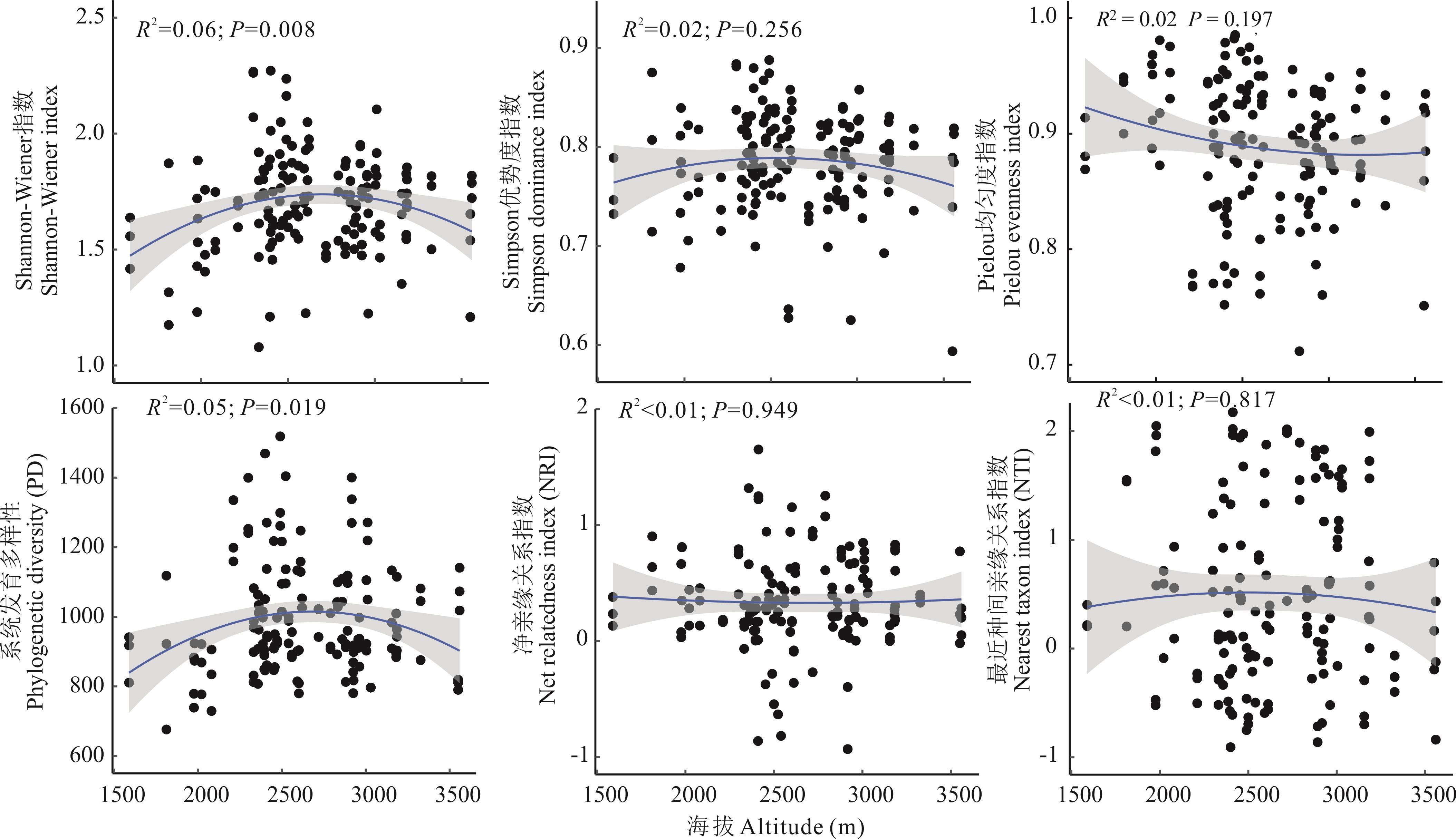
图2 物种多样性和系统发育多样性的海拔特征
Fig.2 Elevation characteristics of species diversity and phylogenetic diversity
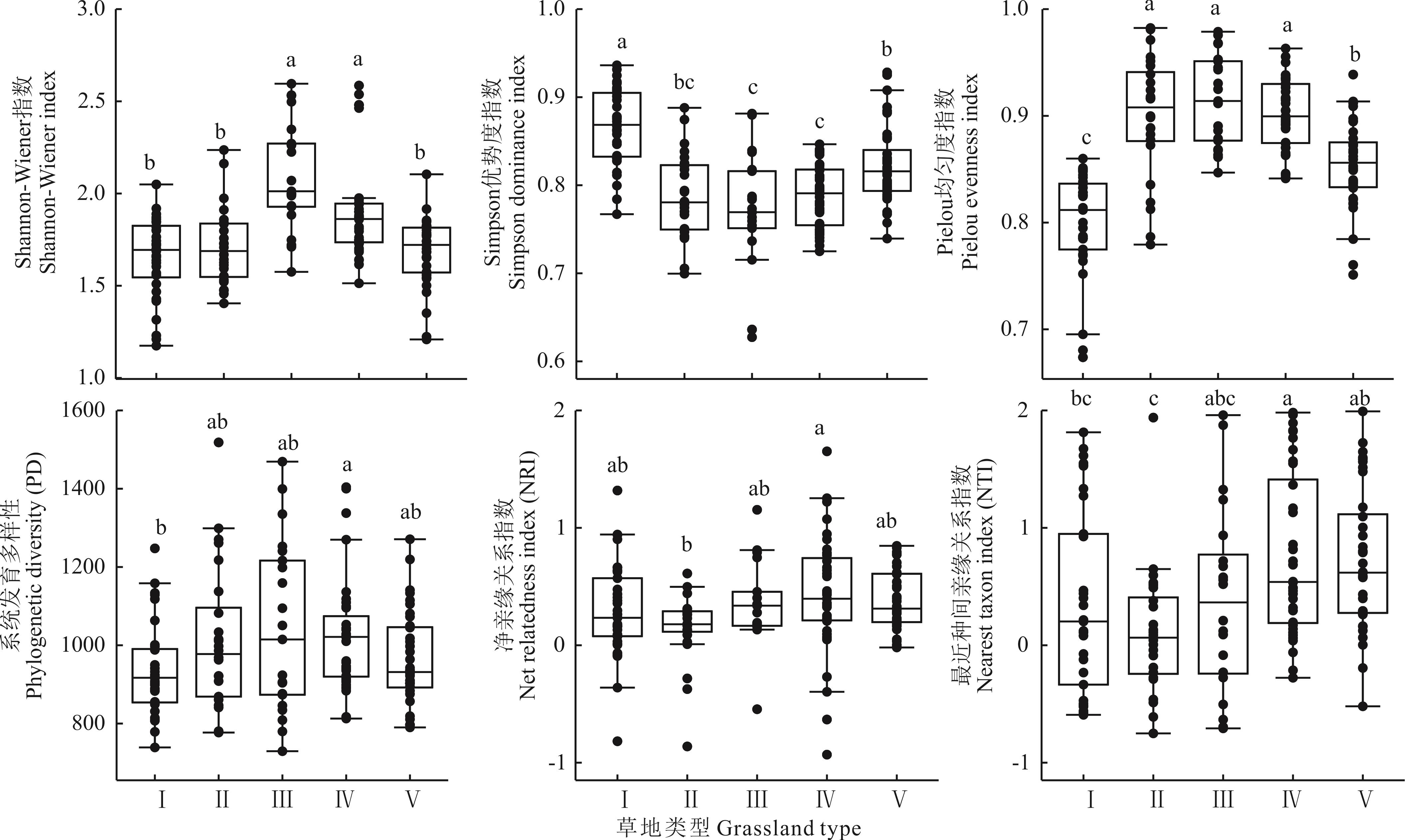
图3 不同类型的草地物种多样性和系统发育多样性特征Ⅰ: 荒漠草原Desert steppe; Ⅱ: 河漫滩草甸River floodplain meadow; Ⅲ: 林缘草甸Forest edge meadow; Ⅳ: 亚高山草甸Subalpine meadows; Ⅴ: 高山草甸Alpine meadow. 不同小写字母表示各草地类型间差异显著(P<0.05)。Different lowercase letters indicate significant differences among the different types of grasslands (P<0.05).
Fig.3 Characteristics of species diversity and phylogenetic diversity of different types of grasslands
变异来源 Source of variation | S-W | Simpson | Pielou | ||||||
|---|---|---|---|---|---|---|---|---|---|
离差平方和 Sum of squares (SS) | 均方 Mean square (MS) | F值 F value | 离差平方和 Sum of squares (SS) | 均方 Mean square (MS) | F值 F value | 离差平方和 Sum of squares (SS) | 均方 Mean square (MS) | F值 F value | |
| 海拔Altitude | 0.038 | 0.038 | 0.665 | 0.004 | 0.004 | 1.694 | 0.001 | 0.001 | 0.051 |
| 草地类型Grassland type | 3.746 | 0.937 | 16.390** | 0.181 | 0.045 | 21.273** | 0.279 | 0.069 | 37.158** |
海拔×草地类型 Altitude×grassland type | 0.332 | 0.083 | 1.450 | 0.026 | 0.007 | 3.077* | 0.014 | 0.003 | 1.813 |
变异来源 Source of variation | PD | NRI | NTI | ||||||
离差平方和 Sum of squares (SS) | 均方 Mean square (MS) | F值 F value | 离差平方和 Sum of squares (SS) | 均方 Mean square (MS) | F值 F value | 离差平方和 Sum of squares (SS) | 均方 Mean square (MS) | F值 F value | |
| 海拔Altitude | 6562.000 | 6562.000 | 0.272 | 0.001 | 0.001 | 0.009 | 0.900 | 0.904 | 1.773 |
| 草地类型Grassland type | 308501.000 | 77125.000 | 3.197* | 2.318 | 0.579 | 3.944* | 13.110 | 3.276 | 6.430** |
海拔×草地类型 Altitude×grassland type | 42515.000 | 10629.000 | 0.441 | 0.631 | 0.158 | 1.074 | 0.910 | 0.227 | 0.446 |
表2 物种多样性和系统发育多样性的协方差分析参数
Table 2 Analysis of covariance (ANCOVA) parameters for species diversity and phylogenetic diversity
变异来源 Source of variation | S-W | Simpson | Pielou | ||||||
|---|---|---|---|---|---|---|---|---|---|
离差平方和 Sum of squares (SS) | 均方 Mean square (MS) | F值 F value | 离差平方和 Sum of squares (SS) | 均方 Mean square (MS) | F值 F value | 离差平方和 Sum of squares (SS) | 均方 Mean square (MS) | F值 F value | |
| 海拔Altitude | 0.038 | 0.038 | 0.665 | 0.004 | 0.004 | 1.694 | 0.001 | 0.001 | 0.051 |
| 草地类型Grassland type | 3.746 | 0.937 | 16.390** | 0.181 | 0.045 | 21.273** | 0.279 | 0.069 | 37.158** |
海拔×草地类型 Altitude×grassland type | 0.332 | 0.083 | 1.450 | 0.026 | 0.007 | 3.077* | 0.014 | 0.003 | 1.813 |
变异来源 Source of variation | PD | NRI | NTI | ||||||
离差平方和 Sum of squares (SS) | 均方 Mean square (MS) | F值 F value | 离差平方和 Sum of squares (SS) | 均方 Mean square (MS) | F值 F value | 离差平方和 Sum of squares (SS) | 均方 Mean square (MS) | F值 F value | |
| 海拔Altitude | 6562.000 | 6562.000 | 0.272 | 0.001 | 0.001 | 0.009 | 0.900 | 0.904 | 1.773 |
| 草地类型Grassland type | 308501.000 | 77125.000 | 3.197* | 2.318 | 0.579 | 3.944* | 13.110 | 3.276 | 6.430** |
海拔×草地类型 Altitude×grassland type | 42515.000 | 10629.000 | 0.441 | 0.631 | 0.158 | 1.074 | 0.910 | 0.227 | 0.446 |
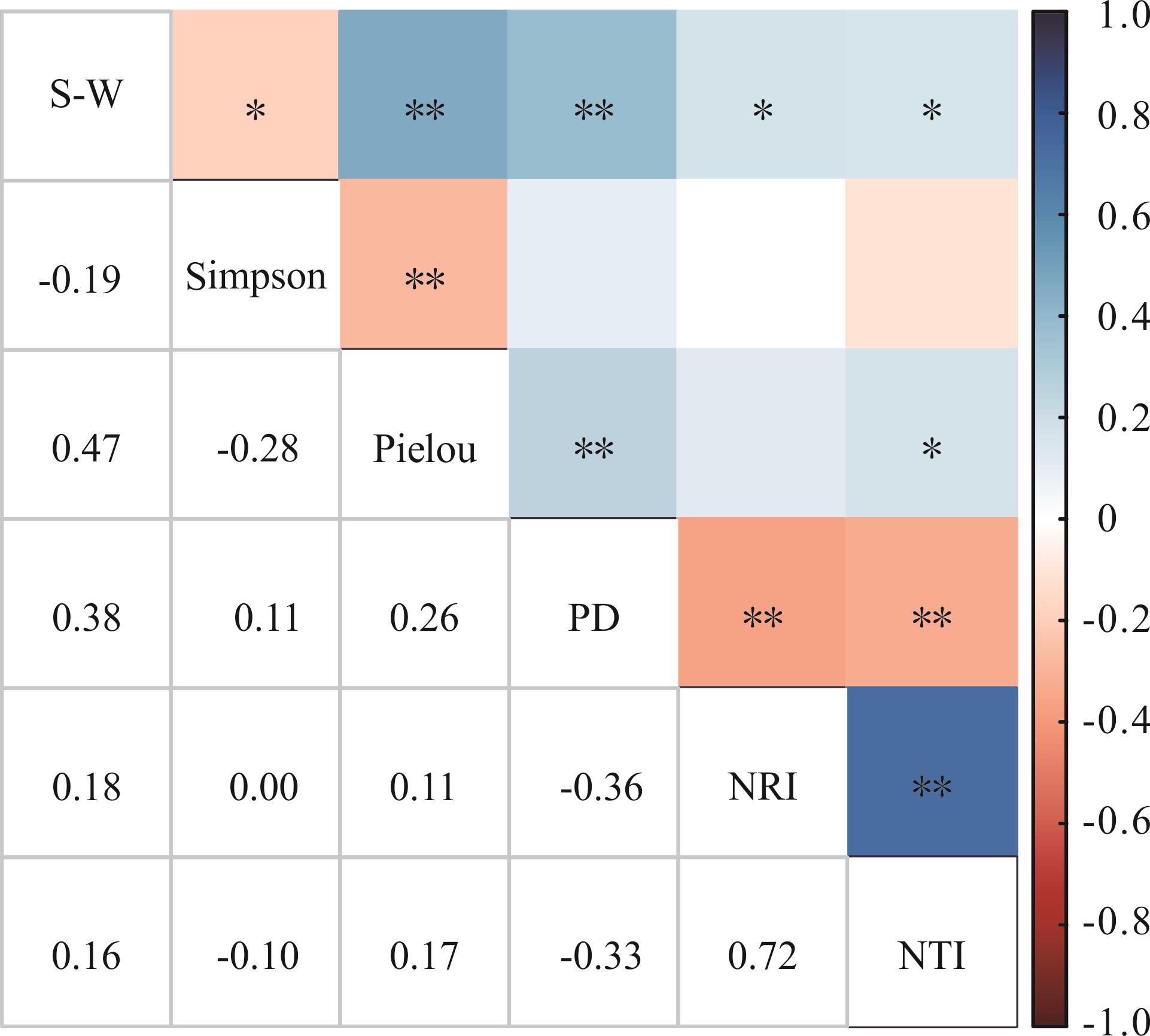
图4 物种多样性和系统发育多样性指数间的相关性*: P<0.05; **: P<0.01.
Fig.4 The correlation between species diversity and phylogenetic diversity index
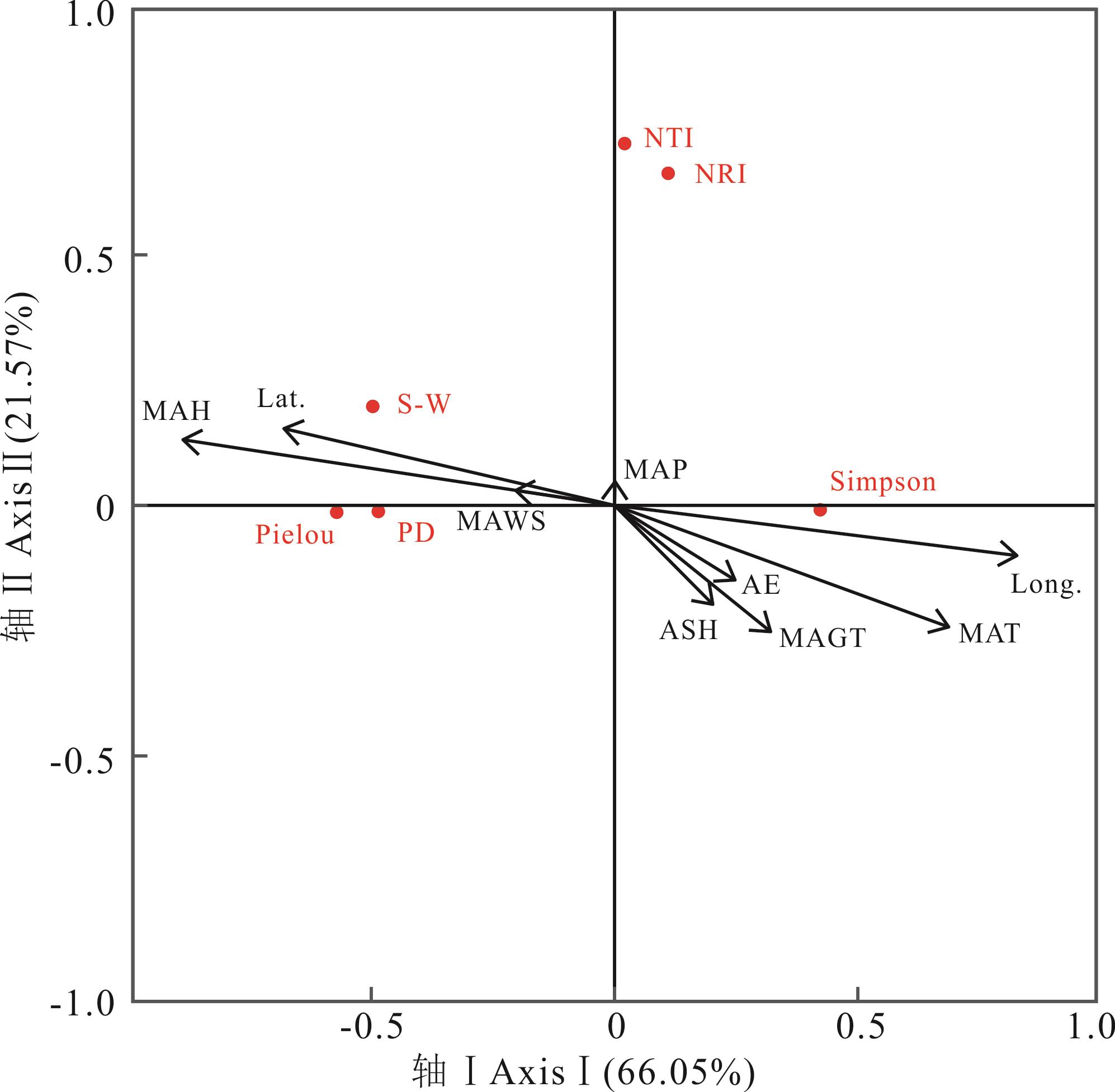
图5 物种多样性和系统发育多样性与其影响因子的冗余分析排序Long.: 经度Longitude; Lat.: 纬度Latitude; MAP: 年平均降水量Mean annual precipitation; MAT: 年平均温度Mean annual temperature; MAGT: 年平均地温Mean annual ground temperature; MAWS: 年平均风速Mean annual wind speed; ASH: 年日照时数Annual sunshine hours; MAH: 年平均湿度Mean annual humidity; AE: 年蒸发量Annual evaporation volume. 下同The same below.
Fig.5 Redundancy analysis (RDA) ranking of species diversity and phylogenetic diversity and their influencing factors
影响因子 Impact factors | R2 | P值 P value | 轴Ⅰ得分 Axis Ⅰ score | 轴Ⅱ得分 Axis Ⅱ score |
|---|---|---|---|---|
| Long. | 0.040 | 0.085 | 0.827 | -0.100 |
| Lat. | 0.127 | 0.001 | -0.679 | 0.153 |
| MAP | -0.008 | 0.590 | 0.001 | 0.048 |
| MAT | 0.080 | 0.040 | 0.687 | -0.243 |
| MAGT | 0.036 | 0.183 | 0.321 | -0.252 |
| MAWS | -0.010 | 0.573 | -0.203 | 0.030 |
| ASH | -0.085 | 0.996 | 0.202 | -0.197 |
| MAH | 0.124 | 0.002 | -0.887 | 0.131 |
| AE | 0.012 | 0.354 | 0.248 | -0.149 |
表3 影响因子显著性检验
Table 3 Significance test of impact factor
影响因子 Impact factors | R2 | P值 P value | 轴Ⅰ得分 Axis Ⅰ score | 轴Ⅱ得分 Axis Ⅱ score |
|---|---|---|---|---|
| Long. | 0.040 | 0.085 | 0.827 | -0.100 |
| Lat. | 0.127 | 0.001 | -0.679 | 0.153 |
| MAP | -0.008 | 0.590 | 0.001 | 0.048 |
| MAT | 0.080 | 0.040 | 0.687 | -0.243 |
| MAGT | 0.036 | 0.183 | 0.321 | -0.252 |
| MAWS | -0.010 | 0.573 | -0.203 | 0.030 |
| ASH | -0.085 | 0.996 | 0.202 | -0.197 |
| MAH | 0.124 | 0.002 | -0.887 | 0.131 |
| AE | 0.012 | 0.354 | 0.248 | -0.149 |
多样性指数 Diversity index | AIC | R2 | 影响因子 Impact factor | 回归系数估计值 Estimate regression coefficient | 标准误 Standard error | t值 t-value |
|---|---|---|---|---|---|---|
| S-W | -410.16 | 0.232 | Altitude** | -0.001 | 0.000 | -3.074 |
| MAT** | -0.315 | 0.104 | -3.032 | |||
| MAH* | -0.146 | 0.063 | -2.312 | |||
| Simpson | -886.43 | 0.118 | MAH** | -0.005 | 0.001 | -4.491 |
| Pielou | -885.07 | 0.236 | MAH** | 0.011 | 0.003 | 3.138 |
| ASH** | -0.001 | 0.000 | -2.967 | |||
| MAWS** | 0.149 | 0.051 | 2.902 | |||
| PD | 1532.50 | 0.201 | Lat.** | 1493.000 | 561.300 | 2.659 |
| MAT* | -192.700 | 79.000 | -2.439 | |||
| MAH* | -117.100 | 48.390 | -2.420 | |||
| NRI | -285.13 | 0.108 | Lat.** | -4.531 | 1.501 | -3.019 |
| MAP* | -0.009 | 0.003 | -2.345 | |||
| MAT* | 1.463 | 0.648 | 2.255 | |||
| NTI | -88.30 | 0.118 | Lat.** | -9.993 | 2.855 | -3.500 |
| MAP** | -0.022 | 0.007 | -3.191 | |||
| MAT** | 3.959 | 1.234 | 3.208 | |||
| MAH** | 1.616 | 0.475 | 3.403 | |||
| AE** | 0.138 | 0.041 | 3.411 |
表4 物种多样性和系统发育多样性影响因子的逐步回归分析
Table 4 Stepwise regression of main factors affecting species diversity and phylogenetic diversity
多样性指数 Diversity index | AIC | R2 | 影响因子 Impact factor | 回归系数估计值 Estimate regression coefficient | 标准误 Standard error | t值 t-value |
|---|---|---|---|---|---|---|
| S-W | -410.16 | 0.232 | Altitude** | -0.001 | 0.000 | -3.074 |
| MAT** | -0.315 | 0.104 | -3.032 | |||
| MAH* | -0.146 | 0.063 | -2.312 | |||
| Simpson | -886.43 | 0.118 | MAH** | -0.005 | 0.001 | -4.491 |
| Pielou | -885.07 | 0.236 | MAH** | 0.011 | 0.003 | 3.138 |
| ASH** | -0.001 | 0.000 | -2.967 | |||
| MAWS** | 0.149 | 0.051 | 2.902 | |||
| PD | 1532.50 | 0.201 | Lat.** | 1493.000 | 561.300 | 2.659 |
| MAT* | -192.700 | 79.000 | -2.439 | |||
| MAH* | -117.100 | 48.390 | -2.420 | |||
| NRI | -285.13 | 0.108 | Lat.** | -4.531 | 1.501 | -3.019 |
| MAP* | -0.009 | 0.003 | -2.345 | |||
| MAT* | 1.463 | 0.648 | 2.255 | |||
| NTI | -88.30 | 0.118 | Lat.** | -9.993 | 2.855 | -3.500 |
| MAP** | -0.022 | 0.007 | -3.191 | |||
| MAT** | 3.959 | 1.234 | 3.208 | |||
| MAH** | 1.616 | 0.475 | 3.403 | |||
| AE** | 0.138 | 0.041 | 3.411 |
| [1] | Baldi A. Habitat heterogeneity overrides the species-area relationship. Journal of Biogeography, 2008, 35(4): 675-681. |
| [2] | Swenson N G, Erickson D L, Mi X. Phylogenetic and functional alpha and beta diversity in temperate and tropical tree communities. Ecology, 2012, 93(8): S112-S125. |
| [3] | Mcgill B J, Etienne R S, Gray J S, et al. Species abundance distributions: moving beyond single prediction theories to integration within an ecological framework. Ecology Letters, 2007, 10(10): 995-1015. |
| [4] | Elton C S. The ecology of invasions by animals and plants. Journal of Wildlife Management, 1960, 24(2): 231. |
| [5] | Ma Z J, Liu B, Wang J Q, et al. Construction of desert plant communities with different slope orientations based on phylogenetic and functional traits: Example of desertification closure reserve in Bohu County. Acta Ecologica Sinica, 2023, 43(10): 3946-3957. |
| 马紫荆, 刘彬, 王军强, 等. 基于系统发育及功能性状的不同坡向荒漠植物群落构建研究——以博湖县沙化封禁保护区为例. 生态学报, 2023, 43(10): 3946-3957. | |
| [6] | Rosindell J, Hubbell S P, Etienne R S. The unified neutral theory of biodiversity and biogeography at age ten. Trends in Ecology & Evolution, 2011, 26(7): 340-348. |
| [7] | Huang J X, Zheng F Y, Mi X C. Influence of environmental factors on phylogenetic structure at multiple spatial scales in an evergreen broad-leaved forest of China. Chinese Journal of Plant Ecology, 2010, 34(3): 309-315. |
| 黄建雄, 郑凤英, 米湘成. 不同尺度上环境因子对常绿阔叶林群落的谱系结构的影响. 植物生态学报, 2010, 34(3): 309-315. | |
| [8] | Zhang M M, Qin H, Wang Y, et al. Beta diversity of wetland vegetation in the middle and upper reaches of the Fenhe River watershed. Acta Ecologica Sinica, 2016, 36(11): 3292-3299. |
| 张淼淼, 秦浩, 王烨, 等. 汾河中上游湿地植被β多样性. 生态学报, 2016, 36(11): 3292-3299. | |
| [9] | Schweiger O, Klotz S, Durka W, et al. A comparative test of phylogenetic diversity indices. Oecologia, 2008, 157(3): 485-495. |
| [10] | Petchey O L, Gaston K J. Functional diversity(FD), species richness and community composition. Ecology Letters, 2002, 5(3): 402-411. |
| [11] | Zhong J J, Chen J, Chen Q, et al. Quantitative classification of MRT, CCA ordination, and species diversity along elevation gradients of a natural secondary forest in the Qinling mountains. Acta Ecologica Sinica, 2019, 39(1): 277-285. |
| 钟娇娇, 陈杰, 陈倩, 等. 秦岭山地天然次生林群落MRT数量分类、CCA排序及多样性垂直格局. 生态学报, 2019, 39(1): 277-285. | |
| [12] | Wang E Z, Zhang Y L, Qian H L, et al. Study on the distribution pattern of species diversity and phylogenetic diversity of plant community in Yanqi Hola Mountain along the altitude gradient. Acta Agrestia Sinica, 2025, 33(5): 1612-1621. |
| 王恩召, 张云玲, 钱慧玲, 等. 焉耆霍拉山植物群落物种多样性与系统发育多样性沿海拔梯度分布格局研究. 草地学报, 2025, 33(5): 1612-1621. | |
| [13] | Jiang S, Wei T X, Fan D H, et al. Plant diversity in different positions of gullies and valleys in the loess region of western Shanxi Province, northern China. Journal of Beijing Forestry University, 2024, 46(6): 20-27. |
| 江姗, 魏天兴, 范德卉, 等. 晋西黄土区沟谷不同部位植物多样性. 北京林业大学学报, 2024, 46(6): 20-27. | |
| [14] | Wang Z H, Lv S J, Wang Z W, et al. Effects of grazing intensity on dominant population and species diversity and their typical relationships. Ecology and Environment Sciences, 2024, 33(6): 869-876. |
| 王梓晗, 吕世杰, 王忠武, 等. 放牧强度对优势种群重要值和物种多样性及其二者典型关系的影响. 生态环境学报, 2024, 33(6): 869-876. | |
| [15] | Guo H, Liu W Q, Chen X L. Practical achievements, current problems, and solutions of the ecological civilization system in Xinjiang. Journal of Shaanxi Academy of Governance, 2025, 39(3): 102-106. |
| 郭虹, 刘婉青, 陈晓丽. 新疆生态文明制度体系的实践成就、现实问题与解决路径. 陕西行政学院学报, 2025, 39(3): 102-106. | |
| [16] | Tao M. Grassland resources degradation investigation and governance countermeasures in Hejing County. Modern Agricultural Science and Technology, 2018(6): 220-222. |
| 陶梦. 和静县草地资源退化情况调查及治理对策. 现代农业科技, 2018(6): 220-222. | |
| [17] | Abudureheman·Wusiman, Yusufujiang·Rusuli, Zhang F, et al. Temporal and spatial characteristics of grassland degradation in Xinjiang Section of Tianshan Mountains based on remote sensing monitoring and its relationship with climate factors. Pratacultural Science, 2023, 40(7): 1779-1792. |
| 阿卜杜热合曼·吾斯曼, 玉素甫江·如素力, 张发, 等. 基于遥感监测的天山新疆段草地退化时空特征及其与气候因子的关系. 草业科学, 2023, 40(7): 1779-1792. | |
| [18] | Gamito S. Caution is needed when applying Margalef diversity index. Ecological Indicators, 2010, 10(2): 550-551. |
| [19] | Njogu W A. Species richness, functional and phylogenetic diversity of plant communities along the altitudinal gradient of Mount Kenya, East Africa. Beijing: University of Chinese Academy of Sciences, 2021. |
| Njogu Waigwa Antony. 东非肯尼亚山海拔梯度植物群落的物种丰富度、功能和系统发育多样性. 北京: 中国科学院大学, 2021. | |
| [20] | Liu L, Ren S C, Xue T, et al. Vegetation distribution and species diversity in lake aiding basin based on Shannon-Wiener index. Ground Water, 2020, 42(4): 120-123. |
| 刘亮, 任世昌, 薛挺, 等. 基于Shannon-Wiener指数的艾丁湖流域植被分布及物种多样性研究. 地下水, 2020, 42(4): 120-123. | |
| [21] | Li W H, Ganjurjav H, Cao X J, et al. Effects of altitude on plant productivity and species diversity in alpine meadows of northern Tibet. Acta Prataculturae Sinica, 2017, 26(9): 200-207. |
| 栗文瀚, 干珠扎布, 曹旭娟, 等. 海拔梯度对藏北高寒草地生产力和物种多样性的影响. 草业学报, 2017, 26(9): 200-207. | |
| [22] | Fang J Y, Wang X P, Shen Z H, et al. Methods and protocols for plant community inventory. Biodiversity Science, 2009, 17(6): 533-548. |
| 方精云, 王襄平, 沈泽昊, 等. 植物群落清查的主要内容、方法和技术规范. 生物多样性, 2009, 17(6): 533-548. | |
| [23] | He J S, Chen W L. A review of gradient changes in species diversity of land plant communities. Acta Ecologica Sinica, 1997, 17(1): 93-101. |
| 贺金生, 陈伟烈. 陆地植物群落物种多样性的梯度变化特征. 生态学报, 1997, 17(1): 93-101. | |
| [24] | Tang Z Y, Fang J Y. A review on the elevational patterns of plant species diversity. Biodiversity Science, 2004, 12(1): 20-28. |
| 唐志尧, 方精云. 植物物种多样性的垂直分布格局. 生物多样性, 2004, 12(1): 20-28. | |
| [25] | Pan H L, Li M H, Cai X H, et al. Responses of growth and ecophysiology of plants to altitude. Ecology and Environment Sciences, 2009, 18(2): 722-730. |
| 潘红丽, 李迈和, 蔡小虎, 等. 海拔梯度上的植物生长与生理生态特性. 生态环境学报, 2009, 18(2): 722-730. | |
| [26] | Huang Z L, Kong G H, He D Q. Plant community diversity in Dinghushan Nature Reserve. Acta Ecologica Sinica, 2000, 20(2): 193-198. |
| 黄忠良, 孔国辉, 何道泉. 鼎湖山植物群落多样性的研究. 生态学报, 2000, 20(2): 193-198. | |
| [27] | Li M J, He Z S, Jiang L, et al. Distribution pattern and driving factors of species diversity and phylogenetic diversity along altitudinal gradient on the south slope of Daiyun Mountain. Acta Ecologica Sinica, 2021, 41(3): 1148-1157. |
| 李梦佳, 何中声, 江蓝, 等. 戴云山物种多样性与系统发育多样性海拔梯度分布格局及驱动因子. 生态学报, 2021, 41(3): 1148-1157. | |
| [28] | Niu H Y, Wang Z F, Lian J Y, et al. New progress in community assembly: community phylogenetic structure combining evolution and ecology. Biodiversity Science, 2011, 19(3): 275-283. |
| 牛红玉, 王峥峰, 练琚愉, 等. 群落构建研究的新进展: 进化和生态相结合的群落谱系结构研究. 生物多样性, 2011, 19(3): 275-283. | |
| [29] | Mao Z H, Zhu J J. Effects of disturbances on species composition and diversity of plant communities. Acta Ecologica Sinica, 2006, 26(8): 2695-2701. |
| 毛志宏, 朱教君. 干扰对植物群落物种组成及多样性的影响. 生态学报, 2006, 26(8): 2695-2701. | |
| [30] | Forest F, Grenyer R, Rouget M, et al. Preserving the evolutionary potential of floras in biodiversity hotspots. Nature, 2007, 445(7129): 757-760. |
| [31] | Honorio C E N, Kyle G, Dexter R, et al. Phylogenetic diversity of Amazonian tree communities. Diversity and Distributions, 2015, 21(11): 1295-1307. |
| [32] | Mishler B D, Knerr N, Gonzalez-orozco C E, et al. Phylogenetic measures of biodiversity and neo- and paleo-endemism in Australian Acacia. Nature Communications, 2014, 5(1): 4473. |
| [33] | Wang D B, Ji S Y, Chen F P. A review on the species diversity of plant community. Chinese Journal of Ecology, 2001, 20(4): 55-60. |
| 汪殿蓓, 暨淑仪, 陈飞鹏. 植物群落物种多样性研究综述. 生态学杂志, 2001, 20(4): 55-60. | |
| [34] | Zhang L Y, Chen C D. On the general characteristics of plant diversity of Gurbantunggut sandy desert. Acta Ecologica Sinica, 2002, 22(11): 1923-1932. |
| 张立运, 陈昌笃. 论古尔班通古特沙漠植物多样性的一般特点. 生态学报, 2002, 22(11): 1923-1932. | |
| [35] | Li F L, Bao W K. Responses of the morphological and anatomical structure of the plant leaf to environmental change. Chinese Bulletin of Botany, 2005, 22(Supple 1): 118-127. |
| 李芳兰, 包维楷. 植物叶片形态解剖结构对环境变化的响应与适应. 植物学通报, 2005, 22(增刊1): 118-127. | |
| [36] | Tang Z C. Response and adaptability of plants to water stress——Ⅱ response and adaptability of plants to drought. Plant Physiology Communications, 1983(4): 3-9. |
| 汤章城. 植物对水分胁迫的反应和适应性——Ⅱ植物对干旱的反应和适应性. 植物生理学通讯, 1983(4): 3-9. |
| [1] | 马玉龙, 邱开阳, 骆欣怡, 张晶晶, 王雨航, 王国会, 郑翔, 海旭莹, 薛斌, 谢应忠. 不同固沙植被恢复模式对土壤理化性质、酶活性和草本植物多样性的影响[J]. 草业学报, 2026, 35(6): 1-12. |
| [2] | 刘阳, 肖红, 徐长林, 邓明月, 魏文强, 韩奥, 马凯, 王昀. 东祁连山高寒草甸山生柳灌木扩张对草本植物群落特征的影响[J]. 草业学报, 2026, 35(3): 13-25. |
| [3] | 王慧腾, 刘文兰, 唐红, 刘晓娟, 韩蓉, 宋捷. 兰州滨河公园自生植物物种多样性与功能多样性对城市化的响应[J]. 草业学报, 2026, 35(3): 96-113. |
| [4] | 周诗杰, 王义莲, 孙攀, 尚静, 杨文钰, 王学贵, 杨继芝. 四川省玉米大豆带状复合种植田杂草发生种类及群落特征分析[J]. 草业学报, 2026, 35(2): 143-154. |
| [5] | 何佳奇, 吴林, 邱智敏, 高绪勇, 高伦伦, 付双彬, 杨燕萍, 王培龙, 徐婉, 周庄. 温州绕城高速公路边坡杂草物种多样性及群落特征[J]. 草业学报, 2026, 35(2): 40-53. |
| [6] | 李捷, 于雪婷, 赵恕轲, 弋西求尕, 尕玛东周, 吴昊, 单俞霖, 于鹤英. 草地生态系统碳储量估算方法及影响因素研究进展[J]. 草业学报, 2026, 35(10): 222-236. |
| [7] | 严双, 夏菲, 魏巍, 王敬龙, 吴皓阳, 冉林灵, 薛云尹, 石昊, 郑晒坤, 王军强, 贺俊东. 高寒草甸不同侵蚀样地植物多样性的差异及其关键影响因子[J]. 草业学报, 2025, 34(6): 1-13. |
| [8] | 罗顺华, 刘新宇, 孟宝平, 陈璇黎, 胡仁杰, 于红妍, 王贤颖, 张勃, 秦彧. 祁连山国家公园高寒草地功能群多样性与生产力研究[J]. 草业学报, 2025, 34(6): 14-26. |
| [9] | 李雪萍, 许世洋, 李建军, 漆永红. 青稞根腐病根际土壤细菌多样性及群落结构变化规律[J]. 草业学报, 2025, 34(5): 118-129. |
| [10] | 王守兴, 周华坤, 欧立鹏, 李成先, 王雁鹤, 宁晓春, 谷强, 魏代军, 杨明新. 三江源不同草地类型植被及土壤微生物多样性与土壤因子特征的研究[J]. 草业学报, 2025, 34(4): 16-26. |
| [11] | 姜安静, 董乙强, 周时杰, 聂婷婷, 吴悦, 柳泽宇, 单兴芸, 雷雅欣, 吴凯, 安沙舟. 草地植物多样性沿海拔梯度分布特征及其驱动因素——以天山北坡东段为例[J]. 草业学报, 2025, 34(3): 29-40. |
| [12] | 龚昕, 霍新茹, 李雯, 杨彦东, 刘超, 秦伟春, 沈艳, 王国会, 马红彬. 宁夏罗山山地草原植被群落特征及其空间分异[J]. 草业学报, 2025, 34(2): 1-15. |
| [13] | 吕娜, 高吉喜, 李政海, 尤春赫, 刘晓曼, 张彪, 莫宇, 朱萨宁, 彭阳, 杨雪. 植物生长中期施肥对草甸草原群落特征与物种多样性的影响[J]. 草业学报, 2025, 34(2): 109-122. |
| [14] | 陶惠赟, 杨闰艳, 李延灿, 刘亚鹏, 祁鹤兴. 黄河源区矮嵩草根际土壤微生物多样性及对环境因子的响应[J]. 草业学报, 2025, 34(12): 16-32. |
| [15] | 吕烨昕, 叶茂, 钱娇蓉, 陈维龙, 车静, 李苗苗, 曾国燕. 新疆哈巴河林区草地物种多样性和系统发育多样性分析及影响因素研究[J]. 草业学报, 2025, 34(12): 50-61. |
| 阅读次数 | ||||||
|
全文 |
|
|||||
|
摘要 |
|
|||||
