

ISSN 1004-5759 CN 62-1105/S
草业学报 ›› 2025, Vol. 34 ›› Issue (12): 50-61.DOI: 10.11686/cyxb2025106
吕烨昕1,2( ), 叶茂1,2(), 钱娇蓉1,2, 陈维龙1,2, 车静1,2, 李苗苗1,2, 曾国燕1,2
收稿日期:2025-03-26
修回日期:2025-04-29
出版日期:2025-12-20
发布日期:2025-10-20
通讯作者:
叶茂
作者简介:E-mail: yemao@xjnu.edu.cn基金资助:
Ye-xin LYU1,2(), Mao YE1,2(), Jiao-rong QIAN1,2, Wei-long CHEN1,2, Jing CHE1,2, Miao-miao LI1,2, Guo-yan ZENG1,2
Received:2025-03-26
Revised:2025-04-29
Online:2025-12-20
Published:2025-10-20
Contact:
Mao YE
摘要:
为揭示哈巴河林区草地群落构建机制,本研究基于117个草本样方数据,整合物种、谱系发育等生物多样性指标,通过Pearson关联分析与广义线性回归模型(GLM)等方法,阐明生物多样性指标之间的关系,并探讨环境要素对群落结构的影响。结果表明:1)共记录到42种草本植物,隶属于17科37属,优势科为禾本科、菊科、蔷薇科和毛茛科,狗尾草、早熟禾、羽衣草和针茅是主要优势种;2)61.5%的样地净亲缘关系指数(NRI)和净最近亲缘关系指数(NTI)大于0,T检验结果表明群落的发育结构呈显著的聚集模式(P<0.05);3)系统发育多样性指数(PD)与丰富度指数(Ma)、多样性指数(H')、优势度指数(D)和物种丰富度(SR)呈极显著正相关关系(P<0.001);相反,NRI和NTI与H'和D呈显著负相关关系(P<0.05);4)广义线性回归模型分析显示,年均降水量正向影响物种多样性指数和NTI (P<0.05),而物种多样性指数与经度、海拔呈极显著正相关关系(P<0.001),与纬度呈显著负相关关系(P<0.05);年均温与Ma呈显著负相关关系(P<0.05),与H'呈极显著负相关关系(P<0.001),但环境要素对PD和NRI无显著影响(P>0.05)。研究表明,水分和地理梯度是调控该区域草地群落多样性特征的关键因素。
吕烨昕, 叶茂, 钱娇蓉, 陈维龙, 车静, 李苗苗, 曾国燕. 新疆哈巴河林区草地物种多样性和系统发育多样性分析及影响因素研究[J]. 草业学报, 2025, 34(12): 50-61.
Ye-xin LYU, Mao YE, Jiao-rong QIAN, Wei-long CHEN, Jing CHE, Miao-miao LI, Guo-yan ZENG. Biodiversity and phylogenetic diversity of grasslands in the Habahe forest area of Xinjiang and analysis of the influencing factors[J]. Acta Prataculturae Sinica, 2025, 34(12): 50-61.
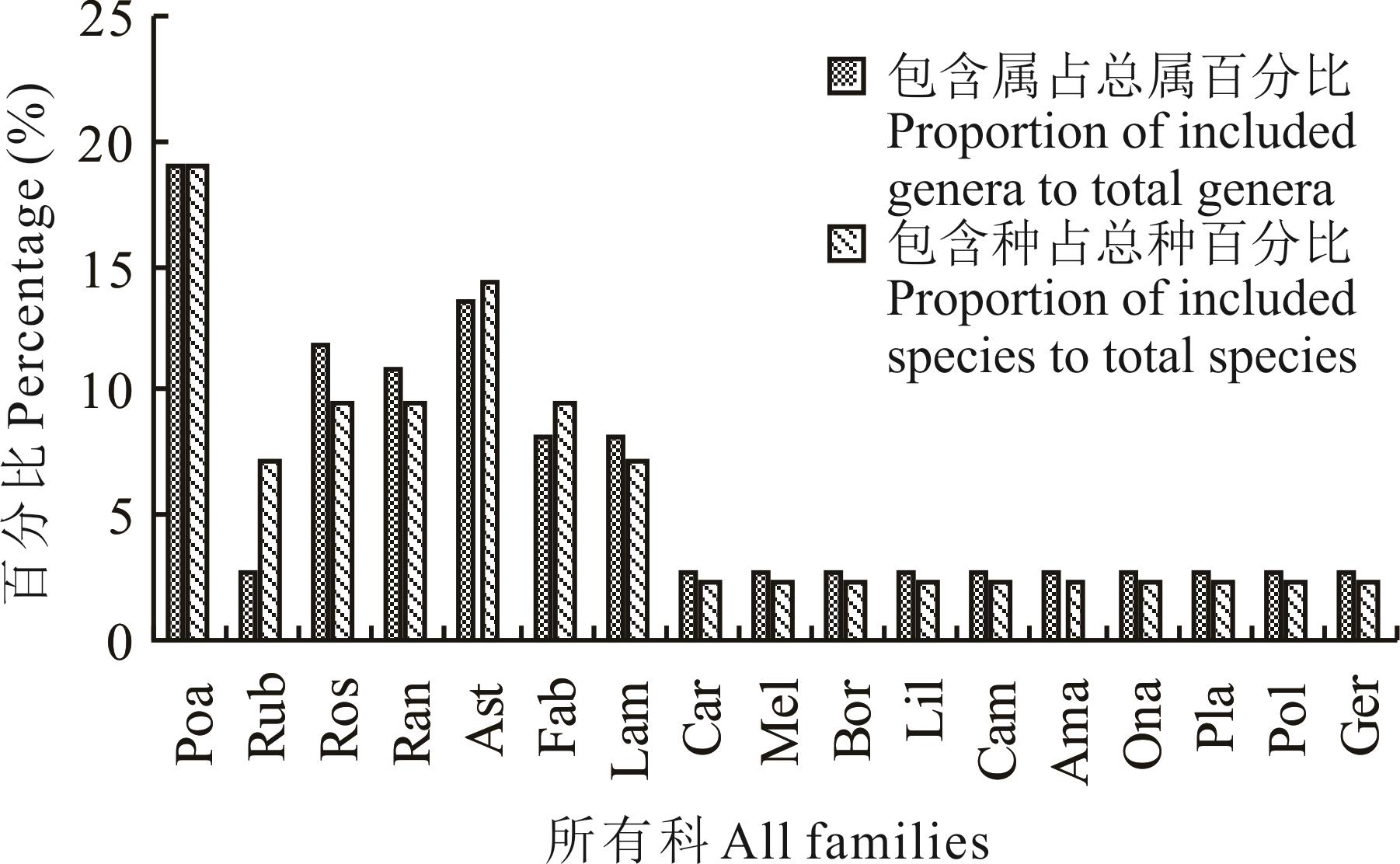
图1 哈巴河林区草地植物群落的物种组成Poa: 禾本科Poaceae; Rub: 茜草科Rubiaceae; Ros: 蔷薇科Rosaceae; Ran: 毛茛科Ranunculaceae; Ast: 菊科Asteraceae; Fab: 豆科Fabaceae; Lam: 唇形科Lamiaceae; Car: 石竹科Caryophyllaceae; Mel: 藜芦科Melanthiaceae; Bor: 紫草科Boraginaceae; Lil: 百合科Liliaceae; Cam: 桔梗科Campanulaceae; Ama: 苋科Amaranthaceae; Ona: 柳叶菜科Onagraceae; Pla: 车前科Plantaginaceae; Pol: 蓼科Polygonaceae; Ger: 牻牛儿苗科Geraniaceae.
Fig.1 Species composition of grassland plant communities in the Habahe forest area
| 物种名称Species name | LF | IV (SDR) | 物种名称Species name | LF | IV (SDR) |
|---|---|---|---|---|---|
| 狗尾草Setaria viridis | A | 65.05(10.05) | 野蔷薇Rosa multiflora | P | 31.11(3.78) |
| 早熟禾Poa annua | A | 62.65(19.57) | 苜蓿Medicago sativa | P | 29.68(5.57) |
| 羽衣草Alchemilla japonica | P | 60.94(12.71) | 夏枯草Prunella vulgaris | P | 29.42(2.39) |
| 针茅Stipa capillata | P | 52.07(10.56) | 叉歧繁缕Stellaria dichotoma | P | 28.66(9.01) |
| 大针茅Stipa grandis | P | 48.03(16.73) | 野草莓Fragaria vesca | P | 28.09(2.91) |
| 艾Artemisia argyi | P | 46.52(24.50) | 风铃草Campanula medium | P | 26.75(5.23) |
| 车轴草Galium odoratum | P | 42.35(5.82) | 赖草Leymus secalinus | P | 25.40(4.96) |
| 青蒿Artemisia caruifolia | A | 41.37(3.66) | 木地肤Bassia prostrata | A | 24.81(1.37) |
| 火绒草Leontopodium leontopodioides | P | 36.23(5.02) | 野豌豆Vicia sepium | P | 24.50(6.43) |
| 唐松草Thalictrum aquilegiifolium var. sibiricum | P | 35.67(4.12) | 猪牙花Erythronium japonicum | P | 22.89(0.55) |
| 野火球Trifolium lupinaster | P | 35.16(8.41) | 车前Plantago asiatica | P | 21.28(2.16) |
| 薄荷Mentha canadensis | P | 35.14(1.18) | 蓬子菜Galium verum | P | 21.02(3.43) |
| 冷蒿Artemisia frigida | P | 35.13(11.06) | 勿忘草Myosotis alpestris | P | 20.04(2.62) |
| 蓍Achillea millefolium | P | 35.07(5.74) | 糙苏Phlomoides umbrosa | P | 19.58(1.15) |
| 羊茅Festuca ovina | P | 34.74(6.63) | 委陵菜Potentilla chinensis | P | 19.01(1.33) |
| 藜芦Veratrum nigrum | P | 34.15(0.67) | 匍枝毛茛Ranunculus repens | P | 17.94(5.34) |
| 冰草Agropyron cristatum | P | 33.15(2.12) | 全缘铁线莲Clematis integrifolia | P | 17.55(0.98) |
| 北方拉拉藤Galium boreale | P | 32.89(3.85) | 金莲花Trollius chinensis | P | 17.47(0.51) |
| 异燕麦Helictochloa hookeri | A | 32.74(14.85) | 老鹳草Geranium wilfordii | P | 16.51(1.74) |
| 萹蓄Polygonum aviculare | A | 31.79(3.94) | 白车轴草Trifolium repens | P | 15.81(2.57) |
| 蒲公英Taraxacum mongolicum | P | 31.71(3.64) | 柳兰Chamerion angustifolium | P | 12.53(0.72) |
表1 哈巴河林区草地植物群落物种的重要值和优势度
Table 1 Importance values and dominance of species of grassland plant communities in Habahe forest area (%)
| 物种名称Species name | LF | IV (SDR) | 物种名称Species name | LF | IV (SDR) |
|---|---|---|---|---|---|
| 狗尾草Setaria viridis | A | 65.05(10.05) | 野蔷薇Rosa multiflora | P | 31.11(3.78) |
| 早熟禾Poa annua | A | 62.65(19.57) | 苜蓿Medicago sativa | P | 29.68(5.57) |
| 羽衣草Alchemilla japonica | P | 60.94(12.71) | 夏枯草Prunella vulgaris | P | 29.42(2.39) |
| 针茅Stipa capillata | P | 52.07(10.56) | 叉歧繁缕Stellaria dichotoma | P | 28.66(9.01) |
| 大针茅Stipa grandis | P | 48.03(16.73) | 野草莓Fragaria vesca | P | 28.09(2.91) |
| 艾Artemisia argyi | P | 46.52(24.50) | 风铃草Campanula medium | P | 26.75(5.23) |
| 车轴草Galium odoratum | P | 42.35(5.82) | 赖草Leymus secalinus | P | 25.40(4.96) |
| 青蒿Artemisia caruifolia | A | 41.37(3.66) | 木地肤Bassia prostrata | A | 24.81(1.37) |
| 火绒草Leontopodium leontopodioides | P | 36.23(5.02) | 野豌豆Vicia sepium | P | 24.50(6.43) |
| 唐松草Thalictrum aquilegiifolium var. sibiricum | P | 35.67(4.12) | 猪牙花Erythronium japonicum | P | 22.89(0.55) |
| 野火球Trifolium lupinaster | P | 35.16(8.41) | 车前Plantago asiatica | P | 21.28(2.16) |
| 薄荷Mentha canadensis | P | 35.14(1.18) | 蓬子菜Galium verum | P | 21.02(3.43) |
| 冷蒿Artemisia frigida | P | 35.13(11.06) | 勿忘草Myosotis alpestris | P | 20.04(2.62) |
| 蓍Achillea millefolium | P | 35.07(5.74) | 糙苏Phlomoides umbrosa | P | 19.58(1.15) |
| 羊茅Festuca ovina | P | 34.74(6.63) | 委陵菜Potentilla chinensis | P | 19.01(1.33) |
| 藜芦Veratrum nigrum | P | 34.15(0.67) | 匍枝毛茛Ranunculus repens | P | 17.94(5.34) |
| 冰草Agropyron cristatum | P | 33.15(2.12) | 全缘铁线莲Clematis integrifolia | P | 17.55(0.98) |
| 北方拉拉藤Galium boreale | P | 32.89(3.85) | 金莲花Trollius chinensis | P | 17.47(0.51) |
| 异燕麦Helictochloa hookeri | A | 32.74(14.85) | 老鹳草Geranium wilfordii | P | 16.51(1.74) |
| 萹蓄Polygonum aviculare | A | 31.79(3.94) | 白车轴草Trifolium repens | P | 15.81(2.57) |
| 蒲公英Taraxacum mongolicum | P | 31.71(3.64) | 柳兰Chamerion angustifolium | P | 12.53(0.72) |

图2 哈巴河林区草地群落系统发育树
Fig.2 Phylogenetic tree of grassland communities in the Habahe forest area
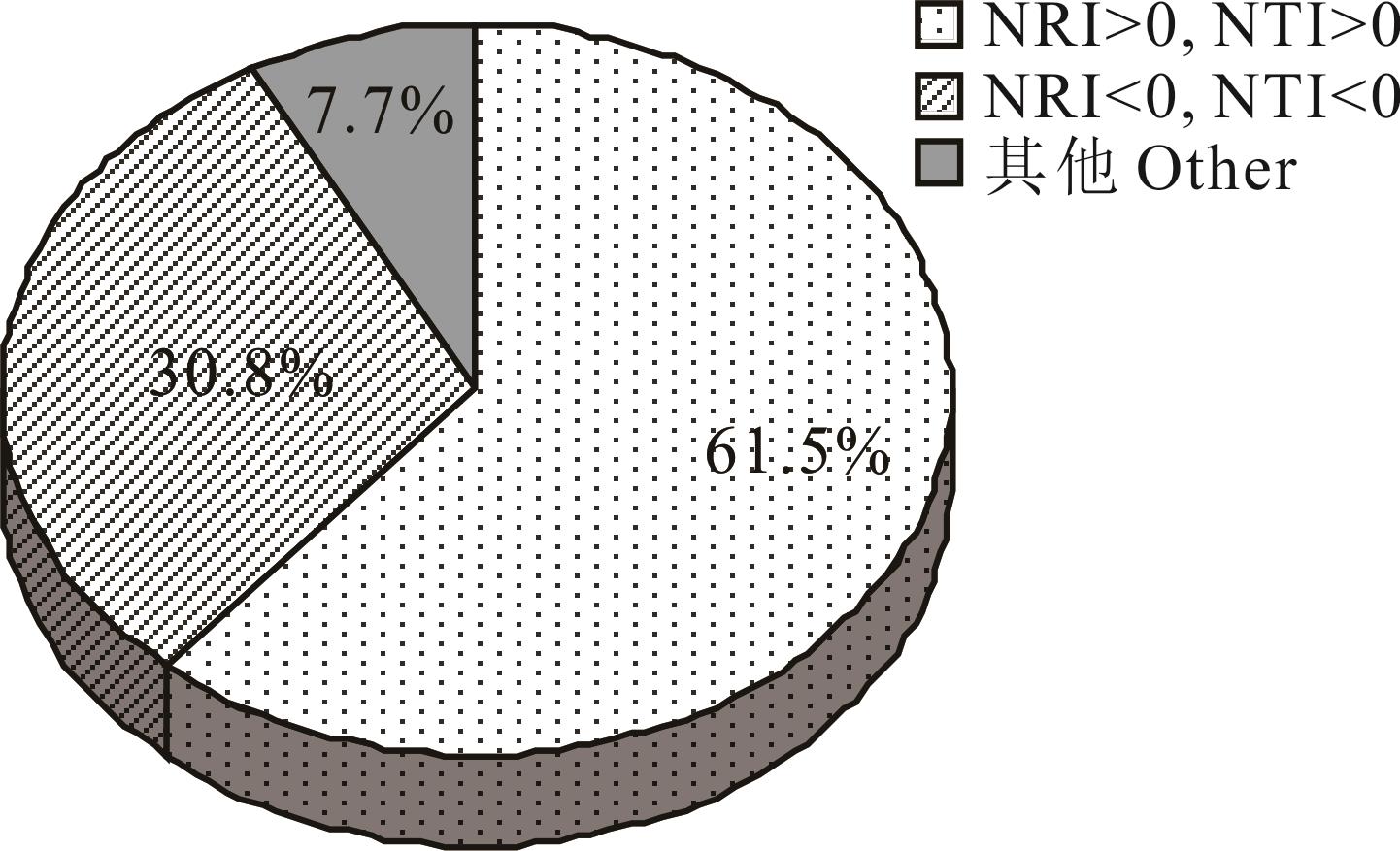
图3 哈巴河林区草地系统发育结构百分比
Fig.3 Percentage of phylogenetic structure of grassland samples in the Habahe forest area
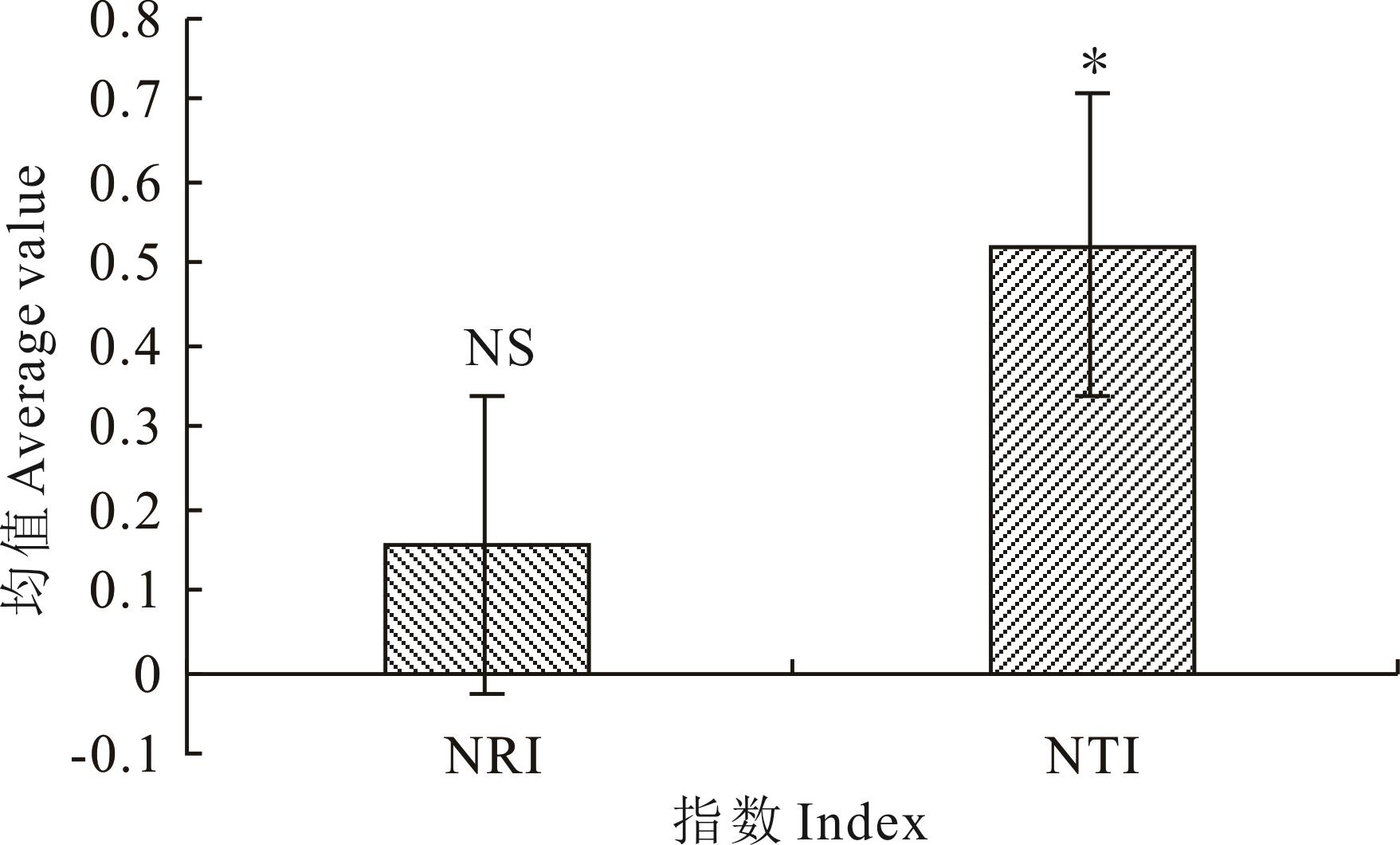
图4 净亲缘关系指数和净最近亲缘关系指数均值的T检验NS: P>0.05; *: P<0.05.
Fig.4 T-test for the average values of the net relatedness index (NRI) and net nearest taxa index (NTI)
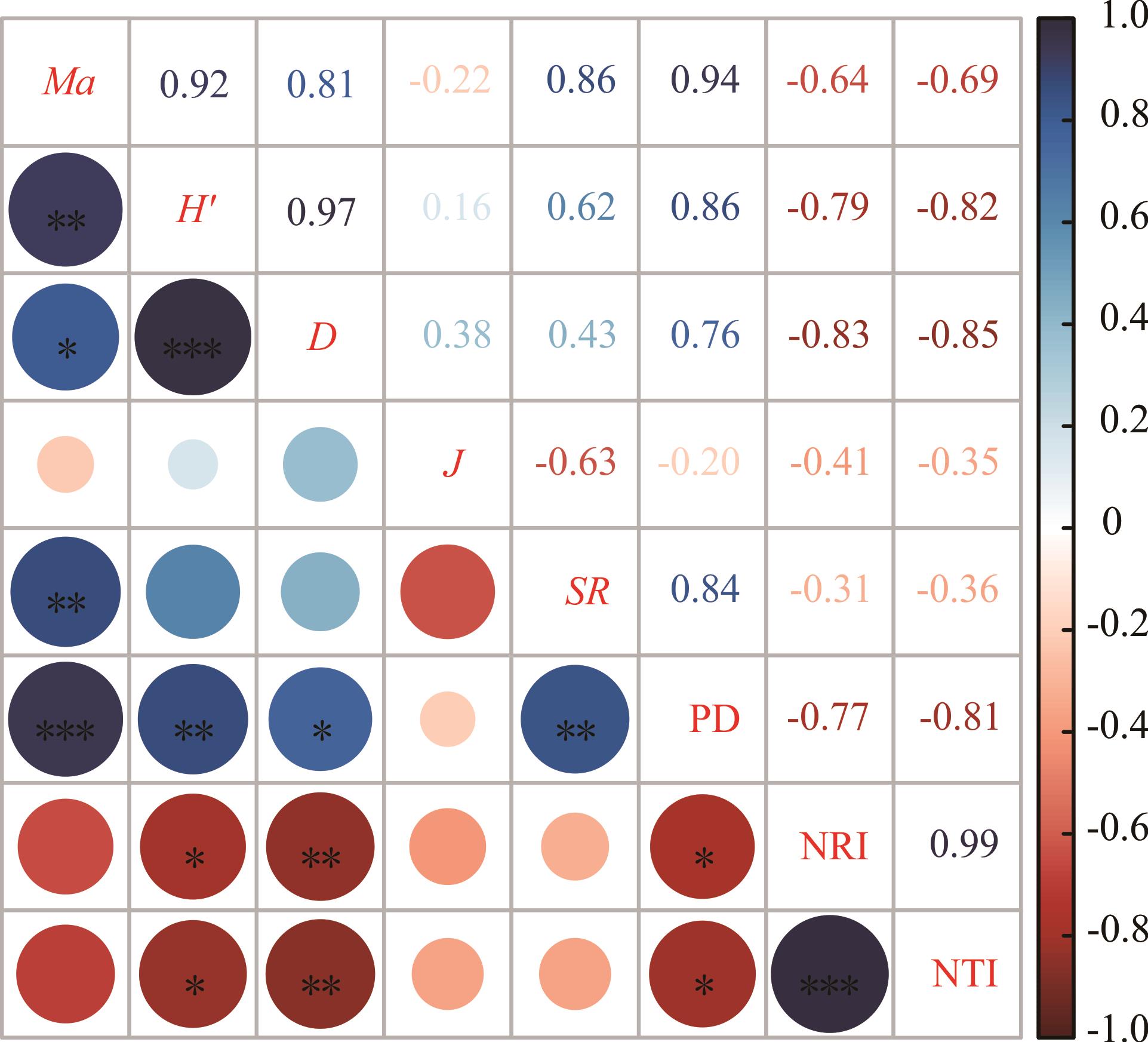
图5 生物群落多样性特征及其系统发育指数间的Pearson相关分析*: P<0.05; **: P<0.01; ***: P<0.001; 蓝色代表正相关,红色代表负相关,圆圈越大颜色越深,则相关性越强Blue denotes positive correlations, red represents negative correlations, with larger and darker circles indicating stronger associations; Ma: Margalef丰富度指数Margalef diversity index; H': Shannon-Wiener多样性指数Shannon-Wiener diversity index; D: Simpson优势度指数Simspon dominance index; J: Pielou均匀度指数Pielou evenness index; SR: 物种丰富度Species richness; PD: 系统发育多样性指数Phylogenetic diversity index; NRI: 净亲缘关系指数Net relatedness index; NTI: 净最近亲缘关系指数Net nearest taxa index.
Fig.5 Statistical assessment of Pearson correlation coefficients between community-level biodiversity metrics and phylogenetic structure indices
多样性指数 Diversity index | 环境因子Environmental factor | R2 | AIC | |||||
|---|---|---|---|---|---|---|---|---|
| Lat | Lon | Asl | Aap | Aat | Aae | |||
| Margalef物种丰富度Margalef diversity index | -0.525* | 0.322** | 0.455*** | 0.220* | -1.179* | 0.646 | 0.629 | -28.489 |
| Shannon-Wiener多样性指数Shannon-Wiener diversity index | -0.435* | 0.402*** | 0.528*** | 0.074 | -1.416*** | 0.968* | 0.756 | -36.855 |
| Simspon优势度指数Simspon dominance index | -0.510 | 0.515*** | 0.460*** | 0.083 | -0.531 | 0.092 | 0.632 | -92.889 |
| Pielou均匀度指数Pielou evenness index | -0.185 | 0.747*** | 0.120 | -0.174 | 0.011 | 0.361 | 0.217 | -68.512 |
| 物种丰富度Species richness | -0.596 | 0.211 | 0.413* | 0.186 | -1.037 | 0.535 | - | 158.570 |
| 系统发育多样性Phylogenetic diversity index | -0.084 | 0.006 | 0.227 | -0.077 | -0.877 | 0.227 | - | 515.687 |
| 净亲缘关系指数Net relatedness index | -0.687 | -0.007 | 0.286 | 0.196 | -0.036 | -0.073 | - | 127.783 |
| 净最近亲缘关系指数Net nearest taxa index | -0.564 | 0.234 | 0.158 | 0.351* | 0.776 | -0.514 | - | 136.419 |
表2 植物群落物种多样性和系统发育多样性与环境因子的最优模型回归分析
Table 2 Optimal model regression analysis of plant community species diversity and phylogenetic diversity with environmental factors
多样性指数 Diversity index | 环境因子Environmental factor | R2 | AIC | |||||
|---|---|---|---|---|---|---|---|---|
| Lat | Lon | Asl | Aap | Aat | Aae | |||
| Margalef物种丰富度Margalef diversity index | -0.525* | 0.322** | 0.455*** | 0.220* | -1.179* | 0.646 | 0.629 | -28.489 |
| Shannon-Wiener多样性指数Shannon-Wiener diversity index | -0.435* | 0.402*** | 0.528*** | 0.074 | -1.416*** | 0.968* | 0.756 | -36.855 |
| Simspon优势度指数Simspon dominance index | -0.510 | 0.515*** | 0.460*** | 0.083 | -0.531 | 0.092 | 0.632 | -92.889 |
| Pielou均匀度指数Pielou evenness index | -0.185 | 0.747*** | 0.120 | -0.174 | 0.011 | 0.361 | 0.217 | -68.512 |
| 物种丰富度Species richness | -0.596 | 0.211 | 0.413* | 0.186 | -1.037 | 0.535 | - | 158.570 |
| 系统发育多样性Phylogenetic diversity index | -0.084 | 0.006 | 0.227 | -0.077 | -0.877 | 0.227 | - | 515.687 |
| 净亲缘关系指数Net relatedness index | -0.687 | -0.007 | 0.286 | 0.196 | -0.036 | -0.073 | - | 127.783 |
| 净最近亲缘关系指数Net nearest taxa index | -0.564 | 0.234 | 0.158 | 0.351* | 0.776 | -0.514 | - | 136.419 |
| [1] | Yan Y J, Yang X, Tang Z Y. Patterns of species diversity and phylogenetic structure of vascular plants on the Qinghai-Tibetan Plateau. Ecology and Evolution, 2013, 3(13): 4584-4595. |
| [2] | Swenson N G, Erickson D L, Mi X, et al. Phylogenetic and functional alpha and beta diversity in temperate and tropical tree communities. Ecology,2012, 93(8): S112-S125. |
| [3] | Schweiger O, Klotz S, Durka W, et al. A comparative test of phylogenetic diversity indices. Oecologia, 2008, 157(3): 485-495. |
| [4] | Ci X Q, Li J. Phylogenetic diversity and its application in floristics and biodiversity conservation. Biodiversity Science, 2017, 25(2): 175-181. |
| 慈秀芹, 李捷. 系统发育多样性在植物区系研究与生物多样性保护中的应用. 生物多样性, 2017, 25(2): 175-181. | |
| [5] | Li X, Sun H. Phylogenetic pattern of alpine plants along latitude and longitude in Hengduan Mountains Region. Plant Diversity, 2017, 39(1): 37-43. |
| [6] | Gong H, Yu T, Zhang X, et al. Effects of boundary constraints and climatic factors on plant diversity along an altitudinal gradient. Global Ecology and Conservation, 2019, 19(7): e00671. |
| [7] | Macheroum A, Kadik L, Neffar S, et al. Environmental drivers of taxonomic and phylogenetic diversity patterns of plant communities in semi-arid steppe rangelands of North Africa. Ecological Indicators, 2021, 132(12): 108279. |
| [8] | Merwin L, He T, Lamont B B. Phylogenetic and phenotypic structure among Banksia communities in south-western Australia. Journal of Biogeography, 2012, 39(2): 797-807. |
| [9] | Rosindell J, Hubbell S P, Etienne R S. The unified neutral theory of biodiversity and biogeography at age ten. Trends in Ecology & Evolution, 2011, 26(7): 340-348. |
| [10] | Lu M M, Huang X C, Ci X Q, et al. Phylogenetic community structure of subtropical forests along elevational gradients in Ailao Mountains of southwest China. Biodiversity Science, 2014, 22(4): 438-448. |
| 卢孟孟, 黄小翠, 慈秀芹, 等. 沿海拔梯度变化的哀牢山亚热带森林群落系统发育结构. 生物多样性, 2014, 22(4): 438-448. | |
| [11] | Leibold M A, McPeek M A. Coexistence of the niche and neutral perspectives in community ecology. Ecology, 2006, 87(6): 1399-1410. |
| [12] | Getschke G. The unified neutral theory of biodiversity and biogeography. Plant Systematics & Evolution, 2002, 85(11): 3172-3174. |
| [13] | Huang J X, Zheng F Y, Mi X C. Influence of environmental factors on phylogenetic structure at multiple spatial scales in an evergreen broad-leaved forest of China. Chinese Journal of Plant Ecology, 2010, 34(3): 309-315. |
| 黄建雄, 郑凤英, 米湘成. 不同尺度上环境因子对常绿阔叶林群落的谱系结构的影响. 植物生态学报, 2010,34(3): 309-315. | |
| [14] | Zhang M M, Qin H, Wang Y, et al. Beta diversity of wetland vegetation in the middle and upper reaches of the Fenhe River watershed. Acta Ecologica Sinica, 2016, 36(11): 3292-3299. |
| 张淼淼, 秦浩, 王烨, 等. 汾河中上游湿地植被β多样性. 生态学报, 2016, 36(11): 3292-3299. | |
| [15] | Shi Y, Grogan P, Sun H, et al. Multi-scale variability analysis reveals the importance of spatial distance in shaping Arctic soil microbial functional communities. Soil Biology and Biochemistry, 2015, 86(7): 126-134. |
| [16] | Mayfield M M, Levine J M. Opposing effects of competitive exclusion on the phylogenetic structure of communities. Ecology Letters, 2010, 13(9): 1085-1093. |
| [17] | Bennett J A, Lamb E G, Hall J C, et al. Increased competition does not lead to increased phylogenetic overdispersion in a native grassland. Ecology Letters, 2013, 16(9): 1168-1176. |
| [18] | Jump A S, Mátyás C, Peñuelas J. The altitude-for-latitude disparity in the range retractions of woody species. Trends in Ecology & Evolution, 2009, 24(12): 694-701. |
| [19] | Chai Y X. The species diversity and community assembly of arbuscular mycorrhizal fungi in Qilianshan Mountains on a northwest-facing slope and a southeast-facing slope. Lanzhou: Lanzhou University, 2018. |
| 柴宇星. 祁连山阴阳坡丛枝菌根真菌多样性及群落构建机制研究. 兰州: 兰州大学, 2018. | |
| [20] | Liu Y. Protection and restoration of wetlands in Habahe County, Altay of Xinjiang. Wetland Science & Management, 2022, 18(2): 47-50. |
| 刘岩. 新疆阿勒泰哈巴河县湿地保护和恢复工程. 湿地科学与管理, 2022, 18(2): 47-50. | |
| [21] | Tan F, Yang P N, Wang C, et al. Water requirement for ecological restoration of damaged vegetation in arid area-A case study at plain area in Habahe County, Xinjiang Wei Autonomous Region. Bulletin of Soil and Water Conservation, 2023, 43(1): 244-252. |
| 谭翻, 杨鹏年, 王翠, 等. 干旱区受损植被生态恢复需水量—以新疆哈巴河县平原区为例. 水土保持通报, 2023, 43(1): 244-252. | |
| [22] | Zhou Q, Ye M, Zhao F F. Ecosystem health assessment based on the VOR model analysis in forest area of Altai Mountains. Journal of Gansu Agricultural University, 2021, 56(3): 137-148. |
| 周泉, 叶茂, 赵凡凡. 基于VOR模型的阿尔泰山林区森林生态系统健康评价. 甘肃农业大学学报, 2021, 56(3): 137-148. | |
| [23] | Zeng G Y, Ye M, Li M M, et al. Stability and diversity of plant communities and their biomass in grassland before and after grazing in the Habahe region of Altai Mountains. Research of Soil and Water Conservation, 2025, 32(1): 82-91. |
| 曾国燕, 叶茂, 李苗苗, 等. 放牧对阿尔泰山哈巴河地区草地植物群落稳定性与多样性及其生物量关系的影响. 水土保持研究, 2025, 32(1): 82-91. | |
| [24] | Shen R, Zhang J L, He B, et al. The structure characteristic and analysis on similarity of grassland community in dry-hot valley of Yuanjiang River. Ecology and Environmental Sciences, 2010, 19(12): 2821-2825. |
| 沈蕊, 张建利, 何彪, 等. 元江流域干热河谷草地植物群落结构特征与相似性分析. 生态环境学报, 2010, 19(12): 2821-2825. | |
| [25] | Chen Q. Diversity and community assembly mechanisms of plant and soil microbial in Qilian Mountain National Park. Yangling: Northwest A & F University, 2023. |
| 陈倩. 祁连山国家公园植物和土壤微生物多样性及群落构建机制. 杨凌: 西北农林科技大学, 2023. | |
| [26] | Webb C O. Exploring the phylogenetic structure of ecological communities: An example for rain forest trees. The American Naturalist, 2000, 156(2): 145-155. |
| [27] | Kraft N J, Adler P B, Godoy O, et al. Community assembly, coexistence and the environmental filtering metaphor. Functional Ecology, 2015, 29(5): 592-599. |
| [28] | Webb C O, Ackerly D D, McPeek M, et al. Phylogenies and community ecology. Annual Review of Ecology and Systematics, 2002, 33(1): 475-505. |
| [29] | Mori A S, Fujii S, Kitagawa R, et al. Null model approaches to evaluating the relative role of different assembly processes in shaping ecological communities. Oecologia, 2015, 178(1): 261-273. |
| [30] | Faith D P. Conservation evaluation and phylogenetic diversity. Biological Conservation, 1992, 61(1): 1-10. |
| [31] | Lyu Z L, Liu B, Chang F, et al. Species diversity and phylogenetic diversity in Bayinbrook alpine grasslands: elevation gradient distribution patterns and drivers. Acta Prataculturae Sinica, 2023, 32(7): 12-22. |
| 吕自立, 刘彬, 常凤, 等. 巴音布鲁克高寒草甸物种多样性与系统发育多样性沿海拔梯度分布格局及驱动因子. 草业学报, 2023, 32(7): 12-22. | |
| [32] | Li M J, He Z S, Jiang L, et al. Distribution pattern and driving factors of species diversity and phylogenetic diversity along altitudinal gradient on the south slope of Daiyun Mountain. Acta Ecologica Sinica, 2021, 41(3): 1148-1157. |
| 李梦佳, 何中声, 江蓝, 等. 戴云山物种多样性与系统发育多样性海拔梯度分布格局及驱动因子. 生态学报, 2021, 41(3): 1148-1157. | |
| [33] | Wang G H, Ren J Z, Zhang Z H. Species diversity in relation to phylogenetic traits of plant. Acta Prataculturae Sinica, 2003, 12(1): 41-46. |
| 王国宏, 任继周, 张自和. 物种多样性与植物系统发育. 草业学报, 2003, 12(1): 41-46. | |
| [34] | Faith D P. Biodiversity’s option value: A comment on Maier. Ambio, 2018, 47(6): 735-736. |
| [35] | Moles A T, Ackerly D D, Webb C O, et al. A brief history of seed size. Science, 2005, 307(5709): 576-580. |
| [36] | Jin H X, He F L, Li C L, et al. Vegetation characteristics, abundance of soil microbes, and soil physico-chemical properties in desertified alpine meadows of Maqu. Acta Prataculturae Sinica, 2015, 24(11): 20-28. |
| 金红喜, 何芳兰, 李昌龙, 等. 玛曲沙化高寒草甸植被、土壤理化性质及土壤微生物数量研究. 草业学报, 2015, 24(11): 20-28. | |
| [37] | Zhu G D, Guo N, Han Y J, et al. Effects of extreme drought on plant diversity and soil properties of Inner Mongolian desert steppe. Chinese Journal of Grassland, 2021, 43(3): 52-59. |
| 朱国栋, 郭娜, 韩勇军, 等. 极端干旱对内蒙古荒漠草原植物群落物种多样性和土壤性质的影响. 中国草地学报, 2021, 43(3): 52-59. | |
| [38] | Wang D P, Ji S Y, Chen F P. A review on the species diversity of plant community. Chinese Journal of Ecology, 2001, 20(4): 55-60. |
| 汪殿蓓, 暨淑仪, 陈飞鹏. 植物群落物种多样性研究综述. 生态学杂志, 2001, 20(4): 55-60. | |
| [39] | He M Y, Wang Y X, Peng Z C, et al. The spatial pattern of aboveground biomass and species richness in the grassland of Qilian Mountain. Pratacultural Science, 2020, 37(10): 2012-2021. |
| 何美悦, 王迎新, 彭泽晨, 等. 祁连山草原地上生物量和物种丰富度的空间格局. 草业科学, 2020, 37(10): 2012-2021. | |
| [40] | Yang Y H, Rao S, Hu H F, et al. Plant species richness of alpine grasslands in relation to environmental factors and biomass on the Tibetan Plateau. Biodiversity Science, 2004, 12(1): 200-205. |
| 杨元合, 饶胜, 胡会峰, 等. 青藏高原高寒草地植物物种丰富度及其与环境因子和生物量的关系. 生物多样性, 2004, 12(1): 200-205. | |
| [41] | Yang M, Wei S, Mwangi B N, et al. Horizontal distribution characteristics and environmental factors of shrubland species diversity in Hainan Island, China. Land, 2022, 11(7): 1047. |
| [42] | Zhang G, Li Q, Sun S. Diversity and distribution of parasitic angiosperms in China. Ecology and Evolution, 2018, 8(9): 4378-4386. |
| [43] | Feng J M, Dong X D, Xu C D, et al. Effects of sampling scale on latitudinal patterns of species diversity in seed plants in northwestern Yunnan, China. Biodiversity Science, 2009, 17(3): 266-271. |
| 冯建孟, 董晓东, 徐成东, 等. 取样尺度效应对滇西北地区种子植物物种多样性纬度分布格局的影响. 生物多样性, 2009, 17(3): 266-271. | |
| [44] | Hawkins B A, Diniz-Filho J A F. Latitude and geographic patterns in species richness. Ecography, 2004, 27(2): 268-272. |
| [45] | Lomolino M V. Elevation gradients of species-density: Historical and prospective views. Global Ecology and Biogeography, 2001, 10(1): 3-13. |
| [46] | Tan S S, Ye Z L, Yuan L B, et al. Beta diversity of plant communities in Baishanzu Nature Reserve. Acta Ecologica Sinica, 2013, 33(21): 6944-6956. |
| 谭珊珊, 叶珍林, 袁留斌, 等. 百山祖自然保护区植物群落beta多样性. 生态学报, 2013, 33(21): 6944-6956. | |
| [47] | Zhang X, Ye M, Pan X T, et al. Characteristics of grassland plant community change with elevation and its relationship with environmental factors in the Burqin forest region of the Altai mountains. Diversity, 2023, 15(10): 1098. |
| [48] | Chen H, Li Y Q, Zheng S W, et al. Research on the correlations of shrub biomass with slope-aspect and altitude in dry valley of the upper reach of the Minjiang River. Journal of Chengdu University (Natural Science Edition), 2007, 26(1): 14-18. |
| 陈泓, 黎燕琼, 郑绍伟, 等. 岷江上游干旱河谷灌丛生物量与坡向及海拔梯度相关性研究. 成都大学学报(自然科学版), 2007, 26(1): 14-18. | |
| [49] | Su J J, Liu Y P, Liu L Y, et al. Quantitative classification and ordination analysis of typical plant communities in Altay Prefecture of Xinjiang. Acta Prataculturae Sinica, 2023, 32(9): 50-67. |
| 苏金娟, 刘永萍, 刘丽燕, 等. 新疆阿勒泰地区典型植物群落数量分类与排序分析. 草业学报, 2023, 32(9): 50-67. | |
| [50] | Zeng G Y, Ye M, Li M M, et al. The relationships between plant community stability and diversity across different grassland types and their association with environmental factors in the Habahe forest area, Xinjiang. Diversity, 2024, 16(8): 499. |
| [51] | Xu J, Dang H, Tian T, et al. Human disturbance rather than habitat factors drives plant community assembly and diversity patterns in a semiarid region. Land Degradation & Development, 2020, 31(14): 1803-1811. |
| [52] | Wang J M, Qu M J, Wang Y, et al. The drivers of plant taxonomic, functional, and phylogenetic β-diversity in the gobi desert of northern Qinghai-Tibet Plateau. Biodiversity Science, 2022, 30(6): 62-75. |
| 王健铭, 曲梦君, 王寅, 等. 青藏高原北部戈壁植物群落物种、功能与系统发育β多样性分布格局及其影响因素. 生物多样性, 2022, 30(6): 62-75. | |
| [53] | Takahashi K, Tanaka S. Relative importance of habitat filtering and limiting similarity on species assemblages of alpine and subalpine plant communities. Journal of Plant Research, 2016, 129(6): 1041-1049. |
| [54] | Gairola S, Ghildiyal S K, Sharma C M, et al. Species richness and diversity along an altitudinal gradient in moist temperate forest of Garhwal Himalaya. The Journal of American Science, 2009, 5(5): 119-128. |
| [55] | Wang J W, Ming S P, Xu M, et al. Diversity pattern and phylogenetic structure of plant communities in alpine ecological key zone. Acta Agrestia Sinica, 2023, 31(9): 2777-2786. |
| 王俊伟, 明升平, 许敏, 等. 高山生态关键带植物群落多样性格局与系统发育结构. 草地学报, 2023, 31(9): 2777-2786. | |
| [56] | Li Y G. Geographical distribution patterns and conservation of wetland plant diversity in the Qinghai-Tibet Plateau. Lhasa: Tibet University, 2024. |
| 李义刚. 青藏高原湿地植物多样性地理分布格局及其保护. 拉萨: 西藏大学, 2024. | |
| [57] | Gilbert B, Lechowicz M J. Neutrality, niches, and dispersal in a temperate forest understory. Proceedings of the National Academy of Sciences, 2004, 101(20): 7651-7656. |
| [58] | Fernandez-Going B M, Harrison S P, Anacker B L, et al. Climate interacts with soil to produce beta diversity in Californian plant communities. Ecology, 2013, 94(9): 2007-2018. |
| [59] | Zhang X X, Ye J F, Laffan S W, et al. Spatial phylogenetics of the Chinese angiosperm flora provides insights into endemism and conservation. Journal of Integrative Plant Biology, 2022, 64(1): 105-117. |
| [60] | Du Z Y, An H, Wen Z L, et al. Response of plant community structure and its stability to water and nitrogen addition in desert grassland. Acta Ecologica Sinica, 2021, 41(6): 2359-2371. |
| 杜忠毓, 安慧, 文志林, 等. 荒漠草原植物群落结构及其稳定性对增水和增氮的响应. 生态学报, 2021, 41(6): 2359-2371. | |
| [61] | Han W Y, Chen L, Su X K, et al. Effects of soil physico-chemical properties on plant species diversity along an elevation gradient over alpine grassland on the Qinghai-Tibetan Plateau, China. Frontiers in Plant Science, 2022, 13(4): 822268. |
| [1] | 安玉霞, 王文强, 余殿, 梁咏亮, 杨君珑, 李小伟. 基于优化MaxEnt模型的锁阳分布研究:现状评估与未来预测[J]. 草业学报, 2025, 34(7): 1-12. |
| [2] | 严双, 夏菲, 魏巍, 王敬龙, 吴皓阳, 冉林灵, 薛云尹, 石昊, 郑晒坤, 王军强, 贺俊东. 高寒草甸不同侵蚀样地植物多样性的差异及其关键影响因子[J]. 草业学报, 2025, 34(6): 1-13. |
| [3] | 罗顺华, 刘新宇, 孟宝平, 陈璇黎, 胡仁杰, 于红妍, 王贤颖, 张勃, 秦彧. 祁连山国家公园高寒草地功能群多样性与生产力研究[J]. 草业学报, 2025, 34(6): 14-26. |
| [4] | 李雪萍, 许世洋, 李建军, 漆永红. 青稞根腐病根际土壤细菌多样性及群落结构变化规律[J]. 草业学报, 2025, 34(5): 118-129. |
| [5] | 王守兴, 周华坤, 欧立鹏, 李成先, 王雁鹤, 宁晓春, 谷强, 魏代军, 杨明新. 三江源不同草地类型植被及土壤微生物多样性与土壤因子特征的研究[J]. 草业学报, 2025, 34(4): 16-26. |
| [6] | 龚昕, 霍新茹, 李雯, 杨彦东, 刘超, 秦伟春, 沈艳, 王国会, 马红彬. 宁夏罗山山地草原植被群落特征及其空间分异[J]. 草业学报, 2025, 34(2): 1-15. |
| [7] | 吕娜, 高吉喜, 李政海, 尤春赫, 刘晓曼, 张彪, 莫宇, 朱萨宁, 彭阳, 杨雪. 植物生长中期施肥对草甸草原群落特征与物种多样性的影响[J]. 草业学报, 2025, 34(2): 109-122. |
| [8] | 陶惠赟, 杨闰艳, 李延灿, 刘亚鹏, 祁鹤兴. 黄河源区矮嵩草根际土壤微生物多样性及对环境因子的响应[J]. 草业学报, 2025, 34(12): 16-32. |
| [9] | 刘倩, 丁彦芬, 宋杉杉, 许文婕, 杨威. 南京明城墙绿带草本层自生植物群落数量分类与排序分析[J]. 草业学报, 2024, 33(5): 1-15. |
| [10] | 于双, 李小伟, 王瑞霞, 杨君珑, 马龙. 灵武白芨滩不同年限柠条固沙林林下草本群落演替规律及机制[J]. 草业学报, 2024, 33(3): 13-23. |
| [11] | 石昊, 杨彩红, 夏菲, 王军强, 魏巍, 王敬龙, 薛云尹, 郑晒坤, 吴皓阳, 冉林灵, 严双, 姜晓敏. 短期增温对修复过程中藏北高寒退化草地生产力的初期影响[J]. 草业学报, 2024, 33(11): 30-45. |
| [12] | 王鹏, 金正, 余婷, 秦康强, 桑新亚, 陶建平, 罗唯学. 预测姜黄属植物在中国当前和未来气候情景下的潜在分布区变化[J]. 草业学报, 2024, 33(10): 14-27. |
| [13] | 凤紫棋, 孙文义, 穆兴民, 高鹏, 赵广举, 陈帅. 南方山区杉木人工林林下草本植物多样性的影响因素[J]. 草业学报, 2023, 32(9): 17-26. |
| [14] | 杨欣怡, 杨富强, 周旭姣, 王明军, 黄海霞, 鲁松松, 张晓玮, 杜伟波, 王旭虎, 田青, 赵安, 贺万鹏, 周晓雷. 青藏高原东北边缘云杉-巴山冷杉林火烧迹地草本植物群落构建机理[J]. 草业学报, 2023, 32(8): 40-47. |
| [15] | 吕自立, 刘彬, 常凤, 马紫荆, 曹秋梅. 巴音布鲁克高寒草甸物种多样性与系统发育多样性沿海拔梯度分布格局及驱动因子[J]. 草业学报, 2023, 32(7): 12-22. |
| 阅读次数 | ||||||
|
全文 |
|
|||||
|
摘要 |
|
|||||
