

ISSN 1004-5759 CN 62-1105/S
草业学报 ›› 2026, Vol. 35 ›› Issue (11): 13-23.DOI: 10.11686/cyxb2025464
陈燕1( ), 闫永刚2, 赵香君2, 李志刚1,3()
收稿日期:2025-11-11
修回日期:2026-02-04
出版日期:2026-11-20
发布日期:2026-10-12
通讯作者:
李志刚
作者简介:Corresponding author. E-mail: lizg001@sina.com基金资助:
Yan CHEN1(), Yong-gang YAN2, Xiang-jun ZHAO2, Zhi-gang LI1,3()
Received:2025-11-11
Revised:2026-02-04
Online:2026-11-20
Published:2026-10-12
Contact:
Zhi-gang LI
摘要:
围封与补播是退化荒漠草原的主要恢复措施,但二者对荒漠草原植被、土壤有机碳及土壤颗粒特征的影响机制尚不明确。以宁夏盐池退化荒漠草原为对象,设置不同起始年份的围封(2017,2021年)、补播(2017,2021年)及对照长期自由放牧处理,于2024年测定地上植被生物量、凋落物量以及0~60 cm土层的根系生物量、土壤有机碳和颗粒组成。结果表明:1)与对照相比,2021年补播与2017年围封对地上生物量和凋落物量的提高均最具优势,但二者间差异不显著(P>0.05);2)2017年恢复措施较2021年对地下根系生物量的提升效果更为明显,且2017年围封略优于2017年补播;3)各恢复措施均不同程度提高了土壤有机碳含量,但2017年恢复措施显著优于2021年,且2017年补播略优于2017年围封;4)各恢复措施均不同程度降低了细砂粒比例,提升了极细砂粒和粉黏粒比例,并提高了土壤分形维数,但2017年恢复措施优于2021年,且2017年围封略优于2017年补播。5)路径分析模型表明,地下生物量是驱动有机碳积累和促进分形维数值升高的关键因子。结果表明,短期补播较短期围封对草地植被的恢复更具优势,但是长期围封较长期补播对草地植被恢复及土壤物理结构的改善更具优势。总之,退化荒漠草原的恢复需依赖长期人为正向干预。
陈燕, 闫永刚, 赵香君, 李志刚. 围封与补播对退化荒漠草原植被生物量、土壤有机碳及颗粒特征的影响[J]. 草业学报, 2026, 35(11): 13-23.
Yan CHEN, Yong-gang YAN, Xiang-jun ZHAO, Zhi-gang LI. Impacts of grazing exclusion and reseeding on vegetation biomass, soil organic carbon, and soil particle characteristics in a degraded desert steppe[J]. Acta Prataculturae Sinica, 2026, 35(11): 13-23.
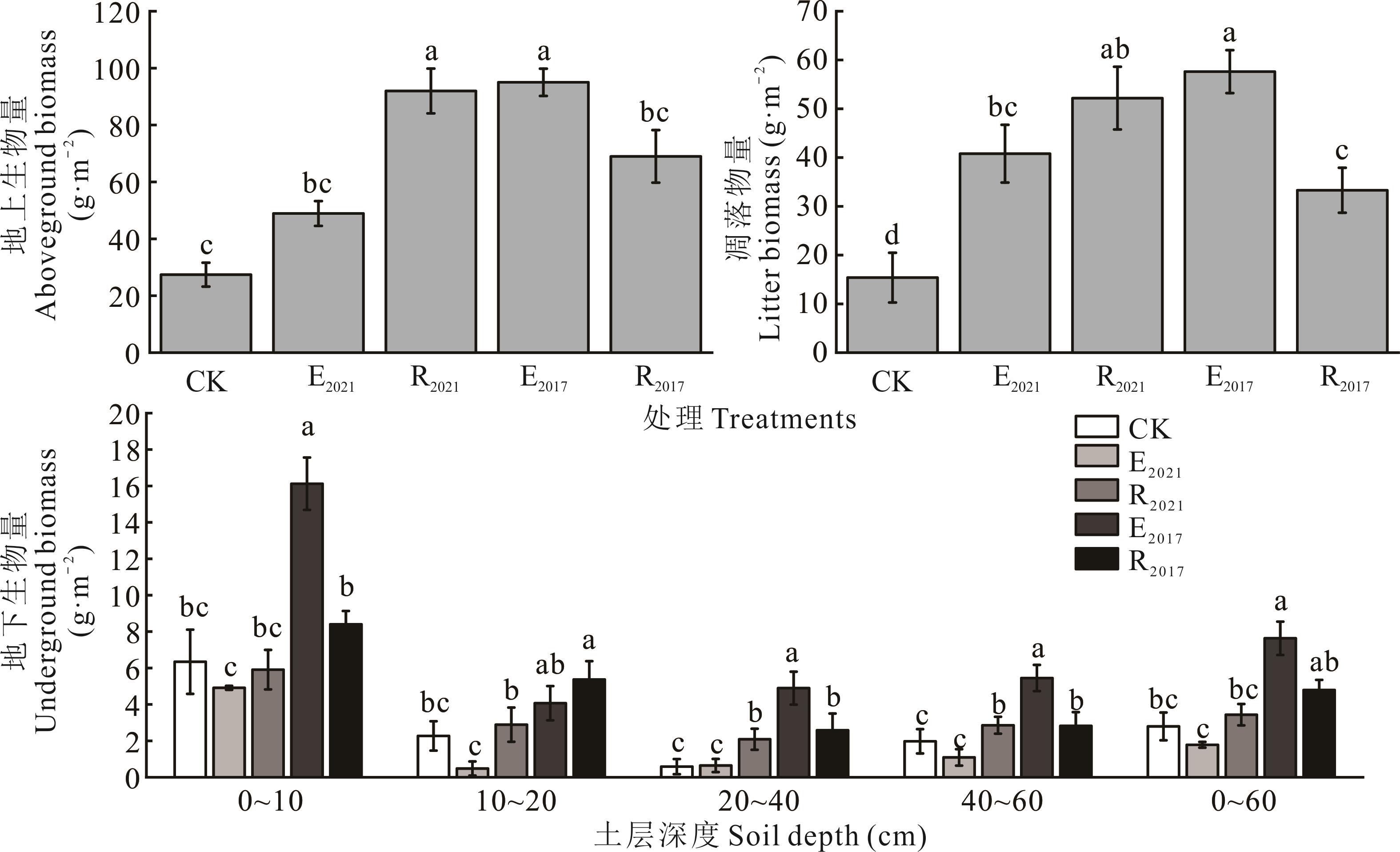
图1 不同处理地上生物量、凋落物蓄积量和地下生物量的变化规律CK: 对照Control; E2021: 2021年围封草地Enclosed grassland in 2021; E2017: 2017年围封草地Enclosed grassland in 2017; R2021: 2021年补播草地Reseeded grassland in 2021; R2017: 2017年补播草地Reseeded grassland in 2017. 不同字母表示处理间差异显著(P<0.05),下同。Different letters indicate significant differences among treatments (P<0.05). The same below.
Fig.1 Changes of aboveground biomass, litter biomass, and underground biomass among different treatments
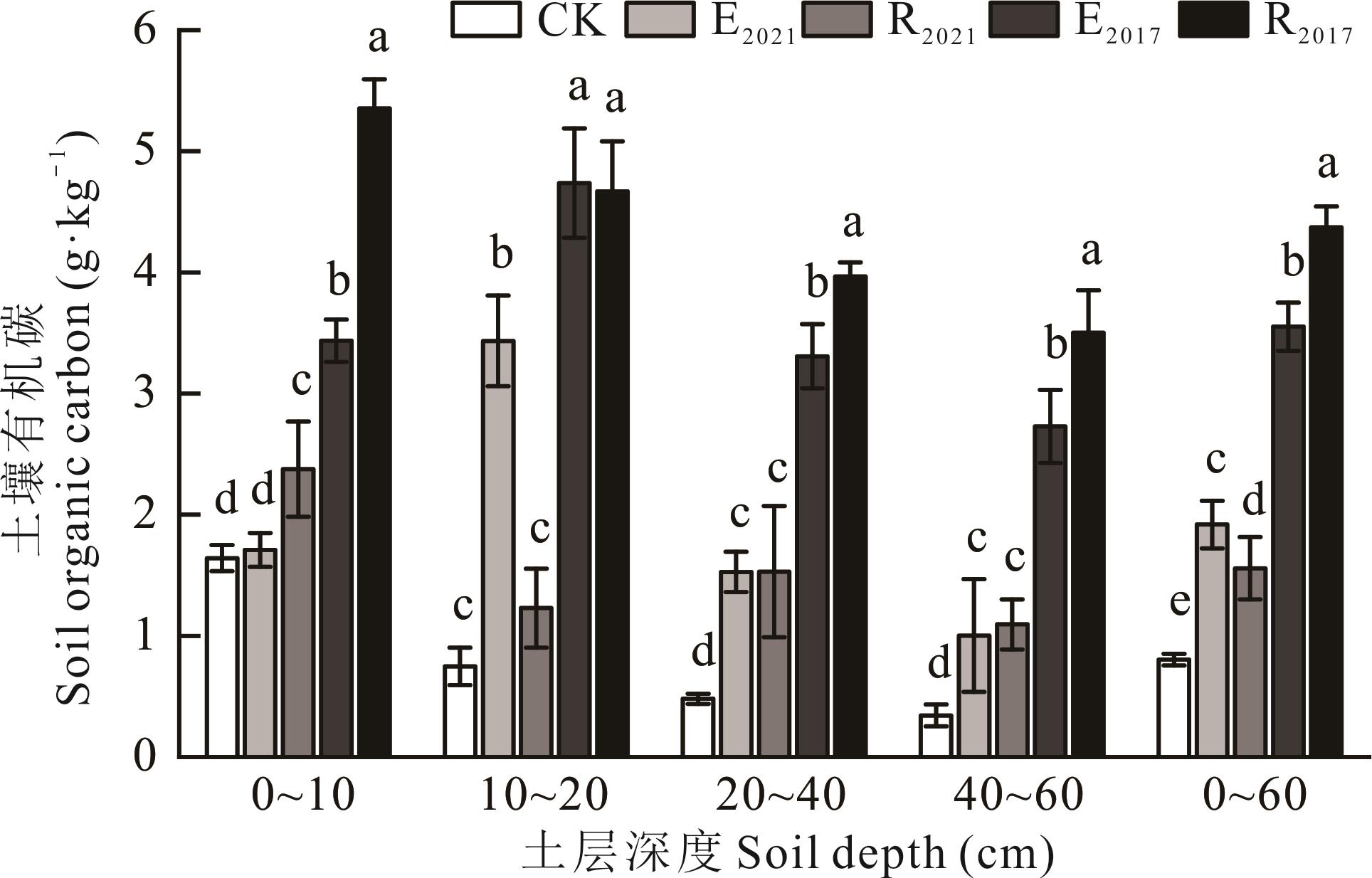
图2 不同处理土壤有机碳的变化规律
Fig.2 Changes of soil organic carbon among different treatments
土层深度 Soil depth (cm) | 处理 Treatments | 中砂粒 Medium sand (250~500 μm) | 细砂粒 Fine sand (100~250 μm) | 极细砂粒 Very fine sand (50~100 μm) | 粉黏粒 Silt+clay (<50 μm) |
|---|---|---|---|---|---|
| 0~10 | CK | 2.33±0.21ab | 54.99±6.42a | 37.11±3.72a | 5.57±2.89a |
| E2021 | 3.76±2.25ab | 55.18±3.32a | 35.44±1.07b | 5.63±1.84a | |
| R2021 | 4.36±2.04a | 58.32±3.87a | 34.41±5.27b | 2.92±0.70a | |
| E2017 | 1.45±0.99b | 50.97±7.88a | 40.08±5.04a | 7.51±4.44a | |
| R2017 | 2.97±0.80ab | 52.80±7.38a | 37.42±4.80a | 6.81±3.64a | |
| 10~20 | CK | 2.39±1.33a | 59.15±2.20a | 36.25±3.34b | 2.22±0.60c |
| E2021 | 2.33±0.63a | 59.81±5.97a | 35.48±4.81b | 2.38±0.76c | |
| R2021 | 2.36±2.04a | 59.28±4.03a | 35.59±5.11b | 2.77±0.98c | |
| E2017 | 1.12±0.95b | 45.63±3.96b | 40.47±3.41a | 12.78±1.45a | |
| R2017 | 1.15±1.08b | 45.04±3.95b | 44.03±5.91a | 9.79±1.30b | |
| 20~40 | CK | 6.42±2.22a | 62.49±1.78a | 28.67±3.41b | 2.43±0.47c |
| E2021 | 2.27±0.26b | 67.68±4.27a | 28.57±3.80b | 1.49±0.31c | |
| R2021 | 2.56±2.11b | 59.75±5.80a | 35.93±6.62a | 1.75±1.02c | |
| E2017 | 3.27±1.73b | 41.47±5.00b | 37.39±2.79a | 17.88±3.14a | |
| R2017 | 1.74±0.74b | 49.02±2.80b | 41.35±0.67a | 7.89±2.97b | |
| 40~60 | CK | 1.72±0.16a | 56.06±1.98b | 38.17±2.00a | 4.05±0.51c |
| E2021 | 4.43±1.78a | 65.67±4.58a | 27.07±3.06b | 2.84±0.881c | |
| R2021 | 2.05±0.43a | 57.56±4.91b | 37.95±4.35a | 2.45±0.85c | |
| E2017 | 5.02±4.26a | 37.72±1.68d | 38.22±2.76a | 19.04±2.60a | |
| R2017 | 3.99±1.27a | 44.21±5.24c | 37.52±4.18a | 14.28±2.76b |
表1 不同处理下土壤的粒径组成
Table 1 Soil particle compositions among different treatments (%)
土层深度 Soil depth (cm) | 处理 Treatments | 中砂粒 Medium sand (250~500 μm) | 细砂粒 Fine sand (100~250 μm) | 极细砂粒 Very fine sand (50~100 μm) | 粉黏粒 Silt+clay (<50 μm) |
|---|---|---|---|---|---|
| 0~10 | CK | 2.33±0.21ab | 54.99±6.42a | 37.11±3.72a | 5.57±2.89a |
| E2021 | 3.76±2.25ab | 55.18±3.32a | 35.44±1.07b | 5.63±1.84a | |
| R2021 | 4.36±2.04a | 58.32±3.87a | 34.41±5.27b | 2.92±0.70a | |
| E2017 | 1.45±0.99b | 50.97±7.88a | 40.08±5.04a | 7.51±4.44a | |
| R2017 | 2.97±0.80ab | 52.80±7.38a | 37.42±4.80a | 6.81±3.64a | |
| 10~20 | CK | 2.39±1.33a | 59.15±2.20a | 36.25±3.34b | 2.22±0.60c |
| E2021 | 2.33±0.63a | 59.81±5.97a | 35.48±4.81b | 2.38±0.76c | |
| R2021 | 2.36±2.04a | 59.28±4.03a | 35.59±5.11b | 2.77±0.98c | |
| E2017 | 1.12±0.95b | 45.63±3.96b | 40.47±3.41a | 12.78±1.45a | |
| R2017 | 1.15±1.08b | 45.04±3.95b | 44.03±5.91a | 9.79±1.30b | |
| 20~40 | CK | 6.42±2.22a | 62.49±1.78a | 28.67±3.41b | 2.43±0.47c |
| E2021 | 2.27±0.26b | 67.68±4.27a | 28.57±3.80b | 1.49±0.31c | |
| R2021 | 2.56±2.11b | 59.75±5.80a | 35.93±6.62a | 1.75±1.02c | |
| E2017 | 3.27±1.73b | 41.47±5.00b | 37.39±2.79a | 17.88±3.14a | |
| R2017 | 1.74±0.74b | 49.02±2.80b | 41.35±0.67a | 7.89±2.97b | |
| 40~60 | CK | 1.72±0.16a | 56.06±1.98b | 38.17±2.00a | 4.05±0.51c |
| E2021 | 4.43±1.78a | 65.67±4.58a | 27.07±3.06b | 2.84±0.881c | |
| R2021 | 2.05±0.43a | 57.56±4.91b | 37.95±4.35a | 2.45±0.85c | |
| E2017 | 5.02±4.26a | 37.72±1.68d | 38.22±2.76a | 19.04±2.60a | |
| R2017 | 3.99±1.27a | 44.21±5.24c | 37.52±4.18a | 14.28±2.76b |
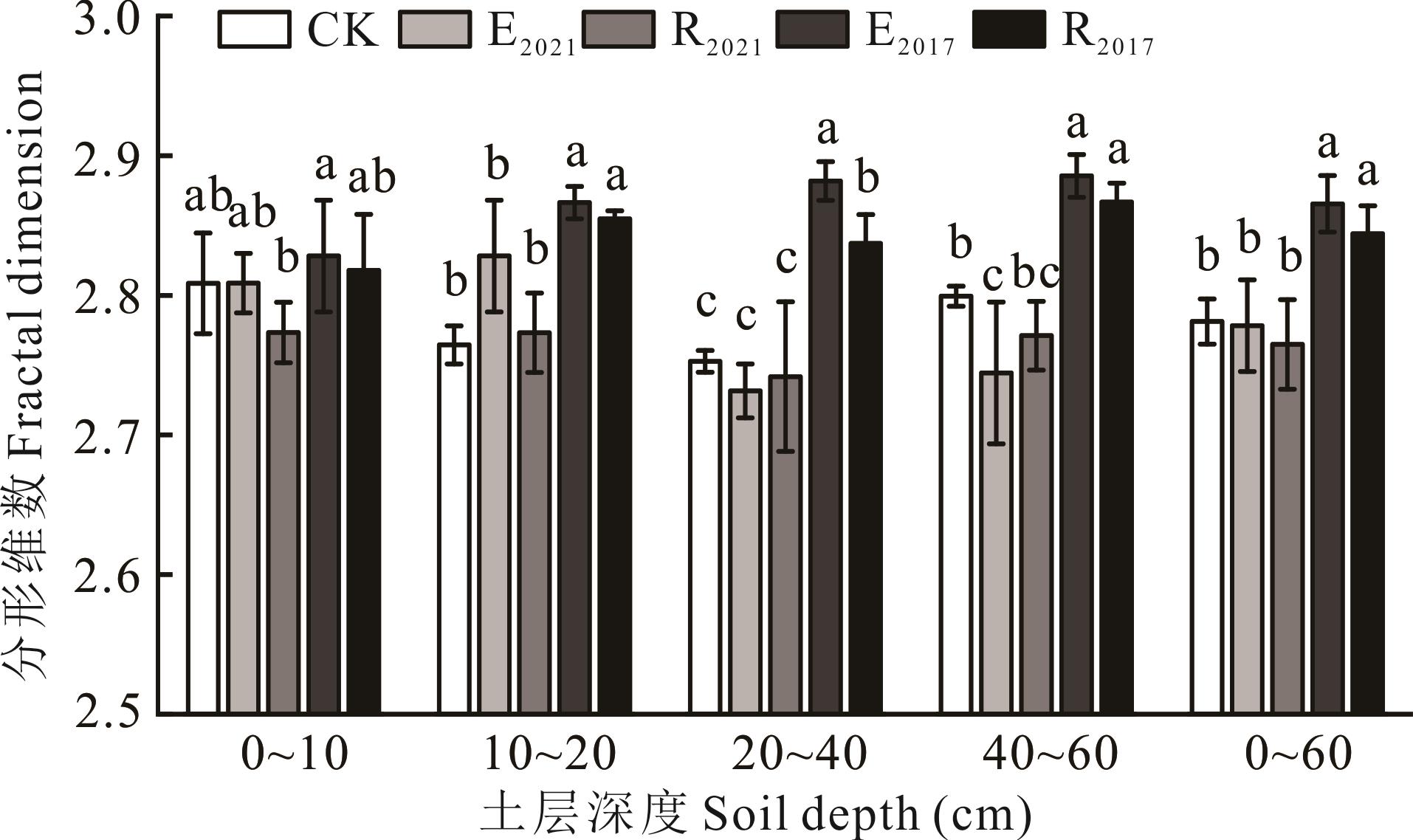
图3 不同处理下土壤颗粒分形维数特征
Fig.3 Fractal dimension characteristics of soil particles among different treatments

图4 土壤颗粒组成与分形维数间的关系分析
Fig.4 Correlation analysis between soil particle composition and fractal dimension
土壤颗粒 Soil particles | 土层深度 Soil depth (cm) | 地上生物量 Aboveground biomass | 凋落物量 Litter biomass | 地下生物量 Underground biomass | 土壤有机碳 Soil organic carbon |
|---|---|---|---|---|---|
中砂粒 Medium sand | 0~10 | -0.001 | 0.117 | -0.165 | -0.165 |
| 10~20 | -0.239 | -0.160 | -0.365 | -0.365 | |
| 20~40 | -0.446* | -0.469* | -0.446* | -0.446* | |
| 40~60 | 0.158 | 0.207 | 0.310 | 0.310 | |
细砂粒 Fine sand | 0~10 | -0.046 | -0.037 | -0.246 | -0.246 |
| 10~20 | -0.429 | -0.264 | -0.751** | -0.751** | |
| 20~40 | -0.589** | -0.350 | -0.725** | -0.725** | |
| 40~60 | -0.475* | -0.236 | -0.741** | -0.741** | |
极细砂粒 Very fine sand | 0~10 | 0.078 | 0.033 | 0.205 | 0.205 |
| 10~20 | 0.201 | 0.070 | 0.506* | 0.506* | |
| 20~40 | 0.553* | 0.268 | 0.660** | 0.660** | |
| 40~60 | 0.248 | -0.040 | 0.192 | 0.192 | |
粉黏粒 Silt+clay | 0~10 | -0.018 | -0.037 | 0.277 | 0.277 |
| 10~20 | 0.573** | 0.418 | 0.812** | 0.812** | |
| 20~40 | 0.554* | 0.454* | 0.669** | 0.669** | |
| 40~60 | 0.456* | 0.293 | 0.831** | 0.831** |
表2 不同土层土壤颗粒组成与植物生物量及土壤有机碳的相关分析
Table 2 Correlation analysis between soil particles composition and plant biomass and soil organic carbon in different soil depths
土壤颗粒 Soil particles | 土层深度 Soil depth (cm) | 地上生物量 Aboveground biomass | 凋落物量 Litter biomass | 地下生物量 Underground biomass | 土壤有机碳 Soil organic carbon |
|---|---|---|---|---|---|
中砂粒 Medium sand | 0~10 | -0.001 | 0.117 | -0.165 | -0.165 |
| 10~20 | -0.239 | -0.160 | -0.365 | -0.365 | |
| 20~40 | -0.446* | -0.469* | -0.446* | -0.446* | |
| 40~60 | 0.158 | 0.207 | 0.310 | 0.310 | |
细砂粒 Fine sand | 0~10 | -0.046 | -0.037 | -0.246 | -0.246 |
| 10~20 | -0.429 | -0.264 | -0.751** | -0.751** | |
| 20~40 | -0.589** | -0.350 | -0.725** | -0.725** | |
| 40~60 | -0.475* | -0.236 | -0.741** | -0.741** | |
极细砂粒 Very fine sand | 0~10 | 0.078 | 0.033 | 0.205 | 0.205 |
| 10~20 | 0.201 | 0.070 | 0.506* | 0.506* | |
| 20~40 | 0.553* | 0.268 | 0.660** | 0.660** | |
| 40~60 | 0.248 | -0.040 | 0.192 | 0.192 | |
粉黏粒 Silt+clay | 0~10 | -0.018 | -0.037 | 0.277 | 0.277 |
| 10~20 | 0.573** | 0.418 | 0.812** | 0.812** | |
| 20~40 | 0.554* | 0.454* | 0.669** | 0.669** | |
| 40~60 | 0.456* | 0.293 | 0.831** | 0.831** |
土层深度 Soil depth (cm) | 地上生物量 Aboveground biomass | 凋落物量 Litter biomass | 地下生物量 Underground biomass | 土壤有机碳 Soil organic carbon |
|---|---|---|---|---|
| 0~10 | -0.080 | -0.088 | 0.450* | 0.241 |
| 10~20 | 0.534* | 0.363 | 0.652** | 0.783** |
| 20~40 | 0.475* | 0.289 | 0.611** | 0.687** |
| 40~60 | 0.363 | 0.134 | 0.627** | 0.590** |
表3 不同土层土壤颗粒分形维数与植物生物量及土壤有机碳间的相关分析
Table 3 Correlation analysis between soil particles fractal dimension and plant biomass and soil organic carbon in different soil depths
土层深度 Soil depth (cm) | 地上生物量 Aboveground biomass | 凋落物量 Litter biomass | 地下生物量 Underground biomass | 土壤有机碳 Soil organic carbon |
|---|---|---|---|---|
| 0~10 | -0.080 | -0.088 | 0.450* | 0.241 |
| 10~20 | 0.534* | 0.363 | 0.652** | 0.783** |
| 20~40 | 0.475* | 0.289 | 0.611** | 0.687** |
| 40~60 | 0.363 | 0.134 | 0.627** | 0.590** |
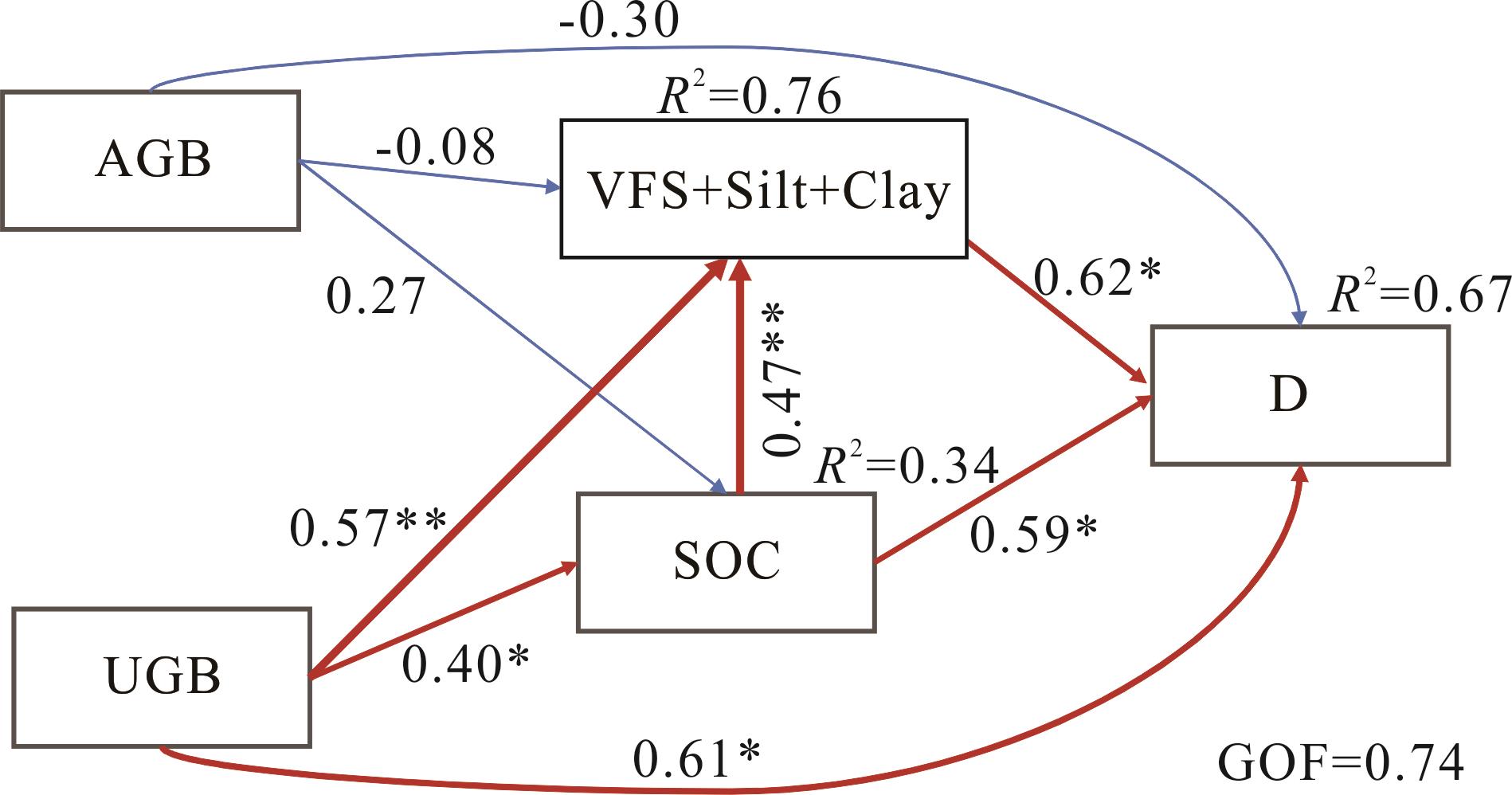
图5 地上生物量、地下生物量及土壤有机碳对土壤颗粒及分形维数影响的偏最小二乘路径模型红色线条表示正相关,绿色线条表示负相关。R2表示每个内生潜变量被模型解释的变异比例;GOF表示模型的整体拟合优度,>0.64表示拟合良好。Red lines indicate positive correlations, while green lines indicate negative correlations. R2 represents the proportion of variance in each endogenous latent variable explained by the model; GOF denotes the overall goodness of fit of the model, with a value greater than 0.64 suggesting a good fit. *: P<0.05; **: P<0.01. AGB: 地上生物量Aboveground biomass; UGB: 地下生物量Underground biomass; VFS: 极细砂粒Very fine sand; Silt: 粉粒; Clay: 黏粒; SOC: 土壤有机碳Soil organic carbon; D: 分形维数Fractal dimension.
Fig.5 The partial least squares path model showing effects of aboveground biomass, underground biomass and soil organic carbon on soil particle composition and fractal dimension
| [1] | Wang T, Chen L, Xie Y L, et al. Responses of rhizosphere bacteria to grazing in alpine meadow of Henan County, Qinghai Province. Acta Agrestia Sinica, 2025, 33(10): 3263-3271. |
| 王添, 陈兰, 谢永丽, 等. 青海省河南县高寒草甸根际土壤细菌对放牧的响应. 草地学报, 2025, 33(10): 3263-3271. | |
| [2] | Tian X. A report on E-C translation of current state and future impacts of climate change on biodiversity (Excerpts) from the perspective of translation skopos theory. Lanzhou: Lanzhou Jiaotong University, 2024. |
| 田雪. 目的论视角下《气候变化对生物多样性的影响: 现状与未来》(节选)英汉翻译实践报告. 兰州: 兰州交通大学, 2024. | |
| [3] | Zhang G R, Wang X Y, Lyu J L, et al. Impact and mechanisms of grazing exclusion on soil organic carbon dynamics in grasslands. Acta Ecologica Sinica, 2025, 45(16): 8243-8252. |
| 张光茹, 王星宇, 吕佳霖, 等. 围栏封育对草地土壤有机碳动态的影响机制研究进展. 生态学报, 2025, 45(16): 8243-8252. | |
| [4] | Nan W L, Xie Y Z, Peng W D, et al. Restoration effects of reseeding and enclosure on the vegetation of different degraded desert steppes. Pratacultural Science, 2024, 41(5): 1068-1077. |
| 南万璐, 谢应忠, 彭文栋, 等. 补播与围封对不同退化程度荒漠草地植被的恢复效果. 草业科学, 2024, 41(5): 1068-1077. | |
| [5] | Yu S, Tao L B, Xu D M, et al. Effects of enclosure on the soil organic carbon and its active components in desert steppe grassland. Acta Prataculturae Sinica, 2019, 28(2): 190-196. |
| 于双, 陶利波, 许冬梅, 等. 封育对荒漠草原土壤有机碳及其活性组分的影响. 草业学报, 2019, 28(2): 190-196. | |
| [6] | Yan B L, Wang Z W, Qu Z Q, et al. Effects of enclosure on carbon density of plant-soil system in typical steppe and desert steppe in Nei Mongol, China. Chinese Journal of Plant Ecology, 2018, 42(3): 327-336. |
| 闫宝龙, 王忠武, 屈志强, 等. 围封对内蒙古典型草原与荒漠草原植被-土壤系统碳密度的影响. 植物生态学报, 2018, 42(3): 327-336. | |
| [7] | Wang L Y, Zhou G N, Zhu X Y, et al. Effects of litter on soil organic carbon and microbial functional diversity. Acta Ecologica Sinica, 2021, 41(7): 2709-2718. |
| 王利彦, 周国娜, 朱新玉, 等. 凋落物对土壤有机碳与微生物功能多样性的影响. 生态学报, 2021, 41(7): 2709-2718. | |
| [8] | Zhang Y F, Wang X, Pan H Z, et al. Long-term enclosure restoration effect and their environmental dependencies in desert steppes of northern China. Acta Ecologica Sinica, 2025, 45(17): 8529-8543. |
| 张艺斐, 王兴, 潘海珠, 等. 中国北方荒漠草原长期围栏封育恢复效应及其环境依赖性. 生态学报, 2025, 45(17): 8529-8543. | |
| [9] | Bao P A, Wen Z L, Wang Y, et al. Effects of different forage reseeding patterns on plant community structure and soil characteristics in desert steppe. Acta Prataculturae Sinica, 2025, 34(10): 62-73. |
| 鲍平安, 文志林, 王炎, 等. 不同牧草补播模式对荒漠草原植物群落结构及土壤特性的影响. 草业学报, 2025, 34(10): 62-73. | |
| [10] | Zhang Y J, Zhou J Q, Yang G W, et al. Theory and application of no-tillage reseeding in degraded grasslands. Chinese Science Bulletin, 2020, 65(16): 1546-1555. |
| 张英俊, 周冀琼, 杨高文, 等. 退化草原植被免耕补播修复理论与实践. 科学通报, 2020, 65(16): 1546-1555. | |
| [11] | Wang X, Yu S, Xu D M, et al. Effects of different restoration measures on soil carbon and nitrogen and their component fractions in a degraded desert steppe. Acta Prataculturae Sinica, 2022, 31(1): 26-35. |
| 王星, 于双, 许冬梅, 等. 不同恢复措施对退化荒漠草原土壤碳氮及其组分特征的影响. 草业学报, 2022, 31(1): 26-35. | |
| [12] | Lynch J P. Root phenes for enhanced soil exploration and phosphorus acquisition: Tools for future crops. Plant Physiology, 2011, 156: 1041-1049. |
| [13] | Wang B, Lin X K, Feng Z R, et al. Effects of reseeded native forage species on soil water holding capacity and vegetation biomass in a desert steppe. Pratacultural Science, 2023, 40(9): 2247-2256. |
| 王博, 蔺雄奎, 冯占荣, 等. 补播乡土牧草对荒漠草地土壤持水性及植被生物量的影响. 草业科学, 2023, 40(9): 2247-2256. | |
| [14] | Dong Y W, Wang B, Lin X K, et al. Impacts of reseeding native grass and a legume on soil microbial community structure in the desert steppe of Ningxia. Pratacultural Science, 2024, 41(5): 1099-1111. |
| 董月唯, 王博, 蔺雄奎, 等. 补播乡土禾豆牧草对宁夏荒漠草地土壤微生物群落结构的影响. 草业科学, 2024, 41(5): 1099-1111. | |
| [15] | Guo Z N, Tan J G, Sun S X, et al. Study on fractal dimension and nutrient characteristics in different grazing intensity. Acta Agrestia Sinica, 2024, 32(12): 3698-3705. |
| 郭振宁, 镡建国, 孙世贤, 等. 不同放牧强度荒漠草原土壤粒径分形维数和养分特征研究. 草地学报, 2024, 32(12): 3698-3705. | |
| [16] | Zhang H D, Zhou S L, Li Q, et al. Soil particle composition and pore characteristics in the root zone of date palm in the dry zone under different irrigation methods. Transactions of the Chinese Society of Agricultural Engineering, 2024, 40(24): 98-105. |
| 张华东, 周少梁, 李侨, 等. 不同灌溉方式下旱区枣树根区土壤颗粒组成和孔隙特征. 农业工程学报, 2024, 40(24): 98-105. | |
| [17] | Zhao M Y, Zhao W W, Liu Y X. Comparative analysis of soil particle size distribution and its influence factors in different scales: a case study in the Loess Hilly-gully area. Acta Ecologica Sinica, 2015, 35(14): 4625-4632. |
| 赵明月, 赵文武, 刘源鑫. 不同尺度下土壤粒径分布特征及其影响因子-以黄土丘陵沟壑区为例. 生态学报, 2015, 35(14): 4625-4632. | |
| [18] | Ma X C, Jin W H, Tu J Y, et al. Impact of shifts among mycorrhizal types on soil aggregate composition and characteristics. Journal of Zhejiang A&F University, 2023, 40(6): 1149-1157. |
| 马行聪, 金文豪, 屠嘉莹, 等. 不同优势菌根类型转变对土壤团聚体组成及性状的影响. 浙江农林大学学报, 2023, 40(6): 1149-1157. | |
| [19] | Jiang H X, Zhou Y, Hu K, et al. Effects of different grazing times on soil particle composition and fractal dimension in the desert steppe. Acta Prataculturae Sinica, 2024, 33(6): 17-28. |
| 姜海鑫, 周瑶, 胡科, 等. 不同放牧时间对荒漠草原土壤颗粒组成及分形维数的影响. 草业学报, 2024, 33(6): 17-28. | |
| [20] | Shi J C, Jie D M, Liu L D, et al. The preliminary research on the fractal characteristics of Phragmites communis phytolith in northeast China. Quaternary Sciences, 2017, 37(6): 1444-1455. |
| 史吉晨, 介冬梅, 刘利丹, 等. 东北地区芦苇植硅体分形特征初步研究. 第四纪研究, 2017, 37(6): 1444-1455. | |
| [21] | Yoshihara Y, Tatsuno Y, Miyasaka K, et al. Can complementarity in water use help explain diversity-productivity relationships in semi-arid grasslands? Journal of Arid Environments, 2020, 173: 103994. |
| [22] | Bao S D. Soil agricultural chemistry analysis. Beijing: China Agriculture Press, 2013. |
| 鲍士旦. 土壤农化分析. 北京: 中国农业出版社, 2013. | |
| [23] | Yang P L, Luo Y P, Shi Y C. Soil fractal characteristics characterized by the weight distribution of particle size. Chinese Science Bulletin, 1993, 38(20): 1896-1899. |
| 杨培岭, 罗远培, 石元春. 用粒径的重量分布表征的土壤分形特征. 科学通报, 1993, 38(20): 1896-1899. | |
| [24] | Huang F, Liu J, Wang B, et al. The impacts of shrub branch covering on soil respiration in a desert steppe of Ningxia. Acta Ecologica Sinica, 2025, 45(7): 3218-3228. |
| 黄飞, 刘静, 王博, 等. 灌枝覆盖对宁夏荒漠草地土壤呼吸的影响. 生态学报, 2025, 45(7): 3218-3228. | |
| [25] | Wang B, Liu J, Li Z G, et al. The contributions of root morphological characteristics and soil property to soil infiltration in a reseeded desert steppe. Catena, 2023, 225: 107020. |
| [26] | Cai A D, Zhang W J, Shen X R, et al. Carbon sequestration efficiency of different soil particle sizes under long-term fertilization. Journal of Plant Nutrition and Fertilizers, 2015, 21(6): 1431-1438. |
| 蔡岸冬, 张文菊, 申小冉, 等. 长期施肥土壤不同粒径颗粒的固碳效率. 植物营养与肥料学报, 2015, 21(6): 1431-1438. | |
| [27] | Xu X. The interaction network of “Rhizosphere-bulk-rooting zone” soil microbiota-Taking Rhododendron lapponicum in Qilian Mountains as an example. Lanzhou: Northwest Normal University, 2024. |
| 徐笑. “根际-非根际-根围”土壤微型生物互作网络——以祁连山高山杜鹃为例. 兰州: 西北师范大学, 2024. | |
| [28] | Lin X K, Schneider R L, Morreale S J, et al. The impacts of shrub branch shelter and nitrogen addition on soil microbial activity and plant litter decomposition in a desert steppe. Applied Soil Ecology, 2025, 207: 105956. |
| [1] | 胡世璐, 冯锦彦, 罗浩, 饶宁, 崔盛超, 黎明杰, 查天山, 冯薇. 围栏封育下宁夏盐池荒漠草地生态系统植物群落变化特征及驱动因子[J]. 草业学报, 2026, 35(7): 32-45. |
| [2] | 马江萍, 曹立娟, 张文文, 赵梦雨, 王腾飞, 张译尹, 王斌, 李佳旺, 王小兵, 兰剑. 补播与施磷对退化苜蓿草地生产力及土壤理化性质的影响[J]. 草业学报, 2026, 35(7): 92-104. |
| [3] | 凡文帅, 王兴, 张祎, 张艺斐, 宋乃平, 杨新国, 李莹莹. 中国北方荒漠草原区灌木植被恢复效应及其对环境的依赖性[J]. 草业学报, 2026, 35(5): 36-47. |
| [4] | 杨雪琴, 李建平, 陈婧, 连佳丽, 韩翠, 罗叙, 赵莹. 降水变化对荒漠草原生态系统碳氮储量及固持速率的影响[J]. 草业学报, 2026, 35(5): 48-60. |
| [5] | 连佳丽, 陈婧, 杨雪琴, 赵莹, 罗叙, 韩翠, 李建平. 降水变化对荒漠草原土壤有机碳分布与有机碳库稳定性的影响[J]. 草业学报, 2026, 35(5): 85-98. |
| [6] | 李豫悦, 魏浩男, 马兴忠, 姜海鑫, 聂明鹤, 周瑶, 代成江, 田小武, 王国会, 马红彬. 轮牧对荒漠草原土壤种子库特征的影响[J]. 草业学报, 2026, 35(4): 1-13. |
| [7] | 刘冬娅, 杨燕, 刘静, 王博, 李志刚. 短期羊粪归还对荒漠草地土壤质量的影响[J]. 草业学报, 2026, 35(2): 28-39. |
| [8] | 邓文辉, 宋珂辰, 张浩, 管思雨, 雍嘉仪, 谢铁娜, 胡海英. 降水变化对荒漠草原植物群落主要物种气孔形态和光合生理特性的影响[J]. 草业学报, 2026, 35(1): 65-78. |
| [9] | 邓文辉, 宋珂辰, 张浩, 管思雨, 雍嘉仪, 胡海英. 降水变化条件下荒漠草原优势植物根际微生物群落结构和多样性特征研究[J]. 草业学报, 2025, 34(5): 12-26. |
| [10] | 郭楠, 杜鹉辰, 纪守坤, 刘建, 崔素倩, 袁辉, 韩旭, 刘计双, 高立杰. 施肥和补播对山地草甸牧草营养及瘤胃发酵的影响[J]. 草业学报, 2025, 34(4): 150-163. |
| [11] | 骆欣怡, 邱开阳, 金涛, 鲍平安, 黄业芸, 何毅, 谢应忠. 碳、氮、钾添加对荒漠草原凋落物分解特征的影响[J]. 草业学报, 2025, 34(2): 41-53. |
| [12] | 贺聪, 马永才, 字洪标. 不同围封年限对高寒草地植物群落的影响[J]. 草业学报, 2025, 34(11): 17-30. |
| [13] | 马蓉, 李俊瑶, 岳平, 马旭君, 白珍, 庄玲, 白敬, 赵学勇, 王少昆. 降水变化下荒漠草原优势植物功能性状对生物量分配的调节机制[J]. 草业学报, 2025, 34(11): 31-39. |
| [14] | 鲍平安, 文志林, 王炎, 陈彦虎, 季波, 王占军, 吴旭东, 蒋齐. 不同牧草补播模式对荒漠草原植物群落结构及土壤特性的影响[J]. 草业学报, 2025, 34(10): 62-73. |
| [15] | 张振豪, 贾子玉, 李鑫宇, 程云湘. 荒漠草原混牧牛羊的放牧行为特征[J]. 草业学报, 2025, 34(1): 226-237. |
| 阅读次数 | ||||||
|
全文 |
|
|||||
|
摘要 |
|
|||||
