
ISSN 1004-5759 CN 62-1105/S
草业学报 ›› 2026, Vol. 35 ›› Issue (11): 106-118.DOI: 10.11686/cyxb2025488
• 研究论文 • 上一篇
屈亚飞1,2,3( ), 王腾飞1,2,3, 张译尹1,2,3, 孙建伟4, 尤越5, 石斌红6, 李喜斌7, 王斌1,2,3, 梁丹妮1,2,3(), 兰剑1,2,3()
收稿日期:2025-12-02
修回日期:2026-01-22
出版日期:2026-11-20
发布日期:2026-10-12
通讯作者:
梁丹妮,兰剑
作者简介:liangdn@nxu.edu.cn基金资助:
Ya-fei QU1,2,3(), Teng-fei WANG1,2,3, Yi-yin ZHANG1,2,3, Jian-wei SUN4, Yue YOU5, Bin-hong SHI6, Xi-bin LI7, Bin WANG1,2,3, Dan-ni LIANG1,2,3(), Jian LAN1,2,3()
Received:2025-12-02
Revised:2026-01-22
Online:2026-11-20
Published:2026-10-12
Contact:
Dan-ni LIANG,Jian LAN
摘要:
针对西北灌区饲草产量偏低、光能等资源利用效率不高等问题,以青贮玉米与饲用高粱为对象,系统探讨了不同行比配置对其间作系统种间竞争关系与光能利用效率的影响,旨在筛选适宜宁夏引黄灌区的高效间作模式,为饲草产能提升与农田可持续生产提供理论支撑。于2022-2023年在宁夏引黄灌区开展田间试验,设置青贮玉米单作(SM)、饲用高粱单作(SS)及5种行比间作处理(10M2S、8M4S、6M6S、4M8S、2M10S),系统测定干草产量、粗蛋白产量、土地当量比(LER)、种间竞争指标及光能利用情况。结果表明,行比配置显著影响系统生产力与种间关系,其中,6M6S处理表现最优,干草产量达25.00 t·hm-2,较SM和SS分别提高39.0%和29.6%,粗蛋白产量提升效果显著;LER为1.38,土地利用率提高38%。种间竞争分析表明,6M6S有效缓解青贮玉米竞争压力(AM=0.10),相对拥挤系数(KM)达3.25,种间促进效应显著。光能利用方面,6M6S在中下层叶面积指数(LAI)、消光系数及辐射利用效率(RUE)均最高,RUE达3.02 g·MJ-1,较SM提高29.1%。其他处理如10M2S与2M10S因行比失衡导致竞争加剧、冠层光分布不均;4M8S与8M4S则因冠层结构协调性不足,辐射利用效率较低。本研究明确了6M6S为青贮玉米-饲用高粱间作的最优行比配置,其在协调种间关系、优化冠层结构与提升光能利用效率方面具有显著优势,为实现西北灌区饲草高产高效与农业可持续发展提供了重要的理论依据与技术路径。
屈亚飞, 王腾飞, 张译尹, 孙建伟, 尤越, 石斌红, 李喜斌, 王斌, 梁丹妮, 兰剑. 行比配置对宁夏引黄灌区青贮玉米/饲用高粱间作系统种间关系和光能利用效率的影响[J]. 草业学报, 2026, 35(11): 106-118.
Ya-fei QU, Teng-fei WANG, Yi-yin ZHANG, Jian-wei SUN, Yue YOU, Bin-hong SHI, Xi-bin LI, Bin WANG, Dan-ni LIANG, Jian LAN. Effects of row ratio configuration on interspecific competition and light use efficiency of silage maize/forage sorghum intercropping systems in the Ningxia Yellow River irrigation area[J]. Acta Prataculturae Sinica, 2026, 35(11): 106-118.
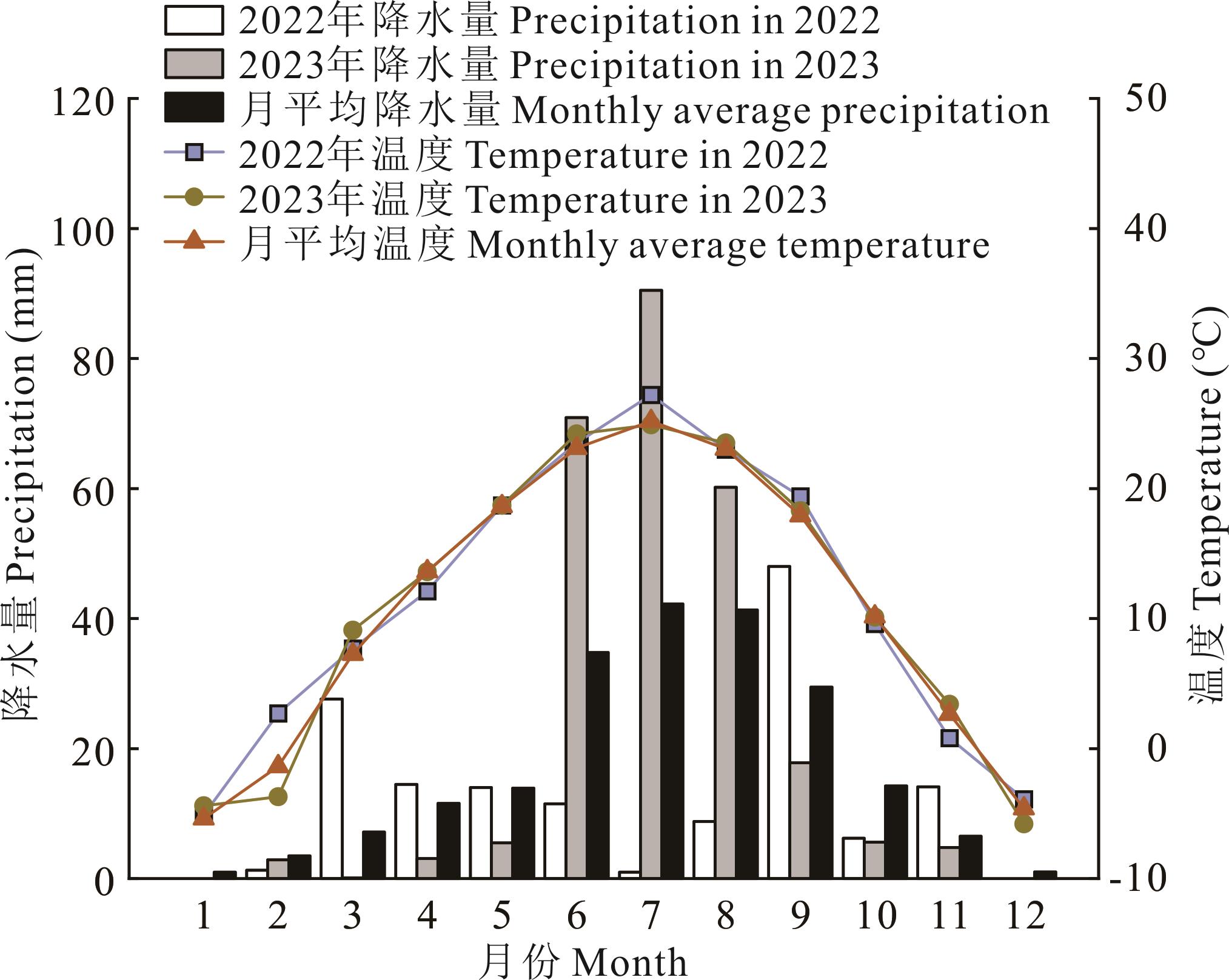
图1 试验地点气象数据
Fig.1 The meteorological data of experimental site
材料名称 Material name | 品种 Variety | 纯净度 Purity (%) | 发芽率Germination rate (%) | 千粒重Thousand seeds weight (g) | 来源 Source |
|---|---|---|---|---|---|
| 饲用高粱S. bicolor | 绿巨人 Green Giant | 99 | 98 | 29.74 | 北京百斯特草业有限公司Beijing Best Grass Industry Co., LTD |
| 青贮玉米Z. mays | 先玉1321 Xianyu 1321 | 98 | 97 | 373.00 | 宁夏农垦茂盛草业有限公司Ningxia Agricultural Reclamation Maosheng Grass Industry Co., LTD |
表1 试验材料详细信息
Table 1 Detailed information of test materials
材料名称 Material name | 品种 Variety | 纯净度 Purity (%) | 发芽率Germination rate (%) | 千粒重Thousand seeds weight (g) | 来源 Source |
|---|---|---|---|---|---|
| 饲用高粱S. bicolor | 绿巨人 Green Giant | 99 | 98 | 29.74 | 北京百斯特草业有限公司Beijing Best Grass Industry Co., LTD |
| 青贮玉米Z. mays | 先玉1321 Xianyu 1321 | 98 | 97 | 373.00 | 宁夏农垦茂盛草业有限公司Ningxia Agricultural Reclamation Maosheng Grass Industry Co., LTD |

图2 青贮玉米和饲用高粱间作田间种植模式
Fig.2 Field planting pattern of silage maize and forage sorghum intercropping
年份 Year (Y) | 处理 Treatment (T) | 株高Plant height (cm) | 干草产量 Hay yield (t·hm-2) | 粗蛋白产量 Crude protein yield (kg·hm-2) | |
|---|---|---|---|---|---|
| 青贮玉米Silage maize | 饲用高粱Forage sorghum | ||||
| 2022 | 10M2S | 337.00±6.11a | 300.78±8.44c | 22.03±0.42bc | 1.65±0.01ab |
| 8M4S | 329.33±10.88a | 358.22±4.96a | 24.22±0.88ab | 1.75±0.13a | |
| 6M6S | 327.00±9.07a | 360.33±7.60a | 24.55±1.24a | 1.75±0.07a | |
| 4M8S | 326.78±9.03a | 335.00±5.13b | 21.06±0.96c | 1.47±0.02bc | |
| 2M10S | 333.67±8.45a | 356.56±7.96a | 20.01±0.57cd | 1.42±0.04c | |
| MS | 331.00±8.08a | - | 17.61±0.52d | 1.15±0.02d | |
| SS | - | 347.56±11.63ab | 18.59±0.32d | 1.46±0.04bc | |
| 2023 | 10M2S | 337.90±4.44a | 301.38±10.92c | 22.75±0.33bc | 1.70±0.05a |
| 8M4S | 328.60±6.46a | 357.19±4.06a | 23.53±1.30ab | 1.75±0.13a | |
| 6M6S | 328.03±10.11a | 361.07±8.13a | 25.45±0.62a | 1.78±0.06a | |
| 4M8S | 327.68±9.44a | 335.60±8.77b | 21.13±0.88cd | 1.47±0.02b | |
| 2M10S | 325.57±8.33a | 354.16±6.63a | 19.87±0.55de | 1.41±0.04b | |
| MS | 329.47±7.14a | - | 17.61±0.52e | 1.15±0.02c | |
| SS | - | 345.72±11.51ab | 18.77±0.31e | 1.47±0.06b | |
| 年份Year (Y) | 0.004ns | 0.027ns | 0.136ns | 0.178ns | |
| 处理Treatment (T) | 1.917ns | 29.810*** | 26.394*** | 25.050*** | |
| Y×T | 0.020ns | 0.028ns | 0.256ns | 0.068ns | |
表2 不同间作模式株高与产量的比较
Table 2 Comparison of plant height and yield in different intercropping patterns
年份 Year (Y) | 处理 Treatment (T) | 株高Plant height (cm) | 干草产量 Hay yield (t·hm-2) | 粗蛋白产量 Crude protein yield (kg·hm-2) | |
|---|---|---|---|---|---|
| 青贮玉米Silage maize | 饲用高粱Forage sorghum | ||||
| 2022 | 10M2S | 337.00±6.11a | 300.78±8.44c | 22.03±0.42bc | 1.65±0.01ab |
| 8M4S | 329.33±10.88a | 358.22±4.96a | 24.22±0.88ab | 1.75±0.13a | |
| 6M6S | 327.00±9.07a | 360.33±7.60a | 24.55±1.24a | 1.75±0.07a | |
| 4M8S | 326.78±9.03a | 335.00±5.13b | 21.06±0.96c | 1.47±0.02bc | |
| 2M10S | 333.67±8.45a | 356.56±7.96a | 20.01±0.57cd | 1.42±0.04c | |
| MS | 331.00±8.08a | - | 17.61±0.52d | 1.15±0.02d | |
| SS | - | 347.56±11.63ab | 18.59±0.32d | 1.46±0.04bc | |
| 2023 | 10M2S | 337.90±4.44a | 301.38±10.92c | 22.75±0.33bc | 1.70±0.05a |
| 8M4S | 328.60±6.46a | 357.19±4.06a | 23.53±1.30ab | 1.75±0.13a | |
| 6M6S | 328.03±10.11a | 361.07±8.13a | 25.45±0.62a | 1.78±0.06a | |
| 4M8S | 327.68±9.44a | 335.60±8.77b | 21.13±0.88cd | 1.47±0.02b | |
| 2M10S | 325.57±8.33a | 354.16±6.63a | 19.87±0.55de | 1.41±0.04b | |
| MS | 329.47±7.14a | - | 17.61±0.52e | 1.15±0.02c | |
| SS | - | 345.72±11.51ab | 18.77±0.31e | 1.47±0.06b | |
| 年份Year (Y) | 0.004ns | 0.027ns | 0.136ns | 0.178ns | |
| 处理Treatment (T) | 1.917ns | 29.810*** | 26.394*** | 25.050*** | |
| Y×T | 0.020ns | 0.028ns | 0.256ns | 0.068ns | |
年份 Year (Y) | 处理 Treatment (T) | 青贮玉米偏土地当量比 PLERM | 饲用高粱偏土地当量比 PLERS | 土地当量比 Land equivalent ratio |
|---|---|---|---|---|
| 2022 | 10M2S | 1.11±0.02a | 0.13±0.03e | 1.25±0.05ab |
| 8M4S | 0.95±0.04b | 0.41±0.02d | 1.35±0.03a | |
| 6M6S | 0.70±0.08c | 0.66±0.02c | 1.36±0.09a | |
| 4M8S | 0.38±0.01d | 0.77±0.06b | 1.15±0.07b | |
| 2M10S | 0.21±0.02e | 0.88±0.01a | 1.09±0.03b | |
| MS | - | - | - | |
| SS | - | - | - | |
| 2023 | 10M2S | 1.15±0.06a | 0.13±0.02e | 1.29±0.05ab |
| 8M4S | 0.95±0.04b | 0.36±0.02d | 1.31±0.06ab | |
| 6M6S | 0.73±0.07c | 0.67±0.01c | 1.40±0.06a | |
| 4M8S | 0.38±0.01d | 0.77±0.04b | 1.15±0.05bc | |
| 2M10S | 0.21±0.02e | 0.86±0.01a | 1.07±0.02c | |
| MS | - | - | - | |
| SS | - | - | - | |
| 年份Year (Y) | 0.244ns | 0.384ns | 0.015ns | |
| 处理Treatment (T) | 141.136*** | 279.238*** | 10.755*** | |
| Y×T | 0.094ns | 0.317ns | 0.232ns | |
表3 不同间作模式土地当量比的比较
Table 3 Comparison of land equivalent ratio in different intercropping patterns
年份 Year (Y) | 处理 Treatment (T) | 青贮玉米偏土地当量比 PLERM | 饲用高粱偏土地当量比 PLERS | 土地当量比 Land equivalent ratio |
|---|---|---|---|---|
| 2022 | 10M2S | 1.11±0.02a | 0.13±0.03e | 1.25±0.05ab |
| 8M4S | 0.95±0.04b | 0.41±0.02d | 1.35±0.03a | |
| 6M6S | 0.70±0.08c | 0.66±0.02c | 1.36±0.09a | |
| 4M8S | 0.38±0.01d | 0.77±0.06b | 1.15±0.07b | |
| 2M10S | 0.21±0.02e | 0.88±0.01a | 1.09±0.03b | |
| MS | - | - | - | |
| SS | - | - | - | |
| 2023 | 10M2S | 1.15±0.06a | 0.13±0.02e | 1.29±0.05ab |
| 8M4S | 0.95±0.04b | 0.36±0.02d | 1.31±0.06ab | |
| 6M6S | 0.73±0.07c | 0.67±0.01c | 1.40±0.06a | |
| 4M8S | 0.38±0.01d | 0.77±0.04b | 1.15±0.05bc | |
| 2M10S | 0.21±0.02e | 0.86±0.01a | 1.07±0.02c | |
| MS | - | - | - | |
| SS | - | - | - | |
| 年份Year (Y) | 0.244ns | 0.384ns | 0.015ns | |
| 处理Treatment (T) | 141.136*** | 279.238*** | 10.755*** | |
| Y×T | 0.094ns | 0.317ns | 0.232ns | |
| 因素Factor | 青贮玉米竞争力Aggressivity of silage maize (AM) | 饲用高粱竞争力Aggressivity of forage sorghum (AS) | 青贮玉米相对拥挤系数Relative crowding coefficient of silage maize (KM) | 饲用高粱相对拥挤系数Relative crowding coefficient of forage sorghum (KS) | 青贮玉米竞争比率Competition ratio of silage maize (CRM) | 饲用高粱竞争比率Competition ratio of forage sorghum (CRS) | 系统生产力System productivity (SP) | 叶面积指数Leaf area index (LAI) | 消光系数Extinction coefficient (k) | 截获光合有效辐射Intercepted photosynthetically active radiation (IPAR) | 辐射利用效率Radiation use efficiency (RUE) |
|---|---|---|---|---|---|---|---|---|---|---|---|
| 年份Year | ns | ns | ns | ns | ns | ns | ns | ns | ns | ns | ns |
| 处理Treatment | *** | *** | ** | ** | *** | *** | *** | *** | ** | *** | *** |
| 年份×处理Year×treatment | ns | ns | ns | ns | ns | ns | ns | ns | ns | ns | ns |
表4 不同间作模式下种间竞争、群体光合有效辐射及光能利用效率的方差分析
Table 4 Variance analysis of different intercropping patterns in interspecific competition, population photosynthetically active radiation and light utilization efficiency
| 因素Factor | 青贮玉米竞争力Aggressivity of silage maize (AM) | 饲用高粱竞争力Aggressivity of forage sorghum (AS) | 青贮玉米相对拥挤系数Relative crowding coefficient of silage maize (KM) | 饲用高粱相对拥挤系数Relative crowding coefficient of forage sorghum (KS) | 青贮玉米竞争比率Competition ratio of silage maize (CRM) | 饲用高粱竞争比率Competition ratio of forage sorghum (CRS) | 系统生产力System productivity (SP) | 叶面积指数Leaf area index (LAI) | 消光系数Extinction coefficient (k) | 截获光合有效辐射Intercepted photosynthetically active radiation (IPAR) | 辐射利用效率Radiation use efficiency (RUE) |
|---|---|---|---|---|---|---|---|---|---|---|---|
| 年份Year | ns | ns | ns | ns | ns | ns | ns | ns | ns | ns | ns |
| 处理Treatment | *** | *** | ** | ** | *** | *** | *** | *** | ** | *** | *** |
| 年份×处理Year×treatment | ns | ns | ns | ns | ns | ns | ns | ns | ns | ns | ns |
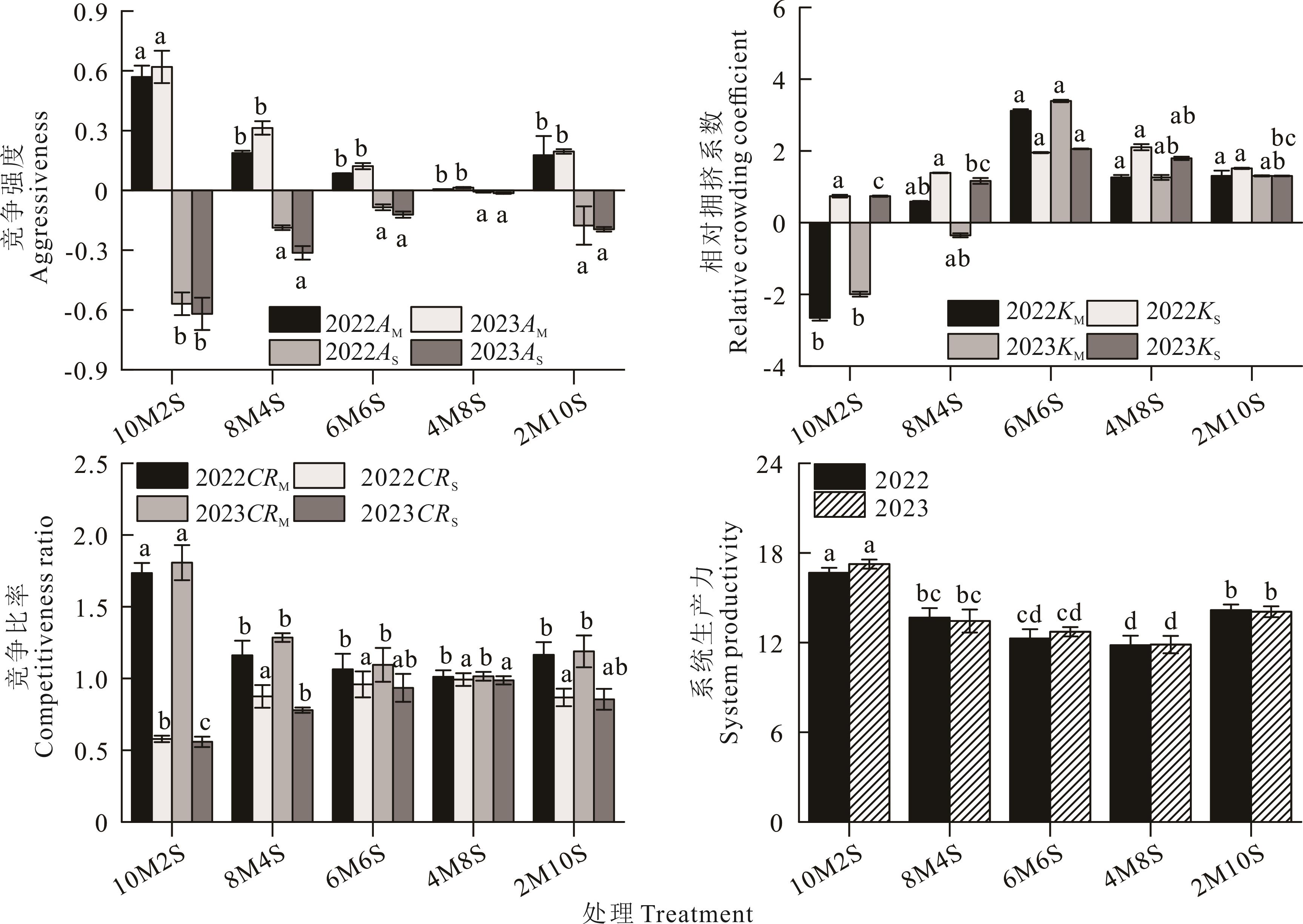
图3 不同间作模式种间竞争比较AM为青贮玉米竞争力,AS为饲用高粱竞争力,KM为青贮玉米相对拥挤系数,KS为饲用高粱相对拥挤系数;CRM为青贮玉米竞争比率;CRS为饲用高粱竞争比率;M代表青贮玉米,S代表饲用高粱,10M2S、8M4S、6M6S、4M8S、2M10S为不同行比间作处理;不同小写字母表示处理间在P<0.05水平差异显著,下同。AM: Aggressivity of silage maize; AS: Aggressivity of forage sorghum; KM: Relative crowding coefficient of silage maize; KS: Relative crowding coefficient of forage sorghum; CRM: Competition ratio of silage maize; CRS: Competition ratio of forage sorghum;M: Silage maize; S: Forage sorghum. Treatments 10M2S, 8M4S, 6M6S, 4M8S, and 2M10S represent different row-ratio intercropping patterns. Different lowercase letters indicate significant differences among treatments at P<0.05. The same below.
Fig.3 Comparison of interspecific competition among different intercropping patterns

图4 不同间作模式下叶面积指数和消光系数比较
Fig.4 Comparison of leaf area index and extinction coefficient under different intercropping patterns

图5 不同间作模式下辐射截获量和辐射利用效率比较
Fig.5 Comparison of intercepted photosynthetic radiation and radiation use efficiency under different intercropping patterns
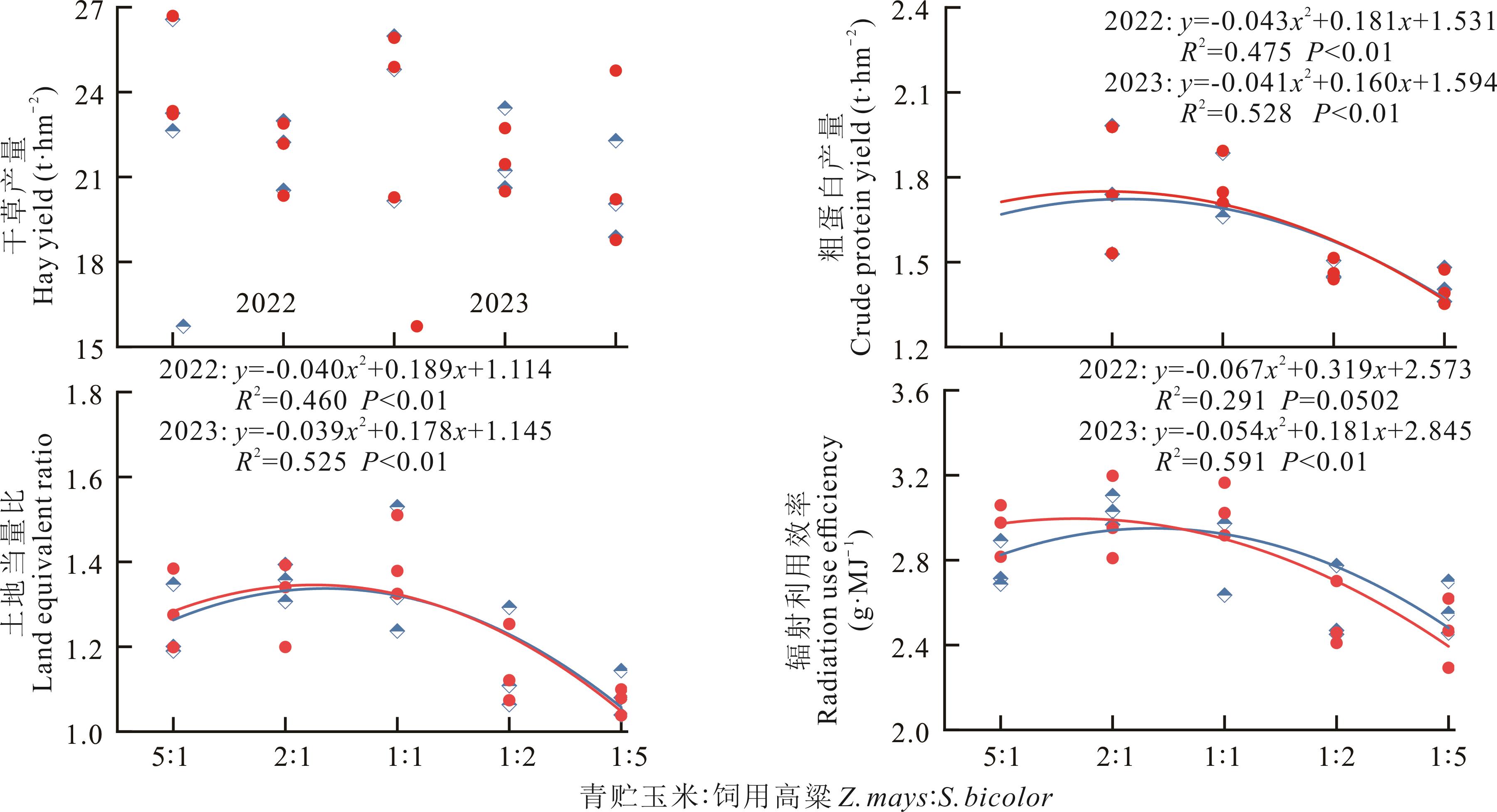
图6 青贮玉米-饲用高粱不同行比与生产力、土地当量比和辐射利用效率的拟合
Fig.6 Fitting of different row ratios of silage maize-forage sorghum with productivity, land equivalent ratio and radiation use efficiency
| [1] | Li X Y, Yin X F, Zhou X L, et al. Countermeasures and suggestions for high quality development of forage industry in China. Acta Agrestia Sinica, 2020, 28(4): 889-894. |
| 李新一, 尹晓飞, 周晓丽, 等. 我国饲草产业高质量发展的对策和建议. 草地学报, 2020, 28(4): 889-894. | |
| [2] | Wang T F, Ma X, Liu J L, et al. Analysis of the yield, quality and economic benefits from multiple cropping of fodder oats in the Yellow River irrigation area. Acta Prataculturae Sinica, 2025, 34(4): 27-37. |
| 王腾飞, 马霞, 刘金龙, 等. 引黄灌区复种饲用燕麦种植模式产量、品质及经济效益分析. 草业学报, 2025, 34(4): 27-37. | |
| [3] | Wang J T, Sa D W, Shao L H, et al. Optimizing agricultural structure and accelerating the development of the forage industry. Acta Prataculturae Sinica, 2025, 34(2): 211-220. |
| 王加亭, 撒多文, 邵麟惠, 等. 调整优化农业结构, 加快饲草产业发展. 草业学报, 2025, 34(2): 211-220. | |
| [4] | Ge Y Q, Wang J, Liu R, et al. A dataset of shallow soil moisture for alfalfa in the Ningxia irrigation area of the Yellow River. Frontiers in Plant Science, 2024, 15: 1472930. |
| [5] | Wang B, Shi J M, Wang T F, et al. Effect of nitrogen application on production performance and nitrogen fertilizer contribution of forage sorghum/lablab mixed cropping. Acta Prataculturae Sinica, 2025, 34(4): 53-63. |
| 王斌, 史佳梅, 王腾飞, 等. 施氮对饲用高粱/拉巴豆混播草地生产性能和氮肥贡献率的影响. 草业学报, 2025, 34(4): 53-63. | |
| [6] | Feng Q, He X L, Wang B, et al. A study of mixed sowing effects for oat and common vetch in the Ningxia Yellow River irrigation area. Acta Prataculturae Sinica, 2024, 33(3): 107-119. |
| 冯琴, 何小莉, 王斌, 等. 宁夏引黄灌区燕麦与箭筈豌豆的混播效果研究. 草业学报, 2024, 33(3): 107-119. | |
| [7] | Yan Z L, Ren Q, Fan Z L, et al. Postponed nitrogen application optimizes interspecific interactions and enhances nitrogen use efficiency in wheat-maize intercropping systems in an oasis irrigation region. Acta Agronomica Sinica, 2025, 51(8): 2190-2203. |
| 闫喆林, 任强, 樊志龙, 等. 氮肥后移优化绿洲灌区小麦间作玉米种间关系提高氮素利用效率. 作物学报, 2025, 51(8): 2190-2203. | |
| [8] | Dzvene A R, Tesfuhuney W A, Walker S, et al. Optimizing the planting time and stand density of sunn hemp intercropping for biomass productivity and competitiveness in a maize-based system. Field Crops Research, 2023, 304: 109179. |
| [9] | Wang B, Deng J Q, Wang T F, et al. Optimizing nitrogen application rates to maximize productivity while reducing environmental risk by regulating nitrogen and water utilization in mixed cropping systems. Agricultural Water Management, 2024, 303: 109053. |
| [10] | Gong X W, Dang K, Lv S M, et al. Interspecific competition and nitrogen application alter soil ecoenzymatic stoichiometry, microbial nutrient status, and improve grain yield in broomcorn millet/mung bean intercropping systems. Field Crops Research, 2021, 270: 108227. |
| [11] | Wang W, Li M Y, Zhang W, et al. Soil moisture drives the shift from selection to complementarity effect in the rainfed maize/faba bean intercropping system. Plant and Soil, 2024, 499: 313-328. |
| [12] | Gong X W, Dang K, Li J, et al. Effects of different intercropping patterns on photosynthesis production characteristics and water use efficiency of proso millet. Scientia Agricultura Sinica, 2019, 52(22): 4139-4153. |
| 宫香伟, 党科, 李境, 等. 糜子绿豆间作模式下糜子光合物质生产及水分利用效率. 中国农业科学, 2019, 52(22): 4139-4153. | |
| [13] | Wang Z K. Light and water transmission and utilization in wheat/maize strip intercropping system. Yangling: Northwest A&F University, 2015. |
| 王自奎. 小麦/玉米间作复合群体光能和水分传输利用试验与模拟研究. 杨凌: 西北农林科技大学, 2015. | |
| [14] | Gou F, Van Ittersum M K, Simon E, et al. Intercropping wheat and maize increases total radiation interception and wheat RUE but lowers maize RUE. European Journal of Agronomy, 2017, 84: 125-139. |
| [15] | Li H L, Chai Q, Fan Z L, et al. Effects of reduced tillage and combined application of organic fertilizer on soil physical and chemical properties and crop yield of silage maize and lablab mixed cropping system in Hexi oasis irrigation area. Acta Agronomica Sinica, 2025, 51(11): 3013-3025. |
| 李海龙, 柴强, 樊志龙, 等. 少耕及有机肥配施对河西绿洲灌区青贮玉米×拉巴豆系统土壤理化特性及作物产量的影响. 作物学报, 2025, 51(11): 3013-3025. | |
| [16] | Li R N, Li X, Liu X, et al. Analysis of yield and quality traits of silage maize in multi-environment trials. Journal of Maize Sciences, 2025, 33(6): 73-79. |
| 李若楠, 李响, 刘霄, 等. 多环境试验下的青贮玉米产量及品质分析. 玉米科学, 2025, 33(6): 73-79. | |
| [17] | Wang T F, Wang B, Zhang Y Y, et al. Response of productivity of silage maize-forage sorghum intercropping system to row ratio configuration. Chinese Journal of Eco-Agriculture, 2025, 33(8): 1529-1540. |
| 王腾飞, 王斌, 张译尹, 等. 青贮玉米-饲用高粱间作系统生产力对行比配置的响应. 中国生态农业学报, 2025, 33(8): 1529-1540. | |
| [18] | Samarappuli D, Berti M T. Intercropping forage sorghum with maize is a promising alternative to maize silage for biogas production. Journal of Cleaner Production, 2018, 194: 515-524. |
| [19] | Wang J G. Science of forage and feed crop cultivation (The Second Edition). Beijing: China Agriculture Press, 2018. |
| 王建光. 牧草饲料作物栽培学(第2版). 北京: 中国农业出版社, 2018. | |
| [20] | Zhang Y Y, Wang B, Wang T F, et al. Effects of intercropping triticale with alfalfa on system yield, resource utilization, and alfalfa seed yield. Acta Prataculturae Sinica, 2025, 34(8): 43-53. |
| 张译尹, 王斌, 王腾飞, 等. 苜蓿种子田间作小黑麦对饲草产量、水分利用及苜蓿种子产量的影响. 草业学报, 2025, 34(8): 43-53. | |
| [21] | Li Y Y, Yu C B, Sun J H, et al. Nitrogen environmental endurance and economically-ecologically appropriate amount of nitrogen fertilizer in faba bean/maize intercropping system. Transactions of the Chinese Society of Agricultural Engineering, 2008, 24(3): 223-227. |
| 李玉英, 余常兵, 孙建好, 等. 蚕豆/玉米间作系统经济生态施氮量及对氮素环境承受力. 农业工程学报, 2008, 24(3): 223-227. | |
| [22] | Guyen B, Lucas M. Adjusting line quantum sensing to improve leaf area index measurements and estimations in forests. MethodsX, 2022, 9: DOI: 10.1016/j.mex.2022.101805. |
| [23] | Xiao Y B, Li L, Zhang F S, et al. Interspecific competition and facilitation for nutrient in wheat and legumes intercrops. Chinese Journal of Eco-Agriculture, 2004, 12(4): 92-95. |
| 肖焱波, 李隆, 张福锁, 等. 两种间作体系中养分竞争与营养促进作用研究. 中国生态农业学报, 2004, 12(4): 92-95. | |
| [24] | Li Y Y, Hu H S, Cheng X, et al. Effects of interspecific interactions and nitrogen fertilization rates on above- and below- growth in faba bean/mazie intercropping system. Acta Ecologica Sinica, 2011, 31(6): 1617-1630. |
| 李玉英, 胡汉升, 程序, 等. 种间互作和施氮对蚕豆/玉米间作生态系统地上部和地下部生长的影响. 生态学报, 2011, 31(6): 1617-1630. | |
| [25] | Du G J, Bai W, Cai Q, et al. Effects of maize-alfalfa intercropping system on crop yields and productivity. Chinese Journal of Agrometeorology, 2025, 46(3): 398-408. |
| 杜桂娟, 白伟, 蔡倩, 等. 玉米-紫花苜蓿间作模式对作物产量及土地生产力的影响. 中国农业气象, 2025, 46(3): 398-408. | |
| [26] | Zhao J H, Sun J H, Chen L Z, et al. Role of complementarity and select effect for yield advantage of maize/legumes intercropping systems. Acta Agronomica Sinica, 2022, 48(10): 2588-2596. |
| 赵建华, 孙建好, 陈亮之, 等. 玉/豆间作产量优势中补偿效应和选择效应的角色. 作物学报, 2022, 48(10): 2588-2596. | |
| [27] | Tan Y, Hou F L, Chai Q, et al. Expanding row ratio with lowered nitrogen fertilization improves system productivity of maize/pea strip intercropping. European Journal of Agronomy, 2020, 113(1): 125986. |
| [28] | Wang C, Zhou L B, Zhang G B, et al. Responses of photosynthetic characteristics and dry matter formation in waxy sorghum to row ratio configurations in waxy sorghum-soybean intercropping systems. Field Crops Research, 2021, 263: 108077. |
| [29] | Rajesh K V, Amit C H, Ram S V, et al. Improving production potential and resources use efficiency of peppermint (Mentha piperita L.) intercropped with geranium (Pelargonium graveolens L. Herit ex Ait) under different plant density. Industrial Crops and Products, 2013, 44: 577-582. |
| [30] | Peng R D, Xu H S, Bi H X, et al. Accumulated photosynthetically activeradiation and its heterogeneity collectively decrease soybean yield in apple-based intercropping systems. Agronomy, 2025, 15(3): 581. |
| [31] | Woittiez L S, Van Wijk M T, Slingerland M, et al. Yield gaps in oil palm: A quantitative review of contributing factors. European Journal of Agronomy, 2017, 83: 57-77. |
| [32] | Li H X, Li Q, Yu C L, et al. Unified estimation of rice canopy leaf area index over multiple periods based on UAV multispectral imagery and deep learning. Plant Methods, 2025, 21(1): 73. |
| [33] | Cai Z C, Bi H X, Xu H S, et al. Distribution of photosynthetically available radiation and its effect on growth of Arachis hypogaea in Malus pumila and Arachis hypogaea intercropping system in loess area of Western Shanxi. Journal of Northwest A&F University (Natural Science Edition), 2017, 45(4): 51-58. |
| 蔡智才, 毕华兴, 许华森, 等. 晋西黄土区苹果花生间作系统光合有效辐射及其对花生生长的影响. 西北农林科技大学学报(自然科学版), 2017, 45(4): 51-58. | |
| [34] | Wang Q S, Sun B D, Hao H, et al. Photosynthetically active radiation determining yields for an intercrop of maize with cabbage. European Journal of Agronomy, 2015, 69: 32-40. |
| [35] | Qiang B B, Chen S Y, Fan Z, et al. Effects of nitrogen application levels on soybean photosynthetic performance and yield: Insights from canopy nitrogen allocation studies. Field Crops Research, 2025, 326: 109871. |
| [1] | 彭诗雨, 莫启顺, 刘琼波, 冉艳琳, 杨丰, 牛丽丽, 杨廷韬, 陈志红, 何胜江, 陈超, 李舟. 基于灰色关联与DTOPSIS框架的贵州多生态区青贮玉米品种综合评价与筛选[J]. 草业学报, 2026, 35(9): 113-128. |
| [2] | 李慧婷, 李中利, 水清明, 蒋丛泽, 魏恺全, 杨宪龙. 混播比例和施氮模式对黄土高原紫花苜蓿-无芒雀麦混播草地产量和水氮利用效率的影响[J]. 草业学报, 2026, 35(9): 180-197. |
| [3] | 翟勇全, 马尧, 宋丽华, 曹兵. 黑麦草间作密度对枣-草间作系统生产力、净效益和可持续性的影响[J]. 草业学报, 2026, 35(7): 68-79. |
| [4] | 张辉, 李慧玲, 王庆森, 刘丰静, 李金玉, 李良德, 钟秋生, 王定锋. 茶园间作杂草野艾蒿对茶园土壤微生物结构及多样性的影响[J]. 草业学报, 2026, 35(6): 166-180. |
| [5] | 李磊, 马勇宽, 蒋鹏, 朱志明, 纪立东, 李龙, 许兴. “六位一体”模式对宁夏盐碱地土壤水盐动态、质量等级及青贮玉米产能的影响[J]. 草业学报, 2026, 35(3): 68-82. |
| [6] | 臧家艺, 徐明杰, 谢济骋, 沈禹颖, 来兴发. 有机肥等氮替代化肥对旱作区青贮玉米/饲用大豆间作系统饲草产量和水分利用效率的影响[J]. 草业学报, 2026, 35(3): 83-95. |
| [7] | 向泽宇, 唐忠炳, 彭昕桁, 杨晓龙, 杨创明, 邱相东, 陈春发, 彭焱松, 周赛霞. 武功山山地草甸植物群落特征和生态位[J]. 草业学报, 2025, 34(9): 12-25. |
| [8] | 唐伟, 李子光, 赵庆田, 孙娟. 燕麦种植密度对马唐和稗草生长及根际真菌群落结构的影响[J]. 草业学报, 2025, 34(8): 149-164. |
| [9] | 张译尹, 王斌, 王腾飞, 兰剑, 胡海英. 苜蓿种子田间作小黑麦对饲草产量、水分利用及苜蓿种子产量的影响[J]. 草业学报, 2025, 34(8): 43-53. |
| [10] | 孔天赐, 马学青, 贺晨帮, 樊泰延, 芦光新, 祁鹤兴. 青贮玉米真菌性病害对青贮发酵微生物多样性的影响[J]. 草业学报, 2025, 34(7): 95-106. |
| [11] | 张英豪, 刘楚波, 周坤, 郭家存, 刘世鹏, 孙娈姿. 果草系统中枣树对不同方位紫花苜蓿和鸭茅生长的影响[J]. 草业学报, 2025, 34(6): 203-212. |
| [12] | 蒋鹏, 李磊, 解昊郡, 徐得甲, 王锐, 虎强, 孙权. 净化沼液滴灌对砂壤土质量、青贮玉米生产力的影响及安全消纳容量分析[J]. 草业学报, 2025, 34(4): 64-81. |
| [13] | 马江萍, 张译尹, 王腾飞, 王斌, 兰剑. 饲用高粱与拉巴豆混播对种间关系及草地生产力的影响[J]. 草业学报, 2025, 34(3): 111-122. |
| [14] | 王弟成, 柴强, 樊志龙, 殷文, 范虹, 何蔚, 孙亚丽, 桑会哲, 胡发龙. 混作豆科饲草及减氮对青贮玉米生产系统土壤理化特性和产量的影响[J]. 草业学报, 2025, 34(12): 97-110. |
| [15] | 鲍根生, 李媛, 冯晓云, 赵倩. 施氮量和混播方式对燕麦/饲用豌豆间作系统氮素吸收和干物质产量的影响[J]. 草业学报, 2025, 34(11): 161-173. |
| 阅读次数 | ||||||
|
全文 |
|
|||||
|
摘要 |
|
|||||
