

ISSN 1004-5759 CN 62-1105/S
草业学报 ›› 2026, Vol. 35 ›› Issue (5): 85-98.DOI: 10.11686/cyxb2025230
连佳丽1( ), 陈婧1, 杨雪琴1, 赵莹1, 罗叙1, 韩翠1, 李建平1,2()
收稿日期:2025-06-09
修回日期:2025-08-08
出版日期:2026-05-20
发布日期:2026-03-11
通讯作者:
李建平
作者简介:Corresponding author. E-mail: lijianpingsas@163.com基金资助:
Jia-li LIAN1(), Jing CHEN1, Xue-qing YANG1, Ying ZHAO1, Xu LUO1, Cui HAN1, Jian-ping LI1,2()
Received:2025-06-09
Revised:2025-08-08
Online:2026-05-20
Published:2026-03-11
Contact:
Jian-ping LI
摘要:
研究降水对荒漠草原生态系统土壤有机碳(SOC)动态的调控机制,对于深入理解脆弱干旱环境下的碳循环过程和稳定机制具有重要意义。以宁夏盐池县荒漠草原为研究对象,采用遮雨棚技术模拟5个降水梯度,分别为正常降水的33%、66%、100%、133%和166%(记为P33、P66、PCK、P133、P166),探讨荒漠草原土壤有机碳(SOC)分布格局及碳(C)库稳定性在不同降水变化模式下的演变动态,揭示降水变化对土壤C库稳定性的影响机制。结果表明:1)各降水处理下,SOC、土壤可溶性有机碳(DOC)及土壤微生物生物量碳(MBC)含量均随土层深度增加而递减,表层(0~10 cm)含量最高;同一土层中,增水处理显著提高了SOC、土壤易氧化有机碳(EOC)及MBC含量,而DOC含量在减水处理下显著升高;2)土壤有机C库稳定性指标显示,增水处理显著提升了碳库活度(CA)、碳库管理指数(CPMI),其中P133处理的CPMI达192.49%,表明适度增水可增强C库稳定性;3)Pearson相关性分析和结构方程表明,降水通过影响土壤水分与土壤酶活性对活性SOC组分产生影响,进而影响CPMI,其中DOC对CPMI的影响为主要通路。因此,增水处理可有效提高荒漠草原活性SOC组分及CPMI,活性SOC对于降水变化极为敏感,可作为表征降水变化对荒漠草原土壤C库稳定性影响的重要参数。
连佳丽, 陈婧, 杨雪琴, 赵莹, 罗叙, 韩翠, 李建平. 降水变化对荒漠草原土壤有机碳分布与有机碳库稳定性的影响[J]. 草业学报, 2026, 35(5): 85-98.
Jia-li LIAN, Jing CHEN, Xue-qing YANG, Ying ZHAO, Xu LUO, Cui HAN, Jian-ping LI. Effects of precipitation changes on the soil organic carbon distribution and stability of organic carbon pool in desert steppe[J]. Acta Prataculturae Sinica, 2026, 35(5): 85-98.
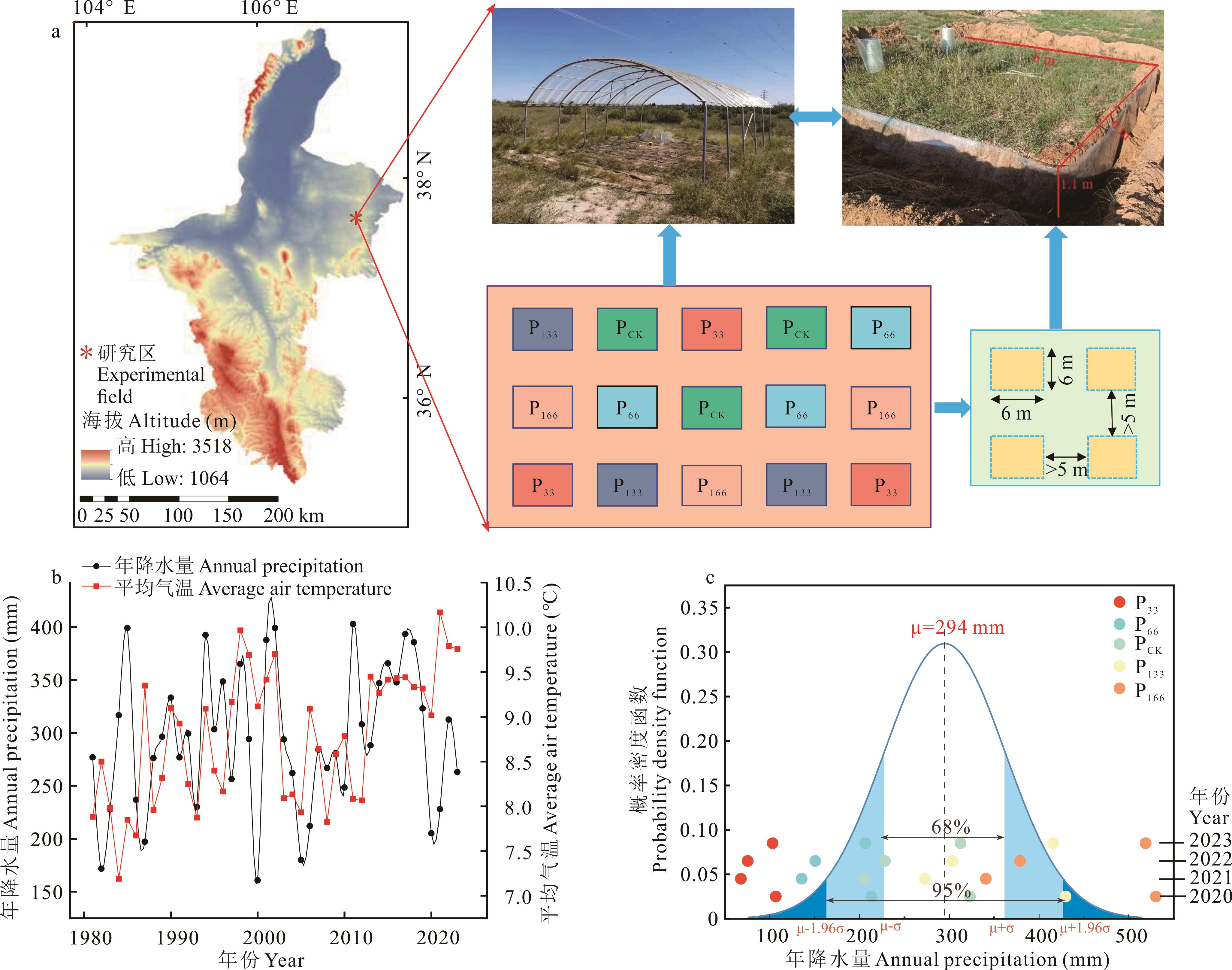
图1 研究区概况a: 荒漠草原野外试验区位置、设计和降水调控装置Location, design and precipitation control device of desert grassland field test area; 该地图基于宁夏回族自治区标准地图服务网站宁S(2022)第001号标准地图制作,底图边界无修改。This map was made based on the standard map of Ningxia Hui Autonomous Region’s Standard Map Service Website [宁S(2022)第001号], and the boundaries didn’t modified. b: 1981-2023年宁夏盐池县降水量和气温变化Precipitation and air temperature changes in Yanchi County of Ningxia from 1981 to 2023; c: 荒漠草原40 a间(1981-2023年)降水概率密度函数和2020-2023年模拟降水处理的统计变化The probability density function of precipitation in desert steppe for 40 years (1981-2023) and the statistical changes of simulated precipitation treatment from 2020 to 2023.
Fig.1 Profile of the study area
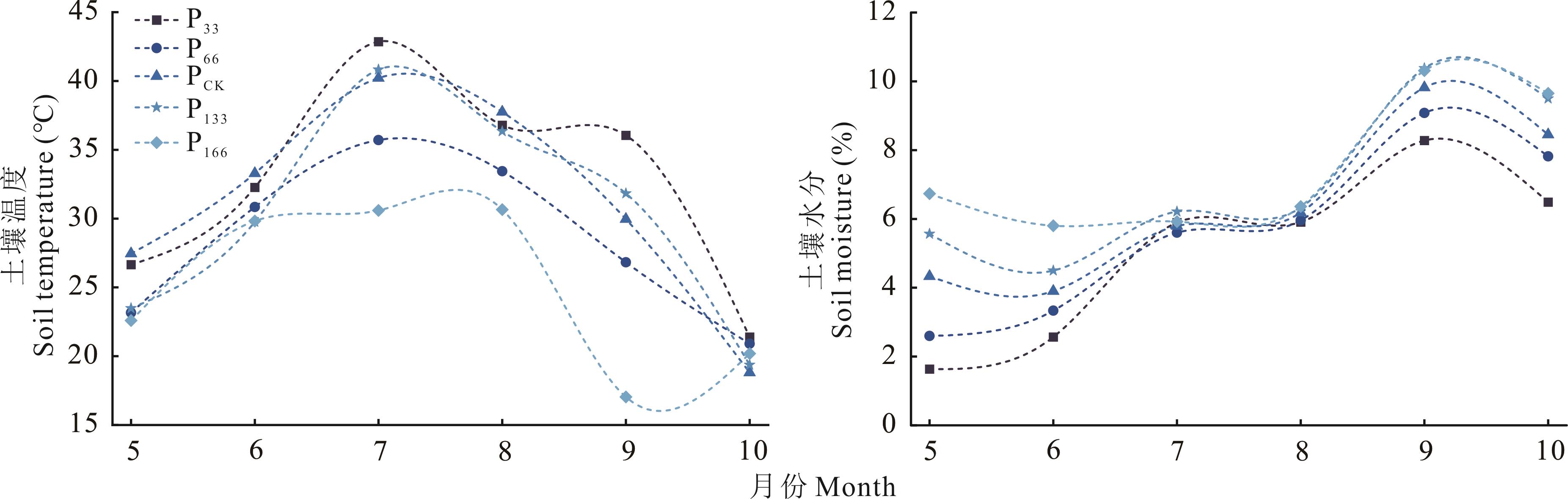
图2 降水变化下土壤温度与土壤水分的时间变化
Fig.2 Temporal variations of soil temperature and soil moisture under the change of precipitation
处理 Treatment | 土壤有机碳 Soil organic carbon | 土壤全氮 Soil total nitrogen | 土壤全磷 Soil total phosphorus |
|---|---|---|---|
| P33 | 1.64±0.47b | 0.16±0.05b | 0.21±0.04a |
| P66 | 1.87±0.61b | 0.20±0.06b | 0.22±0.03a |
| PCK | 2.51±1.02ab | 0.26±0.13ab | 0.24±0.04a |
| P133 | 2.14±0.63b | 0.20±0.07b | 0.23±0.02a |
| P166 | 3.08±1.36a | 0.33±0.18a | 0.25±0.05a |
表1 研究区降水处理6 a(2018-2023)后的土壤理化性质
Table 1 Soil physical and chemical properties after 6 years of precipitation treatment (2018-2023) in the study area (g·kg-1)
处理 Treatment | 土壤有机碳 Soil organic carbon | 土壤全氮 Soil total nitrogen | 土壤全磷 Soil total phosphorus |
|---|---|---|---|
| P33 | 1.64±0.47b | 0.16±0.05b | 0.21±0.04a |
| P66 | 1.87±0.61b | 0.20±0.06b | 0.22±0.03a |
| PCK | 2.51±1.02ab | 0.26±0.13ab | 0.24±0.04a |
| P133 | 2.14±0.63b | 0.20±0.07b | 0.23±0.02a |
| P166 | 3.08±1.36a | 0.33±0.18a | 0.25±0.05a |
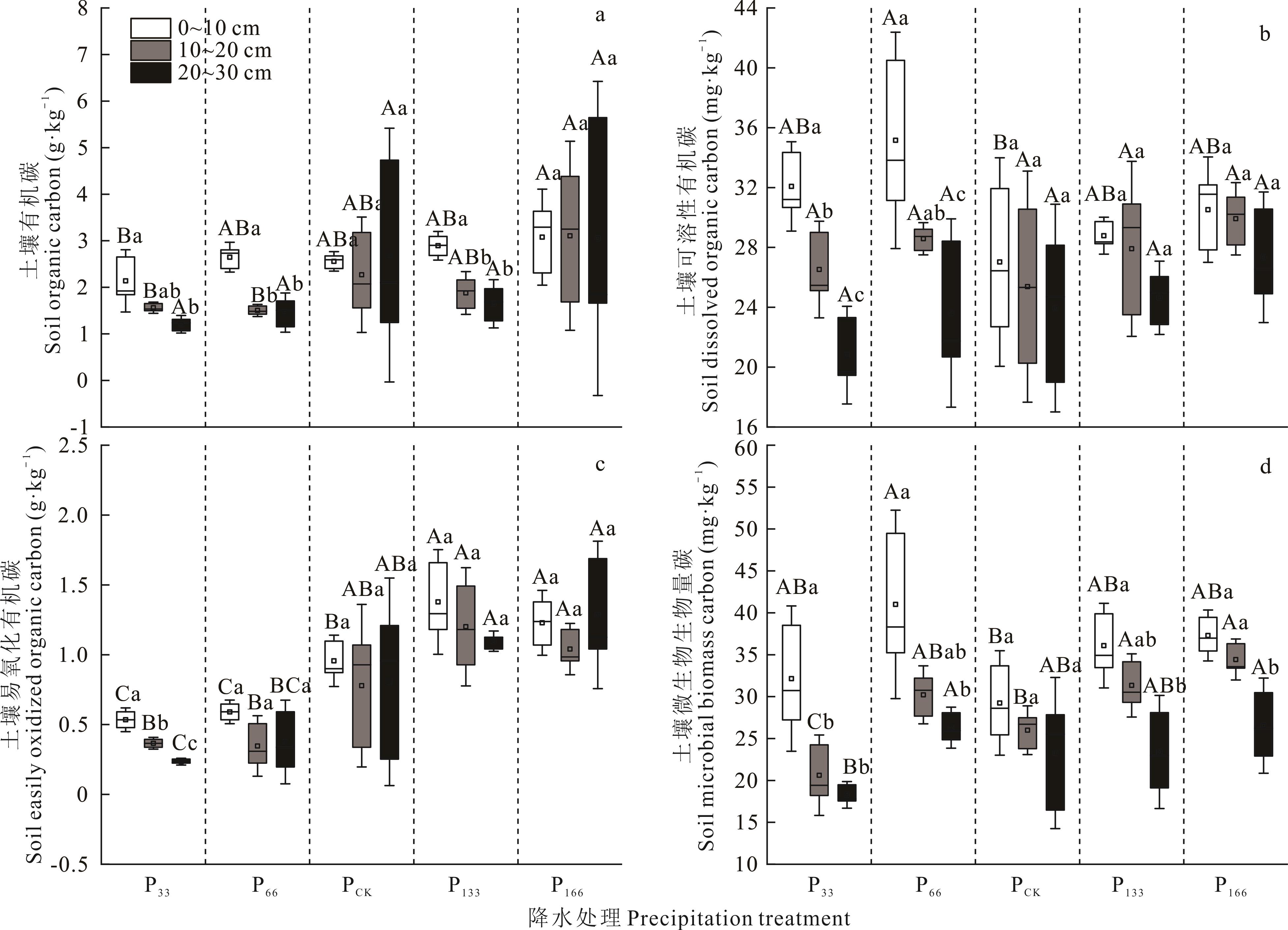
图3 降水变化下各土层有机碳及其组分含量不同大写字母表示同一土层不同处理间差异显著(P<0.05);不同小写字母表示同一处理不同土层间差异显著(P<0.05)。下同。Different capital letters indicate significant differences at the 0.05 level among different treatments of the same soil layer; different lowercase letters indicate significant differences at the 0.05 level among different soil layers of the same treatment. The same below.
Fig.3 The content of organic carbon and its components in each soil layer under the change of precipitation
处理 Treatment | 土壤碳库活度 Carbon pool activity (CA) | 碳库活度指数 Carbon pool activity index (CAI) | 碳库指数 Carbon pool index (CPI) | 碳库管理指数 Carbon pool management index (CPMI, %) |
|---|---|---|---|---|
| P33 | 0.30±0.06b | 0.66±0.32c | 0.72±0.25b | 49.90±35.37b |
| P66 | 0.32±0.14b | 0.62±0.21c | 0.83±0.31ab | 53.84±34.55b |
| PCK | 0.54±0.24b | 1.00±0.00bc | 1.00±0.00ab | 100.00±0.00b |
| P133 | 2.19±2.05a | 2.88±2.32a | 0.88±0.33ab | 192.49±96.53a |
| P166 | 0.93±0.58b | 2.05±1.99ab | 1.36±0.74a | 190.07±157.09a |
表2 降水变化下的土壤碳库管理指数
Table 2 Soil carbon pool management index under the change of precipitation
处理 Treatment | 土壤碳库活度 Carbon pool activity (CA) | 碳库活度指数 Carbon pool activity index (CAI) | 碳库指数 Carbon pool index (CPI) | 碳库管理指数 Carbon pool management index (CPMI, %) |
|---|---|---|---|---|
| P33 | 0.30±0.06b | 0.66±0.32c | 0.72±0.25b | 49.90±35.37b |
| P66 | 0.32±0.14b | 0.62±0.21c | 0.83±0.31ab | 53.84±34.55b |
| PCK | 0.54±0.24b | 1.00±0.00bc | 1.00±0.00ab | 100.00±0.00b |
| P133 | 2.19±2.05a | 2.88±2.32a | 0.88±0.33ab | 192.49±96.53a |
| P166 | 0.93±0.58b | 2.05±1.99ab | 1.36±0.74a | 190.07±157.09a |

图4 降水变化下各土层的土壤酶活性变化BG: β-1,4-葡萄糖苷酶β-1,4-glucosidase; CBH: 纤维二糖水解酶Cellobiose hydrolase; NAG: β-1,4-N-乙酰氨基葡萄糖苷酶β-1,4-N-acetylglucosaminidase; AKP: 碱性磷酸酶Alkaline phosphatase. 下同The same below.
Fig.4 Changes in soil enzyme activity with each soil layer under the change of precipitation change
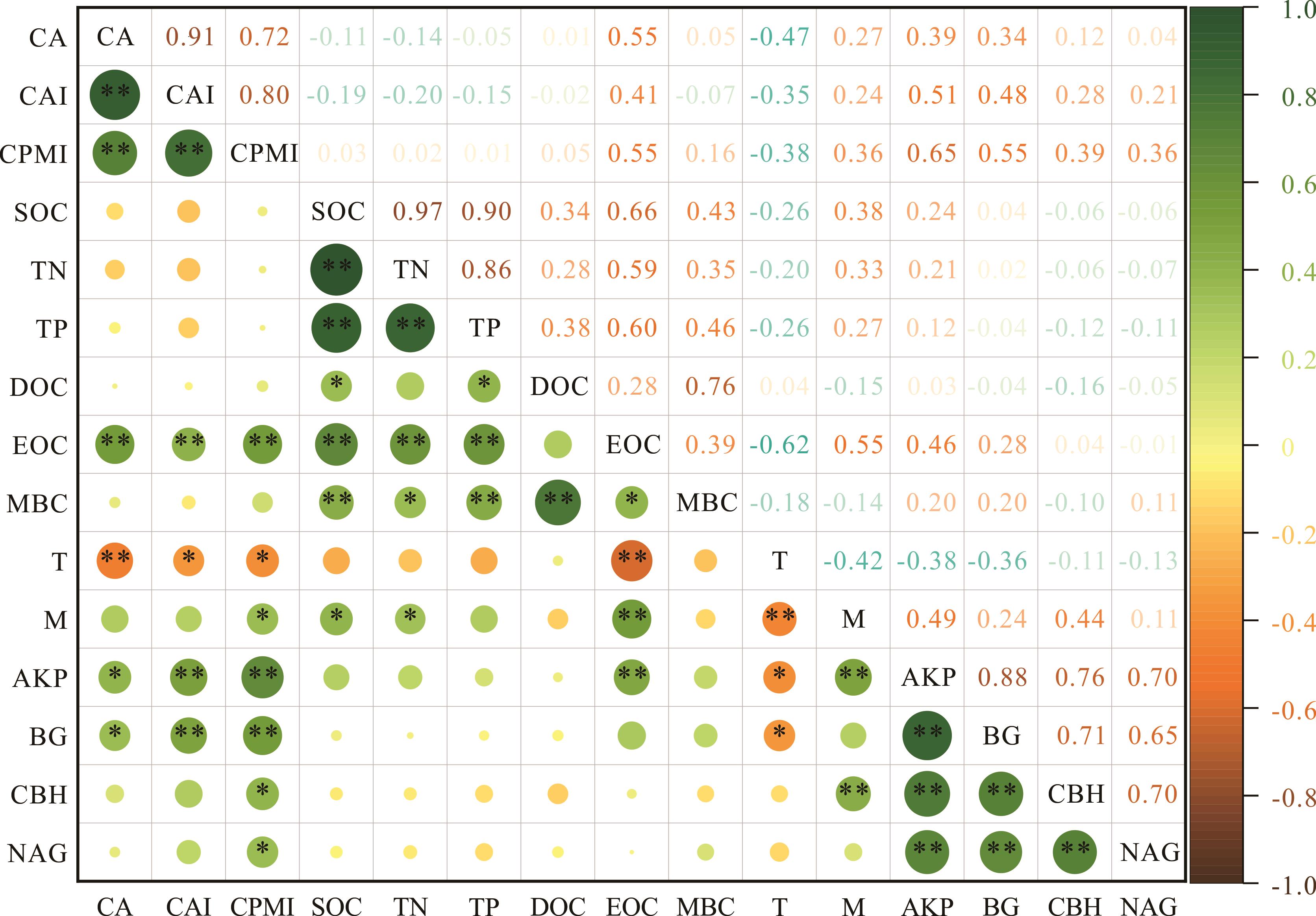
图5 土壤理化性质、酶及有机碳组分与土壤碳库稳定性的相关性分析CA: 碳库活度Carbon pool activity; CAI: 碳库活度指数Carbon pool activity index; CPMI: 碳库管理指数Carbon pool management index; SOC: 土壤有机碳Soil organic carbon; EOC: 易氧化有机碳Easily oxidized organic carbon; DOC: 可溶性有机碳Dissolved organic carbon; MBC: 微生物生物量碳Microbial biomass carbon; M: 土壤水分Soil moisture; T: 土壤温度Soil temperature; TP: 全磷Total phosphorus; TN: 全氮Total nitrogen. *: P<0.05; **: P<0.01。下同The same below.
Fig.5 Correlation analysis between soil physical and chemical properties, soil enzymes, soil organic carbon components and soil carbon pool stability
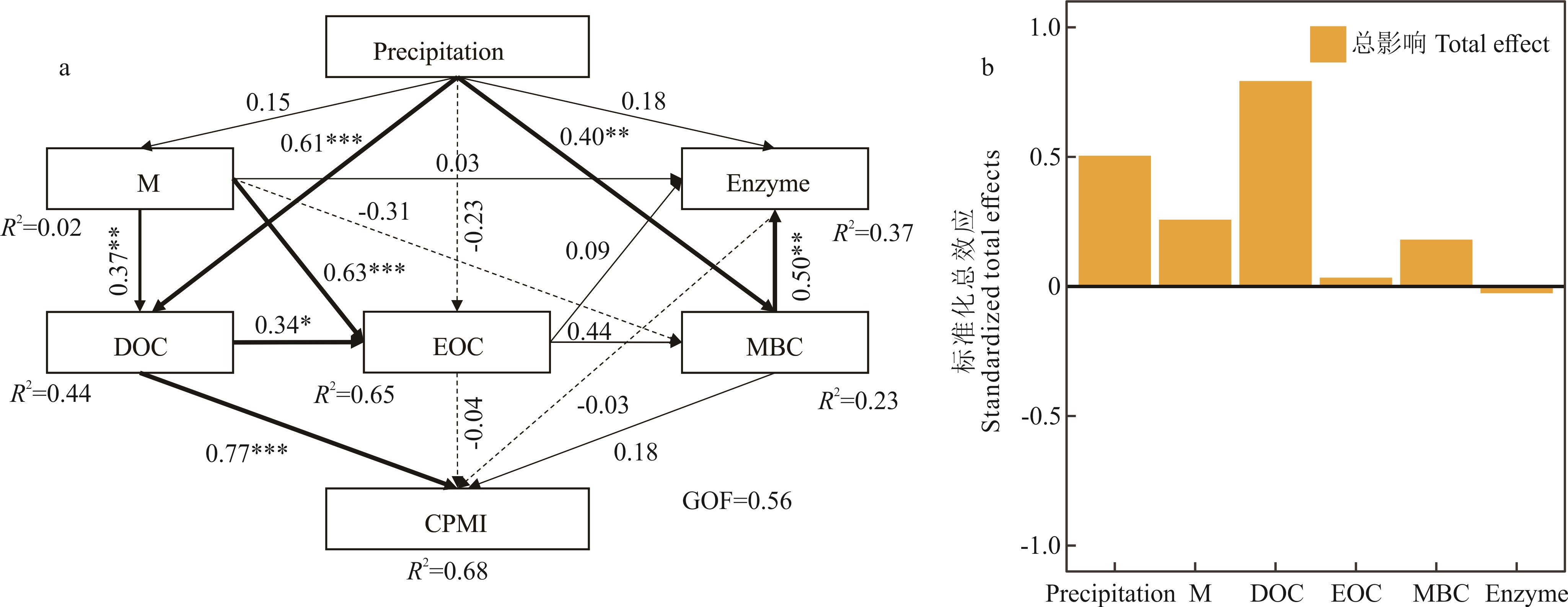
图6 降水变化对土壤碳库管理指数影响的结构方程模型和标准化总效应Precipitation: 降水量变化Precipitation change; Enzyme: 4种土壤酶活性Activity of four kinds soil enzymes (BG, CBH, NAG, AKP); CPMI: 碳库管理指数Carbon pool management index; GOF: 模型拟合度Goodness-of-fit. 图中单箭头表示假设的因果关系方向,实线和虚线分别代表正向和负向路径,线的粗细反映效应程度。The single arrows in the figure represent the hypothesized direction of causality. The solid and dotted lines represent positive and negative pathways, respectively. The thickness of the line reflects the extent of the effect. ***: P<0.001.
Fig.6 The structural equation model analysis (SEM) and standardized total effect for the effects of precipitation change on the carbon pool management index
| [1] | Smith M D. An ecological perspective on extreme climatic events: a synthetic definition and framework to guide future research. Journal of Ecology, 2011, 99(3): 656-663. |
| [2] | Wang P, Huang K L, Hu S J. Distinct fine-root responses to precipitation changes in herbaceous and woody plants: a meta-analysis. New Phytologist, 2020, 225(4): 1491-1499. |
| [3] | Xu S, Geng W X, Sayer E J, et al. Soil microbial biomass and community responses to experimental precipitation change: a meta-analysis. Soil Ecology Letters, 2020, 2: 93-103. |
| [4] | Bai Y F, Cotrufo F M. Grassland soil carbon sequestration: Current understanding, challenges, and solutions. Science, 2022, 377(6606): 603-608. |
| [5] | Zhou X H, Zhou L Y, Nie Y Y, et al. Similar responses of soil carbon storage to drought and irrigation in terrestrial ecosystems but with contrasting mechanisms: a meta-analysis. Agriculture, Ecosystems & Environment, 2016, 228: 70-81. |
| [6] | Du Y, Wang Y P, Su F, et al. The response of soil respiration to precipitation change is asymmetric and differs between grasslands and forests. Global Change Biology, 2020, 26(10): 6015-6024. |
| [7] | Deng L, Peng C, Kim D G, et al. Drought effects on soil carbon and nitrogen dynamics in global natural ecosystems. Earth-Science Reviews, 2021, 214: 103501. |
| [8] | Chen X M, Liu J X, Deng Q, et al. Effects of precipitation intensity on soil organic carbon fractions and their distribution under subtropical forests of South China. Chinese Journal of Applied Ecology, 2010, 21(5): 1210-1216. |
| 陈小梅, 刘菊秀, 邓琦, 等. 降水变率对森林土壤有机碳组分与分布格局的影响. 应用生态学报, 2010, 21(5): 1210-1216. | |
| [9] | Tarnocai C, Canadell J G, Schuur E A G, et al. Soil organic carbon pools in the northern circumpolar permafrost region. Global Biogeochemical Cycles, 2009, 23(2): GB2023. |
| [10] | Crowther T W, Todd-Brown K E O, Rowe C W, et al. Quantifying global soil carbon losses in response to warming. Nature, 2016, 540(7631): 104-108. |
| [11] | Iii F S, Mcfarland J, Mcguire A D, et al. The changing global carbon cycle: linking plant-soil carbon dynamics to global consequences. Journal of Ecology, 2009, 97(5): 840-850. |
| [12] | Thomey M L, Collins S L, Vargas R, et al. Effect of precipitation variability on net primary production and soil respiration in a Chihuahuan Desert grassland. Global Change Biology, 2011, 17(4): 1505-1515. |
| [13] | Canarini A, Carrillo Y, Mariotte P, et al. Soil microbial community resistance to drought and links to C stabilization in an Australian grassland. Soil Biology & Biochemistry, 2016, 103: 171-180. |
| [14] | Sherlynette P C, Elsa E C, Robert W, et al. Soil microbial responses to drought and exotic plants shift carbon metabolism. The ISME Journal, 2019, 13(7): 1776-1787. |
| [15] | Hoover D L, Rogers B M. Not all droughts are created equal: the impacts of interannual drought pattern and magnitude on grassland carbon cycling. Global Change Biology, 2016, 22(5): 1809-1820. |
| [16] | Cleveland C C, Wieder W R, Reed S C, et al. Experimental drought in a tropical rain forest increases soil carbon dioxide losses to the atmosphere. Ecology, 2010, 91(8): 2313-2323. |
| [17] | Zhang L, Wylie B K, Ji L, et al. Upscaling carbon fluxes over the Great Plains grasslands: Sinks and sources. Journal of Geophysical Research Biogeosciences, 2011, 116(G3): G00J03. |
| [18] | Schlesinger W H. Evidence from chronosequence studies for a low carbon-storage potential of soils. Nature, 1990, 348: 232-234. |
| [19] | Xi J Y, Bai W, Yin P S, et al. Effects of simulated warming on soil organic carbon composition and biomass in alpine swamp meadow in the headwaters region of the Yangtze River. Ecological Science, 2019, 38(1): 92-101. |
| 奚晶阳, 白炜, 尹鹏松, 等. 模拟增温对长江源区高寒沼泽草甸土壤有机碳组分与植物生物量的影响研究. 生态科学, 2019, 38(1): 92-101. | |
| [20] | Sowerby A, Emmett B A, Williams D, et al. The response of dissolved organic carbon (DOC) and the ecosystem carbon balance to experimental drought in a temperate shrubland. European Journal of Soil Science, 2010, 61(5): 697-709. |
| [21] | Xiang Y B, Zhou S X, Xiao Y X, et al. Effects of simulated nitrogen deposition and precipitation changes on soil organic carbon in an evergreen broad-leaved forest that is part of the Rainy Area of Western China. Acta Ecologica Sinica, 2017, 37(14): 4686-4695. |
| 向元彬, 周世兴, 肖永翔, 等. 模拟氮沉降和降雨量改变对华西雨屏区常绿阔叶林土壤有机碳的影响. 生态学报, 2017, 37(14): 4686-4695. | |
| [22] | Ma X H, Huang J Y, Yu H L, et al. Soil organic carbon and its easily decomposed components under precipitation change and nitrogen addition in a desert steppe in northwest China. Chinese Journal of Plant Ecology, 2024, 48(8): 1065-1077. |
| 马煦晗, 黄菊莹, 余海龙, 等. 降水量变化及氮添加下荒漠草原土壤有机碳及其易分解组分研究. 植物生态学报, 2024, 48(8): 1065-1077. | |
| [23] | Blair G, Lefroy R D B, Lisle L. Soil carbon fractions based on their degree of oxidation, and the development of a carbon management index for agricultural system. Australian Journal of Agricultural Research, 1995, 46(7): 393-406. |
| [24] | Qian H Y, Zhou H X, Luo Y J, et al. Responses of soil labile organic carbon and carbon pool management index to alpine wetland degradation. Chinese Journal of Ecology, 2020, 39(7): 2273-2282. |
| 钱虹宇, 周宏鑫, 罗原骏, 等. 土壤活性有机碳及碳库管理指数对高寒湿地退化的响应. 生态学杂志, 2020, 39(7): 2273-2282. | |
| [25] | Yang Y J, Liu S R, Schindlbacher A, et al. Topsoil organic carbon increases but its stability declines after five years of reduced throughfall. Soil Biology and Biochemistry, 2021, 156: 108221. |
| [26] | Hu A G, Guan Q Y. China tackles global climate change. Beijing: Tsinghua University Press, 2019. |
| 胡鞍钢, 管清友. 中国应对全球气候变化. 北京: 清华大学出版社, 2019. | |
| [27] | Luo X, Wang Y T, Zhang J, et al. Responses of dominant species and rhizosphere soil stoichiometry to rainfall in typical steppe of the Loess Plateau. Acta Ecologica Sinica, 2022, 42(3): 1002-1014. |
| 罗叙, 王誉陶, 张娟, 等. 黄土高原典型草原优势种植物及其根际土壤化学计量对降雨变化的响应. 生态学报, 2022, 42(3): 1002-1014. | |
| [28] | Lian J L, Chen J, Yang X Q, et al. Responses of desert steppe plant diversity and microbial diversity to precipitation change. Biodiversity Science, 2024, 32(6): 131-144. |
| 连佳丽, 陈婧, 杨雪琴, 等. 荒漠草原植物多样性和微生物多样性对降水变化的响应. 生物多样性, 2024, 32(6): 131-144. | |
| [29] | Bao S D. Soil agro-chemical analysis (The third edition). Beijing: China Agricultural Press, 2000. |
| 鲍士旦. 土壤农化分析(第3版). 北京: 中国农业出版社, 2000. | |
| [30] | Li J P, Xie Y Z. Effects of natural grassland enclosure on carbon and nitrogen storage in deep soil in the Loess Plateau of China. Pratacultural Science, 2016, 33(10): 1981-1988. |
| 李建平, 谢应忠. 封育对黄土高原天然草地深层土壤碳、氮储量的影响. 草业科学, 2016, 33(10): 1981-1988. | |
| [31] | Barreto R C, Madari B E, Machado P L O A, et al. The impact of soil management on aggregation, carbon stabilization and carbon loss as CO2 in the surface layer of a Rhodic Ferralsol in Southern Brazil. Agriculture Ecosystems & Environment, 2009, 132(3): 243-251. |
| [32] | Zhong Z K, Li W J, Lu X Q, et al. Adaptive pathways of soil microorganisms to stoichiometric imbalances regulate microbial respiration following afforestation in the Loess Plateau, China. Soil Biology and Biochemistry, 2020, 151: 108048. |
| [33] | Saiya-Cork K R, Sinsabaugh R L, Zak D R. The effects of long term nitrogen deposition on extracellular enzyme activity in an Acer saccharum forest soil. Soil Biology and Biochemistry, 2002, 34(9): 1309-1315. |
| [34] | Zhong Z K. Effects of experimental warming and precipitation manipulation on the key processes of soil carbon cycle in abandoned farmland of the Loess Hilly Region. Yangling: Northwest A & F University, 2021. |
| 钟泽坤. 增温和降雨改变对黄土丘陵区撂荒草地土壤碳循环关键过程的影响. 杨凌: 西北农林科技大学, 2021. | |
| [35] | Zhang X, Zhao Y C, Xie E Z, et al. Spatio-temporal change of soil organic carbon, progress and prospects. Journal of Agro-Environment Science, 2020, 39(4): 673-679. |
| 张秀, 赵永存, 谢恩泽, 等. 土壤有机碳时空变化研究进展与展望. 农业环境科学学报, 2020, 39(4): 673-679. | |
| [36] | Zhou Y, Li Y Y, Li N, et al. Contribution of soil microbial necromass carbon to soil organic carbon in grassland under precipitation change and its influencing factors in loess hilly region, Northwest China. Chinese Journal of Applied Ecology, 2024, 35(9): 2592-2598. |
| 周玥, 李娅芸, 李娜, 等. 黄土丘陵区降水变化下草地土壤微生物残体碳对土壤有机碳组分的贡献及其影响因素. 应用生态学报, 2024, 35(9): 2592-2598. | |
| [37] | Diao H J, Chen X P, Zhao X, et al. Effects of nitrogen addition and precipitation alteration on soil respiration and its components in a saline-alkaline grassland. Geoderma, 2022, 406: 115541. |
| [38] | Ding J M, Wang W Z, Mi W B, et al. Spatial characteristics of soil organic carbon in grassland of Ningxia and its influencing factors. Acta Ecologica Sinica, 2023, 43(5): 1913-1922. |
| 丁金梅, 王维珍, 米文宝, 等. 宁夏草地土壤有机碳空间特征及其影响因素. 生态学报, 2023, 43(5): 1913-1922. | |
| [39] | Hu C J, Yan C, Guo L, et al. Effects of flooding on soil organic carbon and dissolved organic carbon under extreme rainstorm. Chinese Journal of Eco-Agriculture, 2024, 32(8): 1322-1330. |
| 胡婵娟, 鄢创, 郭雷, 等. 极端降雨条件下淹水对农田土壤有机碳、可溶性有机碳的影响. 中国生态农业学报, 2024, 32(8): 1322-1330. | |
| [40] | Li J J, Zhao X, Pan T H, et al. Effects of different land-use types on soil labile organic matter. Journal of Soil and Water Conservation, 2011, 25(1): 147-151. |
| 李君剑, 赵溪, 潘恬豪, 等. 不同土地利用方式对土壤活性有机质的影响. 水土保持学报, 2011, 25(1): 147-151. | |
| [41] | Kalbitz K, Solinger S, Park J H, et al. Controls on the dynamics of dissolved organic matter in soils: A review. Soil Science, 2000, 165(4): 277-304. |
| [42] | Xu S, Wang J J, Sayer E J, et al. Precipitation change affects forest soil carbon inputs and pools: A global meta-analysis. Science of the Total Environment, 2024, 908: 168171. |
| [43] | Li H, Yang Y S, Si Y T, et al. Effects of short-term global warming and precipitation reduction on the quantity and spectral characteristics of soil DOM in Cunninghamia lanceolata plantation. Chinese Journal of Eco-Agriculture, 2017, 25(7): 949-957. |
| 李欢, 杨玉盛, 司友涛, 等. 短期增温及减少降雨对杉木人工林土壤DOM的数量及其光谱学特征的影响. 中国生态农业学报, 2017, 25(7): 949-957. | |
| [44] | Liu X F, Lin T W, Xiong D C, et al. Interactive responses of undergrowth vegetation biomass in Chinese fir to soil warming and precipitation separation. Journal of Subtropical Resources and Environment, 2014, 9(3): 92-95. |
| 刘小飞, 林廷武, 熊德成, 等. 土壤增温及降雨隔离对杉木幼林林下植被生物量的影响. 亚热带资源与环境学报, 2014, 9(3): 92-95. | |
| [45] | Li L B, Tu C L, Zhao Z Q, et al. Distribution characteristics of soil organic carbon and its isotopic composition for soil profiles of Loess Plateau under different vegetation conditions. Earth and Environment, 2011, 39(4): 441-449. |
| 李龙波, 涂成龙, 赵志琦, 等. 黄土高原不同植被覆盖下土壤有机碳的分布特征及其同位素组成研究. 地球与环境, 2011, 39(4): 441-449. | |
| [46] | Skopp J, Jawson M D, Doran J W. Steady-state aerobic microbial activity as a function of soil water content. Soil Science Society of America Journal, 1990, 54(6): 1619-1625. |
| [47] | Xu X, Wang F, Luan Y L, et al. Soil readily oxidizable carbon along an elevation gradient of Wuyi Mountains in southeastern China. Chinese Journal of Ecology, 2008, 27(7): 1115-1121. |
| 徐侠, 王丰, 栾以玲, 等. 武夷山不同海拔植被土壤易氧化碳. 生态学杂志, 2008, 27(7): 1115-1121. | |
| [48] | Yin Y, Liu Y Y, Jing Y L, et al. Contents of soil organic carbon and components in three types of forests in the mountain area of Eastern Liaoning. Chinese Journal of Ecology, 2018, 37(7): 2100-2106. |
| 殷有, 刘源跃, 井艳丽, 等. 辽东山区三种典型林型土壤有机碳及其组分含量. 生态学杂志, 2018, 37(7): 2100-2106. | |
| [49] | Li N, Wang B R, An S S, et al. Response of soil bacterial community structure to precipitation change in grassland of loess plateau. Environmental Science, 2020, 41(9): 4284-4293. |
| 李娜, 王宝荣, 安韶山, 等. 黄土高原草地土壤细菌群落结构对于降水变化的响应. 环境科学, 2020, 41(9): 4284-4293. | |
| [50] | Blair N, Faulkner R D, Till A R, et al. Long-term management impacts on soil C, N and physical fertility: Part Ⅱ: Bad Lauchstadt static and extreme FYM experiments. Soil & Tillage Research, 2006, 91(1/2): 39-47. |
| [51] | Jiang X, Xu D P, Rong J J, et al. Landslide and aspect effects on artificial soil organic carbon fractions and the carbon pool management index on road-cut slopes in an alpine region. Catena, 2021, 199: 105094. |
| [52] | Diekow J, Mielniczuk J, Knicker H, et al. Carbon and nitrogen stocks in physical fractions of a subtropical acrisol as influenced by long-term no-till cropping systems and N fertilisation. Plant and Soil, 2005, 268(1): 319-328. |
| [53] | Gami S K, Lauren J G, Duxbury J M. Soil organic carbon and nitrogen stocks in Nepal long-term soil fertility experiments. Soil & Tillage Research, 2009, 106(1): 95-103. |
| [54] | Zhu L Q, Hu N J, Zhang Z W, et al. Short-term responses of soil organic carbon and carbon pool management index to different annual straw return rates in a rice-wheat cropping system. Catena, 2015, 135: 283-289. |
| [55] | Hao L Y, Zhang L H, Xie Z K, et al. Influence of precipitation change on soil respiration in desert grassland. Environmental Science, 2021, 42(9): 4527-4537. |
| 蒿廉伊, 张丽华, 谢忠奎, 等. 降水变化对荒漠草原土壤呼吸的影响. 环境科学, 2021, 42(9): 4527-4537. | |
| [56] | Zhou J G, Zhang J F, Lambers H, et al. Intensified rainfall in the wet season alters the microbial contribution to soil carbon storage. Plant and Soil, 2022(1/2): 476. |
| [57] | Wu L W, Zhang Y, Guo X, et al. Reduction of microbial diversity in grassland soil is driven by long-term climate warming. Nature Microbiology, 2022, 7: 1054-1062. |
| [58] | Wang B, Chen Y L, Li Y, et al. Differential effects of altered precipitation regimes on soil carbon cycles in arid versus humid terrestrial ecosystems. Global Change Biology, 2021, 27(24): 6348-6362. |
| [59] | Peng Y, Peñuelas J, Vesterdal L, et al. Responses of soil fauna communities to the individual and combined effects of multiple global change factors. Ecology Letters, 2022, 25(9): 1961-1973. |
| [60] | Nielsen U N, Ball B A. Impacts of altered precipitation regimes on soil communities and biogeochemistry in arid and semi-arid ecosystems. Global Change Biology, 2015, 21(4): 1407-1421. |
| [61] | Wei X Y, Meerbeek K V, Yue K, et al. Responses of soil C pools to combined warming and altered precipitation regimes: A meta-analysis. Global Ecology and Biogeography, 2023, 32(9): 1660-1675. |
| [62] | Fuchslueger L, Bahn M, Fritz K, et al. Experimental drought reduces the transfer of recently fixed plant carbon to soil microbes and alters the bacterial community composition in a mountain meadow. New Phytologist, 2014, 201(3): 916-927. |
| [63] | German D P, Allison S D. Drying and substrate concentrations interact to inhibit decomposition of carbon substrates added to combusted inceptisols from a boreal forest. Biology and fertility of Soils, 2015, 51(5): 525-533. |
| [64] | Franzluebbers A J, Haney R L, Honeycutt C W, et al. Climatic influences on active fractions of soil organic matter. Soil Biology and Biochemistry, 2001, 33(7/8): 1103-1111. |
| [65] | Hopkins F M, Filley T R, Gleixner G, et al. Increased belowground carbon inputs and warming promote loss of soil organic carbon through complementary microbial responses. Soil Biology and Biochemistry, 2014, 76: 7-69. |
| [66] | Ren T J, Smreczak B, Ukalska-Jaruga A, et al. Differential impacts of nitrogen addition on soil dissolved organic carbon in humid and non-humid regions: A global meta-analysis. Journal of Environmental Management, 2025, 377: 124744. |
| [67] | Wang J, Li G, Xiu W M, et al. Effects of nitrogen and water on soil enzyme activity and soil microbial biomass in Stipa baicalensis steppe, Inner Mongolia of North China. Journal of Agricultural Resources and Environment, 2014, 31(3): 237-245. |
| 王杰, 李刚, 修伟明, 等. 氮素和水分对贝加尔针茅草原土壤酶活性和微生物量碳氮的影响. 农业资源与环境学报, 2014, 31(3): 237-245. | |
| [68] | Luo R, Kuzyakov Y K, Zhu B, et al. Phosphorus addition decreases plant lignin but increases microbial necromass contribution to soil organic carbon in a subalpine forest. Global Change Biology, 2022, 28(13): 4194-4210. |
| [69] | Li X J, Xie J S, Zhang Q F, et al. Substrate availability and soil microbes drive temperature sensitivity of soil organic carbon mineralization to warming along an elevation gradient in subtropical Asia. Geoderma, 2020, 364: 114198. |
| [1] | 凡文帅, 王兴, 张祎, 张艺斐, 宋乃平, 杨新国, 李莹莹. 中国北方荒漠草原区灌木植被恢复效应及其对环境的依赖性[J]. 草业学报, 2026, 35(5): 36-47. |
| [2] | 杨雪琴, 李建平, 陈婧, 连佳丽, 韩翠, 罗叙, 赵莹. 降水变化对荒漠草原生态系统碳氮储量及固持速率的影响[J]. 草业学报, 2026, 35(5): 48-60. |
| [3] | 李豫悦, 魏浩男, 马兴忠, 姜海鑫, 聂明鹤, 周瑶, 代成江, 田小武, 王国会, 马红彬. 轮牧对荒漠草原土壤种子库特征的影响[J]. 草业学报, 2026, 35(4): 1-13. |
| [4] | 刘冬娅, 杨燕, 刘静, 王博, 李志刚. 短期羊粪归还对荒漠草地土壤质量的影响[J]. 草业学报, 2026, 35(2): 28-39. |
| [5] | 邓文辉, 宋珂辰, 张浩, 管思雨, 雍嘉仪, 谢铁娜, 胡海英. 降水变化对荒漠草原植物群落主要物种气孔形态和光合生理特性的影响[J]. 草业学报, 2026, 35(1): 65-78. |
| [6] | 邓文辉, 宋珂辰, 张浩, 管思雨, 雍嘉仪, 胡海英. 降水变化条件下荒漠草原优势植物根际微生物群落结构和多样性特征研究[J]. 草业学报, 2025, 34(5): 12-26. |
| [7] | 骆欣怡, 邱开阳, 金涛, 鲍平安, 黄业芸, 何毅, 谢应忠. 碳、氮、钾添加对荒漠草原凋落物分解特征的影响[J]. 草业学报, 2025, 34(2): 41-53. |
| [8] | 马蓉, 李俊瑶, 岳平, 马旭君, 白珍, 庄玲, 白敬, 赵学勇, 王少昆. 降水变化下荒漠草原优势植物功能性状对生物量分配的调节机制[J]. 草业学报, 2025, 34(11): 31-39. |
| [9] | 鲍平安, 文志林, 王炎, 陈彦虎, 季波, 王占军, 吴旭东, 蒋齐. 不同牧草补播模式对荒漠草原植物群落结构及土壤特性的影响[J]. 草业学报, 2025, 34(10): 62-73. |
| [10] | 张振豪, 贾子玉, 李鑫宇, 程云湘. 荒漠草原混牧牛羊的放牧行为特征[J]. 草业学报, 2025, 34(1): 226-237. |
| [11] | 贺世龙, 叶贺, 李静, 张雅玲, 德海山, 红梅. 不同时限氮沉降和降水变化对荒漠草原中小型土壤节肢动物群落结构与多样性的影响[J]. 草业学报, 2024, 33(9): 140-154. |
| [12] | 曹颖, 聂明鹤, 沈艳, 胡艳, 马登宝, 李东, 候腾思, 方鹏, 王学琴. 宁夏干旱风沙区荒漠草原不同退化阶段植被土壤变化特征及其相关性[J]. 草业学报, 2024, 33(8): 1-14. |
| [13] | 候腾思, 沈艳, 马红彬, 方鹏, 曹颖. 柠条平茬对荒漠草原土壤水分特征及水量平衡的影响[J]. 草业学报, 2024, 33(8): 15-24. |
| [14] | 佘洁, 沈爱红, 石云, 赵娜, 张风红, 何洪源, 吴涛, 李红霞, 马益婷, 朱晓雯. 基于无人机遥感影像和面向对象技术的荒漠草原植被分类[J]. 草业学报, 2024, 33(7): 1-14. |
| [15] | 姜海鑫, 周瑶, 胡科, 丁占胜, 马红彬. 不同放牧时间对荒漠草原土壤颗粒组成及分形维数的影响[J]. 草业学报, 2024, 33(6): 17-28. |
| 阅读次数 | ||||||
|
全文 |
|
|||||
|
摘要 |
|
|||||
