

ISSN 1004-5759 CN 62-1105/S
草业学报 ›› 2026, Vol. 35 ›› Issue (9): 129-141.DOI: 10.11686/cyxb2025386
• 研究论文 • 上一篇
杨陶阳1,2( ), 苏日力格2,3, 乌日力格2,3, 姜娜2, 杨殿林2, 红梅4, 张海芳2(), 赵建宁1,2()
收稿日期:2025-09-23
修回日期:2025-11-27
出版日期:2026-09-20
发布日期:2026-07-27
通讯作者:
张海芳,赵建宁
作者简介:zhaojianning@caas.cn基金资助:
Tao-yang YANG1,2(), Surilige2,3, Wurilige2,3, Na JIANG2, Dian-lin YANG2, Mei HONG4, Hai-fang ZHANG2(), Jian-ning ZHAO1,2()
Received:2025-09-23
Revised:2025-11-27
Online:2026-09-20
Published:2026-07-27
Contact:
Hai-fang ZHANG,Jian-ning ZHAO
摘要:
狼毒大戟扩散蔓延是草地退化的典型标志,严重威胁草地生态功能与畜牧业可持续发展。为筛选可高效、安全防除狼毒大戟的除草剂,本研究以清水为对照(CK),选用7种除草剂,于狼毒大戟盛花期喷施,30 d后评估了防除效果,翌年返青期测定狼毒大戟的再生力,施药当年和翌年植物生长旺盛期调查植物群落特征,系统分析除草剂对植物群落结构、多样性和生产力的影响,以此评估施用除草剂对其他植物的安全性。结果表明:1)短期防效方面,三氯吡氧乙酸和草甘膦对狼毒大戟的株防效与鲜重防效均高达100%;相比之下,其余5种除草剂的株防效和鲜重防效均低于65%,防除效果不佳;2)持续抑制能力方面,三氯吡氧乙酸处理能完全抑制翌年狼毒大戟的萌发和生长,而翌年草甘膦处理区的狼毒大戟种群密度恢复至1.76株·m-2,地下休眠芽再生力强;3)三氯吡氧乙酸处理提升了莎草科和禾本科植物的重要值及生物量,施药当年群落Shannon-Wiener指数和Pielou均匀度指数分别较CK显著提高7.6%和15.46%;至翌年,三氯吡氧乙酸处理区禾本科与莎草科生物量合计占比达88.77%,促进群落向禾本科-莎草科优势方向稳定演替,但多样性指数与对照无显著差异;4)草甘膦处理严重抑制了非靶标植物生长,导致杂类草、莎草科和禾本科植物的生物量较CK分别显著下降了86.05%、63.58%和90.80%;同时,物种丰富度指数和Shannon-Wiener指数也分别显著下降了54.44%和20.58%;5)TOPSIS-多准则决策模型分析表明,三氯吡氧乙酸防除狼毒大戟兼具高效、可持续、对非靶标植物安全的优点,可在防除狼毒大戟的同时促进植物群落恢复,是治理狼毒大戟型退化草地的优选方案。
杨陶阳, 苏日力格, 乌日力格, 姜娜, 杨殿林, 红梅, 张海芳, 赵建宁. 狼毒大戟的化学防除效果及对其他植物群落的影响[J]. 草业学报, 2026, 35(9): 129-141.
Tao-yang YANG, Surilige, Wurilige, Na JIANG, Dian-lin YANG, Mei HONG, Hai-fang ZHANG, Jian-ning ZHAO. Efficacy of chemical control on Euphorbia fischeriana and its effect on other plant communities[J]. Acta Prataculturae Sinica, 2026, 35(9): 129-141.
处理 Treatment | 除草剂 Herbicides | 有效成分及剂型Active ingredient & formulation | 用量 Dosage | 适用场景 Recommended application | 传导类型 Conduction type | 作用机理 Mechanism of action | 生产厂家 Manufacturer |
|---|---|---|---|---|---|---|---|
| H1 | 三氯吡氧乙酸 Triclopyr | 48%乳油48% emulsifiable concentrate (EC) | 4.20 L·hm-2 | 牧场;阔叶杂草Grazing land; broadleaf weeds | 内吸传导型Systemic conduction type | 合成激素类 Synthetic auxin | 科迪华农业科技有限责任公司Corteva Agricultural Technology Co., Ltd. |
| H2 | 草甘膦 Glyphosate | 41%水剂41% aqueous solution (AS) | 4.60 L·hm-2 | 非耕地;阔叶杂草Non-arable land; broadleaf weeds | 内吸传导型Systemic conduction type | 5-烯醇丙酮莽草酸-3-磷酸合酶抑制剂5-enolpyruvylshikimate-3-phosphate synthase (EPSP) inhibitors | 侨昌现代农业有限公司Qiaochang Modern Agriculture Co., Ltd. |
| H3 | 苯磺隆 Tribenuron-methyl | 75%水分散粒剂75% water dispersible granule (WDG) | 16.00 g·hm-2 | 麦田;阔叶杂草Wheat field; broadleaf weeds | 内吸传导型Systemic conduction type | 乙酰乳酸合成酶抑制剂Acetolactate synthase (ALS) inhibitors | 山东胜邦绿野化学有限公司Shandong Shengbang Green Chemical Co., Ltd. |
| H4 | 氯氨吡啶酸 Aminopyralid | 21%水剂21% AS | 0.45 L·hm-2 | 草原;阔叶杂草Grassland; broadleaf weeds | 内吸传导型Systemic conduction type | 合成激素类 Synthetic auxin | 科迪华农业科技有限责任公司Corteva Agricultural Technology Co., Ltd. |
| H5 | 氯氟吡氧乙酸Fluroxypyr | 20%乳油20% EC | 0.90 L·hm-2 | 草原;阔叶杂草Grassland; broadleaf weeds | 内吸传导型Systemic conduction type | 合成激素类 Synthetic auxin | 天津市华宇农药有限公司Tianjin Huayu Pesticide Co., Ltd. |
| H6 | 氟磺胺草醚Fomesafen | 25%水剂25% AS | 1.00 L·hm-2 | 大豆田;阔叶杂草Soybean field; broadleaf weeds | 触杀型Contact type | 原卟啉原氧化酶抑制剂Protoporphyrinogen oxidase (PPO) inhibitors | 山东滨农科技有限公司Shandong Binnnong Technology Co., Ltd. |
| H7 | 乙羧氟草醚Fluoroglycofen-ethyl | 10%微乳剂10% micro-emulsion (ME) | 75.00 g·hm-2 | 大豆田;阔叶杂草Soybean field; broadleaf weeds | 触杀型Contact type | 原卟啉原氧化酶抑制剂 PPO inhibitors | 河南瀚斯作物保护有限公司Henan Hansi Crop Protection Co., Ltd. |
| CK | 清水Clear water | 无Nothing | 450 L·hm-2 | 无Nothing | 无Nothing | 无Nothing | 无Nothing |
表1 试验处理概况
Table 1 Overview of the experimental treatments
处理 Treatment | 除草剂 Herbicides | 有效成分及剂型Active ingredient & formulation | 用量 Dosage | 适用场景 Recommended application | 传导类型 Conduction type | 作用机理 Mechanism of action | 生产厂家 Manufacturer |
|---|---|---|---|---|---|---|---|
| H1 | 三氯吡氧乙酸 Triclopyr | 48%乳油48% emulsifiable concentrate (EC) | 4.20 L·hm-2 | 牧场;阔叶杂草Grazing land; broadleaf weeds | 内吸传导型Systemic conduction type | 合成激素类 Synthetic auxin | 科迪华农业科技有限责任公司Corteva Agricultural Technology Co., Ltd. |
| H2 | 草甘膦 Glyphosate | 41%水剂41% aqueous solution (AS) | 4.60 L·hm-2 | 非耕地;阔叶杂草Non-arable land; broadleaf weeds | 内吸传导型Systemic conduction type | 5-烯醇丙酮莽草酸-3-磷酸合酶抑制剂5-enolpyruvylshikimate-3-phosphate synthase (EPSP) inhibitors | 侨昌现代农业有限公司Qiaochang Modern Agriculture Co., Ltd. |
| H3 | 苯磺隆 Tribenuron-methyl | 75%水分散粒剂75% water dispersible granule (WDG) | 16.00 g·hm-2 | 麦田;阔叶杂草Wheat field; broadleaf weeds | 内吸传导型Systemic conduction type | 乙酰乳酸合成酶抑制剂Acetolactate synthase (ALS) inhibitors | 山东胜邦绿野化学有限公司Shandong Shengbang Green Chemical Co., Ltd. |
| H4 | 氯氨吡啶酸 Aminopyralid | 21%水剂21% AS | 0.45 L·hm-2 | 草原;阔叶杂草Grassland; broadleaf weeds | 内吸传导型Systemic conduction type | 合成激素类 Synthetic auxin | 科迪华农业科技有限责任公司Corteva Agricultural Technology Co., Ltd. |
| H5 | 氯氟吡氧乙酸Fluroxypyr | 20%乳油20% EC | 0.90 L·hm-2 | 草原;阔叶杂草Grassland; broadleaf weeds | 内吸传导型Systemic conduction type | 合成激素类 Synthetic auxin | 天津市华宇农药有限公司Tianjin Huayu Pesticide Co., Ltd. |
| H6 | 氟磺胺草醚Fomesafen | 25%水剂25% AS | 1.00 L·hm-2 | 大豆田;阔叶杂草Soybean field; broadleaf weeds | 触杀型Contact type | 原卟啉原氧化酶抑制剂Protoporphyrinogen oxidase (PPO) inhibitors | 山东滨农科技有限公司Shandong Binnnong Technology Co., Ltd. |
| H7 | 乙羧氟草醚Fluoroglycofen-ethyl | 10%微乳剂10% micro-emulsion (ME) | 75.00 g·hm-2 | 大豆田;阔叶杂草Soybean field; broadleaf weeds | 触杀型Contact type | 原卟啉原氧化酶抑制剂 PPO inhibitors | 河南瀚斯作物保护有限公司Henan Hansi Crop Protection Co., Ltd. |
| CK | 清水Clear water | 无Nothing | 450 L·hm-2 | 无Nothing | 无Nothing | 无Nothing | 无Nothing |
处理 Treatment | 药害级别 Injury level | 株防效 Plant control efficiency | 鲜重防效 Fresh weight control efficiency |
|---|---|---|---|
| H1 | 5 | 100.00±0.00a | 100.00±0.00a |
| H2 | 5 | 100.00±0.00a | 100.00±0.00a |
| H3 | 3 | 63.00±4.32ab | 58.58±5.22ab |
| H4 | 2 | 15.28±1.54ab | 12.06±1.10ab |
| H5 | 2 | 18.36±3.44ab | 15.93±1.26ab |
| H6 | 1 | 7.70±1.43ab | 6.63±3.06ab |
| H7 | 1 | 5.23±2.57b | 3.31±0.59b |
表2 7种除草剂对狼毒大戟的株防效和鲜重防效
Table 2 Control effect of seven herbicides on plant and fresh weight control efficiency of E. fischeriana (%)
处理 Treatment | 药害级别 Injury level | 株防效 Plant control efficiency | 鲜重防效 Fresh weight control efficiency |
|---|---|---|---|
| H1 | 5 | 100.00±0.00a | 100.00±0.00a |
| H2 | 5 | 100.00±0.00a | 100.00±0.00a |
| H3 | 3 | 63.00±4.32ab | 58.58±5.22ab |
| H4 | 2 | 15.28±1.54ab | 12.06±1.10ab |
| H5 | 2 | 18.36±3.44ab | 15.93±1.26ab |
| H6 | 1 | 7.70±1.43ab | 6.63±3.06ab |
| H7 | 1 | 5.23±2.57b | 3.31±0.59b |
处理 Treatment | 密度 Density (plant·m-2) | 盖度 Coverage (%) | 株高 Plant height (cm) | 地上生物量 Aboveground biomass (g·m-2) | 地下休眠芽 Root suckering bud (buds·plant-1) |
|---|---|---|---|---|---|
| CK | 5.79±0.18a | 67.75±1.31a | 21.22±0.31a | 146.06±3.68a | 10.25±1.31a |
| H1 | 0.00±0.00e | 0.00±0.00f | 0.00±0.00d | 0.00±0.00d | 0.00±0.00b |
| H2 | 1.76±0.11d | 12.50±1.44e | 15.67±0.22c | 49.62±4.78c | 9.75±0.48a |
| H3 | 1.99±0.06d | 25.00±2.04d | 15.14±0.11c | 54.37±3.80c | 9.00±0.41a |
| H4 | 3.83±0.15b | 45.50±2.10b | 20.56±0.88ab | 89.31±2.88b | 9.75±0.85a |
| H5 | 3.30±0.12c | 36.25±3.15c | 19.74±0.48b | 75.59±2.92b | 9.75±0.85a |
| H6 | 5.48±0.25a | 62.50±3.23a | 20.38±0.48ab | 138.73±9.55a | 9.75±1.03a |
| H7 | 5.41±0.25a | 62.50±3.23a | 20.18±0.39ab | 140.82±5.90a | 10.25±0.85a |
表3 7种除草剂处理对狼毒大戟翌年生长的影响
Table 3 Effects of seven herbicide treatments on the growth of E. fischeriana in the following year
处理 Treatment | 密度 Density (plant·m-2) | 盖度 Coverage (%) | 株高 Plant height (cm) | 地上生物量 Aboveground biomass (g·m-2) | 地下休眠芽 Root suckering bud (buds·plant-1) |
|---|---|---|---|---|---|
| CK | 5.79±0.18a | 67.75±1.31a | 21.22±0.31a | 146.06±3.68a | 10.25±1.31a |
| H1 | 0.00±0.00e | 0.00±0.00f | 0.00±0.00d | 0.00±0.00d | 0.00±0.00b |
| H2 | 1.76±0.11d | 12.50±1.44e | 15.67±0.22c | 49.62±4.78c | 9.75±0.48a |
| H3 | 1.99±0.06d | 25.00±2.04d | 15.14±0.11c | 54.37±3.80c | 9.00±0.41a |
| H4 | 3.83±0.15b | 45.50±2.10b | 20.56±0.88ab | 89.31±2.88b | 9.75±0.85a |
| H5 | 3.30±0.12c | 36.25±3.15c | 19.74±0.48b | 75.59±2.92b | 9.75±0.85a |
| H6 | 5.48±0.25a | 62.50±3.23a | 20.38±0.48ab | 138.73±9.55a | 9.75±1.03a |
| H7 | 5.41±0.25a | 62.50±3.23a | 20.18±0.39ab | 140.82±5.90a | 10.25±0.85a |
科 Family | 植物物种名 Plant species name | 重要值Important values | |||||||||
|---|---|---|---|---|---|---|---|---|---|---|---|
| 当年Application year | 翌年Following year | ||||||||||
| CK | H1 | H2 | H3 | H4 | H5 | H6 | H7 | CK | H1 | ||
| 大戟科Euphorbiaceae | 狼毒大戟E. fischeriana | 34.70 | 0.00 | 0.00 | 27.40 | 30.92 | 30.29 | 32.95 | 33.80 | 27.76 | 0.00 |
| 蔷薇科Rosaceae | 鸡冠茶Sibbaldianthe bifurca | - | 1.35 | 6.31 | - | 1.21 | 0.69 | 1.74 | 5.23 | 1.41 | 1.98 |
| 轮叶委陵菜Potentilla verticillaris | - | 0.94 | - | - | - | - | - | - | - | - | |
| 菊叶委陵菜Potentilla tanacetifolia | 1.45 | 6.17 | 4.59 | 1.56 | 9.63 | 0.36 | 6.50 | 5.14 | 1.80 | ||
| 星毛委陵菜P. acaulis | 17.08 | 2.67 | 13.12 | 12.57 | 16.48 | 6.67 | 10.42 | 12.86 | 14.66 | - | |
| 耧斗菜叶绣线菊S. aquilegiifolia | 3.63 | - | - | - | - | - | 1.46 | - | 0.37 | - | |
| 菊科Asteraceae | 麻花头K. centauroides | 1.67 | - | 6.43 | 0.88 | 3.97 | 4.25 | - | - | - | - |
| 冷蒿Artemisia frigida | 1.43 | 3.92 | 2.26 | - | 2.76 | - | 8.24 | - | 2.21 | 2.45 | |
| 漏芦Rhaponticum uniflorum | 0.36 | - | - | - | - | - | 1.92 | 1.37 | - | 0.36 | |
| 鸦葱Scorzonera austriaca | 0.35 | 0.53 | - | 1.16 | - | - | 0.55 | - | 0.32 | ||
| 山柳菊Hieracium umbellatum | - | - | - | 0.96 | 2.69 | - | 0.89 | - | - | - | |
| 狗舌草Senecio campestris | - | - | - | - | - | 1.18 | - | 2.11 | 0.68 | 0.33 | |
| 火绒草Leontopodium leontopodioides | 1.21 | - | - | 2.60 | - | - | - | - | - | - | |
| 阿尔泰狗娃花Aster altaicus | - | 6.41 | - | - | - | - | - | - | - | - | |
| 猪毛蒿Artemisia scoparia | 0.39 | - | - | - | - | - | - | - | - | - | |
| 毛茛科Ranunculaceae | 唐松草Thalictrum aquilegiifolium | 0.38 | 2.05 | 12.45 | - | 6.36 | 1.99 | - | - | 0.30 | - |
| 棉团铁线莲Clematis hexapetala | - | - | 3.25 | - | - | 1.46 | 0.44 | 0.56 | 0.36 | 0.84 | |
| 细叶白头翁Pulsatilla turczaninovii | - | 15.34 | 4.70 | 0.87 | - | - | - | - | - | 0.35 | |
| 鸢尾科Iridaceae | 囊花鸢尾Iris ventricosa | - | 0.74 | - | 0.86 | - | - | - | 0.51 | - | - |
| 粗根鸢尾Iris tigridia | - | - | - | - | - | - | - | 0.43 | 0.78 | 0.32 | |
| 紫草科Boraginaceae | 鹤虱Lappula myosotis | 0.37 | 0.79 | - | - | 0.63 | 4.29 | 0.92 | - | - | - |
| 石竹科Caryophyllaceae | 山蚂蚱草Silene jenisseensis | 0.60 | 4.60 | - | 2.40 | - | - | 2.40 | - | - | - |
| 玄参科Scrophulariaceae | 婆婆纳V. incana | 2.38 | - | - | - | 0.53 | - | 0.67 | - | 2.53 | - |
| 百合科Liliaceae | 山韭Allium senescens | - | 0.71 | - | 2.39 | - | 0.57 | 0.40 | - | - | - |
| 十字花科Brassicaceae | 山菥蓂N. thlaspidioides | 3.35 | - | - | - | - | - | 0.83 | 0.66 | 1.15 | - |
| 罂粟科Papaveraceae | 野罂粟Oreomecon nudicaulis | 0.38 | - | - | 0.76 | - | - | 1.04 | 1.12 | - | 1.77 |
| 报春花科Primulaceae | 点地梅Androsace incana | 0.36 | - | - | - | - | 2.23 | 0.53 | 1.14 | - | - |
| 车前科Plantaginaceae | 车前Plantago asiatica | - | 1.26 | - | 1.60 | - | 1.59 | 0.35 | - | - | - |
| 茜草科Rubiaceae | 蓬子菜G. verum | 0.40 | - | - | - | - | - | - | 3.10 | 1.14 | 1.07 |
| 伞形科Apiaceae | 北柴胡Bupleurum chinense | - | - | - | - | - | - | - | 1.24 | - | - |
| 唇形科Lamiaceae | 多裂叶荆芥Schizonepeta multifida | - | - | - | - | - | - | - | - | 5.42 | - |
| 莎草科Cyperaceae | 寸草C. duriuscula | 15.98 | 25.67 | 42.80 | 22.61 | 21.35 | 22.16 | 25.10 | 12.80 | 17.03 | 21.17 |
| 柄状薹草C. pediformis | 3.48 | - | - | - | - | - | - | 8.16 | - | - | |
| 禾本科Gramineae | 狼针草Stipa baicalensis | - | - | 2.10 | 3.67 | 1.63 | 4.73 | - | 1.45 | 1.92 | - |
| 冰草A. cristatum | 1.62 | 3.08 | - | 1.25 | 2.16 | 3.38 | - | 0.68 | - | 20.52 | |
| 草地早熟禾Poa pratensis | 1.10 | 1.96 | - | 4.32 | 1.88 | - | 5.57 | - | 2.84 | 17.42 | |
| 羊草Leymus chinensis | - | 7.83 | - | 2.42 | 0.84 | 0.51 | - | - | 3.24 | 14.56 | |
| 羽茅A. sibiricum | 2.98 | 9.11 | - | 5.50 | 3.46 | 3.05 | 1.65 | 2.75 | 3.68 | 9.02 | |
| 洽草Koeleria macrantha | 2.88 | - | - | - | 0.58 | - | 1.65 | 0.43 | 0.99 | - | |
| 画眉草Eragrostis pilosa | - | - | - | - | - | - | - | - | 0.72 | 1.87 | |
| 豆科Leguminosae | 胡枝子Lespedeza bicolor | 0.36 | - | 1.97 | - | - | - | 0.46 | 1.19 | 4.74 | 3.51 |
| 小叶锦鸡儿C. microphylla | 1.17 | 4.85 | - | 4.22 | 2.56 | 1.32 | - | 1.36 | 0.92 | 0.32 | |
表4 喷施除草剂后草地植物群落物种组成及其重要值的变化
Table 4 Changes in species composition and importance values of the grassland plant community after herbicide application (%)
科 Family | 植物物种名 Plant species name | 重要值Important values | |||||||||
|---|---|---|---|---|---|---|---|---|---|---|---|
| 当年Application year | 翌年Following year | ||||||||||
| CK | H1 | H2 | H3 | H4 | H5 | H6 | H7 | CK | H1 | ||
| 大戟科Euphorbiaceae | 狼毒大戟E. fischeriana | 34.70 | 0.00 | 0.00 | 27.40 | 30.92 | 30.29 | 32.95 | 33.80 | 27.76 | 0.00 |
| 蔷薇科Rosaceae | 鸡冠茶Sibbaldianthe bifurca | - | 1.35 | 6.31 | - | 1.21 | 0.69 | 1.74 | 5.23 | 1.41 | 1.98 |
| 轮叶委陵菜Potentilla verticillaris | - | 0.94 | - | - | - | - | - | - | - | - | |
| 菊叶委陵菜Potentilla tanacetifolia | 1.45 | 6.17 | 4.59 | 1.56 | 9.63 | 0.36 | 6.50 | 5.14 | 1.80 | ||
| 星毛委陵菜P. acaulis | 17.08 | 2.67 | 13.12 | 12.57 | 16.48 | 6.67 | 10.42 | 12.86 | 14.66 | - | |
| 耧斗菜叶绣线菊S. aquilegiifolia | 3.63 | - | - | - | - | - | 1.46 | - | 0.37 | - | |
| 菊科Asteraceae | 麻花头K. centauroides | 1.67 | - | 6.43 | 0.88 | 3.97 | 4.25 | - | - | - | - |
| 冷蒿Artemisia frigida | 1.43 | 3.92 | 2.26 | - | 2.76 | - | 8.24 | - | 2.21 | 2.45 | |
| 漏芦Rhaponticum uniflorum | 0.36 | - | - | - | - | - | 1.92 | 1.37 | - | 0.36 | |
| 鸦葱Scorzonera austriaca | 0.35 | 0.53 | - | 1.16 | - | - | 0.55 | - | 0.32 | ||
| 山柳菊Hieracium umbellatum | - | - | - | 0.96 | 2.69 | - | 0.89 | - | - | - | |
| 狗舌草Senecio campestris | - | - | - | - | - | 1.18 | - | 2.11 | 0.68 | 0.33 | |
| 火绒草Leontopodium leontopodioides | 1.21 | - | - | 2.60 | - | - | - | - | - | - | |
| 阿尔泰狗娃花Aster altaicus | - | 6.41 | - | - | - | - | - | - | - | - | |
| 猪毛蒿Artemisia scoparia | 0.39 | - | - | - | - | - | - | - | - | - | |
| 毛茛科Ranunculaceae | 唐松草Thalictrum aquilegiifolium | 0.38 | 2.05 | 12.45 | - | 6.36 | 1.99 | - | - | 0.30 | - |
| 棉团铁线莲Clematis hexapetala | - | - | 3.25 | - | - | 1.46 | 0.44 | 0.56 | 0.36 | 0.84 | |
| 细叶白头翁Pulsatilla turczaninovii | - | 15.34 | 4.70 | 0.87 | - | - | - | - | - | 0.35 | |
| 鸢尾科Iridaceae | 囊花鸢尾Iris ventricosa | - | 0.74 | - | 0.86 | - | - | - | 0.51 | - | - |
| 粗根鸢尾Iris tigridia | - | - | - | - | - | - | - | 0.43 | 0.78 | 0.32 | |
| 紫草科Boraginaceae | 鹤虱Lappula myosotis | 0.37 | 0.79 | - | - | 0.63 | 4.29 | 0.92 | - | - | - |
| 石竹科Caryophyllaceae | 山蚂蚱草Silene jenisseensis | 0.60 | 4.60 | - | 2.40 | - | - | 2.40 | - | - | - |
| 玄参科Scrophulariaceae | 婆婆纳V. incana | 2.38 | - | - | - | 0.53 | - | 0.67 | - | 2.53 | - |
| 百合科Liliaceae | 山韭Allium senescens | - | 0.71 | - | 2.39 | - | 0.57 | 0.40 | - | - | - |
| 十字花科Brassicaceae | 山菥蓂N. thlaspidioides | 3.35 | - | - | - | - | - | 0.83 | 0.66 | 1.15 | - |
| 罂粟科Papaveraceae | 野罂粟Oreomecon nudicaulis | 0.38 | - | - | 0.76 | - | - | 1.04 | 1.12 | - | 1.77 |
| 报春花科Primulaceae | 点地梅Androsace incana | 0.36 | - | - | - | - | 2.23 | 0.53 | 1.14 | - | - |
| 车前科Plantaginaceae | 车前Plantago asiatica | - | 1.26 | - | 1.60 | - | 1.59 | 0.35 | - | - | - |
| 茜草科Rubiaceae | 蓬子菜G. verum | 0.40 | - | - | - | - | - | - | 3.10 | 1.14 | 1.07 |
| 伞形科Apiaceae | 北柴胡Bupleurum chinense | - | - | - | - | - | - | - | 1.24 | - | - |
| 唇形科Lamiaceae | 多裂叶荆芥Schizonepeta multifida | - | - | - | - | - | - | - | - | 5.42 | - |
| 莎草科Cyperaceae | 寸草C. duriuscula | 15.98 | 25.67 | 42.80 | 22.61 | 21.35 | 22.16 | 25.10 | 12.80 | 17.03 | 21.17 |
| 柄状薹草C. pediformis | 3.48 | - | - | - | - | - | - | 8.16 | - | - | |
| 禾本科Gramineae | 狼针草Stipa baicalensis | - | - | 2.10 | 3.67 | 1.63 | 4.73 | - | 1.45 | 1.92 | - |
| 冰草A. cristatum | 1.62 | 3.08 | - | 1.25 | 2.16 | 3.38 | - | 0.68 | - | 20.52 | |
| 草地早熟禾Poa pratensis | 1.10 | 1.96 | - | 4.32 | 1.88 | - | 5.57 | - | 2.84 | 17.42 | |
| 羊草Leymus chinensis | - | 7.83 | - | 2.42 | 0.84 | 0.51 | - | - | 3.24 | 14.56 | |
| 羽茅A. sibiricum | 2.98 | 9.11 | - | 5.50 | 3.46 | 3.05 | 1.65 | 2.75 | 3.68 | 9.02 | |
| 洽草Koeleria macrantha | 2.88 | - | - | - | 0.58 | - | 1.65 | 0.43 | 0.99 | - | |
| 画眉草Eragrostis pilosa | - | - | - | - | - | - | - | - | 0.72 | 1.87 | |
| 豆科Leguminosae | 胡枝子Lespedeza bicolor | 0.36 | - | 1.97 | - | - | - | 0.46 | 1.19 | 4.74 | 3.51 |
| 小叶锦鸡儿C. microphylla | 1.17 | 4.85 | - | 4.22 | 2.56 | 1.32 | - | 1.36 | 0.92 | 0.32 | |
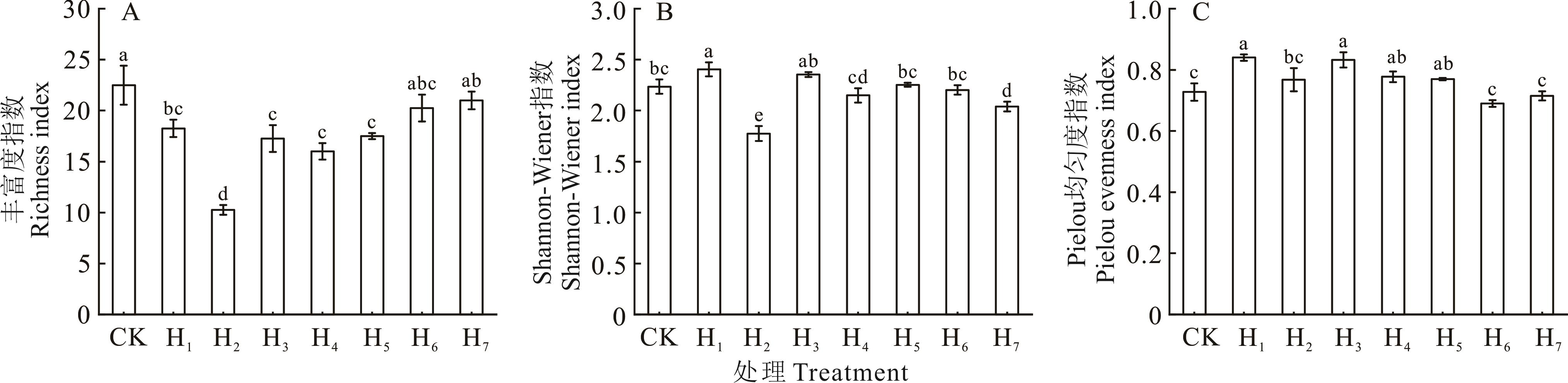
图1 喷施除草剂后当年草地植物群落多样性的变化不同小写字母表示不同除草剂间差异显著(P<0.05)。下同。Different lowercase letters indicate significant differences among different herbicides at the 0.05 level. The same below.
Fig.1 Changes in diversity of the grassland plant community within the year after herbicide application
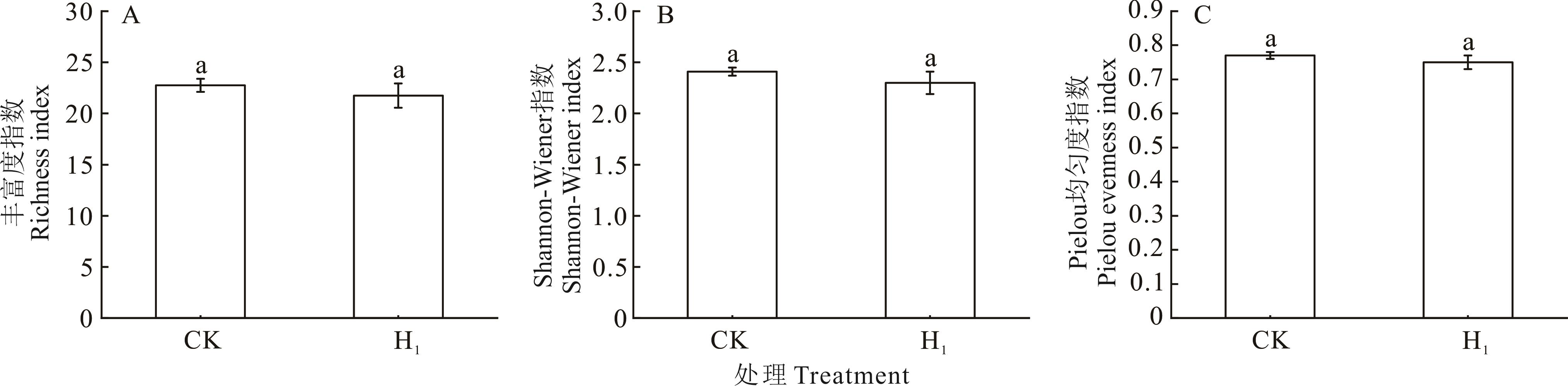
图2 喷施除草剂后翌年草地植物群落多样性的变化
Fig.2 Changes in diversity of the grassland plant community in the following year after herbicide application

图3 喷施除草剂后当年草地植物群落地上生物量的变化
Fig.3 Changes in aboveground biomass of the grassland plant community within the year after herbicide application

图4 喷施除草剂后翌年草地植物群落地上生物量的变化
Fig.4 Changes in aboveground biomass of the grassland plant community in the following year after herbicide application
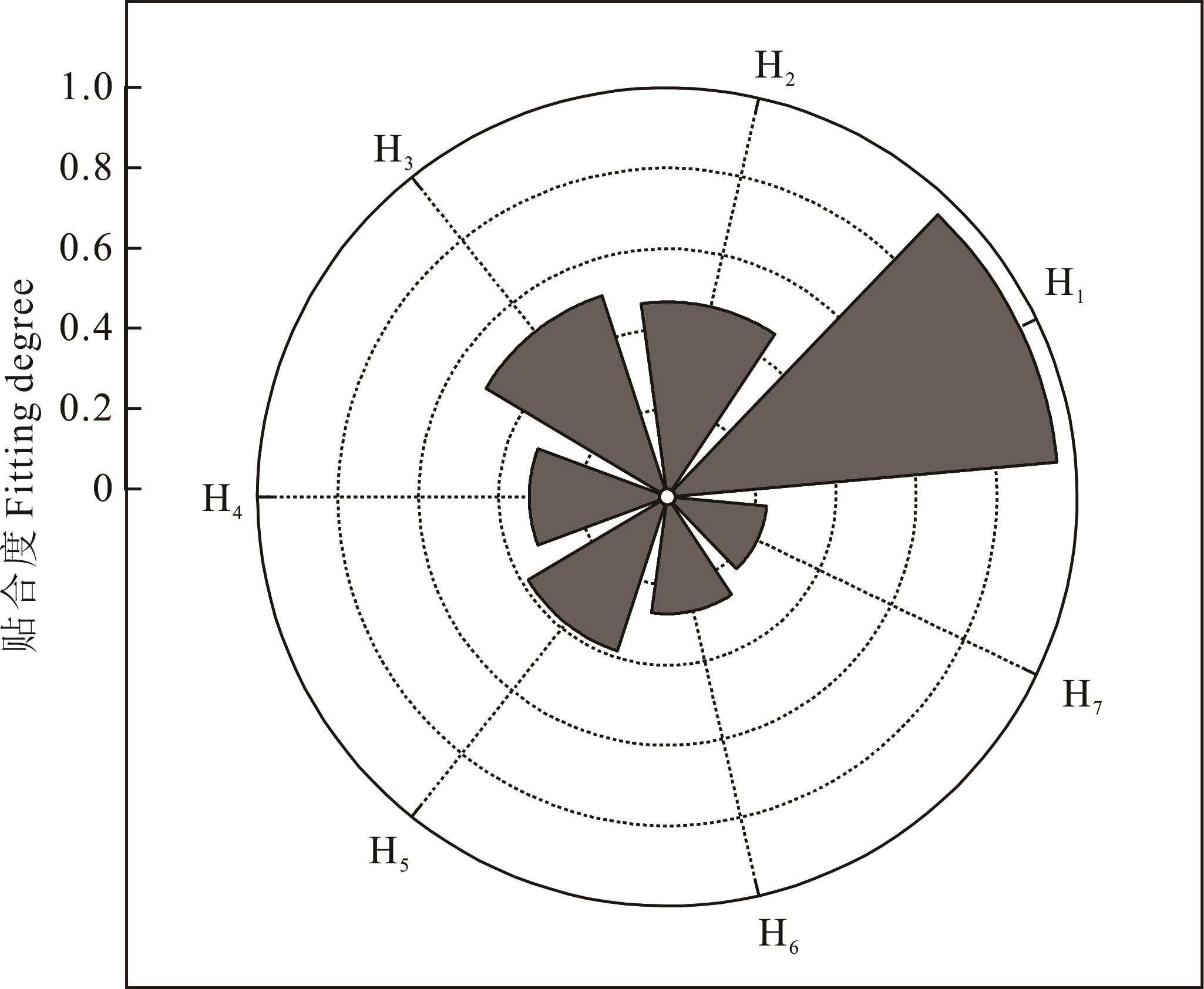
图5 不同除草剂的综合评价
Fig.5 Comprehensive evaluation of different herbicides
| [1] | Kemp D R, Han G D, Hou X Y, et al. Innovative grassland management systems for environmental and livelihood benefits. Proceedings of the National Academy of Sciences of the United States of America, 2013, 110(21): 8369-8374. |
| [2] | O’Mara F P. The role of grasslands in food security and climate change. Annals of Botany, 2012, 110(6): 1263-1270. |
| [3] | Zhao Y Y, Liu Z F, Wu J G. Grassland ecosystem services: a systematic review of research advances and future directions. Landscape Ecology, 2020, 35(4): 793-814. |
| [4] | Han D M, Wang G Q, Xue B L, et al. Evaluation of semiarid grassland degradation in North China from multiple perspectives. Ecological Engineering, 2018, 112(1): 41-50. |
| [5] | Hou H Y, Yun X J, Zhou J W, et al. Assessing restoration effectiveness: a comparative analysis of ecological restoration methods in temperate degraded grassland of Inner Mongolia. Chinese Journal of Grassland, 2025, 47(2): 39-47. |
| 侯慧扬, 运向军, 周建伟, 等. 不同修复方式在内蒙古退化温性草原植被生态修复中的应用效果综合评价. 中国草地学报, 2025, 47(2): 39-47. | |
| [6] | Yang S S, Sun J Y, Liu C, et al. Stellera chamaejasme expansion promotes the restoration of soil microbial diversity and ecosystem multifunctionality in degraded grasslands. Catena, 2024, 241(15): 112-120. |
| [7] | Sun G, Luo P, Wu N, et al. Stellera chamaejasme L. increases soil N availability, turnover rates and microbial biomass in an alpine meadow ecosystem on the eastern Tibetan Plateau of China. Soil Biology & Biochemistry, 2009, 41(1): 86-91. |
| [8] | Lu H, Wang S S, Zhou Q W, et al. Damage and control of major poisonous plants in the western grasslands of China-a review. Rangeland Journal, 2012, 34(4): 329-339. |
| [9] | Zhao Y T, Hu C M, Dong X, et al. NDVI characteristics and influencing factors of typical ecosystems in the semi-arid region of northern China: A case study of the Hulunbuir grassland. Land, 2023, 12(3): 1589-1606. |
| [10] | Zhang F, Wang Q, Li Y. Study on quantitative method of spatial and temporal dynamic monitoring of vegetation cover in Hulun Buir grassland. Journal of Natural Resources, 2010, 25(10): 1698-1708. |
| 张峰, 王桥, 李营. 呼伦贝尔草原植被覆盖时空动态变化监测定量方法研究. 自然资源学报, 2010, 25(10): 1698-1708. | |
| [11] | Zhu B B, Wei J, Sun S H, et al. Distribution and prevention and control practice of common poisonous grasses in Hulunbuir grassland. Journal of Grassland and Forage Science, 2025, 46(3): 48-51. |
| 朱宾宾, 伟军, 孙双红, 等. 呼伦贝尔草原常见毒害草区域分布与防控实践. 草学, 2025, 46(3): 48-51. | |
| [12] | Zhang Q. Effects and mechanisms of poisonous plants on plant community characteristics in Inner Mongolia meadow steppe. Changchun: Northeast Normal University, 2024. |
| 张庆. 内蒙古草甸草原有毒植物对植物群落特征的影响及途径分析. 长春: 东北师范大学, 2024. | |
| [13] | Guo J M. Effects of interaction between Stellera chamaejasme and Euphorbia fischeriana on soil microenvironment of degraded grasslands in Inner Mongolia. Changchun: Northeast Normal University, 2024. |
| 郭晶铭. 内蒙古退化草地狼毒-狼毒大戟相互作用对土壤微环境的影响. 长春: 东北师范大学, 2024. | |
| [14] | Deng Y Y. Secondary metabolites of three plants and their biological functions. Shenyang: Shenyang Agricultural University, 2019. |
| 邓彦彦. 三种植物的次生代谢产物及生物功能研究. 沈阳: 沈阳农业大学, 2019. | |
| [15] | Peng F H. Study on the diversity and spatial distribution pattern of three common poisonous plants in meadow grassland of Dumont County. Daqing: Heilongjiang Bayi Agricultural University, 2019. |
| 彭芳华. 杜蒙县草甸草原三种常见有毒植物多样性及空间分布格局研究. 大庆: 黑龙江八一农垦大学, 2019. | |
| [16] | Zhou P. The effects of Stellera on the rhizospher microbial community and the protein expression profile of chamaejasme under drought stress. Xi’an: Northwest University, 2015. |
| 周攀. 瑞香狼毒对根际微生物群落的影响及在干旱胁迫下狼毒蛋白表达谱的变化. 西安: 西北大学, 2015. | |
| [17] | Yang C, Sha R K, Surilage, et al. Research progress on distribution, toxicity, control and utilization of poisonous grass species in natural grassland of China. Journal of Domestic Animal Ecology, 2022, 43(11): 88-96. |
| 杨晨, 沙日扣, 苏日拉格, 等. 中国天然草原毒害草种类分布、毒性及防控与利用研究进展. 家畜生态学报, 2022, 43(11): 88-96. | |
| [18] | Guo Y Z, Zhang R H, Sun T, et al. Harm, control and comprehensive utilization of poisonous weeds in natural grasslands of Gansu Province. Acta Agrestia Sinica, 2017, 25(2): 243-256. |
| 郭亚洲, 张睿涵, 孙暾, 等. 甘肃天然草地毒草危害、防控与综合利用. 草地学报, 2017, 25(2): 243-256. | |
| [19] | Guo T, Yu Z H, Xue Y, et al. Screening and safety evaluation of herbicides for weed control in tobacco fields in Guizhou. Journal of Henan Agricultural Sciences, 2024, 53(5): 112-122. |
| 郭涛, 余知和, 薛原, 等. 贵州烟田杂草防控除草剂筛选与安全性评价. 河南农业科学, 2024, 53(5): 112-122. | |
| [20] | Shi Y X, He J, Zhang J, et al. Chemical constituents of Euphorbia fischeriana. Chinese Traditional and Herbal Drugs, 2020, 51(8): 2107-2111. |
| 史影雪, 赫军, 张佳, 等. 狼毒大戟化学成分研究. 中草药, 2020, 51(8): 2107-2111. | |
| [21] | Wei J C, Gao Y N, Huang H H, et al. Euphorfinoids A and B, a pair of ent-atisane diterpenoid epimers from the roots of Euphorbia fischeriana, and their bioactivities. Natural Product Research, 2023, 37(8): 1300-1309. |
| [22] | Lym R G. Leafy spurge (Euphorbia esula) control with glyphosate plus 2,4-D. Journal of Range Management, 2000, 53(1): 68-72. |
| [23] | Xie H Q, Yang T Y, Zhao L, et al. Efficacy in control against Stellera chamaejasme L. and impact on forage grass yield of 48% Garlon EC. Journal of Grassland and Forage Science, 2018, 39(3): 38-40. |
| 谢红旗, 杨廷勇, 赵磊, 等. 48%盖灌能乳油对草地狼毒的防治效果及牧草产量的影响. 草学, 2018, 39(3): 38-40. | |
| [24] | Pang N N, Cui Y, Hu J Y. Weather dependent dynamics of the herbicides florasulam, carfentrazone-ethyl, fluroxypyr-meptyl and fluroxypyr in wheat fields through field studies and computational simulation. Chemosphere, 2016, 165(1): 320-328. |
| [25] | Chen C, Wang Q H, Mo C H, et al. Control efficiency of forefront on Oxytropis ochrocephala and its influence on rangeland vegetation. Grassland and Turf, 2015, 35(3): 72-77. |
| 陈超, 王庆海, 莫重辉, 等. 迈士通除草剂对天然草地毒草黄花棘豆的防除效果及其植被的影响. 草原与草坪, 2015, 35(3): 72-77. | |
| [26] | Yu H Y, Li L X. Study on influence of applying herbicide to control Ligularia virgaurea on grassland vegetation. Qinghai Prataculture, 2018, 27(1): 7-10. |
| 于红妍, 李林霞. 防除草地黄帚橐吾药剂筛选试验研究. 青海草业, 2018, 27(1): 7-10. | |
| [27] | Wu C X, Liu W T, Lu X T, et al. Resistance of three kinds of broadleaved weeds in wheat field to tribenuron-methyl in Henan province. Journal of Triticeae Crops, 2016, 36(9): 1264-1268. |
| 吴翠霞, 刘伟堂, 路兴涛, 等. 河南省3种麦田阔叶杂草对苯磺隆的抗性. 麦类作物学报, 2016, 36(9): 1264-1268. | |
| [28] | Ge Y. Mechanism of soil fomesafen-contaminated remediation by different ecotypes of earthworms. Harbin: Northeast Agricultural University, 2025. |
| 葛闫. 不同生态型蚯蚓对氟磺胺草醚污染土壤的修复机制研究. 哈尔滨: 东北农业大学, 2025. | |
| [29] | Bao P A, Wen Z L, Wang Y, et al. Effects of different forage reseeding patterns on plant community structure and soil characteristics in desert steppe. Acta Prataculturae Sinica, 2025, 34(10): 62-73. |
| 鲍平安, 文志林, 王炎, 等. 不同牧草补播模式对荒漠草原植物群落结构及土壤特性的影响. 草业学报, 2025, 34(10): 62-73. | |
| [30] | Yang X L. Standard operating procedures for biological activity testing of pesticides-herbicides volume. Chinese Journal of Pesticide Science, 2017, 19(2): 188. |
| 杨新玲. 农药生物活性测试标准操作规范——除草剂卷. 农药学学报, 2017, 19(2): 188. | |
| [31] | Duan G H, Wang M, Chen L, et al. Effects of three pre-emergence herbicides on weed control in Atractylodes lancea and their safety evaluation. Plant Protection, 2024, 50(2): 325-331. |
| 段功豪, 王萌, 陈雷, 等. 三种苗前除草剂对茅苍术杂草防治效果及安全性评价. 植物保护, 2024, 50(2): 325-331. | |
| [32] | Feng L, Tian X S, Yue M F, et al. Chemical control abilities of 15 kinds of herbicides on the seedling and mature plants of ragweed (Ambrosia artemisiifolia L.). Chinese Agricultural Science Bulletin, 2011, 27(25): 117-120. |
| 冯莉, 田兴山, 岳茂峰, 等. 15种除草剂对不同生长时期豚草的防效评价. 中国农学通报, 2011, 27(25): 117-120. | |
| [33] | Li L, Hu J Y, Li Z Y, et al. Evaluation of control effects of 10 herbicides and their combinations on Achnatherum splendens. Plant Protection, 2020, 46(3): 285-290. |
| 李炼, 胡警匀, 栗振义, 等. 10种除草剂及组合对芨芨草的防效评价. 植物保护, 2020, 46(3): 285-290. | |
| [34] | Deng L, Xie L, He W, et al. Research progress on control methods for Oxytropis glabra. Xinjiang Animal Husbandry, 2015, 10(2): 10-12. |
| 邓利, 谢丽, 何雯, 等. 小花棘豆防除方法的研究进展. 新疆畜牧业, 2015, 10(2): 10-12. | |
| [35] | Xu M T, Wang H, Xu J C, et al. Safety and bioactivity evaluation of triclopyr on wheat. Journal of Triticeae Crops, 2022, 42(9): 1162-1169. |
| 许孟桃, 王惠, 许锦程, 等. 三氯吡氧乙酸对小麦的安全性及生物活性评价. 麦类作物学报, 2022, 42(9): 1162-1169. | |
| [36] | Li B. The synthesis of fluroxypyr-dodecyl as herbicide. Wuhan: Wuhan Institute of Technology, 2010. |
| 李博. 氯氟吡氧乙酸十二酯的合成工艺研究. 武汉: 武汉工程大学, 2010. | |
| [37] | Kang X D. Experimental trials and explorations on chemical control of Stellera chamaejasme in alpine pastoral regions. Xinjiang Animal Husbandry, 2008, 12(3): 63-64. |
| 康旭东. 高寒牧区化除狼毒草试验探索. 新疆畜牧业, 2008, 12(3): 63-64. | |
| [38] | Duke S O, Powles S B. Glyphosate: a once-in-a-century herbicide. Pest Management Science, 2008, 64(4): 319-325. |
| [39] | Chu S H, Huang Q C, Li L, et al. Control effects of different glyphosate mixtures on Solidago canadensis L. China Plant Protection, 2025, 45(2): 79-82, 90. |
| 褚世海, 黄启超, 李林, 等. 草甘膦不同复配剂对加拿大一枝黄花的防效比较. 中国植保导刊, 2025, 45(2): 79-82, 90. | |
| [40] | Qiao P Y, Wang A D, Xie B H, et al. Effects of herbicides on invasive Spartina alterniflora in the Yellow River Delta. Acta Ecologica Sinica, 2019, 39(15): 5627-5634. |
| 乔沛阳, 王安东, 谢宝华, 等. 除草剂对黄河三角洲入侵植物互花米草的影响. 生态学报, 2019, 39(15): 5627-5634. | |
| [41] | Bao G S, Wang H S, Zeng H. Effects of adding organosilicon adjuvants to Langdujing on enhancing control effect and plant diversity of grassland communities. Pratacultural Science, 2015, 32(2): 263-268. |
| 鲍根生, 王宏生, 曾辉. 有机硅助剂对“狼毒净”防除狼毒效果及草地植物群落多样性的影响. 草业科学, 2015, 32(2): 263-268. | |
| [42] | Cao J J, Gu T, Zhang Z C, et al. Research on herbicides for controlling Solidago canadensis L. in different habitats. Journal of Weed Science, 2024, 42(4): 82-90. |
| 曹晶晶, 谷涛, 张自常, 等. 防除不同生境下加拿大一枝黄花的除草剂研究. 杂草学报, 2024, 42(4): 82-90. | |
| [43] | Chen W M, Xu L L, Wu J J, et al. Effect of two pyridine herbicides on Stelleropsis tianschanica community and evaluation on yield and selectivity to gramineous pastures. Journal of Weed Science, 2016, 34(1): 43-46, 48-49. |
| 陈卫民, 徐林林, 吴加军, 等. 2种吡啶类除草剂对天山假狼毒群落影响和禾本科牧草产草量及安全性评价. 杂草学报, 2016, 34(1): 43-46, 48-49. | |
| [44] | Wang Y Q, Song M L, Bao G S, et al. Variation of C, N and P stoichiometry in plant and soil after removal Stellera chamaejasme in Stellera chamaejasme patches. Acta Ecologica Sinica, 2021, 41(15): 6280-6288. |
| 王玉琴, 宋梅玲, 鲍根生, 等. 防除狼毒对狼毒斑块植物-土壤C、N、P化学计量特征的影响. 生态学报, 2021, 41(15): 6280-6288. | |
| [45] | Zhao C Z, Fan S Y, Yin C Q. Herbicide technology to combat poisonous weed containing degraded grassland. Acta Prataculturae Sinica, 2004, 40(4): 87-94. |
| 赵成章, 樊胜岳, 殷翠琴. 喷施灭狼毒治理毒杂草型退化草地技术研究. 草业学报, 2004, 40(4): 87-94. | |
| [46] | Zhang X H, Liu L L, Fu X Y. The brief introduction of the properties applications and environmental residues of glyphosate herbicides. Leather Manufacture and Environmental Technology, 2023, 4(18): 57-59. |
| 张旭鸿, 刘莲莲, 付晓燕. 简述草甘膦除草剂的特性、应用及环境残留. 皮革制作与环保科技, 2023, 4(18): 57-59. | |
| [47] | Rodriguez A M, Jacobo E J. Glyphosate effects on floristic composition and species diversity in the Flooding Pampa grassland (Argentina). Agriculture Ecosystems & Environment, 2010, 138(3/4): 222-231. |
| [1] | 石文杰, 李小伟, 任振强, 刘吉德, 刘玲, 郝淑香, 李云霞. 毛乌素沙地不同年限柠条固沙林林下草本土壤种子库特征研究[J]. 草业学报, 2026, 35(8): 1-13. |
| [2] | 刘瞳, 苏日力格null, 姜娜, 庞波, 乌日力格null, 杨陶阳, 张海芳, 赵建宁, 杨殿林. 狼毒大戟扩散对呼伦贝尔草原植物群落演替及土壤理化性质的影响[J]. 草业学报, 2026, 35(5): 72-84. |
| [3] | 尚栋亮, 臧辉. 成坪高尔夫草坪上一年生早熟禾的化学防除研究进展[J]. 草业学报, 2025, 34(5): 223-236. |
| [4] | 马源, 王晓丽, 王彦龙, 马玉寿, 崔海鹏. 生态恢复领域草种丸粒化研究进展[J]. 草业学报, 2023, 32(4): 197-207. |
| [5] | 蒋翔, 马建霞. 我国草地生态恢复对不同因素响应的Meta分析[J]. 草业学报, 2021, 30(2): 14-31. |
| [6] | 罗楠, 舒英格, 陈梦军, 肖盛杨. 喀斯特山区不同草地土壤结构及分形特征[J]. 草业学报, 2020, 29(7): 11-22. |
| [7] | 王婷, 张永超, 赵之重. 青藏高原退化高寒湿地植被群落结构和土壤养分变化特征[J]. 草业学报, 2020, 29(4): 9-18. |
| [8] | 常海涛, 赵娟, 刘佳楠, 刘任涛, 罗雅曦, 张静. 退耕还林与还草对土壤理化性质及分形特征的影响——以宁夏荒漠草原为例[J]. 草业学报, 2019, 28(7): 14-25. |
| [9] | 张灵菲, 卫万荣, 石高宇, 张卫国. 高寒草甸植物群落结构对高原鼠兔种群密度的影响[J]. 草业学报, 2019, 28(3): 93-100. |
| [10] | 王柔懿, 盛军, 贾竣棋, 李海燕, 杨允菲. 通辽火电厂储灰池植被恢复过程中硬拂子茅种群构件的结构特征[J]. 草业学报, 2019, 28(1): 180-187. |
| [11] | 贾希洋, 马红彬, 周瑶, 张蕊, 宿婷婷, 张双乔, 张俊. 不同生态恢复措施下宁夏黄土丘陵区典型草原植物群落数量分类和演替[J]. 草业学报, 2018, 27(2): 15-25. |
| [12] | 李武斌,何丙辉,王力,申建红,黄治清,张兴华,文基坚,代万贵. 九寨沟马脑壳金矿矿山土壤养分空间分布格局[J]. 草业学报, 2011, 20(3): 1-9. |
| [13] | 张晓艳 ,胡玉昆,姬承东,郭正刚,公延明. 2,4-D丁酯对轮叶马先蒿的防除效果及对草地植被的影响[J]. 草业学报, 2009, 18(4): 168-174. |
| 阅读次数 | ||||||
|
全文 |
|
|||||
|
摘要 |
|
|||||
