

ISSN 1004-5759 CN 62-1105/S
草业学报 ›› 2025, Vol. 34 ›› Issue (12): 62-72.DOI: 10.11686/cyxb2025021
刘晨旭1( ), 宋彦涛1(), 孙磊2, 彭滔1, 乌云娜1
收稿日期:2025-01-20
修回日期:2025-03-17
出版日期:2025-12-20
发布日期:2025-10-20
通讯作者:
宋彦涛
作者简介:E-mail: yantaosong@dlnu.edu.cn基金资助:
Chen-xu LIU1(), Yan-tao SONG1(), Lei SUN2, Tao PENG1, Wuyunna1
Received:2025-01-20
Revised:2025-03-17
Online:2025-12-20
Published:2025-10-20
Contact:
Yan-tao SONG
摘要:
围封是恢复退化草原生态系统的有效措施之一。为探寻围封对草原植物群落的影响,本研究在那曲市班戈县,以羌塘草原围封区域为研究对象,选取围封5、9、13、17以及21年样地,对照为各围封年限样地围栏外自由放牧样地。通过方差分析、回归分析和相关性分析研究两种土地利用方式对植物群落特征、植物群落多样性以及两者间关系的影响。结果表明:围封增加了优势种紫花针茅的重要值,围封不同年限后地上生物量、盖度、高度和密度均有不同程度的提高,其中在围封9、21年后围栏内显著高于围栏外(P<0.05)。围封9年后,围栏内α多样性指数显著低于围栏外(P<0.05)。并且围封后,地上生物量和植物群落多样性的关系发生改变,围栏外地上生物量和植物群落多样性的关系呈正相关趋势,但并不显著(P>0.05),而围栏内二者的关系呈显著的负相关趋势(P<0.05)。综上所述:羌塘草原围封9年左右是较为合理的时间,而围封后,根据“质量比假说”优势种(紫花针茅)地上生物量的增加是影响地上生物量和植物群落多样性关系的关键因子。
刘晨旭, 宋彦涛, 孙磊, 彭滔, 乌云娜. 围封改变了羌塘草原植物群落多样性和地上生物量间的关系[J]. 草业学报, 2025, 34(12): 62-72.
Chen-xu LIU, Yan-tao SONG, Lei SUN, Tao PENG, Wuyunna. Grazing exclusion modifies the relationship between plant community diversity and aboveground biomass in the Qiangtang grassland[J]. Acta Prataculturae Sinica, 2025, 34(12): 62-72.
样地 Plot | 围封年限 Exclosure period (a) | 经度 Longitude (E) | 纬度 Latitude (N) | 海拔 Altitude (m) |
|---|---|---|---|---|
| 嘎凉村Galiang Village | 5 | 89°36′23″ | 31°10′25″ | 4840 |
| 杂空组Zakongzu | 9 | 90°59′08″ | 30°59′07″ | 4750 |
| 谢麦珠Xiemaizhu | 13 | 89°43′14″ | 31°47′05″ | 4600 |
| 那查玉Nachayu | 17 | 89°36′20″ | 31°56′45″ | 4580 |
| 果加村Guojia Village | 21 | 89°45′10″ | 31°10′20″ | 4590 |
表1 研究区概况
Table 1 Information of study area
样地 Plot | 围封年限 Exclosure period (a) | 经度 Longitude (E) | 纬度 Latitude (N) | 海拔 Altitude (m) |
|---|---|---|---|---|
| 嘎凉村Galiang Village | 5 | 89°36′23″ | 31°10′25″ | 4840 |
| 杂空组Zakongzu | 9 | 90°59′08″ | 30°59′07″ | 4750 |
| 谢麦珠Xiemaizhu | 13 | 89°43′14″ | 31°47′05″ | 4600 |
| 那查玉Nachayu | 17 | 89°36′20″ | 31°56′45″ | 4580 |
| 果加村Guojia Village | 21 | 89°45′10″ | 31°10′20″ | 4590 |
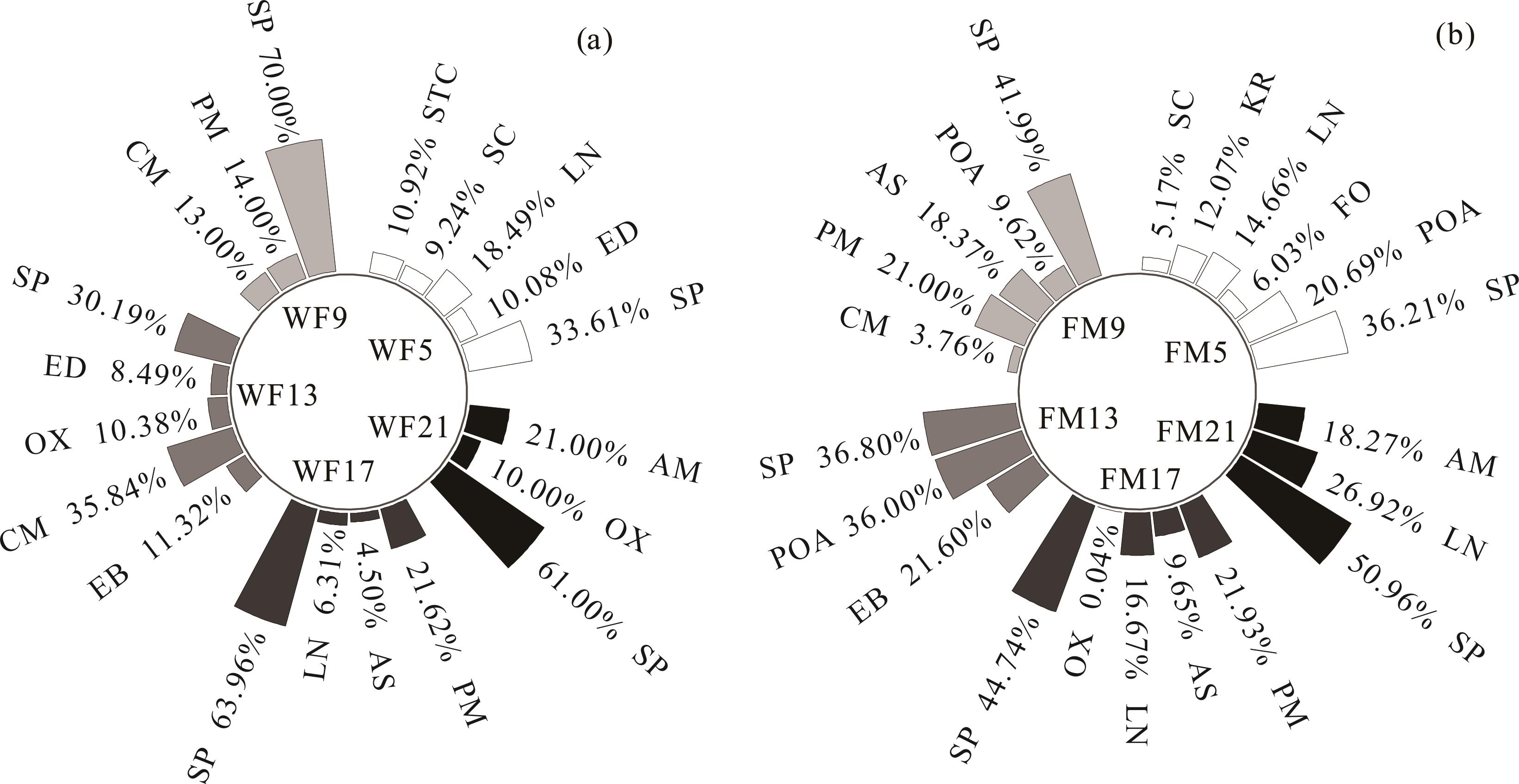
图 1 围封对优势种重要值的影响WF5, WF9, WF13, WF17, WF21分别为围封5, 9, 13, 17, 21年Enclosed for 5, 9, 13, 17, 21 years, respectively; FM5, FM9, FM13, FM17, FM21分别为放牧5, 9, 13, 17, 21年 Grazed for 5, 9, 13, 17, 21 years, respectively; SP: 紫花针茅S. purpurea; PM: 多裂叶委陵菜Potentilla multifida; CM: 青藏苔草Carex moorcroftii; ED: 披碱草Elymus dahuricus; OX: 棘豆Oxytropis; EB: 雪灵芝Eremogone brevipetala; LN: 矮火绒草Leontopodium nanum; AM: 昆仑蒿Artemisia manschanica; SC: 狼毒草Stellera chamaejasne; POA: 早熟禾Poa annua; AS: 阿尔泰狗娃花Aster altaicus; FO: 羊茅Festuca ovina; KR: 粗壮嵩草Kobresia robusta; STC: 西藏风毛菊Saussurea tibetica; 下同The same below.
Fig.1 Effect of enclosure on important value of dominant species
| 项目Item | ET | EP | ET×EP |
|---|---|---|---|
| 地上生物量AGB | *** | *** | ** |
| 盖度Coverage | *** | *** | ns |
| 高度Height | * | ** | * |
| 密度Density | * | *** | ns |
| 多样性指数H | ns | * | ns |
| 优势度指数D | ns | * | ns |
| 丰富度指数Ma | ns | *** | ns |
| 均匀度指数J | ns | ** | ns |
表2 围封处理和围封年限双因素方差分析
Table 2 Two-way ANOVA for enclosure treatment and enclosure duration
| 项目Item | ET | EP | ET×EP |
|---|---|---|---|
| 地上生物量AGB | *** | *** | ** |
| 盖度Coverage | *** | *** | ns |
| 高度Height | * | ** | * |
| 密度Density | * | *** | ns |
| 多样性指数H | ns | * | ns |
| 优势度指数D | ns | * | ns |
| 丰富度指数Ma | ns | *** | ns |
| 均匀度指数J | ns | ** | ns |

图2 围封对地上生物量、盖度特征的影响不同大写字母表示两种不同处理间差异显著(P<0.05),不同小写字母表示在同一处理下不同年限间差异显著(P<0.05),下同Different capital letters indicate significant differences between the two different treatments (P<0.05), while different lowercase letters indicate significant differences among different durations within the same treatment (P<0.05), the same below.
Fig.2 Effect of enclosure on aboveground biomass and coverage characteristics
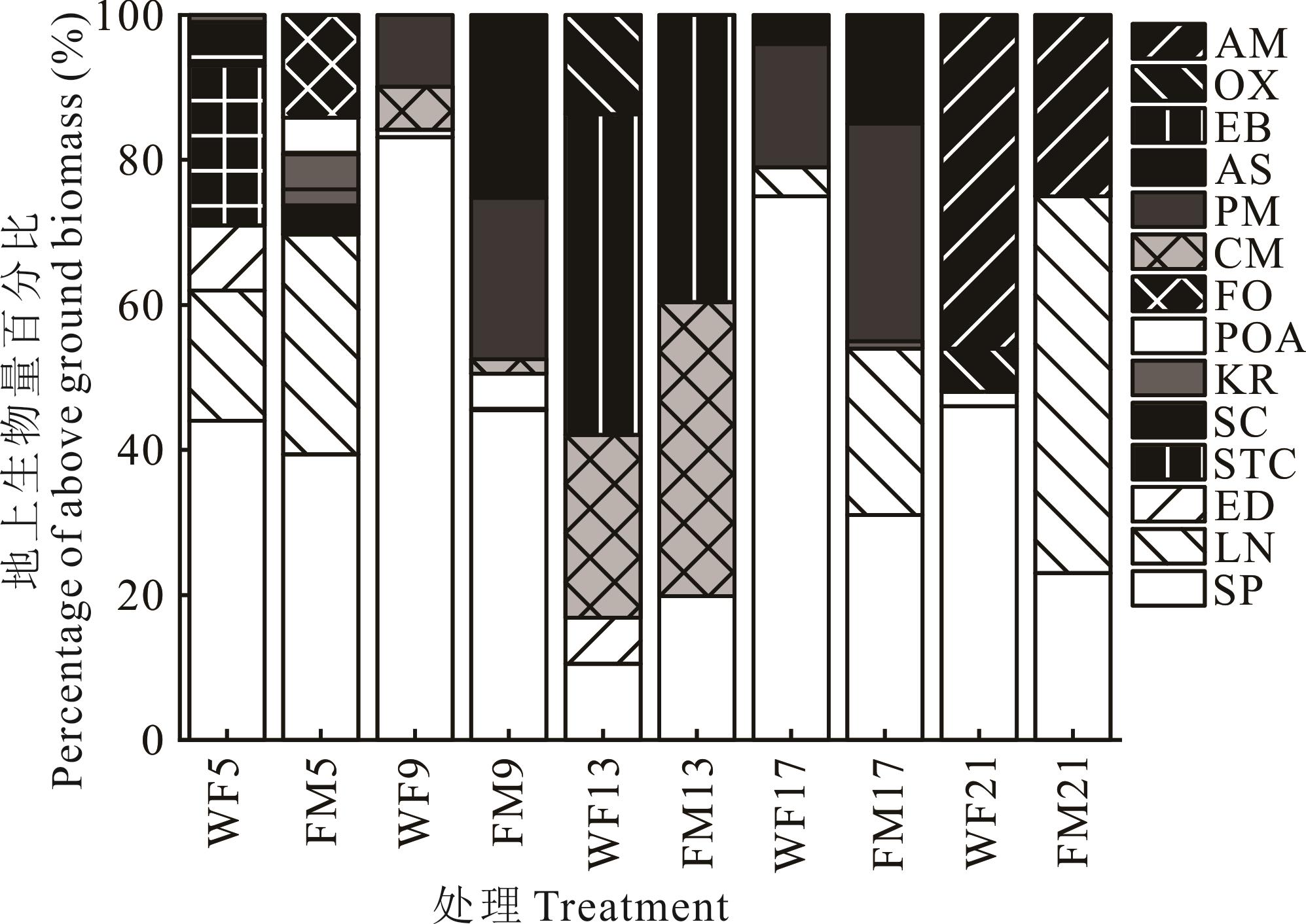
图3 围封对不同物种地上生物量百分比的影响
Fig.3 Effect of enclosure on percentage of aboveground biomass among different species
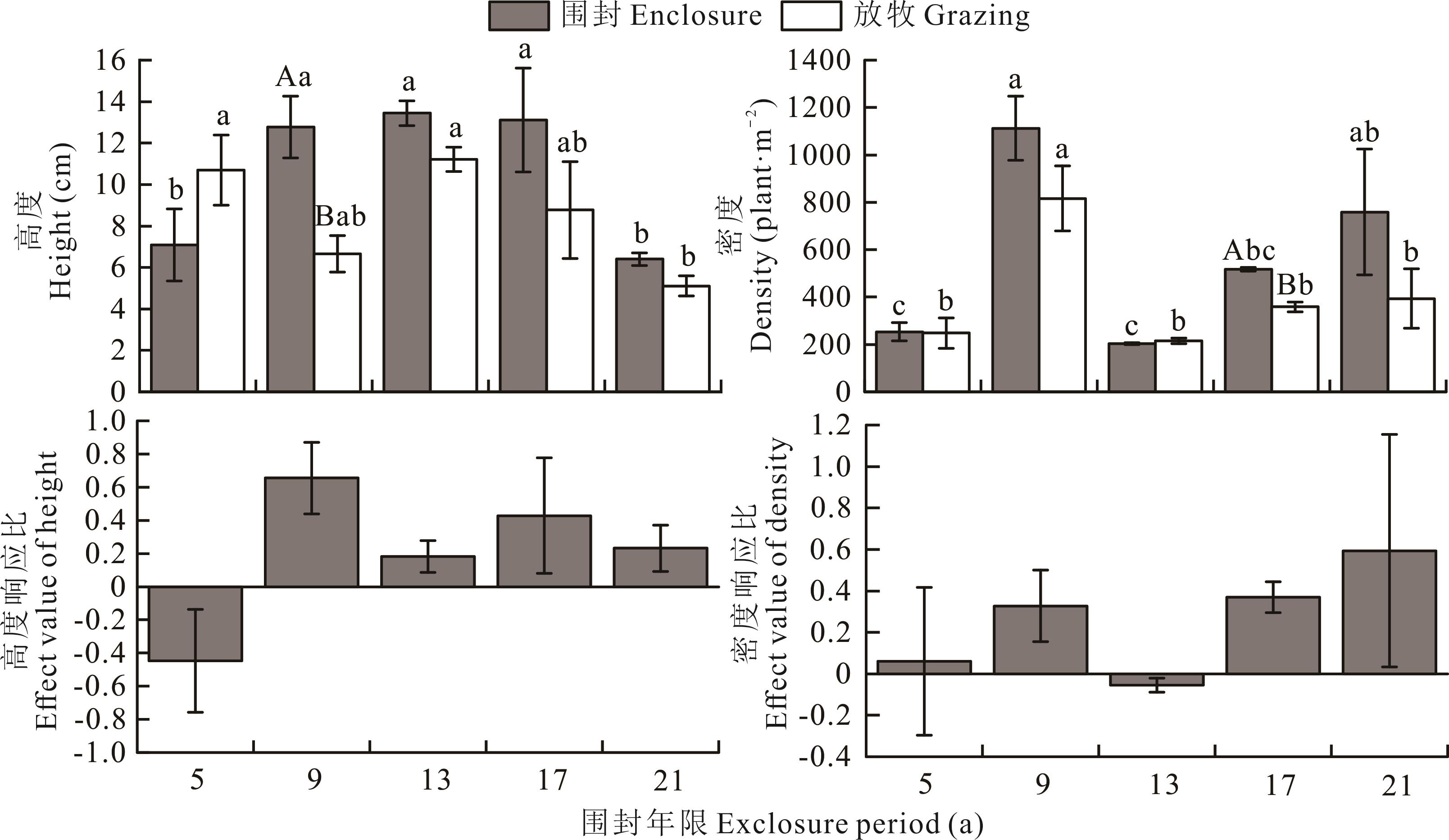
图4 围封对高度、密度特征的影响
Fig.4 Effect of enclosure on height and density characteristics

图5 围封对优势度指数、多样性指数的影响
Fig.5 Effect of enclosure on the Simpson and Shannon-Wiener index
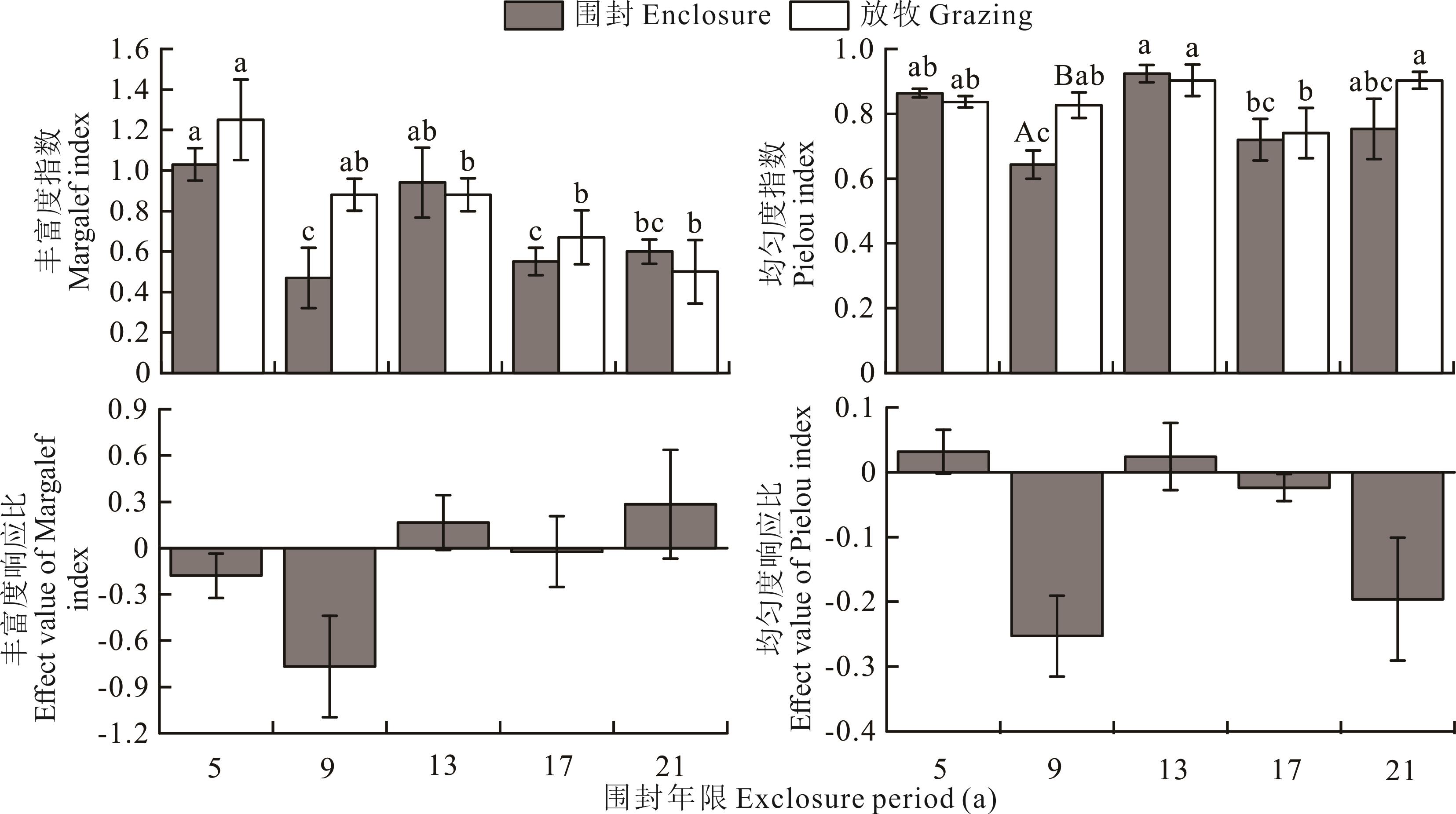
图6 围封对丰富度指数、均匀度指数的影响
Fig.6 Effect of enclosure on the Margalef and Pielou index
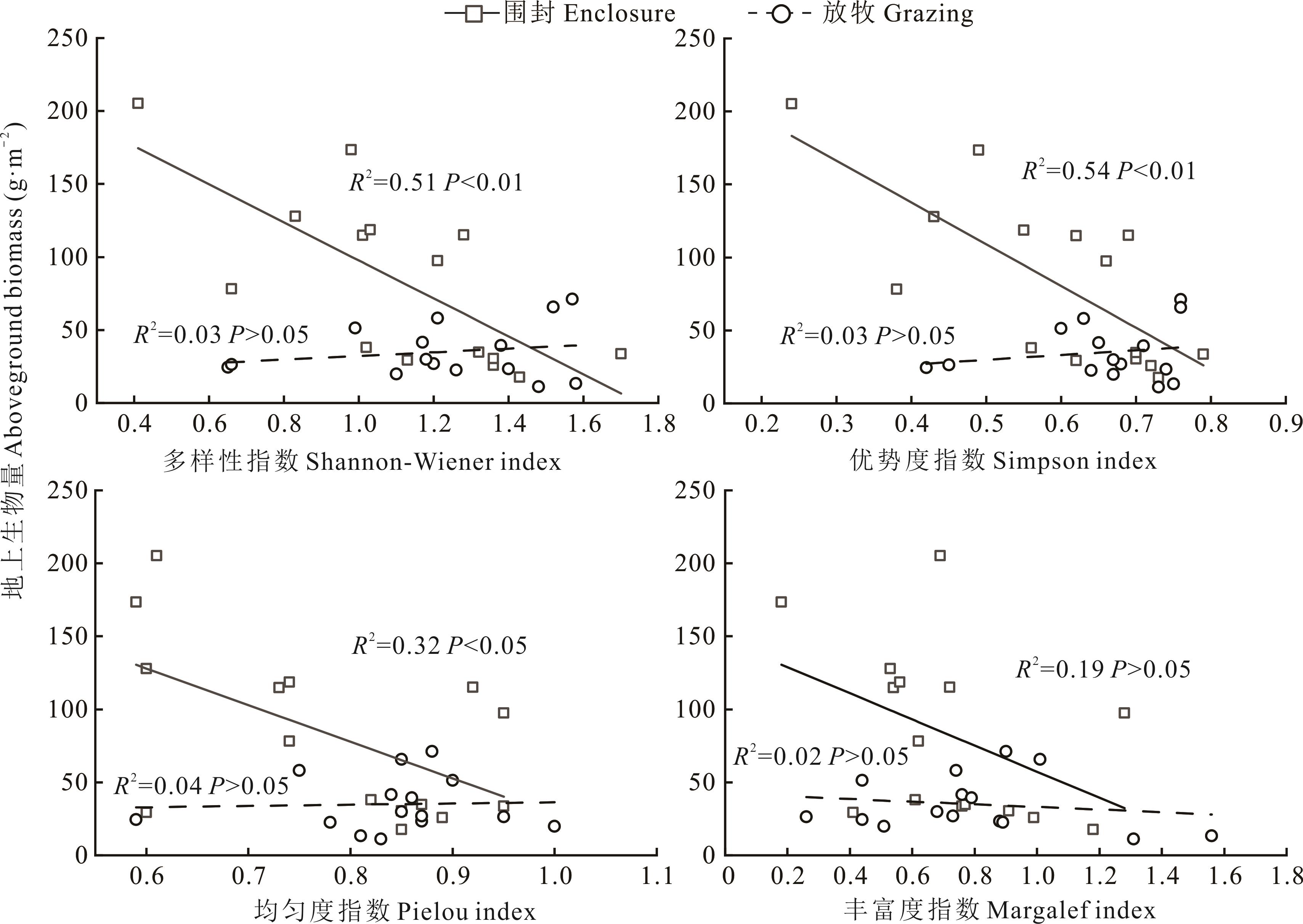
图7 地上生物量和α多样性指数的回归分析
Fig.7 Regression analysis of aboveground biomass and alpha diversity index
项目 Item | 地上生物量 AGB | 地上生物量AGB | 盖度 Coverage | 高度 Height | 密度 Density | 丰富度 Ma | 优势度 D | 多样性 H | 均匀度 J | |
|---|---|---|---|---|---|---|---|---|---|---|
| DAGB | NDAGB | |||||||||
| 地上生物量AGB | 0.88*** | 0.26 | 0.82*** | 0.18 | 0.80*** | -0.43 | -0.74** | -0.72** | -0.69** | |
| DAGB | 0.81*** | -0.23 | 0.77*** | 0.29 | 0.87*** | -0.58* | -0.84*** | -0.78*** | -0.82*** | |
| NDAGB | 0.31 | -0.18 | 0.11 | -0.22 | -0.13 | 0.29 | 0.19 | 0.12 | 0.26 | |
| 盖度Coverage | 0.57* | 0.38 | 0.20 | -0.14 | 0.74** | -0.56* | -0.70** | -0.65** | -0.72** | |
| 高度Height | -0.46 | -0.27 | -0.30 | -0.55* | 0.08 | -0.06 | -0.37 | -0.36 | -0.21 | |
| 密度Density | 0.80*** | 0.85*** | -0.21 | 0.58* | -0.36 | -0.61* | -0.81*** | -0.80*** | -0.85*** | |
| 丰富度Ma | 0.00 | 0.27 | -0.23 | 0.03 | 0.33 | 0.08 | 0.47 | 0.44 | 0.58* | |
| 优势度D | 0.27 | 0.44 | 0.04 | -0.03 | 0.35 | 0.17 | 0.77*** | 0.97*** | 0.92*** | |
| 多样性H | 0.31 | 0.51 | -0.05 | 0.09 | 0.29 | 0.26 | 0.85*** | 0.98*** | 0.90*** | |
| 均匀度J | 0.04 | -0.06 | 0.36 | -0.05 | -0.30 | -0.19 | -0.10 | 0.03 | -0.04 | |
表3 植物群落特征与α多样性指数的相关性
Table 3 Correlation between plant community characteristics and alpha diversity index
项目 Item | 地上生物量 AGB | 地上生物量AGB | 盖度 Coverage | 高度 Height | 密度 Density | 丰富度 Ma | 优势度 D | 多样性 H | 均匀度 J | |
|---|---|---|---|---|---|---|---|---|---|---|
| DAGB | NDAGB | |||||||||
| 地上生物量AGB | 0.88*** | 0.26 | 0.82*** | 0.18 | 0.80*** | -0.43 | -0.74** | -0.72** | -0.69** | |
| DAGB | 0.81*** | -0.23 | 0.77*** | 0.29 | 0.87*** | -0.58* | -0.84*** | -0.78*** | -0.82*** | |
| NDAGB | 0.31 | -0.18 | 0.11 | -0.22 | -0.13 | 0.29 | 0.19 | 0.12 | 0.26 | |
| 盖度Coverage | 0.57* | 0.38 | 0.20 | -0.14 | 0.74** | -0.56* | -0.70** | -0.65** | -0.72** | |
| 高度Height | -0.46 | -0.27 | -0.30 | -0.55* | 0.08 | -0.06 | -0.37 | -0.36 | -0.21 | |
| 密度Density | 0.80*** | 0.85*** | -0.21 | 0.58* | -0.36 | -0.61* | -0.81*** | -0.80*** | -0.85*** | |
| 丰富度Ma | 0.00 | 0.27 | -0.23 | 0.03 | 0.33 | 0.08 | 0.47 | 0.44 | 0.58* | |
| 优势度D | 0.27 | 0.44 | 0.04 | -0.03 | 0.35 | 0.17 | 0.77*** | 0.97*** | 0.92*** | |
| 多样性H | 0.31 | 0.51 | -0.05 | 0.09 | 0.29 | 0.26 | 0.85*** | 0.98*** | 0.90*** | |
| 均匀度J | 0.04 | -0.06 | 0.36 | -0.05 | -0.30 | -0.19 | -0.10 | 0.03 | -0.04 | |
| [1] | Cao X J, Ganjurjav H, Liang Y, et al. Temporal and spatial distribution of grassland degradation in northern Tibet based on NDVI. Acta Prataculturae Sinica, 2016, 25(3): 1-8. |
| 曹旭娟, 干珠扎布, 梁艳, 等. 基于NDVI的藏北地区草地退化时空分布特征分析. 草业学报, 2016, 25(3): 1-8. | |
| [2] | Li J X, Zhang Q S, Wu Y, et al. Research progress on the effects of enclosure on grassland vegetation growth and soil properties. Chinese Journal of Grassland, 2023, 45(5): 137-150. |
| 李佳秀, 张青松, 吴勇, 等. 围封对草地植被生长和土壤特性的影响研究进展. 中国草地学报, 2023, 45(5): 137-150. | |
| [3] | Conant R T, Paustian K. Potential soil carbon sequestration in overgrazed grassland ecosystems. Global Biogeochemical Cycles, 2002, 16(4): 90-99. |
| [4] | Bennett J A, Koch A M, Forsythe J, et al. Resistance of soil biota and plant growth to disturbance increases with plant diversity. Ecology Letters, 2020, 23(1): 119-128. |
| [5] | Sun W, Li S, Wang J, et al. Effects of grazing on plant species and phylogenetic diversity in alpine grasslands, Northern Tibet. Ecological Engineering, 2021, 170: 106331. |
| [6] | Schuldt A, Ebeling A, Kunz M, et al. Multiple plant diversity components drive consumer communities across ecosystems.Nature Communications, 2019, 10: 1460. |
| [7] | Sanaei A, Sayer E J, Yuan Z, et al. Grazing intensity alters the plant diversity-ecosystem carbon storage relationship in rangelands across topographic and climatic gradients. Functional Ecology, 2023, 37(3): 703-718. |
| [8] | Whittaker R J. Meta-analyses and mega-mistakes: Calling time on meta-analysis of the species richness-productivity relationship. Ecology, 2010, 91(9): 2522-2533. |
| [9] | Cusens J, Wright S D, Mcbride P D, et al. What is the form of the productivity-animal‐species‐richness relationship? A critical review and Meta-analysis. Ecology, 2012, 93(10): 2241-2252. |
| [10] | Grace J B, Adler P B, Seabloom E W, et al. Response to comments on “Productivity is a poor predictor of plant species richness”. Science, 2012, 335(6075): 1441. |
| [11] | Ma Y, Ma W, Zhong L, et al. Monitoring and modeling the Tibetan Plateau’s climate system and its impact on East Asia. Scientific Reports, 2017, 7(1): 44574. |
| [12] | Li W, Li J, Liu S, et al. Magnitude of species diversity effect on aboveground plant biomass increases through successional time of abandoned farmlands on the eastern Tibetan Plateau of China. Land Degradation Development, 2017, 28(1): 370-378. |
| [13] | Grace J B, Anderson T M, Seabloom E W, et al. Integrative modelling reveals mechanisms linking productivity and plant species richness. Nature, 2016, 529(7586): 390-393. |
| [14] | Sanaei A, Ali A, Chahouki M A Z, et al. Plant coverage is a potential ecological indicator for species diversity and aboveground biomass in semi-steppe rangelands. Ecological Indicators, 2018, 93: 256-266. |
| [15] | Dong S K, Gao H W, Xu G C, et al. Farmer and professional attitudes to the large-scale ban on livestock grazing of grasslands in China. Environmental Conservation, 2007, 34(3): 246-254. |
| [16] | Wu J, Zhang X, Shen Z, et al. Effects of livestock exclusion and climate change on aboveground biomass accumulation in alpine pastures across the Northern Tibetan Plateau. Chinese Science Bulletin, 2014, 59: 4332-4340. |
| [17] | Bang S H, Zhao W, Yao W W, et al. Effects of fertilization and enclosure on the temporal stability of aboveground net primary productivity in an alpine meadow of the Tibetan Plateau. Pratacultural Science, 2024, 41(3): 611-619. |
| 蚌绍豪, 赵维, 姚万万, 等. 施肥和围封对青藏高原高寒草甸生产力稳定性的影响. 草业科学, 2024, 41(3): 611-619. | |
| [18] | Wu J B, Wang X D. Effect of enclosure ages on community characters and biomass of the degraded alpine steppe at the Northern Tibet. Acta Agrestia Sinica, 2017, 25(2): 261-266. |
| 吴建波, 王小丹. 围封年限对藏北退化高寒草原植物群落特征和生物量的影响. 草地学报, 2017, 25(2): 261-266. | |
| [19] | Fedrigo J K, Ataide P F, Filho J A, et al. Temporary grazing exclusion promotes rapid recovery of species richness and productivity in a long-term overgrazed Campos grassland. Restoration Ecology, 2018, 26(4): 677-685. |
| [20] | Yang J, Zhan W, Wang X T. Effects of enclosure on plant community characteristics of degraded alpine steppe in Northern Tibet. Chinese Journal of Grassland, 2020, 42(6): 44-49, 140. |
| 杨军, 詹伟, 王向涛. 10年围栏封育对藏北退化高寒草甸植物群落特征的影响. 中国草地学报, 2020, 42(6): 44-49, 140. | |
| [21] | Gao F, Wang B, Shi Y X, et al. The response of alpine grasslands ecosystem in the North Tibet to short-term enclosure. Acta Ecologica Sinica, 2017, 37(13): 4366-4374. |
| 高凤, 王斌, 石玉祥, 等. 藏北古露高寒草地生态系统对短期围封的响应. 生态学报, 2017, 37(13): 4366-4374. | |
| [22] | Danzengtaqing, Baimagaweng, Duojidunzhu, et al. Effects of livestock exclusion duration years on plant and soil properties in a Tibetan alpine meadow. Pratacultural Science, 2018, 35(1): 10-17. |
| 旦增塔庆, 白玛嘎翁, 多吉顿珠, 等. 围封年限对西藏高寒草甸植被特征与土壤养分的影响. 草业科学, 2018, 35(1): 10-17. | |
| [23] | Li Z W, Miao Y J, Zong N. Effects of grazing exclusion on plant diversity and ecosystem multifunctionality of alpine grassland in Northern Xizang. Acta Agrestia Sinica, 2025, 33(2): 596-608. |
| 李振威, 缪雨珏, 宗宁. 围栏封育对藏北高寒草地植物多样性与生态系统多功能性的影响. 草地学报, 2025, 33(2): 596-608. | |
| [24] | Hao H M, Liu Y, Wang D, et al. Influence of restoration on community plant diversity and spatial structure of typical grasslands. Acta Agrestia Sinica, 2016, 24(4): 754-759. |
| 郝红敏, 刘玉, 王冬, 等. 典型草原开垦弃耕后不同年限群落植物多样性和空间结构特征. 草地学报, 2016, 24(4): 754-759. | |
| [25] | Guo Z L, Ma Y D, Zheng J P, et al. Biodiversity of tree species, their populations’spatial distribution pattern and interspecific association in mixed deciduous broadleaved forest in Changbai Mountations. Chinese Journal of Applied Ecology, 2004(11):2013-2018. |
| 郭忠玲, 马元丹, 郑金萍, 等. 长白山落叶阔叶混交林的物种多样性、种群空间分布格局及种间关联性研究. 应用生态学报, 2004(11): 2013-2018. | |
| [26] | Hedges L V, Gurevitch J, Curtis P S. The Meta-analysis of response ratios in experimental ecology. Ecology, 1999, 80(4): 1150-1156. |
| [27] | Wang Y T, Liu J K, Wu Z J, et al. Impact of enclosure on characteristics diversities of typical vegetation communities in desert grasslands. Research of Soil and Water Conservation, 2025, 32(1): 121-130, 140. |
| 王益涛, 刘建康, 武志嘉, 等. 围封对荒漠草原典型植物群落特征及多样性的影响. 水土保持研究, 2025, 32(1): 121-130, 140. | |
| [28] | Yan Y C, Tang H P, Xin X P, et al. Advances in research on the effects of exclosure on grasslands. Acta Ecologica Sinica, 2009, 29(9): 5039-5046. |
| 闫玉春, 唐海萍, 辛晓平, 等. 围封对草地的影响研究进展. 生态学报, 2009, 29(9): 5039-5046. | |
| [29] | Zhao L Y, Zhong H S, Zhao M Y, et al. Effect of enclosure and grazed management on aboveground biomass and species diversity in sandy grasslands of Horqin Sandy Land, Eastern Inner Mongolia, China. Ecology and Environmental Sciences, 2018, 27(10): 1783-1790. |
| 赵丽娅, 钟韩珊, 赵美玉, 等. 围封和放牧对科尔沁沙地群落物种多样性与地上生物量的影响. 生态环境学报, 2018, 27(10): 1783-1790. | |
| [30] | Huang C, Peng F, You Q, et al. The response of plant and soil properties of alpine grassland to long-term exclosure in the Northeastern Qinghai-Tibetan Plateau. Frontiers in Environmental Science, 2020, 8: 589104. |
| [31] | Han M Q, Wang Z W, Jin Y X, et al. Response of species diversity and productivity to long-term grazing in the Stipa breviflora desert steppe. Acta Botanica Boreali-Occidentalia Sinica, 2017, 37(11): 2273-2281. |
| 韩梦琪, 王忠武, 靳宇曦, 等. 短花针茅荒漠草原物种多样性及生产力对长期不同放牧强度的响应. 西北植物学报, 2017, 37(11): 2273-2281. | |
| [32] | Xu H B, Su Y L, Zhang L, et al. Effects of ten years enclosure on species diversity and spatial distribution pattern of dominant species in desert steppe communities. Acta Ecologica Sinica, 2024, 44(10): 4334-4341. |
| 许宏斌, 苏艳龙, 张雷, 等. 围封10年对荒漠草原群落物种多样性与优势种空间分布格局的影响. 生态学报, 2024, 44(10): 4334-4341. | |
| [33] | Zhang C X, Nan Z B. Research progress on effects of grazing on physical and chemical characteristics of grassland soil. Acta Prataculturae Sinica, 2010, 19(4): 204-211. |
| 张成霞, 南志标. 放牧对草地土壤理化特性影响的研究进展. 草业学报, 2010, 19(4): 204-211. | |
| [34] | Zhao F X, Xu M. Research progress on the relationship between productivity and biodiversity. Journal of Natural Resources, 2018, 33(11): 2046-2056. |
| 赵峰侠, 徐明. 生产力与生物多样性关系的研究进展. 自然资源学报, 2018, 33(11): 2046-2056. | |
| [35] | Bai W Y, Hou X Y. Research progress on the effects of climate change on dominant plant species of grassland. Chinese Journal of Grassland, 2021, 43(4): 107-114. |
| 白乌云, 侯向阳. 气候变化对草地植物优势种的影响研究进展. 中国草地学报, 2021, 43(4): 107-114. | |
| [36] | Wang Z H, Lyu S J, Wang Z W, et al. The relationship between species diversity and aboveground standing crop of plant community in the desert steppe. Acta Agrestia Sinica, 2024, 32(6): 1856-1863. |
| 王梓晗, 吕世杰, 王忠武, 等. 荒漠草原物种多样性与植物群落地上现存量的关系. 草地学报, 2024, 32(6): 1856-1863. | |
| [37] | Qin H R. The effects of enclosure on species diversity in degraded alpine meadow of “Black Soil Type”. Prataculture Animal Husbandry, 2008(10): 8-13. |
| 秦海蓉. 围栏封育对“黑土型”退化高寒草甸植物群落的影响. 草业与畜牧, 2008(10): 8-13. | |
| [38] | Nan W L, Xie Y Z, Peng W D, et al. Restoration effects of reseeding and enclosure on the vegetation of different degraded desert steppes. Pratacultural Science, 2024, 41(5): 1068-1077. |
| 南万璐, 谢应忠, 彭文栋, 等. 补播与围封对不同退化程度荒漠草地植被的恢复效果. 草业科学, 2024, 41(5): 1068-1077. | |
| [39] | Niu Y, Knops J M H, Hua L, et al. Flawed restoration plans on Tibetan Plateau. Science, 2024, 386(6727): 1233-1234. |
| [40] | Sanaei A, Ali A, Chahouki M A Z. The positive relationships between plant coverage, species richness, and aboveground biomass are ubiquitous across plant growth forms in semi-steppe rangelands. Journal of Environmental Management, 2018, 205: 308-318. |
| [41] | Hossain M L, Li J. Species richness and dominant functional groups enhance aboveground biomass, with no effect on belowground biomass in Qinghai-Tibet Plateau’s grasslands. Ecological Informatics, 2024, 82: 102688. |
| [42] | Spehn E M, Hector A, Joshi J, et al. Ecosystem effects of biodiversity manipulations in European grasslands. Ecological Monographs, 2005, 75(1): 37-63. |
| [43] | Bai Y, Wu J, Xing Q, et al. Primary production and rain use efficiency across a precipitation gradient on the Mongolia Plateau. Ecology, 2008, 89(8): 2140-2153. |
| [44] | Kouba Y, Doghbage A, Merdas S, et al. Grazing exclusion modulates the effects of different components of plant diversity on biomass production in semiarid rangeland. Agriculture, Ecosystems Environment, 2024, 365: 108914. |
| [45] | Sanaei A, Chahouki M A Z, Ali A, et al. Abiotic and biotic drivers of aboveground biomass in semi-steppe rangelands. Science of the Total Environment, 2018, 615: 895-905. |
| [46] | Qin J R, Ma H B, Shen Y, et al. Plant community species diversity of desert steppe in sandy area of Eastern Ningxia. Acta Botanica Boreali-Occidentalia Sinica, 2015, 35(9): 1891-1898. |
| 秦建蓉, 马红彬, 沈艳, 等. 宁夏东部风沙区荒漠草原植物群落物种多样性研究. 西北植物学报, 2015, 35(9): 1891-1898. |
| [1] | 孔繁晰, 唐邦洁, 阿力米日·阿力木江, 阿的各各, 袁茂国, 陈俊. 黄土高原丘陵沟壑区退耕恢复草地植物空间分布格局研究[J]. 草业学报, 2025, 34(9): 1-11. |
| [2] | 姜安静, 董乙强, 周时杰, 聂婷婷, 吴悦, 柳泽宇, 单兴芸, 雷雅欣, 吴凯, 安沙舟. 草地植物多样性沿海拔梯度分布特征及其驱动因素——以天山北坡东段为例[J]. 草业学报, 2025, 34(3): 29-40. |
| [3] | 马利利, 蒋福祯, 马玉寿, 祁凯斌, 贾顺斌, 李正鹏. 粒径配比、施肥量以及播量耦合对矿区煤矸石基质的改良效果[J]. 草业学报, 2025, 34(3): 71-84. |
| [4] | 王文虎, 王世林, 梁国玲, 李文, 曹文侠. 坡向和坡位对祁连山高寒灌丛植物群落多样性的影响[J]. 草业学报, 2025, 34(1): 17-28. |
| [5] | 杜文盼, 赵桂琴, 柴继宽, 杨莉, 张建贵, 史怡超, 张官禄. 根系分隔方式对燕麦/豌豆间作地上生物量、土壤养分及根系性状的影响[J]. 草业学报, 2024, 33(8): 25-36. |
| [6] | 凤紫棋, 孙文义, 穆兴民, 高鹏, 赵广举, 陈帅. 南方山区杉木人工林林下草本植物多样性的影响因素[J]. 草业学报, 2023, 32(9): 17-26. |
| [7] | 刘增辉, 卢素锦, 王雨欣, 张春辉, 尹鑫. 三江源地区人工克隆植物群落生物多样性对初级生产力的影响及机制[J]. 草业学报, 2023, 32(9): 27-38. |
| [8] | 赵敏, 赵坤, 王赟博, 殷国梅, 刘思博, 闫宝龙, 孟卫军, 吕世杰, 韩国栋. 长期放牧干扰降低了短花针茅荒漠草原植物多样性[J]. 草业学报, 2023, 32(9): 39-49. |
| [9] | 许开宏, 施招, 马磊超, 王平, 陈昂, 王兴, 成明, 肖粤新, 王荣谭. 基于机载激光雷达与高景一号数据的草原地上生物量反演研究[J]. 草业学报, 2023, 32(5): 40-49. |
| [10] | 郭芮, 伏帅, 侯蒙京, 刘洁, 苗春丽, 孟新月, 冯琦胜, 贺金生, 钱大文, 梁天刚. 基于Sentinel-2数据的青海门源县天然草地生物量遥感反演研究[J]. 草业学报, 2023, 32(4): 15-29. |
| [11] | 雷石龙, 廖李容, 王杰, 张路, 叶振城, 刘国彬, 张超. 高寒草地植物多样性与Godron群落稳定性关系及其环境驱动因素[J]. 草业学报, 2023, 32(3): 1-12. |
| [12] | 周娟娟, 刘云飞, 王敬龙, 魏巍. 短期养分添加对西藏沼泽化高寒草甸地上生物量、植物多样性和功能性状的影响[J]. 草业学报, 2023, 32(11): 17-29. |
| [13] | 许政勇, 孙斌, 张王菲, 李毅夫, 闫紫钰, 岳巍, 滕思翰. 基于优化三角形植被指数(TVI)的灌丛化草原植被地上生物量遥感估测方法研究[J]. 草业学报, 2023, 32(10): 1-14. |
| [14] | 戎荣, 孙斌, 武志涛, 高志海, 杜自强, 滕思翰. 灌丛化草原小叶锦鸡儿灌丛地上生物量测量方法研究[J]. 草业学报, 2023, 32(1): 36-47. |
| [15] | 赵翊含, 侯蒙京, 冯琦胜, 高宏元, 梁天刚, 贺金生, 钱大文. 基于Landsat 8和随机森林的青海门源天然草地地上生物量遥感估算[J]. 草业学报, 2022, 31(7): 1-14. |
| 阅读次数 | ||||||
|
全文 |
|
|||||
|
摘要 |
|
|||||
