

ISSN 1004-5759 CN 62-1105/S
草业学报 ›› 2025, Vol. 34 ›› Issue (9): 1-11.DOI: 10.11686/cyxb2024428
• 研究论文 •
孔繁晰( ), 唐邦洁, 阿力米日·阿力木江, 阿的各各, 袁茂国, 陈俊()
收稿日期:2024-10-29
修回日期:2024-12-13
出版日期:2025-09-20
发布日期:2025-07-02
通讯作者:
陈俊
作者简介:E-mail: chen_jun2008@nwsuaf.edu.cn基金资助:
Fan-xi KONG(), Bang-jie TANG, A-li-mi-ri ALIMUJIANG, Ge-ge ADE, Mao-guo YUAN, Jun CHEN()
Received:2024-10-29
Revised:2024-12-13
Online:2025-09-20
Published:2025-07-02
Contact:
Jun CHEN
摘要:
为探究黄土高原退耕自然恢复草地植物的空间分布格局,选取陕西省吴起县退耕5、10和25年3个不同退耕恢复年限草地,利用植物齐地面刈割地上生物量测定法和点网格盖度测定法及其γ分布和β分布两种数理解析模型,计算群落整体以及组成群落的各植物种的空间异质性指数,探明各植物种在空间分布格局中所起的作用,为退耕恢复草地的科学管理与合理利用提供理论支撑。研究结果表明,不同退耕恢复年限的草地群落植物种的空间异质性指数均随平均地上生物量和盖度的增大极显著地降低(P<0.01);退耕10年的草地禾本科植物的地上生物量和盖度所占比例较退耕5年的草地高,其中退耕10年草地中针茅在总生物量和盖度中的占比分别达到23.0%和37.6%,而退耕25年的草地中退化指示植物种三叶委陵菜成为群落的第1优势种,说明退耕年限过长不利于维持群落中禾本科等优质植物的地上生物量及盖度比例;优势顺序靠前的植物种降低了群落整体的空间异质性,优势顺序靠后的植物种对群落空间分布格局作用很小。
孔繁晰, 唐邦洁, 阿力米日·阿力木江, 阿的各各, 袁茂国, 陈俊. 黄土高原丘陵沟壑区退耕恢复草地植物空间分布格局研究[J]. 草业学报, 2025, 34(9): 1-11.
Fan-xi KONG, Bang-jie TANG, A-li-mi-ri ALIMUJIANG, Ge-ge ADE, Mao-guo YUAN, Jun CHEN. Species spatial distribution patterns in grassland under restoration in ‘hill and gully’ regions of the Loess Plateau[J]. Acta Prataculturae Sinica, 2025, 34(9): 1-11.
样地 Site | 退耕年限 Years of fallow land | 地点 Position | 地形 Landform | 气候类型 Climate types | 经纬度 Longitude and latitude | 海拔 Altitude (m) | 调查时间Investigation time (年-月-日year-month-day) |
|---|---|---|---|---|---|---|---|
| 1 | 退耕5 a Restoration years of 5 (2019) | 吴起县中台村老虎沟Wuqi County, Zhongtai Village, Tiger Ditch | 坡地 Slope | 半干旱温带大陆性季风气候Semi-arid temperate continental monsoon climate | 36°54′28″ N, 108°04′05″ E | 1417.3 | 2023-07-17-2023-07-18 |
| 2 | 退耕10 a Restoration years of 10 (2014) | 吴起县中台村老虎沟Wuqi County, Zhongtai Village, Tiger Ditch | 坡地 Slope | 半干旱温带大陆性季风气候Semi-arid temperate continental monsoon climate | 36°54′34″ N, 108°04′09″ E | 1364.1 | 2023-07-13-2023-07-14 |
| 3 | 退耕25 a Restoration years of 25 (1999) | 吴起县中台村老虎沟Wuqi County, Zhongtai Village, Tiger Ditch | 坡地 Slope | 半干旱温带大陆性季风气候Semi-arid temperate continental monsoon climate | 36°54′39″ N, 108°04′11″ E | 1357.2 | 2023-07-15-2023-07-16 |
表1 调查地概况
Table 1 Basic condition of the investigating sites
样地 Site | 退耕年限 Years of fallow land | 地点 Position | 地形 Landform | 气候类型 Climate types | 经纬度 Longitude and latitude | 海拔 Altitude (m) | 调查时间Investigation time (年-月-日year-month-day) |
|---|---|---|---|---|---|---|---|
| 1 | 退耕5 a Restoration years of 5 (2019) | 吴起县中台村老虎沟Wuqi County, Zhongtai Village, Tiger Ditch | 坡地 Slope | 半干旱温带大陆性季风气候Semi-arid temperate continental monsoon climate | 36°54′28″ N, 108°04′05″ E | 1417.3 | 2023-07-17-2023-07-18 |
| 2 | 退耕10 a Restoration years of 10 (2014) | 吴起县中台村老虎沟Wuqi County, Zhongtai Village, Tiger Ditch | 坡地 Slope | 半干旱温带大陆性季风气候Semi-arid temperate continental monsoon climate | 36°54′34″ N, 108°04′09″ E | 1364.1 | 2023-07-13-2023-07-14 |
| 3 | 退耕25 a Restoration years of 25 (1999) | 吴起县中台村老虎沟Wuqi County, Zhongtai Village, Tiger Ditch | 坡地 Slope | 半干旱温带大陆性季风气候Semi-arid temperate continental monsoon climate | 36°54′39″ N, 108°04′11″ E | 1357.2 | 2023-07-15-2023-07-16 |
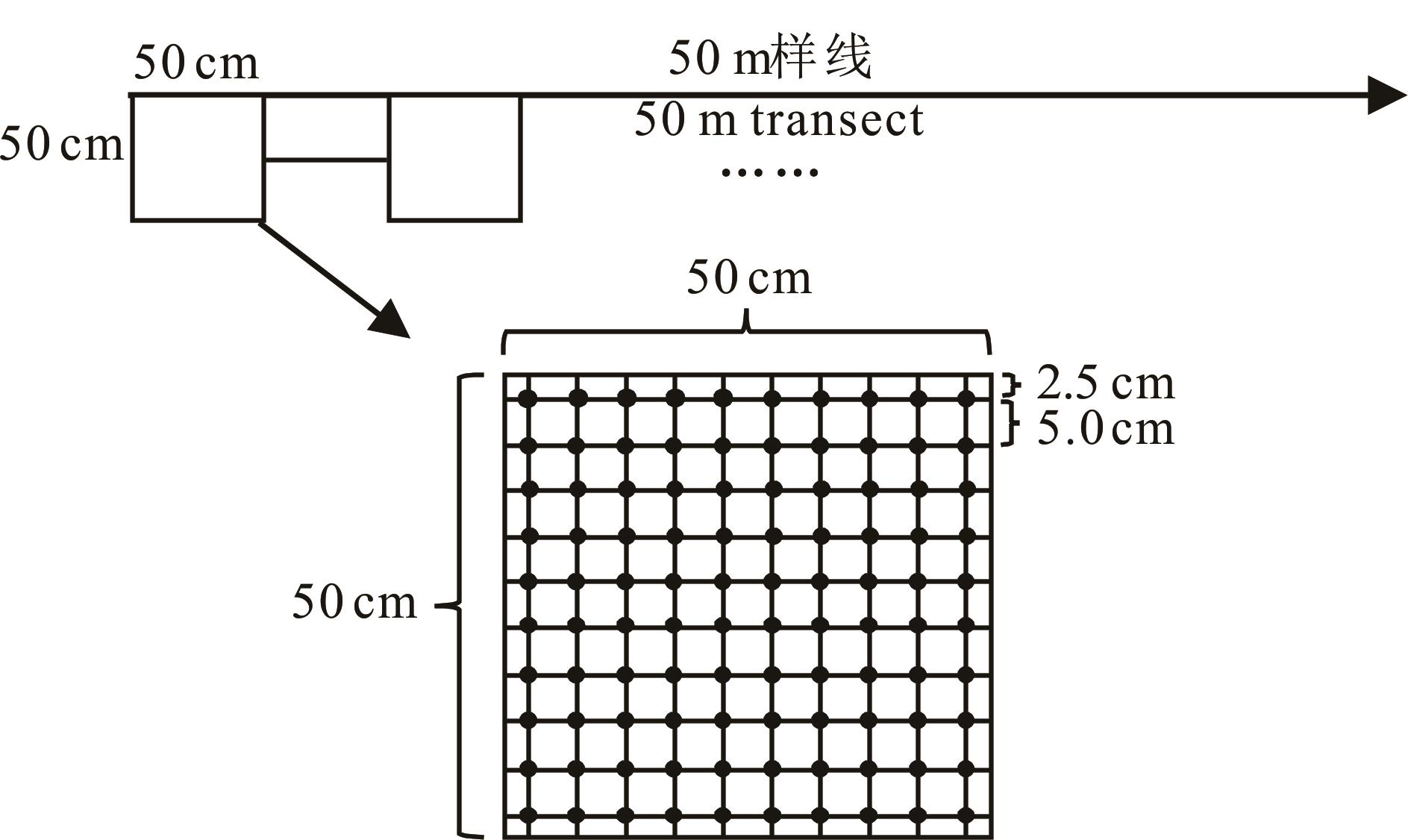
图1 盖度测量方法
Fig.1 Coverage measurement method
项目 Item | 年限Year (a) | ||
|---|---|---|---|
| 5 | 10 | 25 | |
| 平均地上生物量Average aboveground biomass (g·0.25 m-2) | 14.87±5.46b | 14.45±3.76b | 19.44±4.64a |
| 平均盖度Average coverage (%) | 44.28±18.40c | 55.96±24.52b | 76.70±16.58a |
| 地上生物量的空间异质性指数Spatial heterogeneity index of aboveground biomass | 2.25 | 3.08 | 1.16 |
| 盖度的空间异质性指数Spatial heterogeneity index of coverage | 2.85 | 2.66 | 0.85 |
表2 植物群落总体特征
Table 2 General characteristics of plant community
项目 Item | 年限Year (a) | ||
|---|---|---|---|
| 5 | 10 | 25 | |
| 平均地上生物量Average aboveground biomass (g·0.25 m-2) | 14.87±5.46b | 14.45±3.76b | 19.44±4.64a |
| 平均盖度Average coverage (%) | 44.28±18.40c | 55.96±24.52b | 76.70±16.58a |
| 地上生物量的空间异质性指数Spatial heterogeneity index of aboveground biomass | 2.25 | 3.08 | 1.16 |
| 盖度的空间异质性指数Spatial heterogeneity index of coverage | 2.85 | 2.66 | 0.85 |
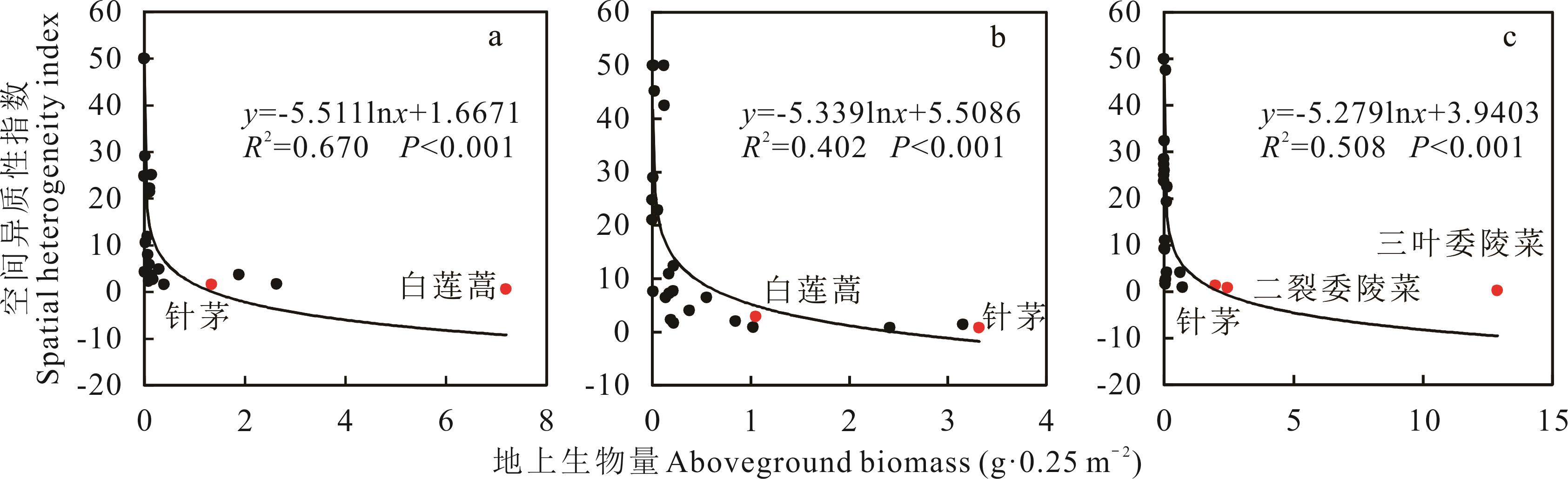
图2 不同退耕年限草地群落中每种植物的地上生物量与其空间异质性指数(Ii )之间的关系针茅: Stipa capillata; 白莲蒿: Artemisia sacrorum; 二裂委陵菜: Potentilla bifurca; 三叶委陵菜: Potentilla freyniana. a、b、c分别表示退耕5、10、25 a的草地。图中每个点表示一种植物,下同。a, b and c respectively represent the grasslands of restoration 5, 10 and 25 years. Each point in the diagram represents a plant, the same below.
Fig.2 Relationship between aboveground biomass of each plant and its spatial heterogeneity index (Ii ) in grassland communities with different years of restoration
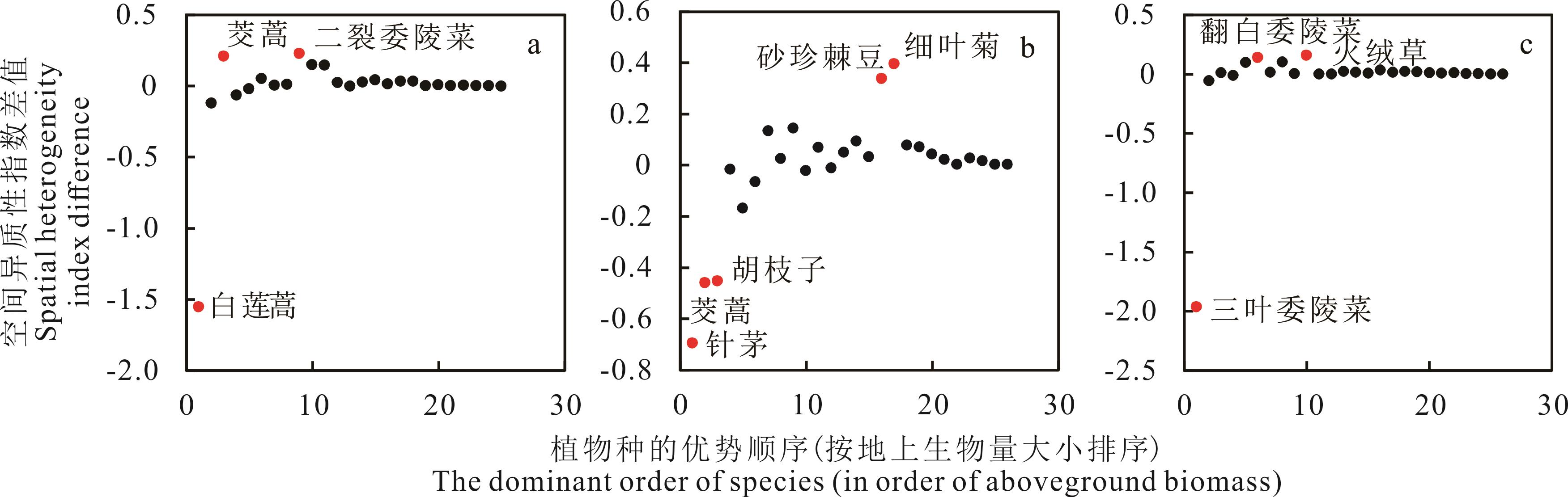
图3 利用γ分布模型计算不同退耕年限草地每种植物种的空间异质性作用茭蒿: Artemisia giraldii; 胡枝子: Lespedeza bicolor; 砂珍棘豆: Oxytropis racemose; 细叶菊: Chrysanthemum maximowiczii; 翻白委陵菜: Potentilla discolor; 火绒草: Leontopodium leontopodioides. 下同The same below.
Fig.3 The effects of each plant species with different restoration years on spatial heterogeneity were calculated by using γ distribution model
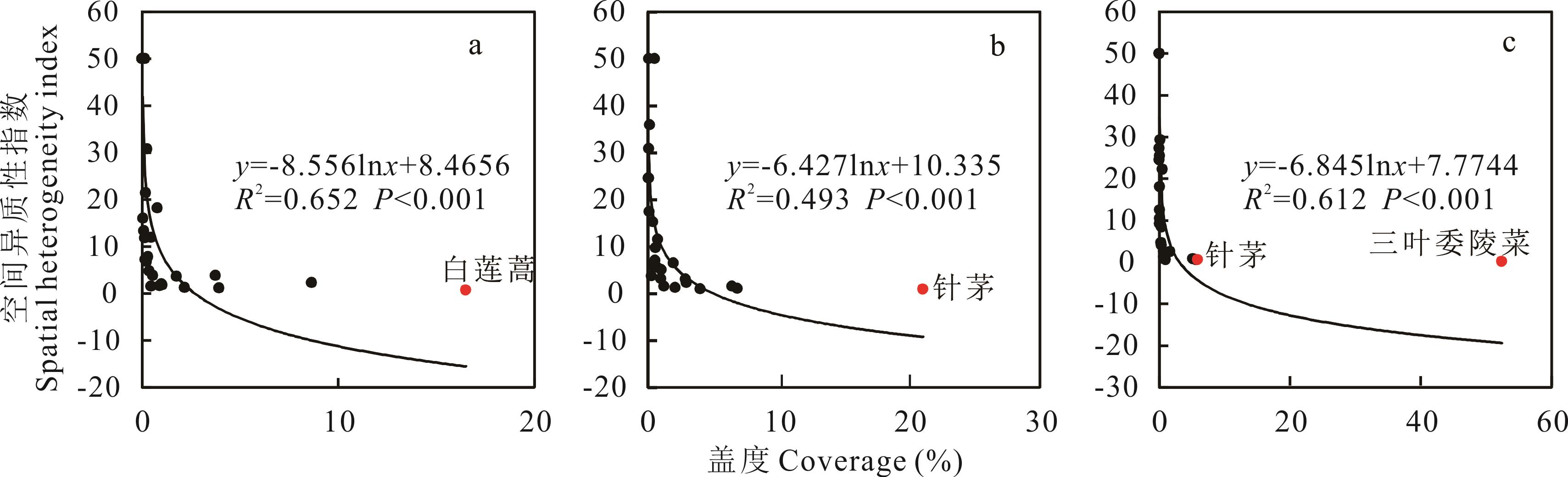
图4 不同退耕年限草地群落中每种植物盖度与其空间异质性指数(Ii )之间的关系
Fig.4 Relationship between the coverage of each plant and its spatial heterogeneity index (Ii ) in grassland communities with different years of restoration
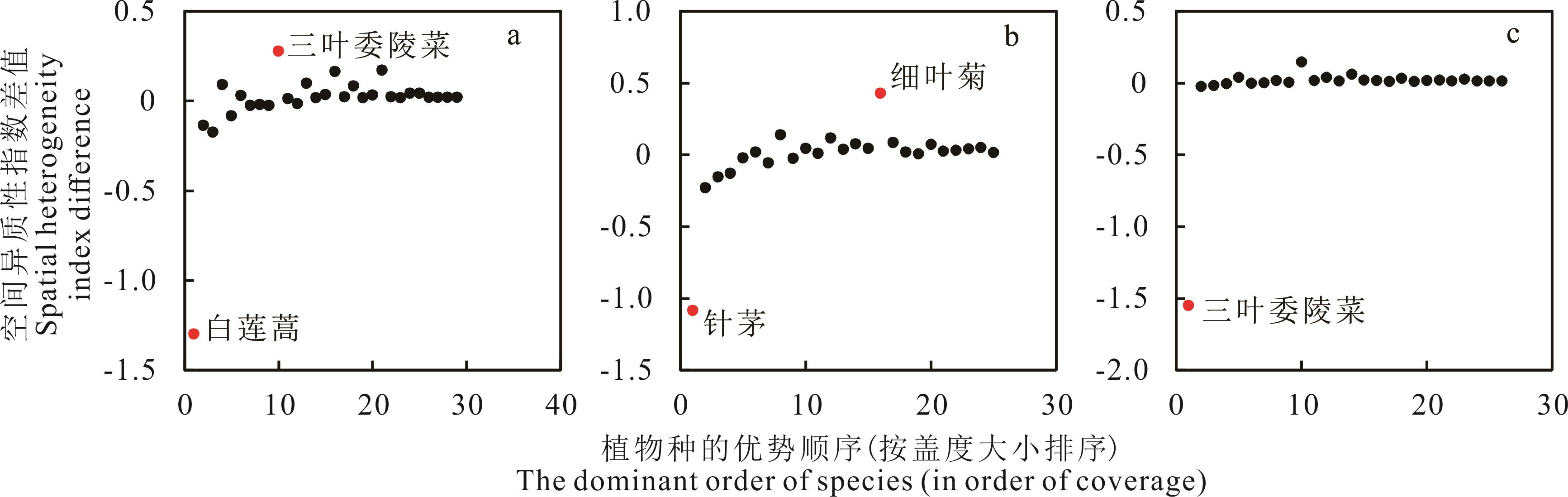
图5 利用β分布模型计算不同退耕年限草地每种植物种对空间异质性的作用
Fig.5 The effects of each plant species with different restoration years on spatial heterogeneity were calculated by using β distribution model
| [1] | Ren J Z, Xu G. The difficulties and opportunities for traditional agrarian culture on the Loess Plateau. Pratacultural Science, 2010, 27(3): 3-8. |
| 任继周, 胥刚. 传统农耕文化在黄土高原上的困境与机遇. 草业科学, 2010, 27(3): 3-8. | |
| [2] | Gong M. Effect of returning farmland to forest and grassland project on sustainable development of grassland industry in Shanxi Province. Forestry of Shanxi, 2024(2): 12-13. |
| 龚梅. 山西省退耕还林还草工程对草业可持续发展影响. 山西林业, 2024(2): 12-13. | |
| [3] | Liu Y W, Deng N, Yan J J, et al. Evaluation of the ecological effect of returning farmland to forest and grassland in the former concentrated contiguous impoverished area of China. Acta Ecologica Sinica, 2024, 44(11): 4719-4732. |
| 刘亦文, 邓楠, 颜建军, 等. 中国原集中连片特困区退耕还林还草的生态效应评估. 生态学报, 2024, 44(11): 4719-4732. | |
| [4] | Zou Y D, Zhang X P, He L, et al. Coupling development situation of agricultural eco-economic system in loess hilly and gully areas as farmland is returned to forest (grass) land——a case study at Wuqi County, Shannxi Province. Bulletin of Soil and Water Conservation, 2022, 42(3): 217-224. |
| 邹亚东, 张晓萍, 何亮, 等. 退耕还林(草)背景下黄土丘陵沟壑区农业生态经济系统耦合发展态势——以陕西省吴起县为例. 水土保持通报, 2022, 42(3): 217-224. | |
| [5] | Chen Y F, Dong M. Spatial heterogeneity in ecological systems. Acta Ecologica Sinica, 2003, 23(2): 346-352. |
| 陈玉福, 董鸣. 生态学系统的空间异质性. 生态学报, 2003, 23(2): 346-352. | |
| [6] | Eppinga M B, Haber E A, Sweeney L, et al. Antigonon leptopus invasion is associated with plant community disassembly in a Caribbean island ecosystem. Biological Invasions, 2022, 24(2): 353-371. |
| [7] | Qiu K, Li Z, Xie Y, et al. Desertification reversal promotes the complexity of plant community by increasing plant species diversity of each plant functional type. Agronomy, 2024, 14(1): 96. |
| [8] | Bai Y, Liu C, Huang Y, et al. Response of spatial heterogeneity of plant community height to different herbivore assemblages in Horqin sandy grassland. Chinese Journal of Plant Ecology, 2022, 46(4): 394-404. |
| 白悦, 刘晨, 黄月, 等. 科尔沁沙质草地植物群落高度空间异质性对不同放牧方式的响应. 植物生态学报, 2022, 46(4): 394-404. | |
| [9] | Zhang X, Liu Y Q, Zhang C H, et al. Response of spatial heterogeneity of biomass to different long-term grazing intensity in desert steppe. Acta Agrestia Sinica, 2024, 32(4): 1243-1251. |
| 张霞, 刘仰乔, 张灿浩, 等. 荒漠草原生物量空间异质性对长期不同放牧强度的响应. 草地学报, 2024, 32(4): 1243-1251. | |
| [10] | Zhao A Z, Zhang A B, Liu H X, et al. Spatiotemporal variation of vegetation coverage before and after implementation of grain for green project in the Loess Plateau. Journal of Natural Resources, 2017, 32(3): 449-460. |
| 赵安周, 张安兵, 刘海新, 等. 退耕还林(草)工程实施前后黄土高原植被覆盖时空变化分析. 自然资源学报, 2017, 32(3): 449-460. | |
| [11] | Liu Y B, Liu B Y, Cheng C, et al. Spatio-temporal changes and influencing factors of vegetation coverage in Yulin City during the past 20 years since the implementation of the “Grain For Green” program. Journal of Soil and Water Conservation, 2022, 36(2): 197-208, 218. |
| 刘逸滨, 刘宝元, 成城, 等. 退耕还林草20年来榆林市植被覆盖度时空变化及影响因素分析. 水土保持学报, 2022, 36(2): 197-208, 218. | |
| [12] | Yamamura Y, Cheng J M, Yasuda T, et al. Livestock-exclusion duration required for restoring grassland in semiarid, loess region in China: Estimate based on species composition measured from small-scale vegetation patterns. Ecological Research, 2021, 36(1): 161-176. |
| [13] | Shiyomi M, Okada M, Takahashi S, et al. Spatial pattern changes in aboveground plant biomass in a grazing pasture. Ecological Research, 1998, 13(3): 313-322. |
| [14] | Chen J. Statistical ecological studies of spatial variation of grass-soil ecosystems. Mito-shi: Ibaraki University, 2007. |
| [15] | Chen J, Shiyomi M, Yamamura Y. Distribution model and spatial variation of cover in grassland vegetation. Grassland Science, 2006, 52(4): 167-173. |
| [16] | Chen J, Hori Y, Yamamura Y, et al. Spatial heterogeneity and diversity analysis of macrovegetation in the Xilingol region, Inner Mongolia, China, using the beta distribution. Journal of Arid Environments, 2008, 72(6): 1110-1119. |
| [17] | Li W Z, Xie Y S, Li X, et al. Product management and grain supply and demand after the grain for green project in Wuqi County. Bulletin of Soil and Water Conservation, 2010, 30(4): 209-213. |
| 李文卓, 谢永生, 李晓, 等. 吴起县退耕后农户生产经营与粮食供需状况. 水土保持通报, 2010, 30(4): 209-213. | |
| [18] | Wang L P, Wei Z C, Liang W W, et al. Vegetation spatial distribution of in Shaanxi Province. Journal of Domestic Animal Ecology, 2015, 36(7): 63-68. |
| 汪丽平, 魏志成, 梁卫卫, 等. 陕西省植被类型的空间分布. 家畜生态学报, 2015, 36(7): 63-68. | |
| [19] | Chen J, Shiyomi M, Bonham C D, et al. Plant cover estimation based on the beta distribution in grassland vegetation. Ecological Research, 2008, 23(5): 813-819. |
| [20] | Chen J, Shiyomi M. Spatial pattern model of herbaceous plant mass at species level. Ecological Informatics, 2014, 24(6): 124-131. |
| [21] | Gao N N, Chen J, Zhang P L, et al. Effects of grazing intensity on the spatial distribution of aboveground biomass of alpine Kobresia meadow in Tibetan. Acta Agrestia Sinica, 2014, 22(2): 255-260. |
| 高宁宁, 陈俊, 张鹏莉, 等. 放牧对西藏高寒嵩草草甸地上生物量空间分布的影响. 草地学报, 2014, 22(2): 255-260. | |
| [22] | Liu T X, Zhao X Y, Duan L M, et al. Distribution characteristics and influencing factors of aboveground biomass in typical grassland ecosystem in Xilin River Basin. Journal of Jilin University (Earth Science Edition), 2024, 54(2): 604-618. |
| 刘廷玺, 赵心毓, 段利民, 等. 锡林河流域草原生态系统地上生物量时空分布特征及其影响因子. 吉林大学学报(地球科学版), 2024, 54(2): 604-618. | |
| [23] | Zhang S L, Yang D W, Yang Y T, et al. Excessive afforestation and soil drying on China’s Loess Plateau. Journal of Geophysical Research-Biogeosciences, 2018, 123(3): 923-935. |
| [24] | Song Y, Wang Y Q, Jin L, et al. Quantitative contribution of the Grain for Green Program to vegetation greening and its spatiotemporal variation across the Chinese Loess Plateau. Land Degradation & Development, 2022, 33(11): 1878-1891. |
| [25] | Hao H M, Liu Y, Wang D, et al. Influence of restoration on community plant diversity and spatial structure of typical grasslands. Acta Agrestia Sinica, 2016, 24(4): 754-759. |
| 郝红敏, 刘玉, 王冬, 等. 典型草原开垦弃耕后不同年限群落植物多样性和空间结构特征. 草地学报, 2016, 24(4): 754-759. | |
| [26] | Dong L B, Hai X Y, Wang X Z, et al. Effects of plant community dynamics on ecosystem carbon stocks since returning farmlands to grasslands on the Loess Plateau. Acta Ecologica Sinica, 2020, 40(23): 8559-8569. |
| 董凌勃, 海旭莹, 汪晓珍, 等. 黄土高原退耕还草地植物群落动态对生态系统碳储量的影响. 生态学报, 2020, 40(23): 8559-8569. | |
| [27] | Liu C, Ye Q R, Li J W, et al. Influences of the uncultivation duration of arable lands and slope aspect on the biomass of shrub and subshrub life-form and species richness on lands in Loess Hilly Region. Acta Agrestia Sinica, 2023, 31(9): 2826-2833. |
| 刘冲, 野起瑞, 李江文, 等. 黄土丘陵区撂荒年限和坡向对灌丛生物量及丰富度的影响. 草地学报, 2023, 31(9): 2826-2833. | |
| [28] | Cheng J M, Zou H Y. The rational utilization of grassland and successional course of grassland vegetation in the Loess Plateau. Acta Prataculturae Sinica, 1995, 4(4): 17-22. |
| 程积民, 邹厚远. 黄土高原草地合理利用与草地植被演替过程的试验研究. 草业学报, 1995, 4(4): 17-22. | |
| [29] | Feng X, Liu B J, Liu J K, et al. Study on the dynamics of artificial fenced grassland vegetation, Ningxia Yanchi County, semi-arid regions of China. Ecology and Environmental Sciences, 2020, 29(10): 1961-1970. |
| 冯湘, 刘宝军, 刘建康, 等. 半干旱区人工封育草地植被动态研究——以宁夏盐池县为例. 生态环境学报, 2020, 29(10): 1961-1970. | |
| [30] | Song D C, Wang L D, Wu H, et al. A study of change in soil characteristics with recovery time in degraded grassland in Minqin. Acta Prataculturae Sinica, 2021, 30(2): 59-68. |
| 宋达成, 王理德, 吴昊, 等. 民勤退耕区次生草地土壤特性研究. 草业学报, 2021, 30(2): 59-68. | |
| [31] | Zheng C L, Cao Z L, Wang X, et al. Effects of enclosure on vegetations recovery in desertified grassland in Hulunbeir. Science of Soil and Water Conservation, 2005, 3(3): 78-81. |
| 郑翠玲, 曹子龙, 王贤, 等. 围栏封育在呼伦贝尔沙化草地植被恢复中的作用. 中国水土保持科学, 2005, 3(3): 78-81. | |
| [32] | Chen M, Ma X L, Chen L Y, et al. The response of community characteristics and plant diversity to enclosure years in the Nalati Mountain Meadow. Journal of Xinjiang Normal University (Natural Sciences Edition), 2024, 43(1): 57-66. |
| 陈茂, 马晓林, 陈路瑶, 等. 伊犁河谷山地草甸群落特征和植物多样性对封育年限的响应. 新疆师范大学学报(自然科学版), 2024, 43(1): 57-66. | |
| [33] | Yan C C, Wang Y, Yang Z F, et al. Effects of long-term enclosure on plant diversity and soil physicochemical properties of meadow grassland on the south slope of Tianshan Mountains. Heilongjiang Animal Science and Veterinary Medicine, 2021(13): 91-96. |
| 闫成才, 王域, 杨志峰, 等. 围栏封育对天山南坡中段草甸草原植物多样性和土壤理化性质的影响. 黑龙江畜牧兽医, 2021(13): 91-96. | |
| [34] | Cheng J M, Jing Z B, Jin J W, et al. Restoration and utilization mechanism of degraded grassland in the semi-arid region of Loess Plateau. Scientia Sinica (Vitae), 2014, 44(3): 267-279. |
| 程积民, 井赵斌, 金晶炜, 等. 黄土高原半干旱区退化草地恢复与利用过程研究. 中国科学: 生命科学, 2014, 44(3): 267-279. | |
| [35] | Ren H Y, Han G D, Ohm M, et al. Do sheep grazing patterns affect ecosystem functioning in steppe grassland ecosystems in Inner Mongolia? Agriculture Ecosystems & Environment, 2015, 213(15): 1-10. |
| [36] | He Q B, Zhao L P, Tan S T, et al. Response of spatial heterogeneity of grassland communities to different disturbance regimes in typical steppe of Yunwu Mountain. Journal of Northwest A & F University (Natural Science Edition), 2018, 46(9): 9-17. |
| 何晴波, 赵凌平, 谭世图, 等. 云雾山典型草原群落空间异质性对不同干扰方式的响应. 西北农林科技大学学报(自然科学版), 2018, 46(9): 9-17. | |
| [37] | Liu Z G, Li Z Q, Fu L K, et al. Small-scale spatial pattern of Potentilla acaulis population under different grazing intensities. Chinese Journal of Applied and Environmental Biology, 2006, 11(3): 308-312. |
| 刘振国, 李镇清, 富兰克, 等. 不同放牧强度下星毛委陵菜(Potentilla acaulis)种群小尺度空间格局. 应用与环境生物学报, 2006, 11(3): 308-312. | |
| [38] | Jiang D M, Li M, Ya T M X, et al. Effects of enclosure on vegetation characteristics and spatial heterogeneity of Caragana mirophylla community in Horqin Sandy Land. Chinese Journal of Ecology, 2009, 28(11): 2159-2164. |
| 蒋德明, 李明, 押田敏雄, 等. 封育对科尔沁沙地小叶锦鸡儿群落植被特征及空间异质性的影响. 生态学杂志, 2009, 28(11): 2159-2164. |
| [1] | 马利利, 蒋福祯, 马玉寿, 祁凯斌, 贾顺斌, 李正鹏. 粒径配比、施肥量以及播量耦合对矿区煤矸石基质的改良效果[J]. 草业学报, 2025, 34(3): 71-84. |
| [2] | 杜文盼, 赵桂琴, 柴继宽, 杨莉, 张建贵, 史怡超, 张官禄. 根系分隔方式对燕麦/豌豆间作地上生物量、土壤养分及根系性状的影响[J]. 草业学报, 2024, 33(8): 25-36. |
| [3] | 张慧龙, 杨秀春, 杨东, 陈昂, 张敏. 2000-2020年内蒙古草地植被覆盖度时空变化及趋势预测[J]. 草业学报, 2023, 32(8): 1-13. |
| [4] | 马婧, 郭方君, 邹枝慧, 孙琳, 陈芳. 腾格里沙漠南缘不同恢复阶段沙质草地植被的季节变化特征[J]. 草业学报, 2023, 32(5): 203-210. |
| [5] | 许开宏, 施招, 马磊超, 王平, 陈昂, 王兴, 成明, 肖粤新, 王荣谭. 基于机载激光雷达与高景一号数据的草原地上生物量反演研究[J]. 草业学报, 2023, 32(5): 40-49. |
| [6] | 郭芮, 伏帅, 侯蒙京, 刘洁, 苗春丽, 孟新月, 冯琦胜, 贺金生, 钱大文, 梁天刚. 基于Sentinel-2数据的青海门源县天然草地生物量遥感反演研究[J]. 草业学报, 2023, 32(4): 15-29. |
| [7] | 苗春丽, 李仲贤, 赵志成, 伏帅, 高金龙, 刘洁, 冯琦胜, 梁天刚. 栽培苜蓿草地智能感知系统关键生物物理指标实时监测及分析算法研究[J]. 草业学报, 2023, 32(12): 90-103. |
| [8] | 周娟娟, 刘云飞, 王敬龙, 魏巍. 短期养分添加对西藏沼泽化高寒草甸地上生物量、植物多样性和功能性状的影响[J]. 草业学报, 2023, 32(11): 17-29. |
| [9] | 许政勇, 孙斌, 张王菲, 李毅夫, 闫紫钰, 岳巍, 滕思翰. 基于优化三角形植被指数(TVI)的灌丛化草原植被地上生物量遥感估测方法研究[J]. 草业学报, 2023, 32(10): 1-14. |
| [10] | 戎荣, 孙斌, 武志涛, 高志海, 杜自强, 滕思翰. 灌丛化草原小叶锦鸡儿灌丛地上生物量测量方法研究[J]. 草业学报, 2023, 32(1): 36-47. |
| [11] | 赵翊含, 侯蒙京, 冯琦胜, 高宏元, 梁天刚, 贺金生, 钱大文. 基于Landsat 8和随机森林的青海门源天然草地地上生物量遥感估算[J]. 草业学报, 2022, 31(7): 1-14. |
| [12] | 沈洁, 丁蕾, 辛晓平, 张翔, 徐大伟, 侯路路, 闫瑞瑞. 基于无人机激光雷达与多光谱数据的不同放牧强度下草原冠层尺度特征研究[J]. 草业学报, 2022, 31(3): 1-15. |
| [13] | 金哲人, 冯琦胜, 王瑞泾, 梁天刚. 基于MODIS数据与机器学习的青藏高原草地地上生物量研究[J]. 草业学报, 2022, 31(10): 1-17. |
| [14] | 刘佳丽, 范建容, 张茜彧, 杨超, 徐富宝, 张晓雪, 梁博. 高寒草地生长季/非生长季植被盖度遥感反演[J]. 草业学报, 2021, 30(9): 15-26. |
| [15] | 马婧婧, 刘耘华, 盛建东, 李宁, 武红旗, 贾宏涛, 孙宗玖, 程军回. 新疆草地优势种植物相对生物量沿海拔梯度变化特征[J]. 草业学报, 2021, 30(8): 25-35. |
| 阅读次数 | ||||||
|
全文 |
|
|||||
|
摘要 |
|
|||||
