

ISSN 1004-5759 CN 62-1105/S
草业学报 ›› 2025, Vol. 34 ›› Issue (12): 85-96.DOI: 10.11686/cyxb2025033
肖娅婷1,2( ), 唐彧哲1,2, 王潞1,2, 白宇飞1,2, 杨海波1,2, 李斐1,2()
收稿日期:2025-02-02
修回日期:2025-03-10
出版日期:2025-12-20
发布日期:2025-10-20
通讯作者:
李斐
作者简介:E-mail: Lifei@imau.edu.cn基金资助:
Ya-ting XIAO1,2(), Yu-zhe TANG1,2, Lu WANG1,2, Yu-fei BAI1,2, Hai-bo YANG1,2, Fei LI1,2()
Received:2025-02-02
Revised:2025-03-10
Online:2025-12-20
Published:2025-10-20
Contact:
Fei LI
摘要:
玉米水分状况的快速无损监测对于水分诊断和灌溉管理具有重要意义,而光谱指数是作物叶片含水量(LWC)无损实时估测的重要指标之一,然而传统的光谱指数在估测LWC时易受外界环境因素影响,导致估测精度较低。机器学习(ML)算法在预测作物水分状况方面有显著的优势,特别是针对精准农业和作物水分监测等应用。因此,本研究旨在将光谱指数与机器学习结合来进一步提高LWC的估测精度,实现玉米水分的高效利用。研究于2023-2024年在内蒙古玉米种植的典型区域进行不同水分梯度的田间试验,测定玉米叶片3个关键生育时期的高光谱反射率,分析13种水敏感的光谱指数与玉米LWC的相关关系后,利用ReliefF技术筛选主要光谱特征作为偏最小二乘(PLSR)、随机森林(RF)、高斯过程回归(GPR)3种机器学习算法的输入变量,构建玉米LWC的估测模型。结果表明,在13种水情指数中改良的DATT指数(MDATT)预测性能最佳(决定系数R2=0.52),但估测精度受生育时期和玉米叶片层位影响较大,不能有效监测玉米LWC。而将全波段光谱(350~2500 nm)和通过ReliefF技术筛选的主要光谱指数分别投入3种机器学习算法中,LWC的估测精度提升了7%~45%。其中以光谱指数作为输入特征的模型整体表现较好,RF和GPR模型在LWC估测中表现较为优越,可解释玉米LWC 88%~89%的变异。最后利用独立数据集对RF和GPR模型进行验证,RF和GPR模型决定系数R2分别为0.89和0.88,均方根误差(RMSE)为1.95%和2.04%。总体来看,光谱指数与RF和GPR算法耦合起到了级联效应,可以显著提高玉米LWC的估测精度,研究结果将为玉米LWC的估测提供可靠的方法,并为玉米水肥一体化管理提供科学有效的依据。
肖娅婷, 唐彧哲, 王潞, 白宇飞, 杨海波, 李斐. 光谱指数助力机器学习提高玉米叶片含水量估测精度[J]. 草业学报, 2025, 34(12): 85-96.
Ya-ting XIAO, Yu-zhe TANG, Lu WANG, Yu-fei BAI, Hai-bo YANG, Fei LI. Use of spectral index-assisted machine learning to improve the accuracy of maize leaf water content estimation[J]. Acta Prataculturae Sinica, 2025, 34(12): 85-96.
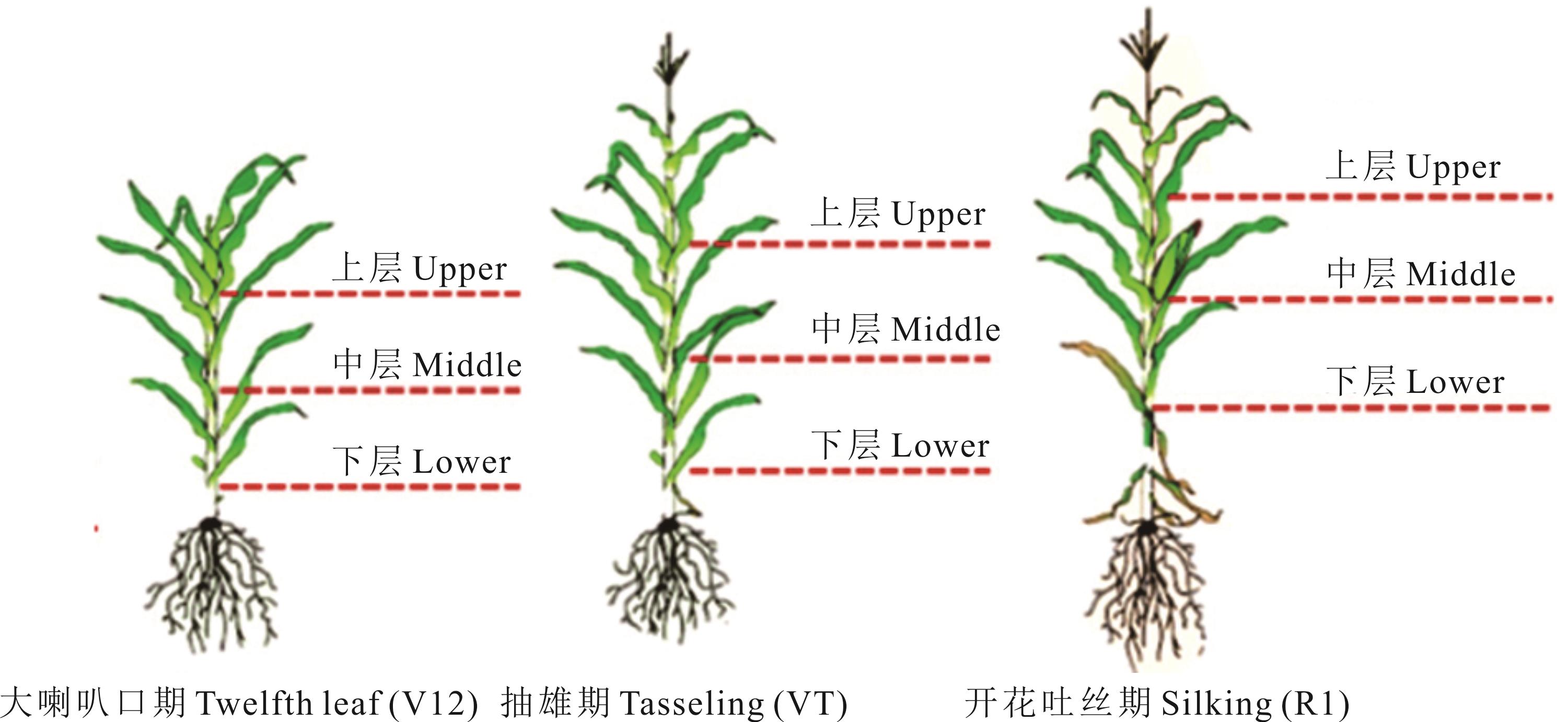
图1 春玉米大喇叭口期、抽雄期和开花吐丝期阶段叶片垂直分层
Fig.1 The vertical division of the spring maize leaf at the V12, VT, and R1 growth stage
光谱指数 Spectral index | 公式 Formula | 文献 References |
|---|---|---|
| 归一化差异水分指数Normalized difference water index (NDWI) | (R860-R1240)/(R860+R1240) | [ |
| 水分指数Water index (WI) | R900/R970 | [ |
| 水分胁迫指数Moisture stress index (MSI) | R1600/R820 | [ |
| 简单比值水分指数Simple ratio water index (SRWI) | R860/R1240 | [ |
| 植被水分指数Plant water index (PWI) | R970/R900 | [ |
| 生理反射指数Physiological reflectance index (PRI) | (R531-R570)/(R531+R570) | [ |
| 改良的DATT指数Modified DATT (MDATT) | (R1740-R2370)/(R1740-R1750) | [ |
| 水带指数Water band index (WBI) | R950/R900 | [ |
| 叶水指数Leaf water index (LWI) | R1300/R1450 | [ |
| 归一化差异水分胁迫指数Normalized different water stress index (NDWSI) | (R850-R970)/(R850+R970) | [ |
| 归一化多波段干旱指数Normalized multi-band drought index (NMDI) | R860-(R1640-R2130)/R860+(R1640-R2130) | [ |
| 全球植被水分指数Global vegetation moisture index (GVMI) | (R820+0.1) -(R1600+0.02)/(R820+0.1) +(R1600+0.02) | [ |
| 水分胁迫指数的倒数Reciprocal of moisture stress index (RMSI) | R860/R1650 | [ |
表1 本研究选取的光谱指数
Table 1 Spectral indices used in this study
光谱指数 Spectral index | 公式 Formula | 文献 References |
|---|---|---|
| 归一化差异水分指数Normalized difference water index (NDWI) | (R860-R1240)/(R860+R1240) | [ |
| 水分指数Water index (WI) | R900/R970 | [ |
| 水分胁迫指数Moisture stress index (MSI) | R1600/R820 | [ |
| 简单比值水分指数Simple ratio water index (SRWI) | R860/R1240 | [ |
| 植被水分指数Plant water index (PWI) | R970/R900 | [ |
| 生理反射指数Physiological reflectance index (PRI) | (R531-R570)/(R531+R570) | [ |
| 改良的DATT指数Modified DATT (MDATT) | (R1740-R2370)/(R1740-R1750) | [ |
| 水带指数Water band index (WBI) | R950/R900 | [ |
| 叶水指数Leaf water index (LWI) | R1300/R1450 | [ |
| 归一化差异水分胁迫指数Normalized different water stress index (NDWSI) | (R850-R970)/(R850+R970) | [ |
| 归一化多波段干旱指数Normalized multi-band drought index (NMDI) | R860-(R1640-R2130)/R860+(R1640-R2130) | [ |
| 全球植被水分指数Global vegetation moisture index (GVMI) | (R820+0.1) -(R1600+0.02)/(R820+0.1) +(R1600+0.02) | [ |
| 水分胁迫指数的倒数Reciprocal of moisture stress index (RMSI) | R860/R1650 | [ |
生育时期及层位 Growth stage and canopy layer | 最大值 Maximum | 最小值 Minimum | 平均值 Mean | 标准差 Standard deviation | 变异系数 Coefficient of variation |
|---|---|---|---|---|---|
| 大喇叭口期Twelfth leaf (V12) | 84.50 | 70.50 | 77.72 | 3.68 | 5.64 |
| 抽雄期Tasseling (VT) | 89.94 | 80.91 | 85.07 | 2.10 | 2.58 |
| 开花吐丝期Silking (R1) | 83.66 | 61.45 | 73.24 | 7.05 | 10.21 |
| 上层叶片Upper layer | 89.71 | 61.45 | 74.58 | 8.70 | 12.15 |
| 中层叶片Middle layer | 86.63 | 71.62 | 78.47 | 4.19 | 5.17 |
| 下层叶片Lower layer | 89.94 | 74.52 | 82.99 | 3.27 | 4.62 |
| 全生育时期All | 89.94 | 61.45 | 78.66 | 6.84 | 9.53 |
表2 不同生育时期及层位玉米叶片含水量描述性统计
Table 2 Descriptive statistics of maize leaf water content at different growth stages and canopy layers (%)
生育时期及层位 Growth stage and canopy layer | 最大值 Maximum | 最小值 Minimum | 平均值 Mean | 标准差 Standard deviation | 变异系数 Coefficient of variation |
|---|---|---|---|---|---|
| 大喇叭口期Twelfth leaf (V12) | 84.50 | 70.50 | 77.72 | 3.68 | 5.64 |
| 抽雄期Tasseling (VT) | 89.94 | 80.91 | 85.07 | 2.10 | 2.58 |
| 开花吐丝期Silking (R1) | 83.66 | 61.45 | 73.24 | 7.05 | 10.21 |
| 上层叶片Upper layer | 89.71 | 61.45 | 74.58 | 8.70 | 12.15 |
| 中层叶片Middle layer | 86.63 | 71.62 | 78.47 | 4.19 | 5.17 |
| 下层叶片Lower layer | 89.94 | 74.52 | 82.99 | 3.27 | 4.62 |
| 全生育时期All | 89.94 | 61.45 | 78.66 | 6.84 | 9.53 |
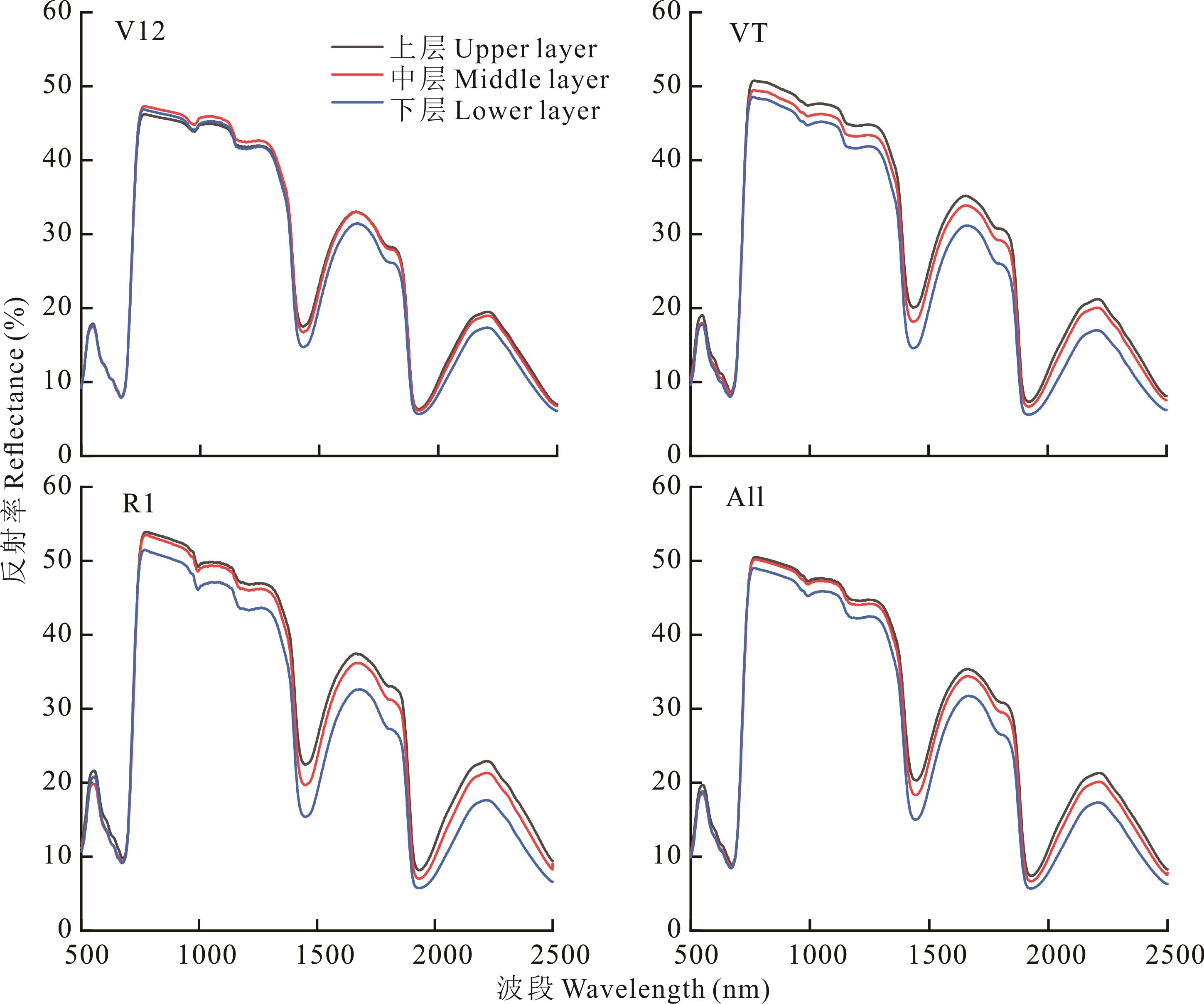
图2 不同生育时期和层位下叶片高光谱反射率
Fig.2 Hyperspectral reflectance of leaves at different growth stages and layers
| 光谱指数Spectral index | 大喇叭口期V12 | 抽雄期VT | 开花吐丝期R1 | 上层Upper | 中层Middle | 下层Lower | 全生育时期All |
|---|---|---|---|---|---|---|---|
| 水分指数WI | 0.57 | 0.22 | 0.65 | 0.17 | 0.08 | 0.12 | 0.36 |
| 归一化差异水分指数NDWI | 0.23 | 0.07 | 0.42 | 0.28 | 0.28 | 0.22 | 0.19 |
| 水分胁迫指数MSI | 0.15 | 0.03 | 0.75 | 0.07 | 0.13 | 0.07 | 0.06 |
| 简单比值水分指数SRWI | 0.57 | 0.22 | 0.65 | 0.17 | 0.08 | 0.12 | 0.36 |
| 植被水分指数PWI | 0.06 | 0.08 | 0.75 | 0.01 | 0.05 | 0.01 | 0.22 |
| 生理反射指数PRI | 0.06 | 0.05 | 0.15 | 0.67 | 0.51 | 0.38 | 0.29 |
| 改良的DATT指数MDATT | 0.64 | 0.18 | 0.76 | 0.38 | 0.20 | 0.32 | 0.52 |
| 水分胁迫指数的倒数RMSI | 0.58 | 0.06 | 0.72 | 0.02 | 0.02 | 0.01 | 0.18 |
| 水带指数WBI | 0.24 | 0.21 | 0.54 | 0.43 | 0.39 | 0.41 | 0.51 |
| 叶水指数LWI | 0.63 | 0.11 | 0.79 | 0.09 | 0.01 | 0.05 | 0.36 |
| 归一化差异水分胁迫指数NDWSI | 0.12 | 0.09 | 0.55 | 0.20 | 0.20 | 0.21 | 0.37 |
| 归一化多波段干旱指数NMDI | 0.11 | 0.04 | 0.60 | 0.01 | 0.02 | 0.01 | 0.13 |
| 全球植被水分指数GVMI | 0.60 | 0.06 | 0.75 | 0.04 | 0.04 | 0.01 | 0.15 |
表3 关键生育时期和不同层位叶片含水量与光谱指数的决定系数
Table 3 Coefficients of determination between leaf water content and spectral index at key growth stages and different canopy layers
| 光谱指数Spectral index | 大喇叭口期V12 | 抽雄期VT | 开花吐丝期R1 | 上层Upper | 中层Middle | 下层Lower | 全生育时期All |
|---|---|---|---|---|---|---|---|
| 水分指数WI | 0.57 | 0.22 | 0.65 | 0.17 | 0.08 | 0.12 | 0.36 |
| 归一化差异水分指数NDWI | 0.23 | 0.07 | 0.42 | 0.28 | 0.28 | 0.22 | 0.19 |
| 水分胁迫指数MSI | 0.15 | 0.03 | 0.75 | 0.07 | 0.13 | 0.07 | 0.06 |
| 简单比值水分指数SRWI | 0.57 | 0.22 | 0.65 | 0.17 | 0.08 | 0.12 | 0.36 |
| 植被水分指数PWI | 0.06 | 0.08 | 0.75 | 0.01 | 0.05 | 0.01 | 0.22 |
| 生理反射指数PRI | 0.06 | 0.05 | 0.15 | 0.67 | 0.51 | 0.38 | 0.29 |
| 改良的DATT指数MDATT | 0.64 | 0.18 | 0.76 | 0.38 | 0.20 | 0.32 | 0.52 |
| 水分胁迫指数的倒数RMSI | 0.58 | 0.06 | 0.72 | 0.02 | 0.02 | 0.01 | 0.18 |
| 水带指数WBI | 0.24 | 0.21 | 0.54 | 0.43 | 0.39 | 0.41 | 0.51 |
| 叶水指数LWI | 0.63 | 0.11 | 0.79 | 0.09 | 0.01 | 0.05 | 0.36 |
| 归一化差异水分胁迫指数NDWSI | 0.12 | 0.09 | 0.55 | 0.20 | 0.20 | 0.21 | 0.37 |
| 归一化多波段干旱指数NMDI | 0.11 | 0.04 | 0.60 | 0.01 | 0.02 | 0.01 | 0.13 |
| 全球植被水分指数GVMI | 0.60 | 0.06 | 0.75 | 0.04 | 0.04 | 0.01 | 0.15 |
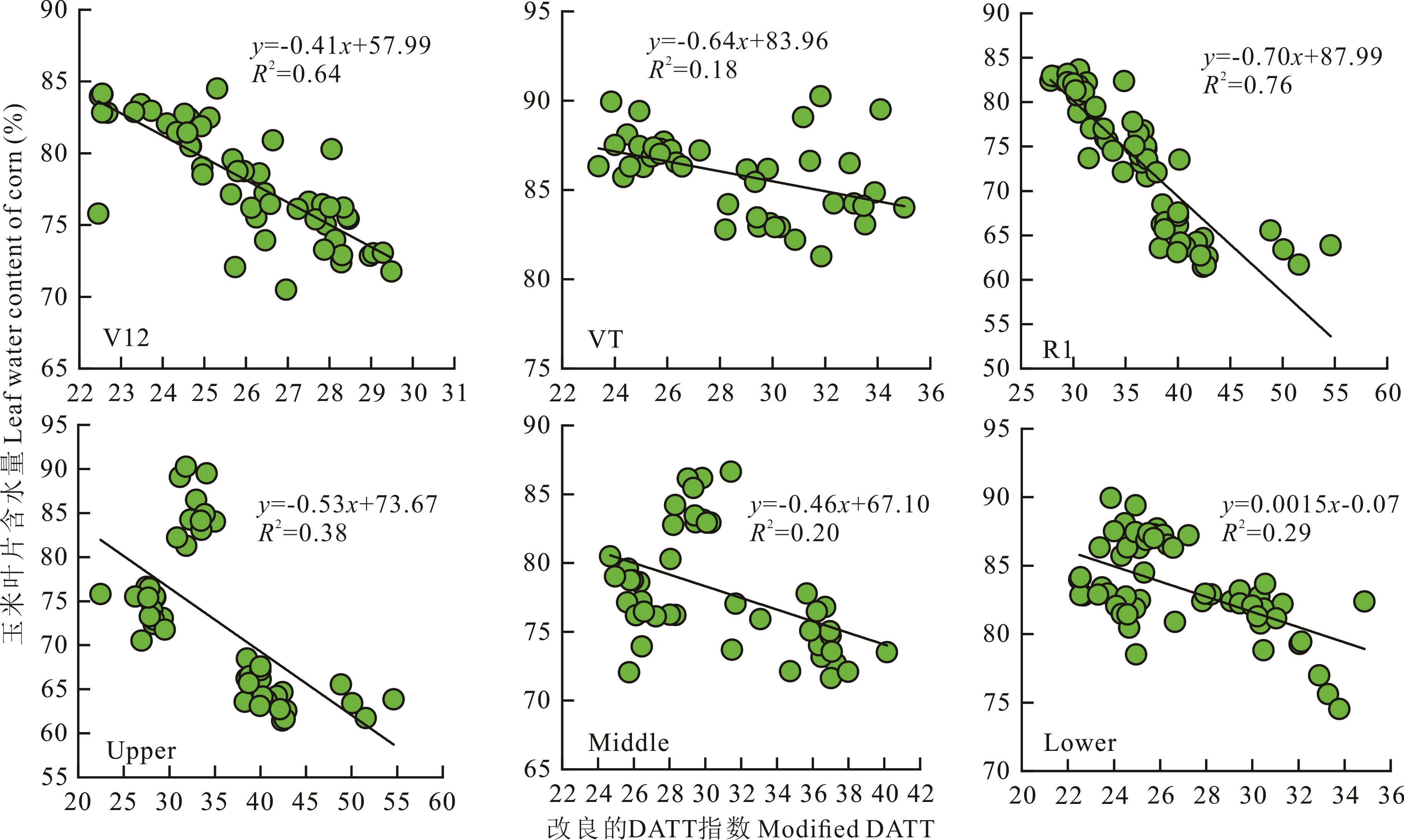
图3 改良的DATT指数在不同生育时期及层位下与玉米叶片含水量的线性相关关系
Fig.3 Linear correlation between modified DATT index and maize leaf water content at different growth stages and layers
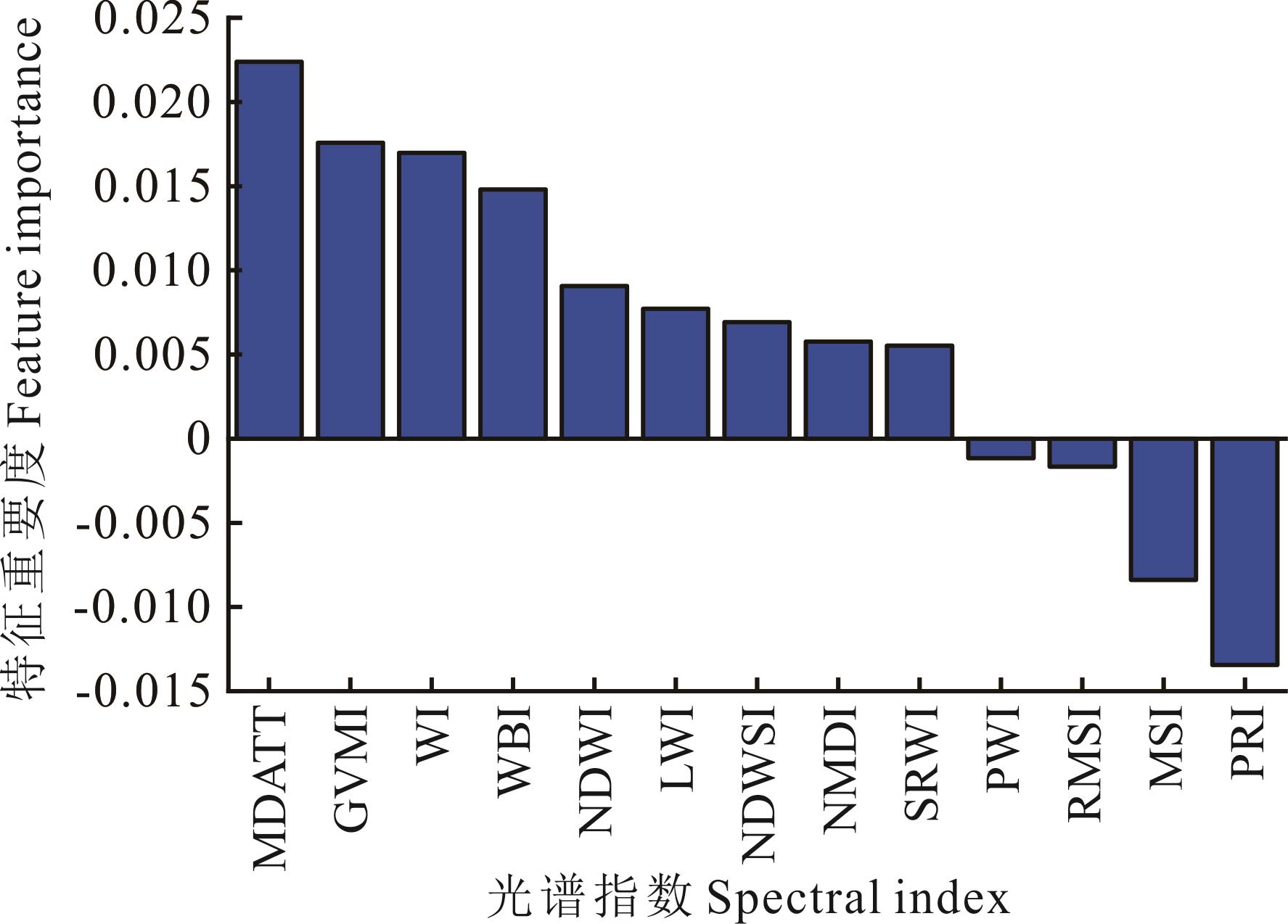
图4 基于ReliefF特征重要度排序
Fig.4 Sorting based on ReliefF feature importance
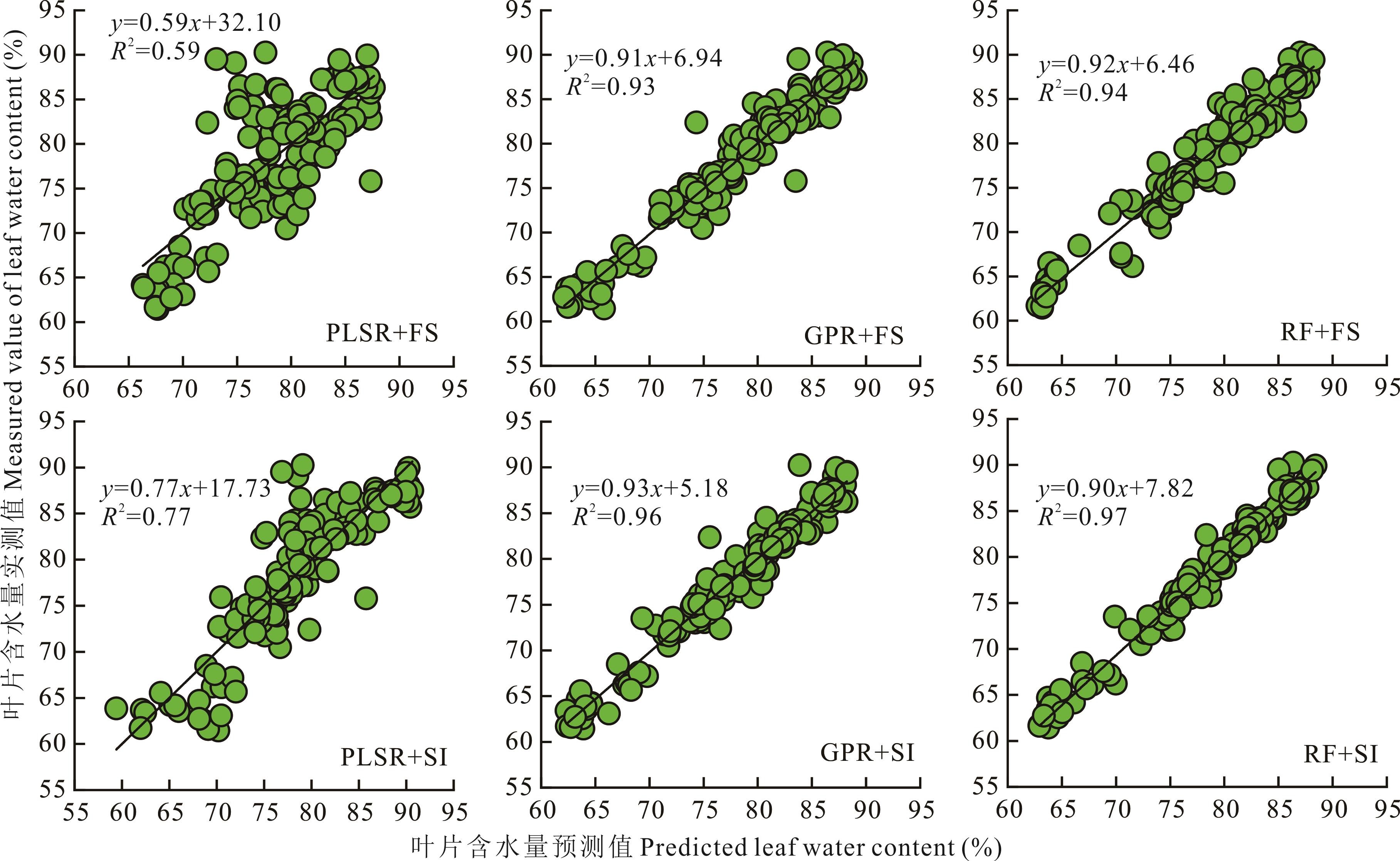
图5 基于全光谱数据集和光谱指数的玉米叶片含水量估测模型构建PLSR: 偏最小二乘回归Partial least squares regression; GPR: 高斯过程回归Gaussian process regression; RF: 随机森林Random forest; FS: 全波段: Full-spectrum; SI: 光谱指数Spectral index. 下同The same below.
Fig.5 Construction of maize leaf moisture estimation model based on full-spectrum dataset and spectral index

图6 基于原始光谱数据集和光谱指数的玉米叶片含水量估测模型的验证RMSE: 均方根误差Root mean squared error; RE: 相对误差Relative error.
Fig.6 Validation of the maize leaf moisture estimation model based on full-spectrum dataset and spectral index
| [1] | Ferraretto L F, Shaver R D, Luck B D. Silage review: Recent advances and future technologies for whole-plant and fractionated corn silage harvesting. Journal of Dairy Science, 2018, 101(5): 3937-3951. |
| [2] | Rouse Jr J W, Haas R H, Deering D W, et al. Monitoring the vernal advancement and retrogradation. TX, USA: Texas A & M University: College Station, 1974. |
| [3] | Inoue Y, Morinaga S, Shibayama M. Non-destructive estimation of water status of intact crop leaves based on spectral reflectance measurements. Japanese Journal of Crop Science, 1993, 62(3): 462-469. |
| [4] | Zhao S H, Wang Q, Yao Y J, et al. Estimating and validating wheat leaf water content with three MODIS spectral indexes: A case study in Ningxia Plain, China. Journal of Agricultural Science and Technology, 2016, 18(2): 387-398. |
| [5] | Rapaport T, Hochberg U, Cochavi A, et al. The potential of the spectral ‘water balance index’(WABI) for crop irrigation scheduling. New Phytologist, 2017, 216(3): 741-757. |
| [6] | Kunz K, Hu Y, Schmidhalter U. Carbon isotope discrimination as a key physiological trait to phenotype drought/heat resistance of future climate-resilient German winter wheat compared with relative leaf water content and canopy temperature. Frontiers in Plant Science, 2022, 13: 1043458. |
| [7] | Zhang J, Zhang W, Xiong S, et al. Comparison of new hyperspectral index and machine learning models for prediction of winter wheat leaf water content. Plant Methods, 2021, 17(1): 1-14. |
| [8] | Ndlovu H S, Odindi J, Sibanda M, et al. A comparative estimation of maize leaf water content using machine learning techniques and unmanned aerial vehicle (UAV)-based proximal and remotely sensed data. Remote Sensing, 2021, 13(20): 4091. |
| [9] | Guo F, Feng Q, Yang S, et al. Estimation of potato canopy leaf water content in various growth stages using UAV hyperspectral remote sensing and machine learning. Frontiers in Plant Science, 2024, 15: 1458589. |
| [10] | Yang C, Tan Y, Bruzzone L, et al. Discriminative feature metric learning in the affinity propagation model for band selection in hyperspectral images. Remote Sensing, 2017, 9(8): 782. |
| [11] | Gao B C. Normalized difference water index for remote sensing of vegetation liquid water from space.//Proceedings of the Imaging spectrometry Conference. SPIE, 1995, 2480: 225-236. |
| [12] | Peeñuuelas J, Pinol J, Ogaya R, et al. Estimation of plant water concentration by the reflectance water index WI (R900/R970). International Journal of Remote Sensing, 1997, 18(13): 2869-2875. |
| [13] | Helskanen J. Estimating aboveground tree biomass and leaf area index in a mountain birch forest using ASTER satellite data. International Journal of Remote Sensing, 2006, 27(6): 1135-1158. |
| [14] | Zarco-Tejada P J, Rueda C, Ustin S. Water content estimation in vegetation with MODIS reflectance data and model inversion method. Remote Sensing of Environment, 2003, 85(1): 109-124. |
| [15] | Apan A, Held A, Phinn S, et al. Formulation and assessment of narrow-band vegetation indices from EO-1 Hyperion imagery for discriminating sugarcane disease.// Proceedings of the Spatial Sciences Institute Biennial Conference (SSC 2003): Spatial Knowledge Without Boundaries, Canberra, Australia: Spatial Sciences Institute, 2003. |
| [16] | Gamon J, Penuelas J, Field C. A narrow-waveband spectral index that tracks diurnal changes in photosynthetic efficiency. Remote Sensing of Environment, 1992, 41(1): 35-44. |
| [17] | Wang Z, Sun Z, Lu S. Optimal vegetation index for assessing leaf water potential using reflectance factors from the adaxial and abaxial surfaces. Computers and Electronics in Agriculture, 2020, 172: 105337. |
| [18] | Peñuelas J, Filella I, Biel C, et al. The reflectance at the 950-970 nm region as an indicator of plant water status. International Journal of Remote Sensing, 1993, 14(10): 1887-1905. |
| [19] | Seelig H D, Hoehn A, Stodieck L S, et al. Plant water parameters and the remote sensing R1300/R1450 leaf water index: Controlled condition dynamics during the development of water deficit stress. Irrigation Science, 2009, 27(5): 357-365. |
| [20] | Hunt Jr E R, Daughtry C S T, Qu J J, et al. Comparison of hyperspectral retrievals with vegetation water indices for leaf and canopy water content.//Proceedings of the Remote Sensing and Modeling of Ecosystems for Sustainability Ⅷ. SPIE, 2011, 8156: 66-76. |
| [21] | Wang L, Qu J J. NMDI: A normalized multi-band drought index for monitoring soil and vegetation moisture with satellite remote sensing. Geophysical Research Letters, 2007, 34(20): 20405. |
| [22] | Ceccato P, Flasse S, Gregoire J M. Designing a spectral index to estimate vegetation water content from remote sensing data: Part 2. Validation and applications. Remote Sensing of Environment, 2002, 82(2/3): 198-207. |
| [23] | Hunt Jr E R, Rock B N. Detection of changes in leaf water content using near-and middle-infrared reflectances. Remote Sensing of Environment, 1989, 30(1): 43-54. |
| [24] | Zhang B S, Li Y Y, Chai Z. A novel random multi-subspace based ReliefF for feature selection. Knowledge-Based Systems, 2022, 252: 109400. |
| [25] | Cheng B, Wu X. A modified PLSR method in prediction. Journal of Data Science, 2006, 4(3): 257-274. |
| [26] | Belgiu M, Drăguţ L. Random forest in remote sensing: A review of applications and future directions. ISPRS Journal of Photogrammetry and Remote Sensing, 2016, 114: 24-31. |
| [27] | Nguyen-Tuong D, Seeger M, Peters J. Model learning with local Gaussian process regression. Advanced Robotics, 2009, 23(15): 2015-2034. |
| [28] | El-Hendawy S E, Al-Suhaibani N A, Elsayed S, et al. Potential of the existing and novel spectral reflectance indices for estimating the leaf water status and grain yield of spring wheat exposed to different irrigation rates. Agricultural Water Management, 2019, 217: 356-373. |
| [29] | Wang X, Zhao C, Guo N, et al. Determining the canopy water stress for spring wheat using canopy hyperspectral reflectance data in loess plateau semiarid regions. Spectroscopy Letters, 2015, 48(7): 492-498. |
| [30] | Wijewardana C, Alsajri F A, Irby J T, et al. Physiological assessment of water deficit in soybean using midday leaf water potential and spectral features. Journal of Plant Interactions, 2019, 14(1): 533-543. |
| [31] | Pasqualotto N, Delegido J, Van Wittenberghe S, et al. Retrieval of canopy water content of different crop types with two new hyperspectral indices: Water absorption area index and depth water index. International Journal of Applied Earth Observation and Geoinformation, 2018, 67: 69-78. |
| [32] | Liu X J, Chen G Q, Wang L, et al. Monitoring leaf relative water content of winter wheat based on hyperspectral index at different growth stages. Journal of Triticeae Crops, 2018, 47(7): 854-862. |
| 刘晓静, 陈国庆, 王良, 等. 不同生育时期冬小麦叶片相对含水量高光谱监测. 麦类作物学报, 2018, 47(7): 854-862. | |
| [33] | Zhang H W, Zhang F, Zhang X L, et al. Inversion of vegetation leaf water content based on spectral index. Spectroscopy and Spectral Analysis, 2018, 38(5): 1540-1546. |
| 张海威, 张飞, 张贤龙, 等. 光谱指数的植被叶片含水量反演. 光谱学与光谱分析, 2018, 38(5): 1540-1546. | |
| [34] | Liu R H, Zhou G S, Zhou L, et al. Remote sensing inversion of leaf and canopy water content in different growth stages of summer maize. Journal of Applied Meteorological Science, 2020, 31(1): 52-62. |
| 刘仁华, 周广胜, 周莉, 等. 夏玉米不同生育期叶片和冠层含水量的遥感反演. 应用气象学报, 2020, 31(1): 52-62. | |
| [35] | Jin X, Xu X, Song X, et al. Estimation of leaf water content in winter wheat using grey relational analysis-partial least squares modeling with hyperspectral data. Agronomy Journal, 2013, 105(5): 1385-1392. |
| [36] | Hasan U, Sawut M, Kasim N, et al. Hyperspectral estimation model of leaf water content in spring wheat based on grey relational analysis. Spectroscopy and Spectral Analysis, 2018, 38(12): 3905-3911. |
| [37] | Zhang J, Tian H Q, Zhao Z Y, et al. Moisture content dectection in silage maize raw material based on hyperspectrum and improved discrete particle swarm. Transactions of the Chinese Society of Agricultural Engineering, 2019, 35(1): 285-293. |
| 张珏, 田海清, 赵志宇, 等. 基于改进离散粒子群算法的青贮玉米原料含水率高光谱检测. 农业工程学报, 2019, 35(1): 285-293. | |
| [38] | Wang L, Zhou X, Zhu X, et al. Estimation of biomass in wheat using random forest regression algorithm and remote sensing data. The Crop Journal, 2016, 4(3): 212-219. |
| [1] | 麦晶晶, 冯琦胜, 王瑞泾, 封森耀, 金哲人, 张忠雪, 梁天刚, 金加明. 基于机器学习的高精度耕地识别模型构建——以甘肃省张掖市为例[J]. 草业学报, 2025, 34(2): 149-162. |
| [2] | 喻启坤, 李雯, 汤丽斯, 韩宇, 李培英, 孙宗玖. 狗牙根叶片相对含水量高光谱反演估算[J]. 草业学报, 2024, 33(12): 59-72. |
| [3] | 杨志贵, 张建国, 李锦荣, 于红妍, 常丽, 宜树华, 吕燕燕, 张玉琢, 孟宝平. 内蒙古温性草原草地类型近20年时空动态变化研究[J]. 草业学报, 2023, 32(9): 1-16. |
| [4] | 郭芮, 伏帅, 侯蒙京, 刘洁, 苗春丽, 孟新月, 冯琦胜, 贺金生, 钱大文, 梁天刚. 基于Sentinel-2数据的青海门源县天然草地生物量遥感反演研究[J]. 草业学报, 2023, 32(4): 15-29. |
| [5] | 苗春丽, 李仲贤, 赵志成, 伏帅, 高金龙, 刘洁, 冯琦胜, 梁天刚. 栽培苜蓿草地智能感知系统关键生物物理指标实时监测及分析算法研究[J]. 草业学报, 2023, 32(12): 90-103. |
| [6] | 秦文利. 行间生草种类对苹果园春季土壤蒸发、空气湿度和土壤贮水的影响[J]. 草业学报, 2023, 32(1): 48-62. |
| [7] | 厉方桢, 钟华平, 欧阳克蕙, 赵小敏, 李愈哲. 基于机器学习的阿勒泰地区草地地下生物量估测与数字制图[J]. 草业学报, 2022, 31(8): 13-23. |
| [8] | 纪童, 蒋齐, 王占军, 季波. 7种禾本科牧草抗旱性研究与评价[J]. 草业学报, 2022, 31(7): 144-156. |
| [9] | 秦格霞, 吴静, 李纯斌, 吉珍霞, 邱政超, 李颖. 基于机器学习算法的天祝藏族自治县草地地上生物量反演[J]. 草业学报, 2022, 31(4): 177-188. |
| [10] | 金哲人, 冯琦胜, 王瑞泾, 梁天刚. 基于MODIS数据与机器学习的青藏高原草地地上生物量研究[J]. 草业学报, 2022, 31(10): 1-17. |
| [11] | 尹作天, 王玉辉, 周广胜, 马全会, 刘晓迪, 贾丙瑞, 蒋延玲. 荒漠草原石生针茅光合特性对渐进式土壤干旱过程的响应及敏感性分析[J]. 草业学报, 2022, 31(1): 81-94. |
| [12] | 郭香, 陈德奎, 陈娜, 李云, 陈晓阳, 张庆. 含水量和添加剂对黄梁木叶青贮发酵品质的影响[J]. 草业学报, 2021, 30(8): 199-205. |
| [13] | 王子欣, 胡国铮, 水宏伟, 葛怡情, 韩玲, 高清竹, 干珠扎布, 旦久罗布. 不同时期干旱对青藏高原高寒草甸生态系统碳交换的影响[J]. 草业学报, 2021, 30(4): 24-33. |
| [14] | 闫慧芳, 孙娟. 含水量和劣变时间对高丹草种子活力及幼苗生长的影响[J]. 草业学报, 2021, 30(12): 152-160. |
| [15] | 普雪可, 吴春花, 周永瑾, 勉有明, 苗芳芳, 侯贤清, 李荣. 宁南旱区地膜秸秆沟垄双覆盖对土壤水分时空变化及马铃薯产量的影响[J]. 草业学报, 2020, 29(10): 149-160. |
| 阅读次数 | ||||||
|
全文 |
|
|||||
|
摘要 |
|
|||||
