

ISSN 1004-5759 CN 62-1105/S
草业学报 ›› 2026, Vol. 35 ›› Issue (5): 162-174.DOI: 10.11686/cyxb2025287
• 研究论文 • 上一篇
柴龙行( ), 赵锐, 刘晓燚, 白金顺()
收稿日期:2025-07-09
修回日期:2025-09-10
出版日期:2026-05-20
发布日期:2026-03-11
通讯作者:
白金顺
作者简介:Corresponding author. E-mail: baijinshun@caas.cn基金资助:
Long-hang CHAI(), Rui ZHAO, Xiao-yi LIU, Jin-shun BAI()
Received:2025-07-09
Revised:2025-09-10
Online:2026-05-20
Published:2026-03-11
Contact:
Jin-shun BAI
摘要:
为量化绿肥对我国作物产量的总体影响,明确不同绿肥与氮肥配合方式的产量效应差异及主要影响因素,准确评估我国农田绿肥还田的增产节氮潜力,为合理利用绿肥实现农田减肥增效提供科学依据。以无绿肥为对照,以绿肥为处理,系统收集了2000-2024年7月公开发表的文献238篇,建立了含有2528组对比数据的数据库,采用整合分析方法定量绿肥对作物产量的影响及影响因素,采用随机森林预测模型分析绿肥对产量效应影响的主控因素,采用线性回归方法分析绿肥替代氮肥比例与产量效应的关系。结果表明:我国农田绿肥平均增加作物产量4.68%。其中,绿肥配合氮肥平均增产8.86%。绿肥配合氮肥在不同主作物管理、绿肥种植和利用方式下均表现增产,但增产幅度(5.32%~17.03%)有所变化;随机森林分析表明,绿肥施用年限、氮肥施用量和绿肥种类是主要影响因素,在长期施用、主作物氮肥用量较低、绿肥混合播种条件下增产效应最高。绿肥替代氮肥总体无显著增产效应,绿肥替代氮肥在不同主作物管理、绿肥种植和利用方式下产量效应在-20.53%~13.26%,随机森林分析发现绿肥替代比例和作物种类是影响绿肥替代氮肥产量效应的主要影响因素,在低替代比例下,小麦或单季稻种植条件下增产效应最高。绿肥替代氮肥产量效应与替代比例呈显著负相关,替代比例临界值为40.5%时能够实现增产与节肥的协同效应。不同作物节氮阈值有所差异,依次为单季稻(54.8%)、小麦(43.8%)、早稻(39.9%)、晚稻(34.7%)和玉米(21.5%)。不同替代比例的产量效应随年限变化表现不同,替代比例为0~40%时具有长期增产节氮效应,替代比例为40%~60%可实现长期节氮同时增产或稳产,而替代比例高于60%在一定时期内作物减产,长期可能实现平产或不减产。我国农田绿肥具有显著增产节氮潜力,但合理发挥绿肥增产节氮效应需要综合考虑主作物管理、绿肥种植和绿肥施用等因素的优化组合。研究为准确评估绿肥应用的作物产量效应提供了量化证据,同时为合理发挥绿肥的增产节肥效应提供了理论依据和技术参考。
柴龙行, 赵锐, 刘晓燚, 白金顺. 绿肥对我国农田增产节氮效应的整合分析[J]. 草业学报, 2026, 35(5): 162-174.
Long-hang CHAI, Rui ZHAO, Xiao-yi LIU, Jin-shun BAI. A meta-analysis of the effects of green manure on yield increase and chemical nitrogen fertilizer saving in Chinese farmlands[J]. Acta Prataculturae Sinica, 2026, 35(5): 162-174.
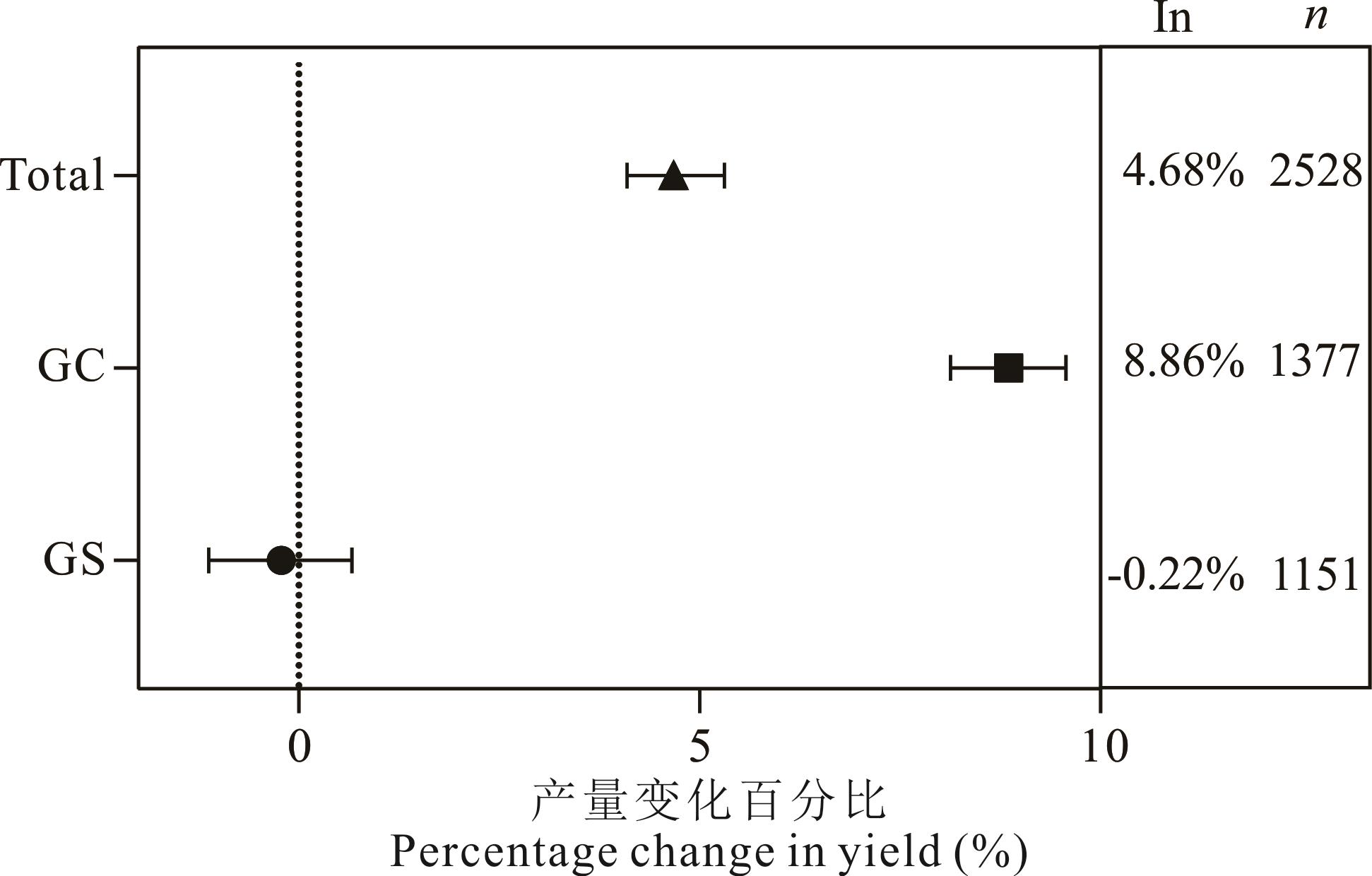
图1 绿肥还田对作物产量的影响Total: 总体; GC: 绿肥配合Green manure combination; GS: 绿肥替代Green manure substitution; In: 与对照相比,绿肥还田产量变化百分比The percentage change in the yield of green manure returned to the field compared with the control; n: 样本数Sample number. 下同The same below.
Fig.1 Effects of green manure incorporation on crop yields

图2 绿肥配合氮肥对作物产量的影响
Fig.2 Effects of green manure combined with nitrogen fertilizer on crop yields
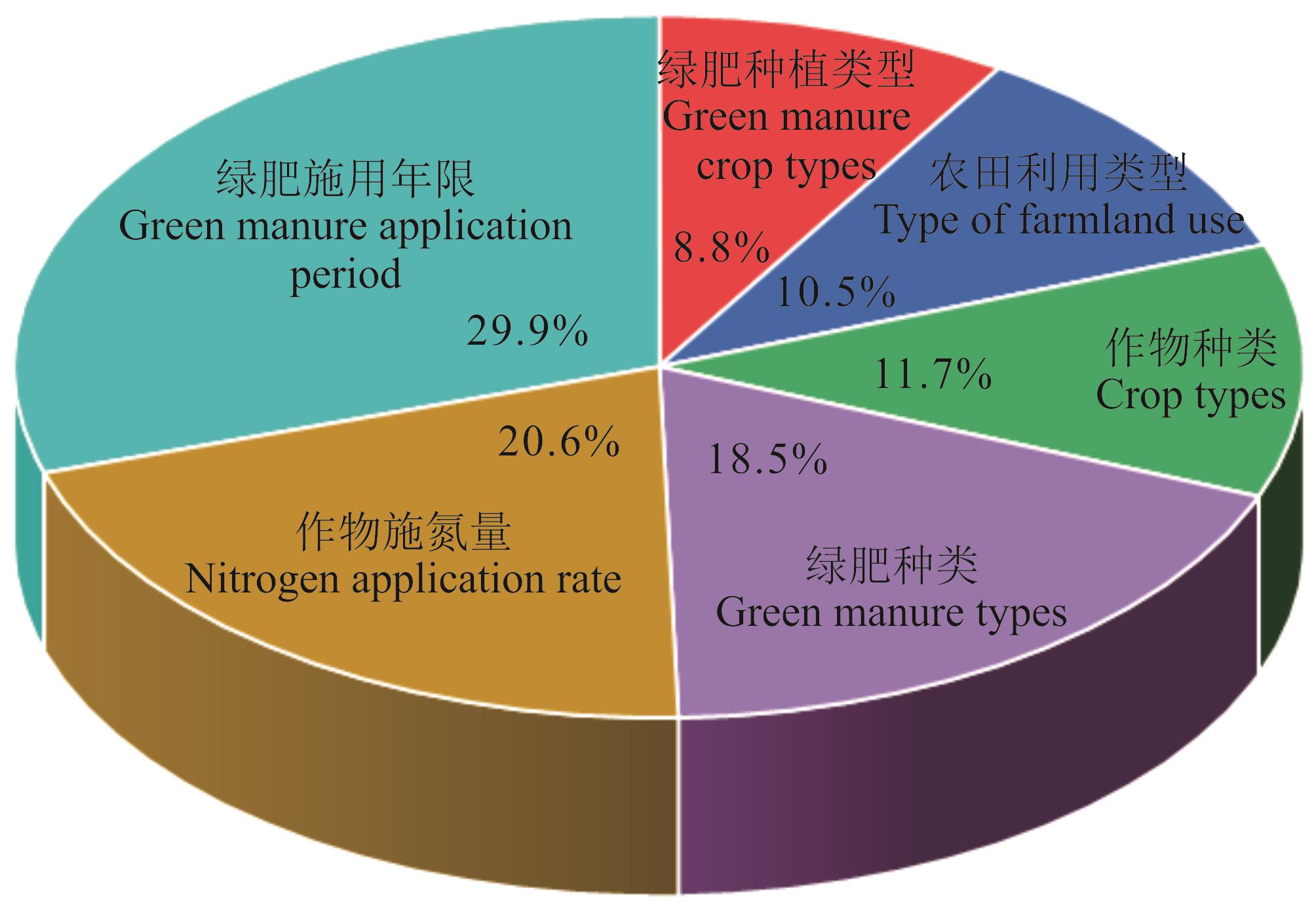
图3 绿肥配合氮肥下影响产量效应的各因素相对贡献率
Fig.3 Relative contribution rates of various factors influencing yield response under the combination of green manure and nitrogen fertilizer

图4 绿肥替代氮肥对作物产量的影响
Fig.4 Effects of green manure substitution for nitrogen fertilizer on crop yields
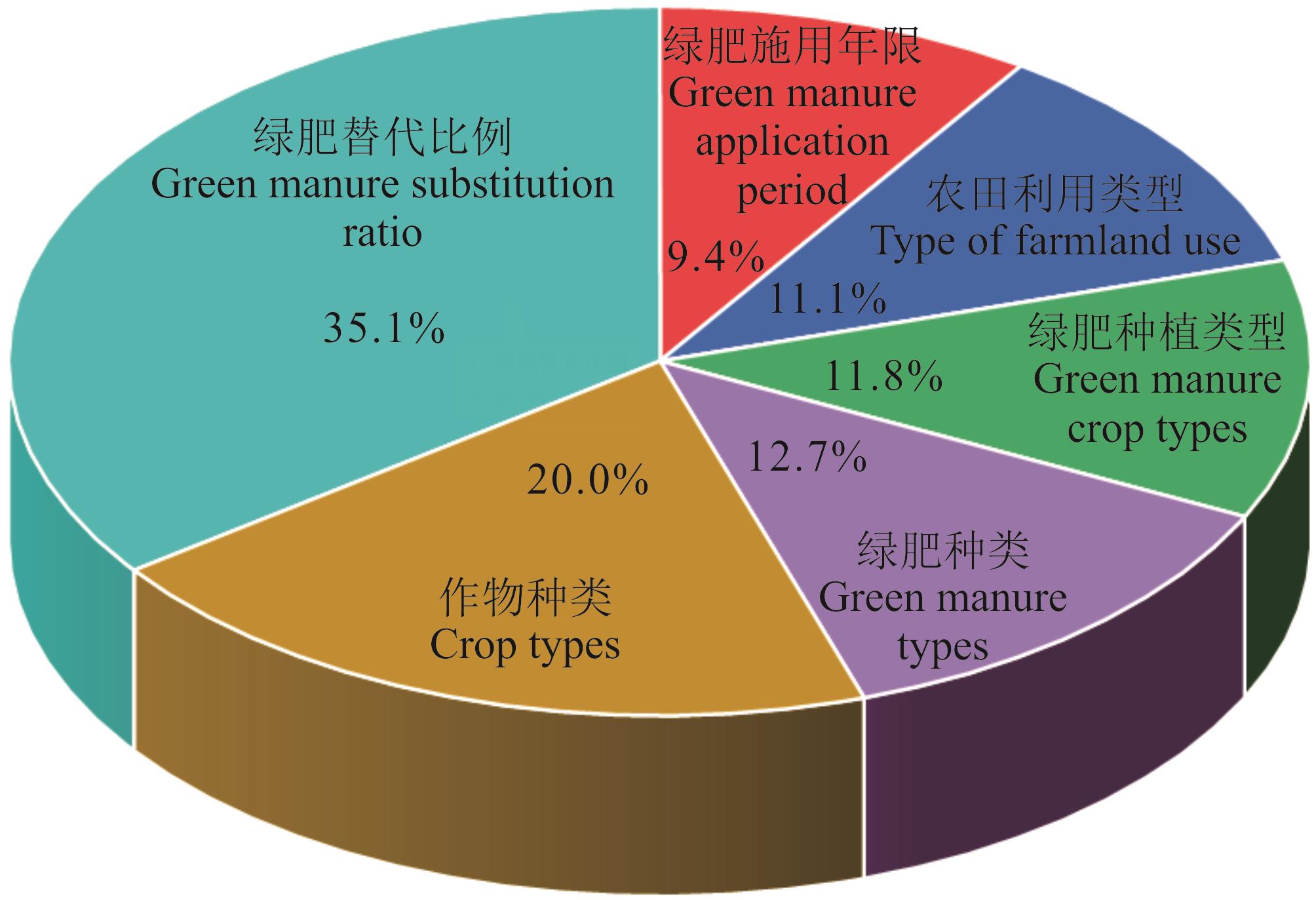
图5 绿肥替代氮肥下影响产量效应的各因素相对贡献率
Fig.5 Relative contribution rates of various factors influencing yield response under green manure substitution for nitrogen fertilizer
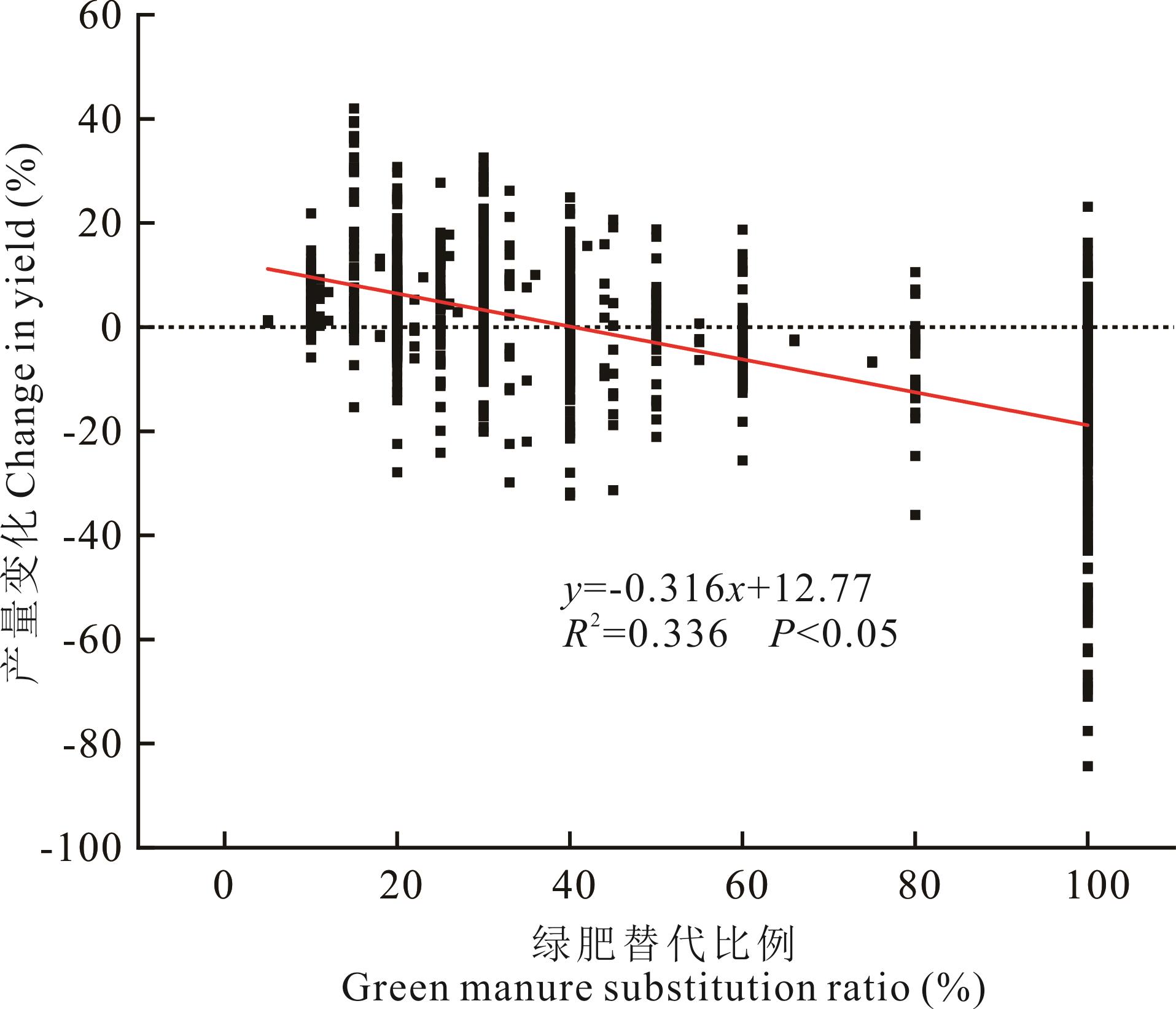
图6 绿肥替代氮肥比例与作物产量变化幅度的线性相关分析
Fig.6 Linear correlation analysis between green manure substitution ratio for nitrogen fertilizer and crop yield change range
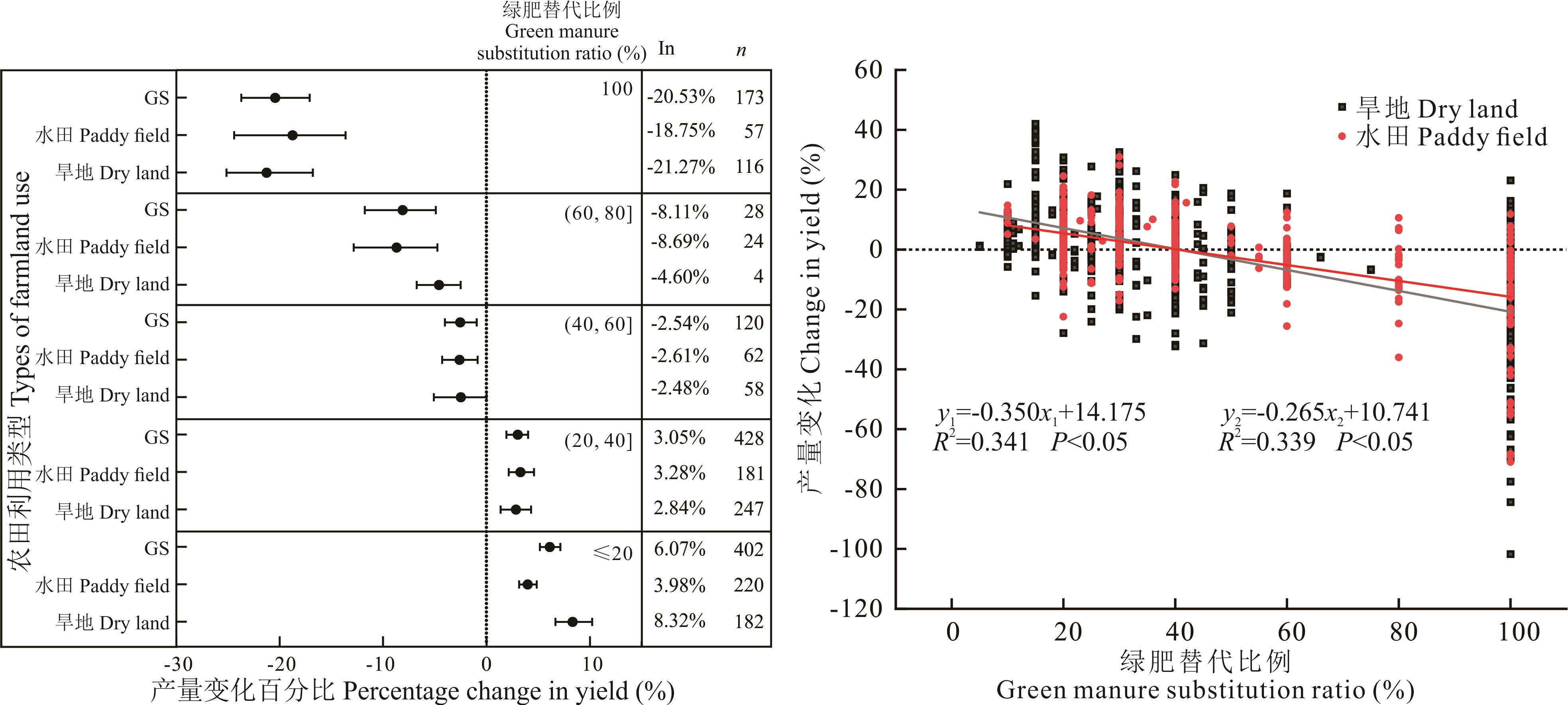
图7 不同绿肥替代比例和农田利用类型对作物产量的影响及与作物产量变化的相关分析y1: 旱地上产量变化The yield change in dry land; y2: 水田上产量变化The yield change in paddy field.
Fig.7 Effects of different green manure substitution ratios and farmland use types on crop yield and correlation analysis with crop yield changes
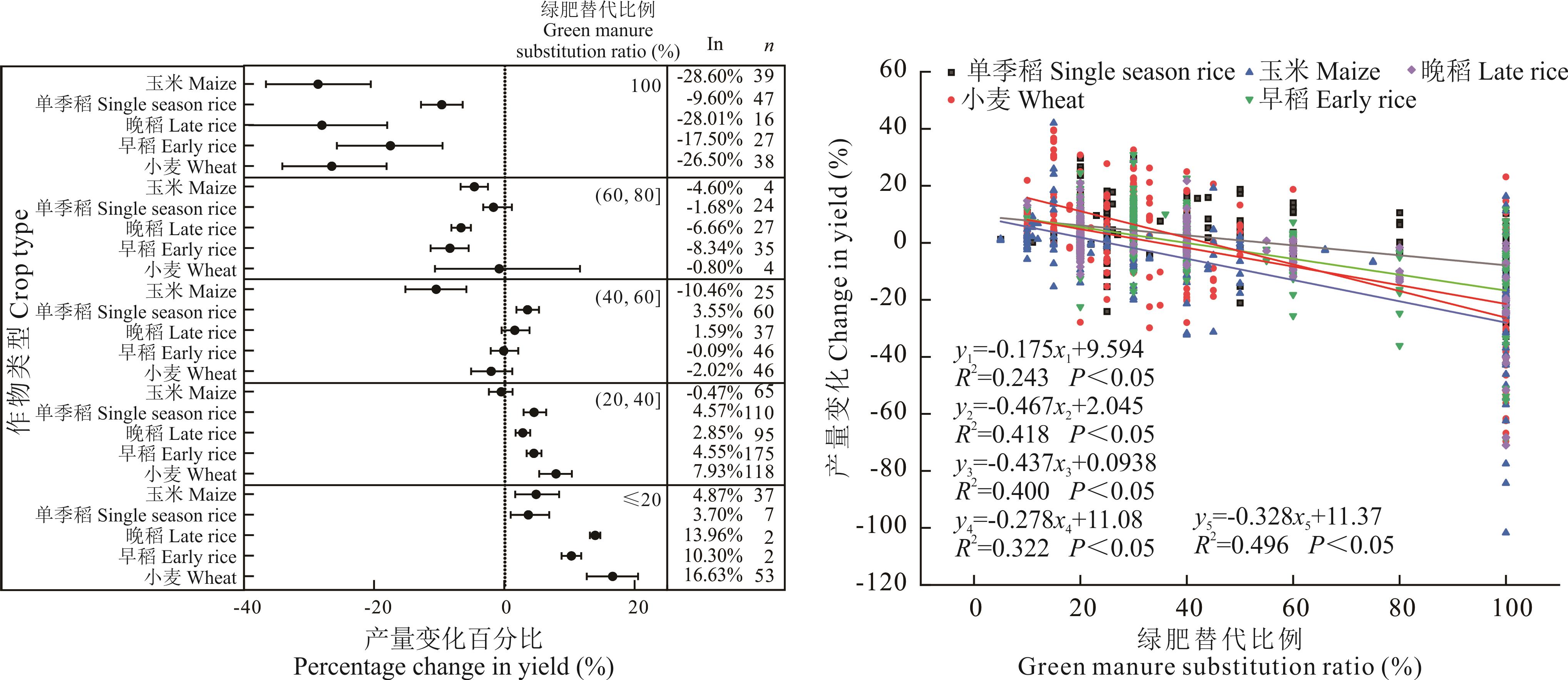
图8 不同绿肥替代比例和作物类型对作物产量的影响及与作物产量变化的相关分析y1: 单季稻产量变化Changes in single-season rice yield; y2: 小麦产量变化Changes in wheat yield; y3: 玉米产量变化Changes in corn yield; y4: 早稻产量变化Changes in early rice yield; y5: 晚稻产量变化Changes in late rice yield.
Fig.8 Effects of different green manure substitution ratios and crop types on crop yield and correlation analysis with crop yield changes
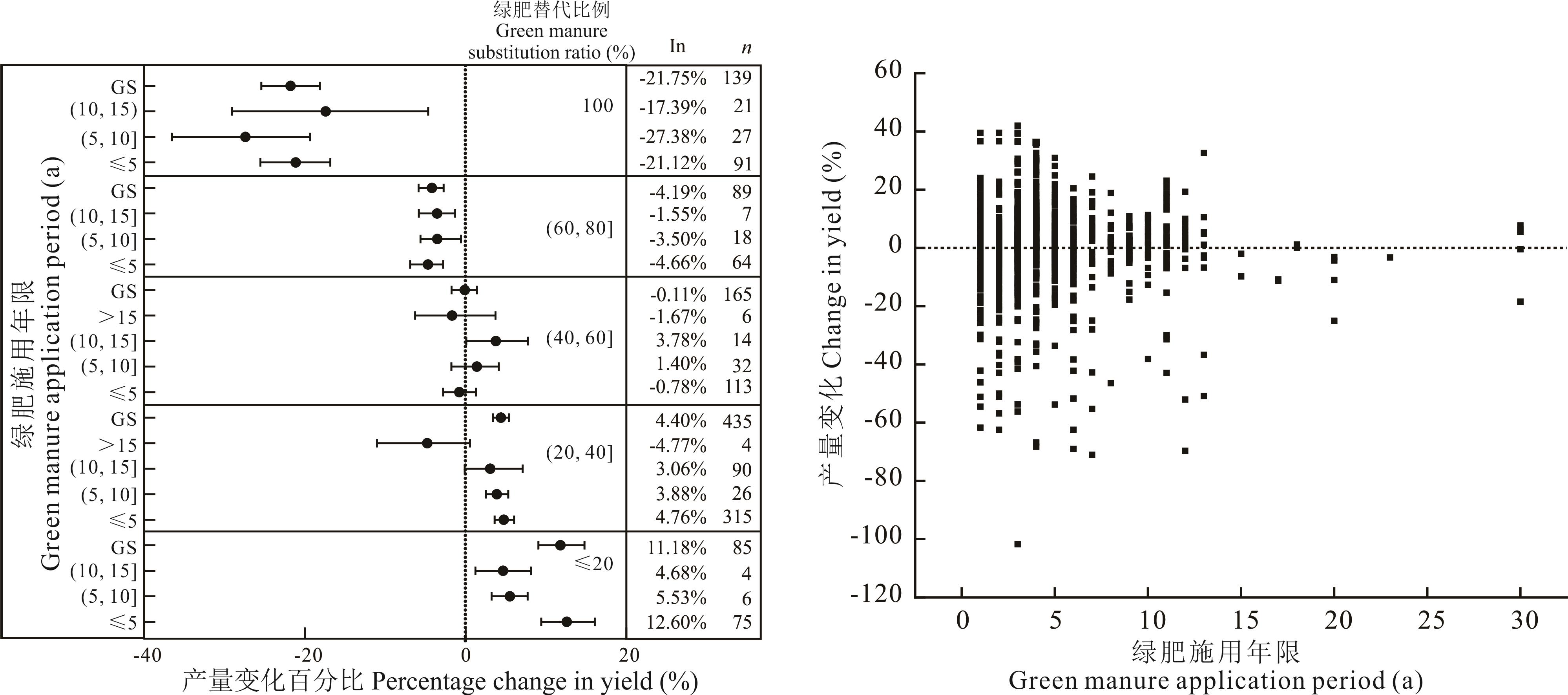
图9 不同绿肥替代比例和绿肥施用年限对作物产量的影响及与作物产量变化的相关分析
Fig.9 Effects of different green manure substitution ratios and green manure application period on crop yield and correlation analysis with crop yield changes
| [1] | Cao W D, Zhou G P, Gao S J. Effects and mechanisms of green manure on endogenous improving soil health. Journal of Plant Nutrition and Fertilizers, 2024, 30(7): 1274-1283. |
| 曹卫东, 周国朋, 高嵩涓. 绿肥内源驱动土壤健康的作用与机制. 植物营养与肥料学报, 2024, 30(7): 1274-1283. | |
| [2] | Feng X M, Alletto L, Cong F W, et al. Strategies to improve field establishment of cover crops: A review. Agronomy for Sustainable Development, 2024, 44(5): 47. |
| [3] | Liang K L, Wang X Q, Du Y T, et al. Effect of legume green manure on yield increases of three major crops in China, a Meta analysis. Agronomy, 2022, 8: 1753. |
| [4] | Gao S J, Zhou G P, Cao W D. Effects of milk vetch (Astragalus sinicus) as winter green manure on rice yield and rate of fertilizer application in rice paddies in south China. Journal of Plant Nutrition and Fertilizers, 2020, 26(12): 2115-2126. |
| 高嵩涓, 周国朋, 曹卫东. 南方稻田紫云英作冬绿肥的增产节肥效应与机制. 植物营养与肥料学报, 2020, 26(12): 2115-2126. | |
| [5] | Ding W C, Xu X P, He P, et al. Improving yield and nitrogen use efficiency through alternative fertilization options for rice in China: A meta-analysis. Field Crops Research, 2018, 227: 11-18. |
| [6] | Tonitto C, David M, Drinkwater L. Replacing bare fallows with cover crops in fertilizer-intensive cropping systems: A Meta-analysis of crop yield and N dynamics. Agriculture, Ecosystems and Environment, 2005, 112(1): 58-72. |
| [7] | Liang H, Li S, Zhang L, et al. Long-term green manuring enhances crop N uptake and reduces N losses in rice production system. Soil & Tillage Research, 2022, 220: 105369. |
| [8] | Huang H, Zhang Z H, Wu Q, et al. Global comprehensive evaluation shows that green manure enhances crop productivity while mitigating gaseous nitrogen losses. Resources, Conservation & Recycling, 2025, 220: 108351. |
| [9] | Yang R, Song S J, Chen S Y, et al. Adaptive evaluation of green manure rotation for a low fertility farmland system: Impacts on crop yield, soil nutrients, and soil microbial community. Catena, 2023, 222: 106873. |
| [10] | Cao W D, Bao X G, Xu C X, et al. Reviews and prospects on science and technology of green manure in China. Journal of Plant Nutrition and Fertilizers, 2017, 23(6): 1450-1461. |
| 曹卫东, 包兴国, 徐昌旭, 等. 中国绿肥科研60年回顾与未来展望. 植物营养与肥料学报, 2017, 23(6): 1450-1461. | |
| [11] | Li Y, Zhang W, Ma L, et al. An integrated analysis of agricultural management practices for enhancing carbon sequestration and ecosystem services in China. Agriculture, Ecosystems & Environment, 2023, 345: 108321. |
| [12] | Zhang D B, Yao P W, Zhao N, et al. Soil water balance and water use efficiency of dryland wheat in different precipitation years in response to green manure approach. Scientific Reports, 2016, 6(1): 26856. |
| [13] | Qin W L, Zhi J F, Xie N, et al. Effects of partial replacement of chemical fertilizers with green manure on dry matter accumulation and yield formation of maize. Scientia Agricultura Sinica, 2024, 57(13): 2549-2567. |
| 秦文利, 智健飞, 谢楠, 等. 绿肥部分替代化肥对玉米干物质积累与产量形成的影响. 中国农业科学, 2024, 57(13): 2549-2567. | |
| [14] | Su X X, Yu A Z, Lü H Q, et al. Effects of wheat multiple cropping with green manure on grain yield formation and nitrogen absorption and utilization of maize in oasis irrigation area in Northwest China. Journal of Plant Nutrition and Fertilizers, 2022, 28(7): 1208-1218. |
| 苏向向, 于爱忠, 吕汉强, 等. 绿洲灌区小麦复种绿肥并翻压还田对翌年玉米产量形成及氮素吸收利用的影响. 植物营养与肥料学报, 2022, 28(7): 1208-1218. | |
| [15] | Du G H, Zhang L, Ding L, et al. Effects of co-incorporation of Chinese milk vetch and rice straw with nitrogen fertilizer reduction on rice yield and nitrogen nutrition balance. Jiangsu Journal of Agricultural Sciences, 2024, 40(6): 1012-1019. |
| 杜光辉, 张琳, 丁丽, 等. 紫云英与水稻秸秆联合还田配合氮肥减施对水稻产量及氮素营养平衡的影响. 江苏农业学报, 2024, 40(6): 1012-1019. | |
| [16] | Nie L P, Guo L W, Zheng C F, et al. Effects of planting and plowing under Chinese milk vetch combined with chemical fertilizer application on soil physical and chemical properties and rice yield in paddy fields. Chinese Agricultural Science Bulletin, 2021, 37(27): 65-69. |
| 聂良鹏, 郭利伟, 郑春风, 等. 种植翻压紫云英配施化肥对稻田土壤理化性状和水稻产量的影响. 中国农学通报, 2021, 37(27): 65-69. | |
| [17] | Yu P, Wang L X, Jacinthe P A, et al. Global synthesis of cover crop impacts on main crop yield. Field Crops Research, 2024, 310: 109343. |
| [18] | Hedges L V, Gurevitch J, Curtis P S. Statistical issues in ecological Meta-analyses. Ecology, 1999, 80(4): 1142-1149. |
| [19] | Fan F, Wopke W D V, David M, et al. Cover crops promote primary crop yield in China: A Meta-regression of factors affecting yield gain. Field Crops Research, 2021, 271: 108237. |
| [20] | Ma J Y, Wang T, Liu X L, et al. Meta-analysis of yield effects and influencing factors of cover crops on main grain crops in China. Scientia Agricultura Sinica, 2023, 56(10): 1871-1880. |
| 马佳玉, 王涛, 刘小利, 等. 覆盖作物对我国粮食作物的产量效应及影响因素的Meta分析.中国农业科学, 2023, 56(10): 1871-1880. | |
| [21] | Liu J H, Yang R X, Wu G C, et al. Analysis of yield increasing effect of winter green manure on rice fields in south China. Chinese Journal of Grassland, 2024, 46(2): 111-120. |
| 刘俊海, 杨瑞雪, 吴桂成, 等. 我国南方稻田冬绿肥培肥增产效应的分析研究. 中国草地学报, 2024, 46(2): 111-120. | |
| [22] | Li X, Xiao D K, Hu Y, et al. Effects of green manure on rice yield and soil fertility in China: a Meta-analysis. Soil and Fertilizer Sciences in China, 2024(6): 79-88. |
| 李炫, 肖大康, 胡洋, 等. 种植绿肥对我国水稻产量和土壤肥力影响的整合分析. 中国土壤与肥料, 2024(6): 79-88. | |
| [23] | Ren K Y, Lu D M, Zou H Q, et al. Effects of substituting manure for fertilizer on yield and nitrogen content of rice grain in the Yangtze River basin. Journal of Agricultural Resources and Environment, 2022, 39(4): 716-725. |
| 任科宇, 陆东明, 邹洪琴, 等. 有机替代对长江流域水稻产量和籽粒含氮量的影响. 农业资源与环境学报, 2022, 39(4): 716-725. | |
| [24] | Zhang C L, Liu C Z, Li B Y, et al. Effects of Chinese milk vetch combined with chemical fertilizer on rice yield in China: a Meta-analysis. Soil and Fertilizer Sciences in China, 2023(3): 39-45. |
| 张成兰, 刘春增, 李本银, 等. 紫云英配施化肥对我国水稻产量效应的整合分析. 中国土壤与肥料, 2023(3): 39-45. | |
| [25] | Lehrer E J, Wang M, Sun Y L, et al. An introduction to Meta-analysis. International Journal of Radiation Oncology, Biology, Physics, 2023, 115(3): 564-571. |
| [26] | Feng Y, Liang H, Nie J, et al. Roles of microbial community and keystone taxa in rice productivity under green manuring in South China. Sustainability, 2024, 16(9): 3565. |
| [27] | Zhang L, Du J T, Fan Q Y, et al. Response of biological nitrogen fixation by milk vetch to soil fertility and rhizobium inoculation. Acta Prataculturae Sinica, 2025, 34(5): 51-63. |
| 张磊, 杜锦涛, 范倩玉, 等. 紫云英生物固氮对土壤肥力及根瘤菌的响应特征. 草业学报, 2025, 34(5): 51-63. | |
| [28] | Yao W, Yang Y, Beillouin D, et al. Legume-rice rotations increase rice yields and carbon sequestration potential globally. One Earth, 2025, 8(2): 101170. |
| [29] | Allen B L, Pikul J L, Waddell J T, et al. Long-term lentil green-manure replacement for fallow in the semiarid northern great plains. Agronomy Journal, 2011, 103: 1292-1298. |
| [30] | Xia Y H, Gao P, Lei W S, et al. Covering green manure increases rice yields via improving nitrogen cycling between soil and crops in paddy fields. Agriculture, Ecosystems & Environment, 2025, 383: 109517. |
| [31] | Cherr M C, Scholberg S M J, McSorley R. Green manure approaches to crop production: A synthesis. Agronomy Journal, 2006, 98(2): 302-319. |
| [32] | Muhammad I, Lyu J Z, Wang J, et al. Regulation of soil microbial community structure and biomass to mitigate soil greenhouse gas emission. Frontiers in Microbiology, 2022, 13: 868862. |
| [33] | Neely C B, Jr R F M, Morgan C L S, et al. Legume green manure and intercropping for high biomass sorghum production. Agricultural Sciences, 2024, 15(6): 605-621. |
| [34] | Kumar V, Ram V, Rajkumari P. Evaluating intercropping indices, yield attributes and yield of baby corn and green gram under different planting patterns. International Journal of Plant & Soil Science, 2024, 36(8): 460-469. |
| [35] | Mukhtar A I, Olalekan T K, Abdulraheem M I, et al. Green manure for agricultural sustainability and improvement of soil fertility. Farming and Management, 2022, 7(1): 1-8. |
| [36] | Muhammad I K, Hyo S G, Muhammad A A, et al. Short term effects of different green manure amendments on the composition of main microbial groups and microbial activity of a submerged rice cropping system. Applied Soil Ecology, 2020, 147: 103400. |
| [37] | Valkama E, Lemola R, Känkänen H E T. Meta-analysis of the effects of undersown catch crops on nitrogen leaching loss and grain yields in the Nordic countries. Agriculture Ecosystems & Environment, 2015, 20: 93-101. |
| [38] | Thorup-Kristensen K, Magid J, Jensen S L. Catch crops and green manures as biological tools in nitrogen management in temperate zones. Advances in Agronomy, 2003, 79: 227-302. |
| [39] | Xie Z J, Tu S X, Shah F, et al. Substitution of fertilizer-N by green manure improves the sustainability of yield in double-rice cropping system in south China. Field Crops Research, 2016, 188: 142-149. |
| [40] | Lyu H Q, Li Y, Wang Y L, et al. Drive soil nitrogen transformation and improve crop nitrogen absorption and utilization: A review of green manure applications. Frontiers in Plant Science, 2024, 14: 1305600. |
| [41] | Ma D K, Yin L N, Ju W L, et al. Meta-analysis of green manure effects on soil properties and crop yield in northern China. Field Crops Research, 2021, 266: 108146. |
| [42] | Wang X, Zhang J D, Zhao Y M, et al. Evaluation of farmland soil health and optimization of evaluation system under different green manure applications in a semi-arid irrigation area. Land Degradation & Development, 2024, 35(5): 1913-1926. |
| [43] | Meng Z L, Zhu Q, Ni X F, et al. Impact of conservation tillage on soil moisture utilization, wheat water requirements and yield. China Seed Industry, 2024(10): 35-37, 41. |
| 孟自力, 朱倩, 倪雪峰, 等. 保护性耕作对土壤水分利用与小麦需水特性和产量影响研究. 中国种业, 2024(10): 35-37, 41. |
| [1] | 张邦彦, 谢小伟, 张朝辉, 武晋民, 王彬, 许兴. 有机-无机改良物料对盐碱地土壤质量及湖南稷子产量的影响[J]. 草业学报, 2025, 34(8): 15-29. |
| [2] | 原韶雨, 韩诗卉, 夏天, 何宁波, 张建杰. 中国北方天然草地土壤pH对不同施肥措施的响应[J]. 草业学报, 2025, 34(7): 28-40. |
| [3] | 姚博, 朱瑞芬, 徐远东, 孙万斌, 刘畅, 陈积山. 基于Meta评估生防菌剂对饲草作物真菌病害防效及其影响因素[J]. 草业学报, 2025, 34(4): 189-200. |
| [4] | 麦晶晶, 冯琦胜, 王瑞泾, 封森耀, 金哲人, 张忠雪, 梁天刚, 金加明. 基于机器学习的高精度耕地识别模型构建——以甘肃省张掖市为例[J]. 草业学报, 2025, 34(2): 149-162. |
| [5] | 刘蕊, 常单娜, 周国朋, 高嵩涓, 柴强, 曹卫东. 农田氧化亚氮减排技术及其与绿肥协同应用分析[J]. 草业学报, 2025, 34(2): 196-210. |
| [6] | 赵文军, 梁婷, 王剑松, 刘魁, 冯瑜, 王正旭, 徐梓荷, 朱云聪, 孙蒙猛, 李湘伟, 付利波, 尹梅, 周国朋, 陈华, 曹卫东. 种植翻压光叶紫花苕配合氮肥减施提高烤烟产量和土壤质量[J]. 草业学报, 2025, 34(10): 74-84. |
| [7] | 王峥, 常伟, 李俊诚, 苏连泰, 高鲤, 周鹏, 安渊. 紫花苜蓿还田对饲料玉米产量和氮素吸收转运的影响[J]. 草业学报, 2024, 33(8): 63-73. |
| [8] | 徐寿霞. 基于meta分析的丛枝菌根对小麦产量和品质的影响[J]. 草业学报, 2024, 33(7): 192-204. |
| [9] | 马路平, 石兆勇, 韦文敬, 杨爽. 基于Meta分析菌根菌对植物叶片生理的影响[J]. 草业学报, 2024, 33(4): 99-109. |
| [10] | 吕帅磊, 常单娜, 周国朋, 刘蕊, 赵鑫, 刘佳, 徐昌旭, 曹卫东. 江西红壤绿肥季施用磷矿粉的磷素效应[J]. 草业学报, 2024, 33(11): 149-160. |
| [11] | 赵文军, 刘蕊, 王正旭, 冯瑜, 薛开政, 刘魁, 徐梓荷, 曹卫东, 付利波, 尹梅, 陈华. 烤烟-绿肥轮作对云南烟田土壤质量与微生物养分限制的影响[J]. 草业学报, 2024, 33(10): 147-158. |
| [12] | 张慧龙, 杨秀春, 杨东, 陈昂, 张敏. 2000-2020年内蒙古草地植被覆盖度时空变化及趋势预测[J]. 草业学报, 2023, 32(8): 1-13. |
| [13] | 蒋丛泽, 受娜, 高玮, 马仁诗, 沈禹颖, 杨宪龙. 陇东旱塬区不同青贮玉米品种生产性能和营养品质综合评价[J]. 草业学报, 2023, 32(7): 216-228. |
| [14] | 银敏华, 马彦麟, 康燕霞, 贾琼, 齐广平, 汪精海. 氮素添加对中国苜蓿产量与品质效应的Meta分析[J]. 草业学报, 2022, 31(9): 36-49. |
| [15] | 赵翊含, 侯蒙京, 冯琦胜, 高宏元, 梁天刚, 贺金生, 钱大文. 基于Landsat 8和随机森林的青海门源天然草地地上生物量遥感估算[J]. 草业学报, 2022, 31(7): 1-14. |
| 阅读次数 | ||||||
|
全文 |
|
|||||
|
摘要 |
|
|||||
