
ISSN 1004-5759 CN 62-1105/S
草业学报 ›› 2026, Vol. 35 ›› Issue (12): 124-138.DOI: 10.11686/cyxb2025493
• 研究论文 • 上一篇
郭紫瑞1( ), 朱文琰2, 郑鑫淼1, 孙平1()
收稿日期:2025-12-02
修回日期:2026-03-23
出版日期:2026-12-20
发布日期:2026-11-02
通讯作者:
孙平
作者简介:E-mail: pingsunny@msn.com基金资助:
Zi-rui GUO1(), Wen-yan ZHU2, Xin-miao ZHENG1, Ping SUN1()
Received:2025-12-02
Revised:2026-03-23
Online:2026-12-20
Published:2026-11-02
Contact:
Ping SUN
摘要:
为探究硒(Se)对高浓度聚乙烯纳米塑料(PE-NPs)污染土壤中多茬紫花苜蓿生长与品质的缓解效应及适宜施用量,本研究采用室外盆栽法,以1%100 nm PE-NPs处理土壤,设置0、0.4、0.8、1.2、1.6、2.0 mg·kg?1 6个硒浓度梯度,连续种植并收获4茬初花期紫花苜蓿,测定其生长与营养指标,通过隶属函数法综合评价硒的缓解效果。结果表明,1%PE-NPs显著抑制4茬紫花苜蓿的生长与营养品质,适宜浓度硒可有效缓解该毒性效应,且最佳缓解浓度随茬次增加呈升高趋势:0.8 mg·kg?1硒对第1茬缓解效果最优,1.6 mg·kg?1硒适用于第2、3茬,2.0 mg·kg?1硒对第4茬缓解作用最显著。各茬次中第2茬经硒调控后综合表现最佳。本研究明确了硒对PE-NPs胁迫的缓解具有茬次依赖性的浓度效应,可为纳米塑料污染农田的牧草安全生产、硒肥科学施用提供理论依据,也为土壤纳米塑料污染的植物修复提供了新思路。
郭紫瑞, 朱文琰, 郑鑫淼, 孙平. 适量硒对聚乙烯纳米塑料胁迫下多茬紫花苜蓿的缓解作用[J]. 草业学报, 2026, 35(12): 124-138.
Zi-rui GUO, Wen-yan ZHU, Xin-miao ZHENG, Ping SUN. Alleviation of polyethylene nanoparticle stress in multi-cut alfalfa using selenium application[J]. Acta Prataculturae Sinica, 2026, 35(12): 124-138.
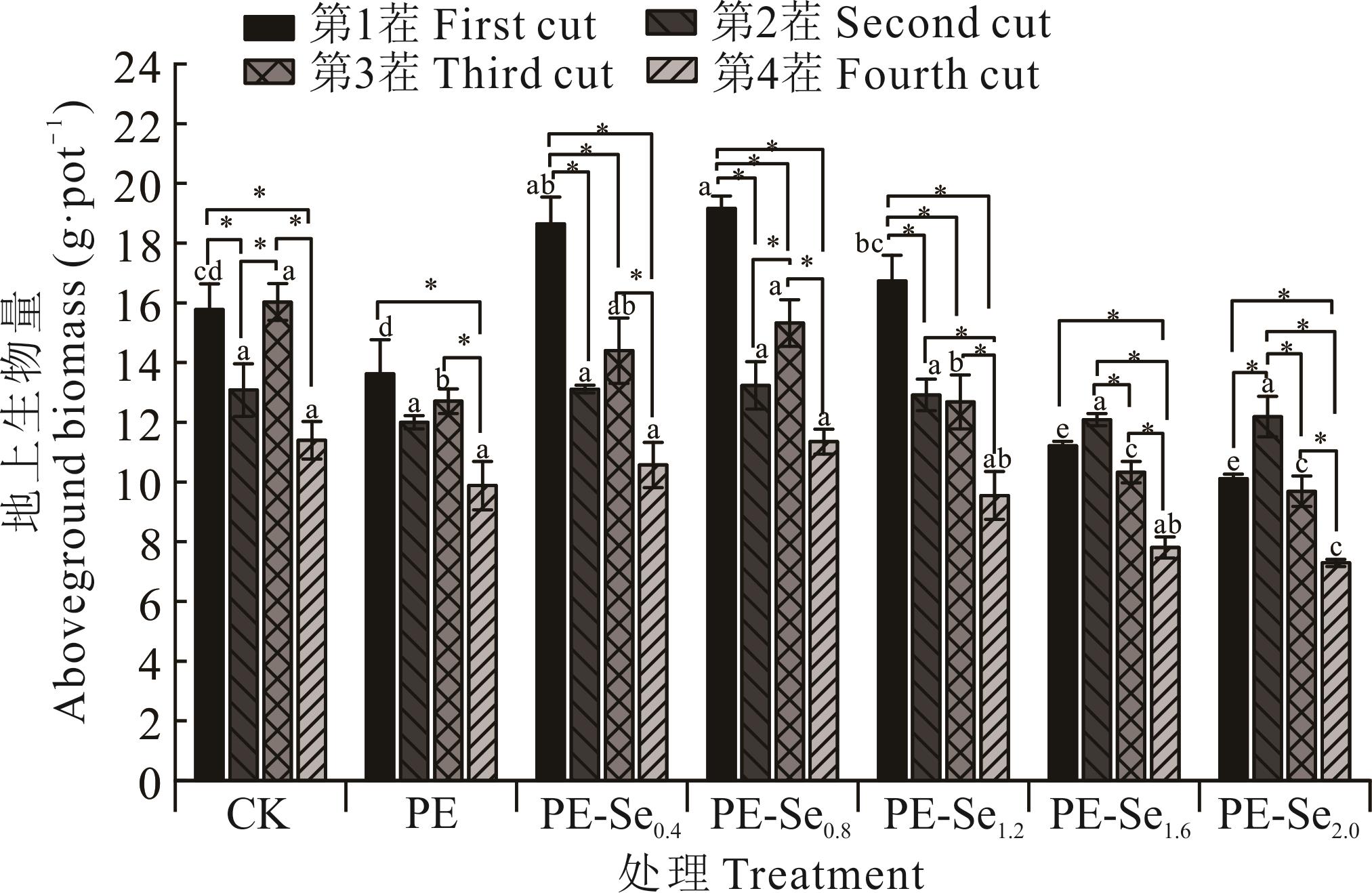
图1 施硒量和刈割茬数对聚乙烯纳米塑料土壤环境下生长的紫花苜蓿地上生物量的影响不同小写字母表示同茬不同处理之间差异显著(P<0.05),*表示相同处理不同茬数之间差异显著(P<0.05),下同。Different lowercase letters indicate significant differences among different treatments within the same cutting frequency (P<0.05), * indicates significant differences among different cutting frequency under the same treatment (P<0.05), the same below.
Fig.1 Effects of selenium(Se) application rate and cutting number on the aboveground biomass of alfalfa grown in polyethylene nanoparticles(PE-NPs) soil
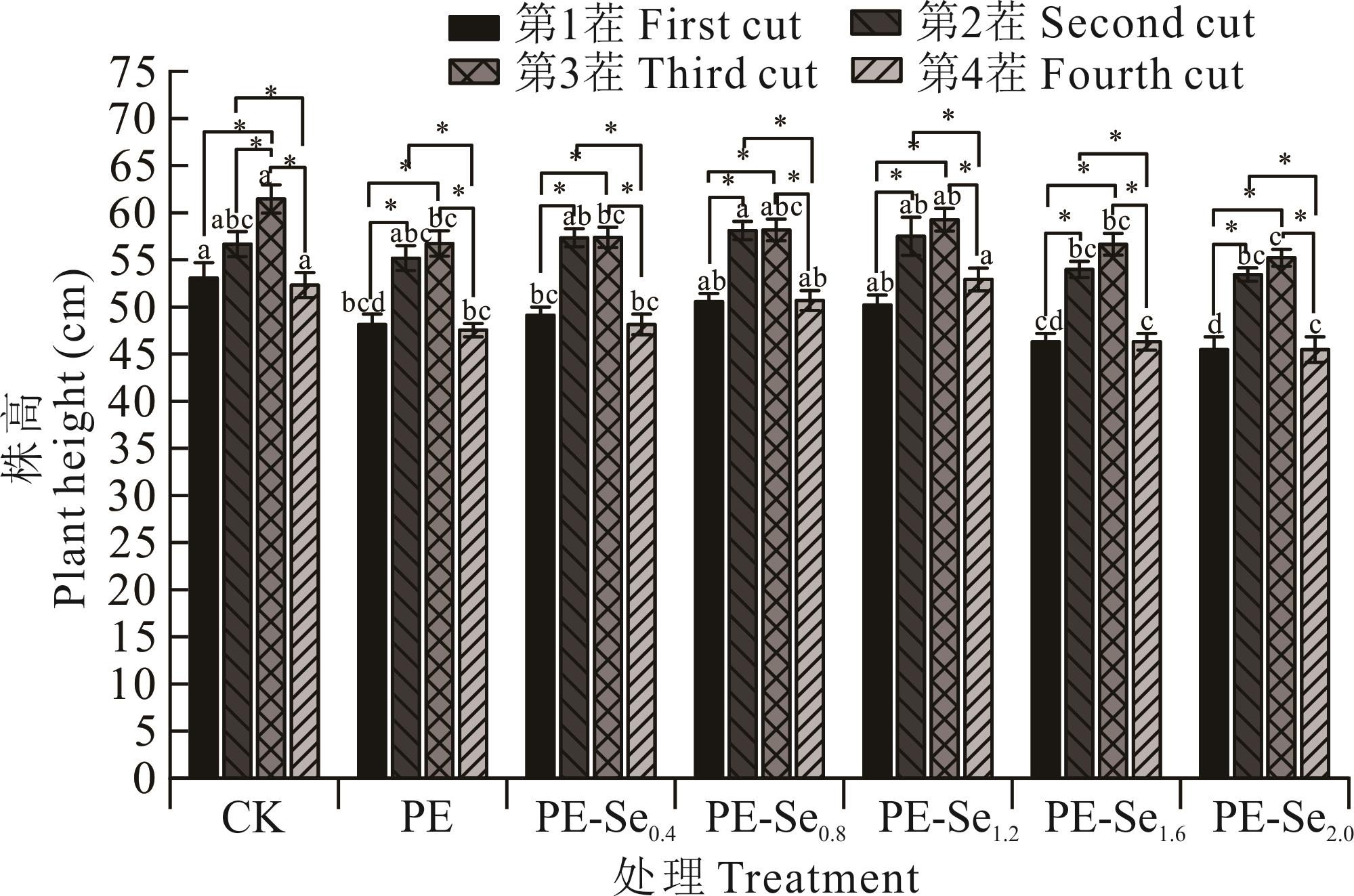
图2 施硒量和刈割茬数对聚乙烯纳米塑料土壤环境下生长的紫花苜蓿株高的影响
Fig.2 Effects of selenium (Se) application rate and cutting number on the plant height of alfalfa grown in polyethylene nanoparticles (PE-NPs) soil
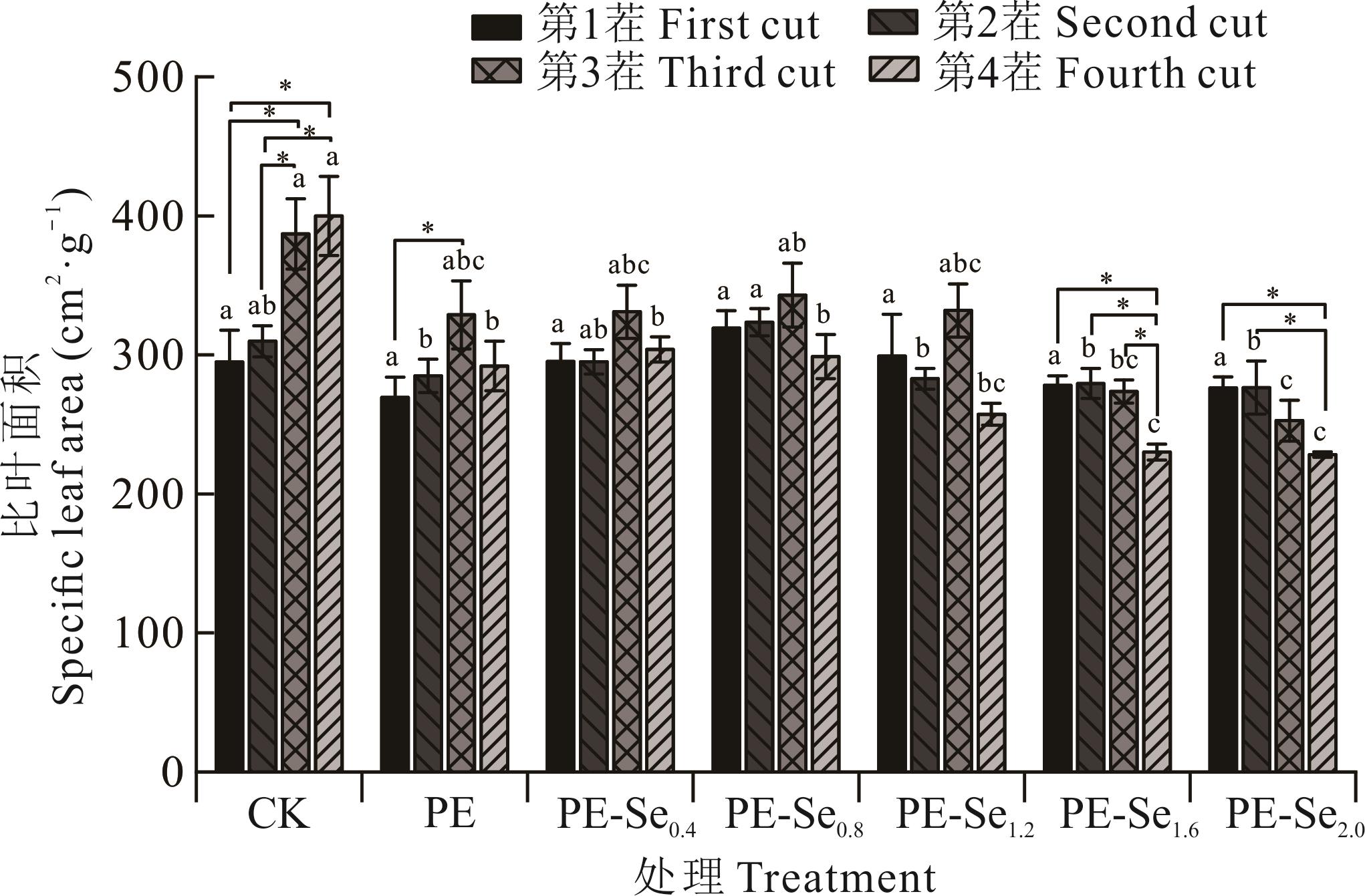
图3 施硒量和刈割茬数对聚乙烯纳米塑料土壤环境下生长的紫花苜蓿比叶面积的影响
Fig.3 Effects of selenium (Se) application rate and cutting number on the specific leaf area of alfalfa grown in polyethylene nanoparticles (PE-NPs) soil
因素 Factor | 地上生物量 Aboveground biomass | 株高 Plant height | 比叶面积 Specific leaf area |
|---|---|---|---|
| 茬数Cutting number | <0.001 | <0.001 | <0.001 |
| Se浓度Concentration | <0.001 | <0.001 | <0.001 |
| 交互作用Interaction | <0.001 | 0.979 | 0.236 |
表1 双因素方差分析中生长指标受刈割茬数和土壤硒含量的主效应及其交互作用的P值
Table 1 P-values for the main effects and interactions of cutting frequency and soil selenium (Se) content on growth indices in the two-factor ANOVA
因素 Factor | 地上生物量 Aboveground biomass | 株高 Plant height | 比叶面积 Specific leaf area |
|---|---|---|---|
| 茬数Cutting number | <0.001 | <0.001 | <0.001 |
| Se浓度Concentration | <0.001 | <0.001 | <0.001 |
| 交互作用Interaction | <0.001 | 0.979 | 0.236 |
处理 Treatment | 干物质 Dry matter | 粗灰分 Crude ash | 粗蛋白质 Crude protein | 粗脂肪 Ether extract | 中性洗涤纤维 Neutral detergent fiber | 酸性洗涤纤维 Acid detergent fiber |
|---|---|---|---|---|---|---|
| CK | 27.00±0.27a | 8.24±0.03d | 17.96±0.26a | 2.81±0.03c | 39.75±0.52b | 25.75±0.21b |
| PE | 26.11±0.20a | 8.23±0.07d | 18.06±0.25a | 2.93±0.04bc | 40.12±0.44b | 25.62±0.19bc |
| PE-Se0.4 | 21.39±0.11c | 7.55±0.05e | 16.93±0.33b | 2.97±0.05b | 41.95±0.60a | 25.65±0.33bc |
| PE-Se0.8 | 20.12±0.15d | 7.48±0.14e | 18.77±0.34a | 3.14±0.04a | 39.52±0.49b | 24.88±0.21c |
| PE-Se1.2 | 21.28±0.07c | 8.52±0.10c | 18.32±0.21a | 3.13±0.08a | 41.84±0.56a | 25.87±0.24b |
| PE-Se1.6 | 21.94±0.11b | 8.97±0.10b | 18.17±0.16a | 3.00±0.03ab | 43.35±0.24a | 26.94±0.19a |
| PE-Se2.0 | 22.18±0.17b | 9.21±0.07a | 18.28±0.20a | 2.96±0.03b | 43.14±0.49a | 27.00±0.26a |
表2 不同浓度硒添加对聚乙烯纳米塑料土壤环境下第1茬紫花苜蓿营养成分的影响
Table 2 Effects of different selenium (Se) application concentrations on the nutrient components of the first-cut alfalfa grown in polyethylene nanoparticles (PE-NPs) soil (%)
处理 Treatment | 干物质 Dry matter | 粗灰分 Crude ash | 粗蛋白质 Crude protein | 粗脂肪 Ether extract | 中性洗涤纤维 Neutral detergent fiber | 酸性洗涤纤维 Acid detergent fiber |
|---|---|---|---|---|---|---|
| CK | 27.00±0.27a | 8.24±0.03d | 17.96±0.26a | 2.81±0.03c | 39.75±0.52b | 25.75±0.21b |
| PE | 26.11±0.20a | 8.23±0.07d | 18.06±0.25a | 2.93±0.04bc | 40.12±0.44b | 25.62±0.19bc |
| PE-Se0.4 | 21.39±0.11c | 7.55±0.05e | 16.93±0.33b | 2.97±0.05b | 41.95±0.60a | 25.65±0.33bc |
| PE-Se0.8 | 20.12±0.15d | 7.48±0.14e | 18.77±0.34a | 3.14±0.04a | 39.52±0.49b | 24.88±0.21c |
| PE-Se1.2 | 21.28±0.07c | 8.52±0.10c | 18.32±0.21a | 3.13±0.08a | 41.84±0.56a | 25.87±0.24b |
| PE-Se1.6 | 21.94±0.11b | 8.97±0.10b | 18.17±0.16a | 3.00±0.03ab | 43.35±0.24a | 26.94±0.19a |
| PE-Se2.0 | 22.18±0.17b | 9.21±0.07a | 18.28±0.20a | 2.96±0.03b | 43.14±0.49a | 27.00±0.26a |
处理 Treatment | 干物质 Dry matter | 粗灰分 Crude ash | 粗蛋白质 Crude protein | 粗脂肪 Ether extract | 中性洗涤纤维 Neutral detergent fiber | 酸性洗涤纤维 Acid detergent fiber |
|---|---|---|---|---|---|---|
| CK | 24.20±0.12bc | 7.42±0.10c | 16.88±0.18b | 3.07±0.04ab | 41.83±0.24a | 26.18±0.16a |
| PE | 25.85±0.78a | 6.73±0.20d | 18.99±0.33a | 3.19±0.07a | 34.56±0.64d | 23.19±0.31c |
| PE-Se0.4 | 26.14±0.40a | 6.67±0.08d | 18.46±0.23a | 2.78±0.06d | 37.71±0.50c | 24.96±0.18b |
| PE-Se0.8 | 24.45±0.18b | 7.75±0.05b | 17.09±0.17b | 2.90±0.04bcd | 40.74±0.49ab | 25.68±0.27ab |
| PE-Se1.2 | 26.97±0.41a | 7.78±0.09b | 17.24±0.25b | 2.88±0.07cd | 39.62±0.57b | 25.08±0.30b |
| PE-Se1.6 | 22.21±0.28cd | 8.02±0.07b | 19.05±0.16a | 3.00±0.10bc | 34.96±0.26d | 23.18±0.13c |
| PE-Se2.0 | 23.24±0.30d | 8.60±0.05a | 17.47±0.22b | 2.88±0.06cd | 41.43±0.44a | 25.56±0.27ab |
表3 不同浓度硒添加对聚乙烯纳米塑料土壤环境下第2茬紫花苜蓿营养成分的影响
Table 3 Effects of different selenium (Se) application concentrations on the nutrient components of the second-cut alfalfa grown in polyethylene nanoparticles (PE-NPs) soil (%)
处理 Treatment | 干物质 Dry matter | 粗灰分 Crude ash | 粗蛋白质 Crude protein | 粗脂肪 Ether extract | 中性洗涤纤维 Neutral detergent fiber | 酸性洗涤纤维 Acid detergent fiber |
|---|---|---|---|---|---|---|
| CK | 24.20±0.12bc | 7.42±0.10c | 16.88±0.18b | 3.07±0.04ab | 41.83±0.24a | 26.18±0.16a |
| PE | 25.85±0.78a | 6.73±0.20d | 18.99±0.33a | 3.19±0.07a | 34.56±0.64d | 23.19±0.31c |
| PE-Se0.4 | 26.14±0.40a | 6.67±0.08d | 18.46±0.23a | 2.78±0.06d | 37.71±0.50c | 24.96±0.18b |
| PE-Se0.8 | 24.45±0.18b | 7.75±0.05b | 17.09±0.17b | 2.90±0.04bcd | 40.74±0.49ab | 25.68±0.27ab |
| PE-Se1.2 | 26.97±0.41a | 7.78±0.09b | 17.24±0.25b | 2.88±0.07cd | 39.62±0.57b | 25.08±0.30b |
| PE-Se1.6 | 22.21±0.28cd | 8.02±0.07b | 19.05±0.16a | 3.00±0.10bc | 34.96±0.26d | 23.18±0.13c |
| PE-Se2.0 | 23.24±0.30d | 8.60±0.05a | 17.47±0.22b | 2.88±0.06cd | 41.43±0.44a | 25.56±0.27ab |
处理 Treatment | 干物质 Dry matter | 粗灰分 Crude ash | 粗蛋白质 Crude protein | 粗脂肪 Ether extract | 中性洗涤纤维 Neutral detergent fiber | 酸性洗涤纤维 Acid detergent fiber |
|---|---|---|---|---|---|---|
| CK | 23.49±0.12a | 8.51±0.07cd | 15.97±0.19d | 2.80±0.05b | 46.21±0.34b | 28.39±0.18bc |
| PE | 20.43±0.28bc | 8.70±0.20bc | 17.53±0.33c | 2.90±0.06b | 45.96±0.67b | 27.73±0.50c |
| PE-Se0.4 | 20.91±0.19bc | 8.15±0.22de | 19.23±0.24a | 2.98±0.07d | 40.71±0.47c | 25.40±0.23e |
| PE-Se0.8 | 20.28±0.49c | 8.08±0.10e | 18.42±0.21b | 2.87±0.06c | 43.24±0.78c | 26.77±0.24d |
| PE-Se1.2 | 20.10±0.40c | 8.64±0.11c | 18.41±0.26b | 2.84±0.04b | 46.64±0.41b | 28.49±0.20bc |
| PE-Se1.6 | 18.65±0.26d | 9.07±0.10b | 17.11±0.19c | 3.08±0.07a | 49.85±0.39a | 29.66±0.14a |
| PE-Se2.0 | 21.27±0.22b | 9.97±0.08a | 17.33±0.34c | 2.60±0.08a | 48.84±0.65a | 28.93±0.32ab |
表4 不同浓度硒添加对聚乙烯纳米塑料土壤环境下第3茬紫花苜蓿营养成分的影响
Table 4 Effects of different selenium (Se) application concentrations on the nutrient components of third-cut alfalfa in polyethylene nanoparticles (PE-NPs) soil (%)
处理 Treatment | 干物质 Dry matter | 粗灰分 Crude ash | 粗蛋白质 Crude protein | 粗脂肪 Ether extract | 中性洗涤纤维 Neutral detergent fiber | 酸性洗涤纤维 Acid detergent fiber |
|---|---|---|---|---|---|---|
| CK | 23.49±0.12a | 8.51±0.07cd | 15.97±0.19d | 2.80±0.05b | 46.21±0.34b | 28.39±0.18bc |
| PE | 20.43±0.28bc | 8.70±0.20bc | 17.53±0.33c | 2.90±0.06b | 45.96±0.67b | 27.73±0.50c |
| PE-Se0.4 | 20.91±0.19bc | 8.15±0.22de | 19.23±0.24a | 2.98±0.07d | 40.71±0.47c | 25.40±0.23e |
| PE-Se0.8 | 20.28±0.49c | 8.08±0.10e | 18.42±0.21b | 2.87±0.06c | 43.24±0.78c | 26.77±0.24d |
| PE-Se1.2 | 20.10±0.40c | 8.64±0.11c | 18.41±0.26b | 2.84±0.04b | 46.64±0.41b | 28.49±0.20bc |
| PE-Se1.6 | 18.65±0.26d | 9.07±0.10b | 17.11±0.19c | 3.08±0.07a | 49.85±0.39a | 29.66±0.14a |
| PE-Se2.0 | 21.27±0.22b | 9.97±0.08a | 17.33±0.34c | 2.60±0.08a | 48.84±0.65a | 28.93±0.32ab |
处理 Treatment | 干物质 Dry matter | 粗灰分 Crude ash | 粗蛋白质 Crude protein | 粗脂肪 Ether extract | 中性洗涤纤维 Neutral detergent fiber | 酸性洗涤纤维 Acid detergent fiber |
|---|---|---|---|---|---|---|
| CK | 21.41±0.15b | 8.04±0.08d | 17.08±0.32d | 2.74±0.05d | 40.79±0.49bc | 24.68±0.27c |
| PE | 20.80±0.28bc | 8.47±0.11c | 17.57±0.14d | 2.92±0.04bc | 42.54±0.44a | 25.94±0.23a |
| PE-Se0.4 | 20.85±0.25bc | 8.05±0.11d | 19.69±0.15b | 3.07±0.06a | 39.34±0.41cd | 25.04±0.30bc |
| PE-Se0.8 | 20.50±0.15c | 8.22±0.17cd | 19.01±0.31c | 3.01±0.05ab | 40.36±0.84bcd | 24.98±0.40bc |
| PE-Se1.2 | 20.50±0.21c | 8.09±0.10d | 19.41±0.14bc | 3.12±0.04a | 40.90±0.49bc | 25.73±0.27ab |
| PE-Se1.6 | 21.23±0.19b | 8.84±0.15b | 19.71±0.20b | 2.88±0.04bc | 41.21±0.60ab | 25.59±0.26ab |
| PE-Se2.0 | 24.27±0.16a | 10.20±0.09a | 20.73±0.14a | 2.83±0.03cd | 38.92±0.40d | 23.83±0.21d |
表5 不同浓度硒添加对聚乙烯纳米塑料土壤环境下第4茬紫花苜蓿营养成分的影响
Table 5 Effects of different selenium (Se) application concentrations on the nutrient components of fourth-cut alfalfa in polyethylene nanoparticles (PE-NPs) soil (%)
处理 Treatment | 干物质 Dry matter | 粗灰分 Crude ash | 粗蛋白质 Crude protein | 粗脂肪 Ether extract | 中性洗涤纤维 Neutral detergent fiber | 酸性洗涤纤维 Acid detergent fiber |
|---|---|---|---|---|---|---|
| CK | 21.41±0.15b | 8.04±0.08d | 17.08±0.32d | 2.74±0.05d | 40.79±0.49bc | 24.68±0.27c |
| PE | 20.80±0.28bc | 8.47±0.11c | 17.57±0.14d | 2.92±0.04bc | 42.54±0.44a | 25.94±0.23a |
| PE-Se0.4 | 20.85±0.25bc | 8.05±0.11d | 19.69±0.15b | 3.07±0.06a | 39.34±0.41cd | 25.04±0.30bc |
| PE-Se0.8 | 20.50±0.15c | 8.22±0.17cd | 19.01±0.31c | 3.01±0.05ab | 40.36±0.84bcd | 24.98±0.40bc |
| PE-Se1.2 | 20.50±0.21c | 8.09±0.10d | 19.41±0.14bc | 3.12±0.04a | 40.90±0.49bc | 25.73±0.27ab |
| PE-Se1.6 | 21.23±0.19b | 8.84±0.15b | 19.71±0.20b | 2.88±0.04bc | 41.21±0.60ab | 25.59±0.26ab |
| PE-Se2.0 | 24.27±0.16a | 10.20±0.09a | 20.73±0.14a | 2.83±0.03cd | 38.92±0.40d | 23.83±0.21d |
茬 Cut | 主成分 Principal component | 提取平方和载入Extraction sums of squared loadings | 提取载荷平方和Extraction sums of squared loadings | ||||
|---|---|---|---|---|---|---|---|
特征值 Eigenvalue | 贡献率Contribution rate (%) | 累积贡献率Cumulative contribution rate (%) | 特征值 Eigenvalue | 贡献率Contribution rate (%) | 累积贡献率Cumulative contribution rate (%) | ||
| 1 | 1 | 3.384 | 67.677 | 67.677 | 3.384 | 67.677 | 67.677 |
| 2 | 1.188 | 23.752 | 91.429 | 1.188 | 23.752 | 91.429 | |
| 3 | 0.355 | 7.107 | 98.536 | ||||
| 4 | 0.071 | 1.423 | 99.959 | ||||
| 5 | 0.002 | 0.041 | 100.000 | ||||
| 2 | 1 | 2.986 | 59.723 | 59.723 | 2.986 | 59.723 | 59.723 |
| 2 | 1.684 | 33.679 | 93.402 | 1.684 | 33.679 | 93.402 | |
| 3 | 0.239 | 4.776 | 98.178 | ||||
| 4 | 0.073 | 1.455 | 99.633 | ||||
| 5 | 0.018 | 0.367 | 100.000 | ||||
| 3 | 1 | 3.004 | 60.084 | 60.084 | 3.004 | 60.084 | 60.084 |
| 2 | 1.642 | 32.842 | 92.926 | 1.642 | 32.842 | 92.926 | |
| 3 | 0.279 | 5.573 | 98.499 | ||||
| 4 | 0.074 | 1.485 | 99.984 | ||||
| 5 | 0.001 | 0.016 | 100.000 | ||||
| 4 | 1 | 3.190 | 63.807 | 63.807 | 3.190 | 63.807 | 63.807 |
| 2 | 1.118 | 22.366 | 86.173 | 1.118 | 22.366 | 86.173 | |
| 3 | 0.657 | 13.149 | 99.323 | ||||
| 4 | 0.022 | 0.445 | 99.767 | ||||
| 5 | 0.012 | 0.233 | 100.000 | ||||
表6 第1~4茬地上生物量与营养品质的主成分分析
Table 6 Principal component analysis of aboveground biomass and nutritional quality for the first to fourth cuts
茬 Cut | 主成分 Principal component | 提取平方和载入Extraction sums of squared loadings | 提取载荷平方和Extraction sums of squared loadings | ||||
|---|---|---|---|---|---|---|---|
特征值 Eigenvalue | 贡献率Contribution rate (%) | 累积贡献率Cumulative contribution rate (%) | 特征值 Eigenvalue | 贡献率Contribution rate (%) | 累积贡献率Cumulative contribution rate (%) | ||
| 1 | 1 | 3.384 | 67.677 | 67.677 | 3.384 | 67.677 | 67.677 |
| 2 | 1.188 | 23.752 | 91.429 | 1.188 | 23.752 | 91.429 | |
| 3 | 0.355 | 7.107 | 98.536 | ||||
| 4 | 0.071 | 1.423 | 99.959 | ||||
| 5 | 0.002 | 0.041 | 100.000 | ||||
| 2 | 1 | 2.986 | 59.723 | 59.723 | 2.986 | 59.723 | 59.723 |
| 2 | 1.684 | 33.679 | 93.402 | 1.684 | 33.679 | 93.402 | |
| 3 | 0.239 | 4.776 | 98.178 | ||||
| 4 | 0.073 | 1.455 | 99.633 | ||||
| 5 | 0.018 | 0.367 | 100.000 | ||||
| 3 | 1 | 3.004 | 60.084 | 60.084 | 3.004 | 60.084 | 60.084 |
| 2 | 1.642 | 32.842 | 92.926 | 1.642 | 32.842 | 92.926 | |
| 3 | 0.279 | 5.573 | 98.499 | ||||
| 4 | 0.074 | 1.485 | 99.984 | ||||
| 5 | 0.001 | 0.016 | 100.000 | ||||
| 4 | 1 | 3.190 | 63.807 | 63.807 | 3.190 | 63.807 | 63.807 |
| 2 | 1.118 | 22.366 | 86.173 | 1.118 | 22.366 | 86.173 | |
| 3 | 0.657 | 13.149 | 99.323 | ||||
| 4 | 0.022 | 0.445 | 99.767 | ||||
| 5 | 0.012 | 0.233 | 100.000 | ||||
茬 Cut | 成分 Component | 干物质 Dry matter (X1) | 地上生物量 Aboveground biomass (X2) | 粗蛋白质 Crude protein (X3) | 酸性洗涤纤维 Acid detergent fiber (X4) | 中性洗涤纤维 Neutral detergent fiber (X5) |
|---|---|---|---|---|---|---|
| 1 | Y1 | 0.934 | 0.917 | -0.049 | 0.993 | 0.824 |
| Y2 | -0.212 | -0.281 | 0.958 | 0.096 | 0.376 | |
| 2 | Y1 | 0.066 | 0.065 | 0.974 | 0.983 | 0.988 |
| Y2 | 0.936 | 0.937 | 0.073 | 0.033 | 0.100 | |
| 3 | Y1 | -0.027 | 0.572 | 0.833 | 0.966 | 0.964 |
| Y2 | 0.940 | 0.724 | -0.506 | 0.173 | 0.259 | |
| 4 | Y1 | 0.676 | -0.031 | 0.395 | 0.967 | 0.905 |
| Y2 | 0.574 | -0.982 | 0.769 | 0.108 | 0.206 |
表7 第1~4茬主成分旋转矩阵的载荷分布特征
Table 7 Characteristics of load distribution of rotated component matrix for the first to fourth cuts
茬 Cut | 成分 Component | 干物质 Dry matter (X1) | 地上生物量 Aboveground biomass (X2) | 粗蛋白质 Crude protein (X3) | 酸性洗涤纤维 Acid detergent fiber (X4) | 中性洗涤纤维 Neutral detergent fiber (X5) |
|---|---|---|---|---|---|---|
| 1 | Y1 | 0.934 | 0.917 | -0.049 | 0.993 | 0.824 |
| Y2 | -0.212 | -0.281 | 0.958 | 0.096 | 0.376 | |
| 2 | Y1 | 0.066 | 0.065 | 0.974 | 0.983 | 0.988 |
| Y2 | 0.936 | 0.937 | 0.073 | 0.033 | 0.100 | |
| 3 | Y1 | -0.027 | 0.572 | 0.833 | 0.966 | 0.964 |
| Y2 | 0.940 | 0.724 | -0.506 | 0.173 | 0.259 | |
| 4 | Y1 | 0.676 | -0.031 | 0.395 | 0.967 | 0.905 |
| Y2 | 0.574 | -0.982 | 0.769 | 0.108 | 0.206 |
| 茬Cut | 第1主成分The first principal component | 第2主成分The second principal component |
|---|---|---|
| 1 | F1=0.934X1+0.917X2-0.049X3+0.993X4+0.824X5 | F2=-0.212X1-0.281X2+0.958X3+0.096X4+0.376X5 |
| 2 | F1=0.066X1+0.065X2+0.974X3+0.983X4+0.988X5 | F2=0.936X1+0.937X2-0.073X3+0.033X4+0.100X5 |
| 3 | F1=-0.027X1+0.572X2+0.833X3+0.966X4+0.964X5 | F2=0.940X1+0.724X2-0.506X3+0.173X4+0.259X5 |
| 4 | F1=0.676X1-0.031X2+0.395X3+0.967X4+0.905X5 | F2=0.574X1-0.982X2+0.769X3+0.108X4+0.206X5 |
表8 第1~4茬地上生物量与营养品质指标的主成分标准化表达式
Table 8 Standardized expressions of principal components for aboveground biomass and nutritional quality indices across the first to fourth cuts
| 茬Cut | 第1主成分The first principal component | 第2主成分The second principal component |
|---|---|---|
| 1 | F1=0.934X1+0.917X2-0.049X3+0.993X4+0.824X5 | F2=-0.212X1-0.281X2+0.958X3+0.096X4+0.376X5 |
| 2 | F1=0.066X1+0.065X2+0.974X3+0.983X4+0.988X5 | F2=0.936X1+0.937X2-0.073X3+0.033X4+0.100X5 |
| 3 | F1=-0.027X1+0.572X2+0.833X3+0.966X4+0.964X5 | F2=0.940X1+0.724X2-0.506X3+0.173X4+0.259X5 |
| 4 | F1=0.676X1-0.031X2+0.395X3+0.967X4+0.905X5 | F2=0.574X1-0.982X2+0.769X3+0.108X4+0.206X5 |
茬 Cut | 处理 Treatment | F3 | F4 | F | 综合排名CR | 茬 Cut | 处理 Treatment | F3 | F4 | F | 综合排名CR |
|---|---|---|---|---|---|---|---|---|---|---|---|
| 1 | CK | 1.658 | 0.186 | 1.844 | 3 | 3 | CK | 0.787 | 0.643 | 1.430 | 1 |
| PE | 1.649 | 0.187 | 1.836 | 4 | PE | 0.974 | 0.225 | 1.199 | 5 | ||
| PE-Se0.4 | 2.021 | -0.073 | 1.948 | 2 | PE-Se0.4 | 2.053 | 0.319 | 2.372 | 7 | ||
| PE-Se0.8 | 2.638 | 0.248 | 2.886 | 1 | PE-Se0.8 | 1.602 | 0.313 | 1.915 | 6 | ||
| PE-Se1.2 | 1.596 | 0.147 | 1.743 | 5 | PE-Se1.2 | 0.962 | 0.136 | 1.098 | 4 | ||
| PE-Se1.6 | 0.079 | 0.161 | 0.240 | 6 | PE-Se1.6 | 0.225 | -0.037 | 0.188 | 2 | ||
| PE-Se2.0 | 0.007 | 0.188 | 0.195 | 7 | PE-Se2.0 | 0.390 | 0.126 | 0.516 | 3 | ||
| 2 | CK | 1.927 | 0.705 | 2.632 | 1 | 4 | CK | 0.851 | -0.176 | 0.675 | 5 |
| PE | 0.018 | 0.141 | 0.159 | 7 | PE | 0.065 | -0.122 | -0.057 | 7 | ||
| PE-Se0.4 | 1.140 | 0.628 | 1.768 | 3 | PE-Se0.4 | 1.134 | 0.012 | 1.146 | 2 | ||
| PE-Se0.8 | 0.323 | 0.506 | 0.829 | 5 | PE-Se0.8 | 0.860 | -0.102 | 0.758 | 4 | ||
| PE-Se1.2 | 0.590 | 0.528 | 1.118 | 4 | PE-Se1.2 | 0.550 | 0.015 | 0.565 | 6 | ||
| PE-Se1.6 | 1.864 | 0.098 | 1.962 | 2 | PE-Se1.6 | 0.669 | 0.165 | 0.834 | 3 | ||
| PE-Se2.0 | 0.350 | 0.136 | 0.486 | 6 | PE-Se2.0 | 2.179 | 0.430 | 2.609 | 1 |
表9 第1~4茬不同硒添加的隶属函数分析与综合排名
Table 9 Membership function analysis and comprehensive ranking (CR) of different selenium (Se) applications for the first to fourth cuts
茬 Cut | 处理 Treatment | F3 | F4 | F | 综合排名CR | 茬 Cut | 处理 Treatment | F3 | F4 | F | 综合排名CR |
|---|---|---|---|---|---|---|---|---|---|---|---|
| 1 | CK | 1.658 | 0.186 | 1.844 | 3 | 3 | CK | 0.787 | 0.643 | 1.430 | 1 |
| PE | 1.649 | 0.187 | 1.836 | 4 | PE | 0.974 | 0.225 | 1.199 | 5 | ||
| PE-Se0.4 | 2.021 | -0.073 | 1.948 | 2 | PE-Se0.4 | 2.053 | 0.319 | 2.372 | 7 | ||
| PE-Se0.8 | 2.638 | 0.248 | 2.886 | 1 | PE-Se0.8 | 1.602 | 0.313 | 1.915 | 6 | ||
| PE-Se1.2 | 1.596 | 0.147 | 1.743 | 5 | PE-Se1.2 | 0.962 | 0.136 | 1.098 | 4 | ||
| PE-Se1.6 | 0.079 | 0.161 | 0.240 | 6 | PE-Se1.6 | 0.225 | -0.037 | 0.188 | 2 | ||
| PE-Se2.0 | 0.007 | 0.188 | 0.195 | 7 | PE-Se2.0 | 0.390 | 0.126 | 0.516 | 3 | ||
| 2 | CK | 1.927 | 0.705 | 2.632 | 1 | 4 | CK | 0.851 | -0.176 | 0.675 | 5 |
| PE | 0.018 | 0.141 | 0.159 | 7 | PE | 0.065 | -0.122 | -0.057 | 7 | ||
| PE-Se0.4 | 1.140 | 0.628 | 1.768 | 3 | PE-Se0.4 | 1.134 | 0.012 | 1.146 | 2 | ||
| PE-Se0.8 | 0.323 | 0.506 | 0.829 | 5 | PE-Se0.8 | 0.860 | -0.102 | 0.758 | 4 | ||
| PE-Se1.2 | 0.590 | 0.528 | 1.118 | 4 | PE-Se1.2 | 0.550 | 0.015 | 0.565 | 6 | ||
| PE-Se1.6 | 1.864 | 0.098 | 1.962 | 2 | PE-Se1.6 | 0.669 | 0.165 | 0.834 | 3 | ||
| PE-Se2.0 | 0.350 | 0.136 | 0.486 | 6 | PE-Se2.0 | 2.179 | 0.430 | 2.609 | 1 |

图4 不同浓度硒和茬数对紫花苜蓿地上生长和营养的补偿指数*表示与第1茬相比有显著差异(P<0.05);无*表示与第1茬相比无显著差异(P>0.05)。 * indicates a significant difference compared with the first cutting (P<0.05); no * indicates no significant difference compared with the first cutting (P>0.05).
Fig.4 Compensation indices of aboveground growth and nutrition in alfalfa under different concentrations of selenium and cutting number
| [1] | Hou W L, Kang W J, Lu B F, et al. Effects of rhizobial strains with different symbiotic effects on the photosynthetic characteristics and respiratory metabolism of alfalfa. Acta Prataculturae Sinica, 2025, 34(11): 66-80. |
| 侯文璐, 康文娟, 陆保福, 等. 不同共生效应根瘤菌株对紫花苜蓿光合特性和呼吸代谢的影响. 草业学报, 2025, 34(11): 66-80. | |
| [2] | Wang X G, Han J G, Liu F Y, et al. Effect of cutting on reproductive growth stage, the seed yield and seed quality of alfalfa (Medicago sativa L. ). Acta Agrestia Sinica, 2005, 13(4): 274-277. |
| 王显国, 韩建国, 刘富渊, 等. 刈割对紫花苜蓿生殖生育期的调控及对种子产量和质量性状的影响. 草地学报, 2005,13(4): 274-277. | |
| [3] | Thompson C R, Olsen Y, Mitchell P R, et al. Lost at sea where is all the plastic? Science, 2004, 304(5672): 838. |
| [4] | Piccardo M, Renzi M, Terlizzi A. Nanoplastics in the oceans: Theory, experimental evidence and real world. Marine Pollution Bulletin, 2020, 157: 111317. |
| [5] | Wu T, Jiao Y Y, Jiao H H. Meta-analysis of the occurrence characteristics and influencing factors of microplastics in agricultural soil in China. Environmental Science, 2025, 46(1): 498-509. |
| 吴婷, 焦旸洋, 焦海华. 我国农用土壤微塑料赋存特征及其影响因素的Meta分析. 环境科学, 2025, 46(1): 498-509. | |
| [6] | Liu B S, Li W F, Pan X L, et al. The persistently breaking trade-offs of three-decade plastic film mulching: Microplastic pollution, soil degradation and reduced cotton yield. Journal of Hazardous Materials, 2022, 439: 129586. |
| [7] | Yu L, Zhang J D, Liu Y, et al. Distribution characteristics of microplastics in agricultural soils from the largest vegetable production base in China. Science of the Total Environment, 2021, 756: 143860. |
| [8] | Guo S, Zhang J J, Liu J W, et al. Organic fertilizer and irrigation water are the primary sources of microplastics in the facility soil, Beijing. Science of the Total Environment, 2023, 895: 165005. |
| [9] | Weithmann N, Möller J N, Löder M G J, et al. Organic fertilizer as a vehicle for the entry of microplastic into the environment. Science Advances, 2018, 4(4): aap8060. |
| [10] | Ren S Y, Wang K, Zhang J R, et al. Potential sources and occurrence of macro-plastics and microplastics pollution in farmland soils: A typical case of China. Critical Reviews in Environmental Science and Technology, 2024, 54(7): 533-556. |
| [11] | Chang N, Chen L, Wang N, et al. Unveiling the impacts of microplastic pollution on soil ecosystems: a comprehensive review. Science of the Total Environment, 2024, 951(8): 175643. |
| [12] | Dong Y M, Gao M L, Song Z G, et al. Microplastic particles increase arsenic toxicity to rice seedlings. Environmental Pollution, 2020, 259: 113892. |
| [13] | Bai H H, Yang Y Q, Huang Y. Distribution of microplastics and their effects on nutrient absorption in strawberry plants. Scientia Horticulturae, 2024, 332: 113214. |
| [14] | Titov A F, Kaznina N M, Karapetyan T A, et al. Role of selenium in plants, animals, and humans. Biology Bulletin Reviews, 2022, 12(2): 189-200. |
| [15] | Li Y X, Zhu N L, Liang X J, et al. A comparative study on the accumulation, translocation and transformation of selenite, selenate, and SeNPs in a hydroponic-plant system. Ecotoxicology and Environmental Safety, 2020, 189: 109955. |
| [16] | Schiavon M, Pilon-Smits E. Selenium biofortification and phytoremediation phytotechnologies: A review. Journal of Environmental Quality, 2017, 46(1): 10-19. |
| [17] | Bai X Q, Jia C Y, Li W S, et al. An investigation of foliar spraying of selenium fertilizer for selenium enrichment and cadmium reduction in alfalfa. Acta Prataculturae Sinica, 2024, 33(1): 50-60. |
| 白旭琴, 贾春云, 李文栓, 等. 叶面喷施硒肥对紫花苜蓿富硒降镉效果的影响. 草业学报, 2024, 33(1): 50-60. | |
| [18] | Gui J Y, Rao S, Huang X R, et al. Interaction between selenium and essential micronutrient elements in plants: A systematic review. Science of the Total Environment, 2022, 853: 158673. |
| [19] | Gupta M, Gupta S. An overview of selenium uptake, metabolism, and toxicity in plants. Frontiers in Plant Science, 2017, 7: 2074. |
| [20] | Fatima M, Maqbool A, Sardar R, et al. Nano-selenium: A green promising approach against abiotic stresses in plants. Journal of Soil Science and Plant Nutrition, 2024, 24(3): 6000-6023. |
| [21] | Santos D C L, Martins S G, Lima S D J, et al. Enhancing wheat resilience to water deficit through selenium biofortification: Perspectives on physiological, biochemical and nutritional responses. Journal of Soil Science and Plant Nutrition, 2024, 24(4): 7418-7435. |
| [22] | Zheng X M, Zhu W Y, Guo Z R, et al. Study on selenium fertilizer mitigation of nutritional inhibition in Medicago sativa induced by high-concentration polyethylene nanoplastics. Feed Research, 2025, 48(16): 104-109. |
| 郑鑫淼, 朱文琰, 郭紫瑞, 等. 硒肥缓解高浓度聚乙烯纳米塑料对紫花苜蓿营养抑制的研究. 饲料研究, 2025, 48(16): 104-109. | |
| [23] | Sun P, Zheng X M, Zhu W Y, et al. Moderate application of selenium alleviates the stress of high concentration polypropylene nanoplastics on alfalfa (Medicago sativa L.). Journal of Henan University of Science and Technology (Natural Science), 2025,46(6)79-88. |
| 孙平, 郑鑫淼, 朱文琰, 等. 适量施硒缓解高浓度聚丙烯纳米塑料对紫花苜蓿的胁迫. 河南科技大学学报(自然科学版), 2025, 46(6)79-88. | |
| [24] | Fan J X, Zhao G L. Sorption characteristics and fraction distribution changes of selenite in soil. Sustainability, 2018, 10(7): 2491. |
| [25] | Chen S Y, Jiang R F, Li H F. Uptake and translocation of selenate or selenite by wheat and rice seedlings. Environmental Science, 2011, 32(1): 284-289. |
| 陈思杨, 江荣风, 李花粉. 苗期小麦和水稻对硒酸盐/亚硒酸盐的吸收及转运机制. 环境科学, 2011, 32(1): 284-289. | |
| [26] | Huang Q Q, Chen S Y, Wang Q, et al. Effects of selenite/selenate and their coexistence in plant on selenium uptake and translocation in rice. Journal of Agro-Environment Science, 2014, 33(11): 2098-2103. |
| 黄青青, 陈思杨, 王琪, 等. 亚硒酸盐/硒酸盐及相互作用对水稻吸收及转运硒的影响. 农业环境科学学报, 2014, 33(11): 2098-2103. | |
| [27] | Chen Z D, Qiu S L, Feng D Q, et al. Effects of selenium application on the production and selenium accumulation of hybrid Pennisetum. Acta Agrestia Sinica, 2024, 32(3): 838-847. |
| 陈钟佃, 邱水玲, 冯德庆, 等. 土壤施硒量对杂交狼尾草生长和硒积累的影响. 草地学报, 2024, 32(3): 838-847. | |
| [28] | Ma P, Liu Z G, Sha Y S, et al. Nitrogen utilization characteristics of alfalfa at the seedling stage and screening of nitrogen-efficient varieties. Acta Prataculturae Sinica, 2026, 35(4): 112-123. |
| 马苹, 刘志国, 沙煜舒, 等. 紫花苜蓿苗期氮利用特性及氮高效品种的筛选. 草业学报, 2026, 35(4): 112-123. | |
| [29] | Yang H, Yang X F, Ning Z P, et al. The beneficial and hazardous effects of selenium on the health of the soil-plant-human system: An overview. Journal of Hazardous Materials, 2021, 422: 126876. |
| [30] | Ma X R, Qian Y H, Yan X X, et al. Effects of combining organic manure and chemical fertilizer on the productivity and nutritional quality of alfalfa. Pratacultural Science, 2026, DOI: 10.11829/j.issn.1001-0629.2025-0300. |
| 马雪融, 钱一翰, 闫晓旭, 等. 有机肥配施化肥对紫花苜蓿生产性能及营养品质的影响. 草业科学, 2026, DOI: 10.11829/j.issn.1001-0629.2025-0300. | |
| [31] | Yin L S, Wen X F, Huang D L, et al. Interactions between microplastics/nanoplastics and vascular plants. Environmental Pollution, 2021, 290: 117999. |
| [32] | Li C N, Wang L, Zhou J Q, et al. Effect of microplastics on the growth and physiological characteristics ofalfalfa (Medicago sativa). Acta Prataculturae Sinica, 2023, 32(5): 138-146. |
| 李超男, 王磊, 周继强, 等. 微塑料对紫花苜蓿生长及生理特性的影响. 草业学报, 2023, 32(5): 138-146. | |
| [33] | Li D, Zhou C R, Zhang J B, et al. Nanoselenium foliar applications enhance the nutrient quality of pepper by activating the capsaicinoid synthetic pathway. Journal of Agricultural and Food Chemistry, 2020, 68(37): 9888-9895. |
| [34] | Asli S, Neuman P M. Colloidal suspensions of clay or titanium dioxide nanoparticles can inhibit leaf growth and transpiration via physical effects on root water transport. Plant Cell & Environment, 2010, 32(5): 577-584. |
| [35] | Huang M G, Huang Y X, Liu L, et al. The effects of micro/nano-plastics exposure on plants and their toxic mechanisms: A review from multi-omics perspectives. Journal of Hazardous Materials, 2024, 465: 133279. |
| [36] | Gao M L, Liu Y, Song Z G. Effects of polyethylene microplastic on the phytotoxicity of di-n-butyl phthalate in lettuce (Lactuca sativa L. var. ramosa Hort). Chemosphere, 2019, 237: 124482. |
| [37] | Jiang X L, Qiao Y T, Li X J, et al. Effects of foliar spraying of excessive selenium on yields and contents of selenium and mineral elements of maize. Journal of Nuclear Agricultural Sciences, 2021, 35(12): 2841-2849. |
| 蒋曦龙, 乔月彤, 李晓靖, 等. 叶面过量施硒对玉米产量、硒和矿质营养元素含量的影响. 核农学报, 2021, 35(12): 2841-2849. | |
| [38] | Jin X W, Zhu X, Huang J, et al.Effects of selenium on chloroplast and photosynthesis. Molecular Plant Breeding, 2019, 17(1): 288-294. |
| 金小琬, 朱茜, 黄进, 等. 硒对叶绿体及光合作用的影响. 分子植物育种, 2019, 17(1): 288-294. | |
| [39] | Djanaguiraman M, Devi D D, Shanker K A, et al. Selenium an antioxidative protectant in soybean during senescence. Plant and Soil, 2005, 272(112): 77-86. |
| [40] | Gill S S, Tuteja N. Reactive oxygen species and antioxidant machinery in abiotic stress tolerance in crop plants. Plant Physiology and Biochemistry, 2010, 48(12): 909-930. |
| [41] | Shi L J, Bai W B, Cao C L, et al. Effects of different selenium application methods on selenium-enriched effect, yield and quality of sorghum. Journal of Shanxi Agricultural Sciences, 2021, 49(10): 1200-1204. |
| 史丽娟, 白文斌, 曹昌林, 等. 施硒方式对高粱富硒效果、产量及品质的影响. 山西农业科学, 2021, 49(10): 1200-1204. | |
| [42] | Mu T T, Zhang F Y, Li Z H, et al. Effects of spraying selenium on selenium Content, conversion rate of organic selenium and quality of foxtail millet in different stages. Acta Agriculturae Boreali-Sinica, 2018, 33(6): 193-198. |
| 穆婷婷, 张福耀, 李志华, 等. 不同时期施硒对谷子硒含量、有机硒转化率及谷子品质的影响. 华北农学报, 2018, 33(6): 193-198. | |
| [43] | Ramady H, Abdalla N, Taha S H. Selenium and nano selenium in plant nutrition. Environmental Chemistry Letters, 2016, 14(1): 123-147. |
| [44] | Feng R W, Wei C Y, Tu S X. The roles of selenium in protecting plants against abiotic stresses. Environmental and Experimental Botany, 2013, 87: 58-68. |
| [45] | Milla R, Reich B P, Niinemets Ü, et al. Environmental and developmental controls on specific leaf area are little modified by leaf allometry. Functional Ecology, 2008, 22(4): 565-576. |
| [46] | Sarah G, Paloma R, Jordi M, et al. Tree mortality across biomes is promoted by drought intensity, lower wood density and higher specific leaf area. Ecology Letters, 2017, 20(4): 539-553. |
| [47] | Shi X, Yang G L, Zheng Y L. Effects of microplastics, fertilization and pesticides on alien and native plants. Plants, 2024, 13(21): 2947. |
| [48] | Liu W X, Cai J P, Fu J L, et al. Responses of leaf functional traits of different grassland plants to desertification and their adaptation strategies. Chinese Journal of Applied Ecology, 2025, 36(8): 2379-2387. |
| 刘万新, 蔡江平, 付佳琳, 等. 不同草地植物叶功能性状对沙化的响应及适应策略. 应用生态学报, 2025, 36(8): 2379-2387. | |
| [49] | Zoltán K, Áron S, Béla K, et al. Uptake dynamics of ionic and elemental selenium forms and their metabolism in multiple-harvested alfalfa (Medicago sativa L. ). Plants, 2021, 10(7): 1277. |
| [50] | Ren Y R, Zhang Q, Li X, et al. Effects of selenium content on growth, antioxidant activity, and key selenium-enriched gene expression in alfalfa sprouts. Foods, 2024, 13(14): 2261. |
| [51] | Gao C Y, Xiao M, Gong Z Q, et al. Selenium biofortification and increased nutritional quality in alfalfa (Medicago sativa L. ) using foliar application of selenium-rich nutrient solution. Journal of Soil Science and Plant Nutrition, 2023, 23(3): 3600-3611. |
| [52] | Wang Y, Zhang J S, He C X, et al. Effects of intercropping and mowing frequency on biological nitrogen fixation capacity, nutritive value, and yield in alfalfa (Medicago sativa L. cv. Vernal). Plants, 2025, 14(2): 240. |
| [53] | Wei Y, Wu X X, Li Y D, et al. Effects of an arbuscular mycorrhizal fungus and rhizobium on the growth and nutritional value of Medicago sativa. Pratacultural Science, 2020, 37 (6): 1115-1123. |
| 魏勇, 吴茜茜, 李应德, 等. AM真菌和根瘤菌对紫花苜蓿生长及其营养价值的影响. 草业科学, 2020, 37 (6): 1115-1123. | |
| [54] | Wang S, Lyu J Y, Zhong S Z, et al. Evaluation of biomass yield and nutritional value of Silphium perfoliatum L. under different cutting frequencies during leafy stage. Chinese Journal of Animal Nutrition, 2025, 37(10): 7206-7217. |
| 王硕, 吕静仪, 钟荣珍, 等. 叶丛期不同刈割茬次串叶松香草的生物产量及营养价值评价. 动物营养学报, 2025, 37(10): 7206-7217. | |
| [55] | Zheng C C, Wang Y J, Sun H, et al. Effects of clipping on nitrogen allocation strategy and compensatory growth of Leymus chinensis under saline-alkali conditions. Chinese Journal of Applied Ecology, 2017, 28(7): 2222-2230. |
| 郑聪聪, 王永静, 孙昊, 等. 盐碱条件下刈割干扰对羊草的氮素分配策略及补偿生长的影响. 应用生态学报, 2017, 28(7): 2222-2230. | |
| [56] | Wang Y, Dai X L, Ma X Y, et al. Yield and quality changes of alfalfa in response to rotationally grazing. Acta Agrestia Sinica, 2022, 30(9): 2477-2482. |
| 王瑜, 代先林, 马晓颖, 等. 划区轮牧对放牧型紫花苜蓿人工草地产量与品质的影响. 草地学报, 2022, 30(9): 2477-2482. | |
| [57] | Monirifar H, Mirmozaffari Roudsari A, Ghassemi S, et al. Harvest time and cultivar effects on growth, physiological traits, yield and quality of alfalfa in saline condition. International Journal of Plant Production, 2020, 14(1): 453-462. |
| [58] | Tälle M, Deák B, Poschlod P, et al. Similar effects of different mowing frequencies on the conservation value of semi-natural grasslands in Europe. Biodiversity and Conservation, 2018, 27(10): 2451-2475. |
| [59] | Tian J J, Wan W F, Liu Q, et al. Response of alfalfa growth and rhizosphere properties to soil phosphorus supply and mowing in a salt-affected soil. Frontiers in Plant Science, 2025, 16: 1565162. |
| [60] | Andreas S, Johanna P, Yakov K. C and N allocation in soil under ryegrass and alfalfa estimated by ¹³C and ¹⁵N labelling. Plant and Soil, 2013, 368(112): 581-590. |
| [61] | Gulinigaer A, Zhang X Y, Wan J C, et al. Effects of growth years and cutting times on nutrient composition and digestibility of cultivated Glycyrrhiza uralensis. Pratacultural Science, 2022, 39(11): 2317-2325. |
| 古丽尼尕尔·艾依斯热洪, 张修业, 万江春, 等. 育龄及刈割频次对栽培甘草营养成分及消化率的影响. 草业科学, 2022, 39(11): 2317-2325. | |
| [62] | Yang Y J, Wang J M, Wu F, et al. Effects of nitrogen fertilization and mowing on soil aggregate distribution and organic carbon content of degraded grassland in northwest Liaoning Province. Journal of Dalian Minzu University, 2026, 28(1): 13-19. |
| 杨沂杰, 王佳铭, 吴飞, 等. 施氮和刈割对辽西北退化草地土壤团聚体分布及有机碳含量的影响. 大连民族大学学报, 2026, 28(1): 13-19. | |
| [63] | Fidler D B, George P B L, Le Brun L J, et al. Soil microbial adaptation to carbon deprivation: shifts in lignocellulolytic gene profiles following long-term plant exclusion. Environmental Microbiome, 2025, 21(1): 9. |
| [64] | Samarina L, Malyukova L, Wang S, et al. Nitrogen deficiency differentially affects lignin biosynthesis genes and flavanols accumulation in tolerant and susceptible tea genotypes (Camellia sinensis (L. ) Kuntze). Plant Stress, 2024, 14: 100581. |
| [1] | 彭诗雨, 莫启顺, 刘琼波, 冉艳琳, 杨丰, 牛丽丽, 杨廷韬, 陈志红, 何胜江, 陈超, 李舟. 基于灰色关联与DTOPSIS框架的贵州多生态区青贮玉米品种综合评价与筛选[J]. 草业学报, 2026, 35(9): 113-128. |
| [2] | 张琪琳, 王小军, 李晶, 程重庆, 梁国玲, 刘文辉, 琚泽亮, 贾志锋, 马祥, 李文. 环青海湖地区燕麦与一年生豆科牧草混播组配研究[J]. 草业学报, 2026, 35(9): 198-210. |
| [3] | 余冬雯, 王晓彤, 马永龙, 吴轩, 杨金辉, 童玉花, 李淑霞. 2,4-表芸苔素内酯对干旱胁迫下紫花苜蓿生理特性的影响[J]. 草业学报, 2026, 35(9): 63-74. |
| [4] | 杨金辉, 王晓彤, 马永龙, 余冬雯, 童玉花, 李淑霞. 喷施纳米氧化铈对紫花苜蓿幼苗耐盐性的影响[J]. 草业学报, 2026, 35(8): 45-54. |
| [5] | 黄兆鹏, 何蓉, 南丽丽, 刘佳乐, 杨文科. 低磷胁迫下外源褪黑素对紫花苜蓿幼苗内源激素及有机酸的影响[J]. 草业学报, 2026, 35(8): 55-64. |
| [6] | 陈奋奇, 张金青, 禹一箭, 李振宇. 紫花苜蓿AP2亚家族基因鉴定、生信分析及MsBBM基因克隆[J]. 草业学报, 2026, 35(7): 117-134. |
| [7] | 刘昊臻, 晁嘉潞, 赵士钦, 王成, 张景鈜, 孙守江. 紫花苜蓿BBR-BPC全基因组鉴定及响应种子老化的表达模式分析[J]. 草业学报, 2026, 35(7): 135-150. |
| [8] | 任孟雨, 王利群, 南丽丽, 郭佳雨. 紫花苜蓿新品系对盐胁迫的响应[J]. 草业学报, 2026, 35(6): 24-34. |
| [9] | 李小聪, 闫聚辉, 王星, 胡鹏飞, 叶雨浓, 伏兵哲. 紫花苜蓿/无芒雀麦间作对草地生产性能和土壤理化特性的影响[J]. 草业学报, 2026, 35(5): 113-125. |
| [10] | 马苹, 刘志国, 沙煜舒, 刘亚玲, 妥小梅, 伏兵哲, 高雪芹. 紫花苜蓿苗期氮利用特性及氮高效品种的筛选[J]. 草业学报, 2026, 35(4): 112-123. |
| [11] | 张钿, 冷华娟, 崔婧, 何飞, 王雪, 李明娜, 杨青川, 康俊梅. 紫花苜蓿突触结合蛋白家族成员鉴定与非生物胁迫下的表达分析[J]. 草业学报, 2026, 35(4): 158-168. |
| [12] | 李建建, 徐夕雯, 张源, 王欢, 王浩然, 李晓慧, 沈会权, 沈绍斌, 宗俊勤, 郭海林. 南京地区饲用大麦主要农艺性状与营养品质评价[J]. 草业学报, 2026, 35(3): 114-127. |
| [13] | 张世超, 崔国文, 张德鹏, 韩福迎, 丁叮, 吕向丽, 林硕, 陈乐然, 李吉儒, 才华. 紫花苜蓿非组培遗传转化体系创建及在耐盐基因功能鉴定与基因编辑中的应用[J]. 草业学报, 2026, 35(3): 223-234. |
| [14] | 童玉花, 王晓彤, 马永龙, 杨金辉, 余冬雯, 李淑霞. 壳聚糖浸种对盐碱胁迫下紫花苜蓿种子萌发的影响[J]. 草业学报, 2026, 35(3): 245-256. |
| [15] | 杜建民, 王占军, 汪威, 马雪鹏, 李东宁, 李吉祥. 灌区苜蓿田间晾晒干燥速率与营养物质变化对主要环境因素的响应[J]. 草业学报, 2026, 35(2): 131-142. |
| 阅读次数 | ||||||
|
全文 |
|
|||||
|
摘要 |
|
|||||
