
ISSN 1004-5759 CN 62-1105/S
Acta Prataculturae Sinica ›› 2026, Vol. 35 ›› Issue (8): 22-31.DOI: 10.11686/cyxb2025357
Previous Articles Next Articles
Li WAN1( ), Xiao-fen CHEN1, Guo-peng ZHOU2, Xiao-lin HE3, Wen-jing QIN1, Wen-wen LUO1, Jia LIU1()
Received:2025-09-02
Revised:2025-10-20
Online:2026-08-20
Published:2026-06-22
Contact:
Jia LIU
Li WAN, Xiao-fen CHEN, Guo-peng ZHOU, Xiao-lin HE, Wen-jing QIN, Wen-wen LUO, Jia LIU. Study of suitable seeding time and seeding density of milk vetch in machine-harvested late rice in the Poyang Lake Basin[J]. Acta Prataculturae Sinica, 2026, 35(8): 22-31.
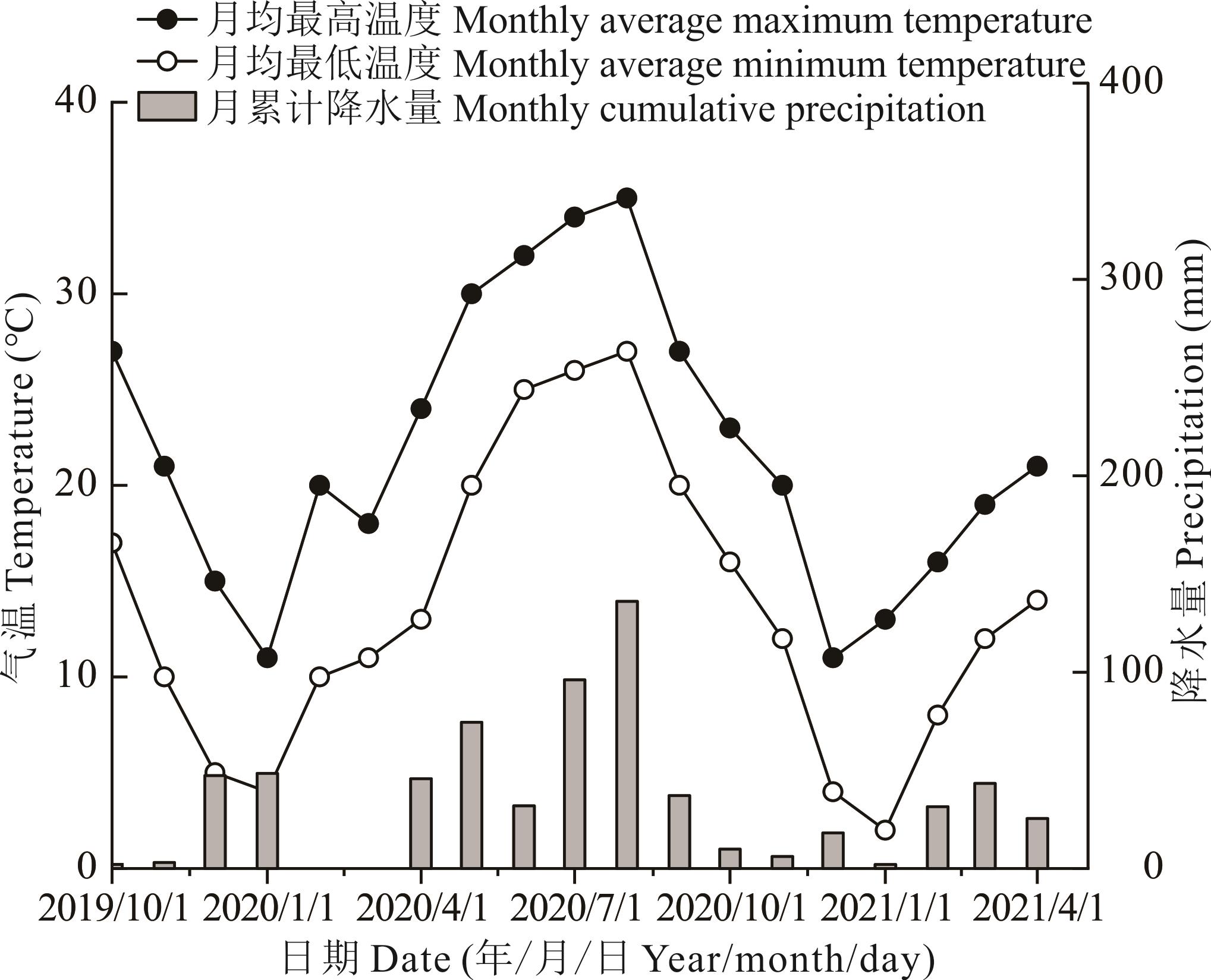
Fig.1 Monthly average maximum and minimum temperatures, and monthly cumulative precipitation during the experiment period
播期 Seeding time | 播量Seeding density | ||||
|---|---|---|---|---|---|
| D1 | D2 | D3 | D4 | D5 | |
| T1 | 89.6 | 92.4 | 93.7 | 94.5 | 93.5 |
| T2 | 90.2 | 92.6 | 94.7 | 95.1 | 94.3 |
| T3 | 91.4 | 94.2 | 93.4 | 94.8 | 94.2 |
| T4 | 89.3 | 91.6 | 92.5 | 93.4 | 92.2 |
| T5 | 88.9 | 90.4 | 91.3 | 92.8 | 90.5 |
Table 1 Germination rate of milk vetch (%)
播期 Seeding time | 播量Seeding density | ||||
|---|---|---|---|---|---|
| D1 | D2 | D3 | D4 | D5 | |
| T1 | 89.6 | 92.4 | 93.7 | 94.5 | 93.5 |
| T2 | 90.2 | 92.6 | 94.7 | 95.1 | 94.3 |
| T3 | 91.4 | 94.2 | 93.4 | 94.8 | 94.2 |
| T4 | 89.3 | 91.6 | 92.5 | 93.4 | 92.2 |
| T5 | 88.9 | 90.4 | 91.3 | 92.8 | 90.5 |
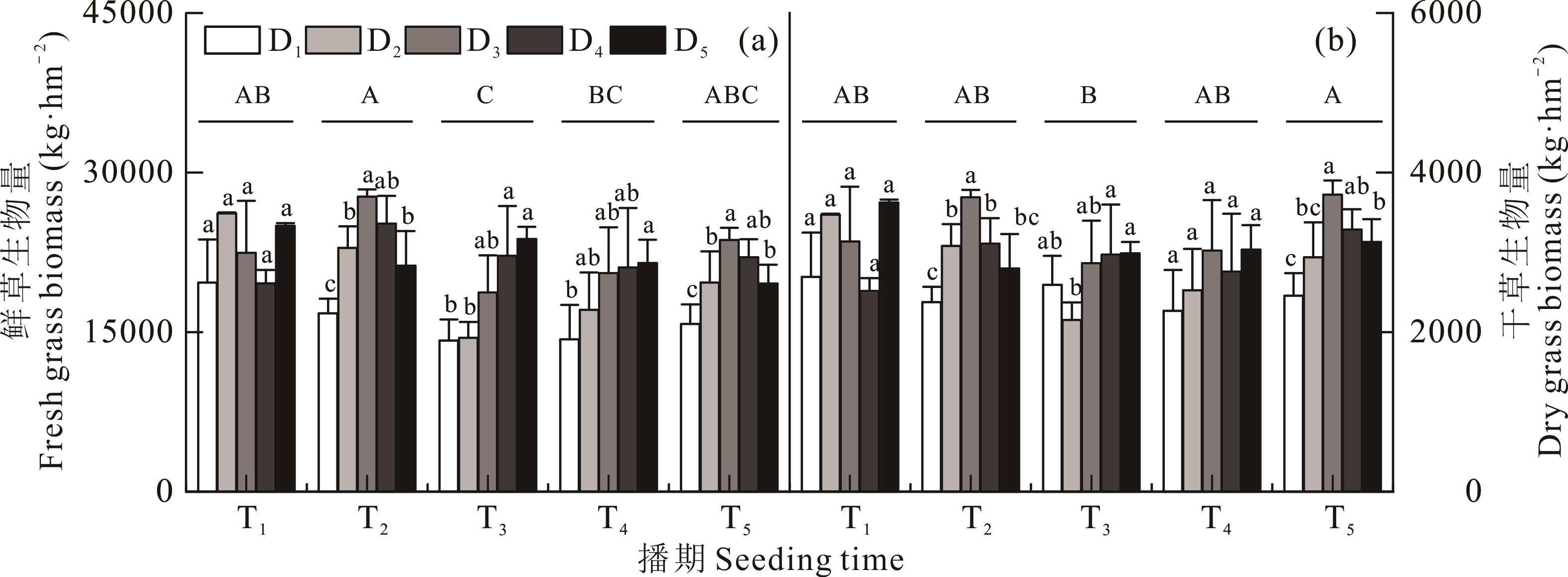
Fig.2 Effect of different seeding times and seeding densities on fresh grass yield and dry grass biomass of milk vetch
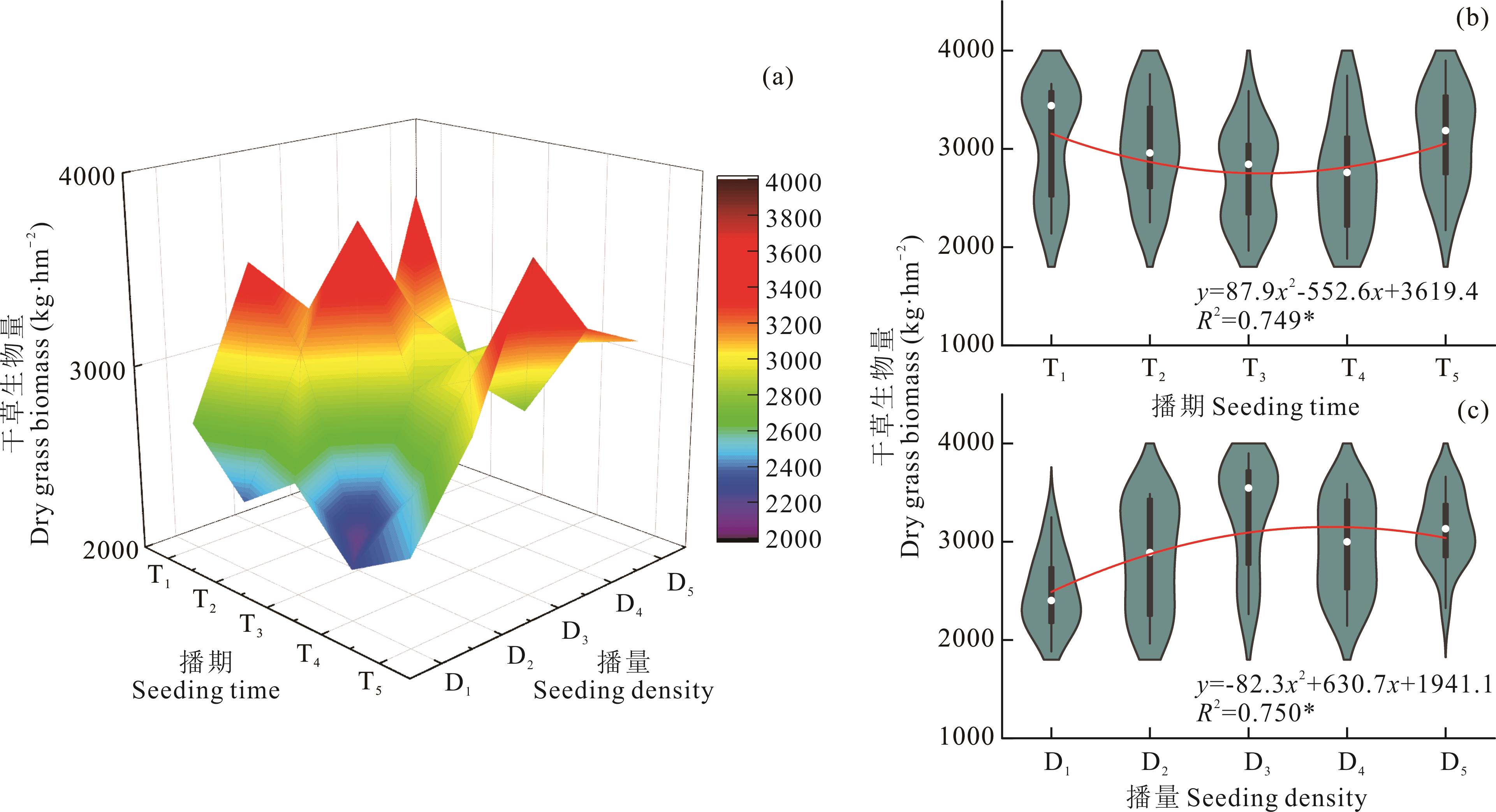
Fig.3 Nonlinear fitting of milk vetch dry grass biomass under different seeding times and seeding densities

Fig.4 Effects of different seeding times and seeding densities on nitrogen, phosphorus, potassium uptake of milk vetch and its nonlinear fitting

Fig.5 Effects of different seeding times and seeding densities on calcium and magnesium uptake of milk vetch and its nonlinear fitting
项目 Item | 鲜草生物量 Fresh grass yield | 干草生物量 Dry grass biomass | 吸收量Uptake | ||||
|---|---|---|---|---|---|---|---|
| N | P | K | Ca | Mg | |||
| 播期Seeding time (T) | 5.00** | 2.43* | 53.58*** | 7.41*** | 3.55* | 2.23* | 1.42ns |
| 播量Seeding density (D) | 10.39*** | 6.58** | 5.52** | 10.78*** | 8.62*** | 7.14** | 5.85** |
| 播期×播量T×D | 2.17* | 1.49ns | 5.19*** | 1.61ns | 2.46** | 1.80* | 1.92* |
Table 2 Two-factor analysis of variance for the effect of different seeding times and seeding densities on biomass and nutrient uptake of milk vetch
项目 Item | 鲜草生物量 Fresh grass yield | 干草生物量 Dry grass biomass | 吸收量Uptake | ||||
|---|---|---|---|---|---|---|---|
| N | P | K | Ca | Mg | |||
| 播期Seeding time (T) | 5.00** | 2.43* | 53.58*** | 7.41*** | 3.55* | 2.23* | 1.42ns |
| 播量Seeding density (D) | 10.39*** | 6.58** | 5.52** | 10.78*** | 8.62*** | 7.14** | 5.85** |
| 播期×播量T×D | 2.17* | 1.49ns | 5.19*** | 1.61ns | 2.46** | 1.80* | 1.92* |
| [1] | Cao W D, Bao X G, Xu C X, et al. Reviews and prospects on science and technology of green manure in China. Journal of Plant Nutrition and Fertilizers, 2017, 23(6): 1450-1461. |
| 曹卫东, 包兴国, 徐昌旭, 等. 中国绿肥科研60年回顾与未来展望. 植物营养与肥料学报, 2017, 23(6): 1450-1461. | |
| [2] | Cao W D, Zhou G P, Gao S J. Effects and mechanisms of green manure on endogenous improving soil health. Journal of Plant Nutrition and Fertilizers, 2024, 30(7): 1274-1283. |
| 曹卫东, 周国朋, 高嵩涓. 绿肥内源驱动土壤健康的作用与机制. 植物营养与肥料学报, 2024, 30(7): 1274-1283. | |
| [3] | Gao S J, Zhou G P, Chang D N, et al. Southern China can produce more high-quality rice with less N by green manuring. Resources, Conservation and Recycling, 2023, 196: 107025. |
| [4] | Ma J Y, Anthoni P, Olins S, et al. Estimating the global influence of cover crops on ecosystem service indicators in croplands with the LPJ‐GUESS model. Earth’s Future, 2023, 11(5): e2022EF003142. |
| [5] | Cao W D, Gao S J. Chinese green manure development strategy by 2025. Chinese Journal of Agricultural Resources and Regional Planning, 2023, 44(22): 1-9. |
| 曹卫东, 高嵩涓. 到2025年中国绿肥发展策略. 中国农业资源与区划, 2023, 44(22): 1-9. | |
| [6] | Gao S J, Wu C X, Zhou G P, et al. “Green manure plus” industry mechanism and its practices. Scientia Agricultura Sinica, 2025, 58(10): 1982-1993. |
| 高嵩涓, 吴翠霞, 周国朋, 等. “绿肥+”产业机制及其实践. 中国农业科学, 2025, 58(10): 1982-1993. | |
| [7] | Zhang X Z, Zhao C S, Dong J W, et al. Spatio-temporal pattern of cropland abandonment in China from 1992 to 2017: A Meta-analysis. Acta Geographica Sinica, 2019, 74(3): 411-420. |
| 张学珍, 赵彩杉, 董金玮, 等. 1992-2017年基于荟萃分析的中国耕地撂荒时空特征. 地理学报, 2019, 74(3): 411-420. | |
| [8] | Chen X F, Zhang L P, Qin W J, et al. A study of the appropriate seeding rates for four winter green manure crops in an upland red soil of Southern China. Acta Prataculturae Sinica, 2021, 30(10): 137-146. |
| 陈晓芬, 张路平, 秦文婧, 等. 红壤旱地上4种冬绿肥适宜播种量研究. 草业学报, 2021, 30(10): 137-146. | |
| [9] | Peng Y, Wang L X, Jacinthe P A, et al. Global synthesis of cover crop impacts on main crop yield. Field Crops Research, 2024, 310: 109343. |
| [10] | Yang L, Nie J, Xu C X, et al. Biological nitrogen fixation of Chinese milk vetch (Astragalus sinicus L.) as affected by exogenous carbon and nitrogen input. Symbiosis, 2021, 85(1): 69-77. |
| [11] | Wang G C, Hu F L, Li H T, et al. Research advances on the effect and mechanism of green manure on improving soil carbon sequestration in cropland. Journal of Plant Nutrition and Fertilizers, 2024, 30(6): 1185-1198. |
| 王国璀, 胡发龙, 李含婷, 等. 绿肥提高农田土壤有机碳固存机制的研究进展. 植物营养与肥料学报, 2024, 30(6): 1185-1198. | |
| [12] | Xia L L, Yan X Y. How to feed the world with less nitrogen pollution. Nature, 2023, 613: 34-35. |
| [13] | Zhou Y, Wei Q S, Guan Y X, et al. Effects of different seeding rates on growth and nutrient accumulation of later-sown Chinese milk vetch. Soils, 2020, 52(3): 482-486. |
| 周影, 魏启舜, 管永祥, 等. 播种量对晚播紫云英生长及养分积累的效应. 土壤, 2020, 52(3): 482-486. | |
| [14] | Liu C Z, Lv Y H, Li B Y, et al. Effects of seeding date on Chinese milk vetch (Astragalus sinicus L.) growth, yield and nutrients accumulation. Soil and Fertilizers Sciences in China, 2018(1): 127-133. |
| 刘春增, 吕玉虎, 李本银, 等. 不同播期对紫云英“信紫1号”生长状况、产量及养分积累的影响. 中国土壤与肥料, 2018(1): 127-133. | |
| [15] | Zhang G Z, Ling G M, Ji C, et al. Path planning of mechanical harvesting considering the lodging and grain bin capacity for the ratoon rice in main season. Transactions of the Chinese Society of Agricultural Engineering, 2024, 40(12): 33-45. |
| 张国忠, 凌高旻, 季超, 等. 考虑倒伏与粮仓容积的再生稻头季机收路径规划. 农业工程学报, 2024, 40(12): 33-45. | |
| [16] | Zhou G P, Cao W D, Bai J S, et al. Co-incorporation of rice straw and leguminous green manure can increase soil available nitrogen (N) and reduce carbon and N losses: An incubation study. Pedosphere, 2020, 30(5): 661-670. |
| [17] | Zhou G P, Gao S J, Chang D N, et al. Using milk vetch (Astragalus sinicus L.) to promote rice straw decomposition by regulating enzyme activity and bacterial community. Bioresource Technology, 2021, 319: 124215. |
| [18] | Bao S D. Soil and agricultural chemistry analysis (Third version). Beijing: China Agricultural Press, 2000. |
| 鲍士旦. 土壤农化分析(第三版). 北京: 中国农业出版社, 2000. | |
| [19] | Wang J H, Feng H X, Cao K, et al. Quantitative assessment of rice yield and profit efficiency of milk vetch returning to field in southern China. Journal of Plant Nutrition and Fertilizers, 2025, 31(4): 819-828. |
| 王建红, 冯含笑, 曹凯, 等. 我国南方紫云英还田的水稻产量和效益的量化研究. 植物营养与肥料学报, 2025, 31(4): 819-828. | |
| [20] | Qu X, Kojima D, Nishihara Y, et al. Can harvest outsourcing services reduce field harvest losses of rice in China? Journal of Integrative Agriculture, 2021, 20(5): 1396-1406. |
| [21] | Wu J F, Zeng Y H, Zhou C H, et al. Study on growth recovery techniques of rolling belt area in milk vetch after rice machine-harvesting. Crops, 2016, 32(1): 82-85. |
| 吴建富, 曾研华, 周春火, 等. 机收稻田皮带辗压区紫云英生长恢复技术研究. 作物杂志, 2016, 32(1): 82-85. | |
| [22] | Zou J N, Pang Z Q, Li Z, et al. The underlying mechanism of variety-water-nitrogen-stubble damage interactions on yield formation in ratoon rice with low stubble height under mechanized harvesting. Journal of Integrative Agriculture, 2024, 23(3): 806-823. |
| [23] | Dai J Q, Yuan Z Y, Chen J, et al. Effects of ridge box cultivation mode and planting density on methane emissions from double cropping rice. Journal of Agricultural Resources and Environment, 2025(43): 1-12. |
| 戴锦清, 袁紫依, 陈俊, 等. 垄厢栽培模式下厢宽和种植密度对双季稻田甲烷排放的影响. 农业资源与环境学报, 2025(43): 1-12. | |
| [24] | Haque M A, Sakimin S Z. Planting arrangement and effects of planting density on tropical fruit crops—A review. Horticulturae, 2022, 8(6): 485. |
| [25] | Liang L P, Liu Z W, Cao C L, et al. Effect of seeding date and seeding rates on agronomic traits and yield of winter rapeseed. Chinese Agricultural Science Bulletin, 2024, 40(36): 37-42 |
| 梁丽鹏, 刘哲文, 曹春莉, 等. 播期和播量对冬油菜农艺性状及产量的影响. 中国农学通报, 2024, 40(36): 37-42. | |
| [26] | Liu J H, He Q J, Guan Y, et al. Suitable sowing date for stable and high yield of summer maize in the northern region of Huang-Huai-Hai, China. Transactions of the Chinese Society of Agricultural Engineering, 2022, 38(5): 131-138. |
| 刘佳鸿, 何奇瑾, 管玥, 等. 黄淮海北部地区夏玉米稳产高产的播期优选. 农业工程学报, 2022, 38(5): 131-138. | |
| [27] | Yan Y Y, Duan F Y, Li X, et al. Photosynthetic capacity and assimilate transport of the lower canopy influence maize yield under high planting density. Plant Physiology, 2024, 195(4): 2652-2667. |
| [28] | Li R D, Xu C L, Wu Z S, et al. Optimizing canopy-spacing configuration increases soybean yield under high planting density. The Crop Journal, 2025, 13(1): 233-245. |
| [29] | Li T, Gao J S, Bai L Y, et al. Influence of green manure and rice straw management on soil organic carbon, enzyme activities, and rice yield in red paddy soil. Soil and Tillage Research, 2019, 195: 104428. |
| [30] | Yang L, Zhou X, Liao Y L, et al. Co-incorporation of rice straw and green manure benefits rice yield and nutrient uptake. Crop Science, 2019, 59(2): 749-759. |
| [31] | Zhou G P, Chang D N, Gao S J, et al. Co-incorporating leguminous green manure and rice straw drives the synergistic release of carbon and nitrogen, increases hydrolase activities, and changes the composition of main microbial groups. Biology and Fertility of Soils, 2021, 57(4): 547-561. |
| [32] | Zhou G P, Cao W D, Bai J S, et al. Non-additive responses of soil C and N to rice straw and hairy vetch (Vicia villosa Roth L.) mixtures in a paddy soil. Plant and Soil, 2019, 436(1/2): 229-244. |
| [33] | Liang H, Li S, Zhang L, et al. Long-term green manuring enhances crop N uptake and reduces N losses in rice production system. Soil and Tillage Research, 2022, 220: 105369. |
| [34] | Huang J Y, Hartemink A E. Soil and environmental issues in sandy soils. Earth-Science Reviews, 2020, 208: 103295. |
| [35] | Wan L, Chen X F, Yang S, et al. Co-incorporation of rice straw and milk vetch (Astragalus sinicus L.) improves soil fertility and rice yield in two typical paddy soils. Soil Use and Management, 2025, 41(1): e70018. |
| [36] | Zhou G P, Gao S J, Lu Y H, et al. Co-incorporation of green manure and rice straw improves rice production, soil chemical, biochemical and microbiological properties in a typical paddy field in southern China. Soil and Tillage Research, 2020, 197: 104499. |
| [1] | Na-na LIU, Yan-mei LIU, Hang-yu YANG, Yuan-qi ZHANG, Kun LI. The degradation effects of soil glyphosate pesticide by plant crops [J]. Acta Prataculturae Sinica, 2026, 35(5): 175-184. |
| [2] | Ying-ying NIE, Li-jun XU, Xiu-yuan XU, Wei XUE, Xin-jia WU, Bo YUAN, Zhao ZHANG, Hong-zhi ZHANG, Qiong ZHOU, Yu-lin LI. Effects of nutrient addition on plant diversity and aboveground biomass of saline-alkali grassland in Horqin [J]. Acta Prataculturae Sinica, 2026, 35(5): 61-71. |
| [3] | Zhe WANG, Jing WANG, Yao-wen XIE, Hui-fang ZHAO, Rui-xiang XIAO, Cai-wen-qiu-zang ZONGSA. Spatio-temporal variation of grassland above-ground biomass and its response to climate change in the Three-River Source region [J]. Acta Prataculturae Sinica, 2026, 35(1): 1-12. |
| [4] | Jia-hui KANG, Min-na ZHENG, Rui-jie GONG, Zhi-shun HAN, Yan-ni CHEN, Xiu-zhi LIANG. Effects of nitrogen and phosphorus supplementation on ecological stoichiometric characteristics of soil microbial-extracellular enzymes in annual artificial grassland [J]. Acta Prataculturae Sinica, 2026, 35(1): 13-24. |
| [5] | Fan-xi KONG, Bang-jie TANG, A-li-mi-ri ALIMUJIANG, Ge-ge ADE, Mao-guo YUAN, Jun CHEN. Species spatial distribution patterns in grassland under restoration in ‘hill and gully’ regions of the Loess Plateau [J]. Acta Prataculturae Sinica, 2025, 34(9): 1-11. |
| [6] | Jia-yi YONG, Shuang MA, Feng-hua MA, Xiao-na ZHAO, Yi-yin ZHANG, Hai-ying HU. Effects of drought stress and rehydration on biomass allocation and osmotic regulation characteristics of Indigofera bungeana [J]. Acta Prataculturae Sinica, 2025, 34(7): 158-170. |
| [7] | Shuang YAN, Fei XIA, Wei WEI, Jing-long WANG, Hao-yang WU, Lin-ling RAN, Yun-yin XUE, Hao SHI, Shai-kun ZHENG, Jun-qiang WANG, Jun-dong HE. Differences along an erosion gradient in alpine meadow plant community diversity and factors influencing diversity [J]. Acta Prataculturae Sinica, 2025, 34(6): 1-13. |
| [8] | Shun-hua LUO, Xin-yu LIU, Bao-ping MENG, Xuan-li CHEN, Ren-jie HU, Hong-yan YU, Xian-ying WANG, Bo ZHANG, Yu QIN. A study of functional group diversity and productivity of alpine grassland in Qilian Mountain National Park [J]. Acta Prataculturae Sinica, 2025, 34(6): 14-26. |
| [9] | Lei ZHANG, Jin-tao DU, Qian-yu FAN, Shun LI, Song-juan GAO, Wei-dong CAO. Response of biological nitrogen fixation by milk vetch to soil fertility and rhizobium inoculation [J]. Acta Prataculturae Sinica, 2025, 34(5): 51-63. |
| [10] | Shu-qi LIU, Dong CUI, Wen-xin LIU, Hai-jun YANG, Yan-cheng YANG, Zhi-cheng JIANG, Jiang-chao YAN, Jiang-hui LIU. Effects of short-term nitrogen addition, watering, and mowing on plant community characteristics and soil physicochemical properties in Sophora alopecuroides degraded grassland [J]. Acta Prataculturae Sinica, 2025, 34(3): 41-55. |
| [11] | Shao-xing LI, Wen-feng SONG, Yu-ling ZHOU, Li-xia SONG, Ke REN, Qun MA, Long-chang WANG. Effects of straw and milk vetch mulching on the ecological stoichiometric characteristics of soil-microbe-sweet potato plants [J]. Acta Prataculturae Sinica, 2025, 34(3): 56-70. |
| [12] | Li-li MA, Fu-zhen JIANG, Yu-shou MA, Kai-bin QI, Shun-bin JIA, Zheng-peng LI. Effect of particle size ratio, fertilizer application amount, and seeding rate combinations coal gangue matrix properties in restoration of a mining area [J]. Acta Prataculturae Sinica, 2025, 34(3): 71-84. |
| [13] | Chen-xu LIU, Yan-tao SONG, Lei SUN, Tao PENG, Wuyunna. Grazing exclusion modifies the relationship between plant community diversity and aboveground biomass in the Qiangtang grassland [J]. Acta Prataculturae Sinica, 2025, 34(12): 62-72. |
| [14] | Rong MA, Jun-yao LI, Ping YUE, Xu-jun MA, Zhen BAI, Ling ZHUANG, Jing BAI, Xue-yong ZHAO, Shao-kun WANG. Regulatory mechanisms of biomass allocation governed by functional traits of dominant plants in desert steppe under precipitation changes [J]. Acta Prataculturae Sinica, 2025, 34(11): 31-39. |
| [15] | Yu-long YAN, Xue-jun DU, Yuan-yue WANG, Jian-li LIU, Yin-gui DING, Yuan-song WEI. Application of desulphurization gypsum with fly ash improves saline-alkali soils [J]. Acta Prataculturae Sinica, 2025, 34(10): 30-40. |
| Viewed | ||||||
|
Full text |
|
|||||
|
Abstract |
|
|||||
