
ISSN 1004-5759 CN 62-1105/S
Acta Prataculturae Sinica ›› 2025, Vol. 34 ›› Issue (6): 14-26.DOI: 10.11686/cyxb2024286
Previous Articles Next Articles
Shun-hua LUO1( ), Xin-yu LIU2,3,4, Bao-ping MENG5,6, Xuan-li CHEN5,6, Ren-jie HU5,6, Hong-yan YU7, Xian-ying WANG7, Bo ZHANG1(), Yu QIN2,3,4()
Received:2024-07-17
Revised:2024-08-08
Online:2025-06-20
Published:2025-04-03
Contact:
Bo ZHANG,Yu QIN
Shun-hua LUO, Xin-yu LIU, Bao-ping MENG, Xuan-li CHEN, Ren-jie HU, Hong-yan YU, Xian-ying WANG, Bo ZHANG, Yu QIN. A study of functional group diversity and productivity of alpine grassland in Qilian Mountain National Park[J]. Acta Prataculturae Sinica, 2025, 34(6): 14-26.
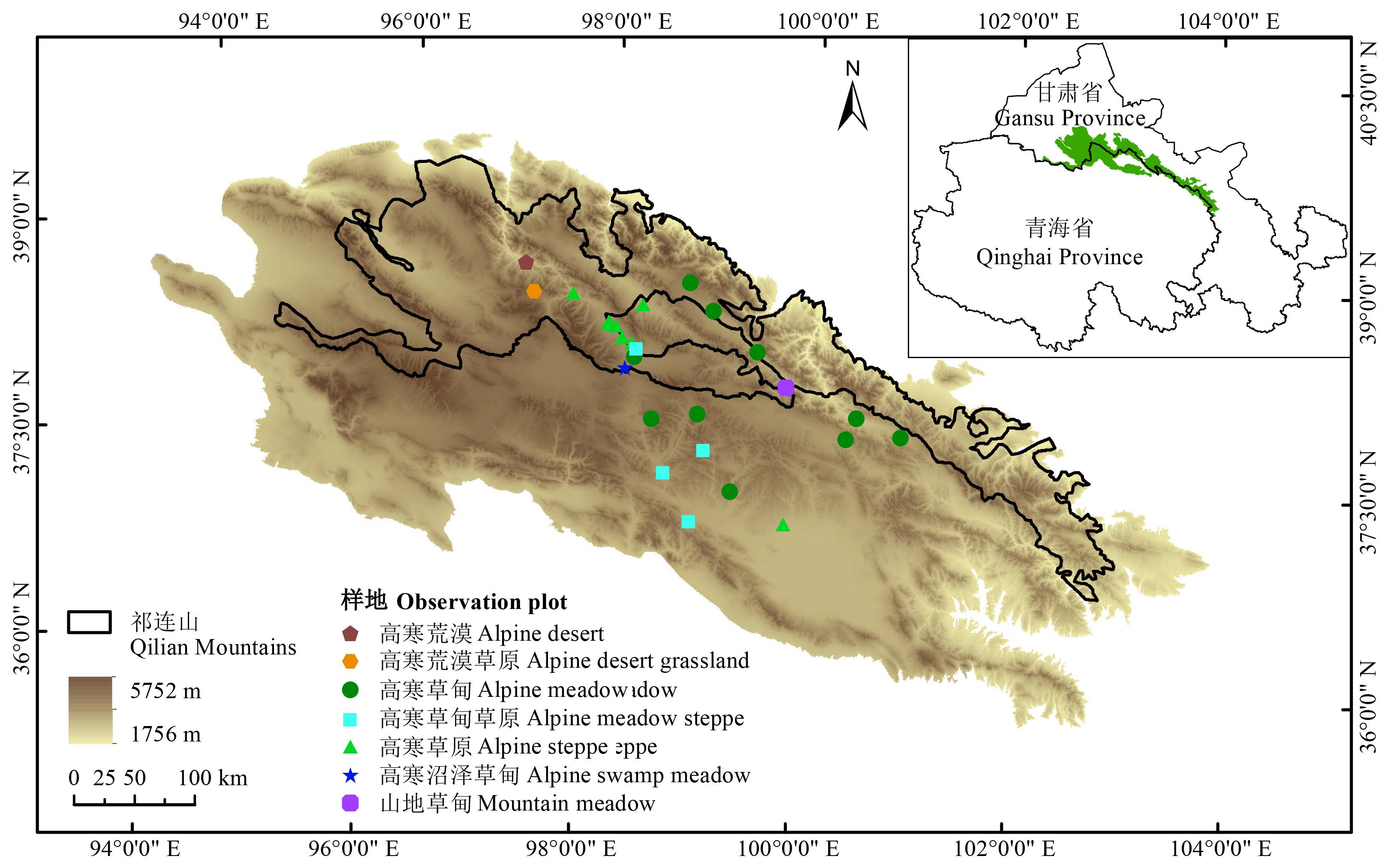
Fig.1 The location of study region and the distribution of observation plot
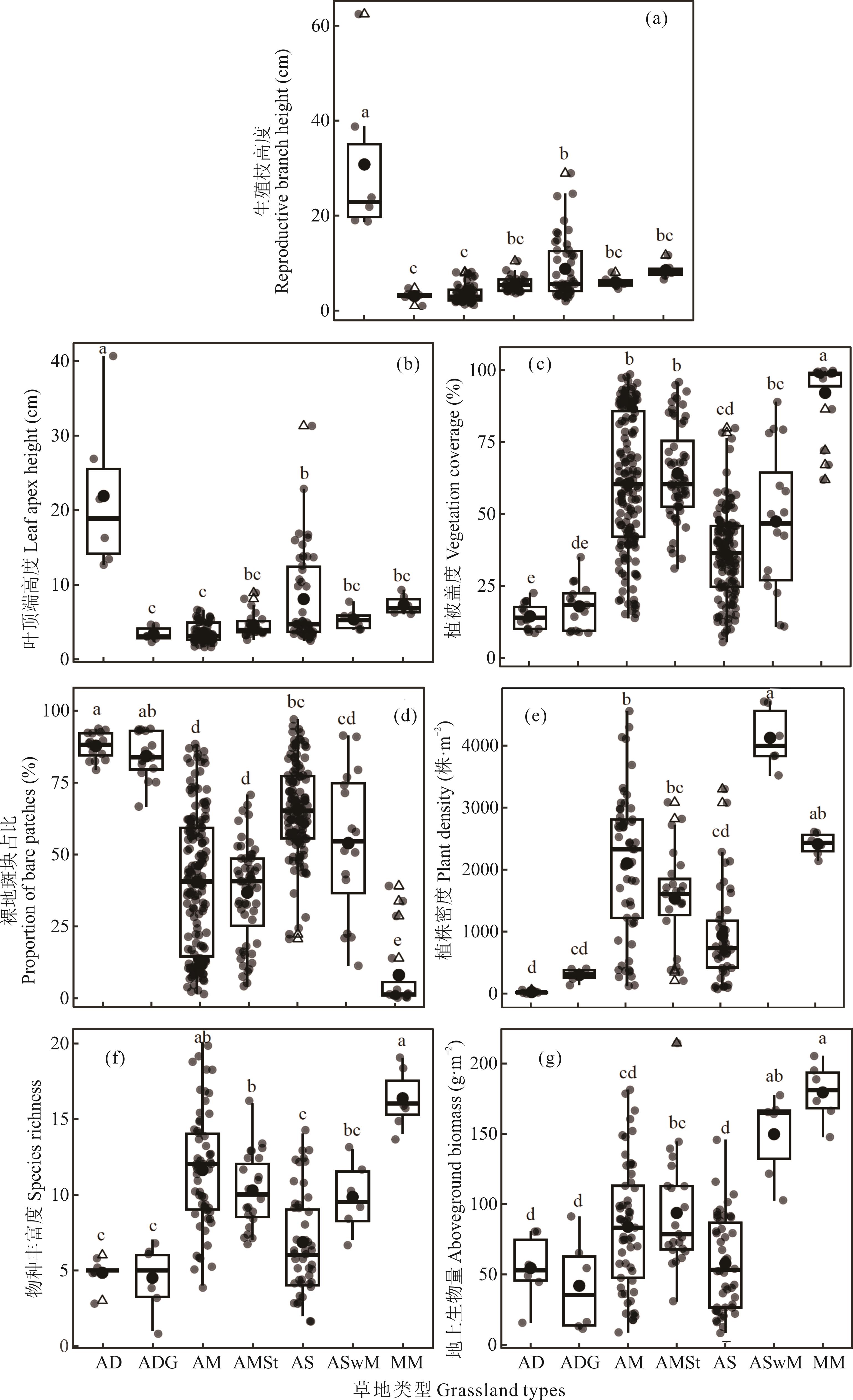
Fig.2 Plant community characteristics of different types of alpine grassland
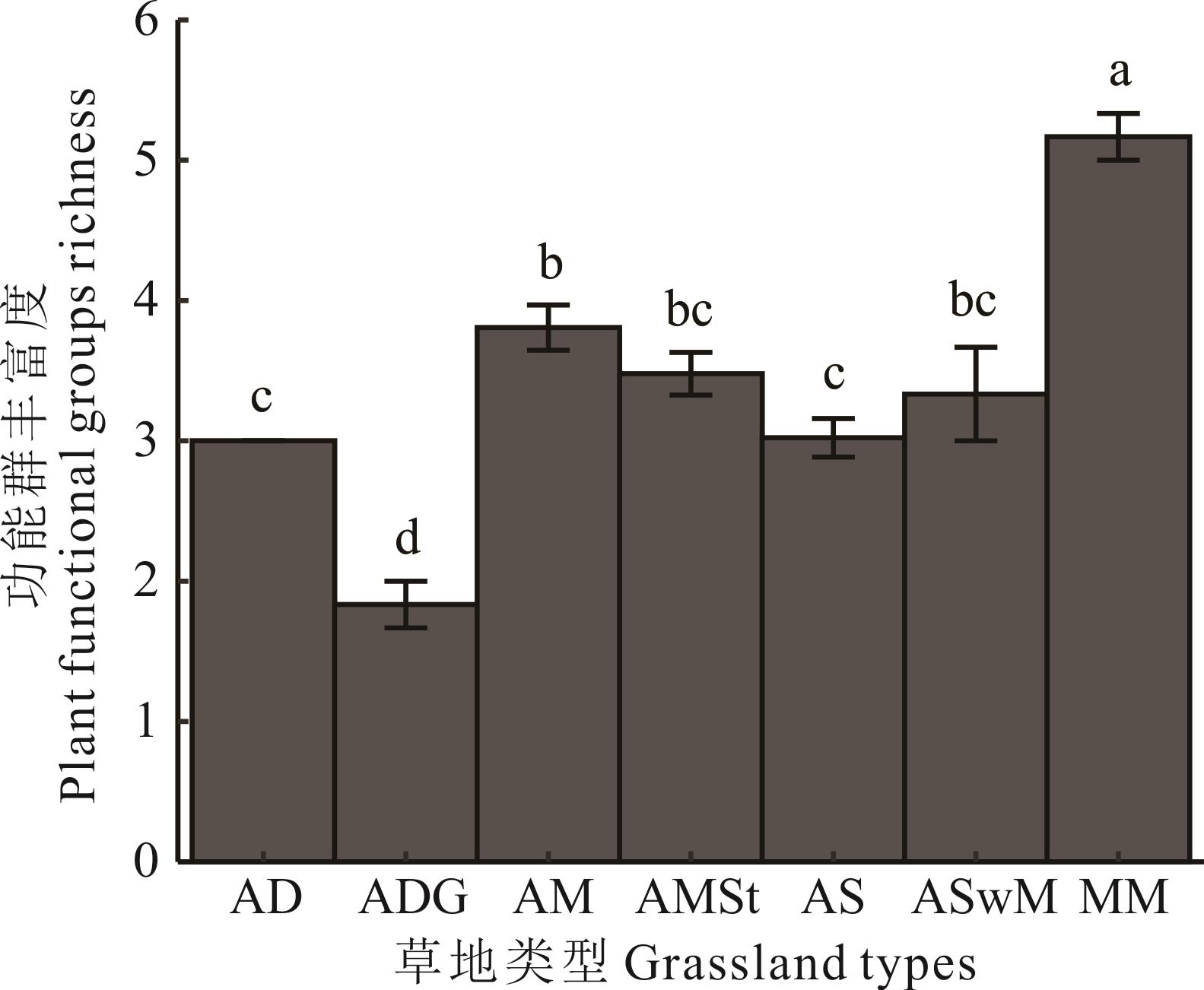
Fig.3 Plant functional groups richness in different types of alpine grassland

Fig.4 Species richness and aboveground biomass of plant functional groups in alpine grassland

Fig.5 Relationship between species richness and functional group richness of plant communities and aboveground biomass in alpine grassland
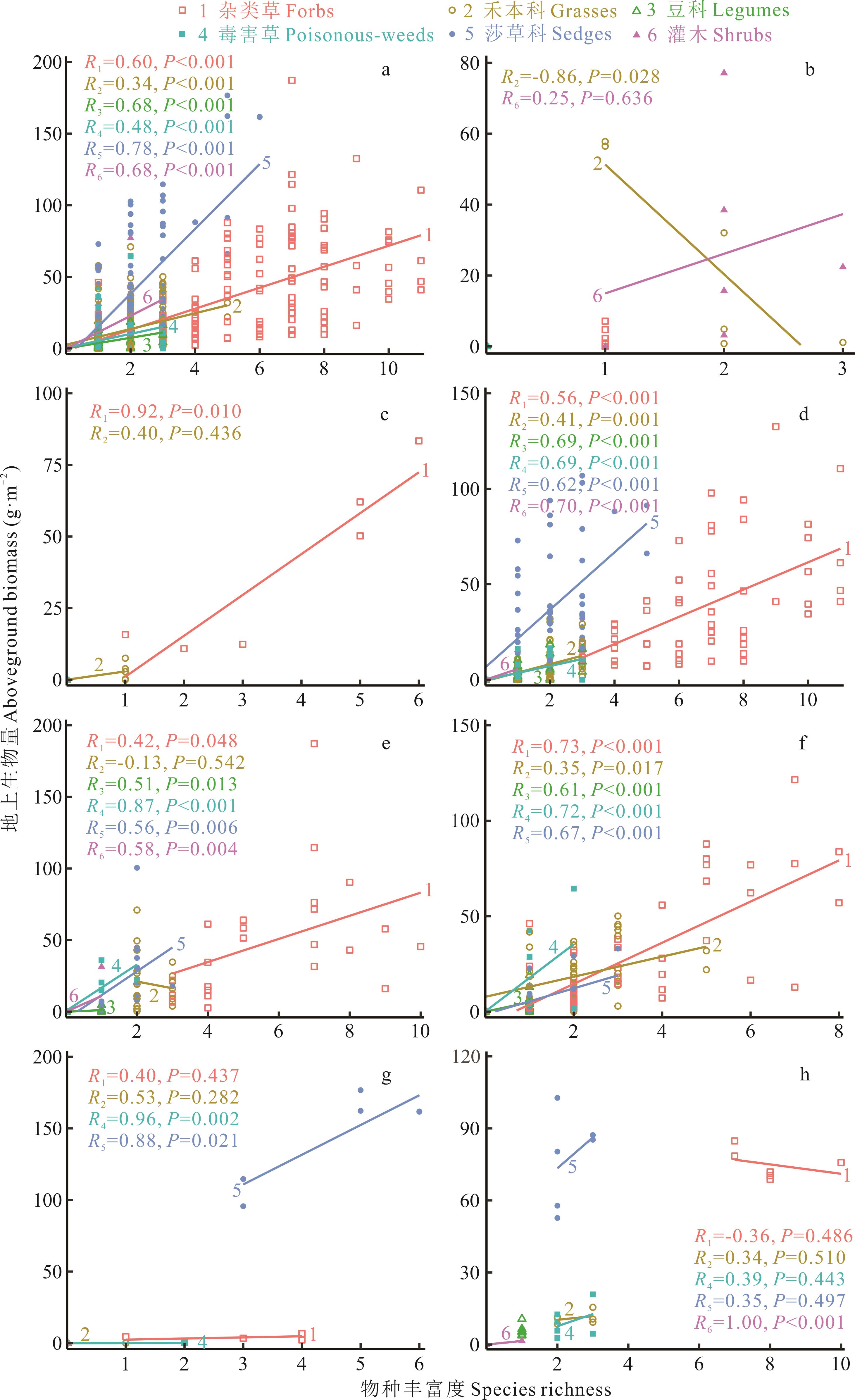
Fig.6 Relationship between species richness and aboveground biomass of plant functional groups in alpine grassland
| 1 | Tilman D, Wedin D, Knops J. Productivity and sustainability influenced by biodiversity in grassland ecosystems. Nature, 1996, 379(6567): 718-720. |
| 2 | Tilman D, Lehman C L, Thomson K T. Plant diversity and ecosystem productivity: theoretical considerations. Proceedings of the National Academy of Sciences of the United States of America, 1997, 94(5): 1857-1861. |
| 3 | Zhang Z H, Zhou H K, Zhao X Q, et al. Relationship between biodiversity and ecosystem functioning in alpine meadows of the Qinghai-Tibet Plateau. Biodiversity Science, 2018, 26(2): 111-129. |
| 张中华, 周华坤, 赵新全, 等. 青藏高原高寒草地生物多样性与生态系统功能的关系. 生物多样性, 2018, 26(2): 111-129. | |
| 4 | Huang J H, Bai Y F, Han X G. Effects of species diversity on ecosystem functioning: mechanisms and hypotheses. Biodiversity Science, 2001, 9(1): 1-7. |
| 黄建辉, 白永飞, 韩兴国. 物种多样性与生态系统功能: 影响机制及有关假说. 生物多样性, 2001, 9(1): 1-7. | |
| 5 | Zhang Q G, Zhang D Y. Biodiversity and ecosystem functioning: recent advances and trends. Biodiversity Science, 2003, 11(5): 351-363. |
| 张全国, 张大勇. 生物多样性与生态系统功能: 最新的进展与动向. 生物多样性, 2003, 11(5): 351-363. | |
| 6 | Barnosky A, Matzke N, Tomiya S, et al. Has the earth’s sixth mass extinction already arrived? Nature, 2011, 471(7336): 51-57. |
| 7 | Wei F W, Nie Y G, Miao H X, et al. Advancements of the researches on biodiversity loss mechanisms. Chinese Science Bulletin, 2014, 59(6): 430-437. |
| 魏辅文, 聂永刚, 苗海霞, 等. 生物多样性丧失机制研究进展. 科学通报, 2014, 59(6): 430-437. | |
| 8 | Wang J B, Zhang D G, Cao G M, et al. Regional characteristics of the alpine meadow degradation succession on the Qinghai-Tibetan Plateau. Acta Prataculturae Sinica, 2013, 22(2): 1-10. |
| 王建兵, 张德罡, 曹广民, 等. 青藏高原高寒草甸退化演替的分区特征. 草业学报, 2013, 22(2): 1-10. | |
| 9 | Zi H B, Ade L J, Liu M, et al. Difference of community characteristics and niche of dominant species in different grassland types of alpine meadow. Chinese Journal of Applied & Environmental Biology, 2016, 22(4): 546-554. |
| 字洪标, 阿的鲁骥, 刘敏, 等. 高寒草甸不同类型草地群落特征及优势种植物生态位差异. 应用与环境生物学报, 2016, 22(4): 546-554. | |
| 10 | Ma S L. It is urgent to protect biodiversity on the Qinghai-Tibet Plateau//Proceedings of the national symposium on biodiversity conservation and control of alien harmful species. Shanghai: Chinese Society for Environmental Sciences, 2008: 79-81. |
| 马生林. 保护青藏高原生物多样性刻不容缓//全国生物多样性保护及外来有害物种防治交流研讨会论文集. 上海: 中国环境科学学会, 2008: 79-81. | |
| 11 | Fu B J, Ouyang Z Y, Shi P, et al. Current condition and protection strategies of Qinghai-Tibet Plateau ecological security barrier. Bulletin of Chinese Academy of Sciences, 2021, 36(11): 1298-1306. |
| 傅伯杰, 欧阳志云, 施鹏, 等. 青藏高原生态安全屏障状况与保护对策. 中国科学院院刊, 2021, 36(11): 1298-1306. | |
| 12 | Wang C T, Long R J, Ding L M. The effects of differences in functional group diversity and composition on plant community productivity in four types of alpine meadow communities. Biodiversity Science, 2004, 12(4): 403-409. |
| 王长庭, 龙瑞军, 丁路明. 高寒草甸不同草地类型功能群多样性及组成对植物群落生产力的影响. 生物多样性, 2004, 12(4): 403-409. | |
| 13 | Yang Y H, Rao S, Hu H F, et al. Plant species richness of alpine grasslands in relation to environmental factors and biomass on the Tibetan Plateau. Biodiversity Science, 2004, 12(1): 200-205. |
| 杨元合, 饶胜, 胡会峰, 等. 青藏高原高寒草地植物物种丰富度及其与环境因子和生物量的关系. 生物多样性, 2004, 12(1): 200-205. | |
| 14 | Zhang C H. Effects of grazing and fertilization on community productivity and species richness in eastern alpine meadow of Tibetan plateau. Pratacultural Science, 2014, 31(12): 2293-2300. |
| 张春花. 放牧方式和施肥梯度对高寒草甸群落生产力和物种丰富度的影响. 草业科学, 2014, 31(12): 2293-2300. | |
| 15 | Zheng Q Y, Liu G, Xiao B X, et al. Effect of grazing intensity on species richness and biomass of alpine meadow in northwest Sichuan. Pratacultural Science, 2017, 34(7): 1390-1396. |
| 郑群英, 刘刚, 肖冰雪, 等. 放牧对川西北高寒草甸植物物种丰富度和生物量的影响. 草业科学, 2017, 34(7): 1390-1396. | |
| 16 | Du G Z, Qin G L, Li Z Z, et al. Relationship between species richness and productivity in an alpine meadow plant community. Chinese Journal of Plant Ecology, 2003, 27(1): 125-132. |
| 杜国祯, 覃光莲, 李自珍, 等. 高寒草甸植物群落中物种丰富度与生产力的关系研究. 植物生态学报, 2003, 27(1): 125-132. | |
| 17 | Hu N, Fan Y L, Ding S Y, et al. Progress in researches on plant functional groups of terrestrial ecosystems. Acta Ecologica Sinica, 2008, 28(7): 3302-3311. |
| 胡楠, 范玉龙, 丁圣彦, 等. 陆地生态系统植物功能群研究进展. 生态学报, 2008, 28(7): 3302-3311. | |
| 18 | Niu Y J, Yang S W, Wang G Z, et al. Relationship between plant species, life form, functional group diversity, and biomass under grazing disturbance for four years on an alpine meadow. Acta Ecologica Sinica, 2018, 38(13): 4733-4743. |
| 牛钰杰, 杨思维, 王贵珍, 等. 放牧干扰下高寒草甸物种、生活型和功能群多样性与生物量的关系. 生态学报, 2018, 38(13): 4733-4743. | |
| 19 | Tang J L, Ren Z G, Zhang X Y, et al. Relationships between species diversity and productivity of different functional groups in a typical steppe in Inner Mongolia. Acta Agrestia Sinica, 2023, 31(7): 1939-1949. |
| 汤靖磊, 任治国, 张学渊, 等. 典型草原不同功能群物种多样性与生产力关系研究. 草地学报, 2023, 31(7): 1939-1949. | |
| 20 | Wang J H, Chen W. Qilian Mountain natural complex and its ecological efficiency. Journal of Hexi University, 2002, 18(2): 113-117. |
| 王桔红, 陈文. 祁连山自然综合体及其生态效能. 河西学院学报, 2002, 18(2): 113-117. | |
| 21 | Li X, Gou X H, Wang N L, et al. Tightening ecological management facilitates green development in the Qilian Mountains. Chinese Science Bulletin, 2019, 64(27): 2928-2937. |
| 李新, 勾晓华, 王宁练, 等. 祁连山绿色发展: 从生态治理到生态恢复. 科学通报, 2019, 64(27): 2928-2937. | |
| 22 | Wang X Y, Yang D W, Zhang L L, et al. The causes of grassland degradation and restoration strategies in Qilian Mountain National Park. Journal of Grassland and Forage Science, 2020(6): 81-86. |
| 王新源, 杨栋武, 张莉丽, 等. 祁连山国家公园草地退化成因及恢复对策. 草学, 2020(6): 81-86. | |
| 23 | Wang T, Gao F, Wang B, et al. Status and suggestions on ecological protection and restoration of Qilian Mountains. Journal of Glaciology and Geocryology, 2017, 39(2): 229-234. |
| 王涛, 高峰, 王宝, 等. 祁连山生态保护与修复的现状问题与建议. 冰川冻土, 2017, 39(2): 229-234. | |
| 24 | Zhang J T, Zhang C Q. Digital elevation model (DEM) data with the spatial resolution of 90 m in the Qilian Mountains. [2020-11-30]. National Special Environment and Function of Observation and Research Stations Shared Service Platform (http://www.ncdc.ac.cn/). |
| 张举涛, 张成琦. 祁连山地区90 m分辨率数字高程模型(DEM)数据. [2020-11-30]. 国家冰川冻土沙漠科学数据中心(http://www.ncdc.ac.cn/). | |
| 25 | Peng S, Ding Y, Liu W, et al. 1 km monthly temperature and precipitation dataset for China from 1901 to 2017. Earth System Science Data, 2019, 11(4): 1931-1946. |
| 26 | Yi S. FragMAP: a tool for long-term and cooperative monitoring and analysis of small-scale habitat fragmentation using an unmanned aerial vehicle. International Journal of Remote Sensing, 2017, 38(8/10): 2686-2697. |
| 27 | Yi S, Chen J, Qin Y, et al. The burying and grazing effects of plateau pika on alpine grassland are small: a pilot study in a semiarid basin on the Qinghai-Tibet Plateau. Biogeosciences, 2016, 13(22): 6273-6284. |
| 28 | Wickham H, Averick M, Bryan J, et al. Welcome to the tidyverse. Journal of Open Source Software, 2019, 4(43): 1686. |
| 29 | Kassambara A. ggpubr: “ggplot2” based publication ready plots. R package version 0.6.0. [2023-2-10]. https://rpkgs.datanovia.com/ggpubr/. |
| 30 | Anwar M, Yang Y H, Guo Z D, et al. Relationship between the species richness and the productivity of alpine steppes in Bayanbulak, Xinjiang. Arid Zone Research, 2006, 23(2): 289-294. |
| 安尼瓦尔.买买提, 杨元合, 郭兆迪, 等. 新疆巴音布鲁克高山草地物种丰富度与生产力的关系. 干旱区研究, 2006, 23(2): 289-294. | |
| 31 | Ma W W. Comprehensive evaluation of climatic conditions on vegetation growth status of alpine grassland in Qinghai Province. Qinghai Prataculture, 2023, 32(2): 44-52. |
| 马文文. 基于气候因子的青海省高寒草地植被生长状况综合评价. 青海草业, 2023, 32(2): 44-52. | |
| 32 | Li Y L, Liu X N, Zhang D G, et al. Vegetation characteristics and soil physicochemical properties of different grassland types of temperate steppe in Longzhong. Acta Agrestia Sinica, 2023, 31(11): 3405-3414. |
| 李娅丽, 柳小妮, 张德罡, 等. 陇中温性草原不同草地型植被特征和土壤理化性质研究. 草地学报, 2023, 31(11): 3405-3414. | |
| 33 | Chen Z, Xu H Y, Shu Q L, et al. Physicochemical properties of soil and enzyme activity characteristics in various grassland types of the Qilian Mountains. Journal of Green Science and Technology, 2024, 26(2): 53-59. |
| 陈卓, 徐海燕, 殊秋丽, 等. 祁连山不同草地类型土壤理化性质及酶活性特征. 绿色科技, 2024, 26(2): 53-59. | |
| 34 | Li X, Yu H B, Liu Y X, et al. Study on community biomass and diversity of different grassland types in Xilingol. Acta Agrestia Sinica, 2022, 30(1): 196-204. |
| 李想, 于红博, 刘月璇, 等. 锡林郭勒不同草原类型群落生物量及多样性研究. 草地学报, 2022, 30(1): 196-204. | |
| 35 | Zheng X X, Jin T T, Mu L F, et al. The relationship between plant species richness in Hulunbeier grassland and biomass and environmental factors. Chinese Journal of Grassland, 2008, 30(6): 74-81. |
| 郑晓翾, 靳甜甜, 木丽芬, 等. 呼伦贝尔草原物种多样性与生物量、环境因子的关系. 中国草地学报, 2008, 30(6): 74-81. | |
| 36 | He M Y, Wang Y X, Peng Z C, et al. The spatial pattern of aboveground biomass and species richness in the grassland of Qilian Mountain. Pratacultural Science, 2020, 37(10): 2012-2021. |
| 何美悦, 王迎新, 彭泽晨, 等. 祁连山草原地上生物量和物种丰富度的空间格局. 草业科学, 2020, 37(10): 2012-2021. | |
| 37 | Huang Z L. The relationship between plant species richness and production//The 4th national symposium on biodiversity conservation and sustainable use. Beijing: China Forestry Publishing House, 2002: 244-250. |
| 黄忠良. 试论植物物种多样性与生产力之间的关系//第四届全国生物多样性保护与持续利用研讨会. 北京: 中国林业出版社, 2002: 244-250. | |
| 38 | Qin Y, Yi S, Ren S, et al. Responses of typical grasslands in a semi-arid basin on the Qinghai-Tibetan Plateau to climate change and disturbances. Environmental Earth Sciences, 2014, 71(3): 1421-1431. |
| 39 | Tilman D, Reich P B, Knops J, et al. Diversity and productivity in a long-term grassland experiment. Science, 2001, 294(5543): 843-845. |
| 40 | Qin Y. Effect of different land utilization on soil nutrients and grassland vegetation in alpine meadow. Lanzhou: Lanzhou University, 2010. |
| 秦彧. 不同土地利用方式对玛曲高寒草地土壤养分与植被的影响. 兰州: 兰州大学, 2010. | |
| 41 | Zhang Q G, Zhang D Y. Biodiversity and ecosystem functioning: recent advances and controversies. Biodiversity Science, 2002, 10(1): 49-60. |
| 张全国, 张大勇. 生物多样性与生态系统功能: 进展与争论. 生物多样性, 2002, 10(1): 49-60. | |
| 42 | Waide R B, Willig M R, Steiner C F, et al. The relationship between productivity and species richness. Annual Review of Ecology and Systematics, 1999, 30: 257-300. |
| 43 | Ma W H, Fang J Y. The relationship between species richness and productivity in four typical grasslands of northern China. Biodiversity Science, 2006, 14(1): 21-28. |
| 马文红, 方精云. 中国北方典型草地物种丰富度与生产力的关系. 生物多样性, 2006, 14(1): 21-28. |
| [1] | Shuang YAN, Fei XIA, Wei WEI, Jing-long WANG, Hao-yang WU, Lin-ling RAN, Yun-yin XUE, Hao SHI, Shai-kun ZHENG, Jun-qiang WANG, Jun-dong HE. Differences along an erosion gradient in alpine meadow plant community diversity and factors influencing diversity [J]. Acta Prataculturae Sinica, 2025, 34(6): 1-13. |
| [2] | Xue-ping LI, Shi-yang XU, Jian-jun LI, Yong-hong QI. Bacterial diversity and community structural changes in rhizosphere soil of naked barley disturbed by root rot [J]. Acta Prataculturae Sinica, 2025, 34(5): 118-129. |
| [3] | Shou-xing WANG, Hua-kun ZHOU, Li-peng OU, Cheng-xian LI, Yan-he WANG, Xiao-chun NING, Qiang GU, Dai-jun WEI, Ming-xin YANG. Vegetation and soil microbial diversity and their relationships with soil factors in different grassland types of the three river headwaters region [J]. Acta Prataculturae Sinica, 2025, 34(4): 16-26. |
| [4] | Shu-qi LIU, Dong CUI, Wen-xin LIU, Hai-jun YANG, Yan-cheng YANG, Zhi-cheng JIANG, Jiang-chao YAN, Jiang-hui LIU. Effects of short-term nitrogen addition, watering, and mowing on plant community characteristics and soil physicochemical properties in Sophora alopecuroides degraded grassland [J]. Acta Prataculturae Sinica, 2025, 34(3): 41-55. |
| [5] | Li-li MA, Fu-zhen JIANG, Yu-shou MA, Kai-bin QI, Shun-bin JIA, Zheng-peng LI. Effect of particle size ratio, fertilizer application amount, and seeding rate combinations coal gangue matrix properties in restoration of a mining area [J]. Acta Prataculturae Sinica, 2025, 34(3): 71-84. |
| [6] | Xin GONG, Xin-ru HUO, Wen LI, Yan-dong YANG, Chao LIU, Wei-chun QIN, Yan SHEN, Guo-hui WANG, Hong-bin MA. Vegetation community characteristics and spatial differentiation in mountain grassland in Luoshan, Ningxia [J]. Acta Prataculturae Sinica, 2025, 34(2): 1-15. |
| [7] | Na LYU, Ji-xi GAO, Zheng-hai LI, Chun-he YOU, Xiao-man LIU, Biao ZHANG, Yu MO, Sa-ning ZHU, Yang PENG, Xue YANG. Effects of fertilizer application during mid-growing season on vegetation community biomass and species diversity in meadow grasslands [J]. Acta Prataculturae Sinica, 2025, 34(2): 109-122. |
| [8] | Wen-pan DU, Gui-qin ZHAO, Ji-kuan CHAI, Li YANG, Jian-gui ZHANG, Yi-chao SHI, Guan-lu ZHANG. Effects of root separation on aboveground biomass, soil nutrient contents, and root characters of intercropped oat and pea [J]. Acta Prataculturae Sinica, 2024, 33(8): 25-36. |
| [9] | Ling-ling XU, Ben NIU, Xian-zhou ZHANG, Yong-tao HE, Pei-li SHI, Ning ZONG, Jian-shuang WU, Xiang-tao WANG. Climate responses of carbon fluxes in two adjacent alpine grasslands in northern Tibet [J]. Acta Prataculturae Sinica, 2024, 33(6): 1-16. |
| [10] | Qian LIU, Yan-fen DING, Shan-shan SONG, Wen-jie XU, Wei YANG. Quantitative classification and ordination analysis of spontaneous vegetation communities in herb layer along the green belt of Nanjing Ming City Wall [J]. Acta Prataculturae Sinica, 2024, 33(5): 1-15. |
| [11] | Yi-ran CHANG, Jia-mei SHI, Dong-mei XU, Ru-long KANG, Yuan MA. Trade-off relationships between biomass and nutrient allocation in different natural populations of Agropyron mongolicum on the desert steppe [J]. Acta Prataculturae Sinica, 2024, 33(11): 186-197. |
| [12] | Hao SHI, Cai-hong YANG, Fei XIA, Jun-qiang WANG, Wei WEI, Jing-long WANG, Yun-yin XUE, Shai-kun ZHENG, Hao-yang WU, Lin-ling RAN, Shuang YAN, Xiao-min JIANG. Initial effects of short-term warming on the productivity of alpine degraded grassland in northern Tibet during the restoration process [J]. Acta Prataculturae Sinica, 2024, 33(11): 30-45. |
| [13] | Qing-hua TIAN, Dan LIU, Xiao-qin LIAO, Xiao-yan SONG, Lei HU, Chang-ting WANG. Effects of nitrogen fertilization on soil aggregate biological binding agents and stability in an alpine grassland [J]. Acta Prataculturae Sinica, 2024, 33(11): 46-57. |
| [14] | Dong ZHANG, Chen HOU, Wen-ming MA, Chang-ting WANG, Zhuo-ma DENGZENG, Ting ZHANG. Study on soil enzyme activities under shrub encroachment gradients in alpine grassland [J]. Acta Prataculturae Sinica, 2023, 32(9): 79-92. |
| [15] | Ji-liang LIU, Wen-zhi ZHAO, Yong-zhen WANG, Yi-lin FENG, Jin-xian QI, Yong-yuan LI. Effect of fencing and grazing on soil macro- and meso-arthropod diversity in alpine grassland ecosystems in the Qilian Mountains in the fall [J]. Acta Prataculturae Sinica, 2023, 32(8): 214-221. |
| Viewed | ||||||
|
Full text |
|
|||||
|
Abstract |
|
|||||
