
ISSN 1004-5759 CN 62-1105/S
Acta Prataculturae Sinica ›› 2025, Vol. 34 ›› Issue (6): 110-121.DOI: 10.11686/cyxb2024369
Ruo-xuan LI( ), Sheng-zhi-can LI, Yi-tong CHEN, Yu-hao SUN, Pei-zhi YANG, Yan-nong CUI, Ming-xiu LONG, Shu-bin HE()
Received:2024-09-26
Revised:2024-11-11
Online:2025-06-20
Published:2025-04-03
Contact:
Shu-bin HE
Ruo-xuan LI, Sheng-zhi-can LI, Yi-tong CHEN, Yu-hao SUN, Pei-zhi YANG, Yan-nong CUI, Ming-xiu LONG, Shu-bin HE. Effects of different planting ratios of broomcorn millet (Panicum miliaceum) on ammonia-oxidizing and denitrifying microorganisms in rhizosphere soil of alfalfa (Medicago sativa)[J]. Acta Prataculturae Sinica, 2025, 34(6): 110-121.
| 功能基因 Functional genes | 引物Primers | 引物序列Primer sequences (5′—3′) | 长度Length (bp) | 参考文献Reference |
|---|---|---|---|---|
| AOA | Arch-amoA26F Arch-amoA417R | GACTACATMTTCTAYACWGAYTGGGC GGKGTCATRTATGGWGGYAAYGTTGG | 417 | [ |
| AOB | amoA1F amoA2R | GGGGTTTCTACTGGTGGT CCCCTCKGSAAAGCCTTCTTC | 500 | [ |
| nirK | NIRK-F NIRK-R | TCATGGTGCTGCCGCGYGANGG GAACTTGCCGGTKGCCCAGAC | 400 | [ |
| nirS | CD3AF R3CDR | GTSAACGTSAAGGARACSGG GASTTCGGRTGSGTCTTGA | 400 | [ |
| nosZ | NOSZ-1126F NOSZ-1381R | GGGCTBGGGCCRTTGCA GAAGCGRTCCTTSGARAACTTG | 400 | [ |
Table 1 Amplification primers and amplification sizes used in Illumina sequencing analysis
| 功能基因 Functional genes | 引物Primers | 引物序列Primer sequences (5′—3′) | 长度Length (bp) | 参考文献Reference |
|---|---|---|---|---|
| AOA | Arch-amoA26F Arch-amoA417R | GACTACATMTTCTAYACWGAYTGGGC GGKGTCATRTATGGWGGYAAYGTTGG | 417 | [ |
| AOB | amoA1F amoA2R | GGGGTTTCTACTGGTGGT CCCCTCKGSAAAGCCTTCTTC | 500 | [ |
| nirK | NIRK-F NIRK-R | TCATGGTGCTGCCGCGYGANGG GAACTTGCCGGTKGCCCAGAC | 400 | [ |
| nirS | CD3AF R3CDR | GTSAACGTSAAGGARACSGG GASTTCGGRTGSGTCTTGA | 400 | [ |
| nosZ | NOSZ-1126F NOSZ-1381R | GGGCTBGGGCCRTTGCA GAAGCGRTCCTTSGARAACTTG | 400 | [ |
处理 Treatments | 土壤有机碳 SOC (g·kg-1) | 总氮 TN (g·kg-1) | 铵态氮 NH4+-N (mg·kg-1) | 硝态氮 NO3--N (mg·kg-1) | 稳定碳同位素 δ13C(‰) | 稳定氮同位素 δ15N(‰) | 钙离子 Ca2+ (mg·kg-1) | 镁离子 Mg2+ (mg·kg-1) | 镉离子 Cd2+ (mg·kg-1) |
|---|---|---|---|---|---|---|---|---|---|
| M | 5.49±0.55a | 0.27±0.07bc | 4.98±0.92a | 2.96±0.50a | -7.20±0.08b | 26.35±2.12b | 4.59±0.27c | 35.83±0.01ab | 0.040±0.00a |
| 1P3M | 4.18±0.87b | 0.22±0.02c | 4.22±0.49a | 3.02±0.70a | -7.03±0.38ab | 26.71±4.51ab | 5.42±0.26a | 39.92±2.43a | 0.039±0.00ab |
| 1P2M | 4.44±0.97ab | 0.25±0.05bc | 4.63±1.04a | 2.89±0.44a | -6.81±0.44ab | 26.81±1.77ab | 5.20±0.43ab | 38.93±3.02ab | 0.033±0.01b |
| 2P3M | 4.23±0.57b | 0.41±0.04a | 4.67±1.03a | 2.99±0.98a | -6.62±0.22a | 32.12±3.89a | 4.73±0.47bc | 36.27±3.43ab | 0.039±0.00ab |
| 1P1M | 5.16±0.66ab | 0.31±0.08b | 4.52±0.83a | 3.01±0.38a | -6.99±0.34ab | 27.33±2.25ab | 4.39±0.07c | 34.84±2.57b | 0.036±0.01ab |
Table 2 Changes of soil factors in different companion planting ratios
处理 Treatments | 土壤有机碳 SOC (g·kg-1) | 总氮 TN (g·kg-1) | 铵态氮 NH4+-N (mg·kg-1) | 硝态氮 NO3--N (mg·kg-1) | 稳定碳同位素 δ13C(‰) | 稳定氮同位素 δ15N(‰) | 钙离子 Ca2+ (mg·kg-1) | 镁离子 Mg2+ (mg·kg-1) | 镉离子 Cd2+ (mg·kg-1) |
|---|---|---|---|---|---|---|---|---|---|
| M | 5.49±0.55a | 0.27±0.07bc | 4.98±0.92a | 2.96±0.50a | -7.20±0.08b | 26.35±2.12b | 4.59±0.27c | 35.83±0.01ab | 0.040±0.00a |
| 1P3M | 4.18±0.87b | 0.22±0.02c | 4.22±0.49a | 3.02±0.70a | -7.03±0.38ab | 26.71±4.51ab | 5.42±0.26a | 39.92±2.43a | 0.039±0.00ab |
| 1P2M | 4.44±0.97ab | 0.25±0.05bc | 4.63±1.04a | 2.89±0.44a | -6.81±0.44ab | 26.81±1.77ab | 5.20±0.43ab | 38.93±3.02ab | 0.033±0.01b |
| 2P3M | 4.23±0.57b | 0.41±0.04a | 4.67±1.03a | 2.99±0.98a | -6.62±0.22a | 32.12±3.89a | 4.73±0.47bc | 36.27±3.43ab | 0.039±0.00ab |
| 1P1M | 5.16±0.66ab | 0.31±0.08b | 4.52±0.83a | 3.01±0.38a | -6.99±0.34ab | 27.33±2.25ab | 4.39±0.07c | 34.84±2.57b | 0.036±0.01ab |

Fig. 1 Alpha diversity of the alfalfa rhizosphere soil ammonia-oxidizing and denitrifying microbial communities in different companion planting ratios
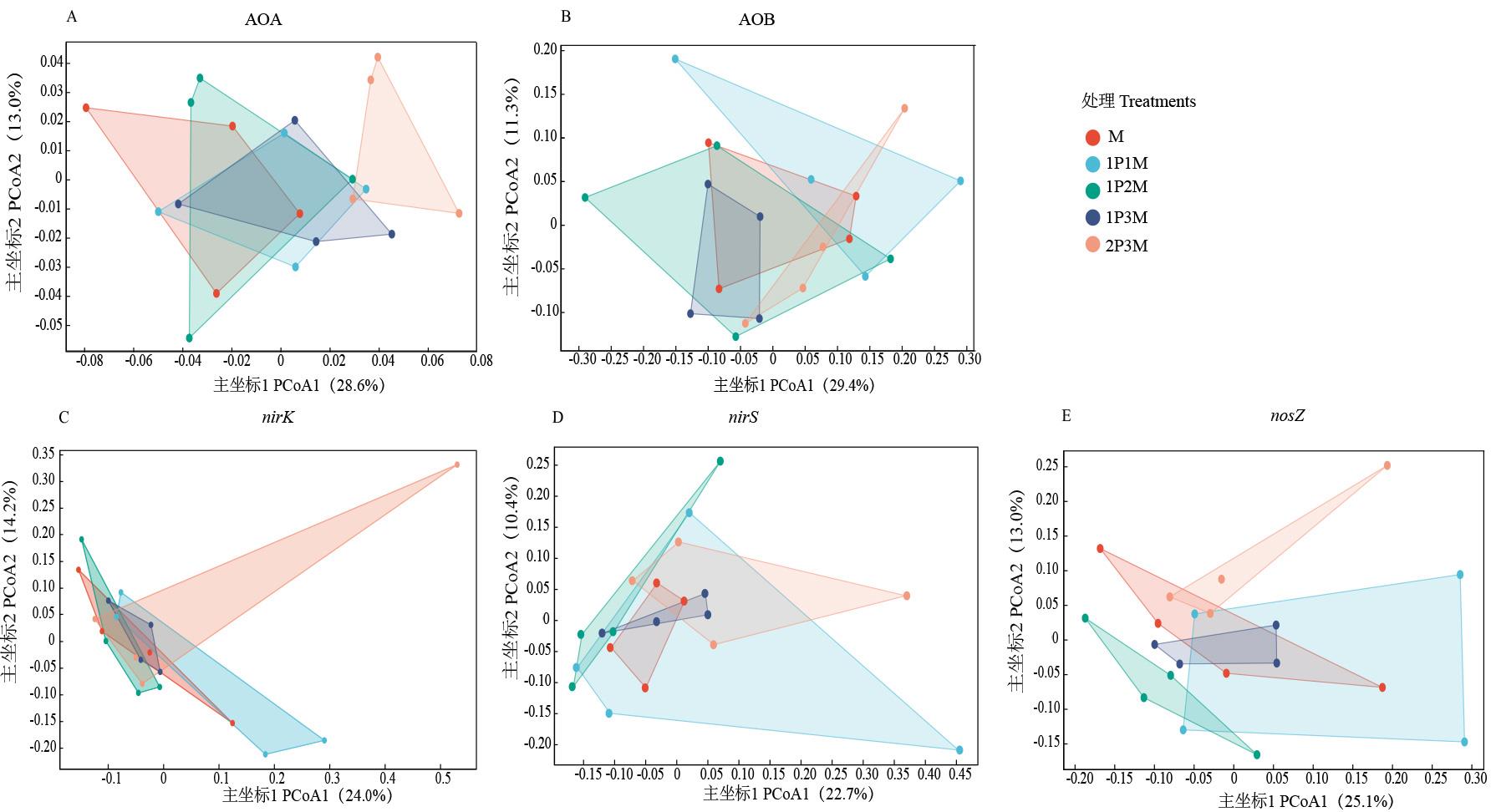
Fig. 2 Principal coordinates analysis of the alfalfa rhizosphere soil ammonia-oxidizing and denitrifying microbial communities in different companion planting ratios
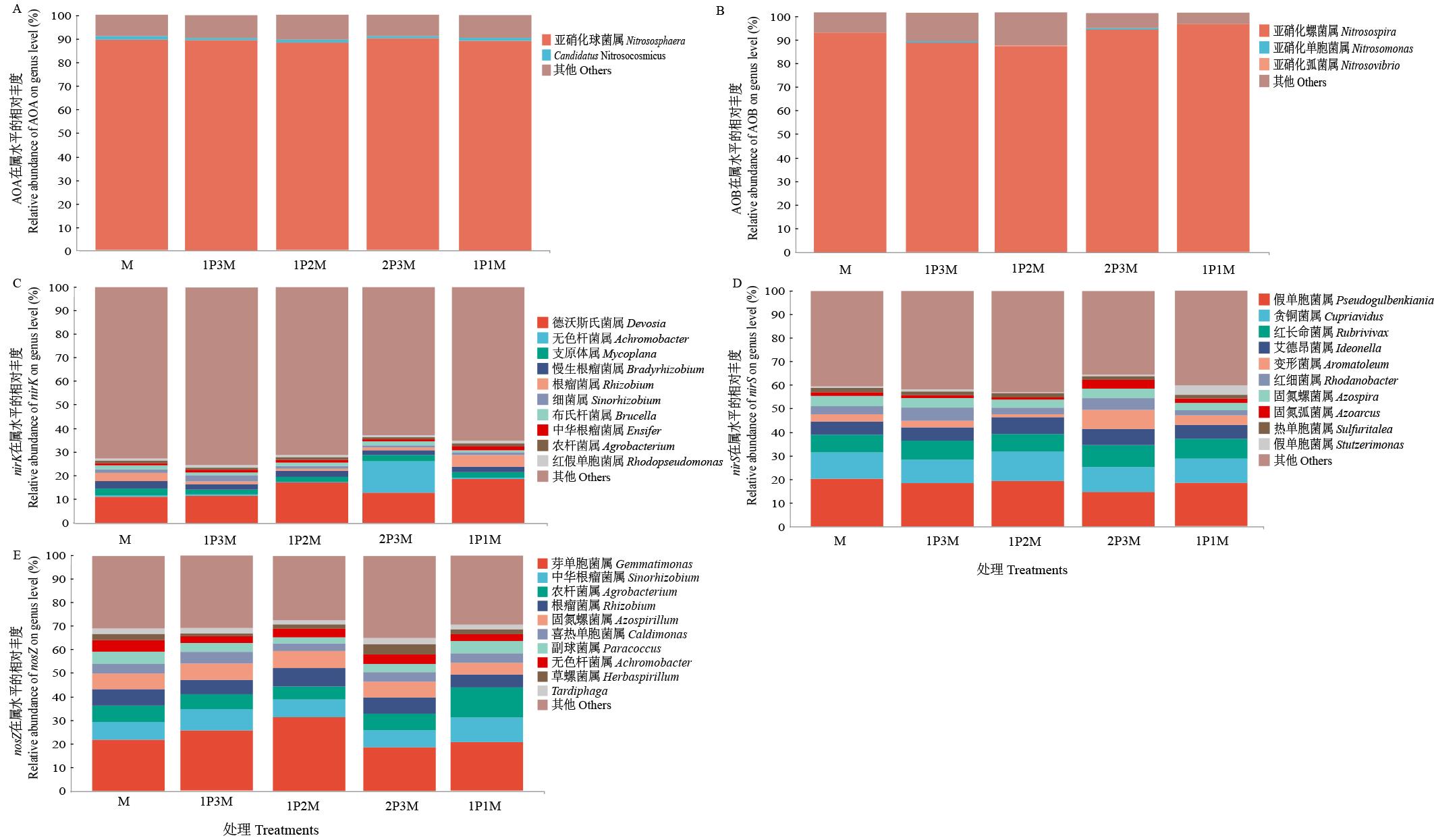
Fig. 3 Community composition at the genus levels of the alfalfa rhizosphere soil ammonia-oxidizing and denitrifying microbial communities in different companion planting ratios
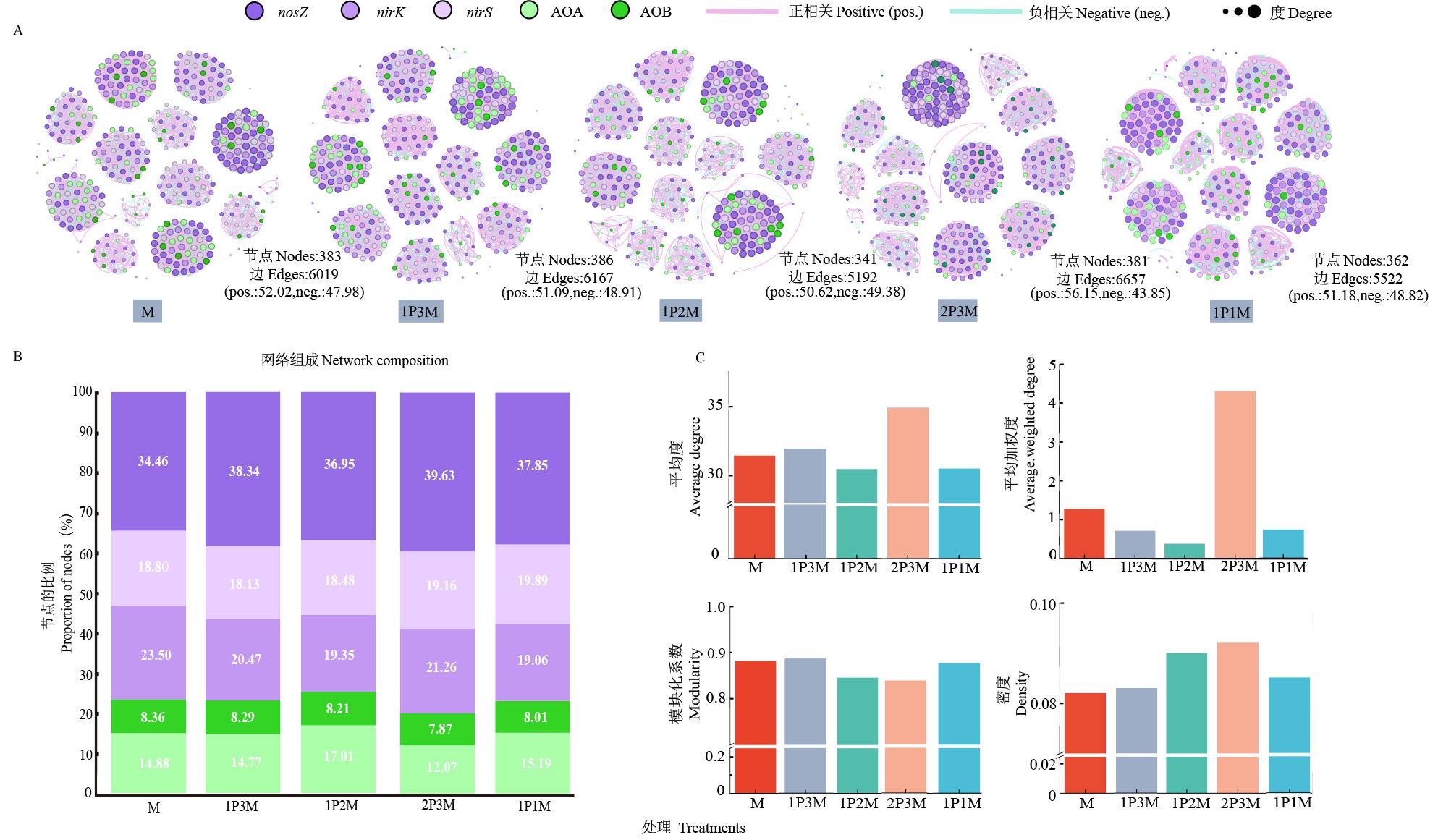
Fig. 4 Visual network (A), network composition (B) and topology properties (C) of microbial co-occurrence network in ammonia-oxidizing and denitrifying communities in different companion planting ratios
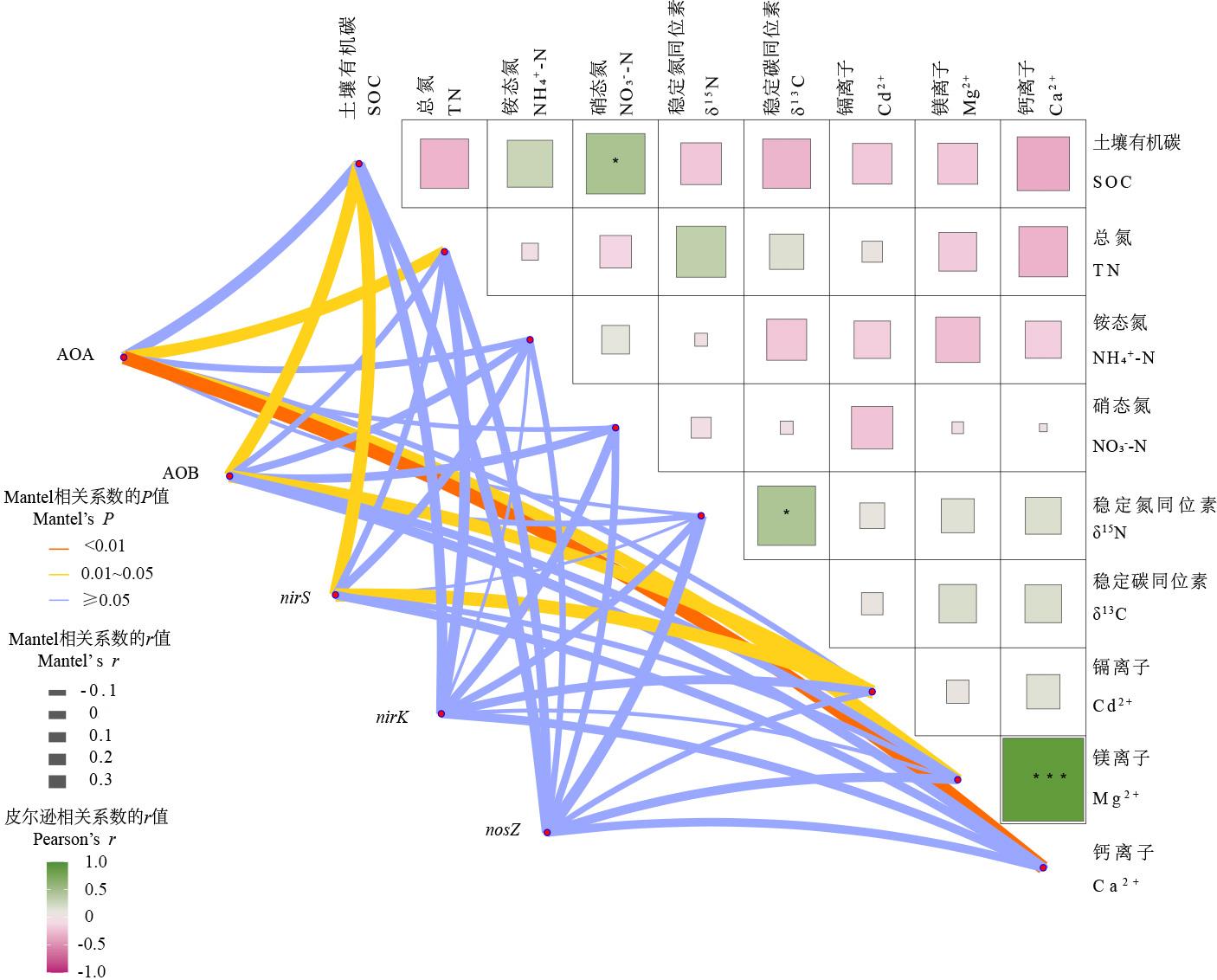
Fig. 5 Relationship of ammonia-oxidizing and denitrifying microbial community diversity with alfalfa rhizosphere soil factors
| 1 | Feng W L, Liu Y S, Li Y R, et al. Feasibility analysis of a double-cropping system for the efficient use of farmland on China’s Loess Plateau. Journal of Geographical Sciences, 2023, 33(6): 1271-1286. |
| 2 | Zhang W, Lu J S, Bai J, et al. Introduction of soybean into maize field reduces N2O emission intensity via optimizing nitrogen source utilization. Journal of Cleaner Production, 2024, 442: 141052. |
| 3 | Gong X W, Dang K, Liu L, et al. Intercropping combined with nitrogen input promotes proso millet (Panicum miliaceum L.) growth and resource use efficiency to increase grain yield on the Loess plateau of China. Agricultural Water Management, 2021, 243: 106436. |
| 4 | Feng Y P, Shi Y, Zhao M Y, et al. Yield and quality properties of alfalfa (Medicago sativa L.) and their influencing factors in China. European Journal of Agronomy, 2022, 141: 126637. |
| 5 | Sowiński J. The effect of companion crops management on biological weed control in the seeding year of lucerne. Biological Agriculture & Horticulture, 2013, 30(2): 97-108. |
| 6 | Li P, Zhang H, Guo T T, et al. Effects of companion crop on weed suppression and forage growth in the early establishment stage of legume-grass mixture in Hulunbuir area. Acta Prataculturae Sinica, 2022, 30(12): 3423-3432. |
| 李沛, 张浩, 郭童天, 等. 保护播种对呼伦贝尔混播草地建植初期杂草抑制和牧草生长的影响. 草业学报, 2022, 30(12): 3423-3432. | |
| 7 | Lai H L, Gao F Y, Su H, et al. Nitrogen distribution and soil microbial community characteristics in a legume-cereal intercropping system: A review. Agronomy, 2022, 12(8): 1900. |
| 8 | Gong X W, Liu C J, Li J, et al. Responses of rhizosphere soil properties, enzyme activities and microbial diversity to intercropping patterns on the Loess Plateau of China. Soil and Tillage Research, 2019, 195: 104355. |
| 9 | Cuartero J, Pascual J A, Vivo J M, et al. A first-year melon/cowpea intercropping system improves soil nutrients and changes the soil microbial community. Agriculture, Ecosystems & Environment, 2022, 328: 107856. |
| 10 | Zhang G Z, Yang H, Zhang W P, et al. Interspecific interactions between crops influence soil functional groups and networks in a maize/soybean intercropping system. Agriculture, Ecosystems & Environment, 2023, 355: 108595. |
| 11 | Zhang J, Lin X G, Yin R. Advances in functional gene diversity of microorganism in relation to soil nitrogen cycling. Chinese Journal of Eco-Agriculture, 2009, 17(5): 1029-1034. |
| 张晶, 林先贵, 尹睿. 参与土壤氮素循环的微生物功能基因多样性研究进展. 中国生态农业学报, 2009, 17(5): 1029-1034. | |
| 12 | Grassmann C S, Mariano E, Diniz P P, et al. Functional N-cycle genes in soil and N2O emissions in tropical grass-maize intercropping systems. Soil Biology and Biochemistry, 2022, 169: 108655. |
| 13 | Han B, Ye X H, Li W, et al. The effects of different irrigation regimes on nitrous oxide emissions and influencing factors in greenhouse tomato fields. Journal of Soils and Sediments, 2017, 17(10): 2457-2468. |
| 14 | Zhou G P, Fan K K, Gao S J, et al. Green manuring relocates microbiomes in driving the soil functionality of nitrogen cycling to obtain preferable grain yields in thirty years. Science China Life Sciences, 2023, 67(3): 596-610. |
| 15 | Liu B, Ahnemann H, Arlotti D, et al. Impact of diversified cropping systems and fertilization strategies on soil microbial abundance and functional potentials for nitrogen cycling. Science of the Total Environment, 2024, 932: 172954. |
| 16 | Bao S D. Soil and agricultural chemistry analysis (the third edition). Beijing: China Agriculture Press, 2000: 106-108. |
| 鲍士旦. 土壤农化分析(第3版). 北京: 中国农业出版社, 2000: 106-108. | |
| 17 | Nilsson R H, Ryberg M, Kristiansson E, et al. Taxonomic reliability of DNA sequences in public sequence databases: a fungal perspective. PLoS One, 2006, 1(1): e59. |
| 18 | Park S J, Park B J, Rhee S K. Comparative analysis of archaeal 16S rRNA and amoA genes to estimate the abundance and diversity of ammonia-oxidizing archaea in marine sediments. Extremophiles, 2008, 12(4): 605-615. |
| 19 | Weiner A M, Maizels N. A deadly double life. Science, 1999, 284(5411): 63-64. |
| 20 | Mosier A C, Francis C A. Denitrifier abundance and activity across the San Francisco Bay estuary. Environmental Microbiology Reports, 2010, 2(5): 667-676. |
| 21 | Michotey V, Méjean V, Bonin P. Comparison of methods for quantification of cytochrome cd1-denitrifying bacteria in environmental marine samples. Applied and Environmental Microbiology, 2000, 66(4): 1564-1571. |
| 22 | Chen Z, Liu J B, Wu M N, et al. Differentiated response of denitrifying communities to fertilization regime in paddy soil. Microbial Ecology, 2011, 63(2): 446-459. |
| 23 | Jensen E S, Carlsson G, Hauggaard-Nielsen H. Intercropping of grain legumes and cereals improves the use of soil N resources and reduces the requirement for synthetic fertilizer N: A global-scale analysis. Agronomy for Sustainable Development, 2020, 40(1): 5. |
| 24 | Egbeagu U U, Liu W Y, Zhang J N, et al. The activity of ammonia-oxidizing bacteria on the residual effect of biochar-compost amended soils in two cropping seasons. Biochemical Engineering Journal, 2023, 191: 108778. |
| 25 | Zhou X Q, Chen C R, Wang Y F, et al. Effects of warming and increased precipitation on soil carbon mineralization in an Inner Mongolian grassland after 6 years of treatments. Biology and Fertility of Soils, 2012, 48(7): 859-866. |
| 26 | De Vries F T, Caruso T. Eating from the same plate? Revisiting the role of labile carbon inputs in the soil food web. Soil Biology and Biochemistry, 2016, 102: 4-9. |
| 27 | Cheng B, Wang L, Liu R J, et al. Shade-tolerant soybean reduces yield loss by regulating its canopy structure and stem characteristics in the maize-soybean strip intercropping system. Frontiers in Plant Science, 2022, 13: 848893. |
| 28 | Laughlin D C, Hart S C, Kaye J P, et al. Evidence for indirect effects of plant diversity and composition on net nitrification. Plant and Soil, 2010, 330: 435-445. |
| 29 | Yu Y J, Zhu B, Wang X G, et al. N2O emission from rice-rapeseed rotation system in Chengdu Plain of Sichun Basin. Chinese Journal of Applied Ecology, 2008, 19(6): 1277-1282. |
| 于亚军, 朱波, 王小国, 等. 成都平原水稻-油菜轮作系统氧化亚氮排放. 应用生态学报, 2008, 19(6): 1277-1282. | |
| 30 | Zhang X L, Teng Z Y, Zhang H H, et al. Nitrogen application and intercropping change microbial community diversity and physicochemical characteristics in mulberry and alfalfa rhizosphere soil. Journal of Forestry Research, 2021, 32(5): 2121-2133. |
| 31 | Franklin R B, Mills A L. Importance of spatially structured environmental heterogeneity in controlling microbial community composition at small spatial scales in an agricultural field. Soil Biology and Biochemistry, 2009, 41(9): 1833-1840. |
| 32 | Liu S, Yao J N, Zhang J J, et al. Functional gene abundance and community diversity of ammonia-oxidizing and denitrifying microorganisms in the rhizosphere soil of desert leguminous shrubs. Acta Prataculturae Sinica, 2024, 33(5): 115-127. |
| 刘爽, 姚佳妮, 张钧杰, 等. 荒漠豆科灌丛根际土壤氨氧化和反硝化微生物功能基因丰度及群落多样性特征. 草业学报, 2024, 33(5): 115-127. | |
| 33 | Zhalnina K, de Quadros P D, Gano K A, et al. Ca. Nitrososphaera and Bradyrhizobium are inversely correlated and related to agricultural practices in long-term field experiments. Frontiers in Microbiology, 2013, 4: 104. |
| 34 | Park S, Cho K, Lee T, et al. Improved insights into the adaptation and selection of Nitrosomonas spp. for partial nitritation under saline conditions based on specific oxygen uptake rates and next generation sequencing. Science of the Total Environment, 2022, 822: 153644. |
| 35 | Danish S, Zafar-ul-Hye M, Mohsim F, et al. ACC-deaminase producing plant growth promoting rhizobacteria and biochar mitigate adverse effects of drought stress on maize growth. PLoS One, 2020, 15(4): e0230615. |
| 36 | Kandel S L, Joubert P M, Doty S L. Bacterial endophyte colonization and distribution within plants. Microorganisms, 2017, 5(4): 77. |
| 37 | Chen S M, Waghmode T R, Sun R B, et al. Root-associated microbiomes of wheat under the combined effect of plant development and nitrogen fertilization. Microbiome, 2019, 7(1): 136. |
| 38 | Li X M, Qiao J T, Li S, et al. Bacterial communities and functional genes stimulated during anaerobic arsenite oxidation and nitrate reduction in a paddy soil. Environmental Science & Technology, 2019, 54(4): 2172-2181. |
| 39 | Xun W B, Liu Y P, Li W, et al. Specialized metabolic functions of keystone taxa sustain soil microbiome stability. Microbiome, 2021, 9(1): 35. |
| 40 | Ling N, Wang T T, Kuzyakov Y. Rhizosphere bacteriome structure and functions. Nature Communications, 2022, 13(1): 836. |
| 41 | Hernandez D J, David A S, Menges E S, et al. Environmental stress destabilizes microbial networks. ISME Journal, 2021, 15(6): 1722-1734. |
| 42 | Ma B, Wang Y L, Ye S D, et al. Earth microbial co-occurrence network reveals interconnection pattern across microbiomes. Microbiome, 2020, 8(82): 1-12. |
| 43 | Banerjee S, Walder F, Büchi L, et al. Agricultural intensification reduces microbial network complexity and the abundance of keystone taxa in roots. ISME Journal, 2019, 13(7): 1722-1736. |
| 44 | Jiao S, Lu Y H, Wei G H. Soil multitrophic network complexity enhances the link between biodiversity and multifunctionality in agricultural systems. Global Change Biology, 2021, 28(1): 140-153. |
| 45 | Feng J Y, Ma H X, Wang C Y, et al. Water rather than nitrogen availability predominantly modulates soil microbial beta-diversity and co-occurrence networks in a secondary forest. Science of the Total Environment, 2024, 907: 167996. |
| 46 | Hou S P, Ai C, Zhou W, et al. Structure and assembly cues for rhizospheric nirK- and nirS-type denitrifier communities in long-term fertilized soils. Soil Biology and Biochemistry, 2018, 119: 32-40. |
| 47 | Castellano-Hinojosa A, Correa-Galeote D, González-López J, et al. Effect of nitrogen fertilisers on nitrous oxide emission, nitrifier and denitrifier abundance and bacterial diversity in closed ecological systems. Applied Soil Ecology, 2020, 145: 103380. |
| 48 | Stahl D A, De La Torre J R. Physiology and diversity of ammonia-oxidizing archaea. Annual Review of Microbiology, 2012, 66(1): 83-101. |
| 49 | Hatzenpichler R. Diversity, physiology, and niche differentiation of ammonia-oxidizing archaea. Applied and Environmental Microbiology, 2012, 78(21): 7501-7510. |
| 50 | Sun H S, Jiang S X. A review on nirS-type and nirK-type denitrifiers via a scientometric approach coupled with case studies. Environmental Science: Processes & Impacts, 2022, 24(2): 221-232. |
| 51 | Azziz G, Monza J, Etchebehere C, et al. nirS- and nirK-type denitrifier communities are differentially affected by soil type, rice cultivar and water management. European Journal of Soil Biology, 2017, 78: 20-28. |
| [1] | Shuang YAN, Fei XIA, Wei WEI, Jing-long WANG, Hao-yang WU, Lin-ling RAN, Yun-yin XUE, Hao SHI, Shai-kun ZHENG, Jun-qiang WANG, Jun-dong HE. Differences along an erosion gradient in alpine meadow plant community diversity and factors influencing diversity [J]. Acta Prataculturae Sinica, 2025, 34(6): 1-13. |
| [2] | Xue-ping LI, Shi-yang XU, Jian-jun LI, Yong-hong QI. Bacterial diversity and community structural changes in rhizosphere soil of naked barley disturbed by root rot [J]. Acta Prataculturae Sinica, 2025, 34(5): 118-129. |
| [3] | Xiao-hui DONG, Shang-li SHI, Guo-li YIN, San-dong CHEN, Hai-qiang GONG, Lin-bo LIU. Diversity of endophytic bacterial and fungal communities in different maize organs [J]. Acta Prataculturae Sinica, 2025, 34(5): 130-145. |
| [4] | Shou-xing WANG, Hua-kun ZHOU, Li-peng OU, Cheng-xian LI, Yan-he WANG, Xiao-chun NING, Qiang GU, Dai-jun WEI, Ming-xin YANG. Vegetation and soil microbial diversity and their relationships with soil factors in different grassland types of the three river headwaters region [J]. Acta Prataculturae Sinica, 2025, 34(4): 16-26. |
| [5] | Xin-zhu CHEN, Ping-dong LIN, Wen YUE, Ya-ni YANG, Shui-ling QIU, Xiang-li ZHENG. Effects of various additives on the quality and microbial diversity of broad bean straw silage [J]. Acta Prataculturae Sinica, 2025, 34(4): 164-174. |
| [6] | An-jing JIANG, Yi-qiang DONG, Shi-jie ZHOU, Ting-ting NIE, Yue WU, Ze-yu LIU, Xing-yun SHAN, Ya-xin LEI, Kai WU, Sha-zhou AN. Distribution characteristics of grassland plant diversity along the altitudinal gradient and its driving factors: A case study of the eastern section of the northern slope of the Tianshan Mountains [J]. Acta Prataculturae Sinica, 2025, 34(3): 29-40. |
| [7] | Shu-qi LIU, Dong CUI, Wen-xin LIU, Hai-jun YANG, Yan-cheng YANG, Zhi-cheng JIANG, Jiang-chao YAN, Jiang-hui LIU. Effects of short-term nitrogen addition, watering, and mowing on plant community characteristics and soil physicochemical properties in Sophora alopecuroides degraded grassland [J]. Acta Prataculturae Sinica, 2025, 34(3): 41-55. |
| [8] | Xin GONG, Xin-ru HUO, Wen LI, Yan-dong YANG, Chao LIU, Wei-chun QIN, Yan SHEN, Guo-hui WANG, Hong-bin MA. Vegetation community characteristics and spatial differentiation in mountain grassland in Luoshan, Ningxia [J]. Acta Prataculturae Sinica, 2025, 34(2): 1-15. |
| [9] | Na LYU, Ji-xi GAO, Zheng-hai LI, Chun-he YOU, Xiao-man LIU, Biao ZHANG, Yu MO, Sa-ning ZHU, Yang PENG, Xue YANG. Effects of fertilizer application during mid-growing season on vegetation community biomass and species diversity in meadow grasslands [J]. Acta Prataculturae Sinica, 2025, 34(2): 109-122. |
| [10] | Wen-hu WANG, Shi-lin WANG, Guo-ling LIANG, Wen LI, Wen-xia CAO. Effects of slope categories of differing aspect and position on plant community diversity in alpine shrubland in the Qilian Mountains [J]. Acta Prataculturae Sinica, 2025, 34(1): 17-28. |
| [11] | ASITAIKEN·Julihaiti, Zong-jiu SUN, Bing-jie YU, DIDAER·Bisulidan, Mei-sha LI, Yi-sheng JING. Effects of enclosure on soil microbial carbon source utilization characteristics of sagebrush desert grassland [J]. Acta Prataculturae Sinica, 2025, 34(1): 29-40. |
| [12] | Jia-ni YAO, Shuang LIU, Jun-jie ZHANG, Ming-zhu HU, Jin-xia DAI. Enzyme activity and microbial metabolic diversity in typical shrub rhizosphere soil in Ningxia desert steppe [J]. Acta Prataculturae Sinica, 2024, 33(9): 1-14. |
| [13] | Shi-long HE, He YE, Jing LI, Ya-ling ZHANG, Hai-shan DE, Mei HONG. Effects of nitrogen deposition and precipitation changes in different time spans on community structure and diversity of soil meso- and micro-fauna in Stipa breviflora desert steppe [J]. Acta Prataculturae Sinica, 2024, 33(9): 140-154. |
| [14] | Rong-chun ZHENG, Zhi-biao NAN, Ting-yu DUAN. Diversity of seed-borne fungi on four Trifolium pratense cultivars [J]. Acta Prataculturae Sinica, 2024, 33(8): 170-180. |
| [15] | Qian LIU, Yan-fen DING, Shan-shan SONG, Wen-jie XU, Wei YANG. Quantitative classification and ordination analysis of spontaneous vegetation communities in herb layer along the green belt of Nanjing Ming City Wall [J]. Acta Prataculturae Sinica, 2024, 33(5): 1-15. |
| Viewed | ||||||
|
Full text |
|
|||||
|
Abstract |
|
|||||
